It could stand on its tail and climb like a rocket, it was the only all-British aircraft ever to reach twice the speed of sound, and pilots said flying it was like being strapped to a skyrocket. This is the story of the English Electric Lightning.
The Lightning is the aircraft that still draws a crowd at every museum that has one. Its shape is unmistakable: a sharply swept wing, a nose intake with a bullet centre, and two huge Rolls-Royce Avon engines stacked one above the other inside a slim fuselage. It was Britain’s front-line interceptor through the most dangerous years of the Cold War, the aircraft sent up to meet Soviet bombers probing the North Sea, and it remains a byword for raw performance. No other British design reached Mach 2. None climbed like it. And few aircraft have been so loved by the people who flew and maintained them.
This is a full history of the Lightning: how it grew out of Britain’s first supersonic research, the unusual engineering that gave it such astonishing performance, its long career on Quick Reaction Alert, the persistent problem of its short range, the many variants and export versions, and where you can find the survivors today, including the famous pair kept running at Bruntingthorpe. Every date and figure here has been checked against reliable sources, and where the record is uncertain it is flagged rather than guessed.
On this page
- Origins: Britain’s supersonic gamble
- From P.1 to Lightning
- Into service
- Design and the stacked engines
- Performance and that climb
- The interceptor’s job: Quick Reaction Alert
- Armament
- The fuel problem
- Proving the design: the Short SB.5
- Radar and fire-control
- An accidental Lightning flight
- Flying and maintaining it
- Where the Lightning served
- The Lightning in display flying
- The variants explained
- Foreign service: Saudi Arabia and Kuwait
- Retirement
- Survivors: where to see a Lightning today
- Specifications
- The missile age and its survival
- Legacy
- Frequently asked questions
Origins: Britain’s supersonic gamble
In the years after the Second World War, Britain set out to understand supersonic flight at a time when much about it was still unknown. The result, eventually, was the Lightning, but the road there began with a research aircraft and a designer with strong opinions.
The driving figure at the start was W. E. W. “Teddy” Petter, who had joined English Electric in the mid-1940s wanting to build the company’s own advanced designs rather than produce other firms’ aircraft. Petter was convinced Britain needed a supersonic fighter and pushed for the work that led to the experimental P.1. Much of the detailed aerodynamic design and the programme’s later direction is credited to his successor as chief engineer, F. W. “Freddie” Page, who saw the aircraft through to maturity. The combination of Petter’s drive and Page’s engineering took an unproven concept all the way to a front-line fighter.
The aircraft adopted a dramatically swept wing and, unusually, a pair of engines mounted one above the other. To test the concept, English Electric built the P.1A research aircraft, which first flew in 1954 with Roland “Bee” Beamont, the company’s chief test pilot, at the controls. The P.1A proved the basic layout could work and could go supersonic in level flight, clearing the way for a true fighter prototype.
From P.1 to Lightning
The definitive prototype was the P.1B, a far more complete aircraft with a redesigned nose featuring the distinctive intake shock cone that housed the radar, an uprated engine installation and the systems a real interceptor would need. The P.1B first flew on 4 April 1957, again with Beamont flying, and exceeded the speed of sound on that first flight.
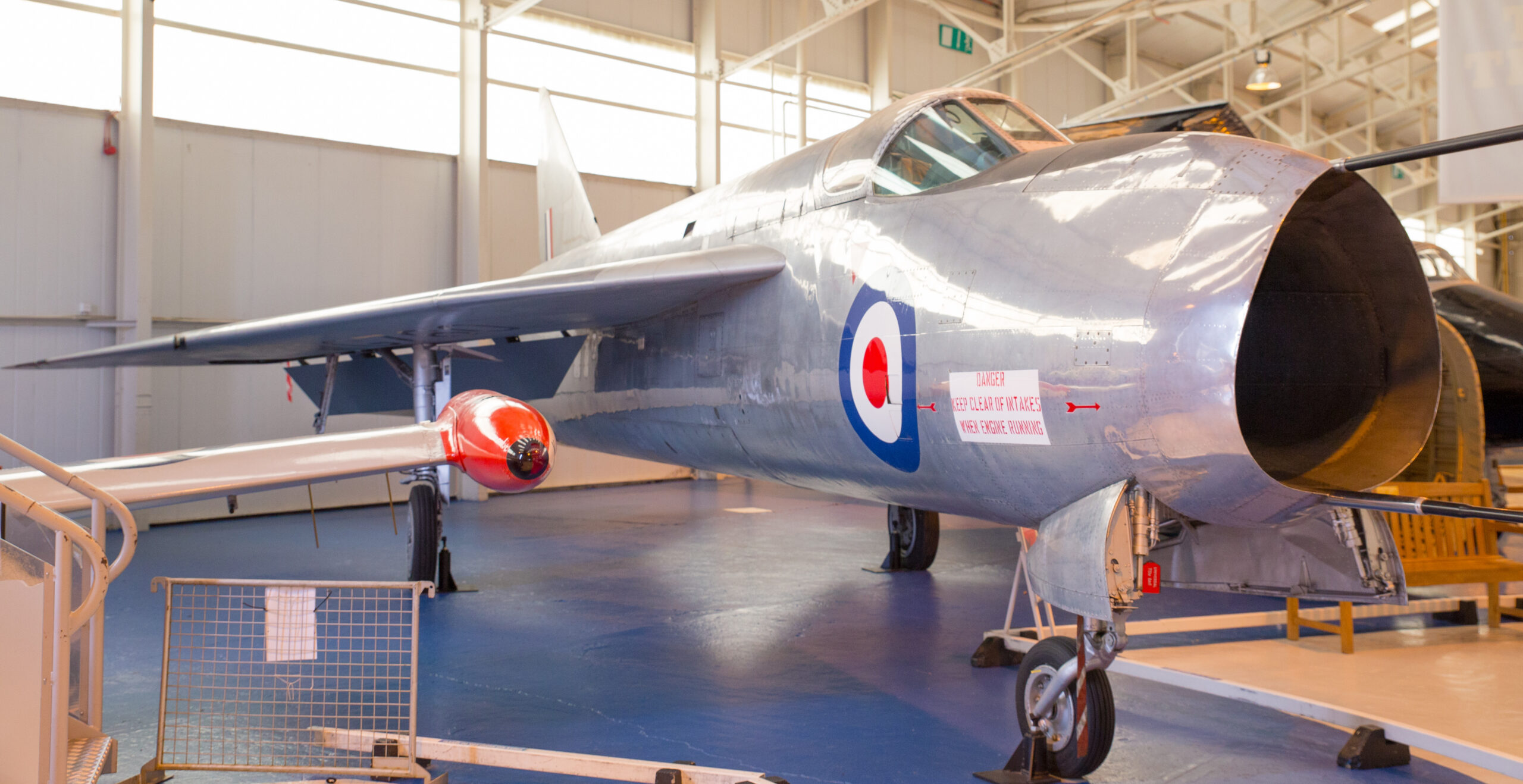
The aircraft was officially named Lightning in October 1958. In November 1958 it reached Mach 2, making it the first British aircraft to achieve twice the speed of sound, a milestone no other all-British design would match. The programme had turned a research shape into the fastest aircraft Britain had ever built, and it had done so quickly.
It is worth pausing on what that meant. The Lightning arrived at a moment when official British defence thinking, captured in the notorious 1957 Defence White Paper, had begun to argue that guided missiles would soon make manned fighters obsolete. The Lightning was developed and entered service against that headwind, and it went on to serve for nearly three decades, long outlasting the prediction that it would be one of the last manned fighters Britain needed.
Into service
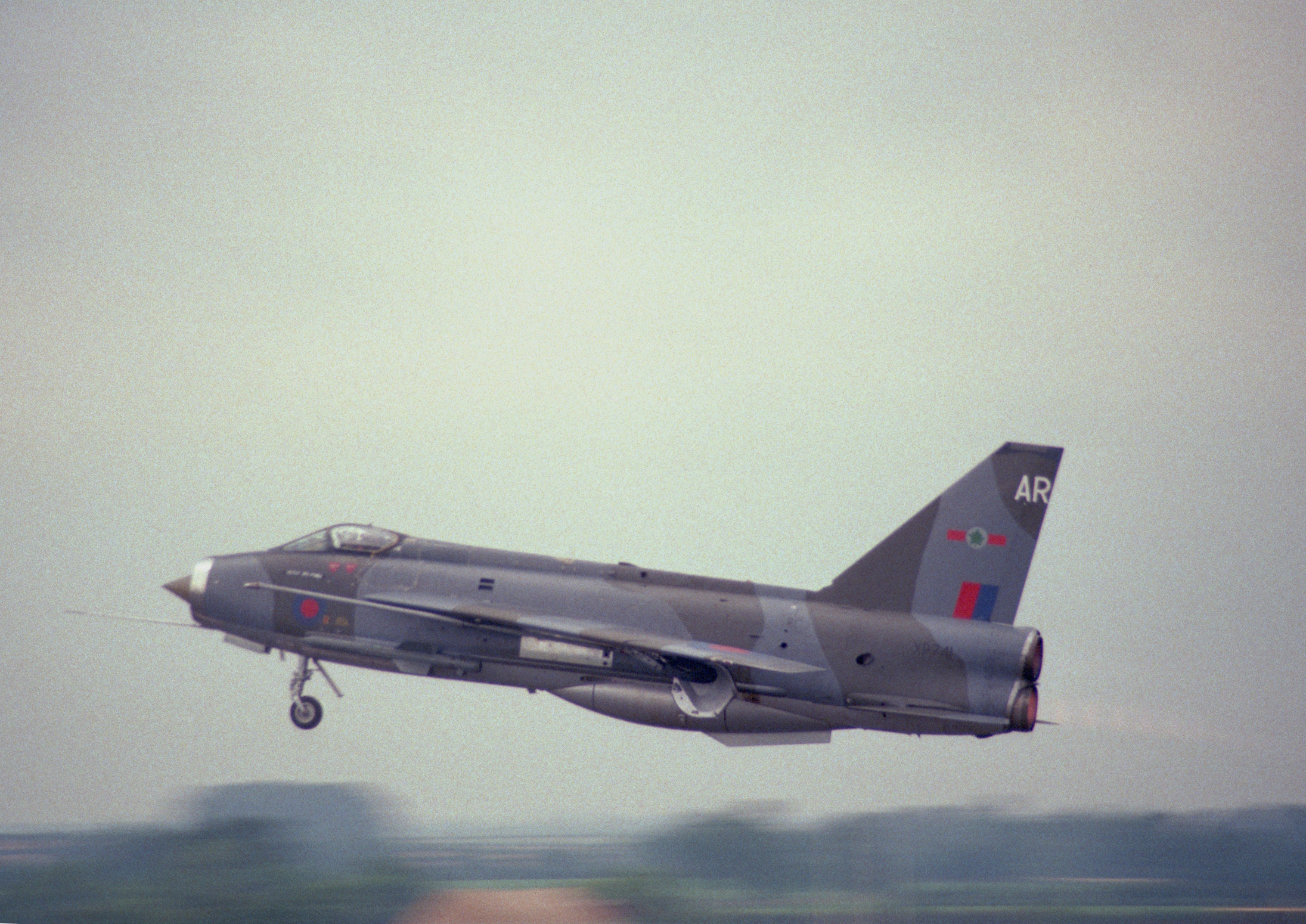
The first production version, the Lightning F.1, entered RAF service in 1960. No. 74 Squadron at RAF Coltishall became the first operational unit, receiving its aircraft from the summer of 1960. For the RAF this was a huge step. Squadrons used to subsonic fighters suddenly had an aircraft that could climb to the height of an intruding bomber in a couple of minutes and close at twice the speed of sound.
The early aircraft were not without limitations, and pilots and ground crews had a steep learning curve with such a high-performance machine. But the Lightning’s sheer capability was obvious from the start, and 74 Squadron’s adoption of it, including its use by the squadron’s “Tigers” for formation aerobatics, helped make the aircraft famous. From that first unit the Lightning spread through Fighter Command and became the backbone of Britain’s air defence.
Design and the stacked engines
The Lightning looks unlike any other fighter, and the reasons go right to the heart of how it was made to perform.
Two engines, one above the other
The defining feature is the engine arrangement. Instead of sitting the two Rolls-Royce Avon turbojets side by side, which would have made the fuselage wide and draggy, the designers stacked them vertically and staggered them front to back inside a slim fuselage. This kept the frontal area small, which mattered enormously for supersonic speed, while still packing in two engines for the thrust the aircraft needed. It was an ingenious solution to conflicting demands, and it gave the Lightning its deep, narrow body. The single nose intake fed both engines, with the bullet-shaped centre cone housing the interception radar.
The wing
The wing was sharply swept, with the leading edge raked back at around sixty degrees, and the ailerons placed at the wingtips. This highly swept planform suited high-speed flight. The trade-off, common to such designs, was high landing speeds and demanding low-speed handling, which the Lightning’s pilots learned to manage. The aircraft sat on a narrow-track undercarriage that retracted outwards into the thin wing, another consequence of the slim, performance-first layout.
Built for the climb
Everything about the Lightning was arranged around getting to height fast and intercepting quickly. The powerful stacked Avons, the clean low-drag shape and the light structure combined to give a rate of climb that astonished everyone who saw it. The aircraft was, in effect, a manned interceptor optimised almost entirely for the climb-and-shoot mission of catching high-flying bombers, and the engineering reflected that single-minded purpose.
Performance and that climb
The Lightning’s performance is the reason it is still talked about. It was really exceptional, even by later standards.
It could climb at a rate that few aircraft of its era could match, reaching the altitudes where intercepting bombers flew in a matter of minutes from a standing start. In a zoom climb, trading speed for height, a Lightning could reach altitudes well above its normal service ceiling, high enough that it could be flown up towards aircraft most fighters could not touch. There are well-documented accounts of Lightnings intercepting high-flying U-2 reconnaissance aircraft during exercises, reaching heights that surprised the Americans, by using a fast climb and a zoom to get up to them. The exact peak altitudes from such efforts vary between accounts, but the capability to zoom far above the normal ceiling is well established.
Top speed was around Mach 2, roughly 1,300 mph at altitude. The service ceiling of the later marks was in the region of 54,000 feet, with the zoom climb taking the aircraft considerably higher for short periods. Pilots routinely describe the experience of a full reheat climb in a Lightning as unlike anything else, the aircraft accelerating while pointing steeply upward. The “skyrocket” description was earned.
Why the climb mattered
An interceptor’s job was to get from the ground to the height and position of an incoming bomber before it could release its weapons. The Lightning’s climb meant it could sit on the ground at readiness and still reach a high, fast target in time. That single quality, more than range or weapons load, was what the aircraft was built to deliver.
The interceptor’s job: Quick Reaction Alert
For most of its career the Lightning’s daily work was Quick Reaction Alert, or QRA. Aircraft sat armed and fuelled at readiness, pilots close by, ready to scramble at a moment’s notice to intercept and identify aircraft approaching United Kingdom airspace. During the Cold War those aircraft were frequently Soviet long-range types probing the air defences over the North Sea and the northern approaches.
A QRA scramble played directly to the Lightning’s strengths. The aircraft could be airborne quickly, climb at its phenomenal rate, and be directed by ground radar towards the intruder for a visual identification or, if it had ever come to it, an interception. Lightnings shadowed and photographed Soviet aircraft on many occasions, a routine but serious task that went on year after year. It is worth being clear that RAF Lightnings never fired their weapons in anger against an enemy aircraft; their deterrent value lay in being ready and able to intercept, not in combat victories.
The Lightning’s role sat within a wider Cold War air defence and deterrent system that also included the V-bombers it might have helped protect or escort. For the offensive side of that same era, see our history of the Avro Vulcan, the delta-winged bomber that carried Britain’s nuclear deterrent while the Lightning guarded the skies.
Armament
The Lightning was built around the interception of bombers, and its weapons reflected that. The primary armament was a pair of infrared guided air-to-air missiles mounted on the forward fuselage, backed in most variants by cannon.
Cannon
Two 30 mm ADEN cannon were fitted to many variants, though the exact gun fit changed across the marks and was a recurring point of debate. Some versions reduced or relocated the cannon, and the question of whether an interceptor still needed guns in the missile age was argued throughout the aircraft’s life. In its final RAF form the Lightning retained cannon in the forward part of the ventral fuel pack, which pilots valued.
Firestreak and Red Top
The Lightning’s guided weapons were British infrared homing missiles. The first was the de Havilland Firestreak, an early tail-chase infrared missile that entered service with the Lightning. It was later joined and largely succeeded by the Hawker Siddeley Red Top, a more capable weapon with greater range, a better seeker giving a degree of forward-hemisphere capability, and a larger warhead. Red Top entered service in the mid-1960s. Not every Lightning variant could carry Red Top, so Firestreak remained in use on some aircraft right through to the type’s retirement.
The fuel problem
For all its performance, the Lightning had one persistent and well-known weakness: fuel. The slim, performance-first fuselage left limited internal space for fuel, and the thirsty Avons in full reheat drank it quickly. A Lightning sortie could be short, and pilots and controllers had to manage fuel carefully, especially in the high-speed, high-reheat profiles the aircraft was built for.
Engineers worked hard to address this. A large ventral fuel pack was fitted under the fuselage, much enlarged on later marks, and over-wing ferry tanks could be carried to extend range for transits. The definitive F.6 in particular gained a bigger ventral tank that improved endurance significantly compared with the earliest versions. Even so, short range remained part of the Lightning story, and it is one of the reasons the RAF later turned to other types for some air defence tasks. The aircraft was a magnificent sprinter rather than a long-distance runner.
Proving the design: the Short SB.5
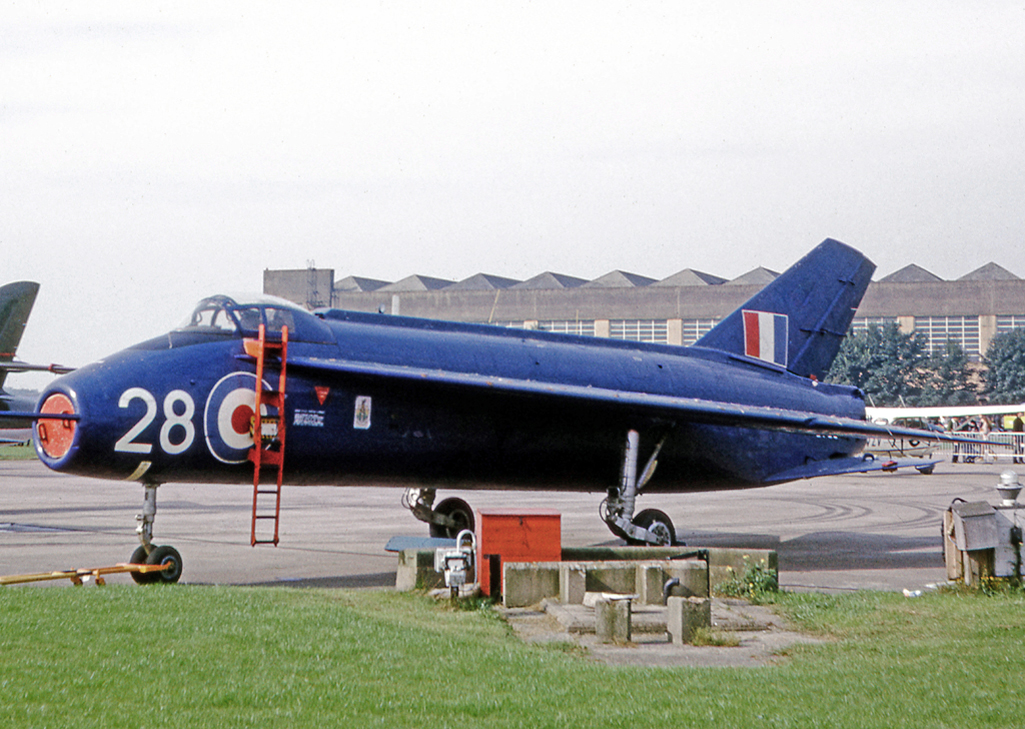
Before committing to the P.1’s dramatic wing, English Electric needed to be sure the configuration would behave. The unknowns of the highly swept wing, and the question of where to put the tailplane, were tested with the help of a special research aircraft, the Short SB.5. First flown in December 1952, the SB.5 was built so that its wing sweep and tailplane position could be altered between flights, letting engineers compare configurations in real flight rather than only in the wind tunnel. The trials confirmed English Electric’s choice of a low-set tailplane and the sweep angle that would define the Lightning. It was a careful, methodical piece of research behind an aircraft that looked anything but cautious.
The radar and fire-control system
An interceptor is only as good as its ability to find the target, and the Lightning carried a capable radar for its day. Early aircraft used the Ferranti AI.23 radar, housed in the bullet-shaped cone at the centre of the nose intake. The radar and the associated gunsight were known together as AIRPASS, standing for Airborne Interception Radar and Pilot Attack Sight System. This gave the single pilot the means to detect a target, track it and bring weapons to bear, all while flying the aircraft at high speed and high altitude. Placing the radar in the intake cone was another consequence of the nose-intake layout, and it became one of the Lightning’s defining visual features.
An accidental Lightning flight
Although the Lightning is remembered as an RAF aircraft, it served with two export customers in the Middle East.
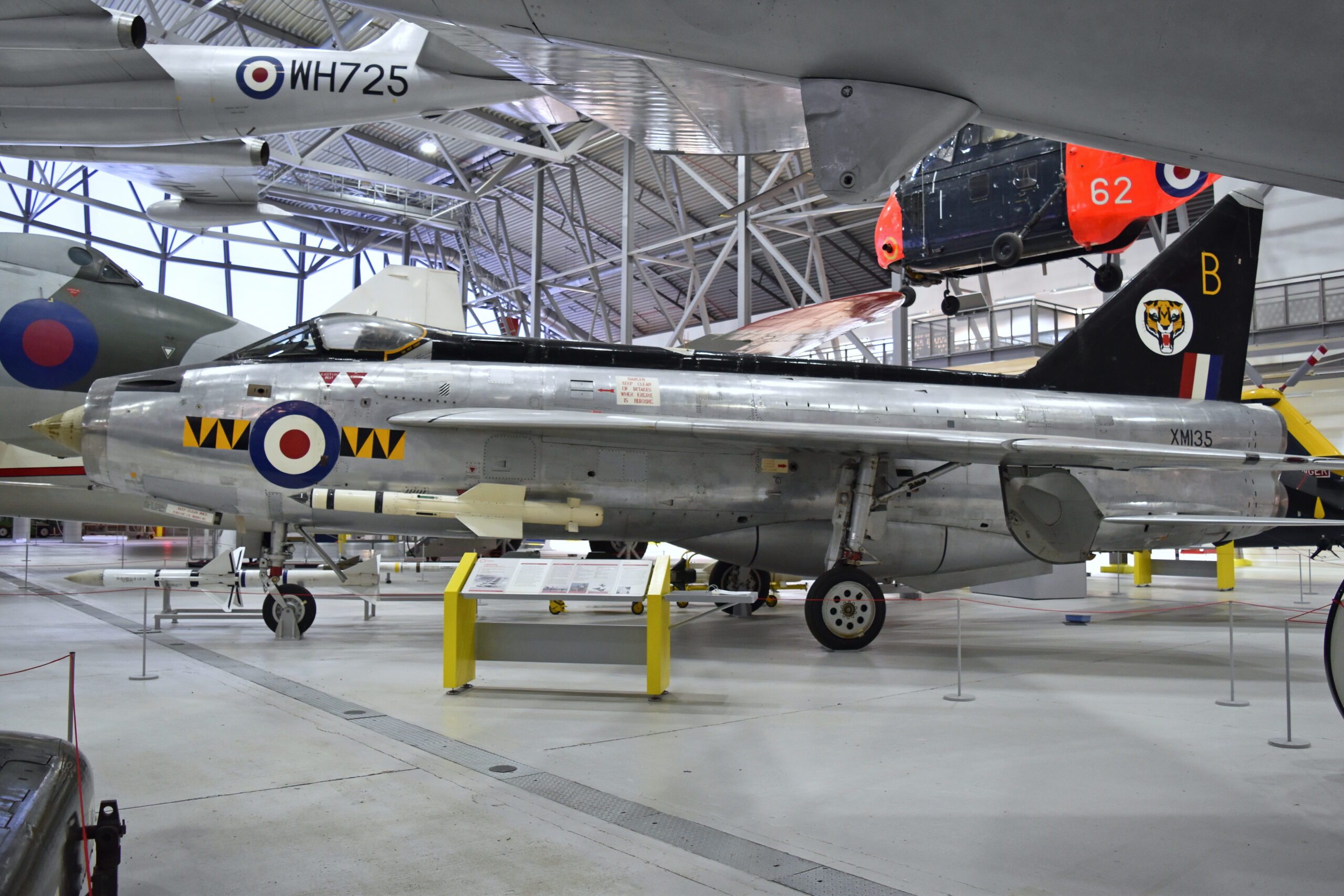
One of the most extraordinary episodes in the aircraft’s history shows just how much performance was packed into it. On 22 July 1966, an RAF engineering officer, Walter “Taffy” Holden, was carrying out ground engine runs on a Lightning at a maintenance unit. With only limited light-aircraft flying experience, and through a sequence of mishaps with the throttle, he found the aircraft accelerating down the runway in reheat and unintentionally got airborne, flying without a canopy or helmet and with the ejection seat not armed. After several attempts he managed to bring the Lightning back down safely. The aircraft involved survives today at the Imperial War Museum at Duxford. The story is often retold as a piece of remarkable airmanship under impossible circumstances, and as a reminder of how much aeroplane the Lightning was, even by accident.
Flying and maintaining the Lightning
Ask anyone who flew the Lightning and the word that comes back is “exhilarating”. The aircraft accelerated and climbed in a way that really surprised pilots converting from earlier types, and a full reheat take-off followed by a near-vertical climb was an experience that stayed with them for life. The flip side of all that performance was an aircraft that demanded to be flown well. The highly swept wing meant high approach and landing speeds, fuel had to be watched constantly, and the cockpit workload during a fast, high climb interception was considerable for a single pilot.
The Lightning also earned a reputation for being hard on its ground crews and, at times, for catching fire. The tightly packed fuselage, with two reheated engines, hot pipework and fuel lines in close company, made the aircraft prone to engine-bay fires during its career, and a number were lost to fire and other causes. The maintenance burden was heavy, with the stacked engines and dense systems making access difficult. None of this dimmed the affection felt for the aircraft; if anything the effort it demanded deepened the bond between the Lightning and the people who kept it flying. It was a thoroughbred, and thoroughbreds need looking after.
The two-seat trainers in use
Converting pilots onto such a high-performance aircraft was a serious task, and the side-by-side two-seat T.4 and T.5 trainers were central to it. Sitting instructor and pupil together, rather than in tandem, suited the conversion role and let the instructor see exactly what the student was doing. The trainers kept full performance, so a pilot’s first taste of the Lightning’s climb came with an experienced hand alongside.
Where the Lightning served
From its first squadron the Lightning spread across RAF Fighter Command and beyond, and it served well outside Britain as well as at home.
Home defence
In the United Kingdom the Lightning flew from a series of well-known fighter stations over the years, including Coltishall, Wattisham and, in its final years, Binbrook in Lincolnshire, which became the last home of the type. These bases stood Quick Reaction Alert and guarded the eastern and northern approaches throughout the Cold War.
RAF Germany
Two squadrons, No. 19 and No. 92, took the Lightning to RAF Gütersloh in West Germany, the RAF base closest to the inner German border, operating in the low-level air defence role from the mid-1960s until the late 1970s, when the Phantom took over. Stationed at the front line of a possible European war, these aircraft were among the most exposed of all.
Overseas: the Far East and Mediterranean
In 1967 No. 74 Squadron took the Lightning to RAF Tengah in Singapore, providing air defence in the Far East until the British withdrawal led to the squadron disbanding in 1971. In the Mediterranean, the Lightning served at RAF Akrotiri in Cyprus, where No. 56 Squadron provided a permanent air defence presence from 1967, flying the F.3 and later the F.6 before returning to Britain in the mid-1970s. The aircraft’s short range made these overseas deployments a logistical effort, often supported by tankers.
The Lightning in display flying
Few aircraft made a better display machine, and the Lightning became a star of the airshow circuit and of formation aerobatics. No. 74 Squadron, the “Tigers”, flew the aircraft as Fighter Command’s leading aerobatic team in the early 1960s, and No. 56 Squadron, the “Firebirds”, with their red-spined aircraft, later took on that role and famously flew large formation displays. A Lightning pulling up into a vertical climb in front of a crowd, reheat roaring, was an unforgettable sight, and it is a large part of why the type is still so fondly remembered at airshows and museums today.
The variants explained
The Lightning developed through a series of marks over its life, each improving the engines, radar, fuel capacity or weapons. The designations can be confusing, so here is the line in plain terms.
The single-seat fighters
The F.1 was the first production version, followed by the F.1A with improvements including in-flight refuelling capability. The F.2 brought further refinements, and many were later upgraded to F.2A standard with features of the later marks. The F.3 introduced uprated Avon engines, the Red Top missile and a revised fin, but deleted the cannon, a decision that drew criticism. The F.3A and then the definitive F.6 added a much enlarged ventral fuel tank and a cranked, kinked wing leading edge that improved range and handling. The F.6 was the ultimate RAF interceptor version, and on it the cannon were reinstated in the front of the ventral pack.
The two-seat trainers
Two-seat versions were built to convert pilots onto the type. The T.4 was the two-seat trainer based on the early marks, and the T.5 was the trainer equivalent of the later F.3 generation. Unusually, the two seats were placed side by side rather than in tandem, within a widened forward fuselage, so instructor and student sat together. The trainers were fully capable aircraft, not stripped-down hacks.
Export versions
For export, English Electric (by then part of the British Aircraft Corporation) developed multi-role versions able to carry bombs and rockets as well as air-to-air missiles. The single-seat F.53 and the two-seat T.55 were built for overseas customers, giving the Lightning a ground-attack capability the RAF versions did not normally use.
Foreign service: Saudi Arabia and Kuwait
The Royal Saudi Air Force operated the Lightning from the late 1960s, using the multi-role F.53 and T.55 versions, and kept them in service into the mid-1980s. The Saudi aircraft saw operational use in the air defence and ground-attack roles, the export versions making more of the type’s ability to carry air-to-ground weapons than the RAF ever did.
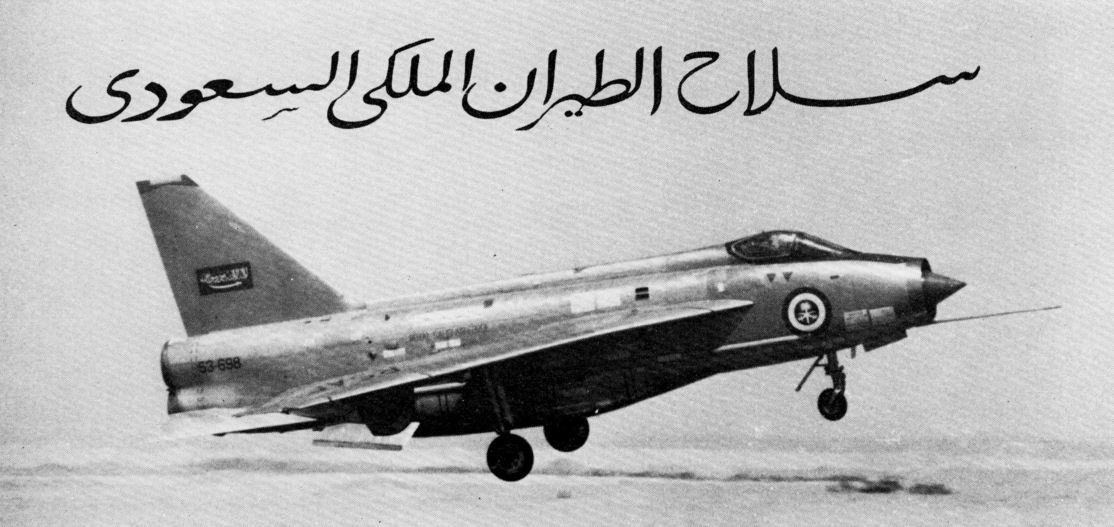
The Kuwait Air Force also bought the Lightning, operating a small fleet of F.53K fighters and T.55K trainers from the late 1960s into the late 1970s. The Kuwaiti experience was shorter and is less well documented, and the small fleet was retired relatively quickly. Between them, the two Middle Eastern operators were the only foreign air arms to fly the Lightning.
Retirement
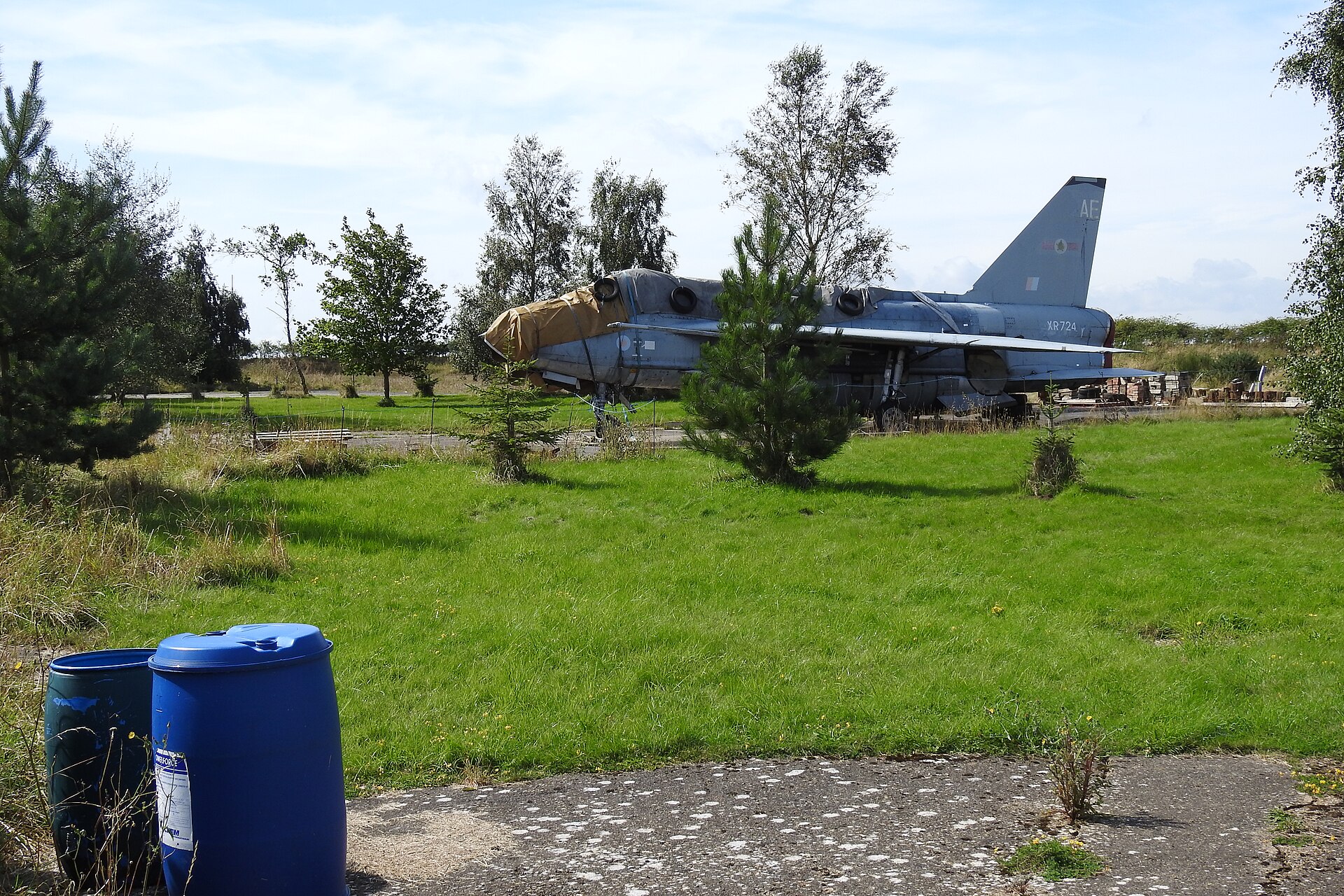
The Lightning soldiered on in RAF service far longer than the 1957 predictions of a missile-only future would have suggested. By the 1970s the RAF was introducing the Phantom for air defence, and later the Tornado F.3 would take over the interceptor role, but the Lightning remained in front-line service into the late 1980s, latterly with the squadrons based at RAF Binbrook in Lincolnshire.
The last RAF Lightnings were retired in 1988, with the final flights taking place that summer. The aircraft’s longevity showed how good the basic design was: an interceptor first flown in prototype form in 1957 was still standing alert more than thirty years later. For the crews at Binbrook the end of the Lightning was the end of an era, and the type’s retirement was marked with real affection. The interceptor torch passed to aircraft like the Tornado, and later to the Typhoon, but none of them quite captured the public imagination the way the Lightning did. For the aircraft that succeeded it in the air defence role, see our history of the McDonnell Douglas F-4 Phantom II.
Survivors: where to see a Lightning today
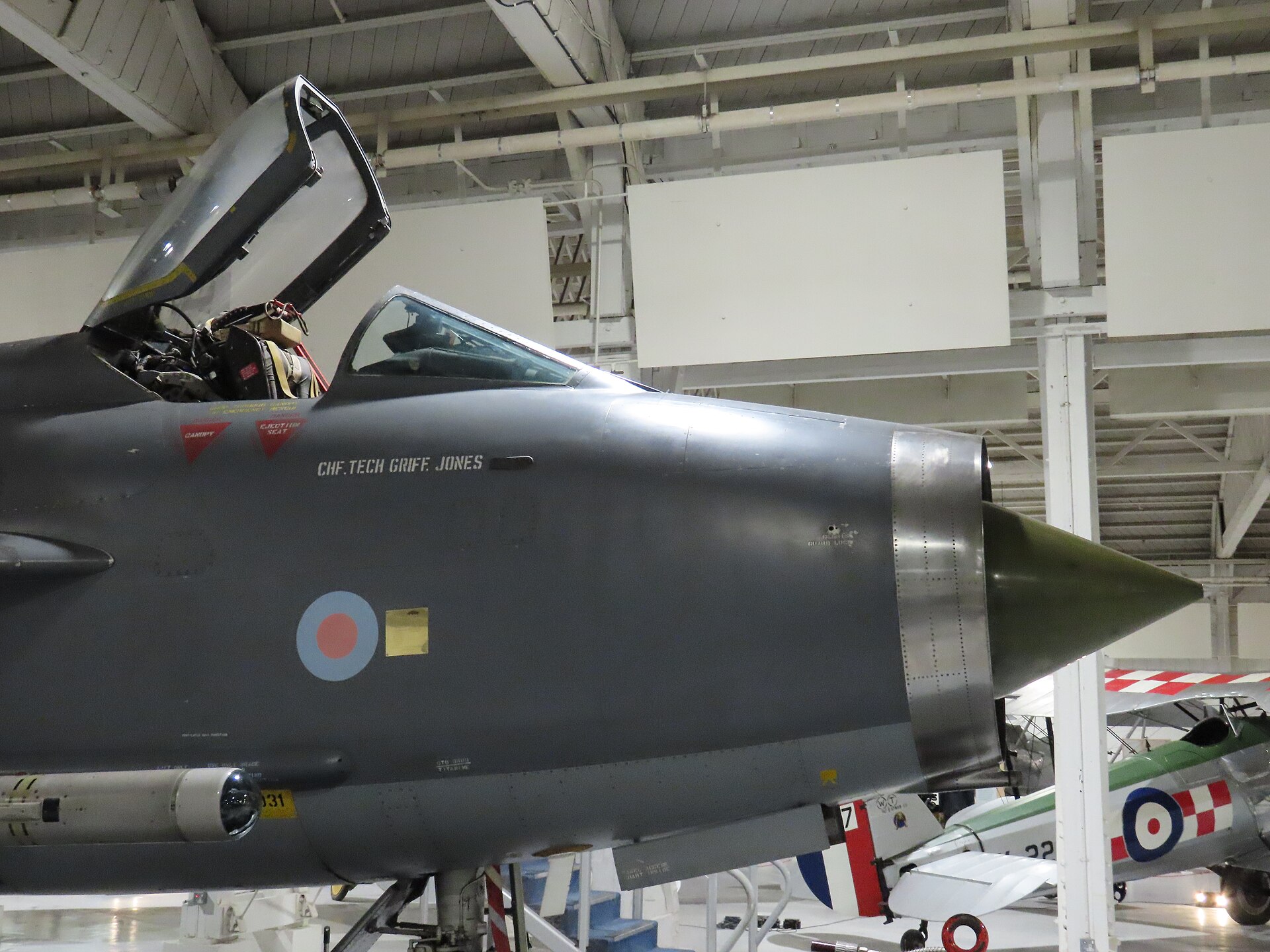
The Lightning is well represented in preservation, and a good number survive on display around Britain and abroad. Because the type retired relatively recently and was so loved, enthusiasts saved many airframes.
The Bruntingthorpe runners
Two aircraft are kept in running condition by the Lightning Preservation Group at Bruntingthorpe in Leicestershire, though public access has been limited since the airfield closed to aircraft operations, so check the group’s site before travelling. The group maintains Lightnings that perform fast taxi runs, thundering down the runway with reheat lit, recreating the sound and spectacle of the aircraft for visitors at special events. These aircraft do not fly, but seeing and hearing a Lightning at full power on the ground is the closest most people will get to the real thing. The group has also preserved the Quick Reaction Alert facilities that go with the aircraft, keeping the whole interceptor story alive.
Static survivors
Many Lightnings are preserved as static exhibits in museums and collections across the United Kingdom and at former airfields, ranging from early marks to the definitive F.6, and including two-seat trainers and export aircraft. Because the aircraft is all metal it preserves well, and restored examples are a highlight of many collections.
The South African flights
For some years a small number of Lightnings were kept flying in South Africa by a private operator, which gave enthusiasts the rare chance to see the aircraft airborne after RAF retirement. That flying came to an end following a fatal accident, and the aircraft are no longer flown. Today no Lightnings fly anywhere; the running aircraft at Bruntingthorpe are the nearest active survivors.
If you want to photograph a Lightning, a fast taxi run is a wonderful subject for the panning and timing skills covered in our guide to photographing fast jets, while a museum example calls for the available-light approach in the warbird photography guide.
Specifications
The figures below are representative of the definitive single-seat interceptor, the Lightning F.6. Performance varied between marks, with the later versions generally faster, higher-flying and longer-legged than the first. Exact figures differ slightly between sources, so these are given as reliable round numbers rather than false precision.
| Role | Single-seat supersonic interceptor |
|---|---|
| Manufacturer | English Electric (later British Aircraft Corporation) |
| First flight (P.1B prototype) | 4 April 1957 |
| Entered RAF service | 1960 (F.1, No. 74 Squadron) |
| Retired (RAF) | 1988 |
| Crew | One (two in T.4 and T.5 trainers) |
| Powerplant | Two Rolls-Royce Avon turbojets with reheat, mounted vertically stacked and staggered |
| Maximum speed | About Mach 2 (roughly 1,300 mph) at altitude |
| Service ceiling | Around 54,000 ft, with zoom climb considerably higher |
| Armament | Two 30 mm ADEN cannon (fit varied by mark) and two infrared guided missiles (Firestreak or Red Top) |
| Notable trait | Exceptional rate of climb; only all-British aircraft to reach Mach 2 |
| Known limitation | Short range and endurance |
| Main operators | Royal Air Force; Royal Saudi Air Force; Kuwait Air Force |
| Approximate number built | Around 337, including prototypes and export aircraft |
Legacy
The Lightning holds a unique place in British aviation. It was the only all-British aircraft to reach Mach 2, the high point of a national aircraft industry that was about to consolidate and shrink. It served for nearly three decades in a role it was superbly suited to, and it defended British airspace through the tensest years of the Cold War without ever firing a shot in anger, which is exactly what a deterrent interceptor is supposed to do.
It is also remembered for the way it made people feel. Pilots speak of it with a devotion few aircraft inspire, and the public still flocks to see the running examples at Bruntingthorpe. Part of that is the performance, the sense of an aircraft built with no compromise around the single goal of climbing fast and catching the enemy high up. Part of it is the sound, the unmistakable thunder of two reheated Avons. And part of it is what the Lightning represents: a moment when British engineers built one of the fastest-climbing interceptors in the world and put it on guard over the North Sea. Alongside designs like the Vulcan and Concorde, it stands as one of the defining British aircraft of the jet age.
No Lightning has flown in the United Kingdom since December 1992, when XP693 and XR773 made the type’s last British flights from Warton, so every usable air-to-air frame is archive material and dating it correctly matters. If you are sourcing Lightning photographs, start with our guide to aviation picture research.
Frequently asked questions
Why does the Lightning have its engines stacked on top of each other?
To keep the fuselage slim. Mounting the two Rolls-Royce Avon engines vertically, one above the other and staggered front to back, gave the aircraft two engines’ worth of thrust while keeping the frontal area small, which was essential for supersonic speed. It is the feature that gives the Lightning its deep, narrow body and single nose intake.
Was the Lightning really the only all-British Mach 2 aircraft?
Yes. The Lightning was the first British aircraft to reach Mach 2, in 1958, and it remains the only all-British design to do so. Other Mach 2 aircraft operated by Britain were either collaborative projects or built abroad.
How fast could the Lightning climb?
Exceptionally fast. It could reach the altitudes where bombers flew within a few minutes of leaving the ground, and in a zoom climb it could trade speed for height to reach altitudes well above its normal service ceiling. This climb performance was the whole point of the aircraft and is why pilots compared flying it to riding a rocket.
Did RAF Lightnings ever shoot down an enemy aircraft?
No. RAF Lightnings spent their careers on Quick Reaction Alert, intercepting and identifying aircraft approaching British airspace, often Soviet types during the Cold War, but they never fired their weapons in anger. Their value was as a ready, capable deterrent.
Why was the Lightning retired in 1988 if it was so good?
Its performance was outstanding but its range and endurance were limited, and by the 1980s newer aircraft with better radar, weapons and range, such as the Phantom and then the Tornado, were better suited to modern air defence. The Lightning had served for nearly thirty years, a remarkable life for an interceptor.
Can you still see a Lightning fly?
Not in the air. No Lightnings fly anywhere today. The closest experience is the fast taxi runs performed by the running aircraft of the Lightning Preservation Group at Bruntingthorpe, where a Lightning thunders down the runway with reheat lit. Many other Lightnings are preserved as static museum exhibits.
Why did the Lightning have such a short range?
The Lightning was designed as a point-defence interceptor, built to climb and accelerate rather than to loiter, and it carried a relatively small internal fuel load. Even with over-wing tanks and a larger ventral tank its endurance was short, which remains its most often-cited weakness.
Where can you see an English Electric Lightning today?
Many Lightnings survive in British museums and private collections. A few are kept in fast-taxi running condition at sites such as Bruntingthorpe in Leicestershire, where preserved examples still make high-speed runs along the runway, although none is allowed to fly.
Did a Lightning ever take off by accident?
Yes. In 1966 an RAF engineering officer, Squadron Leader Walter Taffy Holden, was carrying out engine runs at RAF Lyneham when his Lightning unexpectedly accelerated and took off with him aboard. He had only limited flying experience, yet after several attempts he landed the aircraft safely, in one of the most remarkable stories in RAF history.
Explore more
If you enjoyed this, read our other aircraft histories, including the Avro Vulcan, Concorde, the F-4 Phantom II and the de Havilland Mosquito. You can browse military jet and Cold War aircraft images in the Piemags aviation galleries and the archive collections, and if you would like to use any image, the licensing options are here.