The briefing for the night of 30 May 1982 gave one Royal Air Force Chinook in the Falklands three 105 mm light guns, 85 men and 22 tonnes of ammunition to move to Mount Kent. It flew on night vision goggles, through severe snow showers, to a drop point that the briefing said was a flat plateau and that turned out to be a sloping rock river with deep gullies beside it. In the dark, with the intercom broken, the first load took an hour and a half to put aboard and forty minutes to get off.
On the way back the radio altimeter failed and the aircraft hit the sea. Squadron Leader Dick Langworthy recovered it and flew it home, and all of that is in his Distinguished Flying Cross citation in the London Gazette.
He was flying the only aircraft his squadron had left. Five Chinooks had gone south aboard the container ship Atlantic Conveyor and one had been put ashore at Ascension. ZA718 was airborne on an air test on 25 May when an Exocet hit the ship, and the other three went with her. The citation says: all of No 18 Squadron’s assets, less one Chinook helicopter, were destroyed.
What is on this page
- Frank Piasecki and the flying banana
- Too heavy for one job and too light for the other
- The Model 114 flies
- The 1st Cavalry brought its own
- Guns A Go Go
- Napalm, riot agents and $7,315,000 of wrecks
- Losses in Vietnam
- The civil Chinook, and 2.5 nautical miles east of Sumburgh
- Rebuilding the fleet instead of replacing it
- Britain buys thirty, or thirty-three
- Bravo November
- HC1 to HC2, 1992 to 1998
- 2 June 1994
- The negligence finding, 1995 to 2011
- Eight helicopters that could not be flown
- The other air forces
- What it lifts
- Still being built
- Frequently asked questions
- Sources and further reading
The CH-47 Chinook: key facts
- Ancestry: Frank Piasecki’s tandem rotor line, from the PV-3 of 7 March 1945 onwards.
- Requirement: to replace the piston-engined H-37 with a turbine helicopter.
- Lift: 26,000 lb on the centre hook of the CH-47F.
- Maiden flight: 21 September 1961, the YHC-1B.
- First delivery to the US Army: 16 August 1962.
- Layout: two three-bladed rotors turning in opposite directions, one at each end, and no tail rotor.
- Engines: one either side of the rear pylon, driving into a combining transmission.
- Vietnam: 161 delivered to the Army by February 1966.
- Armed version: four ACH-47A produced in late 1965.
- Vietnam losses: 157 lost of the 592 that served, on the Vietnam Helicopter Pilots Association’s tail-number count.
- Royal Air Force order: 30 announced in April 1978, though the RAF page says 33.
- RAF fleet today: about 51 aircraft, out of service 2040.
- Maximum gross weight: 54,000 lb for the CH-47F Block II now in production.
- Production: over 1,200 delivered to 18 operators by 2012, and still being built in 2026.
Frank Piasecki and the flying banana
The Chinook is the last of a line that runs back to a student project. Frank Piasecki, born in Philadelphia in 1919, built his first helicopter with a group of University of Pennsylvania engineering students in 1940, and on 6 January 1943 the business was incorporated in Pennsylvania as the P-V Engineering Forum, the letters coming from Piasecki and his partner Harold Venzie.
Their PV-2 flew on 11 April 1943 with Piasecki himself at the controls. He was also the chief engineer and the company president, and by the Smithsonian’s account he had no previous flight time in helicopters at all and fourteen hours in fixed-wing aircraft. It was the second helicopter flown successfully by an American designer. On 20 October 1943 he demonstrated it at Washington’s National Airport, and the Smithsonian says that demonstration is what convinced the Navy to fund the larger tandem rotor design.
The Smithsonian dates the Navy contract for the machine to 1 January 1944 and the Naval Helicopter Association Historical Society to February; it flew on 7 March 1945. Piasecki’s insight, and it is the one the Chinook still flies on, was to put the rear rotor in a slightly higher plane than the front one so that it stayed out of the forward rotor’s downwash. Putting the rear rotor up meant bending the fuselage up to carry it, and the bend is what got the aeroplane its name. They called it the flying banana, and the name followed the type through the HRP Rescuer and the H-21.
The company changed its name twice more. It became Piasecki Helicopter Corporation on 1 May 1946. Piasecki himself was forced out as board chairman on 29 April 1955, and on 9 March 1956 the firm renamed itself Vertol Aircraft Corporation, for vertical take-off and landing, to avoid being confused with the new company its founder had gone off to start. Boeing bought it on 31 March 1960. Piasecki went on to hold more than twenty patents, took the National Medal of Technology from President Reagan in 1986 and went into the National Aviation Hall of Fame in 2002.
Too heavy for one job and too light for the other
Late in 1956 the Department of the Army announced that it wanted to replace the piston-engined H-37 with a turbine helicopter. A design competition followed, and in September 1958 a joint Army and Air Force source selection board recommended the Boeing Vertol medium transport. Then, in the words of the Army history of airmobility, the funds for full-scale development were not available and the Army vacillated in its design requirements.
The argument inside the Army was about size, and Lieutenant General John Tolson, who commanded the 1st Cavalry Division in Vietnam and wrote that history, called it the critical decision. One faction wanted a light tactical transport sized for about fifteen troops, to do the work of the H-21 and the H-34. The other wanted something much bigger, able to tow artillery and with a cabin whose minimum interior dimensions would take the Pershing missile system.
The smaller aeroplane was built and flown. Designated YHC-1A, the Army Model 107 flew on 27 August 1959, and three were made. Tolson: the YHC-1A was considered by most of the Army users to be too heavy for the assault role and too light for the transport role.
So the Army decided to buy a heavier transport and to grow the Huey into the tactical troop carrier instead, and Tolson says that decision determined the pattern of airmobile operations for the next decade. The rejected machine became the CH-46 Sea Knight.
The Model 114 flies
The bigger machine was the Model 114, designated YHC-1B, and it flew on 21 September 1961. Only one account gives the aircraft as serial 59-4983, the second prototype, with Leonard Joseph LaVassar at the controls, and the same page prints an impossible serial for the first prototype.
In 1962 the designation changed to CH-47A, and the aircraft got its name. Boeing delivered the first one to the US Army on 16 August 1962, which is the same date the Royal Air Force gives for the type’s entry into service with the Army.
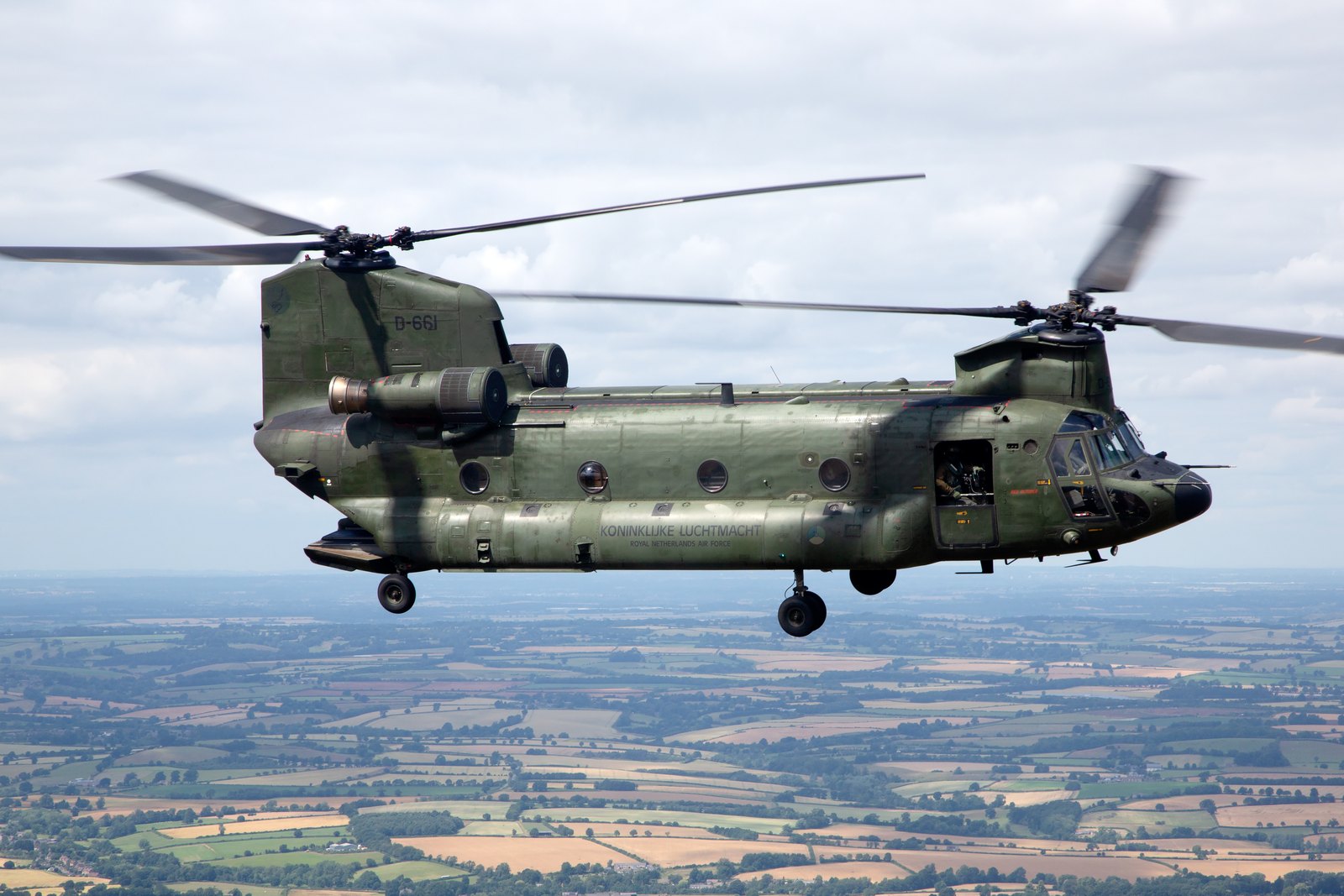
The Army had bought a helicopter with a rotor at each end, turning in opposite directions so that the torque of one cancelled the torque of the other. That is why there is no tail rotor on a Chinook. The cabin floor runs the length of the fuselage and out through a ramp at the back.
The 1st Cavalry brought its own
The 1st Cavalry Division (Airmobile) took its organic Chinook battalion to Vietnam with it in 1965. That unit was the 228th Assault Support Helicopter Battalion, which began operations there in September. A separate medium helicopter company, the 147th, arrived on 29 November in direct support of the 1st Infantry Division. By February 1966 the Army had taken delivery of 161 Chinooks.
Moving the division there took over 400 aircraft, nearly 16,000 people and more than 1,600 vehicles in eight weeks, staging through Brookley Air Force Base at Mobile and Mayport Naval Base near Jacksonville. Before it went, the early Chinooks needed 1,334 modifications for safety of flight. The Hueys needed nearly 2,000.
In theatre the aircraft was short of the lift the brochure promised. Tolson records that the division’s Chinooks were limited to 7,000 lb of payload in the mountains and could take another thousand near the coast, and that the early design was held back by a rotor system which did not permit full use of the installed power.
Tolson: the Chinook soon proved to be such an invaluable aircraft for artillery movement and heavy logistics that it was seldom used as an assault troop carrier. The aeroplane bought to carry a platoon into a landing zone spent the war carrying guns, ammunition and wrecked helicopters.
Guns A Go Go
Boeing Vertol produced four armed and armoured CH-47As late in 1965. The Army Aviation Museum says they were built rather than converted; the serials sit in the CH-47A block.
A unit was stood up at Fort Benning on 18 January 1966 under Lieutenant Colonel William J. Tedesco, redesignated on 19 April as the 53rd Aviation Detachment Field Evaluation (Provisional), and nicknamed Guns-A-Go-Go. It was attached to the 1st Cavalry Division’s 228th Battalion in early December 1966. Tolson, describing what his division received, lists twin 20 mm Gatling guns, 40 mm grenade launchers and .50-calibre machine guns, with other assorted ordnance.
| Serial | Name | Fate |
|---|---|---|
| 64-13151 | STUMP JUMPER | Destroyed in a ground-taxi accident at Vung Tau on 30 July 1966. It broke in two. |
| 64-13145 | CO$T OF LIVING | Shot down near Bong Son on 5 May 1967. A cannon mounting pin vibrated loose, the weapon rotated upward and fired into the rotor system. All eight crew were killed. |
| 64-13154 | BIRTH CONTROL | Shot down near Hue on 22 February 1968 during the Tet Offensive, then destroyed by mortar fire while grounded. |
| 64-13149 | EASY MONEY | Not lost. Used as a maintenance trainer at Vung Tau, moved to Fort Eustis in 1995, restored, and put on display at Redstone Arsenal on 1 May 2000. |
Tolson says two opposite things about them at once. From the infantryman’s viewpoint, he writes, when the Go-Go Bird came the enemy disappeared, and the pilots who flew these test aircraft performed some incredibly heroic deeds to prove the worth of the machine. But from the division’s viewpoint the machines required an inordinate amount of support, and keeping them would have meant giving up three essential lift Chinooks. After two were lost, the last one was transferred away.
Four were built, and one was written off at Vung Tau in July 1966, before the December attachment, so the division only ever received three.
Keeping the armed detachment would have cost the 1st Cavalry Division three of its lift Chinooks. The Army gave it up.
Napalm, riot agents and $7,315,000 of wrecks
During Operation Pershing the 1st Cavalry Division dropped 29,600 lb of riot agents out of CH-47s, using a fusing system made locally on standard drums and armed by static line. A single Chinook could drop two and a half tons of napalm on a position.
One Chinook company, during the Cambodian campaign, moved 272 bulldozers, 54 backhoes, 41 road graders and all the 155 mm howitzers into and out of the area of operations, along with bridge sections, and recovered $7,315,000 worth of downed aircraft. That company flew 2,486 sorties, which a logistician would put at 177,688 ton-miles. At 1523 on 29 June the last CH-47 left Cambodia.
Recovering wrecks is the job most often claimed for the Chinook and the one with the worst evidence behind it. The figure that circulates is around 11,500 aircraft retrieved in Vietnam, worth some three billion dollars. It is not in Tolson, which is the Army’s own account. It is in no Army, Boeing or museum source consulted here.
Losses in Vietnam
The Vietnam Helicopter Pilots Association has built its loss figures from individual tail numbers, holding records for 11,846 of the roughly 12,000 helicopters that served.
| Model | Served | Lost | Pilots killed | Other crew killed |
|---|---|---|---|---|
| CH-47A | 327 | 91 | 33 | 87 |
| CH-47B | 96 | 27 | 17 | 32 |
| CH-47C | 165 | 37 | 25 | 42 |
| ACH-47A | 4 | 2 | 2 | 6 |
| All marks | 592 | 157 | 77 | 167 |
Those figures give the armed Chinooks as two lost, where the Army Aviation Museum fate list gives three. The two counts differ and nothing consulted here reconciles them.
The civil Chinook, and 2.5 nautical miles east of Sumburgh
Boeing Vertol sold a commercial version, the Model 234, into the North Sea oil business. Investigators at the Air Accidents Investigation Branch describe it as a development of the CH-47C, with tandem three-bladed rotors of 60 feet diameter that overlap by about 80 per cent of the disc radius over the fuselage centreline, and an engine on either side of the tail pylon driving through right-angle gearboxes into a combining transmission.
G-BWFC was built in 1981, serial MJ 004, and was configured for 44 passengers. It was registered to British Airways Helicopters from May 1981 and to British International Helicopters from September 1986.
On 6 November 1986 it left Sumburgh at 0858 with 40 passengers, visited three platforms and left Brent Platform C at 1022 with a full load of 44. At 1122 it was handed to the Sumburgh aerodrome controller, and the commander reported four and a half miles and was cleared to land. Nothing more was heard from it.
The cockpit voice recorder caught the crew remarking on a rise in flight deck noise, one of them describing a roaring noise, and then a bang. The forward transmission had failed. The twin rotors lost synchronisation and the blades hit each other, and the aft pylon, with the aft transmission and rotor system still attached, came off the fuselage. It struck the sea in a tail-down attitude, broke up and sank 2.5 nautical miles east of Sumburgh Airport at 1131.
Forty-seven people were on board: three crew and 44 passengers. Forty-five of them died. Two survived, the commander and one passenger, both seriously injured. A Coastguard Sikorsky S-61N happened to be airborne east of the airfield on a training flight, fully crewed and equipped for search and rescue; it sighted two inflated liferafts and then wreckage, found one survivor clinging to a large piece of the aircraft and one to the side of a liferaft, and winched both aboard. Finding (v) of the report reads: their survival and rescue was entirely fortuitous.
The cause, from paragraph 3(b), reads: the immediate cause of the accident was the failure of the modified spiral bevel ring gear in the forward transmission which allowed the twin rotors to collide when synchronisation was lost. Underlying causes were the inadequacy of the hitherto accepted aircraft industry standard of test programme carried out by the manufacturers and the insufficiently stringent inspection programmes required by the FAA and the CAA.
The ring gear is bolted to the sun gear shaft by two flanges clamped together with 24 bolts and a steel shim between them, and the joint is meant to carry the drive by friction through that shim rather than through the bolts. A service bulletin of 1 August 1985 had modified the gear to a new standard to cure a loss of bolt torque. That modification had FAA engineering approval and CAA approval. The investigators found that modified ring gears in forward transmissions consistently suffered wear and corrosion that let fatigue start in the flange, and that the assumption made by the manufacturer, and accepted by the FAA and the CAA, that the modified joints in the forward and aft transmissions would behave similarly was wrong. The test that had been done was done on an aft transmission.
Forward transmission A7-1625 was supplied to British Airways Helicopters in 1982. It came off for scheduled overhaul in October 1985 at 4,019 running hours and had the modification put in. It went into one aircraft, then into G-BWFC, then came out again after ten hours because the oil pressure was low and there was metal in the filter, which turned out to be a failing oil pump. While it was open, someone checked the torque on the ring gear bolts. It then ran 477 hours to a scheduled torque check, which found no loss of torque at all, and 120 hours more to the accident. At the end it had run 4,687 hours, 668 of them since the modification, and it had passed its last inspection.
The recorder tape carried an abnormal signature from the forward transmission for its whole duration. For the final sixty seconds the harmonics grew. It was only audible to the crew for that last minute, by which time, the report says, they were unable to take any action to prevent the accident.
Forty-five people died off Shetland because a modification tested on one gearbox was assumed to behave the same way in another. The Air Accidents Investigation Branch recommended that certification procedures be reviewed so that every modification to a vital component is properly scrutinised and tested before approval.
Rebuilding the fleet instead of replacing it
By the late 1970s the Army had a large fleet of A, B and C models and no money for a new helicopter. It took the old aircraft apart and built them again to a new standard, and it has gone on doing that ever since.
The General Accounting Office reported on the programme in February 1978, under the title Can the Army’s $2.8 Billion Program To Modernize the CH-47 Helicopter Be Improved? The scope was 361 existing aircraft, 104 A models, 74 B and 183 C, plus about 190 new machines. Modernisation was costed at $1.6 billion in escalated dollars and the new aircraft at about $1.2 billion. Another $85.2 million of engine and rotor blade development sat outside the main estimate.
The working parts changed. Fibreglass replaced metal in the rotor blades. The transmissions got integral lubrication, hardened metals, a redundant oil system, self-lubricating bearings and improved debris detection. A separate engine programme aimed to take mean time between depot actions from 329 hours to 1,150, and the hydraulics were modularised, with new flight controls, electrical and auxiliary power work and better cargo suspension.
The $2.8 billion was to go to Boeing Vertol without competition. Modernisation was to start before the interim reliability goals had been proved, though meeting them was essential to the savings the programme was sold on. At three aircraft a month over twelve years, the planned rate was not the most economical, and it meant going on overhauling unconverted aircraft in the meantime. And the modernised helicopter would still not be able to carry external cargo using approved terrain flying techniques at night or in weather that needed instruments.
Deliveries of the CH-47D started in 1982. The RAF Museum’s accession document for its own aircraft says 472 of the model were produced, many of them conversions of earlier A, B and C models. Boeing uses 472 for a different count, of earlier models modernised into CH-47Fs.
Built as CH-47A 64-13115, the museum’s own aircraft was accepted by the Army on 16 February 1965. It went to South Vietnam in October 1966 with the 228th, took small arms damage to the main rotor on 29 June 1969 at 1,567 flying hours, and was hit twice in the aft fuselage that October. It came home in March 1971 with 2,407 hours on it. It was rebuilt as CH-47D 83-24104 on 7 January 1983, accepted again on 30 January 1984, and carried 4,172.7 total flight hours by 22 June 1998. Its forward fuselage is at Hendon now, painted as Bravo November.
Britain buys thirty, or thirty-three
James Wellbeloved, the Under-Secretary of State for Defence for the RAF, told the Commons on 3 April 1978 that subject to the satisfactory outcome of contractual negotiations the RAF would order 30 Chinook medium-lift helicopters. It would, he said, greatly increase the effectiveness of the RAF’s support for the Army in Germany, and double the service’s total lift capability over 24 hours.
The Royal Air Force aircraft page says 33 were ordered in 1978. The RAF Museum calls Bravo November one of the original 30. Both figures are in official sources and neither of them explains the other.
From December 1980 the Chinook HC1 entered service, and 18 Squadron reformed on it in 1981. The Mull of Kintyre Review, looking back from 2011, describes what the RAF had bought: essentially the same aircraft as the CH-47C then in US Army service, with some British avionics and equipment and a number of other special provisions, and a complexity that meant the HC1 was considered to have relatively poor reliability, imposing a heavy maintenance burden and hurting its availability.
Bravo November
Five Chinooks went south to the Falklands aboard MV Atlantic Conveyor, which sailed from Portsmouth on 25 April 1982. ZA707 came off at Ascension. On 25 May the ship was hit by an Exocet. ZA718 was in the air on an air test at the time, and it was the only one of the four still aboard that was not lost with her.
The RAF Museum has the aircraft reaching the San Carlos beachhead on 26 May after leaving HMS Hermes. Langworthy’s citation says the detachment was put ashore on 27 May to operate the one aircraft, with no field deployment equipment, living at first in fox holes before permanent accommodation was set up at Port San Carlos Settlement. Despite a total lack of aircraft spares, the citation says, ZA 718 was flown continuously in support of the battle from 27th May until the cease fire.
On 2 June it flew two lifts into Fitzroy and Bluff Cove carrying 81 paratroopers and then 71. Tolson’s appendix gives the early Chinook’s complement as three crew and 33 passengers. A missing cockpit door, the museum notes, prevented a friendly-fire incident. On 8 June, after the Sir Galahad, it took burn casualties and amputees to Ajax Bay and the hospital ship Uganda. Over eighteen days, with one day off, it moved 2,150 troops, 95 casualties, 550 prisoners of war and 550 tons of stores, which the museum says was more tonnage than a whole squadron of Sea Kings carried in the same period.
After the Argentine surrender on 14 June, the groundcrew fitted a captured Argentine Chinook door to it, and it kept that door on later operations. Four of its pilots were awarded the Distinguished Flying Cross. The museum names three of the four: Langworthy for the Falklands in 1982, Steve Carr, and Flight Lieutenant Ian Fortune, who appears in the Operational Honours list of 24 September 2010 for Afghanistan. The rest of the Falklands crew were Flight Lieutenant Andy Lawless, crewmen Tom Jones and Gary Rogan, and Chief Technician Tom Kinsella, who ran the ground party.
Bravo November retired after more than forty years and went on public display at the RAF Museum Midlands at Cosford in April 2022, for the first time.
HC1 to HC2, 1992 to 1998
When the work started, the HC1 fleet was still recovering from Operation Granby, the British contribution to the 1990 and 1991 Gulf War. In August 1992 an internal RAF review of Chinook airworthiness found that the HC1 suffered from inadequate configuration control, inadequate flight and maintenance publications, and poor system reliability. The answer was to send the surviving aircraft back to Boeing in the United States and bring them up to a common HC2 standard based on the current US Army CH-47D, with British modifications. The transmission, the hydraulics and the electrical systems were replaced, structural work was done, and the Textron-Lycoming T55 engines got a Full Authority Digital Electronic Control system.
The Aircraft and Armament Experimental Establishment could not support the release into service. It had unresolved technical concerns, including an inability to verify the FADEC software and to quantify what it called the software’s then unpredictable performance, and in the establishment’s opinion the unquantifiable risk would be reduced by checks and limits.
So the Controller Aircraft, Sir Donald Spiers, issued an interim release on 9 November 1993 that carried those limits. Crews were to make extra pre-flight checks of the engine overspeed protection system, and to fly to ground and flight limitations whenever the Digital Electronic Control Unit displayed a fault. Held to 18 tonnes, the aircraft was also barred from cloud or fog below plus four degrees. On reversionary mode or unusual engine behaviour they were to land as soon as possible, and if the Engine Fail caption lit they were to expect it to go out after twelve seconds, because it could be spurious.
The Review: the transition from the HC-1 to HC-2 was fraught and to some degree chaotic. Aircraft went away for the upgrade and did not come back on time, availability fell, and the operational demand meant the RAF was still getting to know what was essentially a new aircraft.
In July 1994 the icing clearance was walked back down towards a target of minus six degrees, and full release for the HC2 did not come until September 1998.
2 June 1994
At 16:59 GMT on Thursday 2 June 1994, Chinook HC2 ZD576 was flying from RAF Aldergrove in Northern Ireland to Fort George near Inverness when it hit a hill on the west side of the Mull of Kintyre, a short distance inland and uphill from the lighthouse.
The pilots, Flight Lieutenants Jonathan Tapper and Richard Cook, the two crewmen, Master Air Loadmaster Graham Forbes and Sergeant Kevin Hardie, and twenty-five passengers were killed. Twenty-nine died in all. The passengers were senior Royal Ulster Constabulary and Army officers and six civil servants from the Northern Ireland Office, all of them members of the Northern Ireland security and intelligence community, flying to an annual security conference outside the Province. Chinooks had come to Northern Ireland in 1988, when most troop movements were switched to helicopters after a terrorist attack on an Army transport bus on its way from RAF Aldergrove.
ZD576 had arrived at the Aldergrove detachment on 31 May, two days before. It had recently been brought up to HC2 standard and had flown 57 hours since coming back into service. Every HC2 was then flying under those limits.
The sortie was planned as a visual flight at low level going out. Their first waypoint was meant to be the Mull of Kintyre lighthouse; the point actually programmed into the navigation system was about 280 metres south-east of it. That first leg ran 42 nautical miles on a track of 027 magnetic with a safety altitude of 2,400 feet, a thousand feet above Beinn na Lice, the highest ground near the waypoint. Tapper reckoned the leg at 21 minutes. That day the crew had already flown five hours forty, and he had asked for and been given an hour’s extension to eight.
It took off at 16:42 GMT and was seen at 16:50 over Carnlough on the Antrim coast at low level. At 16:55 a crew member called Scottish military air traffic control at Prestwick. The call was not answered and was not repeated. Nothing suggested it was an emergency. A yachtsman south-west of the Mull saw the aircraft two nautical miles from the lighthouse at an estimated two to four hundred feet, straight and level, below the cloud. Cloud and hill fog covered the Mull from about 250 feet up to at least the summit of Beinn na Lice at 1,404 feet.
About eight tenths of a nautical mile from the waypoint, a crew member changed it by hand to the next one, Corran near Fort William. The navigation system would have called for a turn of about seven degrees to port. It carried on towards the Mull. Fifteen to eighteen seconds before impact it was at 468 feet above the sea, give or take fifty.
It had no cockpit voice recorder and no accident data recorder. A contract to fit them to the fleet was signed in October 1996 and the work finished in the summer of 2002.
The negligence finding, 1995 to 2011
On 3 February 1995 the Board of Inquiry finished its report. It found several possible causes, could not determine a definite one, and concluded that the most probable cause was a selection by the crew of an inappropriate rate of climb which was insufficient for them safely to overfly the high ground of the Mull of Kintyre. It made no finding of negligence against anyone.
The report then went up the chain. The Air Officer Commanding No 1 Group, Air Vice Marshal Sir John Day, concluded that both pilots were negligent to a gross degree, and the Air Officer Commander-in-Chief, Air Chief Marshal Sir William Wratten, supported him. The standard they were working to had been set by an RAF working party in 1983 and reads: only in cases in which there is absolutely no doubt whatsoever should deceased aircrew be found negligent.
A Fatal Accident Inquiry sat before Sheriff Sir Stephen Young in January 1996. In May 1998 the Commons Defence Committee reported. The Public Accounts Committee reported in November 2000 and found the acceptance of the Mk2 into service flawed, the process for RAF Boards of Inquiry unsatisfactory, and the finding of gross negligence short of the standard of proof. A House of Lords select committee took evidence from Wratten, Day, the Board’s president Air Marshal Pulford and the Air Accidents Investigation Branch inspector Mr A N Cable, and concluded unanimously that the reviewing officers were not justified in their finding that negligence on the part of the pilots caused the aircraft to crash.
Liam Fox, the Defence Secretary, appointed a review under Lord Philip on 16 September 2010, with Lord Forsyth of Drumlean, Baroness Liddell of Coatdyke and Malcolm Bruce MP.
On the standard, the Review was unanimous: in our unanimous opinion this case was precisely the kind of case for which the standard of proof was designed to preclude findings of negligence against deceased aircrew. On the legal advice Day had taken, which the Review was told was the first time anyone in his position had done so: we have considered the legal advice he received and found it to be unclear and inaccurate. On what he did with the accident inspector’s evidence: our discussions with Sir John Day indicated to us that he had in fact disregarded Mr Cable’s statement and had instead applied his own judgment to the assessment of the serviceability of the aircraft. On what Cable had actually told the Board: that the aircraft’s pre-impact serviceability could not be positively verified, but that there was no evidence of any malfunction that could have contributed. On the gap in the evidence: the Reviewing Officers’ approach to this gap in the evidence was to apply to both pilots what in our view amounted to a presumption of negligence based upon their shared responsibility for the safety of the aircraft. That approach was inconsistent with the standard of proof.
And on the Ministry of Defence, which had defended the finding since 1995: we find it extremely regrettable that the Department should have taken such an intransigent stance on the basis of an inadequate understanding of the RAF’s own Regulations in a matter which involved the reputation of men who died on active service.
The review made three recommendations: that the finding be set aside, that the Ministry consider apologising to the families, and that it reconsider its policy and procedures for the transport of personnel whose responsibilities are vital to national security. On 13 July 2011 the Defence Council accepted that the Reviewing Officers’ conclusions that Flight Lieutenants Tapper and Cook were negligent to a gross degree are no longer sustainable and must therefore be set aside. That same day the apology was given in Parliament.
Ministers directed in 1997 that Boards of Inquiry could no longer attribute blame or negligence in cases of unnatural death or serious injury. In 2008 Boards of Inquiry were replaced by Service Inquiries under the Armed Forces Act 2006, separating accident investigation from the operational chain of command, and in 2011 an independent Military Air Accident Investigation Branch was set up.
The standard of proof for finding a dead pilot negligent was absolutely no doubt whatsoever. The Board of Inquiry could not determine a cause and made no finding of negligence. Two officers above it found both pilots negligent to a gross degree. The Defence Council set that finding aside on 13 July 2011.
Eight helicopters that could not be flown
In 1995 the Ministry of Defence ordered fourteen Chinook Mk2a from Boeing. Eight of them were modified into a Mk3 variant for Special Forces work, at a cost of about £259 million, and delivered in December 2001. They then sat in storage, because the avionics software fell short of United Kingdom military airworthiness standards.
| When | What happened |
|---|---|
| 1995 | Fourteen Mk2a ordered; eight to be modified to Mk3 for Special Forces |
| December 2001 | All eight delivered, at about £259 million. None could be flown on operations |
| September 2004 | Fix to Field identified: replace the cockpit display systems. Negotiations take 30 months. Final estimate £215 million, in service 2011-12 |
| March 2007 | Afghanistan creates urgent demand. Fix to Field abandoned for Reversion to Mk2/2a standard, available 2009-10 with reduced capability |
| December 2007 | Reversion contract placed. Estimate has grown from £53 million to £90.1 million, plus £22.5 million of Afghanistan equipment |
| 2008 | National Audit Office: total cost from procurement through Reversion will be some £422 million, which includes costs not itemised in the rows above |
| December 2010 | First flight of a Project Julius aircraft, in Hampshire |
| 22 March 2017 | First Chinook HC5, converted from a Mk3, arrives at RAF Odiham |
The National Audit Office noted that the March 2007 decision to abandon Fix to Field was taken without the level of detailed analysis that would usually be expected. The Public Accounts Committee reported in March 2009 that the eight helicopters had been grounded for eight years after delivery because of decisions taken without securing access to the software source code, that the projected cost had passed £422 million, about £52.75 million each, and that cost growth on the Reversion project alone was 70 per cent. Its chairman, Edward Leigh, called the programme bad decision-making to the point of irresponsibility.
The Committee also set out what the absence of those eight aircraft meant on the ground: British troops in Afghanistan had fewer helicopters, made riskier road journeys, and used heavily modified Mk2s for special operations.
The eight were eventually fixed under Project Julius, which converted 38 Mk2 and Mk2A aircraft to Mk4 and Mk4A and the eight Mk3s to Mk5, with a Thales TopDeck cockpit. On 22 March 2017 the first HC5 reached Odiham, fifteen years and three months after the aircraft were delivered.
The other air forces
Boeing lists twenty international customers besides the United States: Australia, Argentina, Canada, Egypt, Germany, Greece, India, Italy, Japan, Morocco, the Netherlands, Saudi Arabia, Singapore, South Korea, Spain, Taiwan, Thailand, Turkey, the United Arab Emirates and the United Kingdom.
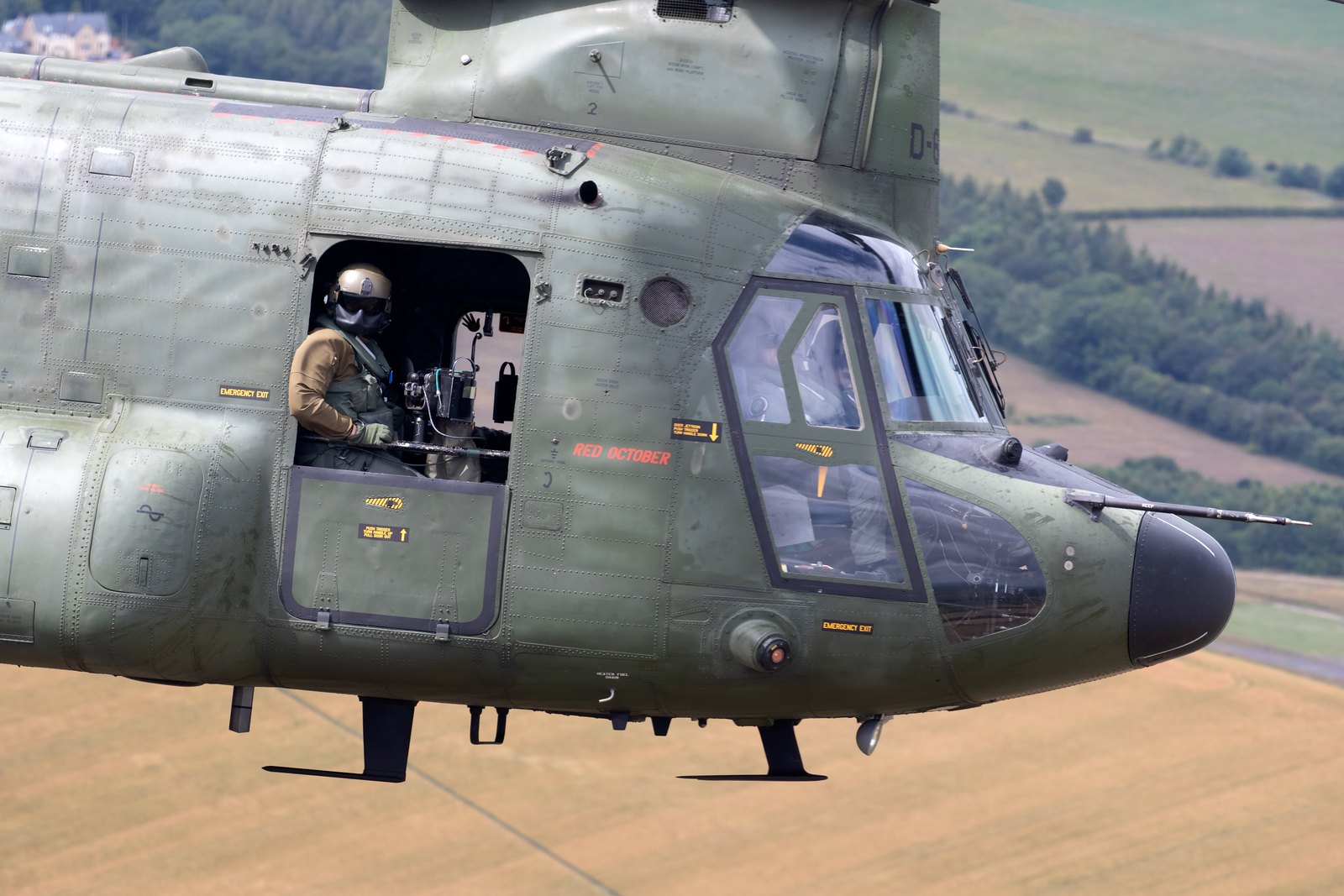
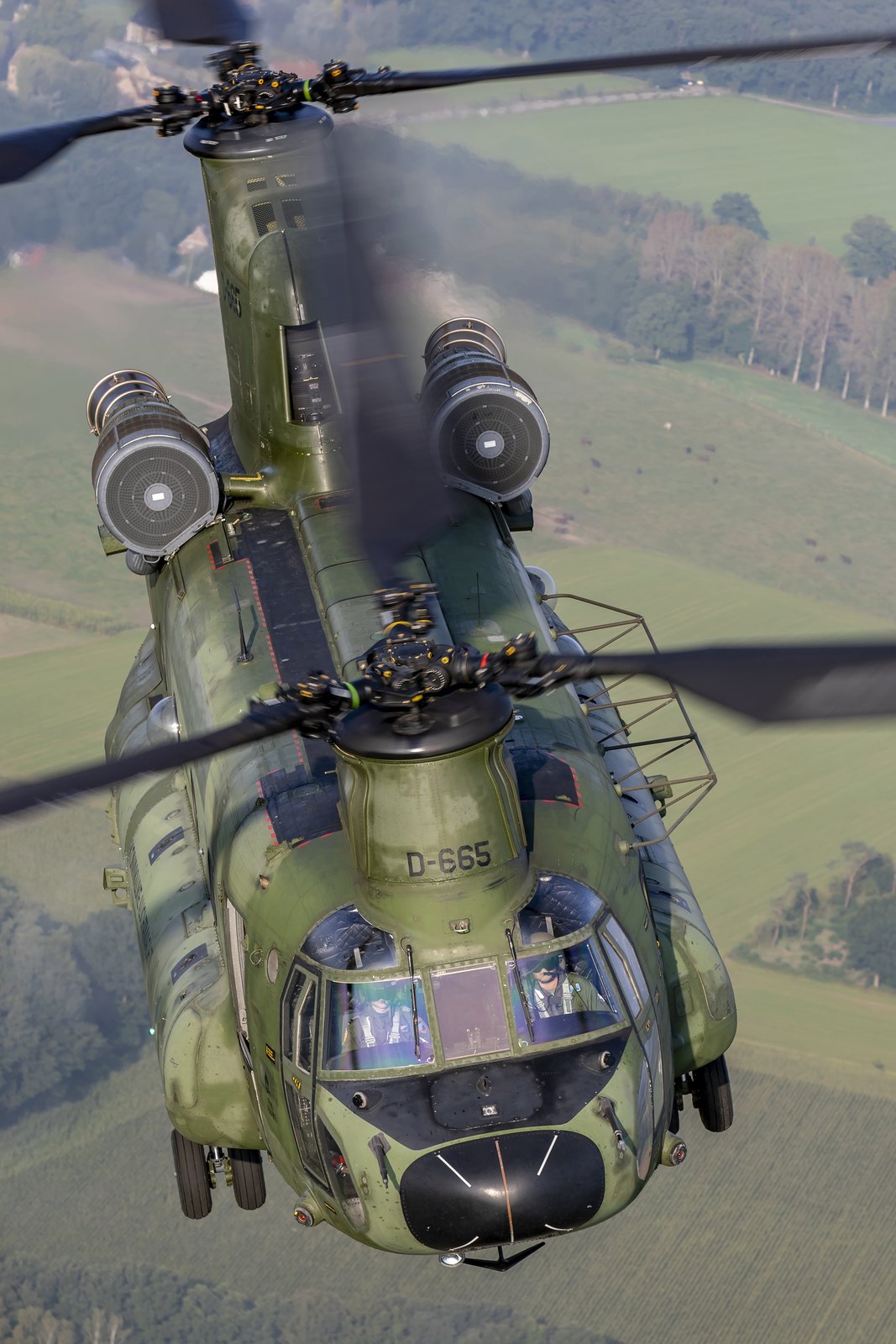
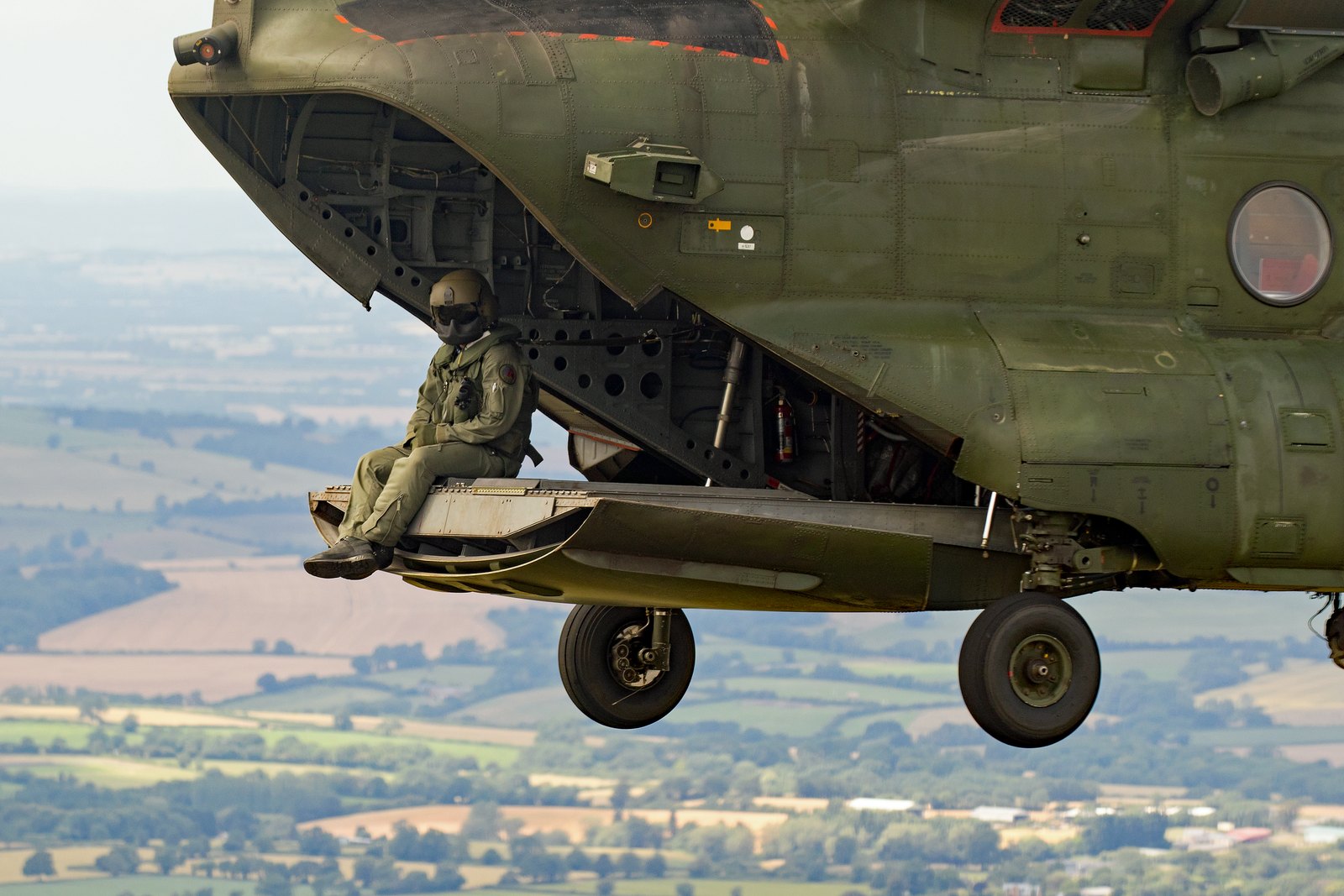
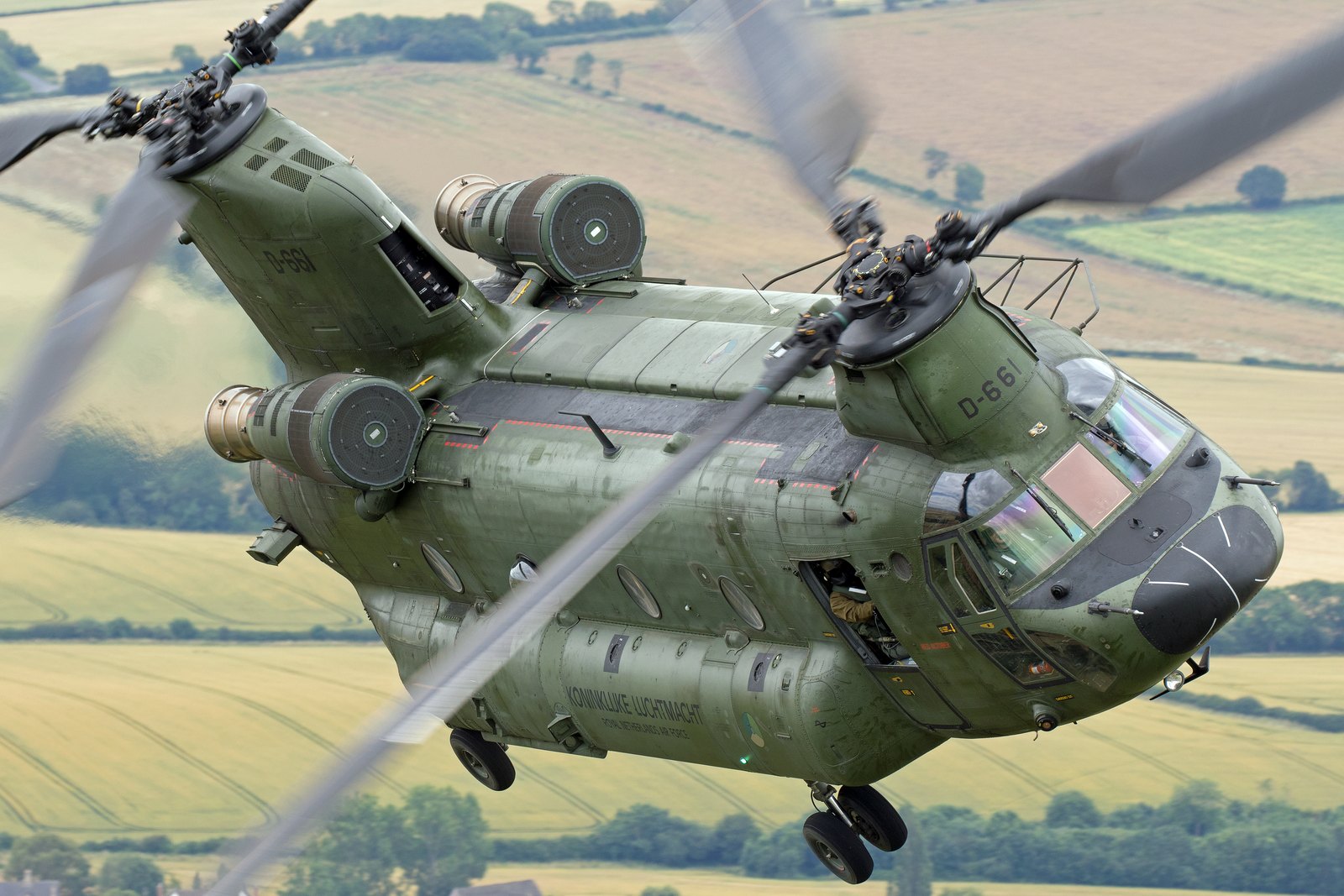
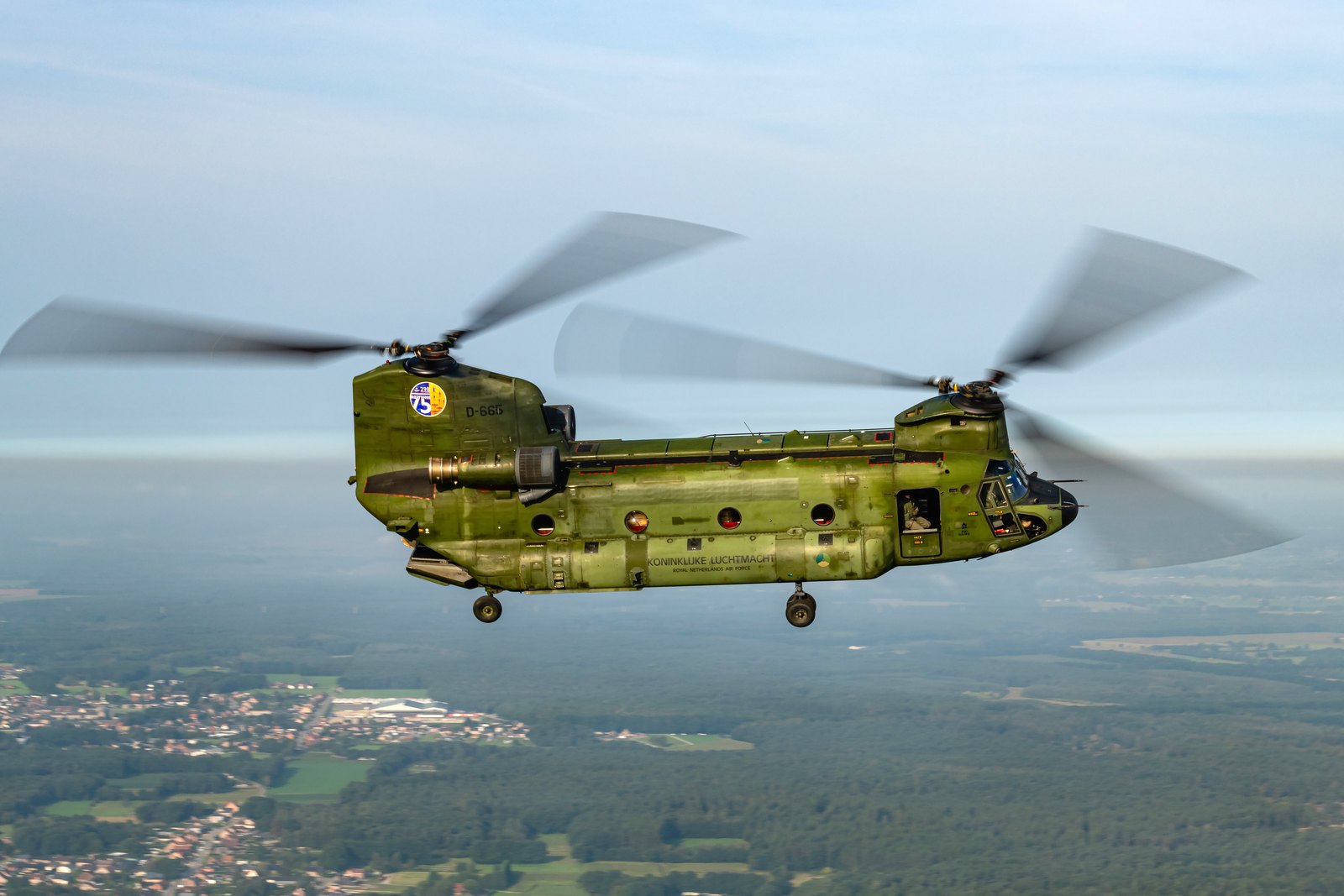
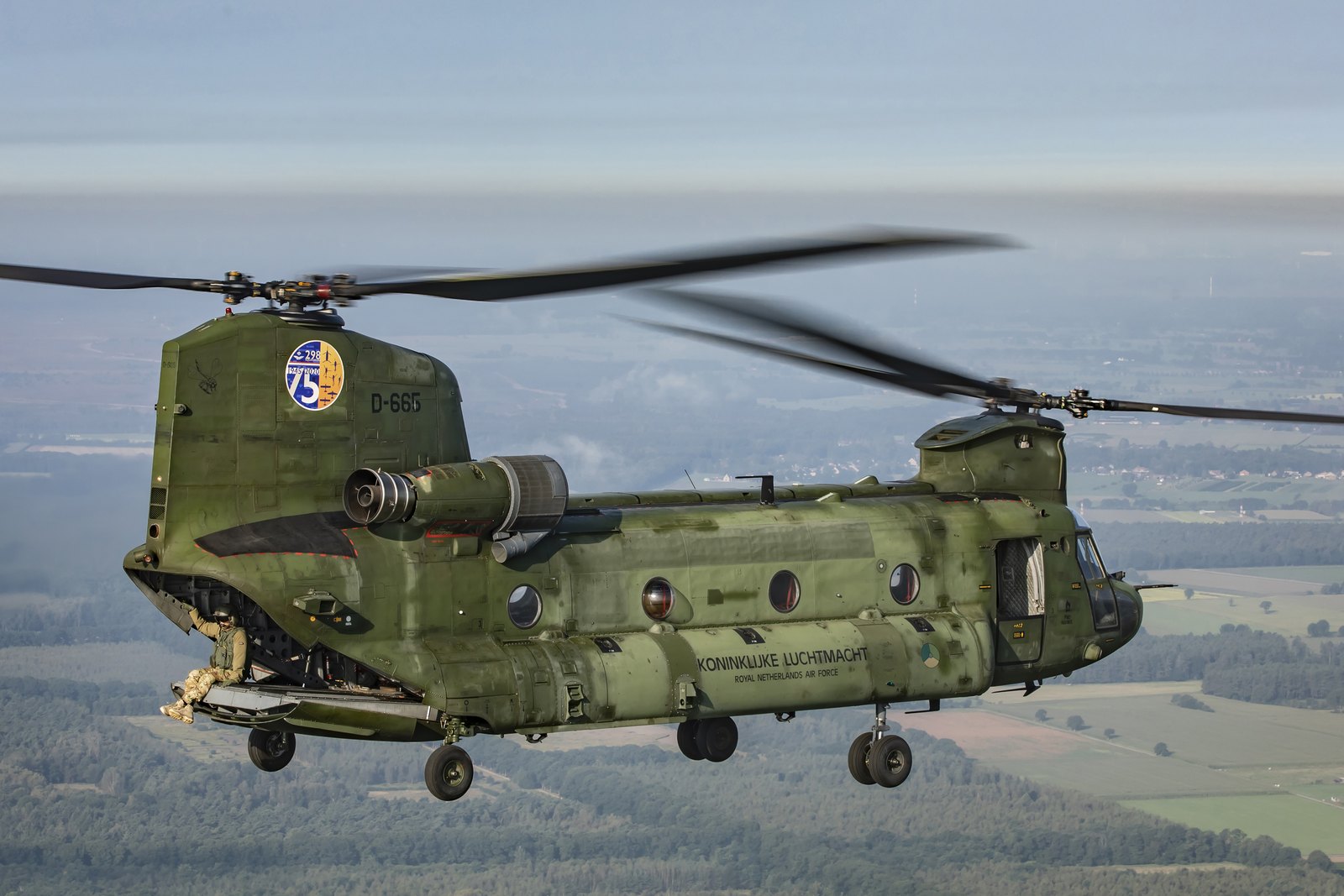
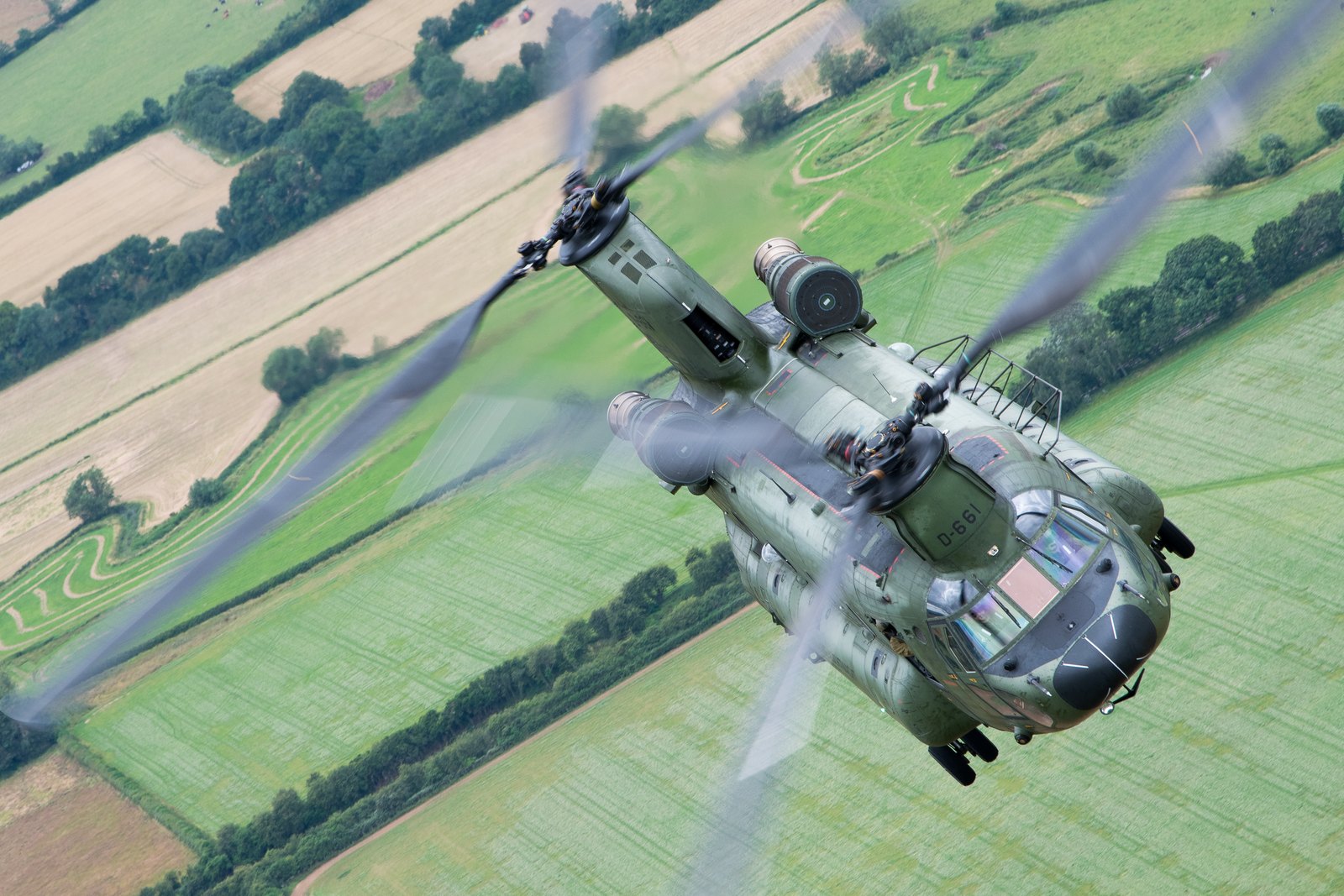
The Netherlands, whose aircraft are in the photographs here, took its first Chinook at Soesterberg in 1995 with 298 Squadron. Since January 2022 all its CH-47Ds have been replaced by the F model, and one of the D models has gone back to Soesterberg as a museum exhibit. The Dutch Chinook has flown in Kosovo, Ethiopia, Bosnia, Iraq, Afghanistan and Mali, alongside the Dutch Apaches.
Japan has built its own since 1984, when Kawasaki Heavy Industries began licence production of the CH-47J. On 17 January 2017 the hundredth Japanese-built aircraft was delivered to the 1st Helicopter Brigade: 69 to the Ground Self-Defense Force and 31 to the Air Self-Defense Force, from the 1986 financial year onwards. Production moved to the CH-47JA in 1993 and Kawasaki now puts its own total at more than 110, none of them counted in Boeing’s figures.
Italy’s ICH-47F is assembled by AgustaWestland under a contract of May 2009 for sixteen aircraft worth about 900 million euros, with Boeing building the fuselages at Ridley Park. Canada ordered fifteen CH-147F in August 2009, at about 1.2 billion Canadian dollars for the aircraft and another 2.2 billion for twenty years of support, and took the first in June 2013. India ordered fifteen CH-47F in September 2015 and became the nineteenth country to choose the type.
Germany is the largest recent order. On 1 June 2022 the Federal Ministry of Defence announced it would replace the CH-53, after nearly fifty years, with sixty CH-47Fs. In July 2023 the order went in for about seven billion euros from the Bundeswehr special fund, for the Block II Standard Range variant with air-to-air refuelling. Production began at Philadelphia in May 2025 and final assembly started in April 2026. Deliveries are due to start in the last quarter of 2027, the last in the last quarter of 2032, with about forty operational by 2030.
All of these were shot air-to-air, from a second aircraft flying alongside, and the frames are available to licence.
What it lifts
| Mark | External cargo | Payload or useful load | Source |
|---|---|---|---|
| CH-47A | 16,000 lb | Payload 10,114 lb, though Tolson records 7,000 lb in the mountains of Vietnam | Tolson, 1971 |
| CH-47B | 20,000 lb | Payload 15,900 lb | Tolson, 1971 |
| CH-47C | 22,700 lb | Payload 19,100 lb | Tolson, 1971 |
| CH-47F | 26,000 lb centre hook, 25,000 lb tandem | Up to 16,000 lb internally, hot and high | US Army |
| CH-47F Block II | Not stated | Useful load 27,700 lb | Boeing |
The Army’s current figures give the F a maximum cruise of 160 knots, a minimum crew of three, and 36 people on board, thirty-three of them passengers. Block II adds 4,000 lb of maximum gross weight, extends the mission radius across nearly all payloads, and brings a stronger airframe, redesigned fuel tanks and an improved drivetrain, on two Honeywell T55-GA-714A engines of 4,777 shaft horsepower each.
There is no documented Chinook landing on Everest. Didier Delsalle made the summit landing on the record, in a single-engined Eurocopter AS350 B3 in 2005.
On 7 and 8 April 2002, 2nd Battalion of the 160th Special Operations Aviation Regiment went back for MH-47E tail number 476, which had been lost on 4 March near the 10,500-foot peak of Takur Ghar in Afghanistan, and brought it out from a crash site at around 9,000 feet. The US Army Special Operations Command history office calls that the first combat-loss recovery of a Chinook since the Vietnam War.
Still being built
On 13 April 2026 the last CH-47F Block I, aircraft number 8494, was delivered to the US Army, ending Block I production after more than two decades. Colonel Jennie Conlon described the Army’s job as balancing the sustainment of the current fleet with the aggressive fielding of modernised capabilities.
The F model came between the two, and the Director of Operational Test and Evaluation reported on it in 2013: an acquisition objective of 464 aircraft, 256 of them delivered by that September, twelve to a battalion, and theatre commanders calling it much more capable than the CH-47D, particularly in navigation, communications and hot and high performance.
Block II is where the money goes now. Delivery to the Army began on 1 July 2024. Nine more were ordered in October 2025 for $461 million and six more in April 2026 for $324 million, taking the total under contract to 24, with six delivered. The Army plans to have its first unit equipped no later than the middle of 2028, and up to 465 aircraft are to be brought to Block II configuration.
The Royal Air Force has about 51 aircraft: eight HC5, fourteen HC6 and around 29 HC6A, flying from Odiham with 7, 18 and 27 Squadrons and from Benson with 28. All 29 HC6A are to go by 2030 and the retirements have started. Fourteen extended-range CH-47Fs were contracted in March 2024, and the Defence Investment Plan of 2026 has them arriving between 2028 and 2032. Janes, reporting that plan, says the gap between the two will mean a temporary, yet significant, reduction in numbers.
Official statements have given four different answers on when those fourteen aircraft arrive: 2026, when the RAF announced the £1.4 billion purchase in May 2021; first delivery 2027 and completion 2029, on the Defence Equipment and Support programme page; from 2027, when Grant Shapps confirmed the contract in March 2024; and 2028 to 2032 in the 2026 plan.
Boeing calls the Chinook its longest continuously running production programme, and in 2012 put the total at over 1,200 delivered to eighteen operators. There are orders on the books running to 2032, and the aeroplane being built now has a maximum gross weight of 54,000 lb against the 33,000 lb of the prototype that flew in 1961.
Frequently asked questions
Who makes the Chinook?
Boeing makes it, near Philadelphia. The design comes from Piasecki Helicopter Corporation, which renamed itself Vertol Aircraft Corporation on 9 March 1956 and was bought by Boeing on 31 March 1960. Kawasaki Heavy Industries has built the CH-47J in Japan under licence since 1984 and has delivered more than 110, and AgustaWestland assembles the Italian ICH-47F with fuselages from Boeing.
When did the Chinook first fly?
On 21 September 1961. The aircraft was the YHC-1B. One account, the only one found that names either, gives it as serial 59-4983, the second prototype, with Leonard Joseph LaVassar at the controls. It was redesignated CH-47A in 1962 and the first one was delivered to the US Army on 16 August 1962. Boeing was still taking orders for it in April 2026.
Why does a Chinook have two rotors and no tail rotor?
Because two rotors turning in opposite directions cancel each other’s torque, so nothing is needed at the back to stop the fuselage spinning. Frank Piasecki’s contribution was to set the rear rotor in a higher plane than the forward one so that it stayed clear of the forward rotor’s downwash. Raising it meant bending the rear fuselage upwards, which is why his early machines were called flying bananas.
How much can a Chinook lift?
The US Army gives the CH-47F a sling load capacity of 26,000 lb on the centre hook, 17,000 lb on the forward or aft hook and 25,000 lb in tandem, with up to 16,000 lb internally in hot and high conditions and a maximum gross weight of 50,000 lb. Boeing gives the Block II a useful load of 27,700 lb and a maximum gross weight of 54,000 lb.
What was the Guns A Go Go Chinook?
An armed and armoured CH-47A. Boeing Vertol produced four of them in late 1965. Lieutenant General John Tolson, describing the three his division received, lists twin 20 mm Gatling guns, 40 mm grenade launchers and .50-calibre machine guns. One was destroyed in a taxi accident in 1966, one was shot down in 1967 with the loss of all eight crew, and one was shot down during the Tet Offensive in 1968. The Vietnam Helicopter Pilots Association, counting by tail number, records two lost rather than three. The fourth aircraft is on display at Redstone Arsenal.
What happened at Sumburgh in 1986?
A British International Helicopters Boeing Vertol 234, G-BWFC, suffered a failure of the forward transmission while descending towards Sumburgh on 6 November 1986. The rotors lost synchronisation and the blades collided, the aft pylon came off, and the aircraft hit the sea. Forty-seven people were aboard and forty-five died. The Air Accidents Investigation Branch traced it to a modified spiral bevel ring gear.
What was Bravo November?
Chinook ZA718, the only one of four aboard MV Atlantic Conveyor to survive the Exocet strike on her on 25 May 1982, because it was airborne on an air test at the time. It flew continuously in support of the Falklands land battle, once carrying 81 paratroopers in a single lift, and over eighteen days moved 2,150 troops, 95 casualties, 550 prisoners of war and 550 tons of stores. Four of its pilots were awarded the Distinguished Flying Cross.
What happened on the Mull of Kintyre in 1994?
Chinook HC2 ZD576 flew into high ground on the Mull of Kintyre on 2 June 1994, killing all 29 people on board: four crew and twenty-five senior Northern Ireland security and intelligence figures. The Board of Inquiry could not determine a cause and made no finding of negligence, but two reviewing officers found both pilots negligent to a gross degree.
Was the Mull of Kintyre verdict ever overturned?
Yes, on 13 July 2011. A review under Lord Philip found that the reviewing officers had failed to apply the required standard of proof of absolutely no doubt whatsoever, that the legal advice one of them took was unclear and inaccurate, and that the Ministry of Defence had been intransigent since 1995. The Defence Council set the finding aside and an apology was made to the families in Parliament the same day.
Why could the RAF not fly its Chinook Mk3s?
Because the avionics software fell short of United Kingdom military airworthiness standards. Eight aircraft were delivered in December 2001 at a cost of about £259 million and went straight into storage. The Public Accounts Committee found the decisions had been taken without securing access to the software source code, and its chairman called the programme bad decision-making to the point of irresponsibility.
How long were the Mk3s grounded?
About eight years. The Public Accounts Committee reported in March 2009 that the eight had been grounded for eight years after delivery. Reverting them to Mk2 and Mk2a standard made them flyable from 2009-10 with reduced capability, and the first to reappear as an HC5 under Project Julius reached RAF Odiham on 22 March 2017, fifteen years and three months after they arrived.
Has a Chinook ever landed on Mount Everest?
No. The documented helicopter landing on the summit of Everest was made by Didier Delsalle in a single-engined Eurocopter AS350 B3 in 2005.
Is the Chinook still in production?
Yes. The last CH-47F Block I was delivered on 13 April 2026, and Block II is now in production, with 24 aircraft under contract as of April 2026 and up to 465 planned for the configuration. Germany ordered sixty in July 2023 for delivery between late 2027 and late 2032, and the Royal Air Force has fourteen extended-range aircraft on contract for 2028 to 2032.
Sources and further reading
- Lt Gen John J. Tolson, Vietnam Studies: Airmobility 1961 to 1971, US Army Center of Military History
- Air Accidents Investigation Branch, Aircraft Accident Report 2/88, G-BWFC
- The Mull of Kintyre Review, Lord Philip and others, HC 1348, 13 July 2011
- National Audit Office, Ministry of Defence: Chinook Mk3 Helicopters, HC 512, 4 June 2008
- Committee of Public Accounts, HC 247, 5 March 2009
- GAO, Can the Army’s $2.8 Billion Program To Modernize the CH-47 Helicopter Be Improved?, PSAD-78-18, 24 February 1978
- Supplement to The London Gazette, issue 49134, 8 October 1982, the Distinguished Flying Cross citation for Squadron Leader Richard Langworthy, which is the primary account of Bravo November in the Falklands.
- Royal Air Force Museum, Bravo November
- Vietnam Helicopter Pilots Association, Helicopter Losses During the Vietnam War, the loss figures by mark, built from individual tail numbers.
- US Army Aviation Museum, ACH-47A Guns-A-Go-Go
- Smithsonian National Air and Space Museum, the PV-2 and PV-3 collection records
- Hagley Museum and Library, Boeing Company Vertol Division records
- Hansard, House of Commons, 3 April 1978
- Hansard, House of Lords, 13 July 2011
- US Army, CH-47 Chinook weapon system page
- Boeing, CH-47 Chinook and H-47 programme pages
- Director, Operational Test and Evaluation, FY2013 report on the CH-47F
- US Army PM Cargo, June 2026
- UK Defence Equipment and Support, Chinook
- Bundeswehr, CH-47 programme page
- USASOC History Office, the recovery from Takur Ghar
- Vertical Flight Society, Vertipedia, the YHC-1B and CH-47D records
- This Day in Aviation, 21 September 1961, the first-flight pilot and the prototype serials, one of which is impossible as printed.
- Helis.com, the Boeing 414 and US Army CH-47 database entries, the 472 conversions figure and the construction-number ranges for the A, B and C models.
- RAF Museum accession document for CH-47D 83-24104
- Royal Air Force, Chinook
- FlightGlobal, 29 March 2017
- Janes, 30 June 2026, on the UK Defence Investment Plan
- Hansard, House of Commons, 14 March 2024
- Kawasaki Heavy Industries, CH-47J
- Vertical Magazine, Didier Delsalle on the Everest landing, the helicopter that did land on the summit, and what it was.
- Nationaal Militair Museum, the Dutch Chinook, 298 Squadron from 1995, the replacement of the D models and the operations flown.
