
Helicopters carry the news. They lift casualties off mountainsides, hunt submarines, ferry troops, fight fires and appear in almost every defence story of the past sixty years, yet try to source a strong photograph of one and the shelves are surprisingly bare. Fixed-wing aviation is served by a crowded market of air-to-air specialists; rotary aviation is not. This guide is for the picture researchers, editors and designers who need helicopter photographs that are sharp, correctly identified and cleanly licensed, and it explains what the Piemags and Aviation Photo Crew helicopter collection holds, how it was shot, and how to get the most from it.
Aviation Photo Crew photograph military helicopters air to air, from the ramp of a Skyvan camera ship, with the cooperation of the operating units. The helicopter holdings now run to roughly a thousand frames covering the AH-64 Apache, the tandem-rotor Chinook, the Merlin, the NH90, the Sea King, the Wildcat, the Bell UH-1 Huey, the HH-139 and the Mi-171, all photographed in the air, at eye level, where a helicopter belongs. Piemags supplies the same imagery agency-style for buyers who prefer that route.
- Why good helicopter photography is scarce
- Who licenses rotary imagery
- The collection: around a thousand helicopter frames
- Apache and Chinook: attack and heavy lift
- Merlin, Wildcat and NH90: the maritime frames
- Sea King, HH-139, Mi-171 and Huey: SAR, utility and heritage
- Why air-to-air suits helicopters
- Rotor blur: the discipline behind the disc
- Captioning helicopter imagery correctly
- An angle guide for designers
- Three worked example briefs
- Technical quality and licensing
- A buyer’s helicopter checklist
- Frequently asked questions
- Sources and further reading
Why good helicopter photography is scarce
The shortage is not an accident, it is built into how helicopters are usually photographed. Most helicopter images in circulation were taken from the ground, at an airshow or over an airfield fence, and the ground is the one place a helicopter never looks its best. Seen from below, a hovering machine becomes a dark belly against a white sky. Seen on the apron, it sits amid fuel bowsers, cones and portable toilets, with its blades drooping and its purpose invisible. The aircraft that spends its working life in the air is almost always pictured doing nothing.
Then there is the rotor problem, which quietly ruins a large share of what remains. A helicopter’s blades turn slowly enough that a fast shutter speed freezes them solid, and a helicopter with frozen blades looks broken, as if it were a model suspended on wires. Producing the full, living disc of motion that the eye expects demands slow shutter speeds, steady panning and a tolerance for throwing away most of a take. Casual photographers rarely accept that trade, so the stock search results fill up with frozen rotors, digital renders and museum airframes on poles, none of which an editor can put on a cover.
Access compounds the scarcity. Military helicopters cannot be photographed air to air without the operator’s cooperation, a camera ship that can fly at helicopter speeds, and crews on both sides who have briefed the formation properly. Very few photography teams in Europe do this work at all, and fewer still do it repeatedly across many types and operators. The result is a market where demand is steady and supply is thin, which is precisely the situation a picture researcher wants to know about before the next rotary brief lands.
The contrast with the fixed-wing market makes the point sharply. A researcher who needs a fast jet can choose between dozens of established air-to-air photographers and decades of well-organised agency material, because display teams, airshow circuits and military publicity have fed that pipeline for generations. Ask the same agencies for a current naval helicopter photographed at eye level over the sea and the options collapse to a handful of frames, many of them old, many of them official handouts that every competitor has already run. The rotary niche has simply never had the supplier base its demand deserves, and that is the gap this collection was assembled to fill.
Who licenses rotary imagery
Demand for helicopter photography is broader than it first appears. Defence media are the obvious constituency: analysis outlets, weekly and monthly defence titles, and the publishers of reference annuals all need current, correctly identified images of front-line types, and an Apache or NH90 photographed in the air will always beat a parked example for the opening spread. Procurement stories, exercise reports and capability features run year round, and each one needs a picture.
The rotary world also has its own trade press, and it is hungrier for strong imagery than most sectors. Titles such as Vertical serve an industry of operators, maintainers and manufacturers who look at helicopters all day and know instantly when a photograph is wrong: frozen blades, a clipped tail rotor, a mislabelled variant. Supplying that readership means supplying frames that survive expert scrutiny, which is where recorded registrations and full rotor discs earn their keep.
Search and rescue and emergency services stories form a third stream. SAR anniversaries, fleet transitions, winch-crew features and coastal safety campaigns all call for helicopters shown in their working element, over the sea or the hills rather than on a pad. A fourth stream comes from manufacturers and their supply chains, whose marketing, investor and heritage material needs imagery of their products in service. And a fifth, easy to underestimate, is heritage publishing: types such as the Sea King and the Huey have retired or are retiring from service after long careers, and every farewell generates books, documentaries and commemorative features that need the aircraft pictured in flight, not on a plinth.
Broadcast and book publishing cut across all of these streams. Documentary producers need stills for title sequences, transitions and publicity, and a helicopter frame with a full rotor disc sits far more comfortably beside moving footage than a frozen-blade stock image does. Book designers, from serious defence histories to partworks and annuals, need covers that sell at thumbnail size on a retailer’s page, and a head-on helicopter at eye level does that job with unusual force. Calendars, museum interpretation and educational publishing round out the picture. None of these buyers wants the same licence, which is why flexible terms matter as much as the imagery, a point this guide returns to in the licensing section.
The collection: around a thousand helicopter frames
The Aviation Photo Crew helicopter holdings currently run to roughly a thousand air-to-air frames, built up type by type through dedicated sessions flown with the operating units. The Apache is the deepest single subject at around two hundred frames, followed by the Merlin at around a hundred and ninety and the NH90 at around a hundred and fifteen, with substantial coverage of the Chinook, Sea King, Wildcat, Huey, HH-139 and Mi-171 alongside. Every session was flown from the Skyvan camera ship, whose rear ramp gives the photographers an open, unobstructed platform and whose flying characteristics let it hold formation at speeds helicopters are happy with.
Because the sessions were arranged with the units themselves, each frame carries its identity with it: type, variant, registration or serial, and operator, recorded at the time rather than reconstructed afterwards. That provenance matters more in rotary photography than almost anywhere else, because helicopter variants can differ in role while looking near identical in silhouette, and a caption error that a general reader would never notice will be spotted immediately by the specialist readership these images tend to serve. The sections that follow walk through the collection type by type, so a researcher can see at a glance what exists before opening the galleries.
It is worth being clear about what a thousand frames means in practice. This is not a thousand near-duplicates of one pass; it is dedicated sessions across many types, operators and countries, each yielding a spread of angles, backgrounds and light. For a researcher, depth of this kind changes how a brief is approached. Instead of asking whether a usable Apache image exists, the question becomes which of the Apache frames fits the layout, and that is a far better conversation to be having on deadline. The collection also continues to grow, with new types and operators added as sessions are flown, so a gap today is worth an enquiry rather than an assumption.
Apache and Chinook: attack and heavy lift
The AH-64 Apache is the collection’s largest single holding, at around two hundred frames. As the West’s best-known attack helicopter it anchors an enormous share of defence coverage, and the air-to-air treatment suits it: the type’s aggressive, insect-like silhouette, sensor-laden nose and stub wings read far more clearly at eye level than from a crowd line. The coverage includes head-on approaches, banking passes and side profiles, with weapons fits visible and rotor discs held full.
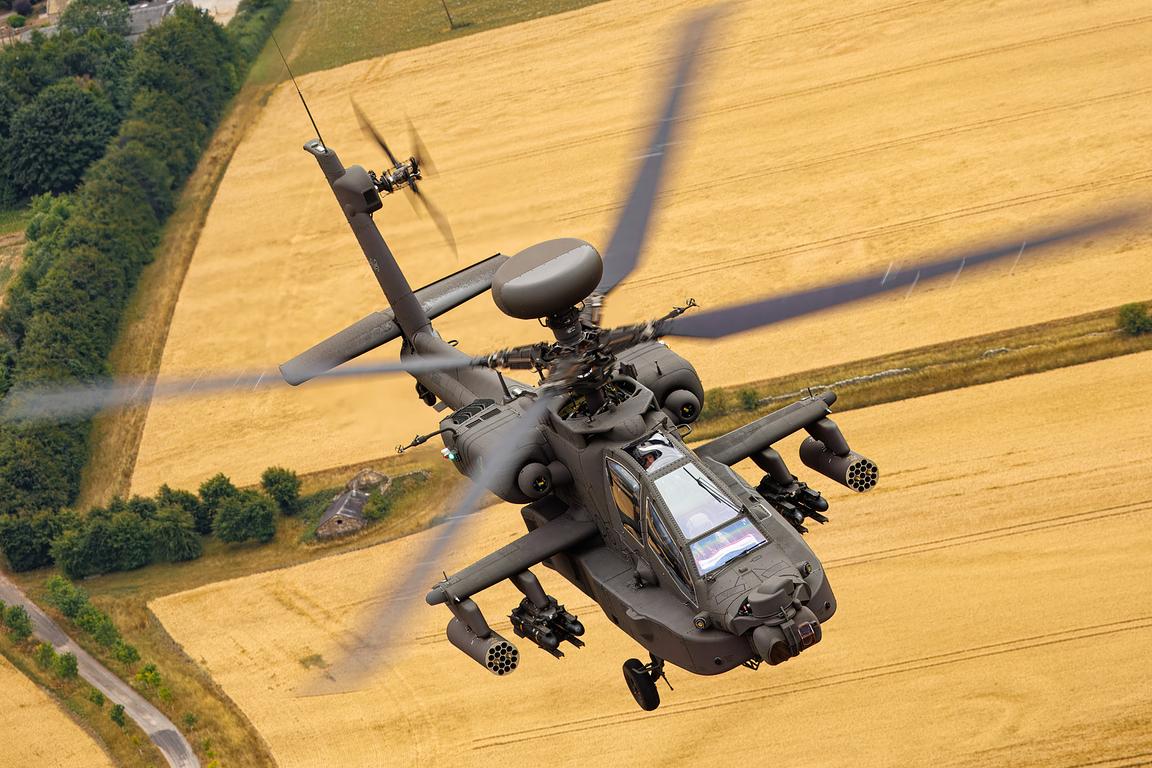
Head-on Apache frames like this one are the collection’s natural cover material. The symmetry is exact, the sensor turrets and weapon pylons are all legible, and the sky above the aircraft leaves room for a masthead. For inside pages, the banking and topside passes show the airframe in motion against real landscape, which is the context most Apache stories are actually about. Depth matters here too: with around two hundred frames to choose from, a title running repeated Apache coverage across a year need never publish the same image twice, and a designer can hold visual consistency across a series while still varying the frame.
The Chinook needs no introduction to any picture desk: the tandem-rotor heavy-lift helicopter is one of the most recognisable aircraft in the world, and its twin discs are also one of the hardest subjects in aviation photography, since both rotors must blur convincingly at once. The collection’s Chinook coverage includes the RAF’s HC6A variant, photographed air to air over open countryside.
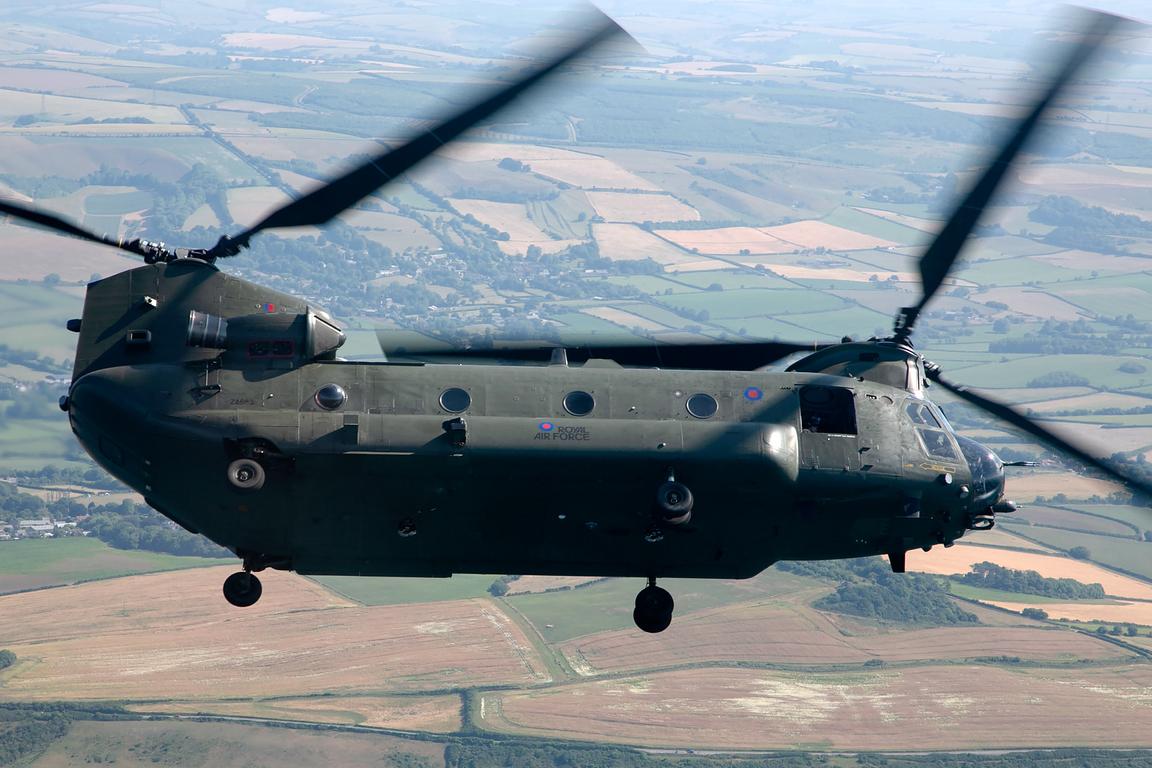
A banking Chinook frame earns its place in a layout because it shows what ground photography cannot: the aircraft’s whole upper surface, the overlap of the two rotor discs and the working landscape beneath. For support-helicopter stories, exercise coverage and anything about battlefield mobility, this is the frame the words are describing. The registration, ZA683, is recorded with the frame, so a caption can identify the aircraft precisely, and the HC6A designation is carried in the metadata rather than left for a busy sub-editor to guess at.
Merlin, Wildcat and NH90: the maritime frames
Maritime helicopters are a world of their own, and a poorly served one. Ships’ flights operate far from photographers, deck landings are hard to shoot well from a deck, and the types themselves, grey on grey, defeat most ground-based attempts. The collection’s naval coverage starts with the Merlin, at around a hundred and ninety frames the second-deepest holding, including the Royal Navy’s HM2 anti-submarine variant.
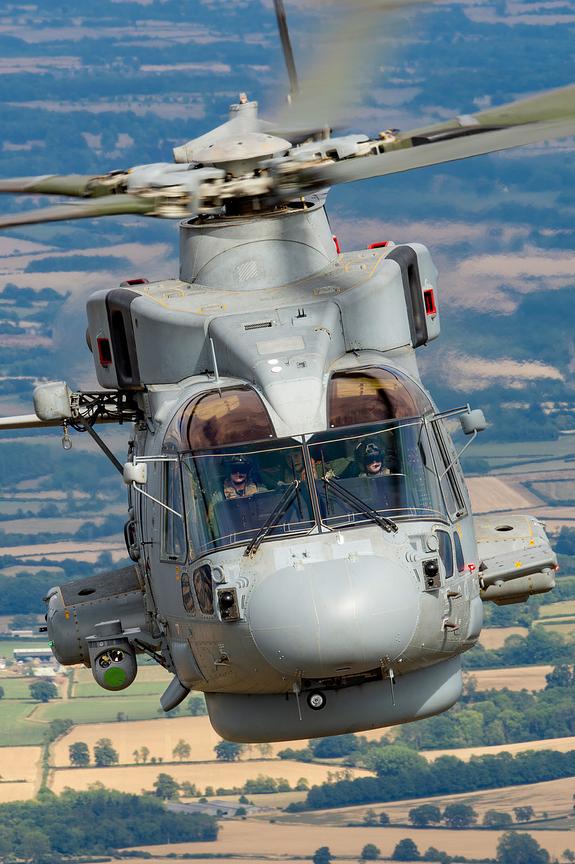
A head-on Merlin at eye level is a frame very few libraries can offer, and it works as hard for anti-submarine warfare features as it does for general naval aviation coverage. The recorded registration, ZH832 in the frame above, lets a caption writer tie the image to a specific airframe rather than a generic type shot, which specialist naval titles appreciate.
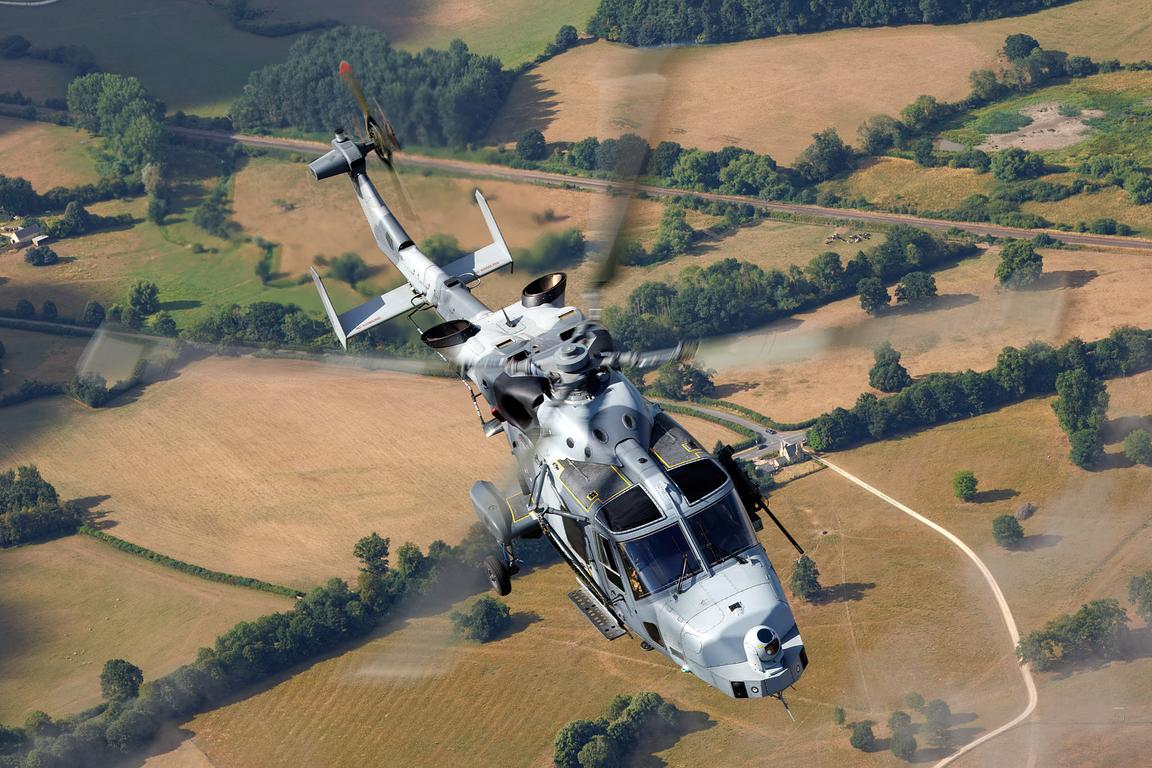
Alongside the Merlin sits the AW159 Wildcat, the Royal Navy’s smaller shipborne helicopter, photographed air to air over patchwork farmland. The Wildcat’s coverage answers a slightly different set of briefs: it is the frame for stories about frigate and destroyer flights, small-ship aviation and the newer end of the naval helicopter fleet.
The third pillar of the maritime coverage is the NH90 in its NFH naval variant, at around a hundred and fifteen frames. The NH90 serves navies across Europe, and imagery of it in its working environment, low over open water, is in constant demand from defence media covering European naval aviation and from the industrial partners behind the programme.
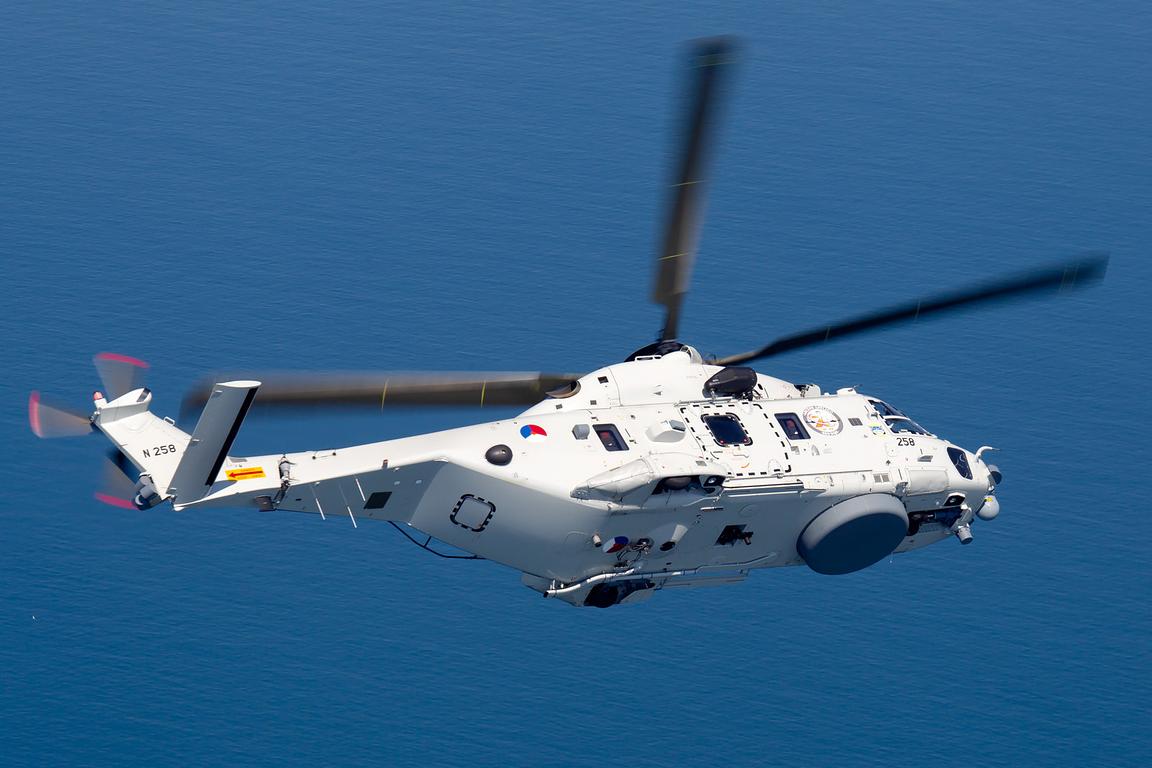
Over-sea frames like this one do double duty. For editorial buyers they are plainly illustrative, a naval helicopter over the water it patrols. For commercial and design buyers they offer something rarer: a clean, saturated blue background with no horizon clutter, which takes overlaid type and logos as comfortably as any studio backdrop while remaining an entirely real photograph.
Sea King, HH-139, Mi-171 and Huey: SAR, utility and heritage
Search and rescue, utility and heritage subjects round out the collection, and between them they answer some of the most emotionally loaded briefs a picture desk receives. The Sea King leads this group. Few helicopters carry as much public affection, after decades of rescue and naval service across many nations, and every stage of the type’s long retirement has generated commemorative publishing. The collection includes the Belgian Sea King Mk48 RS05 in its striking red and black scheme, photographed air to air before the type retired from Belgian service in 2019.
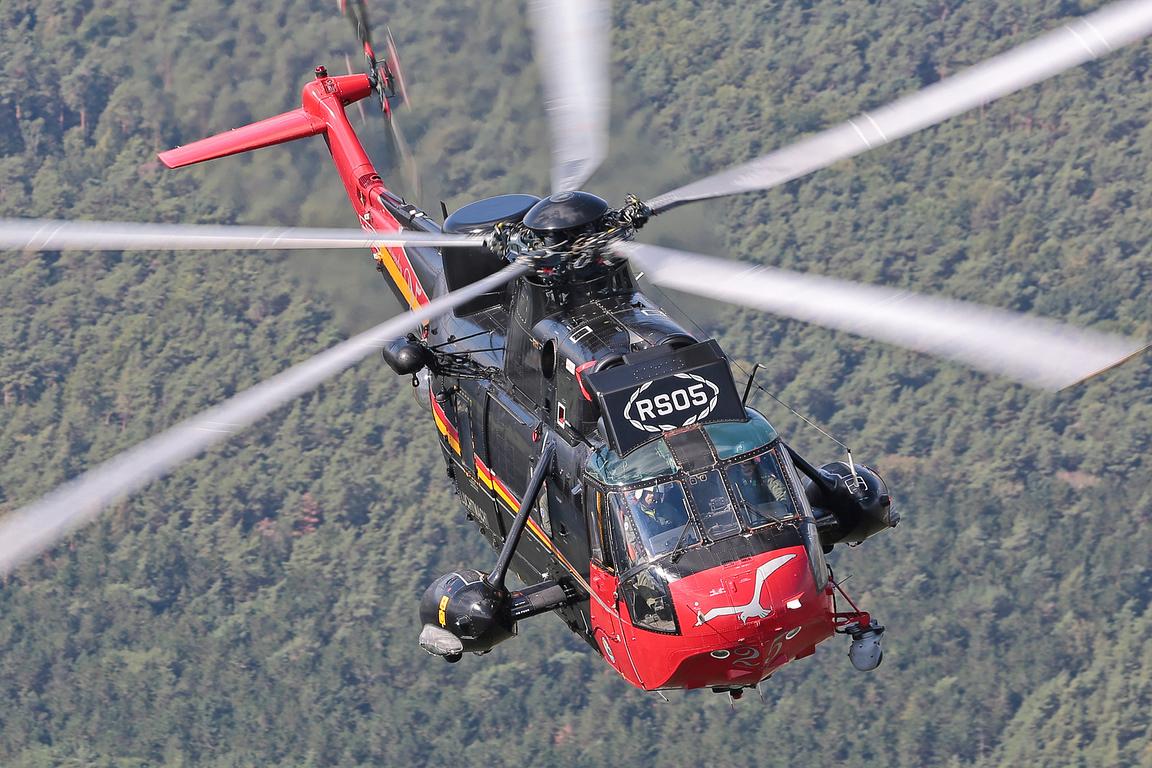
Frames like this are already historical documents. The aircraft no longer flies in Belgian service, which means no photographer will ever take this picture again, and every retrospective, rescue-service history and farewell feature that touches the subject will need imagery exactly like it. Buyers planning heritage content should treat retired-type coverage as a finite resource, because it is one.
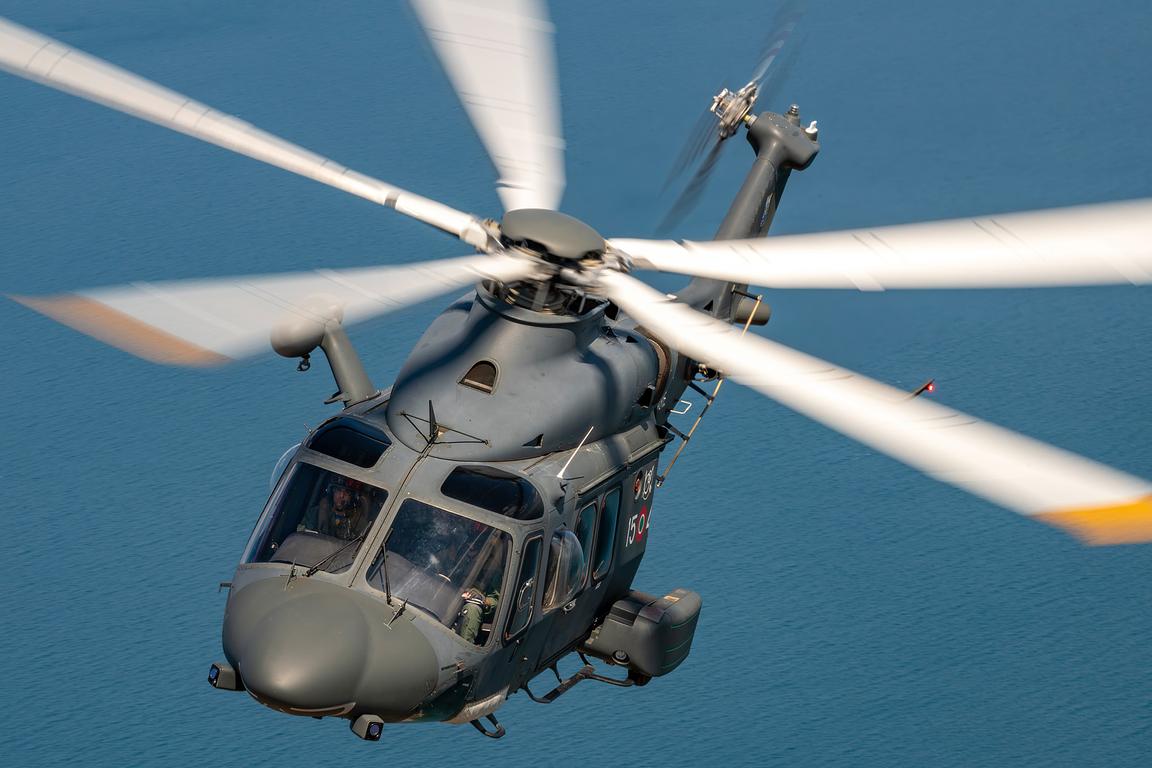
The modern face of the same mission is represented by the HH-139, the search and rescue development of the AW139 family, photographed air to air with the Italian Air Force at Athens Flying Week. It is the frame for stories about the current generation of SAR provision, and its high-visibility scheme reads superbly against open sky.
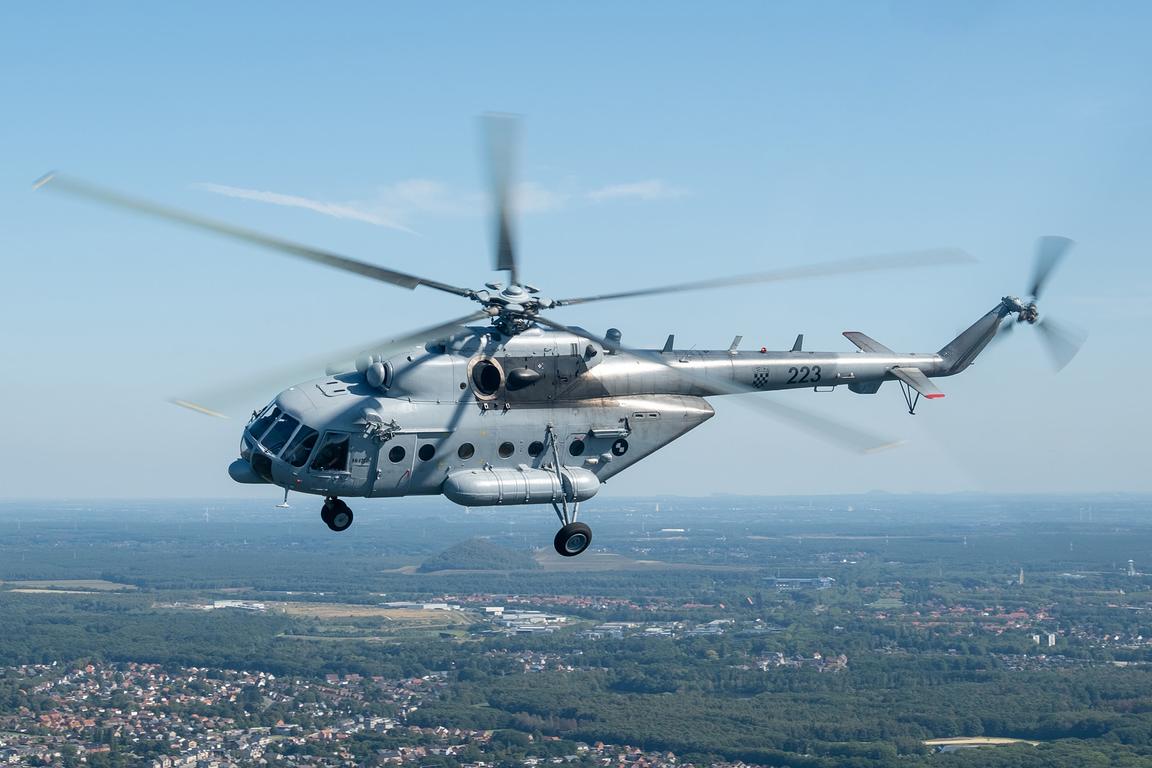
Eastern-built types are a further gap in most Western libraries, and the collection addresses it with the Croatian Mi-171Sh, serial 223, photographed air to air. The Mi-171 belongs to one of the most widely operated helicopter families in the world, and correctly identified, cleanly licensed imagery of it is far harder to find than the type’s ubiquity would suggest.
The group closes with the Bell UH-1 Huey, perhaps the most culturally resonant helicopter ever built. Its silhouette and its sound belong to the shared memory of the twentieth century, and publishers reach for it whenever a story touches the Vietnam era, the birth of air mobility or the history of the helicopter itself. The collection holds the Huey head on, low over trees, with the two-blade rotor swept into a full arc.
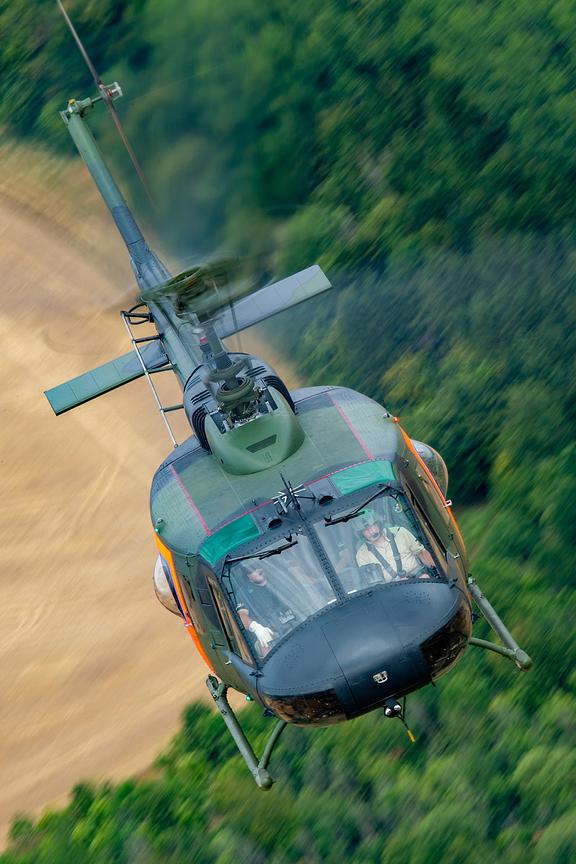
A two-blade rotor is the sternest test of the slow-shutter discipline described below, because there is so little blade to blur, and a Huey frame with a full arc is the quickest way to judge the technical standard of any rotary collection. It is also, simply, the frame every Huey brief is imagining before the search begins. Between the Sea King’s farewell scheme, the HH-139’s working present, the Mi-171’s Eastern lineage and the Huey’s place in cultural memory, this group of frames covers an unusually wide span of editorial territory for four types, and each one of them is a subject most libraries cannot supply air to air at all.
Why air-to-air suits helicopters
Air-to-air photography flatters every aircraft, but it transforms helicopters. A fixed-wing fighter photographed from the ground at an airshow is at least doing something recognisable; a helicopter photographed from the ground is a machine out of context, hovering over tarmac or parked with its blades tied down. Put the camera in the air alongside it and everything changes. The helicopter sits at eye level, in its element, doing its job over the sea or the fields or the treeline, and the photograph shows the subject the words are actually about.
The camera ship matters here. The Skyvan’s open rear ramp gives the photographers a wide, stable, unglazed shooting position with nothing between lens and subject, and the aeroplane itself flies comfortably at the modest speeds helicopters prefer, so the formation can be held steadily while the light and the background are worked. Sessions are planned with the operating unit, briefed jointly, and flown with the helicopter moving through a series of agreed positions, which is why the collection contains head-on, banking, topside and profile coverage of the same aircraft rather than a single lucky pass.
For the buyer, the practical consequence is choice. A ground-based library can offer one angle of a given helicopter on a given day. An air-to-air session yields a set: the cover candidate, the double-page spread, the profile for the sidebar and the closing frame, all of the same airframe, consistently lit, with identity recorded once and correct for all of them.
There is an aesthetic argument too, and it is not a small one. Helicopters at eye level regain the poise that ground angles take away. The fuselage sits level, the disc crowns the machine instead of hiding it, and the background becomes sea, field or forest rather than sky and fencing. Readers may not articulate why one helicopter photograph feels alive and another feels inert, but they respond to the difference, and picture editors who test both kinds against each other on a layout rarely go back.
Rotor blur: the discipline behind the disc
Every helicopter photograph lives or dies by its rotor, and this is worth a researcher understanding because it explains the difference in quality between sources. A shutter speed that would be routine for a jet, above a thousandth of a second, freezes a helicopter’s blades into stiff, countable paddles, and the aircraft immediately looks like a toy. To render the disc the eye expects, the shutter must stay open long enough for the blades to sweep through the frame, which in practice means around 1/125 of a second for a strong arc, and 1/60 or slower for a fully complete disc, especially on two-blade rotors. The same question arises with propeller aircraft, and the speeds involved are set out in our guide to shutter speed for propeller blur.
Holding a long lens steady at those speeds, from one moving aircraft, while tracking another, is the central craft of rotary air-to-air work. It demands smooth panning, patience and a high tolerance for rejected frames, and it is the single biggest reason so little first-rate helicopter photography exists. The frames that survive the edit are the ones where the airframe is critically sharp while the rotor carries a complete, even arc of motion.
For the buyer, the test is simple and worth applying to any source, not just this one. Look at the blades. A full disc means the photographer accepted the difficulty and did the work; frozen blades mean the image was taken the easy way, and the readership that knows helicopters will notice even when the buyer does not. Every frame selected into these galleries has passed that test before publication.
The disc also carries information, which few buyers notice until it is pointed out. The number of blades, the sweep of the arc and the relationship between main and tail rotor all read through the blur, so a full-disc frame still tells the specialist reader exactly what machine this is, from the Huey’s two-blade arc to the overlapping tandem discs of the Chinook. Frozen blades flatten that information into diagram-like stiffness; a proper disc keeps the machine alive on the page while losing nothing a caption needs.
Captioning helicopter imagery correctly
Helicopter captions go wrong in predictable ways, and the collection is built to prevent them. Variants are the first trap: an airframe’s silhouette often changes little between versions that differ substantially in role and equipment, so a caption that names the wrong variant can misdescribe the story’s entire subject. The second trap is operators, since many types serve with numerous nations and services, and the third is time, because fleets are upgraded and repainted and a photograph is always of a particular aircraft on a particular day.
The defence against all three is the same: record identity at source. Every frame in the helicopter galleries carries the registration or serial and the operator as recorded at the session, so a caption can say precisely what is shown, RAF Chinook HC6A ZA683, Royal Navy Merlin HM2 ZH832, Croatian Mi-171Sh 223, rather than gesturing at a type. Where an aircraft or a scheme has since passed into history, as with the Belgian Sea King, the honest caption says so, and the image gains rather than loses value from the acknowledgement. Buyers who inherit imagery of uncertain provenance from other sources are welcome to use these galleries as a reference for checking identities, but the simpler route is to start with frames whose identities were never in doubt.
A note on wording for non-specialist desks: it is always safe to describe these images as modern photographs of aircraft in current or recent service, photographed air to air with the cooperation of the operating unit. That single sentence, adapted to the frame, satisfies the accuracy standards of specialist titles while remaining plain enough for general readers, and the recorded identity supports it if anyone asks.
An angle guide for designers
Different layouts eat different angles, and the helicopter coverage was shot with that in mind. Head-on frames, the Apache with its rocket pods or the Huey over the trees, are natural cover material: strong symmetry, the full rotor disc crowning the airframe, and clean sky above for a masthead. They also crop to portrait formats better than any other rotary angle, because a helicopter head on is taller than it is wide once the disc is included.
Banking and topside frames, like the Chinook over fields or the Wildcat over patchwork farmland, carry double-page spreads, since the landscape reads as texture behind the aircraft and the upper surfaces show the machine’s whole shape. Side profiles are the workhorses of reference publishing and unit histories, showing scheme, markings and equipment fits plainly. Over-sea frames such as the NH90 bring a clean single-colour background that suits overlaid type, while over-land frames root the aircraft in a recognisable working world. A practical note on space: rotor discs need room, and a crop that clips the disc undoes the photographer’s work, so designers should allow the blades their full sweep and place type in the sky or the landscape instead.
Three worked example briefs
How the collection answers real requests is easier to show than describe, so here are three examples of the kind picture desks actually send.
The defence monthly cover. A magazine is running a cover feature on European attack helicopters and needs a frame with immediate aggression, portrait crop potential and space for cover lines. The head-on Apache with rocket pods is the answer: exact symmetry, weapons visible, full disc, sky above for the masthead. The registration and operator from the gallery record go straight into the credits, and the licence for a single-territory cover is agreed directly with the copyright holder.
The SAR anniversary feature. A weekend supplement is marking a rescue-service milestone and wants the story told in two images: the beloved past and the working present. The Belgian Sea King in its red and black scheme carries the heritage half, captioned plainly with its 2019 retirement, and the Italian HH-139 carries the modern half. Both frames are air to air, so the pairing is visually consistent across the spread rather than an archive scan sitting awkwardly beside a modern press handout.
The naval aviation spread. A defence annual needs a double-page opener for its rotary maritime section and inside images to support it. The NH90 over blue sea opens the section, the Merlin HM2 head on anchors the anti-submarine pages and the Wildcat over farmland illustrates small-ship aviation. All three carry recorded registrations for the annual’s data-conscious readership, and because the frames come from one collection the section looks commissioned rather than assembled.
And a fourth, for the awkward ones. A design agency wants a helicopter for a commercial campaign, and the client’s legal team wants the rights position in writing before anything is comped. Because the photographers hold copyright outright and the frames carry no tangled agency chain, terms, territory and duration go into a single agreement with one signature on the supplier side. That paragraph closes more commercial conversations than any thumbnail, and it is the part of the collection a buyer cannot see in the gallery view.
Technical quality and licensing
The helicopter collection is shot on current professional equipment and delivered at native high resolution, suitable for double-page print, exhibition enlargement and broadcast. Identity travels with each frame, and the galleries at professionalaviationphotography.com are the browsable index of what exists, with instant downloads available the moment a licence is agreed. Editorial and commercial terms are explained plainly on the licences page, and Piemags supplies the same imagery agency-style via piemags.com for publishers who prefer to buy that way. There is no third-party rights chain: the photographers hold the copyright, and the photography was flown with the cooperation of the operating units.
On cost, the position is simple: pricing is negotiable, and we will match or beat what you pay other aviation agencies. Founding-customer rates are available while the archive builds its licensing base, which means early buyers lock in favourable terms for exactly the kind of imagery this guide has argued is scarce. Quotes are answered by a photographer who knows the aircraft, which shortens the conversation, and if a brief needs a type, operator or angle that is not yet in the galleries, ask anyway, because requests shape what gets flown next season.
Delivery is built for deadlines. Once a licence is agreed, files are available for instant download from the gallery at full resolution, so a frame chosen on a Friday afternoon can be on the page the same day. Credits are short and consistent, Photo: Aviation Photo Crew, and identification travels with the file, which means a frame dropped into an editorial system arrives already labelled rather than as a mystery for the production desk to solve later.
A buyer’s helicopter checklist
Before licensing any helicopter photograph, from any source, five questions are worth a minute each. First, is the variant right for the story, and does the caption name it correctly? Second, does the rotor carry a full disc of motion, or will the readership see frozen blades? Third, is the identity recorded, registration or serial and operator, so the caption can be verified? Fourth, is the rights position clean, one copyright holder and no unclear agency chain? Fifth, is the resolution honest for the intended size, cover, spread or exhibition wall? Any frame in these galleries answers all five, and any source that cannot answer them deserves caution however good the thumbnail looks.
Rotary imagery will only grow in demand as fleets modernise, veterans retire and the stories that helicopters carry keep coming, and the collection grows with it, session by session. For the wider craft of sourcing aviation imagery, see our guide to aviation picture research, and for the other side of the lens, our guide on how to photograph helicopters explains the craft these frames were built with. The helicopters are working every day; the photographs are one enquiry away.
Sources and further reading
The browsable index of the helicopter holdings is the gallery hub at professionalaviationphotography.com/-/galleries, where every frame discussed in this guide can be viewed at full quality and downloaded instantly once licensed. Licence terms for editorial and commercial use are set out on the licences page, and agency-style supply of the same imagery is available through Piemags. For related reading on this journal, the guides to aviation picture research and helicopter photography technique sit alongside this one.
Requesting images. Email sales@piemags.com with the subject you need, the medium, the territory, the print run or audience, and your deadline. That is enough to quote against. Licensing terms are set out on the Piemags licences page.
Frequently asked questions
Where can I license helicopter photographs for a book or magazine?
High-resolution air-to-air helicopter photographs can be licensed directly from the Aviation Photo Crew galleries at professionalaviationphotography.com, with instant downloads once a licence is agreed and terms explained on the licences page. Piemags supplies the same imagery agency-style via piemags.com for publishers who prefer to buy through an agency rather than direct from the photographers.
Are these modern photographs or archive material?
They are modern, high-resolution colour photographs of helicopters in current or recent service, taken air to air from a Skyvan camera ship during dedicated sessions flown with the cooperation of the operating units. Where a subject has since passed into history, such as the Belgian Sea King, the gallery information says so plainly and the caption can reflect it.
Which helicopter types are in the collection?
The holdings run to roughly a thousand air-to-air frames. The AH-64 Apache is the deepest subject at around two hundred frames, with the Merlin at around a hundred and ninety and the NH90 at around a hundred and fifteen, alongside substantial coverage of the Chinook, Sea King, Wildcat, Bell UH-1 Huey, HH-139 and Mi-171, and the collection continues to grow.
Why are the rotor blades blurred in the photographs?
Deliberately, and it is a mark of quality. A fast shutter freezes a helicopter’s blades and makes the aircraft look like a suspended model, so these frames are shot at slow shutter speeds, around 1/125 of a second or slower, to render the full disc of motion the eye expects. The airframe itself remains critically sharp throughout.
What resolution are the images and will they hold a double-page spread?
The collection is shot on current professional equipment and delivered at native high resolution, suitable for double-page print, exhibition enlargement and broadcast use. Most frames also leave generous room around the aircraft, so designers can recompose, crop to portrait for covers or allow bleed without running out of pixels or clipping the rotor disc.
How do I know the captions and identifications are accurate?
Identity is recorded at source rather than reconstructed afterwards. Each session is arranged with the operating unit, and every frame carries the type, variant, registration or serial and operator as recorded on the day, for example RAF Chinook HC6A ZA683 or Royal Navy Merlin HM2 ZH832. A caption writer can therefore state precisely what is shown.
Who holds the copyright, and is the rights chain clean?
The photographers hold copyright outright, and the photography was flown with the cooperation of the operating units. There is no third-party agency chain to untangle, so licence terms, territory and duration go into a single agreement with one signature on the supplier side, which is often the deciding factor for commercial clients whose lawyers want certainty in writing.
How is pricing set for these images?
Pricing follows use, from single editorial placements to covers, campaigns and exhibition work, and pricing is negotiable: we will match or beat what you pay other aviation agencies. Founding-customer rates are available while the archive builds its licensing base, so early buyers lock in favourable terms, and quotes are answered quickly by a photographer who knows the aircraft.
Can I use the images for search and rescue or emergency services stories?
Yes, and the collection is well suited to them. The Sea King and HH-139 coverage supports rescue-service heritage and current-provision stories respectively, and frames of helicopters working over sea and coastline suit safety campaigns and SAR features. Editorial and commercial terms are both available, with the appropriate licence explained plainly before anything is signed.
Can I request a specific helicopter type, operator or angle?
Please do. The galleries are the index of what exists today, but the collection grows every season and buyer requests shape what gets flown next. If a brief needs a type, operator, scheme or angle that is not yet on file, an enquiry costs nothing and has more than once turned into a dedicated session.
Is exclusivity available on individual images?
Exclusivity can be discussed for specific frames, uses, territories and periods, and because the photographers hold copyright directly there is no agency layer to complicate the arrangement. Tell us what the campaign or publication needs and a licence can be shaped to fit, from simple non-exclusive editorial use up to negotiated exclusive terms for commercial work.
How quickly can I get the files once a licence is agreed?
Immediately. The galleries at professionalaviationphotography.com support instant downloads at full resolution the moment a licence is in place, so an image chosen on deadline can be on the page the same day. Identification travels with the file, and the credit line, Photo: Aviation Photo Crew, is short enough to survive the tightest layout.
