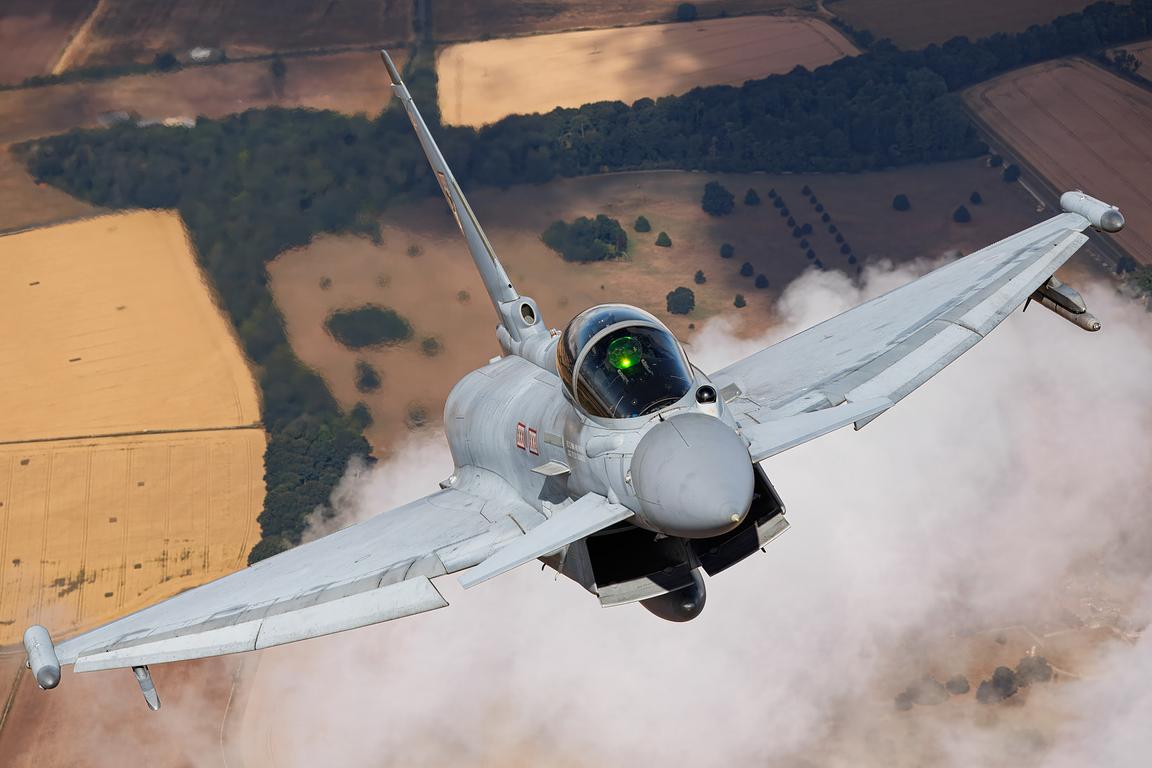
Piemags and Aviation Photo Crew photograph the Eurofighter Typhoon air to air, from a camera ship, in formation with the jets and with the cooperation of the air arms that fly them. The archive holds around 250 Typhoon frames photographed air to air across multiple air arms and multiple seasons, including Royal Air Force jets photographed during RIAT sessions and Luftwaffe aircraft, among them special-scheme jets, photographed near Wittmund. Every frame was shot from the ramp of a Short Skyvan camera ship with the fighters formating alongside, which is the one kind of Typhoon photography that airshow fences and spotting hills cannot produce.
This guide is written for the people who buy pictures: researchers on defence titles, art editors at aerospace and enthusiast magazines, communications teams in the defence industry, and designers who have been handed a brief that says “European fighter, strong, clean, rights sorted” and a deadline that says tomorrow. It explains why the Typhoon keeps earning its place on covers, what is actually in the collection, how the flying is done, how to caption the results without embarrassment, and how licensing works when you deal directly with the photographers who hold the copyright.
- Why the Typhoon sells: one of Europe’s front-line fighters
- The scarcity problem: ground coverage everywhere, air-to-air almost nowhere
- The collection: around 250 air-to-air frames across air arms and seasons
- Special schemes and why they sell
- How air-to-air photography of a fast jet is flown
- Honest captioning for Typhoon imagery
- An angle guide for designers
- Three worked example briefs
- Technical quality and licensing
- A buyer’s Typhoon checklist
- Frequently asked questions
- Sources and further reading
Why the Typhoon sells: one of Europe’s front-line fighters
The Typhoon is one of Europe’s principal front-line fighters. It stands quick reaction alert for the Royal Air Force, for Germany, for Italy and for Spain, and it serves with export operators beyond the four partner nations. When a European government talks about air defence, when an intercept makes the evening news, when an exercise fills a week of trade coverage, the aircraft in the story is very often a Typhoon. For a picture buyer that means one simple thing: the type is a permanent news peg, and it will remain one, because the Typhoon is planned to remain in RAF service to 2040 and in partner nation service well beyond that.
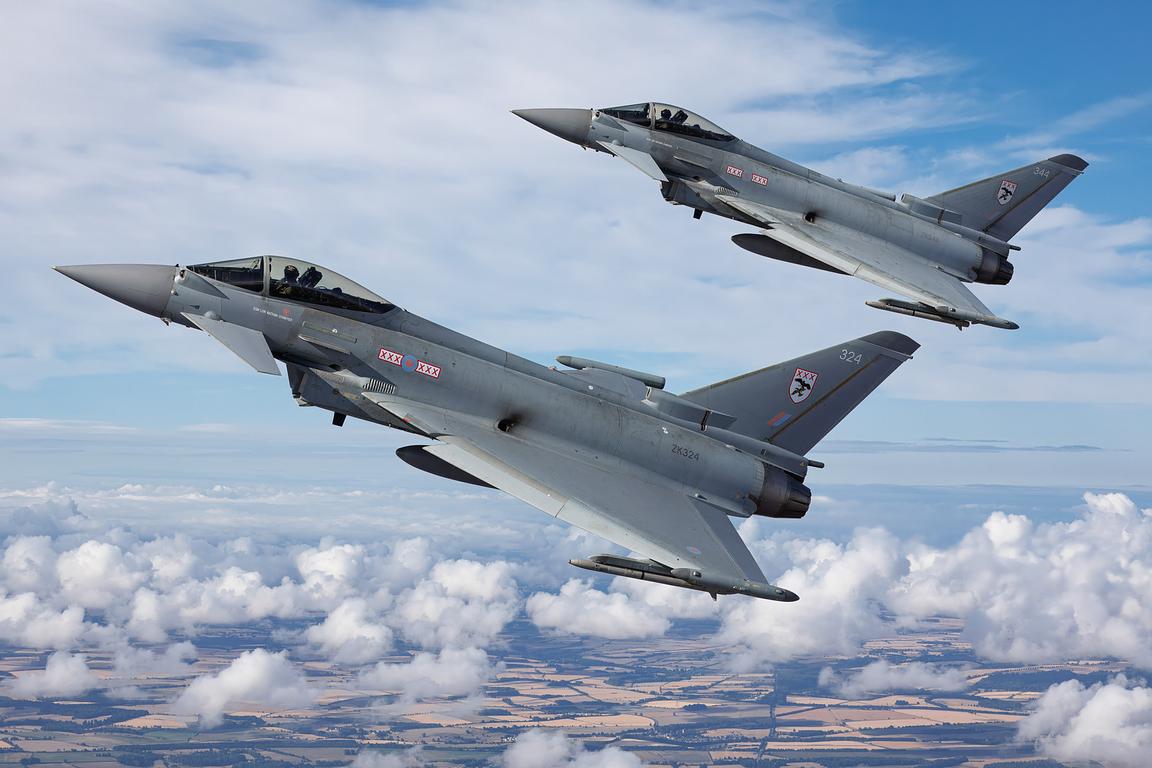
Demand for clean Typhoon imagery comes from three directions at once. Defence media need the type constantly, for news stories, analysis features and the endless cycle of procurement and policy coverage that surrounds any front-line aircraft. The aerospace industry needs it for communications: the Typhoon is built, sustained and upgraded by a supply chain that reaches across Europe, and every company in that chain produces reports, brochures, exhibition stands and websites that want the aircraft looking its best. And the airshow and enthusiast market never stops: monthly magazines, annuals, partworks, calendars and books all consume fighter photography at a rate that surprises people outside the trade.
What all three markets share is a preference for imagery that does not look like everyone else’s. A Typhoon on a runway with a heat haze behind it is a photograph anyone can take. A Typhoon in its element, above cloud, wingtip to wingtip with the camera, is a photograph very few people are ever in a position to take, and it reads differently on a page. Art editors know the difference at a glance, which is why the same handful of air-to-air frames tend to circulate through the big titles while thousands of ground shots go unused. The commercial case for this collection is that it puts a fresh, deep set of those rare frames in front of buyers, with one copyright holder and no rights chain to untangle.
There is also a longevity argument. A photograph of a current front-line fighter does not date the way an airliner photograph does. The Typhoon airframes photographed in these sessions will still be flying, and still be making news, many years from now, so a licence bought today illustrates stories for the life of the aircraft. Buyers who bookmark a reliable Typhoon source are not solving one brief, they are solving a category of brief that will recur for the rest of their careers.
The rhythm of that demand is worth understanding, because it is what makes a Typhoon licence a repeatable purchase rather than a one-off. Air policing deployments generate coverage in waves, exercises generate it in seasons, and industry news, upgrades, contracts and export decisions, generates it year round. Each wave sends the same picture desks looking for the same thing at the same time: a strong, current, correctly identified Typhoon frame that has not already appeared on every rival page. Titles that hold a bookmarked source simply move faster than titles that start each cycle with a cold search, and the difference shows in what reaches the page first.
The scarcity problem: ground coverage everywhere, air-to-air almost nowhere
Typhoon photography is not scarce. Good air-to-air Typhoon photography is. Every airshow season produces tens of thousands of ground-based frames: display routines shot from the crowd line, taxiing jets, static park walkarounds. Stock platforms are full of them, and for some uses they are fine. But they all share the same limitations: cluttered backgrounds, crowd-line angles, heat haze, and a sameness that comes from hundreds of photographers standing in the same place pointing at the same routine.
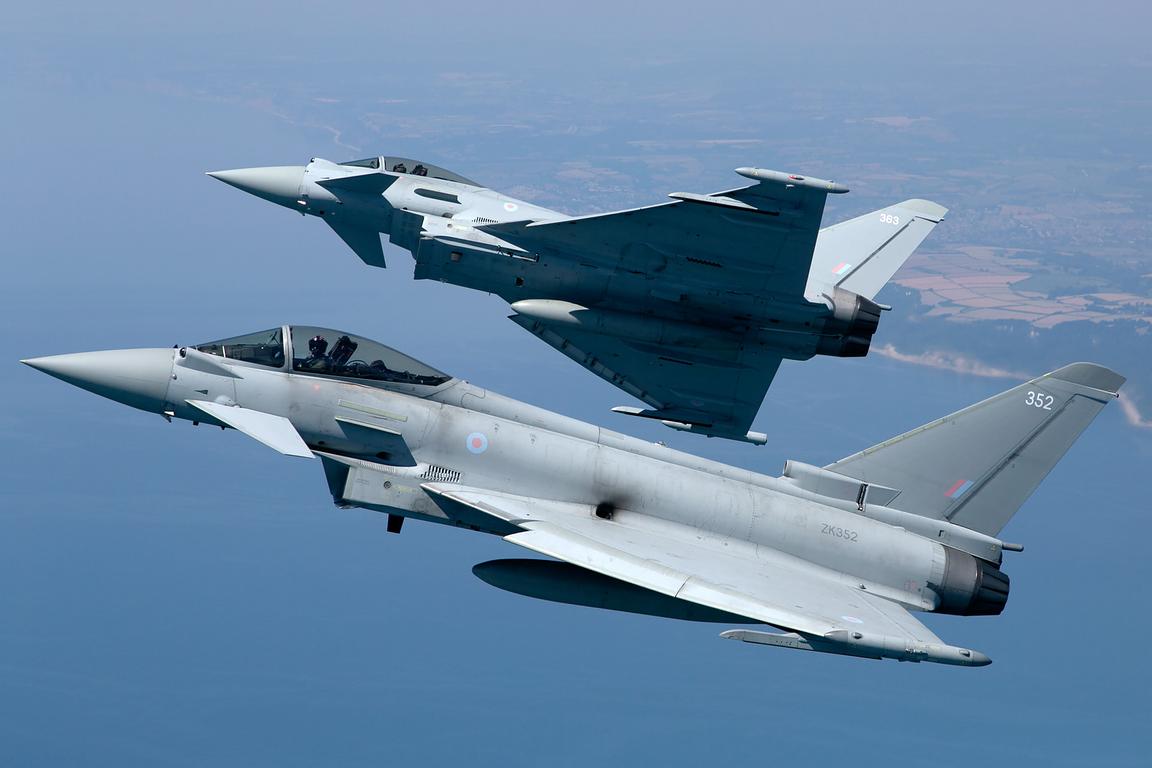
Air-to-air coverage is a different economy altogether. A supersonic fighter cannot be photographed in the air by accident. Someone has to plan a camera-ship sortie: an aircraft with an open ramp or door, a crew cleared to fly it, an air arm willing to commit jets and pilots to a photographic task, a formation briefing, weather, timing, and airspace. Each of those requirements filters out almost everyone, which is why the worldwide supply of properly flown Typhoon air-to-air imagery is a trickle rather than a stream. The frames that do exist are mostly held by air arms themselves or by a small number of specialist crews who are invited to fly these sorties.
Official imagery fills part of the gap, but only part. Air arms release their own air-to-air photography, and some of it is excellent, but it is released on the operator’s terms, at the operator’s resolution, on the operator’s schedule, and the usage conditions attached to official material do not always stretch to the commercial uses that industry communications teams need. A defence contractor building a campaign, or a publisher planning a cover, generally wants a simple commercial licence from a copyright holder who can grant one, and that is a different product from a press-office handout, however handsome the handout may be.
For a picture researcher the practical consequence is familiar. Search any general library for “Eurofighter Typhoon” and the results run to pages, but filter for air-to-air, for print resolution, for accurate identification and for a clean licensing position, and the field collapses to a handful of suppliers. This collection exists to be one of them, and to be the easy one to deal with: browsable galleries, embedded metadata, direct licensing and a photographer answering the email.
The collection: around 250 air-to-air frames across air arms and seasons
The archive holds around 250 Typhoon frames, all photographed air to air, gathered across multiple air arms and multiple seasons. That number matters because depth is what separates a usable collection from a lucky sortie. One good session produces a dozen strong frames of one jet in one light. A collection built season after season produces choice: different air arms, different schemes, different weather, different angles, and enough variety that a researcher can match a frame to a brief rather than bending a brief around the only frame available.
The Royal Air Force coverage includes sessions flown in connection with RIAT, with FGR4s photographed in pairs and singles above cloud. These are the frames that answer most UK-facing briefs: the national insignia is unmistakable, the jets are clean and current, and the above-cloud backgrounds keep the compositions timeless. Pairs formating together give designers the strongest sense of a front-line force at work, while single-ship frames isolate the shape for covers and posters.
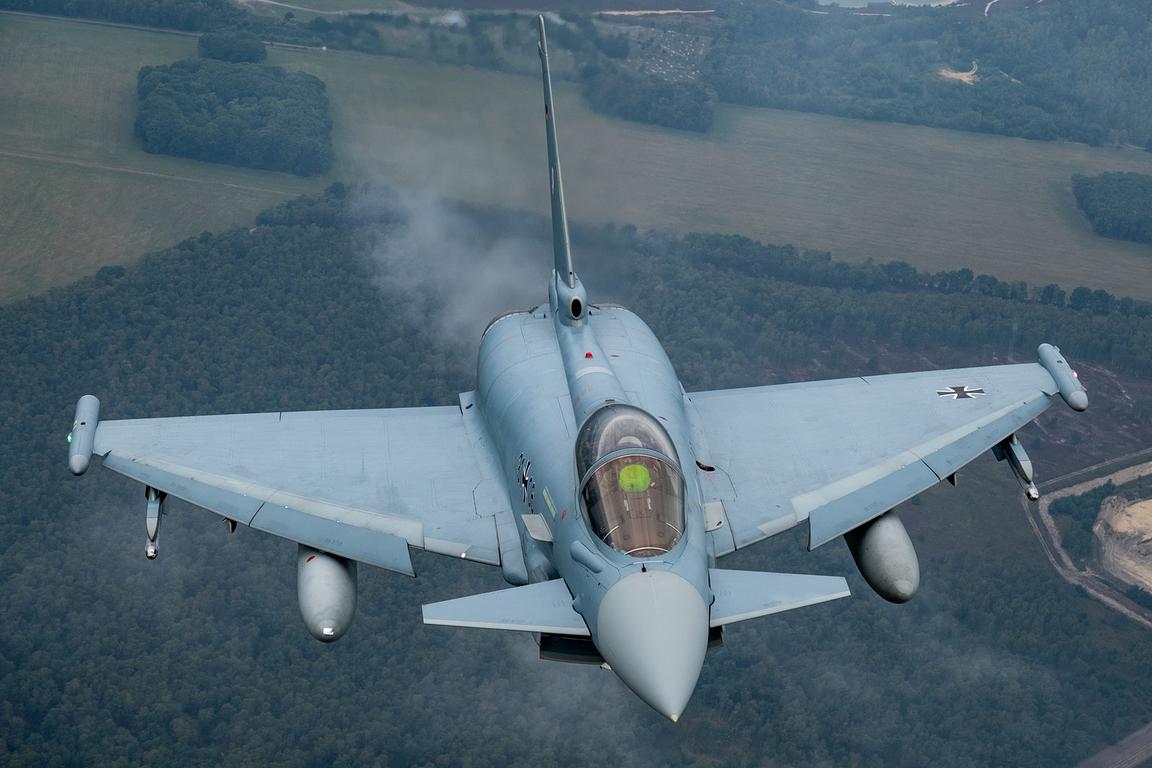
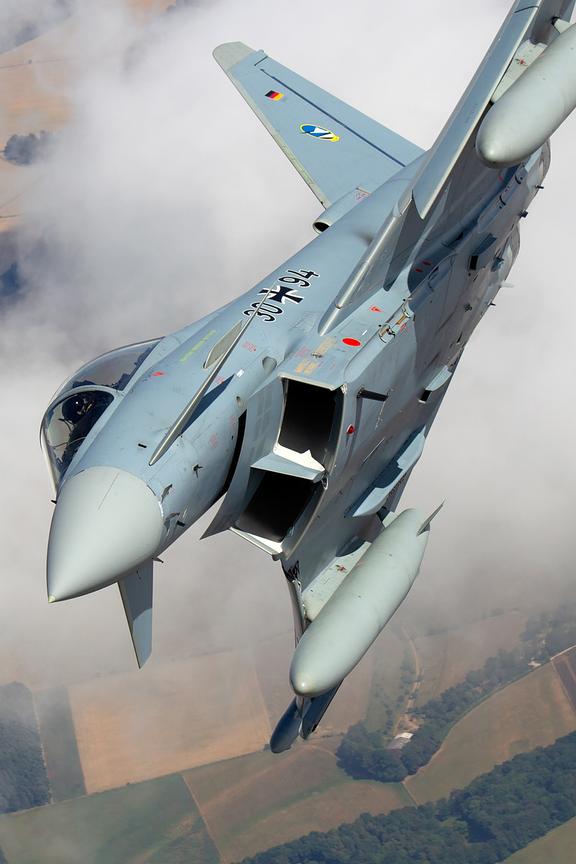
The Luftwaffe coverage was photographed near Wittmund in northern Germany, and it includes jets wearing special schemes alongside standard air-defence grey. The German sessions produced some of the most varied material in the collection: pairs with decorated tails, a full topside planform shot directly overhead, and a head-on frame of a Typhoon pulling into the vertical with reheat plumes behind it, which is the kind of image that makes an art editor stop scrolling.
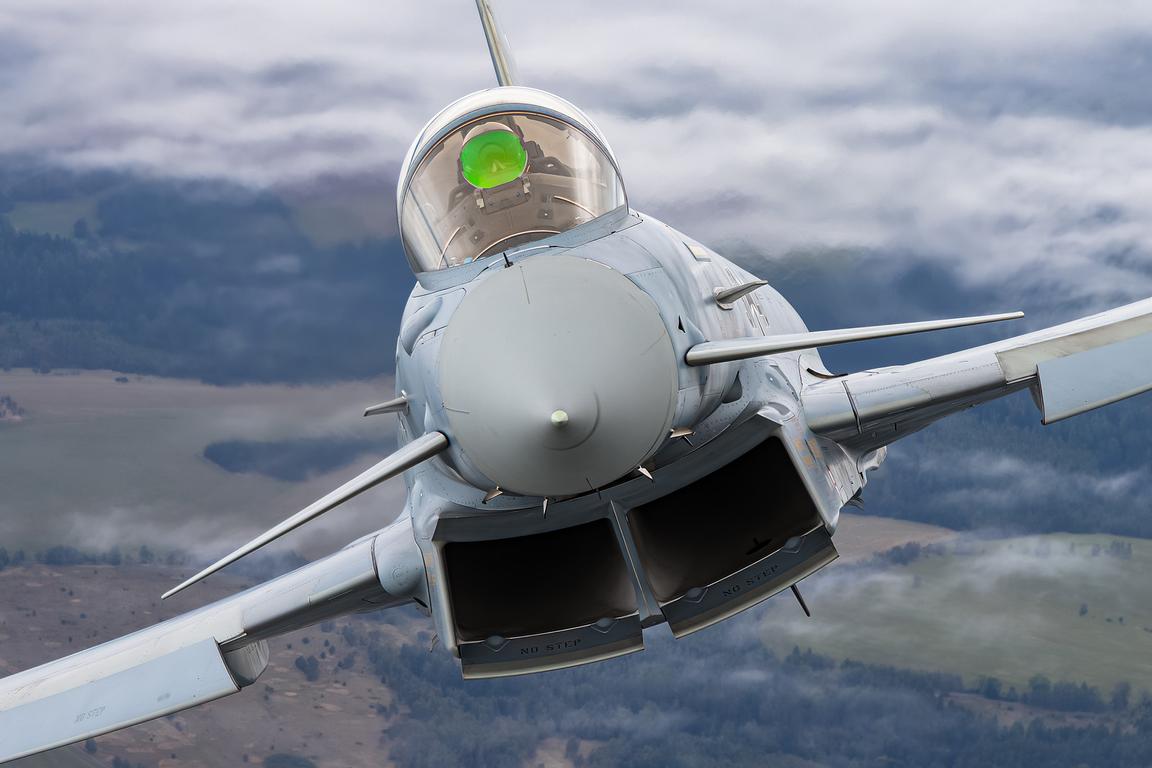
Around the formation work sits a layer of close detail: an extreme head-on study of intakes and canards filling the frame, and tight passes that isolate the intake and wing geometry. These frames rarely lead a feature, but they earn their keep as section openers, chapter furniture and the texture that makes a long layout feel considered rather than assembled. Every frame in the collection was shot from the Skyvan camera ship, from the same open ramp, by photographers whose entire specialism is this kind of flying.
Multiple seasons also means multiple kinds of light and weather, which is a practical asset that only reveals itself when a layout comes together. Above-cloud sessions deliver the clean white floors and blue ceilings that keep a composition timeless and give designers empty space for type. Lower sorties put landscape and sea under the jets and anchor them to a place, which suits features about basing, exercises and national air defence. Soft light flatters the airframe’s curves and lets a special scheme carry the frame; hard light gives edge and glint for covers that need to shout. A researcher can therefore match not only the aircraft and the angle to a brief, but the mood, and mood is usually the difference between a frame that fits a layout and a frame the layout has to be built around.
Special schemes and why they sell
Air arms periodically paint individual jets in special schemes: decorated tails, commemorative colours, designs that mark an occasion for a unit or a base. Whatever the occasion, the commercial effect is the same. A special-scheme jet is a limited edition. It exists for a season or two, it is repainted, and every photograph of it becomes a record of something that no longer flies in that form. Collectors and enthusiast publishers treat these jets as events in themselves, and editorial desks like them because a decorated tail turns a generic fighter picture into a specific, dateable, captionable one.
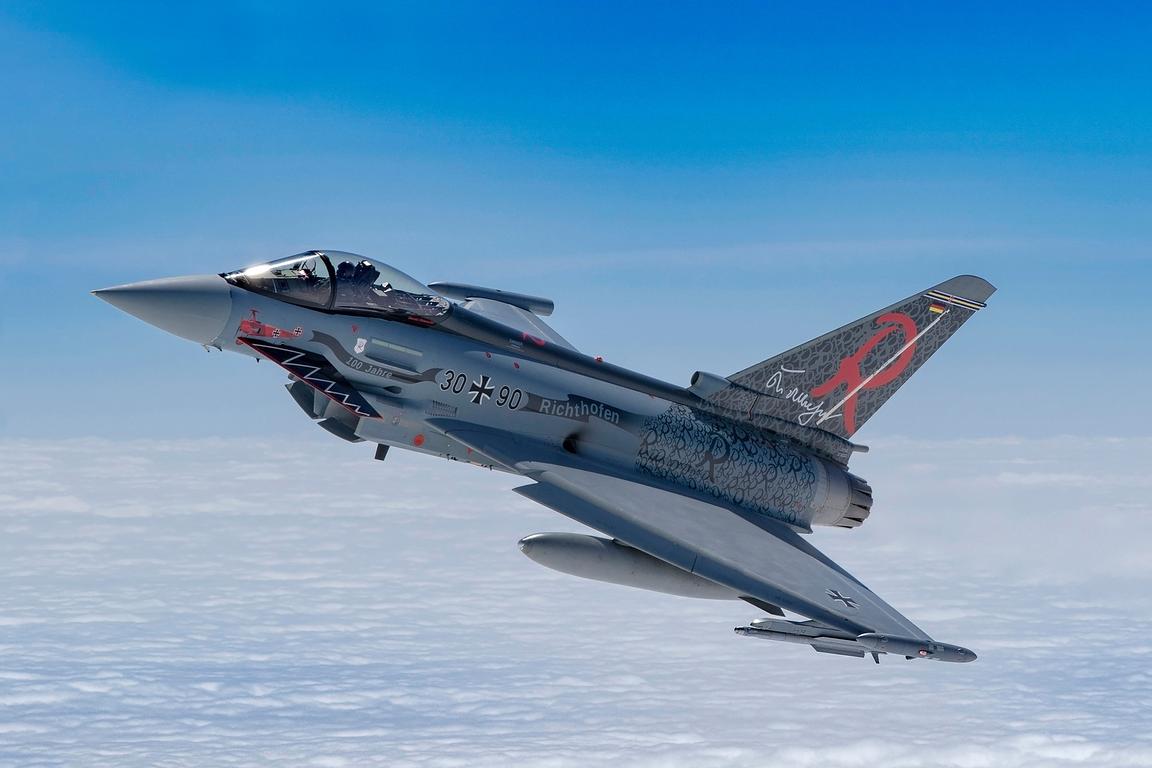
The collection includes Luftwaffe special-scheme jets photographed air to air near Wittmund, both alone and in mixed pairs with standard-scheme aircraft. The mixed pair is a quietly valuable composition: the grey jet anchors the frame as the everyday reality of the force, and the decorated jet lifts it into something worth a double-page spread. On the ground, a special tail is photographed by everyone at the fence on the same afternoon and the market is flooded by the weekend. In the air, formating with a camera ship, the same jet exists in a handful of frames held by one copyright holder, which is a very different proposition for a buyer who wants imagery their competitors do not have.
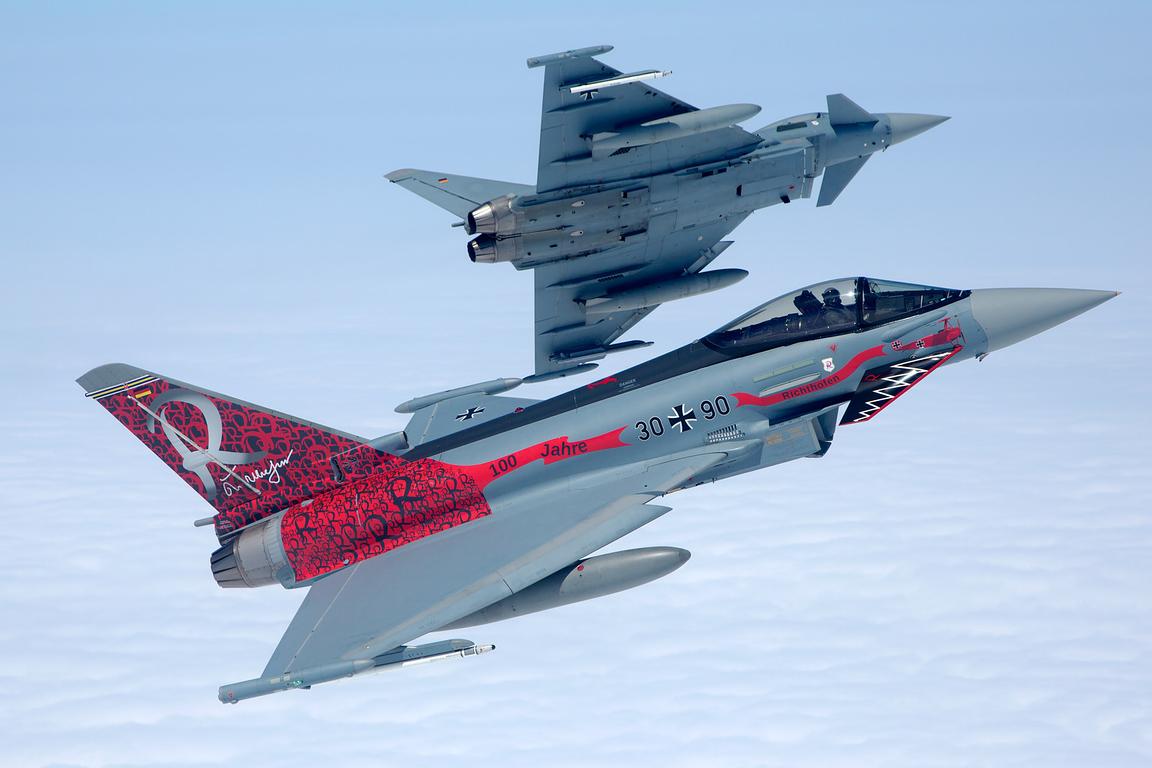
A note of caption discipline belongs here, and it is expanded below: describe these jets as special-scheme aircraft unless the specific occasion has been verified from the operator. The scheme is the saleable fact. The story behind it should only appear in print when it has been checked, because decorated tails are exactly the place where confident guesses go wrong. The gallery metadata records what was photographed and when, which is the honest foundation for whatever caption a title chooses to build.
How air-to-air photography of a fast jet is flown
Photographing a fighter from another aircraft is a formation flying task before it is a photographic one. The camera ship used for these sessions is a Short Skyvan, a boxy twin turboprop whose virtue is a rear ramp that opens in flight, giving the photographers an unobstructed view aft with the jets arranged behind and beside it. The Skyvan flies a planned line at its own modest cruising speed, and the Typhoons come to it.
That last point is the part that surprises people outside the trade. A Typhoon formating on a Skyvan is flying far below its natural cruise, so the jets fly the join with flap extended, holding station at camera-ship speeds with power and small corrections. It is precise, briefed, deliberate flying, flown by pilots for whom close formation is a core skill, and it is the reason air-to-air fighter photography cannot be improvised. Every position the jets take, every echelon change, every break, is agreed on the ground before anyone walks to an aircraft, and the photographers work through the planned sequence as the formation moves around the ramp.
Photographically, jets are in one way kinder than the warbirds this crew also flies with. A propeller aircraft must be shot at slow shutter speeds to keep the propeller disc blurred and alive, which throws away sharpness on every frame. A jet has no propeller to flatter, so faster shutters are usable, and the technical hit rate climbs: frames come back critically sharp from wingtip to fin, even in the bumpy air behind a camera ship. What the jets give in shutter speed they take back in discipline. Close passes and repositioning happen with real energy, the safe distances are absolute, and the window for any given composition may be seconds long. The craft is in having the sequence, the settings and the framing already decided when that window opens.
For a buyer, the reason to care about any of this is provenance and quality. These are not lucky frames snatched from a public display. They are the product of planned sorties flown with the air arms’ cooperation, which is why the compositions exist at all, why the files stand up at print resolution, and why the licensing position is clean enough to put in front of a client’s legal team without a second email.
Honest captioning for Typhoon imagery
Aviation readerships are unforgiving, and the Typhoon invites a particular set of captioning mistakes. The safe method is to caption what the metadata supports and nothing more. The air arm is identifiable from the markings and is recorded with each frame: Royal Air Force jets in this collection are FGR4s, the RAF’s multi-role designation for the type, and the German jets are Luftwaffe aircraft photographed near Wittmund. Type, operator and session information travel with the files, so a caption can be written and checked without guesswork.
The mistakes to avoid are the confident extras. Do not attach a squadron identity unless it has been verified for the date of the photograph, because jets move between units and tail markings are not always what they seem. Do not describe a special scheme as marking a particular occasion unless the operator’s own account has been checked; “wearing a special scheme” is accurate, saleable and safe. Do not caption a photographic sortie as an operational one. These frames show fighters formating on a camera ship by arrangement, and captions such as “on patrol” or “scrambling to intercept” invent a context the photograph does not carry. The honest caption, “photographed air to air during a camera-ship sortie”, has the advantage of also being the more interesting fact.
None of this diminishes the imagery. It protects it, and it protects the title using it. A publication that captions accurately builds trust with exactly the readership that buys fighter coverage, and a communications team that avoids overclaiming gives its legal reviewers nothing to strike out. The archive’s job is to make accuracy effortless by recording the facts at source; the buyer’s job is simply not to add to them.
In practice the workflow is short. Open the frame in the gallery, read the recorded operator and session details, and write the caption from those facts alone: air arm, type, the air-to-air context, and the location of the session where it is recorded, as with the Wittmund material. If a title’s house style wants more colour, the colour should come from the story the feature is telling, not from speculation about the jet in the picture. A caption assembled this way takes two minutes, survives the letters page, and never needs a correction, which over a year of issues is worth more than any single dramatic claim.
An angle guide for designers
Different pages need different geometry, and the Typhoon’s canard-delta shape rewards each angle differently. Knowing which family of frame answers which layout problem saves a research hour, so this section walks the collection by angle rather than by aircraft.
Head-on frames are cover material. Straight down the intakes, canards spread either side of the nose, the delta reduced to a blade: the head-on Typhoon is symmetrical, aggressive and instantly legible at thumbnail size, which is exactly what a newsstand cover or a report front demands. Head-ons also crop vertical better than any other angle, because the energy of the composition runs down the centreline, leaving sky above the fin for a masthead and space below for cover lines. The collection’s head-on set runs from formation distance down to an extreme close study, and includes the vertical pull described earlier for briefs that want raw performance rather than menace.
Topside planforms are spread material. Shot as the jet passes directly overhead or banks away from the ramp, the full planform shows the delta wing, the canards and the twin engines in one clean graphic shape, and it carries a double-page spread with the gutter falling harmlessly through the fuselage. Planforms are also the frames that survive designers’ interventions best: they tolerate type overlaid on the wing, they read correctly when flopped is not an option because of markings, and they keep their drama at large sizes where a side-on view can flatten out.
A word on crops, because the practical formats matter as much as the angles. Most of the collection is shot horizontal with generous margins, which means verticals can be cut from horizontal originals without starving the composition, portrait covers can come out of landscape frames, and square social crops survive without amputating a wingtip. Frames intended for spreads keep the aircraft clear of the centreline so the gutter falls through sky or fuselage rather than through a canopy. None of this is accidental; photographers who work for publication frame with the page in mind, and it shows most when a designer is fighting a deadline rather than admiring a photograph.
Details are furniture. The tight frames of intake and wing geometry, and the close-pass studies, are the material for section openers, contents pages, chapter dividers and the quarter-page slots that every long feature generates. Using genuine air-to-air detail in these slots, rather than cropping a ground shot until it pixelates, is one of those small production decisions that makes a whole title feel more expensive. Pairs, finally, are the storytelling frames: two jets banking together above cloud or holding formation over the sea say “force” rather than “aircraft”, which is usually what a defence feature is actually about.
Three worked example briefs
How the archive answers real requests is easier to show than to describe, so here are three worked examples of the kind of brief that arrives on a picture desk or in a communications team’s inbox. Each follows the same shape: what the buyer needs, which family of frames answers it, and why the rights position holds up under the scrutiny that particular buyer will face. The details are invented; the pattern is not.
The defence magazine cover. A monthly needs a cover for a European air power analysis issue: portrait format, room for a masthead and three cover lines, instant recognition for a professional readership. The answer is a head-on frame cropped vertical, either the extreme close study for menace or the vertical pull for energy. The caption inside identifies the air arm from the metadata, the cover needs no caption at all, and because the frame is air to air rather than a crowd-line shot, the issue does not look like the competitor title on the shelf beside it.
The industry communications spread. A company in the Typhoon supply chain needs a double-page opener for its annual report, with confident, current imagery of the aircraft its components fly on, and a rights position its legal team can sign off for commercial use. The answer is the overhead topside planform or the pair over the sea: clean backgrounds, no visible third-party branding to argue about, and a single direct commercial licence from the copyright holder. The legal review takes one reading because there is no agency chain and no ambiguity about who took the photograph and who can license it.
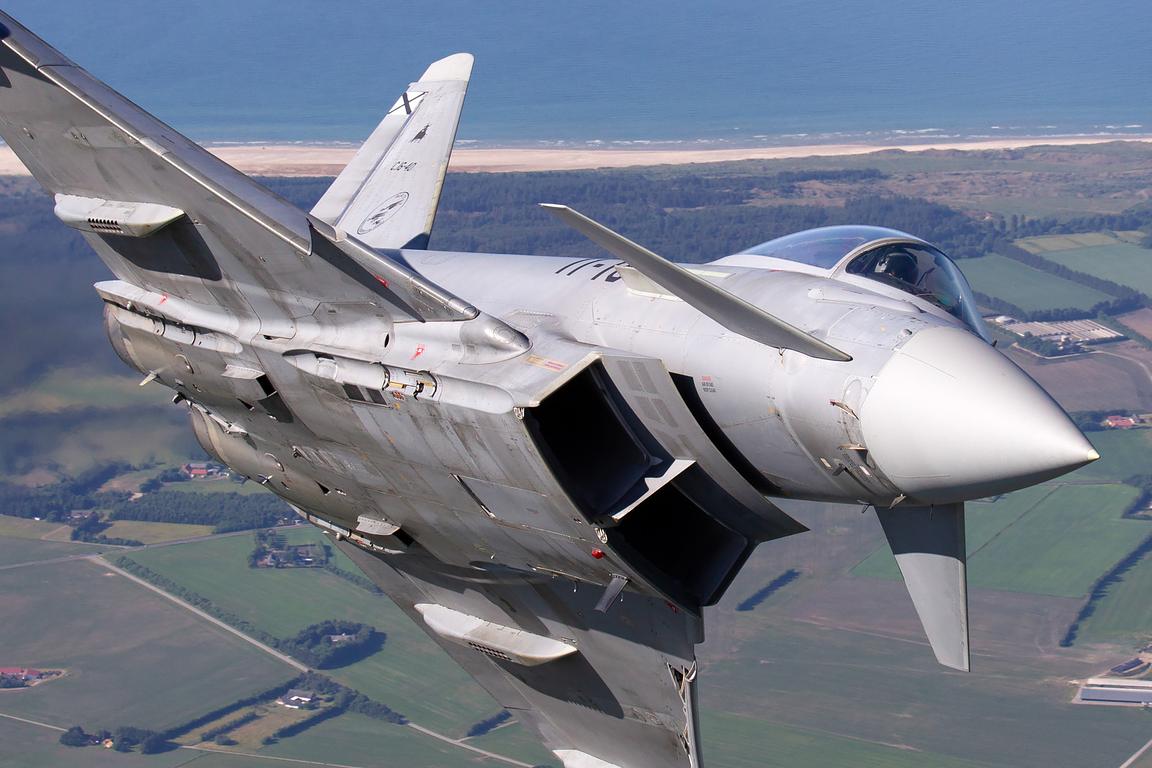
The enthusiast feature. A magazine is running a feature on special-scheme Typhoons and wants imagery that is not the same ramp shots every reader has already seen online. The answer is the Luftwaffe material from Wittmund: the mixed pair with one decorated tail, and the red-tail formation frame. Air-to-air coverage of a special-scheme jet is rare enough that the feature leads with something collectors will keep, and the captions stay safe by describing the schemes as special schemes and letting the operator’s own account, where verified, supply the story.
A fourth, for the awkward ones. Sometimes the brief asks for something the galleries do not yet hold: a particular operator, a particular angle, a particular season. Ask anyway. The archive grows every year, the crew flies new camera-ship sessions each season, and requests from real buyers shape what gets flown next. A brief that cannot be answered today has more than once been answered by the following autumn.
Technical quality and licensing
The Typhoon collection is shot on current full-frame equipment and delivered as high-resolution files suitable for double-page print, exhibition enlargement and broadcast. Because jets allow faster shutter speeds than propeller subjects, the technical hit rate is high and the files are critically sharp at native size. Operator, type and session information are embedded in the files and shown in the gallery metadata, so a frame arrives in an editorial system already labelled, and the credit line, Photo: Aviation Photo Crew, is short enough to survive the tightest layout.
Licensing is direct and simple. The browsable index of what exists lives in the galleries at professionalaviationphotography.com/-/galleries, editorial and commercial terms are explained in plain language at our licences page, and Piemags supplies the same imagery agency-style for publishers who prefer that route via piemags.com. Standard licences are available for instant download, so a researcher working at deadline can go from search to licensed file in minutes rather than waiting on an office to open. For covers, campaigns, exclusivity discussions and anything unusual, a direct conversation with the photographers settles terms quickly, because the people answering the email are the people who took the pictures and hold the copyright.
The instant-download route deserves a sentence of its own, because it changes how a deadline evening goes. A researcher who finds the right frame at nine in the evening does not need to wait for a rights department in another time zone; the standard licence is agreed on screen, the payment goes through, and the full-resolution file is on the server before the layout closes. The direct route exists for everything the standard terms do not cover, and the two run side by side: speed when speed is the point, conversation when the brief needs one.
On price, the position is worth stating plainly: pricing is negotiable, and we will match or beat what you pay other aviation agencies. The archive is building long-term relationships with the desks and teams that buy fighter imagery repeatedly, and founding-customer rates are available for early buyers who set up an account while the collection is new. A researcher who licenses one Typhoon frame this month at a fair rate, and finds the process painless, is worth more to this archive than any single invoice, and the pricing reflects that.
There is no third-party rights chain behind any of it. The photographers are the copyright holders, and the photography was arranged with the cooperation of the operating air arms when the sorties were flown. For editorial use that means clean provenance; for commercial use it means the licence, the territory and the duration go into a single agreement with one signature on the supplier side, which is the paragraph that closes most commercial conversations faster than any thumbnail.
A buyer’s Typhoon checklist
Before licensing any Typhoon photograph, from any source, five questions are worth a minute each. First, is it air to air or ground based, and does the brief deserve the difference? Second, is the operator identified from the markings and recorded in the metadata, so the caption can be checked? Third, if the jet wears a special scheme, is the caption limited to what has been verified? Fourth, is the provenance clean, one copyright holder, no unclear chain, and terms a legal team can read in one sitting? Fifth, is the resolution honest for the intended size, a real file rather than an upscaled crop? Any frame from these galleries answers all five, and any source that cannot answer them deserves caution however good the thumbnail looks.
The Typhoon will be flying, intercepting and making news for decades to come, and the archive’s job is to keep pace with it, season by season and air arm by air arm, so that the best available air-to-air photography of Europe’s front-line fighter is always one enquiry away. Around 250 frames is a strong foundation; it is not a finished collection, and the next season’s sorties are already being planned.
One final point about the market itself. Typhoon imagery is not scarce; good Typhoon imagery is. Search any general platform and the results run to thousands, but apply the filters that matter, air to air, print resolution, accurate identification, clean rights, and the field narrows to a handful of suppliers worldwide. That is the practical case for bookmarking a specialist source before the next news cycle arrives rather than during it, and it is the whole argument of this guide in two sentences.
The aircraft’s story, from four-nation programme to the backbone of European air defence, is told in full in our Eurofighter Typhoon history. If your work is finding and clearing imagery for a living, our guide to aviation picture research covers the craft in general, and if the brief on your desk concerns the other fast jet dominating current coverage, the companion guides to F-35 photographs and F-4 Phantom photographs apply the same thinking to those types. Bookmark whichever you need; the Typhoon, at least, will still be here when you come back.
The browsable index of the Typhoon collection, alongside the rest of the air-to-air archive, is at the Aviation Photo Crew galleries. Editorial and commercial terms are set out on the licences page, and agency-style supply for publishers runs through the Piemags image library. Background reading on the aircraft itself is in our Eurofighter Typhoon history.
Requesting images. Email sales@piemags.com with the subject you need, the medium, the territory, the print run or audience, and your deadline. That is enough to quote against. Licensing terms are set out on the Piemags licences page.
Frequently asked questions
Where can I license Eurofighter Typhoon photographs for a book, magazine or website?
High-resolution air-to-air Typhoon photographs can be licensed directly from the Aviation Photo Crew galleries at professionalaviationphotography.com, with editorial and commercial terms explained plainly on the licences page. Piemags supplies the same imagery agency-style via piemags.com for publishers who prefer that route. Standard licences are available for instant download, and unusual briefs are handled by direct conversation with the photographers.
Are these photographs air-to-air or ground-based airshow shots?
All of the roughly 250 Typhoon frames in the collection were photographed air to air from a Short Skyvan camera ship, with the jets formating alongside during planned sorties flown with the air arms’ cooperation. Ground-based Typhoon coverage is plentiful everywhere; genuine air-to-air coverage of a supersonic fighter is rare, and that scarcity is the collection’s value.
Which air arms appear in the collection?
The collection covers multiple air arms across multiple seasons. Royal Air Force Typhoon FGR4s were photographed during sessions connected with RIAT, and Luftwaffe Typhoons, including special-scheme jets, were photographed near Wittmund in northern Germany. The archive grows season by season, so coverage of further operators is added as new camera-ship sorties are flown.
What resolution are the files and will they hold a double-page spread?
The collection is shot on current full-frame cameras and delivered at native high resolution suitable for double-page print, exhibition enlargement and broadcast. Because jets allow faster shutter speeds than propeller aircraft, frames are critically sharp, and generous margins in most compositions allow vertical cover crops from horizontal originals without starving the image.
Can I get exclusivity on a Typhoon image?
Exclusive and semi-exclusive arrangements can be agreed directly with the photographers, who hold the copyright outright and can therefore actually grant them. Options include exclusivity by territory, by sector or by duration. Because there is no agency chain, the terms go into a single agreement, which makes exclusivity a short conversation rather than a long one.
Do you have special-scheme Typhoons, and how should they be described?
Yes. The Luftwaffe sessions near Wittmund include jets wearing special schemes, photographed air to air both singly and in mixed pairs with standard-scheme aircraft. Describe them in captions as special-scheme aircraft unless the specific occasion has been verified with the operator; the decorated jet is the saleable fact, and accurate wording keeps the caption safe.
Can defence-industry companies use these images commercially?
Yes. Commercial licences for campaigns, annual reports, exhibition stands and corporate websites are granted directly by the copyright holders, with territory and duration set out in a single agreement. The air-to-air frames carry clean backgrounds and a clear provenance, which legal reviewers can approve in one reading, and terms are explained on the licences page.
How is pricing set?
Pricing follows use, from single editorial placements to covers, campaigns and exhibition rates, and quotes come from a photographer who knows the aircraft. Pricing is negotiable, and we will match or beat what you pay other aviation agencies. Founding-customer rates are also available for early buyers who set up an account while the collection is new.
Who owns the copyright, and is there a rights chain to clear?
The photographers of Aviation Photo Crew are the copyright holders, and the photography was arranged with the cooperation of the operating air arms when the camera-ship sorties were flown. There is no agency chain and no third-party rights position to untangle, so licensing is one direct agreement with one signature on the supplier side.
How should I caption these Typhoon photographs?
Caption what the metadata supports: air arm, type, and the air-to-air, camera-ship context. Royal Air Force jets in the collection are FGR4s; German jets are Luftwaffe aircraft photographed near Wittmund. Avoid unverified squadron identities, avoid inventing operational context such as “on patrol”, and describe decorated jets simply as special-scheme aircraft unless the occasion is verified.
Can I request an operator, angle or subject that is not in the galleries?
Ask anyway. The archive grows every season, new camera-ship sorties are planned each year, and requests from real buyers shape what gets flown next. A brief that cannot be answered from the current galleries has more than once been answered by the following season, so an enquiry costs nothing and often pays off.
How quickly can I get the files once a licence is agreed?
Immediately, for standard licences: images are available for instant download from the galleries, so a researcher working at deadline can go from search to full-resolution file in minutes. For negotiated commercial or exclusive licences, files are supplied by download link as soon as terms are agreed, with captions and credits embedded in the metadata.
