F-4 Phantom photographs of an aircraft still flying are now among the harder things to source in aviation publishing. There is no other aeroplane quite like it. Bent wings, drooped tail, two smoking General Electric J79s and a shape that looks as though it was designed by argument rather than aerodynamics, the McDonnell Douglas F-4 Phantom II is the fighter that everybody recognises and almost nobody can photograph in the air any more. Fewer than a handful of air arms still fly it, the fleets that remain are shrinking every year, and the window for making new air-to-air photographs of an operational Phantom is closing fast. This guide is for picture editors, publishers, programme makers and designers who need F-4 Phantom photographs that are current, high resolution and properly cleared: what exists, what it costs, what the licensing terms are, and what we hold from flying alongside the Hellenic Air Force’s Phantoms over Greece.

- Why F-4 Phantom photographs are getting harder to find
- What we hold: flying with the Hellenic Phantoms
- The angles buyers actually ask for
- The Hellenic Phantom: what the pictures actually show
- Technical quality and delivery
- Licensing terms in plain English
- Commissioning new Phantom photography
- Getting the caption right
- A short history for people writing about it
- Beyond the Phantom
- How to request Phantom images
- Frequently asked questions
Why F-4 Phantom photographs are getting harder to find
For thirty years the Phantom was the most photographed fighter in the world. More than 5,000 were built, and at its peak the type served with a dozen air forces across five continents, which means archives everywhere are stuffed with pictures of it. That abundance is precisely the problem for anyone commissioning today. The overwhelming majority of Phantom imagery in circulation is historic: scanned transparencies, press prints, official releases from the 1960s, 1970s and 1980s, most of it soft by modern standards, much of it duplicated across a dozen agencies, and almost none of it shot to the resolution a double-page spread or a 4K documentary now demands.
New Phantom photography is a different proposition entirely, because the aircraft that produce it are nearly gone. The United States retired its last operational Phantoms decades ago and flew the last of its QF-4 target drones at Holloman in December 2016. The final unmanned sortie, on 17 August 2016, presented the aircraft to an F-35 and brought it home. Britain’s Phantoms went in 1992. Germany flew its last F-4F sortie in 2013, Japan’s last front line Phantom squadron stood down in December 2020 and the final test aircraft went in 2021, and South Korea, the most recent of all, retired its last F-4Es in June 2024. What remains is a small and shrinking club, and Greece is its most visible member, operating upgraded F-4E AUP Phantoms with the Hellenic Air Force from Andravida, the aircraft that appear throughout this guide. Turkey remains a serious operator, flying around twenty upgraded F-4E/2020 Terminators with 111 Filo at Eskisehir on active tasking and currently planning to keep them until 2030, and Iran retains a larger but far less well documented fleet. That is very nearly the whole of it.
The consequence for buyers is simple. Every year a few more of the world’s flying Phantoms go to museums, and every year the pool of photographers who have flown alongside an operational one gets no larger. Air-to-air access is not something you can arrange retrospectively. The photographs either exist or they do not, and once the last squadron stands down, the entire genre becomes historic overnight. Publishers planning Phantom titles, documentary teams building sequences around the type, and designers needing a hero image for a cover are all drawing from a well that has stopped filling.
There is a commissioning rhythm to this too. Retirement announcements generate coverage, and so do anniversaries: the Phantom first flew on 27 May 1958, which puts its seventieth anniversary in May 2028, and the Hellenic Air Force has flown the type since 1974, a half-century-plus association that has already produced special schemes and commemorative events. Each of those moments sends picture researchers looking for exactly one thing, which is a modern, sharp, well-lit photograph of a Phantom actually flying. Those are the photographs this guide is about.
What we hold: flying with the Hellenic Phantoms
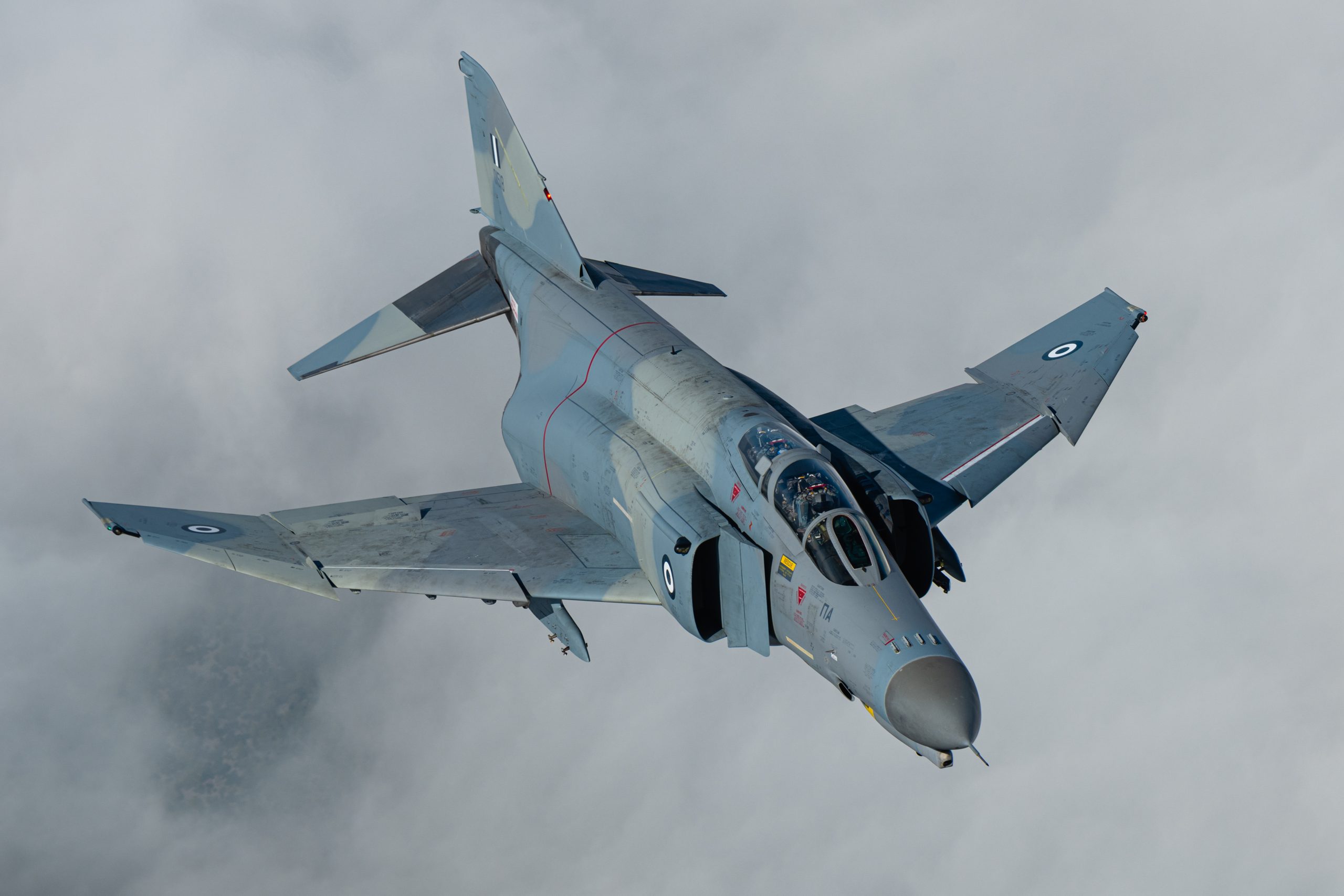
Our Phantom photography comes from air-to-air sorties flown with the Hellenic Air Force over Greece, working from a camera ship alongside F-4E AUP Phantoms of 338 Squadron. These are not airshow crowd-line pictures taken from a fence with a long lens. They are formation photographs made from a briefed position a few dozen metres from the subject, with the pilots flying to a shot list agreed on the ground before engines were started, and they look like it: clean backgrounds, controlled light angles, the aircraft filling the frame with no heat haze between camera and subject.

The sorties were flown as part of Aviation Photo Crew’s Athens work, told in full in our account of the Athens air-to-air sortie, and the results run to several hundred frames of Phantoms alone, covering the full range of angles a picture desk is likely to need. The aircraft were photographed head-on and in close formation, in side profile at the classic three-quarter and dead-beam angles, from above showing the full planform, banking away to reveal the topside, and in silhouette against storm light. There are frames over mountains, over farmland, over the Greek coast and inside towering cumulus, which matters more than it sounds: an image chosen for a book jacket needs different background from one destined for a technical caption in a reference work.
Everything is shot on full-frame professional bodies and delivered at full resolution, which for these files means 24 megapixels and up, comfortably enough for double-page spreads, exhibition prints, cover use and broadcast at any current standard. Files are supplied as high-quality JPEGs by default, with TIFFs available on request for print production, and each carries complete embedded metadata: aircraft type and variant, registration and serial where visible, unit, location, date, and a caption written to editorial standard rather than to search-engine keywords.
The angles buyers actually ask for
Picture research for an aircraft type is more specific than most people outside the trade realise. Editors rarely ask for “a Phantom”. They ask for a Phantom doing a particular thing at a particular angle, because the layout or the script has already decided what the picture must contribute. Over years of supplying this material, the same requests recur, and the collection is built around them.
The side profile is the workhorse. A clean beam-on view with the whole aircraft sharp, wings level or nearly so, is what reference books, technical features and specification pages need, because it shows the shape the reader is being told about. For the Phantom it is also the angle that best displays the type’s defining oddities: the anhedral tailplane drooping at 23 degrees, the dihedral outer wing panels, and the long, drooping radar nose.

The head-on frame sells drama. A Phantom coming straight at the camera, intakes gaping either side of the nose, is the image that ends up on covers and title sequences, and it is one of the hardest to make, because it requires the subject aircraft to fly directly at a camera ship while both remain safely separated, which in turn requires briefing, trust and a formation-qualified crew.
The topside or planform view is the specialist’s picture. Shot from above while the subject banks, it reveals the wing shape, the upper-surface panel lines and the full extent of the camouflage or squadron markings, which makes it indispensable for anyone illustrating a scheme, drawing a profile or building a model reference feature.
The atmospheric frame covers everything else: silhouettes, backlighting, cloudscapes, and aircraft placed small in a big landscape. These are the pictures art directors reach for when they need mood rather than information, and they are the ones that most often end up filling a spread with the text running across the sky.
Finally there is the crew and detail material, close-ups of the cockpit with two helmeted figures visible, of the nose art, unit badges and the weathered panels that tell you an airframe has been working for fifty years. Documentary producers in particular ask for these constantly, because they cut between wide shots and give an editor somewhere to go.
The Hellenic Phantom: what the pictures actually show
The aircraft in these photographs are F-4E AUP Phantoms, and the designation matters when you are writing captions. Greece received its first Phantoms in 1974 and has operated the type continuously ever since, one of the longest unbroken associations any air force has with the aircraft. From 1997 a substantial upgrade programme, the Avionics Upgrade Programme from which the AUP suffix comes, was contracted with DASA of Germany and carried out with Hellenic Aerospace Industry, the first converted aircraft flying in 1999 and deliveries running on into the mid 2000s. It gave the survivors a modern multi-mode radar, new cockpit displays, updated navigation and the ability to carry current air-to-air missiles. The result is a 1960s airframe with a 1990s brain, still flying operational sorties in the 2020s from Andravida in the western Peloponnese, home of 117 Combat Wing and 338 Squadron.

What that means for a picture buyer is that these are not preserved warbirds or airshow relics. They are front-line military aircraft in current service, flown by an operational squadron, wearing standard grey camouflage with squadron markings. Captions can describe them accurately as serving aircraft, which matters for editorial use in a way that a beautifully photographed museum piece never can. It also means the aircraft carry the details that identify them, individual serials, unit badges and the small stencilling that lets a researcher confirm exactly which airframe appears in a frame.
The Hellenic Phantom is also, at this point, one of the last chances anyone will get. Greece has been modernising its fast-jet fleet, and the Phantom’s eventual withdrawal is a matter of when rather than whether. The type’s departure from Greek service will be a story in itself when it comes, and the imagery of these aircraft in the air will move from current to historic on the day it happens.
Technical quality and delivery
Air-to-air photography is unforgiving, and the technical standards behind these frames are worth spelling out because they determine what the files can be used for. Every image is shot in RAW and processed to preserve genuine detail rather than to manufacture it, which for military grey aircraft means resisting the temptation to crush shadows or push saturation into the sky. Grey-on-grey subjects reward careful exposure and punish heavy handling, and the processing here is deliberately restrained: accurate colour, clean shadow detail in the camouflage, and no aggressive sharpening that would leave halos along a fuselage edge when a print house looks at it.
Resolution is full-frame at 24 megapixels or better, delivered without downsampling. In practical terms that supports a double-page spread at 300dpi with room to crop, an exhibition print at normal viewing distance, a book cover with bleed, and any broadcast standard currently in use including 4K stills with pan and scan. Where a production needs an unusually large reproduction, files can be supplied uprezzed to specification, but the native files are large enough that this is rarely necessary.

Delivery is by direct download link, normally the same working day for anything already in the archive. Files arrive with embedded IPTC metadata containing the caption, credit line, date and location, so that the information travels with the image through a production workflow rather than being retyped, and getting lost, at every stage. If you need a particular metadata schema or a specific credit format for your house style, tell us and we will supply it that way.
Licensing terms in plain English
We license Phantom photography for editorial, commercial and advertising use, and we try to keep the paperwork proportionate. Editorial licensing covers books, magazines, newspapers, documentary and broadcast, museum interpretation and exhibitions, and educational publishing. Commercial and advertising licensing covers corporate and promotional use, packaging, merchandise and campaigns, and is quoted separately because the value depends entirely on the scale and territory of the campaign rather than on the picture.
Rights-managed is our normal basis, which means you tell us the use, the territory, the print run or audience, and the duration, and we quote for that. It keeps costs proportionate to the actual use, and it means a regional magazine is not charged as though it were a global campaign. Exclusivity is available, whether for a period, a territory or a market sector, and is quoted on request. Where a project needs something simpler, we can arrange a broader licence covering a set of images across a whole publication or series.
Pricing is negotiable, and we will match or beat what you pay other aviation agencies for comparable material. That is not a slogan. It reflects the fact that we shoot and own the work directly, without the layers of commission that sit between a photographer and a picture desk at a large agency, and it means that if you have a quote for equivalent imagery elsewhere, we would rather have the conversation than lose the commission.
Practical questions get practical answers. Turnaround for material already in the archive is normally the same working day and always within twenty-four hours. Rush requests against a deadline are welcome and we do not surcharge for them. If you need to see options before committing, we will send low-resolution watermarked selects for layout at no charge, and there is no fee for a search. Repeat and volume users are quoted accordingly, and publishers running a series can be set up on standing terms.
Commissioning new Phantom photography
If what you need does not exist, it can sometimes be made. Aviation Photo Crew flies air-to-air sorties with air arms across Europe and beyond, and while access to any operational military aircraft is a matter of official clearance rather than money, a commission with a defined editorial purpose behind it carries considerably more weight with a public affairs office than a speculative request.

The realistic timescales are worth understanding. Military air-to-air access is arranged through unit public affairs teams or defence ministries, and lead times run to months rather than weeks. The sortie itself needs a camera ship, formation-qualified crews on both aircraft, a detailed brief agreed in advance, and weather. What that buys is complete control of the result: you specify the angles, the aircraft configuration, the light and the background, and the shot list is flown to your brief rather than assembled from what happened to be available.
For a publisher planning a major title, or a production with a signature sequence to build, a commissioned sortie can be the difference between illustrating a book and defining it. Talk to us early, because the calendar constraint is almost always the access rather than the photography.
Getting the caption right
Phantom captions go wrong more often than those for almost any other aircraft, partly because the type served so widely and partly because so much of the imagery in circulation was captioned carelessly decades ago and has been copied ever since. A few points save trouble at the proof stage.
The full and correct name is the McDonnell Douglas F-4 Phantom II, with the Roman numeral, because the first Phantom was the straight-winged FH-1 of the late 1940s. In practice most publications drop the numeral after first mention and no one objects, but the first mention is worth getting right in a reference work. The manufacturer changes with the date: aircraft built before the 1967 merger were McDonnell products, and later ones McDonnell Douglas, which is why period captions vary legitimately.
Variant letters matter more than they look, and our guide to military aircraft markings and serials covers the identification groundwork. The F-4E introduced the internal cannon in a lengthened nose, which is the quickest way to distinguish it in a photograph from the earlier F-4C, D and J with their shorter, blunter noses. The AUP suffix used throughout this guide is specific to the Greek upgrade and should not be applied to any other operator’s aircraft. British Phantoms carried their own designations. The FG.1 and FGR.2 were built from the outset around Rolls-Royce Spey turbofans rather than converted to them, which required a redesigned and enlarged rear fuselage and deeper intakes and gave them a visibly fatter profile, so a caption calling an RAF Phantom an F-4E is wrong twice over. A third British type is often forgotten: the fifteen ex-US Navy F-4J (UK) aircraft flown by No. 74 Squadron between 1984 and 1991, usually captioned Phantom F.3, which kept their American J79 engines.
The two crew are a pilot in front and, in later American service, a weapon systems officer behind, historically called a radar intercept officer in Navy and Marine Corps aircraft. Early USAF F-4C crews are the exception worth knowing about, since the back seat was then occupied by a second fully qualified pilot. Neither is a co-pilot, and calling them one will draw letters. The unit convention in Hellenic service is squadron and wing, so the aircraft in this guide belong to 338 Squadron of 117 Combat Wing at Andravida, and a caption that names the base without the squadron is incomplete rather than wrong.
Finally, be careful with the word retired. The Phantom has been retired by many air forces and remains in service with a few, so a blanket statement that the type is no longer flying will be out of date in one direction or the other. Our captions state the operator, the date and the location precisely so that a sub-editor can write around them without guessing, and if you need a caption expanded, checked or rewritten to house style, ask and we will do it.
A short history for people writing about it
The Phantom exists because the United States Navy in the mid 1950s wanted a fleet defence interceptor and got something considerably more useful. The prototype flew on 27 May 1958, and what emerged was a large, brutally powerful two-seat aircraft with no gun, enormous fuel capacity and a radar big enough to matter, capable of carrying a bomb load comparable to a wartime heavy bomber. It set world records for speed and altitude almost immediately, and the Air Force, which had shown no interest at all in a Navy fighter, adopted it in 1962 and eventually bought more of them than the Navy did.
Vietnam made the aeroplane’s reputation and exposed its flaws. Missile-only armament proved a poor idea in a war of close manoeuvring combat, which is why the F-4E arrived with a cannon in its nose, and the Phantom’s smoky engines announced its arrival from miles away. It nonetheless did everything asked of it, flying air superiority, ground attack, reconnaissance in the RF-4 variants and the dangerous Wild Weasel radar-suppression mission in the F-4G, and it produced the American aces of that war.
Export success followed on a scale few aircraft have matched. Britain, Germany, Israel, Japan, Iran, Turkey, Spain, South Korea, Egypt and Greece all flew Phantoms, and Australia leased two dozen from the USAF between 1970 and 1973 while it waited for its F-111s. By the end of production in 1981 the total had passed 5,000 airframes. That reach is why the type appears in so many national stories, and why illustrated books about air forces from a dozen countries all need Phantom pictures.
Greece received its first F-4Es in 1974 and has flown them longer than almost anyone. The AUP upgrade contracted in 1997 bought decades more life, and the result is the aircraft in these photographs: an airframe designed in the Eisenhower administration, carrying avionics contracted in the Clinton years, flying operational sorties in the 2020s alongside F-16s and Rafales. It is, by any measure, one of the most successful combat aircraft ever built, and the last operational examples are worth photographing while they are still there to photograph. Our full history of the F-4 Phantom II covers the story at length, with the sources set out.
Beyond the Phantom
The Phantom is one type among many in the archive. The same air-to-air programme has produced current photography of front-line fighters across NATO and beyond, including Typhoons, F-16s, F-35s, Mirage 2000s and Gripens, alongside transports and tankers, helicopters and a substantial warbird collection. For buyers illustrating a broader feature, that means a single source and a single licence covering several types shot to the same standard, rather than assembling a picture package from four agencies with four sets of terms.

Several companion guides go into detail on other parts of the collection, including our guides to licensing Eurofighter Typhoon photographs, helicopter photographs and early aviation photographs from the pioneering era. Picture researchers new to aviation subjects may also find our guide to aviation picture research useful, and the Phantom’s own story is told at length in our history of the F-4 Phantom II.

How to request Phantom images
The quickest route is to tell us what the picture has to do. A message describing the project, the aircraft or variant you need, the angle or mood, the intended use and the deadline will normally come back the same working day with a selection of low-resolution files for layout and a price for the use you have described. If you would rather browse first, the air-to-air collection including the Hellenic Phantom sorties is in our galleries, and full terms are set out on our licences page.

A selection of the Phantom photography is also available through our Alamy collections, where individual frames of the Hellenic F-4E can be licensed directly from the Piemags collections on Alamy if that suits your procurement process better. For anything beyond a single-image licence, and certainly for volume use, series work or exclusivity, come to us directly through piemags.com, where the terms are more flexible and the pricing is negotiable.
One closing thought for anyone weighing a Phantom project against a deadline further out. The aeroplane in these photographs has been flying since before most of the people reading this were born, and it will not be flying for very much longer. Photographs of it in the air, made this decade, at full resolution, with a licence you can rely on, are a diminishing commodity. If the Phantom is in your plans for the next few years, it is worth securing the imagery while the aircraft are still making it.
Requesting images. Email sales@piemags.com with the subject you need, the medium, the territory, the print run or audience, and your deadline. That is enough to quote against. Licensing terms are set out on the Piemags licences page.
Frequently asked questions
Can I license photographs of Phantoms still flying today?
Yes. Our Phantom photography is current air-to-air work with the Hellenic Air Force’s F-4E AUP Phantoms, one of the last operational fleets in the world. The files are modern digital captures at full resolution rather than scans of period material, so they carry the sharpness and colour accuracy that print and 4K broadcast now demand, and they can be captioned accurately as serving military aircraft.
What resolution are the files, and will they take a double-page spread?
Yes. Images are shot on full-frame professional bodies and supplied at native resolution, 24 megapixels and above, which gives a double-page spread at 300dpi with room to crop, plus cover use, exhibition printing and any current broadcast standard. High-quality JPEGs are standard, TIFFs are available for print production, and files are never downsampled before delivery.
How much does it cost to license a Phantom photograph?
It depends on the use rather than the picture. We license on a rights-managed basis, so tell us the medium, territory, print run or audience, and duration, and we will quote for exactly that. A regional magazine is not priced as a global campaign. Pricing is negotiable, and we will match or beat what you pay other aviation agencies for comparable imagery.
How quickly can you supply images against a deadline?
Same working day for anything already in the archive, and always within twenty-four hours. Rush requests are welcome and carry no surcharge. If you need to lay out before committing, we will send low-resolution watermarked selects free of charge, and there is no search fee.
Which Phantom variant appears in your photographs?
The F-4E AUP, the Hellenic Air Force’s upgraded Phantom. Greece received its first Phantoms in 1974 and modernised the survivors under the Avionics Upgrade Programme contracted in 1997, fitting a modern multi-mode radar, new cockpit displays and current missile compatibility. The aircraft fly operationally from Andravida with 117 Combat Wing, which is why they can be captioned as front-line rather than preserved aircraft.
Do you hold historic Phantom imagery from Vietnam, the RAF or the Luftwaffe?
Not in our own collections. Our Phantom holdings are modern air-to-air photography of the Hellenic F-4E, and we would rather say so than sell you something we do not have. For period American, British or German Phantom material we can point you towards appropriate archive sources, and if a project needs both eras we are happy to advise on how to combine them cleanly under separate licences.
Can you shoot new Phantom photographs to a brief?
Sometimes, and it is worth asking early. Aviation Photo Crew flies air-to-air sorties with air arms across Europe, and a commission with a defined editorial purpose carries real weight with a public affairs office. Access is granted by the air force rather than bought, so lead times run to months, but a commissioned sortie means the angles, configuration, light and background are all flown to your shot list.
What is the difference between editorial and commercial licensing here?
Editorial licensing covers books, magazines, newspapers, documentary and broadcast, museums, exhibitions and educational publishing, and is priced by circulation and duration. Commercial and advertising licensing covers promotional campaigns, packaging and merchandise, and is quoted separately because value scales with the campaign rather than the image. Tell us which applies and we will quote the right one.
Can I get exclusive use of an image?
Yes. Exclusivity can be arranged by period, by territory or by market sector, and is quoted on request. Publishers planning a signature cover image or a broadcaster building a title sequence often take a limited exclusivity so that the same frame does not appear on a rival product during the campaign, and that is simple to arrange.
What angles are available, and can I ask for a specific one?
Yes, and it is the most useful thing you can tell us. The collection covers clean side profiles for reference and technical use, head-on frames for covers and titles, topside and planform views for markings and modelling features, atmospheric silhouettes and cloudscapes for mood spreads, and close crew and detail frames for documentary cutaways. Describe what the picture has to do and we will select against it.
What credit line do you require, and is metadata embedded?
The standard credit is Aviation Photo Crew, and we will supply it in your house format if you have one. Every file carries embedded IPTC metadata with the caption, credit, date and location, plus the aircraft type, variant, registration and unit where visible, so the information travels with the image through production instead of being retyped at each stage.
Why is now a good time to secure Phantom imagery?
Because the supply is closing. The United States, Britain, Germany and Japan have all retired their Phantoms, leaving a small and shrinking group of operators. Every retirement moves the type further into the historic archive, and no new air-to-air photography can be made once the last squadron stands down. The type’s seventieth anniversary falls in May 2028, which will bring its own wave of commissioning.
