
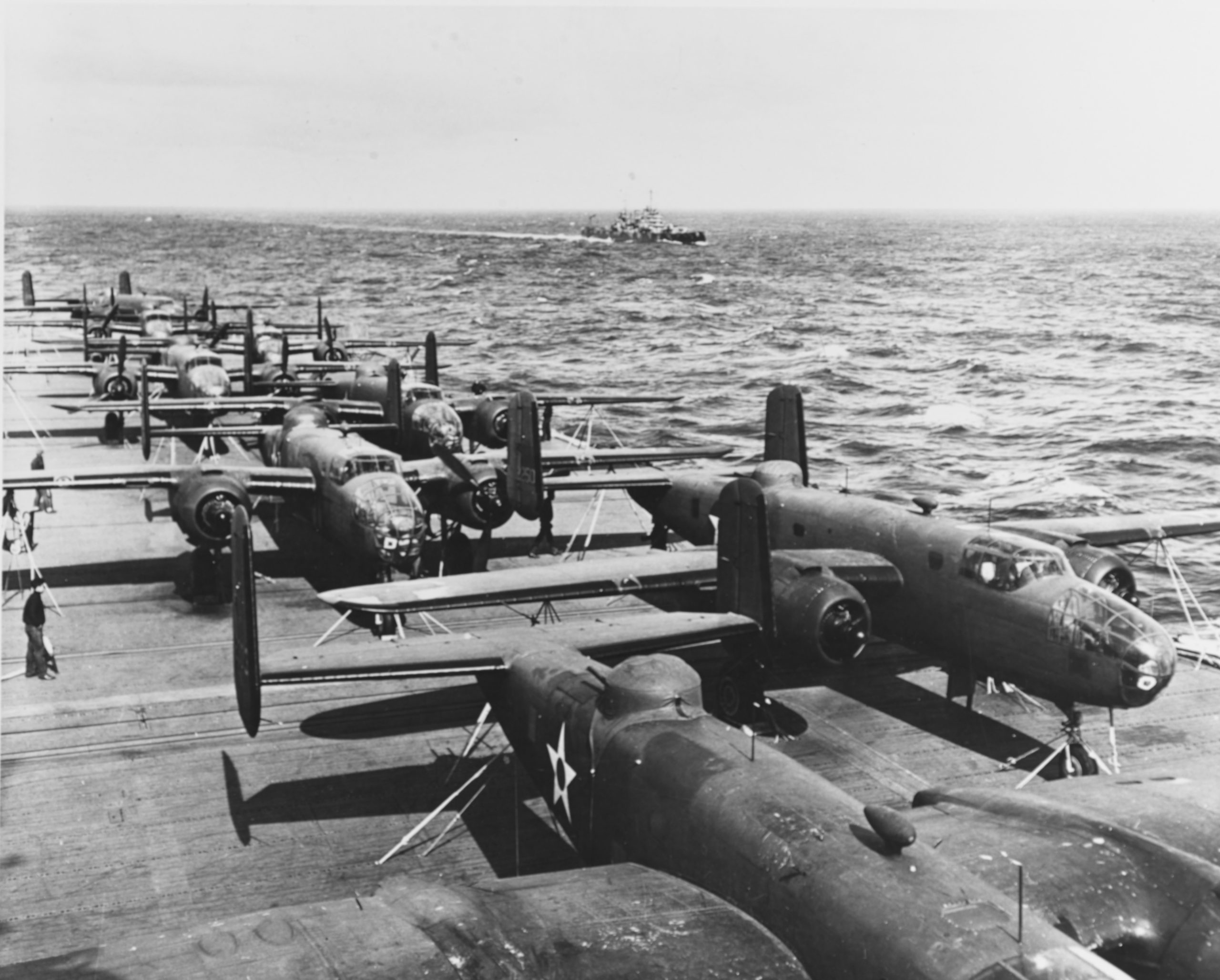
At 08:20 on the morning of 18 April 1942, Lieutenant Colonel James H. Doolittle sat in the cockpit of a B-25 Mitchell medium bomber at the forward end of the USS Hornet’s flight deck, engines run up against the brakes, the carrier’s bow rising and plunging through a grey North Pacific gale. Behind him, packed tail to nose down the after half of the wet flight deck, stood fifteen more Army bombers that had no business being on a ship at all, each loaded with 2,000 pounds of bombs and more than 1,100 gallons of petrol, each bound for the Japanese home islands. The flight deck officer swung his chequered flag in circles, timing the launch to the pitch of the deck. When the flag dropped, Doolittle released the brakes and began a take-off run of about 467 feet by most accounts, into the teeth of the gale, towards Tokyo. What followed over the next eighteen hours, and the next three years, is one of the great stories of the Second World War: the idea born on a Norfolk pier, the eighty volunteers who trained in secret on a Florida airfield, the picket boat that forced the launch roughly 650 nautical miles out, some 170 miles and ten hours earlier than planned, the thirty seconds over Tokyo, the night crash-landings and bail-outs along the China coast, the eight men taken prisoner and the three of them executed, the appalling price China paid for sheltering the rest, the chain of consequence that ran from this raid to the decisive carrier battle at Midway six weeks later, and the eighty silver goblets from which the survivors drank at every reunion, turning one upside down for each man who died, until at last only one remained upright.
The Doolittle Raid occupies a curious place between history and myth, and the two have grown together so tightly that separating them takes patience. The myth says sixteen bombers avenged Pearl Harbor. The record says sixteen bombers scattered fewer than fifty tons of bombs across five Japanese cities and did damage that Japanese engineers repaired within days. Yet the record, read properly, is more remarkable than the myth. The raid’s true payload was not explosive but psychological and strategic, and it detonated in the minds of Japan’s naval leadership with a force out of all proportion to its weight. It shamed the Imperial Navy into a fatal gamble in the Central Pacific, it lifted an American public that had known nothing but defeat for four months, and it cost, by credible estimates, a quarter of a million Chinese lives in the retaliation that followed. This is the full story, and it begins in the darkest winter the United States Navy has ever known.
- America’s darkest winter: the need to hit back
- A carrier full of Army bombers
- Doolittle: the scientist who could fly anything
- Preparing sixteen Mitchells
- Eighty volunteers
- Three weeks at Eglin: learning to leave the ground in 300 feet
- Sixteen bombers lashed to a carrier
- The picket line: discovered
- Sixteen take-offs the book said were impossible
- Five hours at wave height
- The longest night: fifteen aircraft for China
- Aircraft eight: the Soviet detour
- Passed hand to hand: China saves the raiders
- The eight: trial by the conquerors
- The price China paid
- What the raid actually achieved
- Two stars and a medal he never felt he earned
- Portraits from the eighty
- Doolittle’s war after Tokyo
- Thirty seconds over Tokyo: the raid told and retold
- Eighty silver goblets
- Where to touch the raid today
- The anniversary clock
- Licensing the imagery of the Doolittle Raid
- Frequently asked questions
- Sources and further reading
America’s darkest winter: the need to hit back
The winter of 1941 into 1942 was a season of unrelieved catastrophe for the Allies in the Pacific, and it is difficult now to recover how total the darkness felt. On the morning of 7 December 1941, Japanese carrier aircraft had left Battleship Row at Pearl Harbor a smoking ruin, with more than 2,400 Americans dead and the Pacific Fleet’s battle line resting on the harbour mud. That was only the overture. Within hours, Japanese bombers caught much of the American air force in the Philippines on the ground at Clark Field. Guam fell on 10 December. On the same day, off Malaya, Japanese aircraft sank the Royal Navy battleship Prince of Wales and the battlecruiser Repulse, ending forever the idea that capital ships could operate in daylight without air cover. Wake Island’s garrison, after a defence that briefly thrilled American newspaper readers, surrendered on 23 December. Hong Kong fell on Christmas Day. Manila was declared an open city and occupied on 2 January. And still it went on: through that terrible spring, Singapore surrendered on 15 February 1942 with some 80,000 British and Commonwealth troops marching into captivity, the worst capitulation in British military history, while in the Philippines the starving American and Filipino army on Bataan was squeezed towards the surrender that would come in April and the death march that would follow it.
Against this backdrop, President Franklin D. Roosevelt made a demand that his military chiefs privately regarded as close to impossible. At a White House meeting on 21 December 1941, exactly two weeks after Pearl Harbor, he told the assembled Joint Chiefs that he wanted Japan bombed, and not merely its outposts or its shipping. He wanted bombs on the Japanese home islands, as soon as humanly possible, to answer Pearl Harbor in kind and to show both the American public and the Japanese people that Japan itself was not beyond reach. He returned to the point repeatedly in the weeks that followed, pressing his commanders at conference after conference. Roosevelt understood something his planners, buried in logistics, were slower to articulate: that morale was itself a strategic commodity, and that America’s was draining away with every fallen garrison in the headlines.
The difficulty was that no practical means existed. Army bombers based in China or the Aleutians could not reach Tokyo and return; the airfields either did not exist, could not be supplied, or sat at the end of impossible political negotiations. The Navy’s carrier aircraft could reach Japan only if the carriers themselves steamed to within about 200 miles of the coast, deep inside the ring of picket boats, patrol aircraft and land-based bombers that guarded the approaches to the home islands. With the fleet reduced to a handful of precious flight decks, no admiral was willing to gamble them on a gesture. The Japanese high command shared this arithmetic and drew comfort from it. Their nation had not been successfully invaded in centuries, and its cities, the planners in Tokyo assured themselves and the public, lay beyond the reach of any enemy. The problem, then, had a precise shape: America needed an aircraft with the range of an Army bomber launched from a platform with the mobility of a Navy carrier, and no such combination existed in any manual, any doctrine, or anyone’s experience. It would take an accident of geography at a Virginia naval base, and one observant submariner staring out of an aeroplane window, to see the answer.
A carrier full of Army bombers
The idea arrived on 10 January 1942, and it arrived from an unlikely quarter. Captain Francis S. Low was a submariner, not an aviator, serving as operations officer on the staff of Admiral Ernest J. King, the newly appointed Commander in Chief of the United States Fleet. Low had flown down to Norfolk, Virginia, that day to inspect the new carrier Hornet, and as his aircraft departed he looked down at the airfield the Navy used for carrier practice. Painted on one of the runways was the outline of a carrier deck, used by fighter pilots rehearsing their approaches, and as Low watched, a pair of twin-engined Army bombers passed across it on a routine flight. The two images superimposed themselves in his mind: Army bombers, with their long legs and heavy bomb loads, passing over a carrier deck. That evening, back in Washington aboard King’s flagship, Low put the question to the admiral with some diffidence, aware that a submariner proposing aviation heresy might be invited to leave. Could Army medium bombers take off from a carrier? King, a man whose ferocity of temperament was matched by an unexpected openness to ideas, did not dismiss it. He told Low to take it to his air operations officer, Captain Donald B. Duncan, and to mention it to no one else.
Duncan was the ideal examiner, a meticulous naval aviator with a mind for figures, and he spent five days working the problem essentially alone, filling some thirty handwritten pages because he dared not trust the scheme to a typist. His conclusions defined the raid. Landing a medium bomber back aboard a carrier was out of the question; the aircraft would have to fly on to friendly territory, which in practice meant airfields in eastern China. Take-off, however, was possible, given the right aircraft, a light enough load, a long enough deck run and a strong wind over the bow. The right aircraft mattered enormously. The Martin B-26 Marauder had the range but its short wings and high take-off speed made a deck launch marginal to the point of suicide. The Douglas B-23 Dragon had docile handling but a wingspan so broad it could not safely pass the carrier’s island. The North American B-25 Mitchell fitted between these hazards: a wingspan of just over 67 feet that cleared the island with feet to spare, a take-off run that ingenuity could shorten, and the capacity to carry a ton of bombs 2,000 miles with extra tankage. Duncan’s report went to King, and King took it to General Henry H. “Hap” Arnold, chief of the Army Air Forces, who had been wrestling with the same presidential demand from the other side. The two services, so often rivals, fell on the scheme together.
There remained the question of proof, and the Navy answered it with characteristic directness. On 2 February 1942, two B-25s were hoisted aboard the Hornet at Norfolk, and the carrier steamed into the Atlantic. In front of a deeply sceptical ship’s company, Lieutenants John Fitzgerald and James McCarthy ran up their engines and flew both bombers off the deck with room to spare, the first lifting away so readily that watching officers laughed aloud with relief. The bombers were lightly loaded and the aircraft of the raid itself would not be, but the principle stood demonstrated. The project acquired a deliberately opaque name, and it needed a leader. Arnold knew exactly whom he wanted.
Doolittle: the scientist who could fly anything
James Harold Doolittle was born in Alameda, California, on 14 December 1896, and spent much of his childhood in Nome, Alaska, where his carpenter father had gone chasing gold. Small for his age and mocked for it, he learned to box, and boxed so well that he became amateur flyweight champion of the Pacific coast, fighting occasionally for money under an assumed name. The combination that made him, pugnacity harnessed to precision, was visible early. He joined the Army’s flying programme in 1917, missed combat in the First World War as an instructor, and then spent the 1920s conducting what amounted to a one-man campaign to expand the boundaries of what aeroplanes could do. In September 1922 he flew a De Havilland DH-4 from Pablo Beach, Florida, to San Diego in under 24 hours of elapsed time, the first crossing of the continent inside a single day. In 1925 he won the Schneider Trophy seaplane race for the United States in a Curtiss floatplane at record speed. In 1927 he performed the first successful outside loop, a manoeuvre that pressed pilot and airframe with forces then thought unsurvivable.
Yet Doolittle’s greatest contribution to aviation involved no spectacle at all. On 24 September 1929, at Mitchel Field on Long Island, he took off, flew a set course and landed entirely by reference to instruments, the cockpit of his Consolidated NY-2 covered by a fabric hood from before the wheels left the ground until after they touched it again, with a safety pilot aboard who never needed to intervene. That flight, the fruit of patient work with the new artificial horizon, directional gyro and precision altimeter, opened the way to all-weather aviation, and there are those who rate it the most important flight since the Wrights. It was of a piece with the rest of the man, because Doolittle was that rarity, a daredevil with a doctorate. He had earned a master’s and then a Doctor of Science in aeronautics from the Massachusetts Institute of Technology in the mid-1920s, one of the first aeronautics doctorates awarded in the United States, and his thesis work on acceleration forces in flight was drawn from experiments he flew himself. Leaving the Army for Shell in 1930, he spent the decade as the company’s chief aviation executive and used the position to bully, cajole and evangelise the American petroleum industry into producing 100-octane aviation fuel, a decision of incalculable value once war came, since it was high-octane fuel that let Allied engines outperform their rated power. He kept racing too, winning the 1932 Thompson Trophy in the Gee Bee R-1, a stub-winged barrel of an aircraft that killed several of the other men who flew it, and then walked away from racing at the height of his fame, remarking that he had yet to hear of anyone dying of old age in the sport.
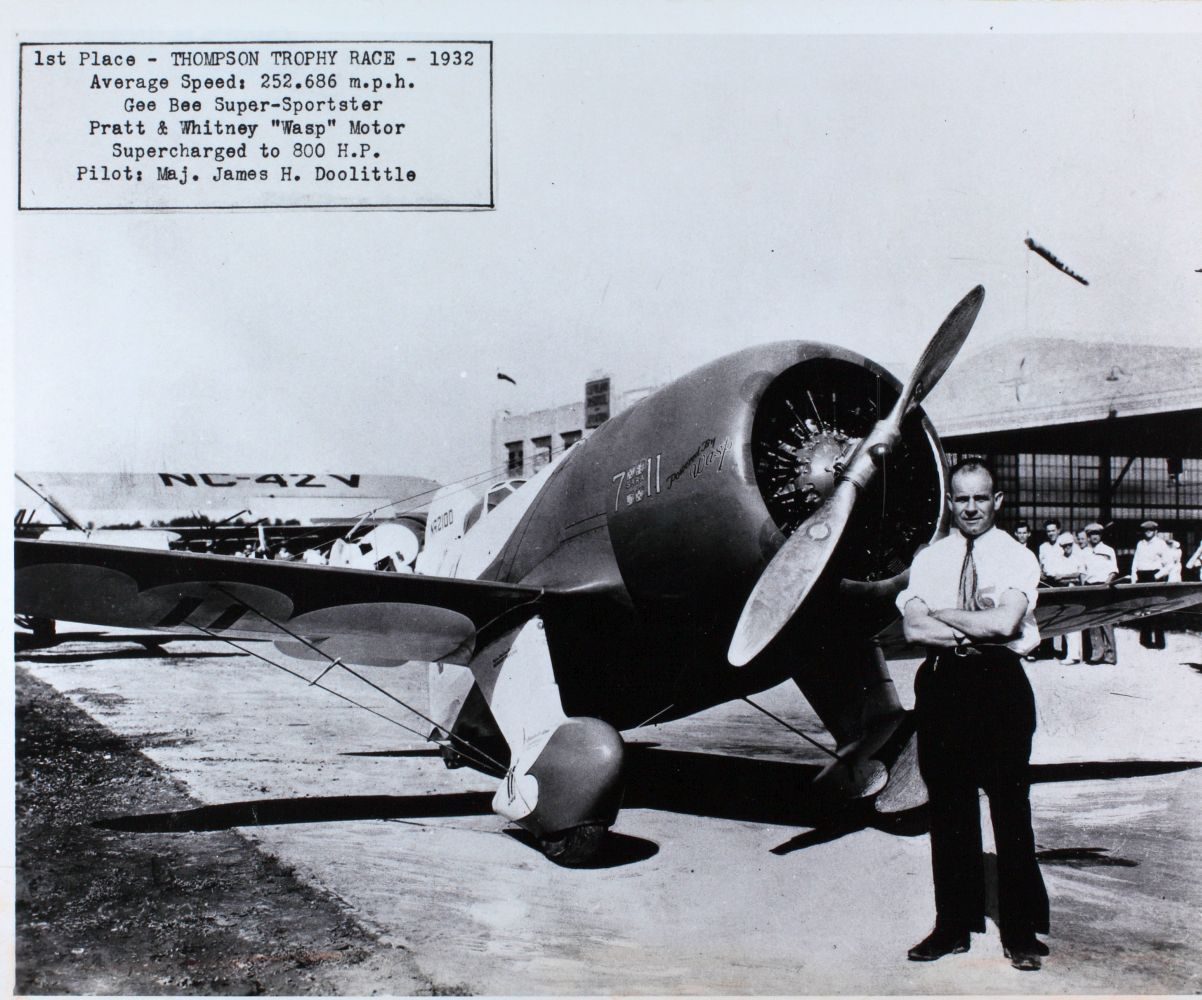
Recalled to active duty as a major in 1940, Doolittle was working on industrial production problems when Arnold summoned him in January 1942 and handed him the file on what was now called Special Aviation Project No. 1. Arnold’s reasoning was sound: the mission needed a leader who was engineer, test pilot and organiser in one man, someone who could modify the aircraft, devise the training and command the respect of young pilots instantly. What Arnold did not intend was for his 45-year-old troubleshooter to fly the mission himself. Doolittle extracted the assignment by manoeuvre, securing Arnold’s conditional agreement and then reaching Arnold’s deputy with the news before Arnold could brief him to refuse. It was, Doolittle later admitted, the fastest talking of his life, and it put him at the head of the line on the Hornet’s deck.
Preparing sixteen Mitchells
The B-25B Mitchell as it rolled from North American’s Inglewood line was a sound medium bomber, but it was built for runways of comfortable length and missions of moderate radius, and the Tokyo raid demanded neither. The arithmetic was brutal. A standard B-25B carried 646 gallons of fuel. The mission, as planned, required a take-off from a carrier deck some 450 to 500 miles from Japan, a low-level penetration, a bombing run, and then a flight across the East China Sea to airfields around Chuchow in Chekiang province, a total distance approaching 2,000 miles. The answer was to turn each bomber into a flying fuel store. A collapsible rubber-lined tank of 225 gallons went into the top of the bomb bay. A 160-gallon collapsible bag was laid in the crawlway above the bomb bay, to be emptied first, flattened and shoved aside. Where the lower gun turret had been, a 60-gallon tank was fitted, and the gunner was given the additional duty of hand-pumping fuel forward as it burned. Finally, ten five-gallon tins were stacked in the rear fuselage, to be poured into the turret tank one by one and then punctured and thrown overboard so that no floating trail would point back towards the carrier. All told, capacity rose from 646 gallons to 1,141, enough, on careful engine handling, to give the mission a fighting chance.
Weight and secrecy dictated the rest of the modifications. The lower turret came out entirely, its retracting mechanism so baulky that Doolittle observed a man could learn the violin well enough for Carnegie Hall sooner than master it. The heavy liaison radio was removed, since the crews would keep radio silence and every pound was fuel. De-icing and anti-icing equipment was fitted as insurance while colder routes were still under consideration. In place of tail guns, the armourers installed two black-painted wooden broomsticks protruding from the tail cone, on the theory that a fighter pilot closing from astern could not tell varnished timber from a pair of fifty-calibre barrels, a piece of theatre that at least one crew later credited with keeping pursuers at a respectful distance. The most telling substitution concerned the bombsight. The Norden sight was then among America’s most jealously guarded secrets, and every aircraft on this mission was expected to end its flight in China, or worse, in Japanese hands. It was also nearly useless at the 1,500 feet from which the raiders would bomb. Captain C. Ross Greening, one of the pilots and a gifted engineer, designed a replacement of two pieces of aluminium that the crews christened the “Mark Twain” and that cost the government about twenty cents in materials. At low level it was more accurate than the Norden, and its capture would tell the enemy nothing. Each aircraft would carry four 500-pound bombs, three of demolition type and one incendiary cluster designed to scatter its bomblets across the tinder of Japanese urban housing.
The conversion work was carried out in deliberate obscurity at the Mid-Continent Airlines maintenance shops in Minneapolis, whose civilian fitters worked around the clock without being told why, and finished at the Sacramento Air Depot in California, where depot staff, equally uninformed, undid several careful modifications in the name of standard practice and drew from Doolittle a memorable display of temper. By the end of March the aircraft were as ready as ingenuity could make them. What they needed now was crews.
Eighty volunteers
The men came from the 17th Bombardment Group, and the choice made itself. The 17th, with its attached 89th Reconnaissance Squadron, had been the first group in the Army Air Forces to receive the B-25, and by early 1942 its crews had more time on the type than anyone else in uniform, much of it flying antisubmarine patrols off the Pacific coast from Pendleton, Oregon, where the group had the distinction of sinking one of the first Japanese submarines credited to Army aircraft. In February the group was ordered across the country to Columbia, South Carolina, ostensibly to fly the same patrols over the Atlantic. The transfer was a screen. Once at Columbia, the group’s flying officers were told only that volunteers were wanted for a secret mission described as extremely hazardous, that it would take them out of the country for perhaps three months, and that nothing more could be said, not the destination, not the task, not the odds. On those terms, essentially the entire group stepped forward, and squadron commanders were reduced to selecting rather than persuading. Twenty-four crews, some 140 men once the ground echelon was counted, were chosen and ordered to Eglin Field in the Florida panhandle, the surplus beyond the sixteen aircraft providing both spares against accident and a margin for weeding out.
The popular image of the Raiders as a hand-picked elite needs the same correction as most such legends. A few were seasoned airmen of long service. Major John Hilger, commander of the attached 89th Reconnaissance Squadron and soon Doolittle’s deputy for the raid, was a professional of the old school; Captain Edward “Ski” York had graduated from West Point; Greening brought his engineer’s ingenuity. But the rosters were filled overwhelmingly with the products of the Air Corps’ frantic pre-war expansion, lieutenants a year or two out of flying school, sergeants barely out of their teens. Some of the co-pilots had never landed a B-25 from the left-hand seat. At least one of the pilots who would fly against Tokyo had fewer than a few hundred hours of total flying time. The navigators were mostly recent graduates of a training pipeline that had scarcely existed two years before, and the gunners, in a detail Doolittle discovered with some horror, had for the most part never fired a machine gun from an aircraft at all. Corporal David Thatcher, whose coolness would later save an entire crew on a Chinese beach, was twenty. Lieutenant Billy Farrow, who would die in front of a Japanese firing squad, was twenty-three.
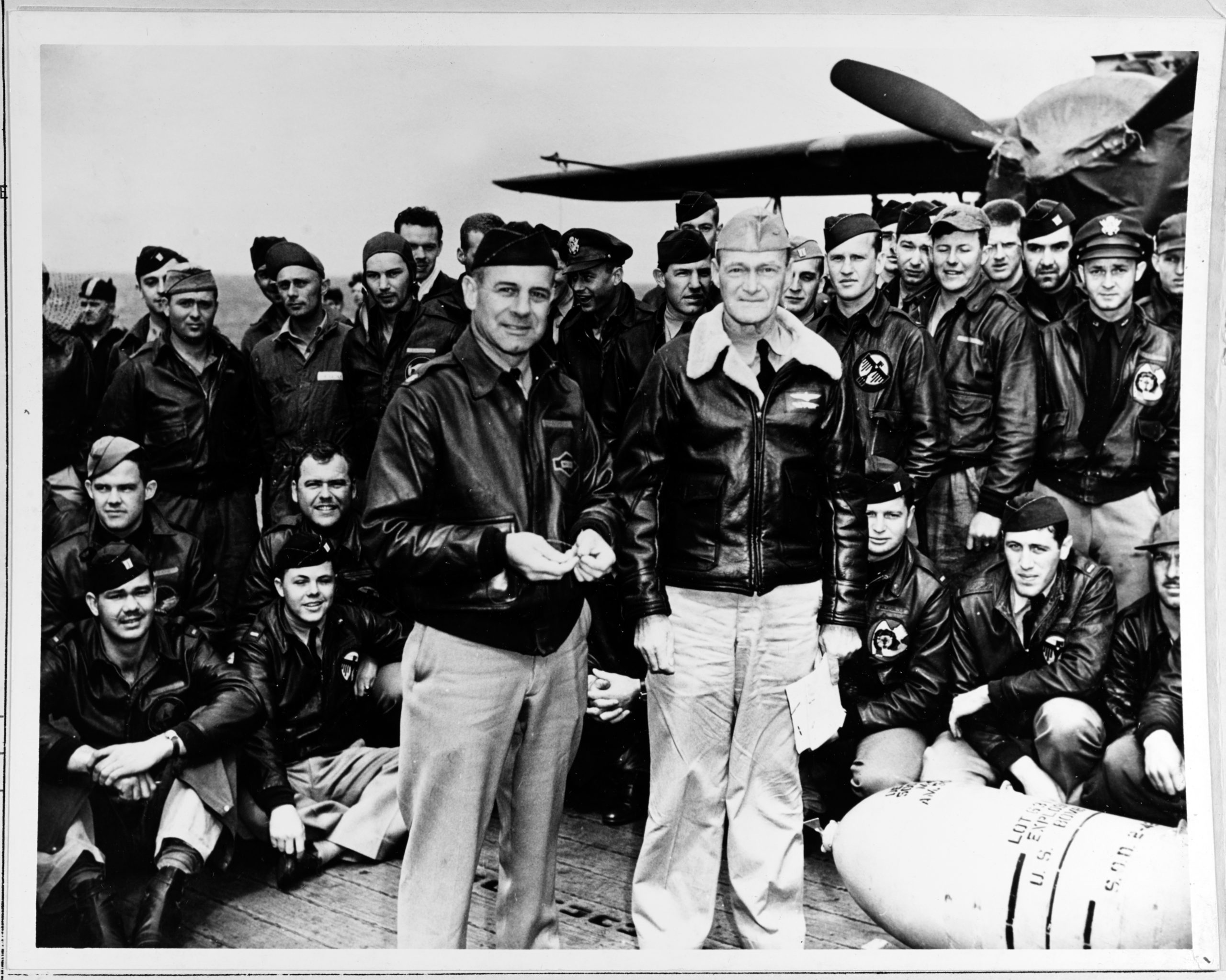
What they shared was not experience but the fact of having volunteered blind, and a commander who told them, repeatedly, that any man could withdraw at any time without a mark against him and without a question asked. None did, though Doolittle also promised that anyone caught speculating aloud about the mission’s target would be off the project by nightfall. When one man talked too freely in a bar, military police were watching, and the lesson circulated faster than any order. Rumour settled privately on Tokyo all the same, as rumour will, but it stayed inside the fence. In the first week of March 1942 the crews began arriving at Eglin, where a naval lieutenant was waiting to teach them something no Army syllabus had ever contained.
Three weeks at Eglin: learning to leave the ground in 300 feet
Eglin Field sprawled across the pine flats of the Florida panhandle, and among its scatter of satellite strips was Auxiliary Field 1, later named Wagner Field, remote enough that a squadron of B-25s could do strange things without an audience. The strange things began with the arrival of Lieutenant Henry L. Miller, a naval aviator and instructor from nearby Pensacola, who introduced himself to the Army pilots and asked to be shown their normal take-off technique. Miller had never flown a B-25 and had never been told, officially, why anyone wanted a medium bomber airborne inside the length of a carrier deck, but he knew carrier flying, and what he taught over the following three weeks inverted everything the Army men knew. A bomber pilot’s instinct was to hold the aircraft on the runway, building speed comfortably past the point of doubt. Miller taught the opposite: flaps fully down, stick hauled back into the pilot’s lap, engines run against locked brakes to full power, and then release, the aircraft staggering into the air at 65 or 70 miles an hour, hanging on its propellers just above the stall, in an attitude one pilot compared to sitting on a ladder leant against the sky. Flown normally, a loaded B-25 used most of a mile of runway. Flown Miller’s way, the pilots found to their astonishment that they could unstick in 500 feet, then 400, and in the best cases with light loads in barely 300. White lines were painted across the strip at carrier-deck intervals, and flags marked the distances, so that every take-off became a measured trial. The training was not free of cost: one aircraft was damaged beyond quick repair when a pilot lifted off too slowly and settled back, and others suffered strains and scrapes, which was among the reasons two dozen crews had been assembled for sixteen seats.
Short take-off was only half the syllabus. The mission would be flown at wave-top and treetop height across open ocean, so the crews practised low-level cross-country navigation over the Gulf of Mexico, day and night, learning to hold a course for hours with no landmark but the sun and the drift of the sea. They bombed from 1,500 feet and lower with Greening’s twenty-cent sight, strafed targets in the scrub, and drilled their turret guns against simulated fighter attacks, live tow-target practice being one more thing the timetable never allowed. The navigators flew long triangular courses out over the Gulf, and the engineer-gunners learned the fuel transfer drill that would keep the aircraft alive in the emptiness beyond Japan. Around all of it lay a fence of secrecy. The crews were forbidden to discuss their work with anyone on the main base, the field was patrolled, and Doolittle, commuting between Florida, Washington and the modification centres, reminded them that lives depended on silence.
The weather stole training days, and the three weeks ended before anyone felt finished; Doolittle himself reckoned the crews had received perhaps half the preparation he wanted. Late in March the order came, and the B-25s lifted from Eglin for the last time and flew west by way of San Antonio to McClellan Field at Sacramento for final inspection, their pilots hedge-hopping most of the way across the continent, partly as practice and partly, being young men in fast aircraft, for the joy of it. Miller went with them. He would coach them to the very edge of the deck, and the Raiders would later make him one of their own, an honorary member of a company no one else could join.
Sixteen bombers lashed to a carrier
On 31 March and 1 April 1942 the chosen aircraft flew the short hop from Sacramento to Naval Air Station Alameda, on the eastern shore of San Francisco Bay, where the Hornet waited at the quay. Each B-25 was defuelled, towed to the dockside crane, hoisted aboard and spotted on the flight deck, wings overhanging the sea, tails jutting over the edge, packed so closely aft that the last aircraft’s tail hung out over the ship’s wake. Sixteen went aboard rather than the fifteen the plan strictly required, through one of history’s small accidents of generosity: the sixteenth was to have been flown off shortly after sailing, a demonstration for the benefit of the Army pilots who would otherwise make their first and only carrier take-off with bombs beneath them and Japan ahead. Once at sea, Doolittle and the Hornet’s captain, Marc Mitscher, agreed the demonstration was a luxury and the extra bomber was not, and the aircraft simply stayed, which is why sixteen crews instead of fifteen entered legend. The arithmetic of deck space had a harsher corollary. With the bombers chained across her after deck, the Hornet could neither launch nor recover her own air group, which was struck below into the hangar. For the passage to Japan, one of America’s newest carriers would be as defenceless as a transport, her survival entrusted entirely to her escorts and to the aircraft of a second carrier she had yet to meet.
The Hornet stood out through the Golden Gate on the morning of 2 April, in company with cruisers, destroyers and an oiler, and once safely at sea Mitscher put the ship’s rumour mill out of its misery. His announcement that the ship would carry the Army bombers to Japan for the bombing of Tokyo was relayed through the compartments, and the response was a spontaneous roar of cheering that men remembered for the rest of their lives, sailors and airmen pounding one another’s backs along the catwalks. On 13 April, north of Hawaii near the dateline, the force made rendezvous with Task Force 16 under Vice Admiral William F. Halsey in the Enterprise, whose fighters and scout bombers would shield the combined fleet. Together the two carriers, with the cruisers Salt Lake City, Northampton, Vincennes and Nashville, eight destroyers and the oilers Cimarron and Sabine, turned west towards Japan, sixteen ships carrying sixteen bombers, and it was to this combined force that Halsey signalled the line the war remembered: this force is bound for Tokyo.
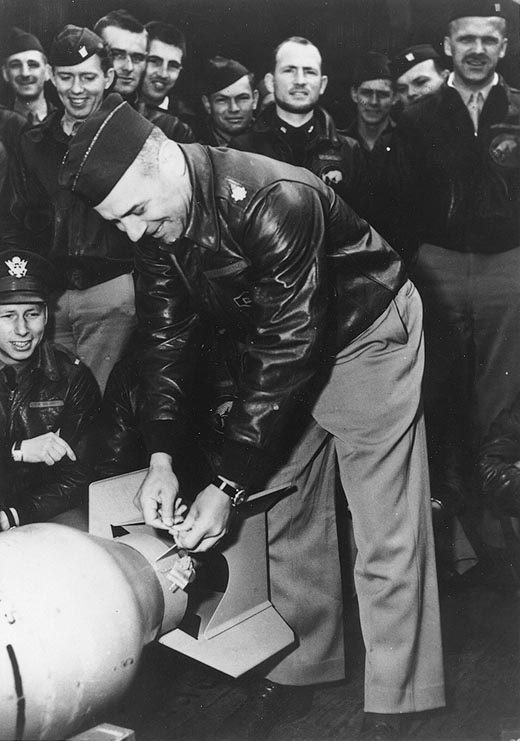
The passage became a floating finishing school. Lieutenant Commander Stephen Jurika, a Hornet officer who had served as an assistant naval attaché in Tokyo before the war, briefed the crews day after day on their targets, on Japanese geography, industry and air defences, and on what to expect, and how little mercy, if they fell into Japanese hands. Navy mechanics helped the Army engineers nurse balky engines and weeping fuel tanks, and the gunners fired at kites flown from the deck. There was one piece of ceremony. Jurika and others had over the years received Japanese friendship medals, and the Secretary of the Navy had forwarded more with the suggestion they be properly returned. On the flight deck, before cameras, the medals were wired to the tail of a 500-pound bomb soon to be addressed to Tokyo, the crews grinning around it in the wind. Ahead of the bows, the plan called for a run to within about 450 miles of the coast and a late-afternoon launch on 19 April, with a night strike led by Doolittle’s incendiaries. The Japanese picket line would have a vote in that plan.
The picket line: discovered
The Japanese had not left the approaches to the home islands unwatched. Strung along an arc some 600 to 700 miles offshore lay a line of requisitioned fishing vessels, small wooden craft of seventy or eighty tons fitted with radio sets, whose crews’ sole duty was to see and to signal. American planners knew the line existed and hoped, in the event, to slip through its gaps under cover of the filthy weather then whipping the North Pacific into 30-foot swells. Through the small hours of 18 April the hope frayed. Enterprise radar flickered with surface contacts before dawn and the force manoeuvred to avoid them, but at 07:38, with the task force still more than 600 nautical miles from Tokyo, lookouts on the Hornet sighted a small vessel that had plainly also sighted them. She was the No. 23 Nitto Maru, seventy tons of picket boat riding out the gale, and aboard the American ships radio operators soon heard her transmitting. Her signal reported three enemy aircraft carriers, an overstatement that would have its own consequences in Tokyo, where the naval staff calculated that carrier aircraft, with their short reach, could not strike before the following day. Halsey did not know what Tokyo would conclude. He knew only that surprise, the one shield his defenceless bomber-carrier possessed, was gone.
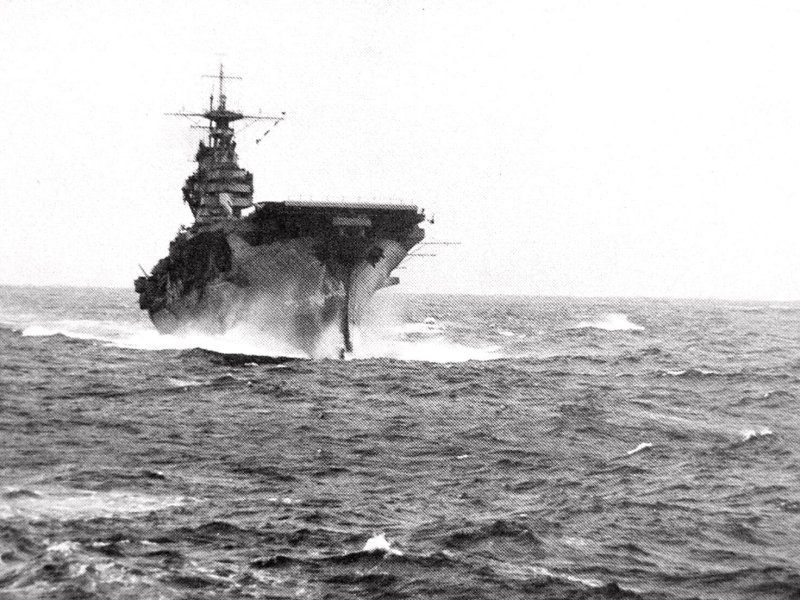
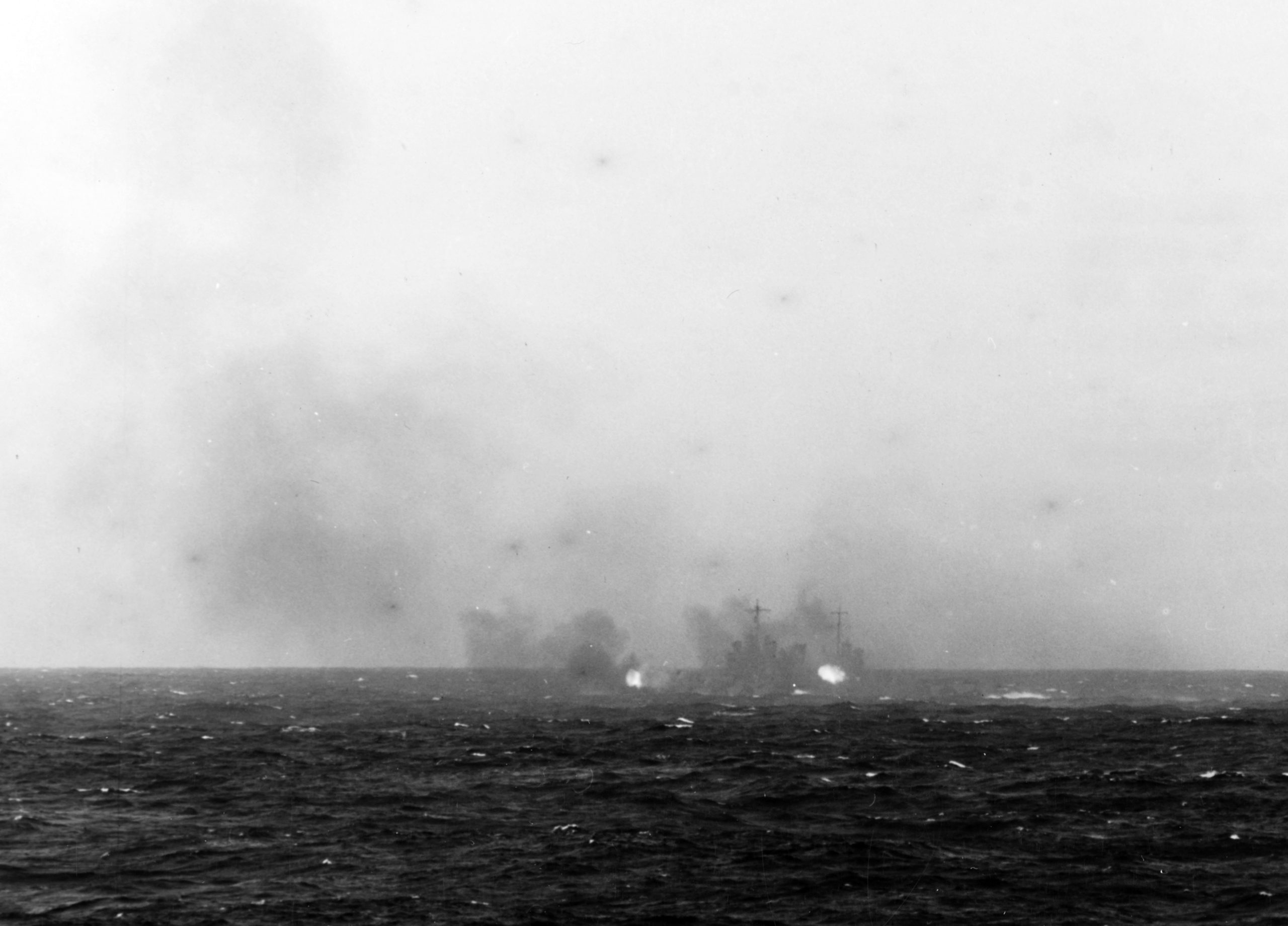
The light cruiser Nashville was ordered to sink the picket, and what followed was a lesson in the difficulty of hitting a cork from a rolling platform. In the heavy seas the tiny target vanished into troughs as the cruiser’s shells arrived, and the Nashville fired hundreds of rounds of six-inch ammunition, with Enterprise aircraft strafing between salvoes, before the Nitto Maru finally went down after a chase of nearly half an hour. To the airmen crowding the Hornet’s rails the spectacle was sobering rather than reassuring. Minutes later the decision came down from Halsey’s flag bridge, and it was the only decision the situation allowed: launch at once. The bombers would go roughly 650 nautical miles out, some 170 miles and ten hours earlier than planned, in daylight instead of dusk, into a gale, from a deck the plan had assumed would be several hundred miles closer to Japan. Halsey’s farewell flashed across to the Hornet by signal light: “TO COL. DOOLITTLE AND GALLANT COMMAND: GOOD LUCK AND GOD BLESS YOU.”
Every man who could work a slide rule understood what the early launch meant. The mission’s fuel margin, slender in the best case, had just been spent before an engine turned. The extra distance consumed roughly the reserve that was to have carried the crews from the China coast inland to the airfields at Chuchow, and it meant they would now cross that coast in darkness, in weather, at the ragged end of their tanks. Worse, though the crews did not know it, the fields themselves would be dark. The plan to position fuel and homing beacons in Chekiang had been entangled for weeks in distance, diplomacy and Chiang Kai-shek’s well-founded fears of Japanese reprisal, and the advanced warning that might have lit the runways was never sent; the raid’s new timetable extinguished whatever chance remained. Sailors flooded onto the Hornet’s deck to strip tie-downs and top off tanks, the five-gallon tins were handed up into the fuselages, and the crews ran to their aircraft through blowing spray. At the head of the line, Doolittle started his engines. The deck was pitching through the height of a house, and Tokyo lay 650 miles beyond the bow.
Sixteen take-offs the book said were impossible
At 08:20 on the morning of 18 April 1942, the USS Hornet turned her bow into a rising gale and Jimmy Doolittle pushed both throttles of a fully laden B-25 to the stops. Everything about the moment defied the manuals. No Army medium bomber had ever flown off a carrier under operational conditions, the sea was running so high that green water was breaking over the flight deck, and the sighting of the picket boat Nitto Maru barely forty minutes earlier had forced the launch some 650 miles from Tokyo, roughly 170 miles further out than anyone had planned. Doolittle, first in line, had about 467 feet of usable deck by most accounts, a distance measured out on the pitching wooden planking with two white guide lines painted so that his left wheel and nose wheel could track them and keep his right wingtip six feet clear of the island. What he had in compensation was wind. The Hornet was making better than twenty knots into a near thirty-knot gale, which put somewhere between forty and fifty miles an hour of air over the deck before the aircraft moved an inch.
The bow was pitching through thirty feet, plunging into the swells and flinging spray the length of the ship. The Navy launch officer, Lieutenant Edgar Osborne, stood by the port side with a chequered flag and timed his signal to the sea itself, whirling the flag faster and faster, then dropping it as the bow began its downward plunge so that each bomber would reach the end of the deck as it rose. Sailors crouched against the island watched Doolittle’s aircraft strain against its brakes, engines bellowing, and then roll. It seemed to the men watching that he was airborne with feet of deck to spare, hanging on the wind, and as he circled back over the ship to check his compass against the carrier’s known heading the flight deck erupted in cheering. If Doolittle could do it, everyone could do it. That was the entire point of his going first.
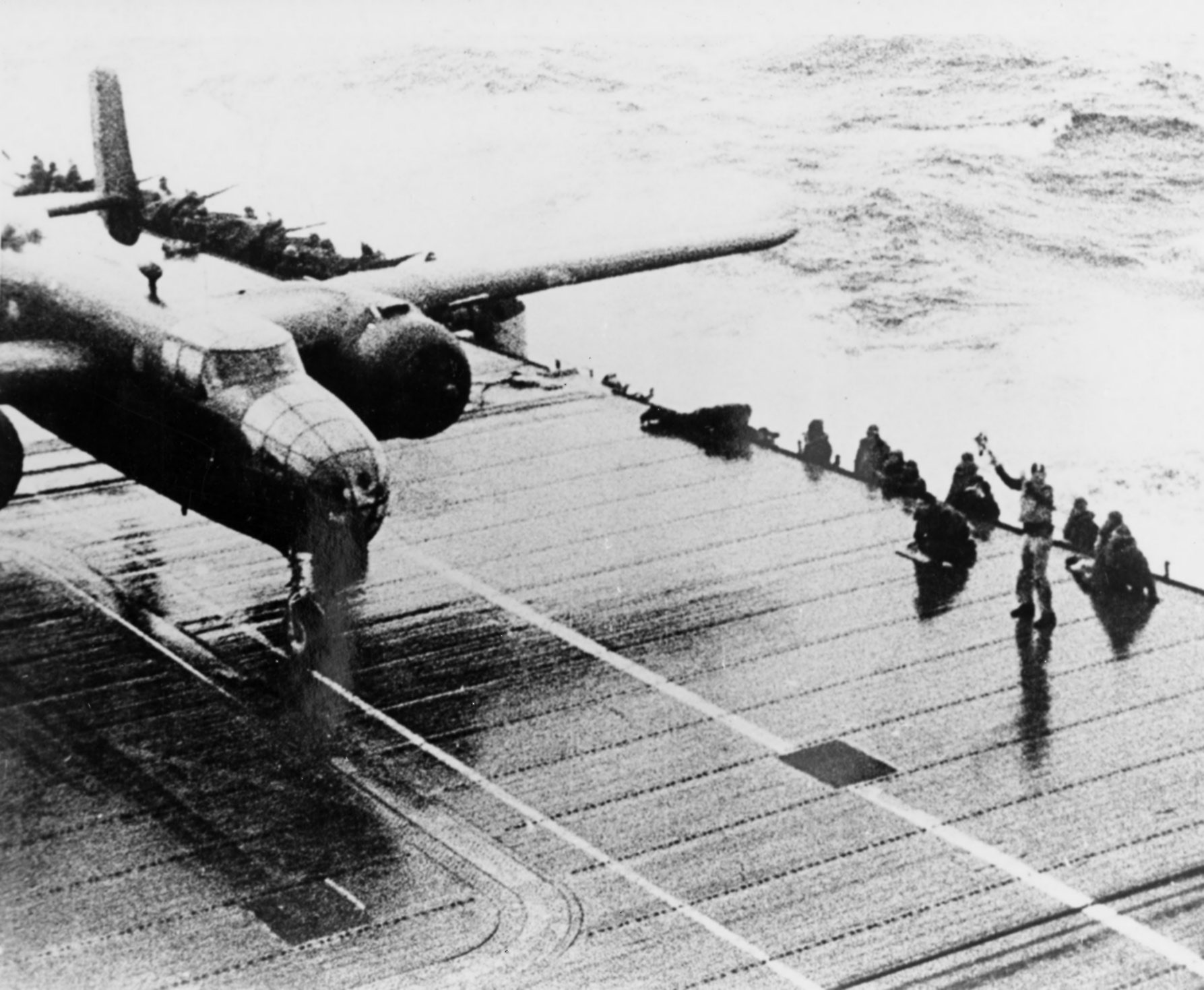
Not everyone made it look easy. Lieutenant Travis Hoover, second away, hauled his aircraft off in a near stall, nose absurdly high, hanging on its propellers with the tail so low it seemed certain to slap the deck and drop into the sea. The watching crews held their breath as the bomber sagged, caught the air, and flew. Ted Lawson, seventh off in the Ruptured Duck, had run through his checks in the rain-lashed cockpit, then reversed some of them in a last-minute recheck and left his flaps fully up. The aircraft staggered off the bow, sank towards the wave tops in a moment Lawson would relive for the rest of his life, and clawed its way clear on raw power and deck wind. He did not realise the error until he was already flying.
The deck itself claimed the morning’s only serious casualty. Seaman Robert Wall, one of the handlers working aft in the shrieking wind, was pushed by the gale and the propeller wash into the spinning left propeller of the sixteenth aircraft, Bill Farrow’s Bat Out of Hell. His arm was terribly mangled and was later amputated. Farrow’s crew, waiting their turn at the very end of the line, watched it happen and carried the image with them across the Pacific. At 09:19, fifty-nine minutes after Doolittle’s wheels left the deck, Farrow followed him into the murk. Sixteen aircraft had attempted the impossible take-off. Sixteen had made it, and not one man had gone into the sea.
Five hours at wave height
There was no formation to speak of. The bombers went for Japan singly and in loose, drifting pairs, throttled back to their most economical cruise and pressed down almost onto the water, at times so low that crews later spoke of pulling up to clear the masts of fishing boats. For nearly five hours they droned west across a grey, whitecapped sea, navigators sweating over drift calculations with no landmarks to check them, gunners watching a horizon that stayed obstinately empty. The extra 170 miles imposed by the early launch sat in every man’s fuel arithmetic like a debt that could not be paid, but that was a problem for the evening. The task for noon was Japan.
Tokyo, by an irony no planner could have engineered, had held an air-raid drill that very morning. Barrage balloons had been flown, aircraft had manoeuvred overhead, and the city’s inhabitants had gone through their practised routines and then gone back to lunch. When the first B-25s swept in around midday, low over the rooftops, many on the ground assumed the drill was still running and waved at the low-flying bombers. Doolittle popped up to 1,200 feet, and at about 12:15 his bombardier, Fred Braemer, put the first bombs of the war on the Japanese home islands into a factory district in northern Tokyo. Behind him, ten of the sixteen crews attacked targets across the capital, striking oil storage, steel and power installations, while others fanned out along the briefed spread: Yokohama, the naval base at Yokosuka, and the long southern leg to Nagoya, Kobe and the Osaka area. At Yokosuka one of Edgar McElroy’s 500-pounders found the dry dock and struck the converted carrier Ryuho, delaying her completion by months, the raid’s single most measurable naval result.
The opposition was close to negligible. Anti-aircraft fire came up late and wild, its shells bursting behind and above bombers flying faster and lower than the gunners had ever practised against. A handful of fighters made passes and pressed none of them home; the raiders’ gunners claimed a few, the claims were never confirmed, and it scarcely mattered. One aircraft took light flak damage. Not a single B-25 was lost over Japan, a fact that would have seemed fantastical to anyone reading the pre-mission intelligence estimates of Tokyo’s defences.
What the bombs actually did was modest and needs stating plainly. Sixteen tons of high explosive and incendiary clusters, four bombs to an aircraft, damaged or destroyed around 112 buildings and inflicted real but limited industrial harm. Around fifty people were killed by most contemporary counts; a postwar Japanese reckoning put the dead at 87, with more than 450 injured. Among the buildings hit were civilian structures, including schools and an army hospital, struck by bombs that fell wide in attacks flown at treetop height against a smoke-hazed city. The Japanese press was ordered to present the raid as a deliberate, indiscriminate attack on civilians, and the newspapers duly filled with accounts of murdered schoolchildren and demands for vengeance against the “inhuman” fliers. That official framing, decided within hours, would within months become a matter of life and death for eight of the men then racing away south-west across the East China Sea, engines leaned to the edge of roughness, chasing the falling sun towards a Chinese coast that did not know they were coming.
The longest night: fifteen aircraft for China
From their landfall exits the crews faced roughly 1,200 miles of the East China Sea and occupied China before the friendly airfields around Chuchow, the cluster of strips in Zhejiang province where they were to land, refuel and fly on into Free China. Every navigator who ran the numbers in the afternoon light reached the same conclusion: the fuel would not stretch. The early launch had seen to that. Crews began preparing to ditch, briefing positions, loosening rafts, and then, as darkness came down, the weather that should have killed them saved them instead. The storm front rolling up from the south-west carried a tailwind of about 25 knots that pushed the bombers along for seven hours, and one by one the captains realised the arithmetic had shifted. They would reach China after all. What they would find when they got there was another matter.
They found nothing. The Chuchow fields lay dark and silent below the overcast, their homing beacons cold, because no word of the raid had ever reached them. The warning message that was to have been sent ahead was never transmitted; Halsey’s task force, running hard for Pearl Harbor under radio silence after the early launch, never sent the alert signal, and the Chinese, hearing unidentified engines in the night and fearing a Japanese raid, kept every light extinguished. The one thing that could have gathered the raiders in, a lit field and a beacon to steer by, was withheld by the very precaution the raid itself had provoked. So fifteen aircraft, after twelve and thirteen hours in the air, the longest combat mission the B-25 had ever flown, groped through storm cloud over mountainous country with their fuel gauges trembling on empty.
Most captains chose the parachute. Crew after crew climbed to safe height, set the autopilot, and stepped out into black, streaming cloud over ranges they could not see, trusting to silk and providence. Doolittle himself went out at around 8,000 feet into rain so thick he could not tell up from down until his canopy cracked open. Others, closer to the coast or unwilling to jump, put their aircraft down on beaches and into the surf. Given the conditions, the survival rate was astonishing, but the night took its dead. Corporal Leland Faktor, the young engineer-gunner of Bob Gray’s crew, was killed in his bale-out, found at the foot of a cliff with his parachute deployed; whether he struck the tail on exit or fell hard in the darkness was never established. On the coast, Dean Hallmark ditched the Green Hornet heavily into the breakers and the aircraft broke apart on impact. Sergeant William Dieter and Corporal Donald Fitzmaurice, both injured in the crash, drowned in the night surf, and their crewmates buried them in the sand at daybreak.
Three men dead out of eighty was, by the sober measure of what had been attempted, a deliverance. But as dawn broke on 19 April the raid as an organisation had ceased to exist. Fifteen aircraft were scattered as wreckage across several hundred miles of Chinese coast and mountain, every one of them a write-off, and seventy-five airmen were down in ones and fives in country where some districts were held by Chinese guerrillas, some by bandits, and some by the Japanese army. Whether the Doolittle raid ended as an epic or a disaster now depended entirely on who found them first.
Aircraft eight: the Soviet detour
One aircraft never turned for China at all. Captain Edward “Ski” York, commanding the eighth bomber off the deck, had watched his fuel gauges with mounting alarm from almost the moment he left the Hornet. His engines were drinking petrol at a rate far beyond the others, and the standard account traces the trouble to the carburettors, which had been adjusted at the Sacramento Air Depot during final preparation, undoing the careful lean-running settings the crews had practised for weeks. Whatever the precise mechanics, the arithmetic aboard aircraft eight was brutal and simple: China was unreachable. After bombing Tokyo, York put it to his crew and made the only decision the fuel allowed, a turn north-west for the Soviet Union, whose Vladivostok region lay some 600 miles away against China’s 1,200.
It was a legally poisonous destination. The Soviet Union, locked in its death struggle with Germany, had signed a neutrality pact with Japan in April 1941 and had refused Roosevelt’s request to let the raiders land on Soviet soil. When York’s B-25 touched down at a military field about forty miles from Vladivostok, the five Americans were received with courtesy, fed, toasted, and interned, and their aircraft was confiscated, exactly as the pact required. Moscow could not hand belligerent airmen back to America without handing Japan a pretext for war in the east.
What followed was thirteen months of drifting, comfortable, maddening captivity. The crew were moved by stages across the breadth of the Soviet Union, from the Far East to the Volga country and finally, after York wrote directly to Stalin asking to be moved somewhere they might be useful, south to Ashgabat in Turkmenistan, a few dozen miles from the Iranian frontier. There, in the spring of 1943, a helpful Soviet acquaintance introduced them to a smuggler who, for a payment of $250, agreed to take them across the border. On the night of 10-11 May 1943 the five airmen rode a lorry through the frontier hills, and on 11 May they walked into a British consulate in Iran, thin, elated, and apparently the authors of one of the war’s neater escapes.
They believed it themselves for most of their lives. The truth, confirmed decades later when post-Soviet archives were opened, is that the NKVD staged the entire affair. The friendly intermediary was a secret police officer, the smuggler was on the state’s books, and the escape route had been prepared and shepherded from Moscow, which wanted the diplomatically embarrassing Americans off its hands in a way Japan could not protest. The crew’s night ride to freedom was, from first handshake to last checkpoint, a production, and it deserves to be recorded as such, an elegant piece of wartime stagecraft rather than a lapse in Soviet vigilance.
One further claim shadows the story of aircraft eight. Nolan Herndon, York’s bombardier and navigator, argued in later life that the Vladivostok flight was no emergency at all but a deliberate secret mission, arranged at high level to test how the Soviets would treat American aircraft and crews with an eye to future shuttle operations. It is a striking theory, and Herndon held to it, but no document has ever surfaced to support it, York denied it, and the fuel-consumption account remains the standard history. The claim belongs in the record as what it is, an unproven suspicion held by a man who was there.
Passed hand to hand: China saves the raiders
Doolittle came down in darkness into a rice paddy near Quzhou, landing seat-first in the night’s accumulation of cold liquid manure, and spent the small hours failing to persuade a terrified farmhouse to open its door. The next day, Chinese soldiers led him to what remained of his aircraft, B-25 number 40-2344, strewn down a mountainside in the rain. He sat down beside a broken wing amid the scattered debris of parachutes and equipment and took stock of the balance sheet as he then understood it: all sixteen aircraft lost, his crews dead, captured or scattered beyond finding, and trivial damage inflicted on Japan in exchange. He would say later that it was the lowest moment of his life. When his crew chief, Staff Sergeant Paul Leonard, found him there and asked what he thought would happen when he got home, Doolittle answered that he supposed he would be court-martialled and imprisoned. Leonard’s reply has passed into the legend of the raid: the colonel had it wrong, they would make him a general and give him the Congressional Medal of Honor, and when they gave him another aeroplane, Leonard asked to serve as his crew chief. Doolittle, who was proved right about nothing and Leonard about everything, called it the finest thing anyone ever said to him.
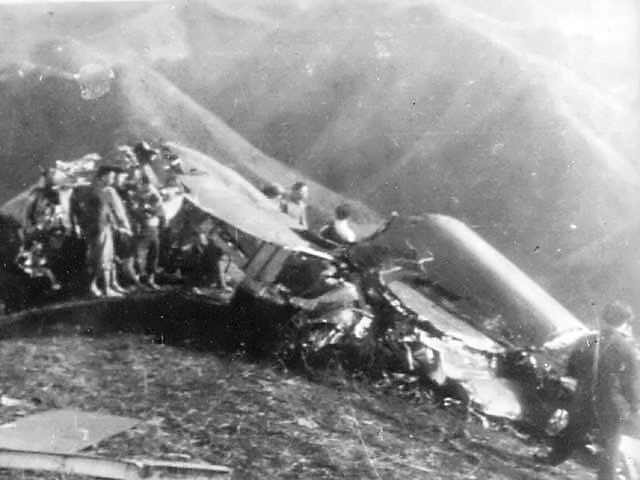
What saved the scattered raiders in those days was China itself, at every level from village to province. Farmers who had never seen a Westerner fed sodden airmen and hid them from patrols. Guerrilla bands passed them along the paths at night. Missionaries, among them the young American John Birch, whom Doolittle’s own party encountered on a river boat, translated, guided and vouched for them through territory where a wrong turn meant a Japanese garrison. The fliers were moved in sedan chairs, on ponies, by sampan and by foot, passed hand to hand westward towards Chuchow and then on into unoccupied China, every stage depending on ordinary people who understood precisely what the Japanese would do to anyone caught helping. By this relay of thousands of small courages, sixty-four of the eighty raiders were carried to safety.
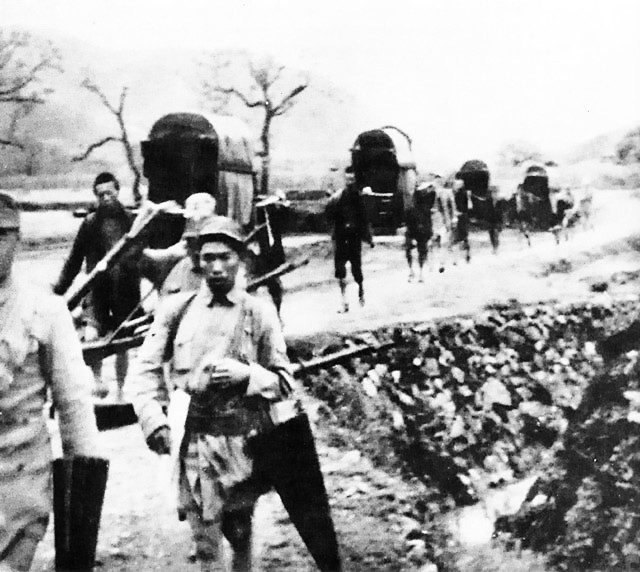
The hardest passage belonged to Ted Lawson’s crew from the Ruptured Duck, who had ditched at speed into the surf off the coast. Lawson was hurled through the windscreen still strapped in his seat and dragged himself ashore with his face torn open and his left leg destroyed below the knee; his co-pilot Dean Davenport and two others were badly injured beside him. Chinese fishermen and villagers carried them inland by litter through Japanese-patrolled country to the town of Linhai, where they were joined by Lieutenant Thomas “Doc” White, the qualified physician who had talked his way onto the raid as a gunner on the fifteenth aircraft. In a mission hospital with almost nothing, White fought the gangrene spreading up Lawson’s leg for days, transfusing blood donated by the crew, and when the infection could no longer be argued with, he amputated Lawson’s shattered left leg with the instruments available. Lawson lived to write Thirty Seconds Over Tokyo, the book and film through which most Americans would come to know the raid, and never ceased crediting the surgeon, and the Chinese bearers, who had refused to let him die. For the men of two other crews, however, the relay of rescue never began. The Japanese found them first.
The eight: trial by the conquerors
Eight raiders fell into Japanese hands within days of the raid: Dean Hallmark’s crew, the sixth off the Hornet, taken on the coast after their ditching had already killed Dieter and Fitzmaurice, and Bill Farrow’s crew, the sixteenth, captured after baling out near Nanchang deep in occupied country. With Hallmark went his co-pilot Robert Meder and navigator Chase Nielsen; with Farrow, co-pilot Robert Hite, navigator George Barr, bombardier Jacob DeShazer and gunner Harold Spatz, the youngest of the captured eight.
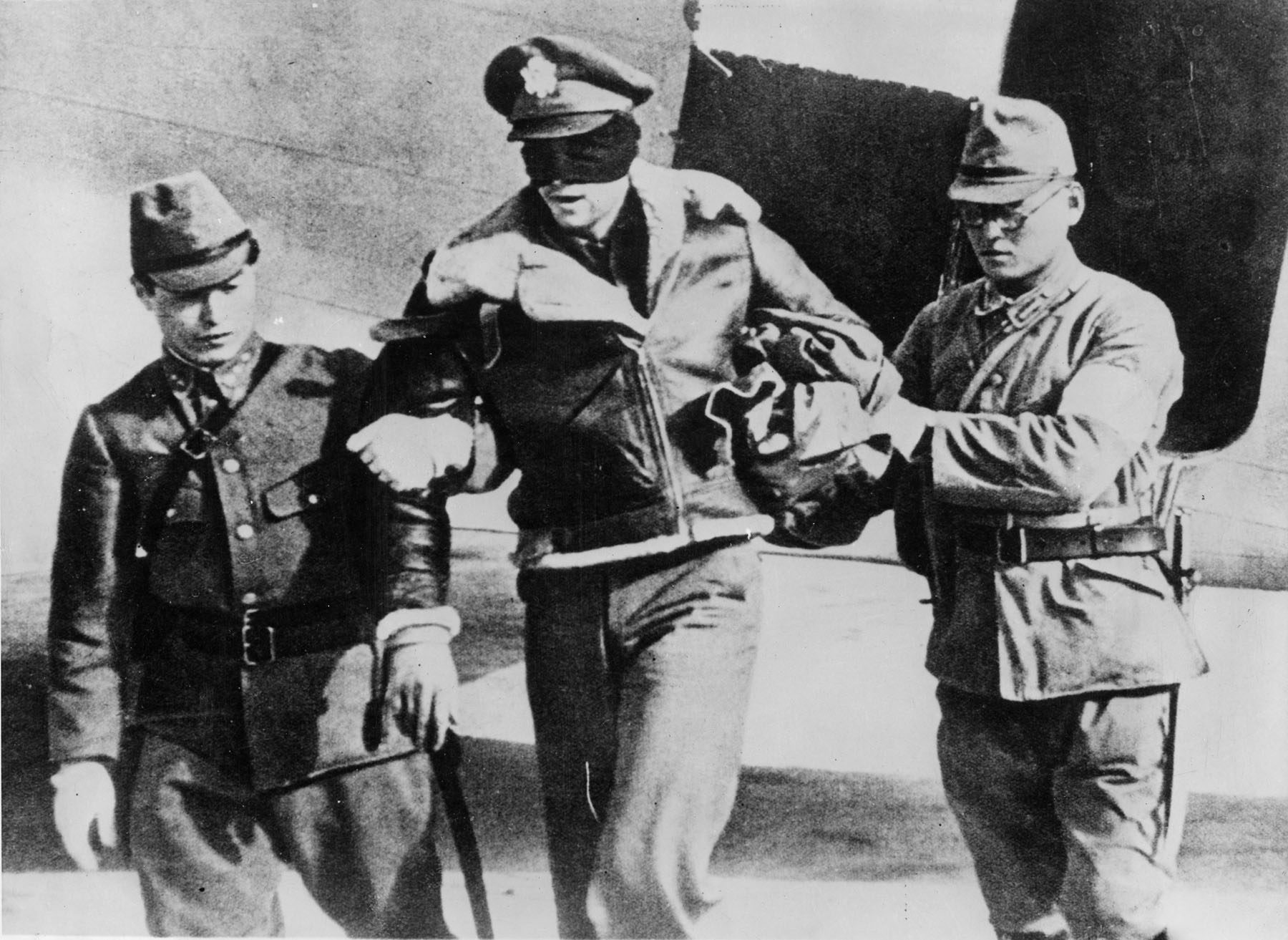
What was done to them in the months that followed was torture, plainly named. At Bridge House gaol in Shanghai and in Kempeitai hands in Tokyo they were starved, beaten, subjected to the water treatment and to mock executions, and kept kneeling for hours in postures designed to break the body’s endurance. Under this treatment the eight signed confessions, written in Japanese they could not read, stating that they had deliberately machine-gunned civilians, including schoolchildren. Those confessions became the foundation of everything that followed. Stray bombs had indeed struck civilian buildings in Japan, schools among them, and Japanese propaganda had fixed on those facts from the first day; but the specific charge of deliberate strafing rested on statements extracted under torture, and the prisoners repudiated them the moment they were free to do so.
To give the proceedings a garment of legality, Japan enacted the Enemy Airmen’s Act in August 1942, a law prescribing death for air attacks on civilian targets, and applied it retroactively to men captured four months before it existed. In a Shanghai courtroom that August, before a military tribunal, the eight were tried in a language they did not understand, without meaningful defence, and all were sentenced to death. Tokyo then staged its own mercy in October: on a recommendation ratified by Tojo and the Emperor, five sentences were commuted to life imprisonment, and three were confirmed. On 15 October 1942, Dean Hallmark, Bill Farrow and Harold Spatz were taken to Public Cemetery Number One outside Shanghai, tied to small wooden crosses, and shot. Each had been allowed a final letter home. Farrow told his mother he would meet her again in the hereafter; Spatz, who had nothing to leave, wrote that his father should have his clothes. The letters were not delivered until after the war.
For the five who remained, commutation meant solitary confinement on starvation rations, sustained for years. Robert Meder, weakened by dysentery and beriberi, wasted through 1943 despite his crewmates’ pleas for his treatment and died on 1 December of that year; his death shamed the Japanese into marginal improvements that probably kept the others alive. Nielsen, Hite, Barr and DeShazer endured forty months, most of it alone in their cells, until American parachutists reached them in August 1945 and brought them out, skeletal and half-blind in the sudden daylight. DeShazer, who had found a Bible in captivity, returned to Japan in 1948 as a missionary and spent thirty years there. Nielsen returned too, in 1946, as a witness at the Shanghai war crimes trial of four of the men who had imprisoned and tried the raiders. The tribunal weighed the torture, the retroactive law and the executions, convicted the accused, and sentenced them to terms of hard labour, verdicts many of the survivors thought lenient. The law had spoken twice over the same eight airmen, once in each direction.
The price China paid
The heaviest bill for the Doolittle raid was presented not to Japan or America but to the Chinese provinces that had saved the raiders. Tokyo understood exactly what the eastern Chinese airfields implied: if B-25s could stage through Zhejiang once, heavier aircraft could do it again, and the home islands would never be secure while those runways existed. Within weeks, Imperial General Headquarters ordered the Zhejiang-Jiangxi campaign, and from May 1942 more than a hundred thousand Japanese troops drove into the very districts through which the airmen had been passed hand to hand. The stated objects were the destruction of the airfields at Chuchow, Lishui and Yushan, and the punishment of the population. Both were pursued with method.
The punishment was not indiscriminate in its targeting, which made it worse. Towns and villages known or suspected to have helped the raiders were singled out. Communities that had fed an American, hidden one, or carried one in a litter were burned to the ground, their inhabitants killed, sometimes after interrogation to establish exactly who had done the helping. Men who had accepted small gifts from grateful fliers, a pair of gloves, a coin, a parachute panel, were identified by those very objects and executed. The city of Nancheng was systematically destroyed over days, its remains put to the torch as the troops withdrew. Missionary witnesses recorded the smoke of burning villages standing along the whole line of the raiders’ escape routes.
To this the campaign added an atrocity of a different order. As the Japanese armies withdrew in the late summer of 1942, Unit 731, the army’s biological warfare organisation, seeded the region with pathogens: plague, cholera, typhoid, paratyphoid and anthrax, spread through wells, food stocks and contaminated ground. Epidemics duly followed among a population already starving and displaced. The weapon then turned in its handlers’ grip, for Japanese soldiers moving through the contaminated zones sickened in their thousands, and by the army’s own reckoning some 1,700 of its troops died of the diseases their own service had disseminated, one of history’s clearest cases of biological warfare devouring its user.
How many Chinese died in the whole campaign can never be established with confidence. Chinese sources put the toll as high as 250,000; the true figure is unknowable, but the destruction of whole villages that had helped the raiders is beyond dispute. The raiders themselves learned of it only gradually, and it marked them. Several said in later life that the knowledge of what their rescue had cost lay on them more heavily than anything they had done over Japan.
For decades the story was barely told in China itself. In the People’s Republic after 1949, a narrative centred on Nationalist soldiers, Christian missionaries and the rescue of American airmen fitted no approved history, and the Zhejiang villagers’ sacrifice went publicly unremembered through the years of Sino-American estrangement. Only with the thaw of relations did the account resurface, carried by local historians, by returning raiders who came to thank the families of their rescuers, and by the descendants of both. Today a memorial hall in Quzhou, the city the fliers never reached on that first dark night, tells the story whole: the aircraft, the airmen, the villagers who took them in, and the price that was exacted for it. It is, fittingly, as much a monument to the rescuers as to the raid.
What the raid actually achieved
Weighed as a bombing operation, the Doolittle raid accomplished almost nothing, and it is no service to the men who flew it to pretend otherwise. Around 112 buildings damaged, one converting carrier delayed in dry dock, a few tanks of oil burned: Japanese war production did not falter for an hour. Set against the ledger’s other side, sixteen irreplaceable aircraft written off, three men dead in the exits, three executed, one dead in prison, and a retaliatory campaign that devastated two Chinese provinces, the raw arithmetic reads like failure. Doolittle himself, sitting by the wreck of his bomber on a Chinese mountainside, ran exactly that calculation and expected a court-martial for it.
The arithmetic was wrong because the raid’s real effects were never material. In Japan, the shock of bombs on the sacred home islands, however light, broke something in the high command’s composure. Fighter groups that the fronts were crying out for were held back for home defence, and stayed held back. Carrier forces were recalled from the Indian Ocean to hunt a raiding fleet that was already gone. Above all, the raid ended the argument inside the Japanese Navy about Yamamoto’s proposed operation against Midway. Yamamoto, who took the attack on the Emperor’s capital as a personal shame, had been pressing for a decisive battle to destroy the American carriers and extend Japan’s defensive perimeter; his opponents’ arguments, already yielding before the raid, dissolved entirely in its embarrassment, and the Midway operation was fixed beyond recall. Six weeks later, in the first days of June 1942, that operation cost Japan four fleet carriers, a heavy cruiser, and the irreplaceable core of her naval airmen in the battle that reversed the Pacific war. The sixteen B-25s did not sink those carriers, but they helped set the course that brought them under American dive bombers, and no honest account of Midway leaves the raid out of its causes.
In America the effect was simpler and, in the spring of 1942, hardly less important. The nation had absorbed five months of nearly unbroken defeat, from Pearl Harbor to the surrender on Bataan nine days before the raid. The news that American bombers had struck Tokyo itself ran through the country like current through a wire. Roosevelt, asked where the aircraft had flown from, answered with a grin that they had come from Shangri-La, the hidden Himalayan paradise of a popular novel, and the joke itself became part of the lift. Doolittle, retrieved from China, was jumped two grades to brigadier general and given the Medal of Honor he had told Sergeant Leonard was a fantasy, and the raiders passed into a national legend that has never dimmed.
Subtract the romance, as the raiders in their honest moments did themselves, and what remains is still substantial. The raid was conceived as a gesture, executed as a gamble, and redeemed by consequences nobody fully foresaw: a strategic error provoked in the enemy’s mind, a defensive reflex that weakened his fronts, and a fighting spirit restored at home when it was most needed. Against that must always be set the villages of Zhejiang, which paid for the gesture at a rate no planner ever entered in the ledger. Eighty men flew off the Hornet on 18 April 1942 believing they would probably not all come back, and in that they were right; what none of them could have known was that their thirty seconds over Tokyo would tilt the reasoning of an empire. By that measure, the measure of what it moved rather than what it destroyed, the raid was among the most profitable military failures ever flown.
Two stars and a medal he never felt he earned
The rewards came almost indecently fast. Doolittle had taken off from the Hornet a lieutenant colonel; within days he jumped two grades to brigadier general, skipping colonel entirely, a promotion so abrupt that, by the familiar telling, he had no stars to pin on and had to borrow them. Then came the summons to Washington that he assumed, with characteristic pessimism, meant a court martial for losing all sixteen aircraft. Instead, in May, Roosevelt hung the Medal of Honor on him at the White House, with Joe Doolittle standing beside her husband in a dress hurriedly bought for the occasion, and Hap Arnold and George Marshall looking on. Doolittle protested to Arnold in the car beforehand that the medal was too much, that it should be reserved for men who risked their lives above and beyond the call of duty, and that every man on the raid had risked exactly what he had. Marshall, riding with them, ended the argument by saying that he happened to think Doolittle did deserve it. He accepted it, but he never made peace with it. He told Joe he would spend the rest of his life trying to earn it, and the remark was not false modesty; it was the operating principle of the next fifty years.
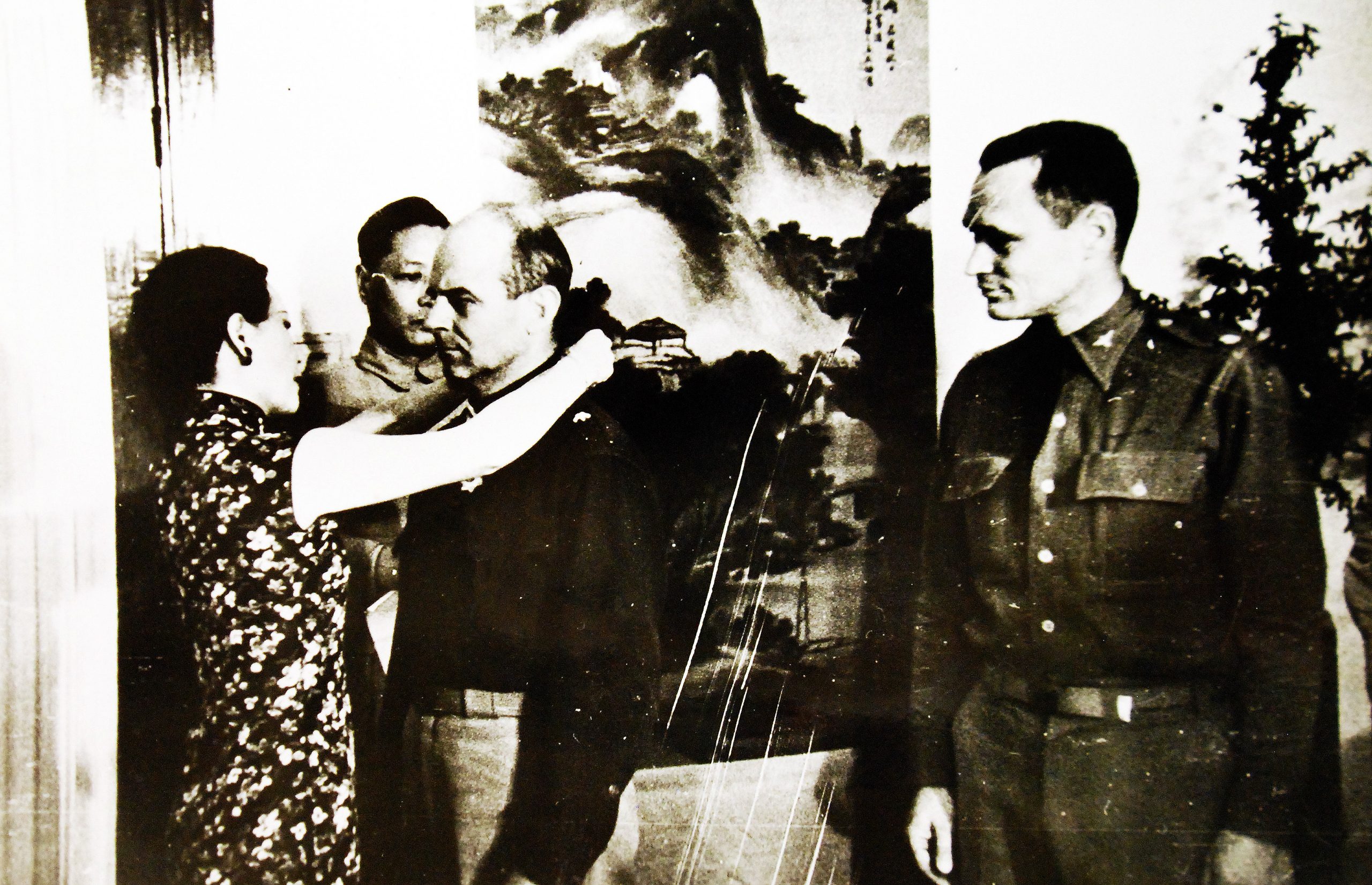
The other seventy-nine were not forgotten. Every man of the eighty received the Distinguished Flying Cross, awarded in batches as they trickled out of China, in hospital wards, at desert airfields, and in some cases posthumously or in absentia, into prison camps whose occupants would not learn of the decoration for years. Those wounded or killed received the Purple Heart. Two Silver Stars stand out from the list. Corporal David Thatcher and Lieutenant Thomas “Doc” White, gunner and flight surgeon, earned theirs not over Tokyo but in the days after, on the beach at Linhai and the long inland roads, keeping the shattered crew of the Ruptured Duck alive when infection and gangrene should have killed them. And the Chinese government, whose people were about to pay so terribly for the raid, gave its own thanks: Madame Chiang Kai-shek presented decorations to Doolittle and his men in Chungking, elegant orders pinned on borrowed, ill-fitting uniforms by the most glamorous political figure in Asia, while outside the city the reprisal campaign was already gathering.
The last honour took seventy-two years to arrive. In 2014 Congress voted the Doolittle Tokyo Raiders a Congressional Gold Medal, and the following spring the medal was presented on Capitol Hill with Dick Cole and David Thatcher, the last two Raiders still able to travel, standing for all eighty. The medal then went where everything of the Raiders eventually goes, to the National Museum of the United States Air Force at Dayton, to sit near the goblets. There is a neatness to the arc. In 1942 the decorations were handed out in haste, to living young men, as instruments of morale in a losing war. In 2015 the gold medal was struck in tranquillity, for the dead and the nearly gone, as an instrument of memory. Doolittle, who died insisting he was still paying off the Medal of Honor, would probably have said the second award was the sounder debt, since by then it could no longer be mistaken for encouragement, only for gratitude.
Portraits from the eighty
Richard Cole never planned to be famous. He was Doolittle’s co-pilot in the lead aircraft, twenty-six years old, a quiet Ohioan who spent the flight to Tokyo sitting three feet from his boyhood hero and later admitted his main worry was doing nothing foolish in front of him. He bailed out into a Chinese night, caught his parachute in a tree, and went on to fly the Hump and serve with the Air Commandos. Then he outlived everyone. He raised the last toast, watched the B-21 take the Raiders’ name, and died on 9 April 2019 at the age of 103, the final Doolittle Raider, still answering questions with the patient courtesy of a man who considered himself ordinary.
Ted Lawson piloted the Ruptured Duck into the surf off the China coast and came out of the wreck with his leg ruined. Doc White amputated the ruined leg with borrowed instruments. Lawson’s 1943 book, Thirty Seconds Over Tokyo, named the raid for a generation and made him its most famous casualty. He died in January 1992, three months short of the fiftieth anniversary.
Ross Greening was the raid’s artist and its improviser, the man who designed the twenty-cent “Mark Twain” bombsight of scrap aluminium after the Norden sights were pulled. Shot down over Italy in 1943 on a later tour, he was captured, escaped from a prison train, evaded for months before recapture, and filled a German prison camp with watercolours that became the book Not As Briefed. He died still in uniform in 1957, a colonel, only forty-two.
Edward “Ski” York, commanding aircraft eight, watched his fuel gauges fail the arithmetic and turned for Vladivostok. Russia, neutral against Japan, interned his crew for thirteen months before an “escape” across the Iranian border that declassified files later revealed had been quietly staged by Soviet intelligence.
Robert Hite was photographed being led from a Japanese transport, blindfolded, hands bound, an image that became shorthand for the captured Raiders. He survived forty months of prison, starvation and solitary confinement, and lived to be the last of the POWs, dying in 2015 at ninety-five.
Jacob DeShazer, Hite’s crewmate, endured forty months as a prisoner, thirty-four of them in solitary, and emerged not with hatred but with a vocation. He returned to Japan as a missionary in 1948 and spent thirty years there. His tract, I Was a Prisoner of Japan, was picked up at a Tokyo railway station by Mitsuo Fuchida, the airman who had led the Pearl Harbor strike, and helped set Fuchida on the road to Christian conversion. The two men later preached together, the bombardier of Nagoya and the herald of Pearl Harbor sharing a stage.
Doc White, the flight surgeon who had talked his way onto the raid as a gunner, swam ashore from his own ditched aircraft and made his way to Lawson’s dying crew, taking his turn at the oars of the boats that carried them inland, twice giving his own blood for transfusions, and performing the amputation that saved Lawson’s life.
And David Thatcher, the twenty-year-old corporal in the Ruptured Duck’s turret, came through the crash almost unhurt and simply refused to let the other four die, dressing wounds, organising bearers, standing watch against Japanese patrols. He went home to Missoula, delivered post for thirty years, and died in June 2016, the second-last Raider of all.
Doolittle’s war after Tokyo
The Medal of Honor could have been a full stop. Plenty of celebrated airmen spent the rest of the war selling bonds. Doolittle instead went back to work, and the work turned out to be commanding air forces, a job nobody, least of all Hap Arnold, had been sure the impatient racing pilot could do. He took the Twelfth Air Force into North Africa for the Torch landings in November 1942, learning the unglamorous trades of logistics, targeting committees and coalition politics under Eisenhower, who had initially not wanted him. He then stood up the Fifteenth Air Force in the Mediterranean in late 1943, opening the strategic bombing of the Reich from the south. And in January 1944 he arrived in England to command the Eighth Air Force, the largest air striking force ever assembled, at the exact moment its daylight campaign against Germany hung in the balance.
His most consequential act there took the form of a changed sign. In the headquarters of his fighter command hung the motto that the first duty of the fighters was to bring the bombers back alive. Doolittle ordered it taken down and replaced: the first duty of the Eighth’s fighters was to destroy German fighters. The Mustangs were unleashed from close escort to hunt, ranging ahead of the bomber streams and strafing airfields on the way home. Bomber crews hated it at first, watching their little friends disappear over the horizon, and losses in the spring of 1944 were cruel. But the Luftwaffe’s day fighter force was bled white in precisely the months before Normandy, and historians have generally judged the decision, made by the man who had once insisted on leading sixteen bombers personally into Tokyo, as the most important of his career. He finished the war a lieutenant general, the MIT doctor of science, holder of one of the first aeronautics doctorates awarded in America, having proved that the scientist-daredevil could also be a commander.
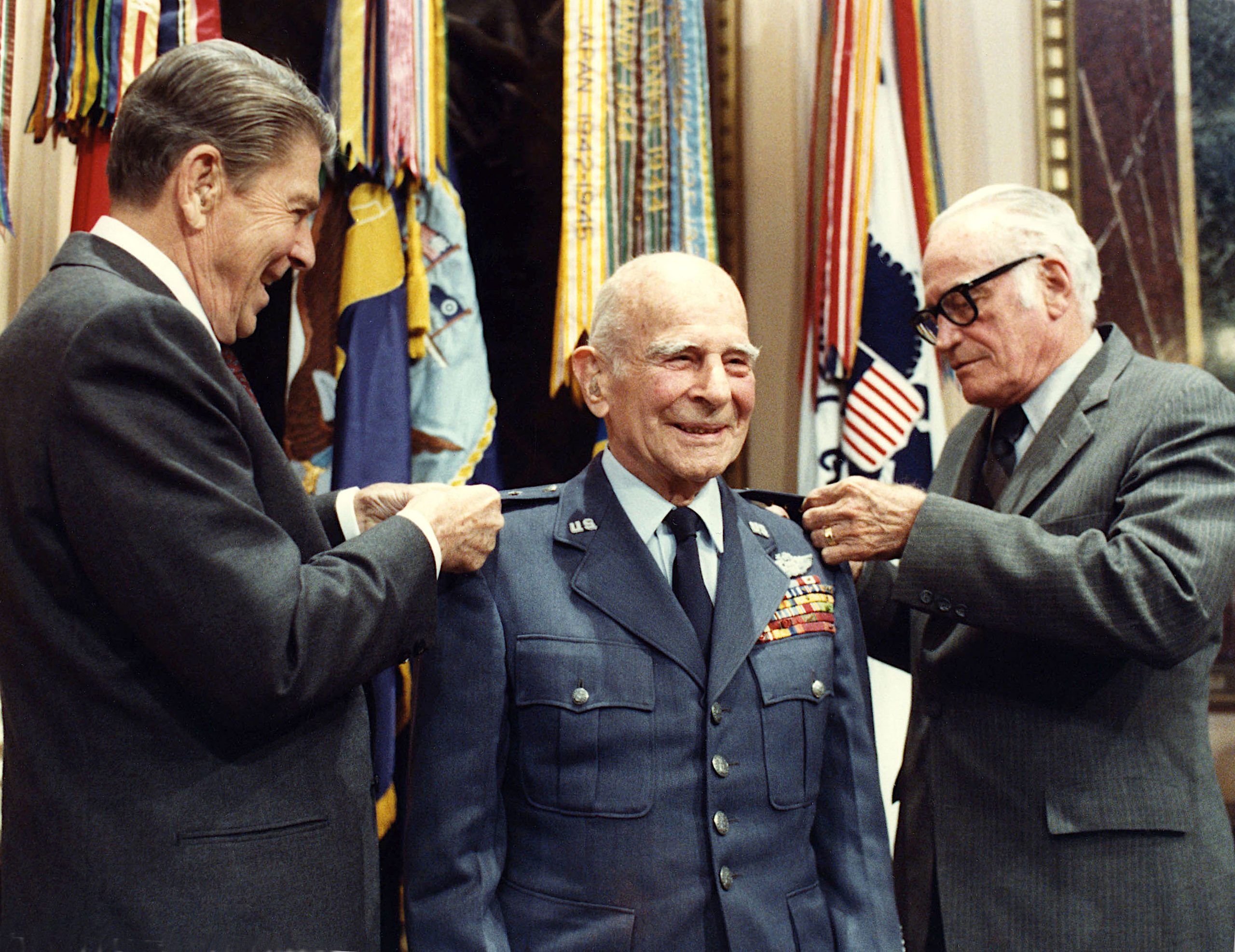
Peace returned him to Shell, where he became a vice president and director, and to the unpaid, unphotographed committee work that shaped the postwar American aerospace establishment: chairman of the Air Force’s Scientific Advisory Board, chairman of the National Advisory Committee for Aeronautics in the years it turned into NASA, adviser on ballistic missiles, space and intelligence. He flew less, then not at all, and grew into the role of the nation’s senior airman emeritus. In 1985, forty years after he had left uniform, Congress voted and Ronald Reagan pinned on his fourth star, making him a full general on the retired list, the rank his wartime contemporaries had always felt he had been denied by the accident of seniority.
Joe died in 1988, on Christmas Eve, ending a marriage of seventy-one years that had begun with a quiet Christmas Eve wedding in 1917 and survived every crash, ocean and war the century could arrange. Doolittle followed on 27 September 1993, aged ninety-six, at his son’s home in Pebble Beach. They buried him at Arlington beside her, under a flyover led by a lone wartime B-25 among the jets. He had spent fifty-one years, by his own accounting, trying to earn the medal Roosevelt gave him. The auditors of these things have long since closed the file as paid in full.
Thirty seconds over Tokyo: the raid told and retold
The raid entered legend before all its men were even out of China, and the vehicle was Ted Lawson. Recovering from his amputation, he told his story to the columnist Bob Considine, and Thirty Seconds Over Tokyo appeared in 1943, serialised, condensed, devoured. It is a plain, decent, unliterary book, which is exactly why it worked; Lawson wrote as the ordinary pilot next door, and his refusal to dramatise made the crash, the surf, the gangrene and the kindness of Chinese villagers land all the harder. The title fixed forever the raid’s essential arithmetic, months of preparation and a lifetime of consequence balanced on half a minute over the target.
MGM filmed it in 1944, with Spencer Tracy playing Doolittle as a granite abstraction of command and Van Johnson as Lawson, and with real B-25s making real deck runs for the cameras. The film’s restraint still surprises; its Tokyo is glimpsed rather than gloated over, its heart is in the Chinese rescue, and its special effects won the Oscar. The same year Twentieth Century-Fox released The Purple Heart, a furious dramatisation of the captured Raiders’ show trial made while the facts of the executions were still only half-public, propaganda in the strict sense, and a measure of how raw the story was: Hollywood was staging a war crime whose survivors were at that moment starving in solitary confinement.
Then the raid settled into the national furniture, surfacing whenever the war was retold. Pearl Harbor in 2001 used the launch as its redemptive final act, Alec Baldwin growling Doolittle’s lines, history bent freely around the love story; the veterans grumbled and bought tickets. Midway in 2019 restored the raid to its correct strategic position, the provocation that helped set the Japanese carriers on the road to their destruction, and, notably, gave screen time to the Chinese rescuers and the price they paid. That shift owed much to James M. Scott’s Target Tokyo, published in 2015, which used Chinese archives and missionary records to put the Zhejiang-Jiangxi reprisals back at the centre of the story after seventy years at its margins.
Each generation, in other words, has retold the raid in its own image, exactly as with the Dambusters legend on the other side of the Atlantic. The 1940s needed defiance and got Lawson’s modest heroics; the Cold War needed institutions and got Doolittle the four-star elder; the blockbuster era needed spectacle and got the deck run in digital slow motion; the present needs reckoning and gets the Chinese cost, the executed prisoners, the moral ledger fully opened. The facts have barely changed since 1943. What changes is which thirty seconds we choose to look at. That the story survives every retelling, propaganda and revision alike, is the surest sign of its durability: sixteen bombers, eighty men, one carrier, and a country that decided, four months after Pearl Harbor, that it would rather do something impossible than nothing at all.
Eighty silver goblets
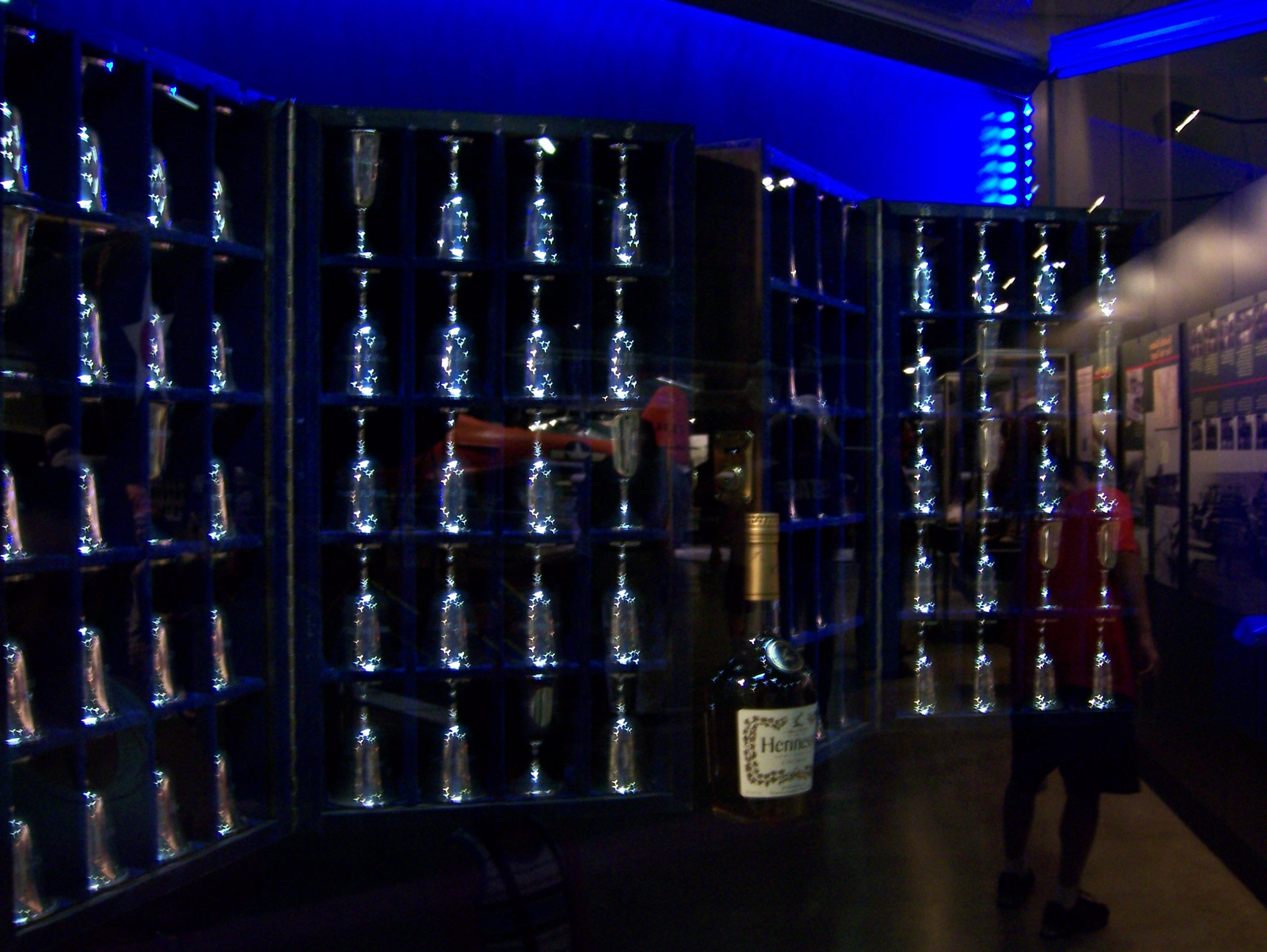
In 1959 the city of Tucson, adopted home of the Raiders’ early reunions, gave the survivors a gift that would come to define them: eighty silver goblets, one for every man who flew, each engraved with a name. The engraving was done twice, once upright and once inverted, so that the name could be read whichever way the goblet stood. That detail was the whole point. At each annual reunion the surviving Raiders gathered in private, called the roll, and drank a toast to the men who had died since they last met; then the goblets of the newly dead were turned upside down in their velvet-lined case, the inverted engraving keeping each name legible in death as in life. Year by year the case slowly turned over, a silver actuarial table, until the upright goblets could be counted on two hands, then one.
With the goblets travelled a bottle: Hennessy cognac of the 1896 vintage, Doolittle’s birth year, set aside with the understanding that the last two surviving Raiders would open it together and drink a private final toast. It was a fine piece of theatre with an obvious flaw, which the Raiders themselves eventually pointed out: the last two might well be too frail to travel, or strangers separated by a continent. So in 2013 the four men still living, Dick Cole, Robert Hite, Edward Saylor and David Thatcher, decided to close the ritual on their own terms while enough of them could stand together. On 9 November 2013, at the National Museum of the United States Air Force at Dayton, before an invited gathering of Air Force leadership, families and the merely awed, three of the four last Raiders, Cole, Saylor and Thatcher, with Hite too ill to attend, opened the 1896 cognac, poured it into their goblets, and drank the final toast to their seventy-six departed comrades. Cole, the senior man, raised his goblet to those lost on the mission and those who had passed away since, in a voice which those present described as steady.
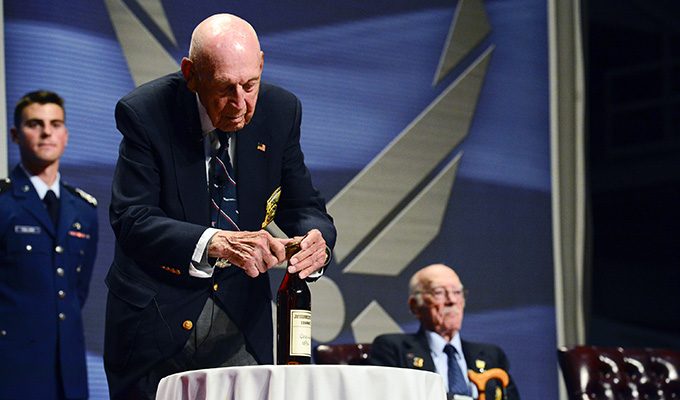
The deaths then came as they had to. Hite in 2015, Saylor the same year, Thatcher in June 2016. And then there was Cole, alone with seventy-nine inverted goblets, carrying the raid’s living memory into rooms full of people born half a century after it. He carried it well. In September 2016, when the Air Force announced the name of its new stealth bomber, Cole stood on the stage as the B-21 was christened Raider, the mission’s name bolted onto the next fifty years of American airpower with the last Raider present to hear it. He kept appearing, kept answering, kept deflecting praise onto the other seventy-nine, until 9 April 2019, when he died in San Antonio at 103. At his memorial two B-25s flew over the mourners, and a missing-man formation of T-38s closed the ceremony with the climb that has become aviation’s sign of the cross. His goblet was turned at Dayton, and the case was complete: eighty names, all inverted, all still legible, exactly as the engraver intended sixty years before.
Where to touch the raid today
The raid’s principal shrine is the National Museum of the United States Air Force at Dayton, Ohio, where the goblets rest in their case alongside a replica of the 1896 cognac bottle, close by the Congressional Gold Medal. A few steps away stands the museum’s B-25, rebuilt to the configuration of Doolittle’s own aircraft and set in a diorama of the Hornet’s deck, nose pointed forever at a painted horizon. It is the closest anyone can now come to standing where the Raiders stood on the morning of 18 April 1942, and the museum has made it the anchor of its Second World War gallery.
At Alameda in California, the USS Hornet Sea, Air and Space Museum occupies the carrier Hornet, CV-12, the Essex-class ship named in honour of the lost CV-8, and she is moored only yards from the pier where the original Hornet loaded Doolittle’s bombers in April 1942. The geography alone is worth the visit; the museum’s Doolittle exhibits do the rest. In China, the Quzhou Doolittle Raid Memorial Hall in Zhejiang province tells the story from the side of the rescuers, and in the hills around it villages maintain markers at crash sites and at the houses where individual airmen were hidden, a network of small local memories that survived war, revolution and time. In Florida, the auxiliary strips at Eglin where the crews practised their impossible take-offs are marked for visitors, and the National Naval Aviation Museum at Pensacola holds the naval side of the story, the carrier film footage and the Navy’s half of a mission that belonged equally to two services.
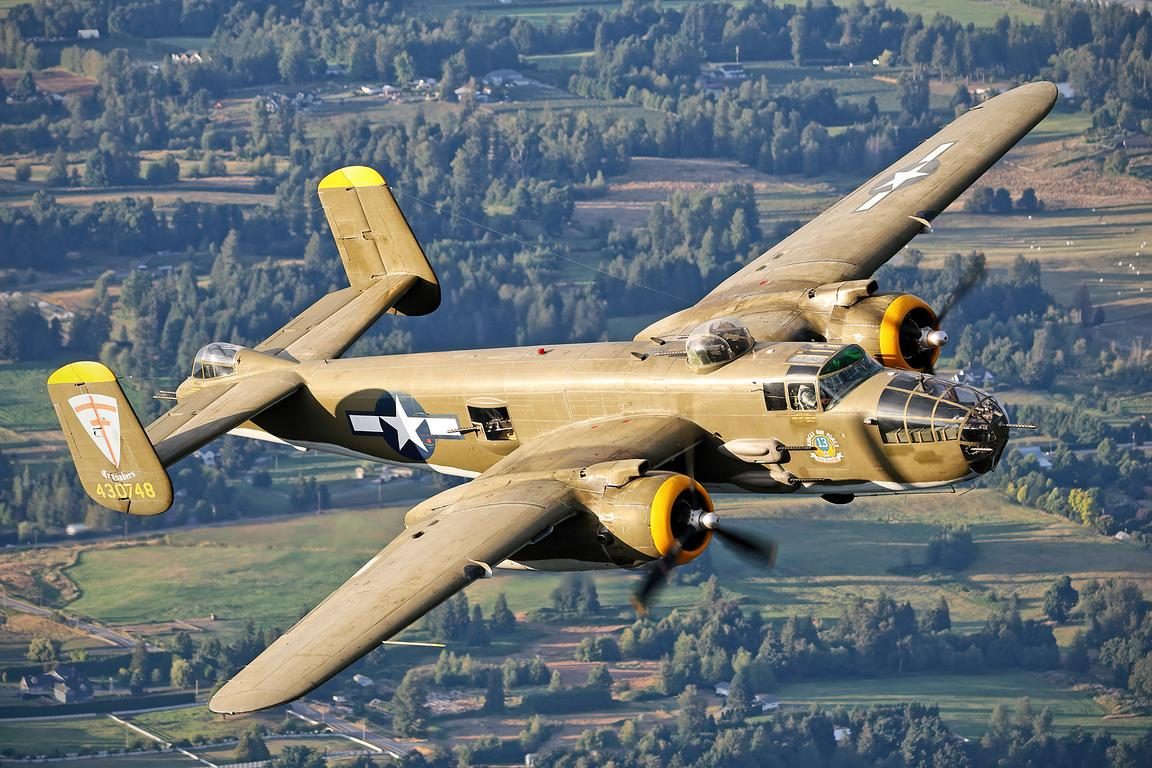
Then there are the aircraft themselves. The B-25 is, by the standards of eighty-year-old bombers, almost common: roughly forty remain airworthy worldwide, sustained by the type’s docile handling and the deep American warbird economy. Almost all of them fly in North America, where gatherings of a dozen or more B-25s have marked the great anniversaries at Dayton. Europe has exactly two. The Dutch historic flight operates Sarinah, a B-25 wearing the colours of the wartime Dutch squadrons that flew Mitchells from England, and the Flying Bulls keep an immaculately polished machine at Salzburg, a mirror-finished celebrity of the European airshow circuit. Britain, which once fielded whole RAF wings of Mitchells, currently has none flying, and a B-25 appearance at a UK show means a Channel crossing by one of the continental pair.
One relic can never be visited. In January 2019 the research vessel Petrel found the Hornet herself, CV-8, on the floor of the South Pacific near the Santa Cruz Islands, more than 17,000 feet down, upright, her guns still trained skyward, sunk in October 1942 just six months after her deck launched the raid. The discovery came in the final weeks of Dick Cole’s life, so that the ship that carried the raid and the last man who had flown from her deck left the story almost together, seventy-seven years apart by calendar and three miles apart by water.
The anniversary clock
Every 18 April the clock strikes. The date has been kept since the first reunion Doolittle convened in December 1946, ostensibly his fiftieth birthday party, in practice the founding of a liturgy, and it has survived the deaths of every man it was created to honour. The National Museum of the United States Air Force now holds a memorial toast each spring, conducted by serving airmen and Raider descendants with ceremonial goblets, the ritual carrying on precisely because the men cannot. The USS Hornet museum at Alameda marks the date aboard the carrier; Quzhou marks it in Zhejiang; B-25 operators across America time their gatherings to it. Like Remembrance Sunday or the Dambusters’ May anniversary, it has detached itself from living memory and become pure calendar, which is what happens to all commemorations that succeed.
The next great tolling of the bell is already visible. The 85th anniversary falls on 18 April 2027, and the commissioning cycles are turning for it now, in 2026, because anniversary content is always built years ahead of the date it serves. The pattern is dependable. The 75th, in 2017, brought eleven B-25s to Dayton, a wave of broadcast documentaries, reissues of Lawson and of Scott, and Dick Cole standing at the centre of it all. The 85th will be the first major anniversary with no Raider alive, which will change the tone but not the volume: the Dambusters’ recent anniversaries, held long after the last crews died, drew larger audiences than many earlier ones, because absence itself becomes the story. Expect the 2027 coverage to lean on the themes the last decade has surfaced, the Chinese rescuers and the reprisals, the POW ordeal, the goblets, and the B-21 Raider, which by then should be flying operationally and will give every editor an irresistible frame of first Raiders and newest Raider.
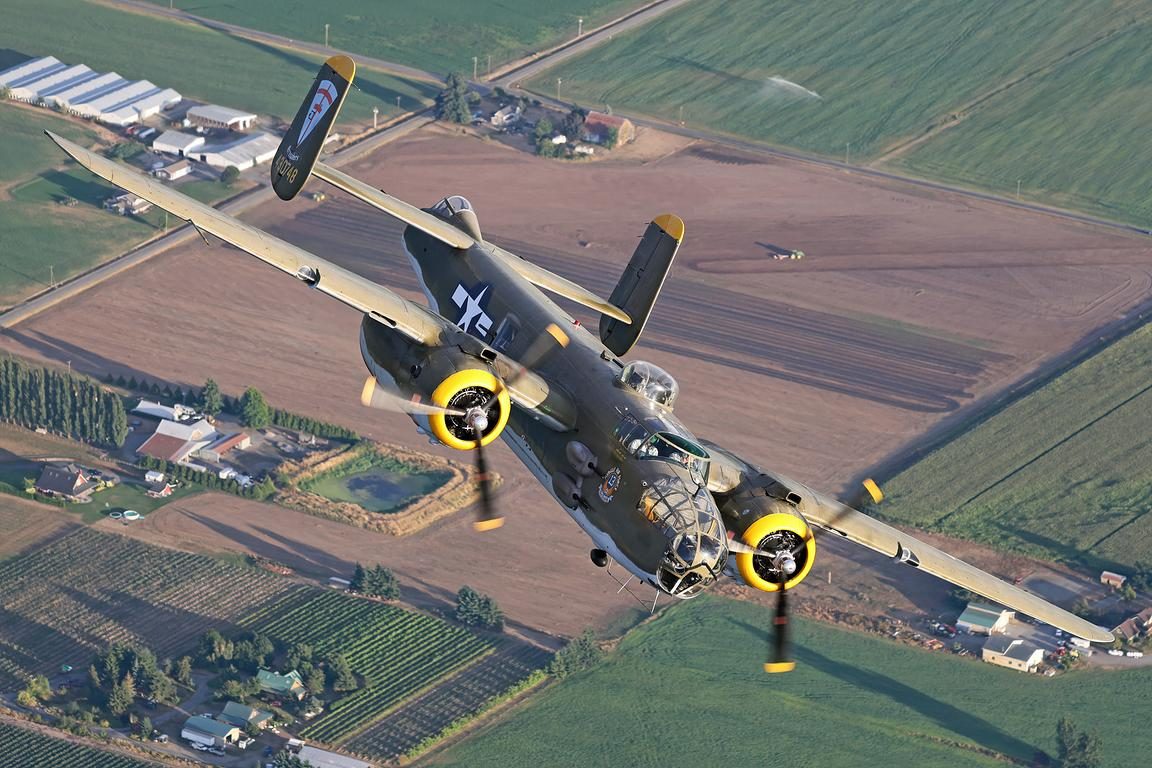
For publishers and programme makers the practical needs are unglamorous and predictable. They will need accurate chronology, because the raid’s dates are widely garbled in circulation; they will need the Chinese dimension handled with care and modern scholarship rather than 1943 shorthand; and above all they will need imagery. The photographic record of the raid is finite and closed, sixteen aircraft, one deck, one medal ceremony, a handful of Chinese rescues and prison images, and every documentary, book jacket, museum panel and streaming series must draw from that same fixed well. The same is true of the RAF’s own great precision operation of that summer, told in full in our epic on the Peenemunde raid. The archival scans exist at publication quality; the difficulty is sourcing them cleanly, with correct identifications, at the resolution modern print and 4K broadcast demand, on schedules that anniversary production always compresses. Those who commission early get the pick; the material is scarce, the demand is synchronised, and everyone wants the same frames in the same eighteen months.
And beyond 2027 the clock will keep striking, the 90th in 2032, the centenary in 2042, each one further from the event and, on all present evidence, no smaller. The Raiders themselves foresaw this. It is why they engraved the names twice, why they closed the toast on their own terms, why Cole spent his last decade patiently feeding the story to anyone who would carry it. They built the raid a memory designed to run without them. The anniversaries are simply that machine, working.
Licensing the imagery of the Doolittle Raid
The defining photographs of the Doolittle Raid form one of the most requested picture sets of the Pacific war: the crowded deck of the Hornet with sixteen B-25s ranged tail-over-stern, the lead aircraft clawing off the pitching bow into the gale, the medal ceremony on deck, Doolittle sitting grimly beside the wreckage of his bomber in China, the blindfolded prisoners, and the silver goblets in their case at Dayton. High-resolution scans of many of these images, prepared for publishing, broadcast and exhibition use, are available from the Piemags collections on Alamy, with identifications and captions checked against the museum and naval records rather than the errors that circulate online, and direct enquiries welcome through piemags.com. For modern material, Aviation Photo Crew shoots air-to-air photography of the world’s flying B-25s, and that work is licensable through our galleries, with full terms on the licences page; pricing is negotiable, and we will match or beat what you pay other aviation agencies. Picture researchers building broader Second World War features may also find our Dambusters epic useful for the RAF’s parallel legend, and our guide to licensing early aviation photographs for the pioneering era that produced Doolittle himself. For the 2027 anniversary cycle, we would encourage early enquiries; the strongest frames are already being asked for.
The raid answered a morning four months earlier, and that morning was an engineering problem before it was anything else. Our account of the aircraft of the Pearl Harbor attack covers the torpedo built to run in forty feet of water, and the carriers that were not in the harbour to receive it.
Frequently asked questions
What was the Doolittle Raid?
On 18 April 1942, sixteen US Army B-25 bombers led by Lieutenant Colonel Jimmy Doolittle took off from the carrier USS Hornet and bombed Tokyo and other Japanese cities, the first strike on the Japanese home islands of the war. Launched early after the task force was spotted, the crews flew on towards China, where nearly all crashed or bailed out. Material damage was slight; the psychological and strategic effects were enormous.
How did B-25s take off from an aircraft carrier, and could they land back aboard?
The crews trained at Eglin Field to lift a loaded B-25 off in under 500 feet, using full flap, careful trim and the carrier’s speed into the wind. All sixteen got airborne from the Hornet’s pitching deck. Landing back aboard was impossible: the B-25 had no arrestor hook, was far too heavy and fast for the deck, and could not have stopped. The mission was always one way, to airfields in China.
Who led the Doolittle Raid?
Lieutenant Colonel James H. Doolittle, a forty-five-year-old former air racer, stunt pilot and MIT-trained engineer who held one of America’s first aeronautics doctorates. He planned the mission, trained the volunteer crews, insisted on flying the lead bomber himself, and bailed out over China with the rest. Within days he was promoted two grades to brigadier general, and in May 1942 Roosevelt presented him with the Medal of Honor.
How many aircraft and men were lost on the Doolittle Raid?
All sixteen B-25s were lost: fifteen crashed, ditched or were abandoned by parachute over and off China, and one landed near Vladivostok, where the Soviets interned it. Of the eighty airmen, three died in the crash-landings, eight were captured by the Japanese, of whom three were executed and one died in prison, and five were interned in the Soviet Union for more than a year. Sixty-four escaped through China with the help of Chinese soldiers, missionaries and villagers.
What did the Doolittle Raid actually destroy?
Very little, measured in rubble. The sixteen bombers hit factories, refineries, docks and military installations in Tokyo, Yokohama, Nagoya and Kobe, causing damage Japan repaired within weeks. The raid’s real destruction was psychological and strategic: it humiliated Japan’s high command, punctured the promise that the home islands were untouchable, lifted American morale after months of defeat, and pushed Japan into the fatal decision to seek battle at Midway.
What happened to the captured Doolittle Raiders?
Eight airmen from two crews fell into Japanese hands in occupied China. After months of torture and a secret show trial, three, Dean Hallmark, William Farrow and Harold Spatz, were executed by firing squad in October 1942. Robert Meder died of starvation and disease in December 1943. The remaining four, including Jacob DeShazer and Robert Hite, endured forty months of imprisonment, most of it in solitary confinement, before liberation in August 1945.
What happened in China after the Doolittle Raid?
Japan launched the Zhejiang-Jiangxi campaign to punish the provinces that had sheltered the fliers and to destroy the airfields they had aimed for. Towns and villages along the escape routes were burned, and biological warfare agents were used. Chinese sources put the death toll as high as 250,000, a figure that cannot be verified but reflects a slaughter that is beyond dispute, and one the Raiders themselves acknowledged with grief for the rest of their lives.
Did the Doolittle Raid cause the Battle of Midway?
It tipped the argument. Admiral Yamamoto had been pressing for an operation to draw out and destroy America’s carriers, and the bombing of Tokyo ended what remained of the argument, since the raid proved the home islands were vulnerable while American carriers remained afloat. The resulting Midway operation, hurried and overcomplicated, ended in June 1942 with four Japanese carriers sunk, the defeat from which Japan’s navy never recovered.
What happened to Jimmy Doolittle after the raid?
He rose to command the Twelfth Air Force in North Africa, the Fifteenth in the Mediterranean and, from January 1944, the mighty Eighth Air Force in England, where he freed the Mustangs to hunt the Luftwaffe rather than merely escort bombers. After the war he returned to Shell and chaired key scientific boards. Reagan presented his fourth star in 1985. He died on 27 September 1993, aged ninety-six, and lies at Arlington beside his wife Joe.
What are the Doolittle Raiders’ goblets?
In 1959 the city of Tucson gave the Raiders eighty silver goblets, each engraved with a name twice, upright and inverted. At every reunion the survivors toasted their dead and turned the goblets of those who had died since the last gathering. A bottle of 1896 Hennessy cognac, Doolittle’s birth year, was reserved for the end; three of the four last Raiders opened it at the final toast on 9 November 2013 at Dayton.
Where can I see Doolittle Raid artefacts today?
The National Museum of the United States Air Force at Dayton holds the goblets, the Congressional Gold Medal and a B-25 rebuilt to Doolittle’s configuration in a carrier-deck diorama. The USS Hornet Museum at Alameda occupies CV-12, moored near where the raid loaded aboard CV-8. In China, the Quzhou Doolittle Raid Memorial Hall and village crash-site markers preserve the rescuers’ story, and Eglin’s training strips in Florida are marked.
Where can publishers license Doolittle Raid photographs?
High-resolution scans of the defining images, the crowded Hornet deck, the launch into the gale, the Medal of Honor ceremony, Doolittle beside his wreck and the silver goblets, are available for publishing, broadcast and exhibition from the Piemags collections on Alamy, with details at piemags.com. Modern air-to-air B-25 warbird photography is also available; pricing is negotiable, and we will match or beat what you pay other aviation agencies.
Sources and further reading
- US Navy History and Heritage Command: The Halsey-Doolittle Raid
- National Museum of the USAF: Doolittle Raid fact sheet
- National Museum of the USAF: Doolittle Raid crews
- National Museum of the USAF: the Raiders’ goblets
- Children of the Doolittle Raiders: the Raiders in China
- James M. Scott, Target Tokyo: Jimmy Doolittle and the Raid That Avenged Pearl Harbor (2015)
- Ted W. Lawson, Thirty Seconds Over Tokyo (1943)
- James H. Doolittle with Carroll V. Glines, I Could Never Be So Lucky Again (1991)
- The Diplomat: The Doolittle Raiders and Chinese Revisionist History
