Supermarine was a British aircraft manufacturer, founded at Woolston on the River Itchen in Southampton in 1913, that made its name building flying boats and Schneider Trophy racing seaplanes before producing the Spitfire, and its story is really the story of one design office learning, race by race, how to build the fastest aeroplane in the world. The company that started life as Pemberton-Billing Ltd, unable even to get its first aircraft off the water, ended up handing the Royal Air Force the fighter that would define British aviation. The line from the racing floatplanes of the late 1920s to the Spitfire of 1936 is not a legend invented afterwards. It runs directly through the same drawing office, the same designer and, in large part, the same engine maker.
This is a company history rather than an aircraft profile. It covers where Supermarine came from, how a small firm building amphibians on the Itchen ended up winning the Schneider Trophy outright, what R. J. Mitchell actually contributed, how the Spitfire was built after his death, what the Luftwaffe did to the Woolston works in September 1940 and what happened afterwards, and how the company faded into the British Aircraft Corporation with its last jets barely remembered. It also covers where you can go and photograph what survives.
What this guide covers
- Origins on the Itchen
- R. J. Mitchell arrives
- Flying boats and the first money
- The Schneider Trophy
- The S.6B and 1931
- Vickers takes over
- The Walrus and the workhorses
- The failure that led to the Spitfire
- Building the Spitfire
- The bombing of Woolston
- Dispersal: a factory with no factory
- The jet years: Attacker, Swift and Scimitar
- Key aircraft and figures
- What survives and where
- Photographing Supermarine aircraft today
- Legacy
- Frequently asked questions
Origins on the Itchen
The company began in 1913 as Pemberton-Billing Ltd, set up by Noel Pemberton Billing on land he had bought at Oakbank Wharf on the River Itchen at Woolston, Southampton. Billing was an inventor, a self-publicist and later a member of parliament, and his interest was in flying boats. He is said to have wanted “a boat which would fly rather than an aircraft that would float”, which tells you something about the priorities of a man who chose a shipyard site rather than an aerodrome.
The company’s registered telegraphic address was “Supermarine, Southampton”. That word, coined as the opposite of “submarine”, eventually became the company name and outlasted everything else about the founder.
The early aircraft were failures. The first, the P.B.1, was displayed at the 1914 Olympia Aero Show and, despite Billing’s claims of a short hop, most accounts agree that it never flew. Others followed with equally little success. When war broke out Billing joined the Royal Naval Volunteer Reserve, the order book was empty, and the company survived only because a director paid off its debts. At one point the workforce was down to fourteen people.
What kept it alive was subcontract work: repairing Sopwith aircraft, building Short seaplanes and Norman Thompson trainers under licence. It was unglamorous, and it taught the firm how to build aeroplanes properly.
Scott-Paine takes the reins
In 1916 Billing, by then an MP running a noisy campaign against the Royal Aircraft Factory, became a political liability for a company that needed Air Department orders. He sold his shares to Hubert Scott-Paine and the other directors, who renamed the business Supermarine Aviation Works Ltd and registered it under that name on 27 June 1916.
Scott-Paine dropped Billing’s obsession with anti-Zeppelin fighters and pushed the company towards flying boats. He also, in 1917, advertised for a personal assistant.
R. J. Mitchell arrives
The man who answered that advertisement was Reginald Joseph Mitchell, a locomotive engineer’s apprentice from Stoke-on-Trent with no aviation background. He impressed Scott-Paine sufficiently to be hired on the spot and was then rotated through every part of the business, including a spell as assistant works manager. When the existing chief designer left in 1919, Mitchell, aged 24, was promoted into the job. He added chief engineer to his role in 1920 and joined the board as technical director in 1927.
It is worth pausing on this, because the popular version of the Mitchell story tends to skip it. He was not a genius plucked from a university laboratory. He was a young engineer who had spent two years learning how a small aircraft firm actually worked: how a hull was riveted, how a costing was done, how a customer was handled. That grounding shows in his aircraft. Mitchell designs were not the most theoretically advanced of their era, but they were consistently the most refined, the most carefully finished, the ones where every unnecessary square inch of frontal area had been argued away.
Flying boats and the first money
After the Armistice, Supermarine was the only British constructor still dedicated to flying boats, and it kept the lights on by buying surplus AD Flying Boats from the government and converting them into the civil “Channel”. A Southampton to Guernsey service followed in 1923. None of it made much money.
What did make money was the Southampton. Developed from the experimental Swan amphibian, it was ordered by the Air Ministry to a 1924 specification and entered RAF service in 1925. It was a large biplane flying boat, initially with a wooden hull and later with a metal one, and it was very good. Eighty-three of all types were built. Between 1923 and 1927, on the back of the Southampton and the earlier Seagull, Supermarine’s sales rose from around £138,000 to around £404,000 and its profits roughly doubled.
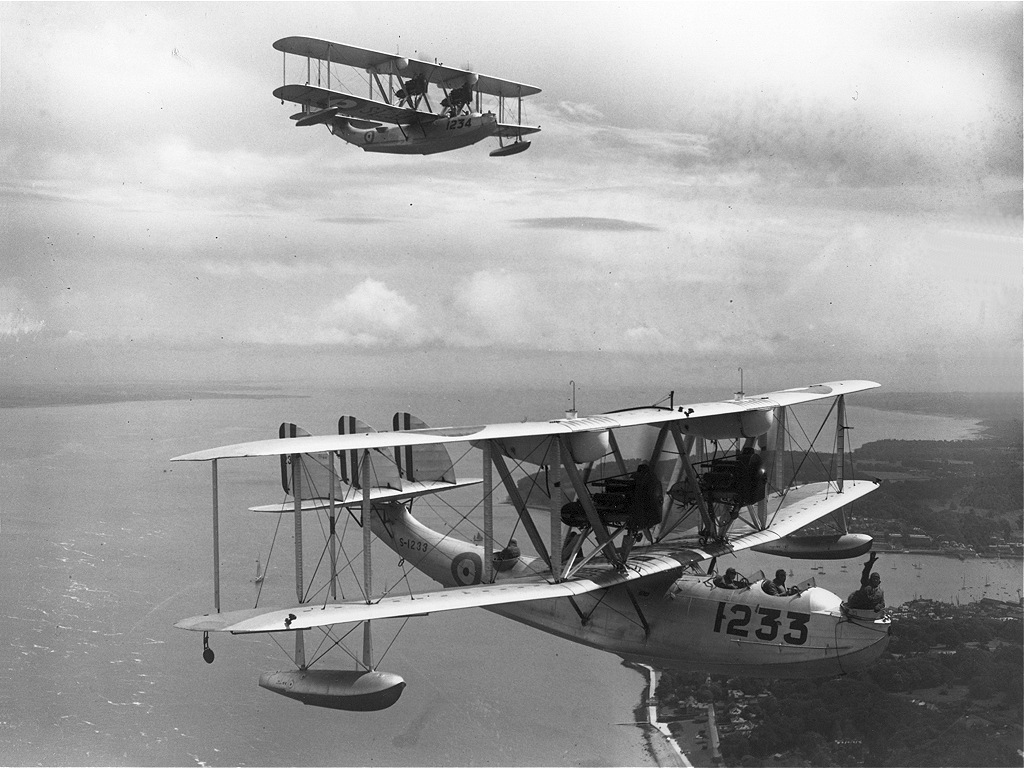
The Southampton also forced Supermarine to learn metal construction. The Air Ministry wanted metal hulls, which are lighter, stronger and do not soak up water and grow heavier with every landing. Supermarine set up a metallurgy department and built metal fabrication facilities at Woolston. Nobody could have known it at the time, but that capability would be the thing that made the racing seaplanes, and then the Spitfire, possible.
The Schneider Trophy
The Schneider Trophy was a seaplane race, first run in 1913, contested over a closed circuit and offered permanently to the first nation to win three times in five years. In the 1920s it became a matter of national prestige, and by the end of that decade it had turned into an arms race for engines and airframes conducted at public expense.
The early attempts
Supermarine’s first entry, in 1919, was the Sea Lion, a rebuilt Baby fitted with a Napier Lion engine. It sank after striking flotsam in fog. In 1922, at Naples, the Sea Lion II, essentially a modified Sea King II with a bigger fin and a much more powerful engine, won the contest and denied the Italians an outright victory. It was flown by Henri Biard, Supermarine’s test pilot. The 1923 entry, the Sea Lion III, was uncompetitive. In 1924, the company withdrew.
Mitchell abandons the flying boat
The 1924 withdrawal is the turning point. Mitchell concluded that racing flying boats were finished, and that the future belonged to slim monoplane floatplanes. The result was the S.4 of 1925, a wooden cantilever monoplane of startling cleanliness, which set a world seaplane speed record of 226.75 mph over Southampton Water. It then crashed during pre-race testing, though Britain still raced: Hubert Broad’s Gloster III finished second.
The S.5 that followed was a different animal: metal fuselage and floats, wire-braced wing, and a fuselage wrapped as tightly around the pilot and engine as Mitchell could manage. It dominated the 1927 contest at Venice, finishing first and second. Flight Lieutenant Sidney Webster won it.
The Rolls-Royce partnership
For 1929 Mitchell designed the S.6, an all-metal aircraft built around a new Rolls-Royce engine rather than the Napier Lion used previously. This is the moment the two threads of the Spitfire story come together. Rolls-Royce, pushed to extract absurd power from a racing engine for a few minutes at a time, learned things about supercharging, fuel chemistry and cooling that fed directly into later engine development. The S.6 won the 1929 contest at Calshot.
The S.6B and 1931
Two consecutive wins meant that a third would give Britain the Trophy permanently. Then the government withdrew funding. The 1931 British entry was rescued by Lady Lucy Houston, who put up £100,000 of her own money, an act of patriotic bloody-mindedness without which there would very likely have been no third win and, quite possibly, no Spitfire.
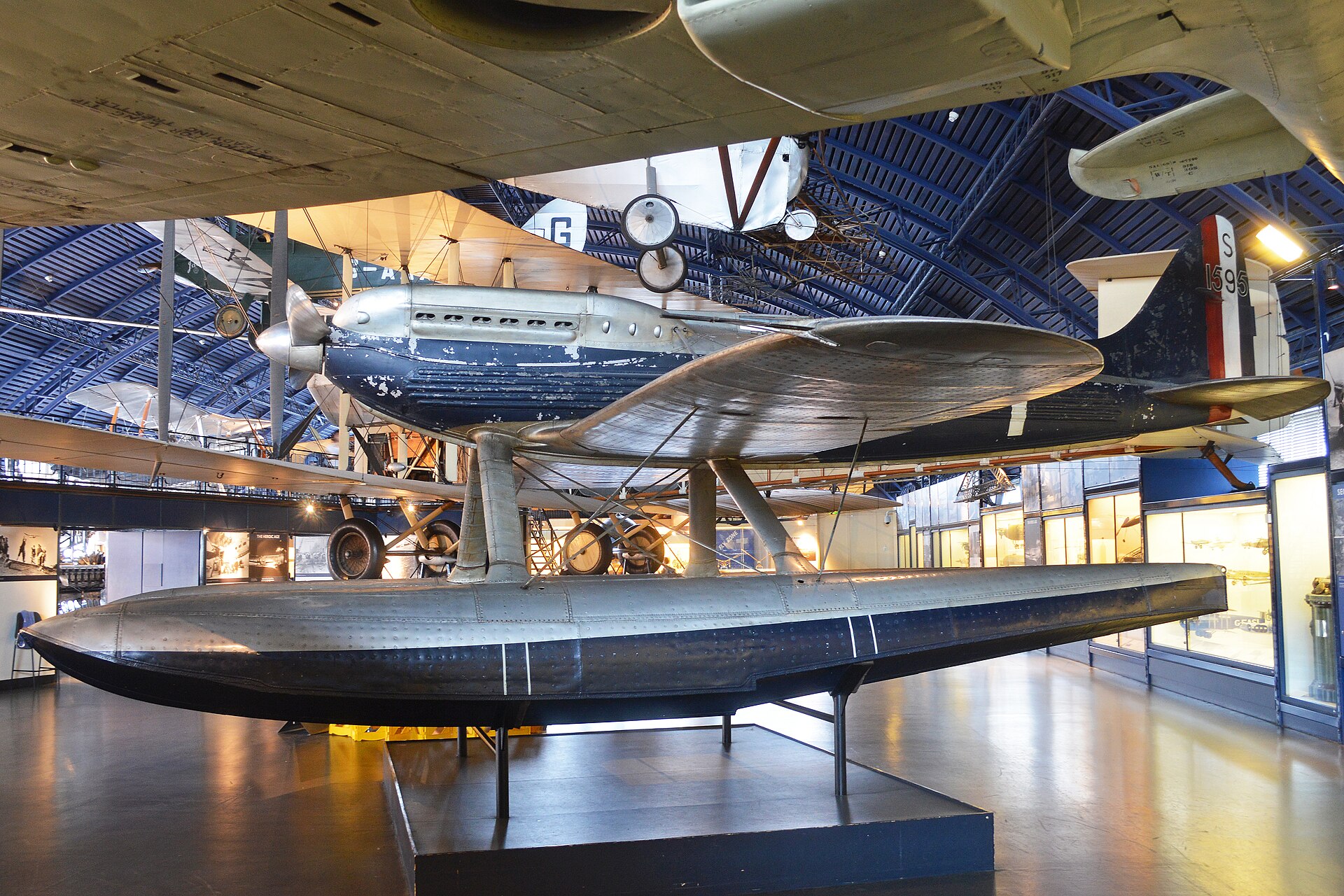
The aircraft was the S.6B, a developed S.6 with more power and enlarged floats to carry the extra fuel. On 13 September 1931, with no other nation able to field a competitive entry, Flight Lieutenant John Boothman flew S.6B S1595 around seven laps of the triangular course over the Solent at an average of 340.08 mph. Britain won the Schneider Trophy outright.
Sixteen days later, on 29 September 1931, Flight Lieutenant George Stainforth pushed an S.6B to 407.5 mph and set a new world air speed record, the first time an aircraft had been officially timed at more than 400 mph. Sources differ on which airframe he used, S1595 or S1596, and it is not worth pretending otherwise; the achievement is not in doubt.
A caution about the legend
It is often said that the Spitfire was simply a Schneider racer with guns. That is not true and does the design a disservice. The S.6B had a wire-braced wing, floats, no undercarriage, no armament, no armour, an engine that ran for minutes rather than hours, and a wing loading that would have been lethal in combat. What carried over was the thinking, the aerodynamic discipline and the engine partnership. The airframe itself was a fresh start.
Vickers takes over
In 1928 Vickers, which had merged with Armstrong Whitworth in 1927 to form Vickers-Armstrongs, bought Supermarine for £390,000 and renamed it Supermarine Aviation Works (Vickers) Ltd. Vickers wanted flying boat expertise to complement its land-plane business, and Supermarine, profitable but short of capital, needed the money to modernise.
The marriage was not a comfortable one. Vickers thought Supermarine was inefficient, with poor stock control and too high a proportion of skilled to unskilled labour. It sent Barnes Wallis down to reform the drawing office. Wallis arrived while Mitchell was on his Christmas holiday, installed himself in Mitchell’s office, and began making changes. Mitchell came back in the new year, exploded, and had Wallis moved to a disused loft in a far corner of the works with instructions to the staff not to make him comfortable. When Wallis complained to the Vickers board, Mitchell threatened to resign. Vickers backed down and recalled Wallis to Weybridge.
The episode is usually told as an amusing clash of egos. It is more useful as a reminder that Mitchell had, by 1930, become really irreplaceable, and knew it.
In December 1938, after Air Ministry and Vickers board concern about delays to both the Spitfire and the Wellington, all Vickers-Armstrongs aviation interests were reorganised into Vickers-Armstrongs (Aircraft) Ltd. Supermarine as a legal entity was wound up, though it continued to design, build and trade under its own name, and the aircraft were badged Vickers Supermarine.
The Walrus and the workhorses
While the racers took the headlines, the company was also building the aircraft that paid the wages. The Scapa and the Stranraer continued the flying boat line into the 1930s. But the most significant of the unglamorous Supermarines was the Walrus.
It began as the Seagull V, a private venture first flown in 1933 in response to an Australian requirement for a catapult-launched amphibian to operate from cruisers. The Royal Australian Air Force ordered 24 in 1934. The Royal Navy, impressed, ordered a version of its own with a more powerful engine, and it entered service as the Walrus. A total of 740 were eventually built by Supermarine and by other firms, principally Saunders-Roe, which took over Walrus and Sea Otter production during the war so that Supermarine could concentrate on Spitfires.
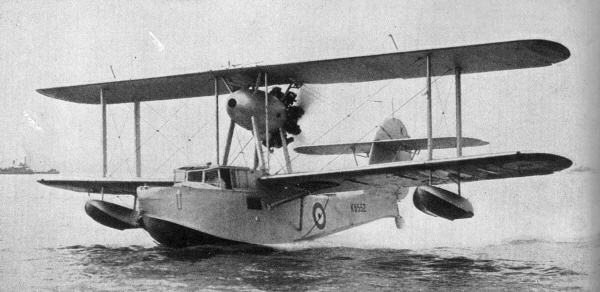
The Walrus was a biplane amphibian with a pusher propeller, a fabric-covered airframe and the aerodynamics of a garden shed. Crews called it the Shagbat. It was also the aircraft that flew air-sea rescue over the Channel and the Mediterranean, landing in open water alongside ditched pilots and hauling them aboard. If the Spitfire is the aeroplane that saved Britain in 1940, the Walrus is the aeroplane that saved the men who flew them. Mitchell designed both.
The failure that led to the Spitfire
In 1931 the Air Ministry issued specification F.7/30 for a high-performance fighter. Supermarine, keen to break out of the seaplane business, responded with the Type 224: an all-metal monoplane with an open cockpit, a cranked gull wing, a fixed undercarriage and an evaporative cooling system that was a persistent source of trouble. It first flew in February 1934. Its performance was average, no production contract followed, and it is remembered today for nothing except what it caused.
Because Mitchell was so unhappy with it. In July 1934 he began a fresh design, the Type 300: shorter wing, retractable undercarriage, enclosed cockpit, everything the 224 was not. In November 1934 he revised it again to take a promising new Rolls-Royce engine, the PV-12, which would later be named the Merlin. Vickers’ Robert McLean approved private money for a prototype, and within a month the Air Ministry wrote specification F.37/34 around it.
The Type 300 was named Spitfire by the Vickers board. Mitchell is widely reported to have disliked it, and the remark usually attributed to him, that it was the sort of silly name they would choose, is repeated in most accounts; it is one of those quotations that may be true and is certainly well worn.
K5054
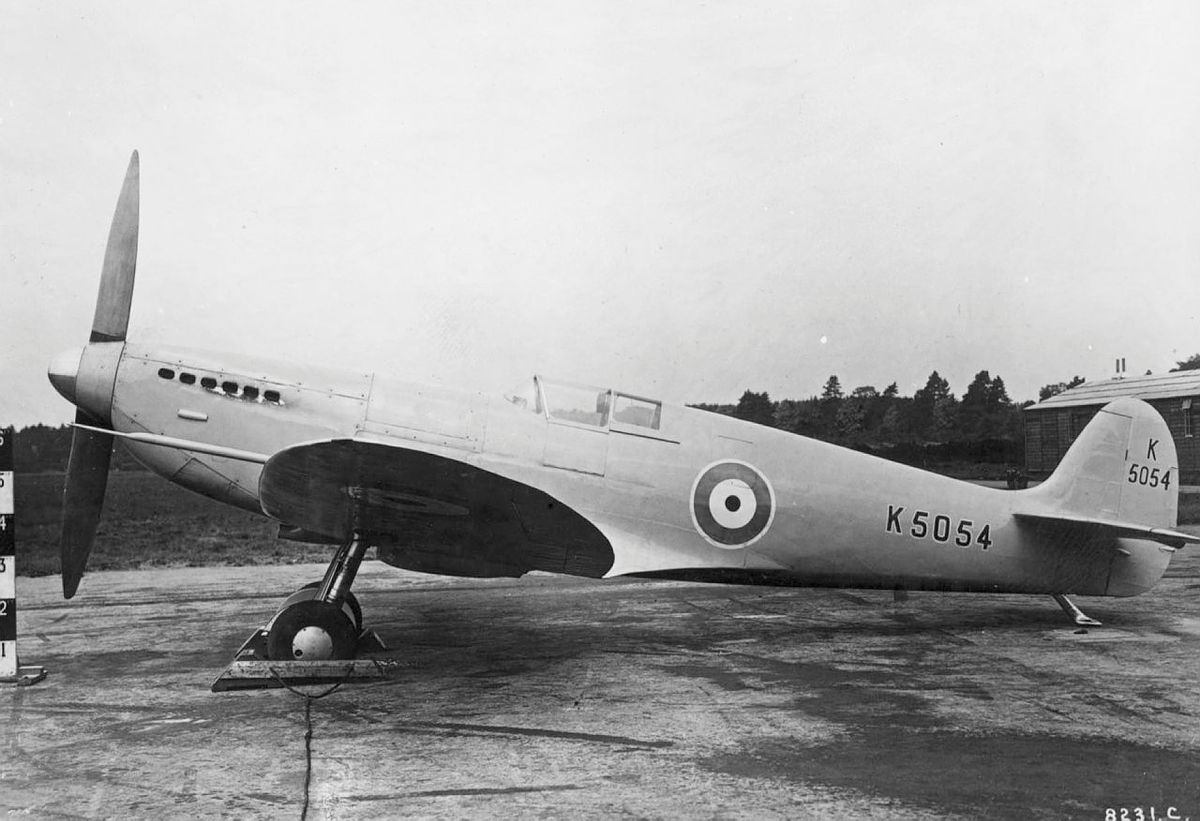
The prototype, K5054, first flew from Eastleigh on 5 March 1936 in the hands of Vickers chief test pilot Joseph “Mutt” Summers. The famous line attributed to Summers on landing, telling the engineers not to touch anything, is usually taken as praise; in fact it almost certainly meant only that he wanted the aircraft left as it was for the next flight rather than that it was perfect. The Air Ministry was impressed enough to order 310 aircraft on 3 June 1936.
Mitchell’s death
Mitchell did not see any of it. He had been diagnosed with cancer in 1933, had an operation, and went back to work. He died on 11 June 1937, aged 42, with the Spitfire ordered but not yet in service. He never saw one in RAF markings and never heard the word associated with the Battle of Britain.
His deputy Harold Payn took over as chief designer, but a security check in September 1939 flagged that Payn had a German-born wife and he was dismissed. Joe Smith, who had been chief draughtsman since 1926, took over the design department and was confirmed as chief designer in 1941.
Building the Spitfire
Designing the Spitfire was the easy part. Building it very nearly broke the company. The aircraft itself, mark by mark, is covered in our full Supermarine Spitfire history; what follows here is the industrial story of how it got made.
The initial order for 310 aircraft was more than double the total number of aircraft Supermarine had built in the previous twenty years. The firm had neither the floor space, the management systems nor the skilled sheet-metal workers to deliver it. Supermarine had contracted to deliver the first aircraft in September 1937. By early 1938 not one had left the factory. The Air Ministry seriously considered limiting Supermarine to the initial order and switching the firm to building Bristol Beaufighters.
The problem was the elliptical wing. It is beautiful, it is aerodynamically excellent, and it is a nightmare to make in quantity: compound curves, no two ribs alike, tolerances that a jobbing subcontractor could not hold. Supermarine eventually organised more than 200 subcontractors, 27 of them producing complete major components, and delivery finally began to flow. No. 19 Squadron at RAF Duxford received the first Spitfire Mk Is on 4 August 1938. By 1 January 1939 only 49 had reached the RAF. By the outbreak of war on 3 September 1939, 306 had been delivered.
Castle Bromwich
The government’s answer to the capacity problem was the shadow factory scheme. Lord Nuffield offered to build an enormous new plant at Castle Bromwich near Birmingham. Work began on 12 July 1938. It was supposed to be turning out 60 aircraft a week by April 1940. It delivered its first ten Spitfires in June 1940, well into the summer of the Battle of Britain, and only after new management was brought in.
Once it worked, it worked on a scale Southampton could never have matched. Castle Bromwich eventually reached a peak of around 320 aircraft a month and built 12,129 Spitfires by the end of the war, more than half of all those made. This is worth being precise about, because the credit is often given entirely to Supermarine. The Spitfire was a Supermarine design; most Spitfires were not built by Supermarine.
The bombing of Woolston
The Supermarine works sat on the Itchen next to the Thornycroft shipyard, which built destroyers. Southampton was therefore a target twice over, and the Luftwaffe knew exactly what was made at Woolston.
On 15 September 1940 eighteen Bf 110s attacked the factory directly. Damage was slight, a few broken windows, but nine people were killed in nearby houses. It was a warning.
On 24 September a low, fast raid by Bf 110s achieved complete surprise. There was little damage to the factory itself, since most of the bombs fell into the mud of the river, but 42 people were killed and 161 injured, many of them when a railway bridge and a shelter beneath a railway embankment took direct hits while workers were still making their way to cover.
Two days later, on 26 September, some sixty Heinkel He 111s of KG 55, escorted by around sixty Bf 110s of ZG 26, attacked from about 17:45 in two waves. This time the raid was detected early and the sirens sounded shortly after four o’clock, which gave the workforce time to get clear. More than 70 tons of bombs were dropped. Seven bombs hit the Woolston works directly and one hit the neighbouring Itchen works. Fifty-five people were killed and 92 injured.
The Woolston factory was destroyed. It was never rebuilt. The ruins were later used to train commandos in street fighting.
What was lost, and what was not
Three completed Spitfires were destroyed and more than twenty damaged. Both prototypes of the Type 317, a four-engined heavy bomber Mitchell had designed to specification B.12/36, were destroyed along with their drawings while still under construction; the contract was cancelled that November. Britain’s four-engined bomber force would be built by Short, Handley Page and Avro instead.
What survived was the thing that mattered. Several of the critical production jigs had already been moved. Most of the precision machine tools were undamaged. And in a piece of luck that is almost comic, one bomb went straight through the drawing office, out of a window and into the river mud without exploding, while another passed through the floor and failed to detonate. The drawings survived.
Dispersal: a factory with no factory
Lord Beaverbrook, the Minister of Aircraft Production, came to Southampton and ordered the complete dispersal of Supermarine. The task fell to the company’s works engineer, Leonard Gooch, and it is one of the great unsung feats of British industrial improvisation.
The rule was that new facilities had to stay within about 50 miles of Southampton so that control could be maintained. By mid-November 1940, 35 workshops were running. Eventually there were around 60 workshops and some 250 subcontractors spread across Hampshire, Wiltshire and Berkshire, clustered around four production centres, each with its own airfield for assembly and test flying: Reading, with assembly at Aldermaston and Henley; Salisbury, with assembly at Chattis Hill and High Post; Southampton, with assembly at Eastleigh; and Trowbridge, with assembly at Keevil. Design, production and administration moved to Hursley House near Winchester in December 1940.
The premises were whatever could be requisitioned: garages, bus depots, laundries, furniture factories, car showrooms. Bus depots were prized because their high ceilings suited wing assembly. Some owners objected. The owner of a steamroller works near Trowbridge appealed to his MP, and an arbitration panel awarded Supermarine 75 per cent of the building; a wall was put up down the middle.
The cost was real. Production fell from 363 aircraft in the quarter before the raids to 177 in the next. It took another nine months to get back to 100 a month. But by the end of the war around 8,000 aircraft had been built in the dispersed factories around Southampton, and the Southampton workforce had grown to about 10,000 people, half of them women.
The jet years: Attacker, Swift and Scimitar
Joe Smith kept the Spitfire competitive to the end of the war, taking it through the Griffon-engined marks and the naval Seafires, and started work on the Spiteful and Seafang as successors. Jet propulsion overtook them and only small numbers were built.
Attacker
With little demand for flying boats and no experience of large multi-engined aircraft, Supermarine went for jet fighters. The first was the Attacker, which took a straight Spiteful wing, complete with its tailwheel undercarriage, and mated it to a new fuselage housing a Rolls-Royce Nene. It entered Fleet Air Arm service in August 1951 with 800 Naval Air Squadron, making it the Royal Navy’s first jet fighter to equip a front-line squadron. It was not a distinguished aeroplane. A tailwheel jet on a carrier deck was an odd compromise even at the time.
Swift
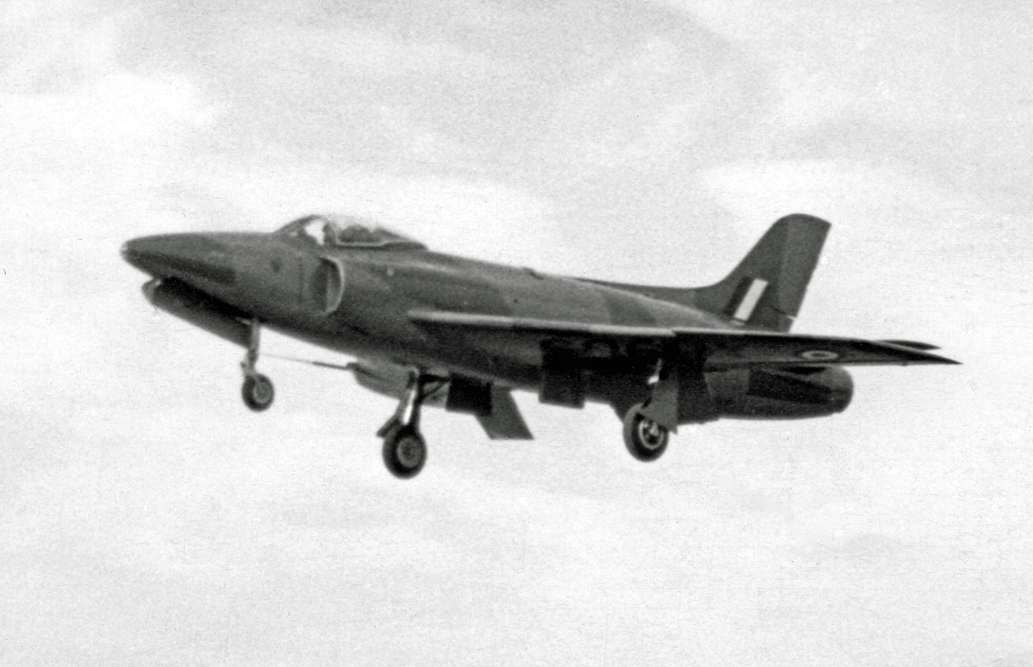
The Swift was the first British-built swept-wing fighter to enter RAF service, and it was a troubled one. As an interceptor it was a disappointment and its fighter career was short. It found a real role in the fighter-reconnaissance variants, the FR.5, which served in Germany and did the low-level photographic work it turned out to be good at. On 26 September 1953 a Swift F.4 flown by Mike Lithgow set a world absolute air speed record of 735.7 mph (1,187 km/h).
Scimitar
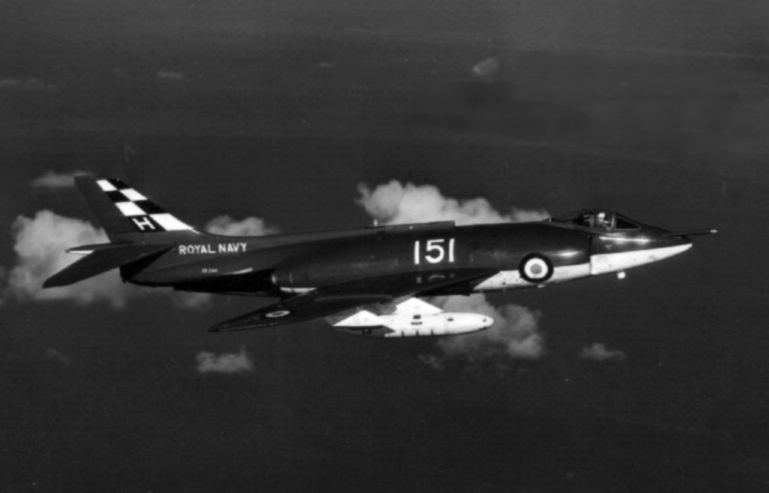
The Scimitar was the last aircraft to carry the Supermarine name. A large, powerful, twin-engined naval strike fighter, it first flew in 1956 and entered Fleet Air Arm service in 1958. Seventy-six were built. It was fast, it was heavy, and it had an unhappy accident record, but it gave the Royal Navy a genuine low-level strike capability and a nuclear delivery aircraft. It was replaced in the strike role by the Blackburn Buccaneer and withdrawn by the end of the 1960s.
The end of the name
In the late 1950s Supermarine turned to non-aviation work, including hovercraft. When Vickers-Armstrongs (Aircraft) became part of the British Aircraft Corporation in 1960, the individual manufacturing heritage names went with it. A Supermarine design office continued to exist for a time, and ex-Supermarine engineers contributed to the Vickers Type 571 proposal that fed into the BAC TSR-2, but the name itself simply stopped being used. There was no closing ceremony. A company that had produced the fastest aeroplane in the world and the most famous fighter in British history was absorbed and forgotten inside a decade.
Key aircraft and figures
| Aircraft | First flew | Role | Why it matters |
|---|---|---|---|
| Sea Lion II | 1922 | Racing flying boat | Won the 1922 Schneider Trophy at Naples, flown by Henri Biard, and kept Italy from taking the trophy outright. |
| Southampton | 1925 (in service) | Reconnaissance flying boat | 83 built. Made the company profitable and forced it to master metal hulls. |
| S.4 | 1925 | Racing seaplane | Mitchell’s break with the flying boat. Set a 226.75 mph seaplane record, then crashed before the race. |
| S.5 | 1927 | Racing seaplane | Won the 1927 Schneider Trophy at Venice, first and second. |
| S.6 | 1929 | Racing seaplane | Won the 1929 contest. First Supermarine racer built around a Rolls-Royce engine. |
| S.6B | 1931 | Racing seaplane | Won the Trophy outright for Britain, 13 September 1931. Raised the world air speed record to 407.5 mph on 29 September 1931. |
| Walrus | 1933 (as Seagull V) | Amphibian | 740 built. The air-sea rescue aircraft of the RAF and Fleet Air Arm. |
| Type 224 | 1934 | Fighter prototype | A failure, and the reason the Spitfire exists. |
| Spitfire | 5 March 1936 | Fighter | 20,351 built. The only British fighter in continuous production throughout the Second World War. |
| Seafire | 1942 (in service) | Naval fighter | Carrier Spitfire. Mostly built by Westland and Cunliffe-Owen. |
| Attacker | 1946 | Naval jet fighter | Entered FAA service with 800 NAS in August 1951, the Royal Navy’s first front-line jet fighter. |
| Swift | 1951 | Jet fighter and recce | Britain’s first swept-wing jet fighter in service. Set a world air speed record of 735.7 mph on 26 September 1953. |
| Scimitar | 1956 | Naval strike fighter | 76 built. The last aircraft to carry the Supermarine name. |
The people
Noel Pemberton Billing founded the company and left it in 1916, having contributed the site, the name and almost nothing else of lasting value.
Hubert Scott-Paine turned it towards flying boats, hired Mitchell, and left in 1923 after a boardroom fight with James Bird.
R. J. Mitchell was chief designer from 1919 until his death in 1937. He designed the Schneider racers, the Walrus, the Southampton and the Spitfire.
Joe Smith was chief draughtsman from 1926 and chief designer from 1941. He is the forgotten man of the story. Mitchell designed the Spitfire; Smith developed it through more than twenty marks, put a Griffon in it, navalised it, and kept it a front-line fighter for the whole war. That was arguably the harder job.
Leonard Gooch, the works engineer, ran the dispersal after the Woolston raids and became works manager in December 1940.
Lady Lucy Houston funded the 1931 Schneider entry after the government pulled out. Without her cheque there is no third win.
What survives and where
Rather less than you might expect, and worth checking before you travel, because museum aircraft do move.
The racers
Two survive. S.6B S1595, the aircraft that won the Trophy outright in 1931, is in the Science Museum in London. S.6A N248 is at Solent Sky in Southampton, a few minutes from where it was built. N248 spent decades wearing the markings of S1596, having been repainted for the 1942 film The First of the Few, and its true identity was only re-established in the early 1980s.
The flying boats and amphibians
The hull of Supermarine Southampton Mk I N9899, the only surviving example of the type, is held by the RAF Museum in London. A Walrus is on display at the Fleet Air Arm Museum at RNAS Yeovilton, restored in the 1960s from the remains of L2301.
The jets
Scimitar F.1 XD317 is at the Fleet Air Arm Museum at Yeovilton. Swifts survive in British museum collections, including an example held by the RAF Museum. Attackers are rare; check before making a special journey.
The prototype
K5054 does not survive. The Spitfire prototype was written off in a landing accident at Farnborough in September 1939, days after the outbreak of war. Full-size replicas exist, including one at Solent Sky and a gate guardian at Southampton Airport, close to the field it first flew from.
Spitfires
The exception to all of the above. Spitfires survive in numbers, they are still being restored, and around seventy are airworthy worldwide, more than at any time in decades. The largest concentrations in Britain are at Duxford, Biggin Hill and Goodwood, and the RAF’s Battle of Britain Memorial Flight operates Spitfires from RAF Coningsby. If you want to photograph a Supermarine aeroplane in the air, that is where you go.
Photographing Supermarine aircraft today
In practice this means photographing Spitfires, and there is a right and a wrong way to do it.
Kill the shutter speed
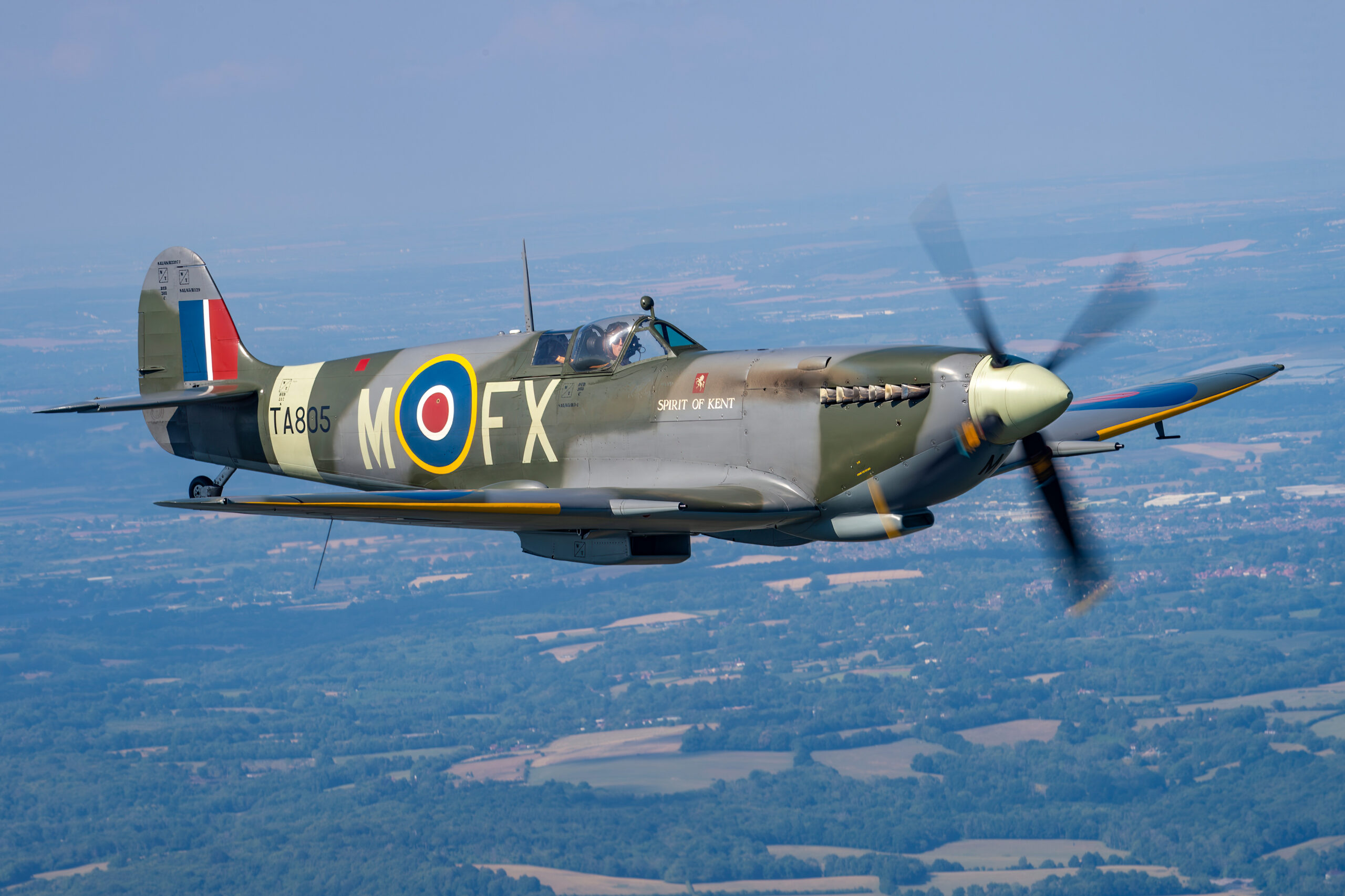
The single most common error is shooting a Merlin-engined fighter at 1/1000 of a second or faster. You will freeze the propeller into four rigid black blades and the aeroplane will look dead, as though someone hung a model in front of a blue background. A Spitfire needs a shutter speed slow enough for the propeller to sweep into a disc: 1/250 is a safe starting point, 1/200 is better, and 1/160 or slower gives a full disc if your panning can hold it. This is the whole subject of our guide to propeller blur and shutter speed, and it is the difference between a photograph of a flying aeroplane and a photograph of a static one.
Pan, do not spray
At those shutter speeds the whole frame depends on your panning. Plant your feet, rotate from the hips, pick the aircraft up early, follow it through, and keep following after the shutter fires. Continuous autofocus, and shoot in short bursts rather than holding the button down.
Get the light behind you and the background behind the aircraft
A Spitfire in front-lit sun with a hangar roof or a line of trees behind it is worth ten Spitfires against an empty blue sky. Warbird displays fly a circuit, which means you can predict where the topside pass will happen. Position yourself so that pass is against something. Our warbird photography guide covers the tactics in detail.
Where to go
Duxford is the obvious answer: it is where the largest number of airworthy Spitfires in Europe are based, and the shows there put them in the air in numbers. The best UK airshows for photographers guide covers which events are worth your time and which are not. For museum work, the Science Museum, Solent Sky and the Fleet Air Arm Museum between them hold most of what remains of Supermarine outside the Spitfire.
Museum aircraft are harder than flying ones
The S.6B in the Science Museum is suspended in a hall full of mixed artificial light and reflective surfaces, and it is a really difficult subject. Shoot wide open, use a high ISO, forget flash, work the angles rather than trying to record the whole aircraft, and go for details: the float struts, the radiator surfaces sunk into the wing skin, the tiny cockpit. That aeroplane’s entire story is written in how little of it there is.
Legacy
Supermarine existed as an independent company for roughly forty-five years and as a name for a few more. In that time it went from a firm that could not get its first aircraft to leave the water to one that held the world air speed record, and then produced the fighter that a nation still recognises by its silhouette.
In the summer of 1940 the Spitfire flew alongside the Hawker Hurricane, which was available in greater numbers and shot down more German aircraft, a point our piece on the aircraft of the Battle of Britain makes at length. The Spitfire got the fame. Both got the job done.
What is worth taking from it is not the Spitfire on its own. It is the sequence. A small company took on an expensive, apparently frivolous air race, kept losing, kept refining, and in the process built an aerodynamic capability, a metal construction capability and an engine partnership that no British firm could have bought or planned for. When the Air Ministry finally asked for a modern fighter, Supermarine had, without quite intending to, spent a decade preparing to build one.
The other lesson is about people. Mitchell died before the Spitfire flew in anger. The factory that built it was flattened. The company’s own management thought it was inefficient, and its parent absorbed it and dropped its name. Almost none of the things that usually determine whether a company is remembered went Supermarine’s way. It is remembered anyway, because of the aeroplanes.
You can see a good deal of what remains in a weekend: the racers in London and Southampton, the flying boat hull at the RAF Museum, the naval aircraft at Yeovilton, and a Spitfire in the air at Duxford. If you photograph aviation in Britain, that is a weekend well spent. The Piemags aviation galleries and archive collections hold a good deal of Supermarine material, and if you want to use an image commercially, the licensing page explains the terms.
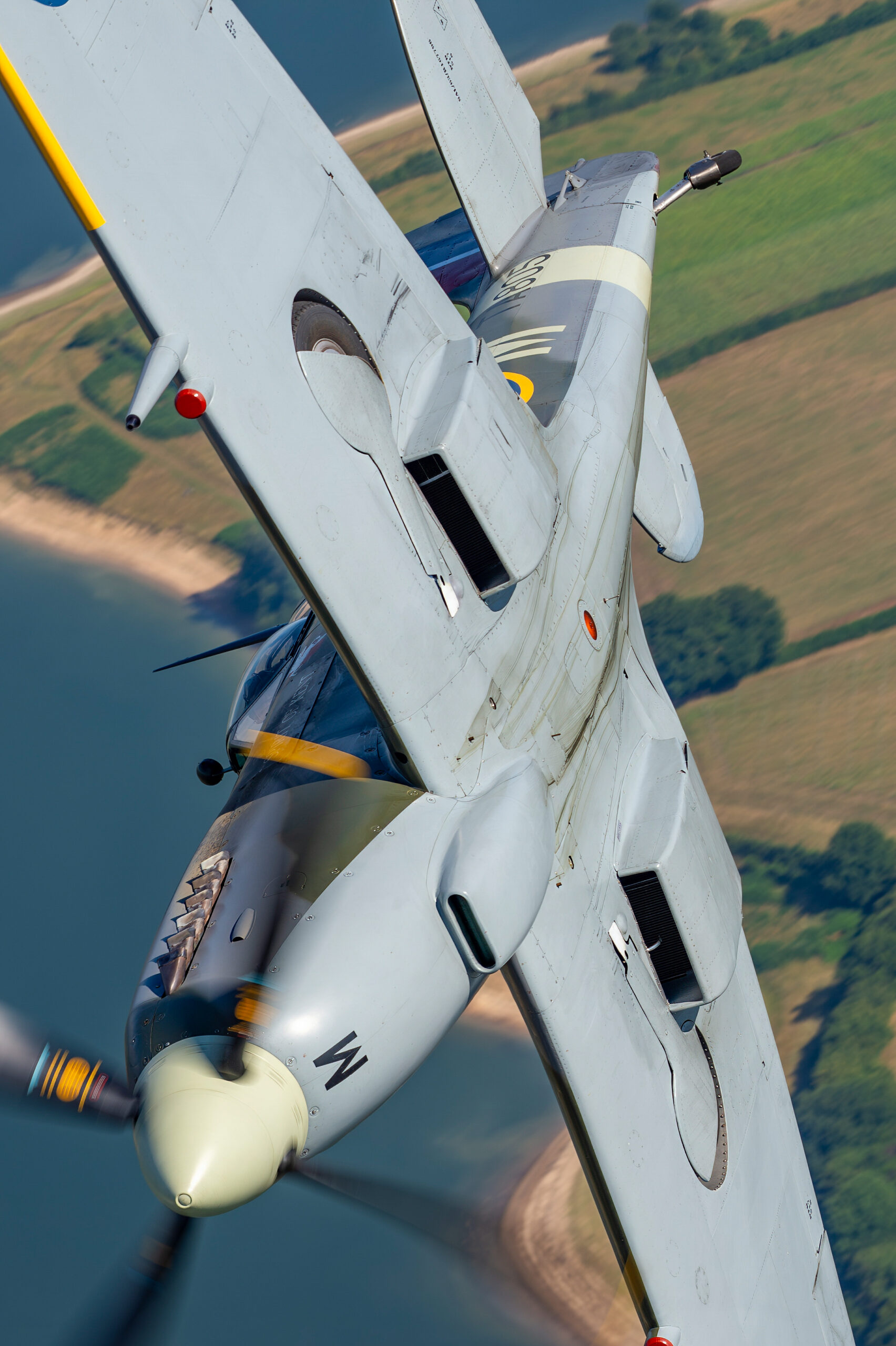
If you are sourcing Supermarine imagery for publication, our picture researcher guide to Spitfire photographs covers marks, provenance and the pitfalls of mislabelled archive material.
Frequently asked questions
What was Supermarine?
Supermarine was a British aircraft manufacturer based at Woolston on the River Itchen in Southampton. It was founded in 1913 as Pemberton-Billing Ltd, renamed Supermarine Aviation Works Ltd in 1916, and bought by Vickers in 1928. It built flying boats, amphibians and the Schneider Trophy racing seaplanes before producing the Spitfire, and the last aircraft to carry its name was the Scimitar.
Did Supermarine really win the Schneider Trophy outright?
Yes. Britain won the contest three times in a row, in 1927, 1929 and 1931, all three with Supermarine aircraft designed by R. J. Mitchell, and under the rules that gave Britain permanent possession of the trophy. The 1931 flight was made by Flight Lieutenant John Boothman in S.6B S1595, who flew seven laps of the Solent course at an average of 340.08 mph.
How fast was the Supermarine S.6B?
On 29 September 1931 Flight Lieutenant George Stainforth raised the world air speed record to 407.5 mph (about 656 km/h) in an S.6B, the first officially recognised flight above 400 mph. Sources disagree on whether the record airframe was S1595 or S1596. The Schneider-winning flight sixteen days earlier averaged 340.08 mph over the closed course, which was necessarily slower than a straight-line record run.
Was the Spitfire just a Schneider racer with guns?
No. The Spitfire was a fresh design and shared no airframe structure with the S.6B, which had floats, a wire-braced wing, no undercarriage and an engine intended to run for minutes rather than hours. What carried over from the Schneider programme was the design team’s understanding of drag, its experience of metal construction, and its working relationship with Rolls-Royce, whose racing engine work fed into the Merlin.
How many Spitfires were built, and did Supermarine build them all?
20,351 Spitfires were built, plus several thousand naval Seafires (figures for the Seafire vary between roughly 2,300 and 2,600 depending on the source). Supermarine did not build most of them. The Castle Bromwich shadow factory near Birmingham produced 12,129 Spitfires, more than half the total, and most Seafires were built by Westland and Cunliffe-Owen.
What happened to the Supermarine factory at Woolston?
It was destroyed by the Luftwaffe. Raids on 24 and 26 September 1940 killed close to a hundred workers and neighbours and left the Woolston works so badly damaged that it was never rebuilt. Production was dispersed across roughly 60 workshops in Hampshire, Wiltshire and Berkshire, using requisitioned garages, bus depots and showrooms, with assembly at airfields including Eastleigh, Chattis Hill, High Post, Aldermaston, Henley and Keevil.
Who designed the Spitfire after R. J. Mitchell died?
Joe Smith. Mitchell died on 11 June 1937, aged 42, before the Spitfire entered service. His deputy Harold Payn briefly succeeded him but was dismissed in 1939 after a security check. Smith, previously chief draughtsman, took over the design department and was confirmed as chief designer in 1941. He developed the Spitfire through the Griffon-engined marks and the Seafire, and kept it a front-line fighter to the end of the war.
Where can I see a Supermarine aircraft today?
The Schneider-winning S.6B S1595 is in the Science Museum in London, and S.6A N248 is at Solent Sky in Southampton. The only surviving Supermarine Southampton hull is held by the RAF Museum in London. A Walrus and Scimitar F.1 XD317 are at the Fleet Air Arm Museum at RNAS Yeovilton. Spitfires survive in numbers and fly regularly at Duxford and with the RAF’s Battle of Britain Memorial Flight. Museum displays change, so check before travelling.
What was the last aircraft Supermarine built?
The Scimitar, a large twin-engined naval strike fighter that first flew in 1956 and entered Fleet Air Arm service in 1958. Seventy-six were built. It was replaced in Royal Navy service by the Blackburn Buccaneer and withdrawn by the end of the 1960s. The Supermarine name itself disappeared when Vickers-Armstrongs (Aircraft) became part of the British Aircraft Corporation in 1960.
