The Supermarine Spitfire is among the most requested warbirds in publishing, and the hardest to source well. Wartime frames are monochrome and heavily reused, airshow images come with crowds and clutter, and much of what circulates online is mislabelled by mark or misattributed entirely. This guide is for the picture researchers, editors and designers who need Spitfire photographs that are sharp, correctly identified and cleanly licensed, and it explains exactly what the Aviation Photo Crew archive holds, how it was shot, and how to caption it with confidence.
Piemags and Aviation Photo Crew photograph airworthy Spitfires air to air, from a camera ship, with the cooperation of their operators. The heart of the collection is a set of sessions flown with UK-based Spitfires in 2024 and 2025, covering Merlin and Griffon marks, a photo-reconnaissance aircraft in PRU blue, desert schemes, invasion stripes and the world-famous polished-metal Silver Spitfire, all photographed in the air, where a Spitfire belongs.
- Why the Spitfire never stops selling
- The demand cycle: anniversaries and the publishing calendar
- The collection: UK Warbirds 2024 and 2025
- The airworthy fleet: why the UK is Spitfire country
- A researcher’s guide to the marks on file
- Merlin or Griffon: telling them apart at a glance
- How air-to-air Spitfire photography is flown
- Captioning Spitfire imagery correctly
- An angle guide for designers
- Uses: publishing, broadcast, museums and brands
- Three worked example briefs
- Where else Spitfire imagery comes from
- Technical quality and licensing
- A buyer’s Spitfire checklist
- Frequently asked questions
- Sources and further reading
Why the Spitfire never stops selling
Few aircraft in history carry the recognition value of the Spitfire. It is shorthand for the Battle of Britain, for 1940, for defiance itself, and it appears on book covers, documentary posters, magazine features and museum banners more often than almost any other aeroplane. Every anniversary year multiplies the demand: Battle of Britain commemorations, VE Day milestones, biographies of pilots, unit histories, model kit packaging, and the steady stream of general Second World War publishing that needs one image that says everything at a glance.
That demand runs into a supply problem. Genuine wartime Spitfire photography is monochrome, variable in quality, concentrated on a handful of famous frames, and often encumbered by unclear provenance after eighty years of copying. Modern imagery solves the quality problem but introduces new ones: airshow photographs taken from the crowd line come with heat haze, cluttered backgrounds and other people’s heads, while much online imagery is unlicensed, unidentified or both. The gap in the middle, high-resolution colour photography of authentic airworthy Spitfires, in the air, correctly identified and cleanly licensable, is exactly the gap this archive fills.
The demand cycle: anniversaries and the publishing calendar
Spitfire demand is not flat; it surges on a predictable calendar, and picture desks that plan ahead of it get first choice of imagery. Battle of Britain anniversaries every September, VE Day milestones each May, D-Day commemorations in June and Remembrance publishing in November all reach for the same aircraft, and the round-number years multiply everything: the eightieth and eighty-fifth anniversaries of 1940 drove months of commissioning, and the ninetieth is already visible on publishers’ schedules. Beyond the calendar sit the evergreen engines of demand: new pilot biographies and memoirs appear every year, aviation partworks and model kit packaging consume side profiles by the dozen, and every general history of the Second World War needs its Spitfire spread.
Broadcast follows the same rhythm with longer lead times. Documentary producers commission a year or more ahead of an anniversary transmission date, and they need stills for pitch decks and interstitials long before an edit exists. Museums and exhibitions work further out still. The practical consequence for researchers is simple: the best Spitfire imagery is licensed early in an anniversary cycle, and a source that can answer quickly, with identification already attached to every frame, saves exactly the time that deadline years burn.
The collection: UK Warbirds 2024 and 2025
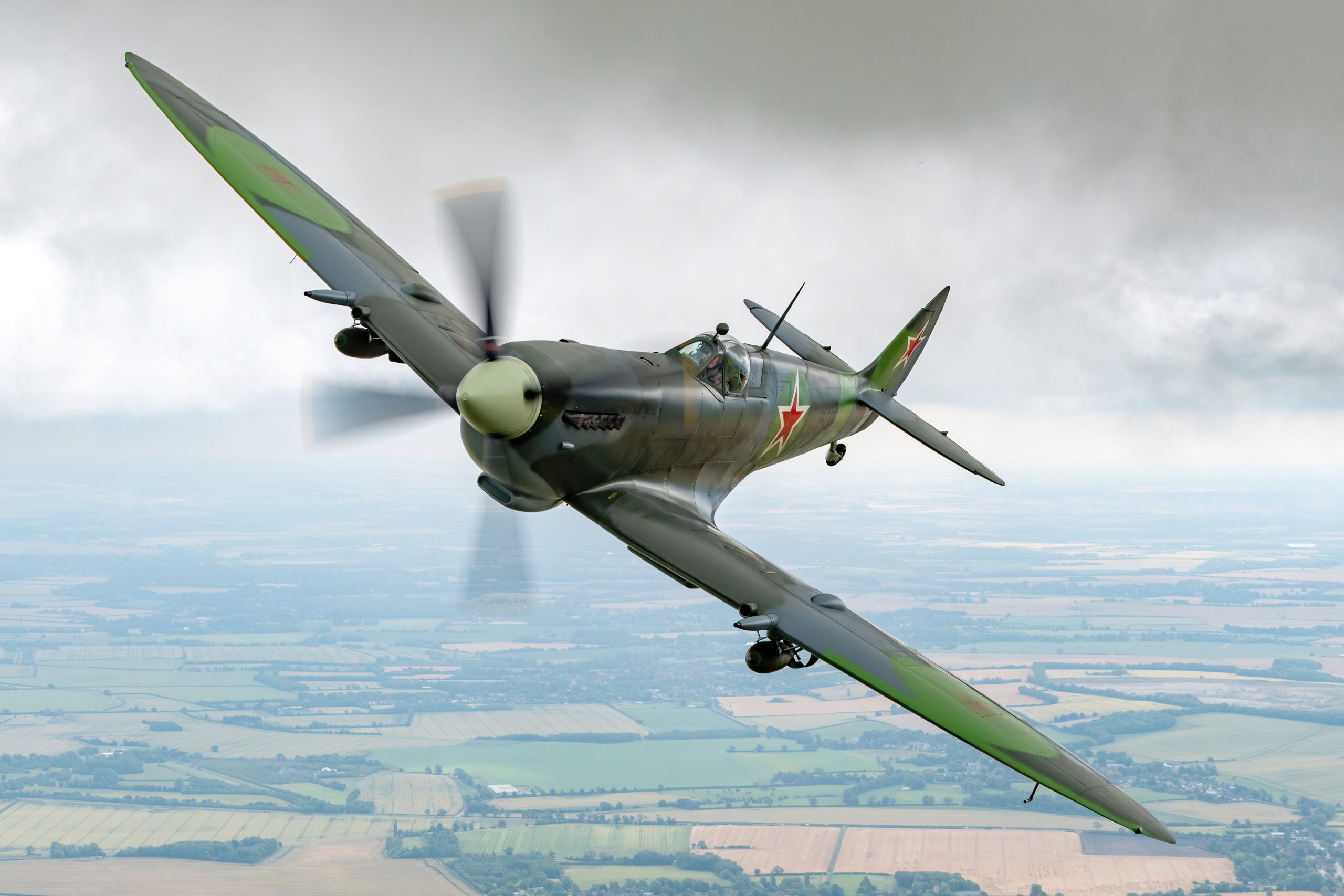
The core Spitfire holdings were photographed during dedicated air-to-air sessions with UK-based warbird operators in 2024 and 2025, published in the UK Warbirds 2024 and UK Warbirds 2025 galleries. These are not airshow grabs. Each aircraft was flown in formation with a camera ship over the English countryside and coastline, giving clean sky, real light and backgrounds that work for layout: cloudscapes, patchwork farmland, chalk cliffs and open sea.
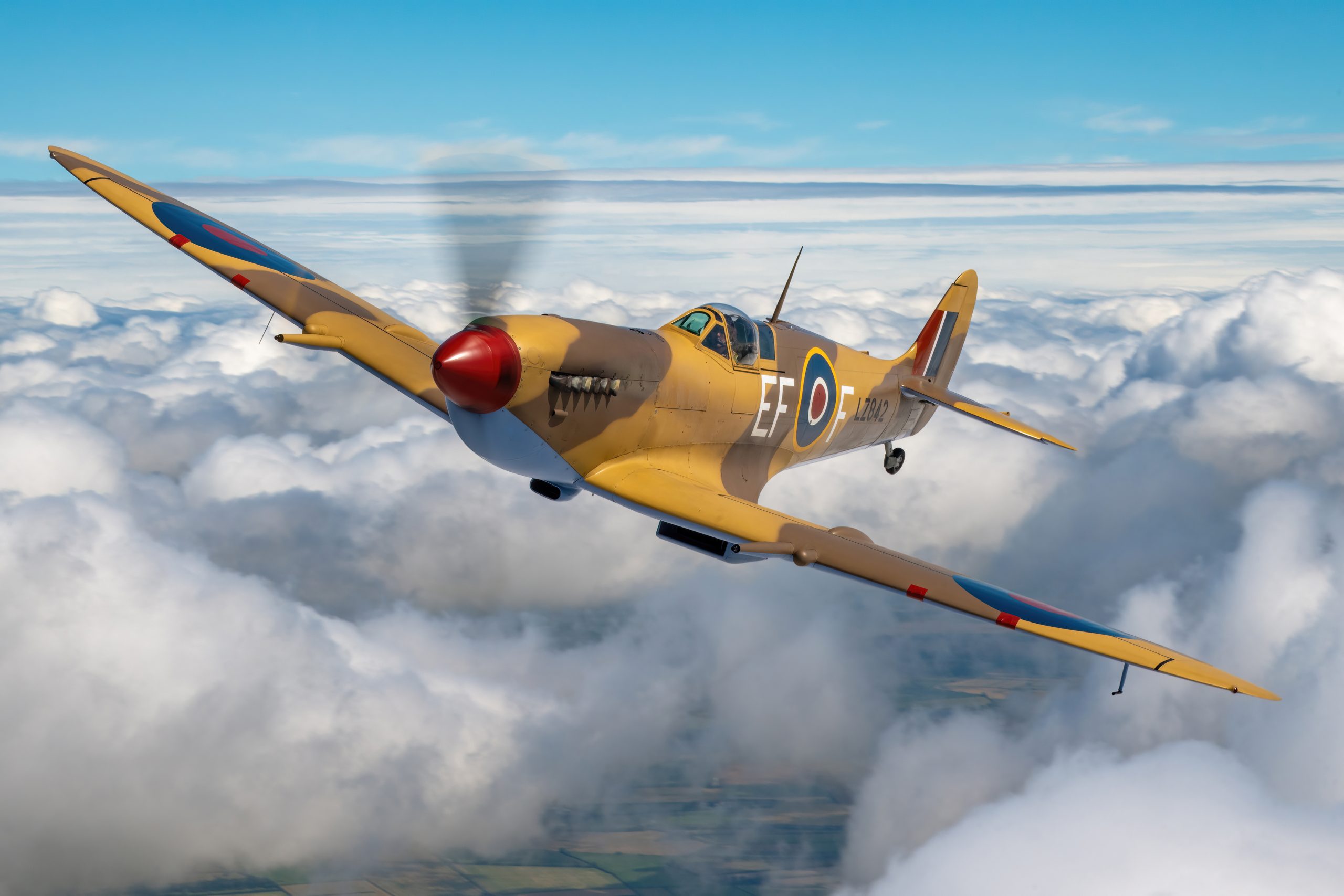
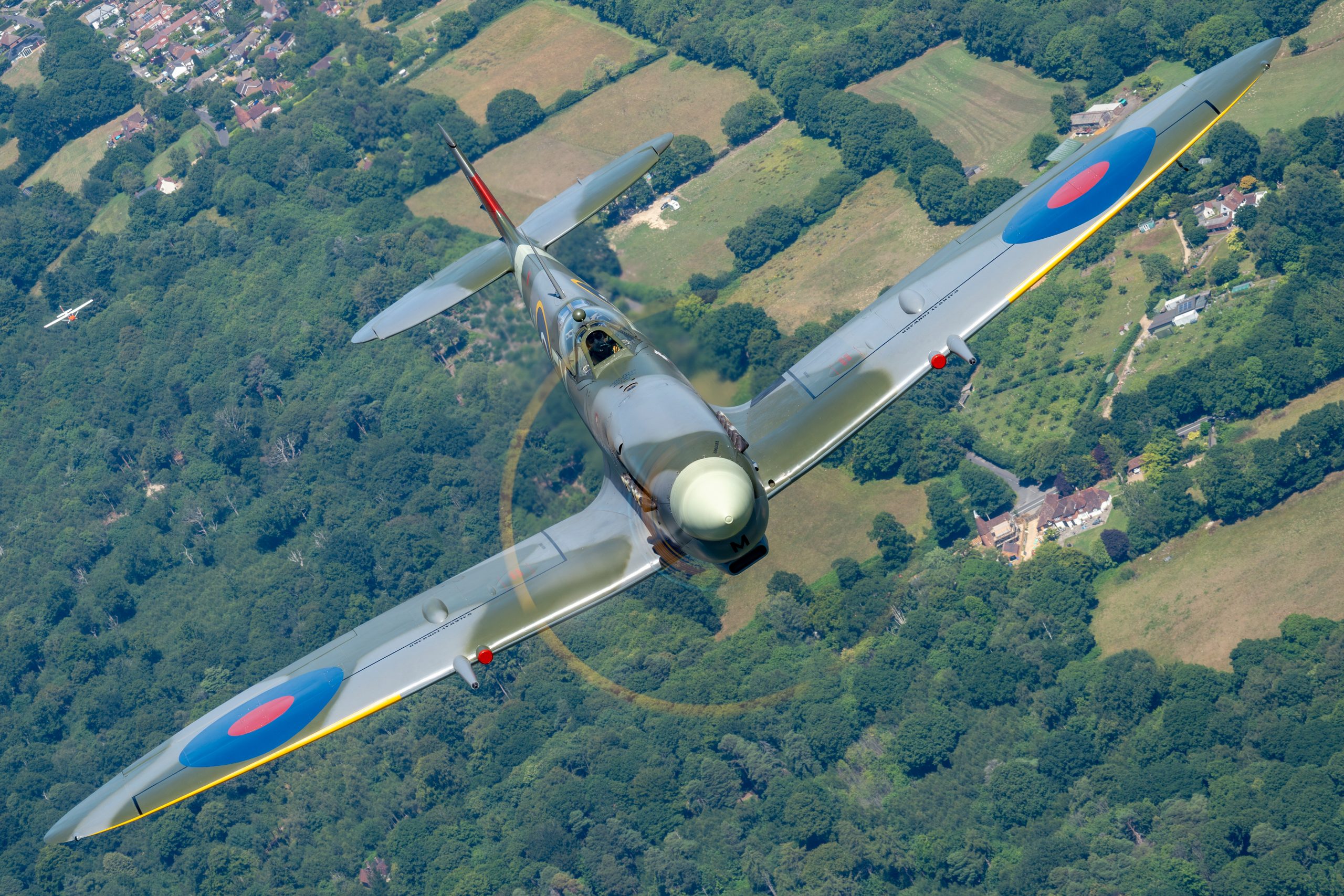
The sessions cover multiple airframes across the two seasons, including Merlin-engined Mk IXs in day fighter and desert schemes, a photo-reconnaissance PR XI in PRU blue, a Griffon-engined FR XIVe with invasion stripes, a high-altitude HF IXe, and the polished-metal Silver Spitfire, the aircraft flown around the world in 2019. Between them the frames run from tight head-on portraits with the propeller disc blurred to full topside plan views, side profiles, silhouettes against the sea and formation break-aways.
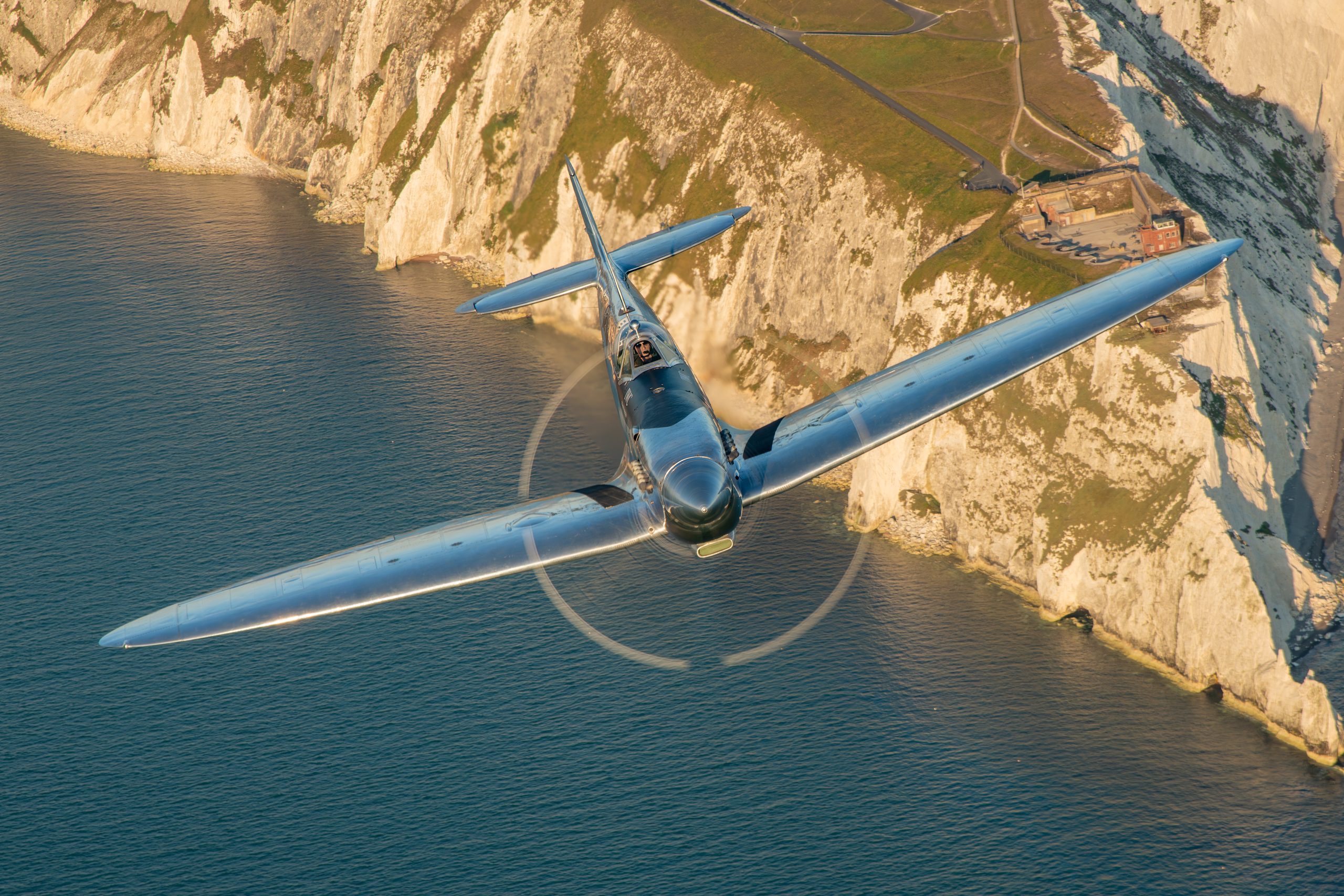
The backgrounds deserve their own mention, because they are half of what a designer buys. The 2024 sessions worked over the patchwork farmland and cloudscapes of central England, giving the classic Spitfire-over-England context that historical features want. The 2025 sessions added the coast, including frames over the chalk stacks of the Needles off the Isle of Wight, within sight of the waters the type defended, and low golden-hour light over open sea. None of it is set dressing; it is the aircraft’s own landscape, and it reads that way on the page.
The airworthy fleet: why the UK is Spitfire country
Around the world, several dozen Spitfires remain airworthy at any given time, and the population is concentrated heavily in southern and central England, within an hour’s flying of the airfields these sessions used. That concentration is no accident. The UK holds the restoration workshops, the engineering expertise, the spares ecosystem and the operator community that keep Merlin and Griffon engines running, and it holds the display market, from the great seasonal airshows to the two-seat experience flights that have made the Spitfire a working aircraft again rather than a static relic.
For a picture buyer this matters in a practical way: the UK fleet is active, varied and photographed in its home landscape. Aircraft change schemes as restorations roll through the workshops, newly completed airframes join the circuit most seasons, and the mix of marks in the air, Merlin and Griffon, fighter and reconnaissance, single-seat and two-seat, is broader than in any other country. An archive that photographs this fleet season by season is, in effect, documenting the living history of the type as it evolves, which is why the 2024 and 2025 galleries differ and why the 2026 additions will differ again.
A researcher’s guide to the marks on file
The Spitfire was built in more than twenty marks, and for a picture researcher the differences matter, because a caption that puts a 1945 Griffon aircraft over 1940 Kent will be caught by any knowledgeable reader. The archive’s coverage concentrates on the marks that dominate today’s airworthy fleet and therefore today’s colour photography.
The Mk IX is the backbone. Introduced in 1942 to counter the Focke-Wulf Fw 190, it became one of the most numerous Spitfire variants and is today the most common airworthy mark, which makes it the definitive subject for modern colour work. The archive holds multiple Mk IXs in different schemes, from northern European day fighter camouflage to the sand and azure of the North African campaign. For editorial use the Mk IX is also the safest general-purpose Spitfire: its silhouette, with the classic elliptical wing and Merlin nose, matches the popular image of the type almost exactly.
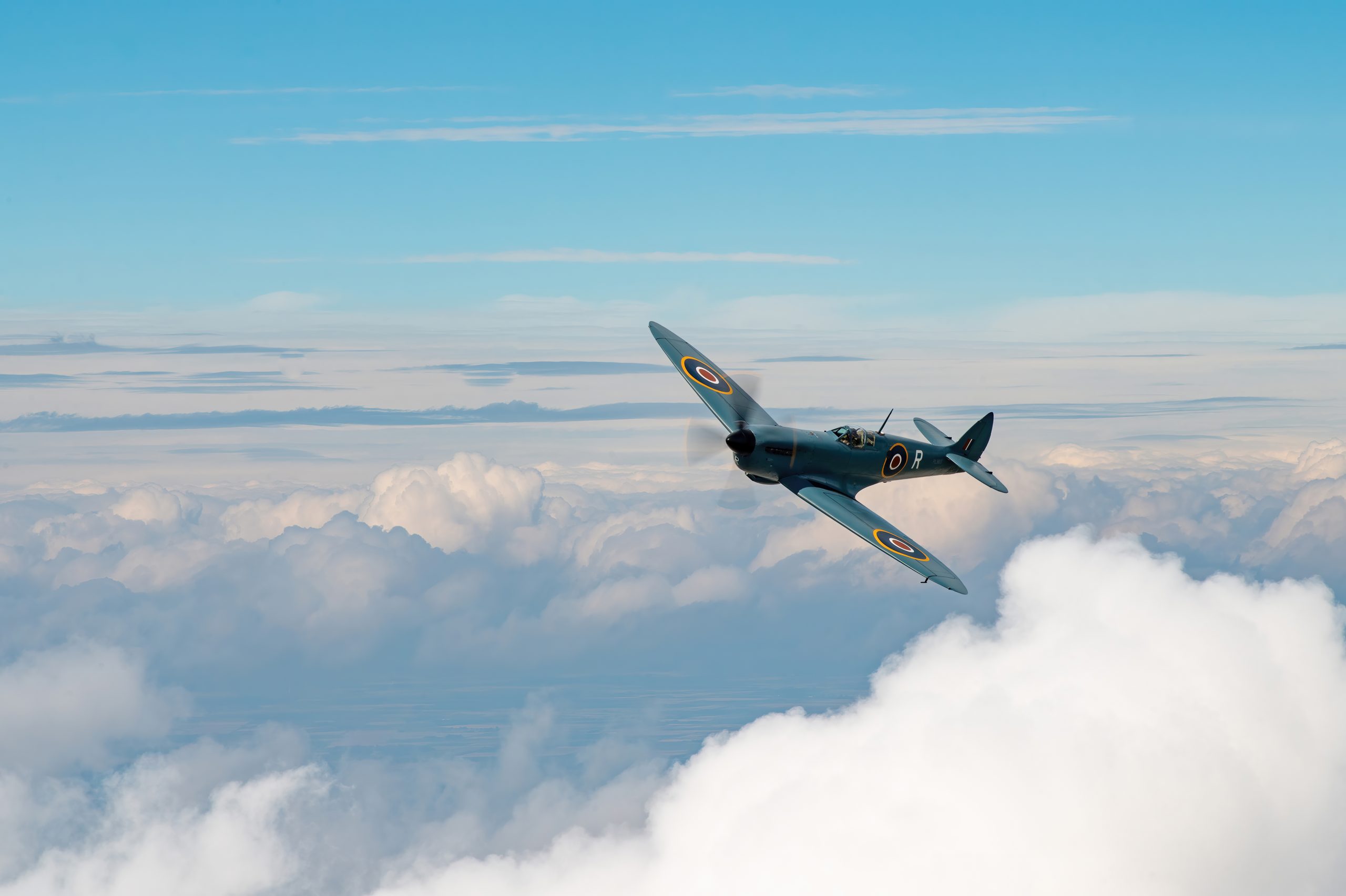
The PR XI is the specialist. Photo-reconnaissance Spitfires flew unarmed, fast and very high, carrying cameras instead of guns, and they wore the deep PRU blue that makes the archive’s PR XI frames instantly distinctive in a layout. For features on reconnaissance, on D-Day intelligence, or on the unarmed pilots who flew alone over Germany, colour imagery of a genuine PR airframe is rare, and this is one of very few airworthy examples in the world.
The FR XIVe brings the Griffon era. With a five-blade propeller, a longer nose and brute performance, the Griffon-engined marks represent the Spitfire’s wartime peak, and the archive’s FR XIVe wears D-Day invasion stripes that anchor it firmly in the 1944 to 1945 timeframe. The HF IXe adds a high-altitude Merlin variant, and the Silver Spitfire, stripped to bare polished metal for its 2019 round-the-world flight, offers something no wartime frame can: the Spitfire as pure sculpture, every rivet line visible in the reflections.
Merlin or Griffon: telling them apart at a glance
The quickest credibility test in Spitfire captioning is the engine. Merlin-engined marks, which include everything from the Battle of Britain Mk I to the Mk IX and PR XI, have a shorter, smoother nose and, on most airworthy examples, a four-blade propeller, though early marks flew with two and three blades. Griffon-engined marks such as the XIV have a longer nose with pronounced cowling bulges, usually a five-blade propeller, and often a broader, taller fin. If a brief calls for the Battle of Britain and the picture desk is offered a five-blade Spitfire, the mismatch will be spotted, if not by the editor then by the readership.
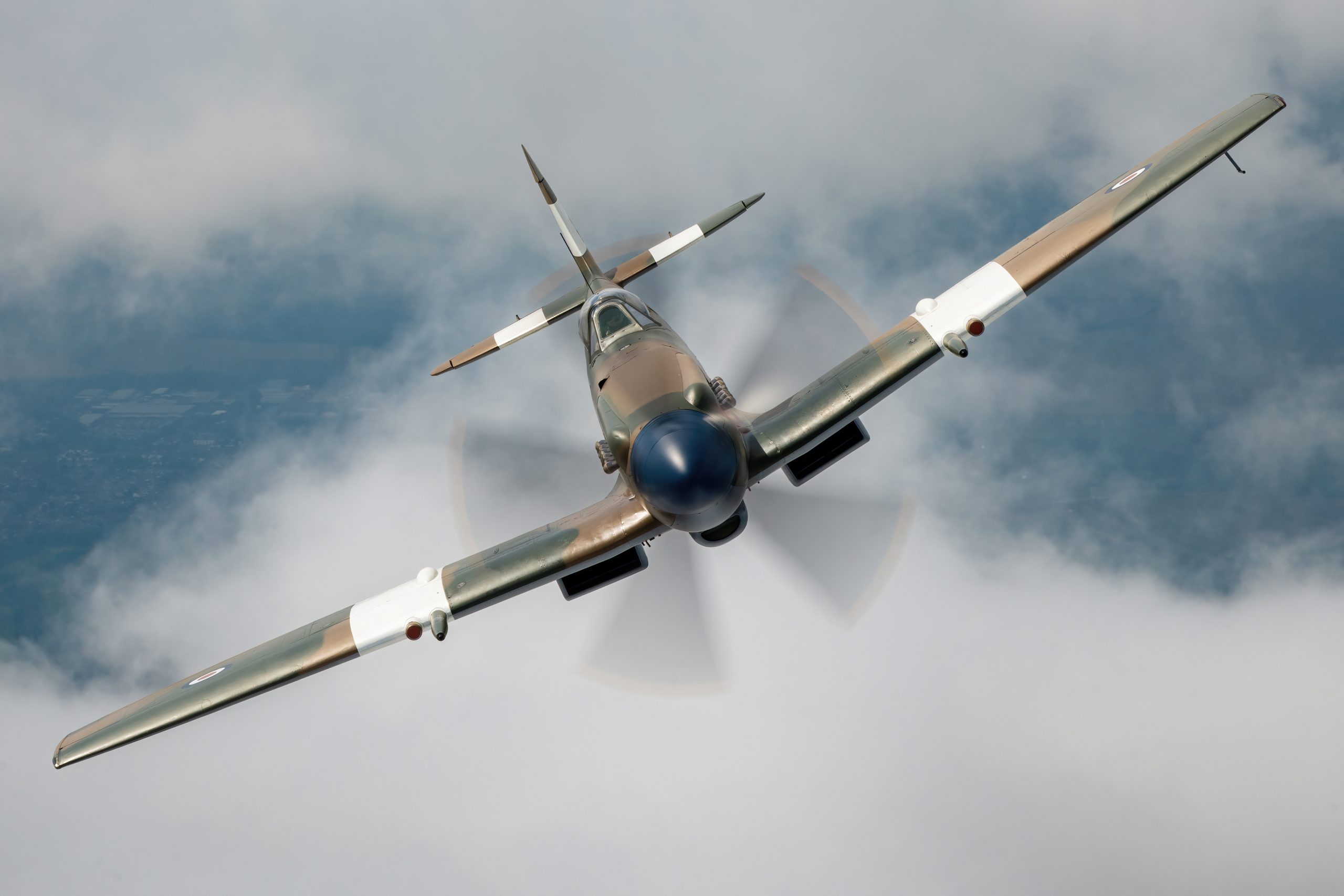
The same discipline applies to schemes. Invasion stripes date an aircraft to mid 1944 onwards. Desert camouflage belongs to the Mediterranean and North Africa. PRU blue means reconnaissance. None of these are decoration; each is a factual claim about time and place, and the safest editorial practice is to caption what the aircraft is and what it wears, rather than implying the photograph shows a particular historical event. The archive’s gallery metadata records type, mark and registration for every frame precisely so that researchers can get this right without guesswork.
How air-to-air Spitfire photography is flown
Air-to-air photography of an eighty-year-old fighter is a planned, briefed and carefully flown operation. The Spitfire formates on a camera ship, typically a slower aircraft with a removed door or opening window, and the photographer works within an agreed block of sky, talking through positions as the light and background change. Every image in these galleries was made with the knowledge and cooperation of the operating pilots, inside the safety framework that UK warbird operations require.
That matters to a buyer for two reasons. First, quality: formation work puts the camera within a few tens of metres of the subject, in chosen light, with backgrounds selected by flying to them rather than accepted by standing under them. Second, provenance: these frames carry clean, documented origin, photographed by the copyright holder with the operator’s cooperation, which means licensing is a single conversation with no third-party chain to untangle.
The craft itself rewards a moment’s attention, because it explains why good air-to-air Spitfire frames are scarce. A piston fighter must be photographed with a slow enough shutter to keep the propeller a turning disc rather than a frozen cross, which means panning a moving camera from a moving, vibrating aircraft at speeds around one two-hundredth of a second while both machines ride the same summer turbulence. The keeper rate is unforgiving and the flying window is short: warbird engines run on tight temperature margins, formation time costs real money in fuel and engine hours, and the light that makes the picture lasts minutes. When a researcher sees a sharp Spitfire with a full prop disc, dimensional light and a chosen background, they are looking at the survivor of hundreds of frames and years of practice, which is precisely what separates commissioned air-to-air work from what a long lens can reach from the ground.
The two-seat Spitfires now flying passengers over the south coast have changed the aircraft’s public life, turning it from a museum piece into something people can experience, and that revival feeds the imagery market from both ends: more airworthy aircraft in more schemes, and a public whose appetite for the type is renewed every summer weekend. The archive photographs this living fleet as it actually exists, which is why its coverage keeps step with restorations, repaints and new arrivals in a way no fixed historical collection can.
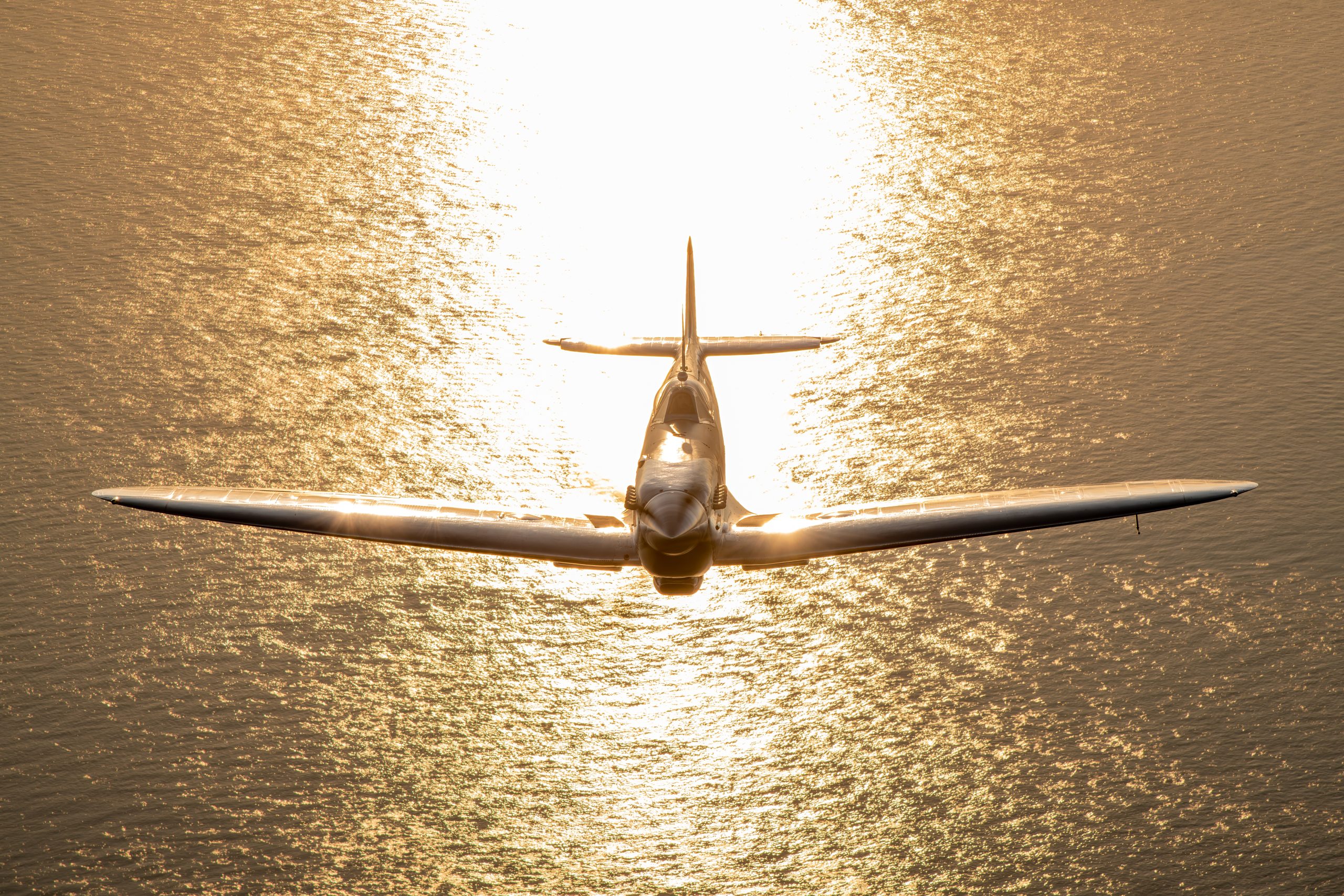
Captioning Spitfire imagery correctly
Honest captioning protects a publication’s credibility, and with warbirds the rules are simple. These are photographs of preserved, airworthy Spitfires flying today, often in historically accurate schemes, and the caption should say so. A frame of a Mk IX in desert camouflage supports a feature on the North African campaign as an illustration of the type, but it should be captioned as a preserved aircraft wearing that scheme, not passed off as a 1943 photograph. Publications that respect this line find that modern colour imagery strengthens historical storytelling rather than undermining it.
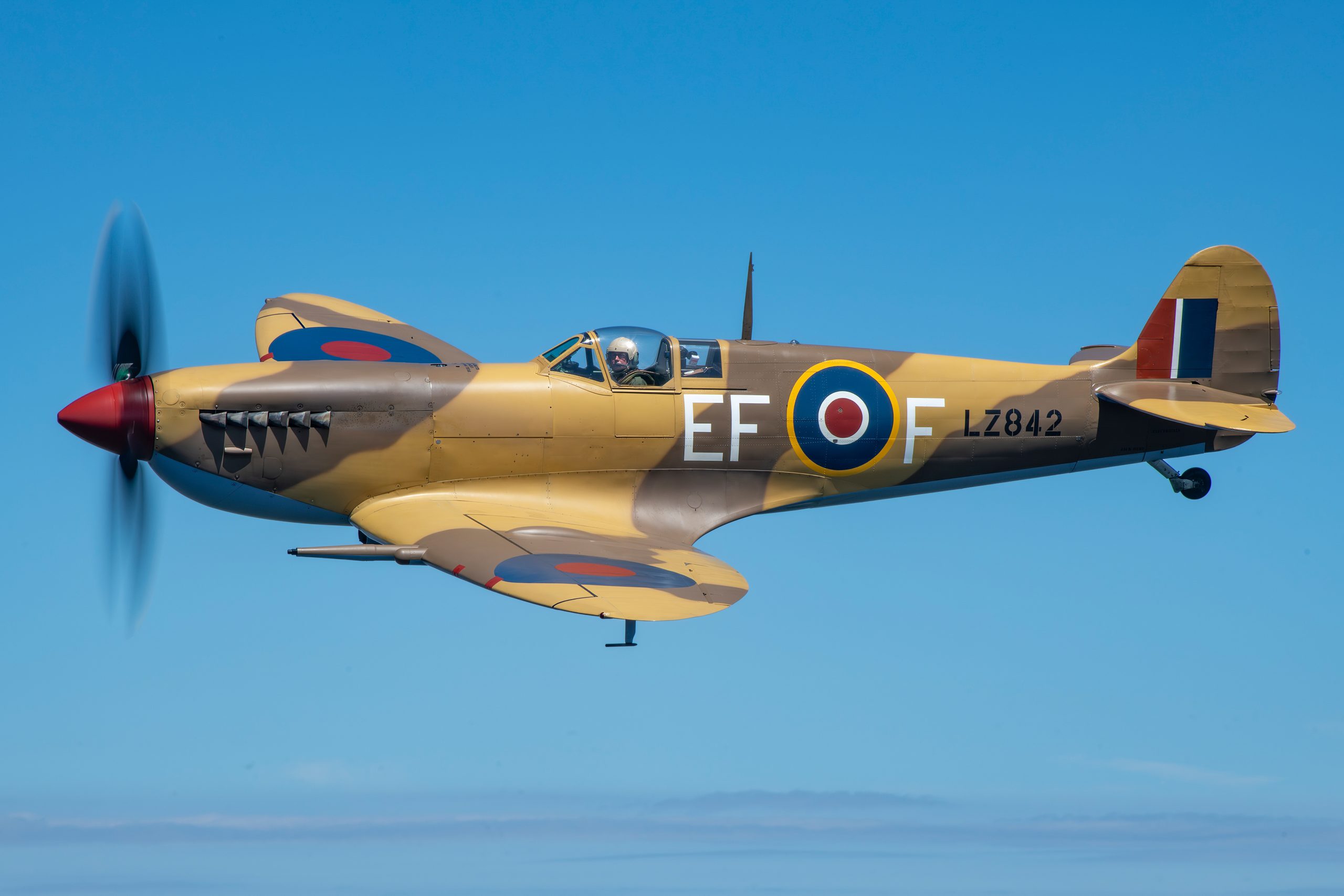
A workable caption formula: aircraft type and mark, identity if known, what it is doing, and where the scheme comes from. For example: “Supermarine Spitfire Mk IX, photographed air to air over England, wearing the desert camouflage of the North African campaign.” It is accurate, it is informative, and it does not claim to be something it is not. Where a brief requires a period photograph, the honest answer is a wartime archive frame, and the two kinds of imagery pair well on a spread: the wartime print for the moment, the modern air-to-air for the machine.
An angle guide for designers
Different layouts eat different angles, and the collection was shot with that in mind. Head-on frames, with the propeller disc turning and the elliptical wing spread flat, are natural cover material: strong symmetry, room for a masthead above and cover lines either side. Topside plan views, looking down on the aircraft against fields or sea, carry double-page spreads because the background reads as texture rather than clutter. Side profiles are the workhorses of unit histories and reference publishing, showing scheme and markings plainly. Silhouettes and low-light frames open chapters and close features. Detail crops, from spinner to cockpit to roundel, make section dividers and contents-page furniture.
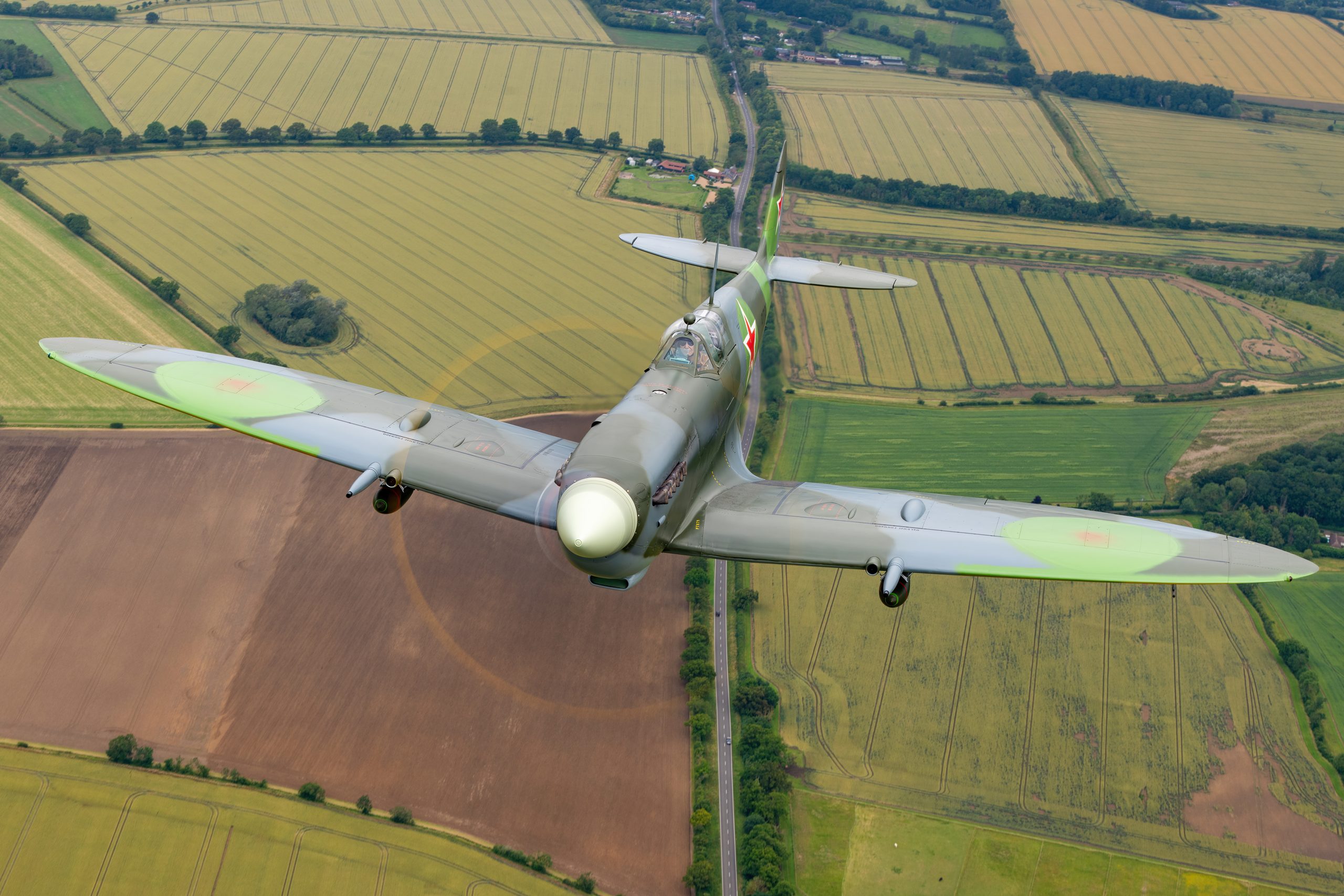
One practical note on orientation: the Spitfire’s recognition value survives cropping unusually well, because the wing shape alone identifies it. Designers who need a vertical crop from a horizontal frame will find the head-on and banking images tolerate it, and the high-resolution originals leave generous room to recompose.
Uses: publishing, broadcast, museums and brands
Book publishing remains the steadiest consumer of Spitfire imagery: jackets, plate sections, chapter openers and endpaper spreads across biography, unit history, general Second World War narrative and the substantial market in aviation reference. Magazines and partworks follow, with the aviation monthlies taking air-to-air work for features and the newsstand specials that appear around every anniversary taking cover-grade frames. Newspapers reach for the Spitfire whenever a flypast, a restoration first flight or an anniversary makes news, and stock-style availability with instant identification suits their deadlines.
Broadcast and streaming use stills more than viewers realise: pitch decks, interstitial cards, end-title backgrounds and the promotional artwork that sells a documentary before a frame of footage is graded. Museums and heritage attractions license for exhibition graphics, interpretation panels and retail. Beyond the strictly editorial world, brands with heritage positioning, from watchmakers to whisky houses, borrow the Spitfire’s associations for campaigns, and that commercial use is precisely where clean, single-holder provenance matters most, because a campaign cannot be built on an image with an uncertain rights chain.
Each of these markets wants a different slice of the same archive, which is why the collection is shot across angles, schemes and moods rather than accumulating near-duplicates of one aircraft on one afternoon. A researcher’s brief, whatever the sector, usually resolves to one of the frame families described in the angle guide above, and the gallery structure makes it quick to see which aircraft exist in which family.
Three worked example briefs
How the archive answers real requests is easier to show than to describe, so here are three worked examples of the kind picture desks actually send.
The book cover. A publisher needs a cover for a Battle of Britain pilot biography: portrait format, room for title and author name, immediate recognition. The answer is a Merlin-engined Mk IX head-on or climbing frame, cropped vertical, sky held clean at the top for type. The mark is later than 1940, so the jacket copy should avoid claiming the image shows the battle itself; most biography jackets simply need the aircraft, and the silhouette is exact.
The documentary still. A production company wants transitional footage-matching stills for a D-Day anniversary programme. The FR XIVe in invasion stripes is the frame: 1944 period markings, a dramatic head-on angle, and a scheme that reads instantly on screen. Caption it as a preserved Griffon-engined Spitfire wearing invasion stripes rather than as a D-Day participant, because Spitfire XIVs were flying anti-V-1 patrols over southern England in June 1944 rather than operating over the beaches. Registration and mark go in the programme’s shot log from the gallery metadata, and licensing for broadcast is agreed directly with the copyright holder in one exchange.
The museum banner. An exhibition on photo-reconnaissance needs a hero image three metres wide. The PR XI topside or banking frame in PRU blue carries the enlargement, and the aircraft is one of the few genuine PR survivors, which gives the interpretation team a real story to hang on the image rather than a generic fighter standing in for a specialist type.
And a fourth, for the awkward ones. A design agency needs a Spitfire for a heritage brand campaign, but the client’s lawyers want the rights position in writing before anything is comped. Because the photographers hold copyright outright and the frames carry no agency chain, the licensing terms, territory and duration go into a single agreement with one signature on the supplier side. That paragraph has closed more commercial conversations than any number of beautiful thumbnails, and it is the part of the archive a buyer cannot see in the gallery view.
Where else Spitfire imagery comes from
A complete picture research strategy uses more than one shelf, and it is worth being clear about what each source does best. Wartime photography, much of it from official RAF photographers, is held by institutions such as the Imperial War Museums, and it is irreplaceable for period authenticity: real 1940 aircraft, real pilots, real fields. Its limits are resolution, monochrome and heavy prior use of the famous frames. Museum photography documents preserved airframes in controlled conditions, ideal for reference detail but static by nature. Airshow photography from public days is abundant and cheap, but ground-to-air angles, haze and cluttered circuits limit its editorial ceiling.
Independent air-to-air work occupies the top of that pyramid: modern quality, flying subjects, chosen light and clean provenance. The strongest spreads usually pair sources, a wartime frame for the historical moment beside a modern air-to-air for the machine in its element, and this archive is built to supply the second half of that pairing at the same technical standard a picture desk expects from any contemporary commission. Our guide to aviation picture research covers the sourcing landscape in depth, and companion buyer’s guides exist for the B-17 Flying Fortress, the Martin Mars, the F-35 Lightning II and the F-4 Phantom II.
It is also worth knowing what sits beside the Spitfires on the same shelf, because briefs rarely arrive alone. The UK Warbirds galleries from the same sessions include Hurricanes, a Gloster Gladiator, Hawker biplane fighters, wartime trainers, a Mustang and rarities such as the de Havilland DH.88 Comet racer, all photographed with the same air-to-air approach and the same metadata discipline. A feature on the Battle of Britain that starts with a Spitfire cover usually needs a Hurricane inside; a piece on fighter evolution wants the biplanes; and sourcing them all from one place, under one licence conversation, is the quiet efficiency that keeps picture desks coming back.
Technical quality and licensing
The Spitfire collections are shot on current full-frame equipment and delivered as high-resolution files suitable for double-page print, exhibition enlargement and broadcast. Every frame carries embedded metadata with type, mark and registration as recorded at the session, and the galleries at professionalaviationphotography.com are the browsable index of what exists. Editorial and commercial licensing runs directly through the site, with terms explained plainly on our licences page, and Piemags handles agency-style supply for publishers who prefer it via piemags.com. There is no third-party rights chain: the photographers are the copyright holders, and permissions for the photography were arranged with the operators when the sessions were flown.
Pricing follows use, from single editorial placements to covers, campaigns and exhibition rates, and quotes are answered by a photographer who knows the aircraft, which shortens the conversation considerably. If a brief needs a mark, scheme or angle that is not in the galleries, ask anyway: the archive grows every season, the 2025 sessions added aircraft the 2024 set did not have, and requests really do shape what gets flown next.
Delivery is simple: files come as full-resolution JPEGs by default, with other formats available on request, supplied by download link within hours of an agreed licence rather than days. Captions, credits and identification travel inside the files as embedded IPTC metadata, so a frame dropped into an editorial system arrives already labelled, and the credit line, Photo: Aviation Photo Crew, is short enough to survive even the tightest layout. For exhibition and campaign work, test files at output resolution can be supplied before commitment, which removes the last uncertainty from a large-format decision.
A buyer’s Spitfire checklist
Before licensing any Spitfire photograph, from any source, five questions are worth a minute each. First, is the mark right for the story, Merlin or Griffon, fighter or reconnaissance? Second, does the scheme match the period claimed, or does the caption need to say “preserved aircraft”? Third, is the identity recorded, registration or serial, so the caption can be checked? Fourth, is the provenance clean, one copyright holder, no unclear chain? Fifth, is the resolution honest for the intended size? Any frame from these galleries answers all five, and any source that cannot answer them deserves caution regardless of how good the thumbnail looks.
The Spitfire will still be selling covers in fifty years. The aircraft photographed in these galleries are maintained, flown and displayed by people who intend to keep them in the air for exactly that long, and the archive’s job is to keep pace with them, season by season, so that the best available photography of the most famous aircraft in the world is always one enquiry away. The history behind the machine is told in full in our Supermarine Spitfire history and our guide to the aircraft of the Battle of Britain.
One final point about the market itself. Spitfire imagery is not scarce; good Spitfire imagery is. Search any stock platform and thousands of results come back, but filter for air-to-air, for correct identification, for clean rights and for print resolution, and the field narrows to a handful of suppliers worldwide. That is the practical case for bookmarking a specialist source before the next anniversary year arrives, rather than searching from scratch against a deadline.
Requesting images. Email sales@piemags.com with the subject you need, the medium, the territory, the print run or audience, and your deadline. That is enough to quote against. Licensing terms are set out on the Piemags licences page.
Frequently asked questions
Where can I license Spitfire photographs for a book or magazine?
High-resolution air-to-air Spitfire photographs can be licensed directly from the Aviation Photo Crew galleries at professionalaviationphotography.com, with editorial and commercial terms explained on the licences page. Piemags supplies the same imagery agency-style for publishers who prefer that route via piemags.com.
Are these wartime photographs or modern ones?
They are modern, high-resolution colour photographs of preserved, airworthy Spitfires, taken air to air from a camera ship during dedicated sessions in 2024 and 2025. They should be captioned as preserved aircraft, and they pair well with genuine wartime archive frames in historical features.
Which Spitfire marks are in the collection?
The core coverage includes Merlin-engined Mk IXs in day fighter and desert schemes, a photo-reconnaissance PR XI in PRU blue, a Griffon-engined FR XIVe with invasion stripes, a high-altitude HF IXe and the polished-metal Silver Spitfire flown around the world in 2019.
How do I tell a Merlin Spitfire from a Griffon Spitfire?
Check the nose and the propeller. Merlin marks such as the Mk IX have a shorter, smoother nose and usually a four-blade propeller on today’s airworthy examples. Griffon marks such as the XIV have a longer nose with cowling bulges and typically a five-blade propeller. The distinction matters for period accuracy in captions.
Can I use a Mk IX photograph to illustrate the Battle of Britain?
With care. The Mk IX entered service in 1942, after the battle, so a caption should present it as a preserved Spitfire illustrating the type rather than as a Battle of Britain aircraft. Many publishers do exactly this for covers, where silhouette recognition matters more than mark-level precision, and keep strict accuracy for inside pages.
What resolution are the images and will they hold a double-page spread?
The collections are shot on current full-frame cameras and delivered at native high resolution suitable for double-page print, exhibition enlargement and broadcast. Generous margins in most frames also allow vertical crops from horizontal originals for cover formats.
Do the images come with accurate identification?
Yes. Type, mark and registration as recorded at the session are embedded in the files and shown in the gallery metadata for every frame, so captions can be written and checked without guesswork.
Who owns the copyright and are there third-party rights to clear?
The photographers of Aviation Photo Crew are the copyright holders, and the photography was arranged with the cooperation of the aircraft operators. Licensing is a single direct agreement with no agency chain or unclear provenance to untangle.
Can I get exclusivity on a Spitfire image?
Exclusive and semi-exclusive arrangements can be discussed for covers and campaigns, subject to any prior placements of the specific frame. Enquire with the intended use and territory and you will get a plain answer about what can be held.
Do you cover other warbirds besides the Spitfire?
Yes. The same galleries include Hurricanes, Mustangs, biplane fighters, trainers and many other types photographed air to air and at UK events, and companion buyer’s guides cover the B-17 Flying Fortress, the Martin Mars, the F-35 Lightning II and the F-4 Phantom II.
What does a Spitfire image licence cost?
Pricing follows use: a single inside editorial placement costs less than a cover, a campaign or an exhibition enlargement. Send the intended use, size, territory and duration through the site and a quote comes back from the photographer directly, usually the same day.
Can I request a specific Spitfire, scheme or angle that is not in the galleries?
Yes, and requests are welcome. The archive grows every season and the sessions flown in 2025 added aircraft and angles the 2024 set did not have. If a brief needs something specific, asking early gives the best chance of it being photographed at a coming session.
