On 11 August 2024 the Martin JRM Hawaii Mars, the largest flying boat in operational service anywhere in the world, made its final flight from Sproat Lake to the BC Aviation Museum. The air-to-air photography flown around those last days is now the closing chapter of an eighty-year story, and this guide explains what the collection holds and how publishers, museums and documentary makers can license it.
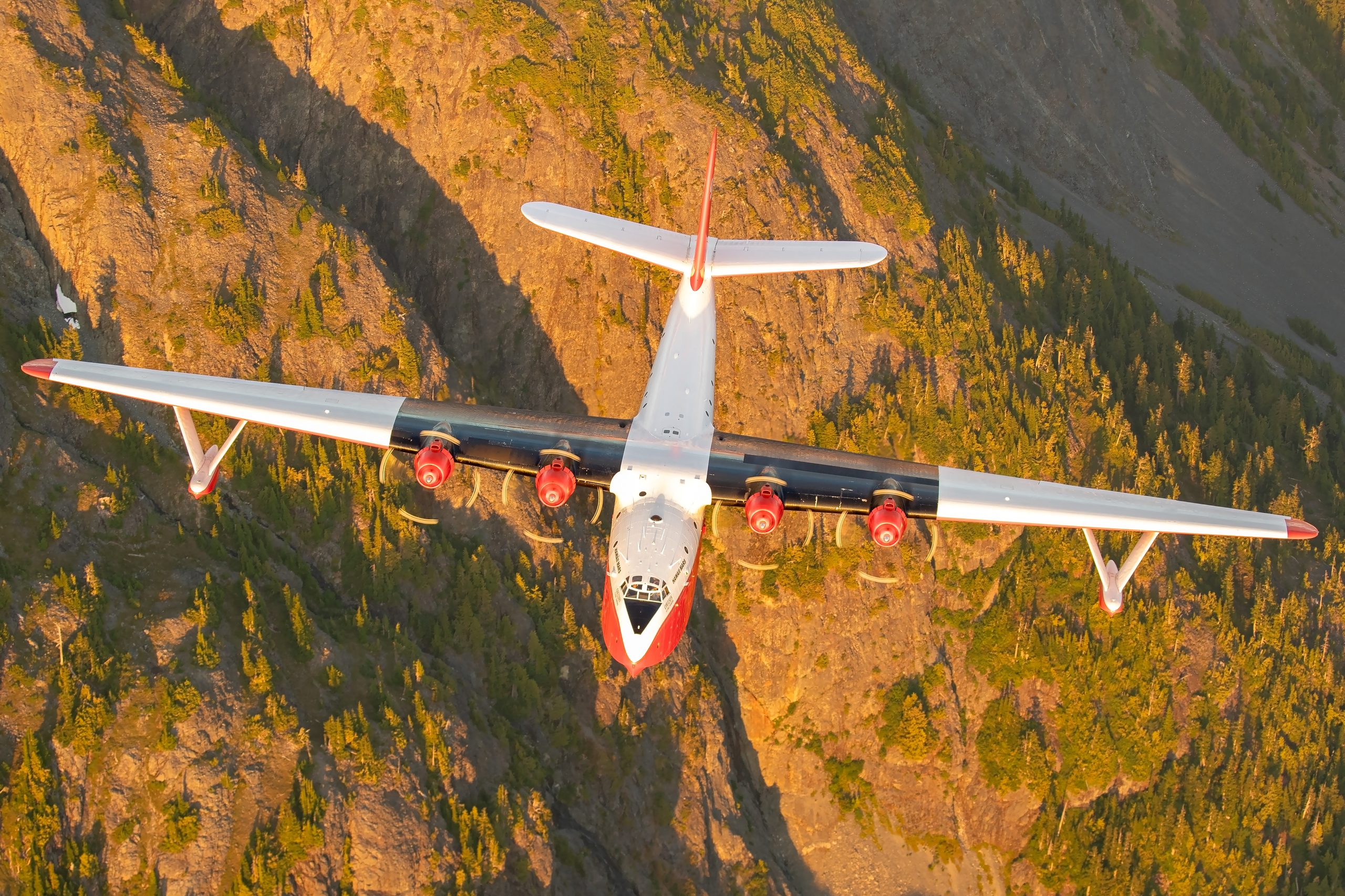
Some aircraft are subjects; a few are events. The distinction matters to picture desks because events have deadlines, anniversaries and closing chapters, and their imagery appreciates rather than dates. The Hawaii Mars was an event for its whole life, from its 1945 birth as the US Navy’s giant Pacific transport to its half-century as the world’s most spectacular water bomber, dropping more than 25,000 litres in a single pass across British Columbia’s fire seasons. When it flew to its museum in August 2024, escorted by the Canadian Forces Snowbirds, it closed the era of the giant flying boats, and the photography made around that retirement became, instantly, a finite historical archive.
This is the third guide in our series for picture buyers, following the general aviation picture research guide and the B-17 buyer’s guide, and it follows the same shape: what the aircraft is, what the coverage contains, how to caption it accurately, and how licensing works.
How to read this guide: researchers on deadline should go straight to the coverage, caption and licensing sections; authors and producers shaping longer projects will find the history and finite-archive sections explain why this subject rewards early planning; and anyone who simply loves the aeroplane is welcome to treat the whole page as a farewell album with footnotes.
What this guide covers
- The aircraft: last of the giant flying boats
- The final flights of 2024
- From Navy giant to water bomber
- What the air-to-air coverage includes
- Photographing a 200 foot flying boat
- Why demand for Mars imagery keeps growing
- Why this archive is finite
- Where else Mars imagery comes from
- Captioning the Mars correctly
- The museum era
- Uses: books, museums, documentaries, film
- An angle guide for designers
- A buyer’s Mars checklist
- Pairing with historical imagery
- Technical quality and delivery
- Licensing the images
- The last giant, well recorded
- Frequently asked questions
The aircraft: last of the giant flying boats
The Martin JRM Mars was built as the US Navy’s long-range Pacific transport at the very end of the flying-boat era, and only a handful were completed, entering service around 1945. With a wingspan of 200 feet, the Mars remains among the largest flying boats ever built, and when its naval career ended, four were bought for a job nobody had imagined: aerial firefighting. Converted to carry over 25,000 litres of water scooped directly from lakes, the Mars fleet fought British Columbia’s forest fires for roughly fifty years, and the red and white Coulson Flying Tankers livery became one of the most recognisable sights in Canadian aviation.
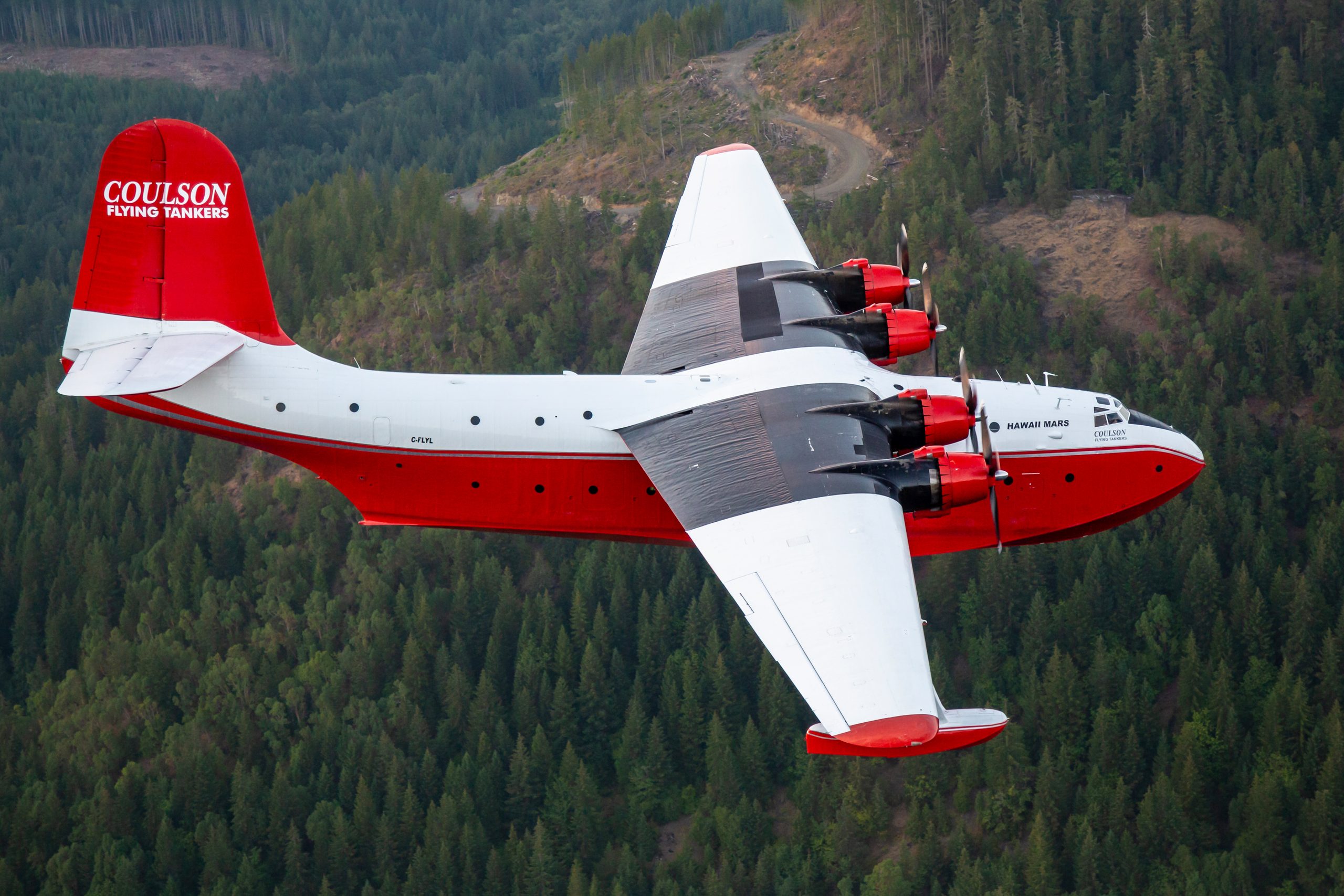
By the 2020s two survived: the Hawaii Mars, kept airworthy by Coulson at Sproat Lake near Port Alberni, and the Philippine Mars. The Hawaii Mars made its final flight on 11 August 2024, touring Vancouver Island past Comox, Nanaimo and Crofton, meeting the Snowbirds along the way, and alighting at Patricia Bay for preservation at the BC Aviation Museum at North Saanich, where its permanent display opened that September. The Philippine Mars went to the Pima Air and Space Museum in Arizona in 2025. No Mars will fly again, and everyone photographing those final days knew it.
The final flights of 2024
The photography in this collection was flown air to air on 10 August 2024, in the Hawaii Mars’s last flying days out of Sproat Lake, with the aircraft working over the lakes and mountains of Vancouver Island in summer evening light. A formation sortie with a subject this size is a rare undertaking in itself; a formation sortie with a subject this size that can never be repeated is the definition of archival photography.

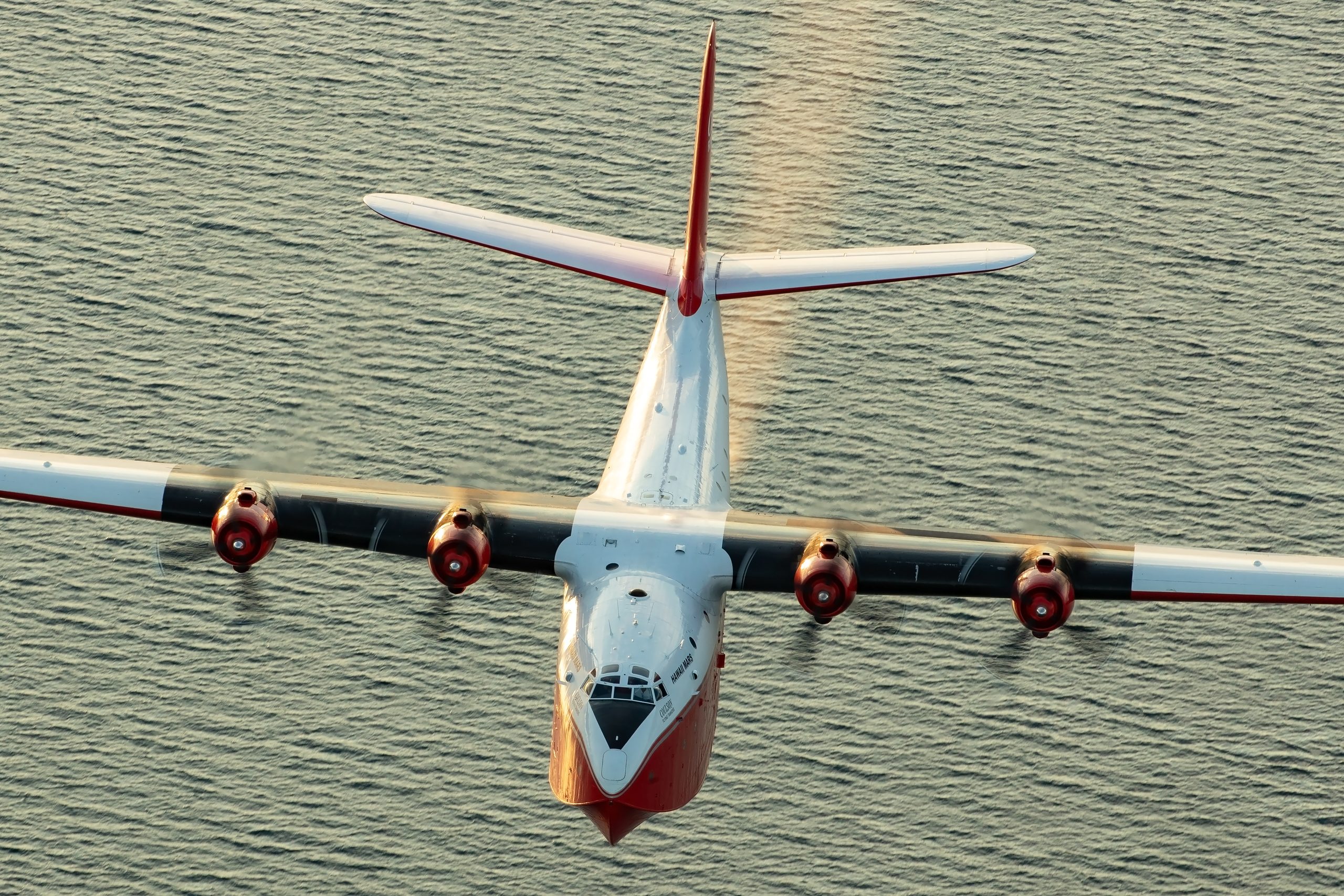
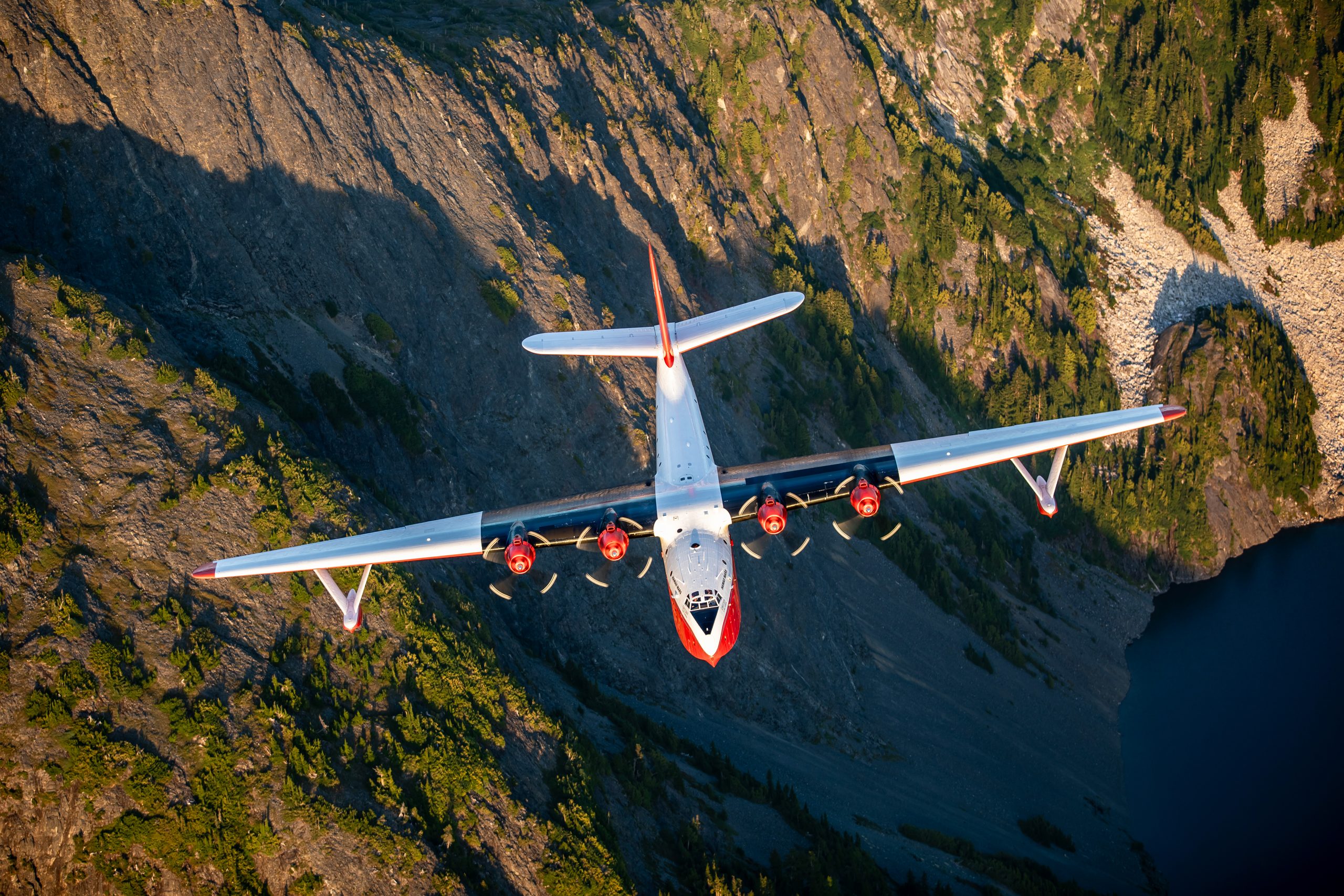
The set includes the image no ground photographer could ever make: the Mars on the step, skimming the lake trailing spray, shot from alongside and above. It includes the aircraft against golden mountainsides, over sparkling open water, head on against forested cliffs, and in the calm side-profile light of the last evenings. Whatever the Mars story needs, the sortie was flown to cover it.
The farewell itself was a public event of a kind aviation rarely stages any more. The final flight of 11 August 2024 left Sproat Lake in the afternoon and toured the island, past Comox, down the Nanaimo coast and over Crofton, where the Snowbirds joined it, before the last alighting at Patricia Bay in the evening; tens of thousands watched from shorelines along the route. The photography in this collection was flown the day before, when the aircraft was still simply itself, working over its own lake without a crowd, and that difference in mood, farewell versus valediction, is a genuine editorial choice the two bodies of material offer between them.
From Navy giant to water bomber
The Mars began as the biggest transport aircraft the US Navy ever ordered, conceived in the late 1930s as a flying dreadnought and matured into a long-range Pacific freighter. The handful completed by Martin carried cargo and personnel across the ocean in the war’s final phase and the years after, setting load-carrying records for flying boats that in some respects were never beaten, because the type’s whole category ended beneath it as runways and landplanes took over long-haul flying.
The second life was Canadian. Bought for conversion in the late 1950s, four Mars became water bombers on Sproat Lake, their cavernous hulls plumbed for tanks that scooped from the lake on the run. For roughly fifty years the survivors dropped on British Columbia’s fires, latterly under Coulson, and the sight of the Hawaii Mars on a drop run became one of aviation’s great spectacles, a Second World War giant doing indispensable modern work into the twenty-first century. That double history, Navy giant and firefighting legend, is why the demand for its imagery spans both military and civil publishing.
The operation behind the frames is worth a paragraph, because provenance questions arrive with every serious licence. This was a briefed formation sortie flown with the operator’s cooperation in the aircraft’s final flying days, photographed from a dedicated camera ship by Aviation Photo Crew, whose air-to-air work runs throughout this blog and the galleries. Date, location, aircraft and permissions were recorded at the time, and the diligence answers a picture desk needs, who, when, where, with what authority, are on file and one email away.
The numbers from the Navy years still astonish: a hull the length of an airliner’s, a wing outspanning the bombers of its day, and payloads that made the type briefly the heaviest lifter on water anywhere. Precision matters with superlatives, and the safe formulation, among the largest flying boats ever built, and the largest in operational service by its final decades, is the one the record supports without argument; the Hughes H-4 flew once and the Saunders-Roe Princess never served, which leaves the Mars alone at the working end of the giants’ table.
What the air-to-air coverage includes
The collection runs to a full sortie’s worth of frames, catalogued in the galleries with date and location attached. Angles cover the complete circle: head-on frames that put the four radials and the deep hull straight at the reader, front quarters over water and against mountainsides, level side profiles including sunset silhouettes, and the topside overheads that show the sheer acreage of that wing, views that exist only from a camera ship flying above two hundred feet of aeroplane.
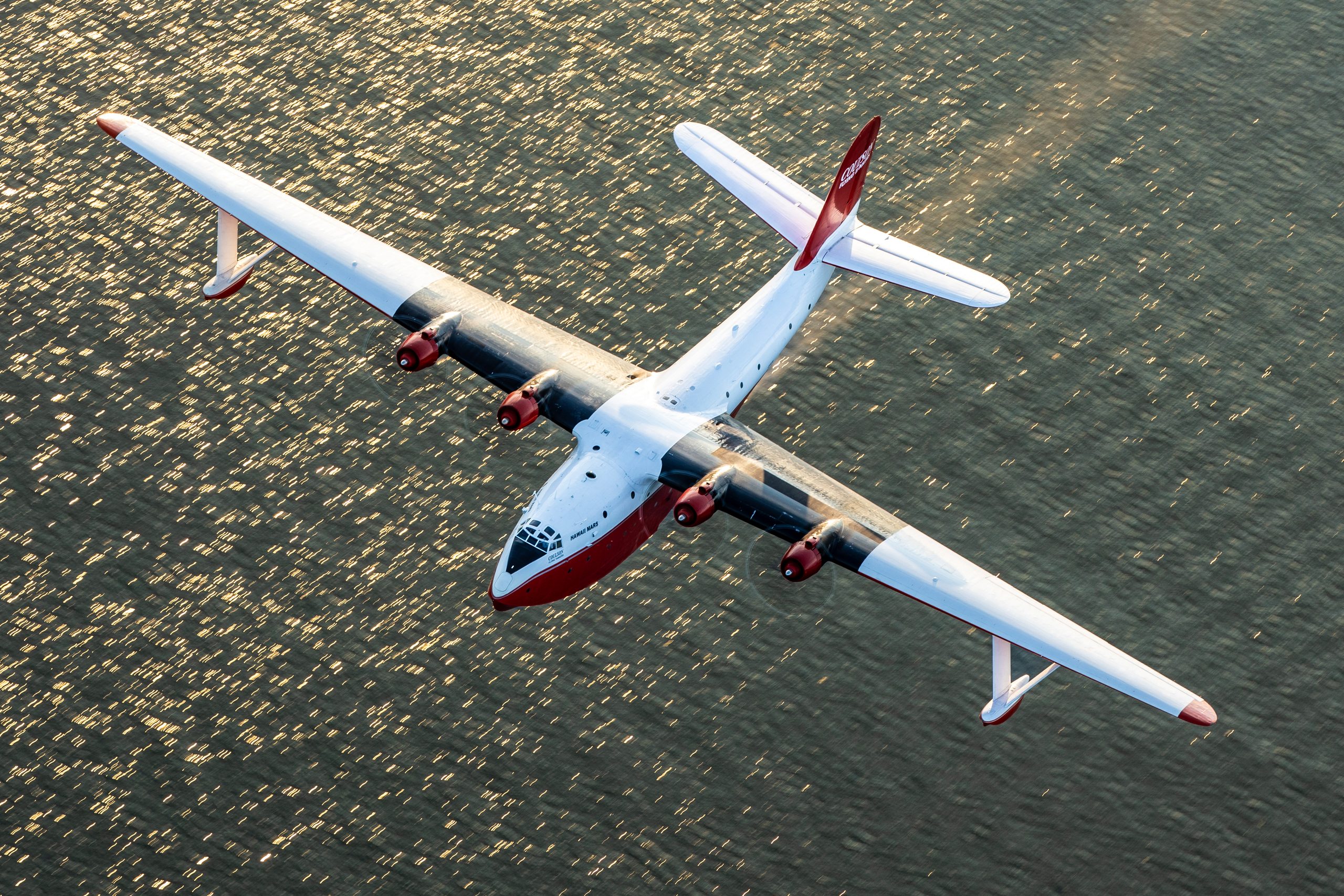
Light ranges from clean afternoon sun to the gold of the last evenings, and the backgrounds are the aircraft’s own country: Sproat Lake, the Alberni valley, the mountains and coastal water of Vancouver Island. For designers that means the set holds both documentary frames, neutral light, full detail, and the emotional ones that carry covers and exhibition walls. Because everything comes from one operation, colour and fit are consistent across the whole take.
The aircraft’s scale does strange, useful things to photographs. Frames with no reference object read as a normal flying boat until a caption supplies the numbers; frames with the landscape working, treetops, shoreline, the camera ship’s shadow, suddenly show a machine the length of a blue whale hanging over a lake. The collection deliberately includes both kinds, because publishers use the trick both ways: the clean portrait for elegance, the scale-revealing frame for awe.
Photographing a 200 foot flying boat
The craft behind these frames differs from fighter work in ways that shaped the collection. Four big radials turn slowly, so shutter speeds sit low, around 1/200 second and below, to keep all four discs alive, exactly the discipline our guide to propeller blur and shutter speed teaches, applied four times over. Formation distances stretch, because framing 200 feet of aeroplane needs room, and the camera ship works a bigger, slower orbit than it would around a fighter. And the light windows matter more: an aircraft this size shades its own hull, so the low golden sun that lifts the fuselage sides was waited for deliberately, which is why so much of the take glows. The ground rules behind sorties of this kind, whatever the subject, are set out in our guide to the basics of air-to-air photography.
The reward for that patience is on this page. Water-flying adds the one element no landplane sortie offers, the interaction of hull and surface, and the spray-run frames were flown with margins planned in advance: the photography holds drama precisely because the flying held none. That is the standard the whole series is flown to, and it is the reason the collection can be licensed with its provenance stated proudly rather than vaguely.
Why demand for Mars imagery keeps growing
Retirement did not end the Mars’s editorial life; it concentrated it. The 2024 farewell generated worldwide coverage and a wave of retrospectives that continues through every anniversary, and the aircraft’s two museums now anchor permanent streams of visitor interest, education programmes and exhibition development, all of which need imagery of the aircraft flying. Fire seasons add their own cycle: every major wildfire summer sends editors looking for the definitive images of aerial firefighting’s history, and the Mars is that history’s largest single character.
There is also the quieter, longer demand of the reference shelf. The Mars appears in every serious survey of flying boats, of firefighting aviation and of Canadian aviation heritage, and those books are rewritten for each generation. The archives that hold strong flying-era material of the type will supply those titles for decades, which is precisely why this collection was flown while the flying could still be done.
Why this archive is finite
Most aviation subjects can be photographed again next season. This one cannot. The Hawaii Mars sits in a museum at Patricia Bay; the Philippine Mars sits in the Arizona desert; and no other giant flying boat flies anywhere on earth. The air-to-air photography that exists of the Mars in its final flying form is all the air-to-air photography there will ever be, and the frames from its last days carry a provenance, photographed 10 August 2024, the day before the final flight, that is itself part of their editorial value.
For picture desks the practical consequence is the one from our rare-subjects guidance: treat the material as a finite resource and licence properly for the use you actually have. There is no next shoot to wait for, and projects about flying boats, aerial firefighting, Canadian aviation or the end of great aviation eras will be drawing on this fixed pool of imagery for decades.
The demand curve has one more driver worth naming: the aircraft’s afterlife on screen. The Mars appears constantly in short-form video, streaming documentaries and social storytelling about firefighting and giant machines, and every wave of that content sends a fresh cohort of commissioning editors looking for stills that outresolve the video frames they started from. Master-quality air-to-air is precisely what that search hopes to find, and the licensing enquiry it produces, can we use this properly, at quality, with permission, is the one this page exists to answer.
Where else Mars imagery comes from
Honesty about the wider market, as in every guide in this series. News agencies covered the final flight itself, 11 August 2024, thoroughly, mostly from the ground and the water, and that coverage serves stories about the event and its crowds. Historical archives hold the US Navy years and mid-century conversion era, much of it public domain. Enthusiast photography from fifty years of Sproat Lake operations exists in quantity, of variable provenance and resolution, and the museums themselves supply the static present.
What remains rare is professional air-to-air of the aircraft flying, in managed light, at master resolution, with clean licensing, and that is the specific shelf this collection occupies. Most serious Mars projects will use several sources; the role of this one is to supply the definitive flying portraits around which the rest arranges itself.
Captioning the Mars correctly
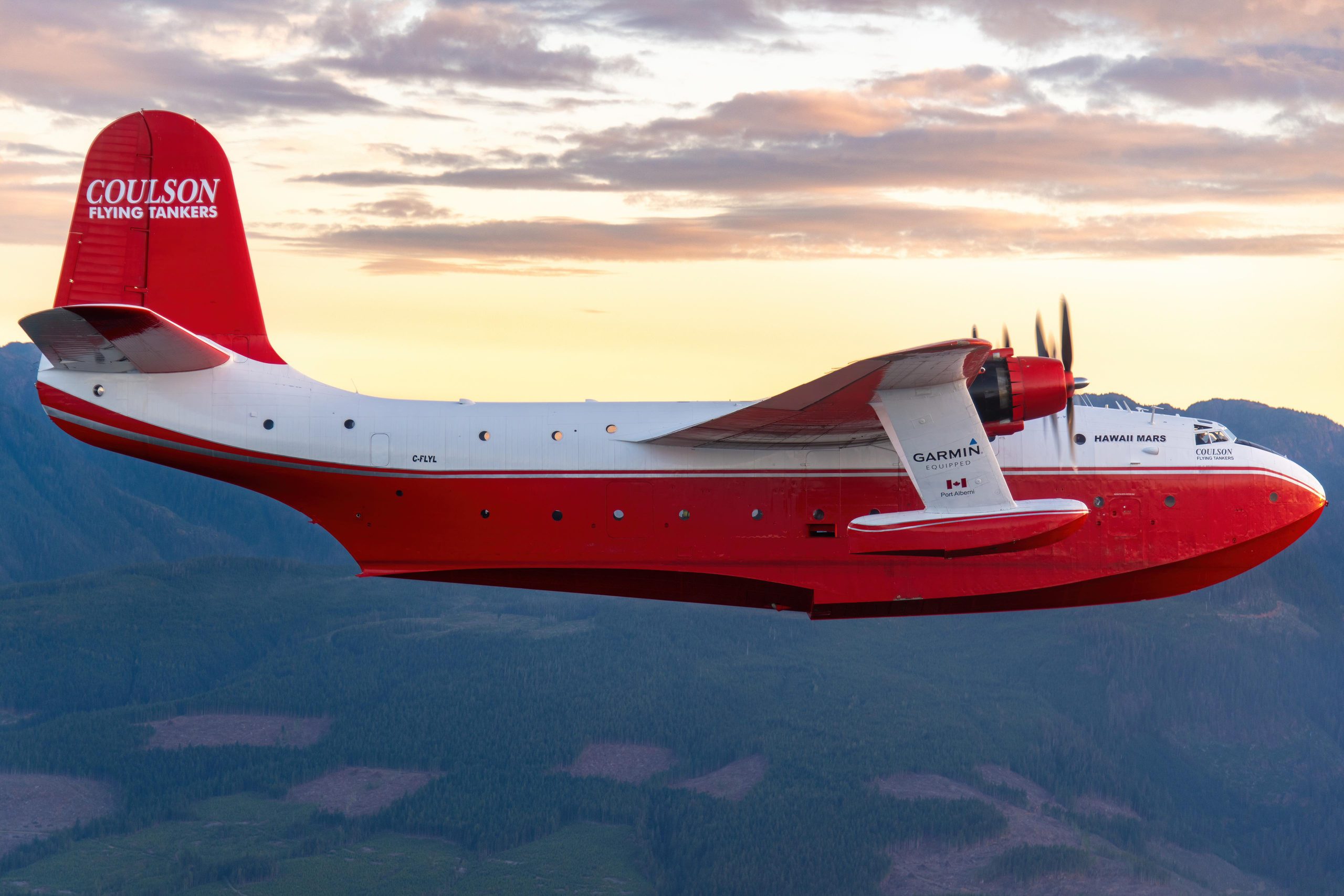
The Mars is mercifully simple to caption accurately, and the details matter. The aircraft is the Martin JRM Hawaii Mars, registration C-FLYL, operated by Coulson Flying Tankers from Sproat Lake, British Columbia. The photographs date from 10 August 2024, during its final flying days; the final flight itself was 11 August 2024, to Patricia Bay for the BC Aviation Museum at North Saanich. Say those things and a caption cannot go wrong.
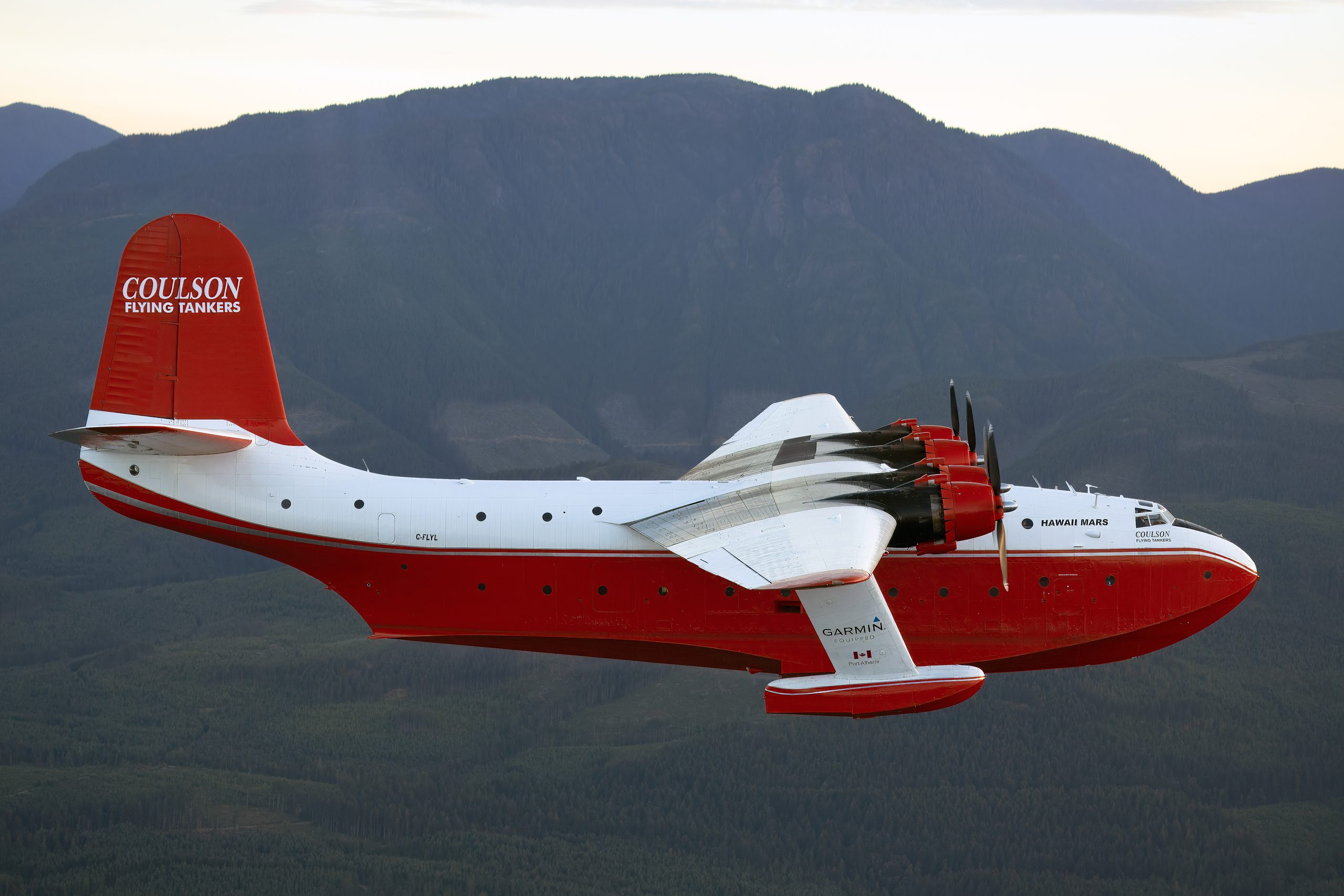
The traps are small but real. Do not describe the aircraft as still flying, and date any use that implies currency. Do not confuse the two survivors: the Hawaii Mars is the red and white aircraft at the BC Aviation Museum; the Philippine Mars, in blue US Navy scheme in its retirement, is at Pima. And the firefighting statistics deserve care: the load was over 25,000 litres per drop, a figure from the operator’s long service, and superlatives beyond the verifiable, largest operational flying boat of its era, last of its kind in service, should stay within what the record supports.
The finite-pool point has one more edge worth stating plainly: exclusivity is possible here in a way it rarely is with living subjects. Because no new Mars flying photography can be made, a publisher or museum that needs a signature frame protected for a jacket or a gallery can buy that protection meaningfully; the pool cannot be refilled behind the agreement. Exclusivity is priced accordingly and honoured absolutely, and the conversation belongs at the start of a project, not the end.
The museum era
The story now continues indoors, and buyers should know the present tense. The Hawaii Mars has been the centrepiece of the BC Aviation Museum at North Saanich since its display opened in late September 2024, close to Victoria’s airport at Patricia Bay, where Mars flying boats first served Canada. The Philippine Mars, the other survivor, crossed to the Pima Air and Space Museum in Arizona in 2025, wearing its US Navy blue. Museum photography of both is possible for anyone with a camera; what no visitor can photograph, ever again, is the subject of this collection, the Mars with its element under it and its engines running.
That split defines the market cleanly. Institutional and news archives hold the type’s history; visitors and local photographers will supply the museum years; and the air-to-air record of the final flying days lives in collections like this one. A well-built Mars feature will likely draw on all three, and the honest-caption rules in this guide keep the three properly labelled.
Museum-era imagery has its own buyer note: institutions elsewhere planning flying-boat or firefighting exhibits frequently license flying-era material to accompany artefacts they hold, because a gallery about water aviation without the water is half a gallery. Display-scale files of the spray runs and topsides have already found exactly that use, and the exhibition licence, long duration, single site, wall-size reproduction, is a standard shape the archive prices without drama.
Uses: books, museums, documentaries, film
The Mars pulls demand from more directions than most warbirds. Aviation history publishing needs it for the flying-boat era’s closing chapter. Firefighting and natural-disaster coverage returns to it every fire season, because the image of a giant scooping a lake is journalism’s shorthand for aerial firefighting. Canadian institutions and publishers treat it as national heritage, which it now formally is. Museums building water-aviation or firefighting exhibits need large-format frames of exactly this kind. And documentary makers covering the 2024 retirement, or the type’s Navy origins, need the closing visuals this collection uniquely provides.
Model and art licensing rounds out the list: the Mars is a perennial subject for profile artists, print makers and kit manufacturers, and the topside and detail coverage supplies the reference angles that ground photography never could. As with the B-17 guide, mention the final use in the brief, because the ideal frames for a memorial exhibition, a fire-season news feature and a box art reference are three different pictures.
Education and children’s publishing deserve their own line, because the Mars is a gateway aeroplane: a machine the size of a building that lands on water and fights fires is how a nine-year-old falls into aviation. Curriculum publishers, museum learning teams and documentary makers pitching younger audiences consistently reach for exactly the frames this collection leads with, the spray run and the giant-over-the-treetops scale shots, and the licence conversation for educational use is deliberately kept simple.
Anniversary publishing will follow its own calendar: the type’s 1945 service entry, the firefighting conversions, and the August 2024 farewell all generate round-number retrospectives, and picture desks planning those features a season ahead will find the archive’s same-day answers most valuable precisely when the calendar is not pressing. The best anniversary features are picture-edited months early; the pool they draw from is already fixed.
An angle guide for designers
The water-skimming spray frames are the collection’s signature and the natural covers; they carry motion, scale and story in one image. The golden mountainside frames are the emotional close for retrospectives, the aircraft literally flying into the sunset of its career. Head-on frames deliver maximum presence for openers and posters. Topsides serve spreads and reference. The dusk profiles are the elegiac chapter-enders. And the tail-on and detail frames put the Coulson titling and registration where a caption or panel can lean on them.
Sequencing advice mirrors the earlier guides: a Mars feature built from one sortie holds together visually, so choose a spine of three or four frames in matching light and let detail crops fill between them. If a layout needs typography space, the open-water and sky backgrounds give it generously; say so in the brief and the recommendation will come back at your ratio.
Two worked briefs to make it concrete. A publisher closing a history of the flying boats needs a final image for the last chapter: the dusk profile or the golden mountainside frame, worldwide print and ebook for one title, supplied at spread resolution with the caption naming the date and the museum where the aircraft now rests. A broadcaster cutting a wildfire documentary needs the machine at work: the spray-run sequence, worldwide in perpetuity for one programme, delivered same day with the honest tense, the Mars fought fires for fifty years, written into the supplied caption. Both are routine; both were anticipated when the sortie was flown.
A buyer’s Mars checklist
Six questions, as ever. Which aircraft, Hawaii or Philippine Mars, and does the caption name it? When was the photograph taken, flying era or museum era? Does the frame’s light and mood match the story’s, farewell, work, or history? Does the resolution support the final size uncropped? Does the licence cover the actual use, territory and duration, with exclusivity addressed if the design depends on it? And is the credit line agreed? The collection’s embedded metadata answers the factual four before the file is even opened.
One more designer’s note on colour. The Mars’s red and white is one of aviation’s strongest liveries on the page, and it does different work in different light: documentary crispness in afternoon sun, fire-warmth against the golden mountainsides, and near-black elegance in the dusk profiles. Feature palettes can be built from the aircraft itself, and art directors who send a swatch or a mood reference with the brief get frame recommendations matched to it, an easy trick that makes a Mars spread feel designed rather than assembled.
Pairing with historical imagery
The Mars story reaches back to 1945, and the strongest layouts pair this modern colour material with the historical record: US Navy photography of the type’s transport years, mid-century frames of the water bomber conversions, and news imagery from fifty years of British Columbia fire seasons. The pairing rules from our earlier guides apply unchanged, period images for events, modern air-to-air for the machine, captions that separate the two, and the 2024 frames sit at the timeline’s end as the type’s formal farewell portrait.
If your project needs current aerial firefighting rather than its history, say so: the wider archive photographs firefighting aviation beyond the Mars, and the working end of the industry, the tankers and helicopters that inherited the Mars’s job, is a brief the same team can answer with current material. The rotary-wing end of that market has its own page here, on sourcing and licensing helicopter photographs. The Mars closes one chapter of that story; the story itself is still being flown and still being photographed.
Technical quality and delivery
The collection is shot on professional full-frame digital bodies and delivered from processed masters: high-resolution JPEG as standard, TIFF on request, embedded captions, credit and identification in every file. Resolution supports double-page print and exhibition enlargement uncropped, and the full sortie is archived behind the published selects, so near-neighbour frames, a different wing position, a cleaner spray pattern, can be checked and supplied on request. The credit line is Aviation Photo Crew.
Delivery practicalities match the earlier guides: files arrive with the honest caption formulation embedded, replacements from the neighbouring frames of the take are same-day when a layout demands a different wing position or spray shape, and nothing is resampled from previews, the masters exist so nobody has to. For exhibition-scale enlargement, tell us the wall size and viewing distance and the file will be prepared and proofed for it rather than simply exported.
Licensing the images
Licensing follows the standard editorial shape: use, size, territory, duration and exclusivity, agreed in writing before delivery, with commercial uses discussed case by case, and the plain-language reference for anyone needing convincing about online images remains the UK Intellectual Property Office’s guidance. Browse the Mars coverage in the galleries, read the options at our licences, and send the brief; the wider Piemags archive stands behind it for projects beyond aviation.
A complete brief, subject, use, size, territory, duration, deadline, exclusivity if it matters, gets a same-day answer, exactly as described in the two earlier guides in this series. For the Mars specifically, say whether your project is about the aircraft, the firefighting, or the farewell, because each has its own best frames, and the archive would rather send you the right six than the famous one.
The last giant, well recorded
Aviation history is unkind to its giants. The great flying boats of the 1930s and 1940s mostly vanished without adequate photography, scrapped in an era that saw them as obsolete plumbing rather than heritage, and researchers building flying-boat features today fight for a handful of usable frames of types that once carried the world’s imagination. The Mars is the exception: the last of the giants retired in the age of professional digital photography, with its final flying days deliberately and thoroughly recorded, air to air, at master quality, with clean provenance.
That makes this collection something slightly larger than a stock shelf. It is the closing visual record of a category of machine humanity built for barely thirty years and will never build again, gathered while the last example could still show what the category meant. Publishers, museums and film-makers who reach for it are not just illustrating an aeroplane; they are drawing on the final entries in the flying boats’ own album, and the archive’s job, holding those entries properly and licensing them cleanly, is one it takes seriously.
The Mars now rests twenty minutes from where its Canadian story began, and the BC Aviation Museum’s visitors walk under a wing that worked for eighty years. What they cannot see, the aircraft alive over its lake in golden light, is what these photographs hold, and holding it well for the people who will keep telling the story is the point of everything described on this page.
Requesting images. Email sales@piemags.com with the subject you need, the medium, the territory, the print run or audience, and your deadline. That is enough to quote against. Licensing terms are set out on the Piemags licences page.
Frequently asked questions
What is the Martin Mars?
A giant flying boat built by the Glenn L. Martin Company for the US Navy at the end of the Second World War, with a wingspan of 200 feet, later converted into the world’s most spectacular water bomber. It fought British Columbia’s forest fires from Sproat Lake for roughly fifty years, latterly with Coulson Flying Tankers.
When did the Hawaii Mars make its final flight?
On 11 August 2024, from Sproat Lake around Vancouver Island, meeting the Canadian Forces Snowbirds along the route, to Patricia Bay for preservation at the BC Aviation Museum at North Saanich. Its permanent display opened that September.
When were these photographs taken?
Air to air on 10 August 2024, during the Hawaii Mars’s final flying days out of Sproat Lake, in afternoon and golden evening light over Vancouver Island’s lakes, mountains and coast.
How many Martin Mars aircraft survive?
Two. The Hawaii Mars is displayed at the BC Aviation Museum in North Saanich, British Columbia; the Philippine Mars went to the Pima Air and Space Museum in Arizona in 2025. Neither will fly again.
How much water could the Mars drop?
More than 25,000 litres per run, scooped directly from the lake surface on the run rather than loaded on the ground, which is what made the type so effective across five decades of firefighting.
Why is this collection described as finite?
Because the subject can never be photographed flying again. All air-to-air photography of the Mars in its final operational form now exists as a fixed pool, and the frames from its last flying days carry that provenance permanently.
Can I license these images for a book or magazine?
Yes, editorial licensing is their purpose: use, size, territory, duration and any exclusivity agreed in writing before delivery. Browse the gallery, send the brief, and a complete brief gets a same-day answer.
Can I use them in a documentary about the Mars or aerial firefighting?
Yes. Stills are licensed for broadcast and streaming, typically worldwide in perpetuity for a named programme, at resolutions comfortable for rostrum work. The farewell-flight provenance makes them natural closing material for any Mars retrospective.
What resolution are the files?
Professional full-frame digital masters supporting double-page print and exhibition enlargement uncropped, delivered as high-resolution JPEG with TIFF available, captions and credit embedded.
How should Mars photographs be captioned?
Name the aircraft (Martin JRM Hawaii Mars, C-FLYL), the operator (Coulson Flying Tankers), the place (Sproat Lake, British Columbia) and the date (10 August 2024, its final flying days). Never imply it still flies, and never confuse it with the Philippine Mars at Pima.
What angles does the collection include?
The full circle: water-skimming spray runs, head-on frames, front quarters over water and mountains, topside overheads showing the 200 foot wing, dusk side profiles and detail frames with the Coulson titling legible, all in consistent light from one operation.
How do I license an image?
Browse the collection at professionalaviationphotography.com, read the licence options on the our-licences page, and send your brief with subject, use, size, territory, duration and deadline. Say whether your story is the aircraft, the firefighting or the farewell, and the right frames come back first.
