
The Vought F4U Corsair was the bent-wing bird: the US Navy’s fastest wartime fighter, a machine so powerful it was initially judged too dangerous for carrier decks, and a legend twice over, first in the Pacific island campaigns and again over Korea. Around 12,600 were built between 1942 and 1953, the longest production run of any American piston-engined fighter, and its pilots claimed one of the most lopsided combat records of the war.
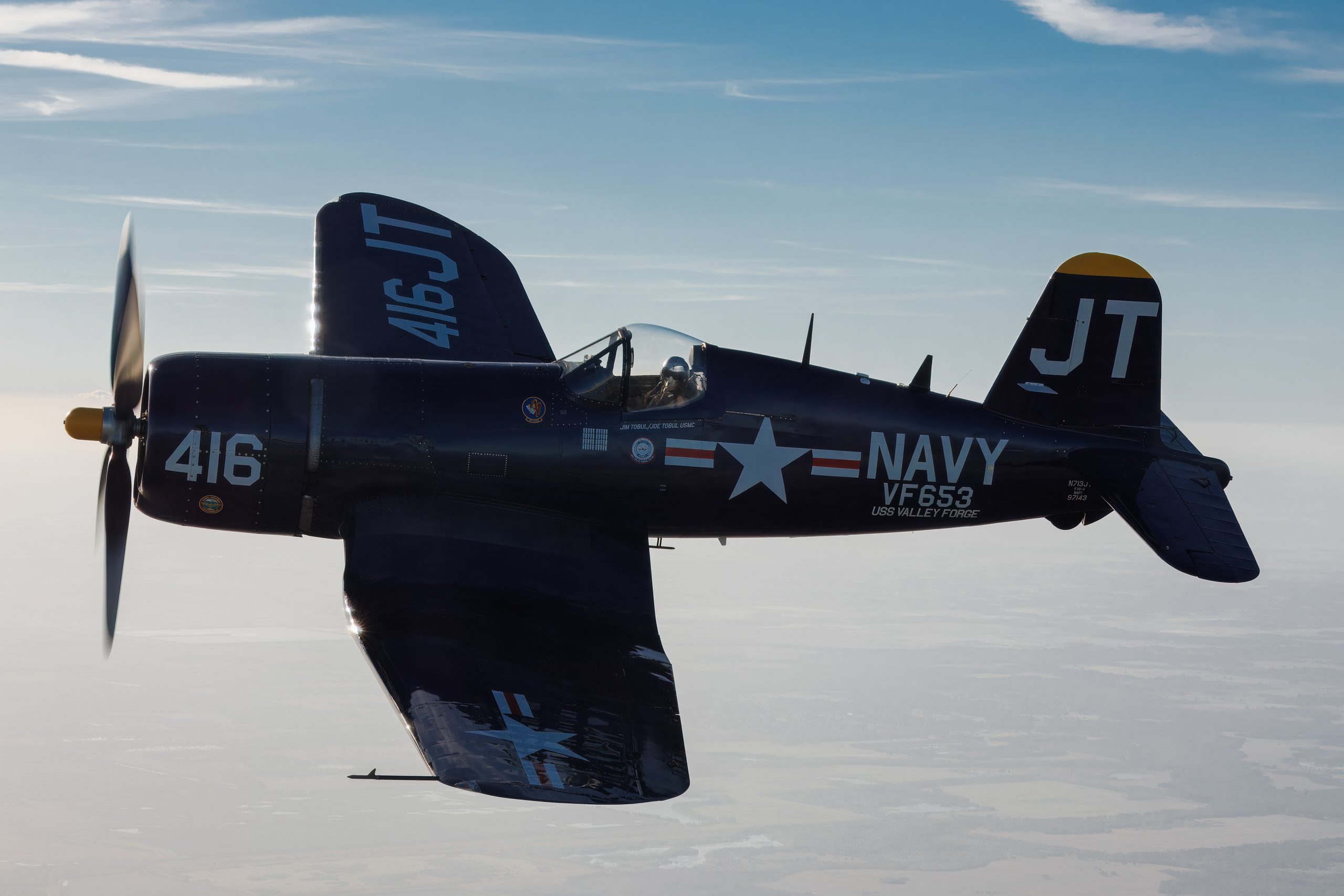
No fighter of the Second World War looks like a Corsair, and few had a stranger career. Ask an aviation artist to draw the Pacific war and the odds are the bent wing appears; ask a warbird crowd to name the sound of a radial at speed and the Corsair is the answer half of them give. It was designed for carriers and spent its great fighting year flying from jungle airstrips because it kept killing the young officers who tried to land it on ships. It was tamed by patient engineering and, in part, by the Royal Navy’s willingness to fly it anyway. And it outlived its whole generation: when newer jets swept the Pacific veterans from the decks, the Corsair went to war again in Korea, and it was still fighting, astonishingly, in 1969.
This guide covers the whole story: the design gamble around the biggest propeller ever fitted to a fighter, the Ensign Eliminator years and the fixes, the Solomons campaign and the aces, the British and Commonwealth Corsairs, Korea and the last piston battles, and where to see and photograph the survivors. Figures are checked against the Smithsonian, the US Navy’s historians and the museums that keep the survivors, and contested numbers are flagged as such.
What this guide covers
- Origins: four hundred miles an hour in 1940
- The bent wing: why the Corsair looks like that
- The Ensign Eliminator: taming the Corsair
- Land-based and lethal: the Solomons
- The Fleet Air Arm’s Corsair
- Twelve thousand bent wings
- Korea: the Corsair’s second war
- F4U-4 Corsair specifications
- Suez, the Football War and the last piston dogfights
- Survivors and where to see one
- Photographing the Corsair today
- Legacy
- Frequently asked questions
A note on names before the story starts. To the US Navy it was the F4U; to Goodyear’s production lines the FG; to Brewster’s, briefly, the F3A; to Britain the Corsair I through IV; and to its pilots, over the years, the Hog, the Hose Nose, the U-Bird and the Bent-Wing Bird. All of them describe the same essential machine, and this guide uses Corsair for all of it except where a specific maker matters.
Origins: four hundred miles an hour in 1940
The Corsair began with a 1938 US Navy requirement for a new carrier fighter and a design team at Vought led by chief designer Rex Beisel. Their answer was built around the most powerful aero engine America had, the eighteen-cylinder Pratt & Whitney R-2800 Double Wasp, and the logic of the design flowed entirely from feeding that engine the biggest propeller possible. Vought test pilot Lyman A. Bullard Jr took the prototype XF4U-1 into the air for the first time on 29 May 1940.
The prototype’s early life was eventful. Six weeks after the first flight it was crash-landed on a Connecticut golf course when it ran low on fuel, and was rebuilt. That autumn, on 1 October 1940, it made the flight that built the legend: a dash between Stratford and Hartford at an average ground speed of 405 mph. Tradition says this made the Corsair the first single-engined American fighter past 400 mph, and Vought said so loudly; historians note the run was unofficial, measured over the ground rather than through the air, and no formal record was set. What nobody disputes is that in 1940 the Corsair was extraordinarily fast, and the US Navy ordered it into production in 1941.
The engine deserves its own sentence, because the Corsair was in a real sense the R-2800’s aeroplane. Pratt & Whitney’s eighteen-cylinder Double Wasp was the outstanding American piston engine of the war, powering the Hellcat and Thunderbolt as well, and the Corsair was designed around getting the most from it earliest. Beisel’s team, including project engineer Frank Albright and aerodynamicist Paul Baker, wrapped the smallest practical airframe around the biggest practical propeller, and every quirk that followed traces back to that single decision.
The bent wing: why the Corsair looks like that
Every distinctive thing about the Corsair follows from its propeller. To convert the R-2800’s power into thrust, Vought fitted a three-blade propeller over thirteen feet across, the largest flown on a fighter to that point, and a propeller that size needs enormous ground clearance. Straight wings would have demanded stilt-like landing gear, too fragile for carrier landings. Beisel’s solution was the inverted gull wing: bend the wing down from the root and mount short, sturdy gear at the lowest point.
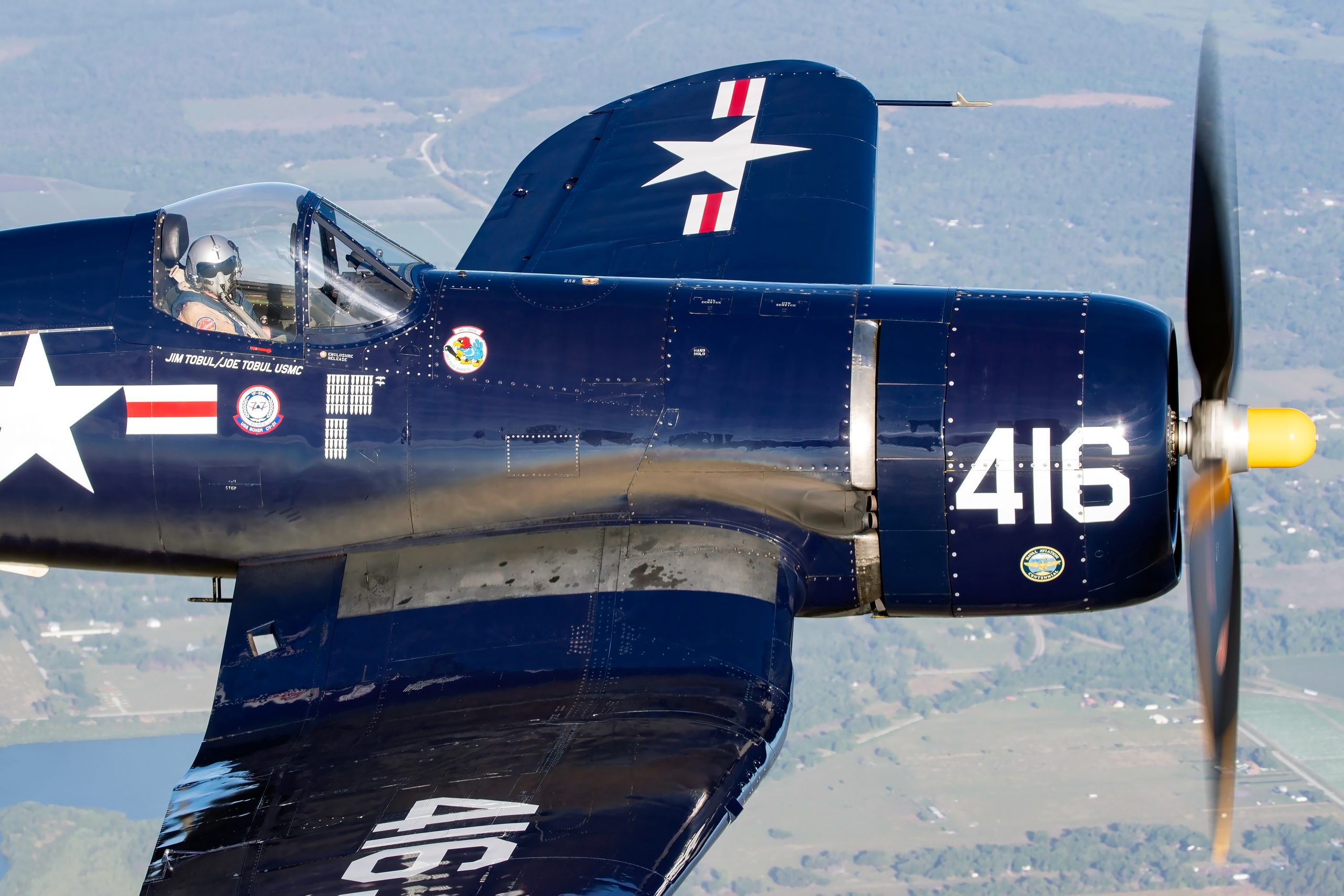
Pilots forgave the aeroplane its vices for what the wing gave back in the air: a firm, planted feel at speed and a distinctive rocking gait on the ground that made a taxiing Corsair recognisable from the far side of an airfield. The bent wing paid a second dividend: the wing met the fuselage at close to a right angle, the cleanest possible junction for drag. The gear rotated backwards to lie flat in the wing and could double as a dive brake. The price was paid in the cockpit. Production aircraft carried a big fuselage fuel tank ahead of the pilot, pushing the cockpit three feet further aft, and the resulting bonnet, the famous hose nose, meant the pilot landing a Corsair could barely see the thing he was landing on. On a runway that was survivable. On a carrier deck it very nearly ended the Corsair’s naval career.
The armament settled early and stayed. Six 0.50 inch Brownings in the outer wings became the standard fit, with cannon on some late variants, and the wing fold just outboard of the guns kept the Corsair honest about its carrier parentage even in the years it flew from land. Fuel lived in the fuselage tank that had pushed the cockpit aft and in the wings, and on the long over-water legs of the Pacific war the type routinely flew with a centreline drop tank that stretched its reach past a thousand miles.
The Ensign Eliminator: taming the Corsair
When fleet squadrons began carrier trials in 1943, the Corsair’s vices arrived together. The stiff landing gear bounced the aircraft over arresting wires like a pogo stick. At landing speeds the left wing could stall without warning and slam the fighter onto the deck. Oil from the cowl flaps spattered the windscreen until the pilot could barely see, and the long nose hid the deck and the landing signal officer at exactly the wrong moment. Young pilots died learning all this, and the fighter earned the grimmest of its nicknames: the Ensign Eliminator.
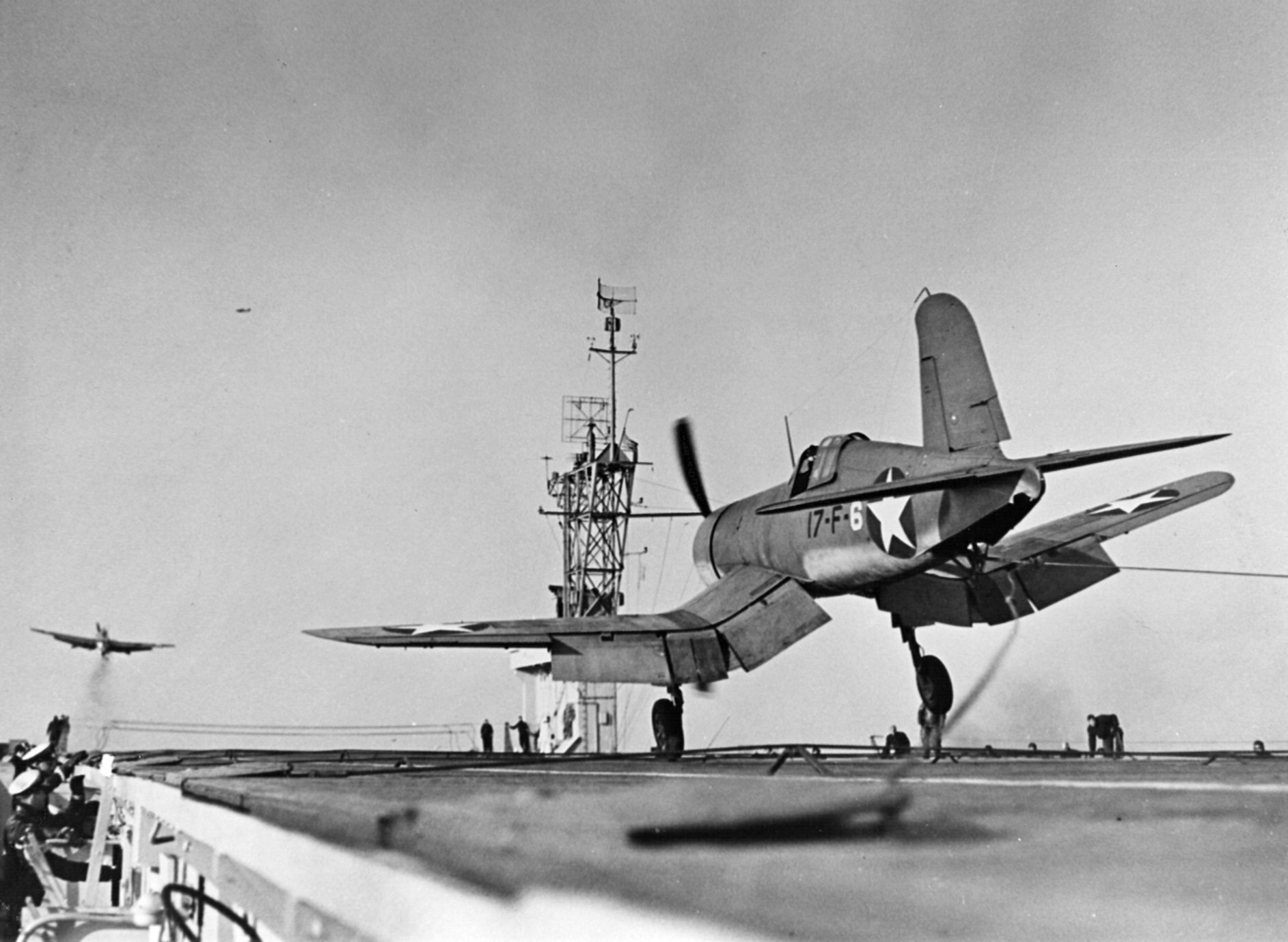
The cures were small and unglamorous. A bleed valve calmed the bouncing oleos. A six-inch stall strip on the starboard wing’s leading edge gave symmetrical warning before the snap. The offending cowl flaps were fixed shut and the panel sealed. A raised seat and a taller, bulged canopy, standard from the F4U-1A, gave the pilot back some of the view the hose nose had stolen. In the meantime the US Navy sent its Corsairs ashore to the Marines, and the type’s greatest fighting year was flown from crushed-coral island strips rather than carrier decks.
The Royal Navy, chronically short of modern fighters, took a different view: it cleared the Corsair for carrier work before the US Navy did, flying a long curving approach that kept the deck in sight around the nose until the final seconds. That approach, adapted from Seafire practice, became standard Corsair technique, and with the accumulated fixes the US Navy formally accepted the type back aboard its carriers in April 1944. By the Okinawa campaign the one-time Ensign Eliminator was flying from every fleet deck in the Pacific.
It is worth pausing on what those young pilots were actually asked to do. A 1943 carrier approach was flown at the edge of the stall, in an aircraft whose stall arrived asymmetrically and whose nose hid the deck, onto a moving runway shorter than a football pitch. The wonder is not that the Corsair killed ensigns; it is that the fixes, once found, were so small. The gap between a dangerous aeroplane and a fine one turned out to be a strip of metal six inches long and a valve, which is as neat a lesson in engineering humility as the war produced.
Land-based and lethal: the Solomons
The Corsair’s combat debut came with Marine squadron VMF-124 at Guadalcanal in February 1943, and its first weeks were humbling; the escort mission of 14 February that ended with heavy American losses taught the new type’s pilots that speed unused is speed wasted. Once they learned to fight in the vertical, diving, shooting and climbing away rather than turning, the balance swung violently. Japanese pilots who tried to drag Corsairs into the low-speed turning fights that suited the Zero found their opponents simply refused, and nothing the Zero flew against dived or climbed with an R-2800.
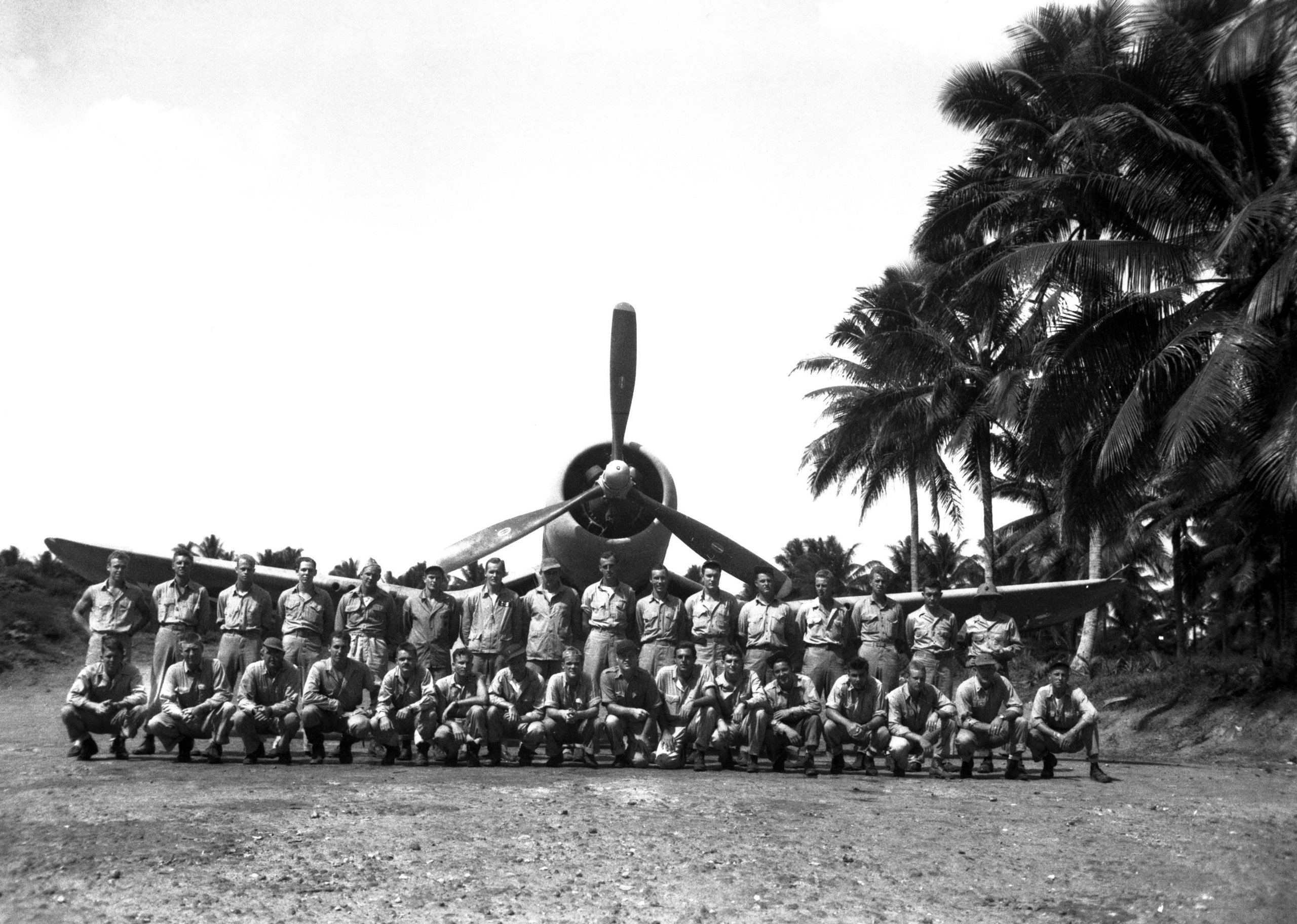
The Solomons made the Corsair’s aces. First Lieutenant Kenneth Walsh of VMF-124 became the first Corsair ace and the first awarded the Medal of Honor, for two August 1943 fights in which he attacked formations of dozens of Zeros, downing four on the second occasion before ditching; he finished the war credited with 21 victories. Major Gregory Boyington, Pappy to his young Black Sheep of VMF-214, ran his credited total to 28 before being shot down near Rabaul on 3 January 1944 and surviving twenty months as a prisoner; his total includes six earlier claims with the Flying Tigers that the record supports only in part, a caveat his legend has never much cared about.
By the end of the war Corsair pilots had claimed 2,140 aerial victories against 189 Corsairs lost in air combat, a ratio of about eleven to one. Those are wartime claims, and every air force’s claims ran high; but even discounted, the record made the point. The nickname Whistling Death, supposedly bestowed by the Japanese, appears in no Japanese source and is best enjoyed as legend.
One US Navy squadron refused to give the Corsair up at sea. VF-17, the Jolly Rogers, worked up on the type through 1943, solved its deck manners for themselves, and were rotated ashore to the Solomons anyway, where they became one of the highest-scoring squadrons of the campaign. On 11 November 1943 their land-based Corsairs made the point about carrier compatibility in the most practical way, landing aboard the carriers Bunker Hill and Essex to refuel while defending a strike force, guests proving the aircraft could have been residents all along.
The Solomons fighting also produced the Corsair’s oddest celebrity pilot. Charles Lindbergh, touring the Pacific as a civilian technical adviser in 1944, flew Corsair combat missions and demonstrated that the aircraft could lift a 4,000 lb bomb load, far beyond its book figure, adding fighter-bomber to the type’s growing list of jobs.
Walsh’s two Medal of Honor fights repay a closer look because they show the aircraft’s character exactly. On both occasions he was alone, having turned back with mechanical trouble and taken off again in a borrowed aircraft, and on both he attacked Japanese formations many times his strength, trusting the Corsair’s speed to carry him through the middle of them and out the other side. That is not courage instead of doctrine; it is courage enabled by a machine that could really refuse the enemy’s kind of fight.
The Fleet Air Arm’s Corsair
Britain’s Fleet Air Arm took 2,012 Corsairs under Lend-Lease, and squadron number 1830, formed on 1 June 1943, was the first of many to take them to sea, principally aboard the armoured carriers of the Home and Pacific Fleets. British Corsairs had their wingtips clipped by eight inches to fit below hangar deckheads, a mutilation that usefully tamed the type’s tendency to float over the wires. As described above, the FAA simply got on with deck operations while the US Navy hesitated, and its curved approach became the Corsair’s signature.
The FAA Corsair’s most famous outing came on 3 April 1944, when Corsairs flew fighter cover for Operation Tungsten, the Fleet Air Arm strike on the battleship Tirpitz in its Norwegian fjord, with further strikes through the summer. In the Pacific, British Pacific Fleet Corsairs fought through the Sakishima and Japan strikes of 1945, and a Canadian Corsair pilot flying with the FAA, Lieutenant Robert Hampton Gray, was awarded a posthumous Victoria Cross in the war’s final days. New Zealand flew the type too: the RNZAF operated between 360 and 425 Corsairs depending on the source consulted, almost entirely in the close-support role in the northern Solomons, where by 1944 there was little left in the air to fight.
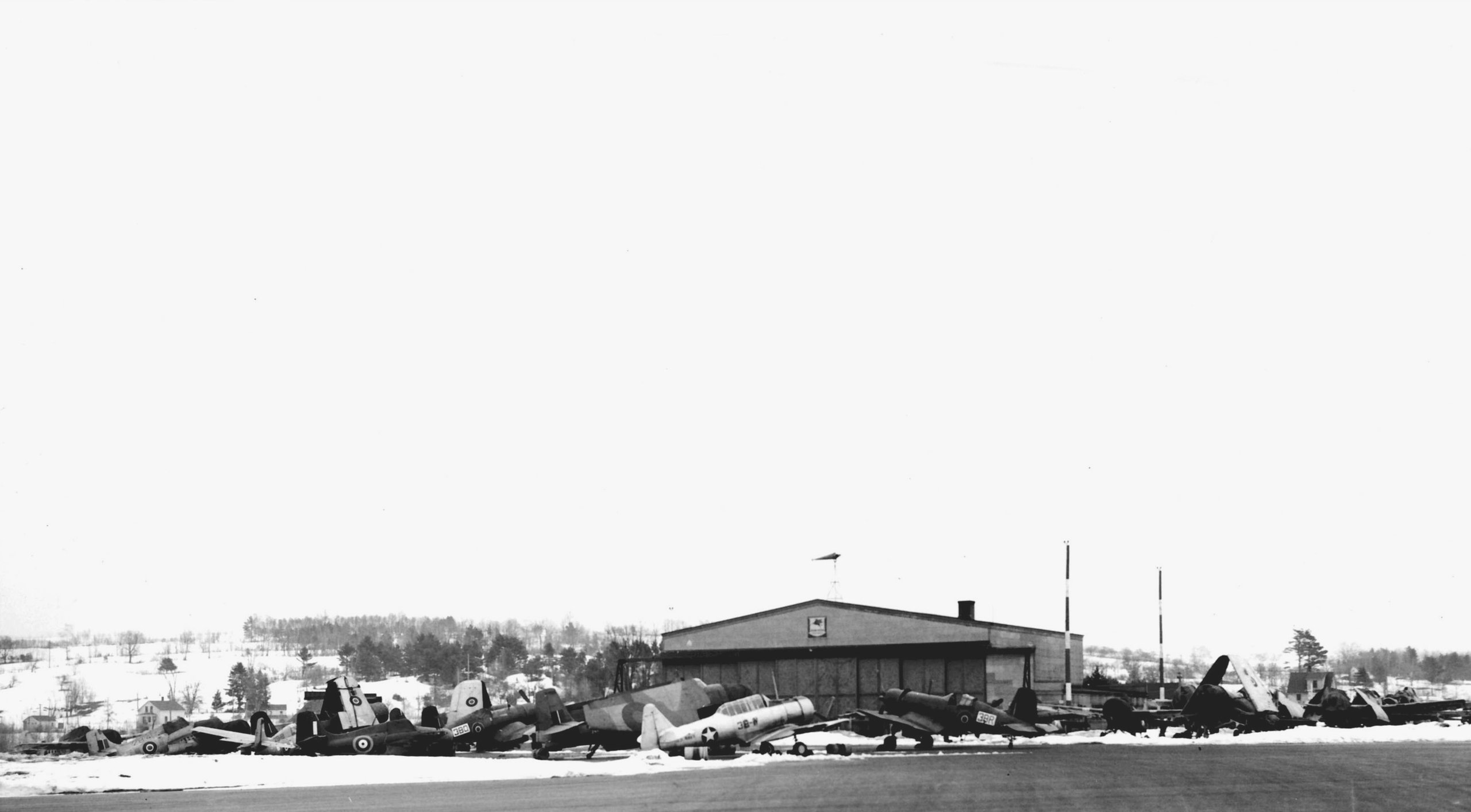
The Commonwealth story has a coda worth telling. When the war ended, Lend-Lease terms required British Corsairs to be paid for, returned or destroyed, and the Royal Navy pushed hundreds of them off its carrier decks into the sea rather than ship them home, a fate shared by aircraft across the Pacific. Every surviving Fleet Air Arm Corsair is therefore a rarity, which is part of what makes Yeovilton’s untouched KD431, described below, so remarkable.
Twelve thousand bent wings
Corsair production tells its own story about the American war economy. Vought could not build them fast enough, so Goodyear, the tyre company, built 4,007 as the FG-1 series, and Brewster added 735 as the F3A before that troubled company collapsed in 1944. Total production ran to about 12,600, with the standard references giving 12,571 and the Smithsonian 12,582, across a run that lasted from 1942 to 1953, the longest of any American piston-engined fighter.
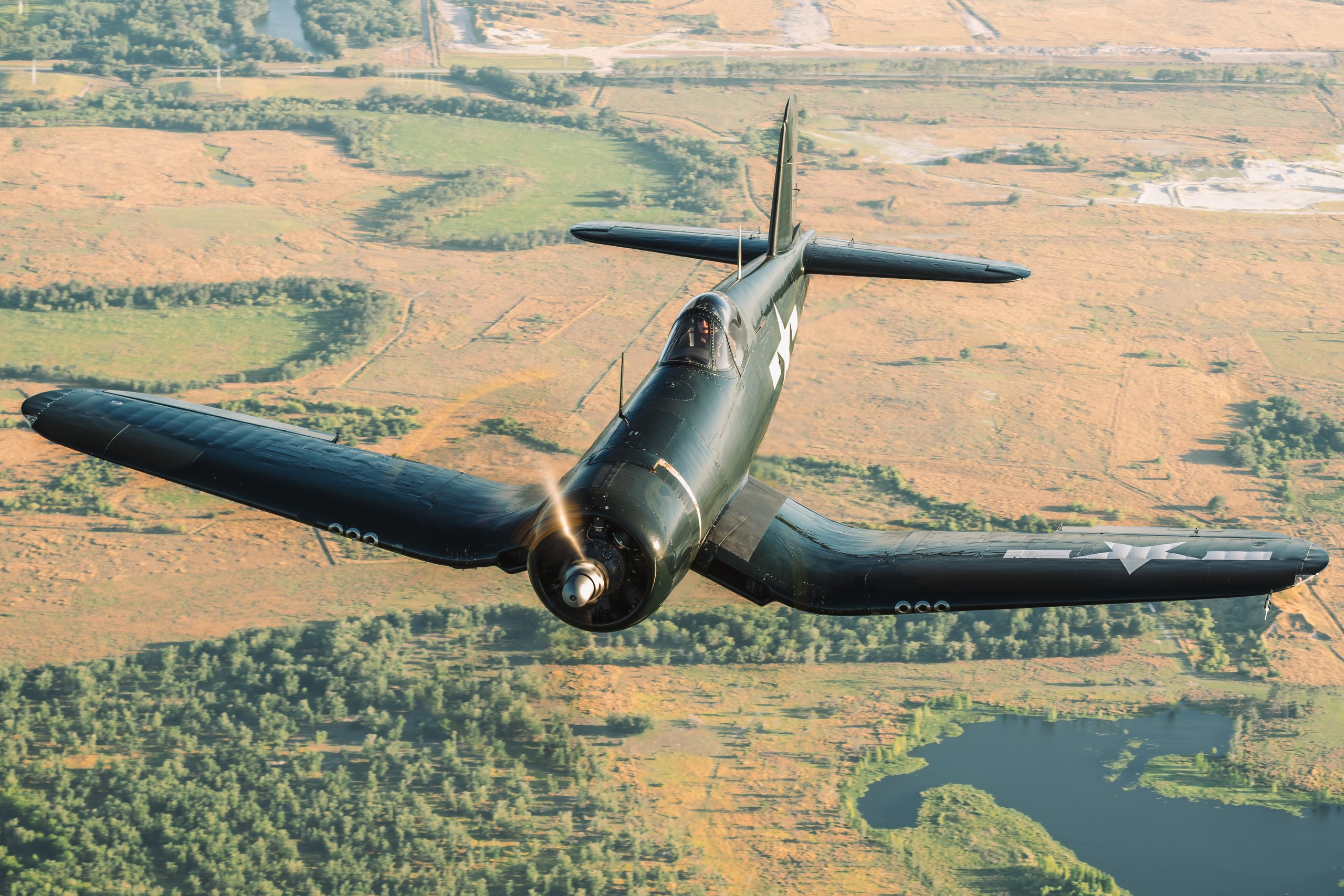
The family grew through the war and past it. The birdcage F4U-1 gave way to the raised-canopy F4U-1A and the fighter-bomber F4U-1D; the definitive wartime-designed F4U-4, with a four-blade propeller and 2,100 horsepower, arrived in 1944 and fought its real war in Korea. Post-war came the F4U-5 with its night-fighter variants, the armoured AU-1 built for low-level attack, and finally the F4U-7 for the French Navy, the last of the line, delivered in 1952 ten years after the first production aircraft.
Production numbers of that size also explain the type’s post-war spread. Surplus Corsairs equipped the navies and air arms of France, Argentina, Honduras and El Salvador, and fed the civilian market that eventually became today’s warbird fleet; the racers of the postwar Thompson Trophy era included famously modified Corsairs, and Goodyear’s enormous F2G racers remain grail airframes for collectors. A fighter built in the thousands could afford to scatter, and the scattering is why so many survive.
Korea: the Corsair’s second war
Five years after V-J Day the Corsair went back to war, and flew more Korean combat than any other Navy or Marine type in the war’s first years. Jets owned the high sky; the Corsair owned the mud. F4U-4s and armoured AU-1s flew close support for the retreating and then advancing armies, night-fighter F4U-5Ns hunted the slow northern raiders the troops called Bedcheck Charlie, and one Corsair even killed a jet: Captain Jesse Folmar of VMF-312 shot down a MiG-15 in September 1952.
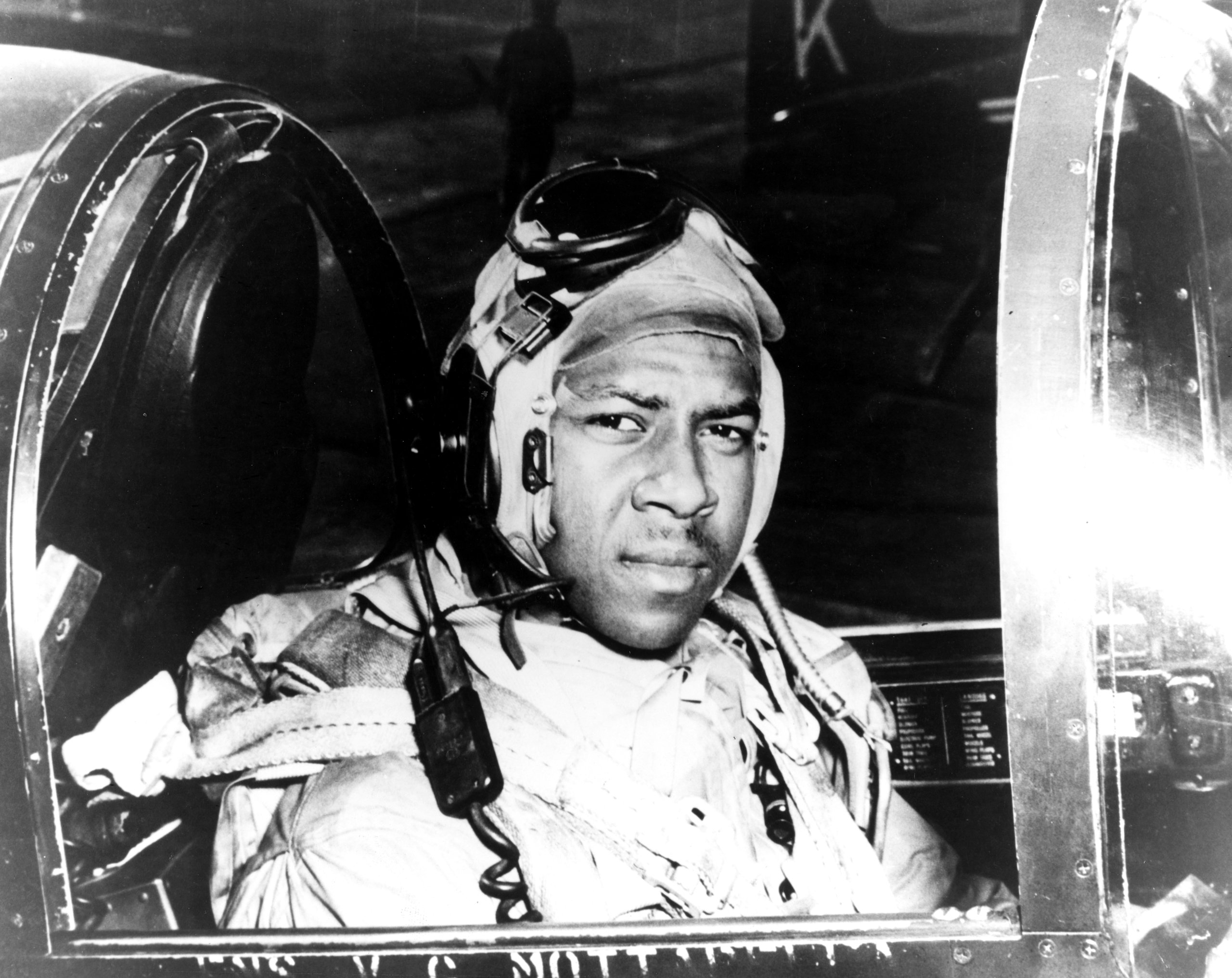
Two Corsair stories from Korea outrank all the statistics. On 4 December 1950, near the Chosin Reservoir, Ensign Jesse Brown of USS Leyte’s VF-32, the US Navy’s first Black naval aviator, was brought down by ground fire behind enemy lines. His wingman, Lieutenant (junior grade) Thomas Hudner, deliberately crash-landed his own Corsair alongside in the snow and fought to free him until dark; Brown died in the wreckage, and Hudner received the Medal of Honor from President Truman the following April. And in the summer of 1953, Lieutenant Guy Bordelon, flying a night-fighter F4U-5N named Annie Mo from a shore base, shot down five night raiders in under three weeks to become the US Navy’s only ace of the Korean War, and the last American ace in a piston-engined aircraft.
The Korean workload also explains the late variants. The F4U-5’s turbo-supercharged engine and the night-fighter -5N and winterised -5NL were built for exactly the war Korea turned out to be, and the AU-1, with extra armour and its supercharging optimised for low level, was a ground-attack aircraft that had given up pretending to be a fighter at all. The Corsair ended its American service not as a relic but as a specialist, doing a job the early jets could not yet do as well.
F4U-4 Corsair specifications
| Specification | F4U-4 |
|---|---|
| Wingspan | 41 ft 0 in (12.5 m) |
| Length | 33 ft 8 in (10.3 m) |
| Height | 14 ft 9 in (4.5 m) |
| Engine | Pratt & Whitney R-2800-18W Double Wasp, 2,100 hp, around 2,450 hp with water injection |
| Maximum speed | 446 to 448 mph (718 to 721 km/h), sources varying by a couple of mph |
| Service ceiling | 41,500 ft (12,650 m) |
| Range | Around 1,005 miles (1,617 km) |
| Armament | Six 0.50 in machine guns (four 20 mm cannon on the -4B); eight 5 in rockets; up to 2,000 lb of bombs |
| Number built (all versions) | 12,571 to 12,582 depending on source, 1942 to 1953, the longest US piston fighter production run |
Set the F4U-4’s numbers beside the fighters it fought and the Corsair’s Korean longevity explains itself: it carried a fighter’s speed and a light bomber’s load, and no jet of 1950 could loiter over troops the way a Corsair could. The airframe had grown from 2,000 to 2,450 horsepower across its life without changing its essential shape, which is the definition of a design with room in it.
Numbers aside, the specification table hides the quality that pilots actually praised: honesty at high speed. The Corsair dived hard, held its ailerons where other fighters’ froze, and delivered its guns from the fast slashing attacks its doctrine demanded. It was never a turning fighter and never needed to be; it imposed its own kind of fight, which is the truest thing a combat aircraft can do.
Suez, the Football War and the last piston dogfights
The Corsair refused to retire. French Navy F4U-7s flew strikes in the 1956 Suez operation and fought on into the Algerian war. In Central America, Honduras and El Salvador both flew Corsairs into the late 1960s, and when the two countries fought the brief Football War in July 1969, Honduran Captain Fernando Soto, flying a Corsair, shot down three Salvadoran aircraft, two Mustangs and a Goodyear Corsair, in the last air combat ever fought between piston-engined fighters. Honduras kept its Corsairs in service until 1979, the last front-line Corsairs anywhere, with individual aircraft flying on into the early 1980s.
France wrung the last drops from the type. The Aeronavale’s F4U-7s, the newest Corsairs in the world, flew strikes during the 1956 Suez intervention, dropping twenty-five tons of bombs, and went on to fly combat over Algeria into the early 1960s, giving the Corsair a combat career that touched four decades from first to last.
Survivors and where to see one
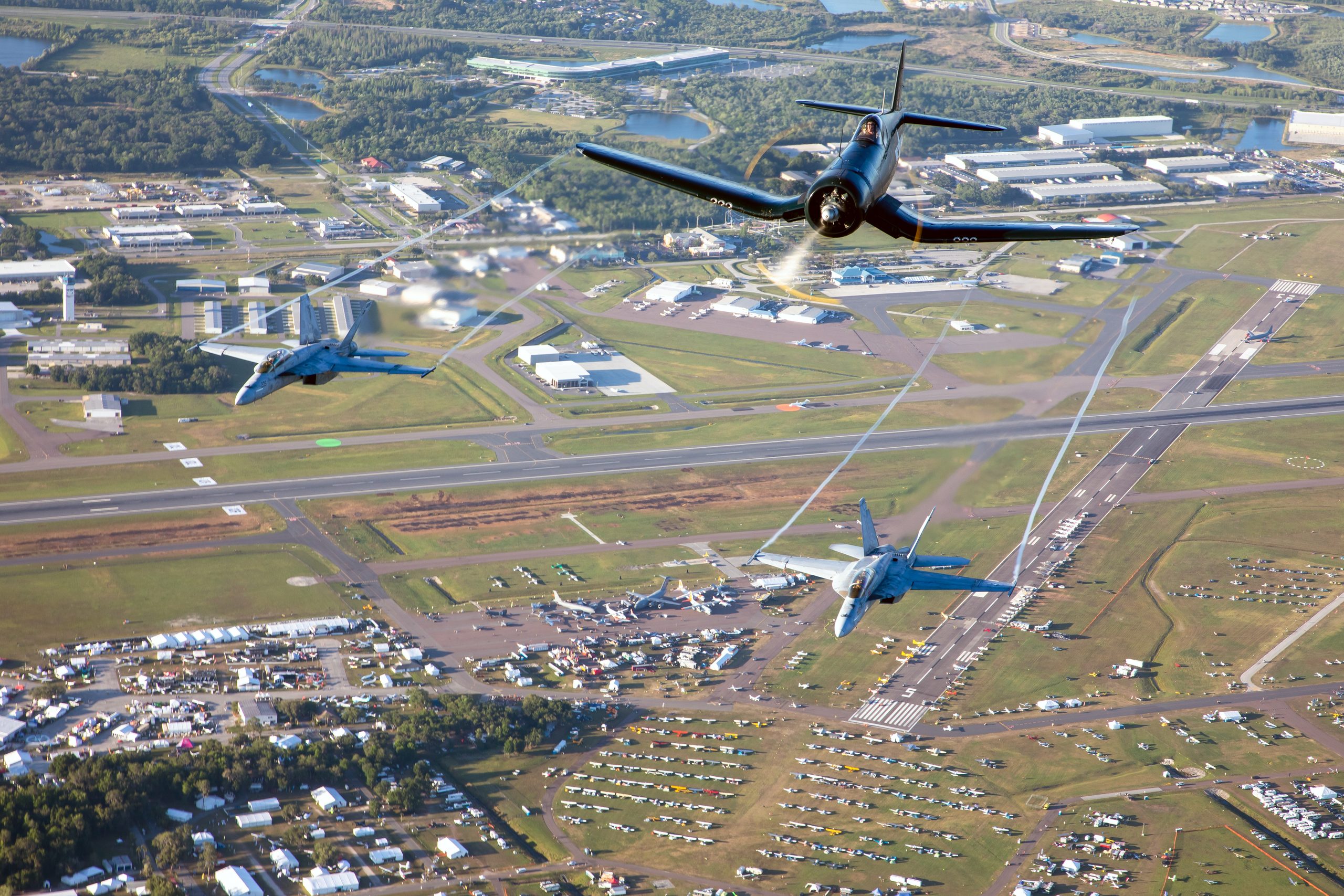
The Corsair survives in numbers most warbirds can only envy: well over a hundred airframes exist, and around 45 to 50 are airworthy worldwide, making it one of the most numerous flying fighters of the Second World War. Airshow audiences across America see Corsairs every season, often flying alongside the US Navy’s current jets in heritage formations, and Europe has flyers in Britain, France and Germany.
Britain holds a survivor of a different kind. At the Fleet Air Arm Museum at Yeovilton stands KD431, a Goodyear-built Corsair shipped to Britain in 1944, and between 2000 and 2005 the museum’s conservators did something radical: they removed its 1963 repaint layer by layer to reveal the original 1944 factory finish beneath, wartime scratches, stencils and all. The result is probably the most original Corsair in existence, a genuine time capsule, and the project is documented in curator David Morris’s book on the aircraft. For a flying British Corsair, The Fighter Collection’s FG-1D at Duxford carries the flag.
The American survivor list carries the pedigree airframes. The Smithsonian’s F4U-1D hangs at the Udvar-Hazy Center; the National Naval Aviation Museum at Pensacola holds an early birdcage F4U-1; and the Planes of Fame museum in California flies an F4U-1A that is a genuine Pacific combat veteran, one of the most historic warbirds airworthy anywhere. Between the museum queens, the working airshow fleet and the racers, the Corsair population is healthy enough that most enthusiasts will see one fly without crossing an ocean, which for an eighty-year-old fighter is a kind of immortality.
Photographing the Corsair today
The Corsair may be the most photogenic piston fighter ever built, and the frames in this article, flown air to air with an F4U-4 and a Goodyear FG-1D, show why the type rewards the camera ship: that wing reads from every angle, and the deep blue US Navy schemes turn golden light into something close to theatre.
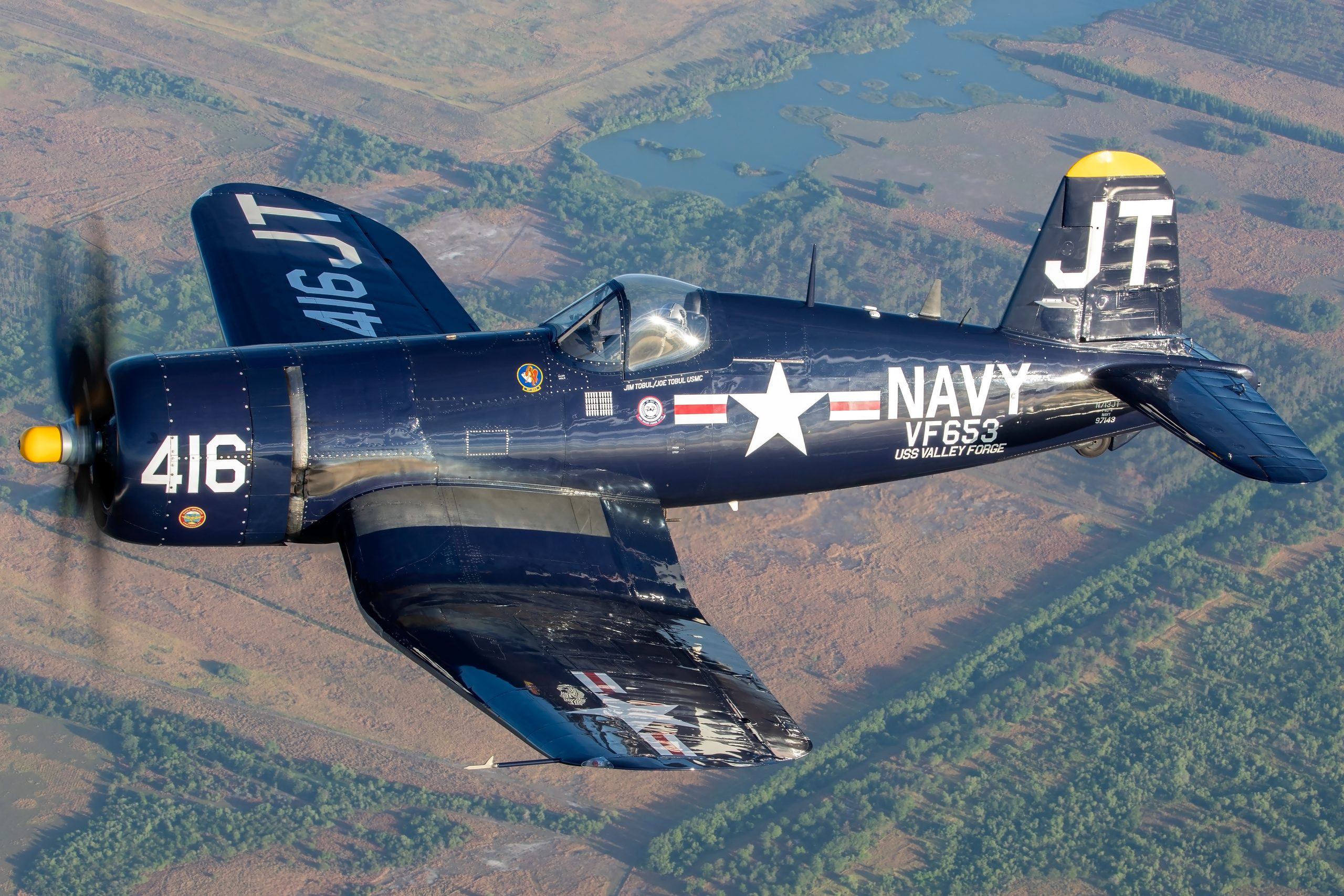
The craft notes are the familiar radial-warbird set with one Corsair-specific addition. Shutter speed matters even more than usual, because that thirteen-foot propeller turns relatively slowly and freezes at speeds that would blur a fighter’s smaller disc; 1/200 second or below keeps it alive, as our guide to propeller blur and shutter speed explains. Expose for the dark blue and watch the highlights on the wing bend. And from the ground, the head-on taxi view, wings spread from the fold, is the shot no other fighter offers; our guide to warbird photography covers working the airshow environment.
For picture researchers and publishers, the Corsair sits in the sweet spot of demand and supply described throughout our buyer guides: constant editorial appetite, from Pacific-war histories to Korean War anniversaries to the enduring Black Sheep legend, met by one of the healthiest survivor populations in the warbird world. The frames in this article, an F4U-4 and an FG-1D flown air to air in Florida light, are exactly the modern colour material that pairs with the wartime record, and the pairing rules from our B-17 buyer’s guide apply to the Corsair unchanged: period images for events and people, modern air-to-air for the machine, captions that never blur the two.
Legacy
The Corsair’s afterlife has been as loud as its career. A generation of Americans met it through the television series Baa Baa Black Sheep, which ran from 1976 to 1978 with Robert Conrad as Boyington and real Corsairs in the flying sequences, and which its subject genially dismissed as Hollywood hokum. Modellers, artists and film-makers have never let the shape go; and the US Navy itself still trades on the lineage, pairing Corsairs with current fighters in heritage flights at shows across the country.
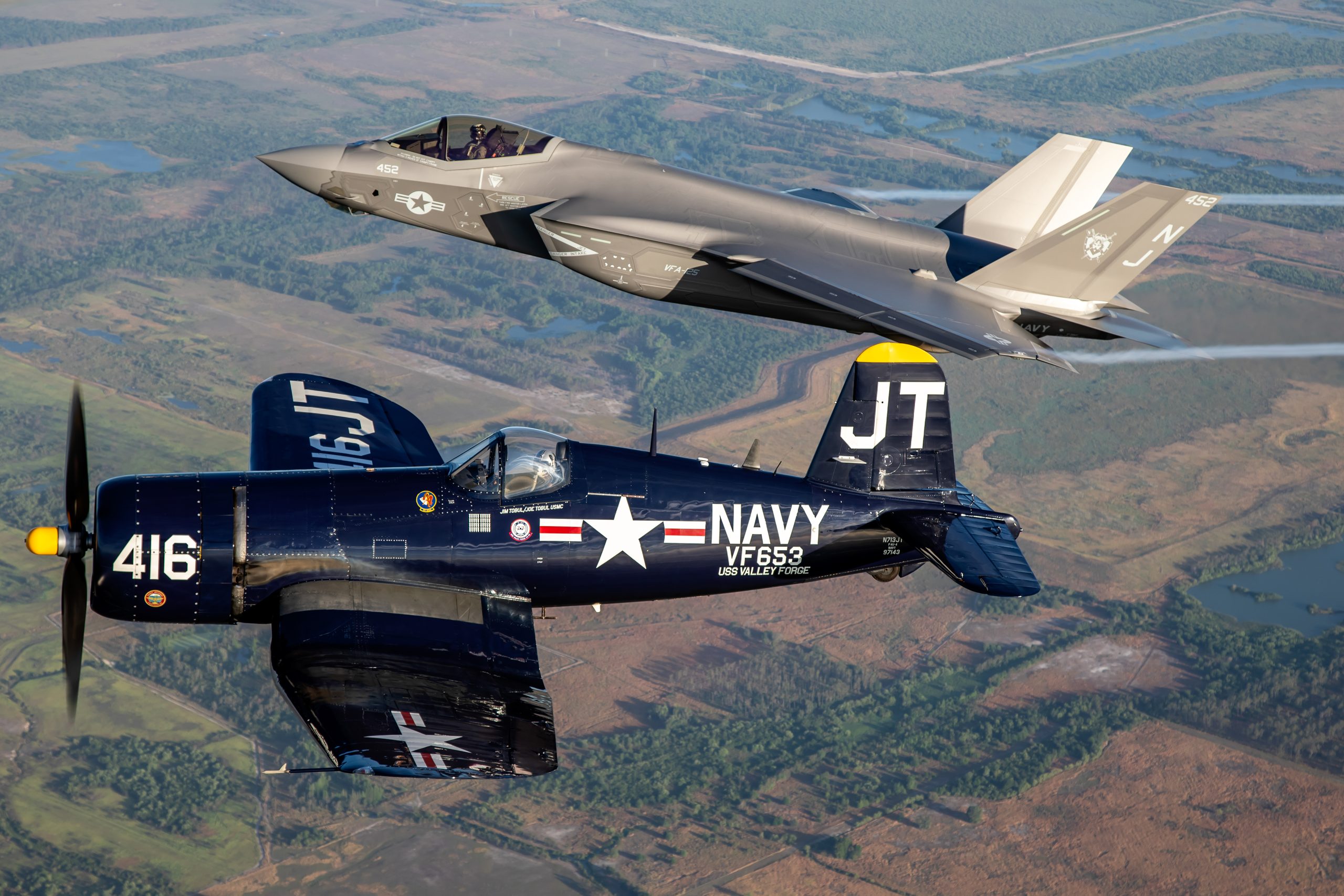
The deeper legacy is the design lesson. The Corsair was a difficult, dangerous aeroplane that became a great one because its makers and users kept fixing it instead of abandoning it: a bleed valve, a stall strip, a raised seat, a curved approach. Persistence turned the Ensign Eliminator into the fighter that flew combat across three decades, and there are worse morals for an engineering story than that.
And the type still earns its keep commercially: Corsair imagery remains in steady demand for publishing, exhibitions and model art, the same buyer market described in our aviation picture research guide, and fresh air-to-air coverage like the frames in this article is how that demand gets met. An aircraft this photographed, this modelled and this filmed does not fade; it simply changes custodians, from navies to museums to the photographers and publishers who keep putting it in front of new eyes.
Frequently asked questions
Why does the Corsair have a bent wing?
To fit its enormous propeller, over thirteen feet across, without stilt-like landing gear. The inverted gull wing dips down from the root so short, sturdy gear could reach the ground while the propeller cleared it, and the near-perpendicular wing-root junction reduced drag as a bonus.
Why was the Corsair called the Ensign Eliminator?
Because early carrier landings killed inexperienced pilots. The gear bounced the aircraft over the arresting wires, the left wing stalled without warning at approach speed, oil misted the windscreen and the long nose hid the deck. A bleed valve, a stall strip, sealed cowl flaps, a raised seat and a curved approach fixed it, and the US Navy accepted it back aboard carriers in April 1944.
Was the Corsair the first American fighter to fly 400 mph?
That is the traditional claim, based on a 405 mph average between Stratford and Hartford on 1 October 1940. Historians note it was an unofficial ground-speed figure rather than a record, so it is best stated as Vought’s claim; either way the Corsair was exceptionally fast for 1940.
What was the Corsair’s kill ratio?
Wartime records credit Corsair pilots with 2,140 aerial victories against 189 Corsairs lost in air combat, about eleven to one. Those are claims rather than audited enemy losses, and all air forces over-claimed, but even discounted the record was remarkably one-sided.
Who were the most famous Corsair pilots?
Gregory Pappy Boyington of the VMF-214 Black Sheep, credited with 28 victories and awarded the Medal of Honor after surviving twenty months as a prisoner; Kenneth Walsh, the first Corsair ace and Medal of Honor recipient with 21 victories; and in Korea, Thomas Hudner, who crash-landed beside his downed wingman Jesse Brown at Chosin, and Guy Bordelon, the Navy’s only Korean War ace.
Did Britain use the Corsair?
Yes, the Fleet Air Arm took 2,012 under Lend-Lease, clipped their wingtips to fit below carrier hangar deckheads, and cleared them for deck operations before the US Navy did, using a curved landing approach. British Corsairs covered the April 1944 Tirpitz strike and fought with the British Pacific Fleet to the war’s end.
How many Corsairs were built?
About 12,600 between 1942 and 1953, the longest production run of any American piston-engined fighter: standard references give 12,571 and the Smithsonian 12,582. Vought built 7,829, Goodyear added 4,007 as the FG-1 series and Brewster 735.
What did the Corsair do in Korea?
It was the workhorse of Navy and Marine ground attack, flew night interception against slow raiders, and even downed a MiG-15. Korea produced the Corsair’s most moving story, Jesse Brown and Thomas Hudner at Chosin in December 1950, and its last ace, Guy Bordelon, in 1953.
When was the Corsair’s last air combat?
July 1969, in the Football War between Honduras and El Salvador, when Honduran Captain Fernando Soto downed three Salvadoran aircraft in a Corsair, the last dogfights ever fought between piston-engined fighters. Honduras retired its Corsairs in 1979.
How fast was the Corsair?
The definitive F4U-4 managed around 446 to 448 mph at altitude on 2,100 horsepower, with roughly 2,450 available with water injection. Wartime F4U-1 variants were around 20 mph slower.
How many Corsairs still fly?
Around 45 to 50 are airworthy worldwide of well over a hundred surviving airframes, making the Corsair one of the most numerous flying Second World War fighters. They are regulars on the American airshow circuit, often in heritage formations with current US Navy jets.
Where can I see a Corsair in the UK?
The Fleet Air Arm Museum at Yeovilton displays KD431, a 1944 Goodyear-built Corsair whose 1960s repaint was painstakingly removed to reveal the original factory finish, making it probably the most original Corsair in existence. The Fighter Collection at Duxford operates an airworthy FG-1D.
