Twelve B-25s came down to five hundred feet over the Bismarck Sea on the morning of 3 March 1943, and broke formation. The convoy below them was already scattering. Each pilot picked his own ship, held the nose on it, fired the eight machine guns in the nose and the fuselage sides to beat down the anti-aircraft fire, and dropped five hundred pound bombs. Thirty-seven bombs went down. Seventeen were claimed as direct hits.
Those twelve aeroplanes had not left the factory like that. They were standard medium bombers, built to drop bombs from eight to fourteen thousand feet at railway yards and supply dumps behind an infantry battle, and a service command workshop had cut the glass nose off them and filled it with guns.
The B-25 Mitchell was bought off a drawing board, built in one factory in California and another in Kansas, and then taken apart and rebuilt by the people who had to fly it. The Army eventually gave in and built it their way.
What is on this page
- Bought without a prototype
- The kink in the wing
- Inglewood and Kansas City
- The men who cut the nose off
- The morning of 3 March
- Counting the convoy
- A field gun in the nose, loaded by hand
- Where the cannon was used
- The guns that tore the fuselage
- The cabin heater that cost a co-pilot
- From a field conversion to the production line
- The Mitchell groups in Italy
- Cassino: the abbey and the town
- Operation BINGO, 6 November 1944
- No. 2 Group at La Caine
- Five aeroplanes to Russia, and the wing in China
- The Marines called it the PBJ
- The odd jobs the Marines gave it
- The same horsepower it started with
- Inside the aeroplane
- The one that hit the Empire State Building
- The survivors
- Frequently asked questions
- Sources and further reading
B-25 Mitchell: key facts
- Type: twin-engined medium bomber, built by North American Aviation.
- Ordered: contract signed September 1939.
- First flight: August 1940, on the AAF pilot training manual’s account.
- Production began: February 1941.
- Total accepted: 9,816 aircraft, June 1940 to August 1945.
- Factories: Inglewood in California and Kansas City in Kansas.
- Engines: two Wright Cyclone R-2600 radials, 1,700 hp each.
- Maximum speed: 285 mph at a combat weight of 33,500 lb in 1945.
- Combat range: 1,200 miles with a 3,200 lb bomb load in 1945.
- Crew: five as designed, commonly six.
- Heaviest gun fitted: a 75 mm cannon, on the B-25G and B-25H.
- Peak US Army inventory: 2,656 aircraft in July 1944.
- Navy and Marine Corps designation: PBJ.
- Last PBJ out of service: 31 January 1946.
Bought without a prototype
On 25 January 1939 the US Army asked for medium bomber designs, according to the Army Air Forces’ own pilot training manual for the type. Forty days later North American had a design. On 20 September 1939, nineteen days after Hitler marched into Poland, the Army signed a contract for a hundred and forty-eight Mitchell bombers, which the manual calls one of the largest orders written up to that time.
There was no prototype. The official history of the Army Air Forces: “North American had initiated design on the B-25 in February 1938 and production began in February 1941, without benefit of an experimental prototype plane.” The same page records that the Air Corps did exactly the same thing to Martin, buying the B-26 Marauder off the drawing board in 1939 with a production contract signed that September.
“Daughter of a slide rule, with neither wind-tunnel tests nor prototypes to study, the performance of the B-25 was a series of figures on an engineer’s drawing board,” the manual says. Inside two months the mock-up was approved. In August 1940 the first aeroplane flew, and the manual says its performance was found to be better than the claims its designers had made for it.
Two other figures circulate for the same two events. The request is often dated 11 March 1939 rather than 25 January, and the contract is usually given as a hundred and eighty-four aircraft rather than a hundred and forty-eight. Neither could be traced to a source here, and a hundred and forty-eight against a hundred and eighty-four looks like a transposition in one of the two.
As late as October 1938 the War Department General Staff held that the infantry division was the basic combat element by which battles are won, and the official history traces from that emphasis the shape of the A-20, the A-26, the B-25 and the B-26. A pure bombardment type, the medium bomber was meant to work at eight to fourteen thousand feet against depots, fortified positions and railway yards along or behind the battle line. Nothing in that description involves five hundred feet, a ship, or eight machine guns.
Nor does it involve a carrier deck. Sixteen Mitchells were lifted aboard the USS Hornet at Alameda on 1 April 1942, and Halsey ordered them off at 0800 on the 18th, about ten hours earlier than planned, after a Japanese picket vessel was sighted.
The kink in the wing
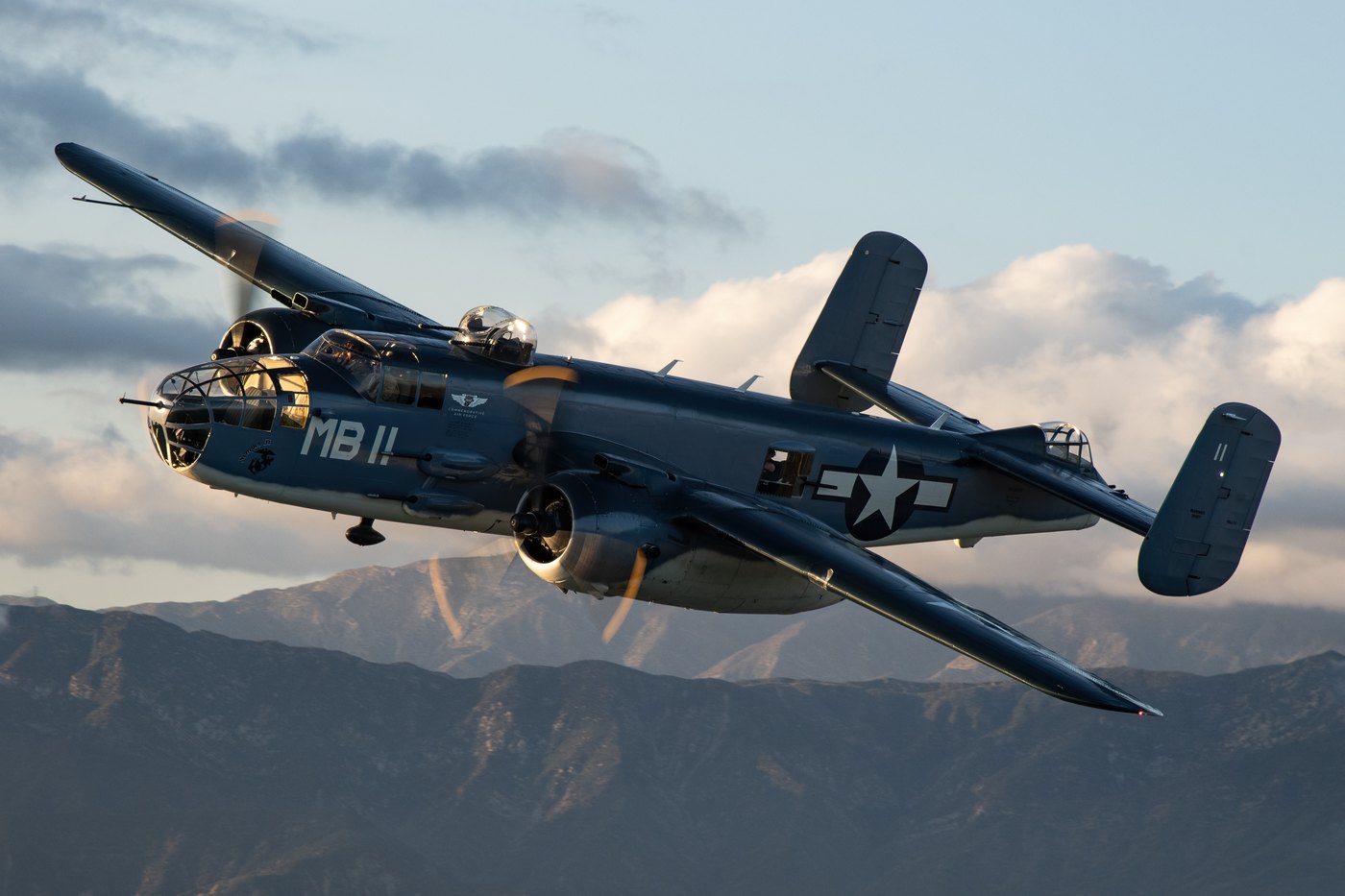
Head on, a Mitchell’s wing does something odd. The inner panels, from the fuselage out to the engines, angle upwards; the outer panels, from the engines to the tips, run flat or slightly down. The training manual puts it: “Positive dihedral in the inner and negative dihedral in the outer wing panels give the plane a gull-wing appearance, while adding control and maneuverability.”
The story usually told is that early aircraft wallowed in a Dutch roll, and that the outer panels were flattened to cure it after the first nine airframes. The two are not necessarily at odds. A fix for a rolling and yawing wallow would reach a pupil pilot as improved control.
“Red-lined at 340 mph, cruising easily at 200 mph, the Mitchell, when emergencies have arisen, has exceeded 340 mph, with no disastrous effects,” the manual says, and then: “Its low landing speed has been a boon to flyers who have had to operate from jungle strips and airfields blasted from mountain sides.” The official history says the B-25 “ranked consistently as a favorite among AAF pilots”. Its opposite number, the Marauder, was promptly dubbed the Widow Maker and the Flying Prostitute.
Inglewood and Kansas City
Between June 1940 and August 1945 the Army Air Forces accepted 9,816 B-25s from the factories, on the count in the Army Air Forces Statistical Digest. The official history gives the same figure in a sentence: “In all, the AAF accepted 9,816 B-25’s and 5,157 B-26’s; a large number of the B-25’s accepted were intended for British and Russian use.”
North American built Mitchells at Inglewood in California, where the design had been drawn, and at a second factory at Kansas City in Kansas. Of those, 3,208 were accepted at Inglewood and 6,608 at Kansas City.
Inglewood built every one of the 171 aircraft accepted in 1941 and was still the bigger plant in 1942. By 1944 it was down to 665 against Kansas City’s 3,012, and in 1945 it built none at all. Accepted between January and August 1945, the last 1,460 Mitchells of the war all came out of Kansas City. Inglewood built Mustangs and Texans instead. Its wartime total across every type was 16,447 aircraft, of which the Mitchell was under a fifth.
Army stocks peaked at 2,656 aircraft in July 1944, the same month the Army Air Forces peaked at 79,908 aircraft of all types. From January 1944 onwards there were about as many Mitchell groups in the AAF as Marauder groups. Production stopped shortly after the Japanese surrender.
| Year | Accepted at Inglewood | Accepted at Kansas City | Accepted that year |
|---|---|---|---|
| 1940 | 0 | 0 | 0 |
| 1941 | 171 | 0 | 171 |
| 1942 | 1,119 | 435 | 1,554 |
| 1943 | 1,253 | 1,701 | 2,954 |
| 1944 | 665 | 3,012 | 3,677 |
| 1945, January to August | 0 | 1,460 | 1,460 |
| Total | 3,208 | 6,608 | 9,816 |
The men who cut the nose off
Captain Paul I. Gunn took command of the first American air transport unit in Australia on 4 February 1942. Gunn is, where the official history introduces him, “formerly manager of the Philippine Airlines and as ‘Pappy’ Gunn already a legendary figure in the Southwest Pacific”, and in February 1942 he was running an outfit of two old B-18s, a C-39 and five new C-53s out of Archerfield near Brisbane.
The legend has Gunn personally inventing the gun nose. The official history does not. Its account of the aeroplane that went to the Bismarck Sea reads: “This was the plane that the ‘gadgeteers’ of the service command, with Kenney’s encouragement and the advice of Major Gunn and Jack Fox, representative in Australia of the North American Aviation company, had modified for strafing.”
Jack Fox is the man almost always left out. He was the manufacturer’s representative in theatre, on the spot, advising an American service command on how to cut up his employer’s aeroplanes. The work itself was a depot programme that Gunn drove and advised on, not a one-man invention.
Off came the lower turret and the tail gun. On went forward-firing machine guns until four bristled from the nose and four more from blisters on the fuselage sides, eight forward-firing guns in all, with two more in the upper turret. For low work the bomb racks took sixty small fragmentation bombs together with six 100 pound demolition bombs. The bombardier went, and a co-pilot took his place, which cut the crew to three. The result was slower and less handy than the A-20 it worked alongside, and the official history says why that did not matter: “in attacks at 150 feet of altitude maneuverability counted for little”.
The 90th Squadron of the 3rd Bombardment Group got the experimental aeroplane, a B-25C1, and it passed its tests in December 1942. By April 1943 about thirty B-25Cs had been converted.
The morning of 3 March
The squadron practised on an old wreck lying off Port Moresby. They tried skip bombing, the technique the battle is remembered for, and gave it up. “Experiments with skip bombing were soon abandoned for direct attack on the target, a reference point on the nose of the plane serving as a bombsight,” the official history says. The bombs were armed with modified delayed-action fuzes. Two aircraft were damaged by flying debris off the hulk and a third was lost when it flew into the wreck’s mast.
Shortly after midnight on 1 March 1943 the Japanese convoy left Rabaul, carrying the 51st Infantry Division to Lae: sixteen vessels, eight destroyers, seven transports and the special service vessel Nojima. Air cover was to be about forty naval and sixty army aircraft on a fixed schedule. Allied intelligence had been reporting troop movements towards Lae since 19 February.
On 1 March a B-24 found fourteen ships under Zero escort about forty miles north-west of Ubili at around three in the afternoon, and the weather kept everything else on the ground. On 2 March B-17s sank the transport Kyokusei Maru; about 850 men were taken off her by two destroyers, run into Lae overnight and the destroyers rejoined the convoy next morning.
RAAF Beauforts went in with torpedoes on the morning of 3 March and hit nothing. By half past nine the main force was assembled over Cape Ward Hunt. Thirteen Beaufighters attacked in line abreast at 220 knots, thirteen B-17s bombed from above while they did it, and thirteen B-25s came in behind them for a conventional medium-altitude attack. Then came the twelve strafers of the 90th Squadron, in what the official history calls “probably the most successful attack of all”. Twelve American A-20s claimed eleven direct hits after them. Six more B-25s at the end of the sequence reported four more.
The morning cost four aircraft: three P-38s out of the twenty-eight flying cover, and a B-17 flown by Lieutenant Woodrow W. Moore, seven of whose crew were strafed in their parachutes.
The afternoon was messier. Cloud over the ranges stopped every Beaufighter and twelve A-20s from crossing, and six of the twenty-nine B-25s despatched failed to find the target. Eight strafers of the 90th got through and inside five minutes had left one destroyer definitely sinking after four direct hits and another probably sinking after four more. Fifteen B-25s followed within ten minutes. That night five motor torpedo boats of the Seventh Fleet came up from Tufi and finished a crippled ship.
Over the fortnight ending 14 March the Allied air forces logged 400 sorties connected with the action, of which 76 per cent reached the objective, and dropped 571 bombs weighing 426,000 pounds. The losses were one B-25 in a landing accident, one B-17 and three P-38s.
Counting the convoy
General Headquarters in the South West Pacific issued a communique on 7 March 1943 putting the enemy convoy at twelve transports, three cruisers and seven destroyers, and claimed all of them destroyed. Allied Air Forces intelligence and the forward headquarters the official history calls ADVON, in its report of 6 April, both described it as eight warships and fourteen merchantmen. That figure of twenty-two rested on an assumption that more ships had joined after the attacks began.
In the summer of 1943 the AAF’s Historical Office in Washington went through the records, including captured Japanese documents. Those documents, in the official history’s words, “offered conclusive proof of the presence of no more than sixteen ships in the original convoy and failed to establish the assumption that additional vessels had later joined them.” Photographic intelligence had positively identified nine ships and five possible destroyers, fourteen in all. ADVON’s own report, published a month after the battle, had said only twelve or thirteen ships were actually seen sinking or in obviously desperate condition.
Washington’s conclusion was that every transport, the Nojima and four of the eight destroyers were lost, which is at most twelve ships. Afterwards the four surviving destroyers were all accounted for: three were sunk in action during 1944 and the Yukikaze ran aground in July 1945.
MacArthur’s headquarters elected to stand on the original figures. One message forwarded over his signature, the official history records, “even contained the remarkable suggestion that some action might be taken against those responsible for calling the claim into question.” He renewed the claim in a press release after the war and called the battle the decisive aerial engagement in his theatre. George Kenney, who ran the air war in the South West Pacific, wrote in 1949 that more ships had joined the convoy on 2 March, and put the total destruction at nineteen to twenty-two.
The Japanese admitted a loss of some 3,000 men and claimed just under 6,000 survived. Of the troops the convoy was carrying, few if any more than the 850 landed at Lae on the night of 2 March ever reached where they were sent.
| Item | GHQ communique, 7 March 1943 | Established in the official history |
|---|---|---|
| Ships in the convoy | 22 (12 transports, 3 cruisers, 7 destroyers) | 16 (7 transports, 8 destroyers, 1 special service vessel) |
| Ships destroyed | All of them | No more than 12 |
| Cruisers present | 3 | None among the sixteen |
| Destroyers lost | 7, of the 7 it counted present | 4 of the 8 present; the other 4 were traced to later fates |
The communique of 7 March claimed twenty-two ships and all of them sunk. The official history settled on sixteen in the convoy and no more than twelve lost, and MacArthur’s headquarters would not withdraw the figure.
A field gun in the nose, loaded by hand
North American began delivering Mitchells with a 75 mm cannon in the nose in 1943. The training manual sets out the fit on the B-25G: “One 75-mm. cannon (type M-4) is in the tunnel beneath the left side of the pilot’s compartment and fires through the nose. The pilot fires the cannon and the cannoneer loads it.” The B-25H had a lighter T-13 gun in the same tunnel, four fixed fifties in the nose, package guns in blisters on the fuselage sides, a top turret, waist guns and a powered tail turret. The manual sums the H up: “fourteen .50-cal. machine guns and one 75-mm. cannon in addition to its complete bombardment equipment”.
Under the pilot’s floor the gun sat in a tunnel, so it was aimed by pointing the aeroplane. A crewman loaded it by hand, one round at a time, in a bomber under fire. A worked loading example in the manual’s mission-planning section runs on twenty-one rounds of 75 mm ammunition and a thousand rounds of fifty calibre.
Kenney did not want it. He “had doubts about the new B-25G, equipped with a 75-mm. gun in the nose, but finally agreed to take sixty-three of them on the understanding that he could modify them if necessary.” When the first one arrived in July 1943, Lieutenant Colonel Gunn put it through a variety of tests against Japanese targets. He was pleased with the accuracy of the cannon and recommended adding four forward-firing machine guns.
The Far East Air Forces wrote off both marks. On the G: “since targets for this awkward piece of ordnance were limited, the weapon was removed and two fixed .50-caliber guns were placed in the cannon hatch.” On the H, which arrived in February 1944 with the improved gun: “Pilots still found it impossible to fire more than four rounds from the cannon in one pass over a target, and aiming difficulties made the plane extremely vulnerable to ground fire. This model was first assigned to the 498th Squadron, and then abandoned in August 1944.”
When Japanese tanks were reported at Wakde in 1944, six B-25Hs of the 398th Bombardment Squadron were sent up in the hope that the nose cannon, “so far a disappointment in combat”, might finally be useful. The tanks had already been destroyed by the ground forces. The Mitchells shot up gun positions instead and lost one aircraft to anti-aircraft fire, “being forced to fly a steady course to sight their cannon”.
Kenney agreed to take sixty-three B-25Gs only on condition that he could modify them if he had to. Inside a year the Far East Air Forces had taken the cannon out of the G and dropped the H altogether.
Where the cannon was used
Over New Britain in December 1943 the cannon Mitchells fired 1,253 rounds of 75 mm ammunition, mostly at the Cape Gloucester airfield and the anti-aircraft positions round it. In the Marshalls in early 1944 the Mitchells specialised in low-level bombing, cannonading and strafing, and the official history sets out both sides of that ledger in the same paragraph: the low attacks avoided radar detection and bombed more precisely, and “the operations proved costly. The 41st Group lost a total of seventeen B-25’s between 28 December and 12 February, in addition to suffering damage on 114 sorties.” From 19 February the B-25s switched to medium altitude and the losses fell away.
The cannon aircraft got work in the Marianas that July and August which the official history says they were peculiarly adapted to, flying sixty-nine sorties against Tinian in the last five days of July and ninety-one over Guam between 3 and 8 August.
In China, Burma and India the returns were kept carefully. The theatre fired 22,955 rounds of 75 mm ammunition and 64,244,000 rounds of fifty calibre across 1944 and 1945. In January 1945 it was holding twenty times more 75 mm ammunition than it was using, and in June 1945 it expended twelve rounds and had 69,747 in stock.
Between 16 October and 16 November 1943, on the British official history’s account, a Mitchell group armed with 75 mm cannon flew eighty-six sorties against shipping in the area of Kos and Calino, sinking a number of the German invasion craft, which delayed the landings without preventing them.
| Where and when | What the record says |
|---|---|
| South West Pacific, 1943 | Kenney agreed to take 63 B-25Gs on condition that he might modify them. Gunn tested the first to arrive, in July, and asked for four more machine guns. |
| Cape Gloucester, December 1943 | The cannon aircraft fired 1,253 rounds of 75 mm, chiefly at the airdrome and the anti-aircraft positions round it. |
| The Marshalls, 28 December 1943 to 19 February 1944 | The 41st Group lost 17 B-25s on low-level work and had 114 sorties damaged. From 19 February the B-25s went to medium altitude. |
| The Aegean, 16 October to 16 November 1943 | A Mitchell group with 75 mm cannon flew 86 sorties against shipping near Kos and Calino. |
| The Marianas, July and August 1944 | The Mitchells flew 69 sorties over Tinian in five days and 91 over Guam in six. |
| Far East Air Forces, after the G arrived in late 1943 | Cannon removed from the B-25G and two fixed fifty calibre guns put in the cannon hatch. |
| Far East Air Forces, August 1944 | The B-25H abandoned, having first been assigned to the 498th Squadron. |
| China, Burma and India, June 1945 | The theatre expended 12 rounds of 75 mm in the month and held 69,747. |
The guns that tore the fuselage
The package guns on the fuselage sides came with a problem nobody had designed for. Bolting heavy machine guns to the outside of a semi-monocoque fuselage and firing them put the blast straight into the structure. The first attempt failed: after three or four hundred rounds the “skin began to ripple and tear loose at the bomb bay, the leading edge of the wing cracked between nacelles and fuselage,” and the blast was plainly working on the primary structure underneath.
At Townsville in Queensland the 4th Air Depot Group solved it. They worked out how to alter the fuselage so as to strengthen it at the points that were failing. The job took ninety-seven separate items, fifty-two of which the depot made itself, and between 25 September and 8 October 1943 Townsville modified thirty-eight aeroplanes.
The cabin heater that cost a co-pilot
Kenney learned that summer what Washington intended to do to the B-25H. An early design had carried eight forward-firing fifty calibre guns. To make room for a cabin heater, the production aeroplane would lose two of them and the co-pilot’s seat.
Kenney had no use for a heater in aircraft that rarely fought above a thousand feet in the tropics. He had a great deal of use for the second man. In Kenney’s units the co-pilot acted as bombardier and camera operator and, as the official history puts it, “often had to take over from a wounded or dead pilot”.
Headquarters had to square what most theatres needed against what one theatre needed, without giving up mass production. The B-25H reached the squadrons with a navigator-cannoneer beside the pilot and no co-pilot.
From a field conversion to the production line
Since 1942 the service command had been cutting this nose by hand. In the spring of 1944 the first B-25Js reached the South West Pacific with a Plexiglas bombardier’s nose carrying one flexible and two fixed machine guns. For a theatre where, in the official history’s words, “medium bombers attacked at low altitude”, this model “was completely unsuited”. The Far East Air Forces had to take the bombardier nose off again and fit eight-gun nose kits, which the Army Air Forces now shipped out for the purpose.
From September 1944 the aircraft arrived from the factory with the eight-gun nose already on them, and the official history records that they “proved suitable for use without armament changes”. The theatre still added a hundred and fifty gallon fuel cell in the radio compartment, for range.
The Mitchell groups in Italy
Four American Mitchell groups fought in the Mediterranean: the 12th, the 310th, the 321st and the 340th. In early November 1943, as the medium bombers moved onto the Italian mainland, the 310th and part of the 321st were still in North Africa, the rest of the 321st was on its way to Grottaglie in the heel of Italy, the 340th was heading there from Sicily, and the 12th was moving to Foggia Main. Soon afterwards the 12th left for the China, Burma and India theatre. The three that stayed became the 57th Bombardment Wing, and for the rest of the war in Italy the 57th Wing is the Mitchell wing. Alongside it, the 42nd Wing flew Marauders.
Before Italy there was Sardinia. The British official history describes the main airfields of Sardinia being assaulted, in the period immediately before the invasion of Sicily and during it, by Wellingtons at night and by American fighter-bombers and Mitchells by day.
The air campaign before the Anzio landing began on 1 January 1944 and got under way on the 2nd, when forty-three of the 57th Wing’s B-25s bombed the railway yards at Terni while seventy-three Marauders hit four places on the line east of Nice. The mediums of both wings began a sustained offensive against the bridges over the Po in July. On 16, 17 and 19 November the 340th Group flew 114 effective sorties against the Lamone crossings at Faenza.
Cassino: the abbey and the town
On 15 February 1944 the abbey was bombed. The American official history puts the start at 0900 and says that by noon B-17s, B-25s and B-26s had dropped 342 bombs, and that by the end of the day 142 heavy bombers and 112 mediums had unloaded 576 tons of high explosive. The British official history starts it at 0830 and counts differently: 135 Fortresses dropping 287 tons of 500 pound general purpose bombs and 66 tons of 100 pound incendiaries, forty-seven Mitchells and forty Marauders dropping 140 tons of 1,000 pound bombs, and 314 rounds of Fifth Army heavy and medium artillery fired into the same target. On 16 and 17 February the mediums attacked the abbey again.
The abbey was reduced to a heap of smoking ruins, but its outer walls, in places thirty feet thick, were still standing. An unexploded bomb was still lodged in the pavement in front of St Benedict’s tomb in 1948. Between three and four hundred women and children sheltering inside were killed. The American history’s verdict on the military result: “The combined pounding destroyed the abbey as a historical monument, but only impaired its usefulness to the enemy.”
A month later the Allies bombed the town. At half past eight on 15 March the B-25s opened the attack, and it ran until noon, when the last Marauder formation turned away. More than 275 heavy bombers and close to 200 mediums dropped over a thousand tons of 1,000 pound demolition bombs into a target 1,400 yards by 400.
The heavy bombers were inaccurate and some of their bombs fell on Allied troops. The mediums were not. Half of all the bombs dropped that morning landed inside the town, and the official history gives the credit for that by name: the Marauder groups, the 17th, 319th and 320th, put close to ninety per cent of their bombs on the target and “stole the air show at Cassino”, in a raid the Mitchells had opened.
Operation BINGO, 6 November 1944
The Brenner line was the main German supply route into Italy and it ran on electricity. With electric traction the route could move twenty-eight to thirty trains a day in each direction, up to 24,000 tons. Allied planners reckoned that forcing it onto steam, on those gradients, would cut it to eight or ten trains a day, so they went for the transformer stations.
A hundred and two B-25s, sixty P-47s and twenty-two Kittyhawks went for four of them on the morning of 6 November 1944. The Mitchells came from all three groups of the 57th Wing. Thunderbolts and Kittyhawks put the station at Verona out of action; the Mitchells and the 57th Fighter Group’s Thunderbolts rendered the stations at Domegliara, Ala and Trento completely useless. At the same time 103 Marauders attacked rail targets between Verona and Trento and created seven blocks in the line. Twenty-three B-24s with forty-six P-38s escorting went for the three northern transformer stations at Salorno, Ora and Bolzano and did no permanent damage at all.
The official history says the enemy “apparently despaired of the task of repairing the shattered transformers and never regained the use of electric locomotion on the line from Verona to Trento.”
The Brenner line could carry up to 24,000 tons a day on electric traction. After 6 November 1944 the Germans never regained the use of electric locomotion between Verona and Trento.
No. 2 Group at La Caine
The Royal Air Force’s Mitchells went to No. 2 Group, the medium and light bomber group of the Second Tactical Air Force, commanded by Air Vice-Marshal Basil Embry. The group flew Mosquitos and Bostons in 1943 and, in the British official history’s wording, “gradually found the Bostons replaced to its satisfaction by Mitchells”. Between the middle of April and the end of May 1944 it made twenty attacks on railway centres and marshalling yards in France.
Four days after the Normandy landings the group was given a set piece. On 10 June 1944 the headquarters of Panzer Group West was at the Chateau of La Caine, with its vehicles parked around it. Forty Typhoons of Nos. 245, 181, 182 and 247 Squadrons went in with rockets. Behind them, sixty-one Mitchells of Nos. 98, 180 and 226 Squadrons and No. 320 (Dutch) Squadron bombed from twelve thousand feet with 500 pound bombs. The vehicles were badly damaged and the chateau worse, and the German chief of staff, General von Dawans, was killed.
No. 320 was the Dutch squadron, and the Netherlands connection with the Mitchell started early. In January and February 1942 the Ferrying Command helped representatives of the Netherlands East Indies government arrange flight delivery of a considerable number of lend-lease B-25s across the South Pacific, flown out by RAF crews and by crews from Consolidated Aircraft’s flight department. A Dutch B-25 squadron then flew out of Darwin over Timor, Amboina and the southern Celebes alongside Australian Hudsons and American Liberators.
No. 2 Group also flew at night. On 18 July 1944 its Mitchells were detailed to drop flares for a maximum Mosquito effort against German movement across the Orne and the Dives towards the Caen sector. A hundred of the 103 Mosquitos attacked.
Five aeroplanes to Russia, and the wing in China
Moscow was promised its first Mitchells in August 1941, two months after the German invasion, when the United States undertook to send forty P-40s and five B-25s. In September 1941 twenty-six Soviet officers were sent to the United States to fly those five aeroplanes home, and before they went they were given two weeks of transition training at Fort George Wright in Washington state. The United States was not yet in the war. In October the Americans and the British each promised Stalin roughly 1,800 aircraft before 1 July 1942, and the first Soviet protocol was signed on 1 October. Three more followed, all settled at the highest political level, which left the Army Air Forces, in the official history’s slightly sour phrase, “no real choice but faithful administration of the responsibilities for execution assigned to it”.
Britain and the Soviet Union between them took the great bulk of American lend-lease aircraft. Of roughly 43,000 aircraft of AAF cognisance sent abroad, Britain received 25,870 and the Soviet Union 14,612, across all types.
In China the Mitchell flew for two air forces at once. Built from the 3rd and 5th Fighter Groups and the 1st Bombardment Group, each of four squadrons, the Chinese-American Composite Wing worked central China south of the Yellow River and west of the Ping-Han railway. When Colonel Clinton Vincent formed the East China Task Force in June 1944 his Mitchell strength was the 11th and 491st Bombardment Squadrons plus the composite wing’s 3rd and 4th Bombardment Squadrons. The American Mitchell group in China was the 341st, with the 11th, 22nd and 491st Squadrons, under the 69th Composite Wing at Kunming, and its job was the defence of the air route over the Hump.
The Marines called it the PBJ
The United States Navy took the B-25 and renamed it. In the Marine Corps’ own official history the sentence is: “It was the B-25, rechristened the PBJ by the Navy, that the Marines adopted and used extensively during the last year of the war.” The Navy’s aircraft record lists the PBJ-1, -1C, -1D, -1G, -1H and -1J, first delivery February 1943, first squadron VMB-413, last aircraft out of service on 31 January 1946, crew of four or five, two Wright R-2600s of 1,700 horsepower each.
VMB-413 took the type into combat for the first time on 15 March 1944, in an attack on Rabaul.
The Marine history describes the round-the-clock siege of the base, with the night half of it given over to Mitchells. The Army’s B-25s had the job first and handed it on. The technique, in a contemporary account the official history quotes, was to keep one aeroplane over the target all night: the first PBJ “appeared over Rabaul just as the Japanese began their evening meal. It dropped several bombs and retired. Minutes later, it came in again, hundreds of feet lower. More bombs dropped and it circled away. This pattern was repeated until, on its last run, the plane strafed the area. As the sound of its motor died away, the Japanese heard the second plane coming in on schedule to repeat the maddening process which went on night after night.”
General Matheny, who had been running bombers in that theatre for fourteen months, commended VMB-413 for taking “the dangerous, tiresome mission of night heckling against the enemy bases to the highest perfection it has attained in the fourteen months I have been working under ComAirSols”.
Five Marine squadrons flew Mitchells in the South and South West Pacific. VMB-413, 423, 433 and 443 saw out the last months of the war at Emirau and Green. VMB-611 was transferred to MAG-32 on 3 March 1945 with orders to move forward from Emirau to the Philippines, and by the end of that month its PBJs were operating from fields on Mindanao.
The odd jobs the Marines gave it
Single-seat fighters crossing a thousand miles of open Pacific had no navigator, so the Marines gave them a Mitchell to follow. When Marine Aircraft Group 12 moved to the Philippines, its headquarters and four fighter squadrons flew 1,957 miles from Emirau by way of Hollandia and Peleliu, and arrived on schedule, with Marine PBJs as navigational escorts. MAG-14 went the same way in January 1945, and on that move the PBJs were stripped of most of their guns and any weight that could come out, so that they could also carry key personnel and priority equipment.
Until April 1945 the Royal New Zealand Air Force’s Venturas had no bombsight suitable for dropping from nine and a half to thirteen thousand feet, so they flew on a Marine Mitchell and dropped when it dropped. The Marine history says the resulting concentration was particularly effective against the larger targets at Rabaul.
There was also a stranger business in September and October 1944, when a naval test unit flew radio-controlled, television-guided drone bombs against targets in the northern Solomons, working with Corsairs, Dauntlesses and PBJs. Forty-seven sorties were flown. Of the drones that attacked, eighteen hit and eleven missed or near-missed; two were lost to radio interference, five to mechanical failure, three to anti-aircraft fire and five to television failures. After its last strike on 26 October the unit was paid off.
Rabaul stayed under attack until the end. On 9 August 1945 Marine PBJs flew the last strike on it: six aircraft from VMB-413, six from VMB-423, five from VMB-443 and one from group headquarters, with a New Zealand Catalina along as air-sea rescue. Each Mitchell carried eight 250 pound bombs. They were dropped through heavy cloud, the targets were storage and bivouac areas near Rabaul and Vunakanau, and nobody saw what they hit.
The same horsepower it started with
The Mitchell ended the war with exactly the engines it began with. Two Wright Cyclone R-2600 fourteen-cylinder radials, 1,700 horsepower each, 3,400 horsepower for take-off in 1941 and 3,400 horsepower for take-off in 1945. In the same period the Marauder went from 3,700 to 4,000.
Everything else about the aeroplane grew. By 1945 it weighed 35,000 pounds against 25,000 in 1941, some aircraft carried as many as fourteen guns where five had been standard, and the normal bomb load had gone from about 2,400 pounds to 4,000. The one thing that did not change was the power available to lift it, and the official history records the consequence: the speeds of the B-25 and the B-26 “were not measurably increased during the war”. At a normal 1945 combat weight of 33,500 pounds the Mitchell’s maximum was 285 mph, and its combat range with a 3,200 pound bomb load was 1,200 miles.
The official history’s materiel volume has the answer to that: “The significant factor in medium bombardment operations, it might be noted, is the size of the bomb load and not the range.”
| Figure | 1941 | 1945 |
|---|---|---|
| Airframe weight | 11,600 lb | 13,000 lb |
| Maximum weight | 25,000 lb | 35,000 lb |
| Take-off power, both engines | 3,400 hp | 3,400 hp |
| Machine guns fitted | 5 | up to 14 on some aircraft |
| Normal bomb load | about 2,400 lb | 4,000 lb |
| Maximum speed at combat weight | not given in this volume | 285 mph at 33,500 lb |
| Combat range with bombs | not given in this volume | 1,200 miles with a 3,200 lb load |
The Marauder’s take-off power went from 3,700 horsepower to 4,000 over the four years of the war. The Mitchell’s did not move at all, and the official history records that neither aircraft’s speed was measurably increased.
Inside the aeroplane
The layout was conventional and cramped. Bombardier, pilot and navigator forward of the bomb bay in that order; radio operator, gunner and photographer aft of it in that order. It was designed for a bomb load of 3,500 pounds and a crew of five, and the manual says it operated efficiently with heavier loads and a crew of six. The gun marks broke that arrangement: on the G and the H there was no bombardier and no co-pilot, and there was a cannoneer, a man whose job was to hand-load a field gun in flight and charge the blister guns. The J put the bombardier back.
The Mitchell has a long-standing reputation for deafening its crews, and a good deal of secondhand testimony about hearing loss attaches to it. The Air Force manual records the physical arrangement: individual flame-damping exhaust stacks on each cylinder rather than a collector ring, which puts a dozen or more separate stacks per engine firing past the fuselage, and engines slung under a mid-set wing with the cockpit close behind and between them. No study of the hearing itself was traced for this article.
The one that hit the Empire State Building
On Saturday 28 July 1945 a B-25 flying from Massachusetts to New York in fog struck the Empire State Building at the seventy-ninth floor. William F. Smith, the pilot, had called LaGuardia and asked for a clearance to land; with visibility near zero the tower had suggested he did not. Fourteen people were killed, Smith and two others on the aeroplane and eleven who worked in the building.
Parts of an engine went on ahead of the aircraft and cut the lifting cables of two lifts at the seventy-ninth floor. Both cars fell to the subbasement, and in one of them was a nineteen-year-old lift operator named Betty Lou Oliver. She broke her pelvis, her back and her neck, and she lived.
The survivors
Mitchells lasted a long time after the shooting stopped. Numbers of them were converted into TB-25 trainers, and three of the survivors now on the American register still carry TB-25 designations. The Commemorative Air Force says of one of its own, a B-25J delivered to the Army Air Forces as 44-31385 in January 1945, that it “stayed in service as a trainer up until it was retired and put into storage at Davis-Monthan AFB, AZ in 1958”.
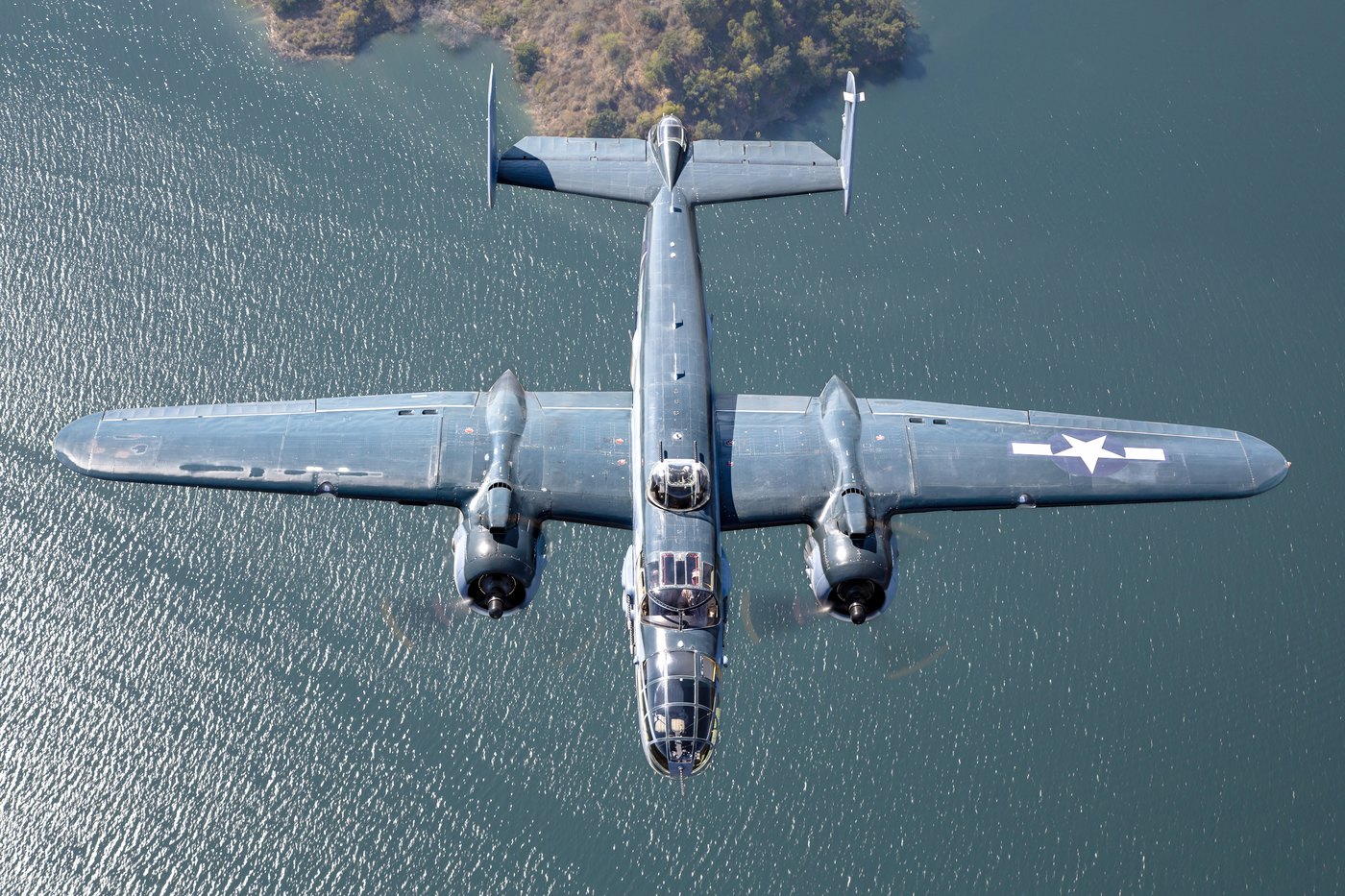
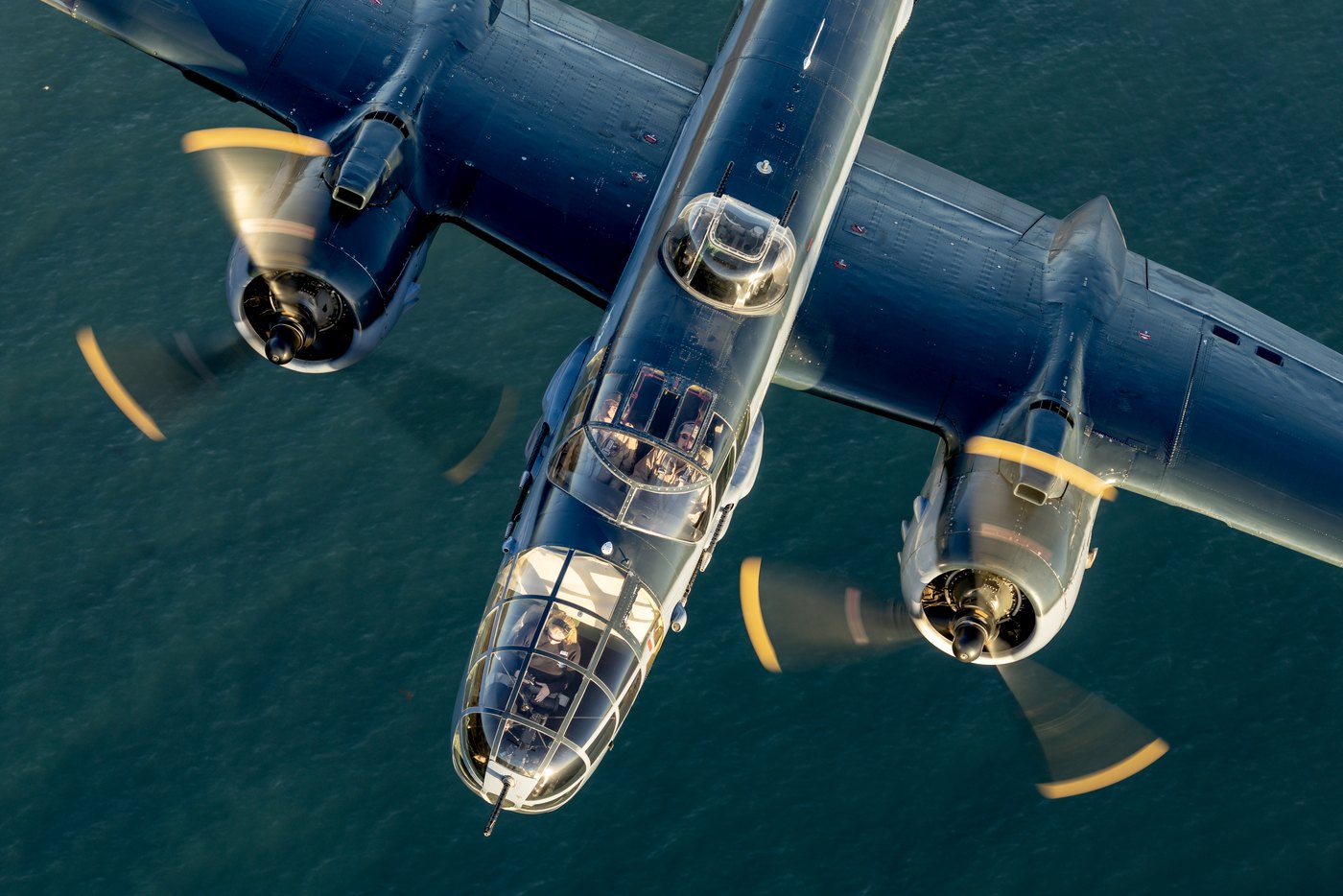
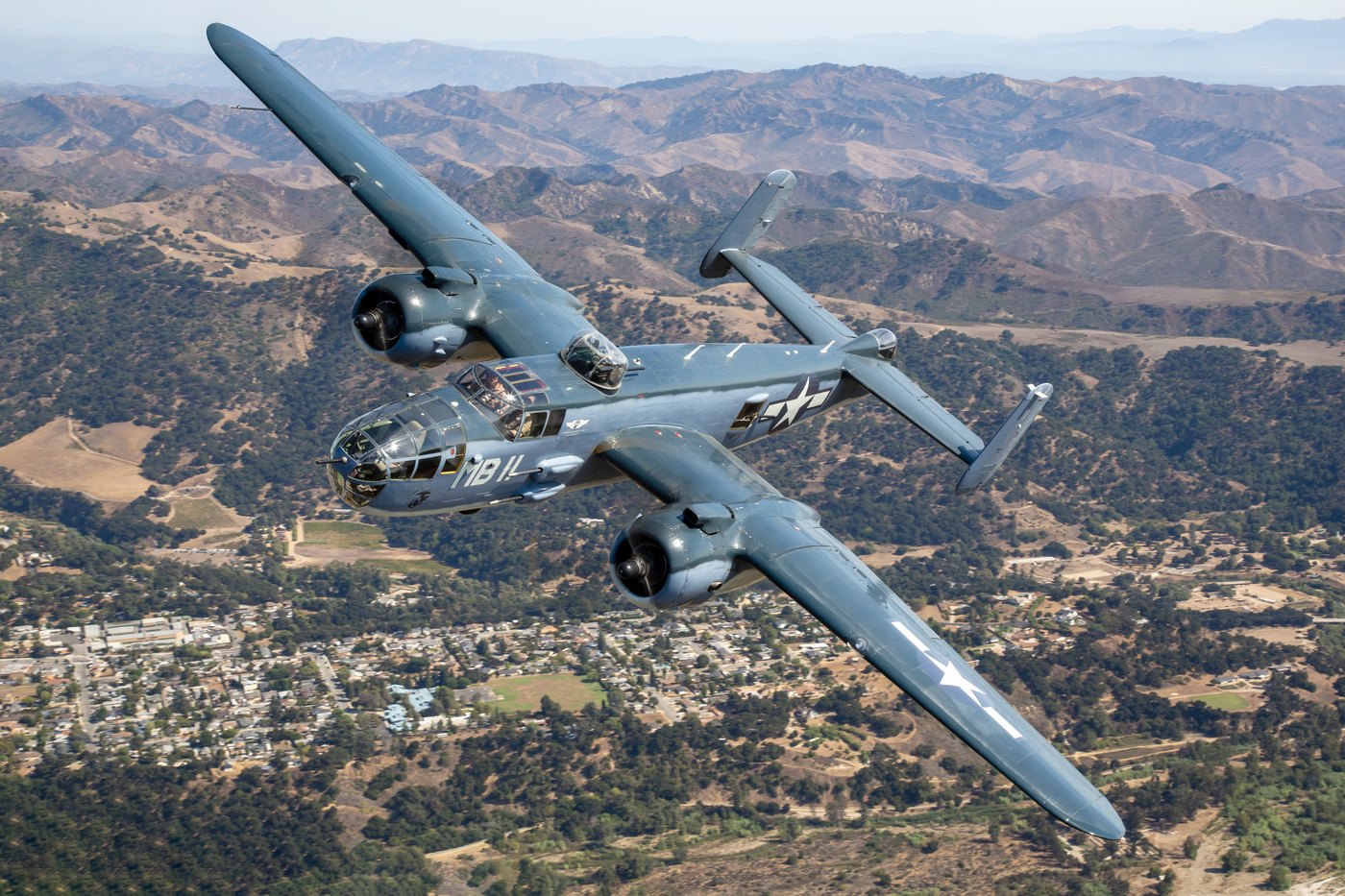
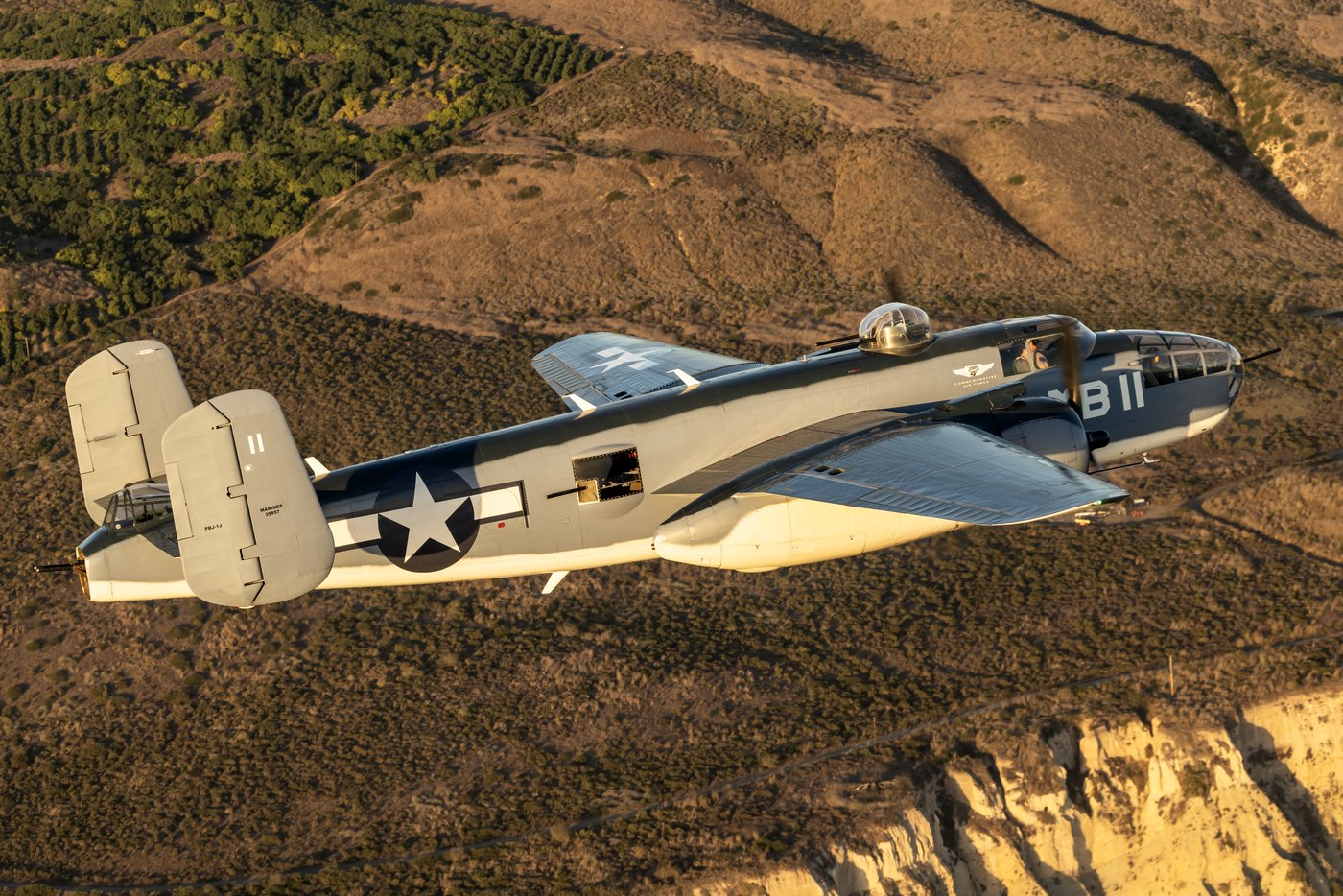
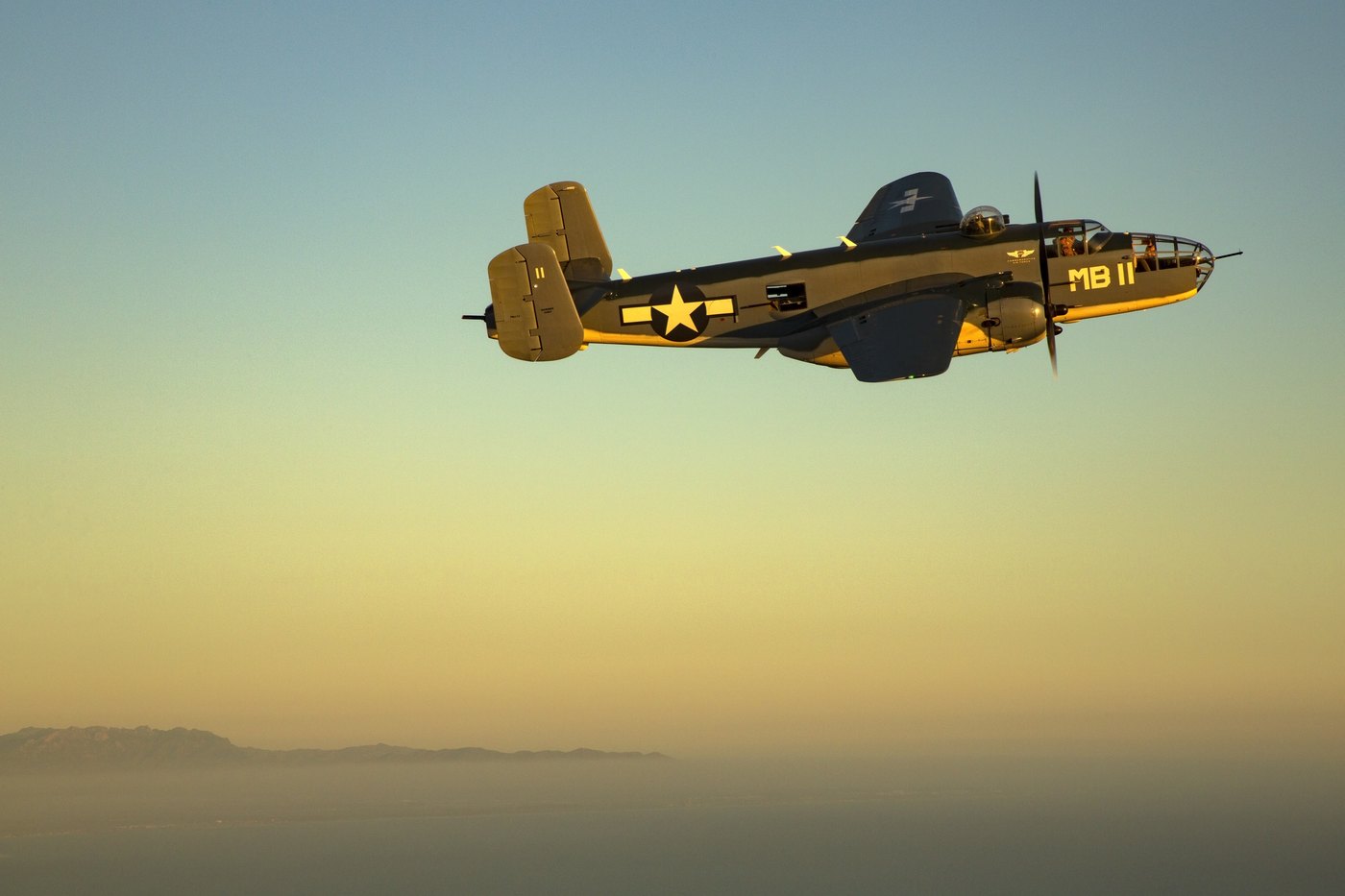
The Commemorative Air Force flies six of them, all registered to the American Airpower Heritage Flying Museum of Dallas, Texas, and scattered across its wings from Arizona to Minnesota. One of the six, Semper Fi, is registered N5865V and is painted as a Marine Corps PBJ-1J. It is the aeroplane in most of the photographs on this page, and the stencil on its fin stands where a wartime bureau number would go.
The CAF says of one of its aircraft that it is one of thirty-four B-25Js still flying. That is an operator’s figure rather than a census. Others sit in museums, and a good many more are gone altogether.
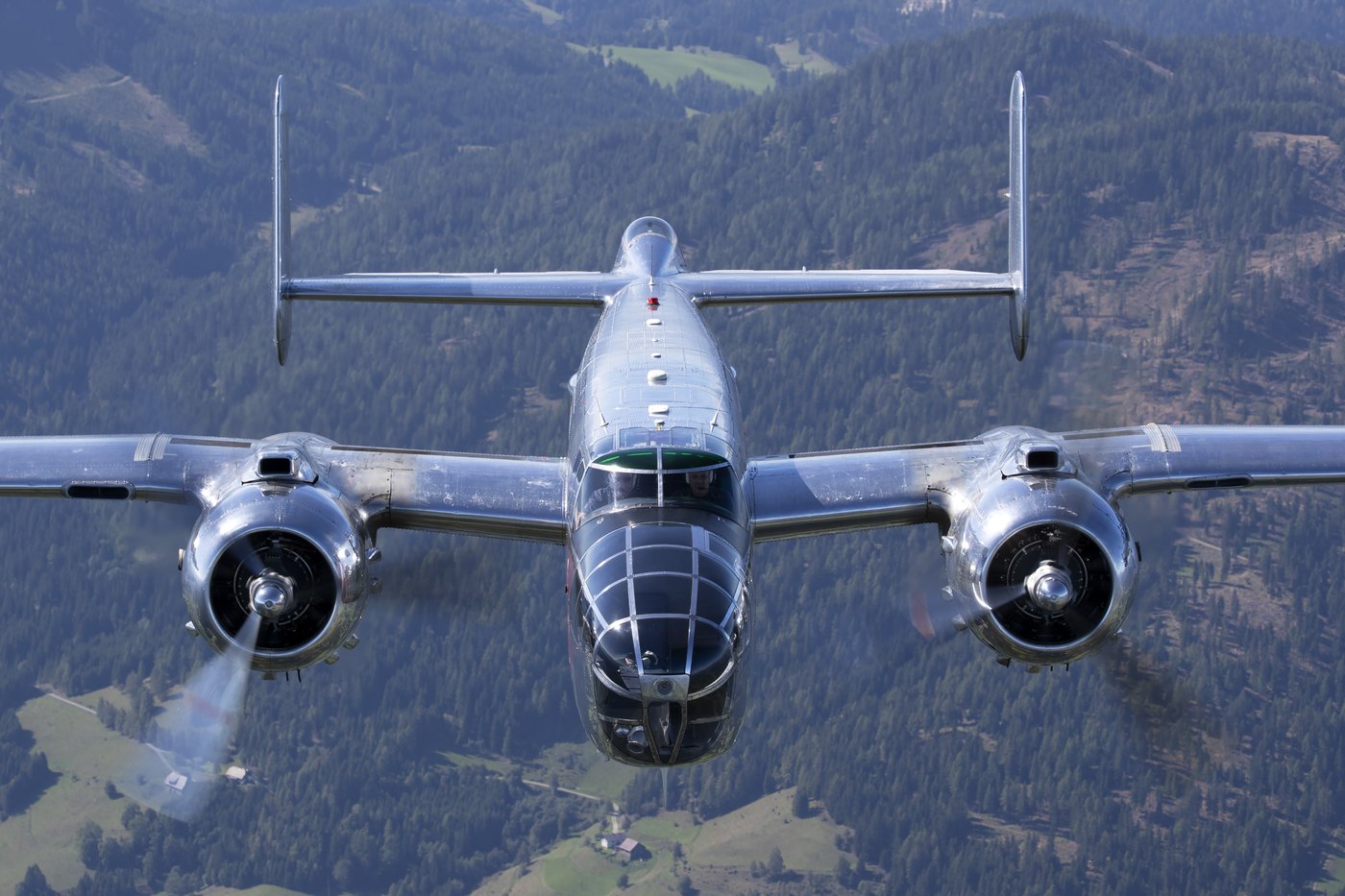
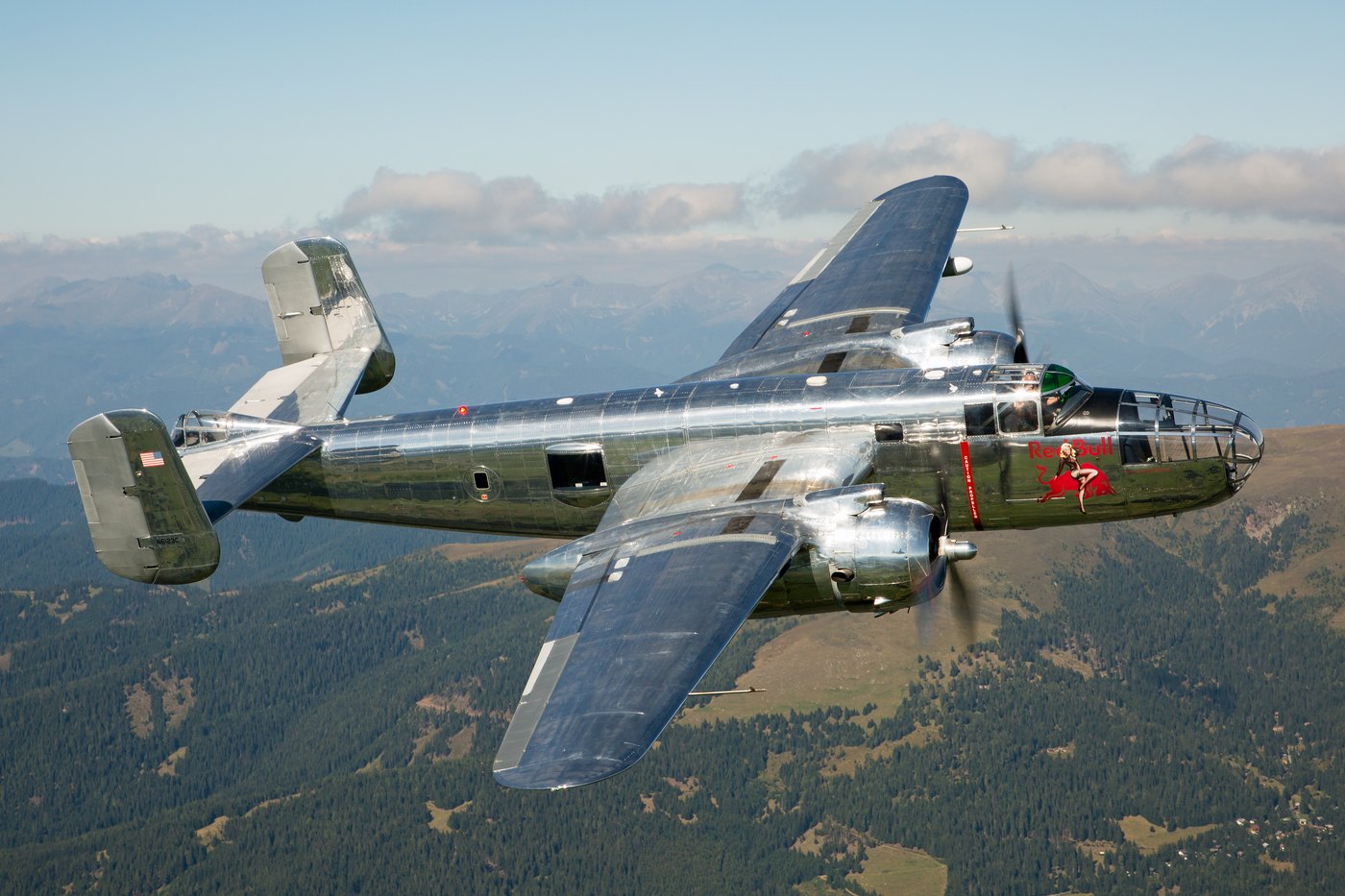
All of these frames were shot from a second aeroplane flying in formation with the subject. In two of them the bare-metal aircraft belongs to the Flying Bulls. Its registration is N6123C, and the American registry records it as a B-25J built in 1945, serial 44-86893, held through a trustee at an address at Kematen in Austria. Kansas City built it.
| Name carried | Registration | Serial on the FAA record | Model on the FAA record | Wing and base |
|---|---|---|---|---|
| Maid in the Shade | N125AZ | 43-35972A | TB-25N | Airbase Arizona, Mesa, Arizona |
| Yellow Rose | N25YR | 43-27868 | TB-25N | Central Texas Wing, San Marcos, Texas |
| Devil Dog | N9643C | 44-86758 | B-25J | Devil Dog Squadron, Georgetown, Texas |
| Miss Mitchell | N27493 | 44-29869 | B-25J | Minnesota Wing, South St Paul, Minnesota |
| Show Me | N345TH | 44-31385A | TB-25J | Missouri Wing, St Charles, Missouri |
| Semper Fi | N5865V | 108-34263 | B-25J | Southern California Wing, Camarillo, California |
The serial on Semper Fi’s registry record, 108-34263, is a North American Aviation charge number rather than a military serial.
Frequently asked questions
What was the B-25 Mitchell?
The B-25 Mitchell was an American twin-engined medium bomber built by North American Aviation from 1941 to 1945. It was designed to bomb depots, railway yards and fortified positions from eight to fourteen thousand feet in support of a ground battle. In the Pacific it was rebuilt in the field as a low-level gun platform, and it also served the US Navy and Marine Corps as the PBJ.
How many B-25 Mitchells were built?
9,816 were accepted by the Army Air Forces between June 1940 and August 1945. The figure comes from the Army Air Forces Statistical Digest and is repeated exactly in the official history of the Army Air Forces. Of those, 3,208 were built at Inglewood in California and 6,608 at Kansas City in Kansas. Production stopped shortly after the Japanese surrender.
Did the B-25’s 75 mm cannon work?
No, not in practice. The B-25G and B-25H carried a 75 mm field gun in a tunnel under the pilot’s floor, aimed by pointing the aeroplane and loaded by hand in flight by a crewman called the cannoneer. The official history records that pilots found it impossible to fire more than four rounds in one pass, that the straight and level run needed to aim it made the aircraft very vulnerable to ground fire, and that the Far East Air Forces abandoned the B-25H in August 1944.
Who invented the B-25 strafer nose?
Not one person. The official history credits the conversion to the “gadgeteers” of the service command, working with Kenney’s encouragement and on the advice of Major Paul Gunn and Jack Fox, North American Aviation’s own representative in Australia. Gunn drove it and is remembered for it; Fox is usually left out. The experimental aircraft passed its tests in December 1942 and about thirty had been converted by April 1943.
What did the B-25 do at the Battle of the Bismarck Sea?
Twelve modified B-25C1 strafers of the 90th Squadron attacked a Japanese convoy at five hundred feet on the morning of 3 March 1943, in what the official history calls probably the most successful attack of the battle. They dropped thirty-seven bombs and claimed seventeen direct hits. Eight more attacked that afternoon. The convoy of sixteen ships lost every transport and four of its eight destroyers.
Why does the B-25 wing have a kink in it?
For control and manoeuvrability, according to the Army Air Forces’ own pilot training manual. The inner wing panels have positive dihedral and the outer panels have negative dihedral, which is what gives the aeroplane its gull-winged look head on. The story usually told, that the outer panels were flattened to cure a Dutch roll after the first nine aircraft, comes from later book sources and not from the wartime manual.
What was a PBJ?
A PBJ was a B-25 in United States Navy and Marine Corps service. The Navy renamed the type on adoption, in line with its own designation system, and the Marines flew it. First delivery was in February 1943, the first squadron was VMB-413, and the last PBJ left service on 31 January 1946. Marine PBJs specialised in night heckling raids on Rabaul and flew the last strike against it on 9 August 1945.
Did the Royal Air Force fly the B-25 Mitchell?
Yes. RAF Mitchells went to No. 2 Group of the Second Tactical Air Force, where they replaced Bostons during 1943 and 1944. On 10 June 1944, sixty-one Mitchells of Nos. 98, 180 and 226 Squadrons and No. 320 (Dutch) Squadron bombed the headquarters of Panzer Group West at the Chateau of La Caine from twelve thousand feet, killing the German chief of staff, General von Dawans.
How fast was the B-25 Mitchell?
285 mph at a normal 1945 combat weight of 33,500 pounds, according to the official history’s materiel volume, which also notes that the speeds of the B-25 and the B-26 were not measurably increased during the war. The wartime pilot training manual gives a red line of 340 mph and an easy cruise of 200 mph, and says aircraft had exceeded 340 mph in emergencies without disastrous effects.
What engines did the B-25 Mitchell have?
Two Wright Cyclone R-2600 fourteen-cylinder, two-row radial engines of 1,700 horsepower each, driving Hamilton hydromatic propellers. Each engine had a two-speed internal supercharger. The take-off rating of 3,400 horsepower for the pair was the same in 1945 as it had been in 1941, while the aircraft’s maximum weight rose from 25,000 to 35,000 pounds over the same period.
Did a B-25 crash into the Empire State Building?
Yes, on 28 July 1945. A B-25 flying from Massachusetts to New York in fog hit the building at the seventy-ninth floor. Fourteen people died, the pilot and two others on the aircraft and eleven who worked in the building. Engine parts cut the cables of two lifts at the seventy-ninth floor and both cars fell to the subbasement. A nineteen-year-old lift operator, Betty Lou Oliver, was in one of them and survived with a broken pelvis, back and neck.
How many B-25 Mitchells are still flying?
Nobody keeps an official count. The Commemorative Air Force, which flies six of them, says one of its aircraft is one of thirty-four B-25Js still flying, which is an operator’s figure and not a census. Airworthy examples in Europe include the Flying Bulls’ polished B-25J, registered N6123C, which the American registry records as serial 44-86893.
Was the B-25 the aircraft used in the Doolittle Raid?
Yes. Sixteen B-25s were lifted aboard the USS Hornet at Alameda on 1 April 1942 for the Doolittle Raid, and Halsey ordered them off at 0800 on 18 April, about ten hours earlier than planned, after a Japanese picket vessel was sighted. The rest of its war was low-level attack in the Pacific, medium bombing in Italy and night heckling for the Marines.
Sources and further reading
- Craven and Cate, The Army Air Forces in World War II, Vol. VI: Men and Planes, ch. 6. This chapter holds the production totals, the purchase without a prototype, what a medium bomber was for, the 1941 and 1945 weights and powers, and the line about the B-25 being a favourite among AAF pilots.
- Army Air Forces, Pilot Training Manual for the Mitchell Bomber, B-25. The wartime manual issued to crews: the origin story, the gull wing, the engines, the crew stations, the 75 mm installation on the G and the H, and a worked load of twenty-one rounds.
- Army Air Forces Statistical Digest, World War II. Tables 75 and 76 hold the factory acceptances by plant and by year.
- Craven and Cate, Vol. IV, ch. 5, “Battle of the Bismarck Sea”. The strafer conversion, the abandonment of skip bombing, the attacks hour by hour, the claims and the AAF re-examination of them.
- Craven and Cate, Vol. IV, ch. 6. Kenney on the B-25G, the Townsville depot’s structural fix, and the fight over the cabin heater and the co-pilot.
- Craven and Cate, Vol. V, ch. 11. The Far East Air Forces’ verdict on the 75 mm gun, and the arrival of factory-built eight-gun-nose B-25Js from September 1944.
- Craven and Cate, Vol. V, ch. 6. The China, Burma and India ammunition returns, including twelve rounds of 75 mm fired in June 1945 against 69,747 on hand.
- Craven and Cate, Vol. IV, ch. 9. Covers the Marshalls, where the 41st Group lost seventeen B-25s on low-level work.
- Craven and Cate, Vol. IV, ch. 10. Records what the cannon Mitchells fired over New Britain in December 1943.
- Craven and Cate, Vol. IV, ch. 19. Describes Wakde, and the B-25H forced to fly a steady course to sight its cannon.
- Craven and Cate, Vol. IV, ch. 20. The Marianas sorties over Tinian and Guam.
- Craven and Cate, Vol. I, ch. 10. Gunn taking over the first American transport unit in Australia in February 1942.
- Craven and Cate, Vol. I, ch. 12. Gives the Tokyo raid in detail, including the launch at 0800 on 18 April 1942.
- Craven and Cate, Vol. II, ch. 16. Where the four Mediterranean Mitchell groups were in November 1943.
- Craven and Cate, Vol. III, ch. 10. Follows the Anzio air campaign and dates the bombing of the abbey to 15 February 1944 and of the town to 15 March.
- Craven and Cate, Vol. III, ch. 11. The summer 1944 offensive against the Po bridges by the mediums of both wings.
- Craven and Cate, Vol. III, ch. 13. Operation BINGO against the Brenner transformer stations, and the Lamone crossings.
- Craven and Cate, Vol. VI, ch. 12. The first five B-25s promised to the Soviet Union in August 1941 and the protocols that followed.
- Craven and Cate, Vol. VI, ch. 20. Names the twenty-six Soviet officers who trained at Fort George Wright in September 1941.
- Craven and Cate, Vol. VI, ch. 10. The lend-lease aircraft totals for Britain and the Soviet Union.
- Craven and Cate, Vol. V, ch. 9. The Chinese-American Composite Wing and the 341st Bombardment Group.
- Craven and Cate, Vol. V, ch. 7. Vincent’s East China Task Force and its Mitchell squadrons in June 1944.
- Craven and Cate, Vol. VII, ch. 7. The delivery of lend-lease B-25s to the Netherlands East Indies government in early 1942.
- Richards and Saunders, Royal Air Force 1939-1945, Vol. III: The Fight is Won, ch. 4. No. 2 Group under Embry, and the Bostons giving way to Mitchells.
- Richards and Saunders, Vol. III, ch. 6. The attack on Panzer Group West at La Caine on 10 June 1944, and the Second Tactical Air Force’s record book for the night of 18 July.
- Richards and Saunders, Royal Air Force 1939-1945, Vol. II: The Fight Avails, ch. 15. The Aegean, and the eighty-six sorties by a Mitchell group armed with 75 mm cannon.
- Richards and Saunders, Vol. II, ch. 16. The British official account of the bombing of the abbey at Monte Cassino, with its own times and tonnages, and the air attacks on the Sardinian airfields before and during the invasion of Sicily.
- Shaw and Kane, History of U.S. Marine Corps Operations in World War II, Vol. II, ch. VI-1. This chapter carries the night heckling at Rabaul, the navigational escorts, the lead-bombardier work for the RNZAF, the drone unit and the last strike of the war.
- Shaw and Kane, Vol. II, ch. V-2. The sentence that names the PBJ as the Marines’ Mitchell.
- United States Naval Aviation 1910-1995. The PBJ’s variants, first delivery, first squadron, bureau number blocks and date out of service.
- Office of War Information, Design and Operation of United States Combat Aircraft, 19 October 1942. A wartime public-information assessment of the type, written to be published.
- Federal Aviation Administration aircraft registry. The registrations, serials and models of the surviving aircraft named here, including N5865V and N6123C.
- Commemorative Air Force aircraft directory. The operator’s account of its six Mitchells, including the estimate of thirty-four B-25Js still flying.
- The Flying Bulls, North American B-25J Mitchell. The operator’s page for the Austrian aircraft. It carries no wartime history for this airframe.
- NPR, “The Day A Bomber Hit The Empire State Building”, 28 July 2008. The date, the floor, the casualties and Betty Lou Oliver’s fall.
