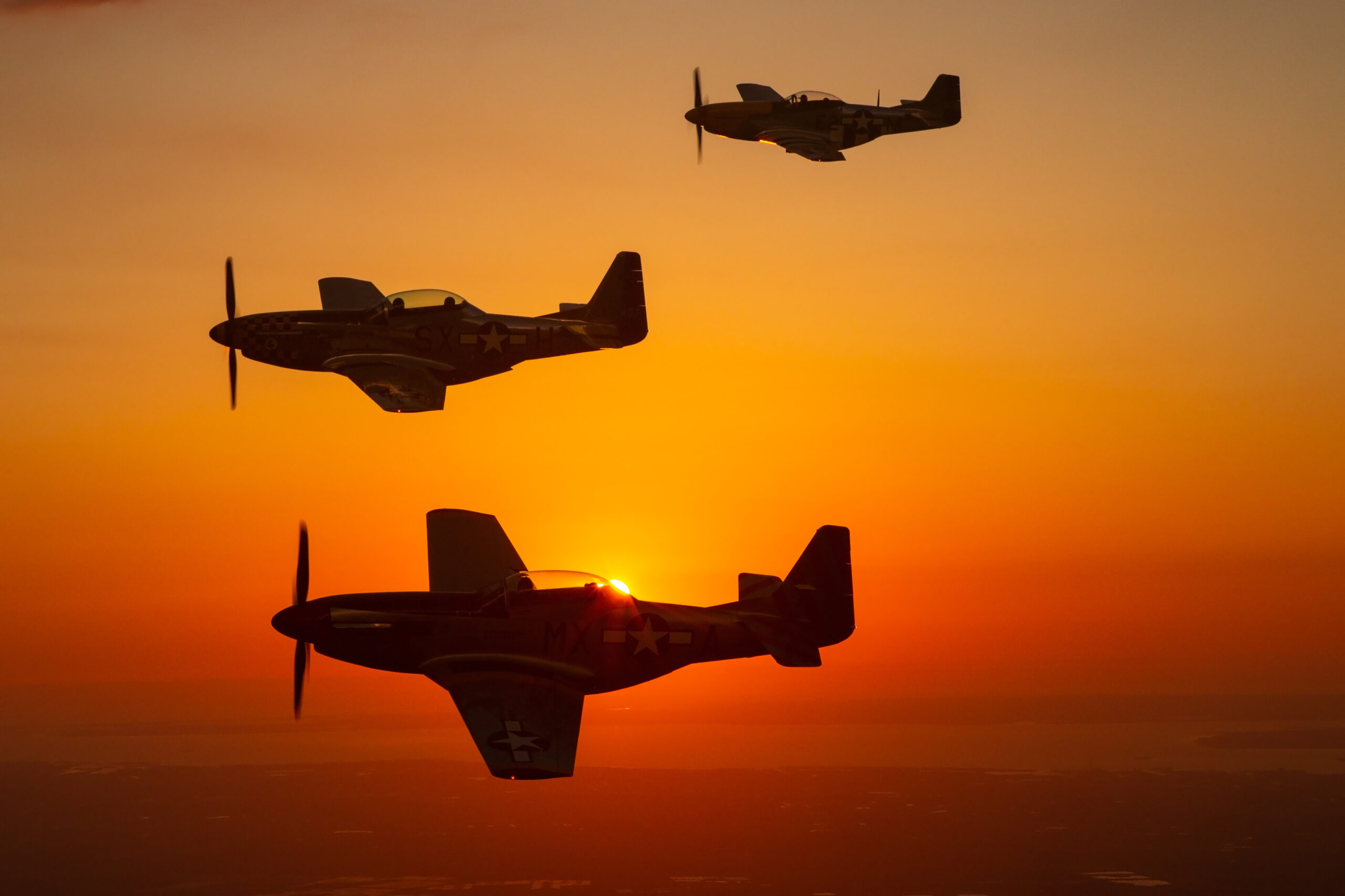
Few aircraft carry as much weight in the story of the air war over Europe as the North American P-51 Mustang. The P-51 Mustang was an American long-range, single-seat fighter of the Second World War that, once fitted with the British Rolls-Royce Merlin engine, could escort heavy bombers all the way to Berlin and back. It arrived later than the famous fighters of 1940, it was built to answer a British purchasing request rather than an American specification, and its first version was a disappointment at the heights where the war was being decided. Yet by 1944 the Mustang had become the aeroplane that could take the daylight bombing campaign all the way to Berlin and bring the escort home again. That single capability, long range married to genuine fighter performance, changed how the air war was fought.
This is the full history of the Mustang: where it came from, how a change of engine turned an also-ran into a war-winner, what it did in combat across Europe and the Pacific, the men who flew it, the variants that followed, its second career in Korea, and where the survivors are today. Throughout, the aim is to separate what is documented from what has hardened into legend, because the Mustang has attracted more than its share of both.
What this guide covers
- A fighter born from a British request
- The Allison years: fast and low
- The Merlin transformation
- Escort to Berlin: the Mustang in the daylight bombing campaign
- The definitive Mustang: the P-51D
- Beyond Europe: the Mustang in the Pacific
- The Tuskegee Airmen and the Red Tails
- The aces and the men who flew it
- Variants at a glance
- Korea and the long afterlife as the F-51
- What survives, and where
- Why the Mustang still matters
- Design and construction in detail
- Fighting the Luftwaffe
- How it compared with its rivals
- Production and the long-range Pacific missions
- Frequently asked questions
A fighter born from a British request
The Mustang did not begin with the United States Army Air Corps. It began with the British Purchasing Commission, the body buying American aircraft for the Royal Air Force in the first year of the Second World War. In early 1940 the commission approached North American Aviation with what looked like a simple proposal: build the Curtiss P-40 under licence to add to RAF strength. North American, led by James Howard Kindelberger, known throughout the industry as Dutch, made a counter-offer. Rather than tool up to build a design that was already middle-aged, the company proposed to design and build a wholly new fighter around the same Allison engine, and to do it quickly.
The British agreed, with a condition that has passed into aviation folklore: that a prototype be ready in a very short time. The contract for the new aircraft, designated NA-73, was signed in late May 1940. The prototype airframe, the NA-73X, was rolled out on 9 September 1940, just 102 days after the firm order was placed on 29 May 1940. It is often said the whole aircraft was designed in 117 days, and the figures are sometimes muddled in the retelling. What is documented is that the airframe was completed in that remarkably short window, although the Allison engine arrived later, so the first flight did not follow at once.
The 102-day airframe
That first flight came on 26 October 1940, with test pilot Vance Breese at the controls. The speed of the programme was real, and it reflected both North American’s fresh approach and the pressure of wartime urgency. It is worth being careful here, because the story is frequently exaggerated. The 102 days refers to the airframe being completed, not to a finished, flying, fully developed fighter. Early testing brought the usual crop of teething troubles, including a serious accident when the prototype was damaged during an engine-related forced landing. None of that detracts from the achievement, but it places the famous number in its proper context.
What made the airframe different
Two features of the design are usually singled out, and both deserve a clear-eyed look. The first is the wing. The Mustang used what is described as a laminar-flow aerofoil, developed with the National Advisory Committee for Aeronautics. The idea was to keep the airflow smooth over a greater proportion of the wing chord, reducing drag and so allowing higher speeds for a given engine power. This is often presented as the Mustang’s secret weapon. In practice the benefit is debated. Genuine laminar flow depends on a wing surface that stays extremely smooth and free of imperfections, and the riveted, painted, gun-camera-fitted wings of operational fighters rarely stayed that clean. Most engineers today accept that the wing was aerodynamically excellent and low in drag, while being cautious about claiming it maintained true laminar flow in service. The honest summary is that the wing helped, but not in the simple, magical way the popular accounts suggest.
The second feature is the radiator installation under the rear fuselage. North American shaped the cooling duct so that air entering it was heated by the radiator, expanded, and left the duct with a small amount of useful thrust, an idea associated with the British aerodynamicist Frederick Meredith and known as the Meredith effect. The recovered thrust was modest and did not cancel the cooling drag, but the careful ducting reduced the penalty that radiators normally imposed. Combined with the clean wing and a tidy, well-streamlined fuselage, it gave the Mustang an unusually low drag for a fighter of its weight.
The Allison years: fast and low
The first Mustangs were powered by the Allison V-1710, a sound engine with one critical limitation for this aircraft. The version fitted lacked a turbocharger or a high-altitude supercharger stage, so its power fell away sharply above about 15,000 feet. At low and medium altitudes the early Mustang was really fast, faster than a contemporary Spitfire down low, but at the heights where bomber-versus-fighter combat would be decided over Germany it was outclassed. This is the central irony of the Mustang’s early career: a superb airframe held back by the wrong engine for the job everyone would later need it to do.
The Royal Air Force took delivery from late 1941, and the first Mustang Mk I squadron formed in early 1942. The RAF made a sensible decision given the aircraft’s strengths. Rather than send it up to high-altitude interceptions it could not win, it used the Mustang at low level for armed reconnaissance and army co-operation over occupied Europe, where its speed near the ground and long endurance were real assets. Some carried a camera installation for tactical photo-reconnaissance. In American service the photo-reconnaissance Mustangs were designated F-6. The dive-bomber and ground-attack version of the Allison Mustang, fitted with dive brakes, became the A-36, sometimes called the Apache or Invader, and saw hard service over Italy and the Mediterranean.
A useful way to think about the early Mustang: it was a low-altitude thoroughbred in a war that, for fighters, was increasingly being fought high. The fix was not a new aeroplane. It was a new engine.
The Merlin transformation
The idea that changed everything was simple to state and difficult to execute: put the Rolls-Royce Merlin into the Mustang. The Merlin, with its two-stage, two-speed supercharger in its later marks, held its power up high, exactly where the Allison faded. The same airframe that was fast and clean down low would, with the right engine, be fast and clean at 25,000 feet and above.
From Mustang X to XP-51B
The credit for pushing the conversion belongs to several people on both sides of the Atlantic. In Britain, Rolls-Royce engineers and test pilots, encouraged by figures including the American attache Thomas Hitchcock who championed the aircraft’s potential, took a small number of Mustangs and fitted them with Merlin 65 engines. These conversions were known as the Mustang X. The results were striking, with large gains in speed and altitude performance. In parallel, North American developed its own Merlin installation in the United States.
The American prototypes were briefly designated XP-78 before becoming the XP-51B. The first flight of the US Merlin Mustang took place in November 1942. The Army Air Forces had seen enough of the projected figures to commit early; an initial contract for several hundred aircraft was placed in August 1942, months before that first flight, which tells you how convincing the calculations were.
Packard builds the Merlin
Producing the Merlin in the numbers the programme needed meant building it in America. The Packard Motor Car Company took on a licence to manufacture the engine, and the Packard-built Merlins were designated V-1650. The P-51B and the near-identical Dallas-built P-51C used the V-1650-3 and later the V-1650-7. This was a considerable industrial achievement in its own right, translating a hand-finished British aero engine into mass production on American lines without losing its performance. The marriage of the North American airframe and the Packard Merlin produced the aircraft the war needed.
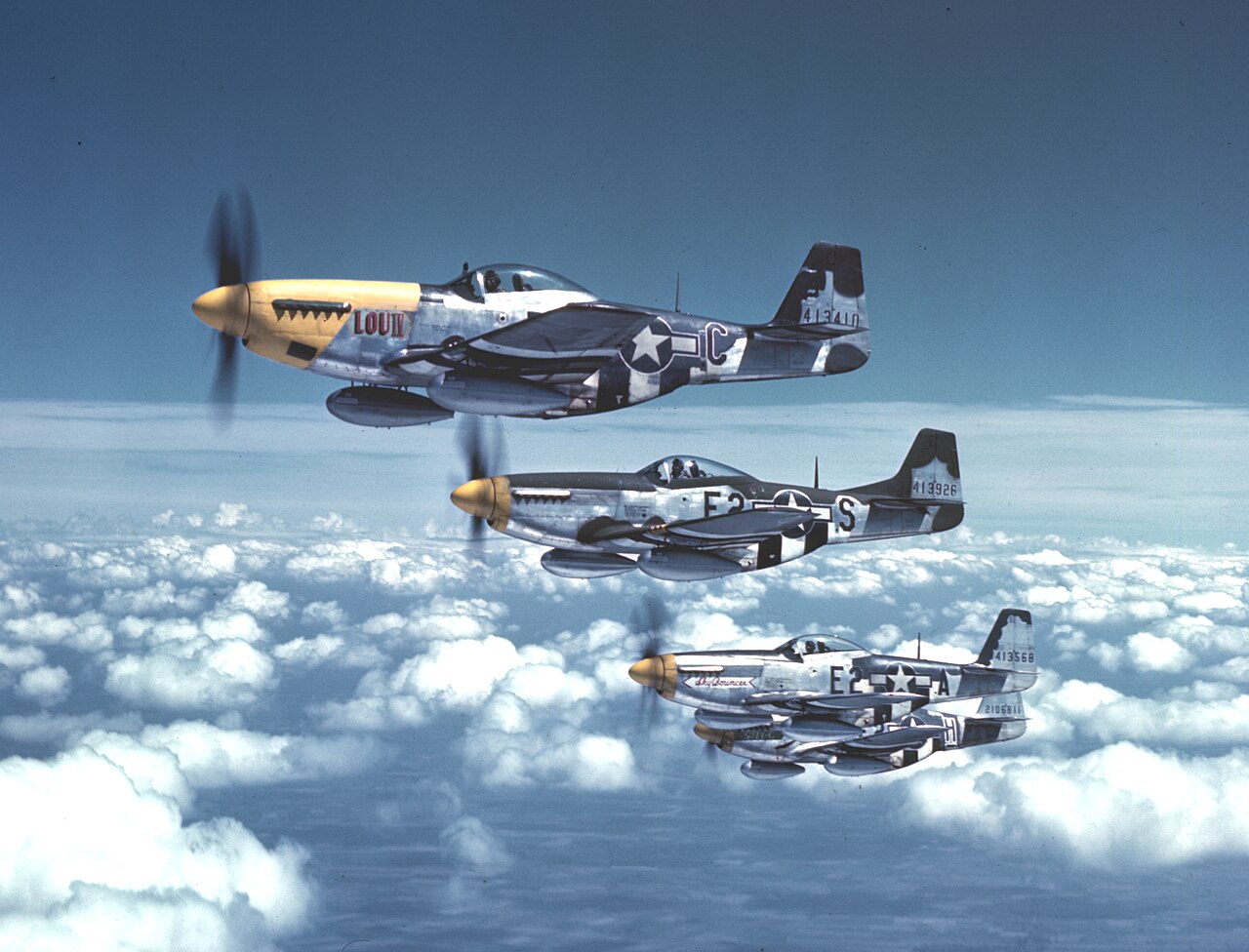
Escort to Berlin: the Mustang in the daylight bombing campaign
To understand why the Merlin Mustang mattered so much, you have to understand the problem it solved. By 1943 the United States Army Air Forces were committed to daylight precision bombing of Germany, flying unescorted or partly escorted formations of heavy bombers deep into enemy airspace. The theory was that massed defensive guns would let the bombers protect themselves. The reality, demonstrated brutally over targets such as Schweinfurt and Regensburg in 1943, was that German fighters could attack the bombers once the short-ranged escorts had to turn back, and the losses were unsustainable.
The range problem the Mustang solved
The escort fighters of 1943, the P-47 Thunderbolt and the P-38 Lightning, were capable aircraft, but the Thunderbolt in particular lacked the range to stay with the bombers all the way to distant targets even with drop tanks. The Mustang had two things in its favour: a low-drag airframe that sipped fuel for the speed it made, and a large internal fuel capacity, later increased by a fuselage tank behind the pilot. Fitted with external drop tanks, the P-51B and C could escort the bombers from England to Berlin and back, a feat no other single-engined Allied fighter could match at the time. The combat radius with drop tanks reached the region of 600 miles, enough to cover the deepest raids.
Doolittle lets the fighters loose
A change in tactics multiplied the Mustang’s effect. When General James Doolittle took command of the Eighth Air Force’s fighters at the start of 1944, he released them from close formation escort. Instead of staying tied to the bombers, Mustangs were allowed to range ahead and hunt German fighters wherever they could be found, including down on the airfields. The aim shifted from simply protecting bombers to destroying the Luftwaffe’s fighter force and, crucially, its experienced pilots. The Mustang’s range meant it could carry that fight across the whole of Germany.
Big Week and the breaking of the Luftwaffe
The campaign known as Big Week in February 1944, part of the wider Pointblank offensive against the German aircraft industry and fighter arm, brought matters to a head. Through the spring of 1944 the Luftwaffe was forced into a battle of attrition it could not win, losing aircraft it could replace and pilots it could not. By the time of the Normandy landings in June 1944, the Allies held air superiority over France and much of Germany. The Mustang was not the only reason for this, the Thunderbolt, the Lightning, the growth of Allied production and the steady draining of German training all played their part, but the long-ranged Mustang was the instrument that made the new, aggressive policy possible. Mustang pilots were credited with destroying a large number of enemy aircraft in the air and on the ground; the most often quoted figure is around 4,950 claimed destroyed in air combat by Mustang pilots during the war, though wartime claims should always be read with caution, as they typically overstate actual losses.
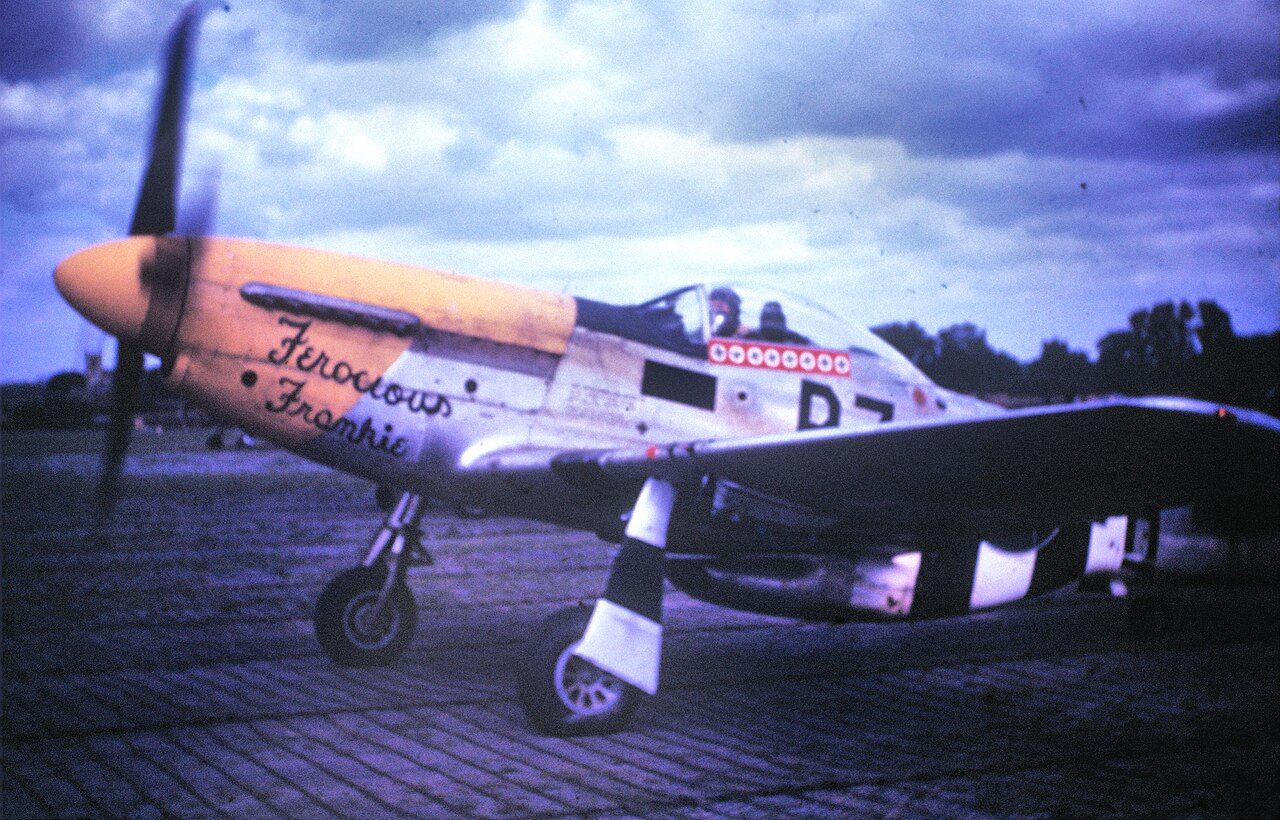
The definitive Mustang: the P-51D
The early Merlin Mustangs, the B and C models, were superb performers but carried two flaws that the next version addressed. They were armed with only four .50 calibre machine guns, and those guns were prone to jamming because they were mounted at an angle in the wing. And they retained the framed, faired canopy of the earlier aircraft, the so-called razorback, which gave a poor view to the rear, a dangerous shortcoming in a dogfight.
The P-51D fixed both. It introduced a cut-down rear fuselage and a one-piece sliding bubble canopy that gave the pilot an almost uninterrupted all-round view, one of the best of any fighter of the war. The armament went up to six .50 calibre Browning machine guns, mounted upright to feed reliably, with a useful ammunition load. Underwing hardpoints allowed the carriage of bombs or high-velocity rockets for ground attack. The P-51D became the most numerous Mustang by a wide margin, with around 8,000 built, and it is the shape most people picture when they think of the aeroplane.
| Powerplant | One Packard V-1650-7 (licence-built Rolls-Royce Merlin), 12-cylinder liquid-cooled V engine, about 1,490 hp, rising to roughly 1,720 hp at war emergency power |
|---|---|
| Wingspan | 37 ft 0 in (11.28 m) |
| Length | 32 ft 3 in (9.83 m) |
| Empty weight | about 7,635 lb (3,465 kg) |
| Maximum speed | about 437 mph (703 km/h) at 25,000 ft |
| Service ceiling | about 41,900 ft (12,800 m) |
| Rate of climb | about 3,200 ft/min (16.3 m/s) |
| Range | roughly 1,000 miles on internal fuel; far greater with external drop tanks, allowing escort to Berlin and back |
| Armament | Six 0.50 in (12.7 mm) AN/M2 Browning machine guns; provision for bombs or high-velocity aircraft rockets under the wings |
| Crew | One |
| First flight (NA-73X prototype) | 26 October 1940 |
| Number built (all variants) | more than 15,000 |
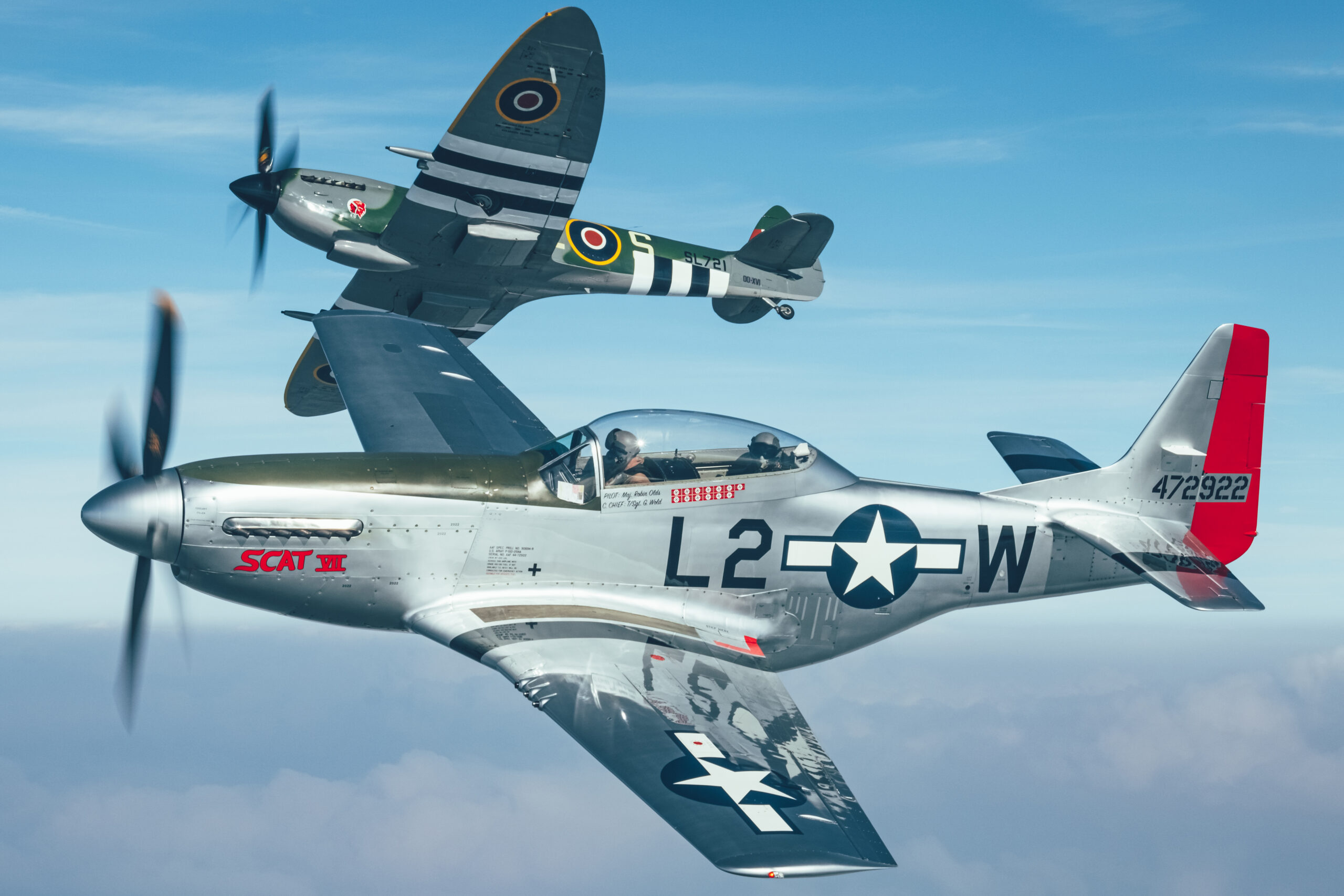
Performance figures for warbirds vary between sources and between individual aircraft, depending on the exact sub-variant, loading and the standard to which figures were measured. The numbers above are representative of the P-51D and are drawn from established references. Treat any single decimal-place figure for a wartime fighter with healthy scepticism.
Beyond Europe: the Mustang in the Pacific
The Mustang reached the Pacific later than Europe, partly because Europe had first call on it and partly because the twin-engined P-38 was already well established over the long sea distances of the Pacific, where a second engine was reassuring. As American forces captured islands closer to Japan, the Mustang’s range made it valuable for escorting B-29 Superfortress raids and for ground attack. From early 1945, P-51s flew very long range missions from Iwo Jima to targets over the Japanese home islands. In practice the escort role from Iwo Jima proved less useful than hoped, the distances and weather were punishing and Japanese fighter opposition to the high-flying B-29s was often limited, so the Mustangs spent much of their effort on strafing and ground-attack sorties. The campaign was hard on men and machines, with navigation over long stretches of open water a constant danger.
The Tuskegee Airmen and the Red Tails
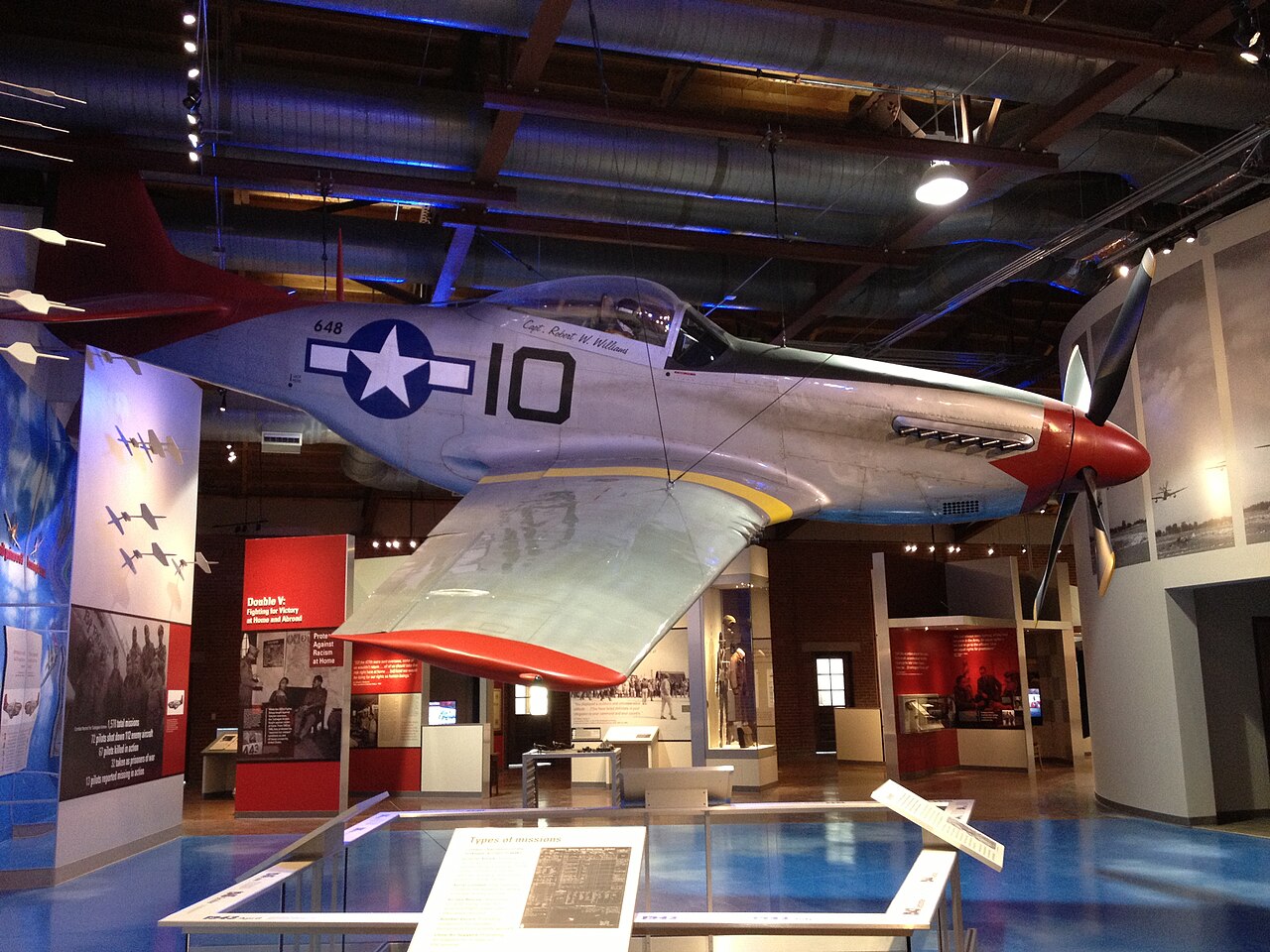
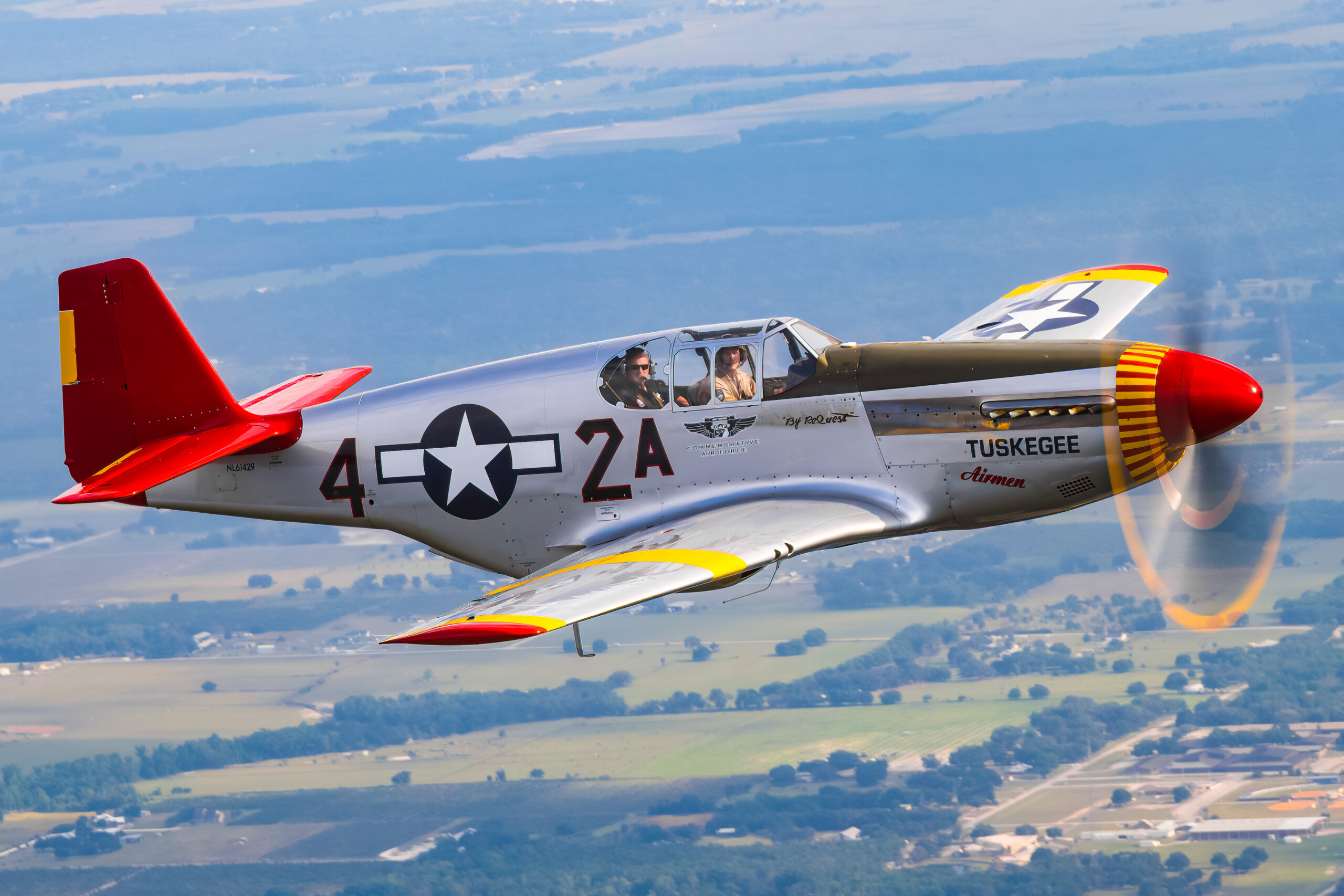
No account of the Mustang is complete without the Tuskegee Airmen, the African American pilots of the segregated 332nd Fighter Group and the 99th Fighter Squadron. Flying P-51s with distinctive red-painted tails, from which came the nickname Red Tails, they served as bomber escorts in the Mediterranean and over southern and central Europe. Their record stands on its own merits as a fighter escort unit, and their service carried a wider significance, made under the contradiction of fighting for a country that still treated them as second-class citizens at home. Some popular retellings have claimed the group never lost a single escorted bomber to enemy fighters; careful research has shown that a small number were in fact lost, so the absolute version of the claim is not accurate. The truer and still remarkable fact is that the unit had an excellent escort record and a hard-won reputation among the bomber crews they protected.
The aces and the men who flew it
The Mustang produced a long roll of high-scoring fighter pilots. The leading American Mustang ace was George Preddy, whose total stood at just under 27 victories, most of them gained in the P-51, before he was killed by friendly anti-aircraft fire on Christmas Day 1944. Many others built large scores escorting the bombers, and the Eighth Air Force’s Mustang groups, among them the 357th, 354th (which actually flew under the Ninth Air Force but pioneered Mustang escort work) and 4th Fighter Groups, became famous names. What the figures show clearly is a pattern common to all air forces: a small minority of pilots accounted for a large share of the victories, while the great majority of the work was the unglamorous business of flying long, cold, exhausting missions and bringing the bombers home.
Pilots who flew the Merlin Mustang generally praised its handling, its range and its view from the bubble canopy, while respecting its limits. The laminar-flow wing, for all its low drag, was not a tight-turning wing in the way a Spitfire’s was, and the aircraft had handling characteristics, particularly with the rear fuselage tank full, that demanded respect until the fuel was burned down. It was a fast, long-legged, hard-hitting fighter rather than a pure dogfighter, and used on its strengths it was very hard to beat.
Variants at a glance
The Mustang family was large, and the names can be confusing. The following are the ones most worth knowing.
Allison-powered Mustangs
The original Mustang Mk I and Mk II in RAF service, and the P-51 and P-51A in American service, all used the Allison engine. The A-36 was the dedicated dive-bomber and ground-attack version with dive brakes. The F-6 was the photo-reconnaissance Mustang. Roughly 1,579 Allison-engined Mustangs of all kinds were built.
Merlin-powered Mustangs
The P-51B (built at Inglewood) and the P-51C (built at Dallas) were the first Merlin production fighters, with the four-gun armament and the framed canopy. The P-51D, with the bubble canopy and six guns, was the definitive wartime version and the most numerous. The very similar P-51K used a different propeller. The P-51H was a much lighter, faster, late-war redesign intended for the planned invasion of Japan; it was one of the fastest piston fighters ever produced, but the war ended before it could see significant combat, and 555 were completed, with production ending in 1946.
Foreign and post-war builds
The Commonwealth Aircraft Corporation built Mustangs in Australia as the CA-17 and CA-18. After the war, the Cavalier company in the United States rebuilt and modernised Mustangs for export and counter-insurgency use, and these Cavalier Mustangs served with several air forces into the 1960s and beyond. A turboprop development, the Piper PA-48 Enforcer, was built and tested much later but never entered service.
Korea and the long afterlife as the F-51
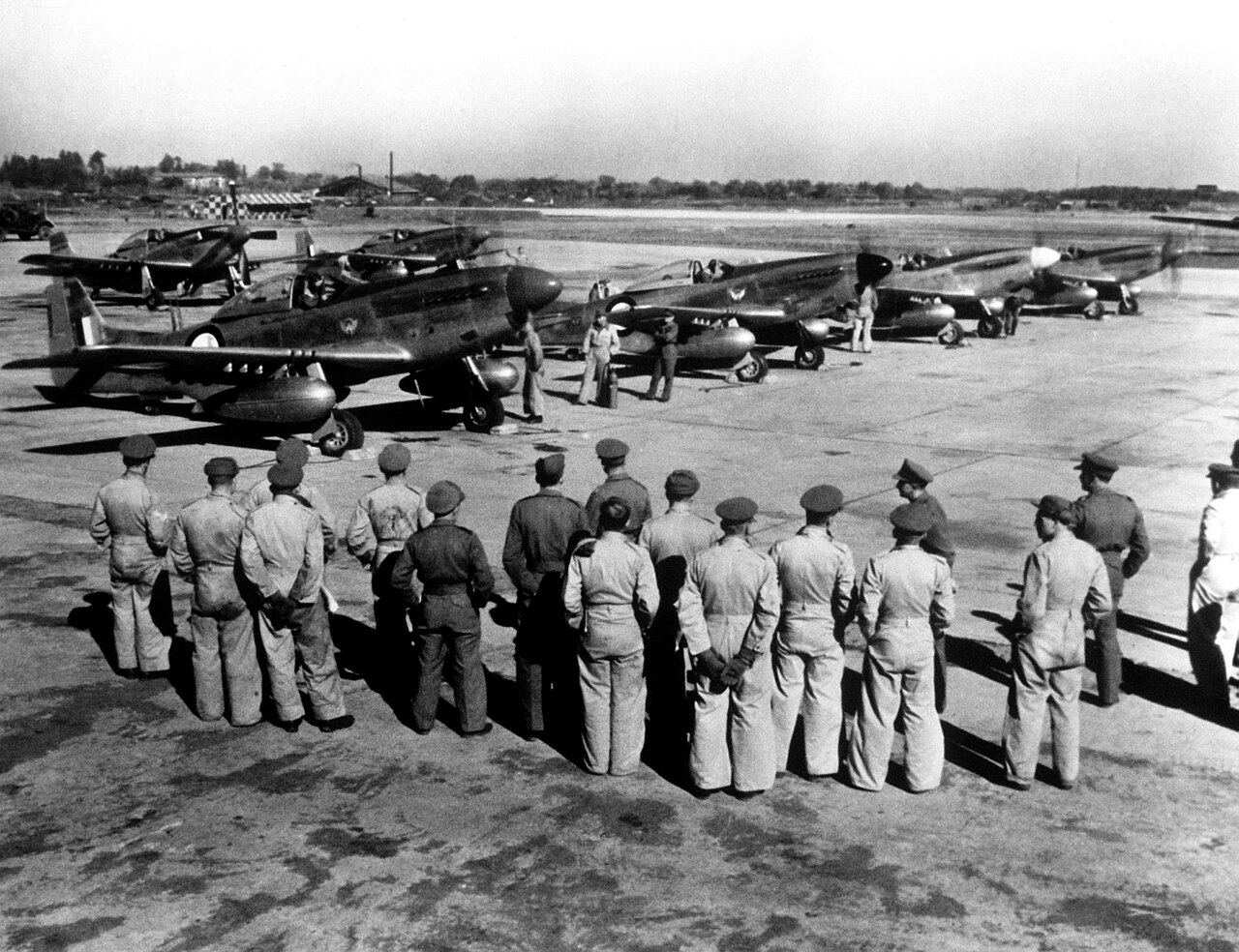
Shortly after the United States Air Force became a separate service, the pursuit designation P was replaced by F for fighter in June 1948, so the P-51 became the F-51. By 1950 the jet age had arrived and the Mustang was no longer a front-line air-superiority fighter, but the outbreak of the Korean War found it suddenly useful again. Jets of the period were thirsty and needed long runways; the Mustang could fly from rough forward strips, loiter over the battlefield and carry a worthwhile load of bombs, rockets and napalm. For the close-support and interdiction role it was pressed back into heavy use, and it served in this capacity until around 1953, when it was steadily replaced by jets such as the F-84 Thunderjet. F-51s lingered in Air National Guard and reserve units through the 1950s, and the type’s very last service use in American hands came as late as 1968, when a vintage example was used as a chase aircraft for a new attack programme. Mustangs also served with a long list of other air forces around the world well into the post-war decades.
What survives, and where
The Mustang is one of the great survivors of the warbird world. It was built in large numbers, it was cheap to buy as surplus after the war, and its performance made it a natural for air racing and private flying, so a healthy population came through to the preservation era. Counts vary by source and definition, but recent surveys put the number of complete Mustangs that still exist at somewhere over 300 worldwide, taking in airworthy aircraft, static museum exhibits, aircraft under restoration and those in storage. Well over 100 of these are kept in flying condition, which makes the Mustang one of the most commonly seen wartime fighters at airshows on both sides of the Atlantic.
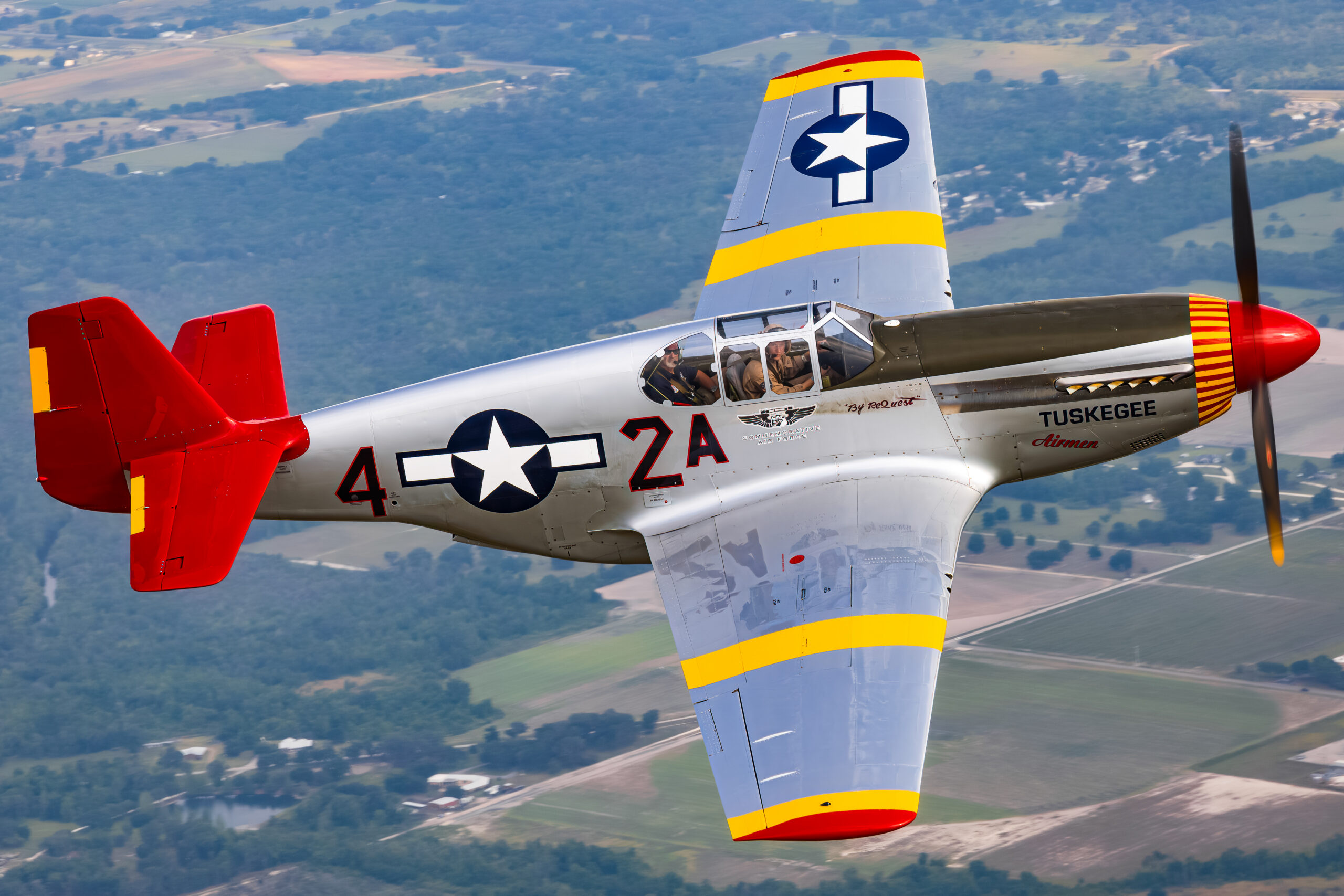
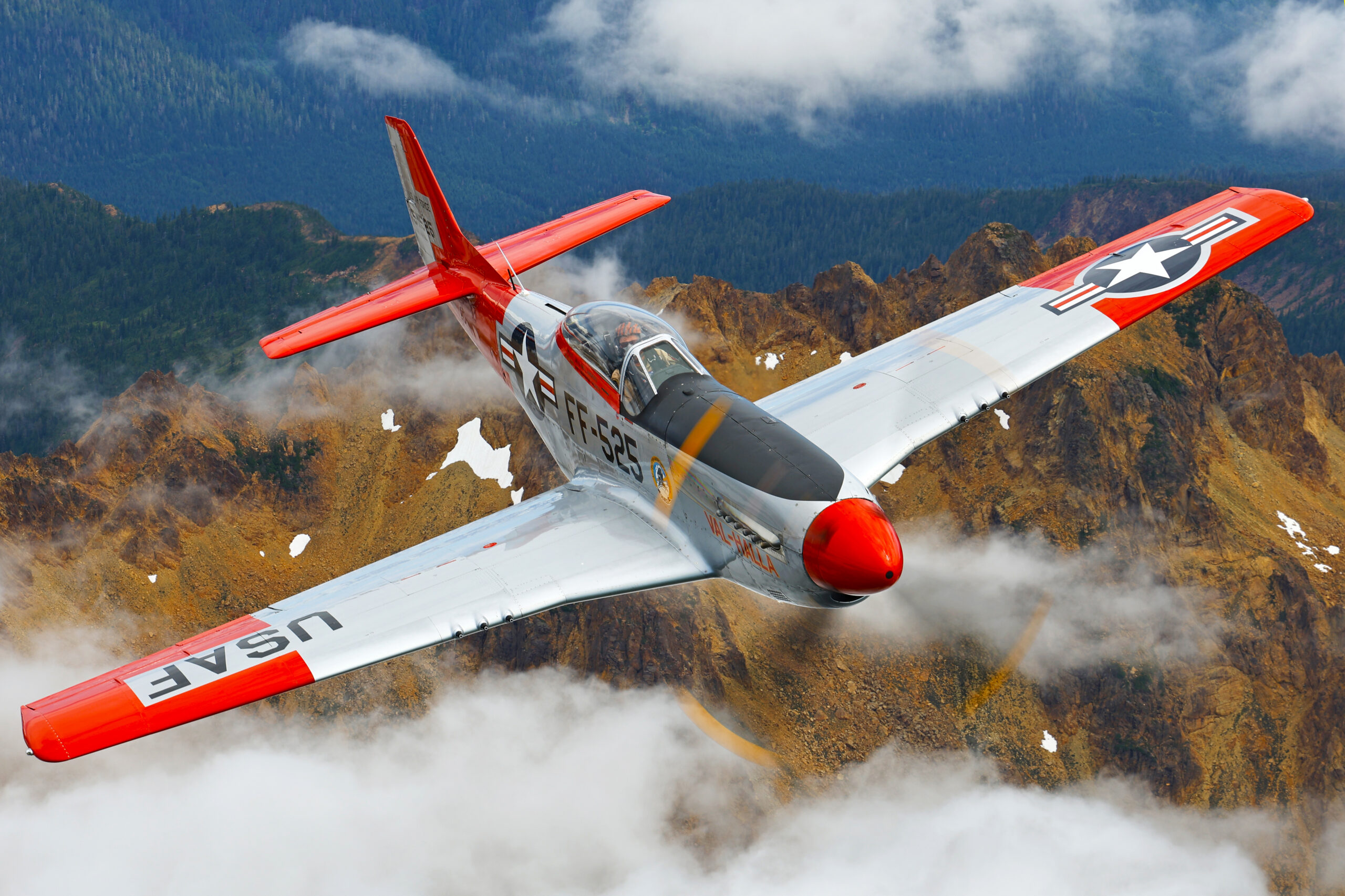
You will find Mustangs in the great national collections, including the Smithsonian’s National Air and Space Museum and the National Museum of the United States Air Force, in British collections, and in the hands of private owners and warbird operators who fly them at displays each season. Two-seat conversions, the TF-51 type, allow a fortunate few to fly in the back seat. For anyone wanting to photograph one, the Mustang rewards the effort: the elliptical-edged wing, the long nose, the gleaming natural-metal finish many wear and the unmistakable note of the Merlin all make it a favourite subject. If you photograph warbirds at displays, the same principles that apply to other propeller aircraft apply here, and our guide to choosing lenses for aviation photography and our airshow photography tips are good starting points for getting the propeller blur and the light right.
Why the Mustang still matters
The Mustang’s reputation rests on a genuine turning point rather than on myth, although it has gathered plenty of myth along the way. It did not win the air war single-handed, and it was not, as is sometimes claimed, simply the best fighter of the war in every respect. What it did was solve a specific and desperate problem at the moment it most needed solving. The daylight bombing of Germany was failing for want of an escort that could go the distance. The Merlin Mustang could, and that capability, used aggressively from early 1944, helped break the back of the German fighter force before the invasion of Europe.
It is also a story about engineering judgement and industrial co-operation: a clean American airframe, a British engine built under licence in Detroit, and a willingness on both sides of the Atlantic to recognise that the combination was greater than either part alone. That is a more interesting and more accurate legacy than the simpler legend of a wonder-plane. The Mustang belongs alongside the other defining aircraft of its era, the Supermarine Spitfire, whose Merlin it shared, and the heavy bombers such as the Avro Lancaster whose American counterparts it was built to protect. For more on why these aeroplanes still hold our attention, see our piece on why aviation history still matters.
For original photography of preserved Mustangs and other classic aircraft, the Piemags archive galleries hold a growing collection, and prints and image licences are available through the licensing page.
Design and construction in detail
Behind the clean lines was a conventional but very well executed piece of engineering. The Mustang was an all-metal, stressed-skin, low-wing monoplane with a retractable tailwheel undercarriage, the standard layout for a modern fighter of its day. What set it apart was the care taken to keep drag low everywhere, not just in the wing. The fuselage was tightly faired around the engine and the pilot, the joints between panels were kept smooth, and the whole machine had a finished, considered look that reflected North American’s fresh-sheet approach.
The wing itself was built around two main spars and carried the main undercarriage, which retracted inwards into the wing, giving a wide and stable track for ground handling, a real virtue on rough wartime strips. Fuel was carried in the wings, and on the Merlin aircraft an additional tank was fitted in the fuselage behind the pilot to extend range. That fuselage tank was the key to reaching Berlin, but it came with a penalty. With it full, the aircraft’s centre of gravity moved aft, and handling became sensitive, with reduced stability, until that tank was burned down. Pilots learned to use the fuselage fuel first, on the outbound leg, so that the aircraft was back to its well-mannered self by the time combat was likely.
The cooling system that gave the Mustang its distinctive belly scoop was carefully designed, with a movable flap at the rear of the duct to control airflow and temperature. The radiator handled both the engine coolant and, in the Merlin aircraft, the intercooler for the supercharger. Keeping the big liquid-cooled engine cool without paying too much in drag was one of the design’s quiet triumphs, and it is a reminder that the Mustang’s performance came from many small, careful decisions rather than any single trick.
Armament on the definitive P-51D was six .50 calibre Browning machine guns in the wings, three to a side, mounted upright so the ammunition belts fed smoothly. This cured the jamming that had troubled the canted guns of the B and C models. The .50 calibre battery was hard-hitting against fighters and adequate against many ground targets, though it was lighter than the cannon armament favoured by the RAF and the Luftwaffe. For ground attack the Mustang could carry bombs or rockets under the wings, and in this role its liquid-cooled engine was a weakness, since a single bullet through the radiator or coolant lines could bring it down, where a radial-engined aircraft like the Thunderbolt might shrug off the same hit.
Fighting the Luftwaffe
The air battles over Germany in 1944 were not simple duels. The Luftwaffe developed heavy fighter formations, with cannon-armed and armoured Focke-Wulf Fw 190 assault aircraft tasked with breaking up the bomber boxes, screened by Messerschmitt Bf 109s whose job was to keep the escorts off them. The Mustang’s task was to get through that screen and break up the attacks before they reached the bombers, and increasingly to hunt the German fighters down before they could form up at all. This is where Doolittle’s decision to free the fighters paid off. By carrying the fight to the German fighters across the whole route, the Mustangs forced the Luftwaffe to fight on unfavourable terms and bled away its irreplaceable experienced pilots.
Strafing airfields was a central part of this, and it was dangerous work. Ground fire was heavy, and the vulnerable cooling system meant that a strafing run that would have been survivable in a Thunderbolt could be fatal in a Mustang. Many Mustang pilots were lost not in air combat but to flak while attacking targets on the ground. The official records and unit histories make clear that destroying the Luftwaffe was as much about attrition on the airfields and in the training system as about victories in the air.
How it compared with its rivals
It is tempting to rank wartime fighters in a neat order, but the honest answer is that each was built around different priorities. The Supermarine Spitfire, sharing the same Merlin engine, was a better short-range interceptor and could out-turn the Mustang, but it never had anything like the Mustang’s range, which limited it to the defensive and close-escort roles. The Republic P-47 Thunderbolt was tougher, with its air-cooled radial engine and heavier firepower, and was a superb ground-attack aircraft, but in its wartime forms it could not match the Mustang’s reach. The German Bf 109 and Fw 190 were dangerous opponents to the end, particularly in skilled hands, but by 1944 the Luftwaffe was short of trained pilots and fuel, and numbers and pilot quality told.
The fair conclusion is that the Mustang was the best aircraft available for the specific and vital job of long-range bomber escort, and a thoroughly good fighter in general, rather than a machine that beat all comers in every category. That distinction matters, because it is the long range, more than any single performance figure, that explains why the Mustang occupies the place it does in the history of the air war.
Production and the long-range Pacific missions
Mustang production ran at two main North American plants, the original works at Inglewood in California and a second line at Dallas in Texas, which is why otherwise similar aircraft carry different letters, the Inglewood-built P-51B and the Dallas-built P-51C being the clearest example. Building more than 15,000 aircraft demanded a mature production system, and the parallel manufacture of the Packard Merlin engine in Detroit was an equally large undertaking. The result was a fighter that was not only excellent but available in quantity at the moment it was needed, which is its own kind of war-winning quality.
In the Pacific, the Mustang’s defining missions were the very long range escorts flown from Iwo Jima once that island had been taken in 1945. The first such mission to the Tokyo area was flown in early April 1945, when Mustangs escorted B-29s over the Japanese capital. These were gruelling flights, several hours over open ocean with only a single engine and a magnetic compass between the pilot and the sea. The combat results were mixed, the high-flying B-29s did not always need close escort and Japanese fighter opposition was uneven, so the Mustangs increasingly turned to strafing airfields and other targets on the home islands. The campaign demonstrated the aircraft’s extraordinary range one more time, in conditions every bit as demanding as the long hauls over Germany.
Frequently asked questions
What made the P-51 Mustang so important in the Second World War?
Its combination of long range and high-altitude performance. Once fitted with the Packard-built Rolls-Royce Merlin engine, the Mustang could escort American heavy bombers all the way to Berlin and back, something no other single-engined Allied fighter could do at the time. That allowed the Allies to take the fight to the German fighter force across the whole depth of Germany, which was decisive in winning air superiority before D-Day.
Why was the early Mustang considered a failure?
It was not a failure so much as the wrong engine for the high-altitude job. The original Allison V-1710 engine lacked a high-altitude supercharger, so the aircraft’s performance fell away above about 15,000 feet. Down low it was excellent, and the RAF used it successfully for armed reconnaissance, but it could not fight effectively at the heights where the bombers were being attacked. Fitting the Merlin solved the problem.
What is the difference between the P-51B, C and D?
The P-51B and P-51C were the first Merlin-powered production versions, built at different factories, with four machine guns and a framed razorback canopy. The P-51D introduced a cut-down rear fuselage, a clear bubble canopy for all-round vision and six machine guns. The D was the most numerous and is the version most people picture.
How many P-51 Mustangs were built, and how many survive?
More than 15,000 Mustangs of all variants were built, the P-51D accounting for around 8,000 of them. Today somewhere over 300 complete aircraft survive worldwide, with well over 100 kept in flying condition, making it one of the most commonly seen warbird fighters at airshows.
Did the Mustang serve after the Second World War?
Yes. Redesignated F-51 after 1947, it saw heavy use as a ground-attack aircraft in the Korean War into 1953, flew with Air National Guard and reserve units through the 1950s, and served with many foreign air forces for years afterwards. Its very last use in American service was as a chase aircraft in 1968.
Was the laminar-flow wing really a breakthrough?
It helped, but its role is often overstated. The wing was really low in drag, which contributed to the Mustang’s speed and range. Whether it maintained true laminar airflow in everyday squadron conditions, with painted and riveted surfaces, is doubted by many engineers. It is fair to call the wing excellent and efficient, and fair to be cautious about the more dramatic claims made for it.
How fast was the P-51 Mustang?
The definitive Merlin-engined P-51D had a top speed of about 437 mph at altitude. That mix of high speed, long range and honest handling was what made it such an effective bomber escort and dogfighter.
Why did the P-51 use a British Rolls-Royce Merlin engine?
The original Allison-engined Mustang performed poorly at high altitude, which blunted its value as a fighter. Fitting the Rolls-Royce Merlin, built under licence in the United States by Packard, transformed its high-altitude performance and turned a disappointing aircraft into one of the finest fighters of the war.
Who were the Tuskegee Airmen who flew the Mustang?
The Tuskegee Airmen were America’s first African American military pilots, flying with the segregated 332nd Fighter Group. Their red-tailed P-51 Mustangs escorting bombers over Europe earned them the nickname the Red Tails and a lasting place in both aviation and civil-rights history.
The Mustang is inseparable from the bomber it escorted. Read the full history of the Boeing B-17 Flying Fortress and the daylight campaign it carried over Europe.
