
Aviation has never been more visible than it is today. Aircraft are photographed constantly, on flightlines, at airshows, through fences, from terminals, and across social media platforms that reward speed and novelty above all else. Images circulate instantly, stripped of context, date, provenance, and often accuracy.
Yet aviation history has never been more vulnerable to distortion.
This journal exists because aviation is not simply something to be seen, it is something to be understood. Every aircraft, photograph, and archive record sits within a wider story of technology, doctrine, industry, politics, and human experience. Without that context, even the most striking image becomes little more than visual noise.
The purpose of the Piemags Aviation Journal is to slow the pace down.
What this guide covers
- Aviation Beyond the Image
- The First Photograph of Powered Flight
- Photographs as Evidence
- How Photography Changed Aviation Itself
- The Value of Archives in a Digital World
- What Gets Lost When Nobody Keeps the Plates
- Aviation Photo Archives You Can Explore Today
- How to Read a Historic Aviation Photograph
- The Digital Flood and the New Scarcity
- What You Can Do: Photographing Today for Tomorrow
- What This Journal Will Cover
- A Journal, Not a Feed
- Looking Ahead
- Frequently asked questions
Aviation Beyond the Image
Photography remains central to aviation documentation, but images alone are not enough. A photograph of an aircraft tells us what existed at a moment in time; history explains why it existed, how it was used, and what followed.
A fighter photographed at an airshow carries a different meaning when placed within its operational history. A preserved warbird tells a richer story when its development, service life, and postwar survival are understood. Even a routine transport aircraft gains significance when viewed through the lens of logistics, strategy, and global reach.
This journal treats aviation photography not as an end in itself, but as an entry point into deeper examination.
The First Photograph of Powered Flight
On the morning of 17 December 1903, on the wind-scoured sand below Kill Devil Hills in North Carolina, Orville Wright set up a tripod and mounted the brothers’ Gundlach Korona V view camera on top of it. He aimed it at a point near the end of the wooden launching rail, focused the lens, slid in a holder carrying a five by seven inch glass plate, and asked John T. Daniels, a crewman from the nearby Kill Devil Hills Life-Saving Station, to squeeze the rubber bulb if the machine did anything worth recording.
Daniels had never taken a photograph in his life. He admitted afterwards that when the Flyer rose from the rail he was so excited that he could not say for certain whether he had squeezed the bulb at all. He had. When Orville developed the plate back home in Dayton, it showed the Flyer a few feet above the rail at the instant of lift-off, Orville prone at the controls, Wilbur caught mid stride at the wingtip, the launching dolly abandoned beneath the machine. The first photograph of a powered aeroplane in flight was also the first photograph its maker had ever taken.
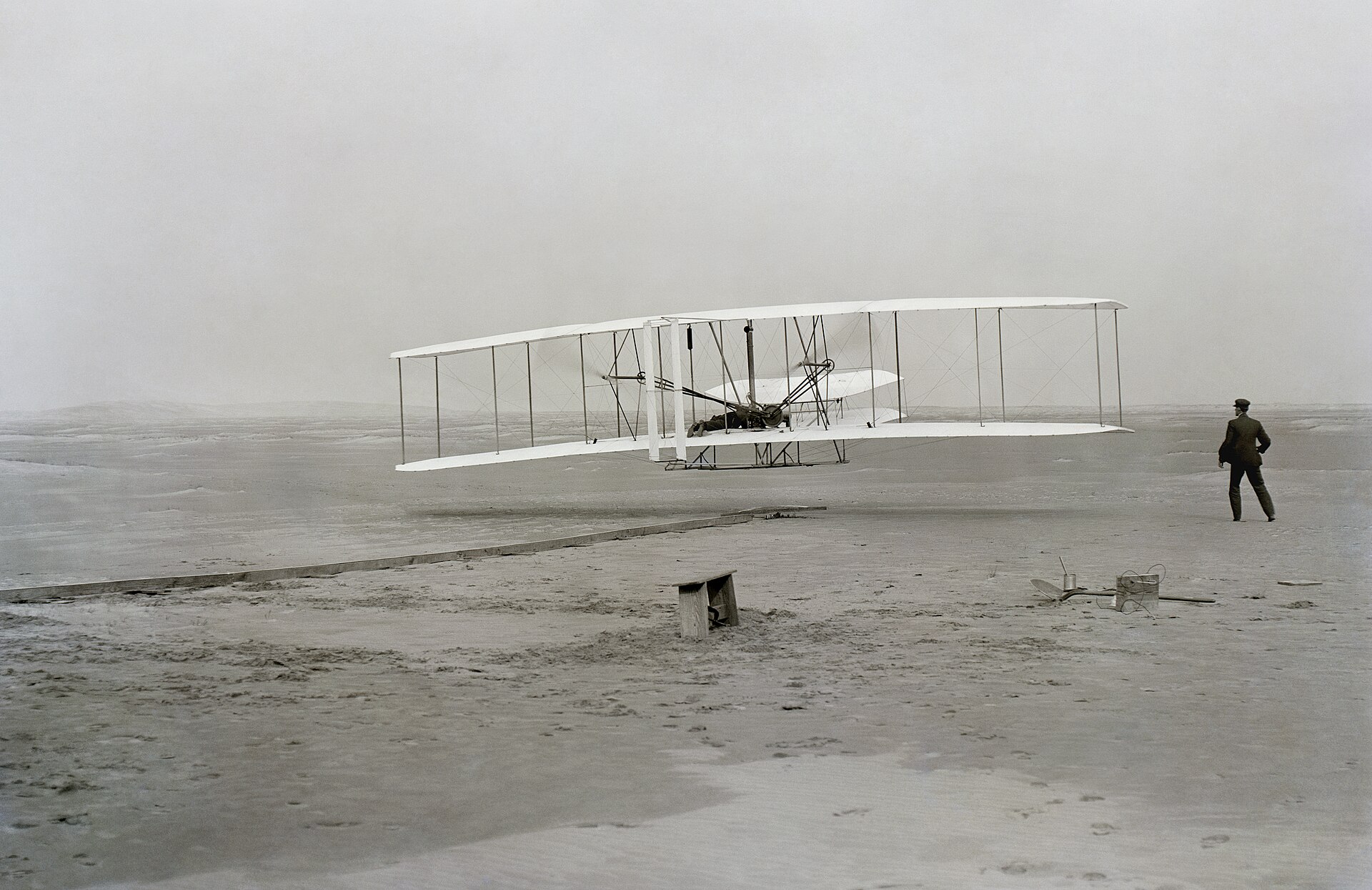
The margin between record and rumour was remarkably thin that morning. Five men witnessed the flights of 17 December. Three glass plates were exposed across the whole day. No press photographer was present, no newsreel camera, no crowd. Had Daniels frozen, had the plate cracked on the long journey back to Ohio, had the emulsion failed, the most consequential few seconds in the history of transport would survive today only as the word of a handful of witnesses and two interested parties.
That single image has since done more work than almost any photograph in the history of technology. It has illustrated every serious account of the invention of the aeroplane. It has been enlarged, annotated and examined inch by inch by historians looking for details of rigging, control surfaces and propeller position. And it settled, permanently, what the moment actually looked like, which is something no written account, however honest, can quite do.
None of this was pure luck. The Wrights were methodical record keepers who treated the camera as an instrument of proof, photographing their gliders, their camps and their experiments season after season because they understood that a claim of this magnitude would one day need evidence. The lesson has not aged: the photograph exists because somebody decided, in advance, that the moment deserved a camera.
There is a coda that sharpens the point. After the fourth flight of the day, a gust of wind caught the parked Flyer and rolled it over, with Daniels clinging on inside the tumbling machine; he escaped bruised, and in later life liked to describe himself as the survivor of the first aeroplane accident. The aircraft was damaged beyond repair and never flew again. Every photograph of the 1903 Flyer in the air therefore dates from one single morning. The window for making the record opened at about half past ten and closed before lunch, and it will never open again. Most historic moments are like that; we just rarely see the edges of the window so clearly.
Photographs as Evidence
A photograph does something that no amount of testimony can: it fixes an event at a place and a time, in a form that can be inspected by people who were not there. Early aviation was, among other things, a contest of claims, and it is striking how consistently the photographic record decided whose claims entered history.
Having flown, the Wrights largely stopped showing anyone. Protective of their patents and wary of imitators, they did not fly in public until 1908, nearly five years after Kitty Hawk. In Europe, where nobody had seen them fly and few had seen their photographs, scepticism hardened into open disbelief, and the French aeronautical establishment felt entitled to regard powered flight as still unclaimed.
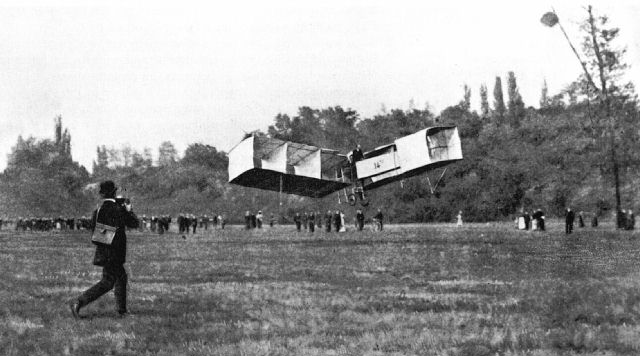
Into that vacuum stepped Alberto Santos-Dumont. On 23 October 1906 he coaxed his tail-first 14-bis across the lawn at Bagatelle in Paris in front of a crowd and officials of the Aéro-Club de France, and in November he flew again over a longer distance. The flights were certified by the Aéro-Club de France, recognised by the FAI, reported by the press and recorded by Pathé, the first aeroplane flights to be captured by a film company. To much of Europe, Santos-Dumont was first because Santos-Dumont had been seen, photographed and filmed. The Wrights had flown three years earlier, but in public perception the deed and the evidence are hard to separate.
When Wilbur Wright finally flew in public in France in 1908, the demonstrations, and the photographs of them, ended the argument almost overnight. The doubters became converts because they could now see, and show others, what the Wrights had been claiming all along.
Consider the counter-example. Gustave Whitehead, a German-born engineer working in Connecticut, was reported in a 1901 newspaper account to have made a powered flight near Bridgeport more than two years before the Wrights. No photograph of either of his powered machines in flight is known to exist. In 2013 a researcher claimed that a blurred picture hanging on the wall in a panoramic photograph of a 1906 exhibition showed Whitehead airborne; the Smithsonian and Scientific American examined the claim and rejected it. Whatever Whitehead did or did not achieve, the absence of a photographic record has kept his claim on the margins for more than a century, while a single glass plate keeps the Wrights at the centre.
Photography did not merely record who flew and when. It decided whose flying became history.
That evidentiary role is under more pressure now than at any time since 1903. Convincing aviation images can be fabricated in seconds by anyone, at no cost, and they circulate faster than corrections ever will. The response cannot be to trust nothing; it has to be to value provenance, the traceable chain from plate or file to publication, more highly than we have ever valued it before. Which is, at bottom, what an archive is for.
How Photography Changed Aviation Itself
The relationship ran in both directions. Photography recorded aviation, but within a decade of Kitty Hawk it had also become one of the principal reasons aircraft existed at all. The reconnaissance aeroplane of the First World War was a camera with wings.
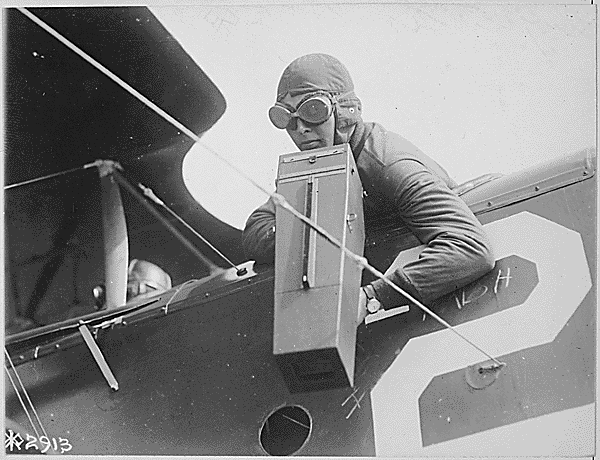
British squadrons followed the French in fitting cameras to their aircraft in early 1915. The first aerial photographers worked in the open, leaning over the cockpit side with a hand-held camera, exposing a glass plate, changing the plate holder with frozen fingers and leaning out again, all while under fire and keeping formation. Before the Battle of Neuve Chapelle in March 1915, British aircraft photographed the German lines in enough detail for intelligence officers to compile maps of the trench fortifications, and around 1,500 photographic maps were distributed to commanders before the attack. For the first time, a British offensive was planned on imagery gathered from the air.
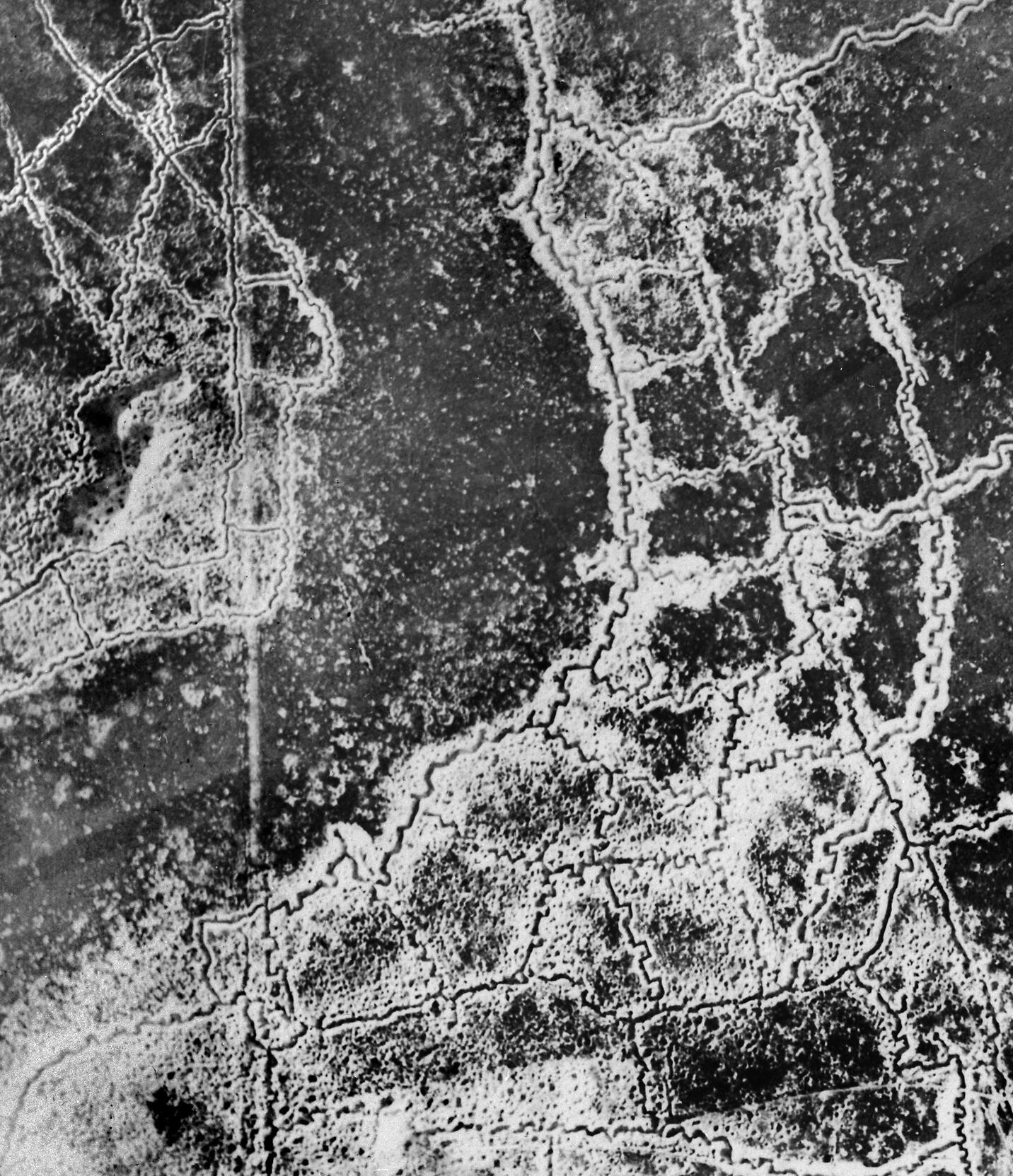
The scale of the effort grew beyond anything the pre-war world could have imagined. During the Battle of the Somme in 1916 the Royal Flying Corps took more than 19,000 aerial photographs of the German positions, reproduced as some 430,000 prints for the units that needed them. Overlapping vertical exposures were assembled into mosaics that mapped entire trench systems. By the end of the war, photographic interpretation had become a military discipline in its own right, and the Imperial War Museums today hold around 150,000 British aerial photographs from the First World War, the largest collection of its kind anywhere. The discipline reached its sharpest point in 1943, when interpreters at Medmenham identified a rocket on a trailer and set in motion the Peenemunde raid.
Photography also became central to the harder business of learning from failure. There is no better illustration than the loss of the de Havilland Comet G-ALYP off Elba in January 1954. Roughly three quarters of the wreckage was recovered from the seabed, in a salvage operation that pioneered the use of underwater television cameras, and the recovered pieces were fixed to a frame at Farnborough so that investigators could rebuild the aircraft and read the sequence of its destruction. A complete fuselage was then fatigue-tested in a water tank until it failed, revealing how pressurisation cycles had grown cracks from the corners of cutouts in the skin. Every stage was documented photographically, and the images from that investigation changed how every subsequent jet airliner was designed. We tell the fuller story in our history of the de Havilland Comet.
And photography taught people to see aircraft in the first place. By the outbreak of the Second World War the Royal Observer Corps had trained nearly 30,000 volunteers to identify aircraft by sight, and from January 1941 the fortnightly journal The Aeroplane Spotter fed the recognition movement with photographs, silhouettes and identification tests, many of the early silhouette cards traced directly from published photographs. Knowing what an aircraft looked like from below, at speed, in poor light, was a matter of life and death for gunners, observers and pilots alike, and the raw material of that knowledge was the photographic record.
It is a short step from those recognition photographs to the aircraft profiles we publish in this journal. Our histories of types such as the Supermarine Spitfire rest on the same accumulated visual record, built up frame by frame over a century.
The Value of Archives in a Digital World
Modern aviation content is abundant. Archival aviation material is not.
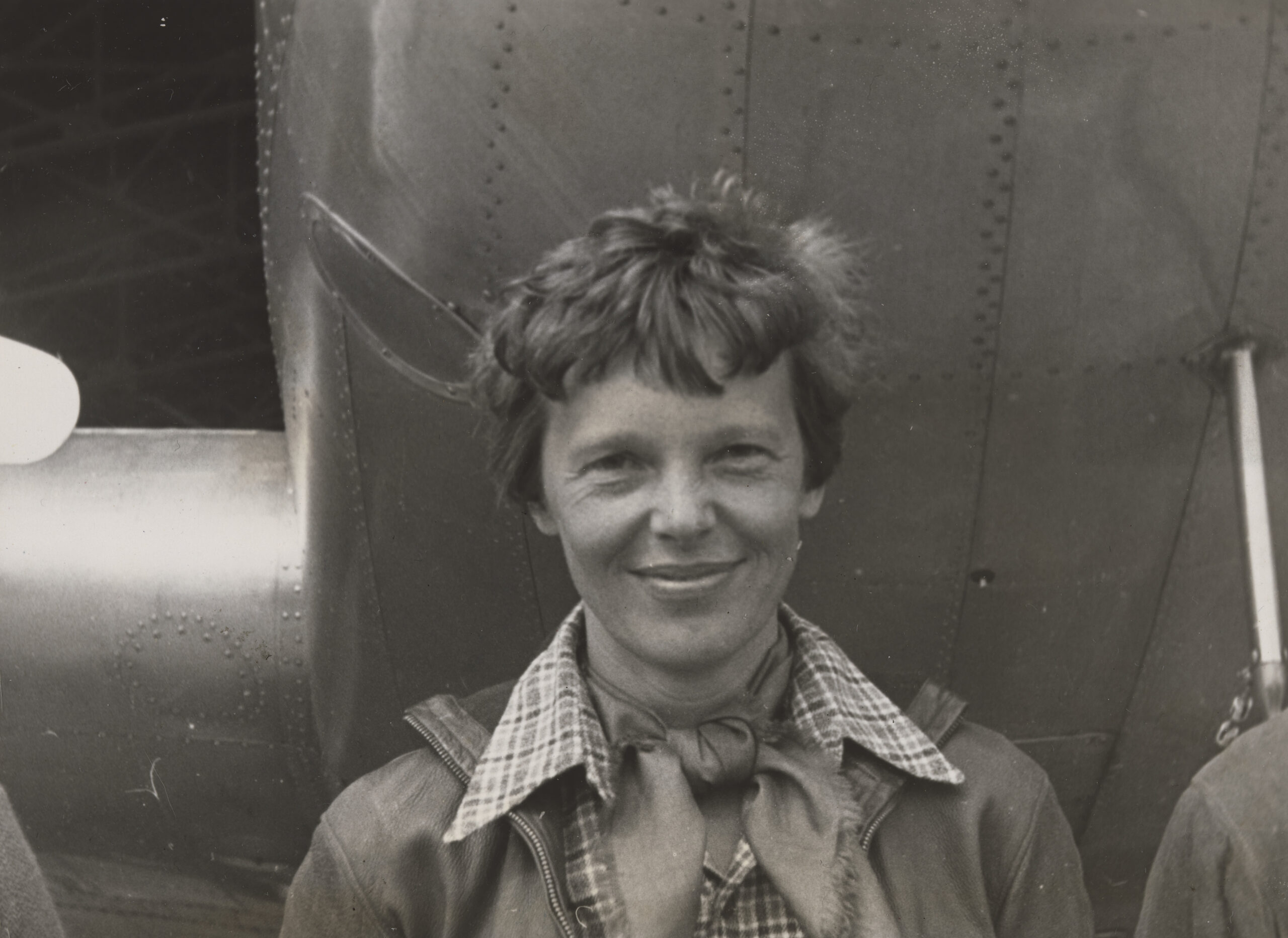
Historical photographs, manuals, documents, and contemporary accounts form the backbone of serious aviation study, yet much of this material remains fragmented, miscaptioned, or poorly contextualised online. Once errors propagate, they become difficult to correct.
One of the aims of this journal is to reconnect aviation imagery with reliable historical frameworks, placing aircraft, people, and events back into their correct technical and operational setting. That applies as much to modern aviation as it does to material from the early years of flight, the world wars, and the jet age.
Archives are not static collections; they are working tools for interpretation and understanding.
What Gets Lost When Nobody Keeps the Plates
Every photographic medium carries the seeds of its own destruction, and the history of aviation photography is also a history of near misses, rescues and irreversible losses.
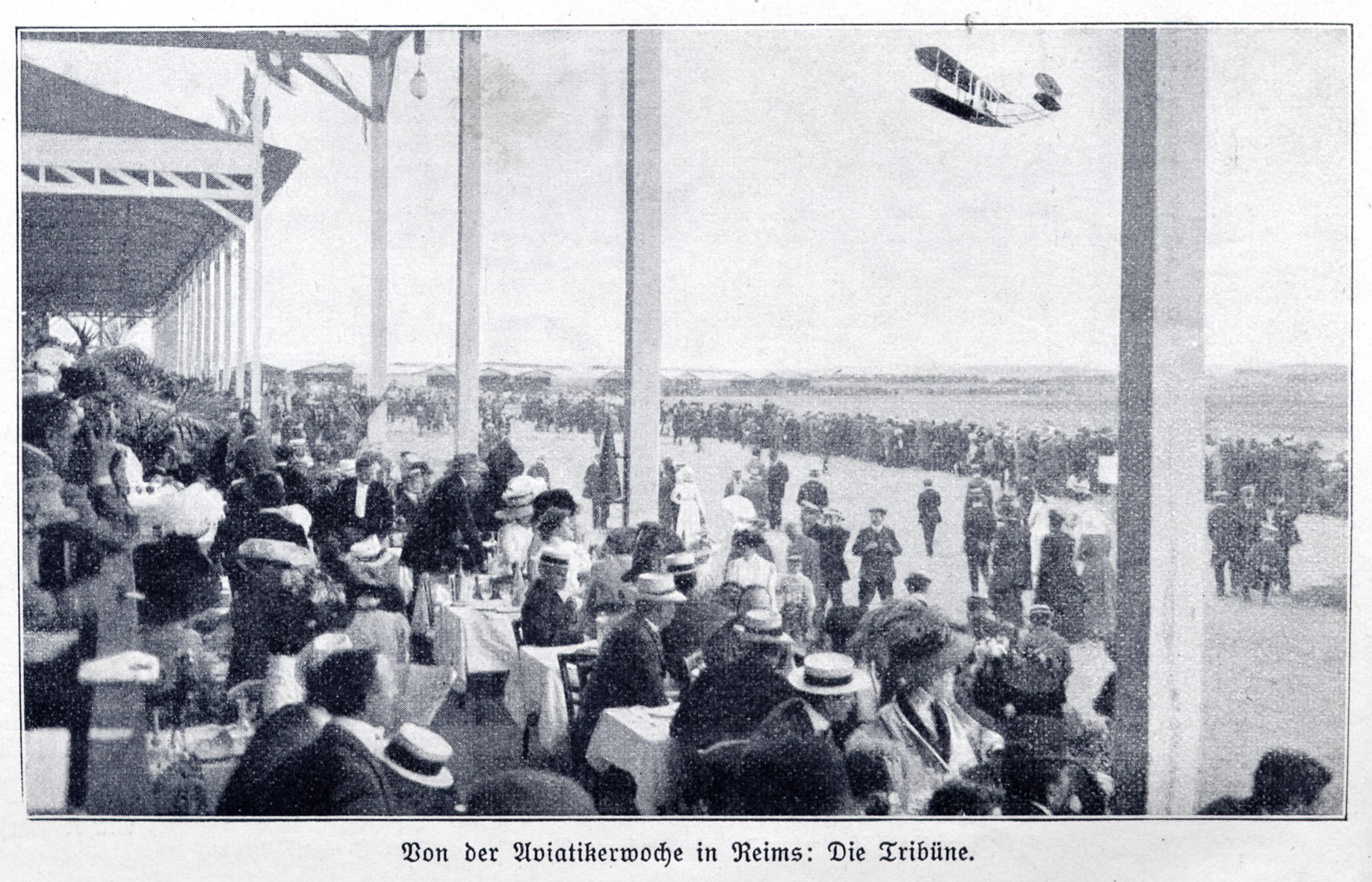
The glass negative, the standard professional medium from the Victorian era well into the twentieth century, is capable of astonishing resolution; a well-made plate from 1910 can be enlarged today to sizes its maker never dreamed of. But glass is heavy, brittle and bulky. A moment of carelessness destroys a plate outright, damp lifts the emulsion, and a working press archive of plates weighs tonnes and fills rooms. When studios closed, when newspapers moved premises, when picture agencies merged or folded, plate collections were expensive to keep and easy to skip, and a great many of them simply went into builders’ rubble. Nobody kept a register of what was thrown away, which is precisely the problem: we cannot count what we no longer have.
Film brought its own dangers. Cellulose nitrate stock, the industry standard from the 1890s to the early 1950s, is chemically unstable. It decomposes over time, the gases it gives off are flammable and toxic, and decomposing nitrate can ignite on its own in a warm store. On 7 December 1978 a vault fire at the US National Archives facility at Suitland, Maryland destroyed about 12.6 million feet of Universal newsreel film shot between 1929 and 1967, most of it unique, unreleased footage that included Second World War combat material. It burned in an afternoon, and no copy exists.
What survives, survives because somebody chose to keep it. Charles E. Brown, one of Britain’s great air-to-air photographers, spent four decades photographing British aircraft for the press and the aviation industry; his archive of around 30,000 images passed to the RAF Museum, where it is preserved, catalogued and available to researchers today. In France, the glass plate archives of the press agencies Rol, Meurisse and Mondial Photo Presse, some 205,000 negatives spanning 1904 to 1937, passed to the Bibliothèque nationale de France, and around 82,000 of them can now be browsed freely online through Gallica. The Rol agency had begun by specialising in sport, aeronautics among it, which is why the infancy of French aviation is so richly documented there.
Britain has its own version of that story. The Daily Herald, launched in 1911 and for a period the best selling daily newspaper in the world, accumulated an archive of some 3.5 million photographs, contact sheets and glass negatives across half a century of news coverage before it ceased publication in 1964. The collection survived the death of its newspaper and is now held at the National Science and Media Museum in Bradford, thousands of its glass plates carrying images that were never printed and exist nowhere else. It could very easily have gone the other way. Archives tend to die when their owners do, unless somebody intervenes.
Survival, in other words, is a decision, made by an institution, a family or a collector, usually at the exact moment when keeping the material is least convenient. Readers of this journal have already seen what such decisions preserve: our long read on the French aviation pioneers of 1908 to 1932, a golden age rescued from the glass plates, and our companion piece on Louis Blériot, both depend on plates that could very easily not exist.
Aviation Photo Archives You Can Explore Today
The good news is that an extraordinary amount of historic aviation photography is now within reach of anyone with a web browser, much of it free to view and clearly catalogued. These are the collections we return to again and again.
| Archive | Where to look | What it holds |
|---|---|---|
| Imperial War Museums (UK) | IWM collections online | Around 11 million photographs of modern conflict, including some 150,000 British First World War aerial photographs, the largest such collection anywhere |
| Royal Air Force Museum (UK) | Collections online and research enquiries | The photographic history of British military aviation from 19th century ballooning onwards, including the Charles E. Brown collection of around 30,000 images |
| Smithsonian National Air and Space Museum (US) | Smithsonian Online Virtual Archives | More than 3 million photographs spanning the history of flight, with thousands digitised and viewable online |
| San Diego Air & Space Museum (US) | Flickr Commons | More than 300,000 images shared online under no known copyright restrictions, drawn from a library of over a million aviation photographs |
| Library of Congress, Bain collection (US) | Prints & Photographs Online Catalog | The files of America’s first news picture agency, founded 1898, with roughly 40,000 digitised glass negatives and strong early aviation coverage |
| Bibliothèque nationale de France | Gallica | The glass plate archives of the Rol, Meurisse and Mondial press agencies: 205,000 negatives from 1904 to 1937, around 82,000 viewable online |
Each of these collections rewards slow browsing rather than targeted searching. The Bain collection alone repays an afternoon: George Grantham Bain’s agency photographed the aviation meetings, record attempts and personalities of the pioneer era as news, and its glass negatives preserve moments that were never intended to be historic.
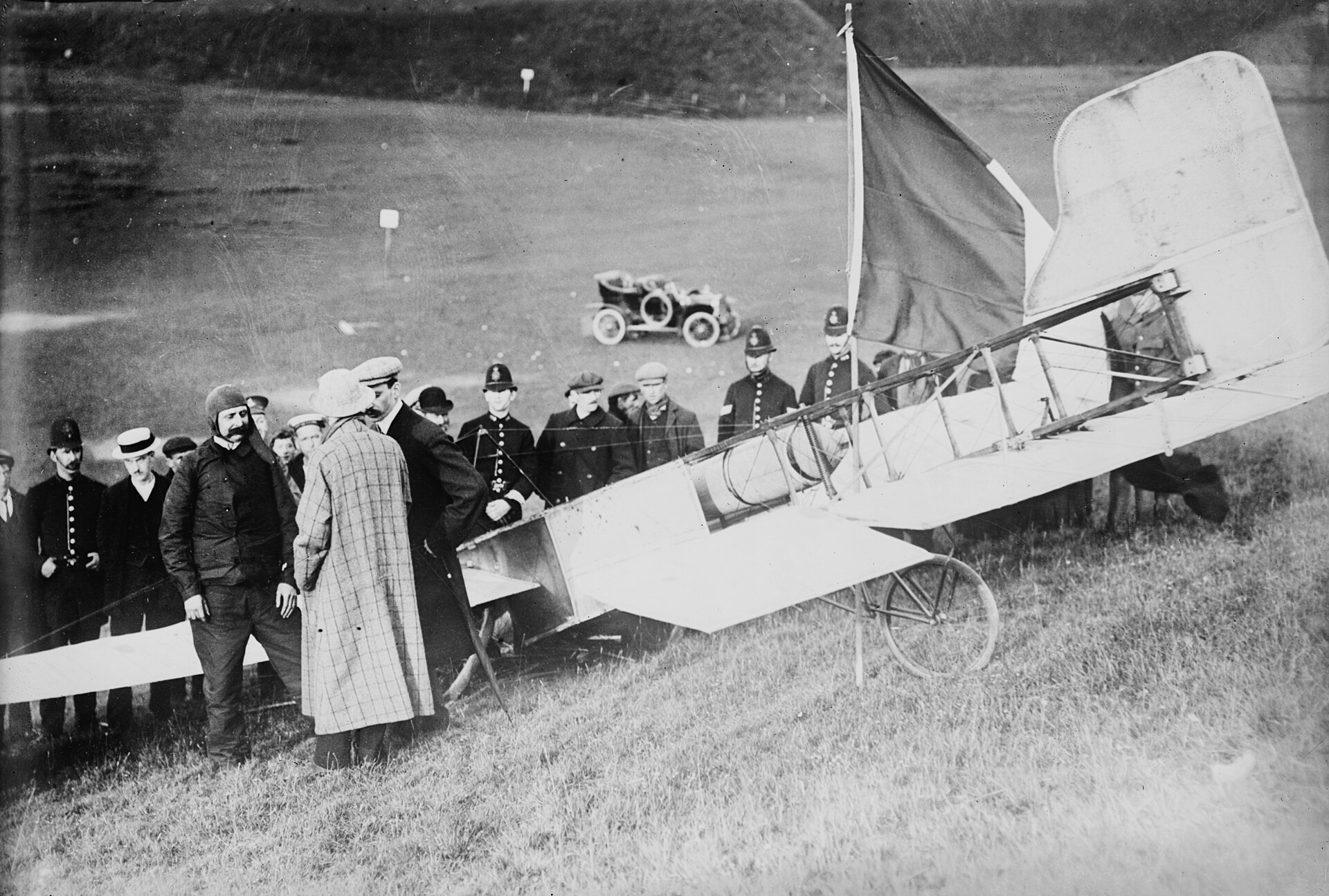
Institutional scale is not the whole story either. Smaller specialist collections, including our own, hold material that the national archives never gathered, and the Piemags archive galleries sit alongside these public collections as another point of entry into the period.
A few habits make these collections far more useful. Search under every name an aircraft carried, manufacturer designations, service names, nicknames and common misspellings, because catalogues inherit the vocabulary of whoever wrote the original caption. Search by serial or registration where you have one. Note the reference number of anything you find, since a collection item without its reference is nearly as hard to relocate as an uncaptioned print. And check the rights statement before republishing anything: public visibility and public domain are not the same thing, and each institution states its own terms.
How to Read a Historic Aviation Photograph
Finding historic images is one skill; reading them is another. A large proportion of the aviation photographs circulating online carry captions that are wrong in some respect, the aircraft type mistaken, the date guessed, the location invented somewhere along a chain of re-posting. Approaching an old photograph properly is closer to fieldwork than to browsing, and it rewards a method.
Start with the caption, and then distrust it. A caption is a claim, not a fact, and captions detach from their images with every generation of copying. Where possible, trace the picture back to the earliest source you can find, an agency plate, a museum catalogue entry, a period magazine, and note what that original caption actually says. It is usually more modest, and more honest, than the confident modern version.
Then interrogate the aircraft itself. Markings are the richest seam of evidence: national insignia changed style at datable points, unit codes moved with the units that wore them, and a legible serial can tie a photograph to an individual airframe whose service record survives on paper. We wrote a full guide to military aircraft markings and serials for exactly this reason; they are the registration plates of aviation history, and they turn an anonymous machine into a traceable one.
The background usually says as much as the subject. Hangars, vehicles, uniforms, advertising boards, the dress of the spectators, all of these place and date an image within surprisingly narrow bounds. A photograph of a fighter is also, incidentally, a photograph of a fuel bowser, a hedgerow and a fashion in hats, and any one of those details can settle an argument that the aircraft alone cannot.
The medium is evidence too. A glass plate, a roll film negative and an early 35mm frame imply different photographers, different budgets and different decades, and prints, mounts and papers carry their own dating clues. None of this demands laboratory skills. Most of it is pattern recognition, and pattern recognition is learned the enjoyable way, by looking at thousands of photographs with the captions covered. If that sounds like plane spotting transplanted into the past, that is precisely what it is, and the habits described in our guide to plane spotting for beginners transfer directly to the archive.
Finally, respect the line between what you know and what you infer. A disciplined caption separates the two: the serial is read from the print, the date is estimated from the markings, the location is suggested by the hangar style. Writing it that way leaves the next researcher something to build on rather than something to unpick. When we publish archive material in this journal we try to hold ourselves to that standard, and readers are welcome to keep us honest.
The Digital Flood and the New Scarcity
By one widely cited industry estimate, more than two trillion photographs were taken worldwide in 2025, roughly 94 per cent of them on smartphones. Set that figure against the three glass plates exposed at Kill Devil Hills on 17 December 1903, and the whole argument of this essay is contained in the comparison.
The same research suggests that around 14.3 trillion photographs had been taken in all of history by the end of 2024, with roughly 1.9 trillion of them made in 2024 alone. On those figures, a large and growing share of every photograph that has ever existed was made within the last few years, and almost none of it will ever be looked at twice.
Abundance changes what an image is worth. When a moment is photographed from a thousand angles, no single frame carries the burden of proof, and none is likely to be treasured. When a moment is photographed once, or not at all, the surviving frame becomes the event, for every historian, publisher, museum and reader who comes afterwards. The old images are historically precious for exactly the reason there are so few of them: each one is a small, unrepeatable act of preservation, made with heavy equipment, at real cost, by somebody who had to choose that subject over every other.
It is tempting to assume that today’s flood will preserve itself, that with this many photographs in existence, everything must be recorded somewhere. The evidence points the other way. Pew Research Center reported in 2024 that 38 per cent of webpages that existed in 2013 were no longer accessible a decade later, and that a quarter of all pages that existed at some point between 2013 and 2023 had already vanished. Link rot eats references; platforms close and take their image libraries with them; files outlive the software that reads them only if somebody takes the trouble to migrate them. A photograph on a dead platform is no more accessible than a plate in a skip.
Formats age just as ungracefully. Proprietary raw files depend on software that manufacturers have no obligation to maintain, discs and cards depend on drives and readers that are already vanishing from shops, and a folder structure that makes perfect sense to its owner is an unlabelled shoebox to everyone else. A glass plate from 1910 can be held up to the light and read by anyone with eyes. A memory card from 2010 already asks more of its finder than that, and the gap widens every year.
So the archivist’s problem has inverted. For the glass plate era, the challenge is the physical survival of a scarce object. For the born-digital era, it is finding, in an ocean of images, the ones with reliable dates, captions and provenance, and keeping them readable for decades. An uncaptioned image is historically almost worthless, whatever its resolution, and the great majority of the two trillion photographs taken each year carry no caption at all.
What You Can Do: Photographing Today for Tomorrow
All of which leads somewhere practical, because the historical record of our own era is being made, or not made, right now, and much of it will be made by enthusiasts rather than institutions.
Photograph the ordinary, deliberately. The routine is always the first thing to disappear from the record, because nobody thinks it worth a frame. The check-in desk, the fuel bowser, the crew bus, the everyday liveries, the regional turboprop on a wet Tuesday: these are the aviation equivalents of the street scenes that historians now prize from a century ago. The displays and the anniversaries will be photographed by hundreds of people. Today’s routine ramp scene is tomorrow’s history, and it may be photographed by nobody but you.
Caption and date everything. An aircraft type, a registration or serial, a place, a date and a line of circumstance turn a picture into a document. Write captions while you still remember the details, embed them in the file metadata rather than in your memory, and keep the originals. A photograph with a caption is evidence; without one it is a puzzle for somebody else to solve, and most puzzles are simply set aside.
Photograph context as well as subjects. The airframe is only half the record; the scene around it is the other half. Pull back and include the crowd line, the ground equipment, the signage, the weather. Series carry more historical weight than singles: the same airfield photographed across seasons and years becomes a document of change in a way no single frame can. And keep your near misses; the exposure spoiled by a baggage truck may one day be the only surviving photograph of that baggage truck.
Print the best of your work. Prints tolerate decades of benign neglect in a way that files and accounts do not, and a labelled print in a box has outlived many a hard drive. Back up the digital originals in more than one place, and revisit the copies every few years rather than trusting a single service to exist forever.
And think about where your collection goes next. The great institutional holdings described above were built largely from the archives of individuals who made arrangements for them. If you have spent decades photographing aviation, a museum or archive may value the collection far more than you expect, and a conversation costs nothing. Approach the institution before anything is boxed up, ask what documentation they need, and be clear about copyright, because a collection whose ownership is tidy is far easier for an archive to accept and to use. A list of what the collection contains, however rough, multiplies its value to a curator. For the material we hold ourselves, our licensing page explains how images from the Piemags collection can be used in publications, exhibitions and research.
What This Journal Will Cover
The Piemags Aviation Journal will publish editorial articles spanning a broad range of aviation subjects, including:
- Aviation history and aircraft development
- Military, civil, and experimental aviation
- Airshows and public display in historical context
- Air-to-air photography and operational access
- Archival material and historical reference imagery
- The evolution of aviation technology and doctrine
Some articles will focus on individual aircraft types or periods. Others will examine wider themes, how aviation is recorded, remembered, and sometimes misunderstood.
What they will share is an emphasis on accuracy, context, and restraint.
A Journal, Not a Feed
This is not a fast-moving news feed, nor is it designed to chase trends. Articles are written to remain relevant over time, providing reference value rather than momentary attention.
In an era where aviation imagery is often consumed without reflection, this journal takes the opposite approach: fewer articles, written with care, grounded in research, and supported where appropriate by archival imagery. Care is easy to claim and harder to show, so the rules are published in one place: how the articles are researched, who writes them and what happens when one turns out to be wrong.
Aviation deserves that level of treatment.
Looking Ahead
Future articles will explore both well-known and overlooked aspects of aviation history, examine how aircraft have been documented across different eras, and consider how modern aviation imagery fits into a longer historical continuum.
The journal will also draw connections between editorial analysis and the wider aviation archive, allowing readers who wish to go deeper to explore original imagery and reference material alongside the written work.
This first article sets the tone.
What follows will build on it.
For readers who want to make their own aviation images, our guide to photographing aircraft at an airshow covers the settings, shutter speeds and technique in depth.
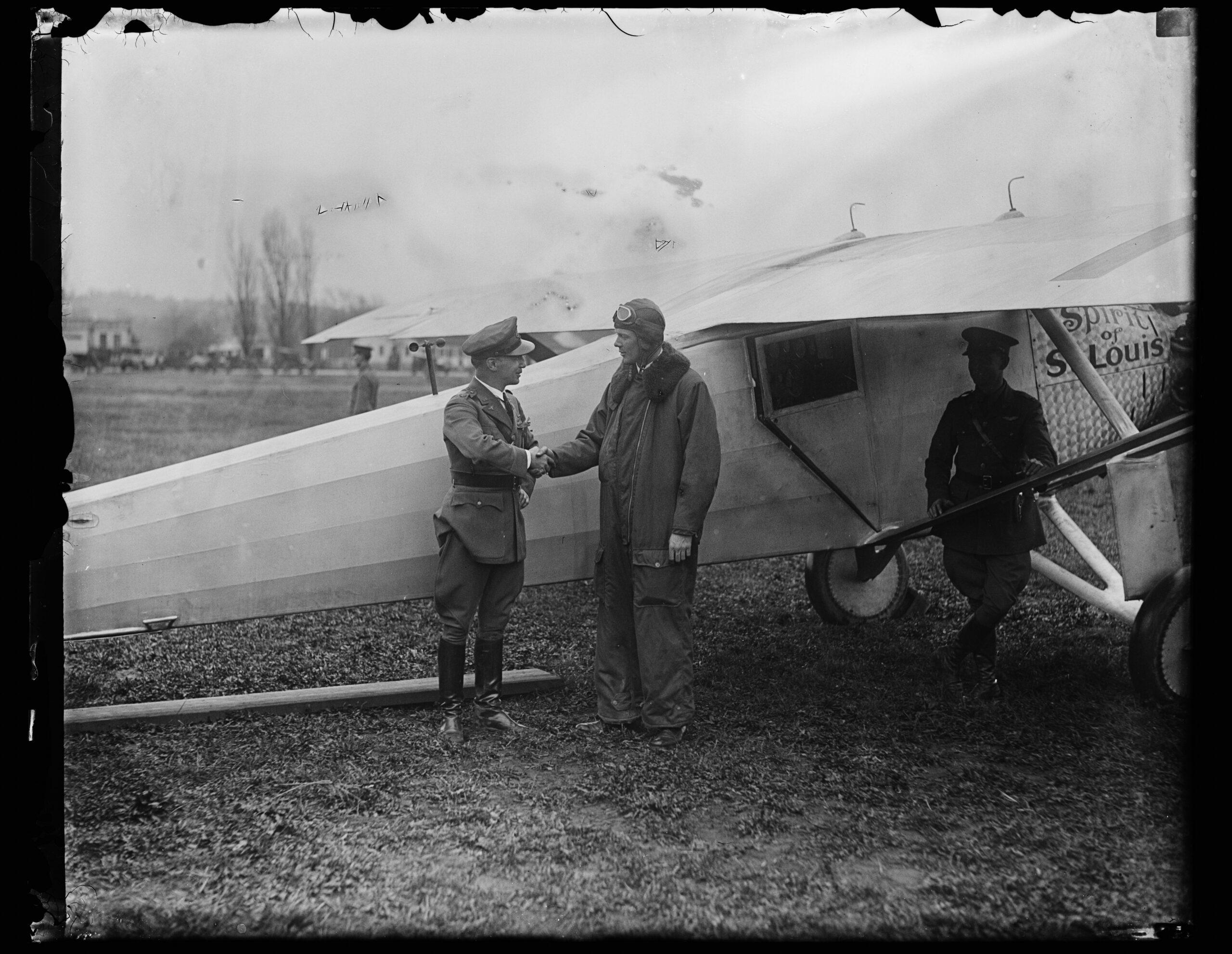
For a case study in how one flight changed an industry, see our account of Lindbergh and the Spirit of St. Louis, which sets the legend against the licensing statistics.
Frequently asked questions
Why does aviation history still matter in the age of instant imagery?
Because knowing how an aircraft, a mission or a photograph came to exist gives context that a single image cannot. History explains why a design looks the way it does, what it achieved and why it is worth preserving.
How does aviation photography help preserve history?
Photographs document aircraft, liveries and events that often no longer exist, creating a visual record that supports museums, researchers, publishers and enthusiasts long after the aircraft themselves are gone.
Why license or collect historic aviation images?
Authentic, well-documented images give accurate reference for publications, exhibitions and research, and they keep the stories of aircraft and the people who flew them alive for new audiences.
Where can I explore historic aviation photographs online?
Major free starting points include the Imperial War Museums collections site, the San Diego Air and Space Museum’s Flickr Commons stream, the Library of Congress Bain News Service collection and the Bibliothèque nationale de France’s Gallica platform, which hosts tens of thousands of digitised press agency glass plates.
Why do so few photographs exist of aviation’s earliest milestones?
Cameras of the era were bulky, plates were expensive and slow to change, and many early flights were private or unannounced. Only three glass plates were exposed at Kitty Hawk on 17 December 1903, and later losses of plates and nitrate film thinned the record further.
How can I make my own aviation photographs useful to future historians?
Caption and date every image with type, registration, place and occasion, keep the original files backed up in more than one place, print the strongest work, and consider offering long-term collections to a museum or archive rather than letting them disappear.
Why does aviation history still matter when we have so many photographs?
Aircraft are photographed constantly today, but images circulate instantly, stripped of context, date, provenance and often accuracy. A photograph tells us what existed at a moment, while history explains why it existed, how it was used and what followed. Without that context even the most striking image becomes little more than visual noise.
Why are old aviation archives valuable in a digital age?
Modern aviation content is abundant, but archival material is not. Historical photographs, manuals and contemporary accounts form the backbone of serious study, yet much of it remains fragmented, miscaptioned or poorly contextualised online, and once errors spread they are hard to correct. Reconnecting imagery with reliable historical frameworks keeps aircraft, people and events in their correct setting.
What does the Piemags Aviation Journal set out to do?
The journal exists to slow the pace down and treat aviation as something to be understood, not simply seen. It publishes carefully researched editorial articles on aircraft development, military and civil aviation, airshows in historical context and archival imagery, with an emphasis on accuracy, context and restraint. It is intended as a reference resource rather than a fast-moving news feed.
It all starts with twelve seconds over a North Carolina beach. For that story, see our account of the first powered flight and the Wright Flyer.
