On this page
- The prize nobody could win
- The men who died trying
- The men with better aeroplanes
- The man nobody had heard of
- Nobody would build him an aeroplane
- Sixty days in San Diego
- The decisions that look mad and were not
- What it actually was
- The flight nobody remembers
- The wait, and the night before
- Eight minutes to eight
- Twenty-eight hundred miles of nothing
- Dingle Bay
- Paris
- What happened on the ground
- What was certified, and what was not
- Home in a cruiser
- The cheque
- Eighty-two cities
- The eighteen months that followed
- What became of the aeroplane
- What became of the man
- Why it still matters
- A last thought about the take-off
- Frequently asked questions
- Sources
The field was wet. It had rained in the night and the dirt and cinders of Roosevelt Field had gone soft, and a wire service reporter standing at the edge of it wrote the words “water-soaked and slimy mud”. Into that, at eight minutes to eight on the morning of Friday 20 May 1927, a silver monoplane began to move. It weighed five thousand two hundred and fifty pounds, more than half of it petrol, and it had never in its life flown anything like that heavy.
It did not want to go. Past the halfway mark of the five thousand feet available it was still not at flying speed. It came unstuck, settled, came unstuck again. At the far end of the field there was a tractor, and beyond the tractor a telephone line, and beyond that a hill with high trees on it. The aeroplane cleared the tractor by about fifteen feet and the wires by about twenty, and turned slightly right to miss the trees, and went away east with a fair reserve of flying speed and nothing else in reserve at all.
Thirty-three and a half hours later a twenty-five-year-old air mail pilot who had never flown over an ocean landed in France, having made his Irish landfall three miles from where he intended, and the twentieth century changed its mind about what aeroplanes were for.
The prize nobody could win
It started with a hotelier. Raymond Orteig had come to New York from France as a boy, worked his way up from a cafe, and ended up owning the Hotel Lafayette and the Hotel Brevoort in Manhattan. In May 1919, with the war just over and pilots everywhere looking for something to do, he offered twenty-five thousand dollars to the first aviator to fly non-stop between New York and Paris. A newspaper prize had done the same work in Europe a decade earlier, as our account of Louis Bleriot and the Channel crossing describes.
He put the offer on the wires on 30 May 1919. Alcock and Brown did not take off from Newfoundland until 14 June, so the story you will read everywhere, that Orteig was inspired by their crossing, has the order of events backwards. The Smithsonian’s own record of the prize says it, and the dates disprove it.

Nobody claimed it. The offer had a five-year term and it ran out in 1924 with the money untouched. Orteig made a fresh offer in January 1925 and it was formalised on 1 June that year, under the rules of the National Aeronautic Association and the international body above it. A competitor had to hold an aviator’s certificate, enter his name on a register, and give sixty days’ notice.
Why did eight years pass? Not because nobody could cross the Atlantic. The Atlantic had been crossed in 1919 three separate ways: by a US Navy flying boat going by the Azores, by Alcock and Brown non-stop from Newfoundland to Ireland, and by a British airship, twice, in both directions. None of them claimed the Orteig money, because none of them had flown between New York and Paris. That is a longer flight, and it is the wrong shape.
The men who died trying
By the spring of 1927 the prize had begun to kill people.
In September 1926 the French ace René Fonck attempted it in a Sikorsky biplane loaded to a weight nobody had tested. It ran off the end of Roosevelt Field, went over an embankment and burned. Fonck and his navigator got out. The radio operator and the mechanic did not.

In April 1927 Noel Davis and Stanton Wooster crashed their Keystone during a final loaded test flight in Virginia. Both were killed.
Three weeks before Lindbergh’s take-off, on 8 May, Charles Nungesser and François Coli left Paris in a white Levasseur biplane called L’Oiseau Blanc, flying the route the other way. Nungesser was a French national hero with forty-three victories and a body full of old injuries. They were seen crossing the Irish coast. They were never seen again, and no wreckage has ever been confirmed. Newspapers in Paris printed that they had arrived in New York before anybody checked. French aviation of exactly those years, recorded on glass plates between 1908 and 1932, is the subject of our piece on the French pioneers and the photographs that survive of them.
Six men were dead. Two of the bodies were never found. And into that, in the same month, walked a completely unknown airmail pilot from the Midwest with no financial backing beyond a group of St Louis businessmen and no aeroplane at all.
The men with better aeroplanes
What is easy to lose now is that in May 1927 Lindbergh was the outsider, and not by a small margin.
Richard Byrd had a Fokker trimotor called America, backing from a department store magnate, and a reputation as a polar aviator. Clarence Chamberlin had a Bellanca called Columbia that had already set a world endurance record by staying up for more than fifty hours. Both were at the same pair of fields on Long Island. Both had crews, money and multiple engines.
The bookmakers were not wrong to prefer them. Chamberlin’s aeroplane could certainly have done it and eventually did something harder. Byrd’s had three engines and a navigator.
What neither had was a decision. Byrd’s team was still testing. Chamberlin’s was tangled in a legal argument about who would fly it. And the weather that had held everybody down for weeks broke on the evening of 19 May, and only one of the three camps moved.
Both flew the Atlantic within six weeks of him. Almost nobody remembers either.
The man nobody had heard of
Charles Lindbergh was flying the mail between St Louis and Chicago. It was the most dangerous flying job in America and it made him exactly the right man for this, for a reason that is not obvious. Airmail pilots flew alone, at night, in weather, on instruments they did not entirely trust, over country they could not see, for hours. Nobody else in aviation did that routinely.
He had also, twice, jumped out of a mail plane by parachute when the weather beat him. He knew what the job did to you.
What he did not have was money. He put in two thousand dollars of his own and persuaded a group of St Louis businessmen to find the rest, for a total in the region of fifteen thousand dollars. The precise contributions have never been published, and anyone who gives you a breakdown is inventing it. What the money bought was the name on the side of the aeroplane.
His flying hours at the time are also unrecoverable, and for a reason that tells you something about the day he landed: his logbook was stolen at Le Bourget within hours of the aircraft coming to a stop, and has never turned up.
Nobody would build him an aeroplane
The rivals had money and famous names. Lindbergh had an idea that everybody thought was wrong: that one engine and one man were better than three engines and a crew.
The logic was arithmetic, not bravado. Three engines meant three times the chance of an engine failure. A crew meant weight, and weight meant fuel he could not carry. He wanted a single-engined monoplane with the pilot behind all the fuel tanks, so that in a crash the tanks were not behind him waiting to come through the cockpit.

He went to the established manufacturers and got nowhere. Some would not build it. Others quoted delivery times measured in months he did not have, with Nungesser and Byrd and Chamberlin all preparing.
Then a telegram came back from a small company in San Diego called Ryan Airlines. They would build it. They would do it in sixty days.
Sixty days in San Diego
Ryan Airlines was not the Ryan of later fame. It had been an airline first, running Los Angeles to San Diego for fourteen dollars fifty one way, and had drifted into building mail planes. It occupied a former fish cannery. For where powered flight had started twenty-four years earlier, see our account of the Wright Flyer’s first flight. The chief engineer was a twenty-eight-year-old called Donald Hall, and he had been in the job about a month.
Hall and Lindbergh designed it together in the sense that Lindbergh specified and Hall solved. Hall wrote the whole thing up afterwards for the National Advisory Committee for Aeronautics, and that report is the reason we know the details as precisely as we do. It is the designer’s own account, written two months after the flight, and where the museums and the popular histories disagree with it, it is usually the museums and the popular histories that are wrong.
The starting point was Ryan’s own M-2 mailplane. Hall stretched the wing by ten feet to carry the load, moved the cockpit aft, and put the fuel where the cockpit used to be.
The decisions that look mad and were not
Almost everything remarkable about the Spirit of St. Louis is something it does not have.
No forward view
The main fuel tank sits between the pilot and the engine. There is no windscreen, and no way to see straight ahead at all. You look out of the side windows, or you use a small periscope on the left side, which a Ryan employee with submarine experience suggested and which Lindbergh agreed to try on condition it could be thrown away in New York if it was no use.

Asked about it, Lindbergh’s answer was flat: there is not much need to see ahead in normal flight. He would not be following airways. Near a field he could bank gently and look. He had been flying the mail from a rear cockpit with mail sacks stacked in front of him, so he was used to it.
No radio
The radio sets of 1927 were heavy and unreliable at that range. He left it out and bought fuel with the weight.
No sextant, and no navigator
He would cross an ocean by dead reckoning alone: a compass heading, a clock, and an estimate of the wind. He worked out the great circle on a gnomonic chart where it plots as a straight line, transferred the points at hundred-mile intervals onto Mercator charts, and joined them up. A course change every hundred miles, which is roughly every hour.
His justification is worth reading, because it is a calculation and not a gamble. Leaving out a navigator bought him about three hundred miles of extra range. Which meant that under normal conditions he could arrive over the coast of Europe three hundred miles off course and still reach Paris. He had reasoned that a landfall anywhere between northern Scandinavia and southern Spain would leave him alive.
What he steered by
Two compasses, one of them an earth inductor compass, which senses the earth’s magnetic field electrically and drives an indicator the pilot flies to. A magnetic compass as backup. A drift sight for measuring how much the wind was pushing him sideways. A stopwatch to time the drift sight. An eight-day clock.
That is the whole navigation fit. Two hydrographic charts of the North Atlantic carrying the great circle course and its bearing every hundred miles, and a map of every state, territory and country he expected to pass over. No means of establishing where he actually was at any point over the ocean.
No parachute, and no brakes
Both left off for weight. He had a rubber raft, a knife, some rations and five cans of army emergency rations.
A wicker chair
The pilot’s seat is basketwork. The uncontroversial reason is weight, a wicker chair against a leather one. Museums also say it was deliberately uncomfortable to help keep him awake, and the tradition is old and widely repeated, though Hall’s own report does not mention the seat at all.
What it actually was
Forty-six feet across the wing, twenty-seven feet eight inches long, three hundred and nineteen square feet of wing. One Wright Whirlwind radial, nine cylinders, air-cooled, a stock engine off the shelf, giving 223 horsepower at 1,800 revolutions in Hall’s figures.
Fuel: 450 US gallons, in three wing tanks and two fuselage tanks, with a twenty-five-gallon oil tank sitting between the pilot and the engine as a firewall, twenty gallons of it filled for the crossing. There were no fuel gauges. He kept time on a clock and changed tanks by the hour.
At full load and full rich it did about seven miles to the gallon. Hall calculated the design range as 4,110 statute miles at ideal speeds and 4,040 at practical ones, against a great circle to Paris of 3,610. That margin, four to five hundred miles, is the whole flight in one number.
It was painted silver and lettered in black, and it carried the registration N-X-211. The X meant experimental: a one-off with no type certificate could not be registered as anything else, and an experimental registration barred it from ever carrying a paying passenger or a bag of mail.
The flight nobody remembers
Before the Atlantic there was a continent. Lindbergh flew the aeroplane out of San Diego on 10 May 1927. It made 174 flights in its life and he flew all but twenty minutes of them, two friends having ten minutes each later that summer.
San Diego to St Louis, then St Louis to New York. It was the fastest transcontinental crossing yet flown, and by the time he reached Long Island it barely made the papers, because the papers were full of the men waiting there with more money and better aeroplanes.
The wait, and the night before
Everybody was weathered in. A depression sat over the Atlantic and nobody was going anywhere, and the rival camps at Roosevelt and Curtiss Fields settled into the business of waiting.
On the evening of 19 May the forecast broke. Lindbergh had the barograph sealed and installed, the instrument the international body required to prove a flight had been non-stop, and went to try to sleep.
He went to the hotel for about two and a half hours of rest and did not sleep at all, and was back at the field before daybreak. By the time he climbed into the aeroplane he had been awake for something over twenty-three hours, and he had thirty-three and a half hours of flying in front of him.
Eight minutes to eight
The aeroplane was hauled to the extreme west end of the field to use every foot of it. There was a light rain. There was almost no wind, which is the worst possible condition for an overloaded aeroplane, and the ground was soft.
Hall had measured the take-off runs at San Diego. At 4,200 pounds and no headwind it needed 1,023 feet. Nobody had ever flown it at 5,250.
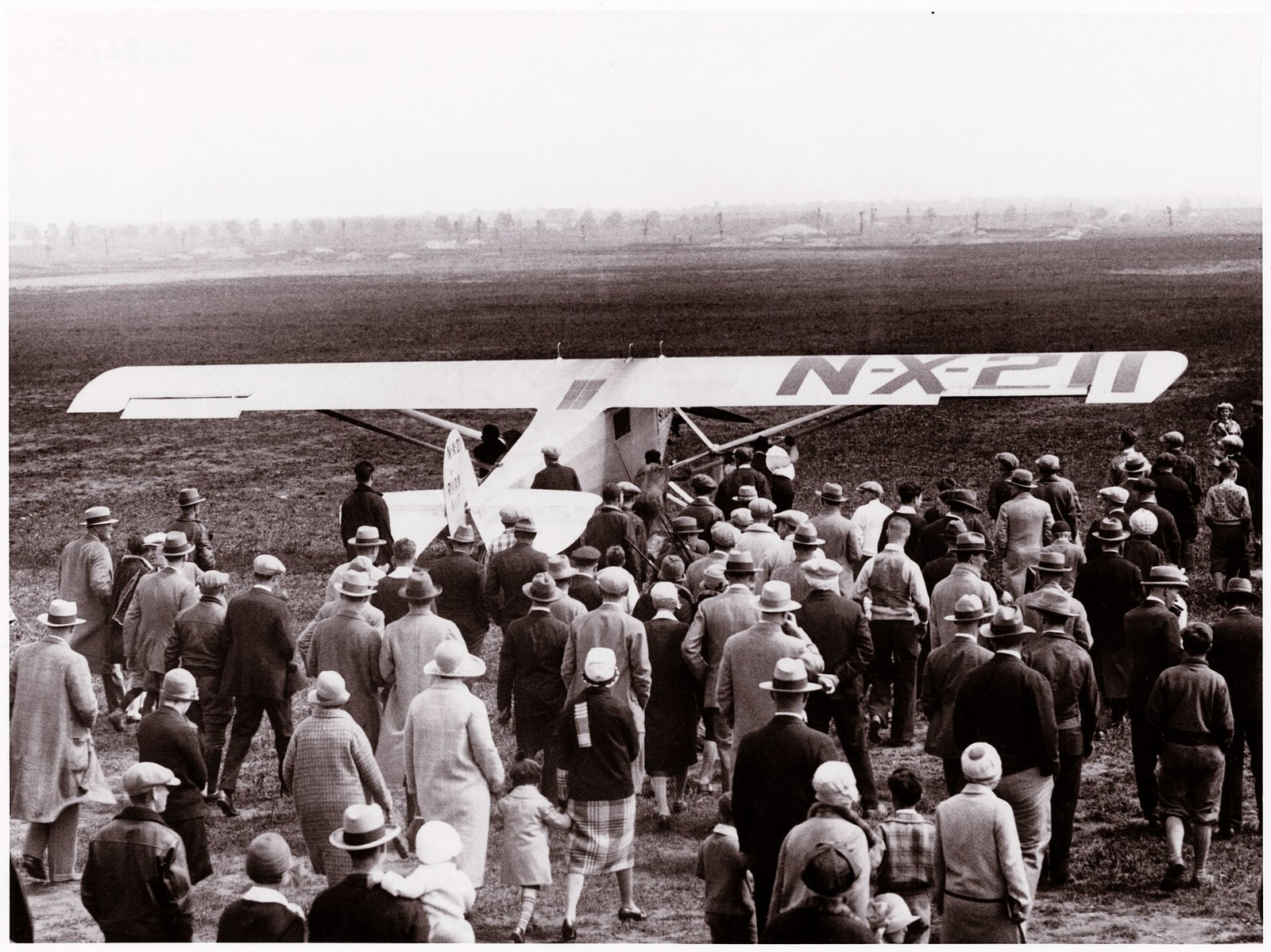
What happened next is in Lindbergh’s own words, and they are calmer than any account written since. Past the halfway mark it was apparent he would clear the obstructions at the end. He cleared the tractor by about fifteen feet, the telephone line by about twenty, and turned right to miss the trees on the hill. Then he throttled back to 1,750 revolutions and settled down.
He wrote afterwards that from a hard field he believed it would have taken off with five hundred pounds more.
Twenty-eight hundred miles of nothing
A Curtiss Oriole with a photographer aboard followed him as far as Long Island Sound and turned back. After that there is nobody.
What the cameras of this period did record, and how those plates are licensed now, is covered in our guide to early aviation photographs and the glass-plate archive.
Nova Scotia
He crossed the Nova Scotia coast close to his intended track. For dead reckoning with no fix of any kind, that was already better than he had any right to expect.
Newfoundland, and the deliberate detour
He took the route slightly south of the great circle so as to pass over St John’s. The reason is bleak and practical: so that if he went into the North Atlantic there would be no argument about whether he had got past Newfoundland at all.
Then the last of the land went behind him and there were eighteen hundred and fifty miles of water.
The ice
He met cloud he could not get over and went into it, and ice began to build on the aeroplane. Ice is the thing that kills you slowly: it adds weight you cannot afford, spoils the wing, and there is no de-icing equipment of any kind. He came out of it by turning back and going round, which cost him fuel and distance and was the only option available.
The sleep
This is the part of the flight that has no technical solution. He had not slept for a day before he took off. Somewhere in the middle of his second night without sleep, over open ocean, with the engine droning and nothing to look at, the body simply stops cooperating.
He flew low, sometimes within a few feet of the water, to find the wind by watching the foam blow off the wave tops. The open window, and holding his eyelids apart with his fingers, come from the book he wrote twenty-six years afterwards rather than the one he wrote that summer.
What he saw in those hours depends on which of his books you read, and the difference matters. In “WE”, written in the weeks after the flight, he describes mirages: coastlines that were not there. In The Spirit of St. Louis, written twenty-six years later, there are presences in the fuselage behind him, speaking in human voices, giving him advice. The second account is the famous one. The first is the contemporary one.
The fishing boats
Late in the crossing he came on a few small fishing boats. He flew over the first and saw nobody. He circled the second, saw a man’s face at a cabin window, came round again, closed the throttle and passed within a few feet of him shouting the only question that mattered.
“Which way is Ireland?”
There was no answer. He opened the throttle and flew on.
Dingle Bay
Less than an hour later a rugged, half-mountainous coast came up ahead to the north-east. He was flying under two hundred feet.
He identified Cape Valentia and Dingle Bay, and resumed his compass course for Paris.
He was less than three miles off his intended track, and two and a half hours ahead of schedule, after two thousand miles of open ocean with no radio, no sextant and no fix of any kind. He had planned for the possibility of being three hundred miles out.
It is worth being honest about why it was that good, because Lindbergh was. The Smithsonian records his own judgement that chance rather than skill or equipment had allowed such accuracy, the winds during the flight having caused no significant drift. Both things are true at once. The navigation was competent, the arithmetic was sound, and he also got the weather he needed.
News of the sighting went to Paris by telegram. The American ambassador got it during a tennis match, ate a quick dinner at half past six, and left for Le Bourget.
Paris
He crossed southern England a little south of Plymouth, pushed the speed up to about 110 miles an hour to make the French coast in daylight, and struck France over Cherbourg. The sun went down just after. Then the beacons of the Paris to London airway came up out of the dark, one after another, and he followed them in.
He saw the lights of Paris a little before ten at night. A few minutes later he was circling the Eiffel Tower at about four thousand feet.

Then he did something that tells you exactly what sort of pilot he was. He flew four or five miles north-east, out into the dark countryside, to check that there was no other aerodrome further out that he ought to be landing at instead. Only when he was satisfied did he come back, spiral down, make one low pass over the field, turn into wind, and land.
Ten twenty-two at night, French time, on Saturday 21 May 1927. Thirty-three hours and thirty minutes.
What happened on the ground
He turned the aeroplane round and started to taxi back towards the lights, and then stopped, because the field ahead of him was covered in people.
How many is the most argued-over number in the story. The New York Times correspondent on the field put twenty-five thousand pairs of eyes on the aeroplane as it appeared and reckoned almost a hundred thousand massed on the eastern side. The Paris police put a hundred thousand inside half an hour. The figure of a hundred and fifty thousand, which the Smithsonian now uses, traces back to French newspapers estimating the number of people on the roads to and from Le Bourget at midnight. All three numbers are describing different things.

What is not in doubt is what the crowd did. They swarmed the aeroplane. Souvenir hunters tore fabric off it. Lindbergh was pulled out of the cockpit and carried bodily over people’s heads for about half an hour before French airmen got him away, one of them putting Lindbergh’s helmet on an American reporter as a decoy.
Somewhere in that half hour his logbook was stolen.
There was about fifty gallons of petrol left in the tanks. He told a wire reporter he had started with 451 and burned about twelve an hour, which is where that figure comes from and it checks out. He told the New York Times he could have gone another five hundred miles. The “eighty-five gallons remaining” that circulates online has no source anybody can find.
What was certified, and what was not
How anybody knew he had not landed
An unsupported claim to have flown an ocean non-stop is worth nothing. The international body required proof, and the proof was a barograph, an instrument that scratches a continuous trace of air pressure, and therefore of height, onto a rotating drum. It was sealed at Curtiss Field on the evening of 19 May and installed in the aeroplane, and it could not be opened without breaking the seal.
The tracing it produced is a record of the flight nobody else could have written: the take-off, the climbs, the ascents over the storms, the turbulence, the descent towards Ireland, the crossing of England and France, and the landing. Any interruption would have shown as a landing. There is none.
It is now in the Smithsonian, on loan from the American aero club, and it is arguably a better artefact than the aeroplane.
The international body ratified a world record for distance in a straight line without landing: 5,809 kilometres, which is 3,610 statute miles, which is 3,137 nautical miles. It is on file, numbered, and the sealed barograph is the evidence. It is now in the Smithsonian, on loan from the American aero club.
Two things about that number are worth being clear on, because almost everybody gets them wrong.
The first is that 3,610 miles is the great circle, the straight-line distance. It is not the distance he flew. He flew a series of straight hundred-mile segments approximating a curve, plus detours round weather, plus circuits at Dingle Bay, the Eiffel Tower and Le Bourget. The distance actually flown is greater and unknown.
The second is that he did not hold the distance record for long. Two weeks later Clarence Chamberlin and Charles Levine flew from the same field to Germany, some three hundred miles further.
He was, and remains, the first man to fly the Atlantic alone and non-stop, and the first to fly non-stop between New York and Paris. Those are the firsts that matter.
Home in a cruiser
He never flew the aeroplane back. The American president sent a light cruiser for him.
The Spirit of St. Louis was crated. Lindbergh flew to London, then back to Paris to say goodbye, then out to the coast in a French aeroplane, and USS Memphis cleared Cherbourg on 4 June 1927 with both of them aboard. She came up the Potomac and berthed at the Washington Navy Yard on Saturday 11 June, and the reception committee waiting on the quay contained two cabinet secretaries, a former secretary of state, the three assistant secretaries for aviation, the chief of the Army Air Corps, the head of naval aeronautics, and his mother.

More than a hundred and fifty thousand people were on the Washington Monument grounds. Coolidge pinned on the Distinguished Flying Cross and handed him a commission as a colonel in the reserve.
One small correction worth making, because it is repeated constantly: this was not the first Distinguished Flying Cross ever awarded. The crews of a goodwill flight to South America had been decorated six weeks earlier. Lindbergh got the first one that existed as a struck medal.
The Medal of Honor came later. Congress authorised it in December 1927 and Coolidge presented it on the White House lawn on 21 March 1928. The citation records his rank as Captain, because that is what he was on the day, and it is why writing “Colonel Lindbergh flew the Atlantic” is wrong by three weeks.
The cheque
He collected the money on 16 June 1927, in the dining room of the Hotel Brevoort, which was Orteig’s own hotel. It took ten minutes. He had come from a parade in Brooklyn, hot and dusty, and had spent much of the time he had in the washroom trying to make himself presentable. Several thousand people waited outside on Fifth Avenue.
The cheque was a piece of theatre in its own right: triple size, on vellum, embossed and illuminated in gold, with the Spirit of St. Louis in one corner and an American flag in the other, drawn on a New York bank and signed by Orteig. It passed from the trustees’ treasurer to their vice-chairman to Orteig to Lindbergh.
Orteig said that he had had two thoughts in making the offer, one to stimulate aviation and the other to strengthen relations between the United States and France, and that through Lindbergh his aspirations had materialised beyond words.
Lindbergh, who blushed easily and did it again, said that the prize had been nothing more or less than a challenge to the pilots and engineers of the world, and that nobody should ever believe such a challenge within reason would pass unanswered.
Orteig kept the cancelled cheque for the rest of his life. It went to the Smithsonian in 1967. What Lindbergh did with the twenty-five thousand dollars is not recorded anywhere reliable, and the story that he divided it among his backers has no source at all.
Eighty-two cities
The thing that actually spread the effect was not the flight. It was what came after it.
The Daniel Guggenheim Fund put up the money for a tour of the United States, and from 20 July to 23 October 1927 Lindbergh flew the same aeroplane 22,350 miles around his own country. Eighty-two cities. All forty-eight states. He arrived on schedule everywhere but once.
By one estimate one American in four saw him in person. At Minneapolis the parade crowd was put at somewhere between a quarter and half a million people. He made something like a hundred and forty-seven speeches and rode nearly thirteen hundred miles in parades, and the whole tour took him a little over two hundred and sixty hours of flying.
Then in December he set off again, non-stop from Washington to Mexico City to start with, and worked his way round Central America, Colombia, Venezuela and the Caribbean before flying Havana to St Louis without stopping, arriving in February 1928.
The point of all this was not adulation. It was that a great many Americans who had never seen an aeroplane at close quarters saw one, in good order, arriving on time, flown by somebody who had just crossed an ocean in it. That is what turns a stunt into an industry.
The eighteen months that followed
Here is the part that justifies the fuss, and it is not the parades.
American federal aviation licensing had only started in 1927, so there are real before-and-after numbers, and they are startling.
At the close of 1927 the government’s aeronautics branch had licensed 1,572 pilots, with another 2,573 applications in hand. By the end of October 1928 there were 3,659 pilots holding active licences. Aircraft went from 681 licensed for interstate commerce at the end of 1927 to 4,844 licensed or pending a year later, and to 7,843 licensed plus another 4,520 carrying identification numbers by the end of 1929.
The airlines are the clearest series of all. On the federal historical series for scheduled domestic air transport, revenue passengers carried went from about 6,000 in 1926 to 9,000 in 1927, 48,000 in 1928 and 162,000 in 1929, with another 11,000 on international services that last year. Airmail went from 433,649 pounds in 1926 to just over seven million pounds in 1929 on the industry figures.
The budget of the Aeronautics Branch, the new civil regulator, went from $550,000 in the 1927 financial year to $3,791,500 the next and $5,575,400 the one after. That is one office rather than the whole of federal aviation spending, and it was starting from nothing.
Two honest qualifications, because a number that good invites suspicion. Airmail postage was cut by three quarters in August 1928, from ten cents per half ounce to five cents per ounce, which filled the mail planes on its own. And the Post Office handed its last route to private contractors in August 1927, which moved a lot of existing traffic from government books onto airline books. The Lindbergh effect is real and it is large, but it is not the only thing in those columns.
You will also see the figure 173,405 quoted for 1929, which is the domestic and international totals added together, and a rise of “three thousand per cent” that is really thirty-fold, or a rise of two thousand nine hundred per cent. Neither is wrong so much as loose, and the unrounded precision suggests a certainty the early figures do not have.
What became of the aeroplane
It flew a tour of the United States that autumn, funded by the Guggenheim fund, and then a tour of Latin America. Then, in 1928, Lindbergh gave it to the Smithsonian, where it has hung ever since. It had flown 174 times in total, all but twenty minutes of that with the same man in the wicker seat. Anyone who needs aircraft photographs to publish rather than to admire will find our aviation photography archive online, with the licence terms published beside it.
Roosevelt Field, where it began, is a shopping centre.
What became of the man
This is where an honest article has to slow down, because the flight is the beginning of a life that gets very complicated.
He married Anne Morrow, who became a serious aviator in her own right and flew as his navigator and radio operator on long survey flights that mapped routes the airlines would later use. She was also, on the evidence of her books, the better writer of the two.
Anne Morrow Lindbergh
She learned to fly, and in 1930 became the first American woman to earn a first-class glider pilot’s licence. She flew as her husband’s navigator and radio operator on the long survey flights of the early 1930s, across the north Atlantic by way of Greenland and Iceland and around the north Pacific, mapping routes that airlines used afterwards. She operated the radio, worked the drift sight and took the pictures.
She also wrote. North to the Orient and Listen! the Wind came out of those flights, and Gift from the Sea, published in 1955, outsold everything either of them ever wrote. On the evidence of the books she was the better writer of the two, and it is not close.
In 1932 their twenty-month-old son was taken from their house and murdered, and the trial that followed was the most intrusive public spectacle America had yet produced. The Lindberghs left the country to get away from it.
In the late 1930s he visited Germany several times at the invitation of the American military attaché to assess German air strength, and in 1938 accepted a German decoration, which he never returned and which followed him for the rest of his life. He became the most prominent speaker for the America First Committee, arguing against American entry into the war. In a speech at Des Moines on 11 September 1941 he named three groups he said were pushing for war: “the British, the Jewish and the Roosevelt administration”. He said that no person with a sense of the dignity of mankind could condone the persecution of the Jewish race in Germany, and then said that the greatest danger Jews posed to the United States lay in “their large ownership and influence in our motion pictures, our press, our radio and our Government”, and that they would “be among the first to feel its consequences”. The condemnation of Nazi persecution was the run-up to the accusation rather than a counterweight to it, and the speech was read at the time, and since, as antisemitic. He had already resigned his reserve commission that April. The speech cost him his public standing for years, though not permanently: he was commissioned a brigadier general in the Air Force Reserve in 1954, the year he won the Pulitzer.
After Pearl Harbor he tried to get back into uniform and was refused. He went to the Pacific as a civilian technical adviser instead and flew some fifty combat missions that he was not supposed to fly, and taught American squadrons fuel-management techniques that materially extended their range.
He spent his last decades on conservation work, won a Pulitzer Prize for the 1953 book, and died in Hawaii in 1974.
Historians do not agree about him and this article is not going to pretend to settle it. What can be said without argument is that the man who flew the Atlantic in 1927 and the man who spoke at Des Moines in 1941 were the same man, and that neither fact cancels the other.
Why it still matters
Alcock and Brown crossed the Atlantic eight years earlier. Nobody outside aviation remembers them. The same thing happened later to the men who pushed past the speed of sound, covered in our account of breaking the sound barrier, and to the aircraft in our history of the North American X-15.
The difference is not distance and it is not danger. It is that Lindbergh did it alone, between two cities everybody had heard of, in an aeroplane paid for by a handful of businessmen, having been an unknown a month before. It was a story anybody could follow, and it arrived at the exact moment when the technology had quietly become good enough for ordinary people to use and nobody had noticed.
The numbers in the licensing tables are what happened when they noticed.
A last thought about the take-off
Everything about that flight was calculated. The great circle on the gnomonic chart, the hundred-mile segments, the fuel against the range, the navigator traded for three hundred miles, the tanks in front of the pilot rather than behind him.
And then it came down to whether a heavily loaded aeroplane on a soft field with no wind would get over a telephone line.
Fifteen feet over the tractor. Twenty over the wires. That is the margin the twentieth century turned on.
Frequently asked questions
How long did Lindbergh’s flight take?
Thirty-three hours and thirty minutes. He took off from Roosevelt Field on Long Island at 7:52 in the morning, New York time, on Friday 20 May 1927, and landed at Le Bourget outside Paris at 10:22 at night, French time, on Saturday 21 May. Those are the figures in his own flight log and the ones the international records body ratified. You will often see the time given to the second, as 33 hours 30 minutes and 29.8 seconds, which comes from using a take-off time of 7:51:30 rather than his own 7:52.
How far did Lindbergh fly?
The certified record distance is 5,809 kilometres, which is 3,610 statute miles or 3,137 nautical miles. But that is the great circle, the straight-line distance from Roosevelt Field to Le Bourget, and it is not the distance he flew. He flew a series of straight hundred-mile segments approximating that curve, plus detours round weather and circuits at Dingle Bay, the Eiffel Tower and Le Bourget. The distance actually covered was greater and nobody knows what it was.
Was Lindbergh the first person to fly across the Atlantic?
No, and this is the most common mistake made about him. The Atlantic had been crossed in 1919 three separate ways: by a US Navy flying boat by way of the Azores, by John Alcock and Arthur Whitten Brown non-stop from Newfoundland to Ireland, and by the British airship R34, in both directions. What Lindbergh did first was fly it alone and non-stop, and fly non-stop between New York and Paris, which is a longer flight and a different problem.
What was the Orteig Prize?
Twenty-five thousand dollars, offered by the New York hotelier Raymond Orteig to the first aviator to fly non-stop between New York and Paris. The offer went out on the wires on 30 May 1919 and ran for five years without a single entrant. Orteig offered it again in January 1925 and it was formalised that June with proper rules. Lindbergh collected it on 16 June 1927 in the dining room of Orteig’s own hotel, on a triple-sized cheque illuminated in gold, in a ceremony that took ten minutes.
How many people died trying to win the Orteig Prize before Lindbergh?
Six, in three crashes, in the eight months before he flew. Two of René Fonck’s crew died when his Sikorsky crashed on take-off at Roosevelt Field in September 1926. Noel Davis and Stanton Wooster were killed in a loaded test flight in April 1927. And Charles Nungesser and François Coli disappeared over the Atlantic in May 1927 flying the route the other way, three weeks before Lindbergh took off. Their aircraft has never been found.
What aircraft did Lindbergh fly?
A Ryan NYP called the Spirit of St. Louis, built for him in about sixty days by Ryan Airlines of San Diego, a small firm working out of a former fish cannery. It was a single-engined high-wing monoplane, 46 feet across the wing and 27 feet 8 inches long, with a Wright Whirlwind nine-cylinder radial. It carried 450 US gallons of petrol and weighed 5,250 pounds at take-off. It made 174 flights in its life and Lindbergh flew all but twenty minutes of them.
Why could Lindbergh not see forward out of the Spirit of St. Louis?
Because the main fuel tank was placed between the cockpit and the engine, deliberately, so that in a crash the fuel would not come through the cockpit from behind him. That left no room for a windscreen. He looked out of the side windows, or used a small periscope on the left side that a Ryan employee with submarine experience had suggested. He was untroubled by it, having flown the mail from a rear cockpit with mail sacks stacked in front of him.
How did Lindbergh navigate across the Atlantic?
By dead reckoning alone: a compass heading, a clock and an estimate of the wind. No radio, no sextant, no way of fixing his position at any point over the ocean. He plotted the great circle on a gnomonic chart, transferred it to Mercator charts at hundred-mile intervals, and flew straight segments with a course change every hundred miles, which is roughly every hour. He measured drift by watching the foam blow off wave tops at low level. Leaving out a navigator bought him roughly three hundred miles of extra range.
How accurate was his navigation?
He made landfall at Dingle Bay in Ireland less than three miles from his intended track and two and a half hours ahead of schedule, having planned for the possibility of being three hundred miles out. That is extraordinary. It is also worth saying that Lindbergh himself judged that chance rather than skill or equipment had allowed such accuracy, because the winds caused no significant drift, and the Smithsonian records that judgement.
Did Lindbergh hallucinate during the flight?
It depends which of his books you read, and the difference matters. In “WE”, written within weeks of the flight, he describes mirages, coastlines that were not there. In The Spirit of St. Louis, written twenty-six years later, there are presences in the fuselage behind him speaking in human voices and giving advice. The second account is the famous one. The first is the contemporary one. What is not in doubt is that he had been awake for over twenty-three hours before he took off and flew at times within a few feet of the water, reading the wind off the foam on the wave tops.
How much fuel was left when Lindbergh landed?
About fifty gallons. He told a wire reporter three days later that he had started with 451 gallons and burned around twelve an hour, which over 33 and a half hours leaves roughly that, and he told the New York Times he could have gone another five hundred miles. The figure of eighty-five gallons that circulates online has no source anybody has been able to find.
What happened to the Spirit of St. Louis?
It flew a tour of the United States in 1927, 22,350 miles around 82 cities in all 48 states, then a goodwill tour of Latin America and the Caribbean that finished in February 1928. Lindbergh then gave it to the Smithsonian, where it has hung ever since. It flew 174 times in all. Roosevelt Field, where the whole thing started, is now a shopping centre.
Sources
The two primary sources for this article are Lindbergh’s own 1927 book and the designer’s technical report, both written within months of the flight. Where a museum or a popular history disagrees with them, they have been preferred.
- Charles A. Lindbergh, “WE”, 1927, his own account written within weeks of the flight
- Donald A. Hall, NACA Technical Note 257, the technical preparation of the Spirit of St. Louis, July 1927
- Smithsonian National Air and Space Museum, the Ryan NYP Spirit of St. Louis
- Smithsonian, the sealed barograph that proved the flight was non-stop
- Smithsonian, the Orteig Prize cheque
- Fédération Aéronautique Internationale, record file 14842, the certified distance of 5,809 km
- Smithsonian, Time and Navigation, on how Lindbergh navigated
- Minnesota Historical Society, the 1927 Guggenheim tour
- Congressional Medal of Honor Society, the citation and its date
- Library of Congress, the Washington reception of 11 June 1927
- FAA historical chronology, for the pilot licence figure, the budget appropriations and the air mail handover
- US Census Bureau, Historical Statistics of the United States, for the air transport passenger series
