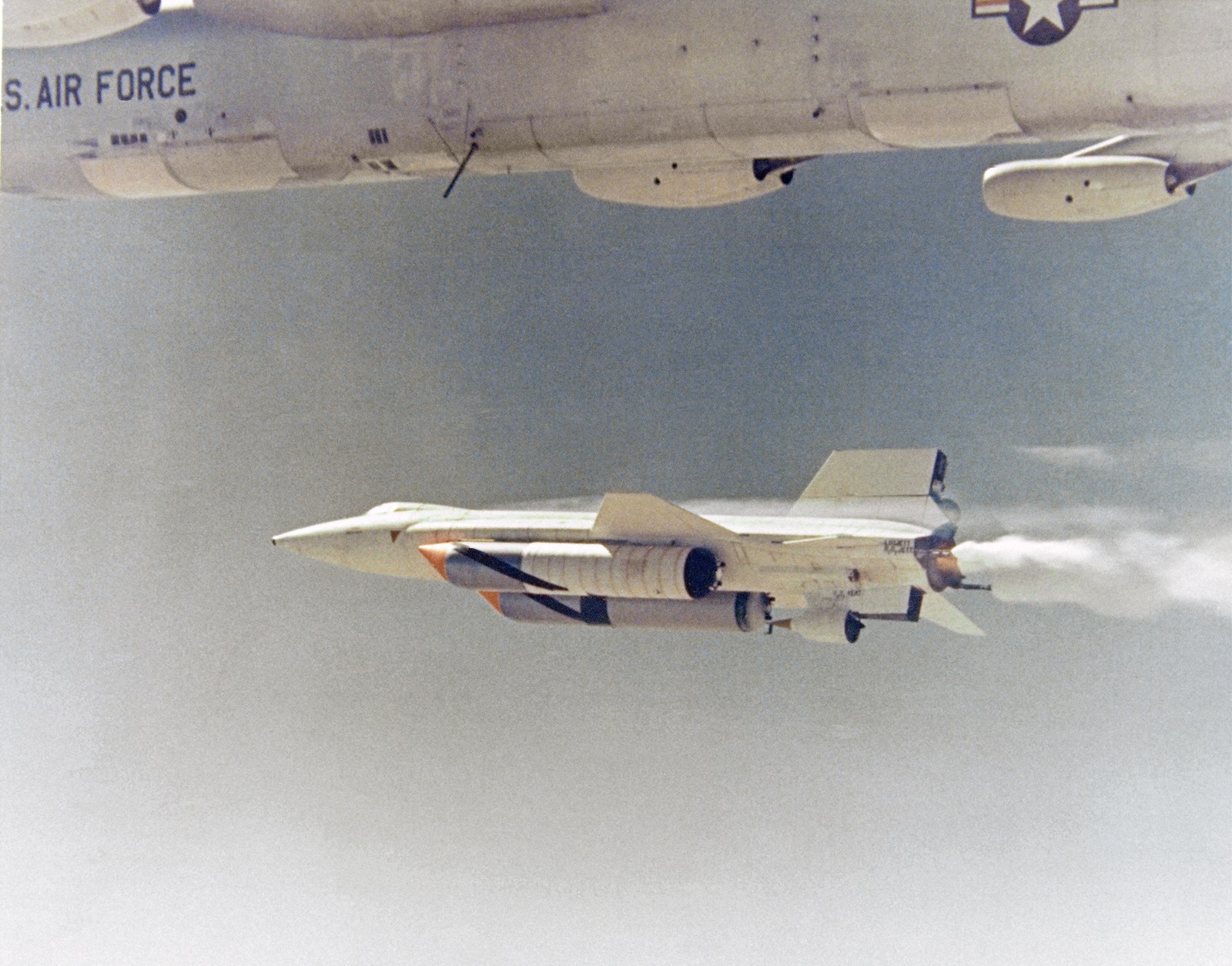
The North American X-15 was a research aeroplane built to fly faster and higher than anything with a pilot in it had flown before, and between 8 June 1959 and 24 October 1968 three of them did it 199 times. Each flight began with an air launch from a converted B-52 at about 45,000 feet and ended, eight to twelve minutes later, on a dry lakebed in the California desert. In between, a rocket engine of 57,000 lbf burned 18,000 lb of ammonia and liquid oxygen in 85 seconds and left the pilot to coast, on one occasion, to 354,200 feet. This X-15 history covers how it was designed, how it was flown, what it cost and how it ended.
X-15 history: what this guide covers
- A personal note: meeting Joe Engle
- A research aeroplane, not a spaceship
- The X-15 at a glance
- Origins: a study, a competition and a contract
- Designing an aircraft to survive its own speed
- Power: eight chambers, then one
- Carrier aircraft, the High Range and the lakebeds
- The flight programme in numbers
- The twelve pilots
- 22 August 1963: 354,200 feet
- X-15A-2 and the flight of 3 October 1967
- 15 November 1967: the loss of Michael Adams
- Ten attempts at a two hundredth flight
- Astronaut wings and a forty-year wait
- Where the aircraft are now
- What the X-15 left behind
- Frequently asked questions
A personal note: meeting Joe Engle
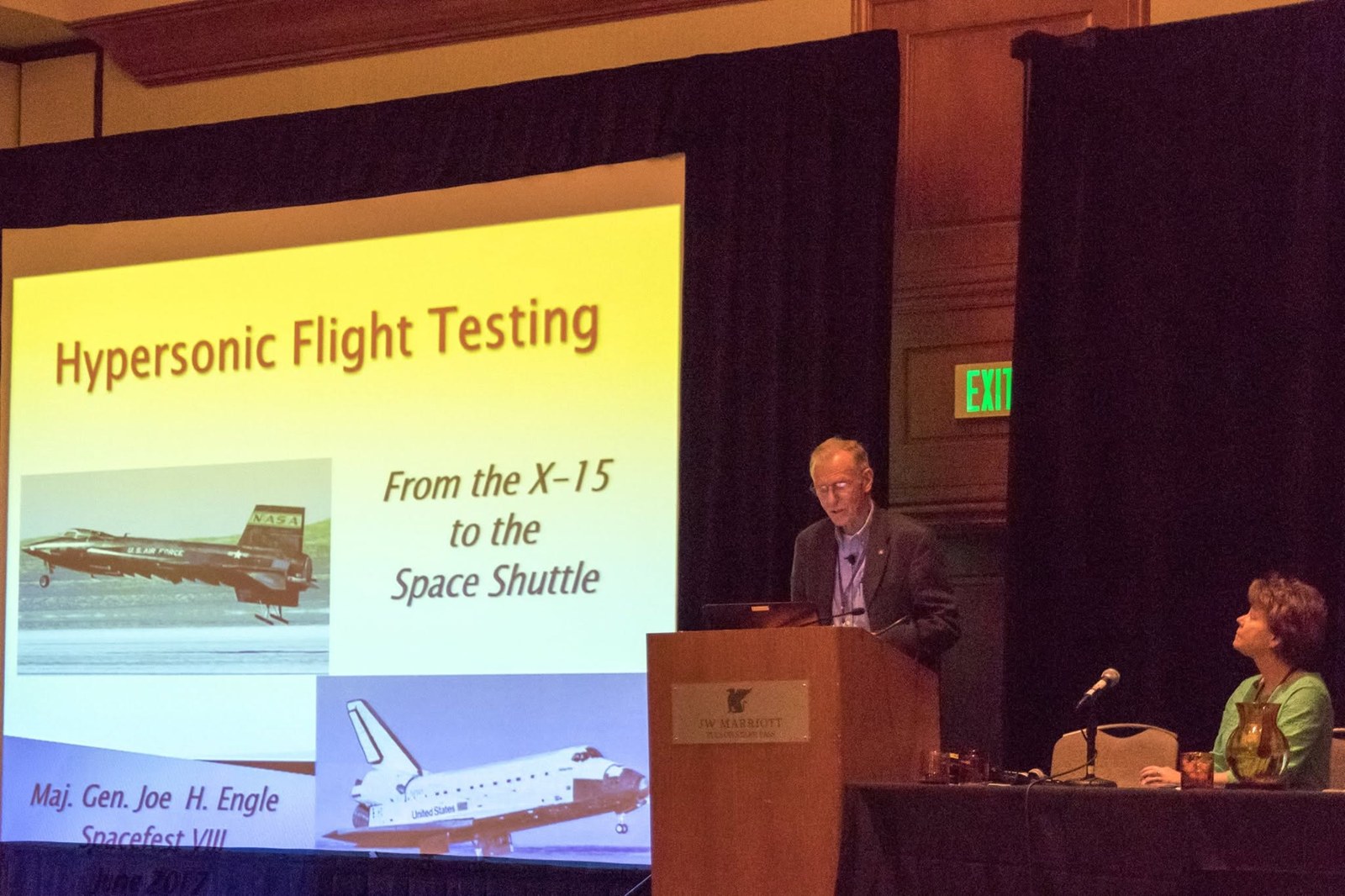
In June 2017 I went to Spacefest VIII in Tucson, Arizona, and one of the speakers was Joe Engle. His talk was called Hypersonic Flight Testing: From the X-15 to the Space Shuttle, and his wife Jeanie was there with him. He talked about the X-15 the way people talk about something they have loved, and there was no distance in it at all.
Afterwards he signed a book and a photograph for me, and then he called me round the table to sit and talk about what it had been like to fly the aircraft. I have been fortunate enough to meet a good many pilots over the years. That afternoon is the one I go back to.
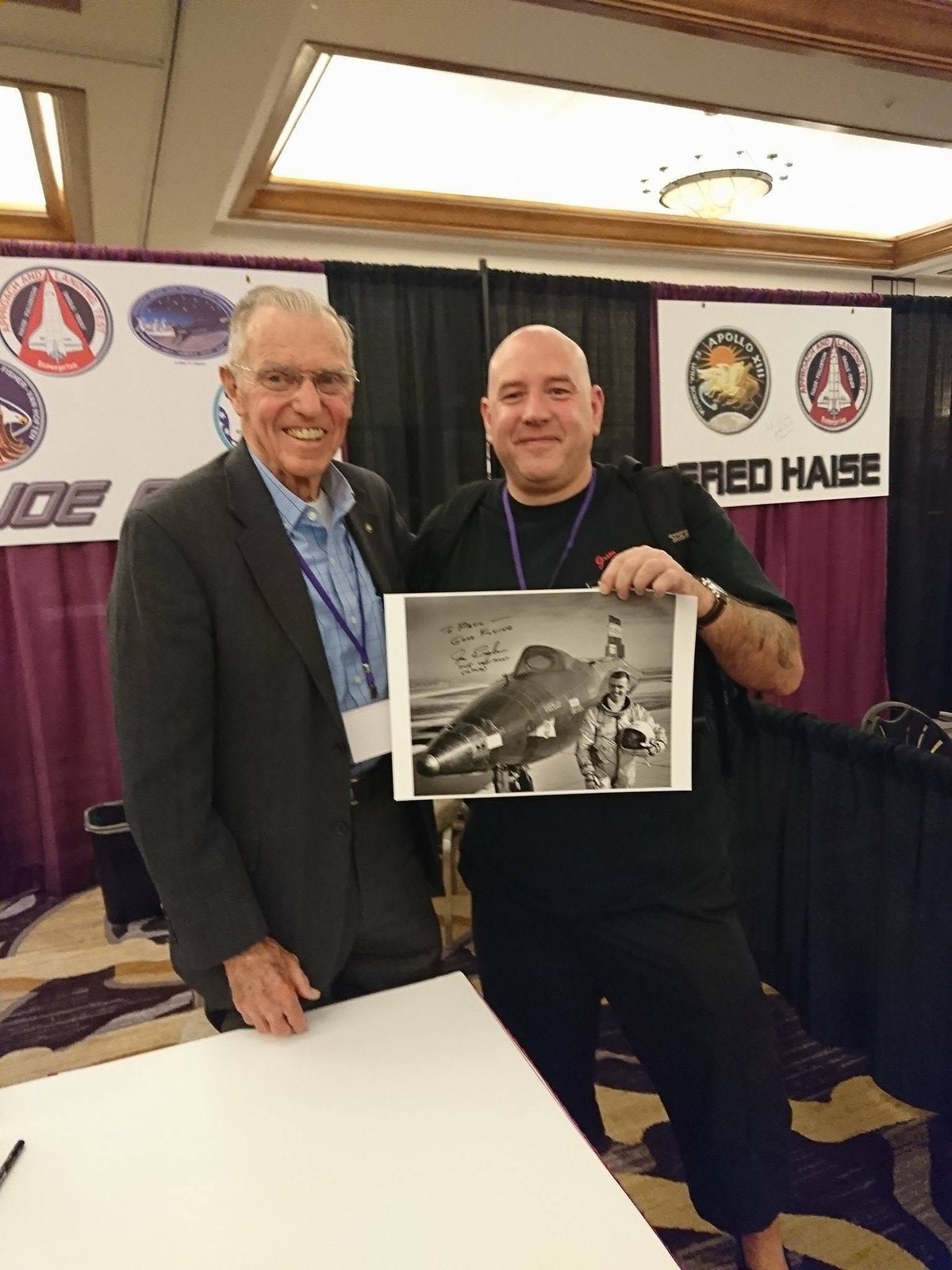
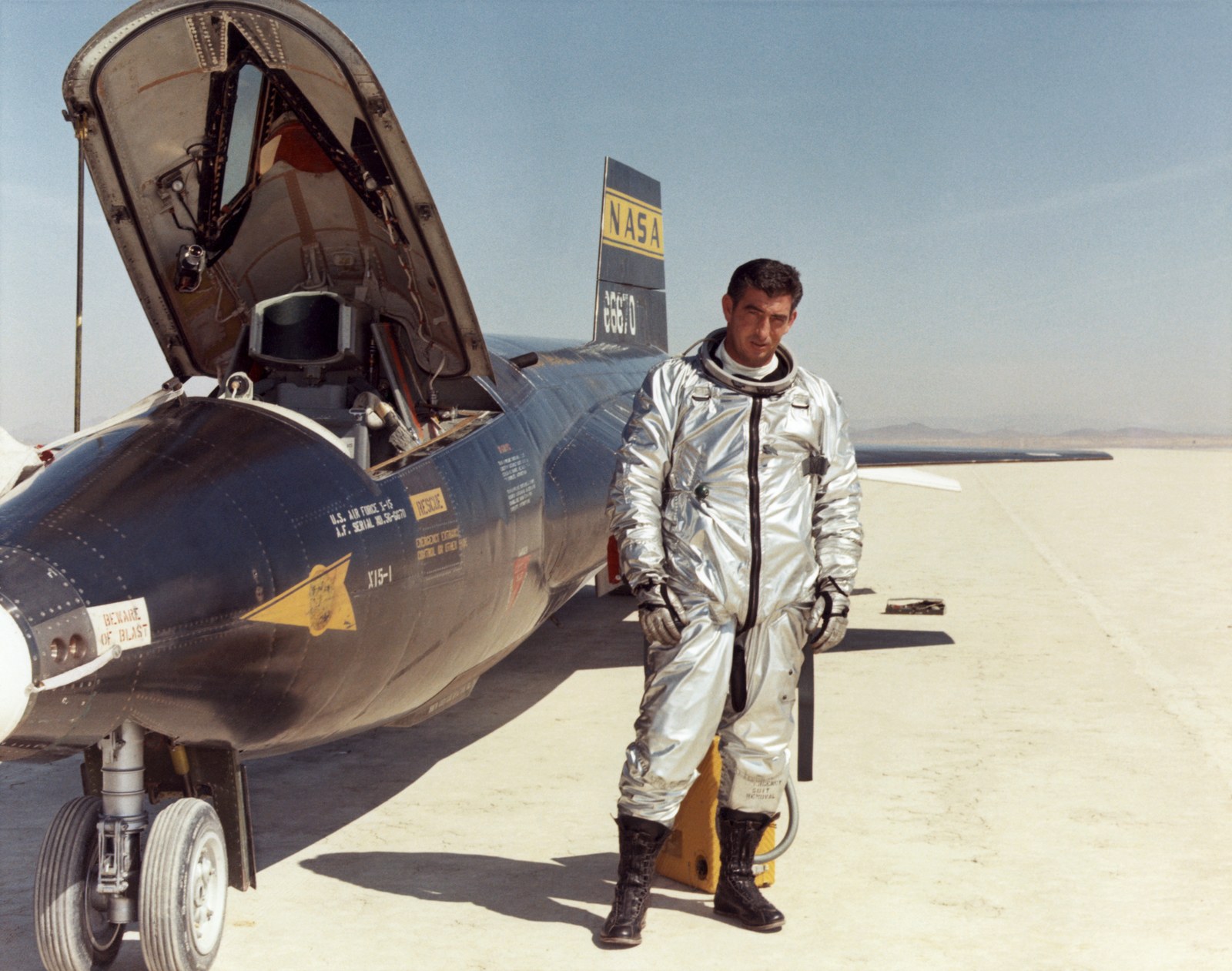
Joe Engle died on 10 July 2024 at the age of 91. He was the last surviving X-15 pilot, and the only person to have flown both the X-15 and the Space Shuttle. He became an astronaut at 32 while flying the X-15 for the Air Force, the youngest pilot ever to qualify. This article is written with that afternoon in Tucson in mind.
A research aeroplane, not a spaceship
It is worth being exact about what the X-15 was. It was not a spacecraft and neither NASA nor the Air Force called it one. It was a research aeroplane, flown from an air launch to gather data on flight at speeds and altitudes no wind tunnel of the period could reproduce, and on thirteen of its 199 flights it went above the boundary of space as the United States Department of Defense then defined it, 50 statute miles or 264,000 feet.
Nor was it a machine that did one thing. Two of the three airframes exceeded Mach 6, on four flights out of 199. One hundred and eight further flights exceeded Mach 5, two never went supersonic at all, and fourteen more never passed Mach 2. The programme carried 28 experiments and yielded more than 765 research reports. Neil Armstrong called the X-15 the most successful research airplane in history, which is a pilot’s verdict rather than a measurement, but the more restrained claim that it was the most successful of the high-speed X-planes is not seriously disputed.
The programme cost approximately 300 million US dollars and killed one pilot. It last flew on 24 October 1968, the programme ended on 20 December 1968 and its authorised funding expired on 31 December 1968.
The X-15 at a glance
These figures are for the basic X-15 as built, with the modified second airframe noted where it differed.
| Role | Hypersonic research aeroplane, air-launched |
|---|---|
| Manufacturer | North American Aviation, Inc., designed at Inglewood, California |
| Number built | Three: 56-6670, 56-6671 and 56-6672 |
| Length | 50.75 ft; X-15A-2 after modification, 53.16 ft |
| Wing span | 22.36 ft, wing area 200.00 sq ft |
| Empty weight | 10,635 lb as built |
| Launch weight | 31,662 lb as built; X-15A-2 design launch weight, 49,640 lb |
| Interim engines | Two Reaction Motors XLR11-RM-5, 11,800 lbf combined at sea level |
| Definitive engine | One Reaction Motors XLR99-RM-1, rated 57,000 lbf at 45,000 ft |
| Propellants | Anhydrous ammonia and liquid oxygen |
| Structure | Inconel X outer skin, aluminium cabin isolated from the outer structure |
| Typical flight time | 8 to 12 minutes, of which 80 to 120 seconds powered |
| Maximum speed recorded | 4,520 mph, Mach 6.70, on 3 October 1967 |
| Maximum altitude recorded | 354,200 ft, on 22 August 1963 |
| First glide flight | 8 June 1959 |
| Last flight | 24 October 1968 |
| Free flights flown | 199 |
Origins: a study, a competition and a contract
The aircraft began inside the NACA. On 4 and 5 February 1954 the Interlaboratory Research Airplane Projects Panel met and set in motion a study of what a hypersonic research aeroplane would have to be. The work at Langley was led by John V. Becker, and it produced a configuration rather than a wish list: a small, heavy, thick-skinned aeroplane with unusual tail surfaces, sized around the propellant it could carry and the heat it could absorb. On 9 July 1954 it was presented to the Air Force and the Navy at NACA Headquarters.
Agreement followed quickly by the standards of the period. Hugh Dryden signed a memorandum of understanding for the NACA on 23 December 1954, and Air Materiel Command issued its invitation-to-bid letter on 30 December 1954. Four companies competed for the airframe: Bell, Douglas, North American and Republic. North American was selected in September 1955 and the losing bidders were notified on 30 September.
A letter contract to North American was drafted on 7 November 1955 and the signed copy came back on 5 December 1955, worth 2.6 million US dollars. Reaction Motors, which would build the engine, signed its own on 14 February 1956 for 2.9 million US dollars. The Air Force assigned serial numbers on 15 June 1956, and those three numbers, 56-6670, 56-6671 and 56-6672, would come to describe three entirely different careers.
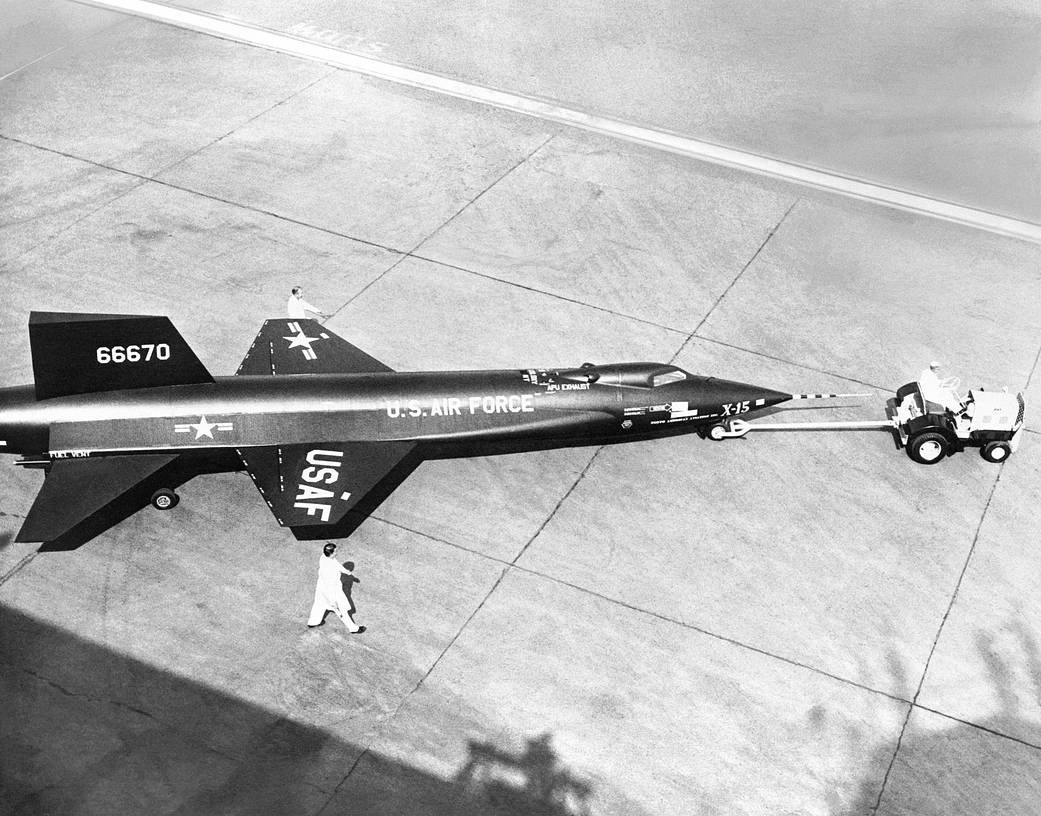
Charles H. “Charlie” Feltz was North American’s chief project engineer, and the aircraft he had to get built was one for which almost no precedent existed. Rollout of the first machine took place at Inglewood on 15 October 1958. The first Air Force estimate, made in 1955, had put development and two aircraft at 12.2 million US dollars; the three airframes alone eventually cost 23.5 million US dollars, and the engine, estimated at about 6,000,000 US dollars, had reached 68.4 million US dollars by June 1959.
Designing an aircraft to survive its own speed
Everything distinctive about the X-15’s shape follows from two problems that do not arise on a supersonic aeroplane: how to stay pointing the right way at hypersonic speed, and where to put the heat.
The wedge tail
Thin supersonic aerofoil sections lose lift-curve slope rapidly as Mach number rises, and preliminary calculations from X-1A wind-tunnel data showed that keeping the X-15 directionally stable at hypersonic speed with a conventional thin section would need a vertical stabiliser the size of one of the X-1’s wings. Charles H. McLellan at Langley had found that at Mach 7 a thick wedge section with a blunt trailing edge should prove many times more effective than the thin shapes that are optimum at lower speed, and tests in Langley’s 11-inch hypersonic tunnel confirmed that a 10-degree wedge angle gave the stability required. The wedge extracts hypersonic directional stability from a surface small enough to build and light enough to carry. The upper stabiliser had a total area of 40.91 sq ft, the lower, on the basic aircraft, 34.41 sq ft. The speed brakes are the same idea used twice: opening them increased the included angle of the wedge and so changed the drag and the stability derivatives together.
The lower rudder created two difficulties of its own and was often simply left at home. It hung below the extended landing skids, so the lower portion had to be jettisoned before touchdown or it would strike the lakebed first. Dick Day and Bob Hoey also found on the simulator that removing it kept a high-altitude re-entry out of the predicted uncontrollable region altogether if a damper failed, at the price of poorer handling at low angles of attack. Of the 199 flights, 126 were flown with the ventral rudder off and 73 with it fitted.
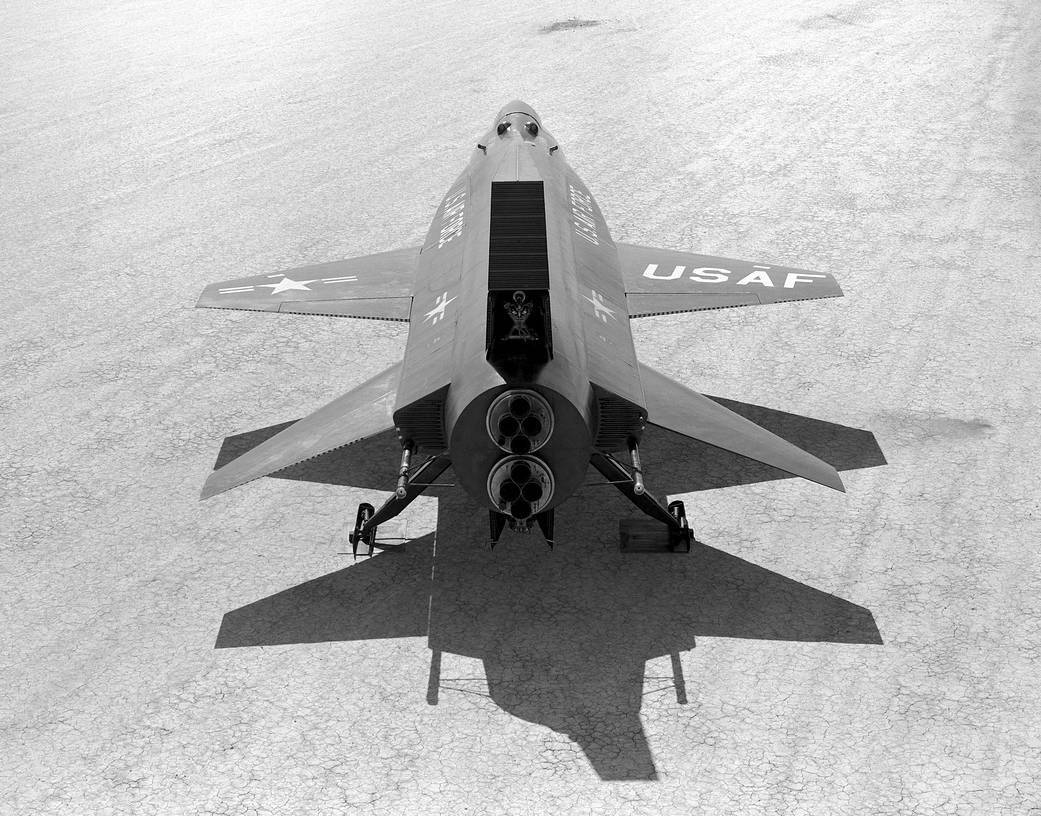
The horizontal surfaces were placed unusually too. Supersonic designers of the period liked to set the stabiliser clear of the wing’s flow field, part-way up the fin or on top of it, and researchers at the High-Speed Flight Station suspected that this was precisely what made recovery from divergent manoeuvres difficult or impossible. The answer, reached in late 1954, was a conventional horizontal surface in the plane of the wing, between the regions of highest downwash, with 15 degrees of anhedral. The surfaces totalled 115.34 sq ft, swept 45 degrees at quarter chord, and worked both together and differentially.
A structure that absorbed its own heat
The X-15 has a hot structure with no insulation, and the reasoning behind that decided the whole aeroplane. The design temperature limit of the best available material was about 1,200°F, well below the estimated equilibrium temperature of about 2,000°F, so the heat had to go somewhere: into active cooling, or into the structure itself as a heat sink. Insulation was rejected because local failure of an insulating layer was judged a serious hazard, because the schemes then available were embryonic and could not be applied to the nose and leading edges, and because measuring heat-transfer rates, one of the aircraft’s primary research objectives, would have been far harder through an insulated skin.
The material chosen was Inconel X, a nickel-chromium alloy of 72.5 per cent nickel, 15 per cent chromium and 1 per cent columbium, selected for its strength at 1,200°F. Aluminium was out of the question: it loses useful strength in the low hundreds of degrees Fahrenheit and melts around 1,200°F, the very temperature the skin was designed to reach. The cabin was aluminium, isolated from the outer structure. Norris Dow’s 1954 analysis then produced the coincidence that made the aircraft buildable: the skin thickness needed to carry the aerodynamic loads was about the same as the thickness needed to absorb the thermal load, so the heat-sink structure cost almost nothing in weight. It gave the programme the first reusable superalloy structure capable of withstanding the temperatures and thermal gradients of hypersonic re-entry. The maximum structural temperature recorded was 1,350°F, and the lowest was minus 245°F.
At Mach 6 the heating load was eight times what it was at Mach 3, and it fell hardest on the front and lower surfaces. The trouble it caused was rarely dramatic and almost always awkward. The wing leading edge, hotter than the structure behind it, expanded faster, putting the section into compression and reducing torsional stiffness; the fix was to segment it, mount it flexibly and cut expansion slots 0.080 in wide. The first temperature problem the programme ever had was the opposite of the one expected: the side-fairing panels along the liquid-oxygen tank buckled from contraction when the tank was first filled, before the aircraft had flown at all. Bob White lost a windscreen panel on two consecutive flights. On 11 October 1961, on flight 2-20-36, the left outer pane cracked, because a soda-lime pane had been fitted to the left panel by mistake. On 9 November 1961, on flight 2-21-37, the right panel shattered while he was decelerating through Mach 2.7 after becoming the first person to fly above Mach 6, and that pane was the correct alumino-silicate glass. The retainer was changed from 0.050-inch Inconel X to 0.100-inch 6Al-4V titanium. On a Mach 5.27 flight a small gap at the aft end of the nose-gear door let the airstream into the compartment, where it struck the bulkhead in front of the cockpit, heated it to 550°F, melted aluminium tubing and put smoke in the cabin. Becker’s own conclusion is the sentence the section turns on: what are minor and unimportant features of a subsonic or supersonic aircraft must be dealt with as prime design problems in a hypersonic airplane.
Controls for where the air runs out
Aerodynamic control surfaces produce force in proportion to dynamic pressure, and above roughly 150,000 ft the X-15’s were no longer effective. On an altitude mission the aircraft spent about two minutes coasting through and above that region on a ballistic arc, so it carried a second, entirely separate set of controls: eight hydrogen-peroxide thrusters of 113 lbf in the nose and two of 40 lbf in each wing tip. They were always used below a dynamic pressure of 25 psf, which corresponds to approximately 180,000 ft, and many pilots began using them from about 100,000 ft, where dynamic pressure is roughly 50 psf and the two systems are about equally effective. Neil Armstrong, a principal engineer on the adaptive control system, gave the rule of thumb: when dynamic pressure on control surfaces reduces to 50 psf, there should be a switchover from aerodynamic to reaction control.
What the thrusters did was control attitude, not trajectory. On the coast above the sensible atmosphere the path was already fixed, and the thrusters altered only which way the aircraft was pointing; once it was back in air thick enough to fly, angle of attack, bank and the speed brakes decided where it came down. This was the first use of reaction controls for attitude control in space, and the cockpit reflected the split: a side stick on the right for aerodynamic control, a side stick on the left for the ballistic controls, and a conventional centre stick as well. The third airframe, 56-6672, was given a Minneapolis-Honeywell MH-96 adaptive flight control system costing 2.3 million US dollars, which among other things blended in the ballistic controls automatically above 90,000 ft, the blending being governed by how far the system had wound up its own gains.
The pilot wore a David Clark full-pressure suit, the MC-2 and later the A/P22S-2, the first practical full-pressure suit for pilot protection in space; Scott Crossfield received his on 17 December 1958. The ejection seat was effective up to Mach 4 and 120,000 ft, which is to say for a decent part of a typical flight and none of the interesting part.
Power: eight chambers, then one
The engine was late, which is why the early flights look so modest against the aircraft’s reputation. Until the definitive motor was ready the X-15 flew on two Reaction Motors XLR11-RM-5 units, from the same family that had powered the Bell X-1. Each had four chambers of 1,475 lbf, giving 5,900 lbf per engine and 11,800 lbf at sea level for the pair, burning liquid oxygen and a mixture of ethyl alcohol and water.
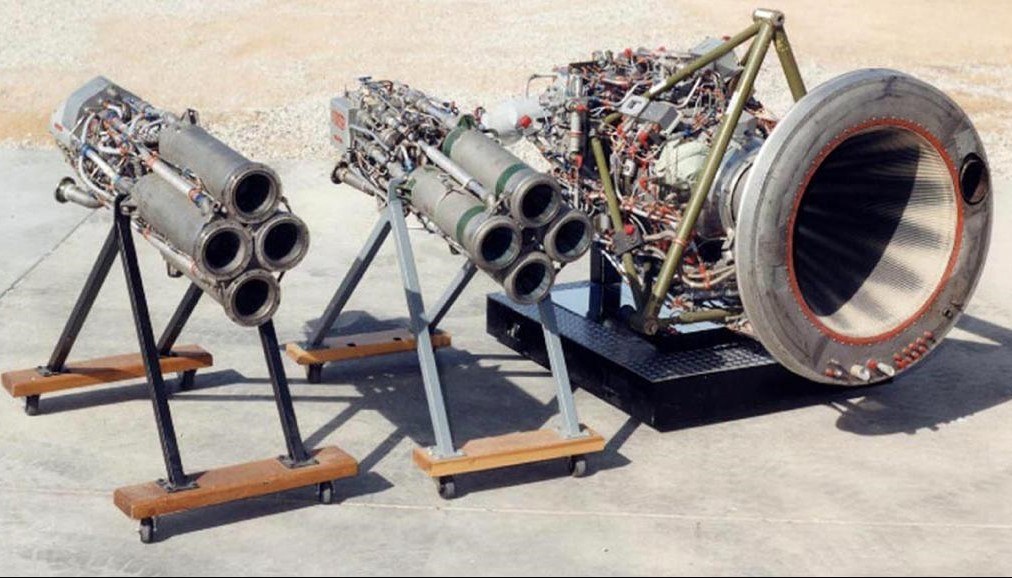
The definitive engine, the XLR99-RM-1, was a different order of machine. At the time it was built, the XLR99 was the largest man-rated rocket engine yet developed. It produced 50,000 lbf at sea level, was rated at 57,000 lbf at 45,000 ft and gave 57,850 lbf at 100,000 ft. It weighed 915 lb dry and ran at a normal chamber pressure of 600 psi on an oxidiser-to-fuel ratio of 1.25 to 1.
What mattered as much as the thrust was that a pilot could manage it. The XLR99 was throttleable from 30 to 100 per cent, although vibration meant that in practice it was not run below 40 per cent, and it could be restarted in flight. At maximum thrust the propellants went through it at a combined 13,000 lb per minute, so the internal supply of 18,000 lb lasted 85 seconds. It was carried as liquid oxygen and anhydrous ammonia in separate tanks, with a smaller tank of hydrogen peroxide to drive the turbopump. Ten production engines were built at just over a million US dollars each, and eight were used across the whole flight programme.
Carrier aircraft, the High Range and the lakebeds
The X-15 could not take off, and the reason was energy. The XLR99 emptied 18,000 lb of propellant in 85 seconds at full thrust, and every second spent climbing from the ground to 45,000 ft and accelerating to Mach 0.8 would have come out of those 85 seconds. Douglas had already quantified the gain in its own High Altitude and High Speed Study, finished in May 1954, before the invitation to bid went out on 30 December 1954 and before there was a competition to enter: raising the launch altitude from sea level to 40,000 ft added about 200,000 ft to the peak of a typical high-altitude mission. Douglas gave the prime reason for launching high as the added safety that 40,000 ft of altitude gave the pilot when he took over under rocket power, and put the performance gain second.
The landing gear followed from that decision rather than driving it. An aeroplane released from under a wing and set down on a dry lakebed has no use for a steerable nose wheel or for main wheels, and the X-15 was given neither: an unsteered nose wheel and two rear skids, which then ruled out a runway roll in either direction. Touchdown was designed for 190 to 230 mph at an angle of attack of approximately 6 degrees.
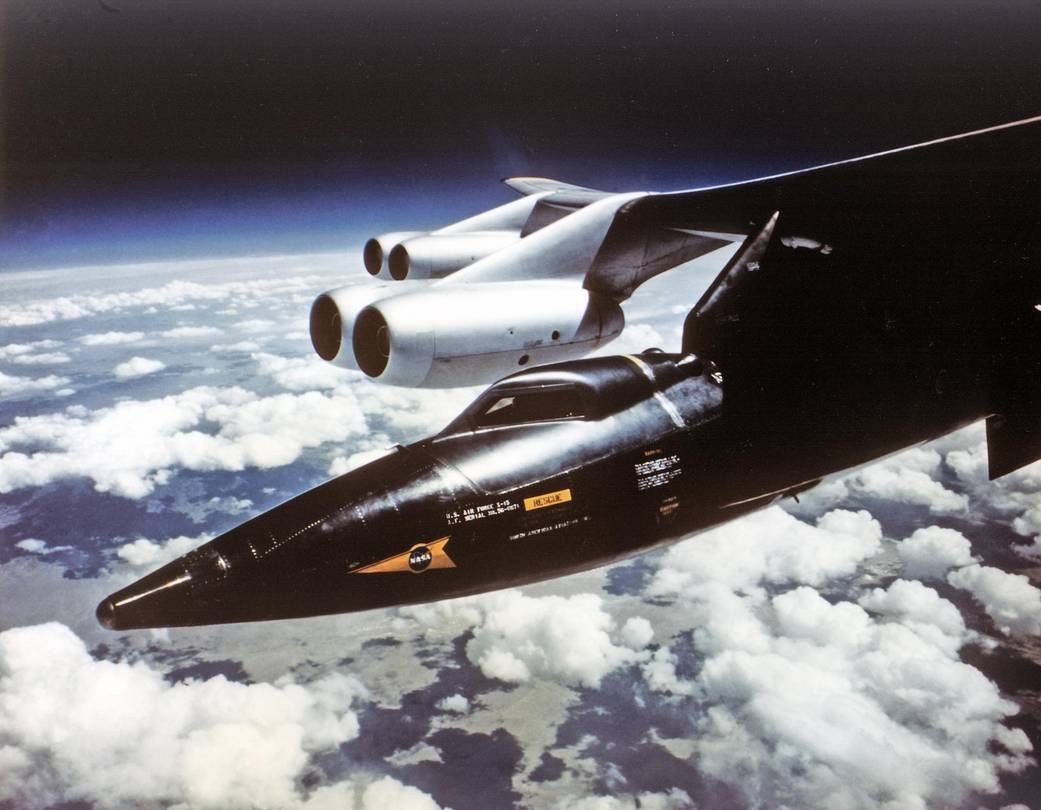
Two carrier aircraft did the work: the NB-52A, 52-003, which arrived at Edwards on 14 November 1958, and the NB-52B, 52-008, which followed on 8 June 1959. The first captive flight was on 10 March 1959.
The flights needed a piece of instrumented sky. The High Range ran approximately 400 miles long by 50 miles wide, with three tracking stations at Edwards, at Beatty in Nevada and at Ely in Nevada, and it cost approximately 11.5 million US dollars. In the control room, radar-measured velocity was the primary cue for the engine-shutdown call. On board, a servo-actuated ball nose measured flow direction and total pressure at stagnation air temperatures NASA quotes as up to 1,900°F, and a stable inertial platform supplied velocity and altitude. Speeds in miles per hour were converted after the flight from measured Mach number and dynamic pressure.
Ten launch locations were used, Delamar Dry Lake the most with 62, followed by Hidden Hills with 50, Mud Lake with 34 and Rosamond with 17. Whatever the launch lake, the aircraft almost always came home to the same place: 188 of the 199 flights landed on Rogers Dry Lake. A simple flight took a pilot 15 to 20 hours on the simulator to prepare.
The flight programme in numbers
The first glide flight, 1-1-5, was flown by Scott Crossfield in X-15-1 on 8 June 1959, launched over Rosamond at Mach 0.79 and 37,550 ft. It lasted 4 minutes 56.6 seconds and touched down at 150 knots. The first powered flight was Crossfield again, on 17 September 1959, in X-15-2: 224.3 seconds of powered time, Mach 2.11 and 52,341 ft in a flight of 9 minutes 11 seconds. Joe Walker made the first government flight on 25 March 1960 and Bob White the first Air Force flight on 13 April 1960. The XLR99 flew for the first time on 15 November 1960, with Crossfield, and Neil Armstrong took X-15-3 up for its first flight on 20 December 1961.
White then made the run of firsts that gave the aircraft its reputation. He flew the first flight at Mach 4 by any piloted aircraft, on flight 2-13-26 on 7 March 1961, reaching Mach 4.43, and the first above 200,000 ft, on flight 2-20-36 on 11 October 1961, reaching 217,000 ft. On 17 July 1962, on flight 3-7-14, he became the first person to fly above 300,000 ft and above 50 miles, reaching 314,750 ft against a planned 282,000 ft. The X-15 was the first winged aircraft to reach Mach 4, Mach 5 and Mach 6, and the first winged vehicle to exceed 300,000 feet.
Set against the totals, those peaks are rarer than the legend suggests. The three aircraft accumulated 30 hours 14 minutes 57 seconds of free flight between them. Of that, 1 hour 25 minutes 33 seconds was above Mach 5 and 1 minute 18 seconds was above Mach 6. Four flights exceeded Mach 6 and only two airframes ever did, 56-6670 and 56-6671. Four flights exceeded 300,000 ft and all four were flown by 56-6672. The airframes were taken from minus 2.5 g to over plus 8.0 g, and pilots’ heart rates in flight ran from 145 to 185 beats per minute.
The twelve pilots
Fifteen pilots were assigned to the programme and twelve flew it; the three who did not were Alvin S. White, Iven C. Kincheloe and John A. Manke. Of the twelve who flew, five came from NASA, five from the Air Force, one from the Navy and one from North American, and their individual totals sum to exactly 199.
| Pilot | Organisation | Flights | Highest Mach and altitude |
|---|---|---|---|
| A. Scott Crossfield | North American Aviation | 14 | Mach 2.97, 88,116 ft |
| Joseph A. Walker | NASA | 25 | Mach 5.92, 354,200 ft |
| Major Robert M. White | USAF | 16 | Mach 6.04, 314,750 ft |
| Lt Cdr Forrest S. Petersen | US Navy | 5 | Mach 5.30, 101,800 ft |
| John B. “Jack” McKay | NASA | 29 | Mach 5.65, 295,600 ft |
| Major Robert A. Rushworth | USAF | 34 | Mach 6.06, 285,000 ft |
| Neil A. Armstrong | NASA | 7 | Mach 5.74, 207,500 ft |
| Captain Joe H. Engle | USAF | 16 | Mach 5.71, 280,600 ft |
| Milton O. Thompson | NASA | 14 | Mach 5.48, 214,100 ft |
| Major William J. “Pete” Knight | USAF | 16 | Mach 6.70, 280,500 ft |
| William H. Dana | NASA | 16 | Mach 5.53, 306,900 ft |
| Major Michael J. Adams | USAF | 7 | Mach 5.59, 266,000 ft |
Bob Rushworth flew the X-15 thirty-four times, more than any other pilot. Jack McKay, second with 29, made three emergency landings in the type and flew 22 more times after the worst of them. Crossfield, who did the contractor’s flying, never went above Mach 2.97 or 88,116 ft, because his job was to prove the aeroplane worked and hand it over. Armstrong’s significance is not in his numbers but in the engineering: he was a principal engineer on the MH-96, made the first flight with the ball nose and the first with the MH-96, and took X-15-3 on its first flight. Joe Engle became the only person to fly a winged aerospace vehicle from orbit through landing under manual control.
All twelve are now dead. The last of them, Joe Engle, died on 10 July 2024, aged 91. Joe Walker was killed on 8 June 1966 in a mid-air collision between his F-104 and the second XB-70A, and Scott Crossfield died on 19 April 2006 when his Cessna 210 came down in a thunderstorm over Georgia.
22 August 1963: 354,200 feet
The highest X-15 flight was 3-22-36, the 91st of the programme, flown by Joseph A. Walker in X-15-3 on 22 August 1963 from Smith Ranch to Rogers. The engine ran for 85.8 seconds and shut down with the aircraft passing 176,000 ft at 5,600 fps. Walker coasted to 354,200 ft, short of the 360,000 ft planned, in a flight lasting 11 minutes 8.6 seconds. Maximum Mach was 5.58, and coming back down he pulled 5 g at 95,000 ft.
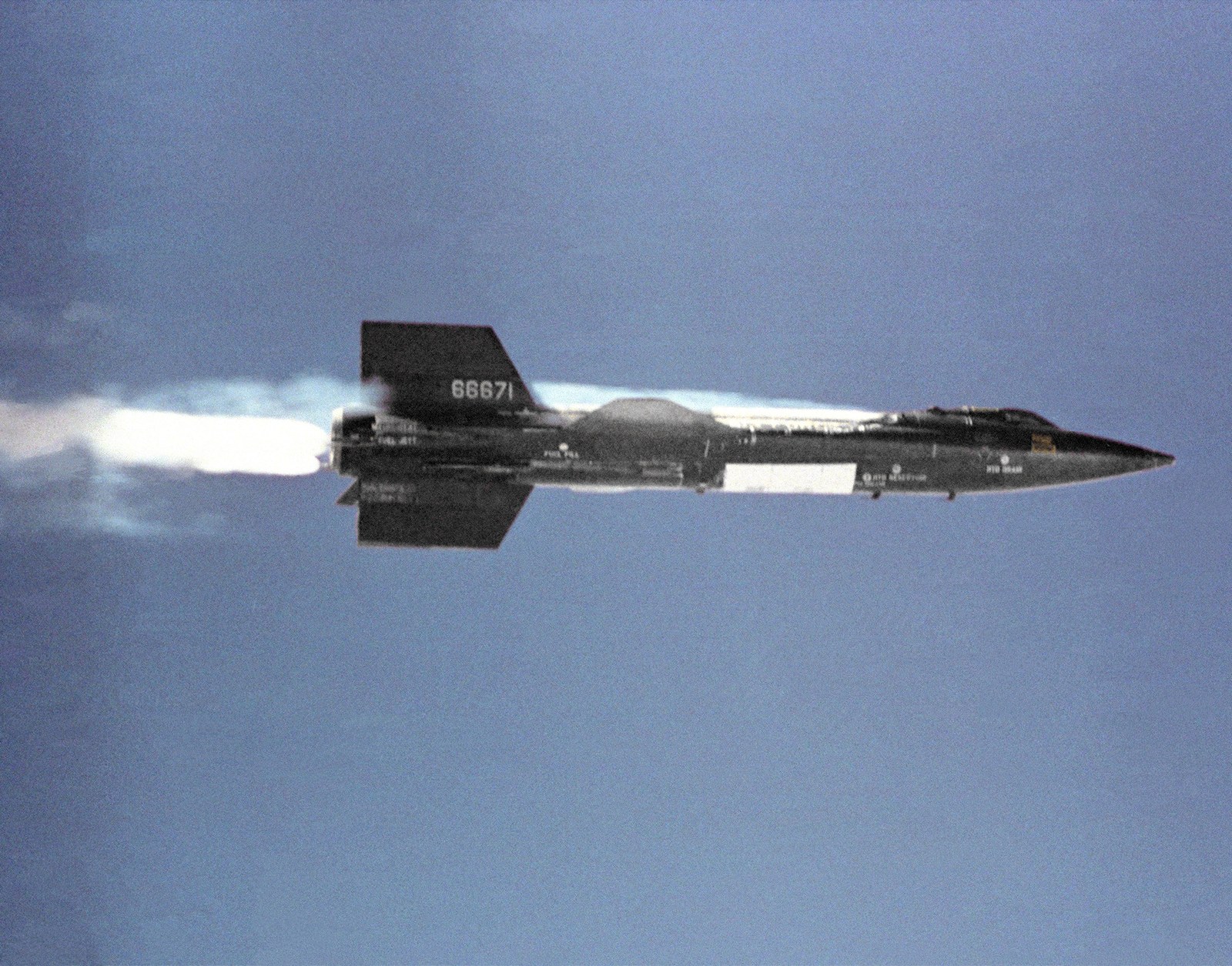
It was not Walker’s first flight above 100 kilometres. On 19 July 1963, on flight 3-21-32, he had reached 347,800 ft, or 106.0 km, against a planned 315,000 ft. Those two flights are the only X-15 flights ever to exceed 100 kilometres, and both were flown in the same aircraft from the same lakebed. Joe Walker was the first person to fly above 100 kilometres twice.
The 354,200 ft figure, which is 67.08 statute miles or 107.96 km, was the highest altitude reached by a winged aircraft until SpaceShipOne exceeded it on 4 October 2004. All ten of the highest X-15 flights were flown by X-15-3, and the highest any other airframe reached was 266,500 feet.
| # | Date | Pilot | Flight | Altitude |
|---|---|---|---|---|
| 1 | 22 August 1963 | Walker | 3-22-36 | 354,200 ft |
| 2 | 19 July 1963 | Walker | 3-21-32 | 347,800 ft |
| 3 | 17 July 1962 | White | 3-7-14 | 314,750 ft |
| 4 | 1 November 1966 | Dana | 3-56-83 | 306,900 ft |
| 5 | 28 September 1965 | McKay | 3-49-73 | 295,600 ft |
| 6 | 27 June 1963 | Rushworth | 3-20-31 | 285,000 ft |
| 7 | 29 June 1965 | Engle | 3-44-67 | 280,600 ft |
| 8 | 17 October 1967 | Knight | 3-64-95 | 280,500 ft |
| 9 | 17 January 1963 | Walker | 3-14-24 | 271,700 ft |
| 10 | 10 August 1965 | Engle | 3-46-70 | 271,000 ft |
X-15A-2 and the flight of 3 October 1967
The second airframe, 56-6671, earned its rebuild the hard way. On 9 November 1962 Jack McKay suffered an engine failure and made an emergency landing at Mud Lake; the landing gear collapsed and the aircraft flipped onto its back. On 13 May 1963 the Air Force directed that it be repaired and modified, at a cost of 4.75 million US dollars. Final assembly was complete at Inglewood on 15 February 1964, and Bob Rushworth flew it in its new form on 25 June 1964.
What came back was a longer, heavier aeroplane designed to go faster. The fuselage was extended by 29 inches to give a larger centre-of-gravity compartment, which could hold a 48 lb liquid-hydrogen tank for a ramjet, although it appears NASA never installed it. Two external tanks, each 23.5 ft long, carried approximately 70 per cent more propellant, taking design launch weight to 49,640 lb and adding 60 seconds of engine burn. The design target was 8,000 fps at 100,000 ft, with peak structural temperatures approaching 2,400°F.
Inconel X could not take that, so the aircraft was given an ablative coating. Martin Marietta received the contract in January 1966 for a material designated MA-25S, a pink substance sealed under a translucent white Dow Corning DC90-090 RTV wear coat. It worked, and it was a warning. It took six weeks to apply and added 125 lb over plan, and once exposed to liquid oxygen it could detonate at an impact of as little as 8 foot-pounds, which made routine spillage a hazard. The lesson NASA took was that the six weeks it took to coat the relatively small X-15 boded ill for larger vehicles.
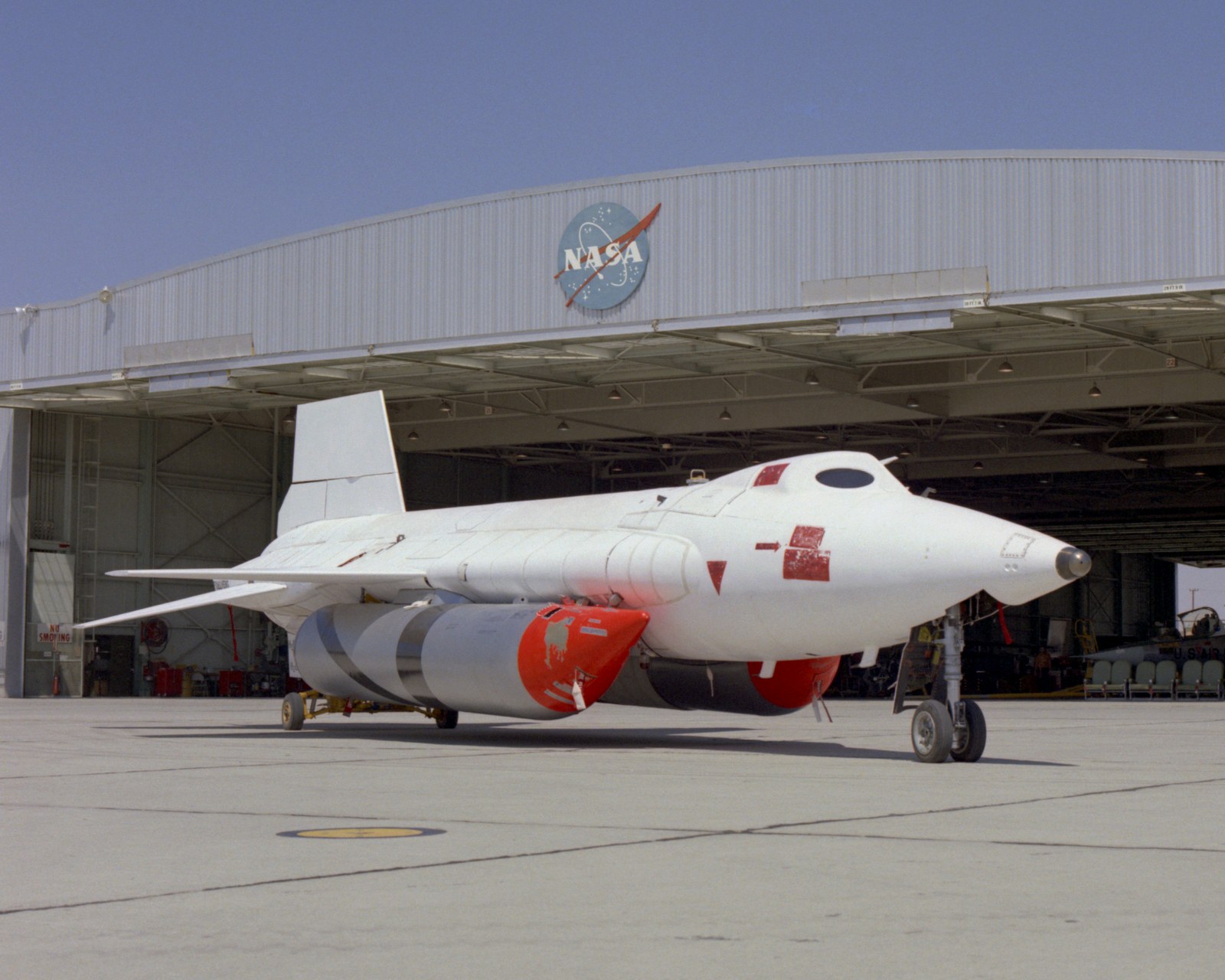
The other addition was a ramjet, and it never worked because it was never meant to. The Hypersonic Research Engine developed at NASA Langley was intended to burn liquid hydrogen, but what X-15A-2 carried was a dummy shape 30 inches in diameter. No hypersonic research engine was ever run on the X-15, and the HRE flight programme was abandoned in December 1967. Pete Knight took the aircraft up with a full ablative coating and the dummy ramjet for the first time on 21 August 1967 and reached Mach 4.94.
Flight 2-53-97, on 3 October 1967, was the 188th flight of the programme. Knight launched from Mud Lake, jettisoned the external tanks at Mach 2.4 and 72,300 ft with dynamic pressure at 287 psf, and ran the engine for 140.7 seconds. He reached Mach 6.70 and 4,520 mph at 102,100 ft, over a ground track of 225 miles, in a flight of 8 minutes 12.1 seconds. That is the fastest speed ever recorded by a piloted aircraft under rocket power, and it was an unofficial speed mark for winged vehicles that stood until Space Shuttle Columbia returned from its first orbital mission in April 1981. Of the 199 flights it was the only one to exceed the original design goal of 6,600 fps, the figure being 6,629 fps. The next fastest, 2-50-89 on 18 November 1966, also Knight’s, reached Mach 6.33 and 4,250 mph.
The aeroplane came back wrecked. The cause was shock on shock interference. The forebody of the fuselage behaved like a flat plate and threw a shock of its own, which met the shock standing off the cylindrical leading edge of the pylon that carried the dummy ramjet; shocks from the uncoated spike and from the impact pressure probes may have crossed the pylon shock as well. The heating that followed was far beyond anything predicted. The ablator and the skin burned through at the ventral leading edge and torque box, wiring and pressure lines in the forward compartment were destroyed, and three of the four explosive bolts holding the ramjet fired, apparently from the heat. The ramjet fell away at about Mach 1 and 32,000 ft over the south area of Rogers Dry Lake, and Knight did not feel it go. Johnny Armstrong worked out roughly where it had landed from the telemetry and the radar data, drove out onto the impact range and walked to it. X-15A-2 returned to Edwards after repair on 27 June 1968 and never flew again.
15 November 1967: the loss of Michael Adams
Flight 3-65-97, the 191st of the programme and the seventh for Major Michael J. Adams, launched at 10:30:07.4 from 45,000 ft over Delamar Dry Lake, with Pete Knight as NASA-1 in the control room. The aircraft was X-15-3, the one with the MH-96. Adams had spent slightly over 23 hours on the simulator preparing for a mission planned to peak at 250,000 ft, and was carrying a traverse-probe experiment in the right wing-tip pod. It was the third flight of that experiment, which had flown on flights 1-35-56 and 1-36-57 in 1963 to 124,200 ft and 111,800 ft with no anomalies. Both of those flights had passed well above the pressure altitude at which the experiment would arc, but each passed through it quickly, and X-15-1, which flew them both, carried no electronics sensitive enough for arcing to be noticed. Electrical breakdown is likeliest not in a hard vacuum but in a partial one, in a particular band of low pressure, and this was the first flight to hold the experiment in that band long enough for it to matter.
About a minute after launch, at 10:31:07, as the aircraft climbed through about 85,000 ft, an electrical disturbance began. Arcing in that experiment becomes likely below pressures corresponding to approximately 90,000 feet pressure altitude. The 1968 accident board traced it to electrical arcing at the starting capacitor of a commercial-off-the-shelf drive motor in that traverse-probe experiment, and NASA confirmed that finding in a re-analysis published in 2014. The motor contained an unrecognised transformer circuit that multiplied the aircraft’s 115 V, 400 Hz supply about fourfold, giving a peak of over 630 V, and at reduced pressure the capacitor terminal arced to the experiment chassis across a gap of approximately 0.25 in. The component had never been tested at simulated altitude. Transient spikes of at least 300 V appeared on the aircraft’s electrical bus, and the disturbance lasted 2 minutes 46 seconds.
The MH-96 dampers tripped and Adams reset them. The reaction controls had blended in at 52 seconds after launch, the system bringing them on at 90 per cent of the maximum summed gain and letting them go again at 75 per cent. Servo transients from the electrical disturbance were read by the gain changer as excessive servo limit cycles, so it cut the gain, and at 59 seconds the reaction controls dropped out. For the whole 2 minutes 46 seconds that followed, the pilot’s right side stick reaction control was intermittent, because the automatic gain controls went on fluctuating erratically. The consequence matters more than the mechanism: the system could interrupt the pilot’s access to his only effective control effector without notifying him, and Adams was unable to detect that the reaction controls were coming and going for nearly three minutes. Meanwhile Adams had switched the cockpit attitude indicator’s cross-pointers to their vernier-attitude-error mode for the experiments, which meant the vertical needle was showing roll angle rather than sideslip, and he flew it as if it were still sideslip. Johnny Armstrong, correlating the recovered cockpit film with the recorded time history, put it exactly: his inputs were in the correct direction to make sideslip zero if it had been sideslip; however, since it was roll angle, his inputs drove the nose further away from the flight path and eventually into a spin.
Sideslip grew from six to eight degrees, then off the scale, and by 162 seconds after launch it was 20 degrees. The control room had no heading indication at all, so nobody on the ground knew the aircraft was pointing the wrong way. At 10:33:30, at about 250,000 ft and 5,000 fps, the aircraft entered a spin. Nine seconds later, at about 240,000 ft, Adams radioed that it seemed squirrelly. At 10:34:01 he called, “I’m in a spin, Pete”. It reached its peak of 266,000 ft still spinning and came back down through the atmosphere yawed across the flight path.
At approximately 130,000 ft, with dynamic pressure back to about 200 psf, the spin was arrested by a combination of automatic and manual reaction control, aerodynamic control and the aircraft’s own weathercock stability. It came out inverted, in a dive. Within seconds the MH-96 entered a divergent limit-cycle oscillation in pitch, the stabilisers running at their maximum rate of about 26 degrees per second. This was traced to a design oversight in a control-system notch filter installed only on X-15-3, fitted to suppress a structural resonance, which introduced a latent failure mode that appeared only in severe off-nominal conditions. The filter had been designed against a simplified picture of the actuator, a first-order lag with hysteresis, where the model used at the flight research centre was nonlinear and rate-limited, so what started the oscillation was a modelling and design oversight and lay outside the adaptive control law itself. The adaptive loop then made it worse. Running at high gain, at or near the critical stability limit, it was less robust and it brought the divergent oscillation on sooner, and its limiting circuitry could be saturated by large direct-current signals, at which point the gains ramped to maximum and amplified the motion further. The oscillation blocked the pilot’s inputs, and as dynamic pressure rose in the dive the stabiliser motions produced accelerations beyond structural limits. At 10:34:54, at approximately 62,000 ft, with dynamic pressure exceeding 1,300 psf, the fuselage buckled and the aircraft broke into several large fragments. The wreckage fell near Johannesburg, California, and on 29 November 1967 Willard E. Dives found the cockpit camera film cassette.
The 1968 board, chaired by Donald R. Bellman, suggested that vertigo may have contributed. There is no conclusive evidence that spatial disorientation was a causal factor. What the record points to instead is poor design of the pilot-aircraft interface and ineffective operational procedures, and two changes came directly out of it: a real-time display of heading, pitch, roll, sideslip and angle of attack was installed in the control room, and the programme resolved not to use one instrument to show two different things in a high-workload cockpit.
Adams’s flight had reached 266,000 ft, which is 50.38 statute miles, clearing the American boundary of space by about 2,000 ft. He was awarded an Air Force astronaut rating posthumously, and in 1991 his name was added to the Astronaut Memorial at the Kennedy Space Center. His was the only fatality in the programme’s 199 flights.
Ten attempts at a two hundredth flight
The programme did not stop when Adams died. It flew for another eleven months and eight more flights, the last of them flown by Bill Dana in X-15-1 on 24 October 1968, reaching Mach 5.38 and 255,000 ft.
What followed is the part most accounts leave out. A two hundredth flight was attempted ten times between 21 November and 20 December 1968 and never got away. Only one of those attempts got the aircraft airborne, on 12 December 1968, and it was aborted before launch when the inertial guidance system failed. The last attempt, on 20 December 1968, was cancelled when it began snowing at Edwards, and X-15-1 was demated from the NB-52A the same day. The programme’s authorised funding expired on 31 December 1968. It ended at 199 flights not because anyone chose to stop there, but because ten attempts at a two hundredth failed.
Astronaut wings and a forty-year wait
Thirteen X-15 flights, by eight pilots, went above 50 statute miles. Five of those eight were military and were given Air Force astronaut ratings at the time: Robert M. White, Robert A. Rushworth, Joe H. Engle, William J. Knight and Michael J. Adams, the last posthumously. White’s were presented at the Pentagon on 18 July 1962, the day after his 314,750 ft flight.
The other three were civilians, and they received nothing. William H. Dana, John B. McKay and Joseph A. Walker were recognised on 23 August 2005 at the NASA Dryden Flight Research Center, forty years after the flights, when Navy Captain Kent V. Rominger, Chief of the NASA Astronaut Office, presented the certificates. Only Dana was alive to accept his in person; the McKay and Walker families accepted for the other two.
Two boundaries were in use, and they belonged to different organisations and to different purposes. The Department of Defense used 50 statute miles, 264,000 ft. The FAI standard is 100 kilometres, which is 62.14 miles or 328,084 ft. All three of the NASA pilots flew above 50 statute miles. None was awarded wings at the time, though the Air Force pilots were, and NASA recognised them on 23 August 2005. Only two X-15 flights ever exceeded 100 kilometres, and Joe Walker flew both.
Where the aircraft are now
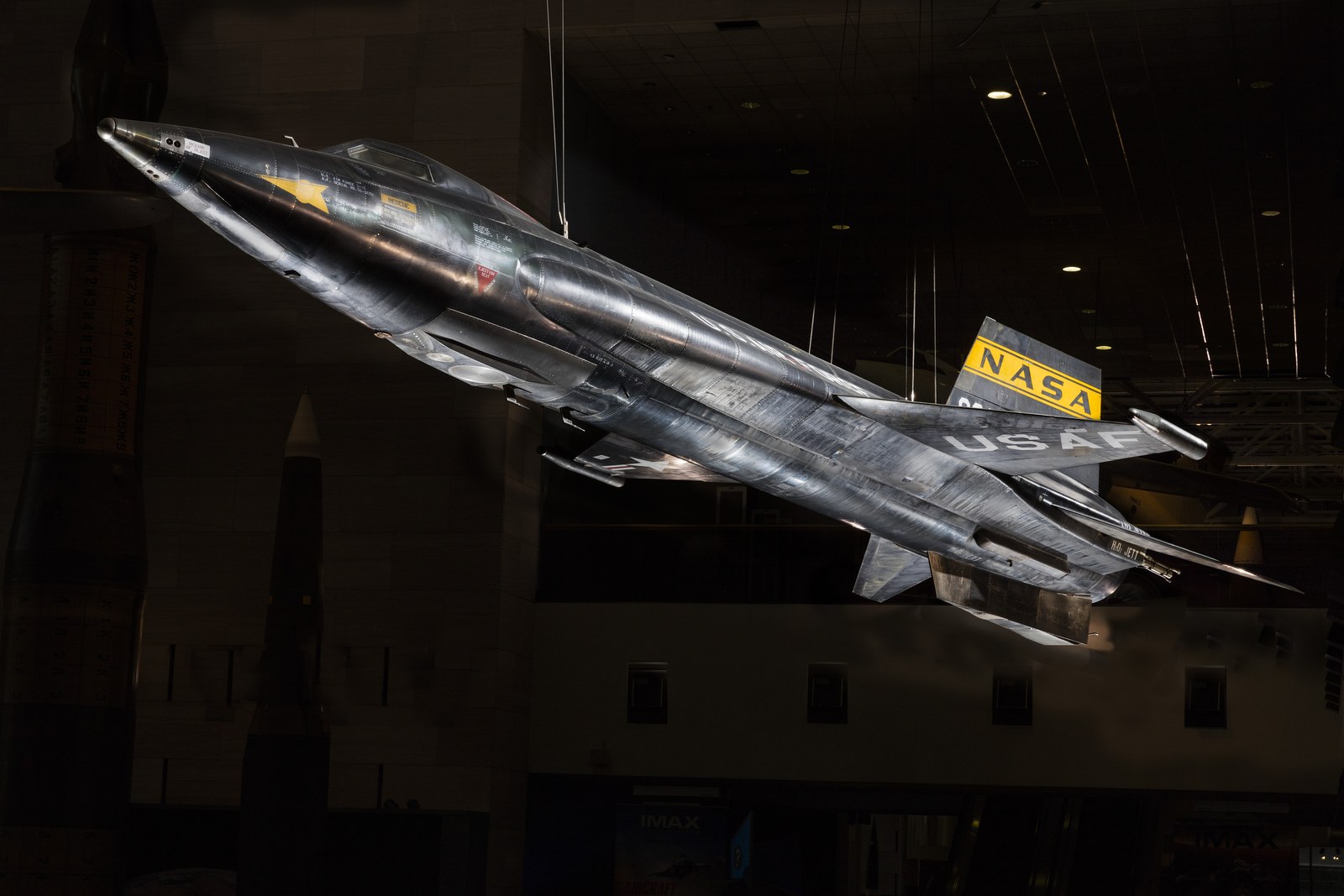
X-15-1, serial 56-6670, went to Andrews Air Force Base and then Silver Hill, Maryland, on 13 May 1969, and ownership passed formally to the National Air and Space Museum on 7 July 1971. It was installed in the museum’s new building on the Mall, which opened to the public on 1 July 1976, and it is on display in the Boeing Milestones of Flight Hall at the National Air and Space Museum in Washington DC. It carries a set of wing-tip pods; the other set was lost with X-15-3. It made the first flight and flew the most, 81 of the 199.
X-15A-2, serial 56-6671, went to the Air Force museum in 1969 and spent a year on loan to the Alabama Space and Rocket Center from 27 March 1970. It is now on display in the Space Gallery of the National Museum of the United States Air Force at Wright-Patterson Air Force Base in Ohio, where it was moved on 2 October 2015. A set of external tanks and a dummy ramjet form part of the display. It flew 53 flights, and it flew the fastest of them.
X-15-3, serial 56-6672, does not survive. The Air Force buried the remains at an undisclosed location on the Edwards reservation. It flew 65 flights, including every one of the ten highest, and there is nothing to see. The Pima Air & Space Museum in Tucson, Arizona holds a full-size replica, and it also took the NB-52A, 52-003, on its retirement.
What the X-15 left behind
The temptation with a research aeroplane is to draw a straight line from it to whatever came next, and with the X-15 the line usually gets drawn to the Space Shuttle’s heat shield. It runs the wrong way. Ablators were the mature technology of the mid-1960s and were expected to be used on the Shuttle; the X-15A-2 experience, with its six weeks of application and its impact sensitivity, contributed to the decision to go with ceramic tiles instead.
The clearer inheritances are about operating a piloted vehicle where the air does not help. The reaction control system was the first use of reaction controls for attitude control in space, and the technique of switching from aerodynamic to ballistic control at about 50 psf of dynamic pressure was worked out on this aircraft by pilots who then flew other things. The ground infrastructure, three radar stations across a range approximately 400 miles long feeding a control room that could call an engine shutdown on measured velocity, was a piloted mission control before mission control looked like one.
The records themselves have been passed. What has not been passed is the manner of it. Twelve men flew three aeroplanes 199 times between 8 June 1959 and 24 October 1968, and the whole programme accumulated 30 hours 14 minutes 57 seconds in the air, of which 1 minute 18 seconds was above Mach 6. In that time it set the world’s unofficial speed and altitude records of 4,520 mph, Mach 6.7, and 354,200 feet.
For how the high-speed research aircraft began, see breaking the sound barrier in the Bell X-1. For the aircraft that took over the high-and-fast reconnaissance role, see the Lockheed SR-71 Blackbird, and for the bomber whose airframes carried the X-15 aloft, the Boeing B-52 Stratofortress. Supersonic flight was being pushed to its limits at the same time in a very different machine, covered in our history of Concorde.
The X-15 is beyond the reach of any working photographer, but the aircraft that followed it are not. The Piemags aviation archive covers current and recent types, and licensing terms are on the licences page.
Frequently asked questions
How fast did the X-15 fly?
Its fastest flight was 2-53-97 on 3 October 1967, flown by Major William J. “Pete” Knight in X-15A-2. He reached Mach 6.70 and 4,520 mph at 102,100 ft in a flight of 8 minutes 12.1 seconds. That is the fastest speed ever recorded by a piloted aircraft under rocket power, and it was an unofficial speed mark for winged vehicles that stood until Space Shuttle Columbia returned from its first orbital mission in April 1981.
How high did the X-15 fly?
The highest flight was 3-22-36 on 22 August 1963, flown by Joseph A. Walker in X-15-3. He reached 354,200 ft, which is 67.08 statute miles or 107.96 km, in a flight lasting 11 minutes 8.6 seconds. That was the highest altitude reached by a winged aircraft until SpaceShipOne exceeded it on 4 October 2004.
How many X-15 flights were there?
There were 199 free flights, flown between 8 June 1959 and 24 October 1968. A two hundredth flight was attempted ten times between 21 November and 20 December 1968 and never got away. The last attempt, on 20 December 1968, was cancelled when it began snowing at Edwards, and X-15-1 was demated from the NB-52A the same day.
How many X-15s were built, and what happened to them?
Three: 56-6670, 56-6671 and 56-6672. X-15-1, 56-6670, flew 81 flights and is on display in the Boeing Milestones of Flight Hall at the National Air and Space Museum in Washington DC. X-15-2, 56-6671, became X-15A-2, flew 53 flights and is on display in the Space Gallery of the National Museum of the United States Air Force at Wright-Patterson Air Force Base in Ohio. X-15-3, 56-6672, flew 65 flights and was destroyed on 15 November 1967; the Air Force buried the remains at an undisclosed location on the Edwards reservation.
What caused the fatal X-15 accident?
Flight 3-65-97 on 15 November 1967 killed Major Michael J. Adams. The root cause was electrical arcing at the starting capacitor of a commercial-off-the-shelf drive motor in a traverse-probe experiment carried in the right wing-tip pod, which arced from the capacitor terminal to the experiment chassis across a gap of approximately 0.25 in and put transient spikes of at least 300 V onto the aircraft’s electrical bus for 2 minutes 46 seconds. The aircraft entered a spin at about 250,000 ft and 5,000 fps, recovered inverted at approximately 130,000 ft, and then broke up at approximately 62,000 ft after the MH-96 entered a divergent limit-cycle oscillation in pitch. That oscillation was traced to a design oversight in a control-system notch filter installed only on X-15-3, which lay outside the adaptive control law itself, although the high-gain adaptive loop made the oscillation worse once it had started.
Did X-15 pilots become astronauts?
Thirteen X-15 flights, by eight pilots, went above 50 statute miles, which is the boundary the United States Department of Defense used, 264,000 ft. Five of those eight were military and received Air Force astronaut ratings at the time: Robert M. White, Robert A. Rushworth, Joe H. Engle, William J. Knight and Michael J. Adams, the last posthumously. The three civilians, William H. Dana, John B. McKay and Joseph A. Walker, were recognised on 23 August 2005 at the NASA Dryden Flight Research Center, forty years after the flights. The FAI standard is 100 kilometres, which is 62.14 miles or 328,084 ft.
Why was the X-15 air-launched instead of taking off?
Energy. The XLR99 emptied 18,000 lb of propellant in 85 seconds at full thrust, and every second spent climbing from the ground to 45,000 ft and accelerating to Mach 0.8 would have come out of those 85 seconds. The landing gear followed from that decision rather than causing it: an aeroplane released from under a wing and set down on a dry lakebed needs no steerable nose wheel and no main wheels, so the X-15 had an unsteered nose wheel and two rear skids.
What engine powered the X-15?
Two engines did, in sequence. Until the definitive motor was ready the aircraft flew on two Reaction Motors XLR11-RM-5 units giving 11,800 lbf at sea level between them. The definitive engine was the Reaction Motors XLR99-RM-1, rated at 57,000 lbf at 45,000 ft, burning anhydrous ammonia and liquid oxygen, throttleable from 30 to 100 per cent and restartable in flight. At the time it was built, the XLR99 was the largest man-rated rocket engine yet developed.
Why did the X-15 have a wedge-shaped tail?
Thin supersonic aerofoil sections lose lift-curve slope rapidly as Mach number rises, and preliminary calculations from X-1A wind-tunnel data showed that keeping the X-15 directionally stable at hypersonic speed with a conventional thin section would need a vertical stabiliser the size of one of the X-1’s wings. Charles H. McLellan at Langley had found that at Mach 7 a thick wedge section with a blunt trailing edge should prove many times more effective than the thin shapes that are optimum at lower speed, and tests in Langley’s 11-inch hypersonic tunnel confirmed that a 10-degree wedge angle gave the stability required.
What was the X-15 made of?
The material chosen was Inconel X, a nickel-chromium alloy of 72.5 per cent nickel, 15 per cent chromium and 1 per cent columbium, selected for its strength at 1,200°F. The cabin was aluminium, isolated from the outer structure. The maximum structural temperature recorded was 1,350°F, and the lowest was minus 245°F.
How did the X-15 control its attitude above the atmosphere?
Aerodynamic control surfaces produce force in proportion to dynamic pressure, and above roughly 150,000 ft the X-15’s were no longer effective. It carried eight hydrogen-peroxide thrusters of 113 lbf in the nose and two of 40 lbf in each wing tip. They were always used below a dynamic pressure of 25 psf, which corresponds to approximately 180,000 ft, and many pilots began using them from about 100,000 ft, where dynamic pressure is roughly 50 psf and the two systems are about equally effective. What the thrusters did was control attitude, not trajectory.
How many pilots flew the X-15?
Fifteen pilots were assigned to the programme and twelve flew it; the three who did not were Alvin S. White, Iven C. Kincheloe and John A. Manke. Of the twelve who flew, five came from NASA, five from the Air Force, one from the Navy and one from North American, and their individual totals sum to exactly 199. Bob Rushworth flew the X-15 thirty-four times, more than any other pilot.
Sources and further reading
- NASA SP-2007-562, Dennis R. Jenkins, X-15: Extending the Frontiers of Flight
- NASA/TM-2014-218538, A Comprehensive Analysis of the X-15 Flight 3-65 Accident
- NASA Armstrong fact sheet FS-2002-09-052 DFRC: X-15 Hypersonic Research Program
- National Air and Space Museum: X-15
- National Museum of the United States Air Force: North American X-15A-2
