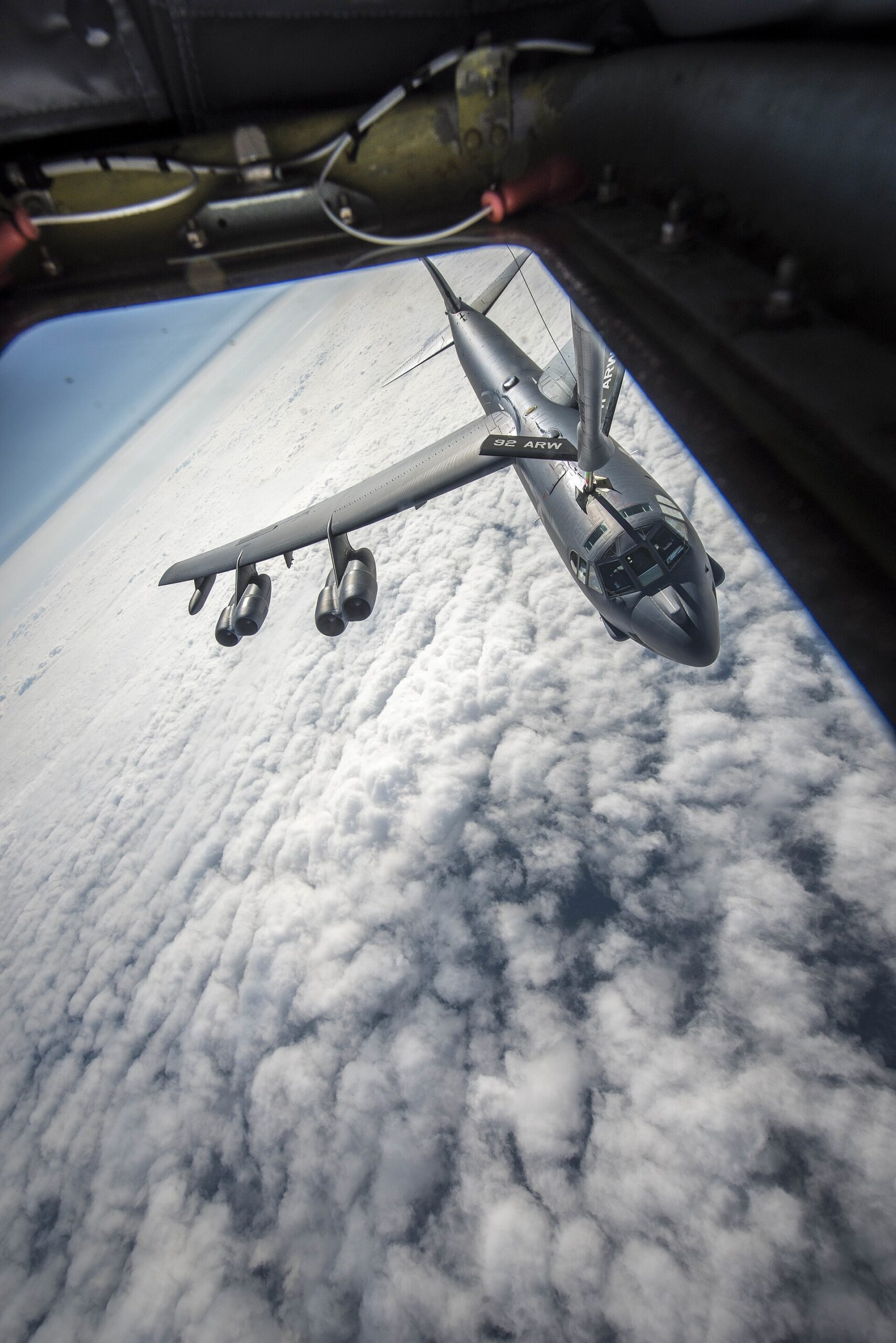
The Boeing B-52 Stratofortress is the aircraft that refused to retire. It first flew in 1952, entered service in 1955, and more than seventy years later it is still flying nuclear deterrent patrols and dropping bombs in combat. Every aircraft designed to replace it has come and gone, while the B-52 has been re-engined and re-equipped time and again. The current plan is to keep it flying into the 2050s, which would give it a working life close to a century, something no other combat aircraft has approached.
This guide tells the whole story: the weekend redesign that turned it from a turboprop into a jet, the record breaking flights of the 1950s, the long decades of nuclear alert, the bombing campaigns from Vietnam to the present day, every major variant, where the survivors are, and the vast modernisation now under way that will turn the B-52H into the B-52J.
B-52 Stratofortress: key facts
- First flight: YB-52 prototype, 15 April 1952.
- Entered service: B-52B, June 1955, with Strategic Air Command.
- Number built: 744, all variants, from 1954 to 1962.
- Engines: eight, in four underwing pods; Pratt and Whitney TF33 turbofans on the B-52H.
- Crew: five on the B-52H.
- In service today: around 75 B-52H aircraft with the US Air Force in 2026, the only version still flying.
- Future: being rebuilt as the re-engined B-52J, expected to serve into the 2050s.
What this guide covers
- Origins and development
- Design and engineering
- Flying and living with the B-52
- Around the world nonstop: Operation Power Flite
- Records and special duties
- The nuclear mission and the Cold War
- Vietnam: Arc Light and Linebacker II
- From the Gulf War to today
- Variants from A to H
- Specifications and key facts
- Where the survivors are today
- The B-52J: re-engining for the 2050s
- The bomber nothing could replace
- Legacy
- Frequently asked questions
Origins and development
The B-52 began life in the years just after the Second World War, when the United States Army Air Forces wanted a bomber that could strike targets deep inside the Soviet Union from bases in North America. The requirement went out in 1946, and Boeing won the competition on 5 June that year with its Model 462, a large straight winged aircraft powered by six Wright T35 turboprops with a gross weight of around 360,000 pounds. It was an enormous machine, and the Air Force soon began to worry that it was too big and still would not meet the range it wanted.
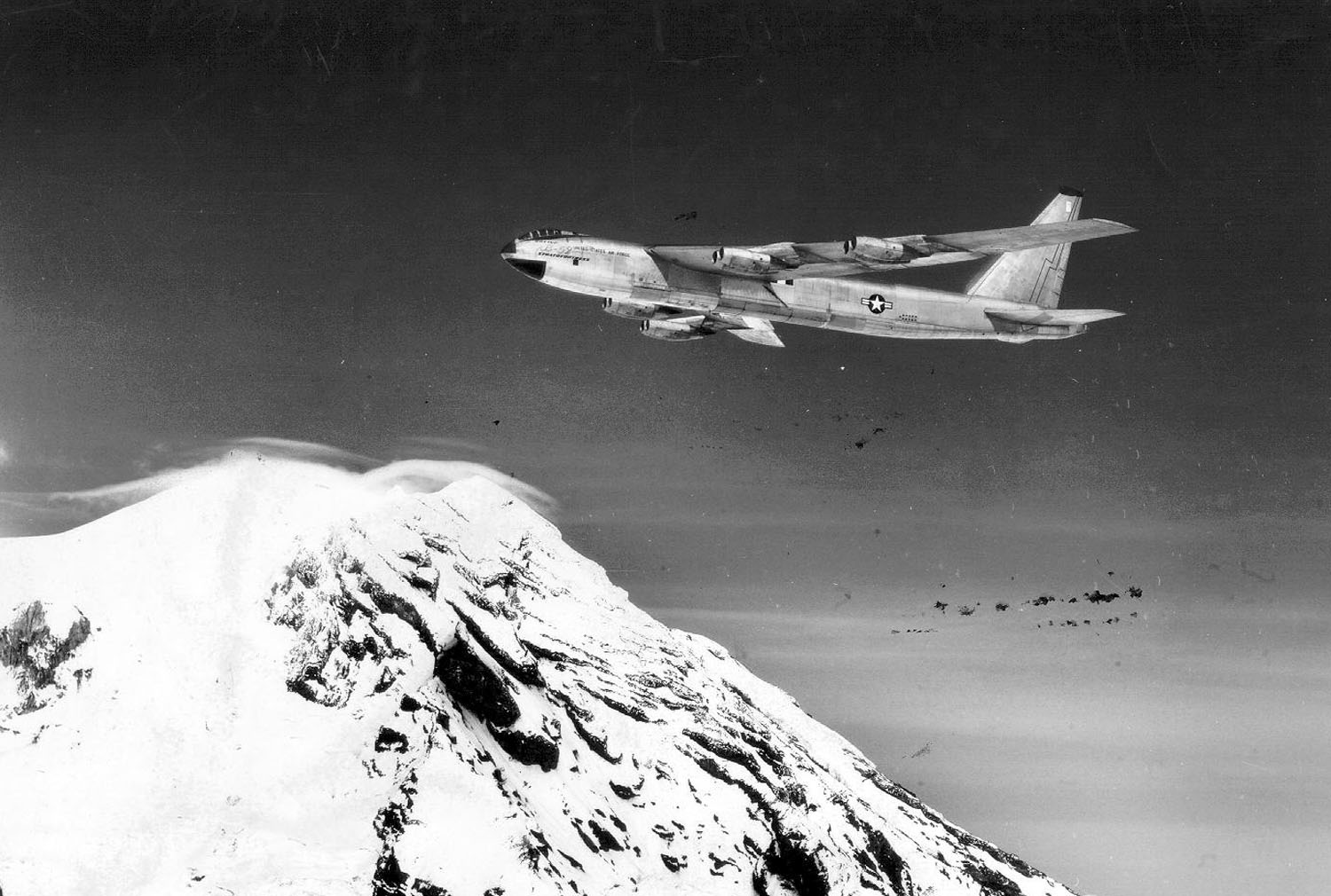
What followed was two years of redesign. Boeing produced the smaller four engined Model 464, then a series of further studies. In July 1948 one version, the Model 464-40, replaced the turboprops with Westinghouse J40 turbojets, but the government was nervous about how much fuel early jet engines burned and told Boeing to keep working on a turboprop aircraft as the basis for the prototype. The programme was drifting.
The turning point is one of the most famous stories in aviation. In October 1948 a Boeing team took a turboprop proposal to Colonel Pete Warden, the Air Force officer in charge of bomber development. Warden was unimpressed and asked whether Boeing could instead give him a four engine turbojet bomber. Over a single weekend in the Hotel Van Cleve in Dayton, Ohio, engineers George Schairer, Art Carlsen and Vaughn Blumenthal, joined by the company vice president of engineering Ed Wells, redesigned the whole aircraft. They produced the Model 464-49, a swept wing jet that borrowed the layout of Boeing’s own B-47 Stratojet, with a 35 degree swept wing and eight engines paired in four underwing pods. The team is said to have built a balsa wood model and written the proposal before Monday. The shape they drew that weekend is, in all its essentials, the aircraft still flying today.
Two prototypes were built. During a ground test in November 1951 the XB-52 suffered a pneumatic system failure that damaged the wing, so it was the second aircraft, the YB-52, that flew first, on 15 April 1952, with Boeing test pilot Alvin “Tex” Johnston at the controls. The XB-52 followed on 2 October 1952. The first production model, the B-52A, was delivered from June 1954, but only three of the thirteen ordered were completed, and all were kept for testing rather than sent to squadrons.
The first version to enter operational service was the B-52B. On 29 June 1955 the aircraft with serial 52-8711 was delivered to the 93rd Bombardment Wing at Castle Air Force Base in California. Production ran at two plants, Boeing Seattle in Washington and Boeing Wichita in Kansas, through a rapid series of improved models, and ended when the last B-52H was delivered in October 1962. In total, 744 Stratofortresses were built in eight years.
Design and engineering
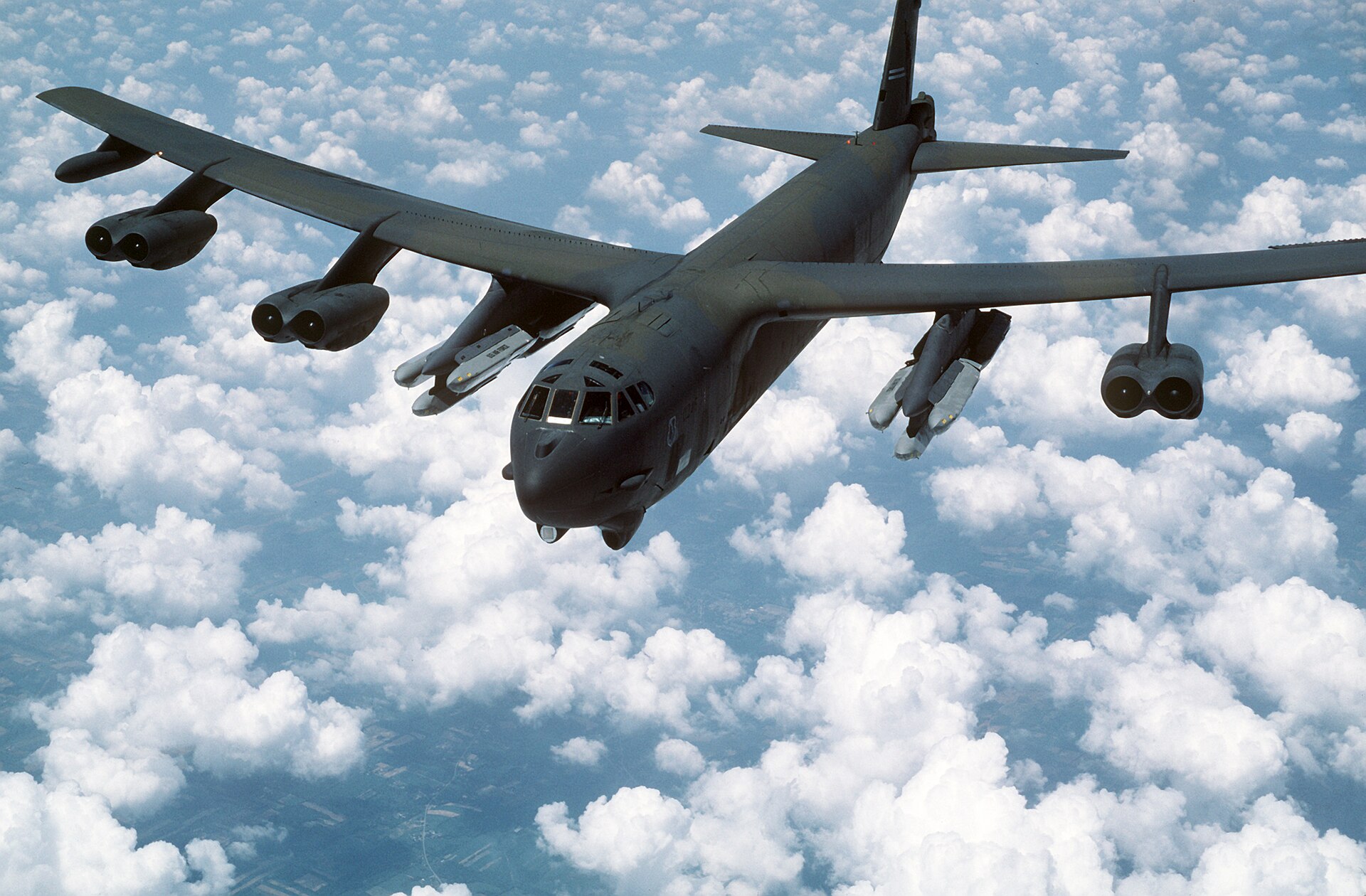
The B-52 is built around a long, slim fuselage and a high mounted wing swept back at 35 degrees. That wing is famously flexible. On the ground it droops under its own weight and under a full fuel load, and in flight the tips flex upwards by several feet. Boeing kept the structure as simple as it could by hanging the eight engines in four twin pods beneath the wing, a layout that has defined the aircraft ever since and that is being retained even in the latest modernisation.
The aircraft’s official name, Stratofortress, follows the pattern of earlier Boeing bombers such as the B-17 Flying Fortress and B-29 Superfortress. Its crews, though, almost never use it. To them the aircraft is the BUFF, which in polite company stands for Big Ugly Fat Fellow. The nickname is worn with affection, and after seventy years of service it has become as much a part of the aircraft’s identity as the eight smoking engines of the early models.
Because the wing sits so high and is packed with fuel, there was no room for conventional wing mounted landing gear. Instead the B-52 uses a bicycle undercarriage, with two twin wheel main units front and rear under the fuselage and small outrigger wheels near the wingtips. The four main gear trucks can be steered together so the aircraft can crab into a crosswind, touching down with its nose pointed away from its direction of travel while the wheels stay lined up with the runway, an unusual sight for anyone watching a landing in a stiff wind.
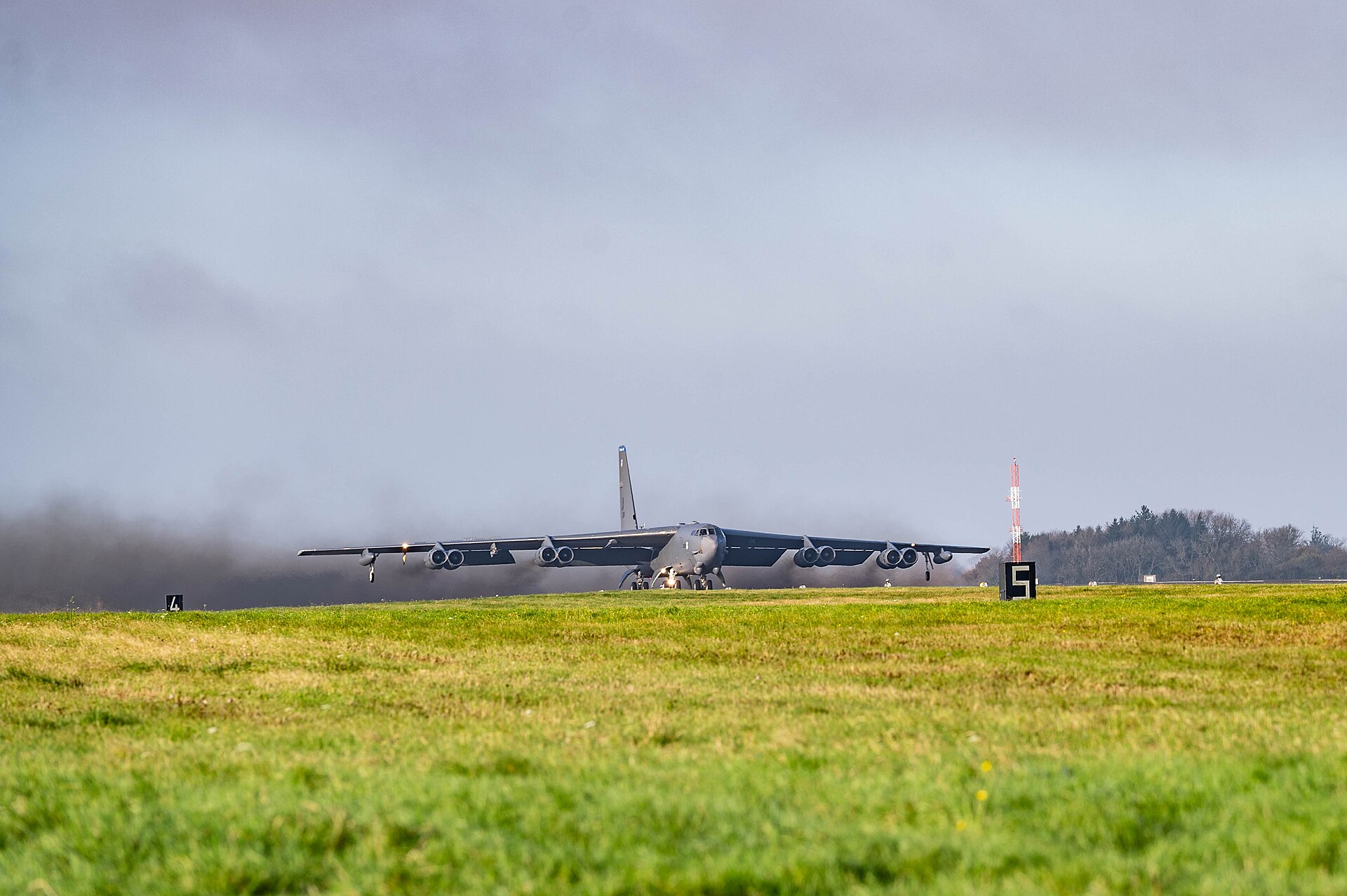
The early models, from the A through to the G, were powered by eight Pratt and Whitney J57 turbojets. These needed water injection to give enough thrust for a heavy take off, which is why film of early B-52s shows them climbing away trailing thick black smoke as the water boiled off. The final B-52H switched to eight Pratt and Whitney TF33 turbofans, which were cleaner, quieter and far more efficient, and gave the H model much better range. That change is a large part of why the H is the version that survived.
Defensive armament originally consisted of guns in the tail, remotely aimed on later models, but the Air Force removed the tail guns from the fleet in the early 1990s once they were judged to add little against modern fighters and missiles. The crew came down over the years to five on the B-52H: two pilots and an electronic warfare officer on the upper deck, and a radar navigator and navigator on the deck below, the two downstairs crew having no windows to speak of. The aircraft carries its weapons in a large internal bomb bay and on pylons under the wings, and its great fuel capacity, topped up by air to air refuelling, gives it the intercontinental reach it was designed for.
Structurally the B-52 is a product of its era, built robustly in aluminium at a time when fatigue life was less well understood, and it has needed careful management and repeated repair to keep flying for so long. The tall fin of the H model folds sideways so the aircraft can fit into hangars, a legacy of the days when bombers were dispersed to many bases. Decades of monitoring, structural inspections and rebuilds have kept the airframes sound, and current studies suggest the basic structure has plenty of life left, which is a large part of why it made sense to spend heavily on new engines and systems rather than replace the aircraft outright.
Flying and living with the B-52
For all its size, the B-52 is flown by a small crew, and life aboard is far from comfortable. The five who fly the B-52H sit on two decks. On the upper deck are the two pilots and, behind them, the electronic warfare officer. Below, in a windowless compartment, sit the radar navigator, who aims the weapons, and the navigator. The two downstairs crew work by their instruments and screens alone, with no view out, for missions that can last the best part of a day.
Those missions were, and are, long. Cold War alert sorties and modern Bomber Task Force flights routinely run to twelve, sixteen or more hours, sustained by air to air refuelling and by crews who trade duties and snatch rest where they can. The aircraft is heavy on the controls and demands respect, not least in the crosswind landing, where the whole undercarriage is angled so the bomber touches down crabbing across the runway. Ground crews, meanwhile, have kept a 1950s design serviceable for seventy years, no small feat as spares for the old engines and systems have grown scarce, which is one of the main reasons for the current rebuild.
Around the world nonstop: Operation Power Flite
Barely two years after the B-52 entered service, Strategic Air Command used it to make a point to the world. In January 1957, three B-52Bs of the 93rd Bombardment Wing, with two more flying as airborne spares, set out from Castle Air Force Base in California to fly around the world without landing. They completed the circuit in 45 hours and 19 minutes, covering 24,325 miles at an average speed of about 525 miles per hour, refuelled in the air along the way by tanker aircraft.
The flight, named Operation Power Flite, made the B-52 the first jet aircraft to circle the globe nonstop. It took less than half the time of the first nonstop circumnavigation, flown by the propeller driven B-50 Lucky Lady II in 1949. The message was blunt and deliberate: the United States could now deliver a hydrogen bomb to any point on earth. General Curtis LeMay, the architect of SAC, was among the crowd that met the bombers when they landed at March Air Force Base, and he awarded the Distinguished Flying Cross to all 27 crew members. The wing received the Mackay Trophy for the most meritorious flight of the year. For a bomber that would spend the next decades as a symbol of deterrence, it was the perfect opening statement.
Records and special duties
Operation Power Flite was not the only record the B-52 set in its early years. On 11 January 1962 a B-52H flown by Colonel Clyde Evely and his crew flew from Kadena on Okinawa to Torrejon in Spain without refuelling, covering 12,532 miles in 21 hours and 52 minutes, an average of about 573 miles per hour. The flight, named Operation Persian Rug, set a world distance record for an unrefuelled aircraft along with a string of official speed records, and it showed just how far the new turbofan powered H model could reach on internal fuel alone.
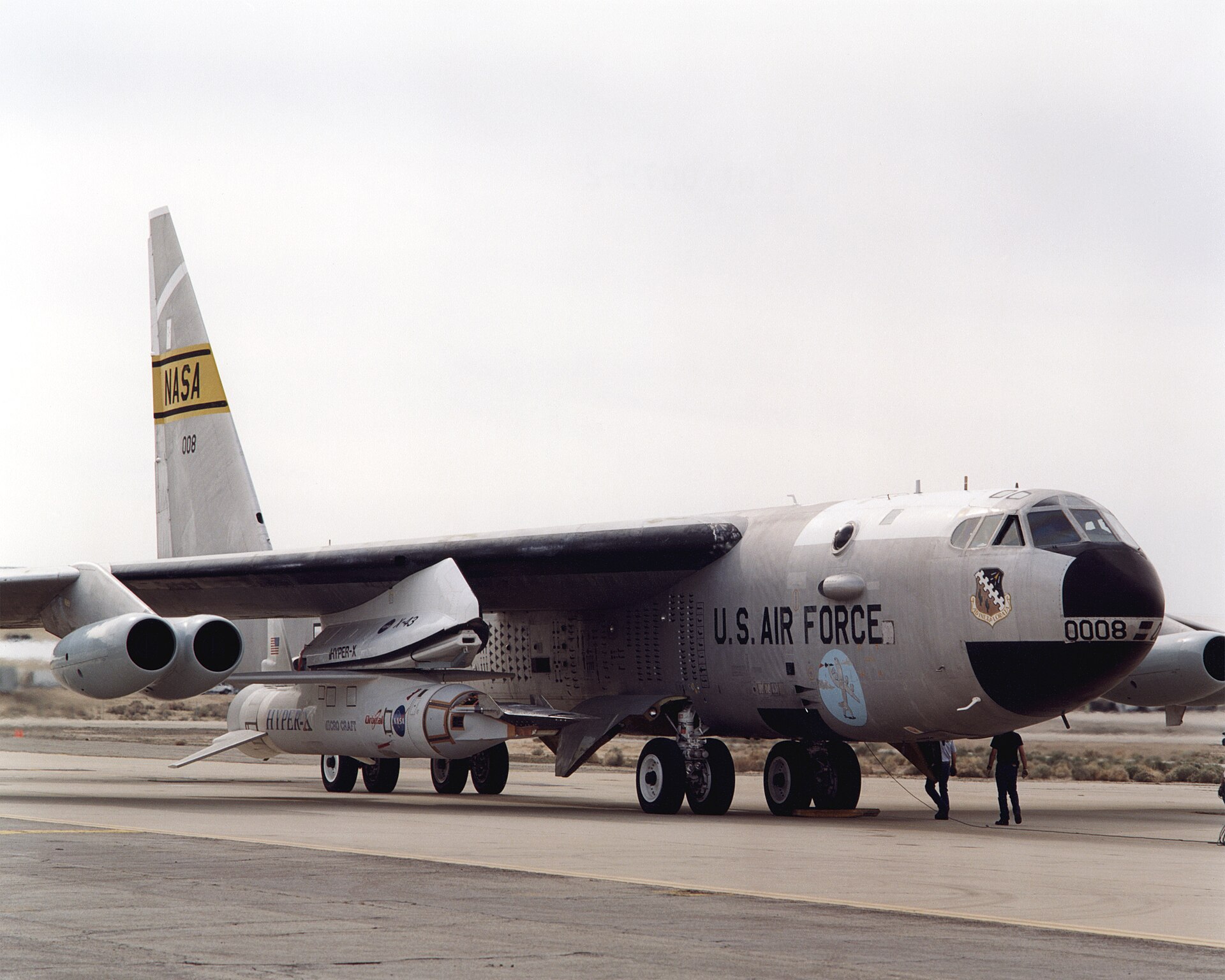
The B-52 also served science. Two early aircraft were converted into NB-52 motherships and used to carry experimental vehicles aloft and release them at altitude. The most famous of this work was launching the North American X-15 rocket plane, which was carried under the wing of an NB-52 and dropped to make its record breaking flights to the edge of space between 1959 and 1968. The NB-52B nicknamed Balls 8 went on to launch a wide range of research vehicles and stayed in service with NASA until 2004, one of the longest careers of any single B-52. This role as a flying launch pad showed how adaptable the basic aircraft was, quite apart from its work as a bomber.
The nuclear mission and the Cold War
For its first decade the B-52 was a nuclear bomber and little else. It was the backbone of Strategic Air Command, the force built to deter a Soviet attack by guaranteeing a devastating reply. A proportion of the fleet stood on ground alert at all times, fuelled and armed, ready to take off within minutes of a warning. Crews lived beside their aircraft in alert facilities, waiting for a klaxon that, thankfully, never sounded for real.
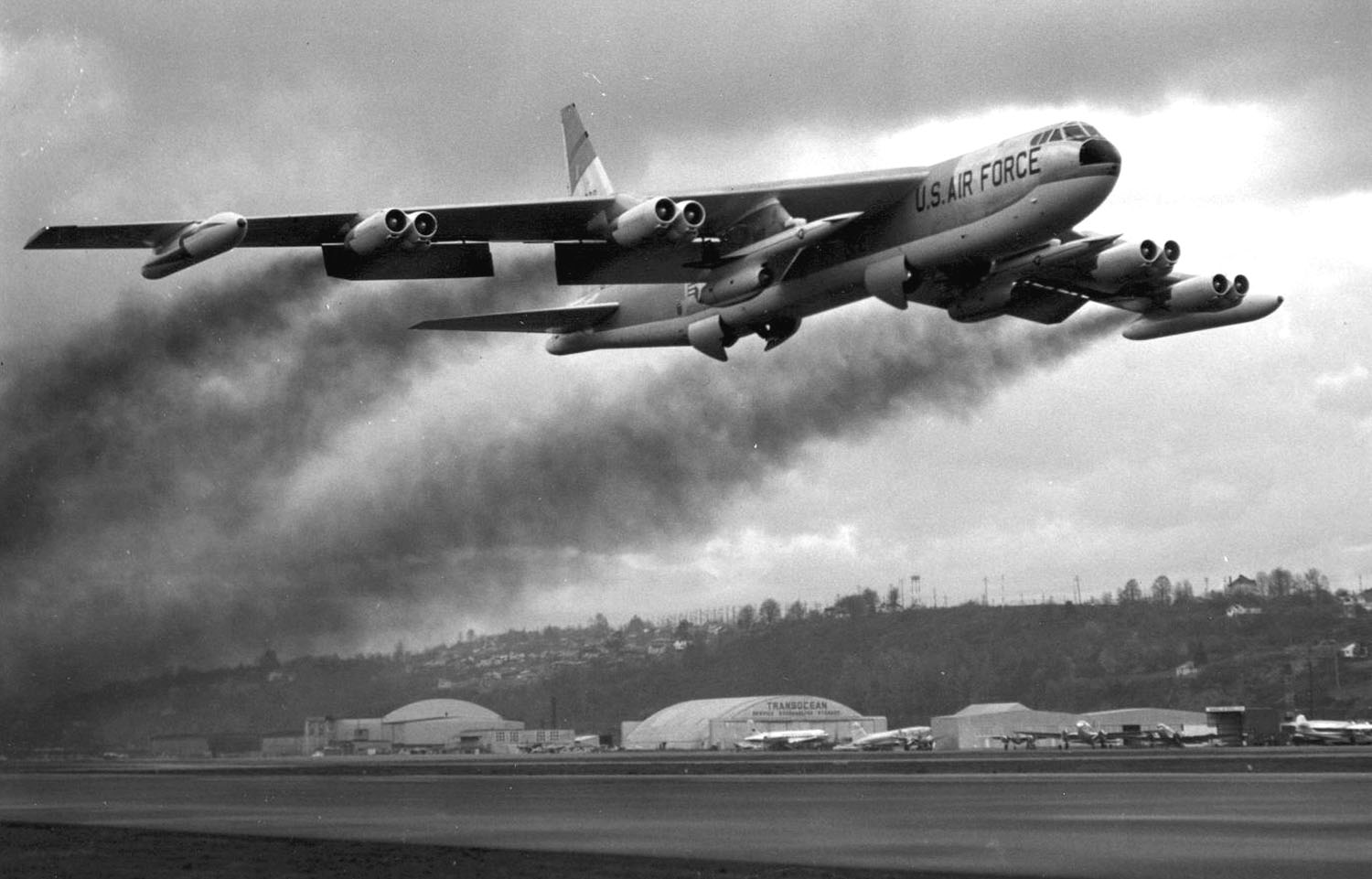
For part of the 1960s SAC went further still and kept armed bombers permanently in the air. Under Operation Chrome Dome, which ran from 1961 to 1968, B-52s carrying thermonuclear weapons flew continuous airborne alert along routes over the Canadian Arctic, Alaska, Greenland and the Mediterranean, always within striking distance of the Soviet Union. It was an extraordinary and exhausting effort, and it carried real danger. In January 1966 a B-52 collided with its tanker during refuelling and came down near Palomares in Spain, scattering nuclear weapon debris across the countryside. In January 1968 another B-52 crashed on the ice near Thule in Greenland. Both were classed as Broken Arrow accidents, involving nuclear weapons, and the Thule crash brought the airborne alert programme to an end.
Even without the airborne patrols, alert was a way of life for Strategic Air Command crews. Bombers sat at the end of the runway loaded with weapons, crews resting in nearby quarters ready to run to their aircraft and be airborne within minutes, all built around the grim logic that a force which could always retaliate would never have to use its weapons. The B-52 formed one leg of what became the nuclear triad, alongside land based missiles and missile carrying submarines, and that share of the deterrent mission is one it still holds today.
Because flying a bomber over heavily defended territory was becoming more dangerous as Soviet air defences improved, the B-52 was given stand off weapons so it could strike from a distance. The first was the AGM-28 Hound Dog, a large supersonic missile carried under the wings from 1959, meant to knock out air defence sites ahead of the bombers. It was intended as a stopgap until the GAM-87 Skybolt air launched ballistic missile arrived, but Skybolt was cancelled in December 1962 and the Hound Dog soldiered on. From 1972 it was replaced by the much smaller AGM-69 SRAM, a short range attack missile designed to clear a path through defences, and in the 1980s the B-52G and H were adapted to carry the AGM-86 air launched cruise missile, which let them attack targets from well over a thousand miles away without crossing hostile airspace at all. That cruise missile role, rather than dropping bombs over the target, is now central to what the B-52 does.
Vietnam: Arc Light and Linebacker II
The B-52 first went to war not with nuclear weapons but with conventional bombs. From June 1965 it flew Arc Light missions over South East Asia, attacking troop concentrations, base areas and supply routes, frequently from altitudes so high that the first warning those on the ground had was the explosions walking across the jungle. To carry enough iron bombs for this work the B-52D was given a modification known as Big Belly, which greatly increased the number of bombs it could hold internally. Over the course of the war the fleet flew well over a hundred thousand sorties in the theatre.
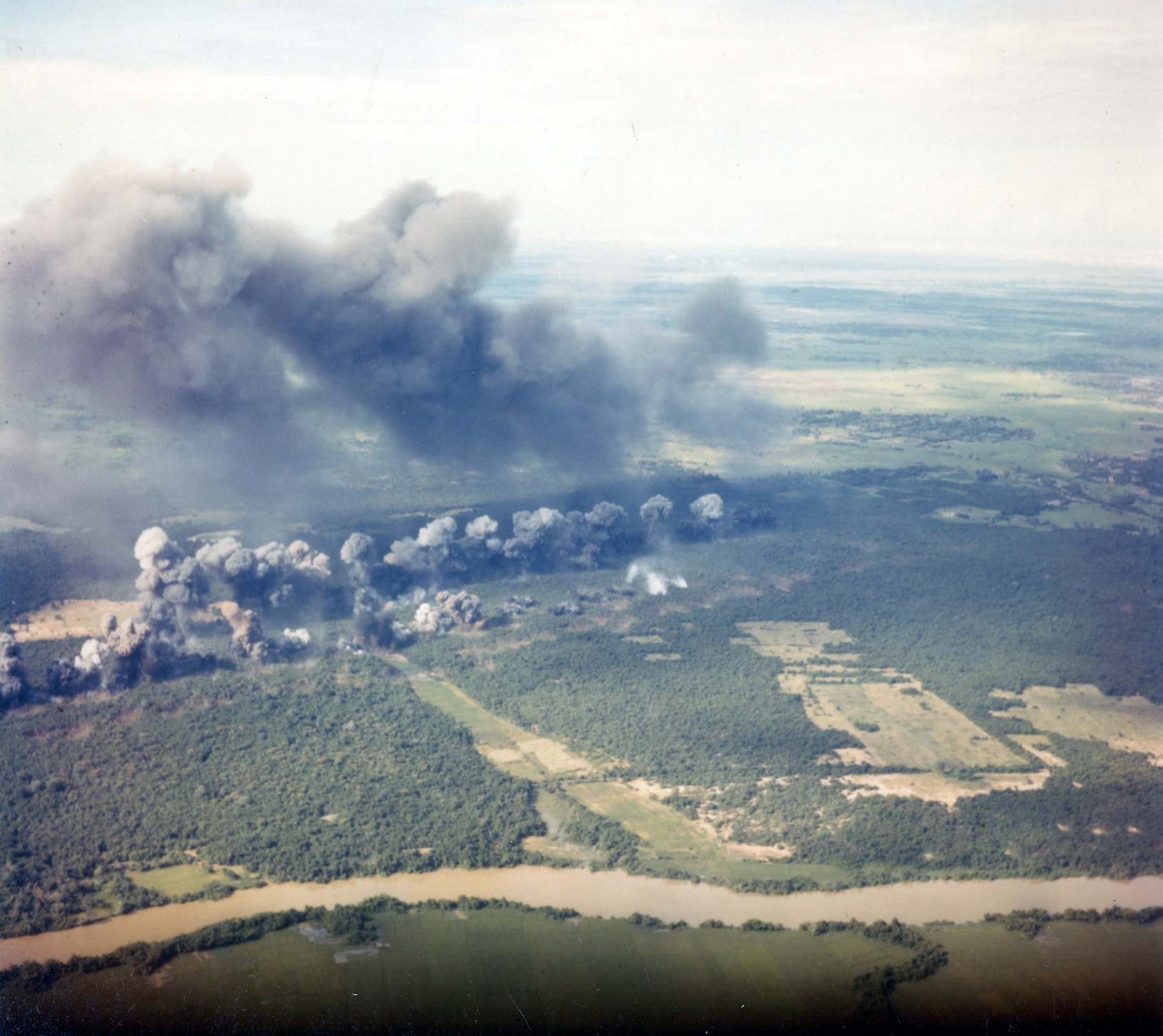
The most intense episode came in December 1972 with Operation Linebacker II, an eleven day campaign against Hanoi, Haiphong and other targets in North Vietnam. This was very different from Arc Light. The B-52s were sent against some of the most heavily defended airspace in the world, thick with radar guided surface to air missiles. Around fifteen B-52s were shot down during the campaign, a shock to crews who had grown used to operating almost unopposed, and it forced changes in tactics in the middle of the operation. For all the losses, Linebacker II is generally credited with helping to bring North Vietnam back to the negotiating table, and it showed both the reach of the B-52 and its vulnerability when sent over modern defences without the right support.
One of the clearest demonstrations of what the B-52 could do came in early 1968 at Khe Sanh, where a United States Marine base was besieged by North Vietnamese forces. Under Operation Niagara the bombers pounded the ground around the base almost around the clock. Over the course of the siege B-52s flew thousands of Arc Light sorties and dropped tens of thousands of tons of bombs, some of them landing only a few hundred yards from the American perimeter without hitting the defenders. General William Westmoreland later said it was the fire of the B-52s, more than anything else, that broke the enemy at Khe Sanh, and the siege became a byword for the sheer weight of firepower the aircraft could bring to bear.
From the Gulf War to today
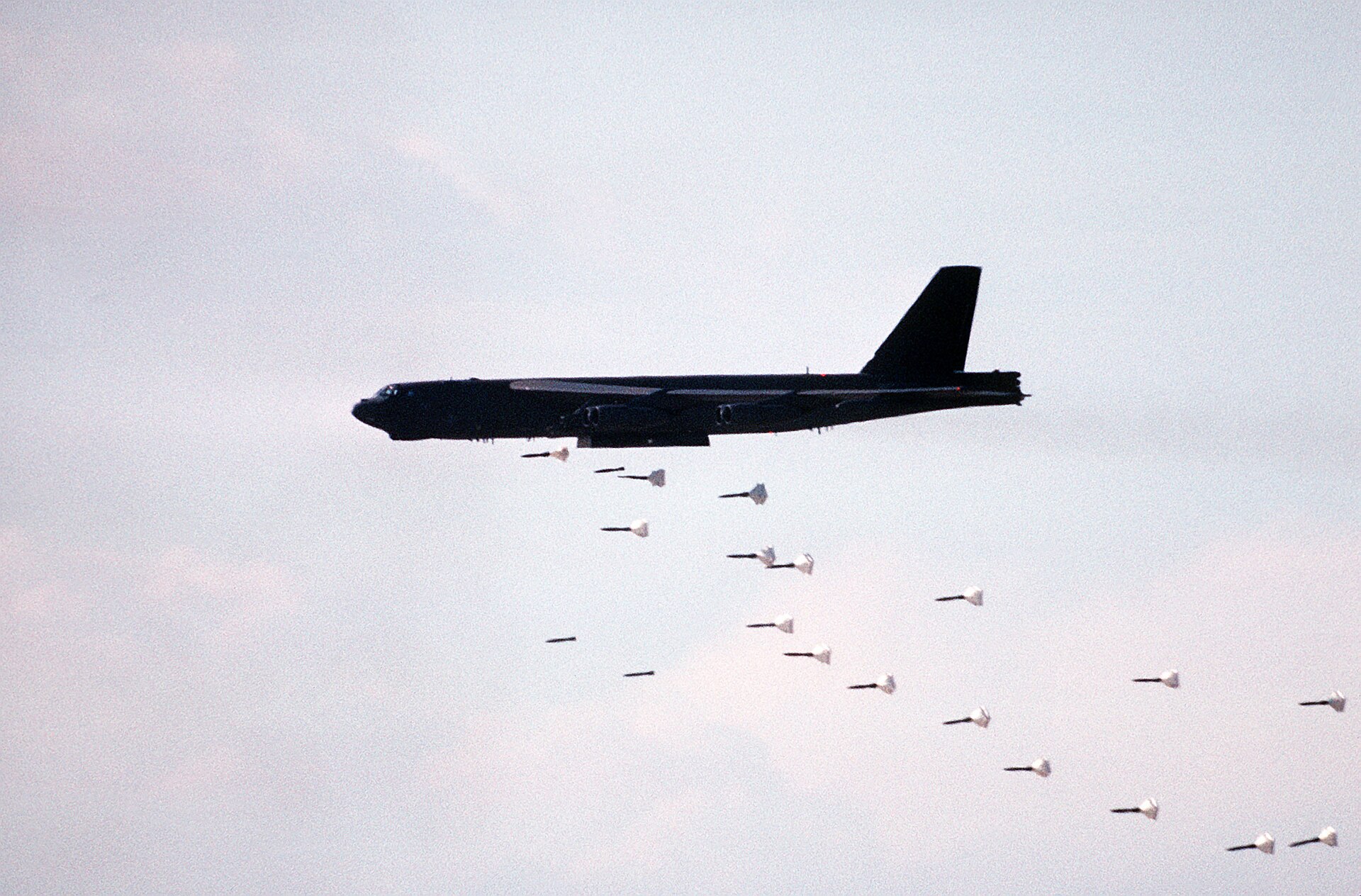
After Vietnam the B-52 kept its nuclear role but grew steadily more important as a conventional heavy bomber. It opened the 1991 Gulf War in dramatic style. A flight of B-52Gs took off from Barksdale Air Force Base in Louisiana, flew to the Gulf, launched conventionally armed cruise missiles at Iraqi targets and flew home again, a round trip of about 35 hours that was the longest combat mission flown up to that point. The mission was known as Senior Surprise, though the crews called it Secret Squirrel. Through the rest of Desert Storm the fleet flew well over a thousand sorties and delivered a large share of the total bomb tonnage dropped, often against dug in troops.
The pattern continued into the twenty first century. B-52s struck Taliban positions in Afghanistan from 2001 during Operation Enduring Freedom, and provided close support to troops on the ground, a striking use for an aircraft designed to drop hydrogen bombs on cities. They supported the 2003 invasion of Iraq, and returned to the region again in later years in the campaign against so called Islamic State. More recently the type has been a mainstay of the Bomber Task Force deployments, flying from home bases and forward locations to show presence in Europe, the Middle East and the Pacific. The aircraft can now carry precision guided bombs and a range of stand off missiles, which keeps a 1950s airframe relevant against modern targets.
What keeps the aircraft relevant is the range of weapons it now carries. A B-52 can drop satellite guided bombs with precision, lay sea mines, and launch cruise missiles both conventional and nuclear, and it is being cleared for new stand off and hypersonic weapons as they enter service. That flexibility, combined with the ability to carry more than thirty tonnes of ordnance, means a single aircraft can be tasked against anything from a massed target to a single aim point, which is exactly the versatility a modern air force values.
The B-52 still makes the news for hard reasons too. On 15 June 2026 a B-52H assigned to the 412th Test Wing crashed near Edwards Air Force Base in California, with the loss of the crew aboard, a reminder that even a settled and much loved design remains a demanding aircraft to operate.
Variants from A to H
The letters that ran from A to H mark a steady growth in capability across the production run. The B-52A was a test aircraft only, with three built. The B-52B was the first operational model, and some were completed as RB-52B reconnaissance aircraft able to carry a crewed sensor capsule in the bomb bay. The C, D and E models added fuel and refuelling capacity and improved systems. The D became especially important in Vietnam once the Big Belly modification let it carry a very heavy load of conventional bombs.
The B-52F brought more powerful engines. The B-52G was a major redesign, with a shorter tail fin, a wing built as an integral fuel tank to carry more fuel, and provision for stand off missiles. Many G models spent their later years carrying cruise missiles, and large numbers were later cut up in the Arizona desert to meet arms control treaty limits, their sliced fuselages left in the open long enough to be counted by Soviet satellites. The final model, the B-52H, introduced the TF33 turbofan engines and better systems, and it is the only version still flying. Every B-52 in service today is an H model built between 1961 and 1962.
Specifications and key facts
| Crew | 5 (two pilots, radar navigator, navigator, electronic warfare officer) |
|---|---|
| First flight | YB-52 prototype, 15 April 1952 |
| Entered service | B-52B, June 1955 |
| Powerplant | 8 x Pratt and Whitney TF33-P-3 turbofans, around 17,000 lbf each |
| Length | About 48.5 m (159 ft) |
| Wingspan | 56.4 m (185 ft) |
| Height | About 12.4 m (40 ft 8 in) |
| Maximum speed | Around 1,000 km/h (about 650 mph, Mach 0.86) |
| Service ceiling | About 15,000 m (50,000 ft) |
| Range | Over 14,000 km (about 8,800 miles) unrefuelled |
| Payload | Around 32,000 kg (70,000 lb) of weapons |
| Number built | 744 (all variants, 1954 to 1962) |
Aircraft of this scale reward patience and a long lens, and you will find plenty of heavy metal in the Piemags archive galleries. Print and usage terms are on the licensing page.
Where the survivors are today
The B-52 is unusual among Cold War aircraft in that the survivors are not only in museums. The United States Air Force still operates a fleet of B-52H aircraft, numbering around 76 before the 2026 loss at Edwards, all of them H models. They are flown by two main wings, the 5th Bomb Wing at Minot in North Dakota and the 2nd Bomb Wing at Barksdale in Louisiana, supported by reserve and test units.
Retired airframes are preserved across the United States. Two aircraft stand out. The first is the NB-52A known as The High and the Mighty One, preserved at the Pima Air and Space Museum in Tucson. The second is the NB-52B nicknamed Balls 8, a NASA mothership that carried the X-15 rocket plane aloft for many of its flights and stayed in service until 2004, which made it the oldest flying B-52 of all before it retired; it now stands at the north gate of Edwards Air Force Base in California. Other B-52D and B-52G models are displayed at air force bases and aviation museums around the country, their size alone drawing crowds wherever they sit.
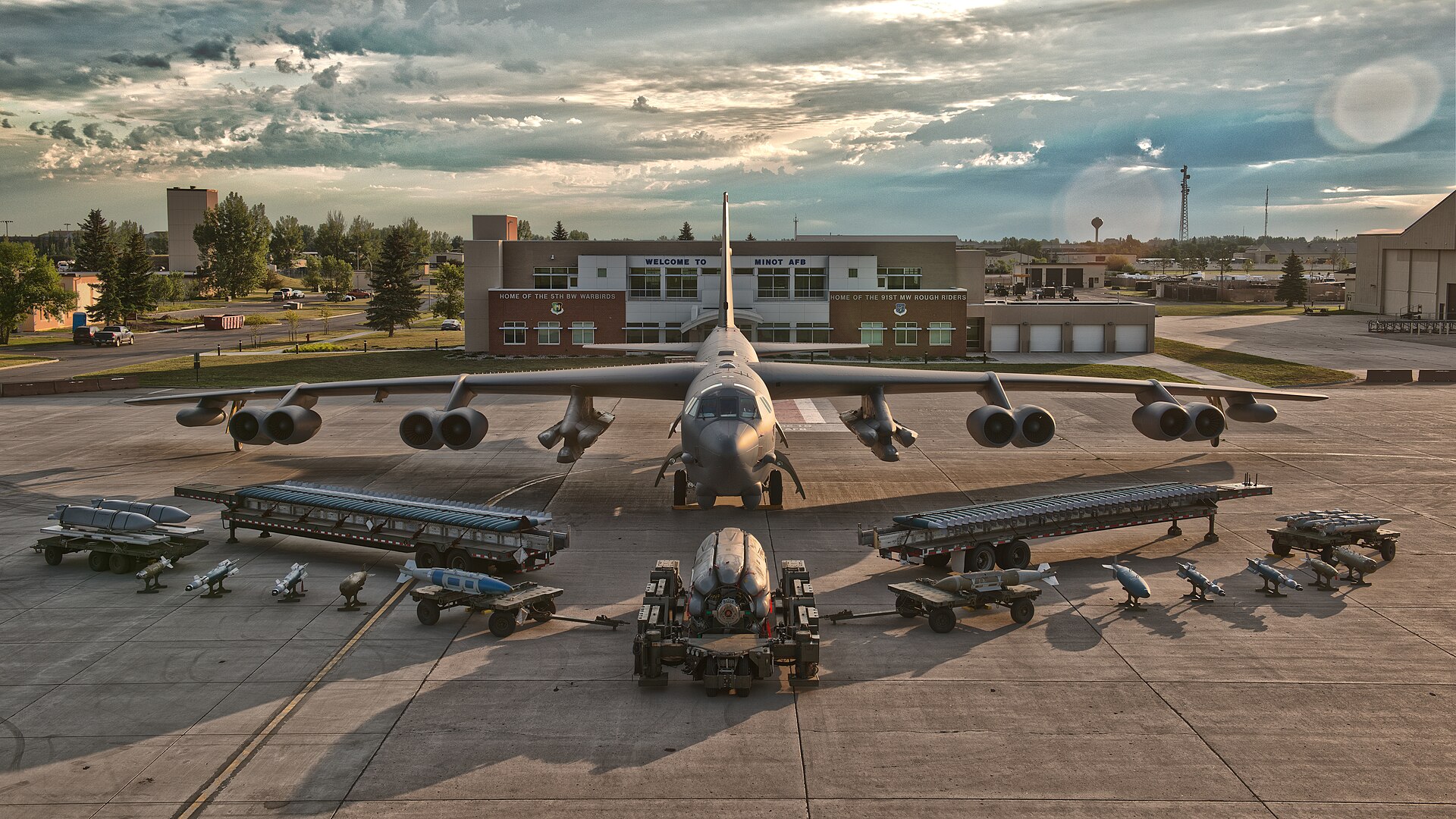
The B-52J: re-engining for the 2050s
Rather than retire the B-52, the Air Force is rebuilding it. The centrepiece is a new engine. In 2021 the service chose the Rolls-Royce F130 to replace the elderly TF33 turbofans under a programme called the Commercial Engine Replacement Program. Crucially, and unlike an earlier proposal that would have cut the number of engines from eight to four, the F130 fit keeps the familiar eight engine layout. The new engines are more efficient and far easier to support, and they cleared a critical design review with the first aircraft due to arrive at Boeing’s San Antonio facility during 2026 and modification work beginning in FY2027, with the whole fleet planned to be re-engined by the mid-2030s, a schedule that has already slipped by about three years.
The engines are only part of the story. The B-52 is also receiving a new Raytheon AN/APQ-188 active electronically scanned array radar, digital avionics, Link 16 data links and improved electronic warfare systems. Taken together these upgrades are expensive: reports have put the engine work at around eight to nine billion dollars and the total modernisation at close to fifty billion. Once modified, the aircraft will be redesignated the B-52J and is expected to serve into the 2050s, working alongside the new B-21 Raider and carrying cruise missiles and future stand off weapons. If the timeline holds, the type will approach a full century of service since its first flight in 1952.
The case for rebuilding rather than replacing comes down to money and time. A new fleet of bombers on the scale of the B-52 would cost far more and take many years to field, while the existing aircraft already do the job. The new engines are expected to cut fuel use sharply and to need far less maintenance than the elderly TF33s, some of which have been in service since the 1960s, and they should extend the aircraft’s range as well. Combined with the new radar and avionics, the aim is an aircraft that is cheaper to run, more capable, and able to keep flying long after its design passes a hundred years old.
The bomber nothing could replace
The B-52 has outlived a remarkable succession of aircraft meant to take its place. In the late 1950s the delta winged Convair B-58 Hustler promised to do the job at twice the speed of sound, but it was costly and short ranged and was retired after barely a decade. The North American XB-70 Valkyrie, designed to cruise at Mach 3, was overtaken by the surface to air missile and cancelled after only two were built, one of which was lost in a mid air collision in 1966.
The story repeated with later designs. The Rockwell B-1 Lancer, a swing wing bomber, entered service in the 1980s and is now itself due to retire before the B-52. The Northrop Grumman B-2 Spirit stealth bomber was so expensive that only 21 were built, too few to take on the whole job. Through all of this the cheap, roomy, long ranged B-52 kept flying, and it is now set to serve alongside the new B-21 Raider well into the future. Each replacement was faster, or stealthier, or more advanced, and each in turn found it could not match the simple economics of the old bomber it was meant to succeed.
Legacy
The most remarkable thing about the B-52 is simply that it is still here. Aircraft designed to replace it have come and gone, and the newer bombers that serve alongside it are far fewer in number. The B-52 has lasted because it does something none of them do as cheaply: carry a very large load of weapons a very long way, and increasingly launch stand off missiles from outside the range of enemy defences, all at a cost per flying hour the Air Force can accept.
It is also a rare thread running through the whole nuclear age, from the ground alert pads of the 1950s and the airborne patrols of Chrome Dome, through Vietnam, the Gulf and the campaigns of the present day, to the re-engined aircraft now taking shape. Few machines have served so long or seen so much, and none of the engineers who sketched it over a weekend in a Dayton hotel could have imagined that their design would still be flying, and still being rebuilt, three quarters of a century later.
For more Cold War history on this blog, see the profiles of the Avro Vulcan and the Lockheed SR-71 Blackbird, and the story of another long serving giant in the Lockheed C-130 Hercules. If you want to photograph aircraft like these, our guide to the best lenses for aviation photography is a good place to start.
Sixty years of service means B-52 photographs span a dozen different configurations, and older images are frequently captioned with the wrong variant. If you are licensing Stratofortress imagery, our guide to aviation picture research is a useful starting point.
Frequently asked questions
How old is the B-52, and when did it first fly?
The Boeing B-52 Stratofortress first flew on 15 April 1952, when the YB-52 prototype took off from Seattle, and it entered service in June 1955. That makes the design more than 70 years old, and individual aircraft still flying were built in the early 1960s.
How many B-52s are still in service in 2026?
The United States Air Force operates around 75 B-52H bombers in 2026, following the loss of one aircraft in a crash at Edwards Air Force Base in June 2026. Every one is a B-52H built between 1961 and 1962, and no other country flies the type.
Why has the B-52 stayed in service so long?
The B-52 has survived because it carries a very large weapons load over intercontinental range at a low cost per flying hour, and because it has been repeatedly upgraded. As a launch platform for stand off cruise missiles it can strike from outside enemy air defences, so its 1950s airframe remains useful even against modern targets.
Has the B-52 ever dropped a nuclear weapon in combat?
No. The B-52 was designed as a nuclear bomber and stood nuclear alert for decades, but every weapon it has actually used in combat has been conventional, from the Arc Light raids over Vietnam to precision guided bombs and cruise missiles in recent conflicts.
What is the B-52J?
The B-52J is the designation for B-52H aircraft rebuilt with new Rolls-Royce F130 engines, a new AN/APQ-188 radar and upgraded avionics. The programme keeps the eight engine layout and is intended to keep the aircraft flying into the 2050s alongside the B-21 Raider.
How many B-52s were built?
Boeing built 744 B-52s between 1954 and 1962, across plants in Seattle and Wichita. The last of them, a B-52H, was delivered in October 1962, and the H is the only model still in service.
What engines does the B-52 use, and why is it being re-engined?
The B-52H uses eight Pratt and Whitney TF33 turbofans, which are efficient but old and increasingly hard to support. The Air Force is replacing them with eight Rolls-Royce F130 engines to cut fuel use and maintenance costs and to keep the fleet viable for decades to come.
Where can I see a B-52 today?
Retired B-52s are displayed at museums and air force bases across the United States. The Pima Air and Space Museum in Tucson, Arizona holds the NB-52A, while the NASA NB-52B known as Balls 8, which launched the X-15, is displayed at the north gate of Edwards Air Force Base in California.
What was Operation Chrome Dome?
Operation Chrome Dome was a US Air Force programme that ran from 1961 to 1968, under which B-52 bombers carrying thermonuclear weapons flew continuous airborne alert near Soviet borders, ready to strike at short notice. It was ended after a B-52 crashed near Thule in Greenland in 1968.
How fast is the B-52 and how high can it fly?
The B-52H has a top speed of around 650 miles per hour, about Mach 0.86, and a service ceiling near 50,000 feet. It is a high subsonic bomber, built to cruise long distances rather than to fly supersonically.
How far can a B-52 fly without refuelling?
A B-52H can fly more than 8,800 miles on internal fuel, and with air to air refuelling its range is limited mainly by crew endurance. In 1962 a B-52H set a world distance record of 12,532 miles without refuelling.
How many bombs can a B-52 carry?
A B-52H can carry around 70,000 pounds, about 32,000 kg, of weapons in its bomb bay and on underwing pylons, one of the largest payloads of any bomber in service. The load can include bombs, sea mines and cruise missiles.
What does BUFF stand for?
BUFF is the crew nickname for the B-52 and stands, in polite form, for Big Ugly Fat Fellow. It is used with affection, and after seventy years of service it has become part of the aircraft’s identity.
Who built the B-52 and where?
The B-52 was designed and built by Boeing, at plants in Seattle, Washington and Wichita, Kansas. A total of 744 were produced between 1954 and 1962.
When will the B-52 be retired?
There is no firm retirement date. With new Rolls-Royce F130 engines, radar and avionics, the re-engined B-52J is expected to serve into the 2050s, which would take the design close to a century of continuous service.
Did a B-52 ever shoot down an enemy aircraft?
Yes. During Operation Linebacker II over North Vietnam in December 1972, B-52 tail gunners were credited with shooting down two MiG-21 fighters using the aircraft’s rear-firing guns, the only confirmed air-to-air kills in the bomber’s history. The gunners worked from the tail with a radar-directed battery of machine guns. The tail guns were later removed from the fleet in the early 1990s once they were judged to add little against modern threats.
How much does it cost to fly a B-52 for an hour?
Figures quoted around 2016 put the B-52H at roughly 70,000 US dollars per flying hour, far below the B-2 Spirit stealth bomber at around 169,000 dollars an hour. That low cost per hour, combined with a very large payload and long range, is central to why the Air Force keeps the old bomber rather than relying only on newer, more expensive types. It is a large part of the case for re-engining the fleet as the B-52J.
Did the B-52 ever fly around the world nonstop?
Yes. In January 1957, three B-52Bs of the 93rd Bombardment Wing flew around the world without landing during Operation Power Flite, completing the circuit in 45 hours and 19 minutes and refuelling in the air along the way. It made the B-52 the first jet aircraft to circle the globe nonstop. The message was blunt: the United States could now deliver a bomb to any point on earth.
