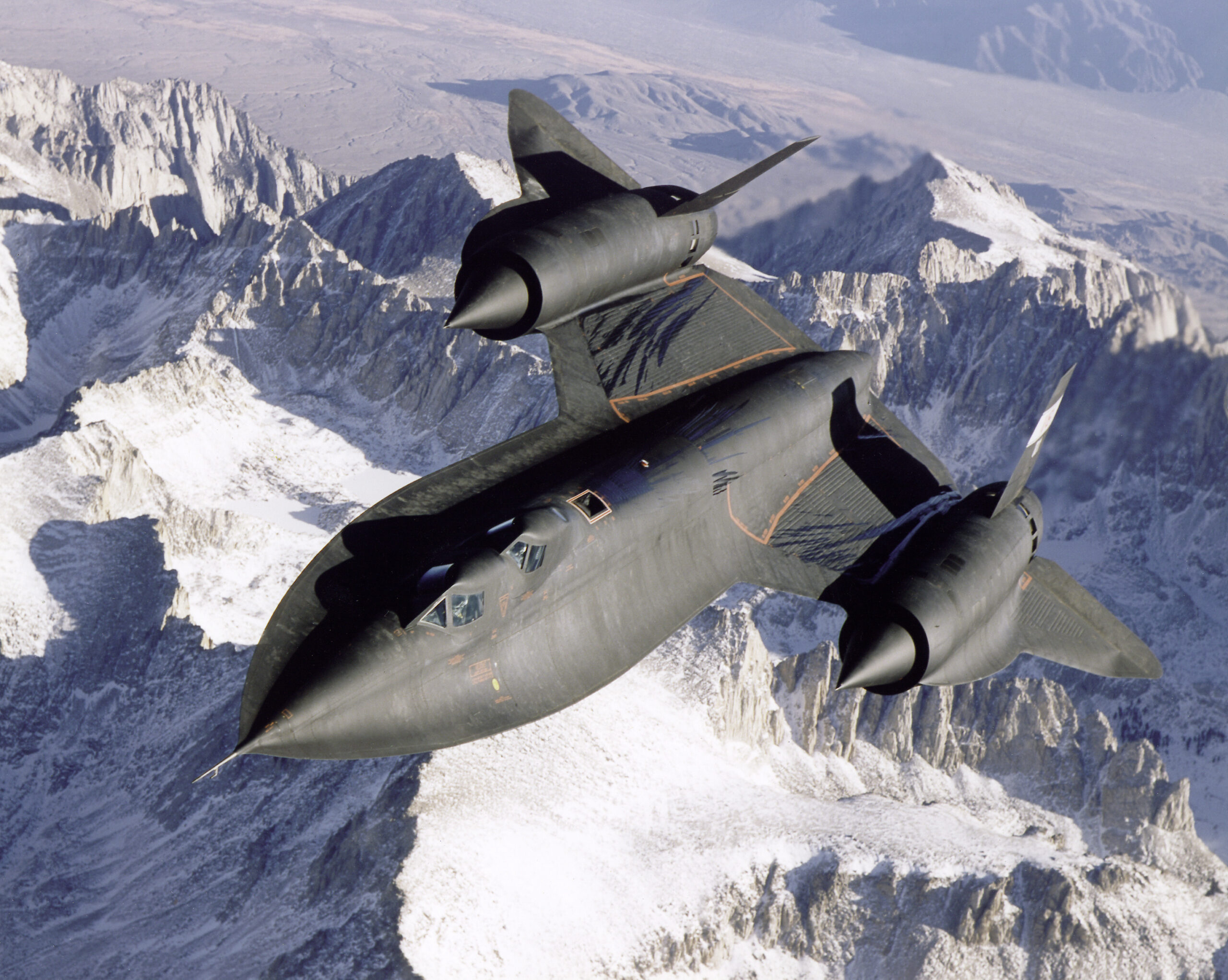
No aircraft has ever made the impossible look quite so calm. The Lockheed SR-71 Blackbird flew higher and faster than anything sent up to stop it, gathered intelligence over some of the most dangerous airspace on earth, and came home every time. In more than three decades of service it was never lost to enemy fire. The records it set in the 1970s still stand. This is the story of how a small team in California built a machine that outran the missile, and why, more than twenty five years after its last flight, nothing has truly replaced it.
The Blackbird was a product of the Cold War’s appetite for secrets. It was conceived to do one thing better than any rival: cross hostile territory at such speed and altitude that interception was a mathematical impossibility. To get there, the engineers at Lockheed’s Skunk Works had to invent new ways of welding metal, new fuels, new engines and new ways of keeping a crew alive in a cockpit where the windscreen grew too hot to touch. The result looked less like an aeroplane than a piece of the future that had arrived early.
What this guide covers
- Origins: the gap the U-2 left behind
- First flight and the name
- Kelly Johnson and the Skunk Works way
- Designing for Mach 3: the engineering problem
- Into service: Kadena, Vietnam and the missions
- What the Blackbird actually carried
- The machine behind the machine
- The records that still stand
- Specifications
- Variants and the wider Blackbird family
- Retirement, reprieve and the final farewell
- Where the survivors are today
- Legacy: the aircraft nothing replaced
- Photographing and seeing the Blackbird
- Frequently asked questions
Origins: the gap the U-2 left behind
To understand the SR-71 you have to start with the aircraft it was built to succeed. In the 1950s the United States had no reliable way of seeing what was happening deep inside the Soviet Union. The answer, for a time, was the Lockheed U-2: a glider-like reconnaissance aircraft that cruised at around 70,000 feet, far above the reach of most fighters. The U-2’s protection was its altitude, and that protection had a shelf life.
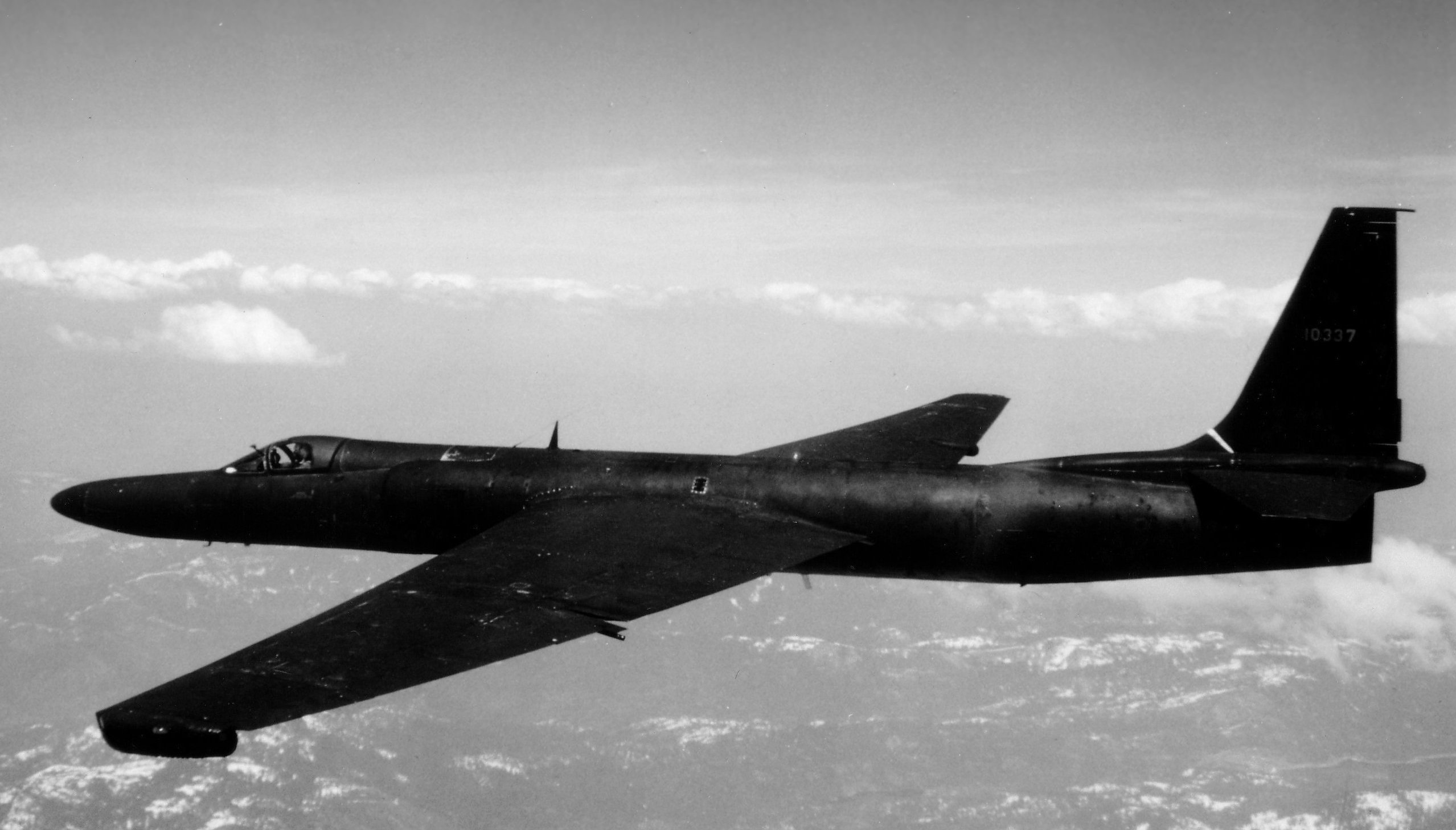
On 1 May 1960 a U-2 flown by Gary Powers was shot down over the Soviet Union by a surface-to-air missile. The aircraft’s altitude was no longer enough. The political fallout was severe, and it confirmed what Lockheed’s designers already suspected: the next reconnaissance aircraft would need to be not only high but fast, fast enough that even if a missile were fired, the aeroplane would be gone before it arrived.
The man given the problem was Clarence “Kelly” Johnson, who ran Lockheed’s Advanced Development Projects division, better known as the Skunk Works. Johnson had already delivered the U-2. Now, working with the CIA on a programme code-named Oxcart, his team designed a single-seat aircraft called the A-12, intended to cruise at around Mach 3 and above 80,000 feet. The A-12 first flew on 30 April 1962. It was the true ancestor of the Blackbird, and almost everything that made the SR-71 remarkable was worked out first on the A-12.
From the A-12 came two other variants worth knowing. The YF-12 was an interceptor prototype, armed with air-to-air missiles, that demonstrated the airframe could carry a fire-control radar and a weapons bay. The M-21 was a stranger thing still: a two-seat A-12 modified to carry and launch the D-21, an unmanned reconnaissance drone, from its back. Neither went into large-scale service, but together they showed how adaptable the basic design was.
The SR-71 itself was developed as a dedicated, two-seat strategic reconnaissance aircraft for the United States Air Force. Where the A-12 had been a CIA asset flown in secret, the SR-71 would fly openly in Air Force markings. It carried a crew of two, a pilot and a reconnaissance systems officer, and a far larger and more capable sensor fit than the single-seat A-12 could manage.
First flight and the name
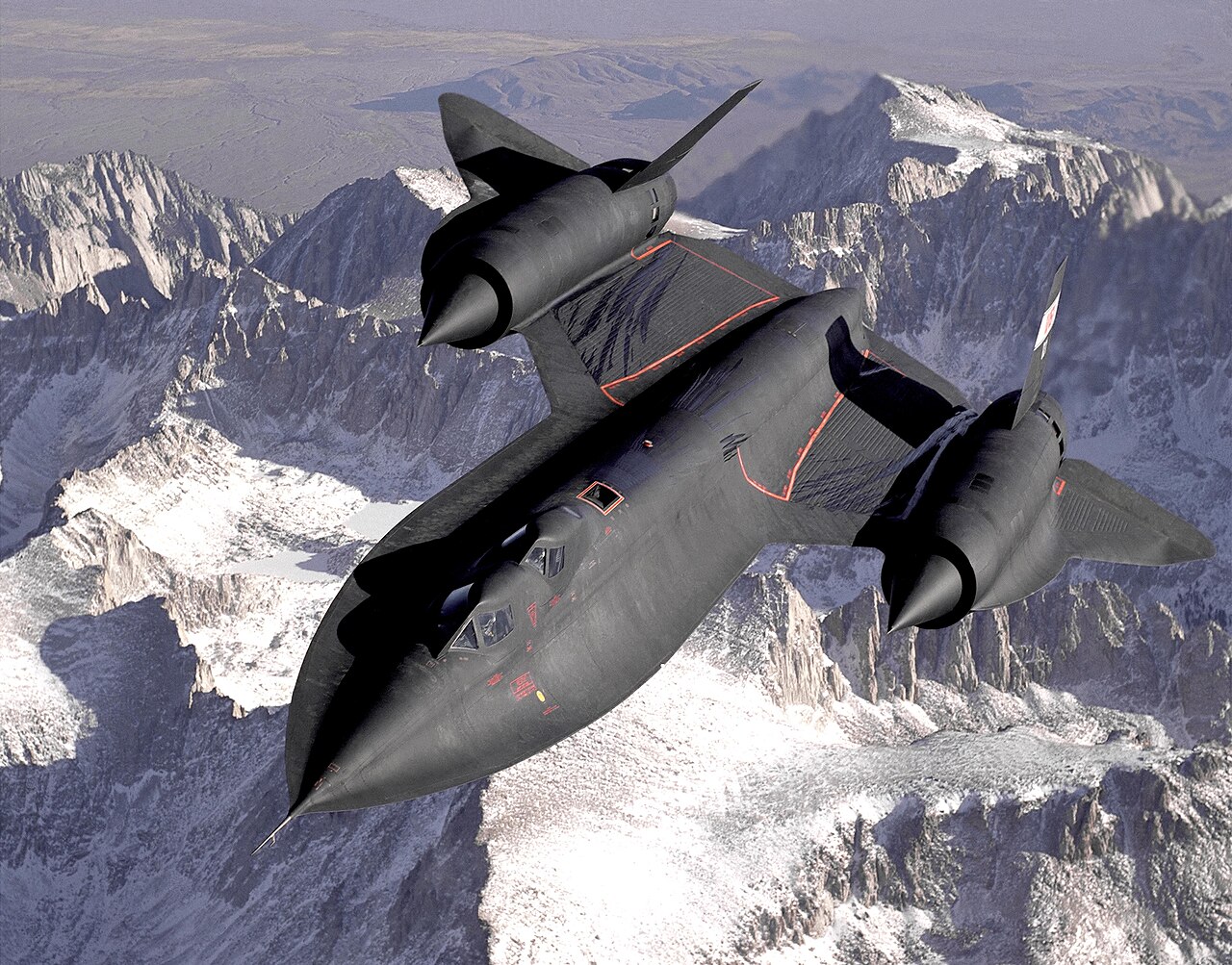
The first SR-71, serial 61-7950, took to the air on 22 December 1964 from Air Force Plant 42 at Palmdale in the California high desert. At the controls was Lockheed’s chief test pilot, Robert J. “Bob” Gilliland, who took the aircraft to Mach 1.5 at 50,000 feet on that first sortie. Gilliland would go on to log more experimental flight test time at Mach 3 than any other pilot. The most SR-71 flying time of any pilot belongs to Lieutenant Colonel Bredette C. Thomas, with 1,217.3 hours. The aircraft entered service with the Air Force in January 1966.
There is a popular story that the designation should have been RS-71 and that a slip of the tongue by a senior figure forced the official change to SR-71. The detail is often repeated and just as often disputed, so it is best treated as one of the many legends that have grown up around the aircraft rather than as settled fact. What is not in doubt is the name that stuck. The black, heat-radiating paint that covered the airframe gave the aircraft its nickname, and “Blackbird” it has been ever since. To the crews who flew it, it was the “Habu”, after a snake found on Okinawa, where the aircraft were based.
Kelly Johnson and the Skunk Works way
None of this would have happened without the working culture that produced it. The Skunk Works was Lockheed’s home for difficult, secret and urgent projects, and Kelly Johnson ran it on a set of principles that valued small teams, short lines of communication and a willingness to take engineering risks that a larger organisation would have refused. Designers worked close to the shop floor, decisions were made quickly, and the customer was kept involved but at arm’s length from the day-to-day work.
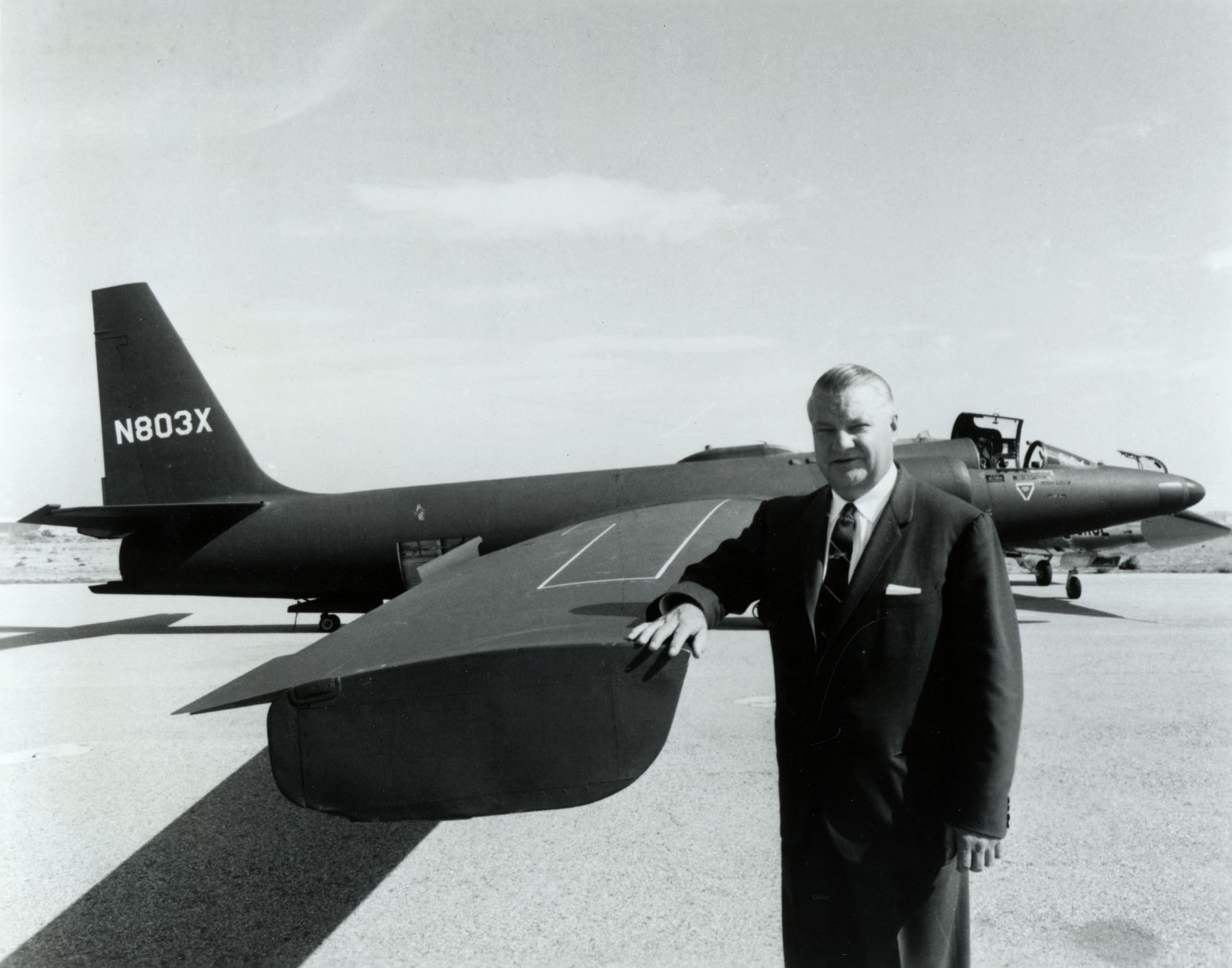
That approach mattered enormously for an aircraft as far beyond the state of the art as the Blackbird. Almost every part of it required a problem to be solved that had never been solved before, from machining titanium to controlling an engine inlet at Mach 3. A conventional programme, with its committees and its caution, might never have reached a flying aircraft at all. The Skunk Works delivered the A-12 and then the SR-71 in a few short years, in deep secrecy, and the methods Johnson used became a model that other advanced projects have tried to copy ever since.
Johnson himself regarded the Blackbird as the high point of his career, and it is easy to see why. He had already given the world the U-2; with the Blackbird he produced an aircraft that flew higher and faster and remained unmatched long after he and most of his team had gone. The aircraft was not the work of a single genius, but of a team that trusted one another to attempt the impossible and to get it flying.
Designing for Mach 3: the engineering problem
Flying at three times the speed of sound is not simply a matter of more power. The real enemy is heat. As an aircraft pushes through the air at Mach 3, friction and compression raise the temperature of its skin to several hundred degrees. Parts of the Blackbird’s structure reached around 300 degrees Celsius in cruise, and the leading edges ran hotter still. Ordinary aircraft aluminium loses its strength long before those temperatures, so the whole airframe had to be built from something that would not.
The titanium problem
Johnson’s team concluded that the answer was titanium, a metal that keeps its strength at high temperature but is notoriously difficult to work with. About 93 per cent of the airframe’s structural weight was titanium alloy. Learning to machine, weld and fabricate it on this scale forced Lockheed to develop entirely new manufacturing techniques, many of which later spread across the aerospace industry.
The difficulties were endless and often strange. Lockheed found that welded titanium had to be washed in distilled water, because the chlorine in ordinary tap water corroded it. Cadmium-plated tools left traces that caused the metal to fail, so they had to be banned from the shop floor. At one point as much as 80 per cent of the titanium delivered was rejected because of contamination before the process was brought under control.
There is also the matter of where the titanium came from. The widely reported account, repeated by Lockheed Martin and many historians, is that the United States did not have enough high-grade titanium ore of its own, and that the largest available supplier was the Soviet Union. To obtain it, the CIA is said to have used a web of front companies and third countries to buy the metal quietly from the very nation the aircraft was designed to spy on. The colourful details that often accompany the story, such as particular cover stories, are harder to verify, but the central irony of Soviet titanium in an American spyplane is well attested.
Shape, chines and a little stealth
The Blackbird’s distinctive look was not styling. The long fuselage carried sharp edges, called chines, that ran forward from the wing along each side of the nose. These chines generated lift, helped the aircraft handle at high speed, and shaped the airflow into the engines. They also flattened the aircraft’s profile in a way that reduced its radar signature. The Blackbird was not stealthy in the modern sense, but it was an early and serious attempt to make a large aircraft harder to detect, using both its shape and special materials and paint designed to absorb radar energy.
To cope with the heat, large sections of the wing skin were deliberately corrugated rather than smooth. As the aircraft warmed in flight and the metal expanded, the corrugations allowed the panels to grow without buckling. On the ground the structure was built loose, with gaps that closed up only once the airframe reached operating temperature.
The J58 engine and the moving inlet
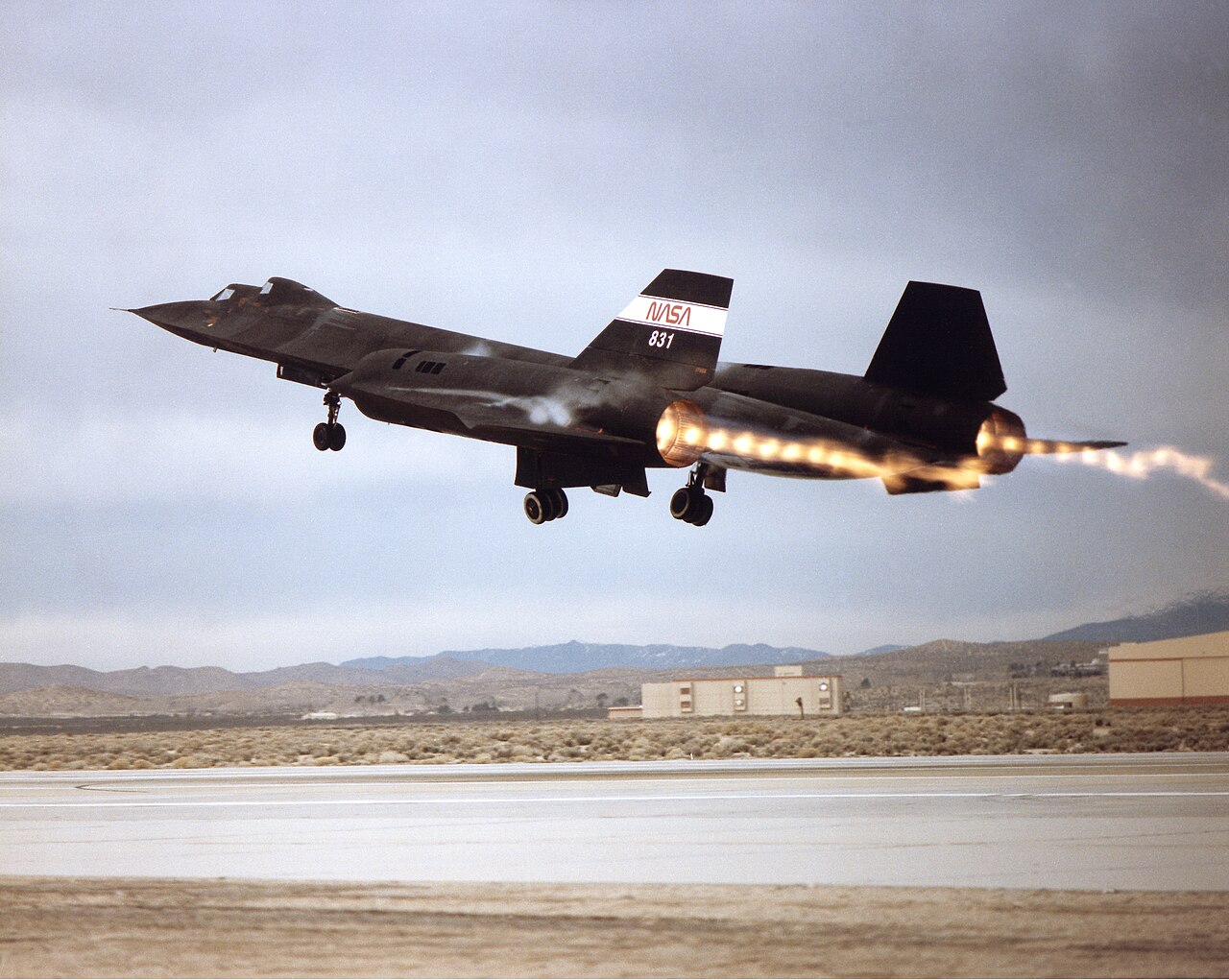
The Blackbird was powered by two Pratt & Whitney J58 engines, designated JT11D-20 in the company’s own scheme. Each produced something in the region of 32,500 pounds of thrust with afterburner. What made the J58 special was not raw power but the way it changed character with speed. At low speed it behaved like a conventional afterburning turbojet. At high Mach numbers it effectively bled air around the core, so that an increasing share of the thrust came from the afterburner and the inlet itself. In this regime it worked partly like a ramjet, and it was this hybrid behaviour that let the aircraft cruise efficiently at Mach 3 rather than simply dash there and run out of fuel.
Just as important as the engine was the inlet in front of it. At the nose of each engine nacelle sat a movable cone, called a spike, that slid backwards as the aircraft accelerated. Its job was to slow the incoming air to subsonic speed before it reached the engine face and to position the shock waves correctly. Get it wrong and the inlet could lose its grip on the airflow in a violent event known as an “unstart”, which would throw the aircraft sideways with great force. Taming the inlet was one of the hardest parts of the whole programme, and later electronic control systems did much to make it manageable.
A fuel of its own
The Blackbird burned a special fuel called JP-7, formulated to resist the heat soaking into the tanks at high speed without vaporising or igniting prematurely. JP-7 was so stable that it was difficult to light, and the engines used a chemical igniter to start combustion. The fuel also served as a coolant, circulating through the airframe to carry away heat before being burned.
The most famous quirk of the design follows from the loose, hot-running structure. On the ground, before the airframe had expanded and sealed, the fuel tanks leaked. A Blackbird sitting on the apron would often be dripping JP-7 onto the concrete, to the irritation of the ground crews. This was not a fault to be fixed but a consequence of building an aircraft that only became fuel-tight once it was hot. Because the tanks were not full to begin with and the aircraft could not carry a full fuel load for long on the ground, the standard practice was to take off with a partial load and then top up from a tanker shortly after departure.
Flying the aircraft
At cruising height the crew were closer to space than to most other aircraft. From around 80,000 feet the sky above turned dark and the curvature of the earth was clearly visible. The cockpit windows grew hot enough that crews described being able to warm food against the glass. To survive a loss of pressure at that altitude, both crew members wore full pressure suits not unlike those used by astronauts, and the programme that supported them fed directly into later space efforts.
Navigation over featureless ocean and hostile land relied on an astro-inertial system that tracked stars even in daylight to fix the aircraft’s position with great accuracy. The reconnaissance systems officer in the rear seat managed the cameras, sensors and electronic systems, while the pilot flew the aircraft and watched over the temperamental engines and inlets.
Into service: Kadena, Vietnam and the missions
The SR-71 reached operational status with the 9th Strategic Reconnaissance Wing, based at Beale Air Force Base in California. Its first overseas operating location was Kadena Air Base on Okinawa, where aircraft began arriving on 8 March 1968. The first operational sortie was flown on 21 March 1968 by Major Jerome F. O’Malley and Major Edward D. Payne. From Kadena the Blackbirds ranged over North Vietnam, Laos and Cambodia, photographing targets that slower aircraft could not reach without unacceptable risk.
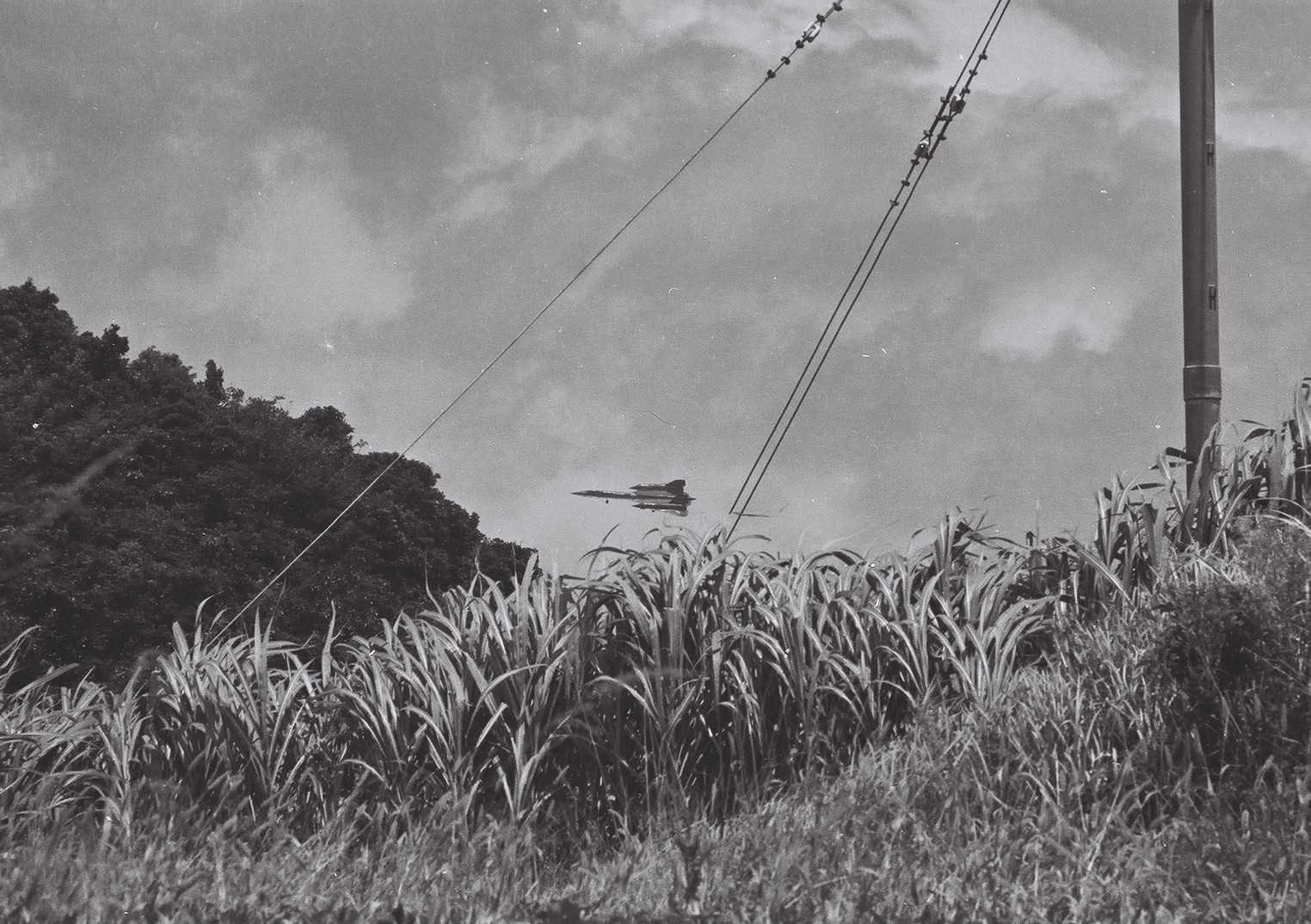
In its early years the pace was modest. The aircraft demanded a long turnaround after each mission, and for nearly two years from 1968 the Kadena detachment averaged around one sortie a week. As crews and ground teams gained experience the tempo rose, to roughly two sorties a week by 1970 and close to one a day by 1972. Even so, every flight was a major undertaking, often involving aerial refuelling and careful planning of the route.
Unlike the secret CIA flights of earlier years, SR-71 missions were flown overtly, in full Air Force markings. The aircraft gathered intelligence along the edges of the Soviet Union, over the Baltic and the Barents Sea, and over trouble spots including Cuba, Nicaragua, Libya and the Middle East. As a matter of policy the Blackbirds did not overfly the Soviet Union itself or China. They did not need to. Their cameras and sensors could look a long way sideways from international airspace.
Outrunning the missile
The Blackbird’s defence was never armour or weapons. It was speed and height, backed by electronic countermeasures. The standard response to a missile launch was simple in principle and astonishing in practice: accelerate and climb. By the time a surface-to-air missile clawed its way up to the Blackbird’s altitude, the aircraft had already moved on, and the missile arrived where the Blackbird had been rather than where it was.
The record speaks for itself. Over the course of operations against North Vietnam, something in the order of 800 surface-to-air missiles are reported to have been fired at SR-71s. None scored a hit. In its entire career the SR-71 was never shot down and never lost a crew member to enemy action. The aircraft that were lost, twelve of them over the years with one fatality, went down to accidents and mechanical failure rather than to the enemy, and most of those losses came in the early years between 1966 and 1972 as crews and engineers learned the machine.
What the Blackbird actually carried
For all the attention paid to its speed, the Blackbird existed to gather intelligence, and its real payload was its sensors. These fell into three broad groups: optical cameras, imaging radar, and equipment for listening to electronic emissions.
For photography, the aircraft could carry Itek’s operational objective cameras, which produced overlapping stereo imagery across the width of the flight path, or a single optical bar camera that swept from horizon to horizon for continuous wide-area coverage. The wide-area camera could record an enormous strip of ground in a single pass, which suited an aircraft crossing a country in minutes rather than hours. A technical objective camera provided closer, higher-resolution views of specific targets along the route.
Later in its career the Blackbird carried the Advanced Synthetic Aperture Radar System, known as ASARS-1, which produced high-resolution radar imagery and could map a target area in detail regardless of cloud or darkness. Alongside the cameras and radar sat electronic intelligence equipment that recorded the radar and radio emissions of the systems below, building a picture of an opponent’s air defences. A single aircraft could therefore come home with photographs, radar maps and an electronic survey of the same area, all gathered in one short, very fast pass.
The machine behind the machine
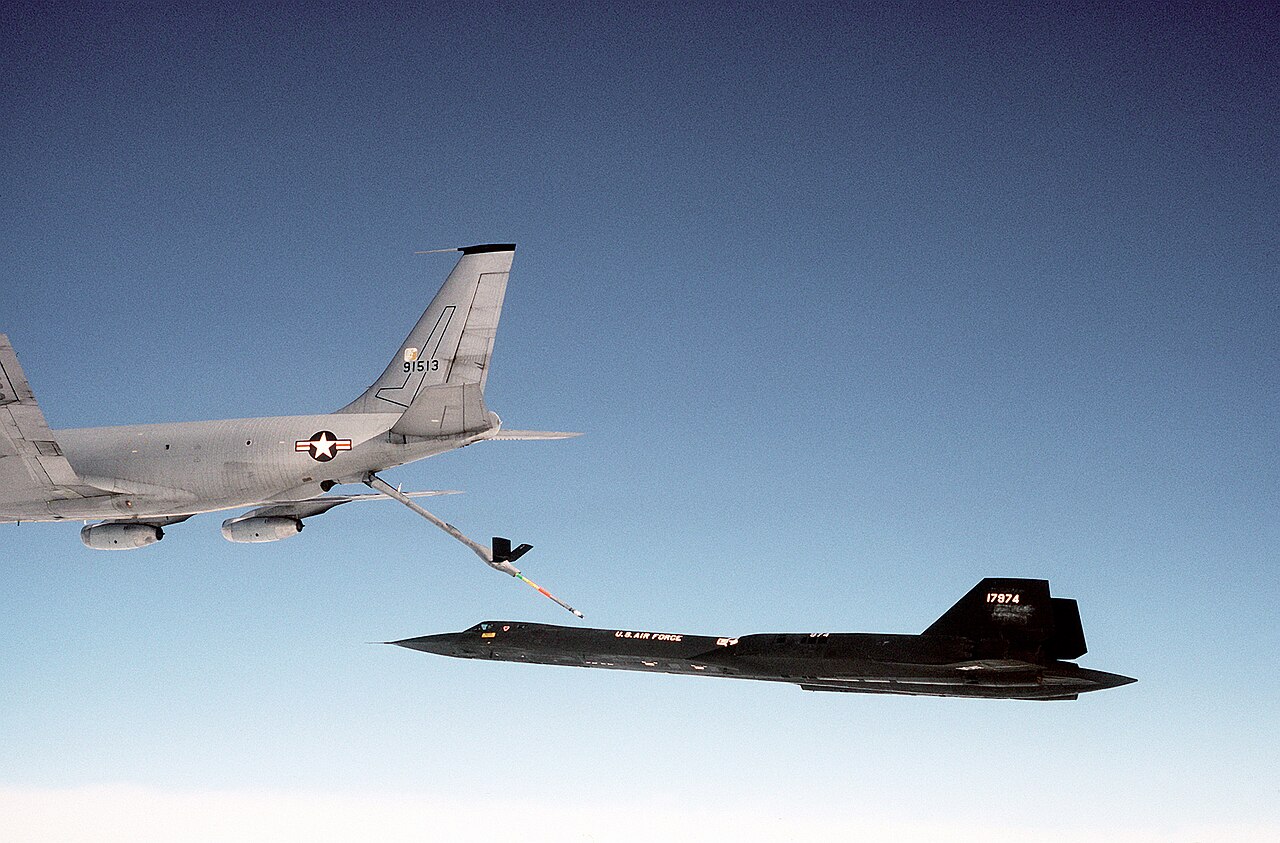
A Blackbird mission was never just an aircraft and a crew. It needed an entire support operation, and the most visible part of that was the tanker fleet. Because the SR-71 burned the special JP-7 fuel, ordinary tankers could not refuel it. The Air Force modified a version of the KC-135 Stratotanker, the KC-135Q, to carry and pass JP-7 while keeping it separate from the tanker’s own fuel. Around fifty-six tankers were converted for the task. A typical sortie began with a partial fuel load, a short climb, and a top-up from a waiting KC-135Q before the Blackbird accelerated away, and long missions involved several such refuellings.
The aircraft also relied on its forward operating locations. Kadena on Okinawa covered the Far East, while detachments operated from RAF Mildenhall in England for missions over Europe and beyond. Beale Air Force Base in California remained the home of the fleet and its training. Behind each flight stood specialists in the pressure suits, the fuel, the sensors and the airframe itself, a standing organisation that made the per-mission cost of the Blackbird very high.
A few missions that show the range
The Blackbird’s value showed most clearly when events moved quickly. During the Yom Kippur War of October 1973, SR-71s flew long reconnaissance missions to the Middle East, in some cases flying round-robin sorties from and back to Griffiss Air Force Base in New York, after Britain declined to let them recover at Mildenhall, and returned with imagery that helped policymakers judge the positions of the forces involved. These were marathon sorties, with multiple air refuellings and hours spent above Mach 3.
Over the Korean peninsula the Blackbird was a regular and provocative presence. On one celebrated mission a crew set out to photograph every known surface-to-air missile site in North Korea in a single pass. North Korea did on occasion fire at the aircraft, including an attempt in 1981, but as elsewhere the missiles missed. The pattern held wherever the Blackbird flew: it was shot at, and it was never hit.
The records that still stand
The Blackbird did not just fly fast in secret. On several occasions it set official records in public, and the most important of them have never been beaten by an air-breathing manned aircraft.
On 1 September 1974 an SR-71 flew from New York to London in 1 hour, 54 minutes and 56.4 seconds, crewed by USAF pilot James Sullivan and reconnaissance systems officer Noel Widdifield. The average speed worked out at well over twice the speed of sound, including a slowdown for in-flight refuelling.
On 28 July 1976 the type set the two figures it is still best known for. Captain Eldon Joersz and Major George Morgan, in 61-7958, recorded an absolute speed over a straight course of 2,193.167 miles per hour, roughly Mach 3.3. Captain Robert Helt and Major Larry Elliott, in 61-7963, set a sustained altitude record in level flight of 85,068.997 feet, a little over sixteen miles up. Both records, for a jet-powered aircraft flown by a crew, remain unbroken to this day.
The last record-setting flight was also the Blackbird’s farewell. On 6 March 1990, on its way to be handed over to the Smithsonian, an SR-71A flew from Los Angeles to Washington in 1 hour, 4 minutes and 20 seconds, at an average of around 2,124 miles per hour, setting a coast-to-coast record in the process. It was a fitting way to retire an aircraft whose entire reason for being was speed.
| Date | Achievement | Detail |
|---|---|---|
| 22 Dec 1964 | First flight | 61-7950, flown by Bob Gilliland from Palmdale |
| 21 Mar 1968 | First operational sortie | Flown from Kadena, Okinawa by O’Malley and Payne |
| 1 Sep 1974 | New York to London | 1 hr 54 min 56.4 sec, Sullivan and Widdifield |
| 28 Jul 1976 | Absolute speed record | 2,193.167 mph in 61-7958, Joersz and Morgan |
| 28 Jul 1976 | Sustained altitude record | 85,069 ft in 61-7963, Helt and Elliott; still unbeaten |
| 6 Mar 1990 | Los Angeles to Washington | 1 hr 4 min 20 sec; final flight to the Smithsonian |
| 9 Oct 1999 | Last flight of the type | NASA aircraft 61-7980 (NASA 844) |
Specifications
The figures below are for the main production variant, the SR-71A, drawn from published Lockheed data. As with any aircraft of this kind, some performance numbers were classified for years and a few remain approximate, so they are best read as the figures the manufacturer and reliable references give rather than as precise limits the aircraft could not exceed.
| Crew | Two (pilot and reconnaissance systems officer) |
|---|---|
| Length | 107 ft 5 in (32.74 m) |
| Wingspan | 55 ft 7 in (16.94 m) |
| Height | 18 ft 6 in (5.64 m) |
| Wing area | 1,800 sq ft (170 m²) |
| Empty weight | 67,500 lb (30,617 kg) |
| Max take-off weight | 172,000 lb (78,018 kg) |
| Powerplant | Two Pratt & Whitney J58 (JT11D-20) afterburning turbojets, about 32,500 lbf each with afterburner |
| Fuel | JP-7, around 12,200 US gallons |
| Maximum speed | About Mach 3.2 to 3.3, roughly 2,200 mph (3,540 km/h) at altitude |
| Service ceiling | About 85,000 ft (26,000 m) |
| Range | About 2,800 nautical miles unrefuelled (3,250 miles, 5,230 km) |
| Structure | About 93 per cent titanium alloy by structural weight |
A note on the numbers. The Blackbird’s true top speed was a matter of judgement as much as engineering, limited in practice by the temperature of the engine inlets rather than a fixed figure. Crews were given a maximum to respect, and the official records above are the firm, witnessed figures. Claims of higher speeds in particular emergencies exist in pilots’ own accounts, but they are personal recollections rather than measured records, and they are presented here as such.
Variants and the wider Blackbird family
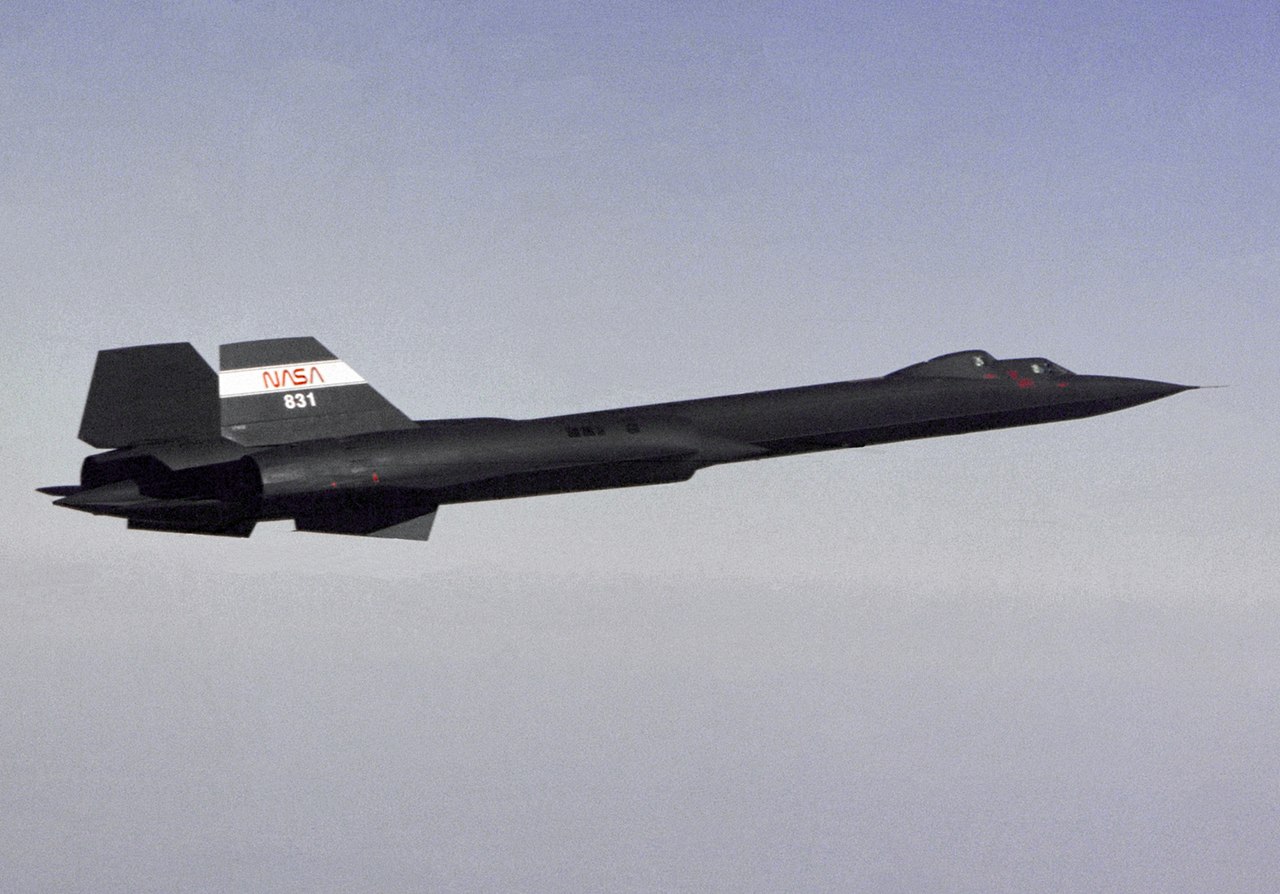
The SR-71 was one branch of a small family of related aircraft, all springing from Kelly Johnson’s original Mach 3 design. Knowing how they fit together helps make sense of the numbers that are often quoted.
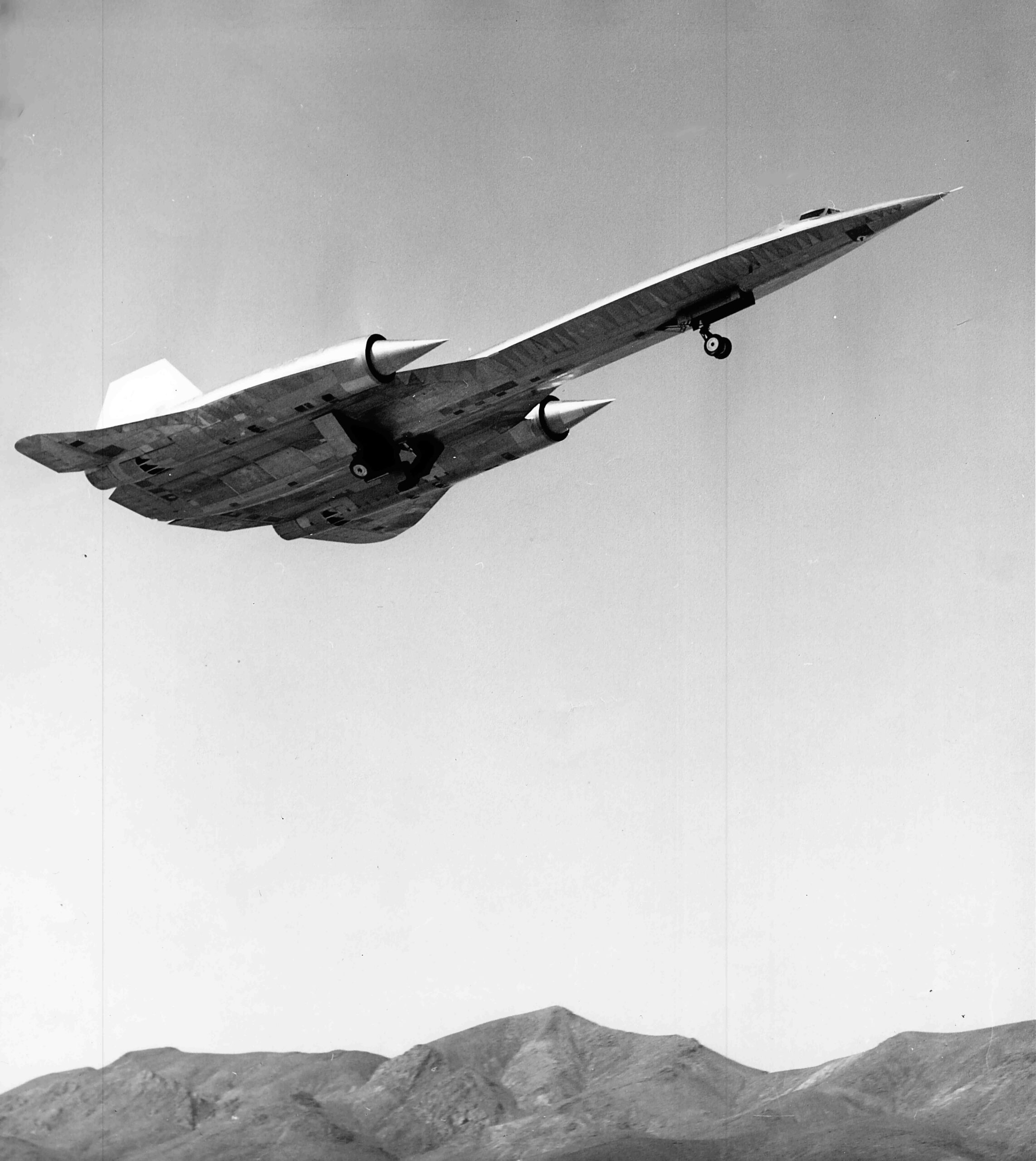
The A-12 and its relatives
The A-12 was the single-seat original, flown for the CIA from 1962. Thirteen were built. The YF-12 was an interceptor prototype derived from it, fitted with radar and air-to-air missiles, and it set its own speed and altitude records before the programme was cancelled. The M-21 was a two-seat A-12 adapted to launch the D-21 reconnaissance drone, of which two were built. These aircraft, together with the SR-71s, make up the roughly fifty Blackbirds produced in total.
SR-71 versions
- SR-71A: the main production reconnaissance version, and the variant that flew the great majority of operational missions and set the records. Thirty-two SR-71s of all versions were built, carrying the serials 61-7950 to 61-7981. The serials sit in the 1961 fiscal year because that is when the aircraft were ordered, not when they flew. The form often seen in print, 64-17950 and the like, is a misreading of the five-digit number painted on the fin.
- SR-71B: a dedicated trainer with a raised second cockpit for the instructor, giving it a distinctive humped profile. It was used to convert pilots onto the type.
- SR-71C: a single hybrid trainer, built from the rear fuselage of a YF-12 and the forward fuselage of an SR-71 static test airframe, produced after one of the SR-71B trainers was lost.
Retirement, reprieve and the final farewell
For all its capability, the Blackbird was extraordinarily expensive to operate. Each aircraft could realistically fly only about once a week, because every mission was followed by a long and labour-intensive turnaround. Aircraft routinely came back needing missing rivets replaced, panels reseated or inlets repaired, and on occasion an airframe was out of action for weeks. A fleet that demanded so much ground effort to keep so few aircraft flying was always going to attract scrutiny when budgets tightened.
At the same time, the case for the aircraft was being eroded from above. Reconnaissance satellites had matured to the point where much of the Blackbird’s strategic photography could be done from orbit, without risking a crew or an irreplaceable airframe. The Air Force retired the SR-71 for the first time in 1989. A short-lived reprieve followed in the mid 1990s, when a small number were reactivated in response to renewed demand for the kind of fast, responsive coverage that satellites, fixed in their orbits, could not always provide. That second career did not last, and the type was soon stood down again.
NASA flew a pair of Blackbirds for high-speed research for several more years. The very last flight of an SR-71 took place on 9 October 1999, when NASA’s aircraft 61-7980, known as NASA 844, flew for the final time. After that, the Blackbirds went to museums.
Where the survivors are today
Because so few were built, and because none was ever shot down, a high proportion of the Blackbird fleet survives. Most of the aircraft that were not lost in accidents are now preserved in museums across the United States, and one is on display in Britain.
For readers on this side of the Atlantic, the most accessible example is at the Imperial War Museum at Duxford in Cambridgeshire. The aircraft there, serial 61-7962, is the only SR-71 on public display anywhere outside the United States. It was retired and stored at Palmdale in 1990, then dismantled and shipped to Duxford in 2001, where it was reassembled and now sits in the American Air Museum. The museum credits it with the 85,069 foot sustained altitude record of July 1976. That record was set by a different aircraft, 61-7963. Lockheed’s own account of the week says Helt and Elliott had trouble with the airframe assigned to them and took 61-7963 instead.
In the United States, the most famous example hangs in the Smithsonian’s Steven F. Udvar-Hazy Center near Washington Dulles airport: this is 61-7972, the aircraft that flew the record-setting final flight in March 1990. Others can be found at the Pima Air and Space Museum in Arizona, at museums associated with the Air Force and NASA, and at sites across the country. Between them they make the Blackbird one of the more widely preserved Cold War aircraft, despite its small numbers.
Legacy: the aircraft nothing replaced
It is rare for an aircraft to retire with its records intact, and rarer still for those records to survive for decades afterwards. The Blackbird managed both. More than a quarter of a century after its last flight, no other air-breathing aircraft flown by a crew has gone faster or sustained greater height in level flight on the record books.
Its influence runs deeper than the figures. The fabrication techniques Lockheed developed to work titanium on a large scale fed into later aircraft. The pressure suits and life-support systems pointed towards spaceflight. The blended shape and radar-absorbing materials were an early step on the road that led, eventually, to genuine stealth aircraft. And the basic idea, that the best defence is to be somewhere the threat cannot reach in time, still shapes thinking about high-speed flight today, in an age of renewed interest in hypersonic aircraft.
There is also the simple matter of how the aircraft looks. The Blackbird has a hold on the public imagination that few machines achieve, the kind usually reserved for aircraft like the supersonic airliner Concorde or the Avro Vulcan. Long, black and impossibly sleek, it still looks like something from the future even though its first flight is now more than sixty years in the past.
Photographing and seeing the Blackbird
The surviving Blackbirds are popular subjects for photographers, and the aircraft presents a particular challenge. Its matt black finish swallows light and hides detail, so it rewards soft, even lighting and careful exposure rather than harsh midday sun. At a museum like Duxford, where the aircraft sits among others in a large hall, a wide lens and attention to background clutter make the difference between a record shot and a memorable one.
The same patience that fast jets demand on a flightline applies here, if for different reasons. Our guides on photographing fast jets and on the basics of air-to-air photography cover the techniques that suit high-performance aircraft, from shutter speed to composition. For period images of Cold War aviation and aircraft of this era, the Piemags archive galleries are a good place to start, and the wider gallery collection covers military and civil aviation across the decades. Anyone wanting to use these images in a book, article or display can find the terms on the licensing page.
Original photography of the surviving Blackbirds is scarce, and a good deal of what circulates online is mislabelled by variant or credited to the wrong airframe. If you are sourcing Blackbird imagery for publication, our guide to aviation picture research sets out how to verify what you are licensing.
Sources and further reading. Serial numbers, airframe histories and the 1976 record flights on this page follow the Blackbird archive at habu.org, maintained by David Allison, together with the National Museum of the United States Air Force, NASA and the Smithsonian National Air and Space Museum. Four corrections to an earlier version of this article, on the serial numbers, the titanium content, Bob Gilliland’s Mach 3 hours and the airframe that set the 1976 altitude record, came from David Allison in August 2026.
For the aircraft that went higher and faster still, and did it on a rocket motor, see our history of the North American X-15.
Long-range flight began with a single engine and a wicker seat. Our account of Lindbergh and the Spirit of St. Louis covers the 1927 crossing.
Frequently asked questions
How fast could the SR-71 actually fly?
Its official records put it at about Mach 3.3, roughly 2,193 miles per hour, set in 1976. In service the limit was set by the temperature of the engine inlets rather than a fixed speed, and crews were told a maximum to respect. Some pilots have described going faster in emergencies, but those are personal accounts rather than measured records.
Was the SR-71 ever shot down?
No. In more than thirty years of service no SR-71 was lost to enemy action, despite something like 800 surface-to-air missiles being fired at the type over North Vietnam alone. Its defence was to climb and accelerate so that missiles arrived too late. Twelve aircraft were lost over the years, all to accidents and mechanical failure, with one fatality.
How many SR-71s were built and how many survive?
Thirty-two SR-71s of all versions were built. As part of the wider Blackbird family, which also included the A-12, YF-12 and M-21, around fifty aircraft were produced in total. Because none was lost to the enemy, a large share survives in museums today.
Why was such a successful aircraft retired?
Cost and changing technology. Each Blackbird was hugely expensive to keep flying and could manage only about one mission a week. At the same time reconnaissance satellites could do much of the same strategic work without risking a crew. The Air Force retired it in 1989, briefly reactivated a few aircraft in the mid 1990s, and NASA flew the last examples until 1999.
Where can I see an SR-71 in the UK?
At the Imperial War Museum at Duxford in Cambridgeshire, in the American Air Museum. The aircraft there, serial 61-7962, is the only SR-71 on display anywhere outside the United States. The museum credits it with the 1976 sustained altitude record, but that record was set by 61-7963.
What was the SR-71 made of, and why?
About 93 per cent of its structural weight was titanium alloy, because ordinary aircraft aluminium would have lost its strength in the heat generated at Mach 3. Working titanium on this scale forced Lockheed to invent new manufacturing methods, and the metal itself is widely reported to have been bought quietly from the Soviet Union through intermediaries.
How high could the SR-71 Blackbird fly?
The SR-71 cruised above 85,000 feet, more than sixteen miles up, higher than almost any other air-breathing aircraft. From that altitude the crews could see the curvature of the Earth, and in 1976 an SR-71 set a sustained altitude record of 85,069 feet.
Why did the SR-71 leak fuel on the ground?
The Blackbird fuselage was built with deliberate gaps to allow for the enormous expansion caused by friction heating at Mach 3, when the airframe grew by several inches. On the ground, cold and contracted, the panels did not seal fully, so the aircraft leaked fuel until it warmed up in flight.
The Blackbird was one of a long line of secret aircraft from the same small organisation. The full story of it is in our history of Lockheed’s Skunk Works, including the A-12 that came first and was faster.
