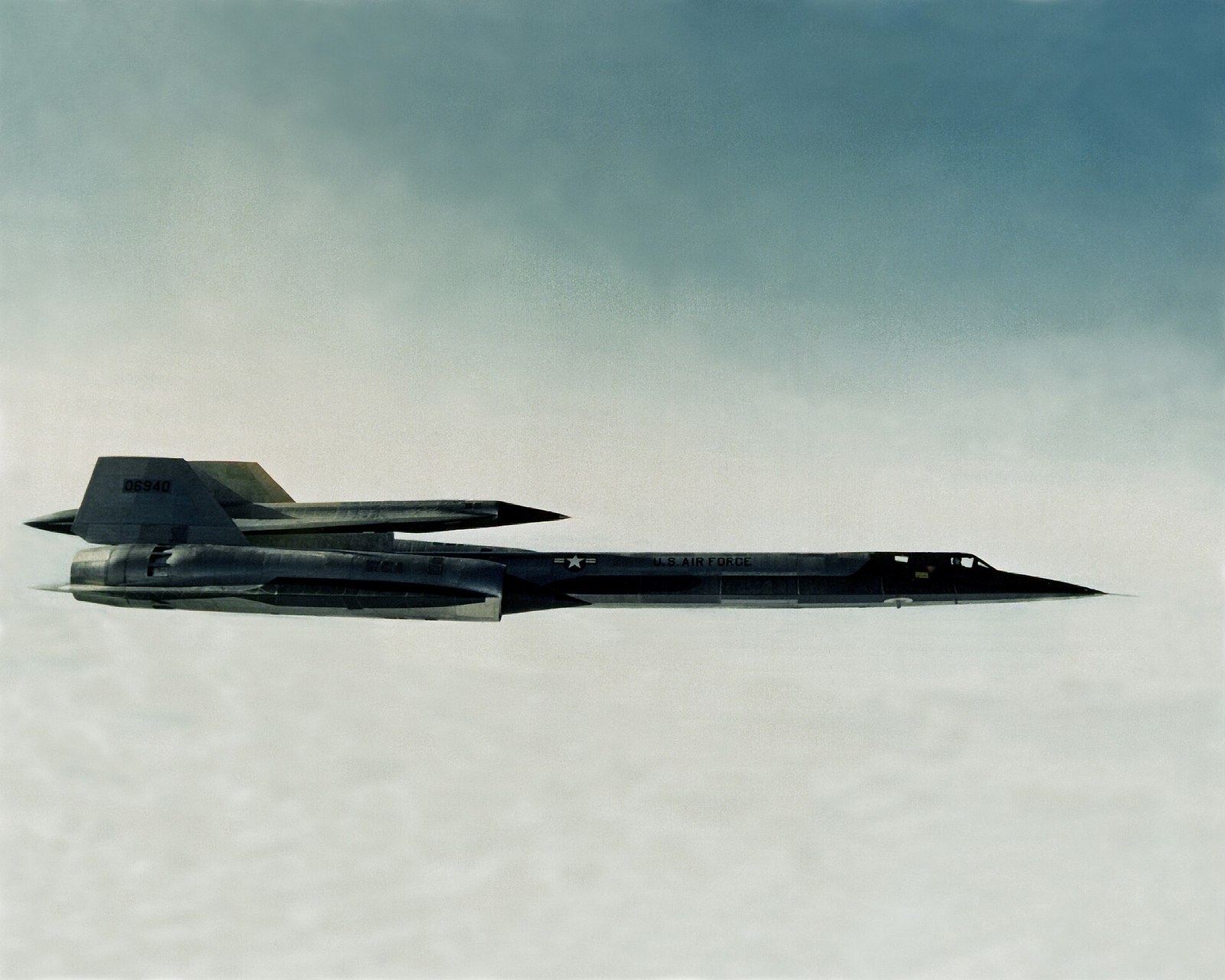
The Lockheed Skunk Works built the U-2, the A-12 and the SR-71 Blackbirds, the F-117 Nighthawk and the aircraft that became the F-35, and it did most of it in secret with teams a fraction of the size anyone thought possible. This is its history: how Kelly Johnson set it up in 1943, the fourteen rules that still get quoted in boardrooms, the aeroplanes themselves, and an honest look at which parts of the legend are documented, which rest on one man’s memory, and which are simply repeated until they sound true.
What this guide covers
- The taxi test that was not a taxi test
- What the Skunk Works actually is
- 1943, and an aeroplane in a hundred and forty three days
- Where the name came from
- Clarence Johnson
- The fourteen rules
- How it actually worked
- The aeroplane that proved the method
- 1 May 1960
- The U-2 is still flying
- The aeroplane nobody remembers
- One operation, and then it was over
- The drone that killed the programme that built it
- The second man
- The Soviet paper that made stealth possible
- Two aeroplanes, both destroyed, neither surviving
- The Nighthawk
- Vega 31
- They are still flying
- The one that was not an aeroplane
- Two aeroplanes, three aircraft
- What it is doing now
- What it cost
- Why it still matters
- Frequently asked questions
The taxi test that was not a taxi test
On a dry lakebed in Nevada on 25 April 1962, a Lockheed test pilot called Louis Schalk took a black aeroplane out for what everyone present had been told was a high speed taxi run. Kelly Johnson had quietly told him to lift off.

Schalk lifted off. He flew about two miles at roughly twenty feet, the aircraft oscillating badly the whole way, and put it down on the lakebed in a cloud of dust. Johnson watched and described it afterwards as horrible. The oscillation was traced to equipment that had been installed backwards.
He flew it again the next day with the undercarriage down, shedding titanium fillets across the desert as he went. On 30 April it flew properly, and Johnson called it the smoothest first flight of anything he had ever designed. The A-12 went on to become the fastest air-breathing aircraft anybody has built, and nobody outside a very small circle knew it existed for another twenty years.
That is the Skunk Works in one morning. An aircraft nobody had heard of, a first flight that was not officially a first flight, a wiring error that could have killed the pilot, and a result decades ahead of everything else in the sky.
What the Skunk Works actually is
Lockheed Martin Advanced Development Programs. That is the formal name, and almost nobody uses it. It is a division of Lockheed Martin Aeronautics based at Palmdale in California, and it has been building secret aeroplanes since the Second World War.
Skunk Works is a registered trademark, which is why the company writes it with the little symbol attached. It has also become an ordinary English expression for a small team working apart from the main organisation, which is a rare thing for a defence contractor’s nickname to achieve.
What it is not is a hidden laboratory in the desert with no address. It employs thousands of people, it advertises for engineers, and one of its current products is an experimental supersonic aeroplane built for NASA. The secrecy is real, but it is compartmentalised rather than total.
1943, and an aeroplane in a hundred and forty three days
In June 1943 the United States Army needed a jet fighter and needed it quickly, because Germany was about to have one. Lockheed put a young engineer named Clarence Johnson in charge of a small team. Work began on a handshake and the formal contract did not turn up until October, four months later.

The aeroplane was the XP-80 Shooting Star and it was finished in a hundred and forty three days, ahead of the deadline. It flew from Muroc, the dry lake that became Edwards Air Force Base, on 8 January 1944, with Lockheed’s chief test pilot Milo Burcham at the controls. Five hundred were ordered the following month, and it became the first American jet fighter to enter operational service.
Two men are worth remembering. Burcham was killed in a P-80 crash in October 1944. Major Richard Bong, the highest scoring American fighter pilot of the war, was killed on 6 August 1945 on an acceptance flight of a production aircraft after a fuel pump failed. That is the Shooting Star’s other record: it killed two of the best pilots in the country before it ever reached a war.
Where the name came from
An engineer called Irv Culver answered the telephone one day with the words Skonk Works, and it stuck.
The reference was to Al Capp’s newspaper strip Li’l Abner, in which a character ran an outdoor still in the backwoods, brewing something unspeakable out of skunks and old shoes. It was a joke about the smell of a nearby plastics factory and about working somewhere nobody wanted to visit, and it suited a team operating out of a tent beside a wind tunnel.
Capp’s publisher eventually objected to the borrowed name and Lockheed changed the spelling to Skunk. By then it had been in use inside the company for years and there was no getting rid of it.
Clarence Johnson
Everyone called him Kelly. He was born in Michigan in 1910, he died in December 1990, and between those dates he had a hand in something like forty aircraft designs.

He joined Lockheed in 1933 and made his name almost immediately by telling the company its new airliner was unstable, then fixing it. The fix, twin fins, became the visual signature of the Electra and then of the P-38 Lightning. He designed the P-38. He ran the XP-80. He designed the F-104 Starfighter, and he led the U-2 and the A-12. The Blackbird that came out of that last programme has its own long piece in our SR-71 history.
He turned down the presidency of Lockheed three times, because he wanted to stay with the aeroplanes. He stepped back from running the Skunk Works in 1975 and stayed on the board.
He was not a comfortable man to work for. Every account of him agrees on that, including the affectionate ones.
The fourteen rules
Johnson wrote down a set of operating rules that Lockheed Martin still publishes. They are worth reading, because they are not motivational. They are procurement policy written by somebody who was angry about procurement.
The third is the famous one. The number of people connected with a project must be restricted, in Johnson’s words, in an almost vicious manner, to between a tenth and a quarter of what a normal system would use.
The first gives the programme manager practically complete control and has him reporting to a division president or higher. The fifth demands a minimum number of reports. The ninth insists that the contractor must have the authority to flight test its own product, and gives the reason plainly: if it does not, it rapidly loses the competence to design anything else. The twelfth requires mutual trust between customer and contractor, and daily contact, specifically in order to cut correspondence to a minimum.
There was also a fifteenth, never written down and passed on by word of mouth, which concerned dealing with people who came to interfere.
How it actually worked
Strip away the mythology and the method comes down to four things, all of them about removing friction rather than adding genius.
Keep the team small and put the engineers within walking distance of the people building the thing. An engineer who can see the aeroplane being made finds out within an hour that his drawing is wrong, rather than within a month.
Give the manager real authority and a short reporting line, so decisions are made by people who understand the problem instead of being escalated to people who do not.
Test your own product, for the reason rule nine gives.
And use security to reduce the number of people involved rather than to hide from the customer. The customer was inside the fence, at the bench, every day. That is what rule twelve is about, and it is the one everybody forgets.
None of this is secret. It has been published for decades and almost nobody manages to do it, which suggests the difficulty was never the knowledge.
The aeroplane that proved the method
In 1953 the Central Intelligence Agency wanted to see inside the Soviet Union and had no way of doing it. What it needed was an aeroplane that could fly higher than anything could reach.

The U-2 was designed and built under a contract signed in March 1955, worth 22.5 million dollars for the first twenty aircraft. Tony LeVier took it into the air for the first time on 1 August that year by accident, during a high speed taxi test at Groom Lake, when the wing simply decided to fly at seventy knots. He had not intended to leave the ground. The official first flight followed three days later.
The first overflight of the Soviet Union came on 4 July 1956, flown by Hervey Stockman. That aeroplane, the seventh built, now hangs in the National Air and Space Museum in Washington.
The programme came in at 18,977,597 dollars against the 22.5 million ceiling. Twenty aircraft, on time, and money handed back. It is the cleanest thing the Skunk Works ever did.
1 May 1960
The U-2’s protection was its altitude, and altitude has a shelf life. On 1 May 1960 a Soviet surface to air missile brought one down near Sverdlovsk in the Urals.
The first missile struck at eight minutes to nine in the morning and tore through the tail and the wings without touching the cockpit. A second battery then engaged a returning radar contact which turned out to be a Soviet fighter scrambled to intercept the U-2. It was destroyed by its own side.
Francis Gary Powers ejected, came down by parachute and was captured. Washington put out a cover story about a weather flight with an oxygen problem. Moscow then produced the pilot.
The Paris summit collapsed within days. Khrushchev demanded an apology and an end to the overflights, Eisenhower refused, and the Soviet delegation walked out. Powers was convicted of spying and sentenced to three years in prison and seven years of hard labour. He was exchanged in February 1962 for the Soviet agent Rudolf Abel.
Overflights of the Soviet Union stopped. That is what created the requirement for the next aeroplane.
The U-2 is still flying
Seventy years after that accidental take-off, the Dragon Lady is still in service with the 9th Reconnaissance Wing at Beale in California, and Lockheed Martin still lists it as a current programme.
Its retirement has been announced and blocked more than once. The budget request published in April 2026 asks to retire the remaining twenty-three aircraft by the end of the 2027 financial year, and names nothing to replace them. Congress has stopped this before.
Most of what is left was built in the 1980s. Whatever happens next, an aeroplane designed on a handshake in 1954 has outlasted almost everything designed to replace it.
The aeroplane nobody remembers
Everybody knows the Blackbird. Far fewer people know that the aeroplane which came first was a different machine, flown by a different organisation, and was faster and higher than the famous one.
The A-12 was built for the Central Intelligence Agency as the U-2’s replacement, under the programme name Oxcart. It was single seat, it was flown by the agency rather than the Air Force, and it first flew in April 1962, more than two and a half years before the SR-71.
Fifteen were built, including one two-seat trainer that everybody called the Titanium Goose. The agency’s own figures put the A-12 at 2,208 miles per hour and 90,000 feet against the Blackbird’s 2,193 and 85,069. The SR-71 was about six feet longer and carried an extra fifteen thousand pounds fully loaded, because it had a second crew member and more equipment aboard, and that weight cost it both the speed and the height.
So the aeroplane that holds the records in the public mind was the slower of the two. The full story of the Blackbird is in our SR-71 history and does not need repeating here. What is worth saying is that it had an older, faster sibling almost nobody has heard of.
One operation, and then it was over
For all of that, the A-12 flew operationally exactly once, in an operation called Black Shield. Between May 1967 and May 1968 it flew twenty-nine missions over East Asia from Kadena on Okinawa, using three aircraft and six pilots.
The last operational sortie went out on 8 May 1968, over North Korea. President Johnson had already ordered the type retired. The final flight of any A-12 came in June that year, delivering an aeroplane into storage at Palmdale.
The cost of proving it had been heavy. Six of the fifteen were lost. Two agency pilots, Walter Ray and Jack Weeks, were killed and are commemorated on the memorial wall at Langley. An engineer died as well. The nine that survive are scattered across the United States, from the Museum of Flight in Seattle to the lawn at Langley. Aircraft preserved indoors need a different approach from anything on a flight line, which our guide to shooting in museums and hangar light works through.
The drone that killed the programme that built it
One of the odder things the Skunk Works attempted was a Mach 3 reconnaissance drone launched from the back of a Mach 3 aeroplane. The drone was the D-21 and the carrier was a modified A-12 called the M-21.

The first successful launch from a supersonic aircraft was made on 5 March 1966. Three went well. The fourth, on 30 July, did not.
The three successful separations had been made in a shallow dive. This one was attempted in level flight. The drone could not get through the shock wave coming off the aeroplane that had just released it, rolled forty-five degrees to the left, and struck the carrier at the wing root. The accident report says the aircraft was cut cleanly in two.
Both crew ejected. The pilot, Bill Park, survived. The launch control officer, Ray Torrick, came down in the Pacific about a hundred and fifty miles off California and drowned when his pressure suit flooded.
Kelly Johnson cancelled the whole launch method on the spot. Later D-21s were carried by B-52s instead. A bar was added to flight suit helmets to stop the faceplate being opened by accident, which is the kind of change that only ever gets made once.
The second man
Ben Rich took over from Johnson in 1975. He had joined in December 1954, the month the U-2 work started, and he had been the lead propulsion engineer on the A-12, where his job was the inlet control system that made Mach 3 possible. He called it the most exhausting and nerve-racking work of his professional life, and anyone who has read about Blackbird inlet unstarts will understand why.
Where Johnson was formidable, Rich was a bridge builder. He listened to customers, he delegated, and he put his engineers through internal training on physics none of them had been taught.
His tenure produced the stealth aircraft. He retired in 1991, at about the moment the F-117 flew its first missions of the Gulf War, and he died in January 1995. The memoir he wrote the year before is where most of the popular Skunk Works story comes from, and it is a wonderful read.
The Soviet paper that made stealth possible
A Soviet physicist called Pyotr Ufimtsev published a paper on how electromagnetic waves reflect off edges. It was not secret. It was not thought important enough to classify. It was translated into English and it sat there.
At Lockheed, a mathematician named Denys Overholser read it and understood something the Soviet air defence establishment apparently had not. Ufimtsev’s method allowed the radar reflection of a shape to be calculated, surface by surface, before the shape was built. If you can calculate it, you can design against it.
Asked for shapes with a small radar signature, Overholser proposed flat surfaces angled to throw radar energy away from the receiver rather than back at it. The team wrote a program called Echo 1 to do the arithmetic, and Ufimtsev’s work fixed the part of it that kept coming out wrong at the edges.
That is why the first stealth aircraft look the way they do. Not because faceting is aerodynamically clever, but because in 1975 a flat surface was the only thing a computer could calculate.
Two aeroplanes, both destroyed, neither surviving
The American defence research agency ran a competition decided by measuring model aircraft mounted on poles. Lockheed won it in April 1976 and the Have Blue programme followed, with two flyable demonstrators.

They looked wrong. Faceted, angular, and by the standards of 1977 barely aerodynamic, they flew at all only because a computer was correcting them several times a second. The first got airborne in December 1977.
Both were lost. The first came down in May 1978 after a hard landing jammed the undercarriage, and Bill Park, the same pilot who had survived the M-21 accident twelve years earlier, ejected with concussion. The second was lost in July 1979 after a hydraulic leak started an engine fire, and Ken Dyson got out safely.
Neither aircraft survives. The wreckage of both was buried somewhere inside the Nellis ranges. For two of the most consequential aeroplanes in the history of military aviation, there is nothing anywhere in the world to photograph.
The Nighthawk
The contract for the operational aircraft came in November 1978 and it flew on 18 June 1981, thirty-one months later, with Hal Farley at the controls. It was Ben Rich’s fifty-fifth birthday.

Sixty-four were built, fifty-nine production aircraft and five development ones, and the type reached initial operational capability in October 1983.
It was flown at night out of a base at Tonopah for five years before anybody outside the programme was told it existed. The Air Force acknowledged it in 1988 and put one on public display at Nellis in 1990. Its first combat was over Panama in December 1989.
Its reputation was made in the Gulf in 1991. It flew 1,271 sorties for no losses and no battle damage, and it accounted for two per cent of the combat sorties and forty per cent of the strategic targets attacked.
Vega 31
On the evening of 27 March 1999, a Serbian missile crew brought one down.
The aircraft was serial 82-0806, callsign Vega 31, flown by Lieutenant Colonel Dale Zelko. The battery was the third battalion of the 250th Air Defence Missile Brigade, using an old Soviet system that NATO called the SA-3. They held the aircraft just long enough, radiated for a matter of seconds so the anti-radiation missiles could not find them, and fired from around eight miles.
Zelko ejected and was picked up by special operations forces before Serbian troops reached him. The wreckage is displayed in the aviation museum in Belgrade and pieces of it are reported to have gone to Russia.
It remains the only F-117 ever brought down in combat.
They are still flying
The Air Force retired the F-117 in April 2008 with a ceremony at Holloman, and then quietly did not get rid of them.
Around thirty-nine airframes remain of the sixty-four built, and a small number are kept airworthy. They fly as adversary aircraft in exercises, as testbeds for radar and infrared sensors, and to give crews something realistic to practise against when the threat is a stealthy cruise missile. The fleet shrinks by two or three a year as aircraft are demilitarised and handed to museums. If you need photographs of aircraft like these for publication rather than for a wall, our aviation photography archive is online, and the terms we license pictures on are published with it.
A support contract runs into the 2030s. An aeroplane officially retired in 2008 has maintenance funding arranged for a further quarter of a century.
The one that was not an aeroplane
Ben Rich’s idea was that if you could make an aircraft invisible to radar you could do the same to a ship. The result was the Sea Shadow, built under a research agency contract and assembled in secret inside a submersible barge at Redwood City in California.

It looked like something out of a film, and a film noticed. The stealth vessel in the 1997 James Bond picture bears an obvious family resemblance.
The Sea Shadow itself never entered service. It was dismantled in 2012. It belongs in the story because it shows the method being carried outside its home domain, and because a good deal of what the Skunk Works built never went anywhere at all.
Two aeroplanes, three aircraft
In the late 1990s the American armed forces set out to buy one fighter that could serve the Air Force, the Navy and the Marines. The Air Force wanted a conventional aeroplane. The Navy wanted one that could be caught by a wire on a carrier deck. The Marines wanted one that could land vertically. Those are not usually the same aeroplane.
The Skunk Works built two demonstrators and flew three configurations out of them. The X-35A flew conventionally from Edwards on 24 October 2000 with Tom Morgenfeld at the controls. It was then taken apart and fitted with a shaft-driven lift fan behind the cockpit and a nozzle that swivelled downwards, and it flew again as the X-35B. The third machine, the X-35C, shared the same forward fuselage with bigger wings and a stronger undercarriage for the carrier.
On one flight in the summer of 2001 the X-35B took off in a few hundred feet, accelerated through the speed of sound, and landed vertically. Nothing had ever done all three in a single sortie before, and nothing had flown on a shaft-driven lift fan at all.
What came out of it was the F-35, which is built at Fort Worth rather than at Palmdale and is a different organisation’s aeroplane. Its history is in our F-35 Lightning II history. The demonstrator that won the competition for it was a Skunk Works machine, and it now hangs at the Udvar-Hazy Center with its lift fan displayed beside it.
What it is doing now
The acknowledged work is a small part of the whole and it is still worth knowing about.
The X-59 is an experimental aeroplane built for NASA to answer one question: can a supersonic aircraft be shaped so that its sonic boom arrives on the ground as a soft thump rather than a bang. It is long and thin and has no forward windscreen at all, because the nose had to be that shape and the pilot looks at a screen instead.
It flew for the first time on 28 October 2025, out of Palmdale and into Edwards, with NASA test pilot Nils Larson aboard. It went supersonic for the first time on 5 June 2026. A week later, on its nineteenth flight, it reached its design point of Mach 1.4 at 55,000 feet.
What happens next is the interesting part. Once the envelope is opened up, the aeroplane will be flown over American towns so that the people underneath can be asked what they heard. If the answer is not much, the ban on supersonic flight over land stops being a physical necessity and becomes an argument about noise limits. The airliner that spent its whole working life inside that restriction is the subject of our history of Concorde and supersonic airline flying.
The U-2 is still a listed programme. So is a great deal that is not listed, and the company has booked billions of dollars of losses on classified work in the last two years, most of it on a single aeronautics programme nobody outside will name.
What it cost
The U-2 is the reason the method has a reputation. Twenty aircraft, on time, and two million dollars handed back to the customer.
The A-12 is the other side of it. The aeroplane was promised for May 1961 and flew in April 1962. The quoted price for twelve aircraft was 96.6 million dollars, and the programme ended at more than 161 million for ten, with about 400 million spent by the end of 1963.
The size of the operation moved the same way. The U-2 team went from twenty-five people to eighty-one. The A-12 spawned an industrial base of some 2,400 machinists and nearly eight thousand workers at its peak. Smallness was a principle applied at the front end of a programme, not a description of the enterprise.
And it killed people. Six A-12s and both Have Blues were lost. Two agency pilots and an engineer died on Oxcart. A launch control officer drowned in the Pacific. Two of the finest pilots in America were killed by the first aeroplane the place ever built.
Why it still matters
Because the aeroplanes are still flying. A U-2 designed in 1954 is doing operational work. F-117s retired in 2008 are in the air with a maintenance contract running into the 2030s. The Blackbird’s records still stand.
And because the method was published, in full, decades ago, and remains almost impossible to copy. Every one of the fourteen rules is about giving a small group of competent people real authority and then leaving them alone. That is not a technical problem. It is an organisational one, and organisations are very bad at solving it.
The last word belongs to the thing itself. In 1943 a team working out of a tent built a jet fighter in a hundred and forty three days. In 2025 the same organisation flew an aeroplane designed to make a sonic boom quiet enough to be legal. Eighty-two years apart, and the same instruction: here is something nobody knows how to do, go and do it, and do not send us any reports.
Frequently asked questions
What is the Skunk Works?
Lockheed Martin Advanced Development Programs, based at Palmdale in California. It is the division that has built Lockheed’s secret and experimental aircraft since 1943, including the U-2, the A-12 and SR-71 Blackbirds, the F-117 Nighthawk and the X-35 that led to the F-35. Skunk Works is a registered trademark, and the phrase has passed into ordinary English for any small team working apart from the main organisation.
Why is it called the Skunk Works?
An engineer called Irv Culver answered the telephone with the words Skonk Works and it stuck. The reference was to Al Capp’s newspaper strip Li’l Abner, in which a character ran an outdoor still in the backwoods brewing something unspeakable out of skunks and old shoes. It suited a team working out of a tent next to a smelly plastics factory. Capp’s publisher later objected and Lockheed changed the spelling.
Did the Skunk Works really build the XP-80 in 143 days?
Yes, and ahead of the deadline. Work started in June 1943 on a handshake, the formal contract did not arrive until October, and the aeroplane was finished that November. It flew from Muroc on 8 January 1944 with Milo Burcham at the controls, and five hundred were ordered the following month.
Who was Kelly Johnson?
Clarence Johnson, born 1910, died December 1990. He joined Lockheed in 1933, had a hand in around forty aircraft designs, and ran the Skunk Works from its founding until 1975. He designed the P-38 Lightning and the F-104 Starfighter and led the U-2 and A-12 programmes. He turned down the presidency of Lockheed three times because he wanted to stay with the aeroplanes.
What are Kelly Johnson’s 14 rules?
A set of operating rules Lockheed Martin still publishes. They give the programme manager near total control and a short reporting line, restrict the number of people involved to between a tenth and a quarter of normal, demand a minimum of reports, require the contractor to flight test its own product, and insist on daily trust between customer and contractor. A fifteenth was never written down and concerned dealing with people who came to interfere.
What is the difference between the A-12 and the SR-71?
The A-12 came first, flew in April 1962, was single seat and was flown by the Central Intelligence Agency. The SR-71 flew in December 1964, was two seat and was flown by the US Air Force. The Blackbird was about six feet longer and carried fifteen thousand pounds more when loaded, and that weight cost it performance. The A-12 was the faster and higher flying of the two, at 2,208 miles per hour and 90,000 feet against 2,193 and 85,069.
How many A-12s were built?
Fifteen, including one two-seat trainer known as the Titanium Goose. Six were lost in accidents and nine survive, scattered across the United States from the Museum of Flight in Seattle to the lawn at CIA headquarters in Langley. Two of the fifteen were modified into M-21 drone carriers.
Is the U-2 still flying?
Yes, with the 9th Reconnaissance Wing at Beale Air Force Base in California, and Lockheed Martin still lists it as a current programme. Retirement has been announced and blocked more than once. The budget request published in April 2026 asks to retire the remaining twenty-three aircraft by the end of the 2027 financial year and names nothing to replace them. Most of what is left was built in the 1980s.
How did stealth actually work?
A Soviet physicist called Pyotr Ufimtsev published an unclassified paper on how electromagnetic waves reflect off edges. At Lockheed, Denys Overholser realised it allowed the radar reflection of a shape to be calculated before the shape was built, and therefore designed against. The answer was flat surfaces angled to throw energy away from the receiver. That is why the first stealth aircraft are faceted: in 1975 a flat surface was the only thing a computer could calculate.
Can you see a Have Blue anywhere?
No. Only two were built and both were lost in accidents, in May 1978 and July 1979. Both pilots survived. The wreckage of both aircraft was buried inside the Nellis ranges in Nevada and no example survives anywhere in the world. For two of the most consequential aeroplanes in military aviation, there is nothing to photograph.
Do F-117s still fly after being retired?
Yes. The Air Force retired the type in April 2008 but kept a number airworthy. Around thirty-nine airframes remain of the sixty-four built. They fly as adversary aircraft in exercises, as testbeds for radar and infrared sensors, and to simulate stealthy cruise missile profiles for training crews. A support contract runs into the 2030s.
Was the Skunk Works always on time and under budget?
No. The U-2 was: twenty aircraft, on time, and two million dollars handed back against a 22.5 million dollar ceiling. The A-12 was the opposite. It was promised for May 1961 and flew in April 1962, was quoted at 96.6 million dollars for twelve aircraft, and ended at more than 161 million for ten.
Sources
- Lockheed Martin: the Skunk Works origin story
- Lockheed Martin: Clarence “Kelly” Johnson
- Lockheed Martin: Ben Rich, the second director
- CIA History Staff: the agency and overhead reconnaissance, the U-2 and A-12 programmes
- CIA: Archangel, the supersonic A-12 reconnaissance aircraft
- CIA: Oxcart versus Blackbird, the differences between the A-12 and the SR-71
- CIA: Area 51 and the U-2 accidental first flight
- US Department of State: the U-2 incident of 1 May 1960
- Smithsonian National Air and Space Museum: the XP-80 Lulu Belle
- US Air Force fact sheet: the U-2S Dragon Lady
- The Museum of Flight: the surviving M-21, and the loss of the second airframe in a D-21 launch accident
- Lockheed Martin: F-117 Nighthawk fast facts
