A working guide to RAF Marham photography: where to stand, what actually flies from the station, and the one thing that will ruin your trip if you do not check it first. Three F-35B squadrons, two roadside spots that want opposite halves of the day, and a runway that has been renumbered without anybody updating the guides.
What is on this page
- The bit everyone comes for
- What flies from Marham
- How many aircraft there really are
- The trap: the day the airfield is shut until teatime
- The rest of the week
- The runway numbers have changed and every guide is wrong
- Which runway, and which side you want to be on
- The viewing spots
- The light, month by month
- How much lens
- Hedges, crops and why winter is better
- Getting there
- Parking, and the one mistake that matters
- If somebody comes over
- Why you will not photograph anything parked
- Where to stay and eat
- The Heritage Centre
- Airshows and Families Day
- A hundred and ten years of it
- Why now, and why that will not last
- Questions people ask
The bit everyone comes for
A Lightning coming back to Marham does not just land. It arrives along the runway at height and speed, pulls into a hard turn over the airfield, comes downwind with the gear out, and then, if the crew are practising it, stops in mid air over a painted pad and lowers itself onto the concrete on a column of its own exhaust.
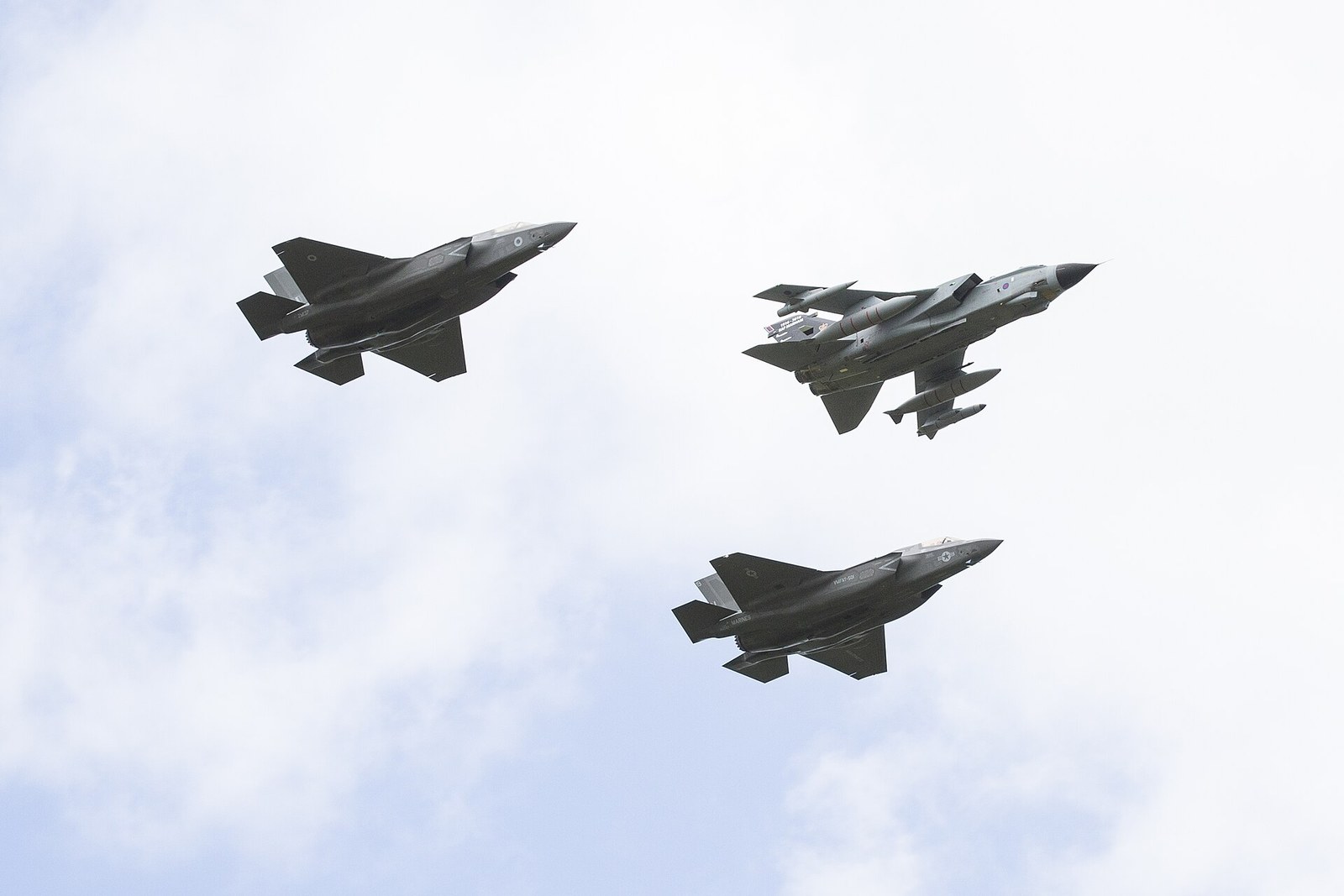
That is the overhead break to vertical landing, and it is the reason people drive to Norfolk. It is also the reason Marham disappoints so many of them, because the airfield is quiet, the aircraft are few, and the station goes for days at a stretch without putting anything in the air before teatime.
This guide is about getting the odds on your side.
What flies from Marham
One aircraft type, three squadrons.

Marham is the home of the F-35B Lightning. The RAF writes it that way, without the “II” that Lockheed Martin uses, and if you want to sound like you have been before, so should you.
617 Squadron is the front-line unit, the Dambusters, reformed for the type in 2016 and flying from Marham since 2018. 207 Squadron is the joint RAF and Royal Navy conversion unit, so a good share of what you see is a student being taught. 809 Naval Air Squadron is the second front-line squadron, a Royal Navy unit, stood up at Marham in December 2023.
A fourth unit, XVII Squadron, is part of the same force but sits at Edwards Air Force Base in California with three aircraft. It is not at Marham and you will not see it there.
How many aircraft there really are
The whole United Kingdom has 47 operational F-35Bs. That figure is the RAF’s own, given in the spring of 2026 as the last of the first batch was delivered. Three of them are in California. The rest are nominally Marham’s, less whatever is at sea or abroad.
The National Audit Office looked at the programme in 2025 and found the fleet was hitting about half the Ministry of Defence’s own target for mission capable aircraft, and about a third of the target for aircraft ready for every mission. It withheld the actual percentages. Work those proportions against the fleet and you get somewhere around ten or eleven aircraft flyable on a given day. The Ministry of Defence disputes how the Audit Office measured it. Nobody claims the fleet is flying hard.
The trap: the day the airfield is shut until teatime
This is the single most useful thing on this page.
Marham runs blocks of night flying, usually Monday to Thursday. Ordinarily the aircraft are down by eleven. But when the station wants a longer block it applies for dispensation to extend its hours, and when that is granted it shifts the whole day. The community notice for one week in May 2025 said flying would run from five in the evening until half past one in the morning, and that the airfield would not be operating during the day.
The same shifted pattern turned up in autumn 2024, with flying from four in the afternoon until quarter to one in the morning.
Drive to Norfolk on a Tuesday morning in one of those weeks and you will see an empty airfield for eight hours.
Marham publishes no flying programme. There is no station diary. These blocks are announced on the station’s Facebook page and its X account, and the parish and town councils nearby repeat them, Marham, Boughton, Shouldham and Swaffham among them. Check both in the fortnight before you travel. It takes two minutes and it is the difference between a day out and a wasted tank of fuel.
The rest of the week
Core hours are eight in the morning to five in the afternoon, and the aerodrome closes at five unless it has been asked to stand by as a diversion airfield. On a Friday that request has to be in by two o’clock, or it shuts at five regardless.
The strongest clue to the weekly rhythm is the station’s own weather briefing office, which staffs up on Sunday night and shuts on Friday afternoon. In summer it closes at four. Saturday is not covered at all.
So: weekdays. Not weekends. Best in the morning unless a night-flying block has moved the whole day.
The runway numbers have changed and every guide is wrong
The main runway at Marham is 05/23.
Every guide and map that names the runway still calls it 06/24, including OpenStreetMap and several pages updated this year. The military aeronautical publication has been using 05 and 23 since at least April 2025, and the current edition, effective January 2026, gives the bearings as 055 and 235 degrees.
If you listen to the radio, or read a guide written by somebody who has not checked, you will be one designation out of step with what you hear. The cross runway, 01/19, is short and marked out as a strip for short take-off work.
Which runway, and which side you want to be on
Marham’s main runway points southwest to northeast. The prevailing wind in this country is southwesterly, so the default is that aircraft land on 23, coming in from the northeast and rolling out towards Fincham.
That matters more here than at most airfields, because Marham’s two usable roadside spots sit at opposite ends and they behave completely differently.
| In use | Arrivals from | Best spot | Light |
|---|---|---|---|
| Runway 23 | The northeast | Chalk Lane | Morning only |
| Runway 05 | The southwest | A1122 lay-by | Afternoon, all year |
There is one more thing worth knowing, and it comes from the noise abatement chart rather than any guide. Departures off 23 hold the runway heading until they cross the boundary and then turn left fifteen degrees to keep the noise off Fincham. Departures off 05 turn right ten degrees to avoid Castle Acre, and crews are told not to turn left between the airfield and Narborough.
The same chart puts the visual circuit for the main runway to the south, and the circuit for the short runway to the west. If you want the circuit rather than the approach, that is where to stand.
The viewing spots
Marham has one detailed guide on the whole internet, Damien Burke’s on Thunder and Lightnings, and it letters its viewing points A to L. Everything else you will find is either a paraphrase of it or a page with no locations on it at all. That is worth saying plainly, because Marham gets described as well documented and it is not.

Of those twelve lettered points, exactly one is backed by a second, independent, first-hand source, and that source has been offline for years. Six of the twelve are not roads at all. They are walks along field edges, over private farmland, at the goodwill of a farmer who is already tired of people in his crops.
So this section covers the four you can reach in a car and stand at, and says which of the rest are worth the boots.
Chalk Lane, for runway 23 arrivals
52.6600, 0.5802. Chalk Lane runs north from the A1122 towards Narborough. Where it crosses the approach, about a kilometre out from the threshold, there is room for several cars on both sides of the road.
You are at the far end of the approach lighting here, and the aircraft come over you at about 170 feet. That is high enough that the underside is what you get. The lane sits about ninety metres off the extended centreline, so at their nearest they are a little over a hundred metres from you, which is a much shorter lens than people expect.
You are looking southwest at the airfield from here, which is the fact that decides the light.
Two warnings, both from the only guide and both worth repeating. Do not block the farm track that runs towards the approach lights. And do not try to tuck into the dip on the west side of the road, because the ground is soft and people have been stuck in it.
The A1122 lay-by, for runway 05 arrivals
Around 52.6333, 0.5265. Heading west along the A1122, there is a rough lay-by on the north side just before the turn for Barton Bendish. It is the most used spot at Marham and the only one that two separate people have written up independently.
It is also on what passes for high ground. The airfield sits at 76 feet and the country around it is Norfolk flat, so the eleven metres this lay-by stands above the runway 05 threshold counts for a lot. That is why this spot and the White Lane track further up are the two people keep coming back to.
You are a kilometre from the threshold and about 460 metres off to the side, so this is a three-quarter angle rather than a head-on shot, with the aircraft around 135 feet up. You are looking northeast. Departures off 23 bank left towards you to miss Fincham, which is the bonus.
The lay-by is uneven and smaller than it used to be. There are a couple of scraps of rough ground either side of it, and the minor road to the south takes a car or two. It is a fast A road: park properly or not at all.
White Road, for the short runway
52.63604, 0.55221. White Road leaves the A1122 on the south side and runs southeast. At the junction there is a small patch of scrub that takes a few cars. Beyond that the road is narrow and there is nowhere.
You are 400 metres from the threshold of runway 01 and aircraft on the approach pass about 75 feet over you. The catch is that 01/19 is the short strip and it is used far less than the main runway, so this is a spot for a day when the wind is doing something unusual rather than a first choice.
White Lane, if the weather has been dry
52.64604, 0.52504. Reached from Fincham rather than the A1122: take the turn signposted for Marham, keep going to the T junction, right, then follow the road round the sharp left and watch for a lane on the right as the trees thin.
This is the highest documented point at Marham, fifteen metres above the runway 05 threshold, and on paper it is the best position on the airfield. In practice it is an unpaved lane that OpenStreetMap records as grass, and a car with ordinary ground clearance will not get far along it. Wet weather makes it impassable without four wheel drive. Park on the hardstanding and leave the farm tracks clear.
The one to skip
The lay-by on the Marham to Narborough road, at the north end of the field, gets recommended occasionally and it is a waste of a drive. You are 1,145 metres out on the approach to the short runway, aircraft are 236 feet above you, and, unusually for Norfolk, you are in a hole: the ground there sits twelve metres below the runway end. That is why you cannot see the airfield from it.
The walks
Points B, C, F, I and K in the existing guide are all field-edge walks from the roadside spots. They get you closer, and the one along the western fence is the best position at Marham, close enough that a 500mm lens was enough for the photographs on that guide.
Two things to weigh. There is no recorded public footpath or bridleway within about a kilometre of the perimeter, so every one of these walks is across private land and depends entirely on the farmer. And the ground is soft for most of the year, which is why the advice about a stepladder being useless keeps appearing.
If you do walk, stay on the field edges, stay out of the crop, and go in the winter.
The light, month by month
This is where Marham catches people out, and no guide covers it.

The two main spots face opposite ways, so they want opposite halves of the day. At Chalk Lane you shoot southwest towards the airfield, so you need the sun in the northeast, which means morning. At the lay-by you shoot northeast, so you need the sun in the southwest, which means afternoon. Taking only the hours when the sun is at least ten degrees up and behind the camera, and keeping inside a normal flying day, gives this.
| Month | Chalk Lane (runway 23) | A1122 lay-by (runway 05) |
|---|---|---|
| January | Nothing | 11:50–14:30 |
| February | Nothing | 12:00–15:40 |
| March | 08:30–09:20 | 13:00–16:50 |
| April | 08:00–09:40 | 12:50–16:50 |
| May | 08:00–10:00 | 12:50–16:50 |
| June | 08:00–10:20 | 12:50–16:50 |
| July | 08:00–10:20 | 13:00–16:50 |
| August | 08:00–09:50 | 13:00–16:50 |
| September | 08:00–09:10 | 12:40–16:50 |
| October | Ten minutes | 12:30–16:40 |
| November | Nothing | 11:30–14:30 |
| December | Nothing | 11:40–13:50 |
Read that carefully, because it is awkward. The prevailing southwesterly wind puts aircraft on runway 23, which puts you at Chalk Lane, which has good light only in the first two hours of the flying day and only from March to September. From November to February there is no usable light at Chalk Lane at all inside normal hours.
The lay-by is the opposite and much kinder: an afternoon spot that works in every month of the year. But it only gets you the aircraft when the wind has swung round to the northeast.
How much lens
Two focal lengths are recorded on the existing guide, 600mm from the lay-by and 500mm from the western fence. Working those back against the distances, both put the aircraft at a little over half the frame width, which is a sensible way to shoot a fast jet.

Using the same proportion and the published approach geometry, on a full-frame body:
| Range | Lens |
|---|---|
| 100 m | 150mm |
| 200 m | 300mm |
| 300 m | 450mm |
| 400 m | 600mm |
| 500 m | 750mm |
At Chalk Lane the aircraft passes about a hundred metres away at its closest, so a 70–200 does the overhead and something longer picks it up on the run in. At the lay-by, where the nearest point is about 460 metres, you want 500mm or more and you will still be cropping.
If you only own one lens for Marham, make it a 150–600 or a 200–600. Our guide to lenses for aviation photography goes into the choice properly.
Hedges, crops and why winter is better
Two of the closest positions at Marham are gaps in a boundary hedge, and the existing guide says the hedge is just high enough to make life difficult.
It is high all summer by law. Hedge cutting in England is prohibited from the first of March to the end of August, so the hedges around Marham are at full height and in full leaf across the entire main visiting season, and cannot legally be cut until September.
Add soft ground, standing crops, and the fact that the aeronautical publication itself flags standing water at the runway intersection and at two of the thresholds, and the pattern is clear. September to February is when the close positions actually work. April to August is when the roadside spots are all you have.
Getting there
The A1122 runs along the entire southern side of the airfield and every documented spot except White Lane is reached from it. Coming off the A47, take the A1122; Chalk Lane is signposted on the right, and continuing west past White Road brings you to the lay-by and then Fincham.
Nearest towns are Swaffham about six miles east, Downham Market about eight miles southwest and King’s Lynn about ten miles northwest.
The nearest railway station is Watlington, at 10.6 kilometres, which no guide mentions. Downham Market is 11.3 and King’s Lynn 15.7. All three are on the Fen Line from Cambridge and London King’s Cross.
There is a bus, Lynx service 39 from King’s Lynn through Shouldham to Marham, roughly two-hourly on weekdays. It will not help you. It serves Marham village and the housing estate on the northwest side, which is the wrong side of the airfield, and from there every viewing spot is a long walk along lanes with no footway. Nothing runs along the A1122 past the airfield.
Marham is a car location. A taxi from Downham Market runs somewhere around twenty to thirty pounds each way.
Parking, and the one mistake that matters
Three crash gates are named in the existing guide, at the end of the lane off Chalk Lane, at the White Lane junction with the A1122, and at the end of the track down from White Lane. Blocking one of them is the single most consequential thing you can get wrong at Marham. They exist so a fire appliance can get onto the airfield.
After that it is farm access. The land around most of the airfield is worked, the farmers are sensitive about it, and the same guide repeats the point at nearly every spot: keep the tracks clear, keep out of the field itself, park so a tractor can get past.
None of this is complicated. Park so that a fire engine and a combine could both get by, and you will never have a problem.
If somebody comes over
The station says in plain terms that there is no official viewing area at Marham. It also asks people not to hang around directly under the approach path, which is why the advice everywhere is to stick to the field edges.
The RAF Police drive the local roads. The consistent report is that if you are parked sensibly and behaving normally they leave you alone, and that the far end of the main runway is the least likely place to attract interest. At the awkward spots, the ones you had to walk to, you are more likely to be asked what you are doing.
Answer politely, say you are photographing aircraft, and that is usually that. No drones: the station is explicit about it and so is every event it runs.
There is a precedent worth knowing. When the Tornado flew its farewell from Marham in February 2019, around three hundred enthusiasts’ cars gathered in a field beside the airfield, the Station Commander came out to talk to them, and the media office handed out commemorative photographs. Marham has form for treating people who turn up as guests.
Why you will not photograph anything parked
Do not plan on static shots. The flight line at Marham has temporary hangars along it that hide the parked aircraft, and the hardened shelter complexes are behind double fencing with nothing visible through it. If it is a picture you need rather than a day at the fence, the Piemags aviation photography archive is the place to look, and the terms for using anything in it are published on the licences page.

Marham is approach and departure or it is nothing. That is different from Coningsby, where a good deal of what people photograph is on the ground, and it is another reason expectations transfer badly between the two.
Where to stay and eat
The Farmhouse at Fincham is on the A1122 about a mile and a half west of the lay-by, which makes it the closest bed and the closest hot food to the spotting. It has rooms and a pub, serves breakfast from seven on weekdays and eight at weekends, and does food through the day.
The Great Danes at Beachamwell, a couple of miles southeast of the airfield, is a licensed guest house that markets itself directly at people visiting the station.
Beyond that you are into Swaffham, Downham Market and King’s Lynn for chains and bed and breakfasts.
One correction to the guides. The advice to use the Little Chef off the A47 has been wrong since January 2018, when the chain stopped trading. What is actually at the Swaffham junction now is a filling station with a convenience store, a drive-through and a coffee machine.
The Heritage Centre
The RAF Marham Aviation Heritage Centre sits outside the wire at Upper Marham, so you need no pass and no identification. It opens Tuesdays and Wednesdays from nine to four and on the last Saturday of each month from half past nine. Admission is free and donations are invited.
It is small, and it is a converted church rather than a hangar, so go for the models, photographs and memorabilia rather than expecting airframes. It is also the only place at Marham where a visitor can reliably find a toilet and a hot drink indoors.
The Victor that used to guard the gate is gone. XH673 was scrapped in November 2020. Guides that tell you it is visible from the road are describing an aeroplane that no longer exists.
Airshows and Families Day
There is no public airshow at RAF Marham and none is planned. The station does not appear in the 2026 airshow calendar.
What Marham holds is an annual Families Day, and it is ticketed rather than open to the public. The 2026 event ran on Thursday 23 July, themed for the station’s 110th anniversary, with a flying display, static aircraft, a fairground and evening music. Adults needed photograph identification and every bag and vehicle was searched.
It also produced the sight of the year, though not in the air. A German Air Force Tornado was flown in for the static display, the first Tornado on the ground at Marham since the RAF retired its own there in March 2019.
A hundred and ten years of it
Marham opened in 1916 against Zeppelins and marked its 110th anniversary this year. It reopened in 1937 as a bomber station and flew Wellingtons, Stirlings and Mosquitos through the war.

Then came the tankers. Marham pioneered British air-to-air refuelling in the fifties and sixties, and 55 Squadron, the last Victor squadron in the Royal Air Force, disbanded there on 15 October 1993.
Tornado arrived in 1982 and stayed for thirty-seven years. IX(B) Squadron and 31 Squadron disbanded at a parade at Marham on 14 March 2019, and the last RAF Tornado flight was flown that day.
Marham was named as the single operating base for the British F-35B in 2013. The rebuilding that followed took both runways out of use for three weeks in September 2017, when more than eighteen thousand tonnes of asphalt went down, and produced three vertical landing pads, twelve refurbished hardened shelters, a new conversion unit hangar and the national operating centre for the type.
Why now, and why that will not last
The last eighteen months have been bad ones to visit Marham, and most people who tried did not know why.

Through 2025 the bulk of the force was at sea. As many as twenty-six British F-35Bs were embarked in HMS Prince of Wales at points during the carrier group’s eight-month deployment, far more than had ever been put on a British deck before, and they did not fly back to Marham until the last week of November.
Then in February 2026 six aircraft of 617 Squadron went to Cyprus, and more followed in March. It was from there, in early March, that an RAF F-35B shot down two drones over Jordan, the type’s first combat kills in British service. They came home to Marham in May.
809 Naval Air Squadron then spent April to July embarked again, flying NATO air policing over Iceland from the carrier deck and reaching as far as Poland. The ship came back to Portsmouth on 24 July.
Which means that right now, in late summer 2026, all three squadrons are home at the same time for the first time in well over a year.
It will not hold. The carrier’s second phase is confirmed for the autumn in northern European waters, and when it sails 809 goes with it. No date has been announced.
Questions people ask
Where is the best place to photograph aircraft at RAF Marham?
There are two roadside spots worth the drive. Chalk Lane, where it crosses the runway 23 approach at 52.6600, 0.5802, has parking on both sides and the aircraft pass close overhead. The rough lay-by on the A1122 just before the Barton Bendish turn, around 52.6333, 0.5265, covers runway 05 arrivals from the high ground on the southwest side. Which one you want depends entirely on the wind.
What aircraft are based at RAF Marham?
The F-35B Lightning, and nothing else. Three squadrons fly it from Marham: 617 Squadron, the front-line Dambusters; 207 Squadron, the joint RAF and Royal Navy conversion unit; and 809 Naval Air Squadron, a Royal Navy front-line unit. A fourth Lightning unit, XVII Squadron, is based at Edwards Air Force Base in California and is not at Marham.
What runway does RAF Marham use?
The main runway is 05/23, 2,783 metres long, running southwest to northeast. Note the numbers: every guide and map that names it still calls it 06/24, but the current military aeronautical publication designates it 05/23 with bearings of 055 and 235 degrees. There is a shorter cross runway, 01/19, marked out for short take-off work.
When does RAF Marham fly?
Weekdays, with core hours from eight in the morning to five in the afternoon, and the aerodrome normally closes at five. Night flying runs Monday to Thursday with aircraft usually down by eleven. Weekends are effectively dead. The station’s weather briefing office staffs up on Sunday night and closes on Friday afternoon, which is the clearest published guide to the working week.
Does RAF Marham fly during the day in night-flying weeks?
Sometimes not at all. When the station runs a dedicated night-flying block it can shift the entire day, flying from five in the evening until half past one in the morning with the airfield closed during daylight. This has happened repeatedly. Marham publishes no flying programme, so the only warning comes from the station’s Facebook page and X account, and from the parish and town councils nearby, which republish the notices.
How many F-35s does the UK have?
Forty-seven operational F-35Bs as of spring 2026, after the first procurement phase completed. Three are at Edwards Air Force Base in California. The National Audit Office found in 2025 that the fleet was achieving about half the Ministry of Defence’s target for mission capable aircraft, without publishing the actual percentages; applied to the fleet, that points to somewhere around ten or eleven aircraft flyable on a given day.
What lens do I need at RAF Marham?
A 150-600 or 200-600 zoom covers it. From the A1122 lay-by you are about 460 metres from the aircraft at the closest point and want 500mm or more. From Chalk Lane the aircraft passes a little over a hundred metres away, so 150 to 200mm fills the frame nicely as it goes over and something longer picks it up on the run in.
Can you see aircraft parked at RAF Marham?
No. The flight line has temporary hangars along it that conceal the parked aircraft, and the hardened shelter complexes are behind double fencing. Marham is an approach and departure airfield for photographers, which is a real difference from somewhere like Coningsby where much of what people shoot is on the ground.
Is there an airshow at RAF Marham?
No public airshow, and none is planned. The station holds an annual Families Day which is ticketed rather than open to the public; the 2026 event ran on 23 July with a flying display and a static display that included a German Air Force Tornado. The RAF Marham Aviation Heritage Centre, outside the wire at Upper Marham, is open to anyone on Tuesdays and Wednesdays and the last Saturday of the month, free of charge.
What is the nearest railway station to RAF Marham?
Watlington, at 10.6 kilometres, which no other guide mentions. Downham Market is 11.3 kilometres and King’s Lynn 15.7. All are on the Fen Line. Public transport does not realistically work for Marham: the one bus serves the village and housing estate on the far side of the airfield, a long walk from any viewing spot along lanes with no footway.
Is photography allowed at RAF Marham?
Photographing from the public road is what everyone does and it is what the only existing guide describes throughout. The station states plainly that there is no official viewing area, and asks people not to stand directly under the approach path, which is why the advice is always to keep to the field edges. Park so a fire appliance can get past, never block a crash gate, stay out of the crops and do not fly a drone.
When is the best time of year to visit RAF Marham?
September to February for the close positions, because hedge cutting is prohibited in England from March to the end of August and the boundary hedges are at full height through the entire summer. For light it is the reverse at one end: Chalk Lane has usable morning light only from March to September and none at all in the depths of winter, while the A1122 lay-by works every month of the year in the afternoon.
Sources and further reading
- UK Military Aeronautical Information Publication, RAF Marham (EGYM), aerodrome and noise abatement charts. aidu.mod.uk
- RAF Marham, station page and flying information. raf.mod.uk
- National Audit Office, The UK’s F-35 Capability, HC 989, 11 July 2025. nao.org.uk
- RAF, “Lightning Strikes at RAF Marham”, 28 May 2026, on the completion of the first F-35B batch. raf.mod.uk
- Thunder & Lightnings, Airfield Viewing Guide: RAF Marham, by Damien Burke. thunder-and-lightnings.co.uk
- Swaffham Town Council, RAF Marham night flying notice, May 2025. swaffhamtowncouncil.gov.uk
- Lynn News, warning of additional noise from RAF Marham night-time exercises, 27 September 2024. lynnnews.co.uk
- Royal Navy, UK Carrier Strike Group completes the first phase of its 2026 mission, 23 July 2026. royalnavy.mod.uk
- RAF, first F-35 combat shoot-down on operations, March 2026. raf.mod.uk
- RAF Marham, Families Day 2026 and the return of the Tornado. raf.mod.uk
- Management of Hedgerows (England) Regulations 2024, on the cutting close season. legislation.gov.uk
- RAF Marham Aviation Heritage Centre. raf.mod.uk
