Airbus A380 history, from the first flight to the last delivery. Two hundred and fifty-one aircraft, one airline that took half of them, five hundred and thirty kilometres of wire that would not fit, and an aeroplane that lost the argument on cost per seat and won it on everything else. How the A380 was built, why it stopped, and why it is still flying.
What is on this page
- Toulouse, 27 April 2005
- Why anyone thought the world needed it
- The aeroplane
- The most important number is the wingspan
- What was actually new
- Getting the pieces to Toulouse
- Five hundred and thirty kilometres of wire
- What it cost to fix
- The unveiling
- Certification
- Into service
- Emirates
- Qantas 32
- Air France 66
- The freighter that never was
- The arithmetic that killed it
- The aeroplane nobody wanted to build
- What it cost everyone else
- The last lifeline
- 14 February 2019
- The last one
- Then it was over, and then it was not
- Who flies it now
- Where to see one
- Photographing it
- What it leaves behind
- Questions people ask
Toulouse, 27 April 2005
At half past ten in the morning, an aeroplane weighing 421 tonnes rolled down runway 32L at Toulouse-Blagnac and left the ground. It was the heaviest take-off any civil airliner had ever made.
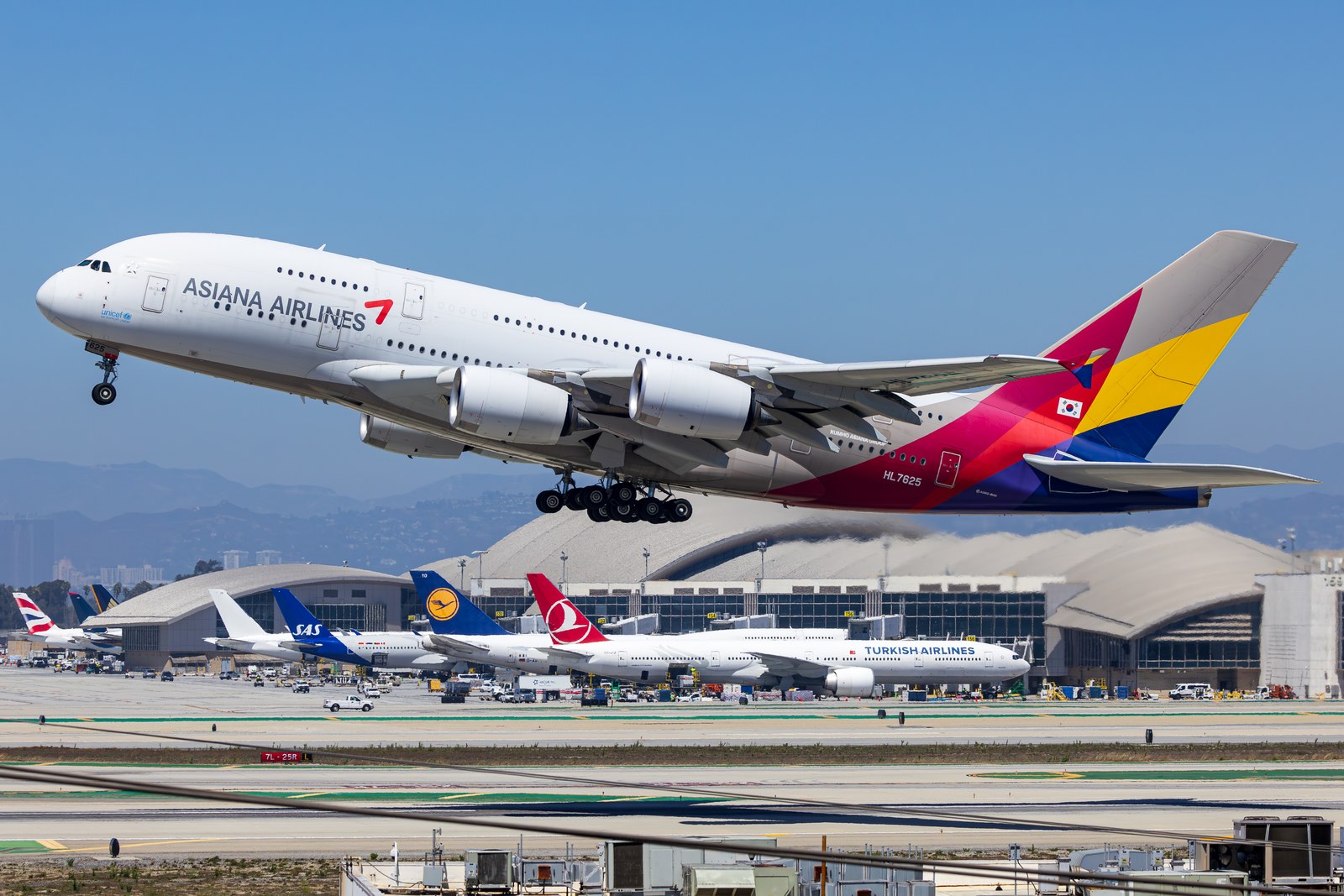
Six men were on board. Claude Lelaie and Jacques Rosay were in the seats as co-captains, with Fernando Alonso and three flight test engineers behind them. Where the passengers would eventually sit there were tanks of water, so the load could be moved about in flight. The aircraft carried the registration F-WWOW, which nobody at Airbus has ever pretended was an accident.
They flew for nearly four hours, out over the Pyrenees and the Atlantic and back. Rosay said afterwards that the speed on take-off had been exactly what they expected.
Fourteen years later Airbus announced it would stop building them. This is what happened in between, and why an aeroplane that everybody wanted to fly on turned out to be one almost nobody wanted to buy.
Why anyone thought the world needed it
The idea began in secret in 1988, with an Airbus engineer called Jean Roeder and a small team working quietly on an airliner larger than anything then flying. Airbus went public with the thought at Farnborough in 1990.
In January 1993 Boeing and several of the Airbus partner companies started a joint study into what they called a Very Large Commercial Transport. It ran for two and a half years and was suspended in July 1995. The projected development bill was around fifteen billion dollars and Boeing’s appetite for it drained away. Airbus carried on alone, and in June 1994 it announced its own project, the A3XX.
The reasoning behind it was a forecast. Air travel was growing, the world’s biggest airports were running out of slots and runway capacity, and the answer to more people through the same gates was obviously bigger aeroplanes. Boeing had owned that end of the market with the 747 for a quarter of a century. Airbus wanted it.
Boeing looked at the same numbers and reached the opposite conclusion. Passengers, it argued, do not want to travel through hubs. They want to fly from where they are to where they are going. Given an aircraft efficient enough to fly thin long routes directly, the traffic would spread out rather than concentrate.
Both companies committed billions to their answer. Boeing read it better.
The aeroplane
Seventy-two point seven metres long. Twenty-four metres to the top of the fin, which is about the height of a seven-storey building. A cabin floor area of 550 square metres across two full-length decks.

Maximum take-off weight started at 560 tonnes and rose to 575 on the heaviest variant. It carried 320,000 litres of fuel and could fly 8,000 nautical miles with a full load of passengers. Four engines, either Rolls-Royce Trent 900s or the GP7200 built by the General Electric and Pratt and Whitney joint venture, each turning a fan almost three metres across.
Twenty-two wheels carried it: two on the nose, four on each wing gear and six on each body gear. That architecture is not an affectation. Spreading 575 tonnes across four main legs is what kept the pavement loading at existing airports within tolerable limits.
Typical seating was 545 in four classes. The certificated maximum, the number approved for emergency evacuation, is 868.
The most important number is the wingspan
The A380’s wing spans 79.75 metres.
That figure was not chosen by aerodynamicists. It was chosen by airport planners. International standards sort aerodromes into categories by the size of aircraft they must handle, and the largest of them covers wingspans up to eighty metres. Go past eighty and every airport that wanted the aeroplane would need a new category of taxiway separation, gate spacing and clearance.
So the wing was drawn to fit inside a box. It is span-limited rather than optimal, and a longer, thinner wing would have been more efficient. The A380 is an aircraft whose defining dimension was set by the width of the world’s concrete.
Even inside the box the infrastructure bill was real. Airports that wanted the type had to widen taxiways, strengthen pavements and build two-level airbridges to load both decks at once.
What was actually new
About a fifth of the structure by weight is not metal in the ordinary sense.
Sixteen per cent is advanced composite. The centre wing box, the structural heart where the wings meet the fuselage, weighs around eleven tonnes and is over forty per cent carbon fibre: the first centre wing box on an airliner to be built that way. The tail surfaces are carbon. Most of the wing leading edge is a glass-reinforced thermoplastic, autoclaved and welded rather than riveted. The rear pressure bulkhead was made by infusing resin into dry carbon fabric.
The remaining four per cent is the interesting one. Twenty-seven panels of the upper fuselage are made of GLARE, which is thin aluminium sheets interleaved with glass fibre in epoxy. It is lighter than aluminium for the same job and resists fatigue cracking far better. It has an unglamorous virtue too: because the outside is metal, impact damage shows up as a visible dent, and repairs can be done with metalworking rather than composite methods.
Nothing about the A380 was conservative except the thing that mattered most commercially, which was the number of engines.
Getting the pieces to Toulouse
Four million parts, from 1,500 companies in thirty countries. The wings came from Broughton in North Wales, the forward and rear fuselage from Hamburg, the centre fuselage from Saint-Nazaire, the tail from Spain.

The problem is that A380 sections are too big to fly. Airbus had spent years moving parts around Europe in the Beluga, a converted A300 with a swollen upper fuselage, and the A380’s components would not fit inside it.
So Airbus built a supply chain around the sections instead. A purpose-built roll-on roll-off ship, the Ville de Bordeaux, collected the wings from Wales and the fuselage sections from Hamburg and Saint-Nazaire and brought them up the Gironde estuary to Pauillac. From there they went by barge to Langon, and from Langon they went by road.
That last leg is the part people remember. The convoys ran at night, at walking pace, along a specially widened route through the villages of southwest France. Roads were rebuilt, roundabouts reshaped, power lines raised and buildings bought and demolished to let the loads through. Villagers came out to watch a wing go past their front windows at two in the morning.
Five hundred and thirty kilometres of wire
Every A380 contains about 530 kilometres of wiring, 98,000 individual wires and 40,000 connectors. Getting it in was what nearly killed the programme.
The design of a modern airliner is done in three dimensions inside software. Airbus used a package called CATIA. The German and Spanish factories were working in version 4. The British and French factories had moved to version 5.
The two versions handled the geometry differently. Harnesses designed in Hamburg to fit a fuselage section modelled in Hamburg did not fit the same section as it existed in the three-dimensional model everyone else was working to. The bundles came out the wrong length. Hundreds of kilometres of pre-formed wiring loom, made to a drawing, would not go where the drawing said it went.
Airbus later admitted, in careful language, that the work needed to finish installing the harnesses in the forward and rear fuselage had been underestimated, that the digital mock-up system had arrived late, and that its people were still learning it.
Two halves of the same company had drawn the same aeroplane in two different languages, and nobody found out until the pieces met.
What it cost to fix
The delays came in three waves. In June 2005 deliveries slipped six months. On 13 June 2006 they slipped another six or seven. On 3 October 2006 the first delivery moved to October 2007, and instead of the nine aircraft promised for 2007 there would be one.
The financial damage was announced in the same instalments: two billion euros of operating profit in June 2006, then a further 2.8 billion in October. Nearly five billion euros, spread over four years, for wire that did not fit.
EADS shares fell twenty-six per cent on 14 June 2006, the day after the second announcement.
On 2 July 2006 the chief executive of EADS, Noël Forgeard, and the chief executive of Airbus, Gustav Humbert, both resigned. Humbert called it a major disappointment for customers, shareholders and employees. It emerged that Forgeard had made about two and a half million euros selling EADS stock weeks before the delays became public; the French market regulator investigated and he denied any wrongdoing.
The A380 programme manager was replaced that September. Humbert’s successor at Airbus lasted about three months. By the end of 2006 the aeroplane had gone through more senior management than most programmes see in a decade.
The unveiling
On 18 January 2005, five thousand guests sat in a hangar at Toulouse while Airbus showed them what all this had bought.
There were dancers, projections, lasers, dry ice, fireworks and a towering projected figure narrating. Children pulled white cords and the curtain fell away from F-WWOW. Jacques Chirac called it a magnificent human endeavour. Tony Blair, standing next to him, said it was simply stunning.
It was, by any measure, a lot. But an aeroplane that had absorbed a decade and the best part of fifteen billion dollars had earned a party, and nobody in that hangar yet knew about the wiring.
Certification
The European authorities certified the A380-841 and -842, the Rolls-Royce variants, on 12 December 2006. The GP7200 version followed on 14 December 2007, after 2,855 engine flight hours across 240 flights.
Two tests from the programme are worth remembering.
The wing was loaded to destruction in a rig on the ground in February 2006. It ruptured at about 1.45 times the limit load, short of the 1.5 the rules require, between the inboard and outboard engines. Airbus added reinforcing strips to the stringers, at a cost of about thirty kilograms, and went back to the authorities. That is what static testing is for, but it made headlines because everything about the A380 made headlines.
The evacuation trial was the other. To certify a passenger cabin you must show that everybody can get out through half the exits inside ninety seconds, in darkness, with volunteers who do not know the layout. At Hamburg in March 2006 Airbus put 853 passengers and twenty crew into the aircraft, deployed the slides on one side only, and emptied it in seventy-eight seconds. One volunteer broke a leg and about thirty picked up minor injuries, which is not unusual for the test. It passed.
Into service
Singapore Airlines took the first aircraft, 9V-SKA, on 15 October 2007. Its chief executive called it the new queen of the skies, which was a deliberate remark about whose crown it was taking.

The inaugural commercial flight, SQ380 from Singapore to Sydney, went on 25 October 2007 with 455 passengers from 35 countries. Every seat had been sold at charity auction. A suite went for a hundred thousand dollars, an economy seat for five hundred and sixty, and the money went to a children’s hospital in Sydney, a community fund in Singapore and Médecins Sans Frontières.
Singapore did not cram it. Their first A380 carried 471 seats in three classes against a certificated maximum of 868, and included the first fully enclosed suites in the sky. They reported burning twenty per cent less fuel per seat-mile than their 747-400s.
Emirates followed in July 2008, and on 1 August flew the first A380 service to the United States, Dubai to New York. That is the airline the story now belongs to.
Emirates
Of the 251 A380s ever built, Emirates took 123. Just under half of every one made went to a single airline in a single city.

That is not an accident of enthusiasm. It is a business model. Dubai sits within eight hours’ flying of most of the world’s population, and Emirates built itself on the idea of moving passengers from anywhere to anywhere through one enormous hub. The A380 was the aeroplane that idea required, and Emirates was the only airline on earth whose network was shaped exactly like the aircraft’s strengths.
Sir Tim Clark, who ran Emirates through the whole of it, put fourteen first class suites with showers on the upper deck and a bar at the back of it. Passengers who would not have chosen the airline chose the aeroplane.
Everyone else bought in tens or fewer. Singapore took 24, Lufthansa 14, British Airways and Qantas 12 each, Air France, Etihad, Korean and Qatar 10 apiece. Asiana, Malaysia and Thai took six, China Southern five, All Nippon three.
Fourteen customers. One of them mattered.
Qantas 32
On 4 November 2010 an Airbus A380-842 named Nancy-Bird Walton left Singapore for Sydney with 469 people aboard.

Climbing through 7,000 feet, the crew heard two almost simultaneous bangs.
Inside the number two engine, the inboard one on the left wing, a small oil pipe had been drilled off centre during manufacture. Where the wall should have been about one and a half millimetres thick it was in places a third of a millimetre. It had cracked, and it was leaking oil into a cavity at 365 degrees, where the oil caught fire.
The fire weakened the arm that drove the intermediate pressure turbine until the disc separated from it. Freed of its load, the disc accelerated until it burst, and it burst with more energy than the engine casing could hold. A fragment weighing about seventy kilograms, some forty per cent of the disc, went out through the side.
Debris went into the left wing, opened a fuel tank and cut about 650 wires. The crew lost hydraulics, electrical buses, ailerons, spoilers, slats, parts of the landing gear system, the anti-icing and the ability to jettison fuel. The flight control system dropped out of its normal protections. Fuel poured out of the wing while they worked.
They flew the aircraft for an hour and three quarters, and put it back on the ground at Changi with 4,000 metres of runway and no leading edge devices, stopping about 150 metres from the end.
Then they could not shut down the number one engine, because the wiring that would have told it to stop had been cut. It ran for about three more hours on the ground until the fire service pumped foam into the intake.
Nobody was hurt.
The Australian investigators traced the defect to the manufacturing process itself, and found that other engines in the Trent 900 fleet had the same fault. Within days the European authorities issued an emergency directive requiring inspection of every Trent 900 in the world inside ten flight cycles, and repeat inspections every twenty. Qantas grounded its entire A380 fleet. Rolls-Royce issued its own service bulletin allowing twenty cycles; the Australian regulator decided that was not enough and directed Qantas to comply within two. Rolls-Royce later wrote software to shut a failing engine down automatically.
Air France 66
Almost seven years later, on 30 September 2017, an Air France A380 with 521 people aboard was over Greenland on its way from Paris to Los Angeles when the number four engine came apart.
This one was different, and worse in principle. The fan itself failed. A crack that began beneath the surface of a blade slot in the fan hub ran out through the metal, and the fan, the air intake and the fan case departed the aircraft together.
The fan hub is a critical rotating part. It is one of the components the whole certification system assumes will not burst. The crew diverted to Goose Bay in Labrador and landed safely.
Finding out why took years, partly because the missing piece of hub was somewhere on the Greenland ice sheet. A search operation eventually recovered it.
The freighter that never was
An A380F was part of the plan from the start, and two of the world’s largest freight operators ordered it. FedEx signed for ten and UPS for ten more.
Then the wiring crisis pushed everything to the right. On 27 November 2006, FedEx cancelled all ten and ordered fifteen Boeing 777 freighters instead, with options on fifteen more. Its chairman said the availability and delivery timing of the aircraft, coupled with payload range and economics, made the Boeing the better decision. UPS cancelled all ten in March 2007.
With both dedicated freight customers gone, Airbus shelved the variant. No A380 freighter was ever built, and none has ever flown.
That matters more than it sounds. The 747 has spent its old age as a freighter, which is why so many are still working. The A380 has no such second career waiting for it: the upper deck floor is not stressed for cargo, the door positions are wrong, and the economics never closed.
The arithmetic that killed it
The A380 was designed around one proposition: that the cost of carrying a passenger falls as the aeroplane gets bigger. That was true in 1994 and it stopped being true while the aircraft was being built.
What broke it was engines. Boeing launched the 787 in December 2003, and the engines built for it turned out to burn about fifteen per cent less fuel than anything available when the A380 was being designed. John Leahy, who sold aeroplanes for Airbus for a quarter of a century, said afterwards that Airbus had been blindsided by the engine makers in 2000. A twin with those engines could match the A380’s cost per seat while carrying half the people, which meant an airline could fly the route twice a day instead of once and fill both.
Then the rules changed underneath it. Twin-engined airliners used to be restricted in how far they could stray from a diversion airfield. That limit was pushed out to 180 minutes, and then to 330. At five and a half hours from the nearest runway there is almost no commercially useful route on earth that needs more than two engines. The A380’s four stopped being a safety argument and became four engines to buy, four to fuel and four to overhaul.
And the traffic did not behave as forecast. Liberalised air agreements let airlines fly smaller aircraft more often instead of concentrating everyone through a hub. Very few routes could fill an A380 every day. Tom Enders, running Airbus at the end, said he admitted it reluctantly but Boeing had largely been right about point to point.
The China market that Airbus expected to absorb hundreds of them took five, all to one airline.
The aeroplane nobody wanted to build
There is a deeper problem, and both sides of the deal have said it out loud.
The A380-800 was designed as the base member of a family. A stretched A380-900 was always the point, and the -800’s structure carries weight it does not need because it was drawn to take the longer version. Enders said plainly that the -800 was not the aircraft they actually wanted to build. Tim Clark at Emirates said he wanted the -900, not the -800.
So the aeroplane was penalised in weight for a growth version that never came, and the growth version never came because the base version did not sell. The programme was carrying the cost of its own ambition from the first delivery.
What it cost everyone else
The A380 also had to be paid for by people who did not buy one.
In 2006 the United States Government Accountability Office costed the changes needed at eighteen American airports to take the aircraft: 927 million dollars, of which about eighty-three per cent went on widening runways and taxiways. Kennedy alone came to 151 million. Anchorage, Atlanta and Miami were each around a hundred.
Every one of those airports had to make a bet on how many A380s would ever turn up. Most of them lost it.
The last lifeline
On 18 January 2018, thirteen years to the day after the roll-out, Emirates ordered twenty more A380s with options on sixteen, a deal worth sixteen billion dollars, for delivery from 2020.
John Leahy said the order showed Airbus’s commitment to produce the A380 for at least another ten years, and that he was personally convinced more orders would follow.
None did. The programme had thirteen months left.
14 February 2019
Airbus and Emirates announced that Emirates was cutting its A380 order book from 162 aircraft to 123, cancelling thirty-nine. It would take fourteen more over two years. In their place it ordered forty A330-900s and thirty A350-900s.
Airbus said in the same statement that A380 deliveries would cease in 2021, because there was no substantial backlog and therefore no basis to sustain production. Three thousand to three and a half thousand jobs were affected.
Enders was blunter elsewhere: if you have a product that nobody wants any more, or that you can only sell below production cost, you have to stop it.
Sheikh Ahmed bin Saeed Al Maktoum, Emirates’ chairman, said the airline had been a staunch supporter since inception, that it was disappointed to give up the order and sad the programme could not be sustained, and that it accepted this was the reality.
Somewhere between twenty-five and thirty billion dollars of development spending was written off. It was never going to be recovered.
The last one
The final set of wings left Broughton in North Wales in February 2020, ending a line of work that had run for fifteen years.
On 17 March 2021 the last A380 to be assembled at Toulouse, construction number 272, flew to Hamburg to have its cabin fitted.
It was delivered on 16 December 2021 as A6-EVS, to Emirates, the 123rd aircraft for that airline and the 251st and last of all. It had first class private suites with shower spas, a premium economy cabin and the bar.
Two hundred and fifty-one aircraft, against a business case that needed something closer to a thousand.
Then it was over, and then it was not
Three months after the last delivery the world had already tried to retire the type.
The pandemic emptied the long-haul network in weeks, and the first aircraft any airline grounds is the biggest one. A380s went to the deserts: Teruel in Spain, Tarbes in the French Pyrenees, Victorville and Mojave in California, Châteauroux in central France. Air France retired its ten outright in May 2020. Lufthansa said its fourteen were permanently decommissioned and sold six of them back to Airbus. Malaysia and Thai never brought theirs back.
And then the traffic returned, and the replacements did not.
Boeing’s 777-9 slipped year after year. A350 and 787 deliveries ran late. Engine shop visits stacked up. Airlines found themselves with demand they could sell and no aeroplanes to sell it in, and the only way to add several hundred seats at short notice was sitting in a desert with the covers on.
So they went and got them back. Qatar Airways, whose chief executive had called the A380 the airline’s biggest mistake, returned eight to service from April 2022. Etihad, whose ten were widely assumed gone, has brought all but one back into use. Qantas recovered all ten from Victorville, the last of them in January 2026 after almost six years parked. British Airways pulled its twelve out of Châteauroux, Teruel and Madrid.
Lufthansa performed the outright reversal. In June 2022 it announced it was bringing the A380 back, citing a steep rise in customer demand and the delayed delivery of aircraft it had ordered. The fleet returned to service on 1 June 2023, based at Munich rather than Frankfurt, and Lufthansa now expects to fly them into the 2030s.
Who flies it now
Ten airlines still had A380s on their books in the summer of 2026, something over 190 aircraft between them, with around 160 of those actually in service at any one time and the rest in maintenance or storage.
Emirates has 116 of them, roughly a hundred flying at any moment with the rest in maintenance, and Tim Clark has said he expects about 110 operational by the end of 2026. Emirates is spending five billion dollars refitting its widebody fleet, 110 A380s among them, and intends to fly the type into the 2040s.
Behind that: British Airways and Singapore Airlines with twelve each, Qantas with ten, Etihad with nine, Qatar and Lufthansa with eight apiece, Asiana with six, Korean Air down to five of its original ten, and All Nippon with three.
The stated intentions are longer than anyone expected in 2019. Qantas has named 2032 as the start of its retirement. Etihad’s chief executive says at least through 2032. British Airways is spending money on new first class suites and the largest business cabin in the world, 110 seats, across the whole upper deck. Singapore has no retirements scheduled.
Aircraft do not get refitted at that expense unless somebody intends to keep them a while.
Where to see one
Sixty-three airports still received A380 service in 2026. Dubai is not a competition: it saw more than twenty thousand A380 departures in the first eight months of the year.

For anyone in Britain, the answer is Heathrow, with nearly five thousand A380 departures in the same period. Emirates alone runs five daily rotations, and British Airways, Qantas, Singapore, Qatar and Etihad all bring their own.
| Airport | A380 departures |
|---|---|
| London Heathrow | 4,899 |
| Munich | 1,540 |
| Paris Charles de Gaulle | 1,205 |
| Manchester | 729 |
| Milan Malpensa | 729 |
| Amsterdam | 486 |
| Zürich | 455 |
| London Gatwick | 430 |
| Frankfurt | 416 |
Those counts run over 243 days, so the ones that divide cleanly tell you the frequency. Manchester and Milan Malpensa both sit on exactly three a day. Amsterdam is two. Madrid, Vienna, Rome, Prague, Birmingham and Glasgow are one apiece. Glasgow is the one to watch, because Emirates has been reshuffling its network and it is worth checking the schedule before making that drive. If the nearest of those is an airport you have not worked before, our guide to finding a vantage point at a large airport is a sensible place to start.
One warning for the coming winter. British Airways is retrofitting its fleet, and that means fewer of its own aircraft flying: the airline’s A380 network shrinks sharply over the 2026 and 2027 winter. If Heathrow is your plan, the Emirates rotations are the dependable ones.
Photographing it
The A380 is the easiest large aircraft in the world to photograph badly.
It is so big that the eye misreads the distance, and shots come out looking like a model. The two things that fix that are foreground and angle. Something in the frame at a known size, a fence, a vehicle, a person, tells the viewer how far away it is. And a three-quarter view shows both decks and the depth of the fuselage, where a pure side-on flattens it into a slab.
It is also slower over the fence than a narrowbody, which sounds helpful and is not: it means you have longer to fill the frame and more chance of clipping a wingtip. Leave room. Seventy-nine and three-quarter metres of wing goes outside the frame faster than you think.
Our own aviation photographs are catalogued in the Piemags archive, and the conditions for reproducing one are set out on the licences page.
For approach shots at Heathrow, Myrtle Avenue and the Renaissance hotel end are the established positions, and our guide to photographing airliners covers the settings. The one thing specific to this aircraft is the wingtip vortices: a heavy A380 on a humid approach pulls visible cones of condensation off the wingtips and flap edges, and nothing else in service does it on that scale.
What it leaves behind
Two hundred and fifty-one aircraft, of which around 160 were still working in the summer of 2026. No freighter, no stretch, no re-engine, no successor, and no other manufacturer showing the slightest interest in building anything like it.
It is the last four-engined airliner that will ever be designed, and probably the largest passenger aircraft anyone will ever build. Not because the engineering failed, but because the world it was drawn for did not arrive.
Airbus was not wrong that airports would run out of room. It was wrong about what airlines would do in response, which was to fly smaller aeroplanes more often to more places rather than pile everyone onto one enormous one.
And yet. Ask any passenger which aircraft they would rather cross an ocean in, and the answer is the same one they have been giving since 2007. The A380 lost the argument on cost per seat and won it on every other measure that people who are not accountants care about.
Emirates expects to still be flying it in the 2040s. The people who cancelled it will be retired long before the aeroplane is.
Questions people ask
How many Airbus A380s were built?
Two hundred and fifty-one, delivered to fourteen customers. Because the programme ended with orders and deliveries equal, that figure is both the number ordered and the number built. Emirates took 123 of them, just under half of every A380 ever made.
Why was the Airbus A380 cancelled?
It stopped making economic sense while it was being built. Engines developed for the Boeing 787 burned around fifteen per cent less fuel than anything available when the A380 was designed, so a twin could match its cost per seat while carrying half the passengers. Rules allowing twins to fly up to five and a half hours from a diversion airfield removed any remaining advantage in having four engines. And airlines chose to fly smaller aircraft more often rather than concentrate passengers through hubs.
When did the last A380 fly?
The last one was delivered, not flown, on 16 December 2021. Construction number 272, registered A6-EVS, went to Emirates as the 251st and final aircraft. The last set of wings had left Broughton in North Wales in February 2020, and the final airframe left the Toulouse assembly line for Hamburg on 17 March 2021.
Is the Airbus A380 still flying in 2026?
Yes. Ten airlines still had them in the summer of 2026, something over 190 aircraft between them and around 160 in service at any one time. Emirates has 116 and intends to fly the type into the 2040s. Qantas has named 2032 as the start of its retirement, Etihad says at least through 2032, and British Airways is fitting new first class suites and a 110-seat business cabin to its twelve.
Which airlines still fly the A380?
Emirates with 116, British Airways and Singapore Airlines with twelve each, Qantas with ten, Etihad with nine, Qatar and Lufthansa with eight, Asiana with six, Korean Air with five and All Nippon with three. Air France retired its fleet outright in 2020; Malaysia Airlines and Thai Airways never brought theirs back after the pandemic.
Why did Lufthansa bring the A380 back?
Because the aircraft meant to replace it did not arrive. Lufthansa grounded all fourteen in 2020 and called them permanently decommissioned, selling six back to Airbus. In June 2022 it reversed the decision, citing a steep rise in customer demand and delayed delivery of aircraft it had ordered, principally the Boeing 777-9. The fleet returned to service on 1 June 2023, based at Munich rather than Frankfurt.
Where can I see an A380 in the UK?
Heathrow, overwhelmingly. It saw 4,899 A380 departures in the first eight months of 2026, more than any airport outside Dubai. Emirates runs five daily rotations there and British Airways, Qantas, Singapore, Qatar and Etihad all bring their own. Manchester has three Emirates A380 departures a day, Birmingham and Gatwick around one. British Airways is retrofitting its fleet, which cuts its own A380 flying sharply over the coming winter.
What happened on Qantas flight 32?
On 4 November 2010 an A380 climbing out of Singapore suffered an uncontained failure of its number two engine. An oil pipe had been drilled off centre in manufacture, leaving a wall as thin as a third of a millimetre where it should have been about one and a half. It cracked, leaked, and the oil caught fire, which weakened the arm driving the intermediate pressure turbine. The disc separated from that arm, overspeeded and burst, throwing a seventy-kilogram fragment out through the engine. Debris cut about 650 wires and opened a fuel tank. The crew flew for an hour and three quarters and landed at Changi. Nobody was hurt.
How wide is the A380’s wingspan and why does it matter?
79.75 metres, and the figure was chosen by airport planners rather than aerodynamicists. International aerodrome categories top out at an eighty-metre wingspan, and exceeding that would have forced every airport wanting the aircraft into a new and far costlier class of taxiway separation and gate spacing. The wing is therefore span-limited rather than aerodynamically optimal.
What caused the A380 delays?
Wiring. Each aircraft carries about 530 kilometres of it, 98,000 individual wires and 40,000 connectors. The German and Spanish factories were designing in one version of the CATIA modelling software while the British and French sites had moved to a newer one, and the two handled the geometry differently. Harnesses came out the wrong length and would not fit. Deliveries slipped three times across 2005 and 2006, costing nearly five billion euros of operating profit and the jobs of both the Airbus and EADS chief executives.
Was there ever an A380 freighter?
No, and none ever flew. FedEx and UPS ordered ten each, but when the wiring delays pushed the schedule back FedEx cancelled in November 2006 and bought Boeing 777 freighters instead. UPS cancelled in March 2007. With both dedicated freight customers gone Airbus shelved the variant. It is one reason the A380 has no second career ahead of it, where the 747 has spent its old age hauling cargo.
How do you photograph an A380 well?
Give it scale and give it an angle. The aircraft is so large that the eye misjudges the distance and shots come out looking like a model, so include something of known size in the frame. A three-quarter view shows both decks and the depth of the fuselage where a side-on flattens it. Leave room at the edges: nearly eighty metres of wingspan leaves the frame faster than you expect. On a humid approach a heavy A380 pulls visible condensation cones off the wingtips and flap edges, which nothing else in service does at that scale.
Heathrow is where to photograph one in Britain, and our Heathrow spotting guide covers exactly where to stand.
Sources and further reading
- Airbus, “A380, world’s largest commercial aircraft, successfully takes to the skies”, 27 April 2005. airbus.com
- Airbus, A380 customers list, January 2022, the final record of orders and deliveries. airbus.com
- Airbus, A380 facts and figures, December 2021. airbus.com
- EASA type certificate data sheet A.110 for the Airbus A380. easa.europa.eu
- Airbus and Emirates reach agreement on the A380 fleet, 14 February 2019. airbus.com
- Emirates completes its A380 fleet with the 123rd delivery, December 2021. emirates.com
- Australian Transport Safety Bureau, investigation AO-2010-089 into the Qantas flight 32 engine failure. atsb.gov.au
- EASA emergency airworthiness directive 2010-0236-E on the Rolls-Royce Trent 900. easa.europa.eu
- Bureau d’Enquêtes et d’Analyses, report on the Air France flight 66 engine failure over Greenland. bea.aero
- US Government Accountability Office, GAO-06-571, on the cost of adapting American airports for the A380, 19 May 2006. govinfo.gov
- FedEx Express to acquire Boeing 777 freighters, 27 November 2006. fedex.com
- Aviation Week, “What went wrong with the Airbus A380”, with Leahy, Enders and Clark on the record. aviationweek.com
