Aircraft vapour is condensation: when the air around a wing, a vortex core or an engine exhaust is cooled below its dew point, the water vapour already in the air turns to visible cloud, and it disappears again the moment the air warms back up. Getting good photographs of it comes down to understanding what causes each type, knowing which day and which manoeuvre will produce it, backlighting it so it glows, and exposing so the bright vapour keeps its texture instead of blowing out to white. This guide to aircraft vapour photography explains the physics of every vapour effect you will see at an airshow or an airfield, then turns that into practical camera craft.
Photographers use one word, vapour, for several different things: the sheet of fluff that boils off the top of a fighter’s wing in a hard turn, the crisp cone around a jet near the speed of sound, the thin spirals streaming from an airliner’s wingtips on a damp approach, and the long white trails a jet leaves at altitude. They look related, and most of them share a single cause, but they are not the same phenomenon and they do not appear in the same conditions. Once you can tell them apart you can predict them, and prediction is most of the battle.
What this guide covers
- The physics in one idea
- Vapour over the wing
- The vapour cone and its myth
- Wingtip and flap vortices
- Contrails
- Afterburner, exhaust and heat haze
- Propellers, rotors and the deck
- Reading the day
- Camera settings for vapour
- Position, light and exposure
- Bringing out vapour in editing
- Common mistakes
- Conditions at a glance
- Frequently asked questions
The physics in one idea
Almost every piece of instant vapour around an airframe comes from the same chain of events. Where the air has to speed up, over the top of a wing, through the low-pressure core of a vortex, or in the expansion region around a transonic aircraft, its pressure drops. Air that drops in pressure quickly also drops in temperature, because the expansion does work and there is no time for heat to flow in from outside. This is adiabatic cooling. If the air is humid enough that this cooling takes it below its dew point, the water vapour it carries condenses into a mist of tiny droplets you can see. As soon as the air slows again and its pressure and temperature recover, the droplets evaporate and the vapour vanishes. That is why manoeuvre vapour flickers on and off with the aeroplane’s loading, and why it is far more generous on a muggy day than a dry one.
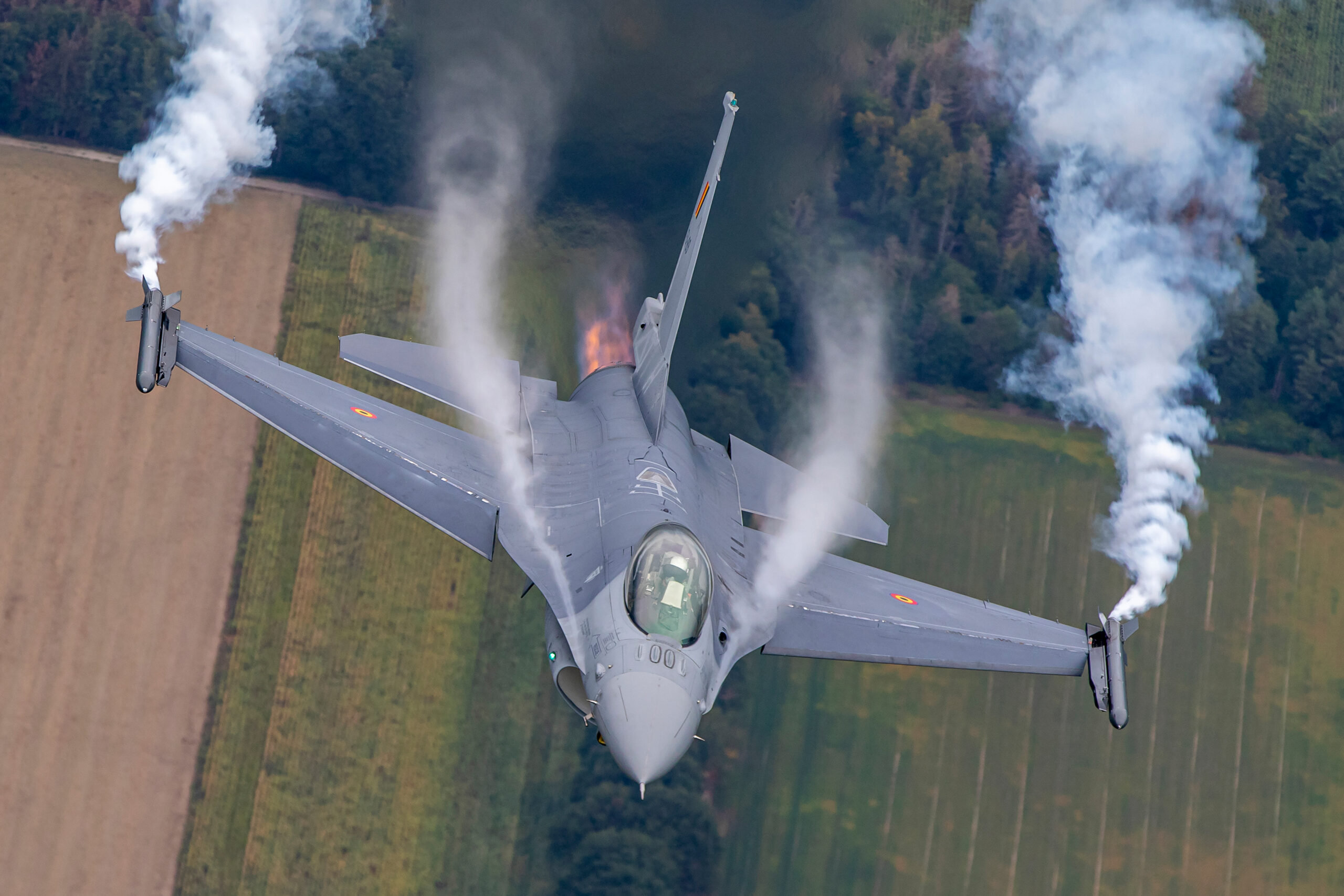
Two numbers decide whether you get a show. The first is relative humidity, or more usefully the spread between the air temperature and the dew point. A small spread, the sort of close, hazy day that feels sticky on the ground, means the air is already near saturation and only a little cooling is needed to condense it. The second is the strength of the pressure drop the aeroplane can generate, which rises with angle of attack, with g, and with speed. Put a hard-pulling fighter into humid air and you get spectacular vapour. Put the same aeroplane into cold, dry, crisp blue-sky air and you may get almost nothing, which is why two displays by the same jet on different days can look completely different. Contrails, covered later, work on a slightly different principle because the engine adds its own moisture, but the theme of cooling below the dew point still runs through everything here.
Vapour over the wing
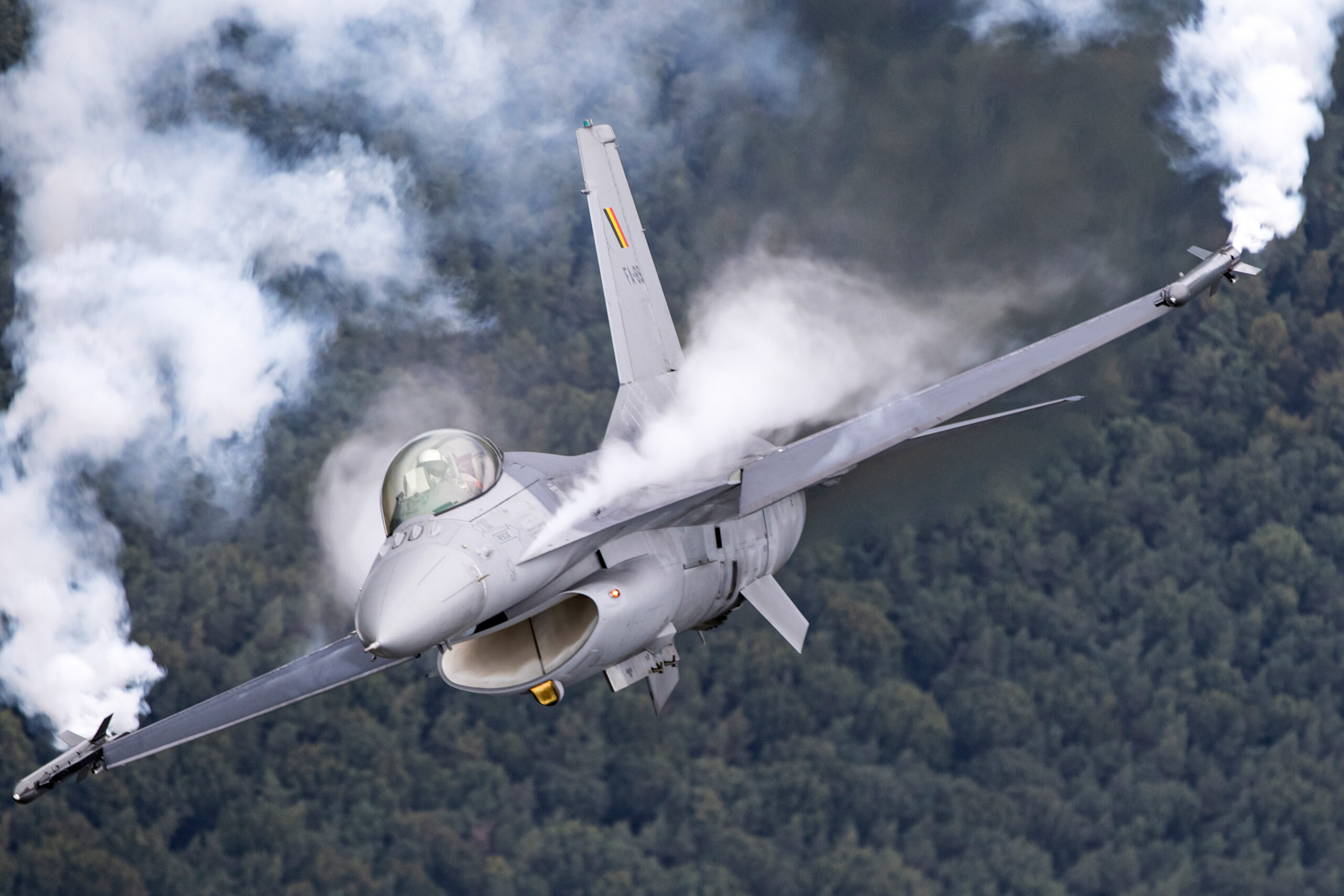
The broad sheet of fluff that appears over the upper surface of a wing during a hard manoeuvre is the most common vapour a display photographer sees. A wing makes lift by generating low pressure across its upper surface, and the harder it is worked, at high angle of attack and high g, the lower that pressure falls. The air accelerating over the wing expands, cools, and where it drops below the dew point it condenses into a translucent layer that clings to the top of the wing and streams back off the trailing edge. On aircraft with leading-edge root extensions, the LERX of an F-18 or the chines of other types, you often see the densest vapour boiling off those surfaces, because they generate strong vortices at high alpha.
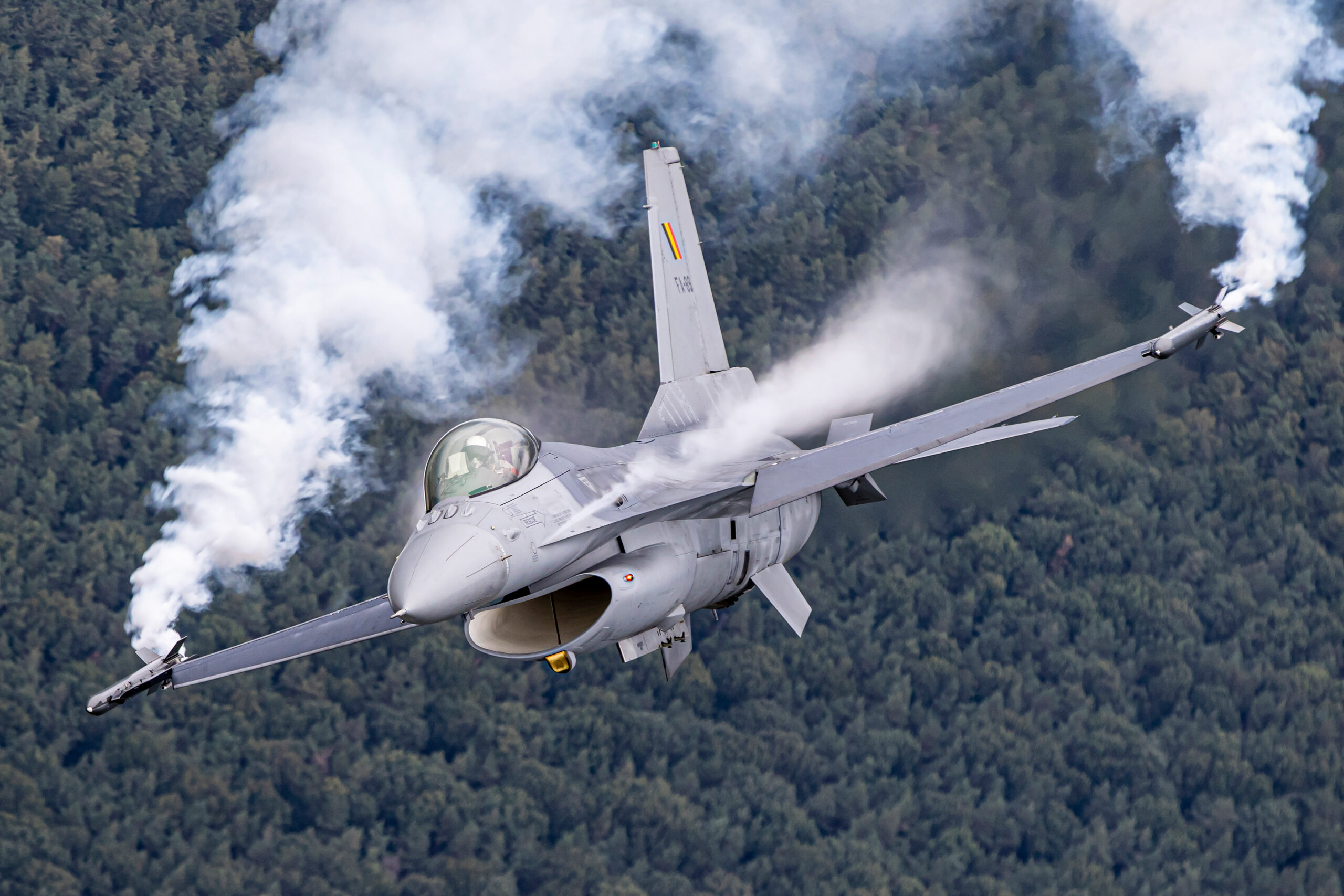
This is a lift effect, not a speed effect, so it happens at ordinary display speeds whenever the wing is loaded up. It is the vapour to watch for during the topside pass, the tight turn back towards the crowd, and the pull up into a loop, the moments when both g and angle of attack peak. Because it hugs the wing, it rewards an angle that shows the top of the aircraft: a banking pass, a topside photo pass, or a shot taken as the jet rolls out of a turn. Keep it distinct in your mind from the tight cone discussed next. Wing fluff is a soft, broad blanket tied to how hard the wing is working; the cone is a sharp-edged shell tied to how close the aircraft is to the speed of sound.
The vapour cone and its myth
The dramatic shell of cloud that wraps around a fast jet, sometimes called a shock collar, is a condensation cloud formed in a local region of very low pressure and temperature around the aircraft as it approaches the speed of sound. On a shape like the Hornet, air flowing over the curved surfaces passes through an expansion region where pressure and temperature fall sharply, condensation forms there, and then a recompression at the rear of the aircraft warms the air again and the cloud evaporates. That abrupt start and finish is what gives the effect its crisp, cone-like edge.
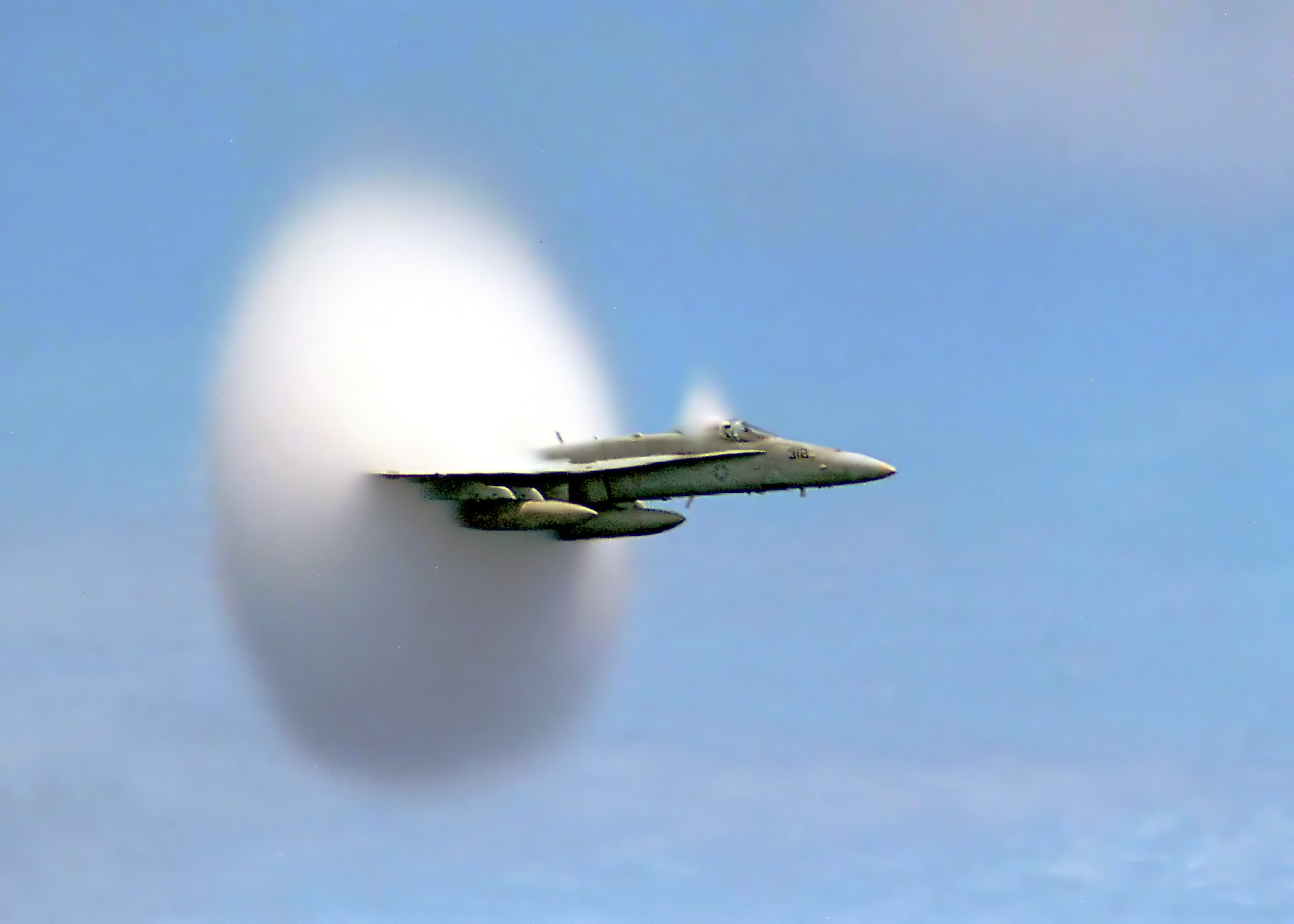
Here is the part worth getting right, because almost every caption gets it wrong. A vapour cone does not prove the aircraft is breaking the sound barrier. It commonly appears at high subsonic, transonic speed, and whether you see it, and how bright it is, depends far more on the humidity of the air than on the exact Mach number. Two passes at the same speed can look utterly different if the moisture in the air is different. You will also see the effect labelled a Prandtl-Glauert singularity. That name comes from a piece of aerodynamic mathematics that predicts pressures rising towards infinity as an aircraft nears Mach 1, but the maths simply stops being valid at those speeds and there is no real singularity, so it does not physically cause the cloud. The honest description is a transonic condensation cloud. For photographers the practical lesson is the same as everywhere else on this page: humidity makes the picture, so the sticky, hazy sea-fret day at a coastal show is your friend, and a display jet worked hard near the speed of sound in that air can give you the shot of the season.
Wingtip and flap vortices
A finite wing leaks air around its tip, from the higher pressure beneath to the lower pressure above, and that leakage rolls up into a trailing vortex spinning off each wingtip and off the outer edge of each flap. The core of that vortex spins fast and has very low pressure, so the air in it cools, and in humid conditions it condenses into a thin, rope-like spiral that streams away behind the tip. The stronger the vortex, the more visible the core, and vortex strength rises with weight, with angle of attack, with low speed and with g. That combination is exactly what a heavy airliner presents on approach with its flaps down, which is why the best place to photograph vortex condensation is off the end of a runway on a damp day as widebodies come in to land.
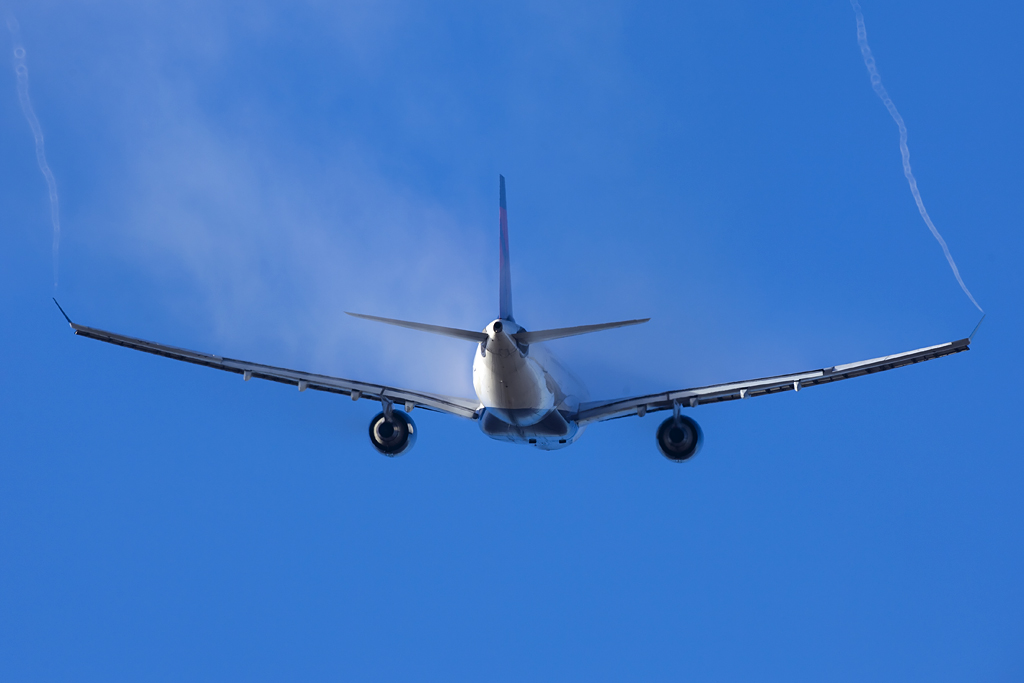
Fighters show the same thing off their wingtips and flap tips in hard turns, often at the same time as the broad wing fluff, which can make a busy, layered picture: a sheet over the wing and two tight spirals peeling off the tips. Keep the two effects separate in your head, because they photograph differently. The wing sheet is a soft blanket best shown from above or from the side of a banking aircraft; the tip vortices are discrete lines that read best against a darker background or when backlit so the spiral catches the sun. At airports, a long lens down the approach, patience, and a humid, bright-but-overcast day will get you clean vortex trails off almost any heavy jet. Our guide to composition for aviation photography covers how to place those trailing lines in the frame so they lead the eye rather than clutter it.
Contrails
Contrails, the long trails you see streaming behind aircraft at altitude, form by a different route from manoeuvre vapour, because the engine supplies the moisture. Jet exhaust is hot and wet, since burning the hydrogen in the fuel produces water. Behind the aircraft that exhaust mixes with the very cold air at cruising height, and it is that mixing, rather than cold air alone, that briefly pushes the plume past saturation, the condition meteorologists call the Schmidt-Appleman criterion. This usually needs ambient air colder than about minus forty Celsius, at which point the water condenses onto soot and other particles from the engine and immediately freezes into a trail of ice crystals. There is typically a short gap of a hundred metres or so behind the aircraft before the trail appears, the distance it takes for the plume to cool. Over the British Isles you rarely see cruise contrails form below about six to eight kilometres, which is why they belong to high traffic and high-altitude passes rather than to the display line.
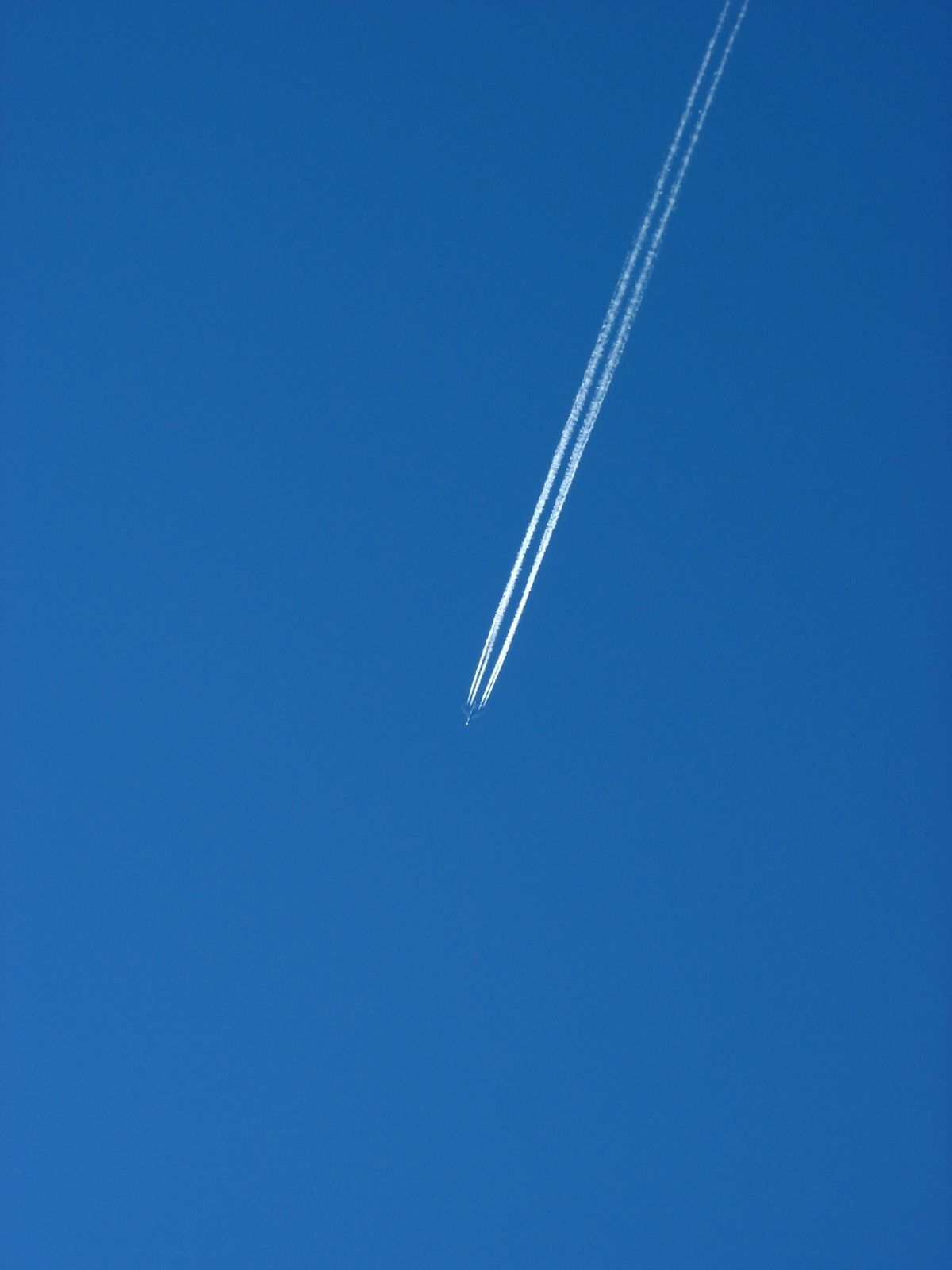
Whether a contrail is a brief white scratch or a broad, sky-covering smear depends on the humidity of the air it forms in. If that air is dry, the ice crystals sublimate away within seconds and the trail is short-lived. If the air is already close to saturated with respect to ice, the crystals survive and grow, and the contrail persists and spreads into sheets that can last for hours and drift into artificial cirrus. For photography that gives you two very different subjects: the crisp, graphic short trail that works as a clean diagonal against deep blue, and the spreading, textural trail that can either ruin a clear sky or, used deliberately, add mood and lead-in lines to a wide composition. A note on the persistent kind, since it comes up: their spreading is simply a matter of ice-supersaturated air, nothing is being added to them, and the aerodynamic contrails that sometimes form from the pressure drop over a wing at altitude are a separate, wing-made effect rather than an exhaust product.
Afterburner, exhaust and heat haze
Some of the effects around a jet’s tail look like vapour but are not condensation at all, and a caption that mixes them up is an easy way to lose credibility. The bright, repeating diamonds you can sometimes see inside an afterburning exhaust are shock diamonds, also called Mach disks. They form when supersonic exhaust leaves the nozzle at a pressure different from the surrounding air and sets up a standing pattern of shock waves and expansion fans, and their glow is hot gas burning and luminescing at the shock points. That is a shockwave effect, not water condensing.
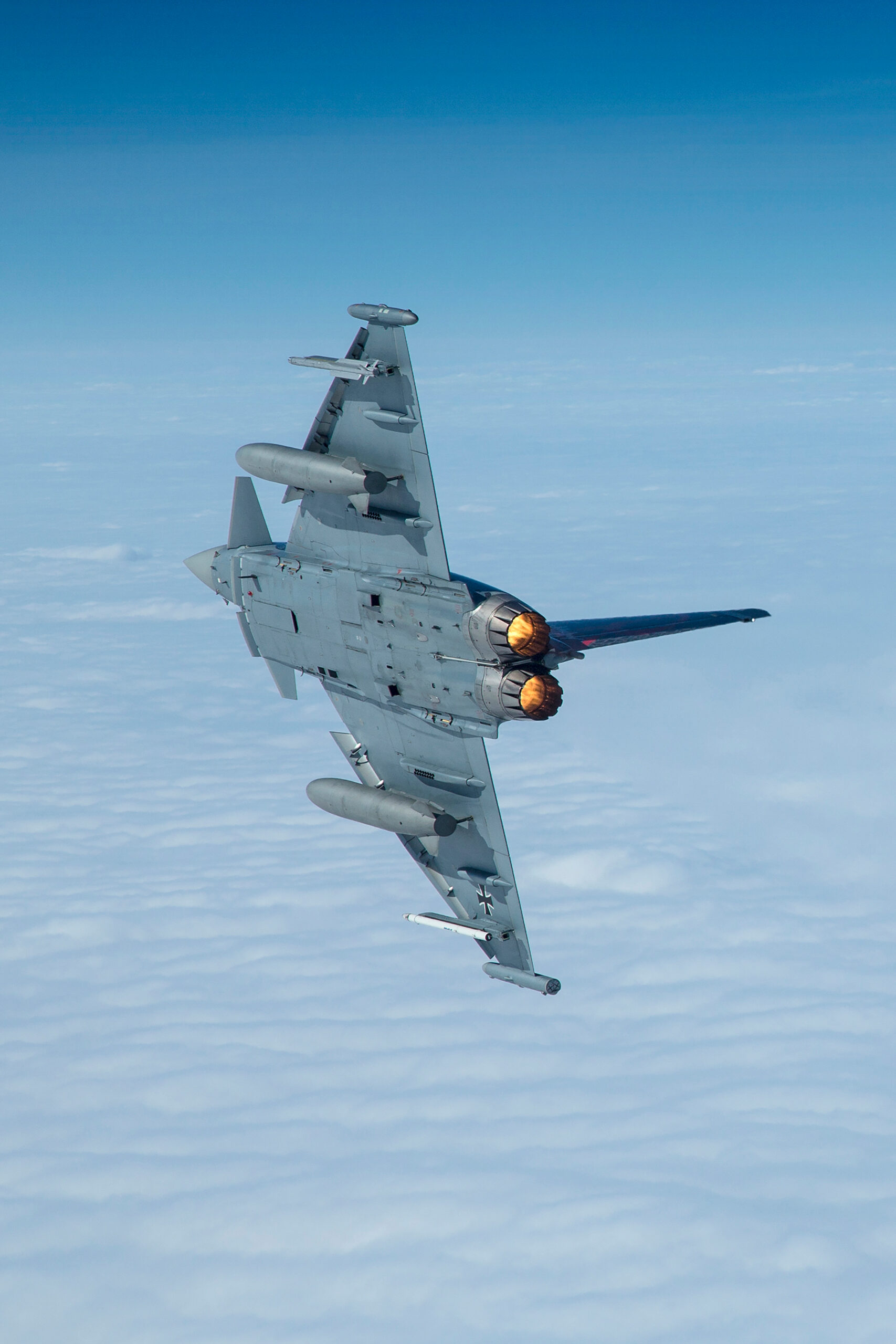
Heat haze is a third thing again. The shimmer you see behind a running engine or over hot tarmac is refraction: light bending as it passes through air of varying density and temperature. It blurs and wobbles whatever is behind it, but it is transparent, whereas condensed vapour is opaque and white. If a jet lights the burner in really humid air you can get all three at once, the glowing exhaust, the shimmer behind it, and a burst of real condensation vapour off the wings and body as the aircraft accelerates and pulls, which is a spectacular but confusing thing to caption accurately. On the ground and at low level on a cold, damp day you may also see a brief plume of condensation behind the engines as the moist exhaust meets cool air, the low-level cousin of a contrail. When you write up the shot, separate the shockwave glow, the refractive shimmer, and the water vapour, because they have three different causes. Our companion piece on dealing with heat haze goes deeper into the refractive problem and how to shoot around it.
Propellers, rotors and the deck
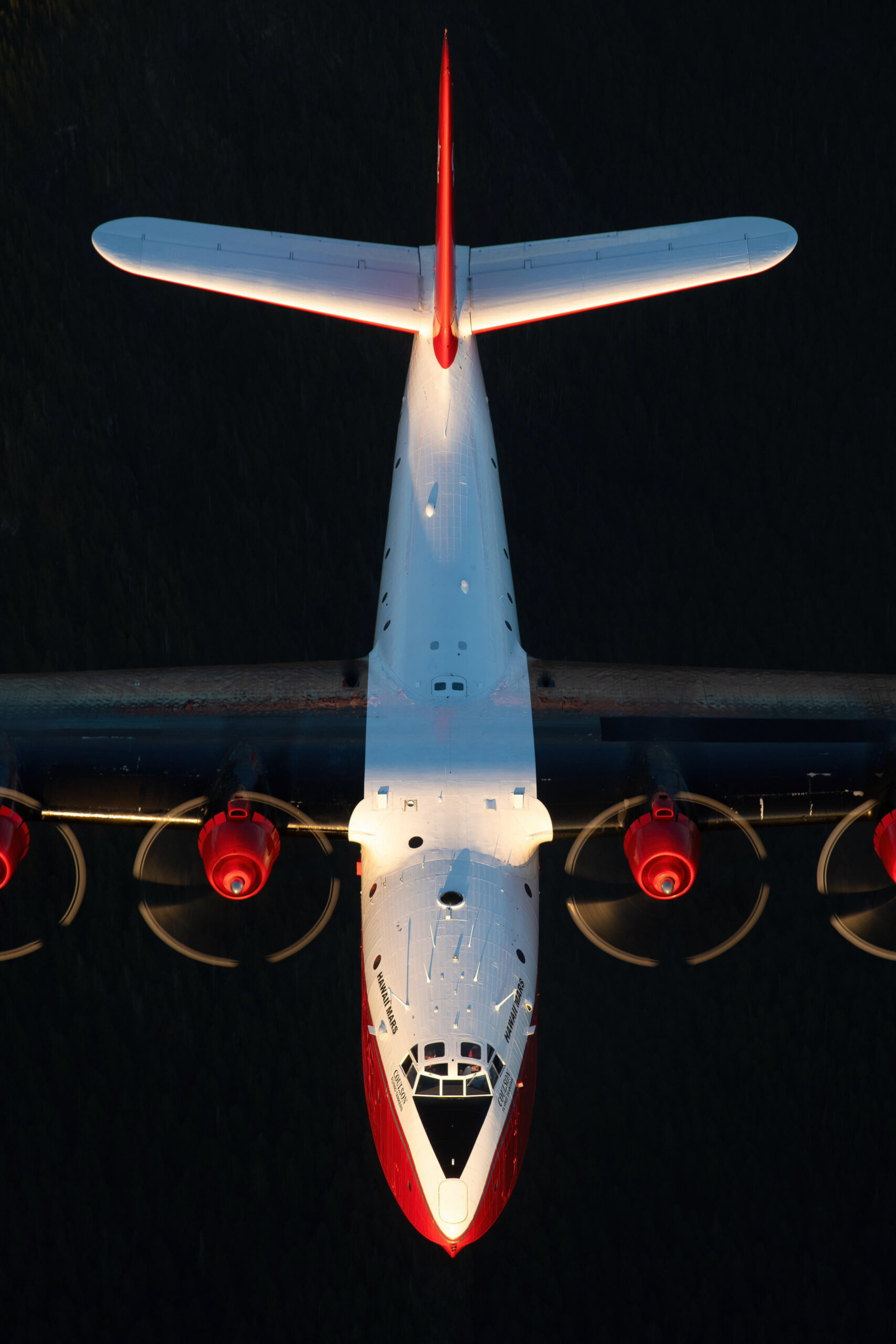
Rotating blades throw off tip vortices exactly as wings do, and in humid air those cores condense too. On a propeller aircraft pulling hard in moist conditions you can catch faint corkscrew lines spiralling back from the blade tips, or a soft ring of condensation around the disc. Helicopters are the more reliable subject, because a main rotor working hard in a high-power hover or a sharp pull-up sheds a whole helical pattern of tip vortices, and on the right day that shows as a fuzzy condensation ring or a ghostly disc around the rotor. It is worth watching for during a display helicopter’s tighter, higher-power manoeuvres rather than in a steady cruise.
Maritime settings deserve a mention because they are where all of this comes together. The famous Hornet cone photographs come from carrier operations for a reason: the air over a warm sea is loaded with moisture, so a jet breaking hard over the deck pulls vapour readily. The same is true of coastal airshows, where a sea breeze brings in humid air and a display over the water can produce far more vapour than the identical routine flown inland on a dry day. One caution when you caption a carrier shot: the steam catapult itself produces literal steam, water vapour from the launch system, which is a different source from the aerodynamic condensation forming on the aircraft. Do not conflate the two. If you can plan your season around the physics, a warm, humid, coastal show is the single most productive place to hunt vapour.
Reading the day
If you take one practical habit from this guide, make it this: check the humidity before you leave for the show, and read the sky when you arrive. The single best predictor of manoeuvre vapour is a small gap between the air temperature and the dew point. A muggy, hazy, close day, the sort where distant aircraft look a little soft, is a vapour day. A dry, cold, sharp-blue day with excellent visibility is usually a poor one, because the air holds so little moisture that even a hard-pulling jet cannot condense much out of it. This is the same reason a display can be all vapour one afternoon and almost bare the next.
Coastal and maritime shows tilt the odds in your favour, because the sea feeds humid air inland on the breeze. Warm summer afternoons after rain, marine-layer mornings, and thundery, close conditions all raise your chances. When you get to the site, watch the first few display items closely: if the opening jet is pulling ribbons of vapour off its wings, you know the air is primed and you can plan to be ready for every hard pass that follows. If the early acts are dry, you may still get vapour from the heaviest-pulling display of the day, so keep watching rather than giving up. Knowing which aircraft to expect it from matters too. The F-18 Hornet and Super Hornet are the archetypes, their high-alpha routines and big leading-edge extensions produce generous vapour; the Eurofighter Typhoon, F-35, F-16, F-15 and Rafale are all reliable when the air is right. The technique of tracking these fast, hard-turning subjects is covered in our guide to photographing fast jets.
Camera settings for vapour
Vapour does not need exotic settings, it needs your normal fast-jet setup with careful attention to the highlights. Start with a shutter speed high enough to freeze a jet cleanly, 1/1000 second as a minimum and 1/1600 to 1/2000 as a comfortable working range. Vapour itself does not need freezing in the way a moving airframe does, but you are photographing the aircraft first and the vapour with it, so the jet sets the shutter speed. Aperture priority at around f/5.6 to f/8 is the common working method for jets: it keeps the aircraft sharp, gives a little depth of field for a pair or a formation, and lets the shutter speed float while you lift ISO to hold it up on a dull, humid day.
The one setting that makes or breaks a vapour photograph is exposure, because vapour is bright and it is very easy to blow it out to a featureless white blob that has lost all its wispy structure. Meter to protect the highlights. Against a bright sky or into the light you will usually need to dial in negative exposure compensation, often between minus a third and minus one stop, and then check the histogram and the highlight-clipping warning so that the brightest vapour still shows detail rather than clipping to pure white. Shoot raw, always, because raw gives you the latitude to pull back a slightly hot highlight in editing that would be gone for good in a JPEG. If in doubt, expose for the vapour and let the airframe sit a touch dark; you can lift the shadows on the aircraft far more safely than you can rebuild a blown highlight. For a fuller treatment of tracking and autofocus in these conditions, see our airshow camera settings and autofocus guide.
Position, light and exposure
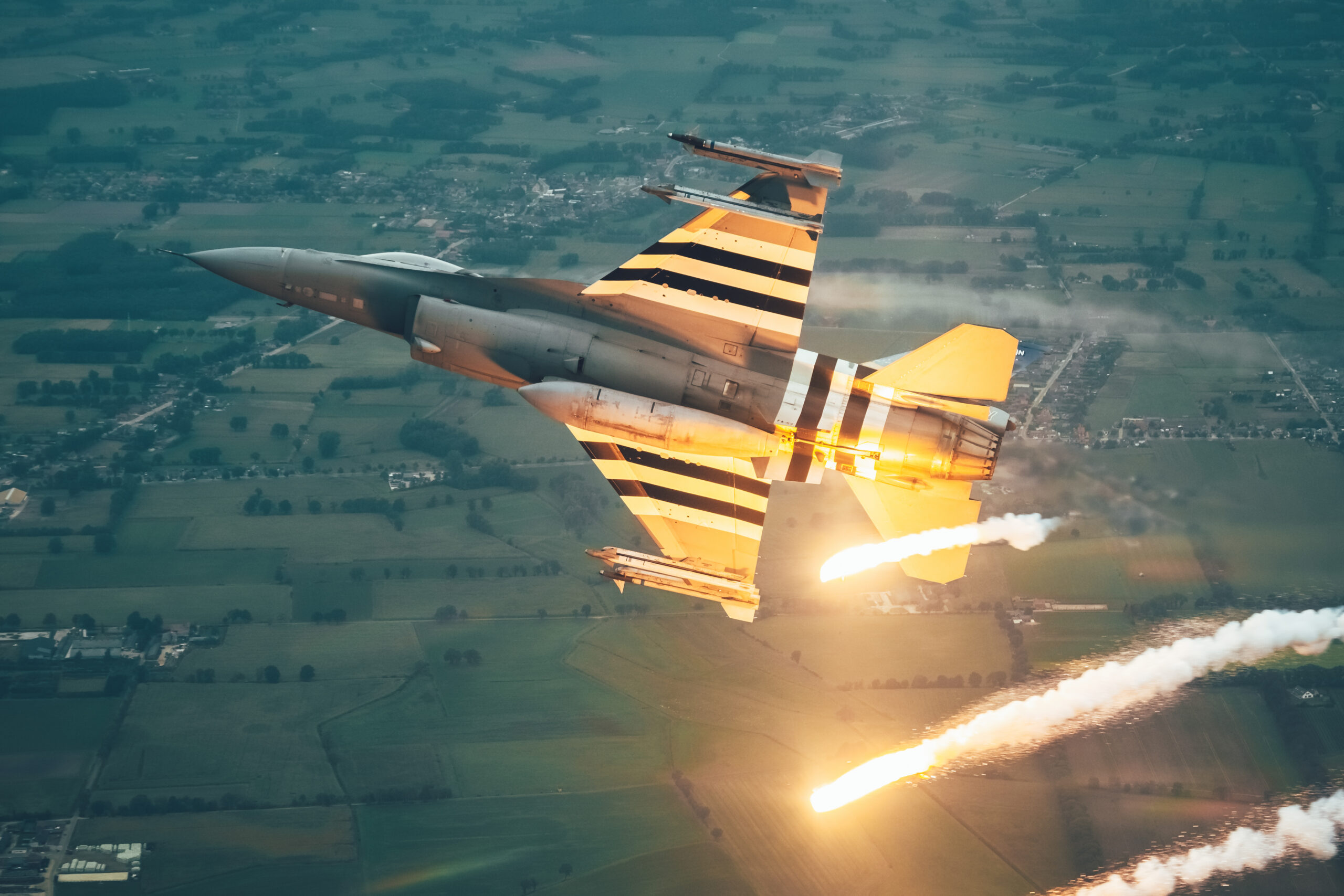
Light direction does more for vapour than any camera setting. Vapour is translucent, so when it is backlit, with the sun behind the aircraft and you looking towards it, the light passes through the mist and it glows. That rim-lit, luminous look is the difference between a record shot and a memorable one, and it is worth accepting a darker, near-silhouetted airframe to get it, because you can recover the aircraft in editing while the glowing vapour carries the picture. Front light, with the sun behind you, renders vapour as a flatter, whiter mass and is the safer but less dramatic option. Position yourself so that the hard-pulling part of the display, the topside pass, the break, the pull-up, happens where the light rakes through the vapour rather than flattening it.
Think about background as well as light. A tight vortex spiral or a thin sheet of fluff reads far better against a darker backdrop, deep blue sky, distant cloud shadow, or a hillside behind an airliner on approach, than against bright haze that swallows it. Give the vapour room in the frame: a hard-turning jet trailing vapour off both wingtips needs space on the side it is turning into, so the trails have somewhere to go. For the glowing, into-the-light approach in particular, our guide to backlighting and silhouettes covers how to meter and where to stand so the sun works for you rather than against you.
Bringing out vapour in editing
The aim in editing is to strengthen the wispy structure of vapour without turning the sky gritty or leaving halos around the wings. Work locally rather than globally. Rather than pushing Clarity, Texture or Dehaze across the whole frame, brush or mask them onto the vapour and the aircraft only, in small amounts, so the clean sky stays clean. Dehaze adds midtone contrast and can lift a slightly flat vapour cloud, Clarity works local midtone contrast, and Texture affects the finest detail; a little of each on a mask usually beats a heavy dose of any one of them.
Guard the highlights first. If the brightest vapour is clipped, recover it with the Highlights and Whites sliders before you add any contrast, because contrast applied to a blown highlight only hardens the loss. If you see the sky going gritty, or a bright fringe appearing along the wing edges, you have pushed the local contrast too far: back it off, soften the mask, and prefer adjusting Blacks and Whites to restore punch over cranking global Clarity. Keep Dehaze well short of its maximum, since heavy Dehaze skews colour and can leave vapour looking dirty rather than luminous. Because you shot raw and protected the highlights in the field, you will have the detail there to work with. Our sharpening and noise reduction guide covers the output-sharpening step that finishes a vapour frame without crunching the soft edges of the cloud.
Common mistakes and how to avoid them
The first and most common error is blowing the vapour out to a white blob. It happens because photographers meter for the aircraft, which is darker than the vapour, and let the bright mist clip. The fix is to watch the highlight warning and expose so the vapour keeps its detail even if the airframe goes a shade dark. A close second is shooting vapour with the sun behind you, which flattens the mist to a dull white; turning to put the sun behind the aircraft, so the vapour is lit from within, transforms the same subject.
The third mistake is technical rather than creative: dropping the shutter speed to chase vapour. Vapour does not need a slow shutter, the aircraft does need a fast one, so keep the shutter up at 1/1000 or faster and do not sacrifice a sharp airframe for an effect that a fast shutter captures perfectly well anyway. The exception is propeller and rotor aircraft, where you want blade blur and so must compromise, but for jets there is no reason to slow down. A related error is being caught in the wrong position when the vapour arrives. Vapour comes with the hard-pulling part of a display, the break, the topside pass, the pull-up, so anticipate those moments, pre-focus on the display line and be tracking before the jet gets there rather than reacting after it has passed.
Two mistakes belong to the caption rather than the camera. Calling a vapour cone proof of the sound barrier is the classic, and it undermines an otherwise good photograph in the eyes of anyone who knows better; describe it as a transonic condensation cloud instead. Mislabelling shock diamonds or heat haze as vapour is the same error in a different place. Finally, over-editing: heavy global Clarity and Dehaze turn a clean sky gritty and leave halos along the wings. Keep the processing local and light, protect the highlights, and let the vapour look like the delicate, translucent thing it is rather than a hard grey smear. Avoid these few traps and you will keep far more of the vapour frames you take, which matters because the good conditions do not come around often.
Conditions at a glance
The effects on this page split cleanly into two families: the low-level, humid-air effects that live around the airframe during hard manoeuvres, and the high-altitude, cold-air contrails made partly by the engine. The table below summarises what causes each, when it appears, and what to watch for as a photographer. Use it as a quick field reference when you are deciding where to stand and what to expect from the day.
| Effect | Cause | Best conditions | Shooting note |
|---|---|---|---|
| Wing-top vapour (fluff) | Low pressure over a hard-worked wing cools air below the dew point | Humid air, high-g and high-alpha passes at display speed | Shoot topside and banking passes; expose for the bright sheet |
| Vapour cone | Condensation in the transonic expansion region around the aircraft | Humid air near the speed of sound; humidity matters more than Mach | Not proof of going supersonic; watch fast, hard passes |
| Wingtip and flap vortices | Very low pressure in the spinning vortex core condenses moisture | Heavy, slow, flapped aircraft in humid air; fighters in hard turns | Best off a runway approach on a damp day, or a backlit tip trail |
| Contrails | Hot, moist exhaust freezes into ice crystals in cold high-altitude air | Above about 8 km, colder than roughly minus 40 Celsius | Persistence depends on humidity; use as leading lines |
| Prop and rotor tip vortices | Low-pressure blade-tip cores condense in humid air | High-power hover or hard pull-ups in moist conditions | Watch helicopter high-power manoeuvres for a condensation ring |
| Shock diamonds | Standing shock pattern in a supersonic afterburner exhaust | Afterburner lit; not condensation and not humidity-dependent | Caption as a shockwave effect, never as vapour |
Keep the two families straight and you will stop wasting a humid day waiting for contrails that will not form at display height, or a crisp blue day hoping for wing vapour the air cannot supply. Match your expectations to the conditions in front of you, and plan the productive days, warm, humid and ideally coastal, into your season deliberately.
Frequently asked questions
What causes vapour to form over an aircraft’s wings?
A wing makes lift by creating low pressure over its upper surface. When the wing is worked hard, at high angle of attack and high g, that pressure drops far enough to cool the passing air below its dew point, and in humid conditions the water vapour condenses into a visible sheet of fluff. It evaporates again the instant the pressure recovers, which is why it flickers on and off with the aircraft’s loading.
Does a vapour cone mean the jet is breaking the sound barrier?
No. A vapour cone is a condensation cloud that forms in the low-pressure expansion region around a jet near the speed of sound, and it usually appears at high subsonic, transonic speed rather than fully supersonic flight. Whether you see it depends far more on how humid the air is than on the exact Mach number, so it is not reliable proof of anything about speed.
What is the difference between vapour and a contrail?
Manoeuvre vapour forms when the aircraft’s own aerodynamics cool humid air below its dew point close to the airframe, and it vanishes within a fraction of a second. A contrail forms high up where hot, moist engine exhaust meets very cold air and freezes into a trail of ice crystals that can linger for minutes or hours. One is a low-level lift-and-pressure effect, the other a high-altitude exhaust-and-ice effect.
Why do some contrails disappear quickly while others spread across the sky?
It comes down to the humidity of the air at cruising height. In dry air the ice crystals sublimate within seconds and the trail is short-lived. In air that is already close to saturated with respect to ice, the crystals survive and grow, so the contrail persists and spreads into broad, cirrus-like sheets. Nothing is added to the persistent ones; the spreading is simply a matter of humidity.
What weather gives the best aircraft vapour?
Warm, humid, hazy conditions with a small gap between the air temperature and the dew point. That close, sticky sort of day means the air is near saturation, so only a little cooling is needed to condense it. Coastal and maritime shows, marine-layer mornings and thundery afternoons all improve your chances, while a dry, cold, sharp blue-sky day is usually poor for vapour.
Which aircraft pull the most vapour at airshows?
The F-18 Hornet and Super Hornet are the classic vapour producers, thanks to their high-alpha displays and large leading-edge root extensions. The Eurofighter Typhoon, F-35, F-16, F-15, Rafale and the Sukhoi family are all reliable when the air is humid enough. Any hard-turning fast jet can pull vapour on the right day, so watch the opening acts to gauge whether the air is primed.
What camera settings should I use to photograph vapour?
Use your normal fast-jet setup: a shutter speed of at least 1/1000 second, ideally 1/1600 to 1/2000, to freeze the airframe cleanly. Aperture priority at around f/5.6 to f/8 keeps the aircraft sharp and lets the shutter float while you raise ISO to hold it up on a dull day. Shoot raw so you can recover any slightly hot highlights afterwards.
How do I stop vapour blowing out to white?
Meter to protect the highlights, because vapour is bright and clips easily. Against a bright sky you will usually need negative exposure compensation, often between minus a third and minus one stop, and you should check the histogram and the highlight-clipping warning so the brightest vapour keeps its texture. If in doubt, expose for the vapour and let the airframe sit a little dark, since shadows recover far better than blown highlights.
Why does backlighting make vapour look better?
Vapour is translucent, so when the sun is behind the aircraft and you are shooting towards the light, the light passes through the mist and it glows. That luminous, rim-lit quality is far more striking than the flat white you get with the sun behind you. It is usually worth accepting a darker, near-silhouetted airframe to get the glow, because the aircraft can be recovered in editing while the vapour carries the image.
Where can I photograph wingtip vortices?
The most reliable place is off the end of a runway on a humid day, where heavy airliners on approach with their flaps down and their wings working hard peel visible condensation off the wingtips and flap edges. Fighters show the same spirals off their tips in hard turns. A long lens, a darker background and patience in bright but humid conditions will get you clean vortex trails.
Are shock diamonds and heat haze the same as vapour?
No. Shock diamonds, the bright repeating pattern in an afterburner exhaust, are a standing shockwave effect in the supersonic exhaust and their glow is hot gas burning, not water condensing. Heat haze is refraction, light bending through air of varying density, which shimmers but stays transparent. Only genuine condensed water is opaque and white, so caption the three separately.
How do I bring out vapour in Lightroom without ruining the sky?
Work locally, not globally. Brush or mask small amounts of Texture, Clarity and Dehaze onto the vapour and aircraft only, so the clean sky is left alone. Recover any clipped highlights before adding contrast, and if the sky turns gritty or halos appear along the wings, back off and soften the mask. Keep Dehaze well short of maximum to avoid a dirty, unnatural look.
