A working guide to Heathrow plane spotting: where to stand, which runway is doing what, the three o’clock switch that catches everybody out, and why the lens you need at Myrtle Avenue is far shorter than the one you brought.
What is on this page
- The wrong lens
- The layout, and the one thing to get right
- Which way today
- The three o’clock switch
- How to find out before you go
- Easterlies, and a 1952 agreement that still shapes the airport
- One thing happening right now
- Where to stand
- The light, and why Heathrow is an afternoon airport
- Which side of the airport to stand on
- How much lens, and why it is less than you think
- Heat haze, and the reason the close spots win in August
- Parking, and the advice every guide still gets wrong
- Toilets and food, mapped properly
- What you will see in 2026
- Getting on with people
- The third runway
- A day that works
- Questions people ask
The wrong lens
Stand at the closed end of Myrtle Avenue on a westerly afternoon and a widebody will pass over the field at something under three hundred feet, gear down, flaps out, close enough to read the panel lines.
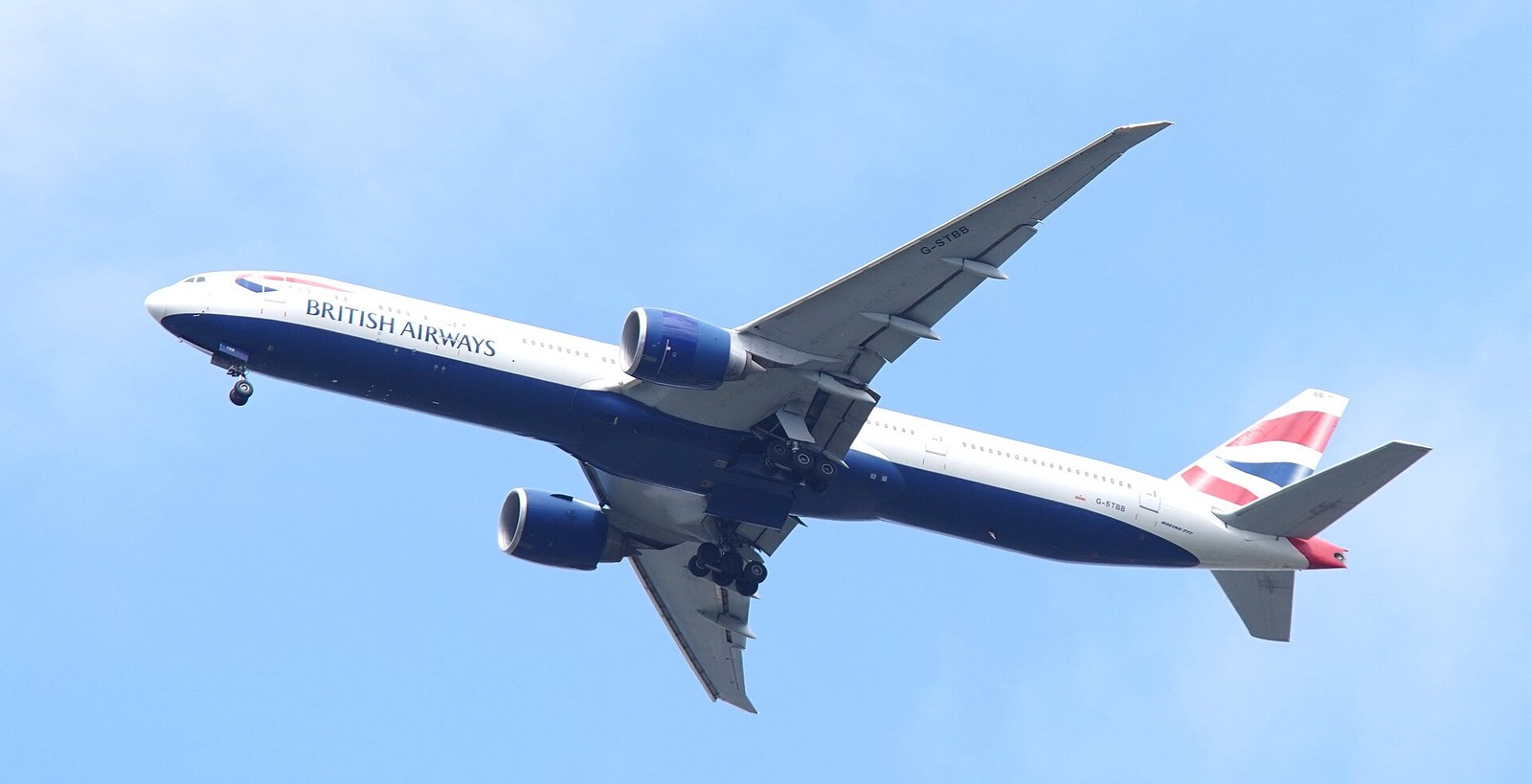
Most people miss the shot, and not because it is difficult. They turn up with the wrong lens. The aircraft is seventy metres long and ninety metres above your head, and by the time it is overhead you need something around 30mm to fit it in the frame. People arrive with a 600mm zoom and spend the afternoon photographing engine cowlings.
Heathrow is the busiest two-runway airport in the world and the easiest place in Britain to photograph airliners. It also has more bad advice written about it than anywhere else in the country. This is what actually works.
The layout, and the one thing to get right
Two parallel runways, both running almost exactly east to west.

The northern runway is 09L/27R. The southern runway is 09R/27L. Get that the wrong way round and every direction in every guide stops making sense, which is worth saying because at least two widely read guides do have it backwards.
The northern runway is 3,902 metres long, the southern 3,660. They sit about 1,415 metres apart. Both are aligned within a third of a degree of true east and west, which turns out to be the single most useful fact for a photographer, and we will come back to it.
The terminals sit between them. Terminal 5 is at the western end, Terminals 2 and 3 in the middle, Terminal 4 to the south.
Which way today
Aircraft take off and land into wind, and in Britain the wind is usually from the southwest. At Heathrow there is also a standing policy preference for departing to the west, over the reservoirs rather than over London.
Over the long run that works out at roughly seventy per cent westerly and thirty per cent easterly, which is the split Heathrow itself publishes. Individual years wander a long way either side of it, so treat seventy thirty as the planning figure and check the day.
On westerlies, aircraft arrive from the east over London and depart to the west over Windsor. On easterlies it all reverses.
The three o’clock switch
This is the Heathrow fact that changes a day out, and hardly any guide explains it properly.
During westerly operations the two runways alternate. One takes the arrivals and the other takes the departures, and at three o’clock in the afternoon, every day, they swap. The runway that has been landing aircraft all morning starts launching them, and the other one starts taking the arrivals.
Then the following week the whole pattern inverts, so the morning configuration becomes the afternoon configuration.
Alternation runs from six in the morning until the last departure. There is one exception worth knowing: between six and seven, the busiest arrival hour of the day, both runways can be used for landings.
What this means in practice is that a spot which is perfect at two o’clock can be pointing at an empty runway at ten past three. If you have driven two hours to stand at the threshold of a particular runway, know which half of the day you are in.
How to find out before you go
Heathrow publishes an annual alternation programme as a document on its noise pages, which gives the week by week pattern. Download it before you travel.
On the day, the station’s own runway channel on X posts the operational picture, and Flightradar24 will tell you which way things are landing in about ten seconds.
One thing to avoid: Heathrow’s own noise tool, xPlane, gets recommended for this and does not answer the question. It will tell you which runway an aircraft used, but the data runs three days behind, so it can tell you about last Tuesday and nothing about this morning.
Easterlies, and a 1952 agreement that still shapes the airport
On easterlies the pattern is different, and simpler, and worse.
There is no alternation. Aircraft land on the northern runway and depart from the southern one, all day. The reason goes back to a verbal undertaking given by a minister in 1952 to spare the village of Cranford from easterly departures off the northern runway.
The government formally ended that undertaking in 2009. But the taxiway work needed to make northern easterly departures practical was never done, so in operational terms nothing changed. The agreement is dead on paper and alive on the ground.
That is now being fixed. A project to bring full alternation to easterly operations has been through planning, with the local council resolving to grant permission in December 2025, and is expected before the end of the decade. When it lands, easterly departures off the northern runway become routine and the east end opens up for shots that are close to impossible today.
One thing happening right now
The northern runway is being resurfaced, work that started in 2025 and is due to finish in October 2026. The southern one is already done.
The work is at night. The runway is closed from eleven in the evening until six in the morning, Sunday through Thursday, with single-runway operation from about half past ten. Daytime operations are largely unaffected, but the declared distances are reduced in the later phases and one runway entry and exit is closed, which changes where aircraft turn off after landing.
If you were planning a night session or an early dawn arrival watch, check the current position first.
Where to stand
Heathrow is written about more than any other airport in Britain, and the quality drops off a cliff after the first few entries. One spot is documented by a dozen independent first-hand sources. Most of the rest rest on one or two. Several that appear high in search results are a pub advertising itself.

These are the ones that hold up.
Myrtle Avenue, for 27L arrivals
TW14 9QU, at the closed western end of the street, in Hatton. The most famous aircraft photography location in the world, and it earns it.
You stand in a grass field under the approach to the southern runway, about a kilometre and a half short of the 27L threshold. On westerlies the arrivals come over you and touch down beyond. That is all you get: no taxiway, no apron, no departures. One thing, done perfectly.
Several guides say the aircraft pass at forty feet, and one says sixty. They do not. An instrument approach crosses the threshold at about fifty feet and climbs back at three degrees, so a kilometre and a half out an aircraft is around 290 feet up. That is a hundred metres of air, not twelve. It is still a low, close, wide-angle spot. It is not a forty foot one.
On easterlies Myrtle flips completely and gives you departures off 09R climbing over your head instead.
Getting there: Piccadilly line to Hatton Cross, then a kilometre on foot, call it fifteen minutes. This is the right way to do it, for reasons in the parking section below.
Northern and Eastern Perimeter Road, for 27R arrivals
The east end of the northern runway, and the best of the three positions is not one place but three.
The grassy patch at the Northern Perimeter Road roundabout puts you lower and closer than Myrtle Avenue on short final. The raised flowerbeds opposite the 27R threshold give you an unobstructed view of the threshold and a slice of the airfield behind it. Further round on the Eastern Perimeter Road, near the British Airways maintenance base, is long-lens work on the approach.
Late on a summer evening you can also shoot 27R line-ups through the fence from the Northern Perimeter Road.
The catch is parking. No source gives a confirmed legal arrangement and the neighbouring trading estate is private. Standing near a crash gate is the fastest way to be asked to move on at Heathrow. Walk from Hatton Cross around the maintenance base.
The Academy viewing stand, the official one
Newall Road, TW6 2RQ. Heathrow runs a free covered viewing stand with seating, and it is open to anyone, not just passengers.
It looks at the northern runway from the eastern end, so on westerlies you get 27R touching down and rolling out. On easterlies the northern runway takes the arrivals, so you get 09L landing towards you and rolling out past you. What you will not get is departures: easterly take-offs come off the southern runway. There is an aviation shop on site. Parking is available and charged.
This is worth knowing because one of the most prominent recent guides states that Heathrow has no dedicated public spectators’ terrace. It does. It is free, it is covered, and it has a roof over it when the weather is doing what Middlesex weather does.
Hatton Cross, elevated and free
The pedestrian bridge by the station crosses the Great South West Road and gives you height over the 27L approach and touchdown. Light poles get in the way of some frames. It costs a tube fare and nothing else.
The two hotels
The Renaissance on the Bath Road, TW6 2AQ, is one of the best known spotting hotels anywhere. It looks at the northern runway from the east end, it is open, it has been refurbished, and it sells rooms specifically on the runway view. Ask for a high floor: the lower ones are obstructed.
The Thistle at Longford, UB7 0EQ, covers the west end of the northern runway, and its terrace and bar have a reputation among photographers. Whether you need to be a guest to use the terrace depends which source you believe, so telephone first.
One honest warning about the Thistle, and it applies to the whole northern side: you are looking south at the runway, and that is the wrong way round for light in this country. More on that below.
Stanwell Moor and Horton Road, for the west end
The parkland alongside Stanwell Moor village covers 27L departures on westerlies. On easterlies it gives you 09R starting its take-off roll and climbing away from you eastward, with the arrivals passing distantly to the north on the other runway. There is a playground and it is a reasonable place to take a family.
Two things to know. First, this side of the airport is much thinner on independent documentation than the east, and the most visible guide to it is a pub’s own marketing which has the runways labelled backwards. Second, and this one is worth money, Stanwell Moor, Poyle and Colnbrook sit outside Greater London and therefore outside the ultra low emission zone. If your vehicle is not compliant, that is twelve pounds fifty a day saved.
What to skip
The old viewing terraces beside Terminal 2 were on the Queens Building, which came down from 2009, and public access had ended long before that. Guides still recommend them. Airport car parks will get you moved on and cost twenty pounds for two hours while they do it. The observation deck at Terminal 4 is real and good, but it is airside, so it is only useful if you are flying.
Poyle, Cranford and the Kings Arms at Stanwell Moor turn up in search results and are, as far as any first-hand account goes, undocumented as viewing locations.
The light, and why Heathrow is an afternoon airport
The runways run east to west within a third of a degree. That single fact decides almost everything about when to go.

On westerlies, most of the time, every aircraft is travelling from east to west. To photograph one head-on you look east. To have the light on the front of it, the sun has to be behind you, in the west. That means the afternoon.
Working the sun position against a camera pointing due east gives the table below. The strict column takes only the hours when the sun is at least ten degrees up and within sixty degrees of directly behind you, which is the standard for a properly front-lit aeroplane. The second column relaxes that to any sun in the western half of the sky, which is when the light starts being worth having if you accept a more raking angle.
| Month | Sun properly behind you | Sun anywhere in the west |
|---|---|---|
| January | 14:20–14:40 | 12:20–14:40 |
| February | 14:10–15:50 | 12:20–15:50 |
| March | 15:00–17:50 | 13:20–17:50 |
| April | 14:30–18:40 | 13:10–18:40 |
| May | 14:10–19:30 | 13:00–19:30 |
| June | 14:10–19:50 | 13:10–19:50 |
| July | 14:20–19:50 | 13:10–19:50 |
| August | 14:30–19:10 | 13:10–19:10 |
| September | 14:40–18:00 | 13:00–18:00 |
| October | 14:40–16:50 | 12:50–16:50 |
| November | 13:50–14:40 | 11:50–14:40 |
| December | Nothing | 12:00–14:00 |
Either way the answer is the same shape. Heathrow on westerlies is an afternoon airport. Nothing worth having before about midday, the good stuff from two, and in the depths of winter a couple of hours around lunchtime if you will take a low raking sun.
And there is a neat coincidence in it. The runway alternation switch happens at three. The light arrives at two. If you want the afternoon light on the arrival runway, you want to know which runway takes the arrivals after three, because that is the one that will have both.
Easterlies are the mirror image. Everything moves west to east, you look west, and the good light runs from early morning to about noon.
Which side of the airport to stand on
There is a second finding in the same geometry, and it explains why several popular positions disappoint.
If you want a side-on shot, you stand beside the runway and point across it. From the southern side you point north, and the sun needs to be in the south, which in Britain it is for most of the day. From the northern side you point south, and the sun needs to be in the north.
Britain sits at fifty-one and a half degrees north, and for most of the year the sun never gets into the northern half of the sky at all. Between April and August it does, but only early and late: on the June solstice it rises at about fifty degrees, well north of east, and sets as far north of west.
| Month | From the south side | From the north side |
|---|---|---|
| January | 09:40–14:40 | Nothing |
| April | 10:00–16:10 | Early morning and late evening only |
| July | 10:40–15:40 | Before about eight and after about six |
| October | 09:00–16:40 | Nothing |
| December | 09:50–14:00 | Nothing |
The southern side gives you a solid block in the middle of every day, all year. The northern side gives you nothing at all from September to March, and in high summer only the first and last hours of daylight, when the sun has swung round far enough north to get behind you.
That is why the Bath Road hotels have a reputation for backlit photographs, and why the fair thing to say about the Thistle terrace is that it is a wonderful place to watch aeroplanes and a difficult place to photograph them, unless you are there at six in the morning in June. It also explains why the end positions matter so much here: at the ends of a runway you shoot along it rather than across it, and the whole north and south problem disappears.
How much lens, and why it is less than you think
This is where Heathrow surprises people.

The aircraft are enormous and the good spots are close, so the numbers come out small. On a full-frame body, filling about two-thirds of the frame:
| Range | Widebody, 73 m | Narrowbody, 38 m |
|---|---|---|
| 150 m | 50mm | 95mm |
| 200 m | 65mm | 125mm |
| 300 m | 100mm | 190mm |
| 400 m | 130mm | 250mm |
| 600 m | 195mm | 375mm |
| 800 m | 260mm | 500mm |
At Myrtle Avenue, with a widebody ninety metres straight up, that comes out at about 30mm. A hundred and fifty metres out, just before or after the pass, it is 50mm. Picking it up further down the approach wants 100 to 200mm. A narrowbody is roughly double throughout, because it is roughly half the length.
So the sensible kit for the threshold spots is something wide and a 70–200, not a supertelephoto. A 16–35 is not a silly suggestion for the overhead pass. Bring the long lens for the perimeter road positions and the hotels, where you are working at six or eight hundred metres.
It is worth seeing the same sum done at a different airport. At San Diego, where the positions sit beside the approach rather than under it, the median across thirty frames came out at 254mm and nothing needed 400.
Heathrow is not unusual in this. The same arithmetic holds at any airport with close positions: at Palm Springs, where the fence is the vantage point, half of everything came in under 200mm.
The camera settings themselves are covered properly in our guide to photographing airliners, which goes into shutter speeds, panning and what to do about the fifteen seconds in which an approaching aircraft goes from a speck to overhead. Picture editors working to a deadline rather than a forecast can go straight to the Piemags aviation photography archive, where the licensing terms are published alongside the pictures.
Heat haze, and the reason the close spots win in August
On a hot day, air rising off tarmac and concrete bends the light before it reaches your sensor, and the result is a photograph that looks soft no matter what you do to it afterwards. It cannot be fixed in editing.
The only real defences are to shoot when the ground is cooler, to get closer, and to avoid pointing across long stretches of hot concrete.
That is exactly why the threshold positions outperform in summer. At Myrtle Avenue or the perimeter road the aircraft comes to within a couple of hundred metres, so there is barely any hot air in the light path. A long-lens shot across the airfield from a hotel window in August is the worst case there is.
Parking, and the advice every guide still gets wrong
Nearly every Heathrow guide tells you there is free street parking at the end of Myrtle Avenue. That advice is at least two years out of date and it may cost you a penalty notice.
In the first five weeks of 2024 alone, enforcement officers visited Myrtle Avenue more than thirty-eight times and issued eight penalty notices. Residents were being blocked into their own driveways. Hounslow Council agreed to convert the single yellow lines at the end of the avenue to double yellows.
Whether that paint is down yet is not something any published source will tell you. Assume it is.
The airport’s own car parks are not an answer. Terminal parking is eight pounds for under half an hour and twenty pounds for two hours, and airport security will move you on regardless. There is a seven pound charge simply for driving onto a terminal forecourt. All the terminals sit inside the ultra low emission zone, which is twelve pounds fifty a day for a non-compliant vehicle, though that is for driving in the zone rather than parking in it.
Toilets and food, mapped properly
There are none at Myrtle Avenue and none on the perimeter roads. This catches people out on a long afternoon.
The answer is the Green Man on Green Man Lane in Hatton, which has a garden, toilets, food and aircraft passing directly overhead on the approach. There is a filling station near Hatton Cross for something quicker.
The Academy viewing stand has an aviation shop. At the western end, the Anchor on Horton Road has free parking for customers, toilets and a full menu, and sits outside the emission zone. Treat its runway advice with caution and its beer with enthusiasm.
What you will see in 2026
The A380 is still the reason most people come, and Heathrow sees more of them than anywhere outside Dubai. Six operators bring them in: British Airways, Emirates, Qatar, Etihad, Qantas and Singapore. British Airways is much the largest, running around five A380 departures a day of its own through the winter.

Qatar has doubled up this year, going twice daily from July through to the middle of January before dropping back. British Airways takes its A380 off Los Angeles from the end of October and puts a 777 on instead.
The 747 is finished as a passenger aircraft here, and you have missed it. The last scheduled 747 passenger service anywhere in the United Kingdom was Korean Air’s, on Seoul to Heathrow, and it ended in October 2025. Korean had planned to bring the 747-8 back for three rotations a week in the summer of 2026 and then shelved that in favour of the 777. Freighters still come. Passenger Queens do not.
New this year: Alaska Airlines from Seattle with the 787, Pakistan International back after being taken off the safety list, and XiamenAir three times a week from Xiamen. ITA has resumed Rome, which is a return rather than a debut.
Getting on with people
Heathrow is unusual in that the airport itself is welcoming about photography. It runs the free viewing stand, it publishes tips, and Myrtle Avenue is the one off-airport location the airport names in its own guidance.
The police view is more prosaic and worth understanding. Airport authorities do not treat photographing aircraft as a reason to be at an airport. That is not a threat, it is the background against which every “we were moved on” story happens. It means that where you stand matters more than what you are doing.
In practice: the established spots are fine and people are there every day. The forecourts and car parks will get you asked to move. The crash gates will get you asked immediately.
Beyond that it is the same list as anywhere. Park so people can get out of their driveways. Take your rubbish home. Answer politely if somebody asks what you are doing. The residents of one short street in Hatton have put up with this for decades, and the ones who complain are not complaining about photography.
The third runway
It has been argued about for twenty years and it is worth being precise about where it actually stands.
The scheme in front of government would put a third runway to the northwest of the existing pair. It is not built, not consented, and not funded. What exists is a proposal working through a planning process.
For a photographer the relevant point is that several of the positions in this guide, including the Renaissance and the villages at the western end, sit inside the area a third runway would take. That is a question for the 2030s rather than for your next trip, but it is a reason not to keep putting the trip off.
The nearer change is the easterly alternation work, expected before the end of the decade, which will open the east end of the northern runway to departures on easterly days. It also brings a noise barrier five to seven metres high near Longford, which may take some of the western sightlines with it.
A day that works
Put the pieces together and the shape of a good Heathrow day is obvious.

Check which way they are landing and which runway has the arrivals after three. Take the Piccadilly line to Hatton Cross. Walk to Myrtle Avenue or the perimeter road depending on which runway is taking the arrivals. Arrive by lunchtime and expect the light to get good from two. Bring something wide and a 70–200 for the threshold, and a long lens only if you plan to work the perimeter road.
Shoot until the sun goes, which in June is nearly eight in the evening and in November is half past two.
Then walk to the Green Man.
Questions people ask
Where is the best place to plane spot at Heathrow?
Myrtle Avenue, at the closed western end of the street in Hatton, postcode TW14 9QU. It sits under the approach to the southern runway and on westerly operations the arrivals pass a couple of hundred feet overhead before touching down about a mile further on. It is documented by more independent first-hand sources than every other Heathrow spot combined. Take the Piccadilly line to Hatton Cross and walk, because the parking situation has changed.
What lens do I need for plane spotting at Heathrow?
Far less than most people bring. At Myrtle Avenue a widebody ninety metres straight up is about a 30mm subject on a full-frame body, and 50mm just before or after the pass. Picking it up further down the approach wants 100 to 200mm. Something wide and a 70-200 will cover the threshold spots completely. Save the long lens for the perimeter road positions and the hotels, where you are working at six to eight hundred metres and want 300 to 500mm.
What time of day is best for photographing at Heathrow?
The afternoon, and not before about two o’clock. Heathrow’s runways run east to west, and on westerly operations, which is roughly seventy per cent of the time, every aircraft moves east to west. To shoot one head-on you look east, which means you need the sun in the west. Nothing is worth having before about midday in any month, and the sun is properly behind you from about two. On easterlies the pattern reverses and the good light runs from early morning to noon.
Which runway does Heathrow use and when does it change?
The northern runway is 09L/27R and the southern is 09R/27L. On westerly operations the two alternate: one takes arrivals and the other departures, and they swap at three o’clock every afternoon. The following week the whole pattern inverts. On easterlies there is no alternation at all, and aircraft land on the northern runway and depart from the southern one.
How high are the aircraft over Myrtle Avenue?
Higher than the guides claim. Several say forty feet and one says sixty. Myrtle Avenue is about a kilometre and a half short of the 27L threshold, and an instrument approach crosses the threshold at around fifty feet and climbs back at three degrees, which puts an aircraft over the field at roughly 290 feet. Close enough to fill a wide-angle frame. Not forty feet.
Can you park at Myrtle Avenue?
Do not count on it. In the first five weeks of 2024 enforcement officers visited more than thirty-eight times and issued eight penalty notices, and Hounslow Council agreed to convert the single yellow lines at the end of the avenue to double yellows. Every guide still says free street parking. Take the Piccadilly line to Hatton Cross instead.
Is there an official viewing area at Heathrow?
Yes, and it is free. Heathrow runs a covered viewing stand with seating on Newall Road, TW6 2RQ, open to anyone rather than just passengers. It overlooks the northern runway from the eastern end and there is an aviation shop on site. Parking is available and charged. One prominent recent guide states that Heathrow has no public spectators’ terrace, which is wrong.
Can you still see a Boeing 747 at Heathrow?
Not as a passenger aircraft. The last scheduled 747 passenger service anywhere in the United Kingdom was Korean Air’s Seoul to Heathrow, which ended in October 2025. Korean had planned to bring the 747-8 back for three rotations a week in summer 2026 and shelved it in favour of the 777. Freighters still operate.
Which airlines fly the A380 into Heathrow?
Six: British Airways, Emirates, Qatar Airways, Etihad, Qantas and Singapore Airlines. Heathrow sees more A380 movements than any airport outside Dubai, with British Airways alone running about five departures a day through the winter. Qatar doubled to twice daily from July 2026 until mid-January. British Airways drops the A380 from Los Angeles at the end of October 2026.
Do the Heathrow hotels work for photography?
The Renaissance on the Bath Road does, from a high floor, looking at the northern runway from the east end. The Thistle at Longford covers the west end and is a fine place to watch from, but it faces the wrong way for light: it sits north of the runway looking south, and the sun is only ever behind you there in the first and last hours of a summer day. From September to March the north side gives you nothing for side-on work. The southern side works all year.
How do I find out which runway Heathrow is using today?
Heathrow publishes an annual alternation programme on its noise pages that gives the week by week pattern, and its own runway channel on X posts the operational picture. Flightradar24 will settle it in seconds on the day. Do not use Heathrow’s xPlane tool for this: it will tell you which runway an aircraft used, but the data runs three days behind, so it describes an aircraft that landed three days ago rather than the one on the approach now.
Is heat haze a problem at Heathrow in summer?
Yes, and it cannot be fixed in editing. Warm air rising off concrete bends the light before it reaches the sensor. The defence is to get closer and to avoid shooting across long stretches of hot tarmac, which is exactly why the threshold spots like Myrtle Avenue and the perimeter road outperform in August while long-lens shots from hotel windows are the worst affected.
Sources and further reading
- UK Aeronautical Information Publication, London Heathrow (EGLL), aerodrome data. nats.co.uk
- Heathrow Airport, runway alternation and the annual alternation programme. heathrow.com
- Heathrow Airport, easterly alternation and the Cranford Agreement. heathrow.com
- Heathrow Airport, operational data on wind direction and runway use. heathrow.com
- Heathrow Airport, spectator areas and the Academy viewing stand. heathrow.com
- Heathrow Airport, tips for photographing and spotting. heathrow.com
- UK AIP Supplement 047/2026, northern runway resurfacing. nats-uk.ead-it.com
- Heathrow Airport, terminal parking tariffs effective 6 January 2026. heathrow.com
- Heathrow Airport, the ultra low emission zone and which parts of the airport sit inside it. heathrow.com
- Metropolitan Police, Heathrow Airport Watch. met.police.uk
- Heathrow Airport, expansion proposal and the third runway. heathrow.com
- NYCAviation, London Heathrow spotting guide, the most carefully structured of the existing guides. nycaviation.com
