The first jet flight was made by an aeroplane that carried nothing, went nowhere, and could not raise its own undercarriage. The Heinkel He 178 flew a circuit of a company airfield in Mecklenburg on 27 August 1939, five days before the German invasion of Poland, and it settled a question nobody had settled before, which was whether a gas turbine could carry a man into the air.
What is on this page
- The first jet flight, five days before the war
- A wooden wing and a hole in the nose
- The student who wanted a fire that never went out
- A letter to Ernst Heinkel
- The engine that ran on hydrogen
- Getting it to burn petrol
- Slung underneath a bomber
- Built in under a year
- Erich Warsitz, the man in the seat
- 27 August 1939
- What the flight actually amounted to
- The second machine
- The demonstration nobody was impressed by
- Frank Whittle, and an engine with no aeroplane
- Did von Ohain know about Whittle?
- Who was first at what
- The other claimants
- Why Germany did not build on the He 178
- The He 280, and why it lost
- The engines that reached the war
- Where it went, and how it ended
- What became of the men
- What survives, and what does not
- Two engines rebuilt from memory
- Questions people ask
The first jet flight, five days before the war
On the morning of 27 August 1939, on Heinkel’s works airfield at Rostock-Marienehe, Erich Warsitz sat in a small aeroplane with a hole in its nose and no propeller anywhere on it. He opened it up, held it straight, and lifted off. That was the first jet flight, and the aeroplane was the Heinkel He 178. It flew five days before the German invasion of Poland.
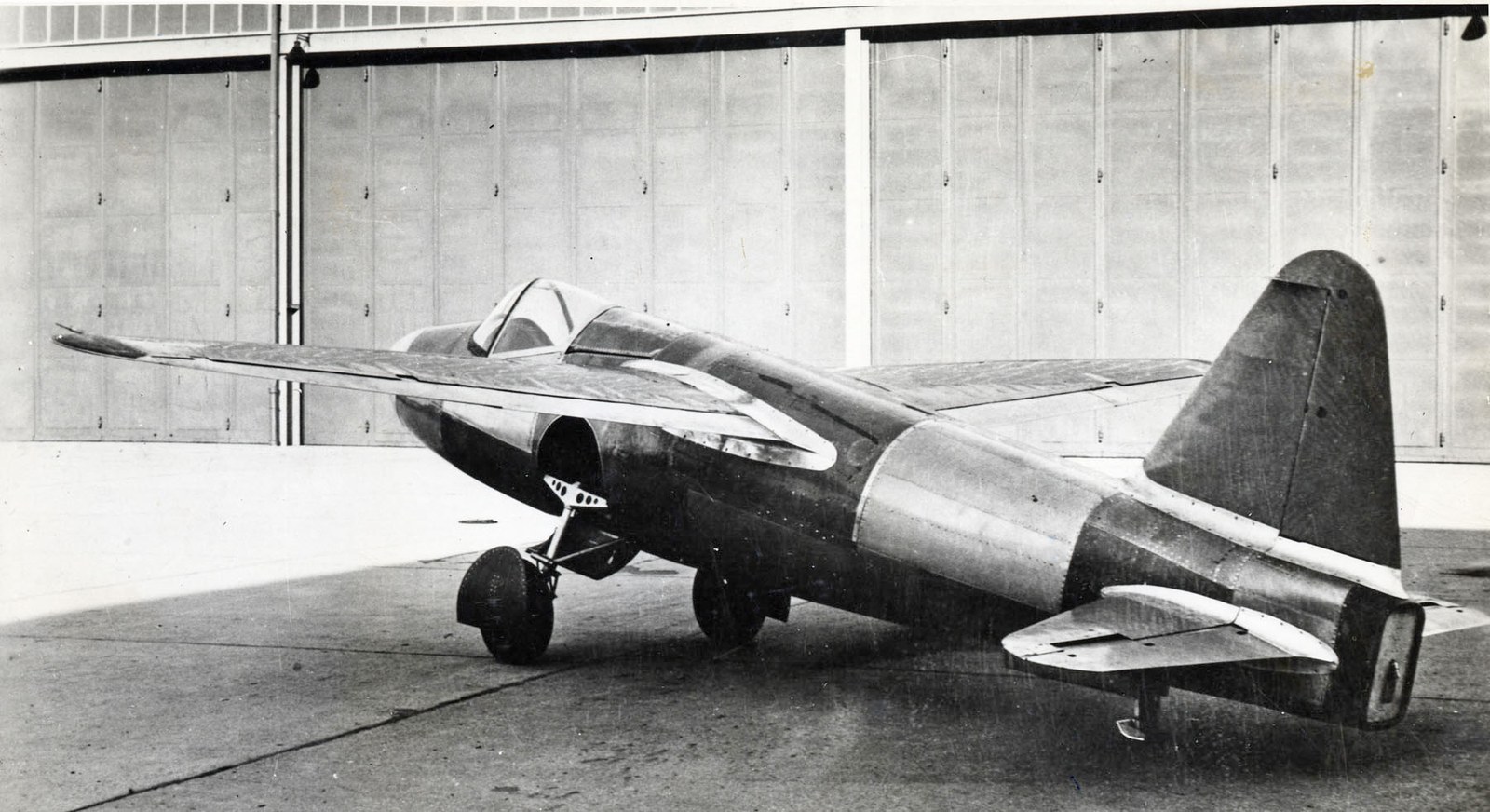
Nothing about the machine looked like a milestone. It was a single-seat research aeroplane with a wooden wing and no armament, and its undercarriage stayed down throughout because Warsitz could not get it to come up. He circled Marienehe airfield and came back in. Germany did not announce what had happened, and Allied investigators were still piecing it together from Heinkel’s own paperwork in May 1945.
The principle is simple. Air went in at the nose, was compressed, was mixed with petrol and burned, drove a turbine, and left through a pipe at the tail, and the reaction on the aeroplane was thrust. Until the morning of 27 August 1939 no such engine had lifted a pilot off the ground. What follows is the story of the 40 months in which a handful of people at Rostock built one that could.
A wooden wing and a hole in the nose
The He 178 was tiny. It spanned 7.20 m (23 ft 7½ in), measured 7.48 m from nose to tail and stood 2.10 m high, with a wing area of 9.1 m². Empty it weighed 1,620 kg, and loaded it came to 1,998 kg. It was a shoulder-wing monoplane, the wing set high on a fuselage of duralumin sheet built as a monocoque shell. The wings were largely of wood, with a layer of asbestos over the timber where it lay near the engine’s heat.

The planform was equi-taper, with moderate dihedral and large trailing-edge flaps inboard. A large opening in the nose took in air, which travelled aft along a duct that curved beneath the pilot’s seat and then rose to the engine, mounted in the fuselage behind him. Behind that, the tailpipe ran back to a conical nozzle, and it took up roughly one third of the aeroplane’s total length.
A single petrol tank sat immediately behind the cockpit, and the undercarriage was a conventional retracting tailwheel arrangement that folded into the fuselage. The He 178 carried nothing at all: no armament, no equipment, no load of any kind. It existed to get a turbojet into the air with a man in front of it, and it had no second purpose.
The student who wanted a fire that never went out
Hans Joachim Pabst von Ohain was born on 14 December 1911. He took his doctorate in Physics and Allied Mechanics at the Georg-August-Universität in Göttingen in 1935. He had conceived his engine in the autumn of 1933, while still a student. He wanted an engine that burned continuously, which he believed would be smoother, lighter and better suited to an aeroplane than the four-stroke cycle.
His first thought was to do it with no moving machinery, by bringing incoming fresh air into direct contact with expanding combustion gas. That is a ramjet. He came to see that compression and expansion had to be separated, and set himself three rules: the greatest possible simplicity, low development risk, and a power-to-weight ratio far better than a piston aero-engine. From those came the simplest rig he could imagine, a radial compressor with a radial turbine of about the same diameter matched to it and the combustion in between.
He filed his patent on 10 November 1935. During the application his own patent lawyer handed him a copy of Frank Whittle’s British patent, filed on 16 January 1930 and published on 16 April 1931, and he narrowed his claims to avoid it. What he did not yet have was combustion. Building a chamber that would burn petrol properly was the difficult part, and it stayed difficult for years.
A letter to Ernst Heinkel
The demonstration model was built in a car workshop, the Autowerkstatt Bartels and Becker in Göttingen, by a motor mechanic named Max Hahn, and von Ohain paid for it himself. The apparatus and the patent application together cost him 6,000 Reichsmark, and Hahn’s suggestions for simplifying it kept the bill within reach. Professor Robert Wichard Pohl, who ran the Göttingen physics institute, let him use its equipment for the first runs, and that is where the combustion trouble showed itself.
Pohl wrote to Ernst Heinkel on 3 March 1936. Heinkel replied on 12 March, and on 17 March von Ohain put his ideas to him at Warnemünde. On 18 March he was shown into a room containing Siegfried and Walter Günter of the project office, the chief designer Schwärzler, the aerodynamicist Helmbold and Dr Matthaes of the experimental department. Their first substantive criticism was that the apparatus needed adapting to what aeroplane builders required, and specifically that its diameter was too big. That objection, on day one, was the whole story of the centrifugal turbojet.
Discussions continued at Rostock, and on 2 April 1936 Max Hahn was given a provisional appointment. Von Ohain began work from the middle of April 1936, aged 24. He had chosen Heinkel deliberately, knowing the firm’s appetite for anything new and for fast aeroplanes, having spent a semester at the physics institute of Rostock University, and reasoning, correctly, that the established engine makers would be cool. Heinkel carried the whole financial and technical risk from his own company’s funds. The air ministry knew what he was doing, and helped where it had to, over materials and foreign patents. The money was Heinkel’s and so was the risk.
The engine that ran on hydrogen
Petrol was the hard part, so von Ohain left it out. A combustion chamber for petrol was difficult, and he decided to demonstrate that the compressor and turbine combination worked at all. He used gaseous hydrogen as the fuel, because its diffusion and combustion speeds are higher by orders of magnitude. The demonstrator was built between the summer of 1936 and the spring of 1937. Inside the works it was the F 2; the literature later called it the HeS 1.
It ran at Rostock at the end of February or the beginning of March 1937. What it proved was that the cycle closed: air compressed by a radial impeller, heat added, gas expanded through a radial turbine that drove the compressor, and thrust out of the back. It proved that to Ernst Heinkel, which was the point of it. On 1 June 1937 von Ohain went onto a permanent salary of RM 500 a month gross, and Heinkel took over his patent the same day.
What it did not prove was anything about an aeroplane. It burned a fuel no aeroplane of 1937 could carry in useful quantity, and it was a rig on a bench rather than a flight engine. In Britain, and independently, Frank Whittle’s Power Jets WU ran for the first time on 12 April 1937, on liquid fuel.
Getting it to burn petrol
Heinkel specified what he wanted next: a flight engine of 300 kg giving 800 kp of thrust. Von Ohain’s answer, set down on 21 May 1937 and called Projekt 2, was drawn for 900 to 1,000 kp at about 250 kg and 13,000 rpm. On 4 May 1938 the whole jet department, Sonderentwicklung II, numbered 23 people. Hahn had manufacturing and combustion trials, with one engineer and 15 workers under him, and the liquid-fuel combustion chamber rested on a patent of his own.

The engine that flew was drawn next, the earliest known general-arrangement drawing being dated 9 June 1938. In May 1938 the plan was 500 kp of thrust at 330 kg, complete by the middle of September, and it was ready for bench testing from March 1939. As built it gave 500 kp of take-off thrust, or 4.90 kN. It weighed 360 kg, measured 930 mm across at its widest and about 1,650 mm long, with a jet 410 mm in diameter.
It burned petrol, but not as anyone had intended. The injection system was not yet working properly, so the fuel was vaporised before it reached the flame rather than atomised into it. No accessory drive was fitted, and an external electric drive was used instead. That was the engine that went into the aeroplane.
A note on the name. This engine is universally called the HeS 3B, and this article calls it that so the reader can follow it. Inside the works in 1939 it was the F 3 b. The He S prefix arrived in August 1939, from the F 8 onward, and was applied to the earlier engines afterwards.
Slung underneath a bomber
An engine on a bench and an engine in the air are not the same object, and Heinkel had aeroplanes to hand. Heinkel’s own documents record an He 118 flying at Marienehe with the engine von Ohain had developed for the firm, and the accounts that followed describe the jet slung beneath the aeroplane.
The engine made many flights that way. It went on until the turbine burned out, and by that point an improved engine was ready to take its place. That is the whole of what the testbed proved and the whole of what it cost.
The record around it is untidy. A Heinkel memorandum shows an He 118 with the Ohain unit standing ready at the works for further tests in early November 1939, by which time Warsitz had already flown the He 178. A later engine, the HeS 6, was flight-tested slung under an He 111, and the two testbeds are easily confused.
Built in under a year
The design of the He 178 was complete on 9 July 1938, and the mock-up was inspected at the end of August 1938. Through August and September 1938 it was settled that the airframe would go to Sonderentwicklung I, Heinkel’s special-development shop, working under the technical direction of Heinrich Hertel. Hertel signed the memoranda of 22 September 1938 that set the construction going. No one man is on record as the designer of the aeroplane.
From there it came together fast. Under a year separates Hertel’s memoranda from the aeroplane standing at Marienehe with an engine in it. On 27 August 1939 Warsitz flew it, and made circuits of the airfield, with the undercarriage refusing to retract however often he tried.
One figure is worth holding onto. From von Ohain starting work at Heinkel to Warsitz lifting off took 40 months. A second airframe, the He 178 V2, was under construction when war broke out. It was never entirely finished, and it was eventually scrapped.
Erich Warsitz, the man in the seat
Erich Karl Warsitz was born on 18 October 1906 and died on 12 July 1983. He was a Luftwaffe pilot attached to the Air Ministry and lent to Ernst Heinkel, which is how a serving officer came to do the most dangerous flying in German industry. Heinkel’s works knew him as Flugkapitän Warsitz, and by the summer of 1939 he had already spent months strapped into a machine that most pilots would have declined.

That machine was the He 176, Heinkel’s rocket aeroplane, driven by a Walter motor that burned eighty-two per cent hydrogen peroxide for something like fifty seconds at a time. Warsitz hopped it along the ground from 8 January 1939, and by 14 April he had made twenty-nine straight-line hops. On 25 May 1939 he performed one of those hops in front of Ernst Heinkel, Erhard Milch, Ernst Udet and other representatives of the Reich Air Ministry. On 15 June 1939 he took it round the airfield for a first full circuit. On 3 July 1939 the aeroplane was shown at Rechlin-Roggentin to Hitler and his generals. Nineteen of Warsitz’s flights in the He 176 are documented, between 12 June and 8 November 1939.
So the man who would climb into the He 178 at the end of August was not being asked to do anything unfamiliar. He was the pilot who took Heinkel’s experimental oddities into the air and brought them back, and he had been doing it all year on a fuel that could set light to a man’s overalls. He became the world’s first jet pilot, and the only man to have flown both the first aeroplane built to fly on rocket power alone and the first to fly on turbojet power alone.
27 August 1939
What was known beforehand was mostly negative. The engine had been ready for bench testing since March 1939, its fuel injection system was not working, and no accessory drive had been fitted to the unit that was to fly. Nobody had established a performance envelope for the aeroplane, because nobody had flown it. What Warsitz was being asked to find out was whether the thing would fly at all.
On the morning of 27 August 1939, at Heinkel’s own works airfield at Rostock-Marienehe on the Warnow, he flew it. His account of the take-off, published long afterwards by his son, is almost entirely about the aeroplane’s manners: “She was wonderfully easy to hold straight, and then she lifted off. Despite several attempts, I could not retract the undercarriage. It was not important, all that mattered was that she flew.”
The wheels stayed down for the whole flight. Warsitz circled Marienehe and brought the machine back in, and of the landing he said only that he restored her to the correct attitude just before touching down and made a wonderful landing. One further thing belongs in the record as something Warsitz reported, that a bird went into the intake and stopped the engine, and that he brought the aeroplane down without power. It was five days before the German invasion of Poland.
What the flight actually amounted to
Judged as an aeroplane, the He 178 was nothing. It carried no armament and no equipment of any kind, its undercarriage would not come up, and no performance envelope was ever established for it. It went round a works airfield, on wheels, and landed on the same grass it had left.
Judged as an experiment, it settled something. Until that morning the turbojet was a proposition on a test bed; afterwards it was a thing that had carried a man. The He 178 made the world’s first flight of a turbojet-powered aircraft, and it was the first aircraft to fly under turbojet power alone, with no piston engine anywhere in it and no rocket. The HeS 3B became the first turbojet engine to fly an aeroplane. The whole business, from von Ohain starting work at Heinkel to Warsitz lifting off, took 40 months, and the department that did it numbered 23 people in May 1938. Von Ohain, looking back nearly fifty years later, put the early success of jet engines down to the simplicity of the radial layout rather than to any superior grasp of aerothermodynamics. He added that such an engine had inherently a favourable thrust to weight ratio, which is a necessary condition for high-speed flight.
It is worth remembering how little of this was obvious even to the people entitled to know. When four Allied investigators sat down in May 1945 with some three hundred pounds of Heinkel’s paperwork, they wrote that documents stated Heinkel had first flown a turbo-jet propelled aircraft on 27 August 1939, and added: “It is not known whether or not this was the first turbo-jet propelled aircraft to fly within Germany.”
A short hop round a company airfield in a machine with no useful performance, flown by a pilot who could not raise the wheels, and the argument about whether a gas turbine could fly an aeroplane was over.
The second machine
A second He 178 was laid down, and it differed in the wing, which was built to a straight-taper planform. It was never brought to completion after the outbreak of war, and it was eventually scrapped. It never flew.
There is an oddity attached to it that has quietly shaped how the world pictures this aeroplane. The only known images of the machine that made the flight are frames from a 16 mm cine film shot during the take-off. The clear, sunlit, three-quarter photographs that appear under the caption “He 178” in book after book are probably of the V2, the one that stayed on the ground. The aeroplane most people have in their heads is the one that never left it.
The flight did change Heinkel’s position, if not the aeroplane’s fate. Until 27 August 1939 Heinkel had carried the whole financial and technical risk from his own company’s funds. After the flight the Reich Air Ministry paid for both machines.
The demonstration nobody was impressed by
At the beginning of November 1939, with the Polish campaign over, the He 178 was flown at Marienehe for a party of officials. Ernst Udet came, as Generalluftzeugmeister and head of aircraft procurement and supply, and Erhard Milch, State Secretary in the Air Ministry and Inspector-General of the Luftwaffe.
They watched an aeroplane whose undercarriage still refused to retract. The reception was cool. They were not impressed by what they saw, and nothing followed from the demonstration.
The engine came out of the airframe afterwards and went back to work, tested further on the bench and slung beneath an He 111. That was the end of the He 178 as a flying machine. Why the men who had just watched the future go past them at low level went home unmoved is the most interesting question in the whole story, and the answer is not the one usually given.
Frank Whittle, and an engine with no aeroplane
Frank Whittle was an RAF officer and ex-apprentice who had gone through Cranwell as a flight cadet. On 16 January 1930, aged 22, he filed British patent GB347206, “Improvements relating to the propulsion of aircraft and other vehicles”. It was published on 16 April 1931, which made it public reading anywhere in the world. The Air Ministry’s view had been set by A. A. Griffith, who judged the idea impracticable in late 1929. The materials of the day would not take the temperatures, Whittle’s fuel consumption looked ruinous, and Griffith had a scheme of his own in mind.

In January 1935 the five pound renewal fee on GB347206 fell due. The Air Ministry declined to pay it, Whittle was a serving officer and could not pay it himself, and Britain’s foundational turbojet patent lapsed.
He went on privately. On 27 January 1936 Whittle, two former RAF officers and a City banking house signed a Four Party Agreement, and Power Jets Ltd was incorporated in March 1936 with Whittle as honorary chief engineer and no government money behind it. The WU bench engine first ran on 12 April 1937 at the British Thomson-Houston works at Rugby, raced out of control on pooled fuel, and was rebuilt more than once. On 30 June 1939 the Air Ministry agreed to fund development.
So on 27 August 1939 Whittle had a turbojet that ran on a test bed and a ministry that had just begun paying for it. He had no aeroplane. Specification E.28/39 was issued in September 1939, and the contract for two Gloster prototypes was signed on 3 February 1940.
Did von Ohain know about Whittle?
He did, and the sequence matters more than the fact. Von Ohain conceived his engine in the autumn of 1933, as a physics student at Göttingen, and the mechanic Max Hahn built him a demonstration model in a Göttingen car workshop. He filed his own patent application on 10 November 1935. While that application was being prepared, and before he had built an engine at Heinkel, his patent lawyer handed him a copy of Whittle’s.

Whittle’s specification had been public since 16 April 1931, so there was nothing improper in the reading, and von Ohain was not much impressed by what he found. He thought the flow reversal in Whittle’s layout wrong, and concluded that the British were not working seriously on the idea. The practical consequence was that he had to narrow the claims in his own application so that they did not run into Whittle’s.
That is the whole of it. Von Ohain arrived at the turbojet independently of Frank Whittle, whose 1930 patent he did not see until after his own design was made, and he then read that patent before a single Heinkel engine was cut. Whittle knew nothing of von Ohain until long afterwards. Both men accepted the other’s independence once the war was over.
Who was first at what
Almost every argument about this subject is an argument about scope. The word “jet” is doing too much work: it sweeps in rocket aircraft, motorjets and ducted fans, and it lets several countries claim the same afternoon. Say turbojet, name the year, and the picture goes tidy.
| Claim | Holder |
|---|---|
| The first patent for a turbojet | Maxime Guillaume, French patent 534,801, filed 3 May 1921. Nobody built it; the compressors of 1921 were nowhere near good enough. |
| The first turbojet patent that anyone subsequently built | Frank Whittle, GB347206, filed 16 January 1930. |
| The engines on the test beds in 1937 | Von Ohain’s hydrogen-burning demonstrator ran at Rostock at the end of February or the beginning of March 1937, and was not a flight engine. Whittle’s Power Jets WU ran at Rugby on 12 April 1937, on liquid fuel. |
| The first turbojet engine to fly an aeroplane | Heinkel’s F 3 b, known afterwards as the HeS 3B. |
| The first aircraft to fly under turbojet power alone | The Heinkel He 178, on 27 August 1939, from the works airfield at Rostock-Marienehe. |
| The world’s first jet pilot | Flugkapitän Erich Karl Warsitz, the only man to have flown both the first aeroplane built to fly on rocket power alone and the first to fly on turbojet power alone. |
| The first Allied jet aircraft | The Gloster E.28/39, first flown 15 May 1941. |
The He 178 made the world’s first flight of a turbojet-powered aircraft. The patent everyone eventually built from was Whittle’s. Neither man took anything from the other.
The other claimants
The Caproni Campini N.1 flew from Caproni’s Taliedo airfield near Milan in August 1940, with Mario de Bernardi at the controls, and it is the claimant that comes closest. It is also a different machine. The N.1 was a motorjet: a 900 hp Isotta Fraschini piston engine buried in the fuselage drove a three-stage variable-incidence compressor, fuel was burned in the duct behind it, and the gas left as a jet worth roughly 1,600 lbf. There was no gas turbine anywhere in it, and the exhaust did no work at all on the compressor. It was heavy, underpowered and slower than good piston fighters. Italy publicised the Campini, and Germany had said nothing whatever about Rostock.

The other name that comes up is Henri Coandă, who exhibited an unconventional aeroplane at the Second International Aeronautical Salon in Paris in the autumn of 1910, with a ducted propulsive unit at the nose driven by a piston engine. From the 1950s onwards he said that in December 1910, at Issy-les-Moulineaux, the machine had burned fuel in its airstream and carried him briefly into the air. That claim is disputed. No contemporary record of a flight, an attempt or a crash exists, and his patents of 1910 and 1911 say nothing about burning fuel in the airstream. On any reading it is not a turbojet claim.
Why Germany did not build on the He 178
The comfortable version of what happened next says that Germany failed to see what it had. It is wrong. By 27 August 1939 the Reich Air Ministry already had a turbojet programme, and it was not Heinkel’s.
Helmut Schelp had joined the ministry’s T-Amt technical division in August 1937. The 1938 reorganisation put him in LC8 alongside Hans Mauch, and the two of them went round the major engine houses, BMW, Bramo, Junkers and Daimler-Benz, pressing the turbojet on firms that built engines for a living. Ministry policy under Mauch saw no place for engine development inside an airframe company, and Heinkel was an airframe company that had wandered into engines through a private hire.
That is the frame in which the He 178 has to be read. It was a small, short-legged single-seat research aeroplane whose undercarriage would not come up, from a manufacturer the ministry distrusted, at a moment when Germany had just won a campaign in four weeks with the aircraft it already had. The ministry was not indifferent to turbojets. It was indifferent to this one. On 12 September 1939 the Generalluftzeugmeister took an axe to Heinkel’s experimental work and killed the He 176 rocket aircraft outright, while the entry for the He 178 said that single-seat turbojet aircraft were to be pushed forward with all possible force. The ministry then paid for both He 178 airframes, which Heinkel had until that point financed himself. Nobody continued the aeroplane, because a turbojet buried in a fuselage was judged more trouble than it was worth.
The He 280, and why it lost
Heinkel had already started on the thing the ministry might actually want, a twin-engined jet fighter, from July 1939, before the He 178 ever flew. The He 280 V1 was towed off behind an He 111 for its first glide on 22 September 1940. On 30 March 1941 Fritz Schäfer flew the V2 under its own power on HeS 8A engines. It was the first aircraft designed as a jet fighter to fly under jet power, fifteen and a half months before the Me 262 managed the same thing.
It lost on engines. The HeS 8 was planned for 700 kg of thrust and gave about 500 kg in early 1941 and about 600 kg later. Its centrifugal compressor made the nacelle too fat and its turbine was uncooled. The airframe was ready in September 1940 and the engine never caught it up. In 1942 Schelp decided that the Junkers Jumo 004 and the BMW 003 were good enough, cancelled both the HeS 8 and the axial HeS 30, and redirected Heinkel to a Class II engine that became the HeS 011. The He 280 was then tried with the late BMW 003, and with Jumo 004s that were too big and too heavy for it.
The rest was politics. Heinkel was out of favour and Messerschmitt was in it. The He 280 was short-ranged, and it carried 20 mm cannon where the Me 262 would carry 30 mm. On 22 March 1943 Erhard Milch ordered Heinkel to stop. Nine prototypes were built and not one of them served.
The engines that reached the war
What went to war was designed to be made rather than admired. Anselm Franz’s Jumo 004 at Junkers used an eight-stage axial compressor and six straight-through combustion cans, and it first ran in October 1940. When nickel, cobalt, chromium and molybdenum ran short under blockade, Franz redesigned it around mild steel with aluminium coating and Cromadur alloy, trading engine life for the ability to build engines at all. It gave 1,980 lbf in production and lasted between ten and twenty-five hours before overhaul, which was catastrophic and still better than nothing. More than 5,000 were built by May 1945. The BMW 003, with a seven-stage axial compressor, was flight-tested under a Ju 88 from October 1943 and went into the He 162 and the Ar 234.

The Me 262 flew on turbojets alone from Leipheim on 18 July 1942, with Fritz Wendel at the controls. It went into series production in 1944 and became the world’s first operational jet fighter. Heinkel’s HeS 011 met every goal set for it by early 1945 and powered nothing into service. What the same engineering became once it was pointed at passengers rather than at fighters is a separate story, and one we tell in our history of the de Havilland Comet.
In Britain the sequence ran the other way about. The Gloster E.28/39 hopped 200 to 300 yards along the ground at Brockworth on or about 8 April 1941, on a W.1X built from spare and reject parts, never meant to fly. Flight Lieutenant P. E. G. Sayer took W4041 up from RAF Cranwell on 15 May 1941, for seventeen minutes on a Power Jets W.1. The Gloster Meteor followed on 5 March 1943 and reached 616 Squadron in July 1944. Twenty months separate 27 August 1939 at Rostock-Marienehe from 15 May 1941 at Cranwell, and the whole of that difference lies in one country having built an aeroplane around its engine before anybody asked it to.
Where it went, and how it ended
The aeroplane went no further, because the problems of a fuselage-mounted engine were considered too great at that stage. Heinkel put his effort into the twin-engined fighter instead.
The machine that had flown went to the Deutsche Luftfahrtsammlung in Berlin, the aviation collection housed in a converted exhibition palace at Alt-Moabit, beside the old Lehrter Bahnhof, which had reopened there on 20 June 1936. The museum’s inventory of 174 objects lists item 78 as “Heinkel He 176V1” and item 79 as “Heinkel He 178V1”. The museum was closed to the public in 1941. From the middle of 1943 part of the collection, 24 aircraft together with the engines, was evacuated to Czarnikau.
The He 178 was not in that convoy. It was destroyed in an air raid on the Berlin collection during the war. Objects from the Luftfahrtsammlung were later identified in the Polish Aviation Museum at Kraków, and the He 178 was not among them. Nothing of the original aeroplane survives. Of the machine that made the flight of 27 August 1939 the only known images came from a 16 mm cine film shot during the take-off.
What became of the men
Hans von Ohain was brought to the United States in 1947 under Operation Paperclip, to Wright Field and Wright-Patterson Air Force Base at Dayton, Ohio, where he spent his entire American career. He became Director of the Air Force Aeronautical Research Laboratory in 1956, then Chief Scientist of the Air Force Aero Propulsion Laboratory, and he retired in 1979. He died at Melbourne, Florida, on 13 March 1998, aged 86.

Frank Whittle lost his company before he gained his money. Power Jets was nationalised on 28 April 1944 for £135,563, and he resigned from the board in 1946. He was appointed KBE in June 1948, retired from the Royal Air Force that year as an Air Commodore on health grounds, and was awarded £100,000 by the Royal Commission on Awards to Inventors. He advised BOAC, worked for Shell, and emigrated to the United States in 1976 to become a research professor at the US Naval Academy at Annapolis. He was appointed to the Order of Merit in 1986. He died at Columbia, Maryland, of lung cancer, aged 89, in August 1996.
The two men met. They shared the Charles Stark Draper Prize in 1991, and they appeared together at Wright-Patterson Air Force Base on 3 and 4 May 1978, talking and answering questions across two days. Each had accepted the other’s independence long before that.
Erich Warsitz, the world’s first jet pilot, was the only man to have flown both the first aeroplane built to fly on rocket power alone and the first to fly on turbojet power alone. The biography compiled by his son records Soviet troops seizing him in Berlin after the war, five years in Siberia, and then Maschinenfabrik Hilden, which he founded and ran until he retired in 1965. He was born on 18 October 1906 and died on 12 July 1983. Ernst Heinkel, who carried the whole financial and technical risk of the jet work from his own company’s funds until the Reich Air Ministry paid for both machines after the flight, was born on 24 January 1888 and died on 30 January 1958. His memoir was published in New York in 1956 as Stormy Life.
What survives, and what does not
Two full-size replicas carry the name, one at Rostock-Laage Airport and one at the Planes of Fame Air Museum in California. Neither is the aeroplane and neither contains any part of it. Photographing either one is museum work rather than airfield work, and our guide to shooting aircraft under a roof covers the awkward light that comes with it. The phanTECHNIKUM at Wismar holds something odder and better. Its He 178 is a model at one fifth scale, with a wing span of 160 cm, and it was made by the Ernst Heinkel Flugzeugwerke at Rostock in 1939. The Piemags aviation archive covers the jets that came after it rather than the one that started them, and the terms for using any of those images are set out on the licences page.

Nothing of the original He 178 survives. Every He 178 on display anywhere is a replica, and the two HeS 3B engines in museum collections are reproductions made about 1981 from drawings von Ohain redrew from memory.
The engines are the stranger case. Both HeS 3B units in museum hands were built about 1981, from plans von Ohain drew again from memory of his own work. The Smithsonian’s National Air and Space Museum holds one, catalogued as A19810039000, a non-working machine built by the German engine industry under MTU leadership, and its own record calls it a reproduction made from plans drawn by von Ohain. The Deutsches Museum in Munich holds the other, sectioned, inventory 1981-147, and von Ohain handed it over in person on 15 May 1981, at the age of 69. Neither of them was measured off the original, because by 1981 there was no original to measure.
Britain’s side of the story fared better. The Gloster E.28/39, the first Allied jet aircraft, first flown 15 May 1941, is preserved by the Science Museum Group; the airframe W4041 was presented to the Science Museum in 1946 as object 1946-110, without its engine. At Rostock a memorial stone was set on Industriestraße, on the ground of the Marienehe works airfield. On 28 August 2019 the Förderkreis Luft- und Raumfahrt Mecklenburg-Vorpommern held a symposium in the city, “80 Jahre Strahlflug”, at which Volker Koos spoke on the chronology of von Ohain’s jet work.
Two engines rebuilt from memory
The He 178 settled a question rather than opening a market. It carried nothing, and no performance envelope was ever established for it. Its engine burned petrol vaporised in advance, because the injection system was not yet working, and it drove its accessories from an external electric motor. The undercarriage would not come up. What it proved was that the cycle worked in the air and not merely on a test bed.
The break with what came before was smaller than it looks. NASA’s history of American propulsion makes the point that the supercharger was already a compressor, and that both von Ohain and Whittle chose a centrifugal one because it was simpler to build. Von Ohain said as much about his own work in a letter written on 5 June 1987: the success of jet engines came from the simplicity of the radial layout rather than from superior scientific insight in aerothermodynamics. The HeS 3B was the first turbojet engine to fly an aeroplane, and it worked because it asked for very little that the workshops of 1939 could not already do.
What is left of it is the point. The aeroplane that opened the jet age is gone entirely, destroyed in an air raid on a museum collection in Berlin. The engines that stand for it in Munich and in Washington are not survivors but reconstructions, made about 1981 from what one man in his late sixties could still recall of drawings he had made in his twenties. The record of the first flight by a turbojet-powered aircraft comes down to a few frames of 16 mm film, sixteen numbered Heinkel memoranda, a works drawing of 9 June 1938, and two engines rebuilt from memory. Why a record that thin is still worth assembling is the argument of our essay on aviation history in an age when everything is photographed.
What that engine became once it was pointed at passengers took another two decades. Our history of the Boeing 707 follows it to the aeroplane that made the cheap seat pay.
Questions people ask
What was the first jet aircraft to fly?
The Heinkel He 178, on the morning of 27 August 1939, from Heinkel’s own works airfield at Rostock-Marienehe. It made the world’s first flight of a turbojet-powered aircraft, and it was the first aircraft to fly under turbojet power alone, with no piston engine anywhere in it and no rocket. It flew five days before the German invasion of Poland.
Who flew the first jet flight?
Erich Karl Warsitz, born on 18 October 1906, a Luftwaffe pilot attached to the Air Ministry and lent to Ernst Heinkel. He became the world’s first jet pilot, and the only man to have flown both the first aeroplane built to fly on rocket power alone and the first to fly on turbojet power alone, having taken Heinkel’s He 176 rocket machine round the airfield for a first full circuit on 15 June 1939.
What engine powered the Heinkel He 178?
A single Heinkel turbojet, called the F 3 b inside the works in 1939 and universally known since as the HeS 3B. It gave 500 kp of take-off thrust, or 4.90 kN, weighed 360 kg and measured 930 mm across at its widest. Its fuel injection system was not working properly, so the petrol was vaporised before it reached the flame, and no accessory drive was fitted, an external electric drive being used instead.
How fast was the He 178?
No measured performance programme was ever flown. The aeroplane made circuits of the works airfield on 27 August 1939, with the undercarriage refusing to retract however often Warsitz tried, and no performance envelope was ever established for it.
Who invented the jet engine, Frank Whittle or Hans von Ohain?
Both, separately. Whittle filed British patent GB347206 on 16 January 1930, published on 16 April 1931, and it is the first turbojet patent that anyone subsequently built from. Von Ohain conceived his engine in the autumn of 1933 and filed his own patent on 10 November 1935. He arrived at the turbojet independently of Frank Whittle, whose 1930 patent he did not see until after his own design was made. The first patent for a turbojet of any kind was Maxime Guillaume’s, filed in France on 3 May 1921, and nobody built it.
Whose engine ran first, Whittle’s or von Ohain’s?
Von Ohain’s hydrogen-burning demonstrator ran at Rostock at the end of February or the beginning of March 1937, and it was not a flight engine. Whittle’s Power Jets WU ran at Rugby on 12 April 1937, on liquid fuel. They were two different machines built for two different purposes, a few weeks apart.
Why did Germany not develop the He 178 further?
Not because the air ministry failed to understand jets. It already had a turbojet programme, begun in 1938 under Helmut Schelp, and it ran inside the engine companies rather than the airframe firms. The He 178 was a small single-seat research machine whose undercarriage would not come up, from a manufacturer the ministry distrusted, and a turbojet buried in a fuselage was judged more trouble than it was worth. The ministry did pay for both He 178 airframes after the flight, which Heinkel had until then financed himself.
Was the Caproni Campini N.1 a jet aircraft?
Not a turbojet one. It flew from Caproni’s Taliedo airfield near Milan in August 1940, with Mario de Bernardi at the controls, but it was a motorjet: a 900 hp Isotta Fraschini piston engine buried in the fuselage drove a three-stage variable-incidence compressor, fuel was burned in the duct behind it, and the gas left as a jet. There was no gas turbine anywhere in it. Italy publicised the Campini, and Germany had said nothing whatever about Rostock.
When did the first British jet aircraft fly?
The Gloster E.28/39 hopped 200 to 300 yards along the ground at Brockworth on or about 8 April 1941, on a W.1X engine built from spare and reject parts and never meant to fly. Flight Lieutenant P. E. G. Sayer took W4041 up from RAF Cranwell on 15 May 1941, for seventeen minutes on a Power Jets W.1. It was the first Allied jet aircraft. Twenty months separate 27 August 1939 at Rostock-Marienehe from 15 May 1941 at Cranwell.
What happened to the He 178 after 1939?
The engine was taken out of the airframe and went back to work on the bench and slung beneath an He 111. The aeroplane itself went to the Deutsche Luftfahrtsammlung in Berlin, whose inventory of 174 objects lists item 79 as Heinkel He 178V1. The museum closed to the public in 1941, and from the middle of 1943 part of the collection was evacuated. The He 178 was not in that convoy. It was destroyed in an air raid on the Berlin collection during the war.
Can you see a Heinkel He 178 today?
Not the real one. Nothing of the original aeroplane survives. Two full-size replicas carry the name, one at Rostock-Laage Airport and one at the Planes of Fame Air Museum in California, and neither contains any part of the aeroplane that flew. The phanTECHNIKUM at Wismar holds a model of the He 178 at one fifth scale, made by the Ernst Heinkel Flugzeugwerke at Rostock in 1939.
Are the HeS 3B engines in museums original?
No. Both HeS 3B units in museum hands were built about 1981, from plans von Ohain drew again from memory of his own work. The Smithsonian’s National Air and Space Museum holds one, catalogued as A19810039000, and the Deutsches Museum in Munich holds the other, sectioned, inventory 1981-147, handed over by von Ohain in person on 15 May 1981. Neither was measured off the original, because by 1981 there was no original left to measure.
Sources and further reading
- Combined Intelligence Objectives Sub-Committee, Report XXIII-14, the Allied technical interrogation of Heinkel-Hirth, May 1945. cdvandt.org
- Volker Koos, Heinkel and the development of the world’s first jet engine, from the Heinkel archive in Stuttgart. adl-luftfahrthistorik.de
- Volker Koos, the Heinkel He 176 rocket aircraft, with the documented flight chronology. adl-luftfahrthistorik.de
- Smithsonian National Air and Space Museum, catalogue record for the Heinkel von Ohain HeS 3B turbojet engine reproduction, A19810039000. airandspace.si.edu
- Smithsonian National Air and Space Museum, catalogue record for the Whittle W.1X turbojet engine. si.edu
- Deutsches Museum, Munich, digital catalogue entry for the sectioned HeS 3B, inventory 1981-147. deutsches-museum.de
- Science Museum Group, the Gloster Whittle E.28/39 jet aeroplane, built 1941. sciencemuseumgroup.org.uk
- Science Museum Group, the Whittle W.U. turbojet. sciencemuseumgroup.org.uk
- Frank Whittle, British patent GB347206, Improvements relating to the propulsion of aircraft and other vehicles, filed 16 January 1930. patents.google.com
- Westminster Abbey, commemoration of Sir Frank Whittle, giving his death as 9 August 1996. westminster-abbey.org
- National Aviation Hall of Fame, enshrinee record for Hans Joachim Pabst von Ohain. nationalaviation.org
- Frank H. Winter, former Curator of Rocketry at the National Air and Space Museum, on the Coanda claim, in the Smithsonian’s own magazine. smithsonianmag.com
