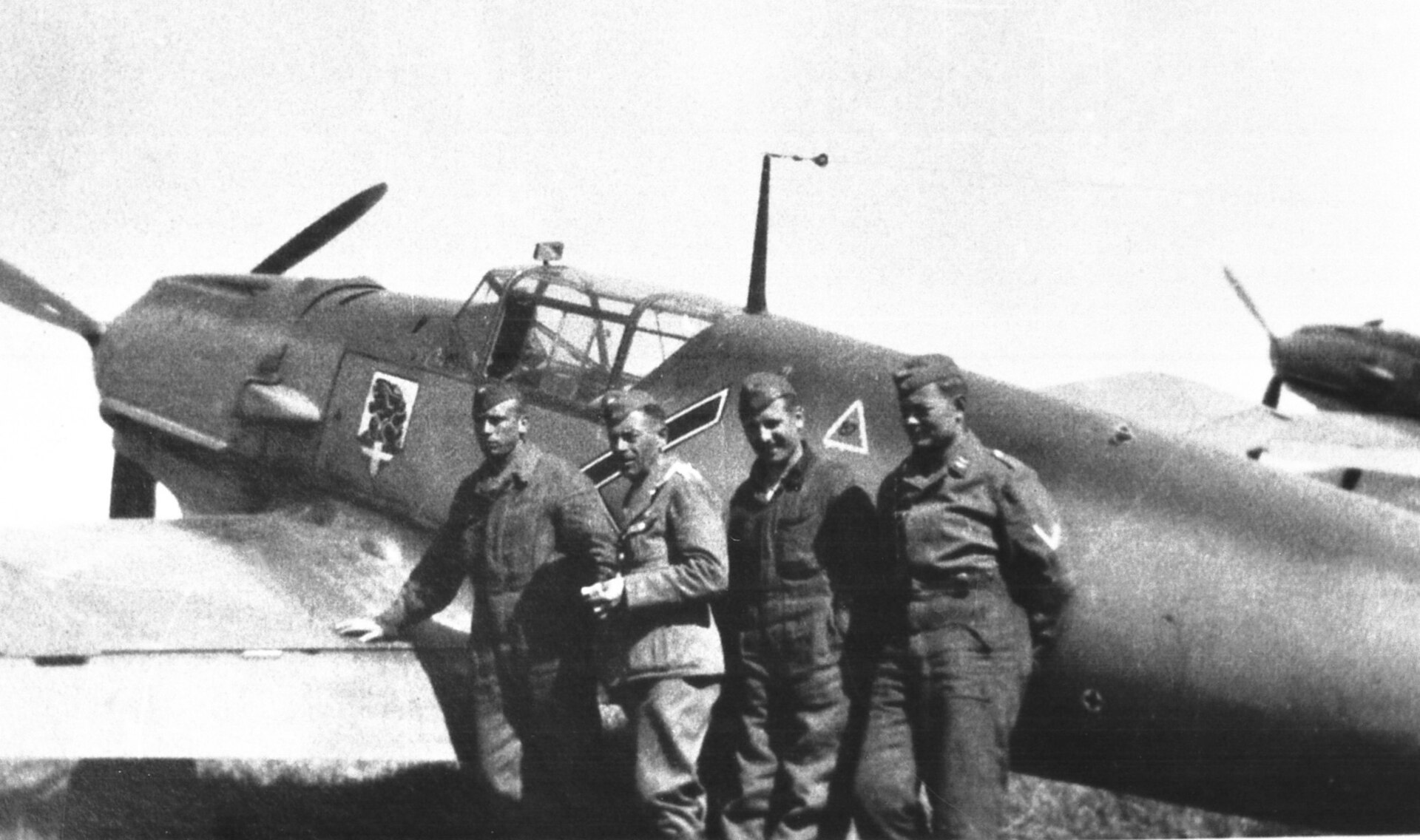
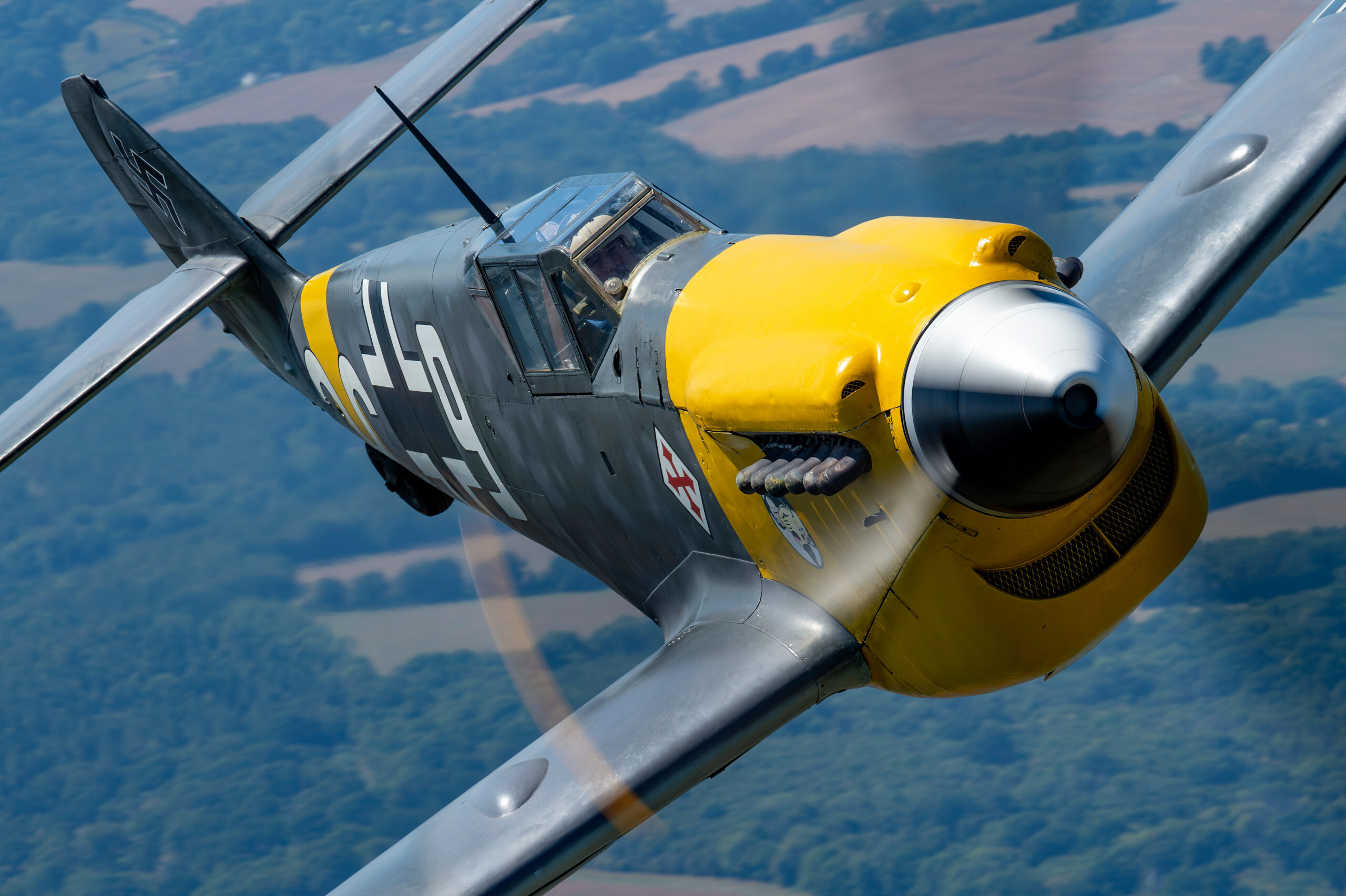
No aircraft is more closely bound up with the German war machine of 1939 to 1945 than the Messerschmitt Bf 109. It was the fighter the Luftwaffe took to war in Poland, flew over the Channel in the Battle of Britain, fought across the deserts of North Africa and deep into the Soviet Union, and it stayed in production from the mid 1930s to the very last days of the conflict. More Bf 109s were built than any other fighter in history, and the three highest scoring fighter pilots who ever lived all flew it.
Yet the same aircraft that dominated the skies in 1940 was, by 1945, an ageing design pushed well beyond what it had been meant to do. This guide traces the whole story: where the 109 came from, how it was built, how it was armed, what it did in every theatre of the war, the long line of variants, the surprising second life it had after 1945, and where the survivors are today.
Messerschmitt Bf 109: key facts
- First flight: Bf 109 V1 prototype, end of May 1935.
- Designer: Willy Messerschmitt and Robert Lusser at Bayerische Flugzeugwerke.
- Number built: more than 34,000, the most produced fighter aircraft in history.
- Engine: inverted V12, from the Junkers Jumo 210 to the Daimler-Benz DB 601 and DB 605.
- Main variants: E (Emil), F (Friedrich), G (Gustav) and K (Kurfurst).
- Top aces: Erich Hartmann (352 victories), Gerhard Barkhorn (301) and Gunther Rall (275), all on the Bf 109.
- Built after the war: in Czechoslovakia as the Avia S-199 and in Spain as the Hispano Buchon.
What this guide covers
- Origins and development
- Design and engineering
- Armament and firepower
- Spain, Poland and the fall of France
- The Battle of Britain
- North Africa and the Eastern Front
- The Experten: the men who flew it
- Defence of the Reich
- Variants from B to K
- Specifications and key facts
- The Bf 109 after 1945
- Where the survivors are today
- Legacy
- Frequently asked questions
Origins and development
The Bf 109 was designed in 1934 by a team led by Willy Messerschmitt and Robert Lusser at the Bayerische Flugzeugwerke, the Bavarian aircraft company whose initials give the aircraft its Bf prefix. When the firm was reorganised and renamed Messerschmitt AG in 1938, later types carried the Me prefix, which is why the same fighter is very often called the Me 109. Both names describe the same aircraft, and wartime documents use them almost interchangeably.
The requirement was for a modern monoplane fighter to replace the biplanes then in service across Europe. Messerschmitt’s approach was to build the smallest and lightest airframe he could wrap around the most powerful engine available, and to keep drag and weight to a minimum even at the cost of comfort or easy handling. The aircraft that resulted was advanced for its day, with an enclosed cockpit, a retractable undercarriage and automatic leading edge slats that extended at low speed to delay the stall and help the fighter hold its turn.
The first prototype, the Bf 109 V1, made its maiden flight at Augsburg-Haunstetten at the end of May 1935 in the hands of Hans-Dietrich Knoetzsch. Because the intended Junkers Jumo engine was not ready, that first aircraft flew with an imported Rolls-Royce Kestrel, a detail that later generations have enjoyed given how the war turned out. In competitive trials the Bf 109 beat its main rival, the Heinkel He 112, and was ordered into production.
From there the aircraft was built in staggering numbers. Total output eventually passed 34,000 machines constructed between 1936 and the spring of 1945, which makes the Bf 109 the most produced fighter aircraft in history. Higher figures of around 35,000 are sometimes quoted, usually when the aircraft built abroad after the war are included. Production was dispersed across many factories, and towards the end was carried out partly by forced labour in appalling conditions, a grim aspect of the aircraft’s story that sits alongside its technical record.
The path from prototype to front line took time. The first service versions, the B, C and D models, were powered by the Junkers Jumo 210 and were still being refined when the Spanish Civil War gave the Luftwaffe a live testing ground. The lessons learned there, about tactics, armament and reliability, fed straight into the Emil that would carry the fighter arm through the opening campaigns of the war. By 1939 the 109 had grown from an experimental design into a mature and battle tested weapon.
Design and engineering
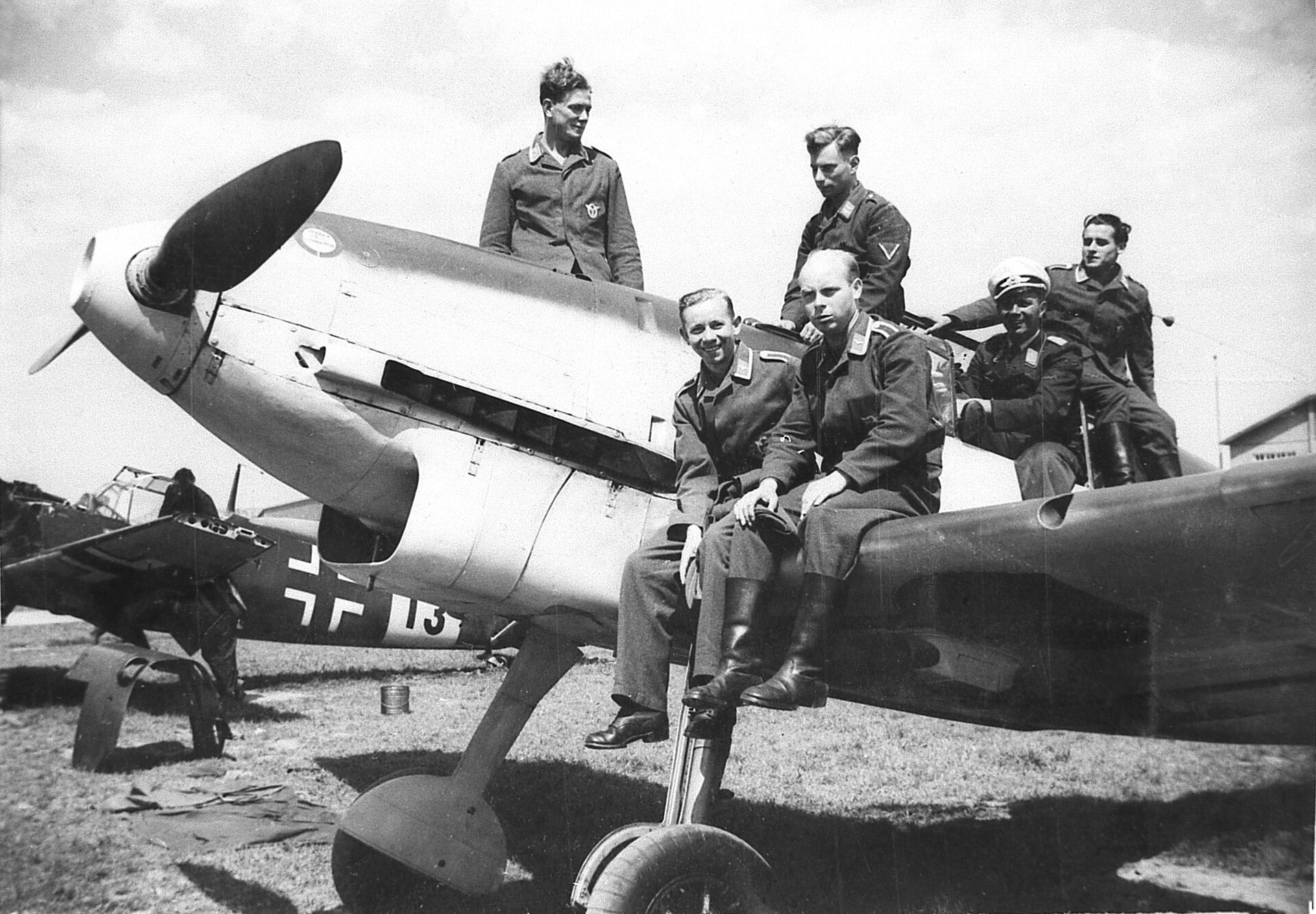
At the heart of the Bf 109 was a liquid cooled, inverted V12 engine. The early models used the Junkers Jumo 210, the Battle of Britain era E model used the Daimler-Benz DB 601, and the later G and K models used the more powerful DB 605. The inverted layout, with the cylinder banks hanging below the crankshaft, allowed a low and clean nose line and left room for a cannon to be mounted between the banks and fire through the propeller hub.
One feature of the Daimler-Benz engines gave the 109 a real tactical edge in 1940. They used direct fuel injection, so they kept running smoothly when the pilot pushed the nose down hard into a dive. The carburettor fed Merlins of the early Spitfires and Hurricanes would cut out briefly under negative g, which meant an RAF pilot could not simply bunt after a diving 109 without his engine stumbling. British pilots had to half roll and pull down instead, losing precious time, until fuel system fixes closed the gap later in the war.
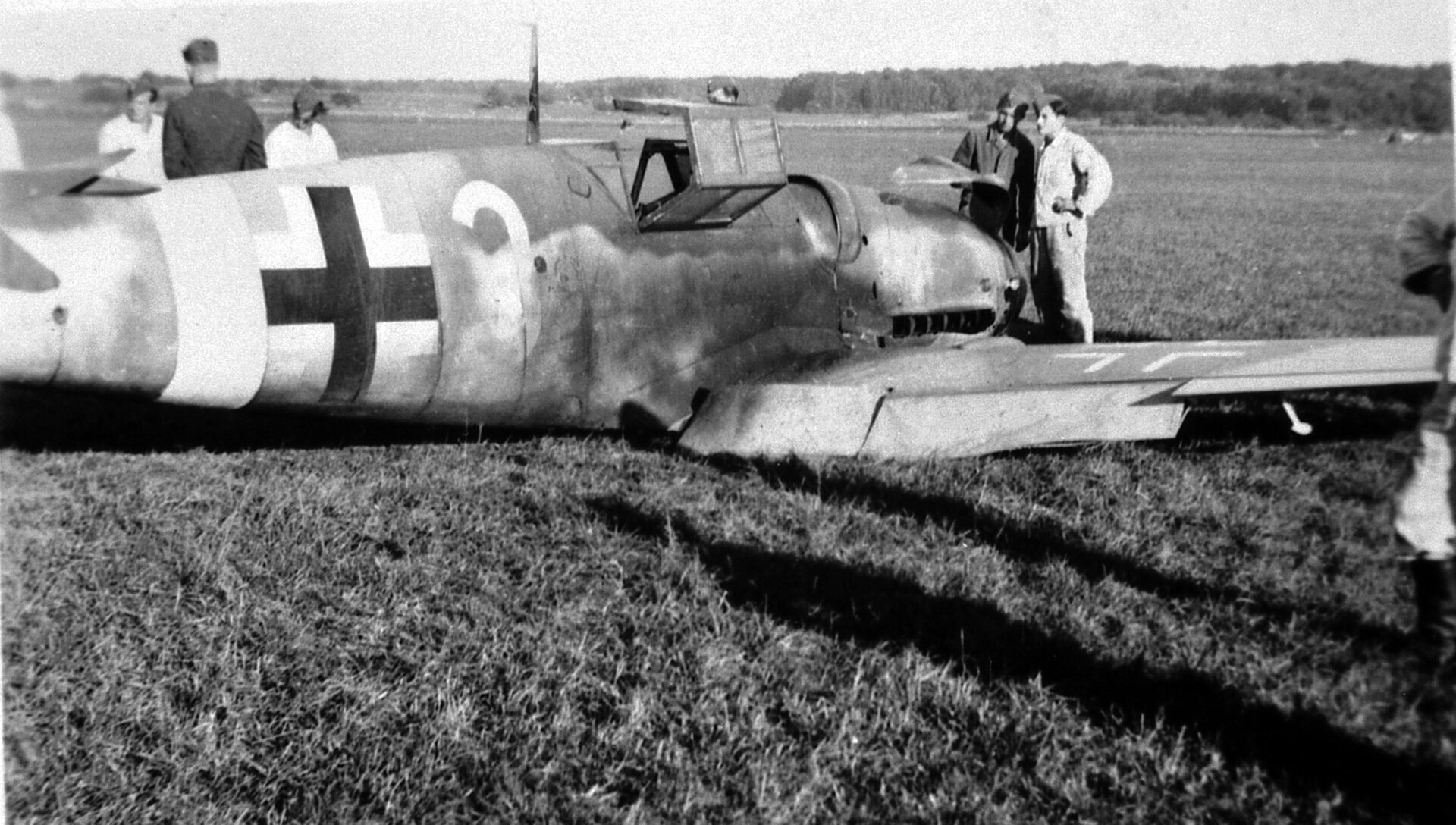
Messerschmitt’s belief in low weight and low drag shaped the whole aircraft. The wings were kept thin and light, which helped performance but limited how much could be built into them, and the fuselage carried most of the structure and the guns. The design also had two well known vices that came straight from these choices. The undercarriage was narrow and hinged from the fuselage, retracting outwards, which made the aircraft unstable on the ground and caused a very large number of take off and landing accidents throughout its career, especially among inexperienced pilots late in the war. The cockpit was cramped and the heavily framed canopy gave poor visibility, particularly to the rear.
Against those faults the Bf 109 was fast, it climbed and dived superbly, and in capable hands it was a difficult and dangerous opponent. The tailwheel became retractable on the F model, cleaning up the airflow, and each generation brought refinements to the cowling, radiators and wing to keep pace with more powerful engines. It was never an easy aircraft, but it was an effective one, and pilots who mastered it could get the very best out of it.
Armament and firepower
The Bf 109 was armed in a way that reflected Messerschmitt’s determination to keep the wings clean. The classic arrangement was a cannon firing through the propeller spinner, the German Motorkanone mounting, backed by machine guns in the cowling that fired through the propeller arc. Early aircraft were lightly armed by later standards, and when it emerged in 1937 that the RAF was planning fighters with eight machine guns, the Luftwaffe decided the 109 needed more punch.
Over time the firepower grew. The Emil of 1940 often carried cannon in the wings as well as in the nose. Later the standard fit became a single 20mm cannon through the hub with two heavy machine guns in the cowling, and this could be supplemented with extra cannon in pods slung under the wings when the target was a heavy bomber. The final K model could carry a hard hitting 30mm cannon firing through the hub, enough to destroy a four engined bomber with a short burst.
All of this came at a price. The underwing gun pods, useful though they were against bombers, added weight and drag and blunted the aircraft’s handling just when it needed to dogfight enemy fighters. The story of the 109’s armament is really the story of the whole aircraft in miniature: a small, light design repeatedly asked to carry more than it was meant to, and doing so at the cost of the very qualities that had made it so good in the first place.
Spain, Poland and the fall of France
The Bf 109 first saw combat in the Spanish Civil War, where the German Condor Legion used early B, C and D models from 1937. Spain was where the aircraft cut its teeth, and just as importantly it was where the Luftwaffe worked out how to fight with it. Under Werner Molders, German pilots developed a loose, flexible formation built around pairs and fours, the Rotte and the Schwarm, which spread the fighters out and let each pilot watch the others’ tails. The wider world later copied it as the finger four, and it gave German fighter units a real advantage in the early war years.
By the invasion of Poland in September 1939 the 109 was the standard German fighter, and in the E, or Emil, form it proved superior to almost everything it met. The Polish fighters were brave but outclassed, and the campaign confirmed the aircraft as the backbone of the Luftwaffe fighter arm. The pattern continued in the assault on France and the Low Countries in May 1940. Only one French fighter, the Dewoitine D.520, could meet the Bf 109E on anything like equal terms, and through a mixture of mismanagement and bad timing it never reached the French air force in the numbers that might have made a difference. By the summer of 1940 the Emil had swept most of its opponents from the sky and stood at the peak of its reputation.
The Battle of Britain
The most famous chapter in the Bf 109 story is the Battle of Britain in the summer of 1940, flown as the E model. In a straight comparison with the RAF fighters it faced, the Emil generally held an edge in climb and dive and, thanks to its fuel injected engine, could follow a diving target in a way its opponents could not. It was broadly a match for the Supermarine Spitfire and superior in several respects to the Hawker Hurricane, and in the hands of experienced pilots it took a heavy toll.
Its great handicap was range. Operating from airfields in northern France, a Bf 109 had only around fifteen minutes of fuel to spare for combat over southern England before it had to turn for home. That single limitation shaped the whole battle. When the 109s were free to roam ahead of the bombers they were deadly, but when they were tied to close escort, throttled back and weaving to stay with the slower aircraft they were protecting, they lost the height and speed that were their main advantages. German fighter pilots bitterly resented the order to fly close escort, and the change did as much as anything the RAF did to blunt the 109 in the battle.
The Battle of Britain also exposed how thin the German fighter force was. There were never enough 109s to escort the bombers properly and hunt the RAF at the same time, and every aircraft lost over England, along with its pilot, was very hard to replace. The Emil remained a superb fighter to the end of the battle, but it was fighting at the far end of its reach, and that told against it.
The battle left a lasting mark on how the Bf 109 was used. It showed that even a first rate fighter could be hamstrung by the mission it was given and the distance it had to fly, and it taught the Luftwaffe hard lessons about escort tactics that it never fully solved. For the RAF, learning to draw the 109s away from the bombers and to fight them on favourable terms was central to survival, while for the Germans the sight of their best fighter turning for home with its fuel low, leaving the bombers exposed, was a foretaste of problems that would only grow.
North Africa and the Eastern Front
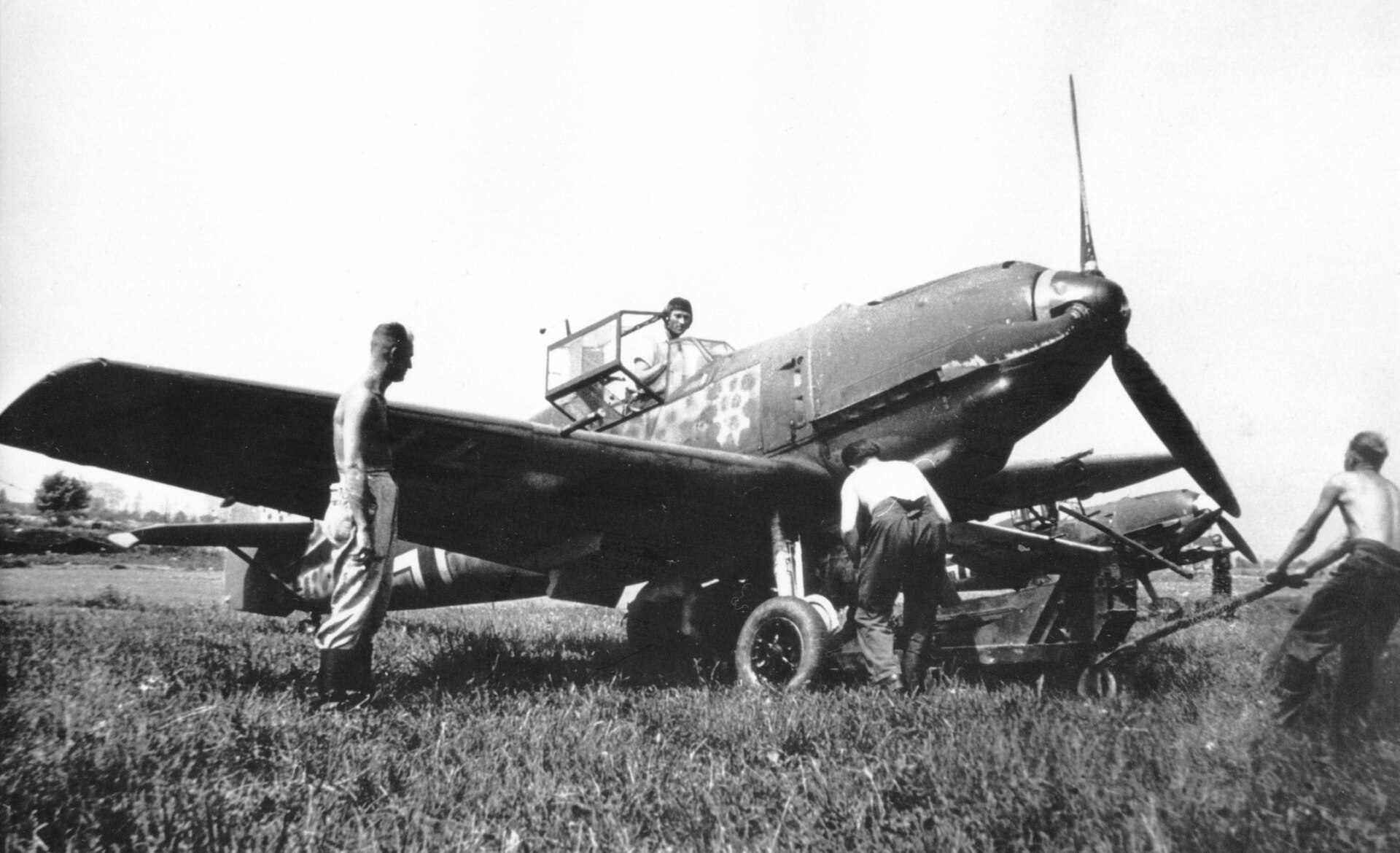
Away from the Channel the Bf 109 found more favourable hunting. In the North African desert the F model equipped Jagdgeschwader 27, and in the early months of 1942, against Allied fighters that were often outclassed, its pilots ran up long strings of victories. The most famous was Hans-Joachim Marseille, the Star of Africa, who claimed all of his 158 victories on the Bf 109 against Western Allied pilots and became a byword for marksmanship and deflection shooting before his death in a flying accident in 1942.
It was on the Eastern Front, though, that the aircraft ran up its most staggering scores. Jagdgeschwader 52, which flew the Bf 109 throughout, was credited with more than ten thousand victories, chiefly against the Soviet air force. The three top scoring fighter aces in history all served with it: Erich Hartmann with 352 victories, Gerhard Barkhorn with 301 and Gunther Rall with 275. Such totals reflect the very particular conditions of the air war in the east, the sheer number of targets and the years of combat flying involved, as much as the qualities of the aircraft. But they cemented the 109’s reputation, and they were flown in an aircraft that remained competitive, through constant development, against a steadily improving enemy.
The scoring did not go unopposed for long. As the war in the east went on, the Soviet air force re-equipped with far better fighters such as the Lavochkin La-5 and the light and nimble Yakovlev Yak-3, and its pilots grew steadily more skilful. The Bf 109 remained competitive to the end, particularly in the hands of the Experten, but the days of easy victories passed and the aircraft found itself fighting hard against opponents every bit as good as it was.
The Experten: the men who flew it
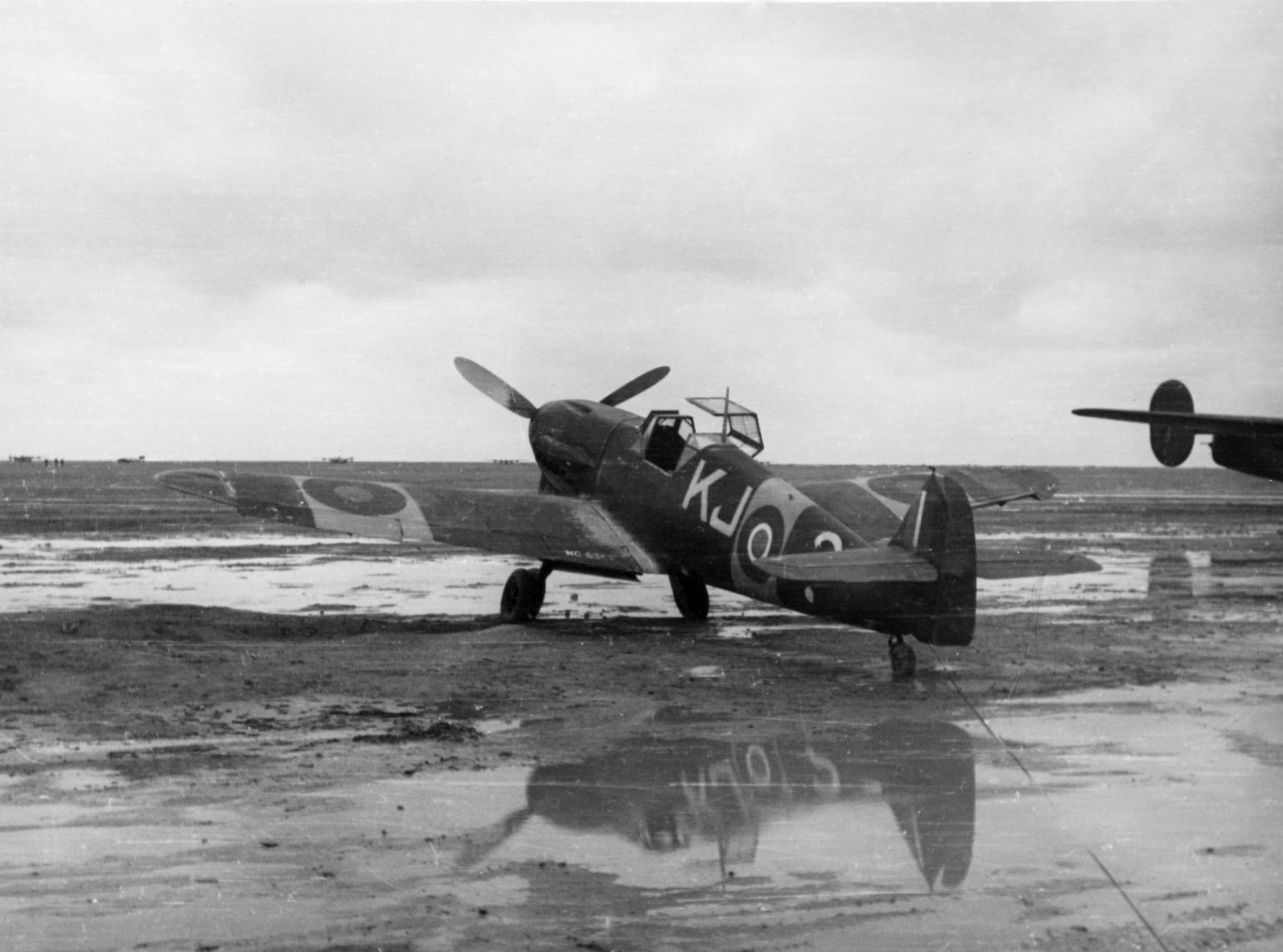
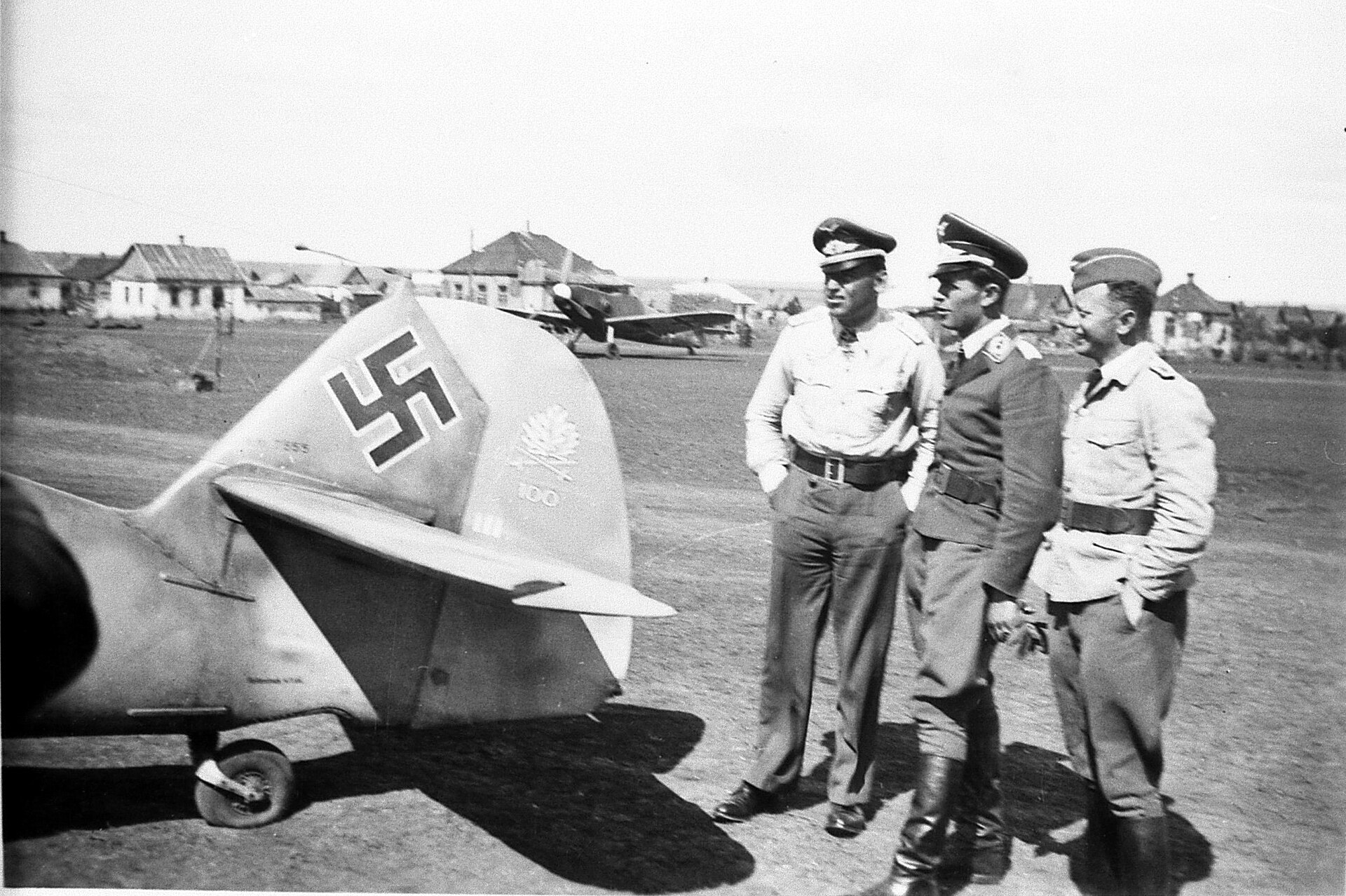
The Bf 109’s reputation is inseparable from the pilots who flew it. The Luftwaffe fighter arm produced a small group of extraordinarily high scoring pilots, the Experten, whose totals dwarf anything seen in Western air forces. Part of the reason was systemic. German pilots flew on operations continuously, without the tour lengths and rotation home that rested Allied aircrew, so the best of them built up combat time, and victories, over years rather than months.
The names run through the whole war. Werner Molders, who had shaped the finger four tactics in Spain, became the first pilot in history to reach a hundred aerial victories before his death in a flying accident in 1941. Adolf Galland, a charismatic and outspoken fighter leader, rose to command the entire fighter force and later flew the Me 262 jet in the closing weeks of the war. Hans-Joachim Marseille, the Star of Africa, was celebrated for his deflection shooting, downing enemy aircraft from difficult angles with short, economical bursts. On the Eastern Front, Erich Hartmann, Gerhard Barkhorn and Gunther Rall ran up the three highest scores in history, all in the Bf 109.
Those totals have to be read with care. The conditions of the Eastern Front, with huge numbers of aircraft in the air, allowed scores that would have been impossible in the West, and German claims, like all wartime claims, were not always exact. But there is no doubt that the Bf 109, in the hands of a skilled and experienced pilot, was a superb instrument, and that the aircraft and its best pilots together formed one of the most formidable combinations of the air war.
Defence of the Reich
In the last two years of the war the Bf 109 was increasingly turned to the defence of Germany itself against the Allied bombing offensive. This was a very different kind of fighting. To bring down four engined bombers the 109 needed heavy cannon, often carried in underwing gondolas, and the extra weight and drag made it slower and less agile just as it had to face the escorting American Mustangs and Thunderbolts. Pilots called the gondola armed machines Kanonenboote, gunboats, and flying them against fighter escort was dangerous work.
By 1944 the Luftwaffe was also losing experienced pilots faster than it could train replacements, so the same demanding aircraft was being handed to men with only a handful of hours on type, many of whom came to grief on that narrow undercarriage before they ever met the enemy. The 109 was still fast and still deadly in a good pair of hands, and the final K model was among the fastest piston fighters of the war, but the balance had swung against it. It ended the conflict fighting a losing battle in the skies over a collapsing Germany, hopelessly outnumbered by the aircraft it had once dominated.
Through the second half of the war the Bf 109 did not fight alone. It served alongside the Focke-Wulf Fw 190, a newer and in some ways tougher fighter with a radial engine and heavier armament. The two aircraft complemented each other, the Fw 190 often taking on the ground attack and bomber destroyer work while the 109, especially in its high altitude versions, covered the fighters above. That the Luftwaffe kept both in production to the very end says something about how good the older design remained, even as its limitations grew harder to ignore.
Variants from B to K
The letters that ran through the Bf 109 mark a steady growth in power and weight. The B, C and D models were the early Jumo powered versions used in Spain and the first months of the war. The E, or Emil, brought the Daimler-Benz DB 601 engine and was the version that fought the Battle of Britain, some carrying wing mounted cannon. The F, or Friedrich, is widely regarded as the finest handling of the whole family, with rounded wingtips, a cleaner cowling and a retractable tailwheel, and many pilots considered it the high point of the design.
The G, or Gustav, was by far the most numerous, with well over twenty thousand built from 1942 around the more powerful DB 605 engine. The G-6 in particular became the standard mount of the middle war years, though the bulges added to its cowling to clear larger guns earned it the nickname Beule, or bump. The final mass produced version was the K, or Kurfurst, which appeared late in 1944, could reach around 452 miles per hour and carried a 30mm cannon through the propeller hub. Two seat trainer versions were also built to convert pilots onto the type, and dedicated reconnaissance and tropical variants filled out the range. Through all of it the basic airframe, first flown in 1935, stayed recognisably the same aircraft, a tribute to how sound the original design had been.
Beyond the main fighter marks, the airframe was adapted for a range of specialised tasks. There were photographic reconnaissance versions with cameras in the rear fuselage, high altitude variants with pressurised cockpits and extended wings to intercept high flying intruders, and tropicalised aircraft fitted with sand filters and survival gear for North Africa. This adaptability, squeezing new roles out of a small and ageing airframe, is one reason the 109 stayed in front line service from the first day of the war to the last.
Specifications and key facts
| Crew | 1 |
|---|---|
| First flight | Bf 109 V1 prototype, end of May 1935 |
| Entered service | 1937 (B model, Spanish Civil War) |
| Engine | Daimler-Benz DB 605A, inverted V12, around 1,475 PS (about 1,455 hp) |
| Length | About 8.95 m (29 ft 4 in) |
| Wingspan | About 9.92 m (32 ft 6 in) |
| Maximum speed | Around 640 km/h (about 398 mph) for the G-6; the later K-4 reached about 452 mph |
| Armament (typical G-6) | 1 x 20mm MG 151/20 through the hub, 2 x 13mm MG 131 in the cowling, optional underwing cannon |
| Number built | More than 34,000 (all variants, the most produced fighter in history) |
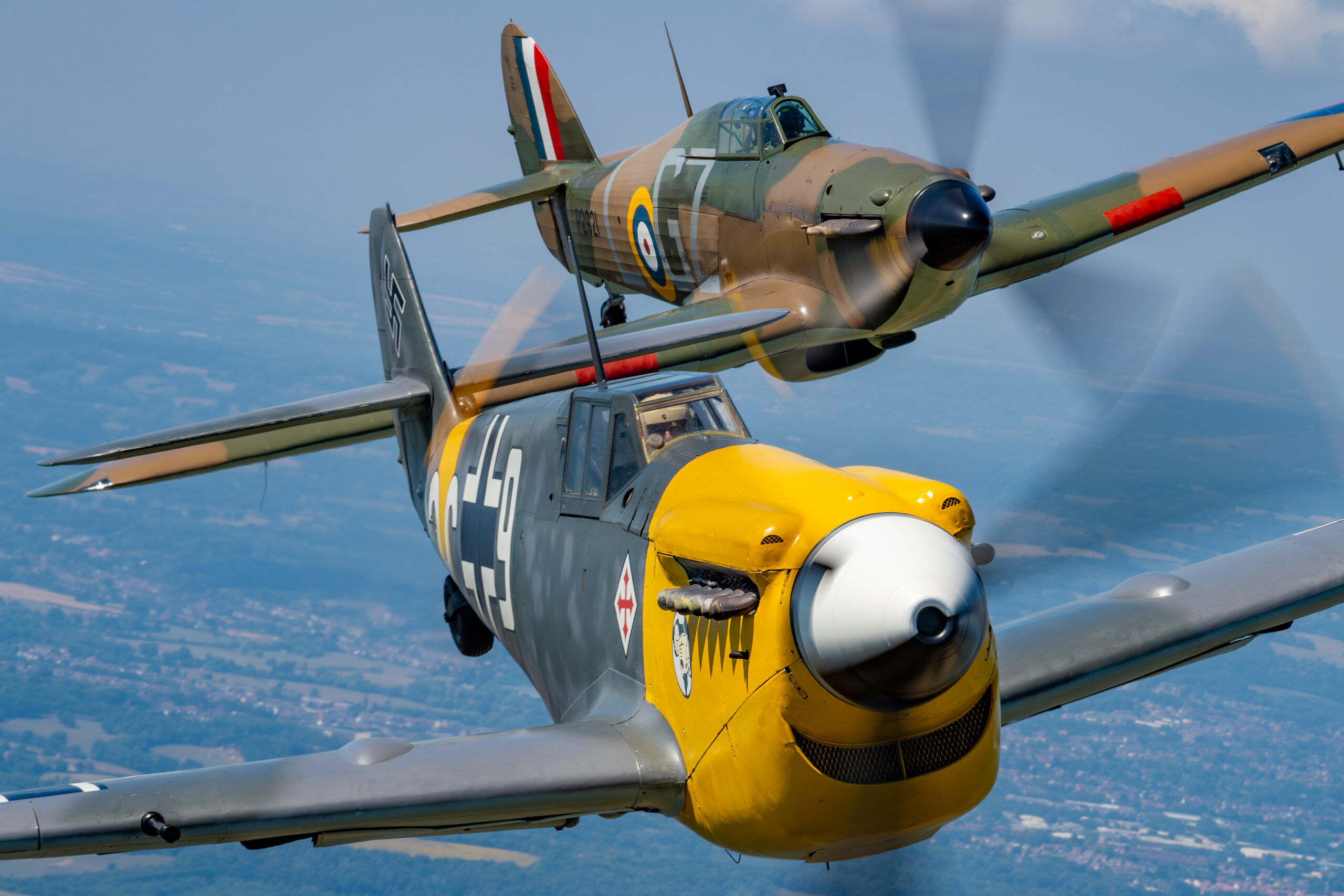
Wartime fighters like this turn up regularly at British warbird displays, and you will find plenty of them in the Piemags archive galleries. Print and usage terms are on the licensing page.
The Bf 109 after 1945
The Bf 109 story did not end in May 1945. In Czechoslovakia, where a Bf 109 factory had operated during the occupation, production continued after the war. The first machines, built with leftover Daimler-Benz engines, were reasonable aircraft, but when those engines ran out the Czechs fitted a Junkers Jumo bomber engine and a large paddle bladed propeller instead. The result, the Avia S-199, was a difficult and even dangerous aircraft, its powerful engine and coarse propeller making the already tricky take off and landing worse still. Czech pilots nicknamed it the Mezek, or Mule.
The S-199 has one remarkable footnote. In 1948, when the new state of Israel was under arms embargo and desperate for fighters, it bought around twenty five S-199s from Czechoslovakia. These became the first fighter aircraft of the Israeli Air Force and flew in the fighting of 1948, so the very last descendants of the Luftwaffe’s main fighter ended their front line careers in Israeli markings, an irony few could have predicted.
In Spain, the licence built story ran even longer. Hispano Aviacion had begun building the 109 during the war and carried on into the 1950s, working through a series of engines as supplies allowed. The final version, the HA-1112-M1L Buchon, first flew in 1954 fitted with a Rolls-Royce Merlin, the very engine that had powered its old enemies, because no suitable German engines were available. Production continued until 1958. Many of these Merlin powered Spanish machines went on to fame of a different kind: painted in Luftwaffe colours, they played the part of Bf 109s in the 1969 film Battle of Britain, and a good number of the aircraft that fly today as 109s are in fact Buchons.
The Bf 109 also served far beyond Germany during and after the war. Switzerland, Finland, Hungary, Romania, Bulgaria and others flew the type, and some kept it in service well into the postwar years. Spain flew its Hispano built machines into the 1960s, giving the basic design an active career spanning nearly three decades. Few fighters of the era were operated by so many air forces, or for so long, another measure of how far the original 1935 concept was stretched.
Where the survivors are today
Many Bf 109s survive in museums around the world, a reflection of how many were built, but genuine airworthy examples with original Daimler-Benz power are very rare. Most are static exhibits, some beautifully restored, others recovered as wrecks from crash sites and painstakingly rebuilt. Collections across Europe, North America and beyond hold examples of the E, F and G models, and the aircraft is a fixture of any serious survey of Second World War fighters.
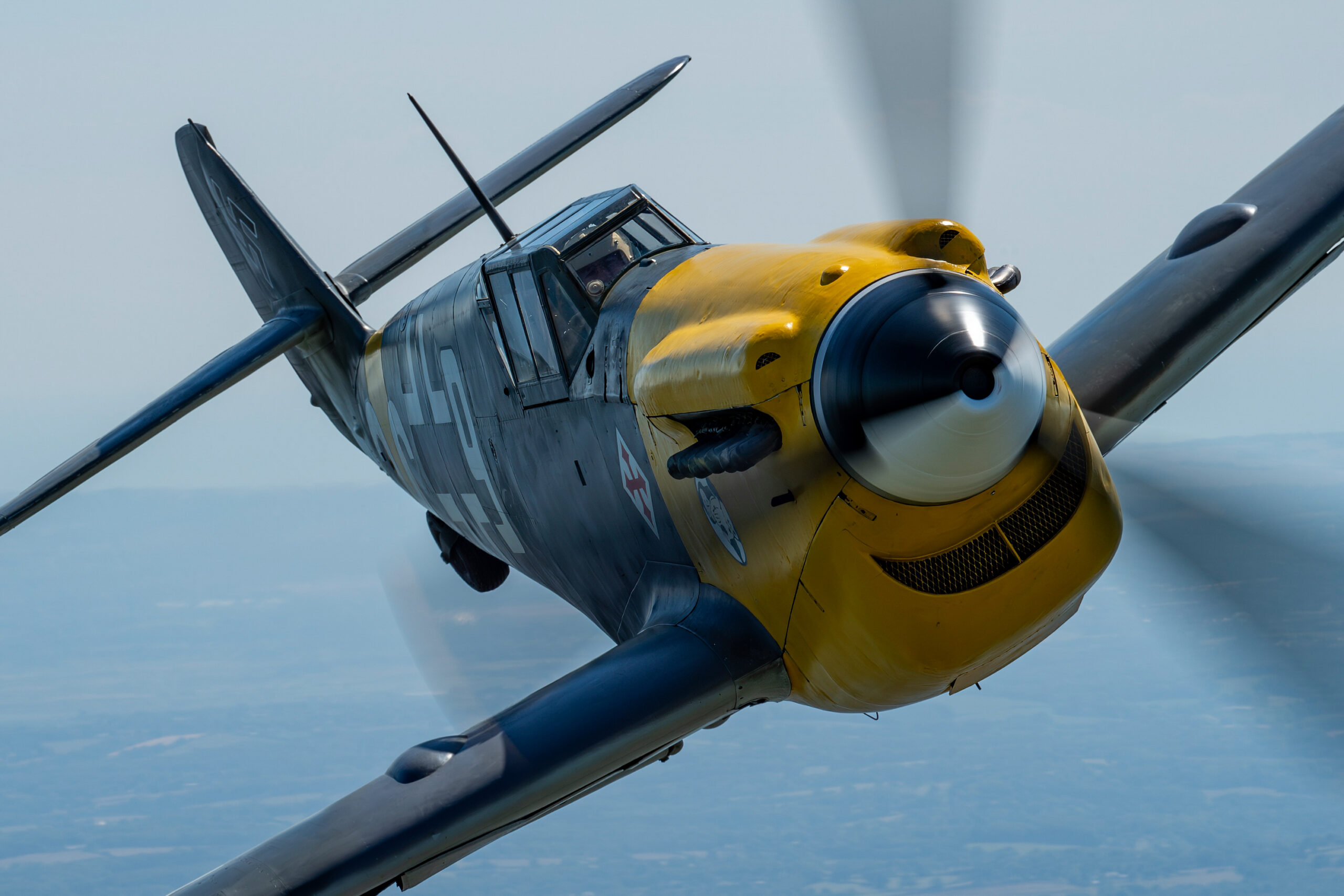
One of the very few airworthy original Emils is a Battle of Britain veteran that was shot down over the Channel on 29 July 1940, crashing at Cap Blanc Nez on the French coast, later restored to fly with an original DB 601 engine, and now part of the Flying Heritage and Combat Armor Museum at Paine Field in Everett, Washington. Far more common on the airshow circuit are the Merlin powered Hispano Buchons, several of which are kept flying and are often painted to represent wartime 109s. For anyone watching a supposed Messerschmitt display in Europe today, there is a fair chance the growl overhead is really a Rolls-Royce Merlin, one more twist in a long and tangled history.
Many of the static survivors have remarkable stories of their own. A good number were recovered decades after the war from crash sites, bogs and remote hillsides across Europe and the former Soviet Union, and painstakingly rebuilt from a mixture of original and newly made parts. Each is a small archaeological project in its own right, and together they have kept a steady supply of 109s reaching museums long after the last was built, and a handful have even returned to the air decades after they were shot down.
Legacy
The Bf 109 is remembered as one of the defining fighters of the piston era, standing alongside the Supermarine Spitfire and the North American P-51 Mustang. As an engineering achievement it is hard to ignore. A design first sketched in 1934 stayed competitive, through constant development, for more than a decade of the fastest moving period in aviation history, and was built in greater numbers than any fighter before or since. That is a record no other single seat fighter can match.
It is also a study in the limits of an idea. The very smallness that made the early 109 so fast left little room to grow, and by 1944 the design was being pushed far beyond what its undercarriage, cockpit and structure had been meant to handle, flown by pilots who had far too little time to learn its ways. Its record is bound up with the cause it served and with the forced labour used to build it late in the war, and any honest account has to hold those facts alongside the technical story. As a machine, though, the Bf 109 remains one of the most important fighters ever built, and one of the most fascinating.
For the aircraft it fought, see our histories of the Supermarine Spitfire and the Hawker Hurricane, and the later North American P-51 Mustang that helped wrest control of the skies from it. If you photograph these aircraft at displays, our guide to warbird photography has practical advice.
While the 109 was doing the Luftwaffe’s fighting, a private venture at Rostock was quietly making it obsolete. Our account of the first jet flight, on 27 August 1939, covers the Heinkel He 178, and why the air ministry watched it and shrugged.
Frequently asked questions
Is it the Bf 109 or the Me 109?
Both names refer to the same aircraft. The Bf prefix comes from Bayerische Flugzeugwerke, the company that designed it. After the firm was renamed Messerschmitt AG in 1938 its later types used the Me prefix, so the fighter is widely known as the Me 109 as well, and wartime documents use both.
How many Bf 109s were built?
More than 34,000 Bf 109s were built between 1936 and 1945, making it the most produced fighter aircraft in history. Higher figures of around 35,000 include aircraft built abroad after the war in Czechoslovakia and Spain.
Was the Bf 109 better than the Spitfire?
The Bf 109 and the Spitfire were closely matched. In 1940 the Bf 109E generally had the edge in climb and dive and could follow a diving target thanks to its fuel injected engine, while the Spitfire could out turn it. The 109’s biggest handicap in the Battle of Britain was its short range over England rather than any single failing against the Spitfire.
Who was the top scoring Bf 109 pilot?
Erich Hartmann was the top scoring Bf 109 pilot and the highest scoring fighter ace in history, credited with 352 aerial victories. He flew the Bf 109 with Jagdgeschwader 52 on the Eastern Front.
Are any Bf 109s still flying?
A small number of Bf 109s still fly, but very few are original German aircraft with Daimler-Benz engines. Many airworthy machines painted as 109s are actually postwar Spanish built Hispano Buchons fitted with Rolls-Royce Merlin engines.
When did the Bf 109 first fly?
The Bf 109 first flew at the end of May 1935, when the V1 prototype took off at Augsburg-Haunstetten. Because its intended German engine was not ready, that first prototype flew with an imported Rolls-Royce Kestrel.
What engine did the Bf 109 use?
The Bf 109 used an inverted V12 engine throughout its life. Early models used the Junkers Jumo 210, the Battle of Britain era E model used the Daimler-Benz DB 601, and the later G and K models used the more powerful DB 605.
Why did the Bf 109 have so many landing accidents?
The Bf 109 had a narrow undercarriage that hinged from the fuselage and retracted outwards, which made it unstable on the ground. Take off and landing accidents were common throughout its career, and they rose sharply late in the war as inexperienced pilots were rushed into service.
What was the Bf 109’s top speed?
Top speed depended on the variant. The widely used G-6 reached around 398 miles per hour, while the final K-4 of late 1944 could reach about 452 miles per hour, making it one of the fastest piston engined fighters of the war.
How was the Bf 109 armed?
The Bf 109 typically carried a cannon firing through the propeller hub, the Motorkanone mounting, backed by machine guns in the cowling. Later aircraft could add cannon in underwing pods to attack heavy bombers, and the final K model carried a hard hitting 30mm cannon.
What is a Hispano Buchon?
The Hispano HA-1112 Buchon is a Spanish built version of the Bf 109, produced after the war. Its final version flew in 1954 with a Rolls-Royce Merlin engine because German engines were unavailable, and many surviving airworthy 109s are in fact these Merlin powered Buchons.
Did Israel use the Bf 109?
Yes, in a form. In 1948 Israel bought around 25 Avia S-199s, a Czech built descendant of the Bf 109, which became the first fighter aircraft of the Israeli Air Force and flew in the fighting of that year.
Which was the best version of the Bf 109?
Many pilots and historians regard the F, or Friedrich, as the best handling version of the Bf 109, with its clean cowling, rounded wingtips and well balanced controls. The G, or Gustav, was the most numerous and the most heavily armed.
Why was the Bf 109’s range so short?
The Bf 109 was designed as a light, short range interceptor with a small fuel load, so it was never intended for long escort missions. Over southern England in 1940 this left it with only about fifteen minutes of combat time before it had to turn for home.
How many Bf 109 variants were there?
The Bf 109 ran through a long line of variants from the early B, C and D models to the E, F, G and final K, along with trainer, reconnaissance and tropical versions and postwar foreign types. The G, or Gustav, was the most produced, with over 20,000 built.
How much did a Bf 109 cost and how long did it take to build?
The Bf 109 was designed with cheap, quick production firmly in mind. A Bf 109F of 1941 cost in the region of 55,000 to 58,000 Reichsmarks and absorbed only a few thousand man-hours to build, far fewer than the roughly 13,000 man-hours quoted for a Spitfire airframe. Willy Messerschmitt was an expert in low-cost manufacture, and that emphasis on ease of production is a large part of why the 109 could be built in such enormous numbers.
Who was Hans-Joachim Marseille, the Star of Africa?
Hans-Joachim Marseille was a Luftwaffe fighter pilot who flew the Bf 109 with Jagdgeschwader 27 in North Africa and became famous for his deflection shooting, downing enemy aircraft from difficult angles with short, economical bursts. He claimed all of his 158 victories on the Bf 109 against Western Allied pilots. He died in a flying accident in 1942 at the age of just 22.
Why was the Bf 109’s fuel-injected engine an advantage in 1940?
The Daimler-Benz engines of the Bf 109E used direct fuel injection, so they kept running smoothly when the pilot pushed the nose down hard into a dive. The carburettor-fed Merlins of the early Spitfires and Hurricanes would cut out briefly under negative g, so an RAF pilot could not simply bunt after a diving 109 without his engine stumbling. British pilots had to half-roll and pull down instead, losing precious time, until fuel system fixes closed the gap later in the war.
The Bf 109 fought alongside a second great Luftwaffe fighter from 1941 onwards. For the full story of its radial-engined partner and rival, read our history of the Focke-Wulf Fw 190, the Butcher Bird.
