The Spitfire gets the songs and the statues, but in the summer of 1940 it was the Hawker Hurricane that did most of the fighting. There were more of them, they shot down more enemy aircraft than every other British defence combined, and they carried the weight of the Battle of Britain on a sturdy frame of steel tube and doped fabric that owed as much to the biplane age as to the modern monoplane. The Hurricane is often called the forgotten hero, and the label fits. It was less glamorous than its stablemate, slower and less graceful to look at, but it was rugged, steady to fly, easy to build and easy to mend, and it was ready when the country needed it.
This is the complete history of the Hawker Hurricane: where it came from, how it was built, how it fought from France to the Far East, the many marks it grew into, where the survivors are today, and why it deserves a place alongside the Spitfire rather than in its shadow. Every date and figure here has been checked against reliable sources, and where the record is uncertain or the numbers are disputed, that is said plainly rather than smoothed over.
On this page
- Origins and development
- Design and construction
- Into service: 1937 to 1939
- France and the early war
- The Battle of Britain
- Beyond Britain: Malta, the desert and the tank buster
- Notable pilots and squadrons
- The Hurricane in Soviet service
- The Far East and the Sea Hurricane
- The main variants
- Specifications
- Where the survivors are today
- Legacy
- Frequently asked questions
Origins and development
The Hurricane was the work of Sydney Camm, Hawker’s chief designer, later Sir Sydney Camm, whose name runs through three decades of British aircraft from biplane fighters to the Harrier. In the early 1930s the RAF still flew open-cockpit biplane fighters, and the Air Ministry was cautious about the monoplane. Camm began by proposing a monoplane derivative of his successful Hawker Fury biplane, an idea that evolved through several stages into a clean low-wing interceptor with an enclosed cockpit, retractable undercarriage and a structure that drew heavily on Hawker’s established methods.
Two things made the design viable. The first was the new Rolls-Royce engine that would become the Merlin, a liquid-cooled V12 that promised far more power than anything available before. The second was a fresh Air Ministry requirement for a fast monoplane fighter armed with eight machine guns, a heavy battery for the time, framed in specification F.36/34 which was written around Camm’s design. The Air Ministry ordered a single prototype, and on 6 November 1935 that aircraft, serial K5083, made its first flight from Brooklands in the hands of Hawker’s chief test pilot, Flight Lieutenant Paul Ward Spencer Bulman, universally known as George. The Hurricane had flown some four months before the prototype Spitfire.
Testing went reasonably well, helped by the conventional structure, though it was constrained at first by the immature state of the Merlin, which had not yet been cleared for full use. The Air Ministry was impressed enough to place a production order for 600 aircraft in June 1936, an unusually large commitment before the type had even entered service, and a reflection of how seriously the threat from Germany was now being taken. A decision in late 1936 to switch from the early Merlin I to the improved Merlin II caused detail changes and delayed deliveries by several months, but it gave the production Hurricane a better engine. The first production Hurricane I flew on 12 October 1937, flown by Philip Lucas.
Design and construction
The Hurricane’s character came from a deliberate choice. Camm could have gone for the new stressed-skin all-metal construction that the Spitfire used, but he chose instead to build on methods Hawker knew well. The result was an aircraft that was a generation older in its bones than its rival, and far easier to make and repair because of it.
The structure
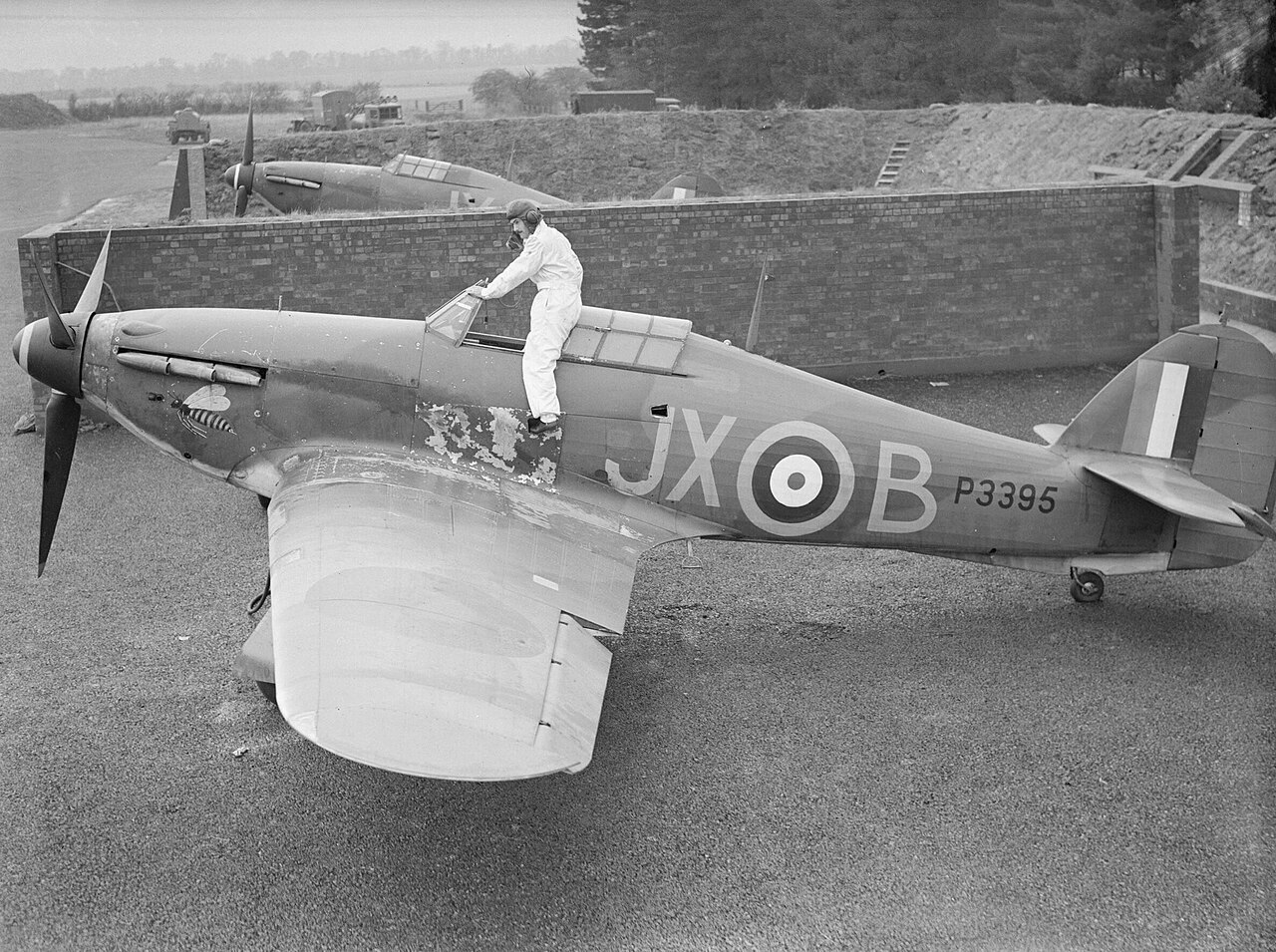
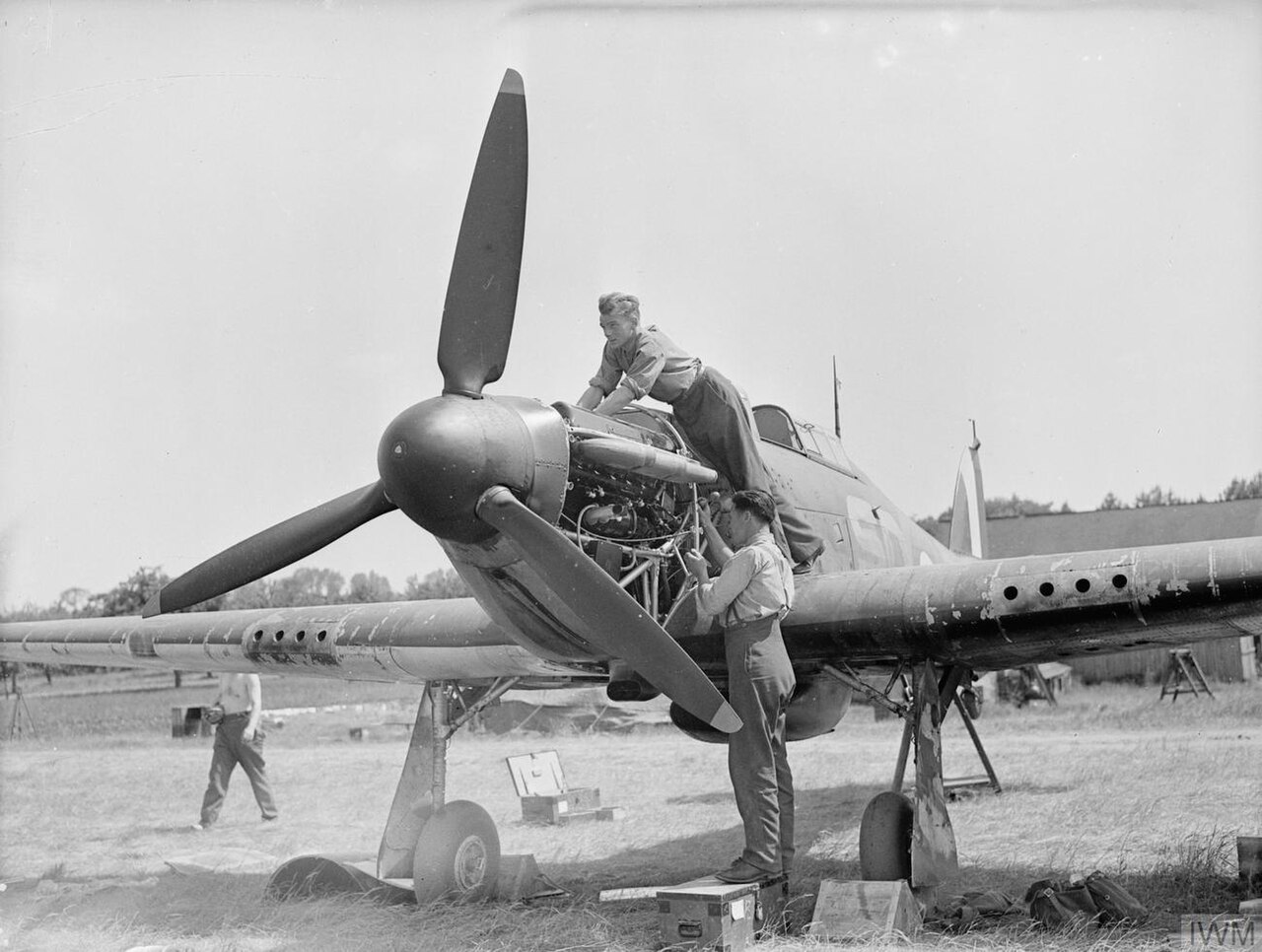
The heart of the fuselage was a Warren truss box-girder built from high-tensile steel tubes, with the joints mechanically fastened rather than welded. Over this strong skeleton went a lighter framework of wooden formers and stringers, and over that a skin of doped linen, except for metal panels around the engine and cockpit. This gave the Hurricane its rounded shape and the slightly old-fashioned feel of a fabric aircraft, but it also gave it real advantages. The structure was forgiving of damage. Cannon shells and bullets could pass straight through fabric without detonating, and a damaged steel tube could often be repaired by riggers at the squadron with simple tools, where a holed stressed-skin panel needed factory-grade work. Hurricanes could be patched up and returned to the fight quickly, and they could be built in workshops that lacked the most advanced equipment.
The early aircraft had fabric-covered wings as well, but an all-metal, stressed-skin wing was introduced from 1939 and used on all later marks. The two types were interchangeable, and one trials aircraft was even flown with a fabric wing on one side and a metal wing on the other. The metal wing was stronger, allowed higher diving speeds and was essential for the heavier armament that came later.
Cockpit, engine and armament
Camm wanted good visibility for the pilot, so the cockpit sat high in the fuselage, which gave the Hurricane its distinctive hump-backed profile and an excellent view over the nose for deflection shooting and landing. The pilot sat behind the Merlin, which drove a propeller that on the earliest aircraft was a Watts two-blade fixed-pitch wooden design. That simple propeller was a serious limit on performance, and it was replaced during 1939 and 1940 by three-blade variable-pitch and then constant-speed metal propellers, which transformed climb and high-altitude performance just in time for the Battle of Britain.
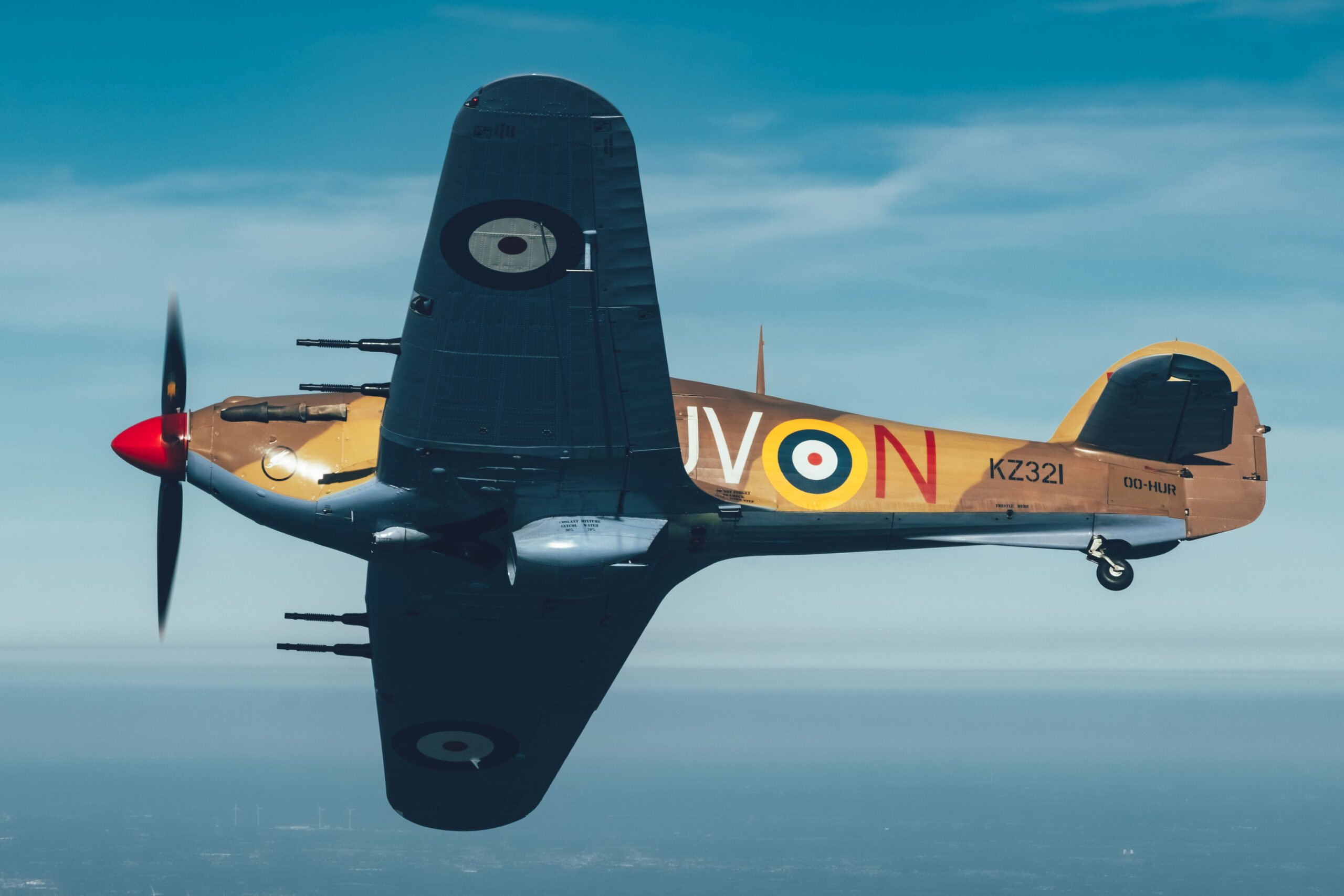
The armament was the heaviest in the world when specified: eight .303 inch Browning machine guns, four in each wing, grouped outside the propeller arc so there was no need for synchronisation gear. Eight rifle-calibre guns could throw a lot of lead in the two or three seconds a fighter pilot usually had a target in his sights, and the grouping of all eight in the wings made the Hurricane a steady gun platform. Later marks would trade the eight light guns for fewer, far heavier cannon.
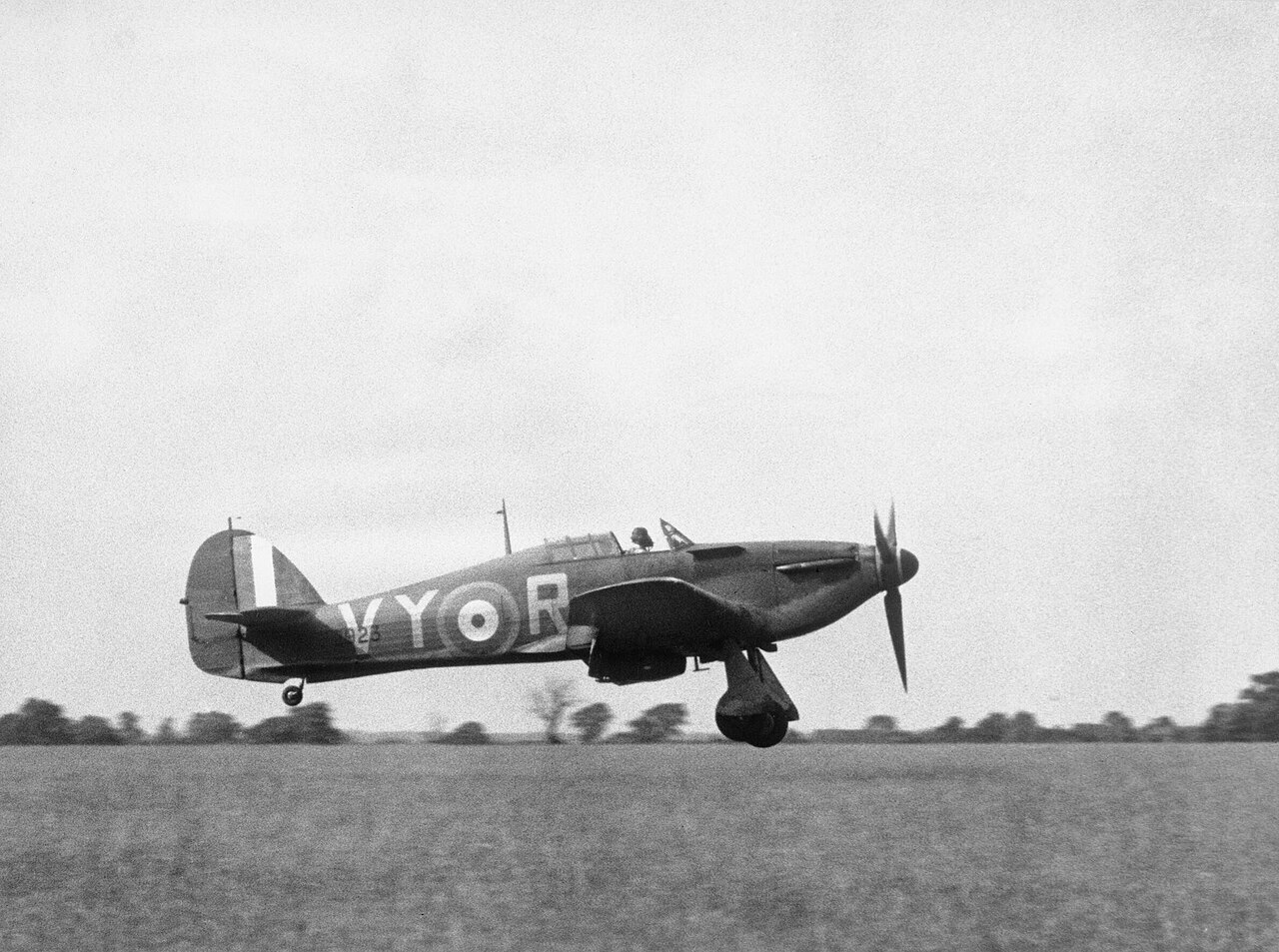
The Hurricane was, by general agreement, a pleasant and steady aircraft to fly. It was not as fast as the Spitfire and did not climb as well, but it was stable, turned tightly, was forgiving near the stall, and sat on a wide, sturdy undercarriage that made it far easier to operate from rough grass airfields than the narrow-tracked Spitfire. For a service expanding rapidly with new pilots, those qualities mattered as much as outright speed.
Into service: 1937 to 1939
The first Hurricanes reached the RAF in December 1937, going to No. 111 Squadron at RAF Northolt under Squadron Leader John Gillan. The squadron exchanged its Gloster Gauntlet biplanes for the new monoplane and began the work of learning to operate a fighter half as fast again as anything the RAF had flown before.
Gillan gave the type its first burst of publicity in February 1938 when he flew from Edinburgh to Northolt at an average ground speed of around 408 mph, a startling figure that made headlines. The truth was less heroic than the newspapers suggested, because Gillan had a powerful tailwind behind him the whole way, a detail not mentioned at the time, and it earned him the lasting nickname “Downwind” Gillan. The flight nonetheless put the Hurricane’s name in front of the public and underlined how far fighter performance had jumped.
Production built up steadily, with Gloster Aircraft brought in to build Hurricanes alongside Hawker to meet the demand. By the outbreak of war in September 1939 close to 500 Hurricanes had been delivered and around 18 squadrons were equipped with the type, making it the most numerous modern fighter in RAF service, ahead of the Spitfire. That head start was crucial. When the fighting began, it was the Hurricane that was available in numbers.
France and the early war
Hurricanes went to France from the first days of the war as part of the Air Component of the British Expeditionary Force and the Advanced Air Striking Force. Through the quiet months of the so-called Phoney War they flew patrols and scored the occasional success, but it was the German offensive of May 1940 that threw them into intense combat. Against the Messerschmitt Bf 109E the Hurricane was at a disadvantage in speed and climb, especially at altitude, but it could hold its own in a turning fight and it proved deadly against bombers and the Junkers Ju 87 Stuka.
The campaign was costly. Hurricanes were lost in large numbers to enemy action, to the chaos of a retreat, and to aircraft being destroyed on the ground or abandoned at overrun airfields. The fighting in France used up aircraft and pilots at a rate that alarmed the commander of Fighter Command, Air Chief Marshal Hugh Dowding, who fought hard to stop more squadrons being fed into a battle he believed was already lost, so that they would be available to defend Britain itself. That decision, to preserve the fighter force, shaped what came next. When France fell, the Hurricane squadrons that had been held back, and those that had escaped, formed the backbone of the defence.
The Hurricane squadrons also flew cover over the beaches of Dunkirk during the evacuation of the British and French armies at the end of May and beginning of June 1940. Much of this air fighting happened out of sight of the troops on the ground, who often felt abandoned by an air force they could not see, but it was real and costly, and it was a foretaste of the larger battle to come. By the time France surrendered, Fighter Command had lost a heavy share of its Hurricanes, and the rebuilding of the force over the following weeks was a race against the clock.
The Battle of Britain
The Battle of Britain in the summer and autumn of 1940 is the Hurricane’s defining chapter. Fighter Command had more Hurricane squadrons than Spitfire squadrons, and the Hurricane equipped the larger part of the force that met the Luftwaffe day after day through July, August and September.
The division of labour
A pattern emerged in how the two fighters were used, though it was never a rigid rule. Where a raid could be intercepted by both types, controllers often tried to send the faster, higher-flying Spitfires against the German fighter escort and the Hurricanes against the bombers. The Hurricane’s steady gun platform and concentrated battery of eight guns made it an effective bomber-destroyer, and breaking up the bomber formations was the whole point of the defence. The reality of combat was rarely so tidy, and Hurricane pilots fought Bf 109s constantly, but the broad idea held: the Hurricane did the heavy work of pulling down bombers while the Spitfire took on the escorts.
The numbers
Because there were more of them and they were so heavily engaged, Hurricanes were credited with the majority of enemy aircraft destroyed during the battle, more than all the other British defences, fighters, anti-aircraft guns and the rest, put together. A figure often quoted is that Hurricanes accounted for around 1,590 of the enemy aircraft claimed by RAF fighters, well over half the total. All wartime victory claims must be treated with caution, because in the confusion of mass combat the same aircraft was often claimed by more than one pilot and post-war research has revised many totals downward, so the exact figure cannot be stated with precision. What is not in doubt is that the Hurricane carried the larger share of the fighting and the larger share of the victories.
Why it worked
The Hurricane’s ruggedness was decisive in a battle of attrition fought over home soil. An aircraft that could absorb damage, that could be repaired overnight and flown again the next morning, that could operate from any reasonable grass field, and that was being built in large numbers, was exactly what Fighter Command needed. Damaged Hurricanes that would have been written off in another air force were back in the line within days. The aircraft also gave its pilot a fighting chance of survival: the wide undercarriage forgave heavy landings, the view from the high cockpit was good, and the structure protected the pilot reasonably well, though the unprotected fuel tank ahead of the cockpit was a notorious fire risk that scarred many pilots before extra protection was added.
The Hurricane fought the whole battle alongside the Spitfire, and the two are best understood as a team rather than rivals. You can read the companion story of its more famous partner in our history of the Supermarine Spitfire, and the two aircraft are still flown together today by the Battle of Britain Memorial Flight.
Beyond Britain: Malta, the desert and the tank buster
By 1941 the Hurricane was being overtaken as a front-line interceptor in Europe by newer fighters, including improved Spitfires and the formidable German Focke-Wulf Fw 190. Rather than retire, the Hurricane adapted. Its strong wing, docile handling and rugged structure made it an excellent platform for ground attack and for service in harsh conditions far from well-equipped bases, and it found a second career across the world.
Night fighting and the intruder role
As the Luftwaffe switched to night bombing in the winter of 1940 to 1941, Hurricanes were pressed into the night-fighter and intruder roles. Without radar of their own the single-seat Hurricanes had limited success against bombers in the dark, but they were used to harass German airfields and aircraft over occupied Europe.
Malta and the Mediterranean
Hurricanes were central to the defence of Malta, the small island that sat astride the Axis supply route to North Africa and endured one of the most concentrated bombing campaigns of the war. Flown off aircraft carriers to reach the island, Hurricanes held the line over Malta through 1941 and into 1942 until Spitfires could be sent to reinforce them. The fighting there was desperate and the odds long, and the Hurricane’s ability to keep flying under primitive conditions was vital.
The desert war
In the Western Desert the Hurricane became a workhorse of the campaign against the Axis forces in North Africa. Fitted with bombs as the Hurribomber, and with tropical filters to cope with sand, it flew fighter, escort and ground-attack missions across Egypt and Libya. The open desert, with its tanks, vehicles and supply columns, was ideal ground-attack country, and it was here that the Hurricane’s most specialised version came into its own.
The flying can opener
The Hurricane Mk IID was an anti-tank aircraft armed with two 40 mm Vickers S cannon, one slung under each wing, with a pair of machine guns retained to help the pilot aim by tracer. The big guns could punch through the armour of the tanks of the period, and the IID earned the nickname “Flying Can Opener”. It was used to good effect in North Africa against Rommel’s armour and later in Burma against the Japanese. The low, slow attack run needed to aim the heavy guns left the aircraft exposed to return fire, so losses could be high, but in the right conditions the IID was a genuine tank killer. Around 296 were built.
The Hurricane in Soviet service
One of the least remembered chapters of the Hurricane’s career is its long service on the Eastern Front. When the Soviet Union was invaded in 1941, Britain sent aircraft to help, and the Hurricane was the first British fighter supplied. The RAF’s No. 151 Wing flew to northern Russia in 1941 and operated from near Murmansk, both to help defend the vital northern ports and to train Soviet pilots and ground crews on the type before handing the aircraft over.
Over the course of the war a very large number of Hurricanes went to the Soviet Union, with figures of around 2,950 commonly cited, which made the Hurricane the most numerous British aircraft in Soviet service. Soviet pilots had a mixed view of it. By the standards of the Eastern Front it was under-armed and under-powered against the latest German fighters, and some units re-armed their aircraft with heavier Soviet guns. But it arrived when it was badly needed, it was available in quantity, and it served through some of the hardest fighting of the war in conditions of extreme cold.
The Far East and the Sea Hurricane
When Japan entered the war the Hurricane was the main British fighter in the Far East, and it fought through the disastrous early campaigns and the long, grinding war in Burma that followed. It faced the nimble Japanese fighters at a disadvantage in a turning fight but could use its strength and diving speed in the right tactics, and as a ground-attack aircraft over the jungle it was invaluable. The Hurricane remained a key type in that theatre for the whole war.
Going to sea
The Hurricane also went to sea. In the desperate days when German long-range aircraft and U-boats were savaging the Atlantic convoys, a stop-gap was devised: the catapult-armed merchant ship, or CAM ship, which carried a single Hurricane on a catapult to be launched against a shadowing or attacking enemy aircraft. The catch was brutal. With no carrier to land on, the pilot had to ditch in the sea or bail out near a friendly ship after his sortie and hope to be picked up. These expendable fighters were known as Hurricats, and the men who flew them showed remarkable nerve.
The fuller answer was the Sea Hurricane, a properly navalised version with catapult spools and an arrester hook for operating from aircraft carriers. Sea Hurricanes served with the Fleet Air Arm and played an important part in protecting convoys, including the hard-fought Malta convoys, until purpose-built and Lend-Lease naval fighters replaced them. Many were conversions of existing airframes rather than new-build aircraft.
The main variants
The Hurricane was produced in a long line of marks, with around two dozen variants in all when sub-types and conversions are counted. The main ones are these.
Hurricane Mk I
The original production fighter, powered by the Merlin II or III and armed with eight .303 Browning machine guns. Early aircraft had fabric wings and a two-blade wooden propeller; later Mk Is had metal wings, a three-blade constant-speed propeller, armour and other improvements. This was the Hurricane of the Battle of France and the Battle of Britain.
Hurricane Mk II
The major wartime production version, powered by the more powerful Merlin XX. It came in several sub-types: the Mk IIA retained eight machine guns; the Mk IIB carried twelve machine guns and could take bombs; the Mk IIC, the most numerous cannon variant, was armed with four 20 mm Hispano cannon and became the standard armed Hurricane for much of the war; and the Mk IID was the anti-tank version with two 40 mm cannon. The cannon-armed Mk IIC in particular gave the Hurricane a heavy punch for ground attack.
Hurricane Mk IV and others
The Mk IV had a “universal” wing able to carry a range of weapons, including cannon, bombs and rocket projectiles, for the ground-attack role. Reconnaissance and tropical sub-types were produced as needed. In Canada, Hurricanes were built by Canadian Car and Foundry as the Mk X and later marks, many fitted with American-built Packard Merlin engines, and these added significantly to total production.
Sea Hurricane
The naval versions, including the catapult Hurricats and the carrier-capable Sea Hurricane Mk IB and Mk IIC, served with the Fleet Air Arm in the convoy battles.
Specifications
Figures vary between sources and between individual aircraft, loadings and engine ratings, so the numbers below are representative rather than absolute. They give a fair picture of the early Mk I that fought the Battle of Britain and the cannon-armed Mk IIC that became the standard later fighter.
| Feature | Hurricane Mk I | Hurricane Mk IIC |
|---|---|---|
| Role | Single-seat fighter | Fighter and ground attack |
| Engine | Rolls-Royce Merlin II or III, about 1,030 hp | Rolls-Royce Merlin XX, about 1,280 hp |
| Maximum speed | Around 320 to 340 mph (515 to 547 km/h) | Around 330 to 340 mph (530 to 547 km/h) |
| Service ceiling | Around 36,000 ft (about 11,000 m) | Around 36,000 ft (about 11,000 m) |
| Range (normal) | Around 600 miles (about 965 km) | Around 460 to 600 miles, more with drop tanks |
| Wingspan | 40 ft (12.19 m) | 40 ft (12.19 m) |
| Length | About 32 ft 2 in (9.82 m) | About 32 ft 2 in (9.82 m) |
| Armament | Eight .303 in Browning machine guns | Four 20 mm Hispano cannon, plus bombs |
| Crew | One | One |
| First flight (type) | Prototype 6 November 1935 | Mk II series from 1940 |
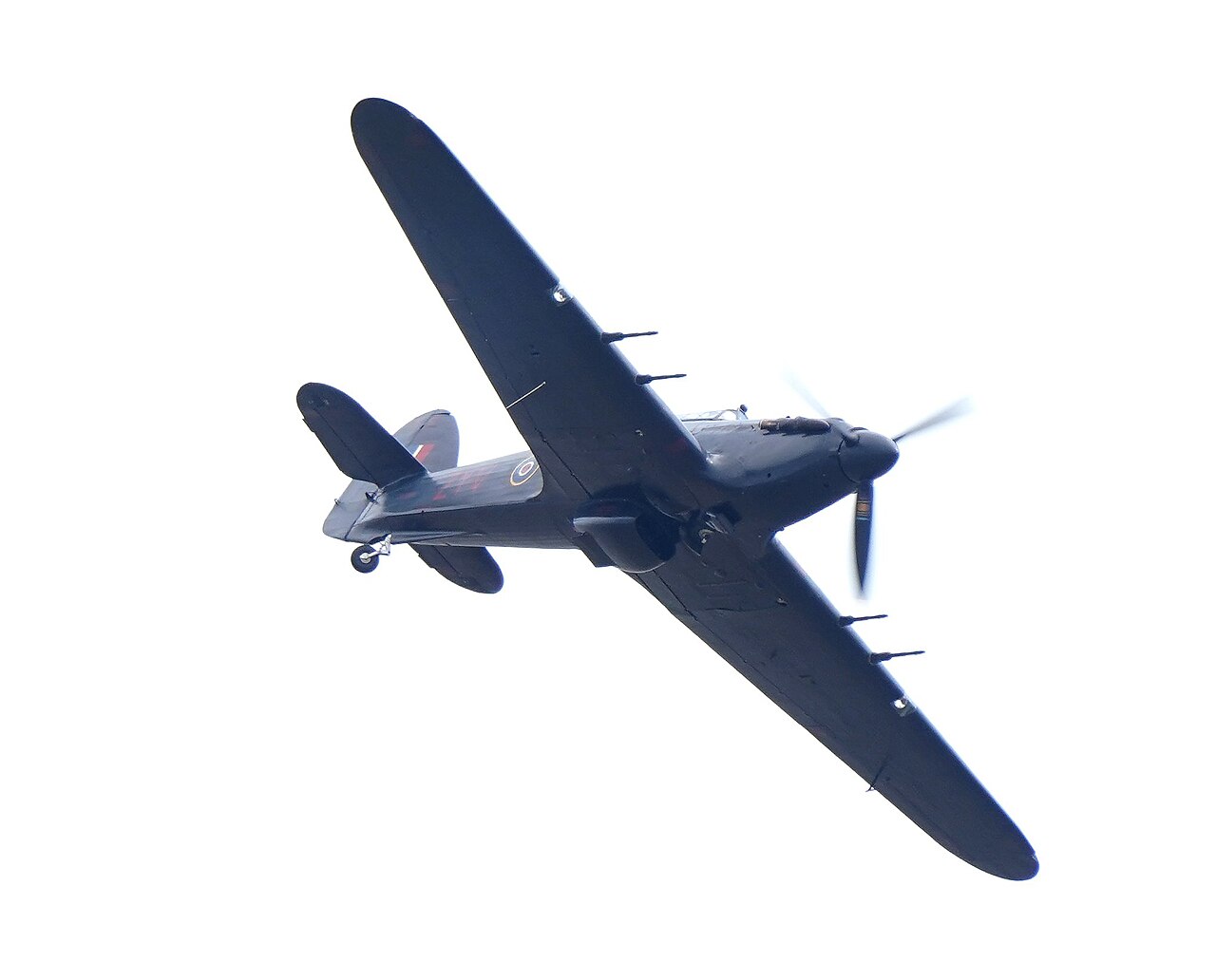
Total production is usually given as a little over 14,000 aircraft, with British output of around 12,700 and a further 1,400 or so built in Canada. Individual sources quote totals between roughly 14,200 and 14,600 depending on how conversions and sub-types are counted, so a round figure of “more than 14,000” is the safest way to state it. Either way, the Hurricane was built in larger numbers than any other British fighter of the war except the Spitfire.
Where the survivors are today
For an aircraft built in such numbers, very few Hurricanes survive, and fewer still fly. Estimates put the number of airworthy Hurricanes worldwide at somewhere between about a dozen and the high teens, with a larger number of static examples preserved in museums. The fabric-and-tube construction that made them easy to repair in wartime also meant that worn-out and damaged airframes were scrapped without sentiment once the war was over, and many simply rotted away.
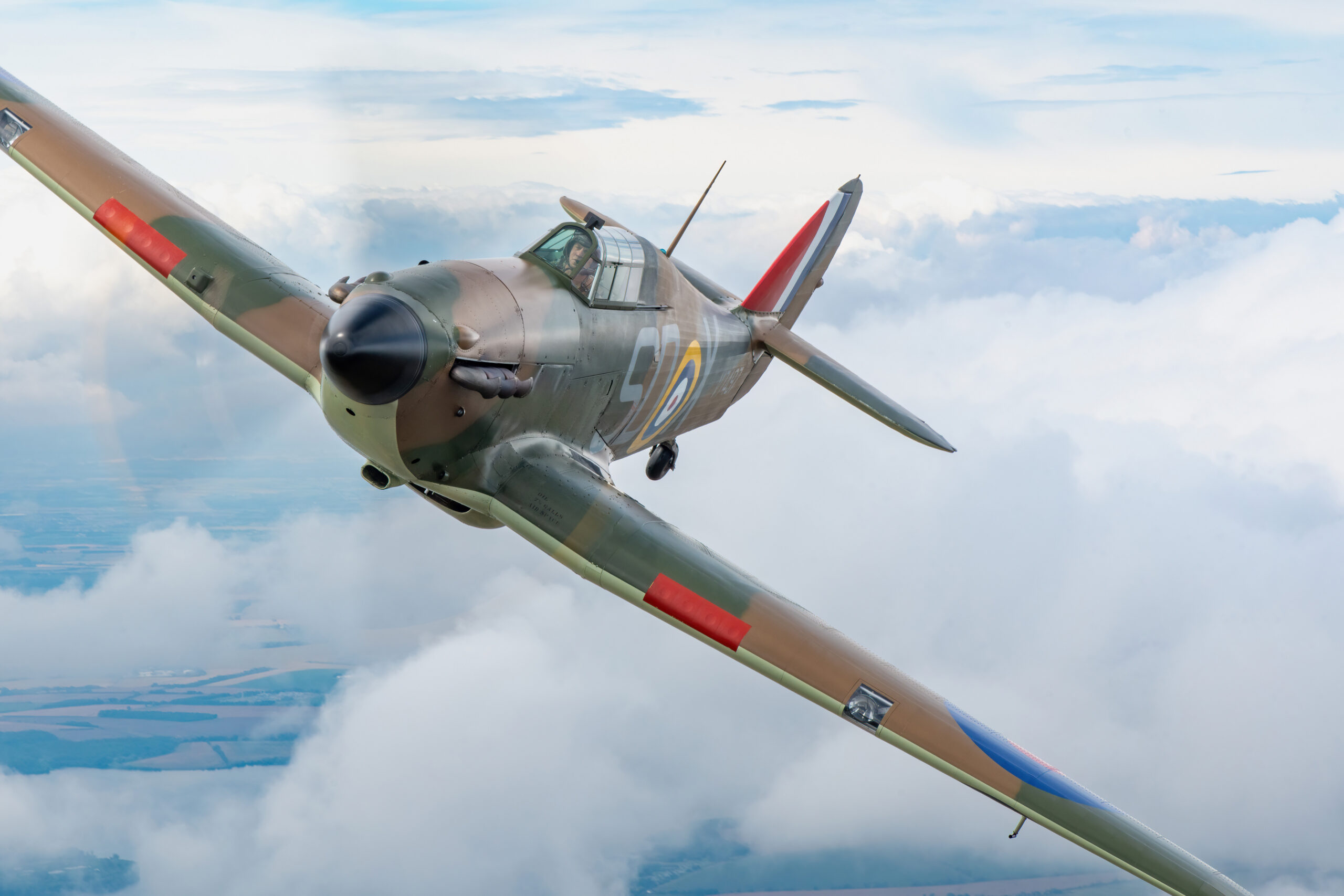
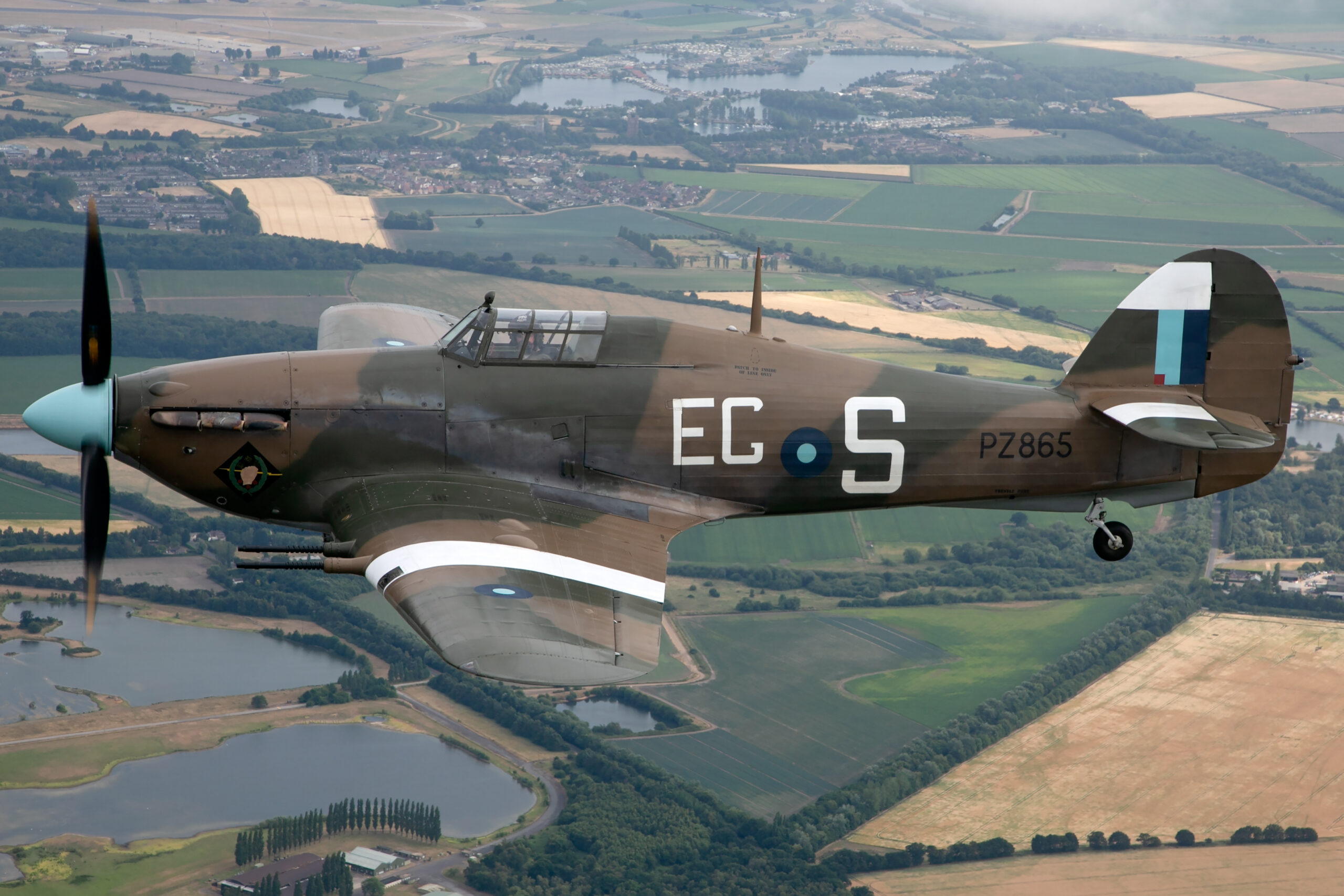
In Britain the most famous flying Hurricanes belong to the Royal Air Force’s Battle of Britain Memorial Flight, which operates two: LF363, often described as the last Hurricane to enter RAF service, and PZ865, the very last Hurricane of all to be built, which rolled out of the Hawker factory in 1944 and was named “The Last of the Many”. Both are Mk IIC aircraft and both appear at airshows and commemorative flypasts across the country, frequently alongside the Flight’s Spitfires and its Lancaster. Other airworthy Hurricanes are flown by private owners and warbird operators in the United Kingdom and abroad, and important static examples are held by the Royal Air Force Museum, the Imperial War Museum and the Smithsonian’s National Air and Space Museum, among others.
Seeing and photographing a Hurricane in the air is one of the highlights of the airshow season, and the type’s relative rarity makes it a prize for enthusiasts. If you want to make the most of the chance, our guide to photographing warbirds covers the settings and technique for capturing piston fighters in flight, and the Piemags aviation galleries include images of surviving wartime aircraft.
Notable pilots and squadrons
The Hurricane’s wartime story is also the story of the people who flew it, and several of the best-known names of 1940 did their fighting in Hurricanes rather than Spitfires.
The Polish squadrons
Among the most effective units in the Battle of Britain was No. 303 (Polish) Squadron, flying Hurricanes from RAF Northolt. Manned largely by experienced Polish airmen who had already fought the Luftwaffe over their own country, 303 became the top-scoring Fighter Command squadron of the battle despite joining the fighting late, in the closing weeks. The squadron’s wartime claims were very high, and even after the careful downward revision that historians apply to all combat claims, its verified score put it at or near the top of the table. The Poles flew with a controlled aggression that impressed and sometimes alarmed their British commanders, and their contribution did much to dispel any doubt about the value of the exiled airmen.
Josef František
The highest-scoring individual pilot of the Battle of Britain was not British but Czech: Sergeant Josef František, who flew a Hurricane attached to 303 Squadron. In the single month of September 1940 he was credited with 17 enemy aircraft destroyed, a remarkable total in so short a time. He was killed in a flying accident on 8 October 1940, at the very end of the battle, and remains one of its outstanding figures.
James Nicolson and the only Fighter Command VC
The only Victoria Cross awarded to RAF Fighter Command in the entire war went to a Hurricane pilot. On 16 August 1940 Flight Lieutenant James Nicolson of No. 249 Squadron was bounced by enemy fighters and his Hurricane was hit and set alight. As he prepared to bail out of the burning aircraft he saw an enemy fighter ahead, climbed back into the blazing cockpit and pressed home his attack before finally taking to his parachute, badly burned. For that action he received the Victoria Cross, the only one given to a pilot of Fighter Command during the Second World War.
Douglas Bader
The legless pilot Douglas Bader, who flew despite having lost both legs in a pre-war crash, commanded No. 242 Squadron, a largely Canadian Hurricane unit, during the Battle of Britain. Bader rebuilt the squadron’s morale and became a leading and controversial advocate of the “Big Wing” tactic of massing several squadrons together before engaging. His Hurricane is among the most recognisable individual aircraft of the period.
Legacy
The Hurricane’s reputation has always lived a little in the Spitfire’s shadow, and that is partly a matter of looks and partly a matter of timing. The Spitfire was the more advanced design, it stayed in front-line service and development right through the war and beyond, and its elliptical wing and its name simply caught the public imagination. The Hurricane, older in concept and overtaken as an interceptor by 1941, slipped quietly into the ground-attack and overseas roles and then into retirement.
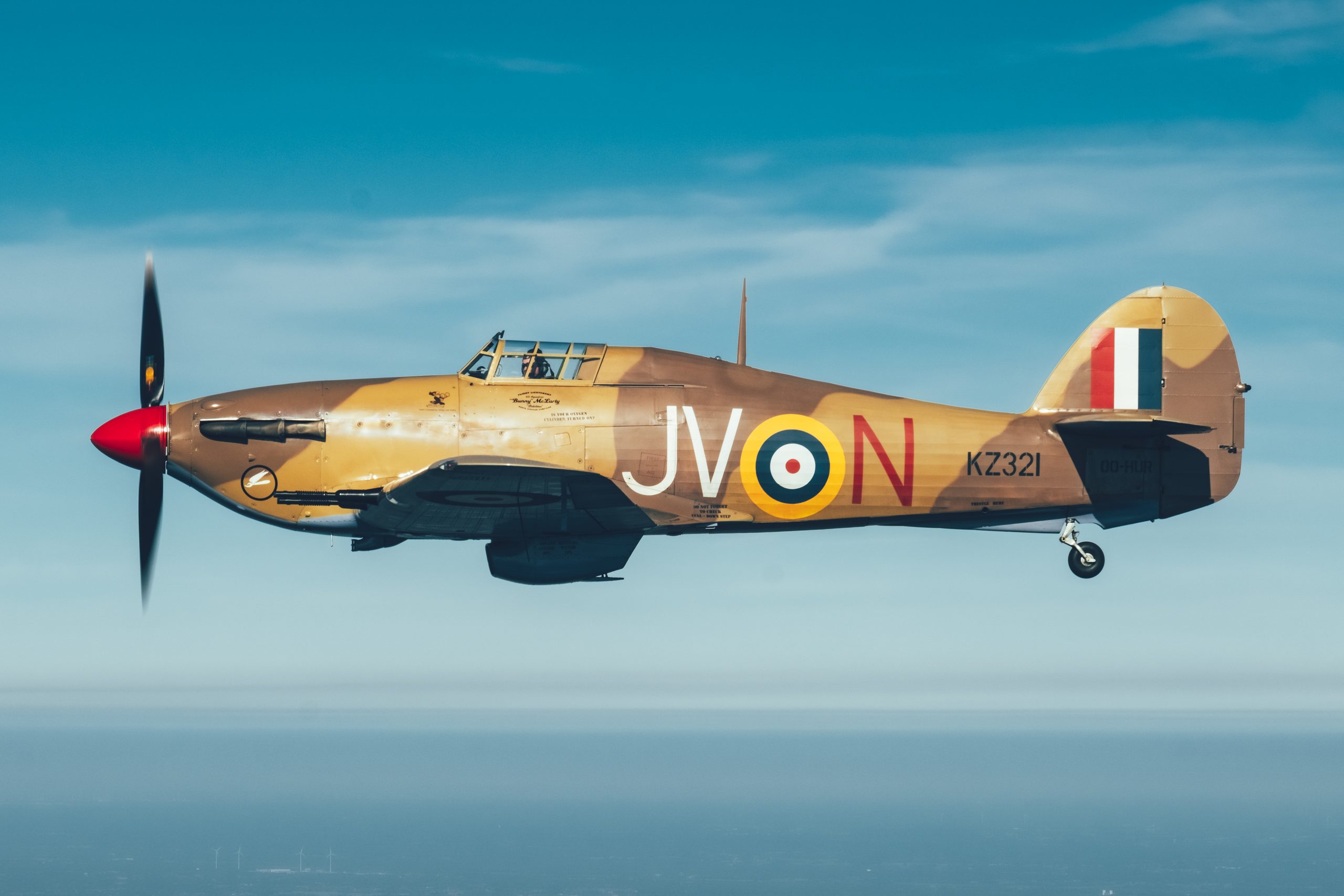
But the record is clear. In the one battle that mattered most, the Hurricane was there in the greatest numbers and did the greatest share of the fighting. It was available when the Spitfire was still arriving, it was rugged enough to keep flying through a long battle of attrition, and it was versatile enough to fight on every front from the Arctic to the tropics and from land bases to the decks of carriers. It was, in the plainest sense, the aircraft that did the job. The men who flew it knew its worth, and so did the ground crews who could put a damaged Hurricane back in the air with a few lengths of steel tube and a fresh skin of fabric.
To call it the forgotten hero of the Battle of Britain is fair, as long as the word hero is taken seriously. The Hurricane deserves to be remembered not as the Spitfire’s understudy but as its essential partner, the steady, dependable fighter that carried the heaviest load in the summer of 1940 and went on serving long after. It belongs in the same company as the other great aircraft of the war, the bombers and fighters whose stories we tell elsewhere, from the Avro Lancaster to the North American P-51 Mustang.
Frequently asked questions
Did the Hurricane or the Spitfire shoot down more aircraft in the Battle of Britain?
The Hurricane. Because there were more Hurricane squadrons and they were heavily engaged, Hurricanes were credited with the majority of the enemy aircraft destroyed during the battle, more than all other British defences combined. A figure of around 1,590 victories is often quoted, well over half the RAF total, though all wartime claims should be treated with caution because aircraft were frequently claimed by more than one pilot and later research has revised many figures.
When did the Hawker Hurricane first fly?
The prototype, serial K5083, made its first flight on 6 November 1935 at Brooklands, flown by Hawker’s chief test pilot George Bulman. That was around four months before the prototype Spitfire flew. The first production Hurricane I followed on 12 October 1937.
How many Hurricanes were built?
More than 14,000, with British production of around 12,700 and a further 1,400 or so built in Canada. Exact totals quoted by different sources range from roughly 14,200 to 14,600 depending on how conversions and sub-types are counted, which is why a round figure of “over 14,000” is the most reliable way to state it.
Why was the Hurricane covered in fabric?
It was a deliberate design choice by Sydney Camm, who built on Hawker’s established methods rather than the newer all-metal stressed-skin construction used by the Spitfire. The steel-tube frame with a fabric skin was strong, easy to build in workshops without advanced equipment, and easy to repair, because a damaged tube could be replaced by ground crew at the squadron. Bullets and shells could also pass through fabric without exploding. Later marks used metal-covered wings.
What was the Hurricane “Flying Can Opener”?
That was the Hurricane Mk IID, an anti-tank version armed with two 40 mm Vickers S cannon under the wings. The big guns could penetrate the armour of contemporary tanks, and the type was used mainly in North Africa against German and Italian armour and later in Burma. The low, slow attack runs needed to aim the guns made it vulnerable, but it was an effective tank killer.
Are there any airworthy Hurricanes left?
Yes, but only a small number, generally estimated at somewhere between about a dozen and the high teens worldwide, with more preserved as static museum exhibits. In Britain the Battle of Britain Memorial Flight operates two Mk IIC aircraft, LF363 and PZ865, the latter being the last Hurricane ever built. They are regular performers at airshows and commemorative events.
Which was the top-scoring squadron of the Battle of Britain?
No. 303 (Polish) Squadron, flying Hurricanes from RAF Northolt, is generally regarded as the top-scoring Fighter Command squadron of the battle, despite joining the fighting only in its closing weeks. It was manned largely by experienced Polish airmen who had already fought the Luftwaffe over their own country. Even after the downward revision historians apply to all wartime claims, its verified score put it at or near the top.
What was the Hurricane’s role compared with the Spitfire?
Fighter Command had more Hurricane squadrons than Spitfire squadrons, and controllers often tried to send the faster, higher-flying Spitfires against the German fighter escorts while the Hurricanes attacked the bombers. The Hurricane’s steady gun platform and battery of eight guns made it an effective bomber-destroyer. In practice the fighting was rarely so tidy, and Hurricane pilots fought Messerschmitt Bf 109s constantly.
Did any Hurricane pilot win the Victoria Cross?
Yes. The only Victoria Cross awarded to RAF Fighter Command in the entire war went to Flight Lieutenant James Nicolson of No. 249 Squadron. On 16 August 1940 his Hurricane was hit and set alight, and as he prepared to bail out he saw an enemy fighter ahead, climbed back into the burning cockpit and pressed home his attack before finally taking to his parachute, badly burned.
If you photograph the Hurricane or any of the surviving wartime fighters at a show this season, the Piemags galleries and licensing pages show how the images can be viewed and used. The forgotten hero is still flying, and it is always worth turning the lens on it.
