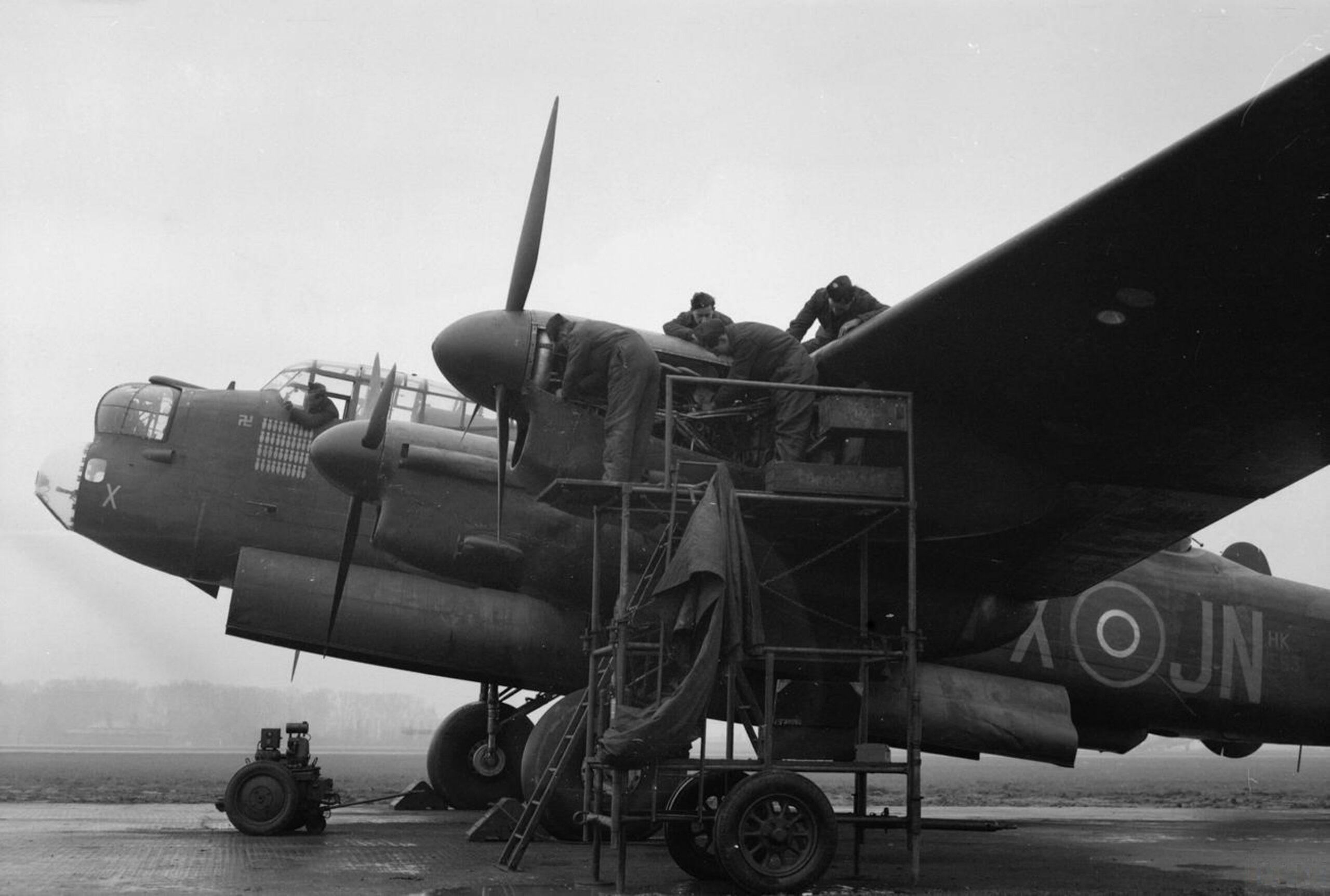
The Avro Lancaster is the aircraft most people picture when they think of RAF Bomber Command in the Second World War. It carried the heaviest bombs of the conflict, flew the most famous single raid of the bomber war, and dropped more tonnage than any other British aircraft of its day. What is less often remembered is that it began as a rescue job, salvaged from the wreckage of a twin-engined failure that nearly ended Avro’s reputation as a bomber maker.
This is the full story of the Lancaster: where it came from, how it was built, what it did in service, the special operations that made its name, the variants that flowed from it, and where the handful of survivors can be seen today. For a companion piece on the other great British aircraft of the period, see our complete history of the Supermarine Spitfire.
What this guide covers
- From failure to icon: the Manchester problem
- Design and engineering
- Into service
- The special operations
- Variants
- Specifications
- The wider war record
- Lancaster, Halifax and Stirling
- Operation Manna: bombs replaced by bread
- After the war
- Where the survivors are today
- Seeing and photographing the Lancaster today
- Bomber Command remembered
- Legacy
- Frequently asked questions
From failure to icon: the Manchester problem
The Lancaster did not start with a clean sheet. It grew directly out of the Avro Manchester, a twin-engined bomber designed by Roy Chadwick to meet Air Ministry Specification P.13/36. That 1936 specification asked for a twin-engined medium bomber for worldwide use, able to carry a torpedo internally and make shallow dive-bombing attacks. The Ministry encouraged the use of the Rolls-Royce Vulture, a large engine then in development. Avro’s submission was selected in February 1937, with Handley Page’s design kept as a backup, and a pair of prototypes was ordered that April.
The Manchester entered RAF service in November 1940. It was a sound airframe wrapped around a bad choice of engine. The Vulture, essentially two Peregrine V12 blocks joined on a common crankcase, proved unreliable and never delivered the power Avro needed. The result was a bomber that was underpowered and prone to engine failure. Only around 200 Manchesters were built and the type was withdrawn from front-line service in 1942 after a short and difficult career.
Chadwick’s four-engined answer
Avro’s escape from the Manchester’s problems was elegant in its simplicity. Rather than persevere with two troublesome Vultures, Chadwick reworked the design around four of the proven Rolls-Royce Merlin engines that already powered the Spitfire and Hurricane. The new aircraft took the Manchester’s fuselage and much of its structure, fitted a longer wing of greater span to carry the four engines, and kept faith with the basic layout. Early in the programme the design was known as the Manchester III before it became the Lancaster.
The change transformed the aircraft. Four reliable Merlins gave the power that two Vultures never could, and the longer wing gave the lift to match. Where the Manchester had been a liability, the Lancaster was, from its first flights, clearly something special. A decision was taken early to re-equip the twin-engined bomber squadrons with the new type as quickly as production allowed.
First flights and into production
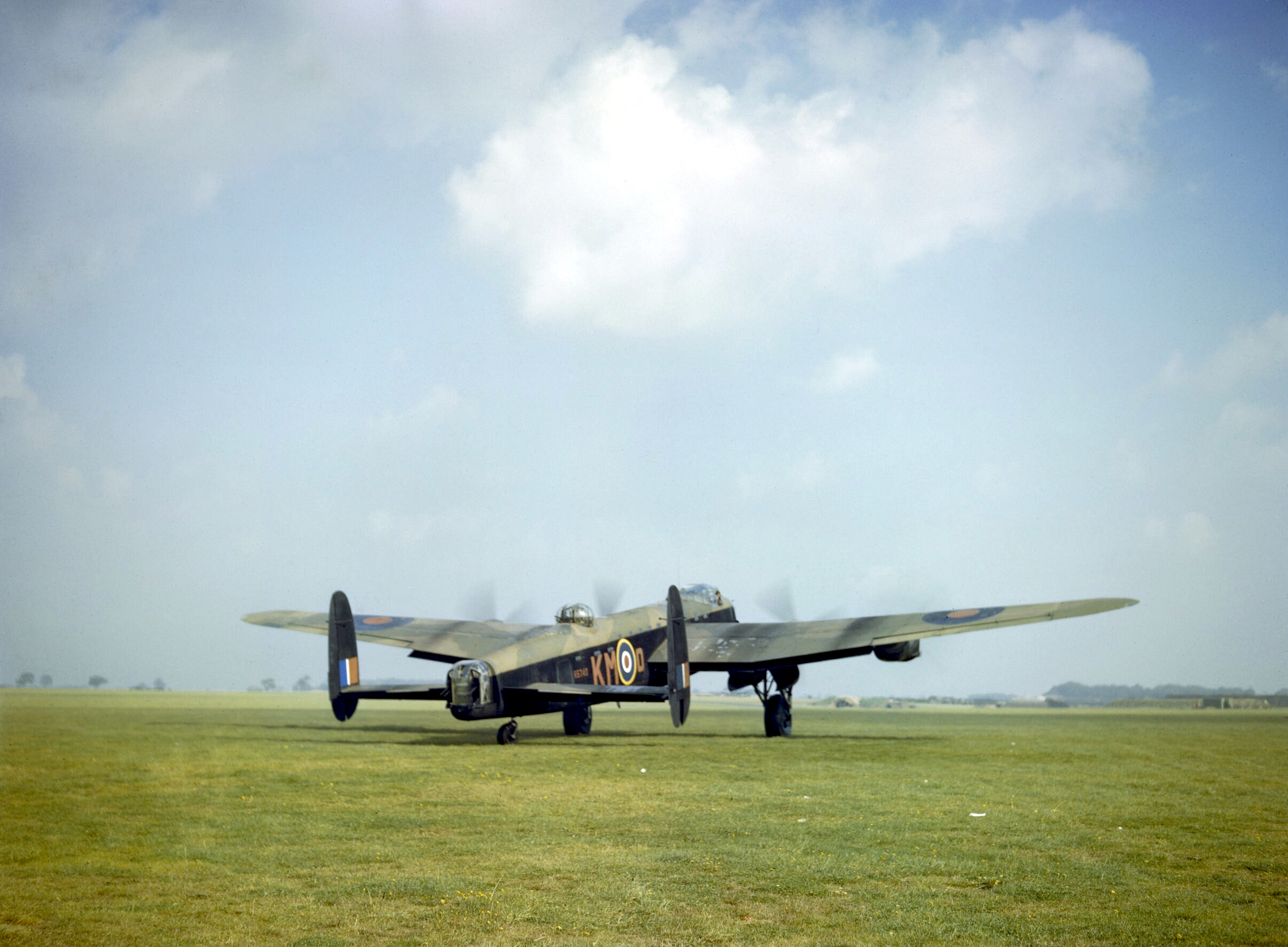
The prototype, BT308, first flew on 9 January 1941 from Ringway, near Manchester. It initially carried the Manchester’s three-finned tail, but this was revised on the second prototype, DG595, which adopted the larger elliptical twin-finned tail that became standard. The twin fins improved stability and gave the dorsal gun turret a better field of fire. The second prototype was also fitted with the more powerful Merlin XX engine. The first production aircraft, L7527, made its maiden flight in October 1941.
From there the programme grew quickly into one of the largest aircraft production efforts in British history. In total 7,377 Lancasters were built by six companies across ten factories on two continents, a figure that includes Canadian production. The aircraft soon overshadowed the other two RAF heavy bombers of the period, the Handley Page Halifax and the Short Stirling, to become the mainstay of the night bombing campaign over Europe.
Building the Lancaster
Producing 7,377 aircraft in wartime conditions was an industrial feat in its own right. The work was spread across a network of plants to guard against bombing and bottlenecks, with Avro’s own factories at Chadderton and Yeadon joined by Metropolitan-Vickers, Armstrong Whitworth, Austin Motors and Vickers-Armstrongs, and by Victory Aircraft in Canada. Six firms built the aircraft at ten factories on two continents. Major sub-assemblies were made in dispersed workshops and brought together for final assembly, and a large part of the workforce was made up of women, who took on skilled production jobs in numbers that would have been unthinkable a few years earlier. Components were largely interchangeable between marks, which made repair and the cannibalising of damaged airframes far simpler in the field. The Lancaster was, in that sense, a product of the whole wartime economy as much as of one drawing office.
Design and engineering
The Lancaster was a mid-wing, all-metal cantilever monoplane with a tailwheel undercarriage and the distinctive twin oval fins. Its virtues were not exotic. It was strong, roomy where it mattered, easy enough to fly for a heavy bomber, and built around a bomb bay that turned out to be one of the most important design features of the entire war.
The Merlin installation
Four Rolls-Royce Merlins gave the Lancaster its performance and its sound. Early aircraft used the Merlin XX rated at around 1,280 horsepower, and later marks used more powerful versions producing as much as 1,640 horsepower for improved take-off and altitude performance. When Merlin supply looked like it might become a bottleneck, a parallel version was developed using the Bristol Hercules radial, and a further large batch used Packard-built Merlins made under licence in the United States. The basic four-engined formula stayed constant throughout.
The bomb bay that changed the war
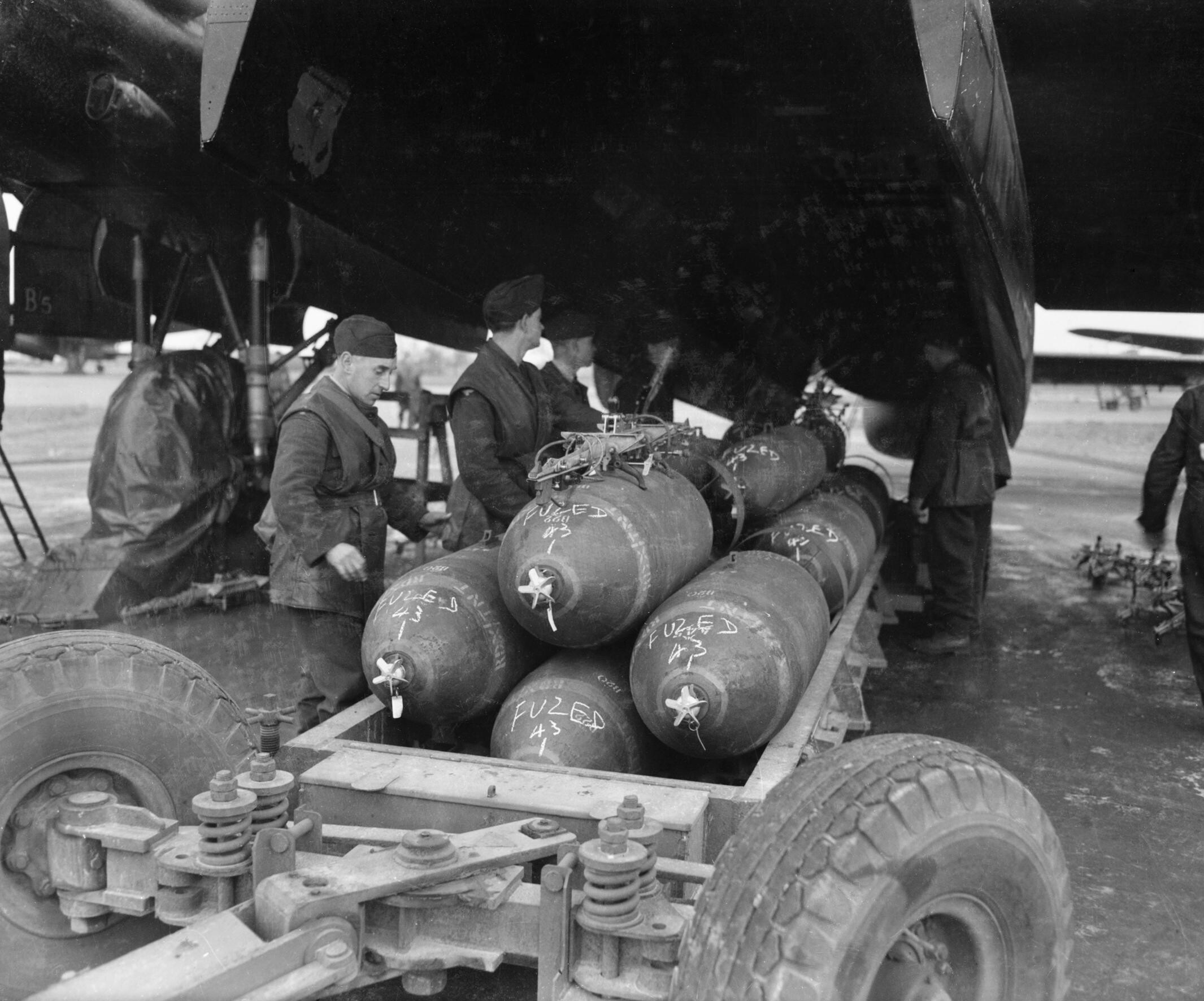
The single most consequential feature of the Lancaster was its bomb bay. It ran unobstructed for 33 feet along the belly of the aircraft, far longer and cleaner than the divided bays of rival designs. This is why the Lancaster, almost alone among Allied bombers, could be adapted to carry the largest weapons of the war.
At first the heaviest single bomb was the 4,000 lb High Capacity blast bomb, known as the “Cookie”. As the war went on, bulged bomb-bay doors were fitted to a proportion of aircraft to allow the 8,000 lb and later the 12,000 lb blockbusters to be carried. The same long bay later took the 12,000 lb Tallboy and finally the 22,000 lb Grand Slam earthquake bombs designed by Barnes Wallis. That 22,000 lb load was the largest carried by any bomber during the conflict. No other aircraft in RAF service could match the Lancaster’s ability to lift and deliver such weapons.
Crew, comfort and the escape-hatch problem
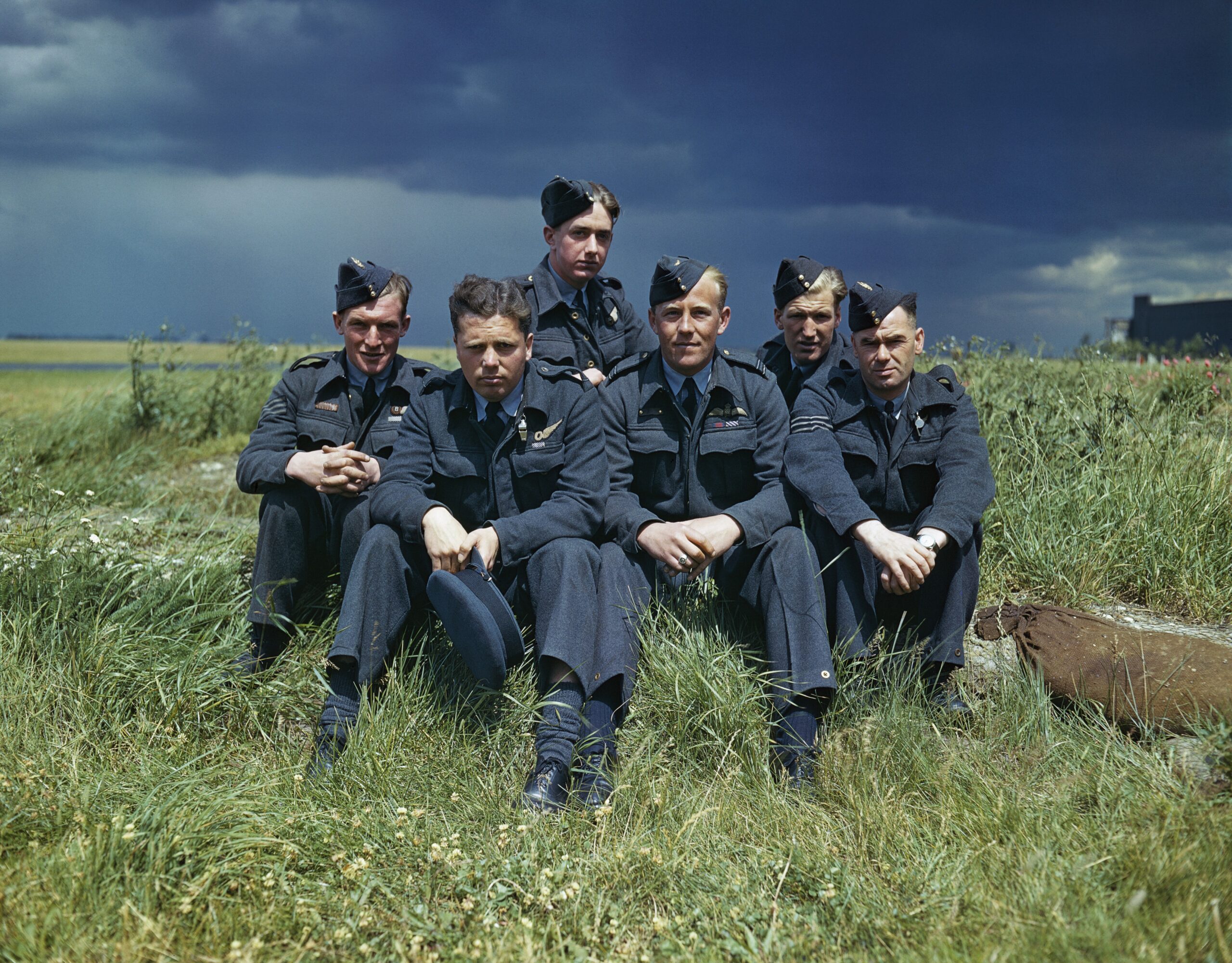
The standard crew was seven: pilot, flight engineer, navigator, bomb aimer, wireless operator, mid-upper gunner and rear gunner. The bomb aimer lay prone in the nose over the bombsight and could also man the front turret. The pilot sat on a raised portion of the floor on the left, with the flight engineer beside him on a folding seat. Almost all British bombers, unlike their American counterparts, were flown by a single pilot.
For all its strengths, the Lancaster had one serious and well-documented flaw. It was a hard aircraft to get out of in an emergency. The forward escape hatch measured only 22 inches by 26.5 inches, and the main wing spar formed a high obstacle across the fuselage that crew had to climb over to move fore and aft. Analysis carried out during the war found that only around 15 per cent of the crews of downed Lancasters managed to bail out successfully. In the Halifax and Stirling, which had a slightly wider hatch, the figure was nearer 25 per cent. In American bombers, flying daylight raids where the escaping crew could see more clearly, the rate was as high as 50 per cent. Attempts by Bomber Command’s Operational Research Section, which included the young physicist Freeman Dyson, to have the escape hatch enlarged were not successful. It is a sobering detail behind the aircraft’s heroic reputation.
Defensive armament
The Lancaster relied for defence on hydraulically operated Frazer Nash turrets, supplied by Nash and Thompson. There were normally three: a nose turret and a mid-upper turret each with two Browning .303 inch machine guns, and a tail turret with four. That gave eight rifle-calibre guns in total. A ventral, or under-fuselage, position was sometimes fitted but was frequently removed in service because it was felt to add little.
The .303 was light for the job. German night fighters increasingly attacked from below and behind with upward-firing cannon, where the Lancaster was weakest, and the rifle-calibre guns lacked the range and hitting power of the heavier weapons carried by some other aircraft. The Operational Research Section even argued that removing the turrets altogether would raise cruising speed enough to cut losses, since a faster, lighter bomber would be harder to intercept. The proposal was never adopted. The turrets stayed, more for crew morale and the deterrent value than for their actual effectiveness.
Into service
44 and 97 Squadrons lead the way
No. 44 (Rhodesia) Squadron at Waddington was the first unit to receive the Lancaster, taking its initial three aircraft on Christmas Eve 1941. The type’s first operational sortie came on 3 March 1942, a “Gardening” mine-laying mission off the German coast near Heligoland. The first crew losses followed soon after, on 24 March 1942, when an aircraft was lost to anti-aircraft fire over Lorient.
The Augsburg raid
The Lancaster announced itself to the public with a daring daylight operation. On 17 April 1942, twelve aircraft of Nos. 44 and 97 Squadrons flew a low-level daylight raid against the MAN diesel-engine works at Augsburg, deep in southern Germany. The factory built engines for U-boats, and the raid was meant to prove that precision attacks could be pressed home in daylight. The cost was severe. Seven of the twelve aircraft were lost. Squadron Leader John Nettleton of 44 Squadron, who led the raid and brought his aircraft home, was awarded the Victoria Cross. The operation showed both the Lancaster’s reach and the brutal arithmetic of daylight raids against a defended enemy, which is why Bomber Command kept the bulk of its effort to the cover of night.
The night offensive
Through 1942 the Lancaster remained in short supply, and squadrons often had to run their own conversion training because there were no dual-control trainers. As production caught up, the aircraft became the backbone of the night bombing campaign. By the end of 1942 around 16 operational squadrons were flying the type. It went on to take part in almost every major raid of the European bomber war, from the battles of the Ruhr and Hamburg to the long, costly campaign against Berlin. By the time of the Normandy landings in 1944, Bomber Command had a daily average strength of around 1,100 aircraft, of which more than 600 were Lancasters.
The Ruhr, Hamburg and Berlin
The Lancaster carried the weight of the major bomber battles of 1943 and 1944. In the Battle of the Ruhr through the first half of 1943 it struck the industrial towns of western Germany night after night, often through heavy flak and searchlight belts. In July 1943 came the attacks on Hamburg, Operation Gomorrah, where a combination of high explosive and incendiaries, helped by the first use of “Window”, the metal foil strips that blinded German radar, created a firestorm that devastated the city and killed tens of thousands of people. The raids on Hamburg showed both the destructive power that massed Lancasters could now deliver and the human cost of the area bombing strategy.
The Battle of Berlin, fought from late 1943 into the spring of 1944, was a longer and more grinding campaign. Arthur Harris believed that wrecking the German capital might end the war, and Lancasters flew the bulk of the deep, dangerous missions across occupied Europe to reach it. Berlin was not knocked out, and losses mounted as German night-fighter defences grew more effective. The campaign reached its grim low point on the night of 30 to 31 March 1944, the Nuremberg raid, when Bomber Command lost more than 90 aircraft in a single night, its heaviest loss of the war. Most of those lost were Lancasters and Halifaxes, and the raid is often cited as the moment when the limits of the night offensive became impossible to ignore.
Navigation, radar and the Pathfinders
Bombing accurately at night over a blacked-out continent was a problem the RAF never fully solved, but a series of aids made a real difference, and Lancasters carried most of them. Early radio navigation came from Gee, which let a navigator fix his position from pulses transmitted by ground stations. Later came H2S, a ground-mapping radar carried in a blister under the fuselage that gave crews a rough radar picture of the terrain and coastlines below, useful when cloud hid the target. To concentrate the bombing, the RAF formed the Pathfinder Force, which flew ahead of the main stream to find and mark the aiming point with coloured target indicators. Lancasters served in the Pathfinder squadrons as well as in the main force, and the marking technique, for all its imperfections, turned scattered raids into something far more concentrated. The constant contest between these aids and the German defences shaped the whole night campaign.
Life on board
For the seven men inside, a Lancaster operation meant many hours of cold, noise and tension. The aircraft was unheated in any real sense, and at altitude in winter temperatures fell far below freezing, so crews wore heavy sheepskin and electrically heated suits and breathed oxygen through masks. The gunners, isolated in their turrets at the extremities of the aircraft, had the loneliest and often the most dangerous stations, scanning the dark for the fighter that might already be lining up from below. The journey to a target such as Berlin and back could last the better part of eight or nine hours, much of it over hostile territory, with the ever-present risk of flak, fighters, collision in the bomber stream, or simple mechanical failure. The statistics of Bomber Command tell the rest: a tour was 30 operations, and for long periods a crew’s chances of completing one were slim. That context is part of any honest account of the aircraft.
The special operations
The Lancaster’s versatility made it the natural choice whenever Bomber Command needed an aircraft to do something out of the ordinary. Three operations in particular sealed its fame.
Operation Chastise: the Dambusters
On the night of 16 to 17 May 1943, No. 617 Squadron, formed less than two months earlier and led by Wing Commander Guy Gibson, attacked the dams of the Ruhr valley in Operation Chastise. The weapon was Barnes Wallis’s “Upkeep”, a cylindrical mine of around 9,250 lb that was spun backwards and released at low level to skip across the water, roll down the face of a dam, and explode at depth against the wall. The Lancaster was the only aircraft capable of carrying it. The aircraft used were modified B.III Specials, officially the Type 464 Provisioning, with the bomb-bay doors removed, the mid-upper turret taken out, and special gear fitted to spin and release the weapon. Two Aldis lights were angled so that their beams met on the water at exactly 60 feet, giving the crews a simple way to judge the correct release height.
Nineteen aircraft set out, flying most of the way at very low level to avoid detection. The Mohne and Eder dams were breached, sending huge volumes of water down the valleys below. The Sorpe, an earthen dam of different construction, suffered only minor damage. The cost was heavy: eight of the nineteen aircraft were lost, 53 of the 133 aircrew were killed and three were taken prisoner. On the ground the flooding killed around 1,300 people, many of them forced labourers and prisoners in camps downstream. Gibson was awarded the Victoria Cross. The raid’s actual effect on German war production was limited and short-lived, and historians still debate its strategic value, but as a feat of flying and a boost to morale it was without equal, and it gave 617 Squadron a reputation it never lost.
Tallboy, Grand Slam and the Tirpitz
After the dams raid, 617 Squadron converted to high-altitude precision bombing in readiness for Barnes Wallis’s earthquake bombs. The first of these was the 12,000 lb Tallboy, a streamlined deep-penetration weapon designed to bury itself in the ground or strike near a hardened target and bring it down with the shock wave. Lancasters of 617 and 9 Squadrons used Tallboys against U-boat pens, V-weapon sites and railway viaducts.
The most celebrated of these attacks was against the German battleship Tirpitz, lying in the Norwegian fjords. In a series of operations codenamed Paravane, Obviate and Catechism, Tallboy-armed Lancasters disabled and finally, in November 1944, capsized the ship. The Tirpitz had tied down Allied naval resources for years, and its destruction by heavy bombers was a striking demonstration of what the Lancaster and its special weapons could achieve.
The largest weapon of all was the 22,000 lb Grand Slam, a scaled-up Tallboy and the heaviest conventional bomb used in the war. Around 32 Lancaster B.Is were specially modified to carry it, with the dorsal turret removed, armour stripped out and uprated Merlin 24 engines fitted for take-off. The first operational Grand Slam was dropped by a 617 Squadron Lancaster in March 1945, against the Bielefeld railway viaduct, which collapsed where earlier conventional bombing had failed.
Special equipment and bomb loads
The Lancaster carried an unusually wide range of weapons, and crews planned loads to suit the target. There were named combinations for different jobs: an “Arson” load of incendiaries for area attacks, a “Cookie” load built around the 4,000 lb blast bomb, a “Gardening” load of parachute sea mines, and a “No-Ball” load for V-1 launch sites, among others. Beyond bombs, some Lancasters carried specialist electronics. Aircraft of No. 101 Squadron were fitted with Airborne Cigar, a German-speaking extra crewman and jamming equipment used to disrupt enemy night-fighter control. The kit made the aircraft trackable by the enemy, and 101 Squadron suffered one of the highest loss rates of any unit as a result.
Variants
The Lancaster was produced in several marks, most of which differed mainly in their engines and place of manufacture. The airframe itself changed surprisingly little.
- Lancaster B.I: the main British-built mark, powered by Rolls-Royce Merlin engines. The majority of squadrons flew this version, and most of the surviving aircraft are B.Is.
- Lancaster B.II: a version powered by the Bristol Hercules air-cooled radial rather than the Merlin, built as insurance against any interruption in Merlin supply. Around 300 were produced by Armstrong Whitworth. They were a stop-gap and did not stay in front-line service as long as the Merlin marks.
- Lancaster B.III: identical to the B.I in almost every respect but fitted with Packard-built Merlins made under licence in the United States. The two were built side by side and were hard to tell apart externally. The Dambusters’ modified aircraft were based on the B.III.
- Lancaster B.X: the Canadian-built version, produced by Victory Aircraft at Malton, Ontario, with Packard Merlins and American-style instruments and electrics. Around 430 were built, and several survivors, including the airworthy Canadian aircraft, are of this mark.
- Specials: the B.III Special (Type 464 Provisioning) for the dams raid, and the B.I Special modified for the Grand Slam.
- Post-war reconnaissance marks: photo-reconnaissance PR.1 and maritime reconnaissance MR.1 aircraft served on into the late 1940s and early 1950s.
The basic design also gave rise to a family of later aircraft. The Avro Lincoln, originally the Lancaster IV and V, was a bigger and longer-ranged development. The Lancastrian was a civil airliner conversion with the turrets faired over and seats fitted. The York was a transport built on Lancaster wings and tail with a new square-section fuselage, and the line ran on through the Lincoln to the Shackleton maritime patrol aircraft, which served the RAF into the 1990s. Few wartime designs proved so adaptable.
Specifications
The figures below are for the standard Lancaster B.I. Performance varied between marks and with the engine fit, the load carried and the equipment of individual aircraft, so these are best read as representative rather than absolute.
| Feature | Detail |
|---|---|
| Role | Four-engined heavy night bomber |
| Manufacturer | A.V. Roe and Co. (Avro), plus partner firms |
| Designer | Roy Chadwick |
| First flight (prototype) | 9 January 1941 |
| Entered RAF service | Early 1942 (No. 44 Squadron, first sortie 3 March 1942) |
| Crew | Seven |
| Length | Approximately 69 ft 4 in (21.18 m) |
| Wingspan | 102 ft (31.09 m) |
| Powerplant | Four Rolls-Royce Merlin V12 engines |
| Power (Merlin XX) | Around 1,280 hp each; later marks up to about 1,640 hp |
| Maximum speed | Around 282 mph (454 km/h) |
| Bomb bay | 33 ft (10 m) long, unobstructed |
| Heaviest bomb carried | 22,000 lb (10,000 kg) Grand Slam (specially modified aircraft) |
| Defensive armament | Eight .303 in Browning machine guns in three turrets (nose 2, mid-upper 2, tail 4) |
| Total built | 7,377 (all marks, two continents) |
A note on numbers: aviation references differ slightly on figures such as service ceiling, range and exact top speed, because these depend heavily on the variant and the load. Where this guide gives an approximate figure, that reflects genuine variation in the sources rather than a single agreed value.
The wider war record
The scale of the Lancaster’s contribution is best seen in the totals. Between 1942 and 1945 the type flew around 156,000 sorties and dropped roughly 608,612 long tons of bombs. The cost was equally large: 3,249 aircraft were lost in action, and the loss of so many seven-man crews lies behind the bald statistics. Only 35 individual Lancasters completed more than 100 operations. The most successful of all flew 140 operations before being retired and scrapped in 1947, a survival record that says as much about luck as about the aircraft.
The Lancaster was admired even by its enemies. Adolf Galland, who commanded the Luftwaffe’s fighter arm, rated it the best night bomber of the war. Arthur Harris, who led Bomber Command, called it his command’s “shining sword”. Those judgements have to be set against the moral weight of the area bombing campaign the aircraft served, which remains one of the most argued-over chapters of the war. The Lancaster was a tool of exceptional capability used in a campaign whose methods and results are still debated. Both things are true at once.
Lancaster, Halifax and Stirling
The Lancaster did not fight alone. Bomber Command’s heavy force rested on three four-engined types, and the differences between them explain a good deal of why the Lancaster came to dominate. The Short Stirling was the first of the trio into service, but it was hobbled by a design requirement that limited its wingspan, which capped its ceiling and meant it flew lower and was more exposed to flak and fighters. Its divided bomb bay could not take the large blast bombs. The Stirling was progressively withdrawn from main-force bombing and moved to glider towing, transport and special-duties work.
The Handley Page Halifax was a closer match and served right through the war in large numbers, including with Canadian and other Commonwealth squadrons. Early Halifaxes had performance and handling problems, though later marks with Bristol Hercules radial engines were much improved and well liked. Even so, the Halifax generally carried a smaller bomb load than the Lancaster and could not take the heaviest weapons. The Lancaster’s combination of ceiling, load and that long bomb bay gave it the edge that mattered most to Bomber Command’s planners, which is why it received priority and ended the war as the senior partner. It is worth remembering, though, that the Halifax crews flew the same dangerous skies and that the survival rate from a stricken Halifax was actually better than from a Lancaster.
Operation Manna: bombs replaced by bread
One of the Lancaster’s last wartime tasks was among its most humane. In the final weeks of the war, large areas of the western Netherlands were close to starvation under German occupation, in what the Dutch remember as the Hunger Winter. In Operation Manna, flown from late April 1945, RAF Lancasters dropped food rather than bombs to the Dutch population, with the tacit agreement of the occupying German forces who held their fire. Thousands of sorties were flown, and the aircraft that had carried Cookies and Tallboys over the Reich now flew low over Dutch fields releasing sacks of flour and tins of food. For many Dutch people of that generation, the sight of low-flying Lancasters became a memory of rescue rather than of war.
After the war
The Lancaster stayed in RAF service for several years after 1945, gradually replaced by its own descendant, the Avro Lincoln. The last Bomber Command Lancaster was retired in December 1953, and the very last RAF examples, used for maritime and photo-reconnaissance, soldiered on a little longer into the mid-1950s. Surplus aircraft found new owners abroad. France’s Aeronavale operated overhauled Lancasters into the 1960s in the maritime patrol and air-sea rescue roles, flying from bases in France and New Caledonia. Argentina and Canada also operated the type post-war, the Royal Canadian Air Force using modified aircraft for reconnaissance and maritime work for many years.
Where the survivors are today
For an aircraft built in such numbers, very few Lancasters remain. Of the 7,377 built, only around 17 largely complete examples survive worldwide, scattered across museums in Britain, Canada, Australia and elsewhere. Of those, just two are maintained in flying condition, and with PA474 stripped down only Canada’s FM213 is currently able to fly, and seeing either of them fly is a rare event.
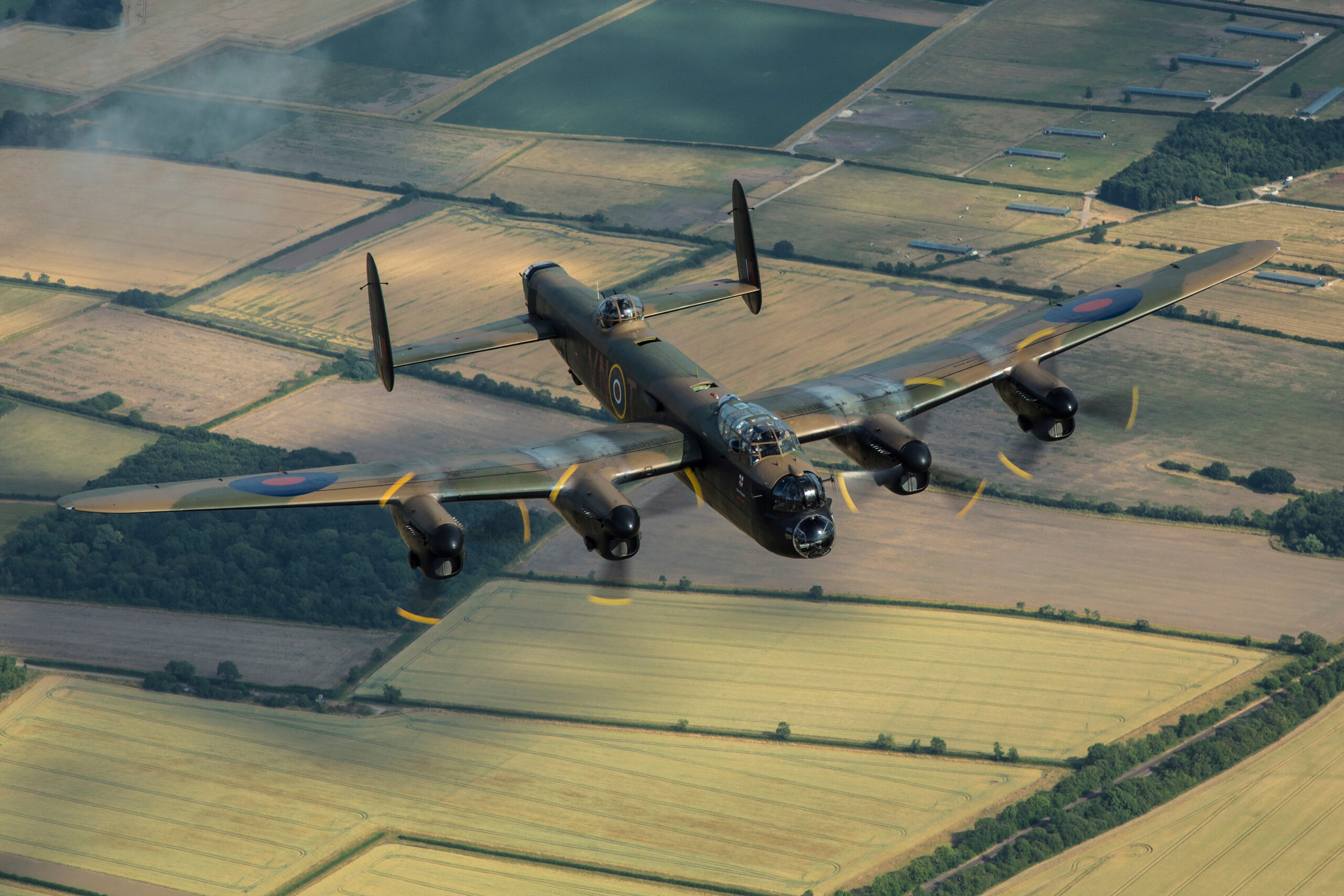
PA474, the Battle of Britain Memorial Flight
PA474 is the better known of the two flyers in Britain. It was built as a B.I by Vickers-Armstrongs at Broughton, near Chester, in 1945, too late for wartime operations. After post-war service in trials and reconnaissance work it was adopted as a flying memorial and is now operated by the Royal Air Force’s Battle of Britain Memorial Flight from RAF Coningsby in Lincolnshire. It normally appears at airshows and commemorations across the country alongside the Flight, though it is grounded for a major overhaul at Duxford that will keep it out of the 2026 season and is not expected to fly again before 2027’s Spitfires and Hurricanes, and it is the only Lancaster flying in Europe.
FM213, “Vera”, the Canadian Lancaster
The world’s only other airworthy Lancaster is FM213, a Canadian-built B.X registered C-GVRA and known affectionately as “Vera”. Built by Victory Aircraft at Malton, Ontario, in 1945, it is operated by the Canadian Warplane Heritage Museum at Mount Hope near Hamilton, Ontario, and returned to flight on 24 September 1988 after a long restoration. It is flown as the Mynarski Memorial Lancaster, honouring Pilot Officer Andrew Mynarski, a Canadian air gunner awarded a posthumous Victoria Cross. In 2014 Vera crossed the Atlantic to tour Britain and fly alongside PA474, the only time in decades that two airworthy Lancasters were seen in the air together.
S for Sugar and G for George
Two static survivors stand out for their wartime records. R5868, “S for Sugar”, preserved at the Royal Air Force Museum, was the first RAF heavy bomber to complete 100 operations and went on to fly 137 sorties, one of the highest totals of any RAF bomber, serving with Australian-manned squadrons from Waddington. Painted on its nose was the boast, borrowed from Hermann Goering, that no enemy aircraft would fly over Reich territory. The other is W4783, “G for George”, which flew 90 operations with No. 460 Squadron of the Royal Australian Air Force before being flown to Australia, where it is now a centrepiece of the Australian War Memorial in Canberra. Both aircraft are reminders that behind the type’s collective record lie individual airframes and the crews who trusted their lives to them.
Just Jane and the ground runners
A third aircraft, NX611 “Just Jane”, is kept at the Lincolnshire Aviation Heritage Centre at East Kirkby. It is not currently airworthy but taxis under its own power for visitors, and a long-running restoration aims one day to return it to flight, which would make three flyable Lancasters in the world. Other complete survivors are preserved statically, including R5868 at the Royal Air Force Museum in London, with the nose section of DV372 on show at the Imperial War Museum, and examples in Canada and Australia. Each one is now a carefully guarded link to a vanished fleet.
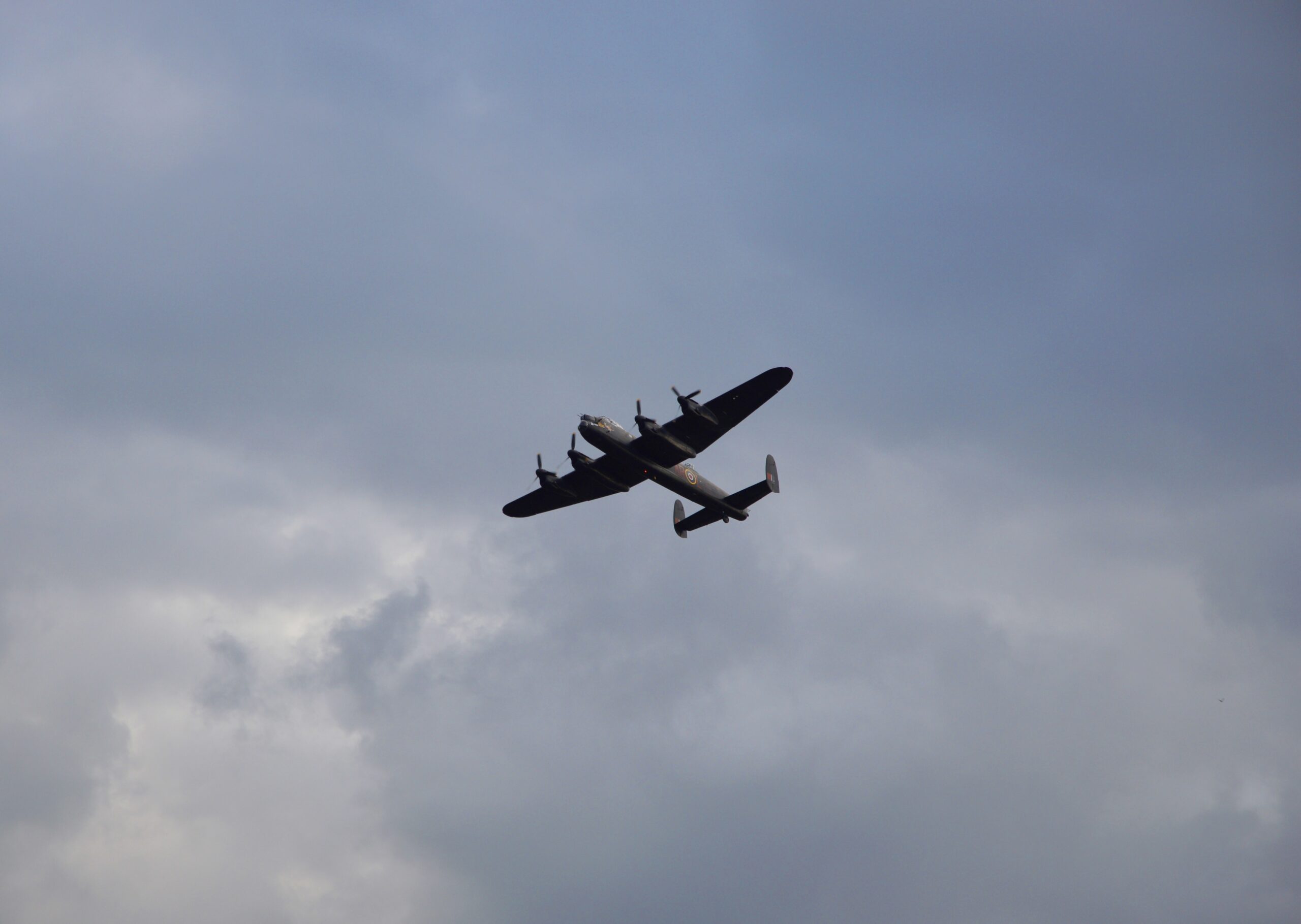
Seeing and photographing the Lancaster today
Because so few Lancasters remain and only one flies in Europe, a flying display by PA474 is normally one of the highlights of the British airshow season, though the aircraft is in deep maintenance and will not display in 2026. The Battle of Britain Memorial Flight publishes its display schedule each year, and the aircraft also appears at major commemorations and flypasts, often with the Flight’s Spitfires and Hurricanes. For anyone who wants to see a Lancaster up close on the ground rather than in the air, the taxi runs of NX611 “Just Jane” at East Kirkby are a rare chance to feel four Merlins running, and the static survivors at the Royal Air Force Museum and elsewhere allow a closer look at the airframe and its turrets.
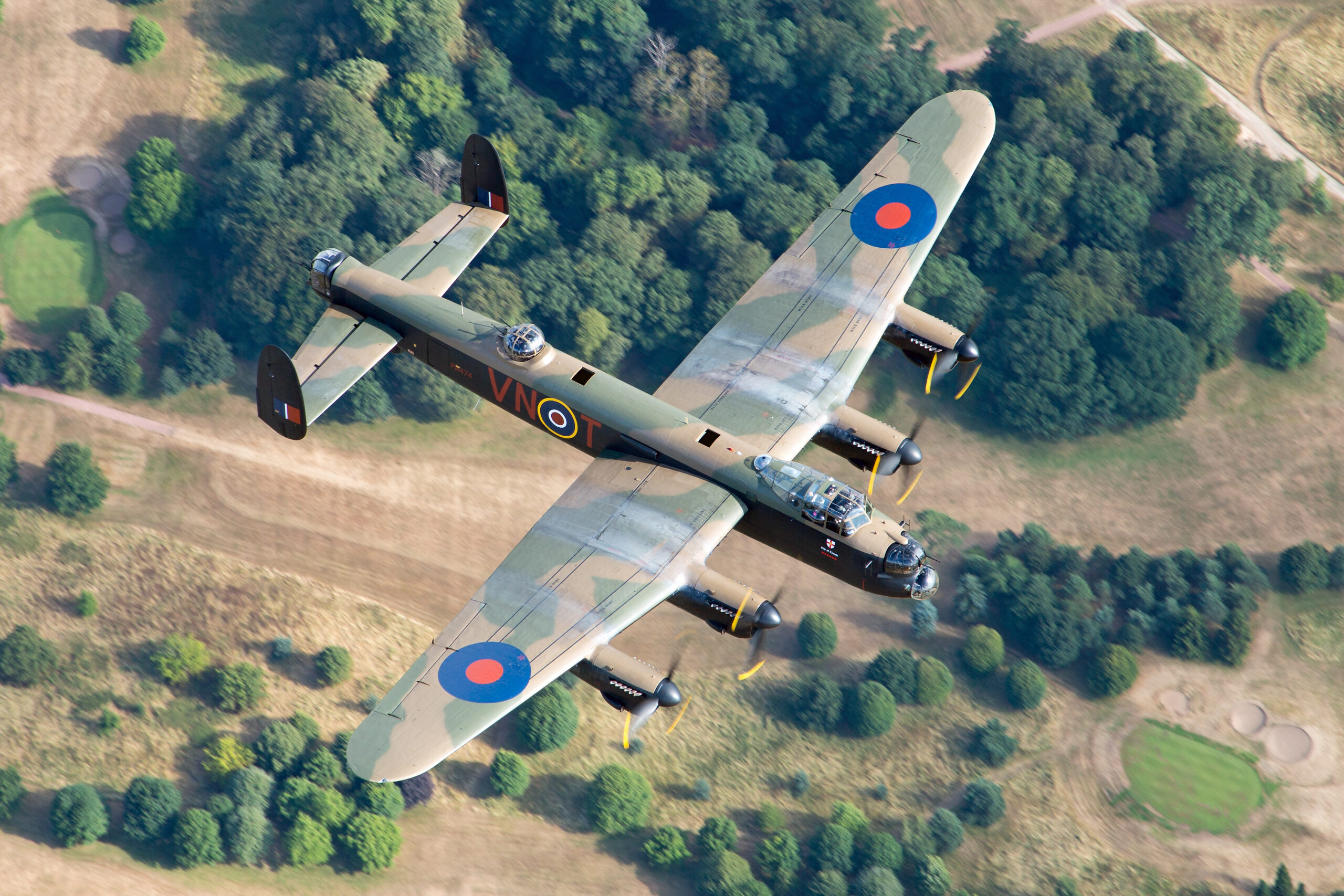
The Lancaster is a demanding photographic subject precisely because of what makes it special. Those four propellers need to be caught with some blur to convey that the engines are turning, which means resisting the urge to freeze everything with a very high shutter speed. A slower speed and a smooth panning action give the sense of movement that a frozen disc cannot, and getting the balance right takes practice, as set out in our guide to the right shutter speed for propeller aircraft. The slow, deliberate passes of a heavy bomber are in some ways more forgiving than a fast jet, but the size of the aircraft and the need to keep the whole airframe sharp while the props blur reward the same careful tracking covered in our airshow photography tips. Historic images of Lancasters and other classic aircraft can be found in the Piemags archive galleries, and prints or editorial use are covered on the licensing page.
Bomber Command remembered
No account of the Lancaster is complete without the human ledger behind it. A total of 55,573 aircrew of RAF Bomber Command were killed during the Second World War, drawn from Britain, Canada, Australia, New Zealand, Poland, Czechoslovakia and many other nations. They were overwhelmingly young men, and the loss rate among bomber crews was among the highest of any branch of the wartime forces. For decades after the war these men received no dedicated national memorial, in part because the area bombing campaign had become a subject of unease. That was finally put right in June 2012, when the RAF Bomber Command Memorial was unveiled in Green Park in London, its bronze sculpture by Philip Jackson showing seven airmen, a full Lancaster crew, returned from an operation. The aircraft and the men who flew it are bound together in that memory, and the surviving Lancasters serve as the most tangible link to them. It is part of why, as we argue in our piece on why aviation history still matters, these machines are worth recording and remembering.
Legacy
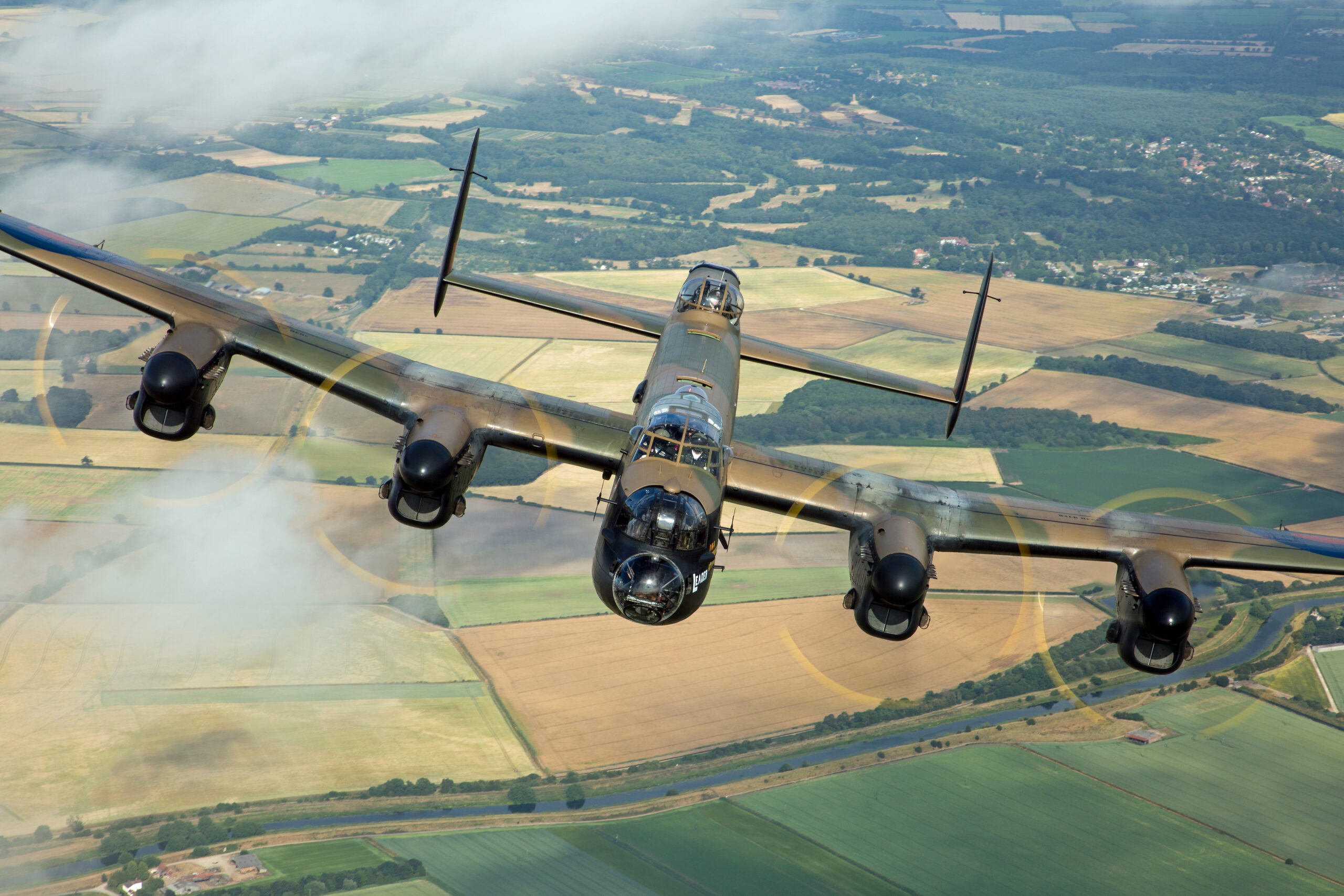
The Lancaster’s reputation rests on a combination of things that few other aircraft managed at once: reliability, lifting power, and a structure that designers could adapt to carry weapons no one had imagined when the aircraft was drawn up. It was not the fastest or the highest-flying bomber of the war, and its defensive armament and escape provisions were real weaknesses that cost lives. But it could be sent against almost any target, from a city to a single battleship to a railway viaduct, and stood a fair chance of bringing the weapon to bear.
Today the Lancaster occupies a particular place in British memory, tied up with the Dambusters film, the sound of four Merlins over a summer airshow, and the quieter act of remembrance for the men of Bomber Command who did not return. When PA474 flies past at a commemoration, it carries all of that with it. For photographers, the Lancaster remains one of the most rewarding and most demanding warbird subjects of all, a four-engined heavy whose slow, deliberate passes reward careful panning and a feel for propeller blur.
The Lancaster’s heaviest single weapon, the 12,000 lb Tallboy, was used against the German battleship Tirpitz in November 1944. That operation, and the three years of failures before it, are covered in the guide to the Tirpitz raid.
Frequently asked questions
How many Avro Lancasters were built?
A total of 7,377 Lancasters were built across all marks, by six companies at ten factories in Britain and Canada. Despite that large number, only around 17 largely complete examples survive today.
How many Lancasters are still flying?
Two. PA474, operated by the Royal Air Force’s Battle of Britain Memorial Flight in England, and FM213 “Vera”, operated by the Canadian Warplane Heritage Museum in Ontario. A third aircraft, NX611 “Just Jane” at East Kirkby, taxis under its own power and is the subject of a long-term restoration towards flight.
What made the Lancaster special compared with other bombers?
Its long, unobstructed 33-foot bomb bay. That single feature let it carry the heaviest bombs of the war, from the 4,000 lb Cookie up to the 12,000 lb Tallboy and the 22,000 lb Grand Slam, weapons that no other RAF aircraft could lift. Combined with four reliable Merlin engines, it gave Bomber Command a heavy bomber of unusual flexibility.
What was the Dambusters raid?
Operation Chastise, flown on the night of 16 to 17 May 1943 by No. 617 Squadron, attacked the Ruhr dams with Barnes Wallis’s “Upkeep” bouncing bomb. The Mohne and Eder dams were breached. Eight of the nineteen Lancasters were lost and 53 of the 133 aircrew were killed. Wing Commander Guy Gibson, who led the raid, was awarded the Victoria Cross.
Why did the Lancaster grow out of the Avro Manchester?
The Manchester was a capable airframe ruined by its unreliable, underpowered Rolls-Royce Vulture engines. Roy Chadwick reworked the design around four proven Merlins on a longer wing. The result, first flown in January 1941, was the Lancaster, and it succeeded everywhere the Manchester had struggled.
Was the Lancaster a safe aircraft to fly?
It was a sound and well-liked aircraft to fly, but it was difficult to escape from in an emergency. Its small forward escape hatch and the high main spar across the fuselage meant that only about 15 per cent of the crews of downed Lancasters bailed out successfully, against roughly 25 per cent in the Halifax and Stirling. Efforts to enlarge the hatch during the war were not adopted.
What was the heaviest bomb the Lancaster could carry?
The Lancaster’s long, unobstructed bomb bay allowed it to carry the largest bombs of the war. Specially modified aircraft carried the 22,000 lb Grand Slam earthquake bomb designed by Barnes Wallis, the heaviest conventional bomb used in the conflict. The same bay also took the 12,000 lb Tallboy and the 4,000 lb Cookie blast bomb, weapons no other RAF aircraft could lift.
How many crew did a Lancaster carry?
The standard crew was seven: pilot, flight engineer, navigator, bomb aimer, wireless operator, mid-upper gunner and rear gunner. The bomb aimer lay prone in the nose over the bombsight and could also man the front turret. Unlike most American heavy bombers, the Lancaster was flown by a single pilot.
How did the Lancaster sink the battleship Tirpitz?
Lancasters of Nos. 617 and 9 Squadrons attacked the German battleship in the Norwegian fjords with 12,000 lb Tallboy bombs in a series of operations. After earlier raids caused damage, a strike in November 1944 finally capsized the ship. The Tirpitz had tied down Allied naval forces for years, and its destruction showed what the Lancaster and its special weapons could achieve.
Before the Lancaster carried the weight of Bomber Command, the Wellington did. For the geodetic bomber that held the line early in the war, see our history of the Vickers Wellington.
The Fleet Air Arm’s war was fought by a very different machine. Read our history of the Fairey Swordfish, the Stringbag that sank battleships.
The Lancaster’s great partner and rival in the bomber offensive was the Handley Page Halifax, which flew more than 75,000 sorties and served in roles the Lancaster never touched. Its full story, from its troubled early marks to the D-Day glider tows, is told in our Handley Page Halifax history.
The Lancaster’s most famous single night is told in full in our special on the Dambusters Raid, from Barnes Wallis’s bouncing bomb to the last of the Dambusters.
Three hundred and twenty four Lancasters flew the RAF’s most secret precision raid of 1943; the full story is in our epic on the Peenemunde raid.
