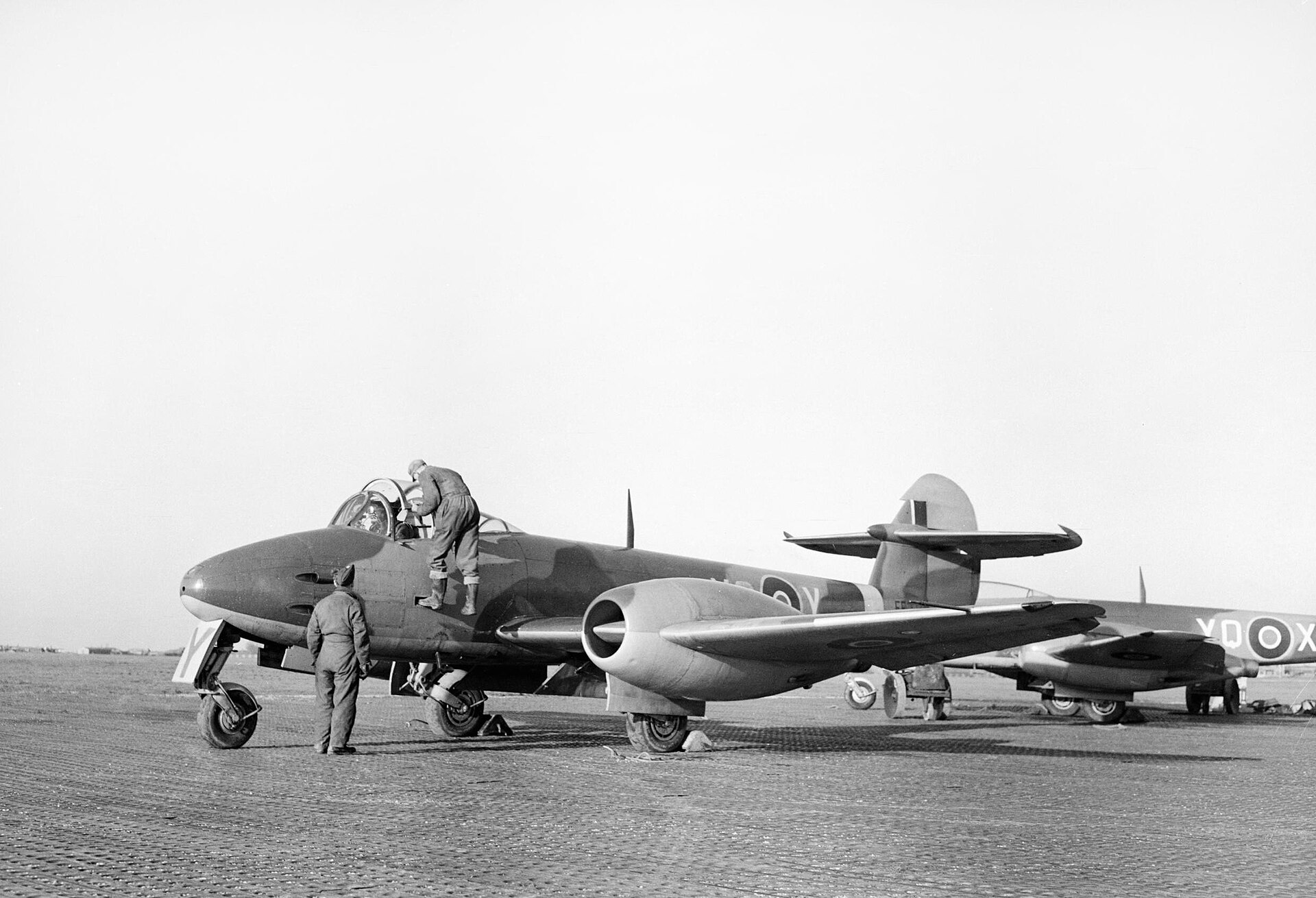
The Gloster Meteor holds a place in history that no other British aircraft can claim. It was the first jet fighter to fly with the Royal Air Force, and the only Allied jet to see combat in the Second World War. While the German Me 262 and the rocket powered Me 163 grabbed the headlines, it was the twin engined Meteor, chasing V-1 flying bombs over southern England in the summer of 1944, that carried the Allied jet age into battle.
It went on to set world air speed records, to fight the Soviet MiG-15 over Korea and to serve the RAF and more than a dozen other air forces well into the 1950s. This guide tells the whole story: where the Meteor came from, how it was built, what it did in the war and after, the long line of fighter, trainer and night fighter variants, and where the survivors are today.
Gloster Meteor: key facts
- First flight: prototype DG206, 5 March 1943.
- Entered service: July 1944, with No. 616 Squadron RAF.
- Claim to fame: the first RAF jet fighter and the only Allied jet to see combat in the Second World War.
- Engines: two turbojets, buried in the wings; Rolls-Royce Derwents on later marks.
- Number built: 3,947, more than any other British jet of the period.
- Production run: 1943 to 1955.
- Combat: V-1 interception in 1944, and Korea with the Royal Australian Air Force.
What this guide covers
- Origins and development
- Design and engineering
- Flying the Meteor
- Armament
- Chasing the V-1 flying bomb
- The war and the Me 262 that never came
- Setting the world air speed record
- Korea and the MiG-15
- Exports and overseas service
- Variants from F.1 to night fighters
- The Meteor as a flying laboratory
- Specifications and key facts
- Where the survivors are today
- Legacy
- Frequently asked questions
Origins and development
The Meteor was a child of the jet engine, and the jet engine in Britain was largely the work of one man. Frank Whittle had been developing the turbojet through his company Power Jets since the 1930s, in the face of official indifference, and by 1940 the Air Ministry was interested enough to order a fighter built around his engines. The Gloster Aircraft Company, whose chief designer George Carter had already worked with Whittle, took on the task.
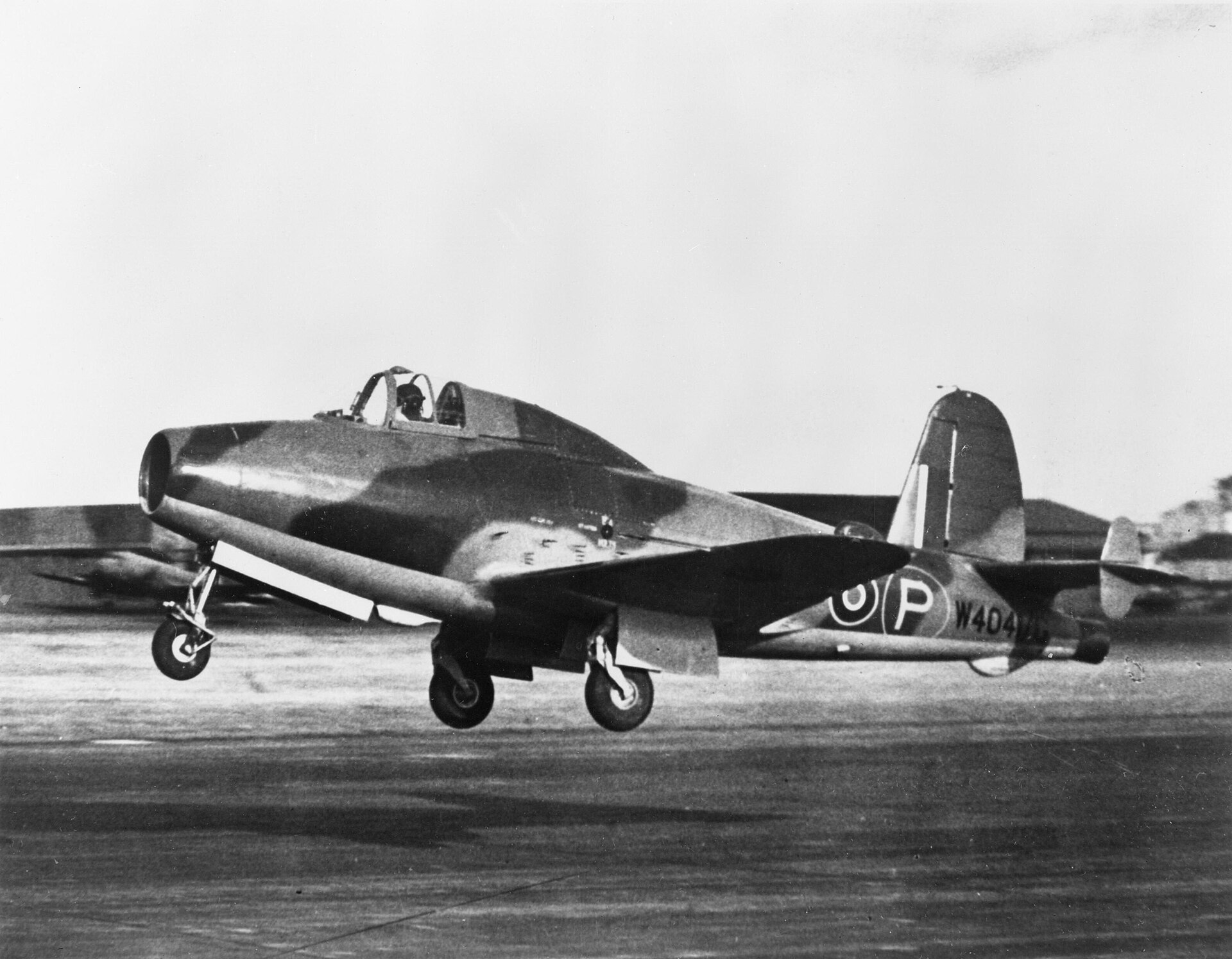
Gloster had already built the stepping stone. Its small experimental aircraft, the Gloster E.28/39, made the first flight by a British jet on 15 May 1941, powered by a single Whittle engine, and proved beyond doubt that the idea worked. The Meteor was the step from that experiment to a usable weapon. One early decision shaped everything that followed. Whittle’s first engines each produced only modest thrust, so rather than wait for a single powerful engine, Gloster designed the fighter around two, one buried in each wing. That twin engine layout gave the Meteor enough power to be useful, and it became the aircraft’s defining feature.
The engines themselves were the programme’s greatest source of delay, and when the first prototype was ready to fly its intended engines were not. That aircraft, DG206, made the first true Meteor flight at RAF Cranwell on 5 March 1943 using engines of a different design by Frank Halford, the units that became the de Havilland Goblin. Production aircraft settled on a Rolls-Royce built development of the Whittle engine, first the Welland and then the more powerful Derwent. The first operational model, the Meteor F.1, entered service in July 1944 with No. 616 Squadron, making the RAF the first air force in the world to fly jet fighters operationally alongside the Germans. Production ran for twelve years, from 1943 to 1955, and reached 3,947 aircraft, more than any other British jet of the period.
None of this had come easily. Whittle had struggled for years to interest officials in the jet engine, working with meagre funds while sceptics doubted it would ever be practical. The Meteor itself was developed under the wartime designation F.9/40, and progress was slowed as much by the difficulty of building reliable engines as by anything to do with the airframe. That Britain nonetheless fielded a working jet fighter by 1944 was a considerable achievement, and it owed a great deal to Whittle’s persistence in the lean years before the war.
Development involved a whole series of prototypes under the F.9/40 name, and because reliable engines were so scarce these were used to test several different designs from rival makers, including axial flow engines as well as Whittle’s centrifugal type. The name Meteor was chosen to follow the fashion for weather and speed themes in RAF fighters, and by the time the aircraft entered service the service had settled on the Rolls-Royce engines that would power the bulk of the fleet. The tangle of engines and prototypes in these early years is a reminder that the whole field of jet propulsion was being invented at the same time as the aircraft that would use it.
Design and engineering
By later standards the Meteor was a conservative design, and deliberately so. Everything about it except the engines was kept as simple as possible. It had an unswept, straight wing, a conventional tail and a tricycle undercarriage, and it was built to be flown and maintained by a service that had never handled jets before. The novelty was concentrated where it mattered, in the two turbojets buried in the wings on either side of the fuselage, fed by intakes in the wing leading edges.
That straight wing was the aircraft’s main limitation. It was fine at the speeds of the mid 1940s, but as the jet age advanced and rivals adopted swept wings, the Meteor could not keep pace. It could be pushed towards the speed of sound only at real risk to the pilot, and it never had the high speed manners of the swept wing fighters that soon followed. Handling on one engine was also demanding. If an engine failed at low speed the thrust from the other, set well out in the wing, could roll the aircraft before the pilot could react, and asymmetric accidents claimed a number of lives in training over the years.
The design was refined steadily. Early flight testing revealed a violent snaking or yawing at speed that was traced to the rudder and soon cured, and the definitive F.8 fighter suffered a tendency to become tail heavy once its ammunition was fired, which was solved by fitting the tail of another abandoned Gloster jet project. These were the ordinary growing pains of the world’s first generation of jet fighters, worked through in real time, and the fact that the RAF was learning all this while actually operating the aircraft is a large part of what makes the Meteor important.
Comfort and systems improved with each mark. Later fighters had a pressurised cockpit and an ejection seat, air brakes to control the speed that built up so readily in a dive, and better instruments for flying in cloud and at night. These were the features that turned an experimental oddity into a practical service aircraft that thousands of ordinary squadron pilots could fly, and most of them were worked out on the Meteor before they became standard on the jets that came after.
Flying the Meteor
For the pilots who converted onto it, the Meteor was a revelation and a challenge in equal measure. Coming from piston fighters, they found an aircraft with no propeller torque, smooth power and a strange quiet rush in place of the roar of a Merlin, one that kept accelerating in a dive in a way nothing had before. It was pleasant and honest to fly for the most part, stable and comfortable, and its four cannon made it a steady gun platform.
But the jet age brought new dangers that the Meteor taught the hard way. The early engines were thirsty and slow to respond, so a pilot who closed the throttles on the approach and then needed power again could be caught out by the lag before the engines spooled back up. Worse was the asymmetric problem. With the engines set well out in the wings, losing one at low speed, on take off or an overshoot, produced a powerful rolling and yawing force towards the dead engine, and if the pilot did not react at once the aircraft could roll onto its back before anything could be done. Engine failure accidents were a persistent and sobering feature of Meteor operations.
These were not so much faults of the Meteor as the growing pains of an entire new kind of flying, learned by a generation of pilots moving from propellers to jets. The Meteor was the aircraft on which the RAF and many other air forces worked out how to train, fly and fight with jets safely, and the lessons, some of them paid for dearly, shaped everything that followed.
The arrival of the two seat T.7 trainer made this transition far safer. For the first time an instructor could sit alongside a pupil in a jet, showing him how to manage the throttles, the approach and the critical business of an engine failure before he was let loose on his own. The T.7 became one of the most important aircraft of the early jet age, and many hundreds of pilots in the RAF and abroad first felt the smooth surge of jet power from its cockpit. It was a quiet but vital contribution, easy to overlook beside the fighters and the records.
Armament
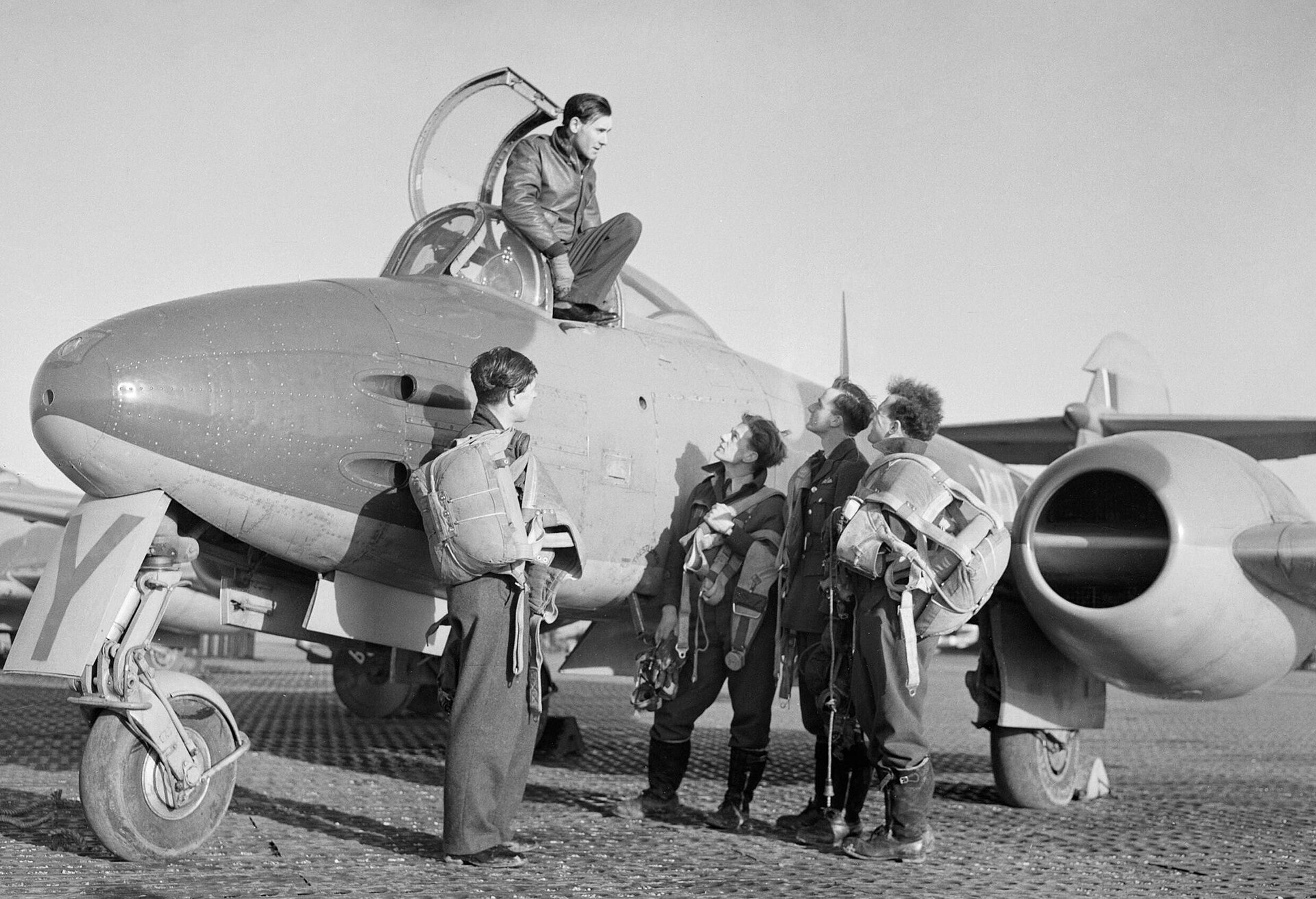
The Meteor’s armament was conventional and effective for its day: four 20mm Hispano cannon grouped in the nose, a heavy battery that concentrated its fire well ahead of the pilot. Against the V-1 flying bomb and against ground targets this was more than adequate, and the nose mounting avoided the harmonisation problems of wing guns. Later marks added underwing rails and pylons so the aircraft could carry rockets and bombs, turning the fighter into a useful ground attack machine, a role in which the Meteor did some of its hardest work in Korea. It was never a heavy hitter by the standards of the 1950s, but for a design conceived in the early 1940s the four cannon nose was a sound and reliable arrangement.
In the ground attack role the later Meteors could carry rockets under the wings, and in Korea these, together with the four cannon, were used against vehicles, buildings and troop positions. It was demanding and dangerous low level work, flown into small arms and anti aircraft fire, and it was here rather than in air combat that the Meteor did most of its fighting in that war.
Chasing the V-1 flying bomb
The Meteor’s first job was the defence of Britain against the V-1 flying bomb. These small pilotless jets came in fast and low, and they were too quick for many piston engined fighters to catch. The Meteor’s speed made it one of the few aircraft that could reliably run them down, and No. 616 Squadron began operations against the V-1 in the summer of 1944. The aircraft’s very first success in action was against one of these flying bombs, an appropriate opening for a jet fighting a jet powered weapon.
The cannon of the early Meteors were prone to jamming, and this led to one of the most famous incidents of the campaign. When his guns failed, one pilot, Flying Officer Dixie Dean, flew alongside a V-1 and used his wing to topple the bomb, upsetting the gyroscope that kept it level so that it dived into open country. The trick was copied by others, and by the end of the campaign Meteors had destroyed fourteen of the flying bombs. It was modest in the wider scheme of the war, but it put the RAF’s new jet into combat and gave its pilots priceless early experience.
The threat the Meteor was rushed to meet was a serious one. From June 1944 Germany launched thousands of V-1 flying bombs at London and the south east, and stopping them strained the whole air defence system of guns, balloons and fighters. Flying from Manston in Kent, the Meteors of No. 616 Squadron were thrown into this anti diver campaign as fast as they could be made ready, and although they accounted for only a small share of the bombs brought down, their speed made them valuable and their presence in action gave Britain a jet fighter earning its keep in combat.
The war and the Me 262 that never came
For the rest of the war the Meteor was handled with great caution. It was moved to the Continent late in the conflict for ground attack and to guard against German jets, but for a long time it was kept away from enemy territory. The fear was that one might be shot down or forced down over German held ground, allowing the enemy to recover its engines and learn the secrets of British jet technology. As a result the Meteor and the German Me 262 never met in combat, a duel that has fascinated enthusiasts ever since but which simply never took place.
The two aircraft make an interesting comparison all the same. The Me 262 had swept wings and was faster, but it was rushed into service with unreliable engines and came too late and in too few numbers to change the war. The Meteor was slower and more conservative but more dependable, and crucially it was the aircraft that gave a major air force its first real experience of operating jets in the field. That experience, rather than any single combat, was the Meteor’s most important wartime contribution.
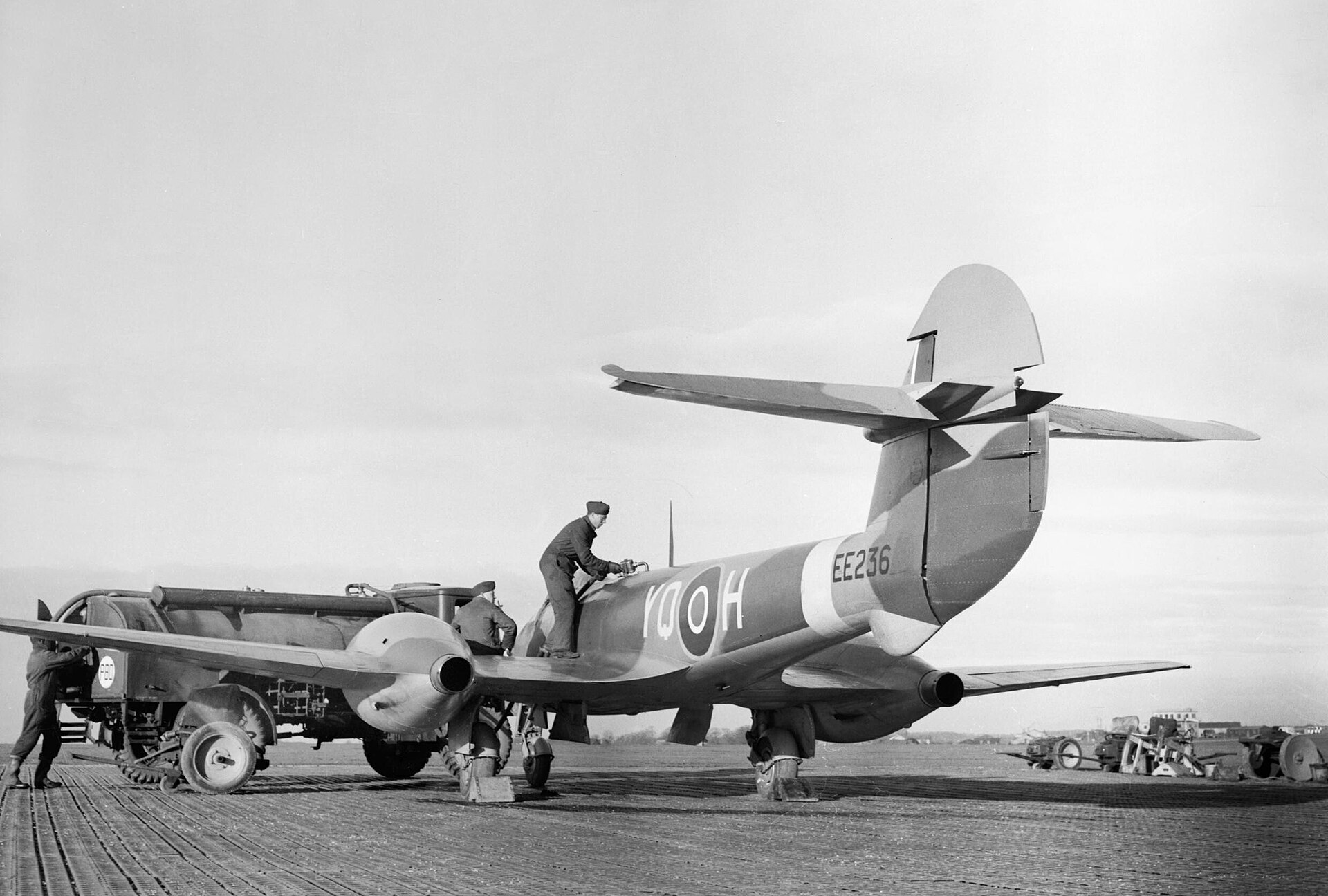
Late in the war Meteors did cross to the Continent, moving to airfields in liberated Europe with the Second Tactical Air Force, where they flew armed patrols and attacked ground targets. Even then they were flown under careful restrictions, kept back from areas where a forced landing might hand the enemy an intact jet. It was a frustrating way to fight for pilots who wanted to test their aircraft against the Luftwaffe, but it made sense while the technology was still so secret, and it meant the Meteor ended the war with both its reputation and its secrets intact.
Setting the world air speed record
With the war over, the Meteor became a showcase for British aviation. Specially prepared Meteor aircraft were used to chase the world air speed record, and they took it twice in quick succession. In November 1945 a Meteor raised the record to just over 606 miles per hour, and in September 1946 another pushed it to around 616 miles per hour. For a brief period Britain held the outright air speed record with a service fighter, a striking statement of how far and how fast jet flight had come in only a few years.
These record flights were more than a stunt. They tested the airframe and engines at the edge of what a straight winged jet could do, they trained pilots and engineers in high speed flight, and they kept British aviation in the public eye at a time when the country was exhausted and short of money. The Meteor that set the records was recognisably the same aircraft that had chased V-1s over Kent, which says a great deal about how much potential the basic design still held.
Korea and the MiG-15
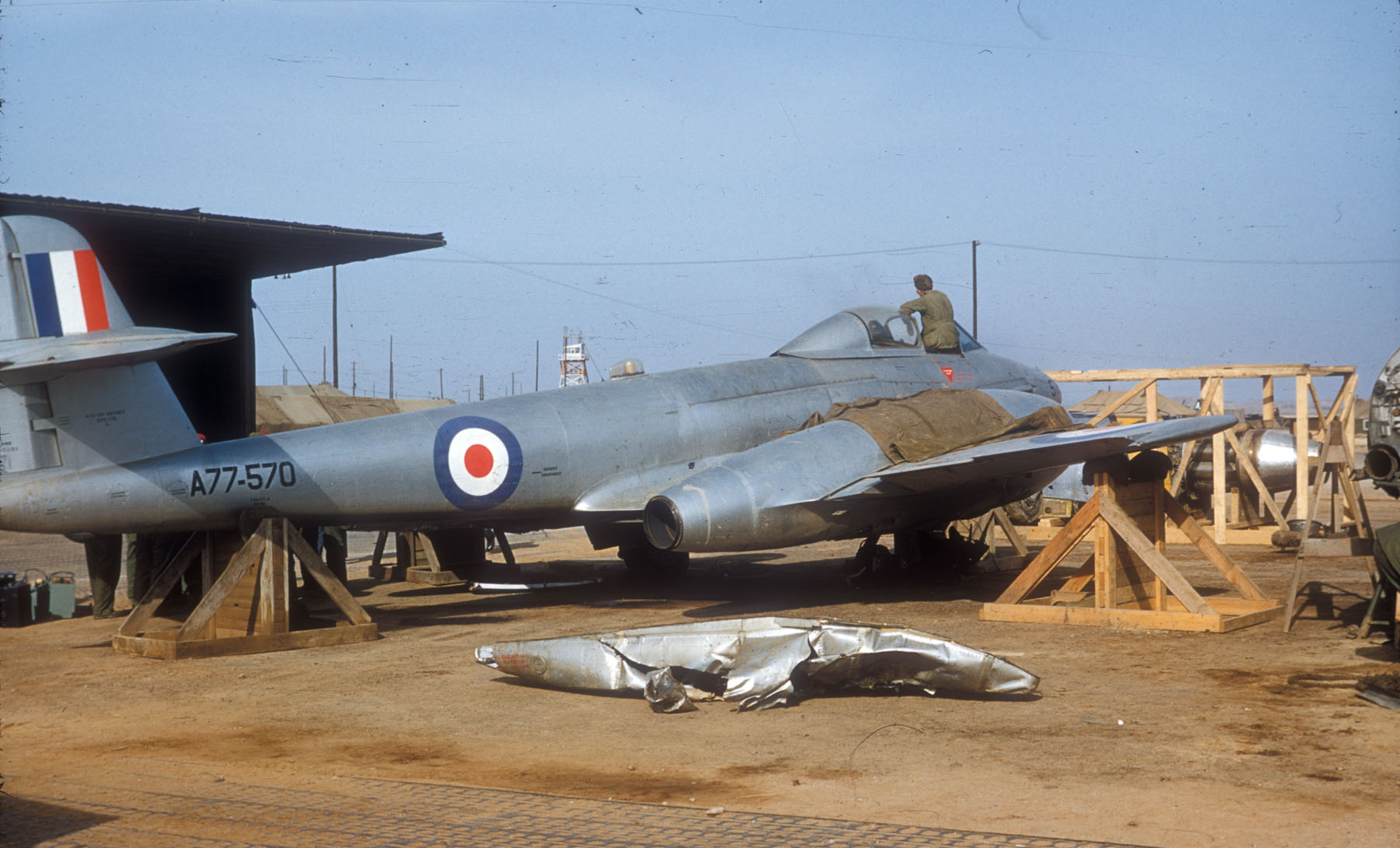
The Meteor’s only sustained air to air combat against other jets came in Korea, and there it met a hard lesson. The Royal Australian Air Force flew Meteor F.8s with No. 77 Squadron, which converted to the type in Japan and returned to the fighting in 1951 with around thirty aircraft. In the air the straight winged Meteor was outclassed by the swept wing Soviet MiG-15, which was faster and more agile at high altitude, and Australian pilots found themselves at a real disadvantage in a straight fight.
That was made painfully clear on 1 December 1951 in the action known as the Battle of Sunchon, when a formation of Meteors was bounced by a larger force of MiG-15s, flown, though the West did not know it at the time, by elite Soviet pilots. The Australians lost three aircraft and claimed only one MiG in return. After such experiences the Meteor was switched largely to ground attack, a role in which it did valuable and dangerous work. By the end of the war No. 77 Squadron had flown thousands of missions, and while it had shot down a handful of MiGs, its main contribution was against targets on the ground. Korea made plain that the day of the straight winged fighter was over, but it also showed the Meteor could absorb punishment and keep flying.
Taken as a whole, No. 77 Squadron’s war was a hard but honourable one. Over the course of the conflict it flew nearly five thousand missions, destroyed several thousand buildings and around fifteen hundred vehicles, and shot down a small number of MiG-15s, all at a real cost in aircraft and men. The Meteor had been asked to do a job for which its straight wing left it outmatched in the air, and its pilots made the best of it, turning increasingly to the ground attack role where the aircraft’s toughness and heavy cannon could be put to good use.
Exports and overseas service
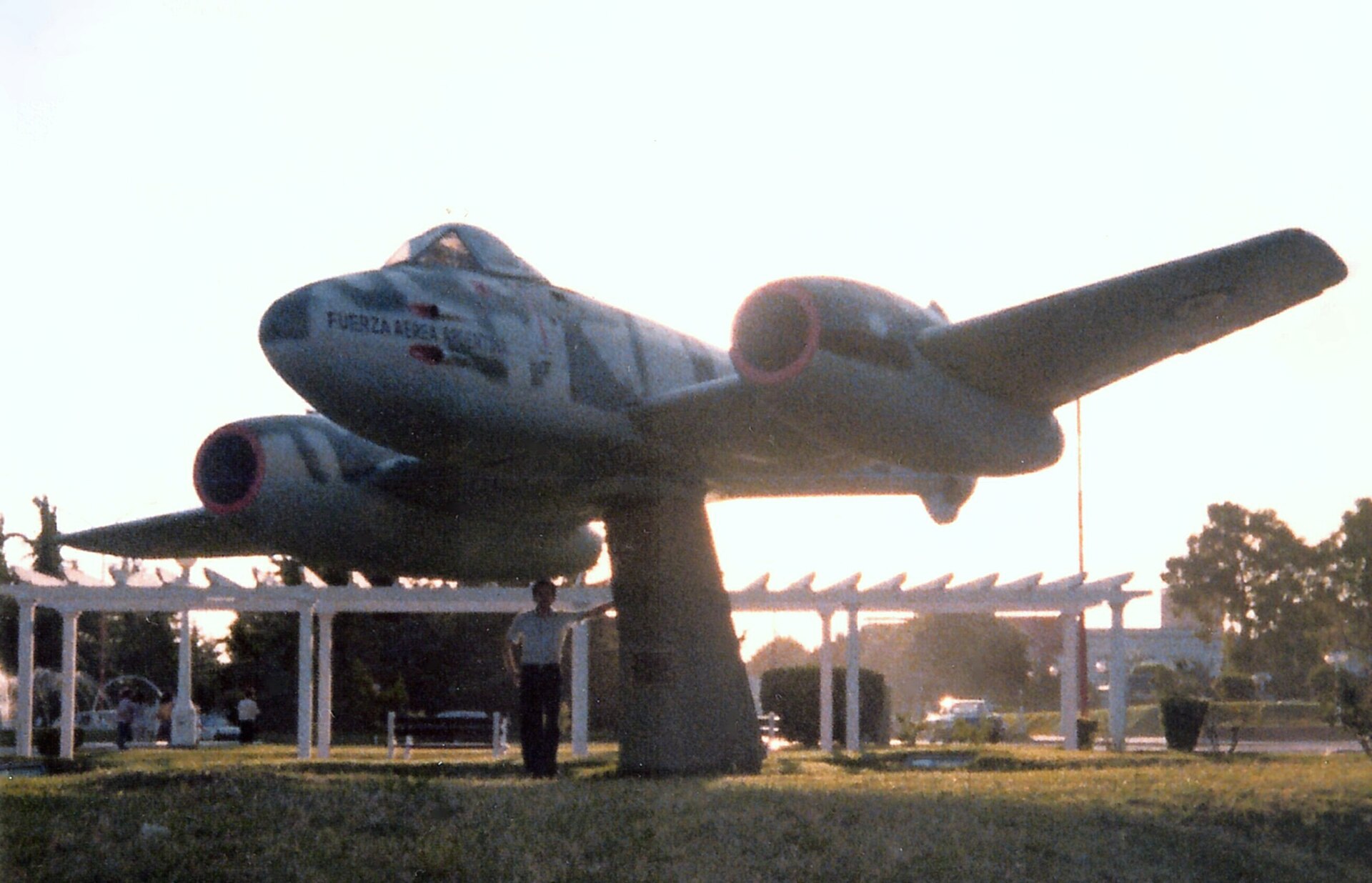
The Meteor was exported very widely, and for many air forces it was their first jet. Argentina bought around a hundred, Belgium several hundred in fighter, trainer and night fighter forms, and Australia, Brazil, the Netherlands, Denmark, Egypt, Israel, Syria and France were among the many other operators. In several of these countries the Meteor introduced a whole generation of pilots and ground crews to jet operations, exactly as it had for the RAF.
Some of these exported Meteors saw combat of their own. In the mid 1950s both Israel and Egypt bought the type, and both nations operated Meteors in the region during the tensions of that period, though the Israeli combat kills of the time were against other Egyptian types rather than against Meteors. For a design that might have been remembered only as a wartime curiosity, this long and varied overseas career is a large part of the story, and it kept Gloster production lines busy for years after the war.
The overseas Meteors were not merely for show. Both Israel and Egypt flew Meteors during the tensions of the mid 1950s, and the type served in various roles in a number of smaller confrontations around the world. For a decade after the war it was a common sight in the skies of Europe, South America and the Middle East, a British export success at a time when the country badly needed the trade, and a reminder of how quickly the Meteor had gone from secret weapon to widely sold standard fighter.
Variants from F.1 to night fighters
The Meteor developed through a clear line of day fighters. The F.1 was the wartime original. The F.3 brought a better sliding canopy, more fuel and Derwent engines. The F.4, whose prototype first flew in May 1945, introduced more powerful Derwent 5 engines and a strengthened, pressurised airframe with slightly clipped wings, and it was the version used to set the world air speed records. The definitive day fighter was the F.8, with a longer fuselage, greater fuel capacity, an ejection seat as standard and a redesigned tail. The F.8 was the RAF’s front line fighter in the early 1950s until swept wing types such as the Hawker Hunter replaced it.
Beyond the single seat fighters the airframe proved unusually adaptable. The two seat T.7 became an important jet trainer, giving many pilots their first taste of jet flight, and dedicated photographic reconnaissance versions, the FR.9 and PR.10, served in the fighter reconnaissance role. Armstrong Whitworth developed a whole family of night fighters, the NF.11 through NF.14, with a lengthened nose housing airborne interception radar and a second crew member to work it, the last of them first flying in 1953. The Meteor was also a favourite testbed for experiments, most strikingly the prone pilot aircraft, in which a pilot lay flat in a special nose to study high g flight, and the Trent Meteor, which became the world’s first aircraft to fly on turboprop power. Between all these versions the Meteor stayed in service in one role or another long after it had ceased to be a competitive day fighter.
The Meteor as a flying laboratory
Roomy, docile and available in numbers, the Meteor became one of the most used experimental aircraft of its era. Its most famous side project was the prone pilot Meteor, in which a pilot lay flat on his stomach in a specially built nose, part of research into how aircrew might better withstand the high g forces of high speed flight. The idea went no further, but the aircraft that tested it survives today.
Even more significant was the Trent Meteor, a converted aircraft fitted with Rolls-Royce Trent engines that became the world’s first aircraft to fly under turboprop power, in 1945, pointing the way to the turboprop airliners and transports that would follow. Meteors were also used to test reheat, or afterburning, new wing sections and all manner of equipment, and two aircraft spent decades with the ejection seat maker Martin-Baker, firing test seats into the air so that the escape systems fitted to generations of later jets could be proven. Few aircraft have contributed so much to the development of others. The Meteor was not only a front line fighter but a workhorse of British aeronautical research, and much of what was learned on it fed into the far more advanced jets of the 1950s and beyond.
Specifications and key facts
| Crew | 1 |
|---|---|
| First flight | Prototype DG206, 5 March 1943 |
| Entered service | July 1944 (F.1, No. 616 Squadron RAF) |
| Engines | 2 x Rolls-Royce Derwent 8 turbojets, about 3,600 lbf each |
| Length | About 13.6 m (44 ft 7 in) |
| Wingspan | About 11.3 m (37 ft 2 in) |
| Maximum speed | Around 965 km/h (600 mph) |
| Armament | 4 x 20mm Hispano cannon |
| Number built | 3,947 (all variants, 1943 to 1955) |
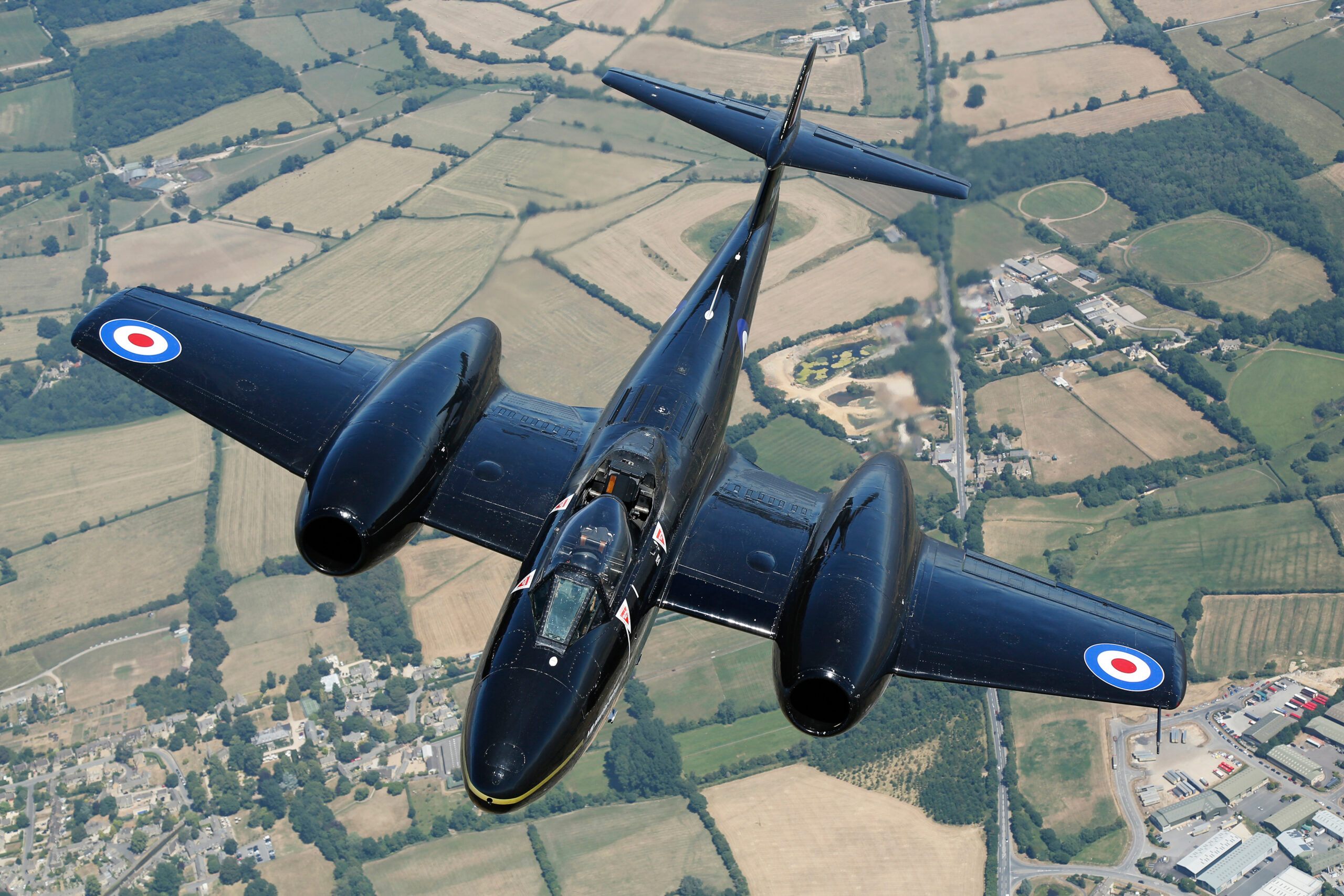
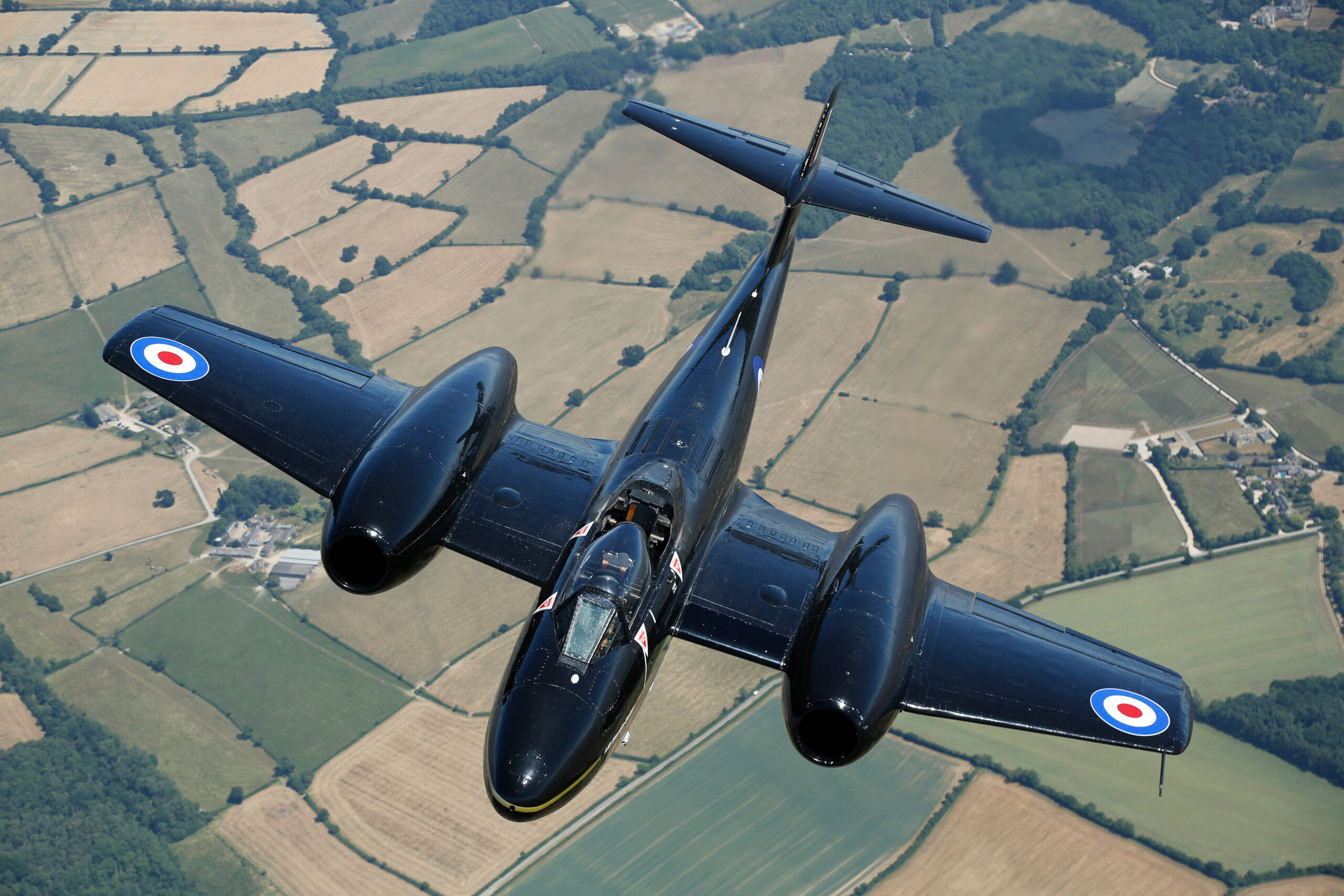
Preserved Meteors are a regular sight at British aviation museums and at the occasional airshow, and you will find early jets among the images in the Piemags archive galleries. Print and usage terms are on the licensing page.
Where the survivors are today
A large number of Meteors survive, reflecting how many were built. They stand as gate guardians outside former RAF stations, fill museum halls across Britain and beyond, and appear in collections around the world. Only two or three, however, remain airworthy anywhere in the world, because the aircraft’s demanding single engine handling makes it a serious machine to keep flying safely.
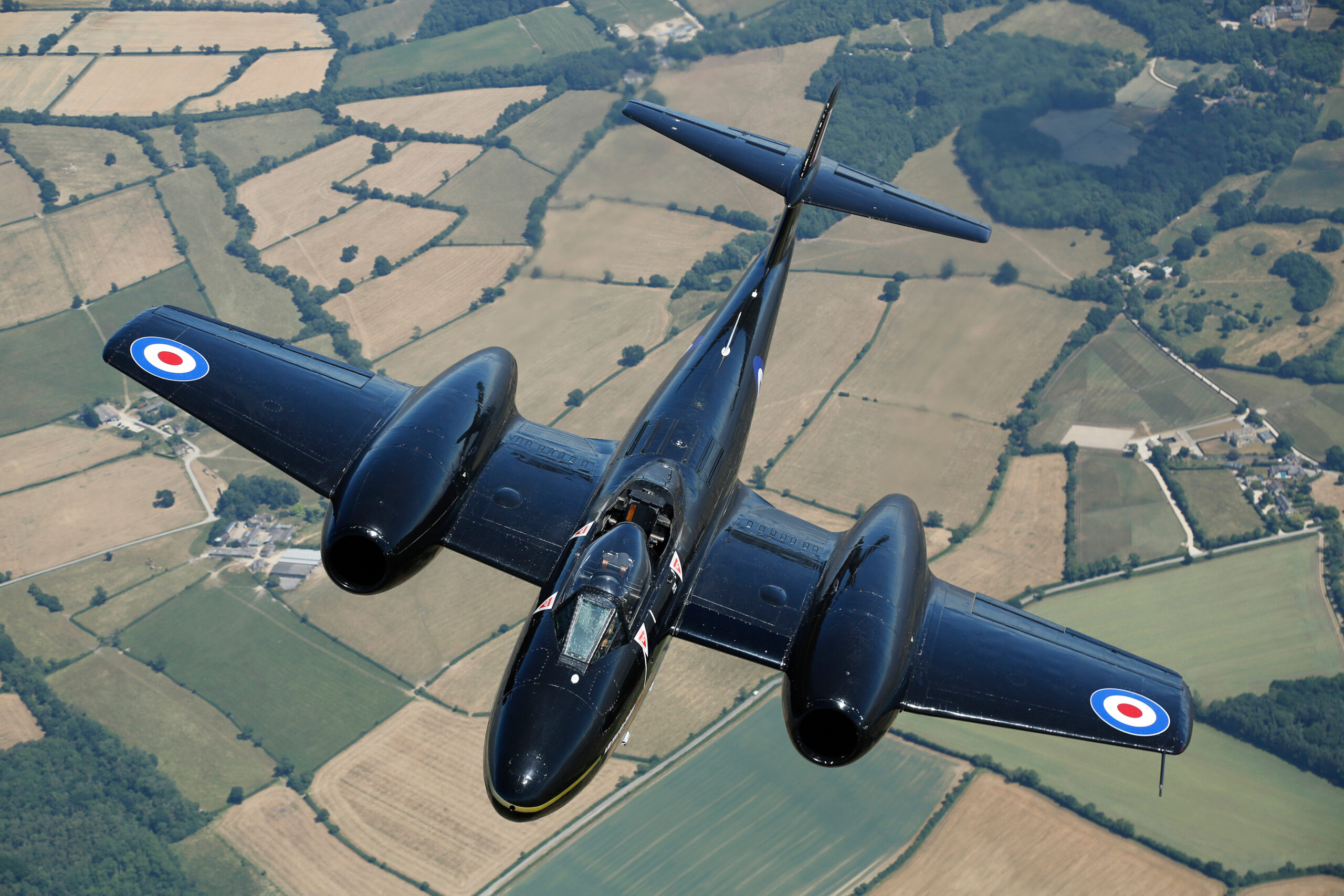
One of the more remarkable survivals is industrial rather than historic. The ejection seat maker Martin-Baker used two Meteors, WL419 and WA638, for decades as flying testbeds for its seats, firing test seats from a special installation and keeping the aircraft in the air long after the type left military service. In Australia a former RAF F.8 flew at Temora in Royal Australian Air Force markings until the Air Force withdrew it from flying in January 2026, and it is now preserved statically at the Temora Aviation Museum, a tribute to the Korean War squadron, and in the United States a Meteor T.7 is preserved by the Planes of Fame Air Museum. A privately owned night fighter survives in Britain, one of very few of its kind, though it is not currently flying.
In Britain the Meteor is well represented in the national collections. Examples can be seen at the Royal Air Force Museum, at the Imperial War Museum at Duxford, at the Newark Air Museum and, fittingly, at the Jet Age Museum in Gloucester, close to where Gloster built the aircraft. Between these and the many others scattered across the country and abroad, the Meteor remains one of the more accessible early jets for anyone who wants to see at first hand the shape that took the RAF into the jet age.
Legacy
The Meteor’s place in history rests less on its performance than on its timing. It was not the fastest or the most advanced jet of its generation, and its straight wing dated quickly. What it did was get the Allied jet age into service and into combat when it mattered, giving the RAF vital early experience of operating, maintaining and fighting with jets. Everything the service later did with faster and more capable aircraft was built on that foundation.
It also served long and faithfully in less glamorous roles, as a trainer, a night fighter, a reconnaissance aircraft and a testbed, and it gave more than a dozen other air forces their first jets. For an aircraft that could have been remembered simply as a footnote to the Me 262, that is a considerable record, and it explains why the Meteor is still treated with real affection by anyone interested in the early jet age. It was the workhorse that carried Britain, and much of the wider world, across the threshold from propellers to jets.
The Meteor also stands at the head of a proud line of British jets. The experience that Gloster, Rolls-Royce and the RAF gained with it fed directly into the swept wing fighters that followed, from the Hawker Hunter to Gloster’s own delta winged Javelin, and into the jet engine industry that became one of Britain’s great postwar strengths. The little twin engined fighter that chased V-1s over Kent was, in a real sense, a forerunner of everything the British jet industry went on to build.
For what came before and after it, see our histories of the Supermarine Spitfire and the Hawker Hurricane that shared the skies over Britain in 1944, and the English Electric Lightning that showed how far British jet fighters had come a generation later. If you photograph preserved jets at displays, our guide to warbird photography has practical advice.
The Meteor was Britain’s answer, and it was not the first of its kind anywhere. Twenty months before the Gloster E.28/39 left Cranwell, a small aeroplane with no propeller flew a circuit of a works airfield on the German Baltic coast. Our account of the first jet flight, and the Heinkel He 178 that made it, covers who built it, who flew it, and why almost nothing came of it.
Frequently asked questions
Was the Gloster Meteor the first jet fighter?
The Gloster Meteor was the first jet fighter to serve with the RAF and the only Allied jet to see combat in the Second World War. The German Me 262 entered service at around the same time, so the two are usually described as the first operational jet fighters, one on each side.
Did the Meteor ever fight the Me 262?
No. For much of the war the Meteor was kept away from enemy territory to protect its engine technology, so the two most famous jets of the war never met in combat despite being in service at the same time.
How did Meteors stop V-1 flying bombs?
Their speed let them catch the fast, low flying bombs and shoot them down with cannon. When guns jammed, one pilot flew alongside a V-1 and tipped it with his wingtip, upsetting its gyroscope so it crashed. Meteors destroyed fourteen V-1s in the 1944 campaign.
How many Gloster Meteors were built?
A total of 3,947 Meteors were built between 1943 and 1955, more than any other British jet aircraft of the period. They served in day fighter, trainer, night fighter and reconnaissance versions.
Are any Gloster Meteors still flying?
Only a small number remain airworthy. They include aircraft in Britain, a former RAF F.8 flown in Australia in Korean War markings, and a Meteor T.7 preserved in the United States. The type’s demanding single engine handling makes it a serious aircraft to operate.
When did the Gloster Meteor first fly?
The first Meteor prototype, DG206, flew on 5 March 1943 at RAF Cranwell, using de Havilland Goblin engines because its intended engines were not ready. The Meteor entered service in July 1944.
What engines did the Meteor use?
The Meteor was powered by two turbojets buried in the wings. Early aircraft used Rolls-Royce Welland engines, and later marks used the more powerful Rolls-Royce Derwent, the engine most associated with the type.
How was the Meteor armed?
The Meteor carried four 20mm Hispano cannon in the nose. Later marks could also carry rockets and bombs on underwing rails, which made it a useful ground attack aircraft, notably in Korea.
Did the Meteor fight in Korea?
Yes. The Royal Australian Air Force flew Meteor F.8s in Korea with No. 77 Squadron. Outclassed in air combat by the swept wing MiG-15, the Meteor was switched mainly to ground attack, in which it did valuable work.
Why did the Meteor have two engines?
Early jet engines produced only modest thrust, so Gloster designed the Meteor around two of them, one in each wing, rather than wait for a single powerful engine. The twin engine layout became the aircraft’s defining feature.
Did the Meteor set a world air speed record?
Yes. Specially prepared Meteor aircraft set the world air speed record twice, raising it to just over 606 miles per hour in 1945 and to around 616 miles per hour in 1946, briefly putting Britain at the front of high speed flight.
Which countries used the Gloster Meteor?
More than a dozen air forces flew the Meteor, including Australia, Belgium, Argentina, Brazil, the Netherlands, Denmark, Egypt, Israel, Syria and France. For many it was their first jet aircraft.
What was the difference between the F.1 and the F.8?
The F.1 was the wartime original, while the F.8 was the definitive day fighter of the early 1950s, with a longer fuselage, more fuel, an ejection seat as standard, a redesigned tail and more powerful engines.
Why was the Meteor dangerous to fly?
The Meteor could be unforgiving if an engine failed at low speed, because the thrust of the remaining engine, set well out in the wing, could roll the aircraft before the pilot reacted. Asymmetric accidents claimed a number of lives during its service.
What is the Gloster E.28/39?
The Gloster E.28/39 was the small experimental aircraft that made the first flight by a British jet, on 15 May 1941. It proved Frank Whittle’s turbojet worked in the air and led directly to the Meteor.
What was the Meteor’s second career as a target tug and drone?
Long after it left front-line squadrons, the Meteor found a lasting role towing targets and, more remarkably, flying as a pilotless drone. Converted F.8 airframes became U.16 drones used as expendable targets to develop and test guided missiles, flown chiefly from Llanbedr in Wales over Cardigan Bay. This work kept Meteor airframes flying in one form or another into the early 2000s, more than half a century after the type entered service.
What was the prone pilot Meteor?
The prone pilot Meteor was a one-off experiment in which a pilot lay flat on his stomach in a specially built extended nose, part of research into how aircrew might better withstand high g forces. The idea was that a prone position would let a pilot tolerate greater loads before blacking out. It went no further as a practical layout, but the aircraft that tested it survives in a British collection.
Did Meteors ever fight each other in combat?
Yes, in the Middle East. Both Israel and Egypt bought Meteors in the mid 1950s, and their aircraft clashed during the fighting of that period, so the type occasionally found itself pitched against others of its own kind. It was an unusual fate for a design that might have been remembered only as a wartime curiosity, and it reflects how widely the Meteor was exported as a first jet for many air forces.
For the swept-wing Soviet fighter that transformed the jet-age battlefield a few years later, see our history of the Mikoyan-Gurevich MiG-15.
The Meteor was replaced in RAF service by a far more capable swept-wing fighter: see our history of the Hawker Hunter.
