The Hawker Hunter was Britain’s finest jet fighter of the 1950s, a swept-wing day interceptor designed by Sydney Camm that first flew on 20 July 1951, set a world air speed record of 727.63 mph in 1953, and went on to serve more than twenty air forces in a career that stretched from the Suez Crisis to the 2010s. Elegant, rugged and a delight to fly, it was built in greater numbers than any other British jet fighter of its generation, with 1,972 produced, and it remains one of the most fondly regarded aircraft ever to wear RAF roundels.
Few aircraft combine beauty, capability and longevity the way the Hunter does. It arrived as the RAF was struggling to field a fighter that could match the new jet bombers, it gave the service a machine that pilots adored, and it then reinvented itself as a ground-attack aircraft and a trainer that soldiered on for decades. This is the full story of where it came from, how it was designed, the record and the aerobatic feats that made it famous, its variants and combat service, and where you can still find Hunters flying and preserved today.
The two most numerous late variants shaped the Hunter’s second career. The FGA.9 was the definitive ground-attack version, a strengthened F.6 with a braking parachute and provision for larger drop tanks and a heavier weapons load, and it became the backbone of RAF ground-attack squadrons east of Suez, flying in the Aden Emergency, over the Radfan and during the Borneo confrontation. Alongside it the FR.10 was a fighter-reconnaissance conversion of the F.6, its gun-ranging radar replaced by three cameras in a modified nose, giving the RAF a fast low-level reconnaissance platform. Both served into the early 1970s before the Hunter left front-line RAF service, and many airframes were then rebuilt and sold on, which is why so many kept flying abroad for decades afterwards.
What this guide covers
Origins and development
The Hunter was born from the RAF’s urgent need in the late 1940s for a fighter that could catch the fast jet bombers then entering service. Sydney Camm, the great Hawker designer behind the Hurricane and the Sea Hawk, developed the swept-wing Hawker P.1067 to meet Air Ministry Specification F.3/48, which was issued in 1948 and effectively written around his design. The requirement called for a speed of 629 mph at 45,000 feet, a high rate of climb and a heavy cannon armament, and the Korean War lent the whole programme an added urgency. That war had shown, brutally, what happened when straight-winged jets met swept-wing opponents, and Britain was determined not to be left behind. Camm’s team drew on wartime and post-war aerodynamic research to give the P.1067 a thin, sharply swept wing and a slim fuselage, and the result looked a generation ahead of the Meteors and Vampires it would replace.
The prototype, WB188, made its first flight on 20 July 1951 in the hands of Hawker’s chief test pilot Neville Duke, powered by a Rolls-Royce Avon borrowed from a Canberra. Duke took it through the sound barrier in a dive the following spring, and the first production F.1 flew in 1953. So promising was the design, and so pressing the need, that the Hunter was ordered straight off the drawing board, in parallel with the rival Supermarine Swift as an insurance policy. It entered RAF service in July 1954, replacing the Meteor, the Canadair Sabre and the Venom, and for the first time gave Fighter Command an aircraft that could really match the Canberra bomber it was meant to intercept. Its immediate predecessor in RAF service is covered in our history of the Gloster Meteor. The decision to order the Hunter and the Supermarine Swift together, before either had been fully proven, reflected how anxious the Air Ministry was not to be caught without a modern swept-wing fighter. In the event the Hunter came good and the Swift, plagued by problems as a fighter, was relegated to the reconnaissance role, so the insurance policy proved unnecessary but the urgency behind it was real.
Design
The Hunter’s reputation rests as much on how it flew as on what it could do. The 35-degree swept wing, the clean lines and the powerful engine gave it excellent performance for its day, and pilots almost universally described it as a delight to handle, responsive and honest, and unusually among swept-wing jets of the era it could be safely spun and even recovered from an inverted spin, a trait demonstrated to test-pilot students for years.
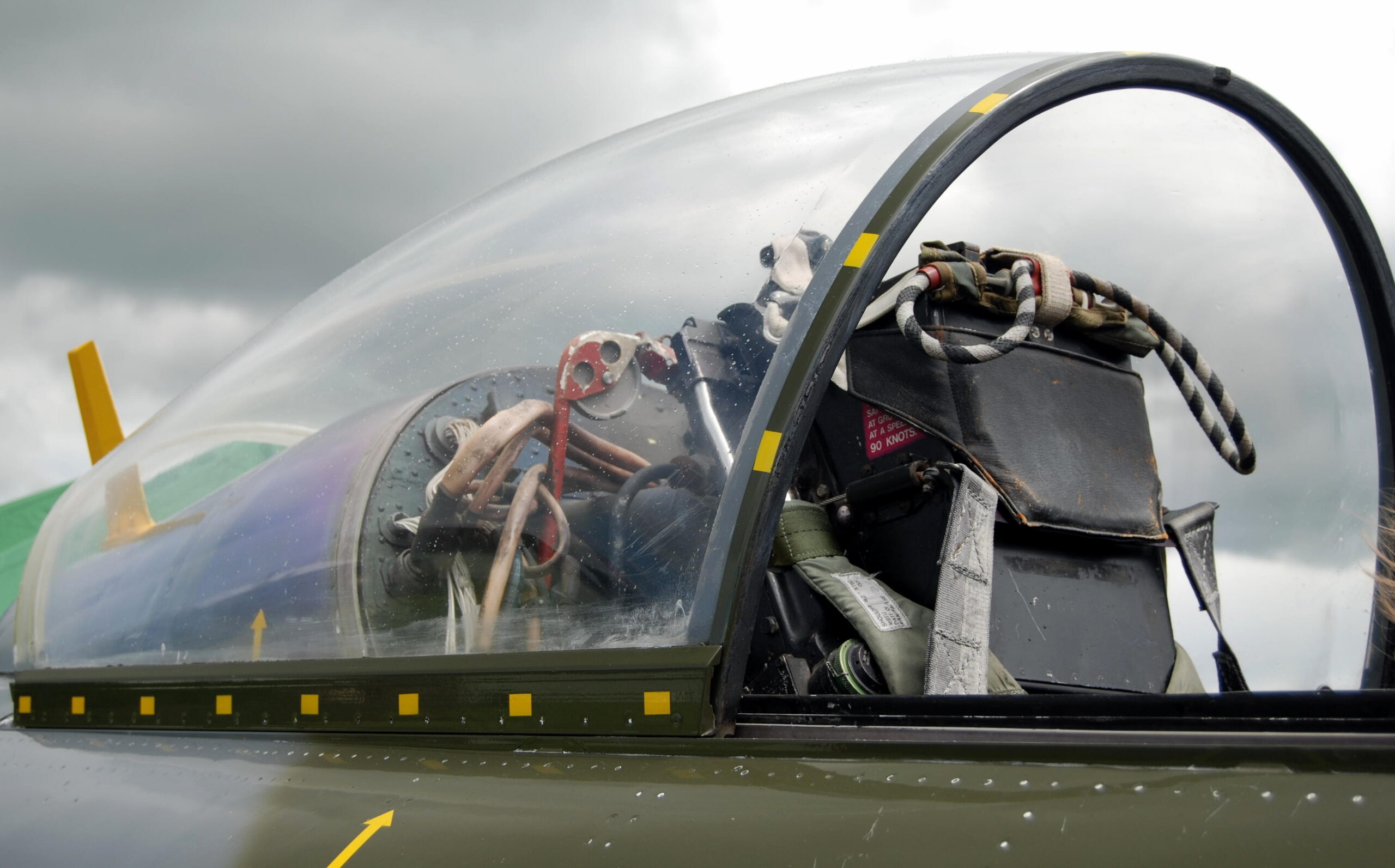
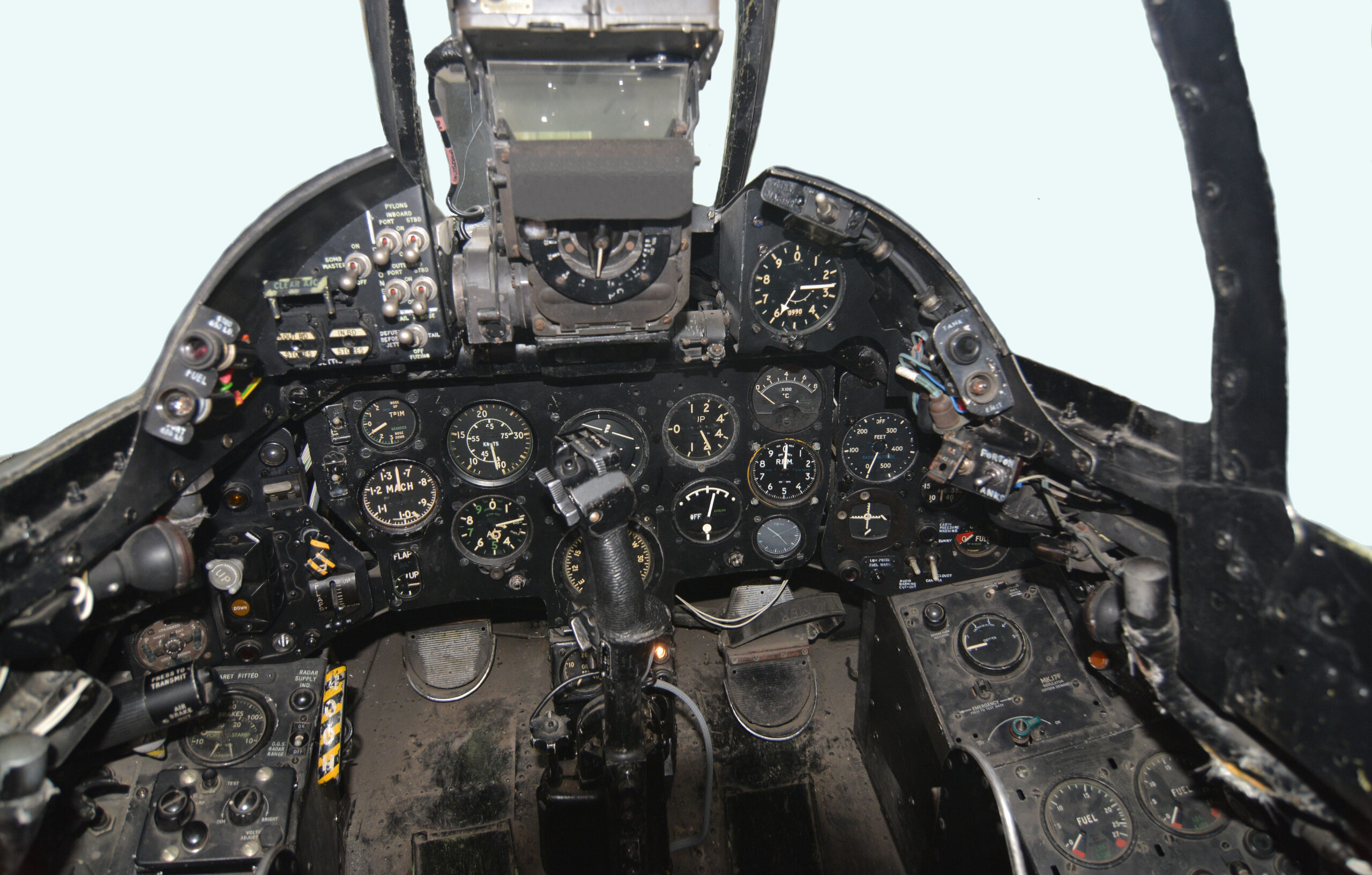
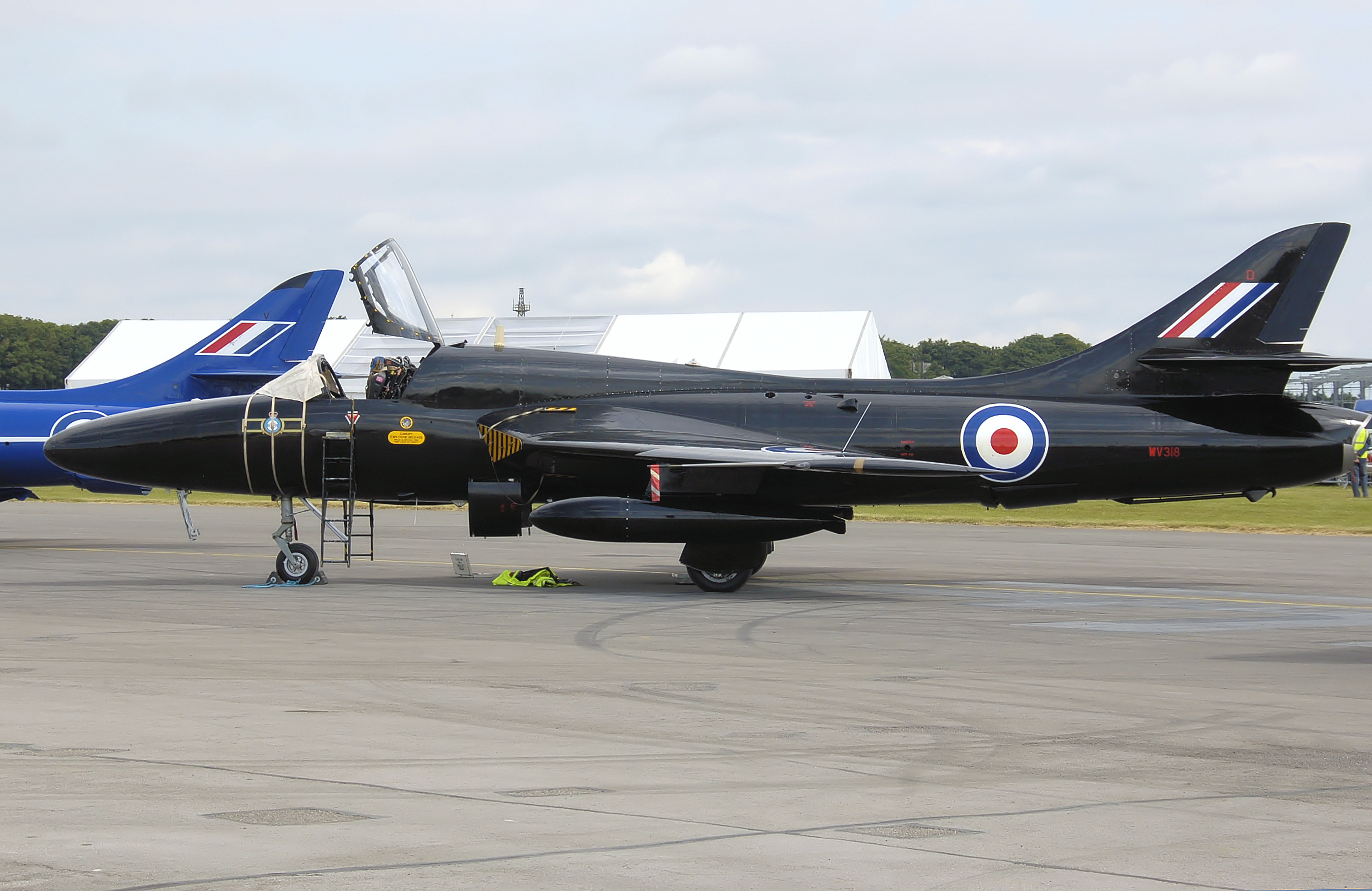
The aircraft was powered by the Rolls-Royce Avon in most marks, though the F.2 and F.5 used the Armstrong Siddeley Sapphire; the RAF standardised on the Avon to share engines with the Canberra fleet. Its armament was formidable and neatly engineered: four 30-millimetre ADEN cannon with 150 rounds each, mounted together in a single pack that could be winched down from the fuselage as a unit and swapped for a freshly loaded one, so the gun barrels stayed with the aircraft while the ammunition was replaced in minutes. Two bulged fairings under the nose, universally nicknamed the “Sabrinas” after a well-known actress of the day, were fitted from the F.4 onwards to collect the spent ammunition links that had previously tumbled back and damaged the fuselage. The airframe itself was built for strength and ease of maintenance, in a series of major sections that could be separated for engine changes and repair, and the whole aircraft had a reassuring solidity that served it well in the rough conditions of overseas service. The definitive F.6 also introduced a distinctive extension to the wing leading edge, the so-called dogtooth, which cured a pitch-up tendency that had troubled earlier marks in hard manoeuvres. One early problem gave real trouble: firing the cannon at altitude could make the early Avon engines surge or flame out as they swallowed the gun gases, a fault cured first by automatically dipping the fuel flow when the guns fired, and finally by the redesigned large-bore Avon of the F.6. Visually the Hunter is one of the most cohesive designs of its generation, the deep oval intakes at the wing roots, the smoothly area-ruled fuselage and the finely tapered wing giving it a balance that photographs and ages beautifully. It is often ranked, with the Spitfire, among the most elegant aircraft Britain ever produced, and that elegance was not skin deep: the clean aerodynamics were a big part of why it performed so well on the thrust available.
The world air speed record
On 7 September 1953, Neville Duke flew a specially modified Hunter, the sole Mk 3, to a world absolute air speed record of 727.63 mph, or 1,171 km/h, over the sea off Littlehampton on the Sussex coast. The aircraft was the original prototype WB188, rebuilt with a reheated Avon engine, a sharply pointed nose, a curved windscreen and a gloss scarlet finish, and it flew from the nearby airfield at Tangmere. Records of this kind were a serious matter of national prestige in the early 1950s, fought over by Britain, the United States and others, and each new mark was front-page news. Duke flew a series of carefully measured passes along the measured course over the sea, where the air was smooth and the timing could be verified, to set the figure that briefly made the Hunter the fastest aircraft in the world. The scarlet Hunter, its record and its famous pilot together captured a moment of post-war British confidence in the air, and the aircraft has been preserved in that guise ever since, a tangible link to the day Britain briefly held the outright speed record.
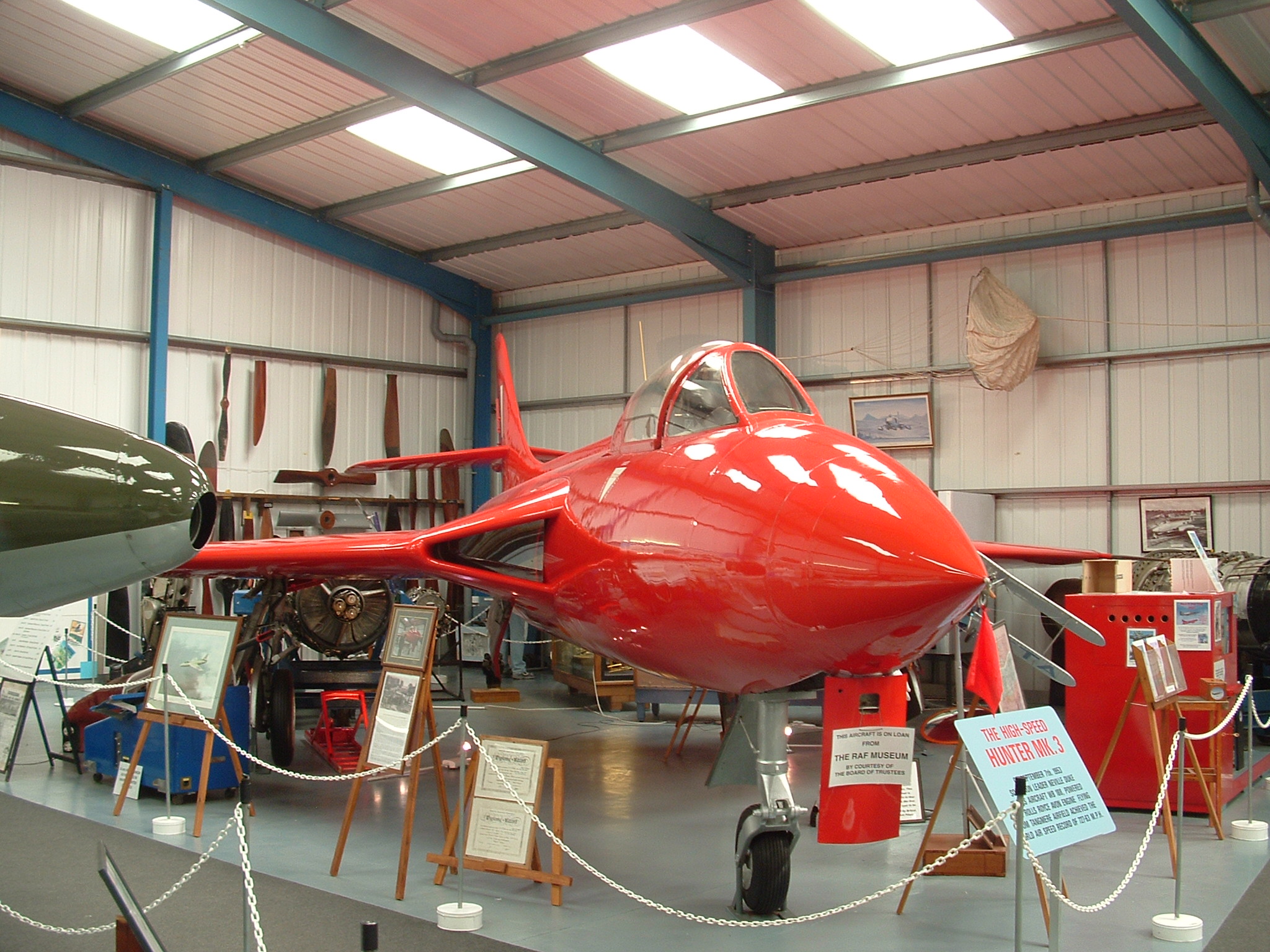
The record was a triumph of national prestige at a time when Britain, the United States and others were trading the fastest-aircraft title back and forth, but it did not last long. Within three weeks the rival Supermarine Swift had taken the record, and no production Mk 3 was ever built. WB188 itself survives, still in its record-breaking scarlet, and is one of the treasures of the Tangmere Military Aviation Museum. The record mattered less for the number itself than for what it announced: that Hawker had built an aircraft at the very front rank of world aviation. Duke, already a celebrated wartime fighter ace and test pilot, became a household name for the flight, and the scarlet Hunter became one of the best-known British aircraft of the decade. The effort also fed directly into the development of the definitive fighter marks, proving the airframe at high speed and giving Hawker invaluable data.
Flying the Hunter
Ask the pilots who flew it and the Hunter’s reputation comes down to one word: delightful. It had beautifully harmonised controls, plenty of power in its later marks, and a solidity and honesty that inspired confidence, and it could be flown hard without vices creeping up on the pilot. It was fast enough to be exciting and forgiving enough to be safe, a rare and valued combination, and generations of RAF pilots regarded a tour on Hunters as one of the high points of a flying career.
That good behaviour was not an accident. The Hunter would recover cleanly from spins, including inverted ones, at a time when many swept-wing jets were treacherous near the stall, and this made it a superb aircraft for teaching pilots to explore the edges of the envelope. The single ventral airbrake, adopted after early split flaps caused an unwanted pitch change, let a pilot slow the aircraft predictably, and the excellent view from the bubble canopy made it a natural gun and ground-attack platform. The one thing it always lacked was range: the early fighter marks in particular were thirsty and short-legged, which is why later versions gained more internal fuel and underwing tanks, and why the Hunter’s combat radius was always modest. As a gun platform it was steady and precise, and the concentrated punch of four 30-millimetre ADEN cannon made it a formidable destroyer of both aircraft and ground targets, a single burst carrying a weight of fire few contemporaries could match. Pilots converting onto it from the Meteor or the Vampire found an aircraft of a different order, faster, smoother and far more capable, and the affection they felt for it comes through in almost every account of flying the type.
Service and combat
In RAF hands the Hunter’s front-line career as a day fighter was surprisingly short, because the supersonic English Electric Lightning began to replace it in that role from the early 1960s. But the Hunter reinvented itself. The ground-attack FGA.9 and the fighter-reconnaissance FR.10 kept the type in front-line service through the 1960s and into the 1970s, flying operations from Aden and the Radfan to bases across the Middle East and Far East, and Hunters remained in RAF training and support use into the mid-1990s. The switch from interceptor to ground-attack aircraft suited the Hunter well, because its steadiness, heavy cannon and good low-level handling made it a fine gun and rocket platform, and the FGA.9 in particular became a mainstay of Britain’s remaining overseas commitments through the 1960s. As the Lightning took over air defence at home, it was this rugged mud-moving Hunter, rather than the sleek day fighter of the early 1950s, that most people came to picture when they thought of the type in RAF service.
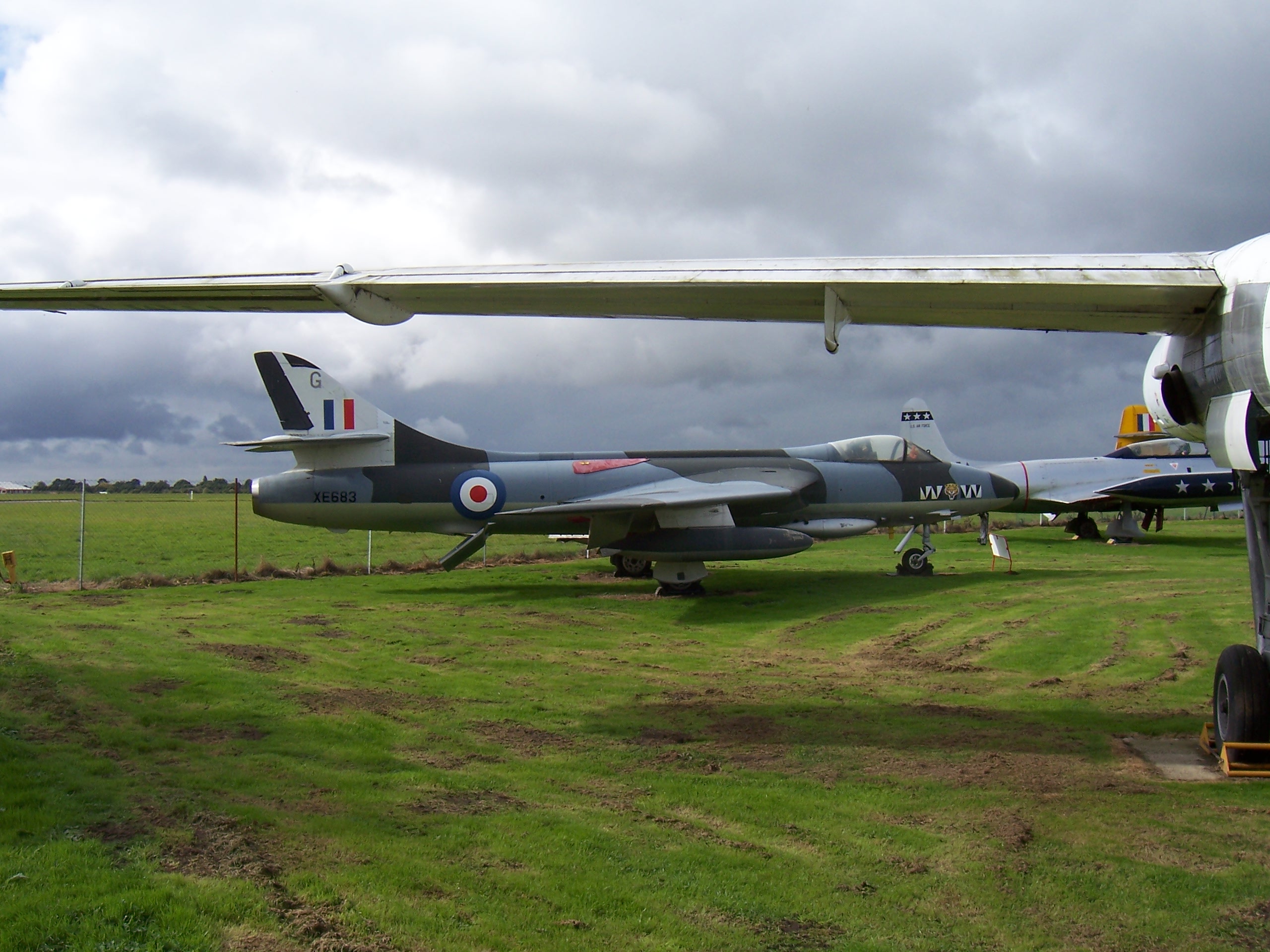
Abroad, the Hunter saw a great deal of combat. Royal Air Force F.5s escorted Canberra bombers during the Suez operation of 1956. Indian Air Force Hunters, delivered from the late 1950s, fought hard in the wars with Pakistan in 1965 and 1971, dogfighting Sabres and attacking armour, most famously in the defence at Longewala in 1971, though the precise kill and loss tallies from those wars remain disputed between Indian and Pakistani accounts and are best treated with caution. Jordanian, Iraqi and Lebanese Hunters saw action in the Arab-Israeli conflicts, Rhodesian Hunters were used extensively in the bush war of the 1970s, and Chilean Hunters bombed the presidential palace during the coup of 11 September 1973. One episode stands out: flying Hunters for Jordan and then Iraq during the 1967 war, the Pakistani exchange pilot Saiful Azam shot down three Israeli aircraft, one in a Jordanian Hunter and two in an Iraqi Hunter, part of a career tally of four, an extraordinary feat in an aircraft by then a decade old. In the ground-attack role over Aden and the Radfan, RAF Hunters worked with cannon and rocket against insurgents in some of the most demanding flying conditions anywhere, hot, high and unforgiving, and earned a reputation for reliability that helped sell the type abroad. It was a fighter that ended up fighting in a remarkable range of wars far from the skies over Britain it had been designed to defend.
Variants
The Hunter was developed through a family of marks that steadily improved the breed. The F.1 and Sapphire-powered F.2 were the first fighters into service; the F.4 added more fuel, strengthened wings with hardpoints and the Sabrina fairings; and the F.6 became the definitive fighter, with the large-bore Avon of around 10,000 pounds of thrust and a distinctive “dogtooth” extension on the wing leading edge to cure a pitch-up tendency. From the F.6 came the ground-attack FGA.9 and the fighter-reconnaissance FR.10, the versions that gave the Hunter its long second career.
The numbers built of each mark tell the story of a design maturing quickly: relatively small runs of the early F.1, F.2 and F.5 as the type found its feet, then large production of the F.4 and, above all, the F.6, which was the version most air forces really wanted. When the front-line fighter role passed to the Lightning, hundreds of F.6 airframes were converted into FGA.9 ground-attack and FR.10 reconnaissance aircraft rather than being scrapped, which is a large part of why the Hunter stayed in service so long. Two-seat trainers, the side-by-side T.7 for the RAF and the naval T.8, kept the Hunter in the training role for decades, and the Royal Navy also flew single-seat GA.11 and PR.11 aircraft. Beyond Britain the type was built under licence in Belgium and the Netherlands and refurbished for export in a long list of marks for Switzerland, India, Sweden, where it was designated the J 34, Chile, Denmark, Peru and a string of Middle Eastern air forces. In all, 1,972 Hunters were built, roughly half of them for overseas customers, making it one of the most successful British jet fighter exports and one of the most widely used Western jets of the Cold War.
The Hunter around the world
Part of what makes the Hunter remarkable is how far and how long it served beyond Britain. more than twenty air forces flew the type, and in many of them it stayed in front-line use for decades after the RAF had moved on. Switzerland was among the most enthusiastic operators, flying its Hunters in the ground-attack role from the mountains until 1994. India kept Hunters in service into the 1990s, Chile and the Middle Eastern operators flew them for many years, and Lebanon returned four Hunters to service in 2008, fifty years after first receiving the type, and did not finally retire them until 2014.
This global career was possible because the Hunter was rugged, cheap to run and easy to maintain, and because Hawker and its licensees were willing to refurbish and adapt airframes to each customer’s needs. Swiss, Chilean and Middle Eastern Hunters were rebuilt and re-engined and given new equipment, and a whole industry grew up around keeping them flying. It is a striking thought that an aircraft designed to defend 1950s Britain against Soviet bombers was still flying combat and training sorties in other air forces well into the twenty-first century. Camm and his team got the basic design right. The exact end dates vary by country and by source: Switzerland withdrew its Hunters in 1994, India phased its out through the 1990s, and Zimbabwe is reported to have kept a handful nominally in service into the 2000s, though spares shortages had long grounded most of them. Whatever the precise dates, the pattern is clear, a 1950s British fighter that went on giving useful service for half a century.
The Black Arrows and the aerobatic era
The Hunter gave the RAF some of the most spectacular formation aerobatics ever flown. In 1958, the Black Arrows of 111 Squadron, their aircraft finished in gloss black, looped a formation of twenty-two Hunters together at the Farnborough air show, a world record for the number of aircraft looped in formation that has never been beaten. The twenty-two were made up of the squadron’s own fourteen jets plus eight borrowed from other Fighter Command units, and after the loop they rolled sixteen aircraft as a single formation.
The Black Arrows were succeeded as the RAF’s premier team by the Blue Diamonds of 92 Squadron, who flew sixteen blue Hunters, and other air forces mounted their own Hunter display teams. That era of large, immaculate formations of a beautiful swept-wing fighter is a big part of why the Hunter is remembered with such affection, and it set a standard for RAF formation flying that runs directly to today’s Red Arrows. The discipline behind those displays was formidable: holding twenty-two aircraft steady through a loop demanded absolute trust and precise flying from every pilot, and the Black Arrows practised relentlessly to make it look effortless. Other operators, including the Swiss and the Belgians, mounted their own Hunter formation teams, and the type’s strength, docility and elegant lines made it an ideal display aircraft. Those great formations, immaculately flown and trailing the distinctive whistle of the Avon, drew enormous crowds and did much to fix the Hunter in the public affection where it has remained ever since.
Where the survivors are today
Because so many were built and the type was so well liked, the Hunter survives in large numbers, in museums around the world and, remarkably, still in the air. A number of airframes remain airworthy with civilian operators and contractors who use them for training and for military threat-simulation work, so the sight and sound of a Hunter in flight has not been lost.
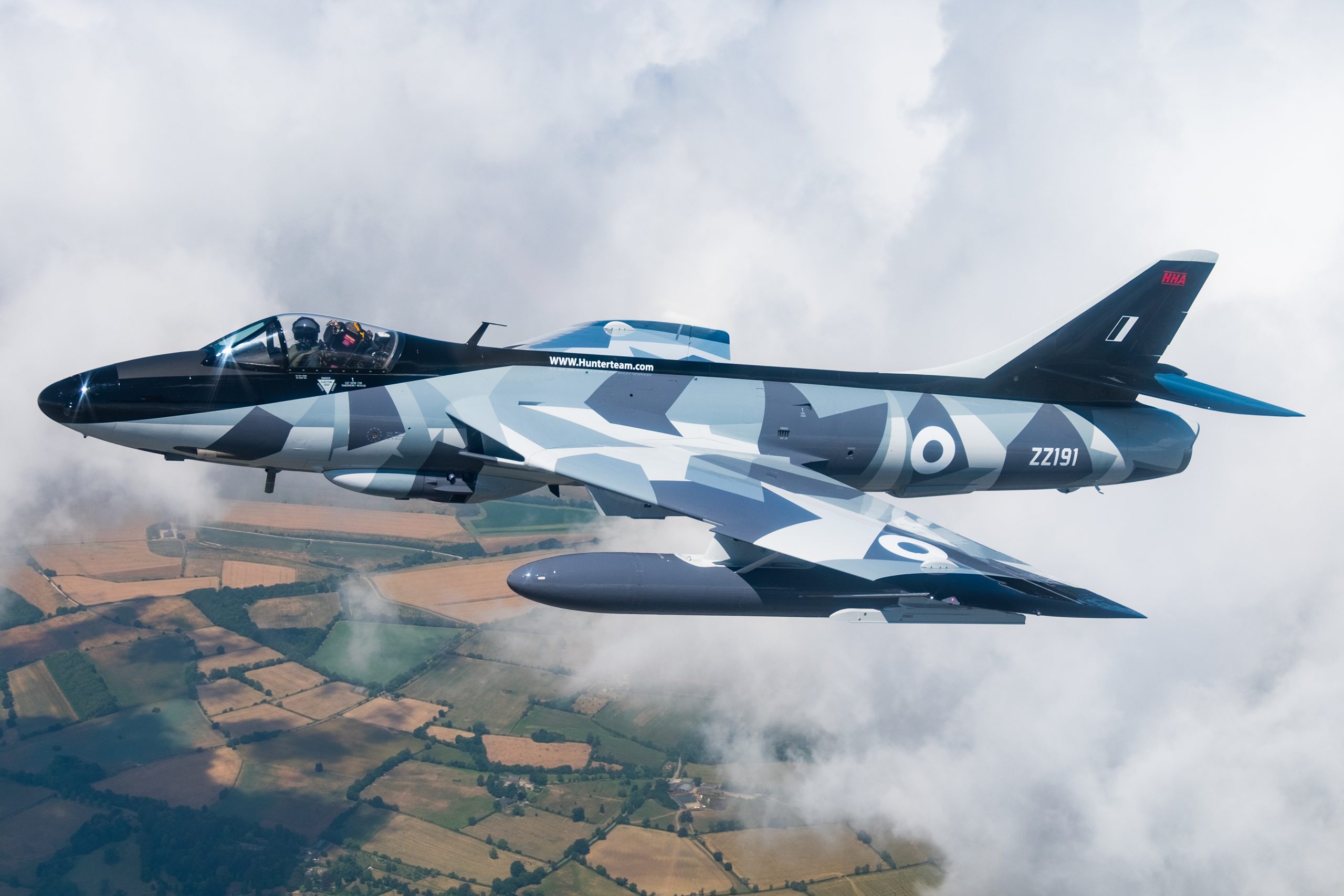
In the United Kingdom, civilian Hunter display flying was effectively halted after the Shoreham air show accident of 22 August 2015, in which a privately operated Hunter crashed onto a main road during a display, killing eleven people on the ground. The Civil Aviation Authority imposed severe restrictions on vintage jet displays in its aftermath, and many UK Hunters were subsequently sold abroad. Contractors such as Hawker Hunter Aviation in Britain and operators in Canada, the United States and elsewhere continue to fly the type. Preserved Hunters are on display at the RAF Museum, at Tangmere, at Duxford, at Newark and at many museums across Europe and beyond, from Switzerland to Australia, a reflection of just how widely the aircraft served. Among the notable survivors are the record-breaking WB188 at Tangmere, an FGA.9 at the RAF Museum, and complete examples at Cosford, Duxford, Newark and the Fleet Air Arm Museum, while Switzerland, Sweden, Denmark, the Netherlands, Canada, Australia and the United States all hold preserved Hunters. Airworthy machines are maintained by contractors and a handful of private owners, mostly ex-Swiss F.58 airframes that were among the last built and the best kept, so the type has a genuine chance of flying for years to come. For the enthusiast this means the Hunter is one of the more accessible classic jets to see in the metal, common in museums across Britain and Europe and still, just occasionally, thundering along a display line under the hands of one of the specialist operators who keep the breed alive.
Photographing the Hunter today
For a photographer, the Hunter is a wonderful subject, whether static in a museum or, on the rarer and more precious occasions, in the air. Its shape is the thing to work with: the graceful swept wing, the deep oval intakes and the slim fuselage reward a low three-quarter angle that shows the sweep and lets the classic lines read against the sky.
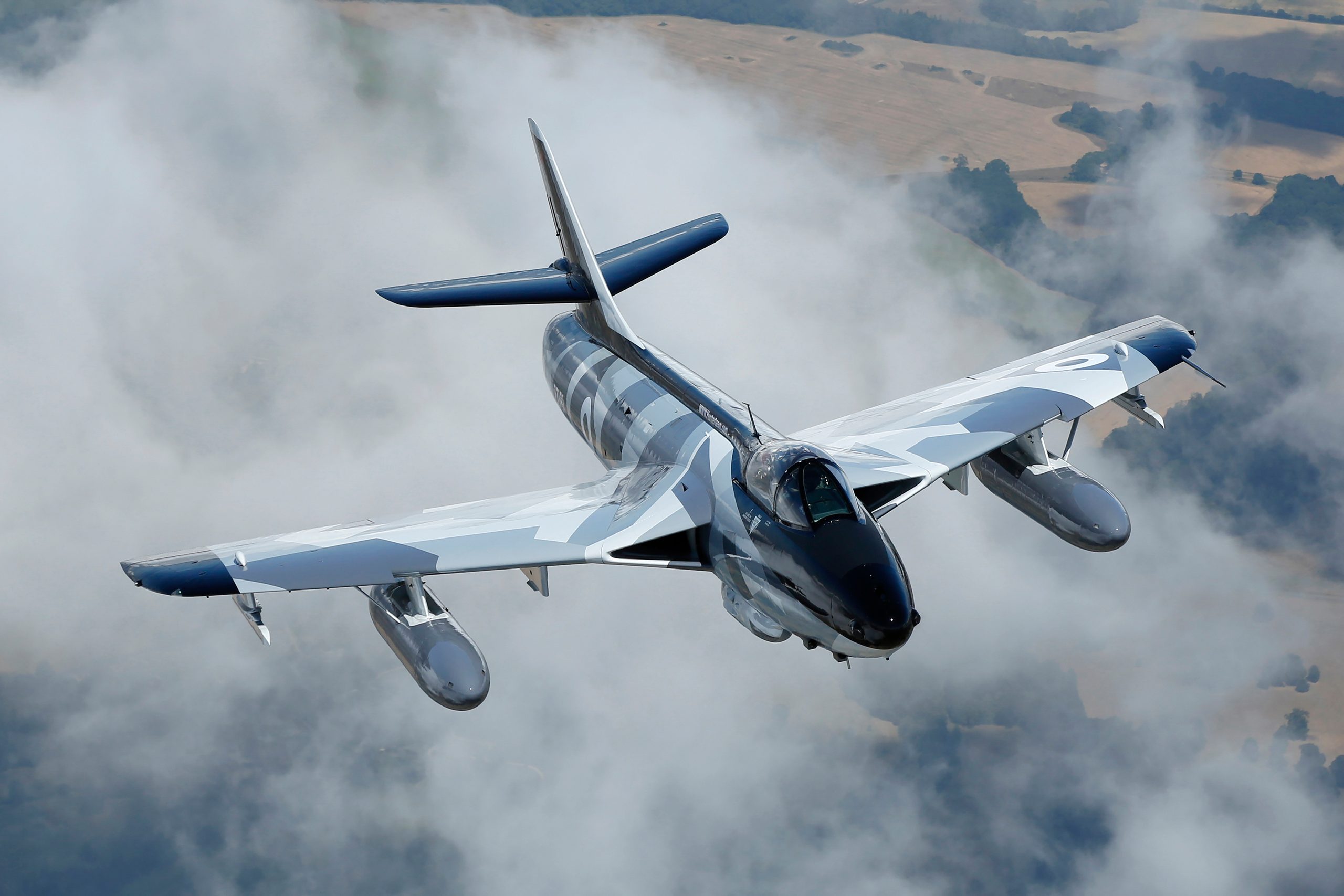
On the ground, museum lighting and cramped halls are the usual challenges, so look for an angle that isolates the aircraft against a plain background, watch for reflections off the polished panels, and raise the ISO rather than fight camera shake. In the air, a Hunter flown by one of the surviving operators is a fast, purposeful subject best treated like any classic jet, with a shutter speed high enough to freeze the airframe and careful tracking through the pass, technique covered in our guide to photographing fast jets. Because airworthy Hunters are now few, every chance to photograph one flying is worth taking, and worth recording accurately, since many wear the markings of one operator while having served with another. A preserved Hunter in a museum is a chance to study the shape at leisure, from the deep intakes and the gun pack to the elegant taper of the wing, and the aircraft photographs beautifully in the low, warm light of early morning or late afternoon, which suits its natural-metal and camouflage finishes far better than the flat glare of midday.
Legacy
The Hunter’s legacy is measured in decades and in affection. It served the RAF for some forty years in one role or another, equipped more than twenty air forces, and flew in combat on several continents into the twenty-first century, with Lebanon operating Hunters as late as 2014. It was Hawker’s first jet fighter for the RAF, and the aircraft that carried the company from its piston-engined Hurricanes and Furies towards the jet age.
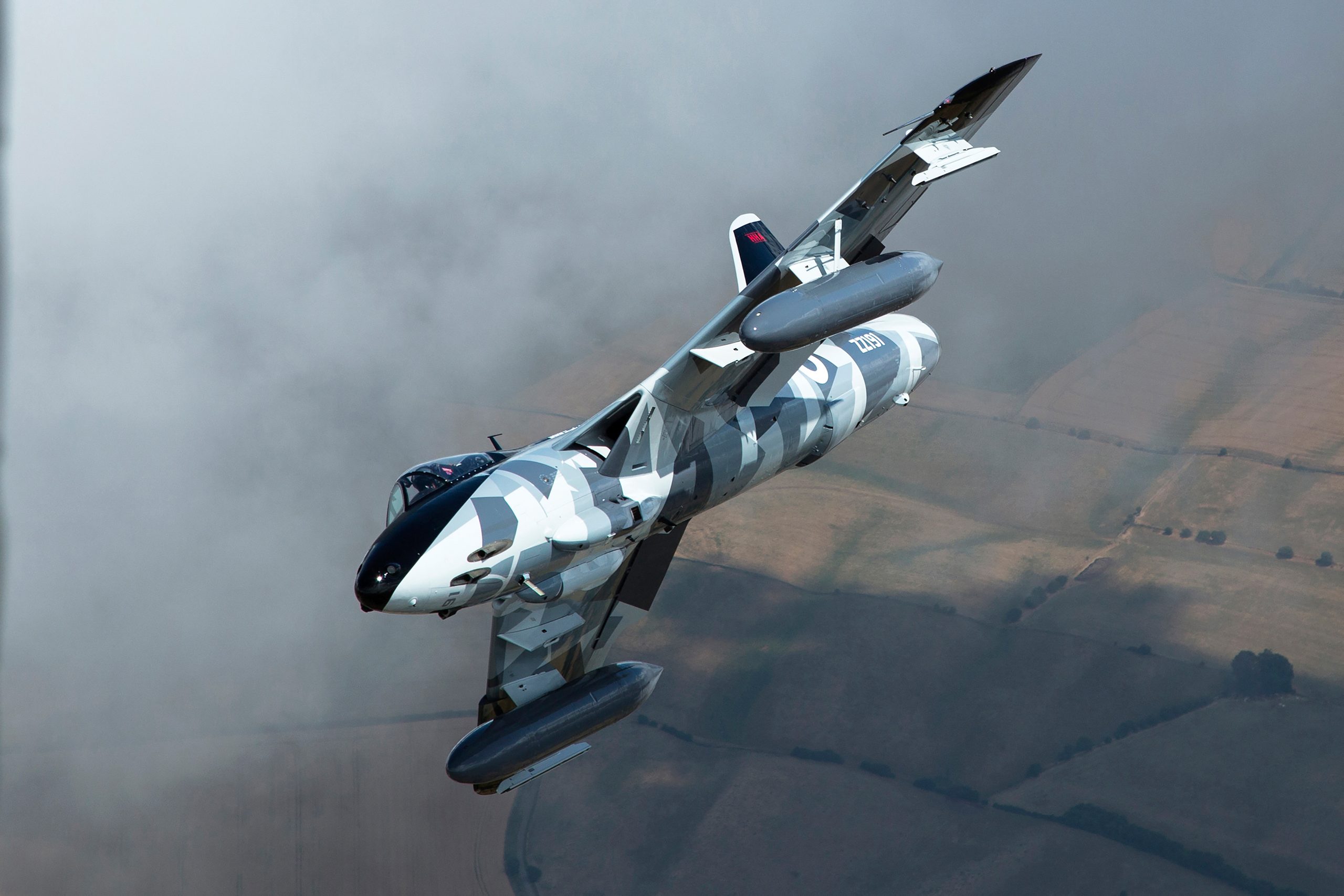
Its ground-attack role passed in time to the Harrier and the Phantom, and its training role to the BAE Hawk that the Red Arrows fly today, placing the Hunter as the pivotal aircraft in Hawker’s line between the pistons and the jump jet. But beyond the lineage, it is simply remembered as one of the most beautiful and best-loved aircraft Britain ever built, an aeroplane that pilots queued to fly and that crowds still fall silent for. It bridged two eras, arriving as a gun-armed day fighter and bowing out as a versatile ground-attack aircraft and trainer, and along the way it gave Britain a genuine world-class success in a field the country would slowly cede to others. For many enthusiasts it is simply the most graceful jet ever built, and the combination of that beauty with real capability and extraordinary longevity is exactly why it is remembered as a high point of British aircraft design. For the manufacturer’s wider story, see our history of Hawker Aircraft.
Specifications
The figures below are for the definitive Hawker Hunter F.6. Published weights and performance vary a little between reference sources, so they are best read as representative rather than exact, and the empty weight in particular is quoted differently depending on how the aircraft is equipped.
| Characteristic | Imperial | Metric |
|---|---|---|
| Crew | 1 (2 in the T.7 trainer) | |
| Length | 45 ft 10.5 in | 13.98 m |
| Wingspan | 33 ft 8 in | 10.26 m |
| Height | 13 ft 2 in | 4.01 m |
| Wing area | 349 sq ft | 32.4 m² |
| Empty weight | approx. 12,760–14,120 lb | approx. 5,790–6,405 kg |
| Max take-off weight | 24,600 lb | 11,158 kg |
| Powerplant | 1 × Rolls-Royce Avon 207 turbojet, approx. 10,145 lbf (45.1 kN) | |
| Maximum speed | 623 mph at 36,000 ft; approx. 715 mph at sea level | 1,003 km/h; Mach 0.94 |
| Combat range | approx. 385 mi | approx. 620 km |
| Service ceiling | approx. 50,000 ft | approx. 15,000 m |
| Rate of climb | approx. 17,200 ft/min | approx. 87 m/s |
| Armament | 4 × 30 mm ADEN cannon (150 rpg) in a removable pack; underwing bombs and rockets | |
The Hunter flew with nineteen air forces and wore dozens of schemes, which makes accurate captioning harder than it looks. If you are licensing Hunter imagery, our guide to aviation picture research explains how to pin down mark and operator before you publish.
Frequently asked questions
When did the Hawker Hunter first fly?
The prototype, WB188, made its first flight on 20 July 1951, flown by Hawker’s chief test pilot Neville Duke. The first production F.1 flew in 1953 and the type entered RAF service in July 1954.
How fast was the Hawker Hunter?
The definitive F.6 had a maximum speed of about 623 mph at 36,000 feet, roughly 715 mph at sea level, or around Mach 0.94, with a service ceiling near 50,000 feet. A specially modified Hunter went considerably faster to set the world air speed record in 1953.
Did the Hawker Hunter hold the world air speed record?
Yes. On 7 September 1953 Neville Duke flew a modified Hunter Mk 3 to a world absolute air speed record of 727.63 mph off the Sussex coast. The record stood for less than three weeks before the rival Supermarine Swift took it, and no production Mk 3 was ever built.
Who designed the Hawker Hunter?
The Hunter was designed by Sydney Camm and his team at Hawker Aircraft, the same design office responsible for the Hurricane, the Typhoon and the Sea Hawk. It was developed as the Hawker P.1067 to meet Air Ministry Specification F.3/48.
How many Hawker Hunters were built?
A total of 1,972 Hunters were built, including licence production in Belgium and the Netherlands, with roughly half of them going to overseas customers. That makes the Hunter one of the most widely exported British jet fighters and one of Britain’s most successful post-war defence exports.
What were the Sabrinas on the Hunter?
The Sabrinas were the two bulged fairings fitted under the Hunter’s forward fuselage from the F.4 onwards. They collected the spent metal links ejected when the cannon fired, which had previously tumbled back and damaged the underside of the aircraft, and they were nicknamed after a well-known actress of the day.
What was the Black Arrows 22-Hunter loop?
At the 1958 Farnborough air show, the Black Arrows of 111 Squadron looped a formation of twenty-two Hunters together, a world record for the number of aircraft looped in formation that has never been beaten. The twenty-two included fourteen of the squadron’s own jets plus eight borrowed from other units.
Did the Hawker Hunter see combat?
Yes, extensively, though mostly with export operators. RAF Hunters flew at Suez in 1956 and in ground-attack operations from Aden, while Indian Air Force Hunters fought in the 1965 and 1971 wars with Pakistan. Jordanian, Iraqi, Lebanese, Rhodesian and Chilean Hunters all saw action, and combat claims from those conflicts are often disputed between the sides.
What engine did the Hawker Hunter use?
Most Hunters were powered by the Rolls-Royce Avon turbojet, with the definitive F.6 using a large-bore Avon of around 10,000 pounds of thrust. The F.2 and F.5 instead used the Armstrong Siddeley Sapphire, but the RAF standardised on the Avon to share engines with its Canberra fleet.
Are any Hawker Hunters still flying?
Yes. A number of Hunters remain airworthy with civilian operators and defence contractors, who use them for training and military threat-simulation work in Britain, Canada, the United States and elsewhere. Airworthy examples are now relatively few, which makes any chance to see one fly worth taking.
Why did civilian Hunters stop flying at UK airshows?
After the Shoreham air show accident of 22 August 2015, in which a privately operated Hunter crashed onto a main road and killed eleven people on the ground, the Civil Aviation Authority imposed severe restrictions on vintage jet displays in the UK. Civilian Hunter display flying in Britain largely came to an end, and many airframes were sold abroad.
Where can I see a Hawker Hunter?
Preserved Hunters are on display at the RAF Museum, at Tangmere, which holds the scarlet record-breaking WB188, and at Duxford, Newark and many other museums across Europe and around the world. Contractors also keep a number of Hunters airworthy, so they occasionally appear in the air.
The Hunter served alongside the Blackburn Buccaneer, including in the improvised 1967 bombing of the wrecked tanker Torrey Canyon.
