Hawker Aircraft was a British manufacturer, founded in 1920 from the wreckage of the Sopwith company and based at Kingston upon Thames, that produced some of the most important combat aircraft in Royal Air Force and Royal Navy history, from the biplane Fury and the Hurricane of the Battle of Britain to the jet-age Hunter and the vertical take-off Harrier. For more than forty years the Hawker name on a fighter was a mark of quality, and the run of designs that came from its drawing office under Sydney Camm shaped British air power from the first monoplanes to the jump jet.
The story is really two stories bound together. One is the run of aeroplanes: elegant silver biplanes, the workmanlike Hurricane, the brutal Typhoon, the beautiful Hunter and the revolutionary Harrier. The other is the tangle of company names, mergers and takeovers that turned a small engineering firm into a division of one of Britain’s largest aviation groups and finally folded it into the nationalised industry. This guide follows both, and ends where the surviving aircraft are today and how to photograph the ones still flying.
What this guide covers
- How Hawker began: from Sopwith to Kingston
- The people behind Hawker
- The biplane years: Hart, Fury and the interwar RAF
- The Hurricane and the monoplane revolution
- Wartime fighters: Typhoon, Tempest and Sea Fury
- Hawker enters the jet age: Sea Hawk and Hunter
- The Harrier revolution: the jump jet
- The corporate story: Hawker Siddeley and the end of the name
- Key Hawker aircraft at a glance
- Photographing Hawker aircraft today
- The Hawker legacy
- Frequently asked questions
How Hawker began: from Sopwith to Kingston
Hawker was born out of a failure. The Sopwith Aviation Company, set up by the sportsman and aviator Thomas Sopwith in 1912, had been one of the great aircraft makers of the First World War, turning out the Pup, the Triplane, the Camel and the Snipe in huge numbers. When the war ended the military orders evaporated overnight, and a punishing government tax on wartime profits finished the job. Sopwith attempted to move into building motorcycles and general engineering, but it was not enough, and in September 1920 the company went into voluntary liquidation rather than face its liabilities.
The people were too good to let go, so they simply started again. In 1920 Harry Hawker, Sopwith’s Australian chief test pilot, together with Thomas Sopwith himself, the engineer Fred Sigrist and the businessman Bill Eyre, bought the assets of the old firm and formed a new company, H. G. Hawker Engineering. The name was deliberate. By putting Hawker rather than Sopwith over the door, the founders avoided any legal link to the debts of the liquidated business, and Thomas Sopwith stepped in as chairman while the company took his test pilot’s name.
The new firm stayed in Kingston upon Thames, in the same corner of south-west London where Sopwith had built his wartime aircraft, and it survived its first lean years on unglamorous work: refurbishing surplus Sopwith Snipes for the RAF, building aluminium car bodies, even making motorcycles. Aircraft design restarted slowly. The first Hawker design, the Humpback of December 1920, was never built. The first Hawker aeroplane actually to fly was the Duiker prototype in July 1923, followed by a string of biplanes with bird names that few people now remember. The firm was finding its feet, and it was about to find the man who would define it.
The people behind Hawker
No account of Hawker makes sense without its people, because the company was unusually shaped by a small number of strong characters who stayed for decades.
Thomas Sopwith
Sopwith was the constant. Having founded the original company at the age of twenty-four, he became chairman of Hawker and remained a guiding presence through every merger and renaming that followed, steering the business from wooden biplanes to jet fighters across a career that spanned the whole first half-century of powered flight. His financial caution in the depression years, keeping the company strong when rivals struggled, made possible the takeovers that turned Hawker into a major group.
Harry Hawker
The man whose name the company carried did not live to see any of its success. Harry Hawker was a brilliant and daring Australian test pilot who had made his reputation flying Sopwith machines and attempting record flights, including a near-fatal effort to cross the Atlantic in 1919. He was killed on 12 July 1921, barely a year after the company was founded, when his Nieuport Goshawk crashed as he climbed away from Hendon while practising for the Aerial Derby. He was thirty-two. The firm kept his name as a memorial, and it went on to become one of the most respected in aviation.
Fred Sigrist
Sigrist was the practical engineer of the founding group, a former Sopwith works manager whose feel for production and for solid, buildable structures underpinned the company in its early years. The construction method that became a Hawker trademark, a framework of metal tubes joined and braced in a way that was strong, repairable and easy to build in quantity, owed much to his influence and served the firm right through the Hurricane.
Sydney Camm
The designer who made Hawker famous joined as a senior draughtsman in November 1923. Sydney Camm, born in Windsor in 1893, had come up the hard way, from model aeroplanes and a carpentry apprenticeship to the drawing office, and he had an instinct for clean, efficient shapes that few could match. His first Hawker design, the little Cygnet, was enough to get him appointed chief designer in 1925, a post he held for the rest of his working life. Over the next four decades his drawing office produced the Hart, the Fury, the Hurricane, the Typhoon, the Tempest, the Sea Fury, the Hunter and the P.1127 that became the Harrier. He was knighted in 1953 and died in 1966, still working. It is a fair claim that no single designer shaped British combat aircraft over so long a period.
The biplane years: Hart, Fury and the interwar RAF
Hawker’s rise to the front rank began with a bomber. The Hawker Hart, which first flew in 1928, was a two-seat light day bomber of such clean design that it could outrun most of the fighters meant to intercept it. It was fast, handsome and, crucially for a company that needed to make money, easy to build and adapt. The Hart and its derivatives became one of the most-produced British aircraft families of the interwar years and the parent of a whole family of variants, each a Hart adapted for a different job: the Audax for army cooperation, the Demon as a fighter, the Hind as an updated bomber, the Osprey for the navy, the Hardy for colonial policing. For much of the 1930s a large share of the RAF flew some version of the Hart.
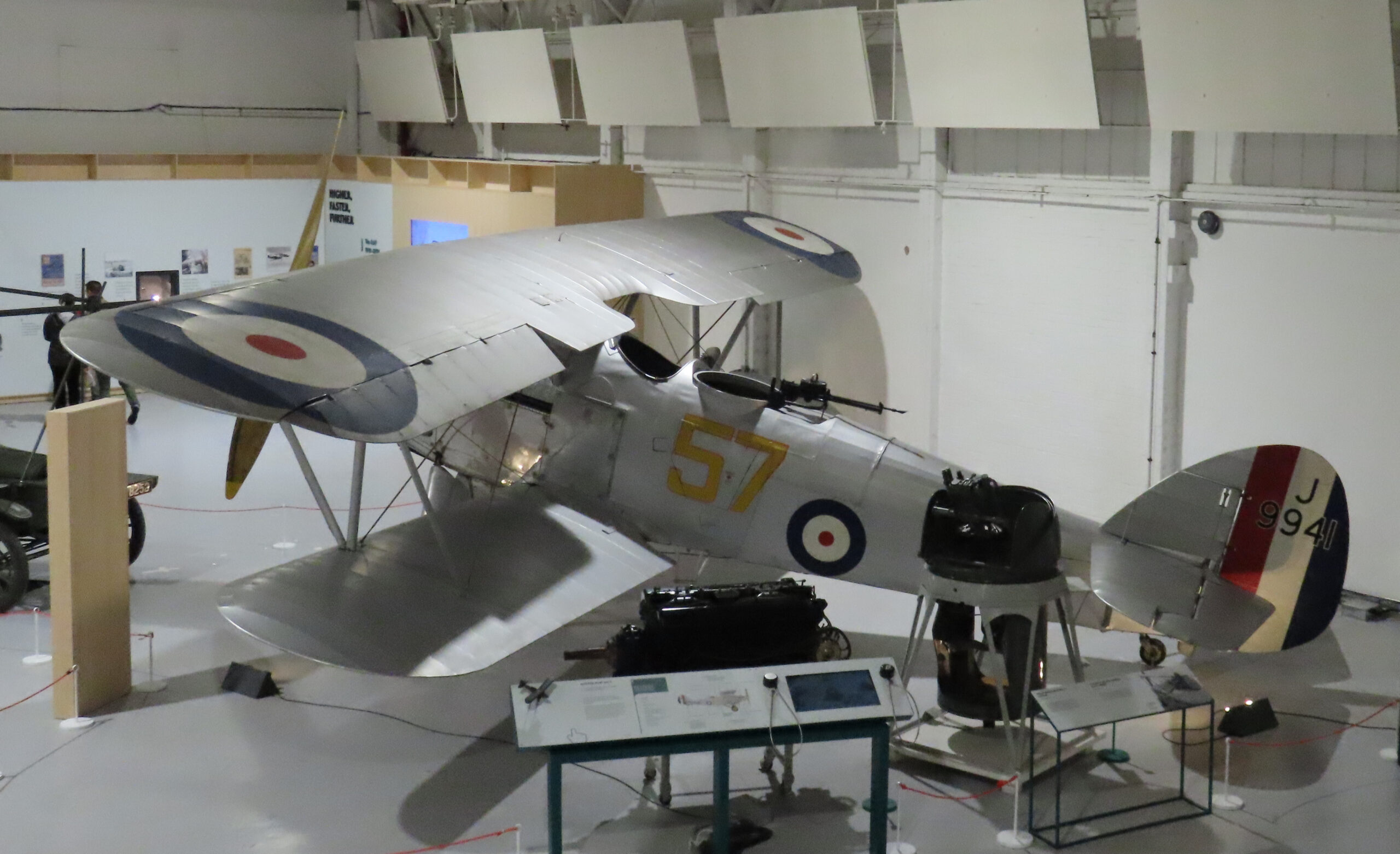
Where the Hart made the money, the Fury made the name. The Hawker Fury, first flown at Brooklands on 25 March 1931, was a single-seat interceptor of real beauty, and it holds a genuine place in the record books as the first operational RAF fighter able to exceed 200 mph in level flight. It was expensive, so it equipped only a few elite squadrons, but those silver Furies, looping in tight formation at the Hendon air displays, were the public face of the pre-war RAF and the high point of the fighter biplane. In the Fury you can already see the shapes Camm would carry into the monoplane age: the same slim nose, the same care over drag.
These biplanes matter for more than nostalgia. They established the Hawker method: a strong metal-tube structure, a close working relationship with Rolls-Royce over engines, and a design office that improved a good basic shape step by step rather than starting from scratch each time. That approach was about to be tested by the biggest change in fighter design for a generation.
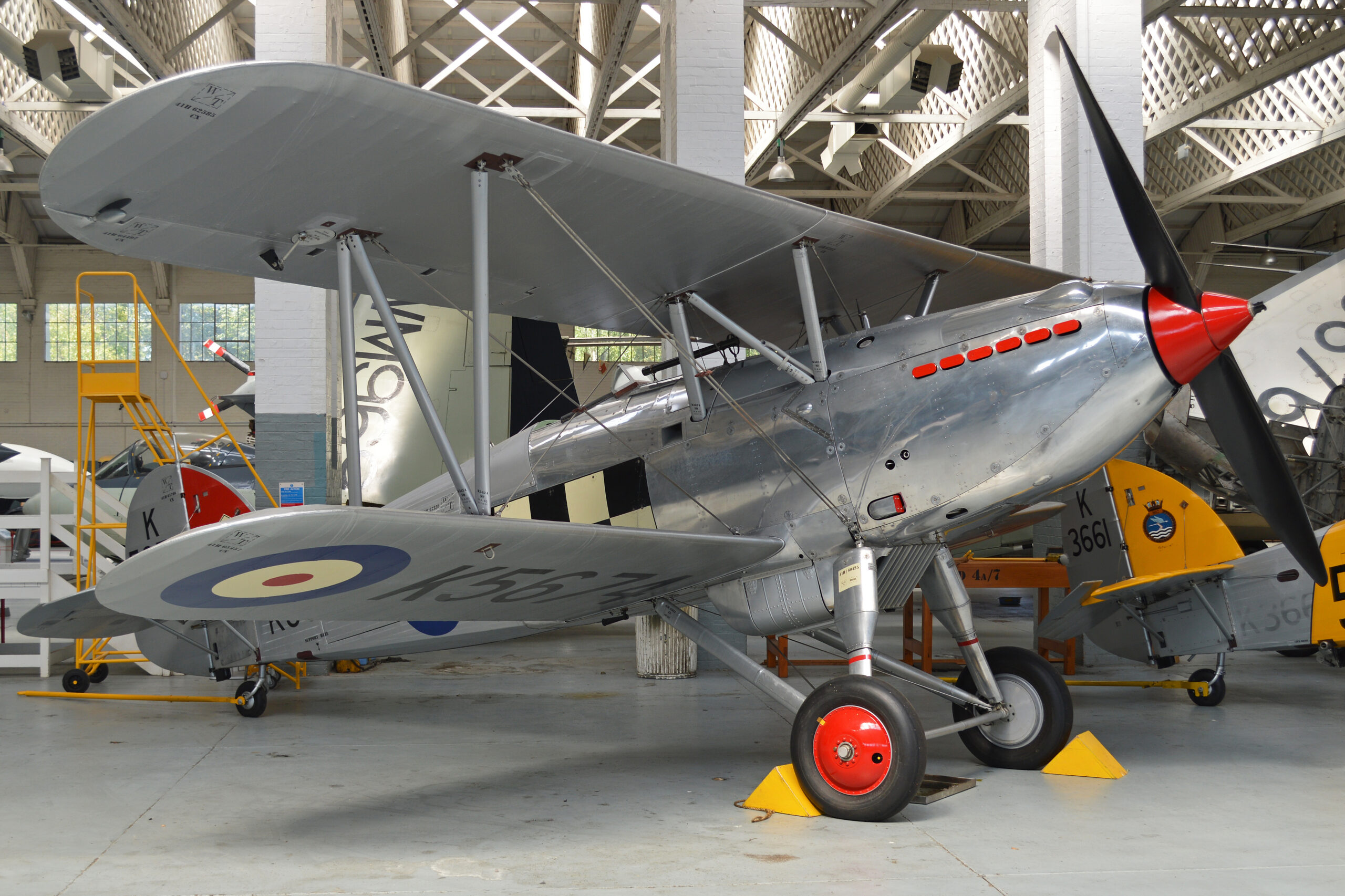
The biplane era also took Hawker to sea and abroad. The Nimrod, a navalised cousin of the Fury, gave the Fleet Air Arm a smart carrier fighter, while Harts and their derivatives were exported to and licence-built for a string of foreign air forces, from Sweden to South Africa, and a Swedish-built version even flew in combat in the Winter War. This export trade taught the company how to adapt a basic design to different engines and requirements, a skill that would pay off handsomely with the Hunter twenty years later. Just as important, the long Hart production run kept the Kingston works busy and profitable through the depression, so that when rearmament came Hawker had the money, the workforce and the confidence to gamble on the Hurricane.
The Hurricane and the monoplane revolution
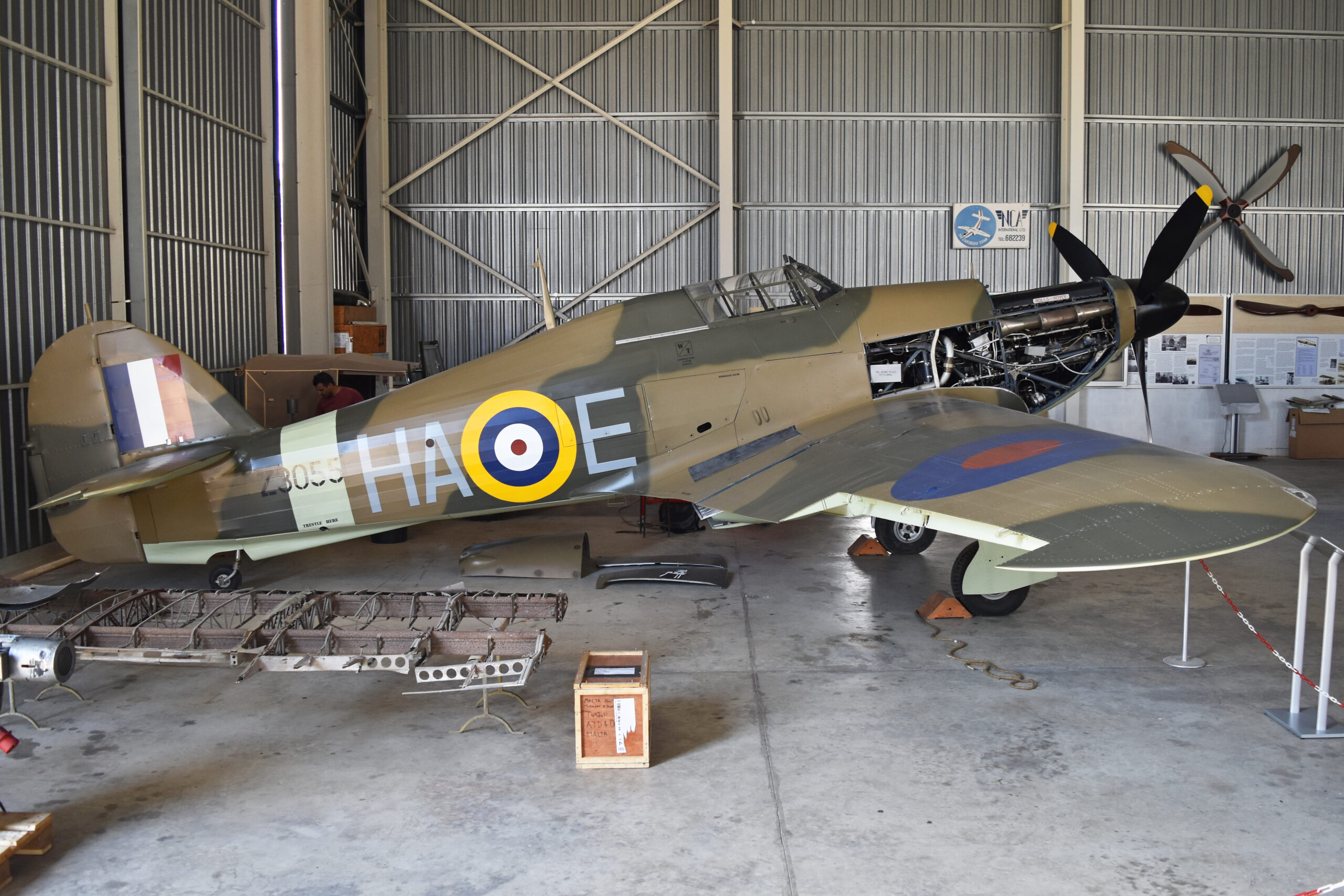
By the early 1930s it was clear that the future of the fighter lay in the fast monoplane: a single low wing, a retractable undercarriage, an enclosed cockpit and an eight-gun battery. Camm’s response was the Hurricane, and it was a shrewd piece of engineering. Rather than leap to an all-new structure, he wrapped the new monoplane form around the tried and trusted Hawker metal-tube framework, covered at first partly in fabric. That made the Hurricane quick to design, quick to build and, as it turned out, easy to repair in the field, because a cannon shell often passed straight through the fabric without wrecking the structure.
The prototype, K5083, first flew on 6 November 1935, and the Hurricane entered RAF service well before its more glamorous stablemate the Spitfire. When the Battle of Britain came in the summer of 1940, the Hurricane was the backbone of Fighter Command. It equipped more squadrons than any other British fighter, and although the Spitfire took the headlines and the glory, the more numerous Hurricanes did a very large share of the day-to-day fighting, typically sent against the German bombers while the Spitfires tackled the escorting fighters. Around 14,500 Hurricanes were eventually built, in Britain, Canada, Belgium and Yugoslavia, and the type served on every major front, from the Western Desert to the Russian Arctic, and went to sea as the Sea Hurricane.
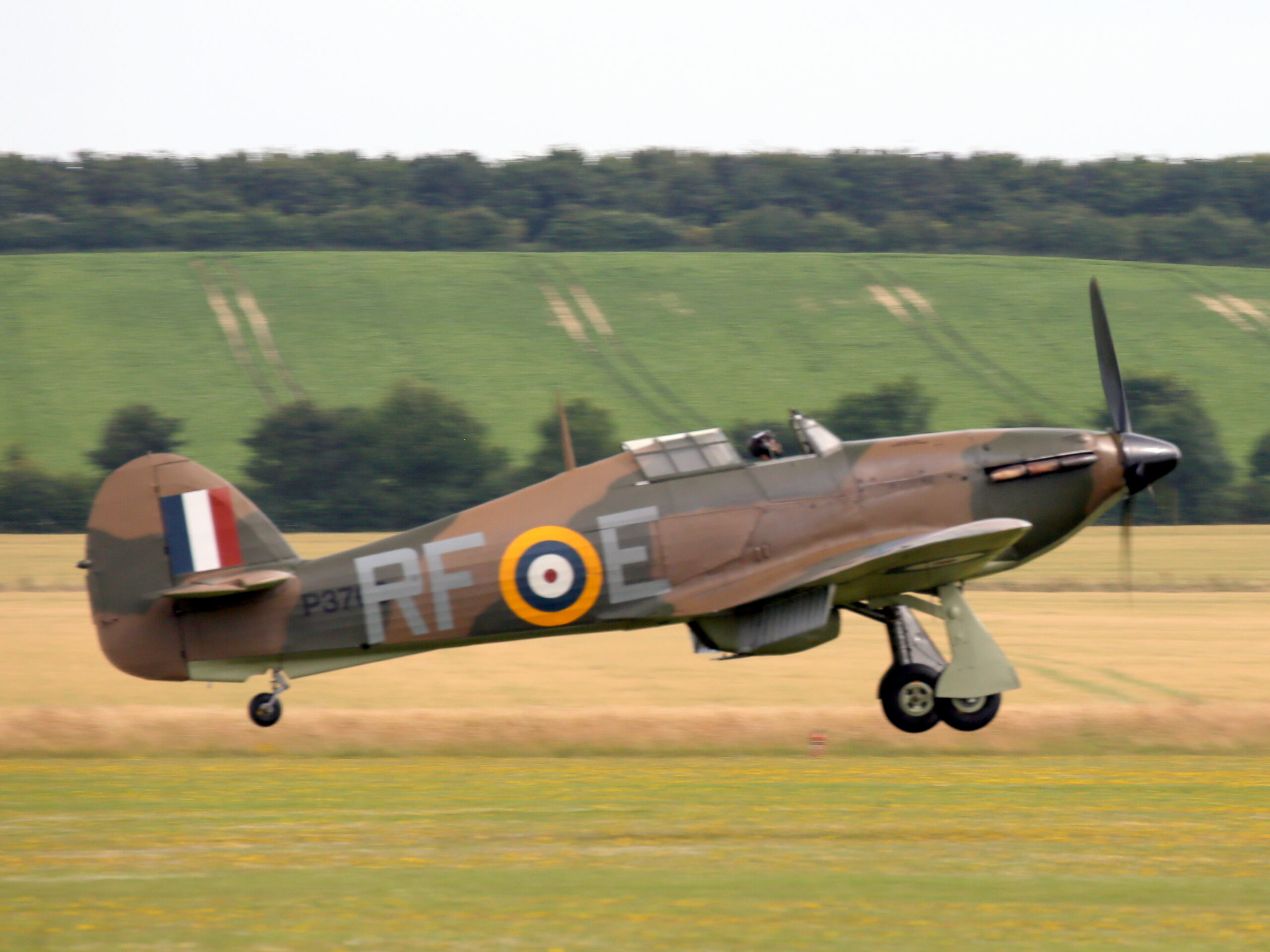
The Hurricane is also the aircraft that lifted Hawker from a successful firm to a strategically vital one. Producing it in the numbers the war demanded turned the company and its new corporate group into one of the pillars of British aircraft production, and the profits and the reputation funded everything that came after. If you want the full story of the type, our dedicated Hawker Hurricane history goes into the design, the combat record and the survivors in detail.
Wartime fighters: Typhoon, Tempest and Sea Fury
The Hurricane was already being outpaced by newer German fighters by the middle of the war, and Hawker’s answer was a much bigger, more powerful machine built around the massive Napier Sabre engine. The Hawker Typhoon, which first flew in 1940, had a troubled start. The engine was unreliable, the airframe suffered structural failures, and as a high-altitude interceptor it disappointed. Its salvation was to be sent down low. Armed with cannon and later with rockets and bombs, the Typhoon became one of the most effective ground-attack aircraft of the war, and in the fighting after D-Day in 1944 its rocket attacks on German armour and transport made it a feared weapon over Normandy.
Out of the Typhoon came something better. Camm’s team gave the design a new, thinner elliptical wing and cleaned up the airframe to produce the Hawker Tempest, which first flew in 1942. The Tempest was one of the fastest low-level piston fighters of the war, and it earned a particular reputation in 1944 for chasing down and destroying V-1 flying bombs, whose speed put them beyond many other interceptors. Where the Typhoon was a heavy hitter, the Tempest was a genuine air-superiority fighter at low and medium height.
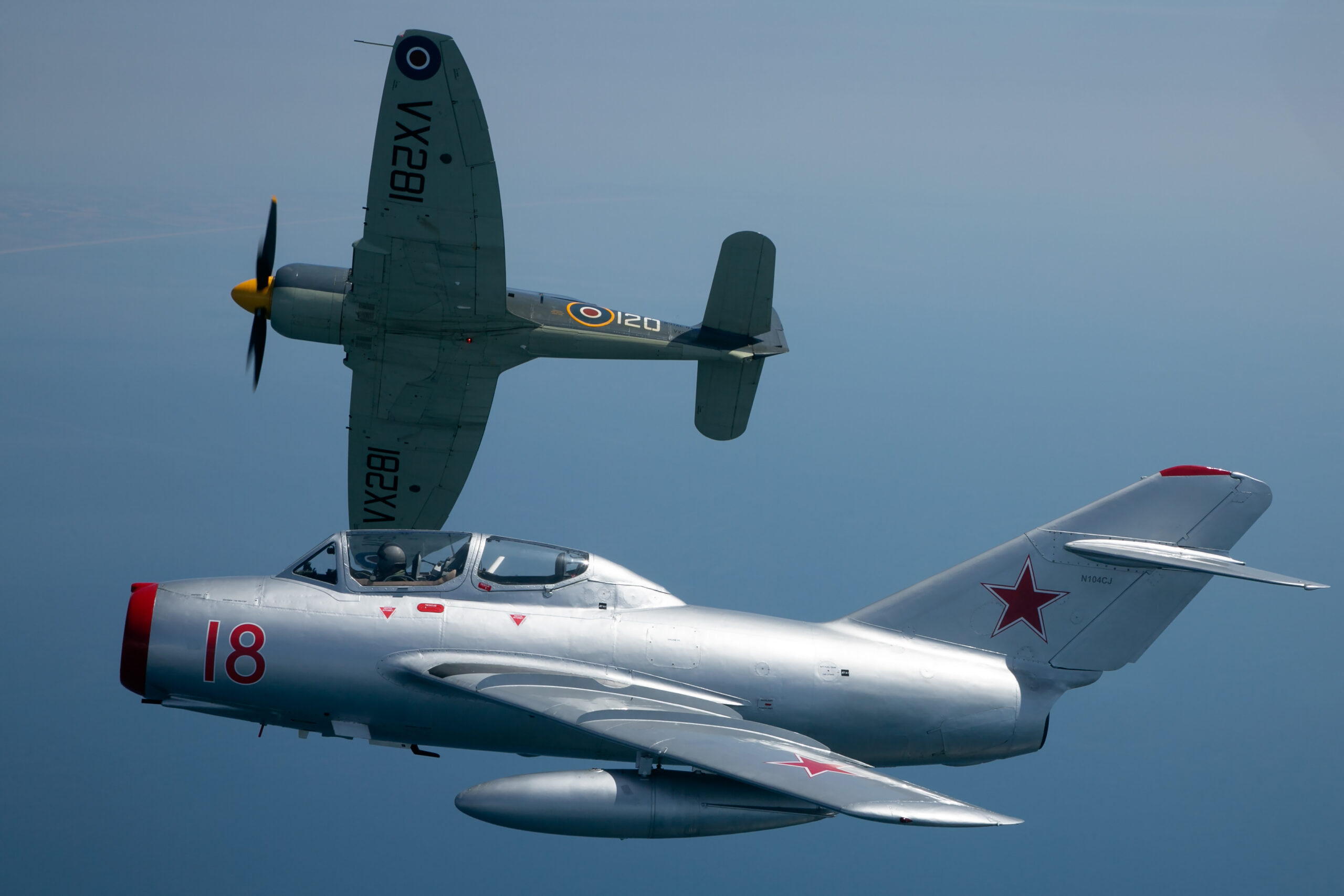
The line reached its peak just as the piston era was ending. The Hawker Sea Fury, developed for the Royal Navy and first flown in 1945, was a lighter, refined development of the Tempest idea around a Bristol Centaurus radial engine. It arrived too late for the Second World War but became one of the fastest piston-engined aircraft ever built and the last piston fighter to serve with the Royal Navy. It also earned a remarkable footnote in the Korean War.
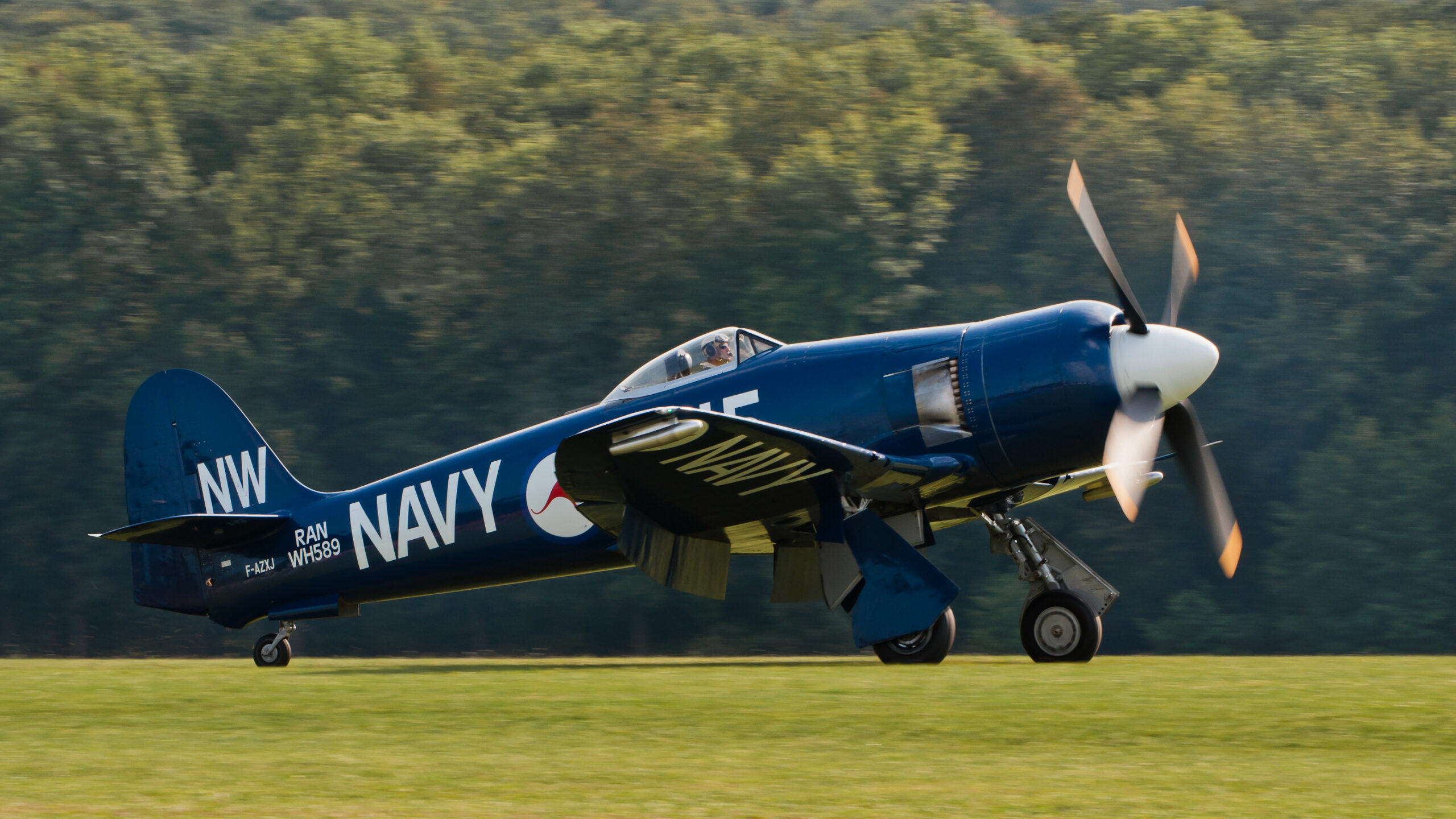
On 9 August 1952, flying a Sea Fury of 802 Naval Air Squadron from the carrier HMS Ocean, Lieutenant Peter Carmichael was credited with shooting down a MiG-15, one of the very few occasions in which a propeller-driven fighter was credited with destroying a jet. The claim is disputed even within the Royal Navy: Carmichael himself always attributed the kill to his whole flight rather than to his own guns, and another pilot in the formation later claimed it. What is not in doubt is that a piston-engined naval fighter held its own in a jet war, which says a great deal about the aircraft and its pilots.
The Typhoon and Tempest deserve to be remembered together, because between them they solved a problem the Hurricane could no longer handle: catching and killing the fastest German aircraft at low level. In the months after D-Day, wings of rocket-firing Typhoons roamed over France attacking tanks, lorries, trains and headquarters, and although postwar analysis showed the rockets were less accurate than wartime claims suggested, the sheer weight and persistence of the attacks broke the movement of German forces by day. The Tempest, meanwhile, was fast enough to catch the V-1 flying bombs launched at London in 1944 and flew standing patrols against them, and in the last months of the war it took on and beat the latest German piston fighters and even hunted the Me 262 jet in the vulnerable moments around its airfields. These were the aircraft in which the Hawker piston fighter reached full maturity.
Hawker enters the jet age: Sea Hawk and Hunter
Hawker came to jets a little later than some rivals, and it came carefully. Its first jet, the P.1040 that became the Sea Hawk, first flew in 1947 and entered service with the Fleet Air Arm as a neat, docile naval fighter-bomber. It was not a world-beater in performance, but it was pleasant to fly and reliable, and it gave the company vital experience of jet design and of the demands of carrier operations. Exported to several navies, the Sea Hawk kept Hawker in the naval jet business while the firm worked on something far more ambitious.
That something was the Hunter, and it is the aircraft many people regard as the most beautiful jet Britain ever built. The prototype first flew on 20 July 1951 in the hands of the test pilot Neville Duke, and the production Hunter that followed was fast, strong and superb to fly. On 7 September 1953 a specially prepared Hunter, flown by Duke, set a world air speed record of just over 727 mph off the Sussex coast. The record was a genuine achievement, though it stood for only a few weeks before the rival Supermarine Swift took it, and it is fairer to remember the Hunter for its long career than for a fortnight of record-holding.
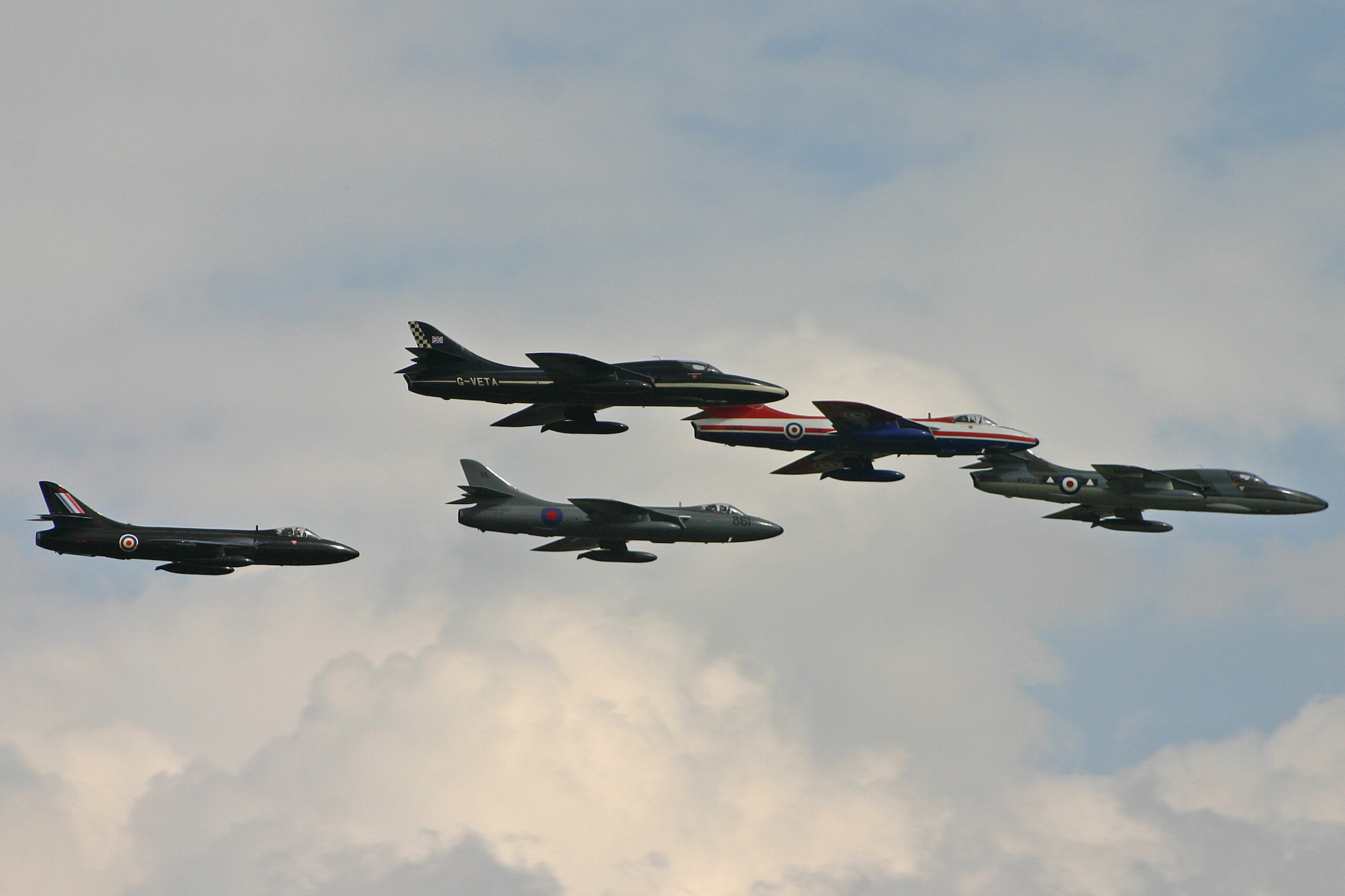
The Hunter sold and served in enormous numbers. More than 1,970 were built, and the type flew with the air forces of 21 nations across six continents, in the fighter, ground-attack, reconnaissance and training roles, some remaining in service for decades. For a great many air forces the Hunter was their first modern jet, and its combination of easy handling and rugged strength made it a favourite of the pilots who flew it. It was the aircraft that proved Hawker could master the jet as completely as it had mastered the biplane and the piston fighter.
The Sea Hawk, too, had its day in action. When British and French forces struck at Egypt during the Suez crisis of 1956, Fleet Air Arm Sea Hawks flew ground-attack sorties from Royal Navy carriers against Egyptian airfields and positions, the first and only major combat use of Hawker’s first jet. It was a modest record next to the Hunter’s, but it confirmed that the design office had made the transition to jets without losing the reliability and ease of handling that had always marked a Hawker aircraft. By the time the Hunter and Sea Hawk were in front-line service, Hawker had done something few firms manage: it had stayed at the very top of fighter design across the enormous technical leap from the biplane to the swept-wing jet, with the same designer in charge throughout.
The Harrier revolution: the jump jet
Hawker’s final and most radical idea was an aeroplane that did not need a runway. Through the late 1950s the design office at Kingston, still under Camm, worked with Rolls-Royce and its Pegasus engine on a fighter that could take off and land vertically by directing the engine thrust downward through swivelling nozzles. The result was the Hawker P.1127, an experimental machine that began its hovering trials in 1960 and, for all its ungainly early appearance, worked. The P.1127 was the last aircraft to carry the pure Hawker name before the brand was dropped, and it was arguably the most influential thing the company ever built.
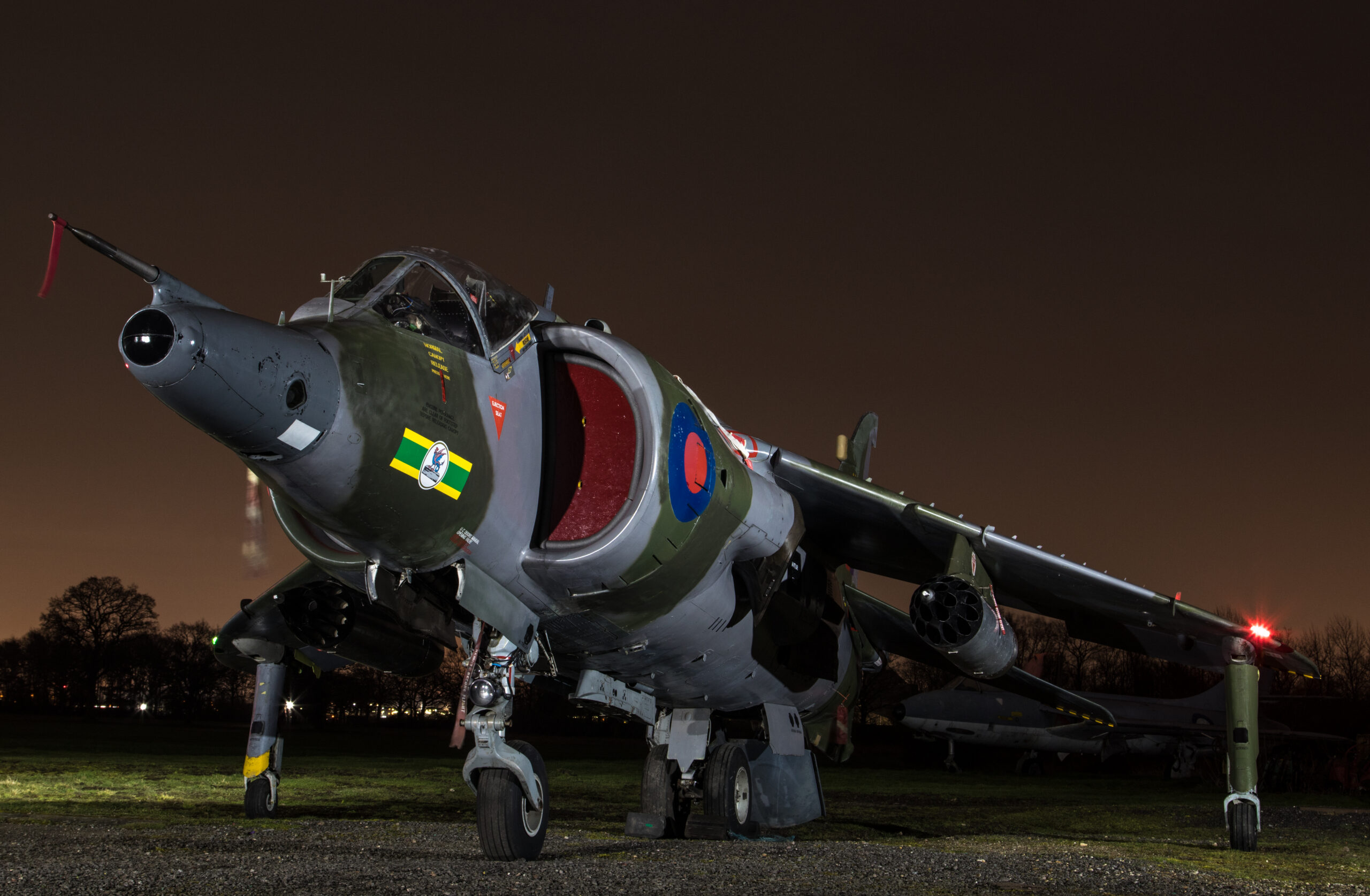
The P.1127 led through the evaluation Kestrel to the Harrier, which entered RAF service in 1969 as the world’s first operational vertical and short take-off strike fighter. By then the Hawker name had gone and the aircraft was badged Hawker Siddeley, but the design was pure Kingston. The Harrier could operate from clearings, roads and small ships, freeing it from vulnerable airfields, and in a much developed form it went on to serve for decades with the RAF, the Royal Navy and, built under licence, the United States Marine Corps. Its most famous hour came in the 1982 Falklands conflict, where Sea Harriers flown from Royal Navy carriers defended the fleet far from any land base, a task no conventional fighter could have performed from those ships.
The Harrier is the clearest proof of the Hawker design tradition at its best: not the flashiest solution, but a truly new idea made to work through patient, practical engineering. The line that began with fabric-covered biplanes ended with an aeroplane that could stop in mid-air and land on a tennis court.
The Hunter was not only an airshow favourite but a hard-worked combat aircraft. In the ground-attack role it saw action with many of its operators across the Middle East, Africa and the Indian subcontinent through the 1960s and 1970s, valued for its ability to carry a useful load of bombs and rockets and absorb battle damage. Switzerland, India, Jordan, Lebanon and many others flew it for decades, and its rugged simplicity made it a natural choice for air forces that needed a capable jet without the cost and fragility of something more advanced. The Hunter’s long career, rather than its brief hold on the air speed record, is the real measure of the design.
The corporate story: Hawker Siddeley and the end of the name
Behind the aeroplanes ran a steady process of growth and absorption that eventually consumed the Hawker name itself. The small firm of 1920, H. G. Hawker Engineering, was renamed Hawker Aircraft Limited in 1933. Financially strong through the depression while others struggled, it bought the Gloster Aircraft Company in 1934, and in 1935 it merged with the engine and vehicle maker Armstrong Siddeley and its aircraft arm Armstrong Whitworth to form Hawker Siddeley Aircraft, a group that also brought in the great bomber maker Avro.
For a long time the individual companies kept their own names and identities, so an aircraft could still be a Hawker even though its maker was part of the wider Hawker Siddeley group. From 1955 that group was reorganised as the Hawker Siddeley Group, with the aircraft firms as divisions rather than separate companies. The old marques were living on borrowed time. In 1963 the group swept away the historic brand names, Hawker, Gloster, Avro, Armstrong Whitworth and the rest, in favour of a single Hawker Siddeley Aviation identity. The P.1127 was the last aircraft to be called a Hawker.
The final chapter came with nationalisation. In 1977 Hawker Siddeley Aviation was merged, along with the British Aircraft Corporation and Scottish Aviation, into the newly formed state-owned British Aerospace, later privatised and eventually part of BAE Systems. The Kingston design office and the Dunsfold airfield where Hawker had tested its aircraft continued to develop and build the Harrier and the Hawk trainer for years afterward, so the engineering lived on even after the name had vanished from the corporate register. The Hawker name itself later resurfaced on business jets built by Raytheon and Hawker Beechcraft, a distant commercial echo of the fighter maker.
Key Hawker aircraft at a glance
Hawker produced dozens of types across five decades. The table below picks out the milestones that mattered most, from the biplanes to the jump jet, with the dates and roles that place each one in the story.
| Aircraft | First flew | Role | Why it mattered |
|---|---|---|---|
| Hawker Duiker | 1923 | Reconnaissance prototype | First original Hawker design to fly |
| Hawker Hart | 1928 | Light day bomber | Most-produced British aircraft between the wars; parent of a large family |
| Hawker Fury | 1931 | Interceptor fighter | First operational RAF fighter to exceed 200 mph in level flight |
| Hawker Hurricane | 1935 | Monoplane fighter | Backbone of Fighter Command in the Battle of Britain; around 14,500 built |
| Hawker Typhoon | 1940 | Ground-attack fighter | Devastating rocket-armed strike aircraft after D-Day |
| Hawker Tempest | 1942 | Low-level fighter | Among the fastest low-level piston fighters; V-1 hunter |
| Hawker Sea Fury | 1945 | Naval fighter | Royal Navy’s last piston fighter; credited with a MiG-15 in Korea |
| Hawker Sea Hawk | 1947 | Naval jet fighter-bomber | Hawker’s first jet; gave the firm carrier-jet experience |
| Hawker Hunter | 1951 | Jet fighter | Over 1,970 built; served with 21 air forces; 1953 air speed record |
| Hawker P.1127 | 1960 | V/STOL prototype | Last aircraft to carry the Hawker name; led to the Harrier |
Every one of these except the Duiker can still be seen today, in museums or, for several types, in the air. That is unusually good survival for a British manufacturer, and it makes Hawker one of the most rewarding marques to seek out and photograph.
Photographing Hawker aircraft today
Hawker types are among the most photographable warbirds and preserved jets on the circuit, partly because so many survive in flying condition and partly because their shapes are so photogenic. Several Hurricanes fly in Britain, including those of the Battle of Britain Memorial Flight, and airworthy Furies, Sea Furies and Hunters appear at shows through the season, though no Harrier has flown on the UK circuit since the type’s retirement in 2010. The RAF Museum’s London and Midlands sites, the Fleet Air Arm Museum at Yeovilton, the Imperial War Museum at Duxford and many smaller collections hold the rest.
The two most common Hawker subjects, the Hurricane and the Sea Fury, are both piston aircraft with big propellers, and they reward the same core technique: a shutter speed slow enough to blur the propeller disc into a full arc, usually somewhere around 1/200 of a second and often slower, so the aircraft looks alive rather than frozen with a stopped prop. Getting that blur while keeping the airframe sharp takes a smooth pan, and it is worth practising. Our guide to the right shutter speed for propeller aircraft covers exactly how to judge it for warbirds like these.
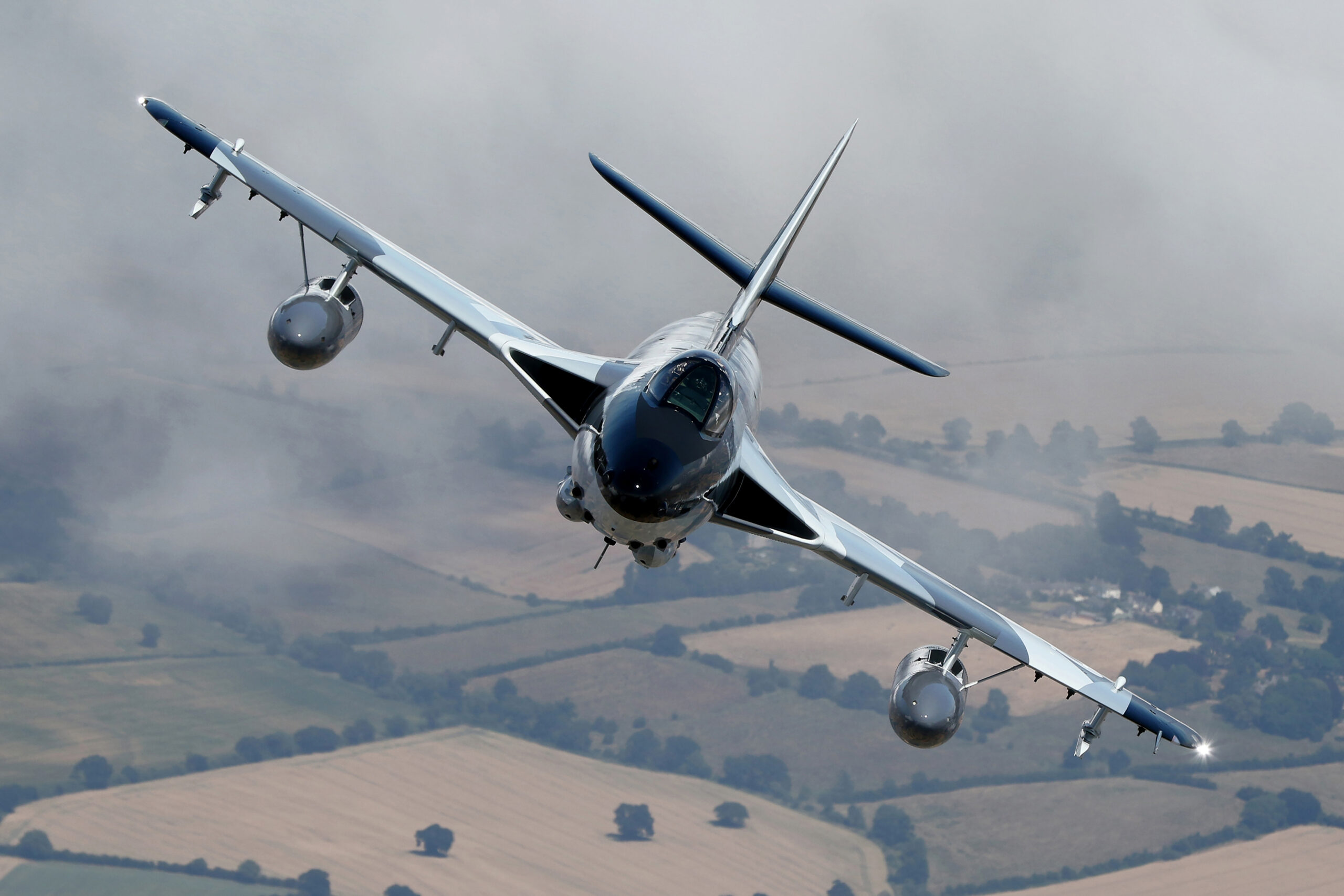
The Hunter and the Harrier are jets and want a different approach: a faster shutter to hold a fast-moving airframe sharp, continuous autofocus and a smooth tracking pan, though you can drop the shutter speed a little on the Harrier when it is hovering or transitioning, because then it is barely moving. The general method for both is set out in our guide to photographing fast jets. On a hot day at a summer show, all of these subjects are prone to the shimmer covered in our guide to dealing with heat haze in aviation photography, so read the air before you blame your lens.
You can see how these aircraft look when the light and technique come together in the Piemags aviation galleries, and if you would like to use any image commercially the licensing page sets out the terms.
The Hawker legacy
Few aircraft companies can point to a run of designs as important as Hawker’s. In the space of one designer’s career the firm produced the fighter that held the line in 1940, the strike aircraft that broke the German army in Normandy, the jet that a fifth of the world’s air forces chose to fly, and the aeroplane that made vertical flight from a fast jet a practical reality. That is a remarkable concentration of influence in one drawing office, and it flowed from a consistent way of working: improve a sound idea patiently, build it strong, and make it something a pilot can trust.
The name has gone from the sky, folded first into Hawker Siddeley and then into British Aerospace and BAE Systems, but the engineering did not stop. The Harrier and the Hawk, both Kingston designs, carried the tradition on for decades, and the Hawk still trains fast-jet pilots and flies with the Red Arrows, though a replacement programme for both the T1 and T2 is now under way. When a preserved Hurricane rolls past at an airshow, or a Hunter sweeps in low and fast, you are seeing the work of a company that shaped a century of British fighters, and whose aeroplanes were good enough that people keep them flying still.
Frequently asked questions
When was Hawker Aircraft founded?
Hawker was founded in 1920 as H. G. Hawker Engineering, when the test pilot Harry Hawker, the aviation pioneer Thomas Sopwith, the engineer Fred Sigrist and the businessman Bill Eyre bought the assets of the bankrupt Sopwith Aviation Company. It was renamed Hawker Aircraft Limited in 1933 and was based at Kingston upon Thames.
Who was Hawker named after?
The company was named after Harry Hawker, an Australian test pilot who had flown for Sopwith and was one of the four men who bought the firm’s assets and founded the new company. The name was chosen partly to avoid any legal link to the debts of the liquidated Sopwith company. Harry Hawker was killed in a flying accident in 1921, only a year after the firm was founded.
What aircraft did Hawker build?
Hawker built a long line of RAF and Royal Navy combat aircraft, including the Hart light bomber, the Fury biplane fighter, the Hurricane of the Battle of Britain, the Typhoon and Tempest ground-attack and fighter aircraft, the Sea Fury naval fighter, the Sea Hawk and Hunter jets, and the P.1127 that became the Harrier jump jet. Most were designed under the chief designer Sydney Camm.
Who designed the Hawker Hurricane?
The Hurricane was designed by Sydney Camm and his team at Hawker. Camm was the company’s chief designer from 1925 until his death in 1966, and he was responsible for almost every important Hawker aircraft from the Hart biplane to the P.1127 Harrier prototype. He was knighted in 1953.
What happened to Hawker Aircraft?
Hawker grew through mergers into the Hawker Siddeley group, buying Gloster in 1934 and merging with Armstrong Siddeley and Armstrong Whitworth in 1935. The historic Hawker brand name was dropped in 1963 in favour of a single Hawker Siddeley Aviation identity, and in 1977 the business was nationalised into British Aerospace, which later became part of BAE Systems.
Was the Hurricane or the Spitfire more important in the Battle of Britain?
Both were essential, and Britain could not have won the battle with either alone. The Hurricane was the more numerous of the two and equipped more squadrons, so it carried a large share of the fighting, often being sent against the German bombers while the Spitfires engaged the escorting fighters. The Spitfire had the edge in outright performance and took most of the glory.
How many Hawker Hunters were built?
More than 1,970 Hawker Hunters were built in total, across fighter, ground-attack, reconnaissance and two-seat training versions. The type served with the air forces of 21 nations across six continents, and for many of them it was their first modern jet. Some Hunters remained in military service for decades and a few still fly today.
Can you still see Hawker aircraft flying?
Yes. Several Hurricanes fly in Britain, including those of the Battle of Britain Memorial Flight, and airworthy Furies, Sea Furies and Hunters appear at airshows through the season. Many more Hawker types are preserved in museums such as the RAF Museum, the Fleet Air Arm Museum at Yeovilton and the collections at Duxford.
From a bankrupt biplane maker to the company that gave the world the jump jet, Hawker packed an extraordinary amount of aviation history into a single lifetime of design. The name has gone, but the aeroplanes endure, and there are few better ways to appreciate them than to stand at the crowd line on a summer afternoon and watch a Hurricane or a Hunter go by.
Hawker traces its line back to Sopwith and the fabric-and-wire fighters of the First World War. For that era, read WWI biplanes and the birth of air combat.
Hawker’s first jet fighter for the RAF is covered in full in our history of the Hawker Hunter.
