On 2 May 1952 a de Havilland Comet registered G-ALYP took off from London Airport and set course for Johannesburg with fare-paying passengers aboard. Nothing like it had ever happened before. The world’s first jet airliner was in scheduled service, flying far higher and considerably faster than the piston airliners it replaced, and it was British.
Within two years the Comet fleet was grounded and the aircraft’s name had become shorthand for one of the hardest lessons in engineering history. Within six more, a redesigned Comet was carrying the first jet passengers across the Atlantic. Few aircraft have packed triumph and tragedy so tightly together, and it is hard to think of one that taught the industry more. This is the full story: the gamble, the glory, the disasters, the extraordinary detective work that followed, and the long, useful second life that ended, remarkably, in 2011.
What this guide covers
- Origins and development
- Design and engineering
- Into service
- The accidents of 1953 and 1954
- The investigation at Farnborough
- The Comet 2 and the Comet 3
- The Comet 4 and the second chance
- Comet 4 operators around the world
- Military Comets and the Nimrod
- Variants
- Specifications and key facts
- Where the survivors are today
- Photographing the Comet today
- Legacy
- Frequently asked questions
Origins and development
The Comet grew out of wartime planning for the peace. By 1943 it was already clear that the United States, with its vast fleets of transport aircraft and its untouched factories, would dominate postwar civil aviation unless Britain did something bold. The Brabazon Committee, convened that year to map out the country’s postwar civil aircraft needs, included among its recommendations a jet-powered mail and passenger carrier, the most speculative item on its list. Most of the industry treated the idea with caution. De Havilland took it up.
No company in the world was better placed to try. It had built the Mosquito, for a time the fastest thing in the RAF’s inventory, and had followed it with the Vampire jet fighter. Unusually, it also made its own engines: the de Havilland Engine Company’s Ghost turbojet, a development of the Goblin that powered the Vampire, would give the new airliner its power. Airframe, engine and ambition all sat under one roof at Hatfield.
The design team under R E Bishop began with some really radical ideas. Early studies explored tailless configurations, and the company built the small DH 108 research aircraft to explore swept wings without tails, a programme that cost the life of Geoffrey de Havilland junior, the founder’s son and chief test pilot, in 1946. The lessons pushed the team back towards caution, and the aircraft that emerged was clean but conventional: a low, moderately swept wing, a normal tail, and four engines buried neatly in the wing roots.
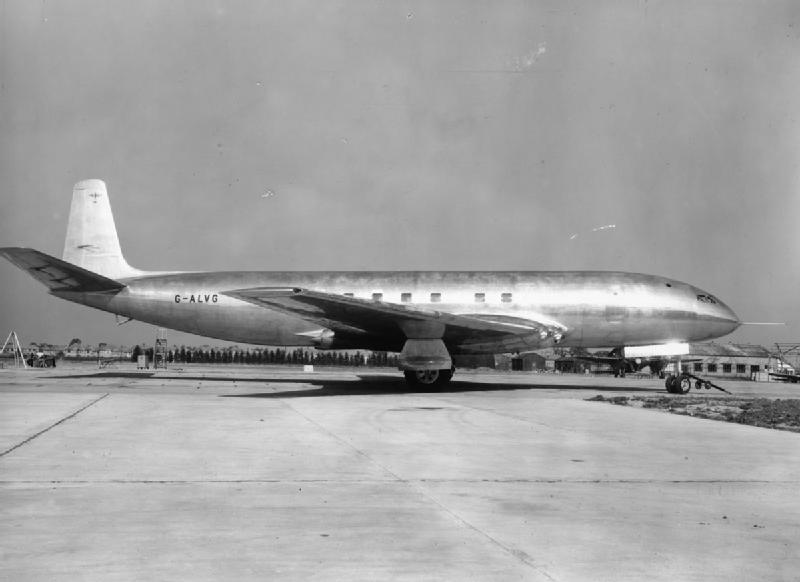
The prototype flew for the first time from Hatfield on 27 July 1949, in the hands of the company’s new chief test pilot John Cunningham. The flight was undramatic, which was exactly what everyone wanted. Britain had entered the jet age with the Gloster Meteor in 1944, and the Comet was a bid to convert that military lead into command of the world’s airline market before the Americans could respond. The scale of that lead is easy to forget: when BOAC put the Comet into service less than three years later, no American jet airliner had even flown. The prototype of the Boeing 707 would not leave the ground until 1954.
Design and engineering
The Comet 1 was strikingly clean. Four de Havilland Ghost 50 centrifugal-flow turbojets, each rated at about 5,050 lb of thrust, sat inside the wing roots, leaving nothing hanging off the airframe to spoil the lines. Burying the engines kept drag low and kept the thrust close to the aircraft’s centreline, so an engine failure produced far less swing than it would on aircraft with engines slung far out on the wings. The moderately swept wing and polished metal finish gave the Comet a look that no piston airliner could match, and photographers have been grateful ever since.
Jet engines of the day were thirsty at low level, so the whole aircraft was designed around flying very high, where the thin air let the Ghosts work efficiently. Inside, 36 to 44 passengers sat four abreast in a pressurised cabin that let the aircraft cruise between 35,000 and 40,000 feet, far above most weather and far above every other airliner in the sky. The cabin pressure differential was higher than any previous airliner had used, which allowed a comfortable cabin altitude at those heights but worked the structure harder on every single flight. That fact, unremarkable on paper, would come to define the aircraft’s story.
Weight was the enemy of range, and de Havilland fought it everywhere. The structure used thin-gauge alloy skins, and the company made extensive use of Redux adhesive bonding alongside conventional riveting, an advanced technique that saved weight and avoided rows of stress-raising holes in many parts of the airframe. The engineering was ambitious in almost every dimension at once, which was both the Comet’s glory and, in the end, its vulnerability: the aircraft was operating beyond the world’s accumulated experience in almost every area that mattered.
For passengers in 1952 the experience was astonishing. The Comet was quiet, smooth and free of the vibration that piston engines drummed through every other airliner. It cruised close to 490 mph, roughly half as fast again as the piston competition, and it turned long, exhausting multi-day journeys into something recognisably modern. People who flew it wrote about it the way a later generation would write about Concorde.
For the crews, the Comet demanded a new way of operating. Civil flying at 40,000 feet was uncharted territory: climb and descent had to be planned over hundreds of miles rather than tens, fuel management was unforgiving because a jet burns heavily at low altitude, and diversions had to be thought about long before they were needed. BOAC’s Comet crews were, in effect, writing the operating manual for all jet transport as they went. Much of what they worked out about high-altitude airline flying passed straight into the routines that every jet operator has used since.
Into service
After a long programme of route-proving trials, BOAC opened the world’s first scheduled jet passenger service on 2 May 1952, from London to Johannesburg with intermediate stops, flown by G-ALYP. Tokyo, Singapore and Colombo followed on the network, and in its first year the Comet carried more than 30,000 passengers. Journey times on the long Empire routes fell dramatically, the aircraft flew above the weather that battered everything else, and the Comet became a national symbol of British technical leadership at a time when the country badly needed one.
Orders followed from overseas. Canadian Pacific Air Lines, Air France and the French independent UAT bought the slightly improved Comet 1A with more fuel and higher weights, and the Royal Canadian Air Force took the type as well. Every airline in the world had to reckon with the fact that BOAC’s passengers were flying above the weather at nearly 500 mph while their own were droning along in piston aircraft far below. In Seattle and Los Angeles, the American manufacturers watched the Comet very closely indeed.
For the travelling public the Comet was simply glamorous. BOAC could sell not just speed but serenity: no roar, no shudder, no bumping through weather at 15,000 feet, just a quiet cabin above the clouds and a view of the curve of the horizon that almost nobody alive had seen. Tickets on the jet services were the most sought-after in the airline’s network, and the aircraft’s silhouette, with its buried engines and unbroken wing, became one of the most recognisable shapes of the early 1950s. For a short while, the fastest, highest and most modern passenger aircraft in the world all wore the same British registration letters.
The accidents of 1953 and 1954
The first blows came on takeoff. On 26 October 1952 a BOAC Comet failed to get airborne at Rome Ciampino and was written off, without loss of life. On 3 March 1953 a Canadian Pacific Comet 1A, CF-CUN Empress of Hawaii, crashed on a night takeoff from Karachi during its delivery flight, killing all eleven aboard. It was the first fatal accident involving a jet airliner. Both were attributed to over-rotation on takeoff, where the nose-high attitude stalled the wing’s leading edge, and the wing was subsequently modified. These were painful accidents, but they were understood, and they did not touch the aircraft’s reputation in the cruise.
Worse followed. On 2 May 1953, a year to the day after the first service, BOAC Flight 783 broke up in a severe thunderstorm minutes after leaving Calcutta, killing all 43 on board. The inquiry pointed to structural failure in the extreme violence of the storm, and the fleet flew on. Then on 10 January 1954 came the accident that defined the Comet story: BOAC Flight 781, flown by G-ALYP, the very aircraft that had opened the jet age, broke up while climbing through about 27,000 feet after leaving Rome and fell into the sea near Elba. All 35 aboard died. There was no storm this time, no distress call, nothing. The aircraft had simply come apart in clear air.
It is worth pausing on how little precedent anyone had for what followed. No jet airliner had ever been grounded, because there was only one jet airliner in the world. The Comet was a national flagship in the most literal sense, the aircraft on which Britain’s claim to lead postwar aviation rested, and the commercial and political pressure to keep it flying was immense. At the same time, nobody could point to a cause. The modifications made that spring were a catalogue of educated guesses, and the decision to resume services reflected the honest, and wrong, belief that every plausible danger had been addressed.
BOAC withdrew the fleet while dozens of modifications were made against every cause anyone could think of, from fire to flutter. With no definite culprit found and the national flag carrier’s jets sitting idle, services resumed in late March 1954. Sixteen days later, on 8 April, South African Airways Flight 201, a Comet operating from Rome towards Cairo, broke up over the Mediterranean with the loss of all 21 aboard. This time there was no argument. The Certificate of Airworthiness was withdrawn, the fleet was grounded indefinitely, and the Comet 1 never carried passengers again.
The investigation at Farnborough
What followed became one of the founding investigations of modern air safety, and it began underwater. Six days after the Elba crash the Royal Navy was asked to recover as much of G-ALYP as possible from the seabed, and Operation Elba Isle grew into a remarkable piece of pioneering salvage. HMS Wrangler acted as headquarters ship, and the Mediterranean Fleet’s salvage vessel RFA Sea Salvor led the recovery work, with the search aided by underwater television cameras developed by the Admiralty Research Laboratory, among the first times TV had ever been used to find a wreck. The wreckage was located on 12 February 1954, and over roughly eleven weeks the ships brought up, piece by piece, the greater part of an airliner from deep water. By early April around 70 per cent of the aircraft and 90 per cent of its engines had been recovered and shipped home for reassembly.
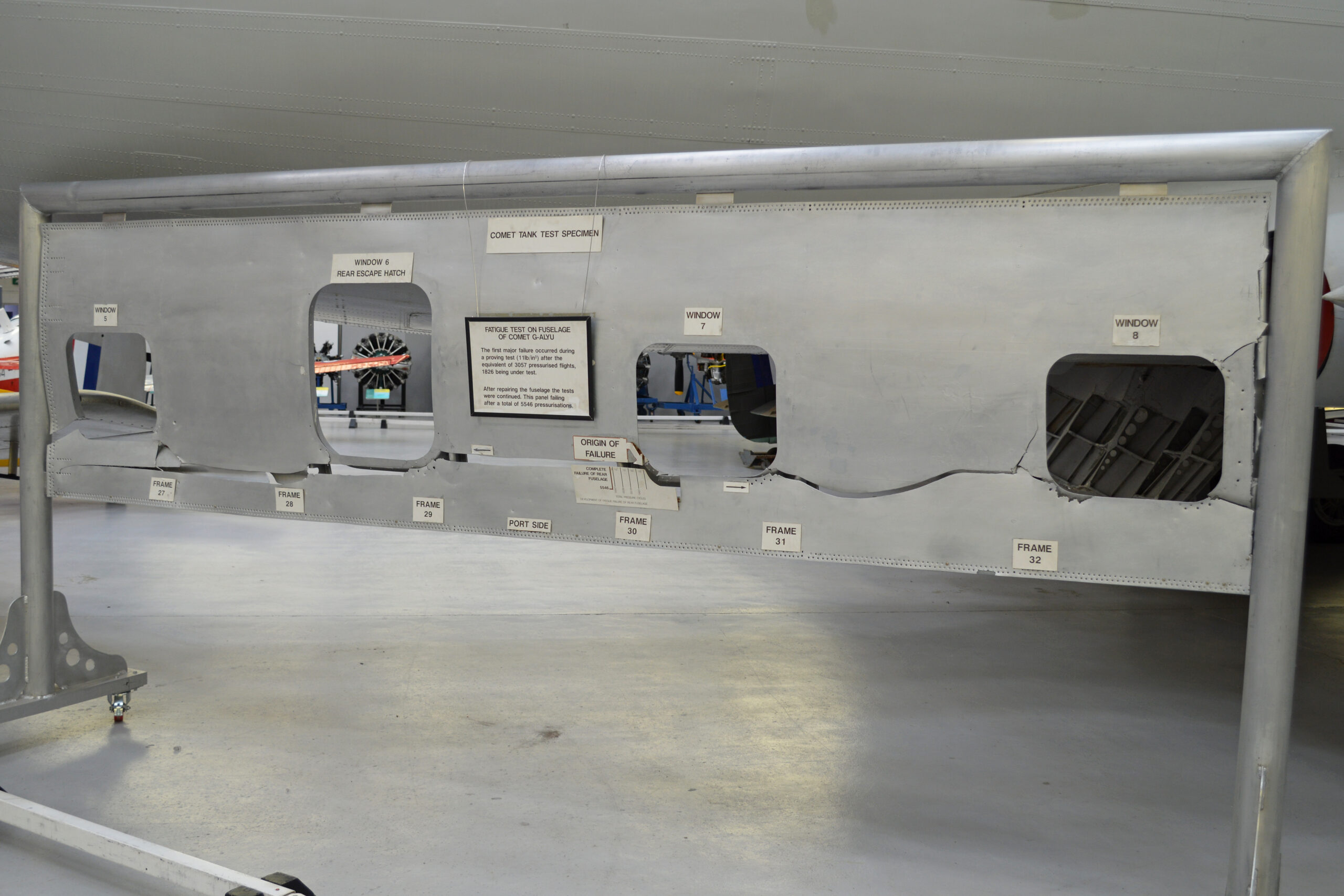
At the Royal Aircraft Establishment at Farnborough, under its director Sir Arnold Hall, the decisive experiment was brutally simple. A complete Comet fuselage, G-ALYU, was sealed in a giant water tank and pressurised and depressurised over and over again to simulate flight after flight, using water rather than air so that a failure would not destroy the evidence. After the equivalent of around 3,000 flights, counting its earlier service, the cabin structure failed. Fatigue cracks, growing invisibly from stress concentrations with every pressurisation cycle, had destroyed it far sooner than anyone had predicted. And in the recovered wreckage of G-ALYP itself, investigators traced the fatal crack to a rivet hole at the rear automatic direction finder aerial window in the roof of the cabin. The two lines of evidence met exactly.
It is often said that the Comet’s square passenger windows caused the disasters. That version is commonly repeated but not quite right. The proven failure in G-ALYP started at the ADF aerial cutout in the roof, not at a passenger window, and the windows themselves were rounded squares rather than sharp-cornered ones. The real lesson was broader and more important: stresses around any cutout in a pressurised, thin-skinned fuselage were far higher than the methods of the day predicted, and repeated pressurisation could grow cracks from tiny features like rivet holes until the structure failed without warning.
The Court of Inquiry under Lord Cohen concluded that de Havilland had been working at the very limit of existing engineering knowledge and did not hold the company to blame. Crucially, the findings were published and shared openly with the world’s industry, including the American manufacturers then designing their own jets. It remains one of the great acts of engineering honesty, and every airliner flying today is safer for it.
The practical consequences arrived quickly. Pressure cabins would from now on be designed with generous radii at every corner of every cutout, with reinforcement around windows, doors and aerials, and with skins thick enough to slow a growing crack. Structures would be designed to be fail-safe, so that a single crack finds its progress blocked rather than running the length of the fuselage. And new airliner types would prove their fatigue life in full-scale tests before passengers ever boarded, cycle after cycle, exactly as the RAE had done with its water tank. None of this was standard practice before 1954. All of it is now.
The Comet 2 and the Comet 3
De Havilland had not been standing still while the Comet 1 flew. The Comet 2, with Rolls-Royce Avon axial-flow engines in place of the Ghosts and a slightly longer fuselage, was already in production when the groundings came, and its order book from airlines around the world evaporated almost overnight. Rather than scrap them, most of the completed and part-built aircraft were finished to a strengthened standard for the Royal Air Force, and they gave the RAF something no other air force in the world had.
The engine change mattered more than it sounds. The Ghost was a centrifugal-flow engine, simple and reliable but bulky and increasingly dated; the Avon was an axial-flow design, slimmer, more powerful and with far more room for development. It was the engine family that would carry the Comet through the rest of its life, and its extra thrust is a large part of what made the later, heavier and far more capable Comet 4 possible at all.
In June 1956, No. 216 Squadron at RAF Lyneham received its first Comet C.2s, making it the world’s first military jet transport squadron. The Comets flew ministers, senior officers and casualty evacuation flights across the old imperial routes at twice the pace of anything else in Transport Command, and the squadron would fly Comets of one mark or another until 1975. Three Comet 2s were modified for a much quieter role: from 1958, as the 2R, they flew with No. 192 and later No. 51 Squadron on signals intelligence duties, monitoring Warsaw Pact radar and radio traffic from the edges of the Iron Curtain. The world’s first jet airliner had become one of the world’s first jet spyplanes.
The single Comet 3, G-ANLO, was the development aircraft for something much more ambitious, longer than the 2 and with more fuel. In December 1955, with John Cunningham at the controls, it set out on a round-the-world promotional tour, the first circumnavigation of the globe by a jet airliner. The message to the airlines was blunt: the Comet was coming back.
The Comet 4 and the second chance
The Comet 4 was what the Comet 1 should have been able to be: a fuselage built with fatigue fully understood, heavier-gauge structure, oval windows, four Rolls-Royce Avon 524 engines of about 10,500 lb thrust each, much more fuel, and seating for around 70 to 90 passengers. It looked like the Comet everyone remembered, but underneath it was an aircraft designed with knowledge that had not existed in 1949, much of it bought at terrible cost.
On 4 October 1958 BOAC used it to open the first transatlantic jet passenger services, with Comet 4s leaving London and New York almost simultaneously; westbound crossings against the wind still needed a fuel stop at Gander in Newfoundland. BOAC beat Pan American’s Boeing 707 across the Atlantic by a matter of weeks, and for one autumn Britain led the world again.
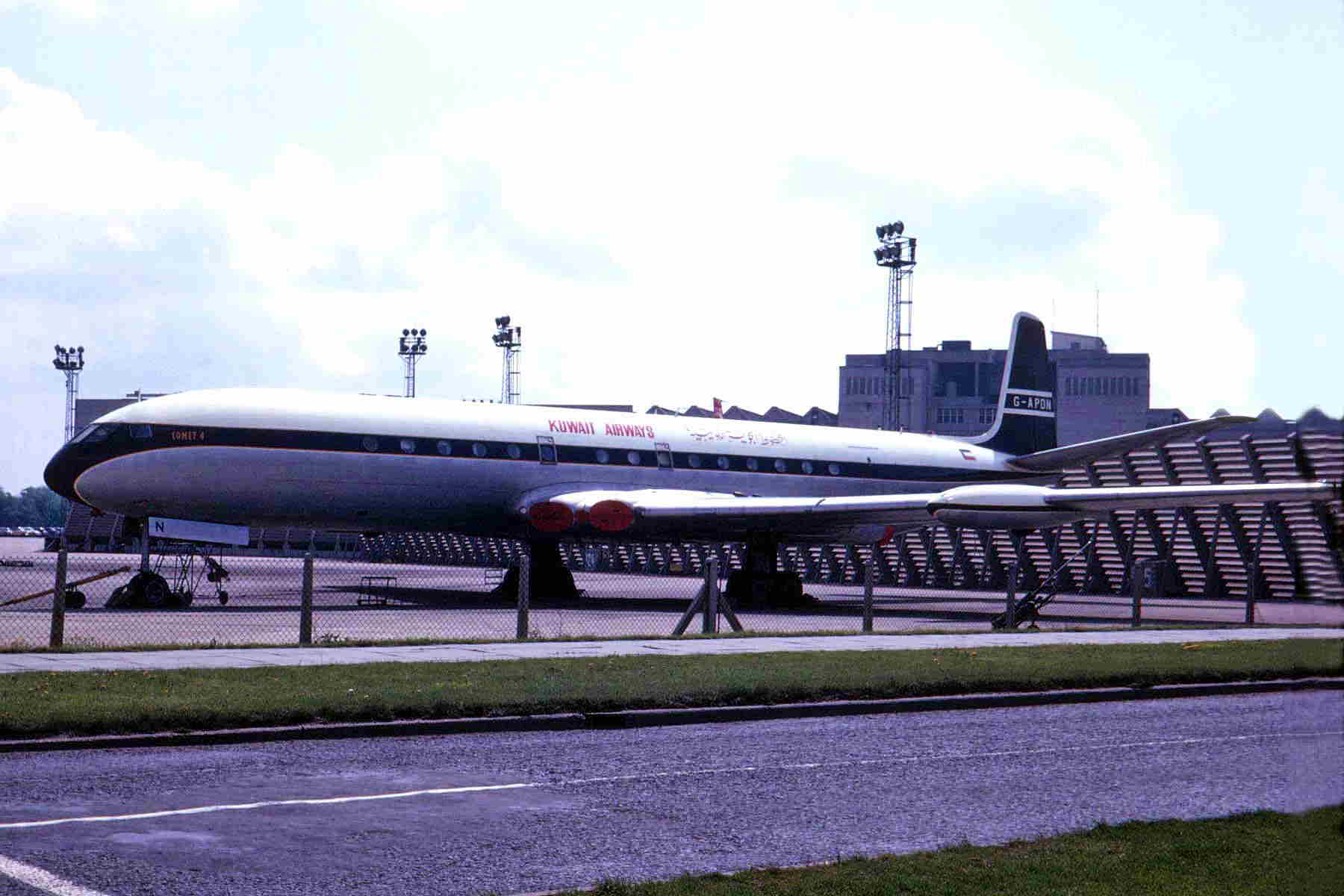
It was a proud moment rather than a lasting victory. The 707 and the Douglas DC-8 were bigger, faster and cheaper per seat, and the world’s airlines bought them in the hundreds. The reasons were mostly cold arithmetic. The American jets carried more seats over longer sectors, so every flight earned more; their podded engines, slung under the wing rather than buried in it, were easier to reach, easier to change and easier to upgrade as more powerful engines arrived; and behind both manufacturers stood a home market bigger than the rest of the world’s put together. The Comet 4 was not beaten because it was a bad aircraft. It was beaten because the aircraft that learned from it were designed around economics as well as engineering. But the Comet 4 family found real markets of its own. The Comet 4B, developed for British European Airways with a longer cabin seating up to 99 and a shorter-span wing for shorter routes, first flew on 27 June 1959, and BEA opened Comet services between Tel Aviv and London on 1 April 1960. The Comet 4C, which combined the long fuselage with the long-range wing, first flew on 31 October 1959 and entered service with Mexicana in 1960, becoming the most numerous version of all. Production ended with 114 airframes built across all marks, from the two prototypes of 1949 to the last 4Cs.
Comet 4 operators around the world
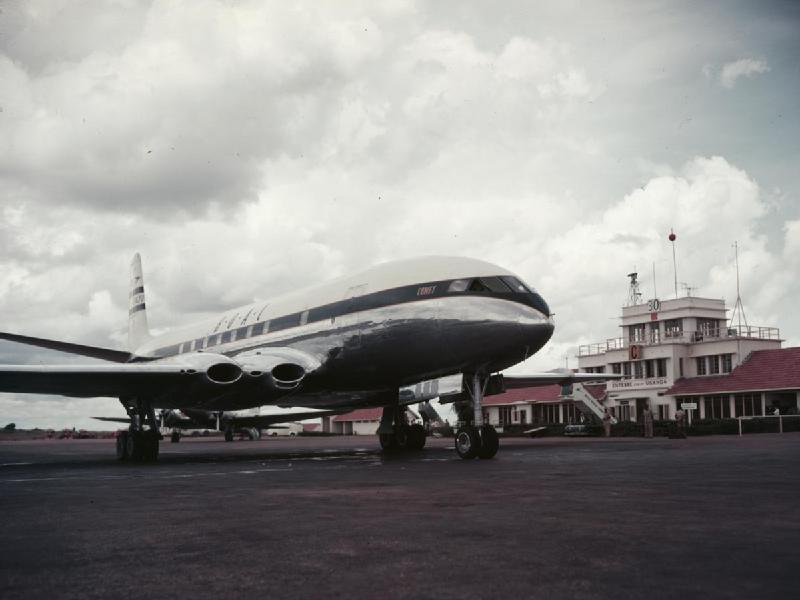
The Comet 4’s second life took it far beyond London. Aerolineas Argentinas took six Comet 4s from 1959 to 1960 and flew them from Buenos Aires to Santiago, New York and Europe, bringing jet travel to South American routes. East African Airways took three new Comet 4s between 1960 and 1962 and ran them between Nairobi, Dar es Salaam, Entebbe and London. Middle East Airlines of Beirut ordered four Comet 4Cs in 1959, and the type also flew in Mexico with Mexicana and in Egypt, among others. For several airlines outside the United States and the Soviet bloc, the Comet was the aircraft that opened the jet age.
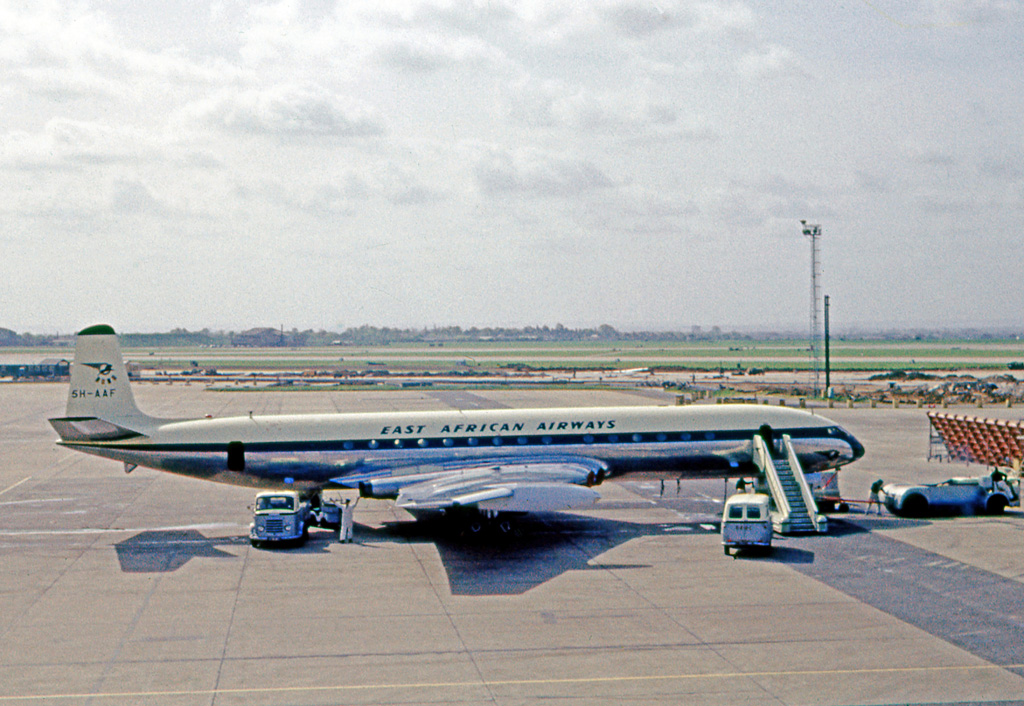
By the mid 1960s the Comet 4 was being displaced from front-line routes by bigger jets, but its second-hand price made it attractive to a new kind of operator. The British package-holiday boom was filling aircraft to the Mediterranean every summer, and a fast, comfortable, four-engined jet that could be bought cheaply was exactly what the charter airlines needed. The Comet’s last decade was spent doing honest, unglamorous work it had never been designed for, and doing it well.
The type’s great final operator was Dan-Air of London. Through the 1960s and into the 1970s the airline bought up second-hand Comets in such numbers that at one point it owned every airworthy civil Comet in the world, and over the years bought 49 of them in all, working the fleet hard on holiday charters to the Mediterranean. Many British holidaymakers of that generation made their first flight in a Dan-Air Comet without knowing anything of the aircraft’s extraordinary history. Dan-Air flew the last scheduled Comet passenger service in November 1980, more than 31 years after the prototype’s first flight.
Military Comets and the Nimrod
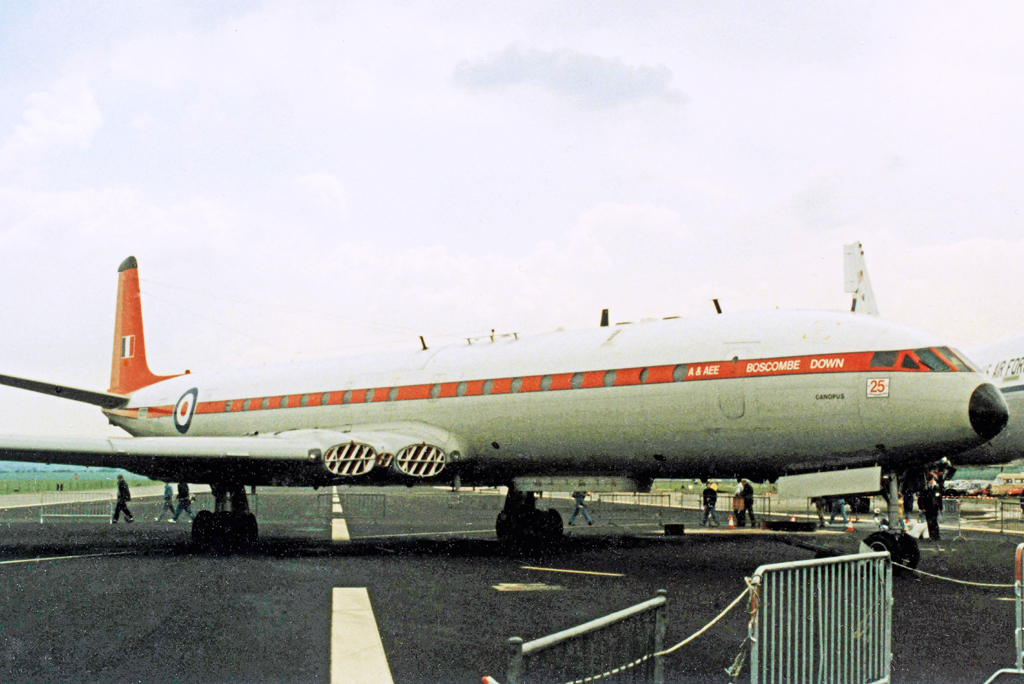
The RAF’s association with the Comet ran from the C.2s of 1956 through Comet C.4s, and No. 216 Squadron flew the type until June 1975. Other Comets served as flying laboratories with research and trials establishments, testing radar, navigation and avionics systems. The most famous of these was XS235 Canopus, a Comet 4C operated for decades on trials work, which on 14 March 1997 made the last flight of any Comet, nearly 48 years after the first.
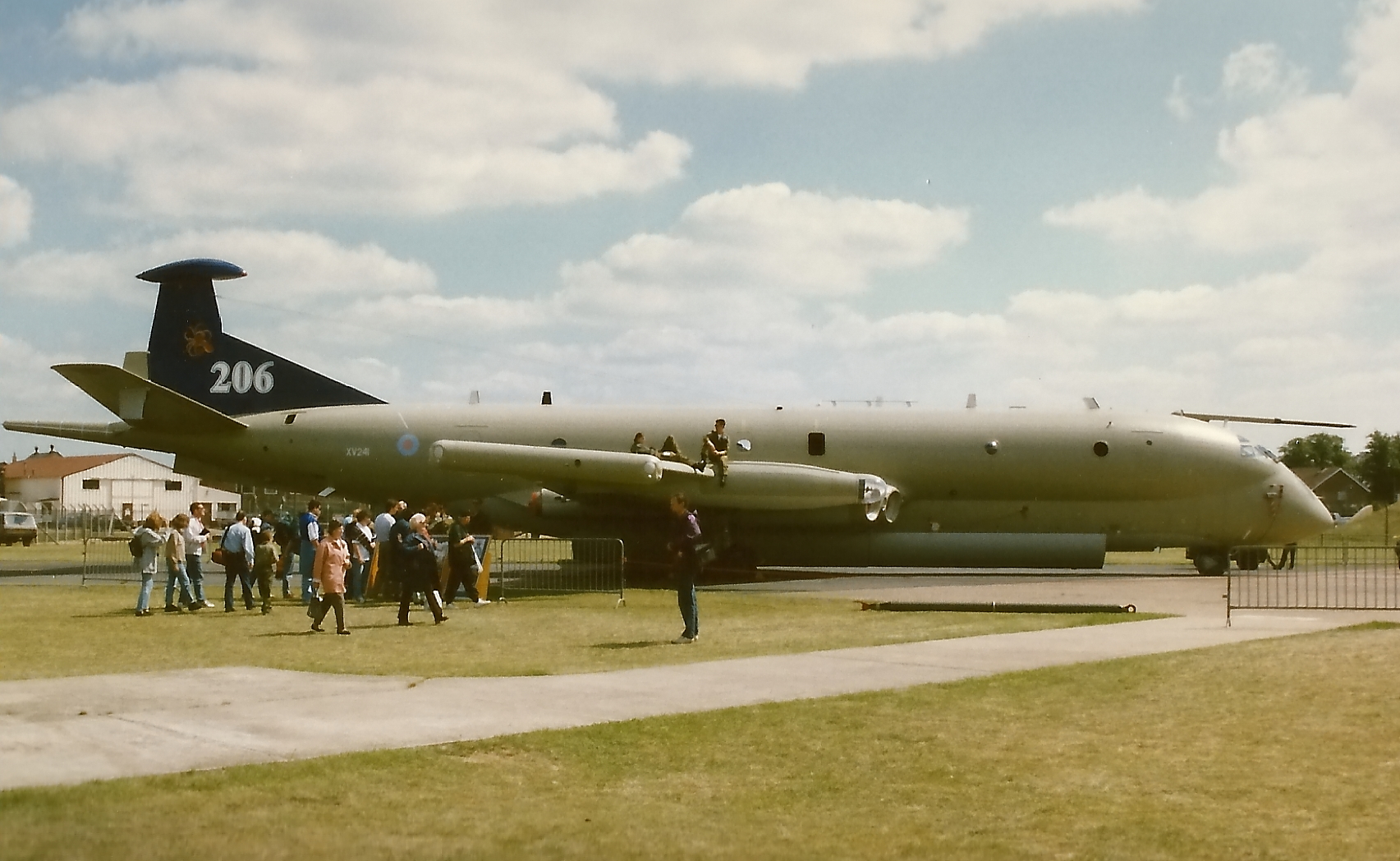
The airframe’s final descendant was the Hawker Siddeley Nimrod maritime patrol aircraft, developed from the Comet 4 at the end of its commercial life. The first two prototypes were converted from the last two unfinished Comet 4C airframes, and the Nimrod entered RAF squadron service at St Mawgan in Cornwall in October 1969. In its maritime, reconnaissance and signals intelligence forms it hunted submarines and gathered intelligence through the whole second half of the Cold War and beyond, and when the last Nimrods retired in 2011 the Comet’s basic design had been in continuous military service for over 60 years after the prototype’s first flight.
Variants
The Comet 1 and export Comet 1A were the original Ghost-powered production aircraft, later modified in surviving examples to strengthened 1XB standard. The Comet 2 introduced Rolls-Royce Avon engines and a slightly longer fuselage; after the groundings most were completed with strengthened structure for the RAF as the C.2, with three converted to 2R signals intelligence aircraft. The single Comet 3 was the stretched development machine that proved the layout of the definitive version.
The Comet 4 of 1958 was the fully redesigned long-haul aircraft. The Comet 4B, built for BEA, traded range for a longer cabin and short-haul seating, while the Comet 4C combined the long fuselage with the long-range wing and became the most numerous version. Military Comets served with RAF Transport Command and in trials and signals roles, and the Hawker Siddeley Nimrod carried the design’s bloodline to 2011.
Specifications and key facts
| Specification | Comet 1 | Comet 4 |
|---|---|---|
| Engines | 4 x de Havilland Ghost 50 turbojets | 4 x Rolls-Royce Avon 524 turbojets |
| Thrust (each) | about 5,050 lb | about 10,500 lb |
| Typical passengers | 36 to 44 | 70 to 90 (up to 99 in the 4B) |
| Cruising speed | about 490 mph | about 500 mph |
| Range | typical stage about 2,100 miles | about 3,200 miles |
| Cruising altitude | 35,000 to 40,000 ft | up to about 40,000 ft |
| First flight | 27 July 1949 (prototype) | 1958 |
| Service entry | 2 May 1952 (BOAC) | October 1958 (BOAC) |
| Production, all marks | 114 airframes | |
Where the survivors are today
Given how central the Comet is to aviation history, surprisingly few complete airframes survive, and no unmodified Comet 1 exists at all. The South Wales Aviation Museum at St Athan displays G-APAS, a Comet 1 completed to strengthened 1XB standard and the only intact survivor of the Ghost-powered first series. The de Havilland Aircraft Museum near St Albans, on the site where the company began, holds Comet material including a Comet 1A fuselage restored to its original external form.
Of the later aircraft, IWM Duxford’s AirSpace hall houses Comet 4 G-APDB in BOAC colours, and the National Museum of Flight at East Fortune in Scotland displays Comet 4C G-BDIX. A Comet 4C, the ex-Mexicana N888WA, is under long-term restoration at the Museum of Flight’s Restoration Center at Paine Field, Everett, and another stands at the Flugausstellung Hermeskeil in Germany. XS235 Canopus survives at Bruntingthorpe in Leicestershire, where for some years it was kept in ground-running condition; changed circumstances at the site mean those engine runs are no longer possible, but the aircraft itself remains. Between them, these survivors cover the whole arc of the story, from the strengthened first-generation fuselage at St Athan to the last Comet ever to fly.
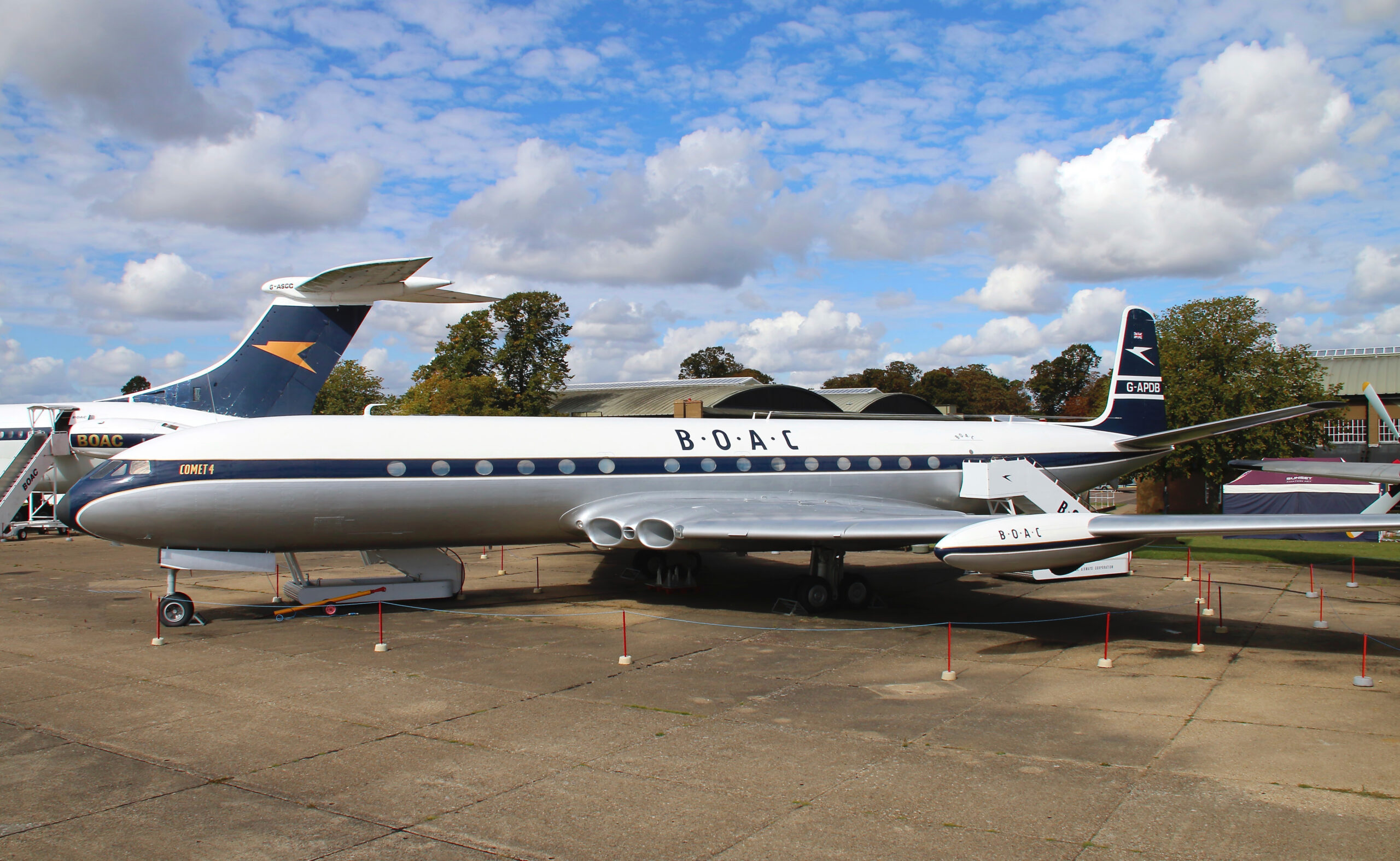
Museum Comets reward the photographer who works around them slowly: the wing-root intakes, the polished nose profile and the oval windows of the 4 series all tell parts of the story. For period images of the classic jet airliners and much else, the Piemags archive galleries are worth a browse, and our licensing page explains how to use them.
Photographing the Comet today
Every surviving Comet is now a museum piece, which sets the photographic problem: these are big, pale aircraft, usually indoors, usually hemmed in by other exhibits. At St Athan and Duxford the full side-on view is rarely available, so it pays to stop hunting for it and work with what the hall gives you. A wide-angle lens close to the nose exaggerates the Comet’s best feature, that long, smooth, unbroken curve back over the cockpit, and the wing-root intakes make strong graphic shapes when you shoot them head-on. Our guide to composition for aviation photography covers the thinking in detail.
Detail studies are where museum Comets reward patience: the oval windows of the 4 series against the polished skin, the BOAC lettering on G-APDB at Duxford, and the double identity of the St Athan aircraft, which wears its civil registration G-APAS but also carried the RAF serial XM823 in its trials career. If serial histories interest you, our piece on reading military aircraft markings and serials explains how to decode them. Indoors, watch your white balance under mixed hall lighting, brace against a barrier rather than fighting for tripod permission, and expose for the highlights on that bright metal skin. The outdoor survivors at East Fortune and Hermeskeil give you sky and natural light instead, at the price of weathering.
Legacy
The Comet’s legacy runs through every airliner flying today. The Farnborough investigation put metal fatigue in pressurised structures at the centre of aircraft design, and the principles that followed, generous corner radii at every cutout, fail-safe structures that tolerate a crack without letting it spread catastrophically, and full-scale fatigue testing of new types, are now simply how airliners are made. Because Britain published the findings rather than burying them, Boeing and Douglas built that knowledge into the 707 and DC-8 from the start. The salvage of G-ALYP from deep water off Elba also set the pattern for every underwater recovery of an airliner since.
The lesson has needed relearning more than once. When an Aloha Airlines Boeing 737 lost a large section of its upper fuselage in flight over Hawaii in 1988, brought on by fatigue cracking in an ageing, heavily cycled airframe, the industry’s response drew directly on the body of knowledge that began in a water tank at Farnborough in 1954. Fatigue in pressurised structures is never solved, only managed, and the management began with the Comet.
There is a harder commercial lesson in the story too. Being first is not the same as winning. Britain’s four-year lead in jet transport evaporated in the grounding years, and the market went to the bigger American jets. The next great British gamble on speed, Concorde, would repeat some of the same pattern: a technical triumph that others turned away from. Yet the Comet airframe itself had a remarkably long life, flying as the Nimrod until 2011, more than 60 years after Cunningham lifted the prototype off the runway at Hatfield.
Something of the Comet also survives in the way the industry talks to itself. The convention that accident findings are published, shared across borders and fed back into every manufacturer’s design offices, rather than guarded as commercial or national secrets, owes an enormous amount to the way Britain handled 1954. Aviation is the safest form of long-distance travel largely because it treats every failure, anywhere, as everyone’s lesson. The Comet was the first and hardest of those lessons at the scale of the jet age.
The Comet matters because it carries both halves of the truth about progress: the courage it takes to go first, and the price of learning what nobody yet knows. That is why aviation history still matters, and why this aeroplane, of all of them, deserves to be remembered accurately.
The engineering that put passengers behind a turbine started a long way from an airline route map. Our account of the first jet flight, on 27 August 1939, covers the Heinkel He 178 and the engine one physics graduate and one motor mechanic built for it.
The Comet was first, and being first is not the same as winning. Our history of the Boeing 707 covers the aeroplane that took the market, including the twenty-two days in October 1958 by which the Comet 4 beat it across the Atlantic.
Frequently asked questions
Was the de Havilland Comet really the first jet airliner?
Yes. The prototype flew on 27 July 1949 and BOAC opened the world’s first scheduled jet passenger service with the Comet 1 on 2 May 1952, from London to Johannesburg. The Boeing 707 did not enter service until 1958.
Why did the Comet crash?
The two 1954 break-ups over the Mediterranean were caused by metal fatigue in the pressurised fuselage. Repeated pressurisation cycles grew cracks from stress concentrations around cutouts in the thin skin until the cabin failed in flight. The earlier Karachi and Rome accidents were takeoff accidents attributed to over-rotation, and the Calcutta loss occurred in a severe thunderstorm.
Did square windows cause the Comet disasters?
Not exactly, although the claim is repeated everywhere. The proven fatigue failure in G-ALYP began at a rivet hole by the rear ADF aerial window in the cabin roof, not at a passenger window, and the passenger windows were rounded squares. The true lesson concerned stress around all cutouts in pressurised structures.
How many Comets were built?
114 airframes across all marks, from the Comet 1 of 1949 to the last Comet 4Cs. The airframe also formed the basis of the Hawker Siddeley Nimrod, which flew with the RAF until 2011.
Did a Comet fly around the world?
Yes. In December 1955 the sole Comet 3, flown by John Cunningham, made a round-the-world promotional tour, the first circumnavigation of the globe by a jet airliner.
When did a Comet last fly?
The last flight of a Comet was made on 14 March 1997 by XS235 Canopus, a Comet 4C used for avionics trials, which is now preserved at Bruntingthorpe. The last scheduled passenger service had been flown by Dan-Air in November 1980.
Where can I see a Comet today?
In the UK: South Wales Aviation Museum, St Athan (Comet 1XB), IWM Duxford (Comet 4), the National Museum of Flight at East Fortune (Comet 4C), the de Havilland Aircraft Museum near St Albans, and Bruntingthorpe (Canopus). Overseas, Comet 4Cs are held near Everett in Washington State and at Hermeskeil in Germany.
How much faster was the Comet than the airliners it replaced?
The Comet 1 cruised at close to 490 mph, roughly half as fast again as the piston airliners of the day, which typically managed around 300 to 350 mph. It also flew far higher, between 35,000 and 40,000 feet, above most of the weather that battered the Constellations and DC-6s below. For passengers used to slow, noisy, turbulent piston flights, the difference in speed, smoothness and altitude was startling.
How many passengers did the Comet 1 carry?
The Comet 1 was designed for 36 to 44 passengers seated four abreast, and BOAC generally configured its aircraft for around 36. The later Comet 4 family was considerably larger, seating roughly 70 to 90, with the short-haul Comet 4B built for British European Airways taking up to 99. In its first year of service the Comet 1 carried more than 30,000 passengers.
What became of the Comet design after the airliner faded away?
The airframe lived on as the Hawker Siddeley Nimrod, a maritime patrol aircraft developed from the Comet 4 at the end of its commercial life; the first two prototypes were converted from unfinished Comet 4C airframes. The Nimrod entered RAF service in 1969 and hunted submarines and gathered intelligence through the rest of the Cold War and beyond. When the last examples retired in 2011, the basic Comet design had been in military service for more than sixty years after the prototype’s first flight.
The Comet did not have the jet age to itself for long. For how the Boeing 707, Douglas DC-8 and Sud Aviation Caravelle followed it into service, see our guide to the early jet airliners of the 1950s.
The jet airliner the Comet pioneered reached its ultimate expression two decades later in the Jumbo, covered in our Boeing 747 history.
The Comet did not fly alone for long. For how the Boeing 707, Caravelle and Tu-104 followed it into service and reshaped air travel, see our guide to the early jet airliners of the 1950s.
