San Diego is the most photogenic big airport in America, and the reason is that the city gets in the way. One runway at sixteen feet above the sea, a downtown that has to be cleared on the way in, and an approach half a degree steeper than standard, which puts airliners low over residential streets with the whole place underneath them. This is everything San Diego plane spotting asks of you: where to stand, which way the runway is running, when to come, and what to put on the camera.
What is on this page
The airport in brief
San Diego International sits about three miles from the middle of the city, on flat ground beside the harbour, and it has one runway. That single fact shapes everything else about photographing there.
| Runway 9/27 | 9,401 x 200 ft, grooved asphalt and concrete, precision markings |
|---|---|
| Magnetic heading | 095 / 275 |
| Elevation | 16.8 ft |
| Approach angle, runway 27 | 3.5 degrees, against a standard 3 |
| Departure curfew | 2330 to 0630. Arrivals unrestricted |
| Passengers | 25.32 million in 2025 |
One runway, and it is widely described as the busiest single runway in the United States. Whether or not that title survives close inspection, and it is a claim the press makes rather than one the FAA publishes, the traffic is real enough: 25.32 million passengers in 2025, a record, funnelled through one strip of concrete less than two miles long.
For a photographer that means something specific. There is no second runway to split your attention, no crossing traffic, no working out which of two approaches is live. Everything that moves comes down the same line, one after another, all day. If you are standing in the right place you get everything. If you are standing in the wrong place you get nothing, and there is no consolation prize.
Seventeen airlines serve the airport. Air Canada, Alaska, American, Breeze, British Airways, Copa, Delta, Frontier, Hawaiian, Japan Airlines, JetBlue, KLM, Lufthansa, Southwest, Sun Country, United and WestJet. Southwest and Alaska dominate the movements, but the list is broader than a British visitor expects, and it now includes a genuine spread of long haul.
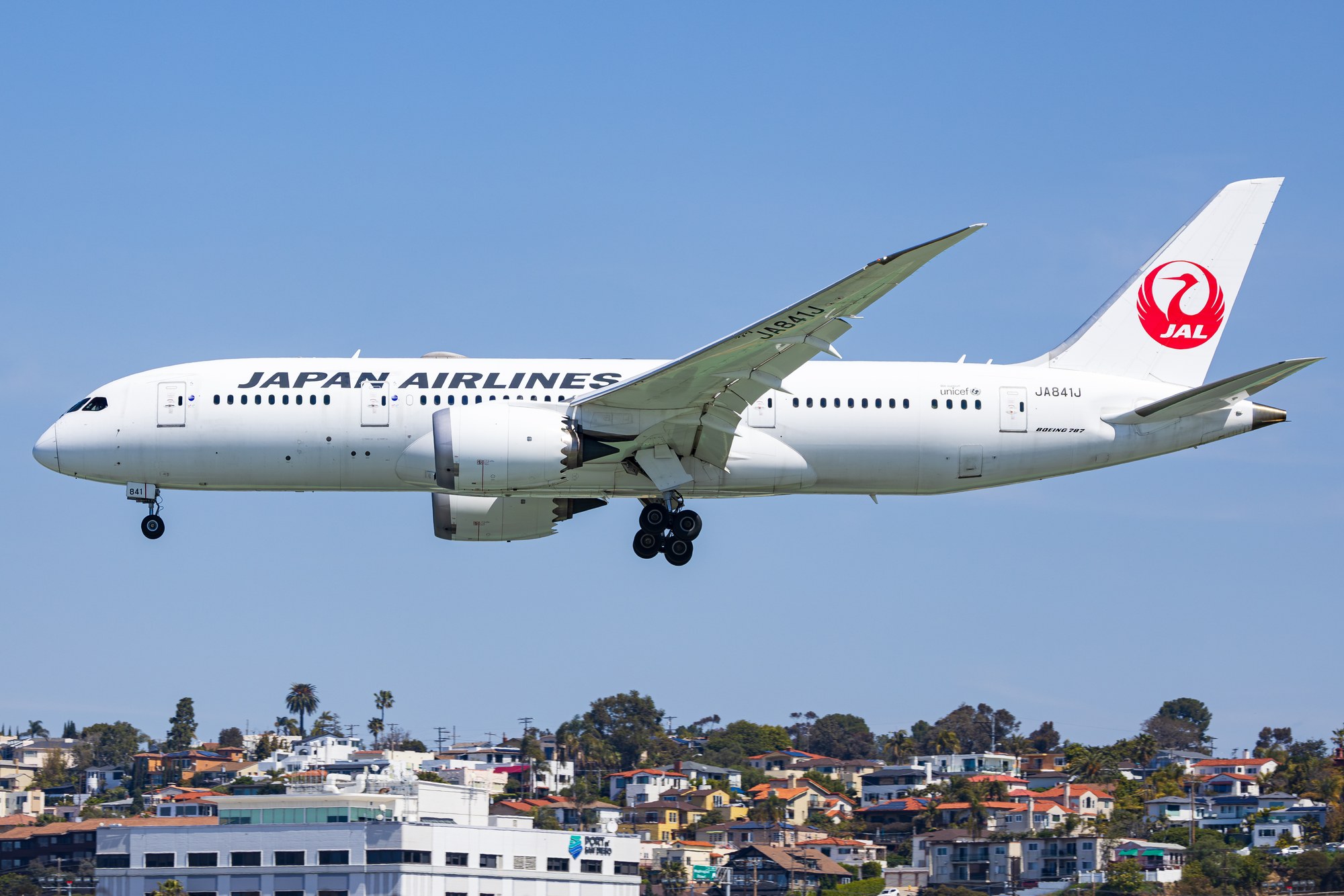
The widebodies are the surprise. Japan Airlines runs the Boeing 787 to Tokyo Narita, and British Airways flies the 777 and 787 to Heathrow twice a day, having doubled up in April 2024. KLM added Amsterdam in May 2025 and Copa added Panama City a few weeks later. These are scheduled services on a timetable, not once a season charters, so a widebody on that steep approach is something you can plan around rather than hope for.
Underneath the airlines there is a steady flow of business aircraft, which at a city like this is what you would expect, and it is worth staying for. The longest lens I used across two days went on a business jet, not an airliner.
The approach, and why it is the whole point
Most airports are photographed from the side. San Diego is photographed from underneath, and that is the reason to come.

The runway sits at sixteen feet above the sea with the city rising immediately to the east of it. The approach crosses the crest of Bankers Hill, the uptown neighbourhood between downtown and Balboa Park, and the obstacles are not abstract. The standard description is that the approach is “unusually steep due to utility poles and over 200-foot-tall buildings within 2 miles of the runway threshold”. An aircraft coming into runway 27 has to clear all of that and then get down onto a runway that starts almost at the waterline.
The published visual glide path for runway 27 is 3.5 degrees. The standard nearly everywhere else is 3. Half a degree does not sound like much written down, but it is about a sixth steeper than normal, and it is the difference between an airliner arriving and an airliner descending at you.
The terrain is also why there is no instrument landing system on runway 27: the ground on the approach makes one impractical. That single fact does more to shape a day at San Diego than anything else on this page, and we come back to it.
What that means with a camera: the aircraft is lower, closer and more nose-down than you are used to, and it fills the frame far earlier than your instinct says it will.
One thing to get right, because it is easy to get wrong. That 3.5 degrees is the visual glide path, the angle the PAPI lights show the pilot. It is not an ILS glideslope, because runway 27 has no ILS at all. The instrument approach lives on runway 9, at the other end.
Pilots have compared the arrival to Kansas City’s downtown airport and to the old Kai Tak at Hong Kong. That is flattering company for a routine daily service into a Californian city, and it tells you why photographers come.
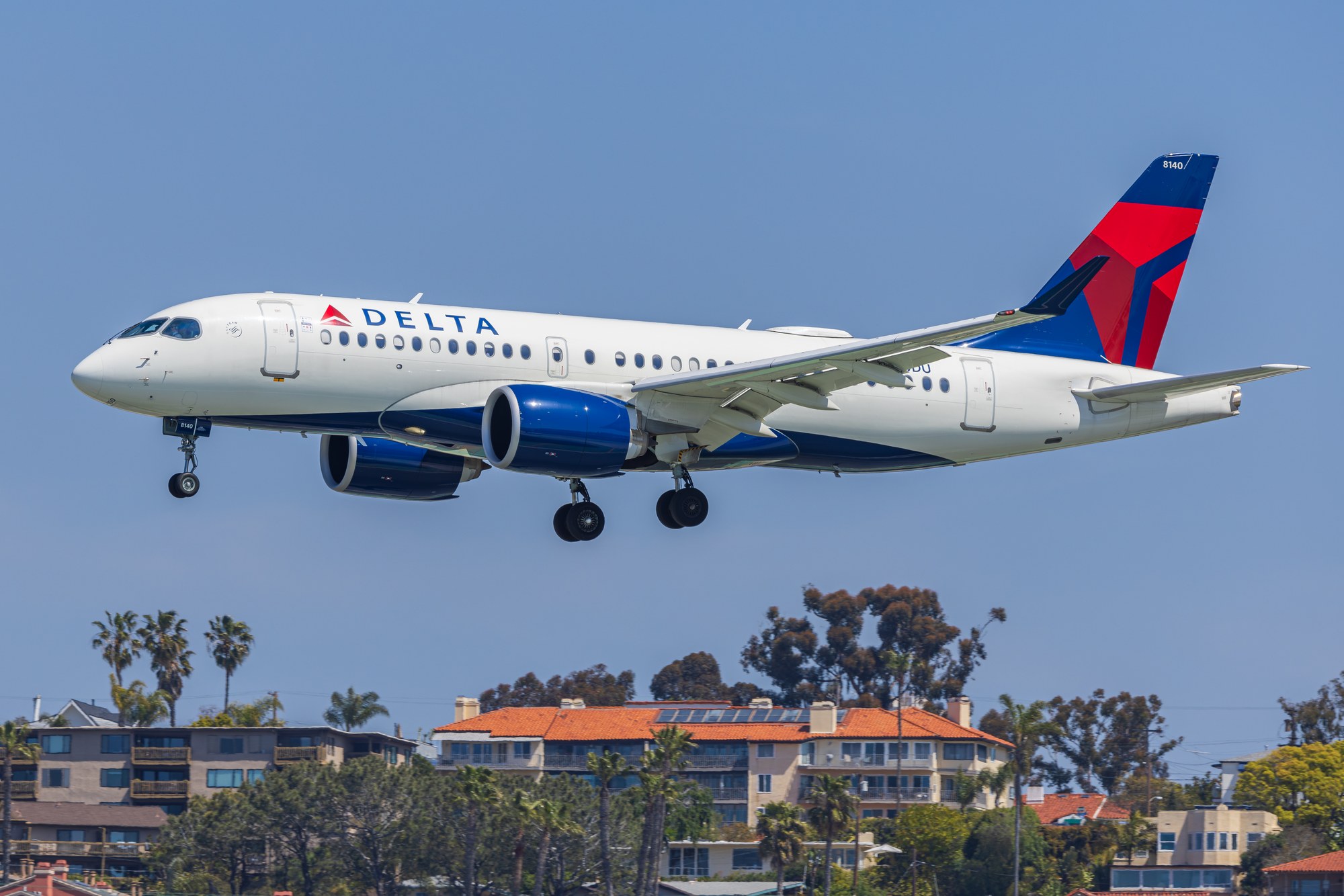
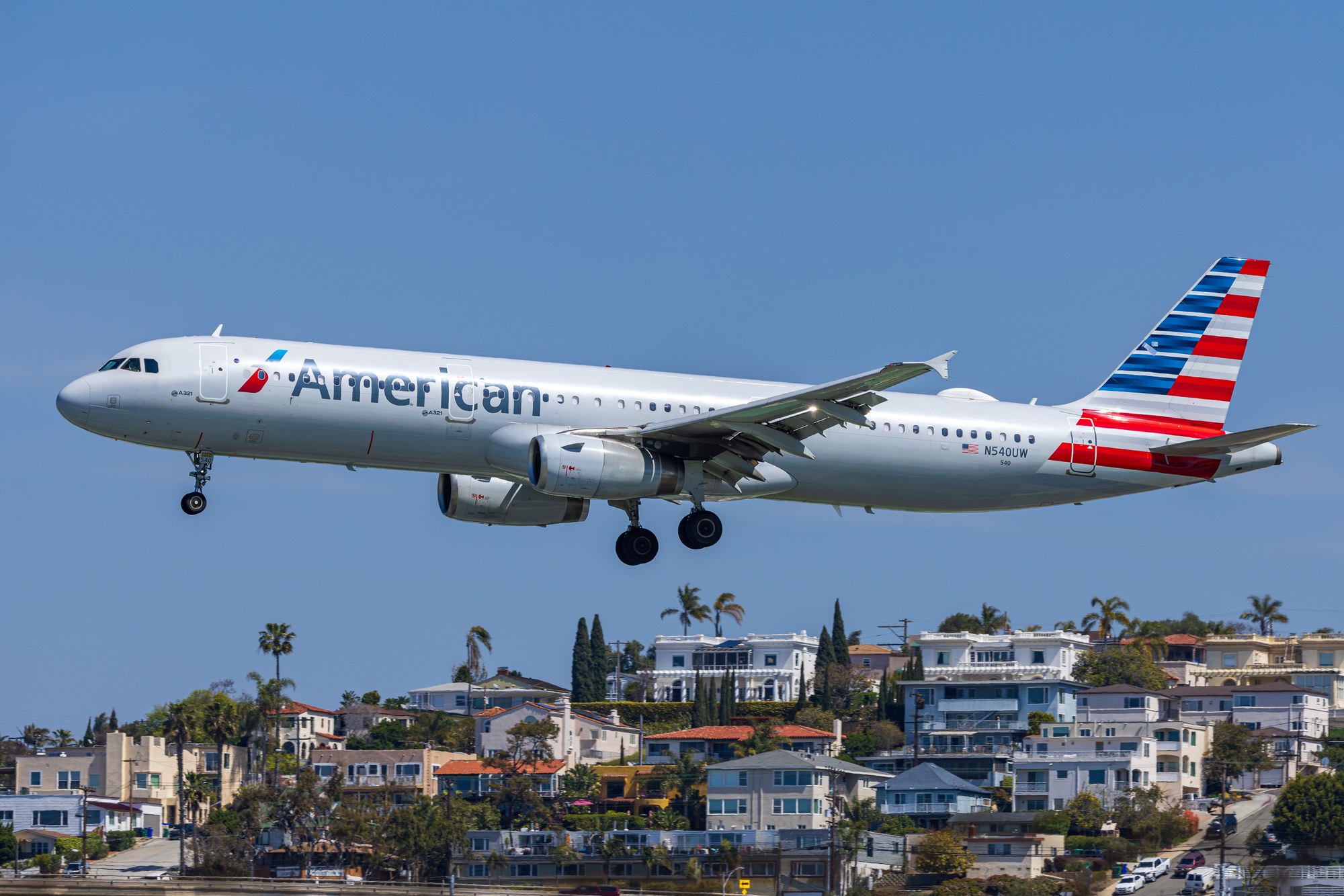
The result on the ground is that the houses of Loma Portal, on the hillside north-west of the field, sit directly behind aircraft on short final. That is the San Diego picture: an airliner with a residential street underneath it, close enough to read the parked cars. No mountain, no desert, no empty airfield. A city, with aeroplanes coming through it.
Which way is it running?
Almost always runway 27, which means landing towards the west, out over the harbour. The sea breeze comes off the Pacific and the airport faces into it.
The wind figures for the airport’s own weather station put it plainly. The wind is most often from the west for ten months of the year, from late January to early December, and most often from the east for about seven weeks either side of the new year. So if you are going in spring, summer or autumn, you can plan on runway 27 and be right nearly every time. December and January are when to check twice.
You will see a figure of 95.4 per cent quoted for runway 27 use. I have not repeated it as fact anywhere in this guide, because it traces back to a newspaper article from 2013 that I could not get hold of, and thirteen year old operational numbers are not worth much. The direction of the thing is not in doubt. The decimal place is.
Two things turn the airport round, and the second one is more interesting than it looks.
A Santa Ana. When the hot dry easterly blows off the desert, the sea breeze is beaten and the airport lands the other way. These are usually brilliantly clear days, which is a cruel joke: the best light of the year arrives on the day the aircraft are pointing the wrong way for most of the good positions.
Low cloud. This is the one people miss. Because runway 27 has no instrument landing system and runway 9 does, a low enough ceiling forces the airport onto the instrument approach, and the instrument approach is at the other end. So a grey morning does not just flatten your light. It can physically reverse the traffic while you are standing there.
The practical upshot is the same as anywhere. Look at a tracking app before you get in the car and see which way they are actually landing. It takes a minute. The difference between doing it and not doing it is a whole morning.
When to visit
Late summer and autumn. September is the clearest month of the year. Avoid May and June, which are the two months the coast disappears under cloud.
San Diego has a reputation for perfect weather and it is mostly deserved, but it is deserved in a way that catches photographers out.
Start with temperature, because there is almost nothing to say about it. These are the average daily highs.
| Jan | Feb | Mar | Apr | May | Jun | Jul | Aug | Sep | Oct | Nov | Dec |
|---|---|---|---|---|---|---|---|---|---|---|---|
| 65F | 65F | 66F | 68F | 68F | 71F | 74F | 76F | 75F | 73F | 69F | 65F |
Eleven degrees between the coldest month and the warmest. You can stand at a fence in San Diego in any month of the year in a shirt and be comfortable. Heat haze, which ruins long lens work at plenty of American airports, is a minor consideration here rather than a season you have to plan around.
The thing that will spoil your trip is not heat. It is cloud.
May Gray and June Gloom
A layer of low grey stratus sits over the coast through late spring and early summer, thick enough to turn a bright morning into a flat white ceiling. The locals have names for it. May Gray, June Gloom, and if it drags on, Fogust.
It is a real weather system rather than an anecdote. The Scripps Institution of Oceanography, which sits on the coast a few miles north of the airport, explains it as a temperature inversion that traps a shallow layer of cloud underneath it, made worse in years when the sea is cooler than normal. It usually burns off somewhere between mid morning and early afternoon, but usually is not a promise, and it can sit there all day.
The cloud figures follow the same shape. The cloudier half of the year runs from early November to early May, and February is the worst month at 41 per cent overcast or mostly cloudy. The clearer half runs from May to November, and September is the best month of the year at 89 per cent clear or partly cloudy.
So the calendar for a photographer runs backwards to the tourist one. Come in September or October. August is nearly as good. Avoid May and June unless you are happy to wait until lunchtime for a sky.
Where to shoot
There is no official viewing area at San Diego. What there is instead is a ring of streets, bridges, parks and car parks around a very compact airport, most of them within a few minutes of each other, and a couple of places you should stay away from.
One piece of honesty before the list. My own photographs on this page were taken from the Harbor Drive and Laurel Street area on the south side of the field in March 2023, and that corner has since been rebuilt. The airport opened a new three lane entrance roadway there on 2 September 2025, running from North Harbor Drive just west of West Laurel Street. Current spotter reports say the old car park on that corner is gone. I could not confirm the date it closed from the airport itself, so treat that corner as the one thing to check before you travel, and treat everything below as compiled from current published guides rather than from my own boots.
1. Balboa Park, the El Prado bridge
Up the hill east of the airport, in the park itself. Park free on 6th Avenue or Balboa Drive and walk along El Prado to the bridge.
- Sees: arrivals on 27 about a mile from touchdown, with the downtown skyline underneath them
- Best: from mid morning once the sun is round
- Lens: mid range, and you will want the wide end for the cityscape
- Needs a step: no
This is the picture that says San Diego to anyone who knows the airport, and it is the one position on the list that is completely free of hassle. You are in a public park full of tourists, museums and joggers, and nobody cares what your lens is pointing at. If you have one session and you want one photograph, come here.
2. Ivy Street and Albatross Street
A residential junction on the hill below the park, under the approach.
- Sees: arrivals passing close overhead, and the touchdown beyond
- Best: late morning onwards
- Lens: short. Published advice suggests around 150mm reaches the touchdown from here and less than that covers the overhead pass
- Needs a step: no
The underside position. This is where you get the belly, the gear and the flaps against sky, which is a different photograph from anything you can take at a British airport fence.
3. Columbia Street and West Nutmeg Street
Down the hill towards the water, on the approach side.
- Sees: short final with San Diego Bay behind, and the touchdown
- Best: late morning to afternoon
- Lens: mid range
- Needs a step: yes, or a tall vehicle. There is a fence to clear
Worth the effort for the water backdrop, but be warned that the street slopes, so getting a level horizon takes more care here than anywhere else on this list. Check the back of the camera rather than trusting your eye.
4. The West Palm Street pedestrian overpass
The footbridge over Interstate 5, reached from Kettner Boulevard and India Street. Street parking nearby, and the Middletown trolley station is across the road.
- Sees: side-on approach shots framed by the downtown towers, and some of the landing run
- Best: late morning onwards
- Lens: mid range
- Needs a step: effectively yes. Most of the span is covered by a grated fence six or seven feet high, so bring something to stand on or a lens narrow enough to go through the grating
The only position on this list you can reach easily without a car, which makes it the answer if you are in San Diego for a conference rather than a photographic trip.
5. The Aladdin parking garage
A multi storey off Laurel Street, right beside the field.
- Sees: landings and taxiing traffic from an elevated deck, looking down the runway
- Best: morning, before the ground warms up
- Lens: long for departures, mid range for arrivals
- Needs a step: no, you are already up
Two caveats and they are both real. You pay to park, by the day rather than the hour, and staff do come and ask people to move on, though by all accounts politely. Shimmer is also the worst here of anywhere on the list, because you are looking along a lot of hot concrete at the departure end. Take the arrivals early and do not expect miracles at 400mm across the field at two in the afternoon.
6. NTC Park, Liberty Station
West of the field, on the old Naval Training Center site.
- Sees: departures passing overhead once they are airborne off 27
- Best: afternoon
- Lens: mid range
- Needs a step: no
A free public park, and the departures position. Aircraft are high by the time they reach you, so a conventional side-on shot is hard and the underside is the picture. Good place to take an hour off with a coffee while still watching aeroplanes.
7. The Embarcadero
The waterfront walk on the far side of Harbor Drive from the airport.
- Sees: arrivals
- Best: morning
- Lens: mid range
- Needs a step: no
Metered parking, and the catch is Harbor Drive itself: a lorry or a bus at the wrong moment will go straight through your shot. Fine as somewhere to walk between other positions, less good as a place to plant yourself for two hours.
Three places to stay away from
This is the most useful thing published about San Diego and it is buried in the existing guides, so here it is at the front.
Laurel Airport Parking carries signs stating that photography and video are prohibited and threatening arrest for trespass if you are doing anything other than parking a car. Do not test it.
The Solar Turbines car park is private and security patrol it, and they do ask people to leave. The public pavement on Laurel outside it is fine, so stand there instead.
The rental car centre roof was once the best position at the airport. It now carries an employees only sign and spotters have stopped using it.
Behaving yourself
Spotting at San Diego is tolerated in public places and actively discouraged on private ones, and the boundary between the two runs down the middle of the airport’s edge. That is a harder line to read than at a British airfield, where the fence is the fence.
The rules that keep you out of trouble are simple. Stay on public pavements, streets and parks. Carry photo identification. If somebody in uniform asks what you are doing, tell them plainly and do not argue about your rights, because you are standing next to an international airport in a country where that conversation goes better when you are polite. And if a sign says no photography, believe it and walk fifty yards.
What lens you actually need
Less than you would take, and this time I can be precise about it, because I went through the focal length recorded in every frame I shot there across two days on a full frame body.
| Range | Frames | Share |
|---|---|---|
| 100 to 199mm | 3 | 10% |
| 200 to 299mm | 20 | 67% |
| 300 to 399mm | 7 | 23% |
| 400mm and beyond | 0 | 0% |
The median was 254mm. The longest frame of the entire two days was 363mm. Not one photograph needed 400mm, and nothing came close to 500mm.
A 100-400mm zoom would have taken all thirty frames with room to spare. A 70-200mm would have taken five of them, which is only 17 per cent, so this is not an airport where a short telephoto is enough. The useful range is roughly 200 to 350mm and two thirds of everything lands inside a hundred millimetre band.
That is a narrower and longer spread than you might expect from an airport famous for aircraft passing low overhead, and the explanation is where I was standing. From a side-on position beside the approach, an airliner at a few hundred metres wants around 250mm. From directly underneath it at Ivy Street you would be working far shorter, and the published advice for that spot is about 150mm. The airport does not set the focal length. The position does.
How this compares with Palm Springs
Worth a paragraph, because the two sets are mine, taken on the same trip three days apart with the same camera and the same lens, and they came out differently.
| San Diego | Palm Springs | |
|---|---|---|
| Frames | 30 | 49 |
| Median focal length | 254mm | 186mm |
| Longest frame | 363mm | 500mm |
| At or under 200mm | 17% | 59% |
| Aperture | f/7.1 on 29 of 30 | f/5 or f/5.6 on 41 of 49 |
Palm Springs is the wider airport and the one where a 100-400 is generous. San Diego needs more reach in the middle and none at the top. Between them they make the same point from two directions: on this side of the Atlantic the aircraft are big and the positions are close, and a 600mm lens is answering a question nobody asked. Our guide to the best lenses for aviation photography runs through the options by system, and the Canon RF 100-500mm shot every frame on this page.
Light, and which side to stand on
The runway lies on 095 and 275, so the approach runs almost exactly east to west. That is the single most useful thing to know about light here, because it means the sun tracks along the flight path rather than across it.
In practice: aircraft landing west are lit from behind you if you are on the south side of the approach through the middle of the day, and the north side is the difficult one for most of the year. The city is to the east of the runway, so the Balboa Park position looks west into the afternoon and the light comes over your shoulder from behind the park.
| Date | Sunrise | Sunset |
|---|---|---|
| 15 January | 06:51 | 17:05 |
| 15 March | 06:58 | 18:56 |
| 15 June | 05:40 | 19:58 |
| 15 September | 06:32 | 18:54 |
| 15 December | 06:43 | 16:44 |
Now put the curfew next to that table, because the two together tell you how to plan a day.
The airport’s own noise page says it “operates under a nighttime noise curfew that prohibits departures between 11:30 p.m. and 6:30 a.m.” Read that carefully. It restricts departures. Arrivals are not limited at all. So the first hour of light is arrivals only, every single day of the year, and the airport does not properly wake up until half past six. In midsummer that means an hour of empty sky after sunrise. In December, sunrise is at 06:43 and the curfew lifts at 06:30, so the two line up almost exactly and you get the whole day from first light.
The other half of it is the evening. Sunset in June is just before eight, and departures run until half eleven, so there is a long stretch of aircraft leaving in warm light and then in the dark. If you want the classic San Diego departure shot with the city lit behind it, the summer evenings are when it exists.
What you will see
Two mornings at the approach, and this is what came down it.
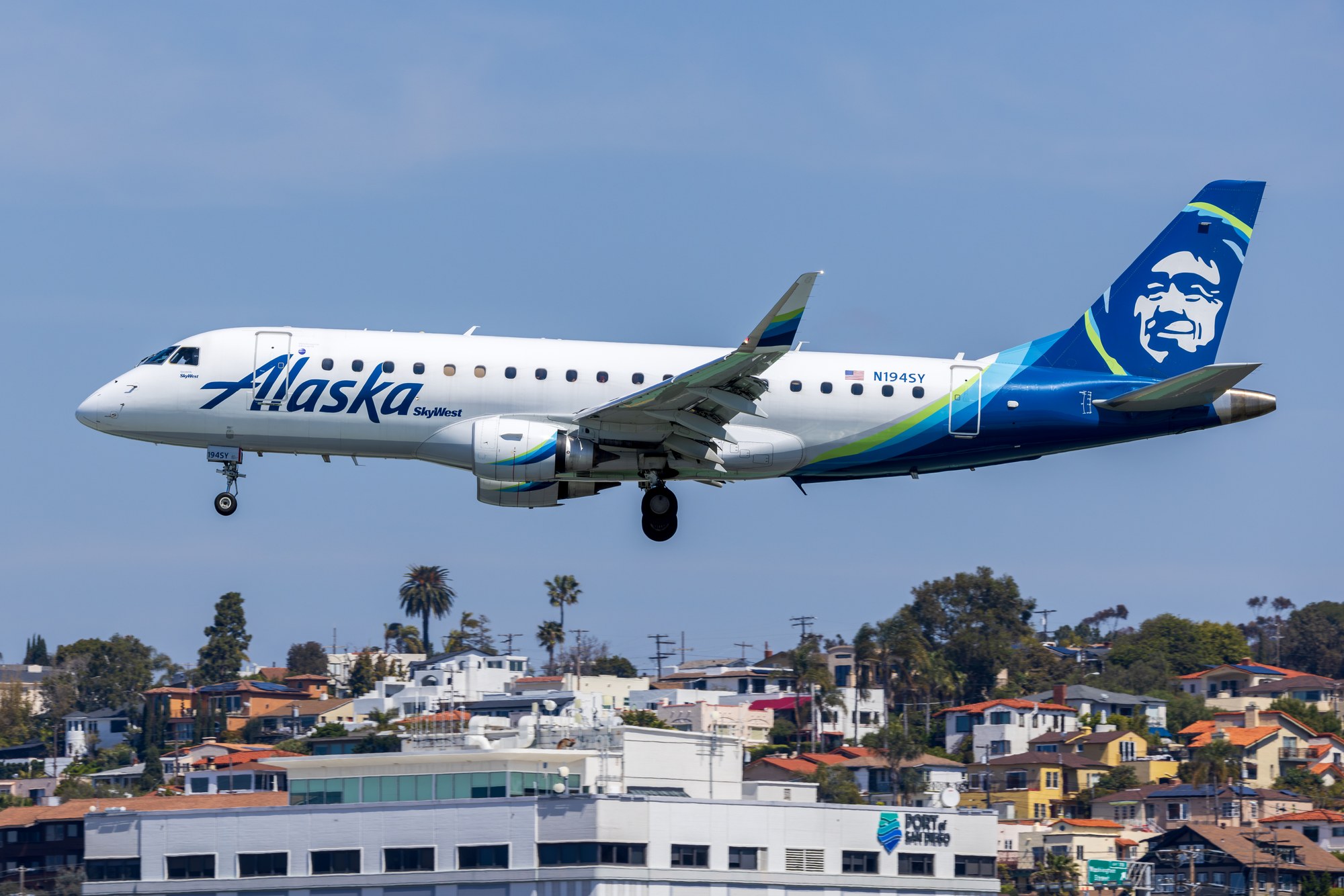
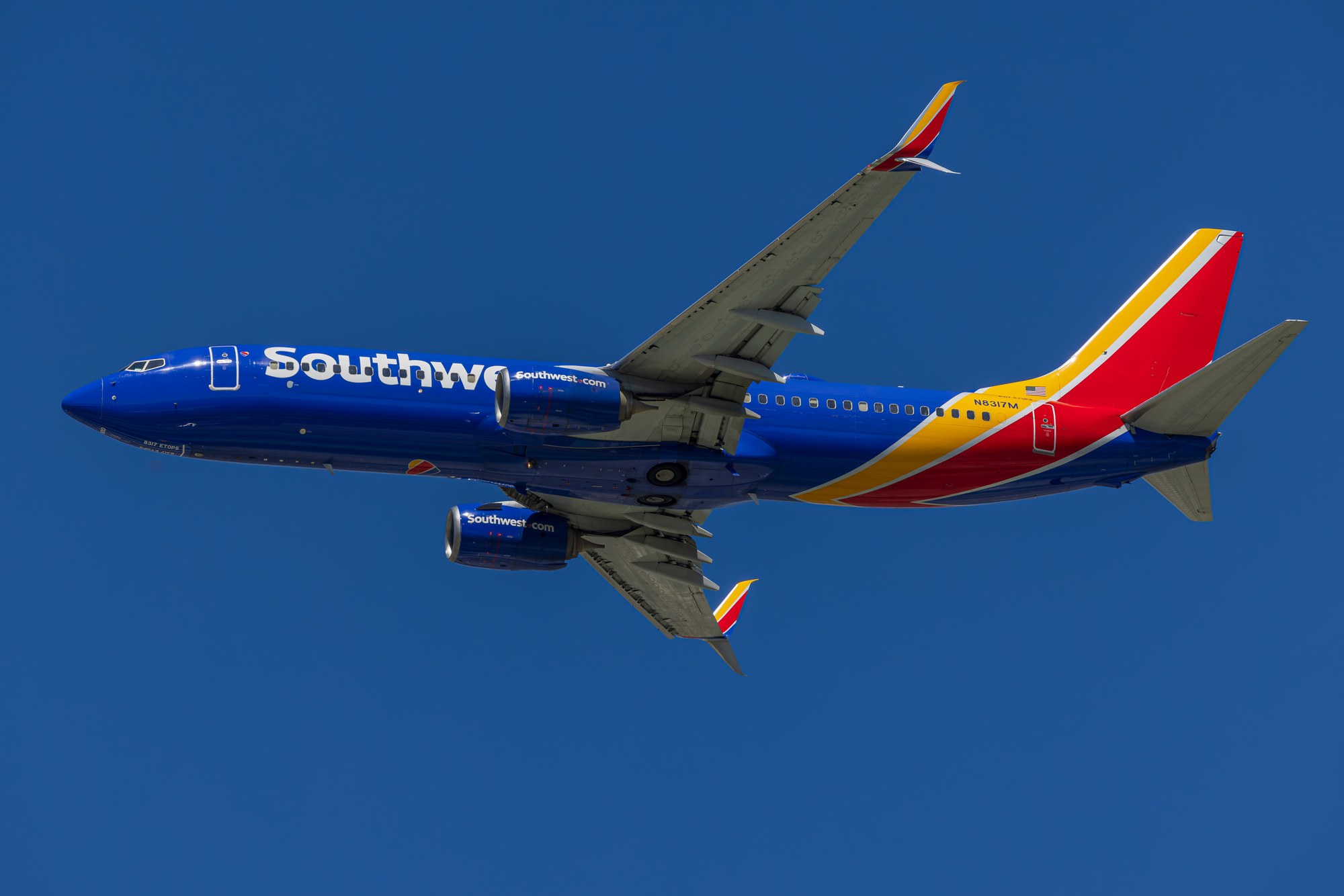
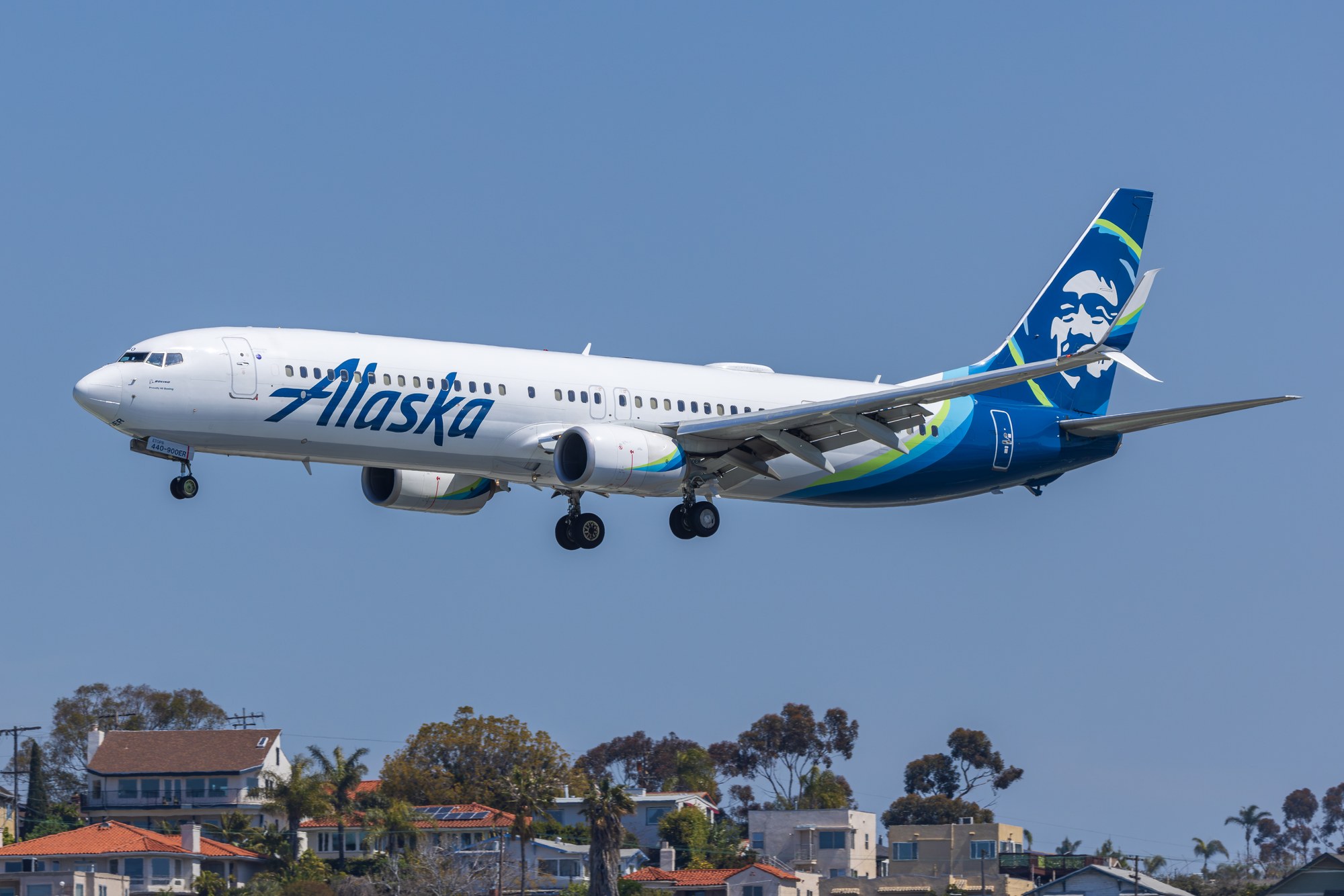
Southwest and Alaska carry the airport. Southwest in 737-700s, 737-800s and MAX 8s, Alaska in 737-800s and 737-900ERs and in Embraer E175s flown for them by SkyWest. If you photograph nothing else you will fill a card with those two.
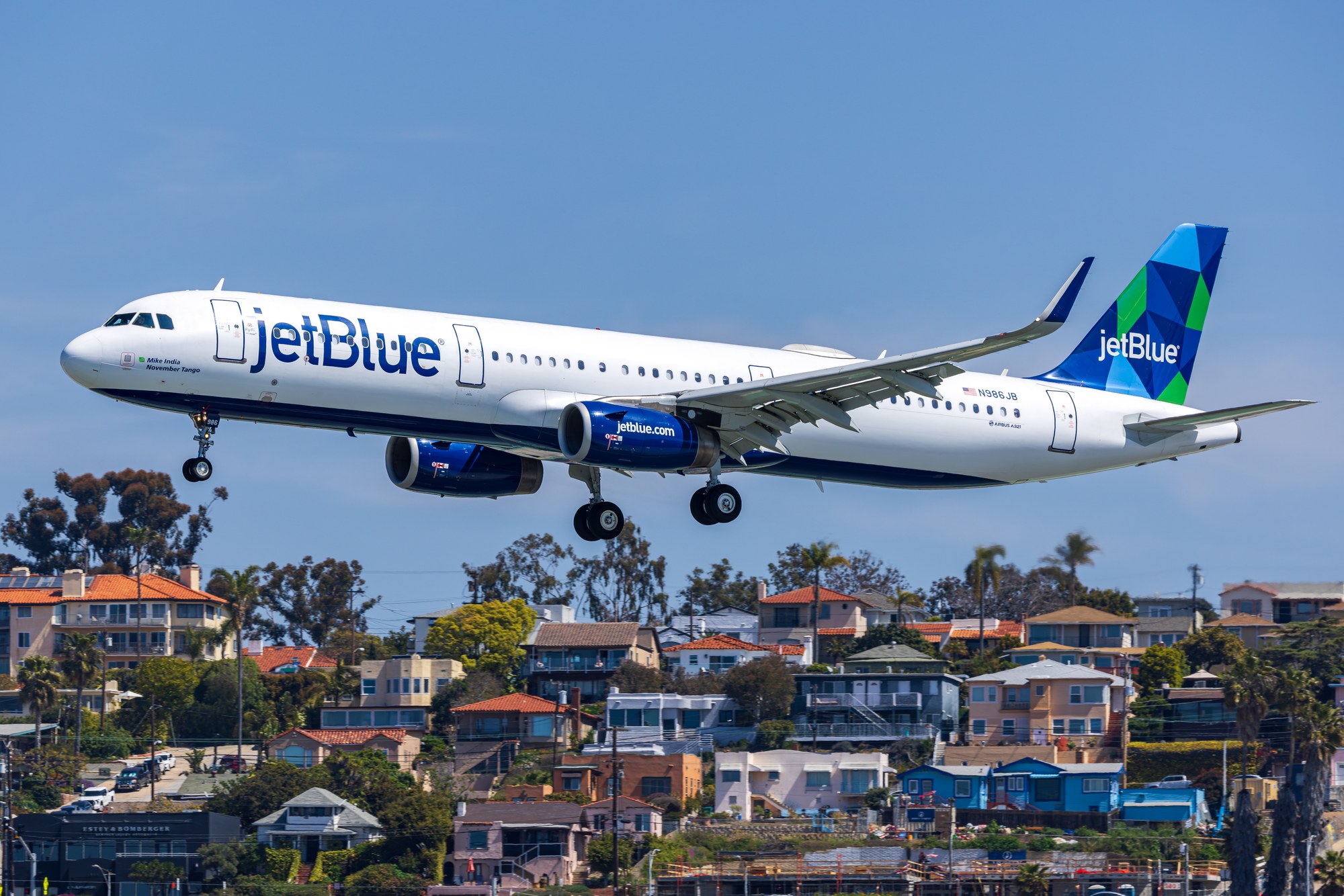
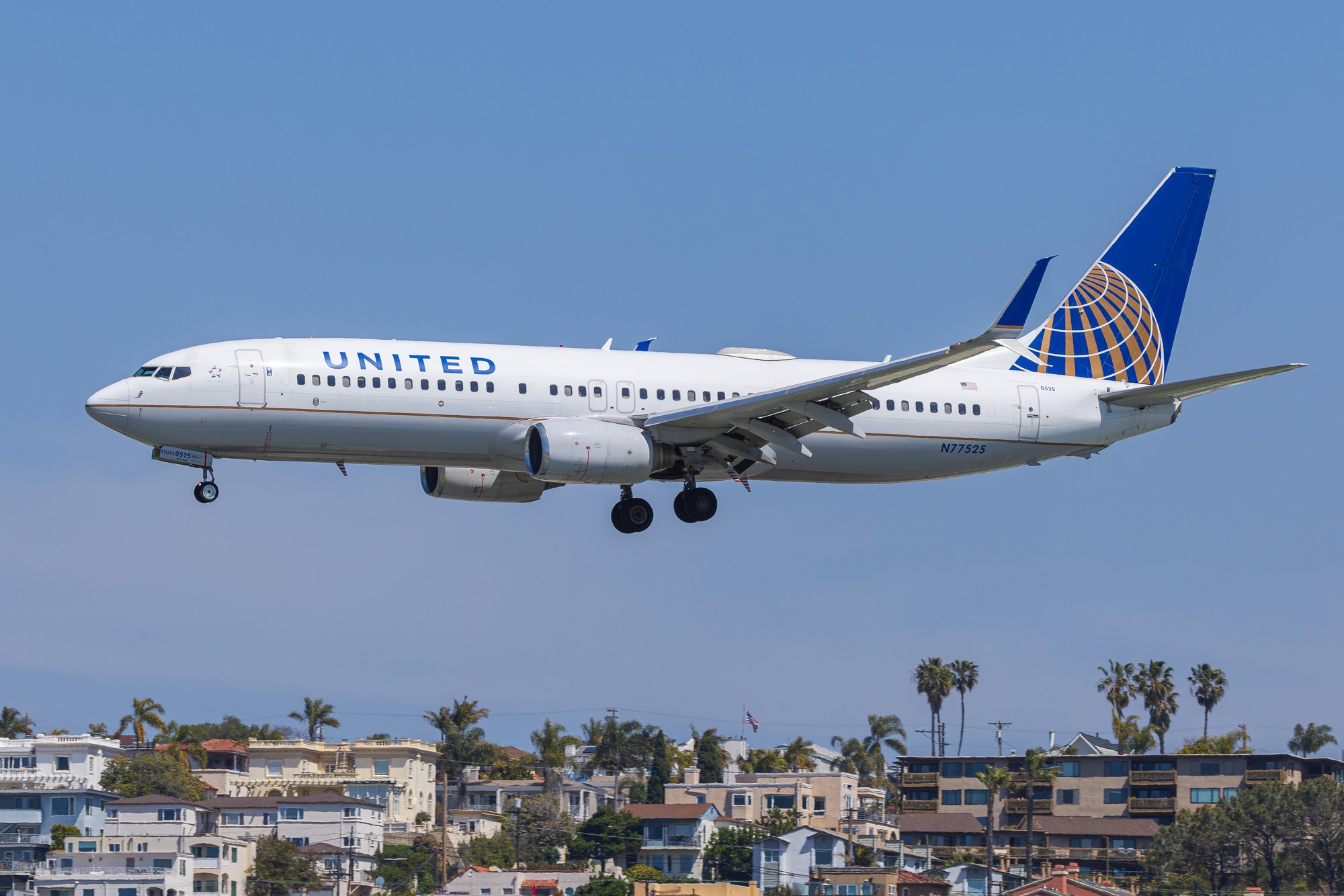
The rest of the American majors are all there. United, including aircraft still carrying the Continental globe on the fin more than a decade after that merger. American in A321s, several of them still wearing US Airways registrations. Delta, including the A220, which is a good looking aeroplane and still not a common sight for a British photographer. JetBlue in A321s.
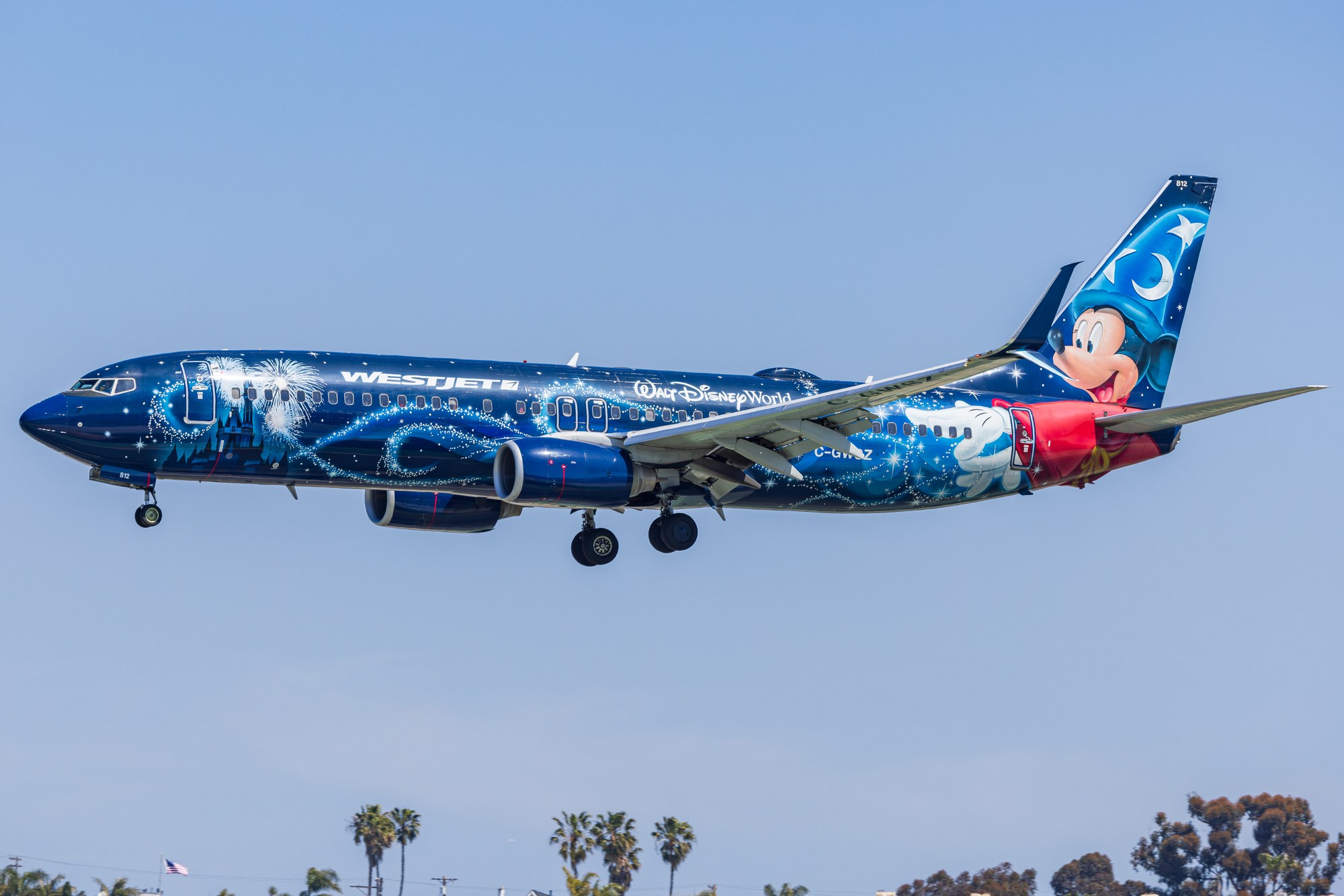
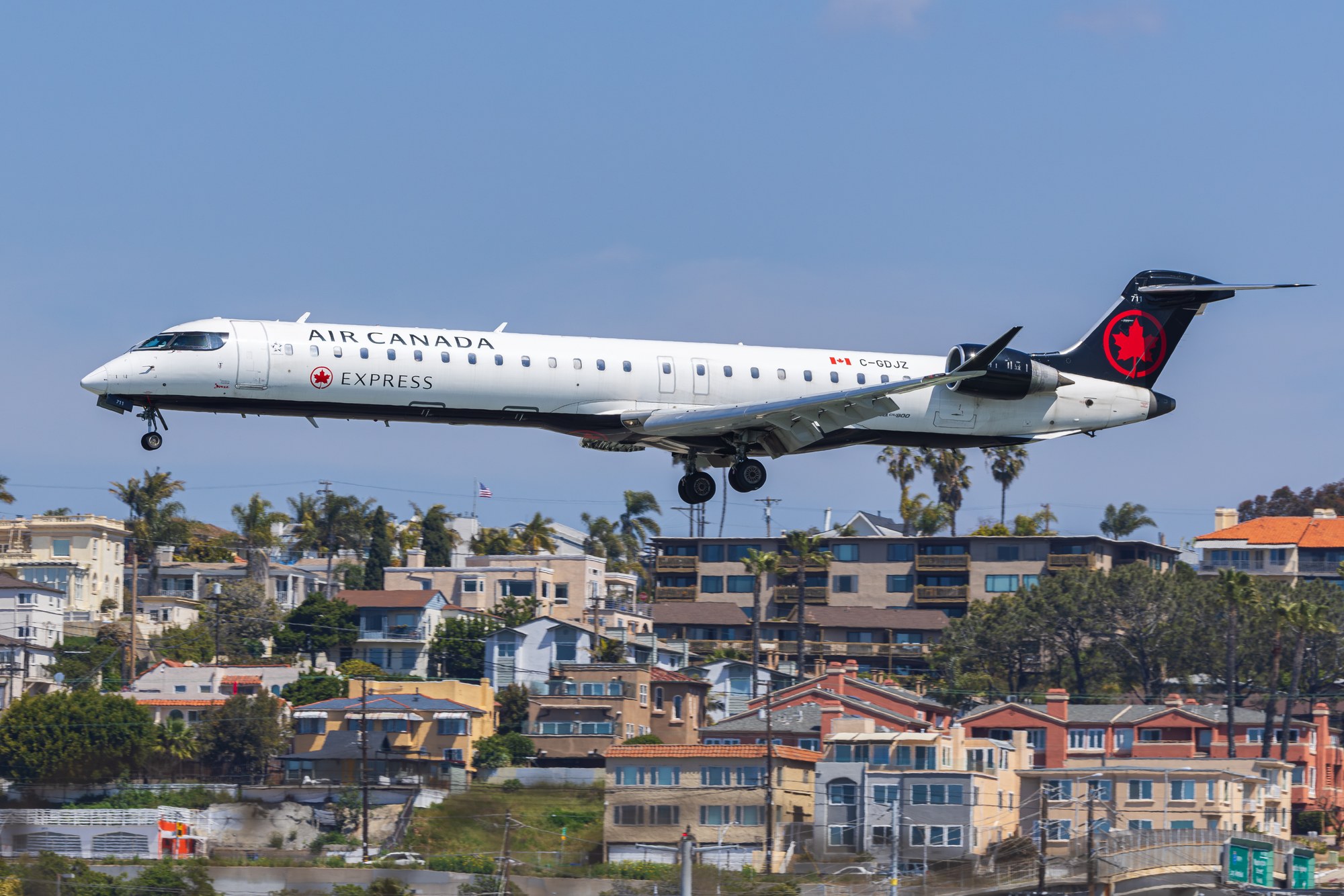
Canada sends more than you expect. WestJet and Air Canada Express both run into San Diego, and a Canadian registration on a Californian approach is a picture you cannot take at home. On my first morning the WestJet 737 that turned up was wearing the full Walt Disney World scheme, which is not something you plan for.
The widebodies are the reason to check a timetable. Japan Airlines brings the 787 in from Tokyo and British Airways brings the 777 or 787 from Heathrow twice a day. A 787 on a 3.5 degree approach over a city is the best photograph the airport offers, and unlike almost everything else here it happens at a time you can look up in advance.
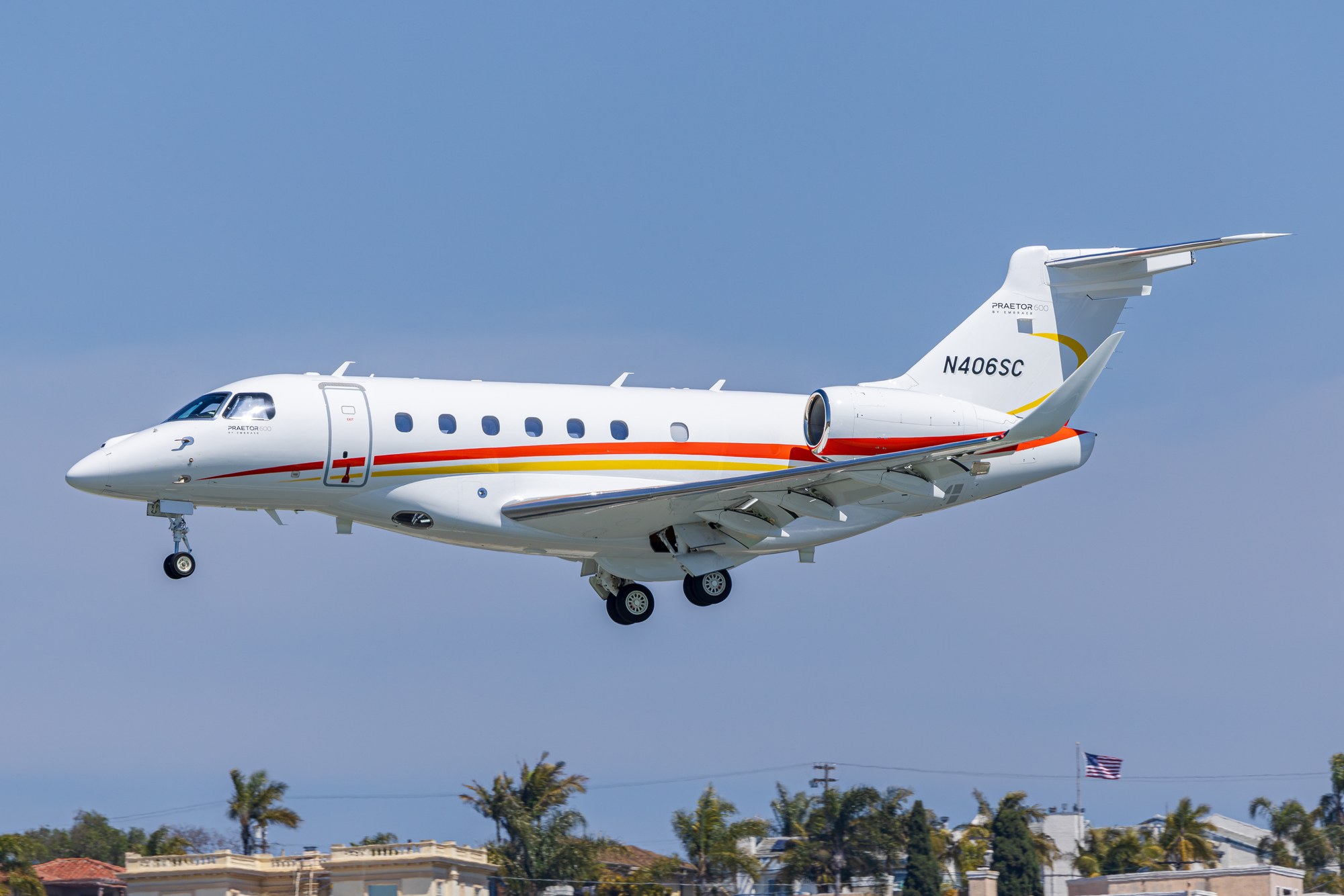
Business aircraft all day. Citations, Challengers, Globals, and on my second morning an Embraer Praetor 600, which obligingly has its own type name painted on the fin so there is no argument about what it is. These are the aircraft that want the long end of the lens, because they are a third the length of a 737 and sit no closer.
What you will not see is much cargo or much military. This is a city airport doing city airport work, and the appeal is the density and the setting rather than the exotica.
Camera settings
Honest answer first: I shot two days at San Diego on one set of settings and barely touched the camera. That is not laziness, it is what the airport asks for.
Shutter speed
1/1000 covered every frame I took there. Aircraft on approach are moving across you slowly in angular terms even when they are close, and the light is good enough that a faster shutter costs you nothing and gains you nothing. If a propeller turns up, and King Airs do use this airport, drop to somewhere near 1/320 or the blades stop dead and the aircraft looks wrong. Our guide to propeller blur shutter speeds has the numbers.
Aperture
f/7.1 on twenty nine frames out of thirty. That was a deliberate choice and a different one from the same lens at Palm Springs three days later, where I worked wide open throughout.
The reason is depth. At San Diego the aircraft has a hillside of houses close behind it and the picture is partly about that hillside. Stopping down a little keeps the background readable instead of turning it to mush. At Palm Springs the background was a mountain two miles off and open sky, so there was nothing to hold and no reason not to shoot wide open. Same lens, same photographer, opposite decision, and the difference is what was behind the aeroplane.
If you are copying anything from this page, copy that thought rather than the number.
ISO
100 on twenty nine frames and 125 on the other. The light is that reliable. Auto ISO will sit at the bottom of its range all day and never trouble you.
Autofocus
Servo, with aircraft subject detection if your camera has it. An airliner on approach against a clear sky is the easiest target a modern autofocus system is ever given. The one to watch is the moment the aircraft drops below the skyline and the background becomes houses and trees, because that is where a less confident system will jump off the aeroplane and onto a roof. Our guide to camera settings and autofocus goes through it properly.
Exposure
The trap here is the same one as anywhere with white aircraft and blue sky, made slightly worse by the water. A white fuselage against a deep sky will pull the meter down and you will lose the shadow side. Watch the highlight warning, expose for the aircraft rather than the sky, and accept a bright background. And when the aircraft drops in front of the dark hillside, expect to come back the other way by a stop.
Practical notes
Check which way it is running before you set off. One runway, and if it has reversed the good positions become the wrong positions. Any tracking app answers it in a minute.
You do not strictly need a car, which is unusual. The airport is three miles from downtown, the trolley reaches the Palm Street bridge, and Balboa Park is walkable from parts of the city. A car makes the day easier and lets you move between positions, but San Diego is the rare American airport you can photograph without one.
Take something to stand on if you plan to use Columbia Street or the Palm Street bridge. Both have a fence problem. Balboa Park, Ivy Street and NTC Park do not.
Carry identification and stay on public ground. The private car parks around the field are firm about photography and the signs mean it.
Take less lens than you think and more than at Palm Springs. Something reaching 400mm is ample. Something reaching 200mm is not.
Sun cream even in winter. Sixty five degrees and clear still burns you over three hours at a fence, and the reflection off the water does not help.
Getting there and staying
San Diego is about two hours south of Los Angeles on the I-5 and roughly two hours west of Palm Springs, which is why the two appear together in this archive: they were shot on the same trip, three days apart. If you are flying from Britain, British Airways will take you there directly twice a day, which means you can photograph the aircraft you arrived on.
Staying downtown or in Little Italy puts you within a mile or two of every position on this list and inside walking distance of two of them. It is more expensive than staying out by the freeway and worth it here in a way it usually is not, because the whole appeal of this airport is that everything is close together.
If you are building a Southern California trip around aeroplanes, the obvious pairing is Palm Springs two hours inland, which is a completely different kind of airport: wide, quiet, desert light and a mountain, where San Diego is tight, busy and urban. Doing both in a week gives you two sets of pictures that look nothing like each other.
Is it worth the trip?
As the reason for crossing the Atlantic on its own, no. As the best single airport in Southern California to photograph, and as somewhere you can work without a car in a city worth being in anyway, yes, and comfortably.
What San Diego gives you is a photograph you cannot take anywhere else in America: a large aircraft, low, steep, with a city underneath it. Los Angeles has far more traffic and far more variety and none of that intimacy. The single runway that makes the airport awkward to run is exactly what makes it good to photograph, because everything comes to one place and you never have to choose.
What it asks in return is that you get the season right and the direction right. Come in September rather than June, look at a tracking app before you leave the hotel, and stay off the private car parks. Do those three things and it is one of the easiest good airports in the country. Get the first one wrong and you will spend three days photographing aeroplanes against a flat white sky.
Every photograph on this page comes from the Piemags aviation archive. You can browse the aviation archive to licence images for personal, editorial or commercial use, on the terms set out in our licence terms. For a British comparison, our guide to plane spotting at Heathrow covers an airport with the opposite problem, and our guide to photographing airliners goes into the shots themselves.
Questions people ask
Is San Diego a good airport for plane spotting?
Yes, and it is one of the most distinctive in America. It has a single runway with a visual approach angle of 3.5 degrees against a standard 3, so aircraft come down steeply over the city and pass low over residential streets. It handled a record 25.32 million passengers in 2025 and is widely described as the busiest single-runway commercial airport in the United States. Seventeen airlines serve it, including scheduled widebodies from Tokyo and London.
What lens do you need at San Diego airport?
Something reaching about 400mm is ample and something reaching only 200mm is not. Across 30 frames shot there on full frame the median focal length was 254mm, the longest frame was 363mm and nothing needed 400mm or more. Only 5 of the 30 were at or below 200mm. From directly underneath the approach, at Ivy Street, published advice suggests around 150mm is enough, so the position matters more than the airport.
When is the best time of year to photograph San Diego airport?
Late summer and autumn. September is the clearest month of the year at 89 per cent clear or partly cloudy. Avoid May and June, when the marine layer known locally as May Gray and June Gloom puts a lid of low grey stratus over the coast that often does not clear until the middle of the day. February is the cloudiest month at 41 per cent overcast or mostly cloudy. Temperature is not a factor: the average high ranges only from 65F to 76F across the whole year.
Which runway does San Diego use?
There is only one, 9/27, and it is used in the 27 direction almost all of the time, landing westward over the harbour. The wind at the airport is most often from the west for ten months of the year, from late January to early December. Two things reverse it: a Santa Ana easterly, and low cloud, because runway 27 has no instrument landing system while runway 9 does, so a low ceiling forces the airport onto the other end.
Why is the approach to San Diego so steep?
Because the city is in the way. The runway sits at 16.8 feet above sea level with downtown towers, Bankers Hill, utility poles and housing immediately east of it, so arrivals have to clear all of that and still get down onto a runway that begins near the waterline. The published visual glide path for runway 27 is 3.5 degrees against the usual 3. That is the angle shown by the PAPI lights rather than an instrument glideslope, because runway 27 has no ILS.
Is there an observation deck at San Diego airport?
No. There is no official public viewing area, which is normal for a large American airport. Photographers use public streets, parks and bridges around the field instead. The car park at Harbor Drive and Laurel Street that older guides describe as the official spot has been rebuilt: the airport opened a new entrance roadway at that corner on 2 September 2025, and current reports say the old lot has gone.
Where can you photograph aircraft at San Diego?
The El Prado bridge in Balboa Park gives arrivals about a mile out with the skyline underneath and is free and hassle-free. Ivy Street and Albatross Street puts you under the approach for underside shots. Columbia Street at West Nutmeg gives short final over the bay but needs a step. The West Palm Street footbridge over Interstate 5 is reachable by trolley. NTC Park at Liberty Station covers departures. The Aladdin garage is paid and staff move people on.
Is plane spotting allowed at San Diego airport?
In public places, yes. On the private car parks around the field, no, and they are firm about it. Laurel Airport Parking posts signs prohibiting photography and threatening arrest for trespass, the Solar Turbines lot is patrolled by security, and the rental car centre roof now carries an employees only sign. Stay on public pavements, streets and parks, carry photo identification, and be polite if anyone asks what you are doing.
Which airlines fly to San Diego?
Air Canada, Alaska, American, Breeze, British Airways, Copa, Delta, Frontier, Hawaiian, Japan Airlines, JetBlue, KLM, Lufthansa, Southwest, Sun Country, United and WestJet. Southwest and Alaska account for most of the movements. Widebodies are scheduled rather than occasional: Japan Airlines flies the Boeing 787 to Tokyo Narita and British Airways flies the 777 and 787 to London Heathrow twice daily.
Does San Diego airport have a curfew?
Yes, and it matters for planning a day. Departures are prohibited between 11:30pm and 6:30am, with exemptions for medical and emergency flights. Arrivals are not restricted at all. So the first hour after sunrise is arrivals only, every day of the year. In December that barely matters because sunrise is at 06:43 and the curfew lifts at 06:30, but in June it means an hour of quiet sky after the sun is up.
What settings should you use at San Diego?
1/1000 second covered every frame I took there, and f/7.1 covered 29 of 30. Stopping down slightly is deliberate here rather than habit: the aircraft has a hillside of houses close behind it and a little depth of field keeps that background readable. ISO sat at 100 almost throughout. Servo autofocus with subject detection, and watch the moment the aircraft drops below the skyline, because that is where focus can jump onto a roof.
How does San Diego compare with Palm Springs for photography?
They are opposites, and both sets on this site were shot on the same trip three days apart with the same camera and lens. San Diego is urban, busy and tight: median focal length 254mm, nothing beyond 363mm, shot at f/7.1 to hold the background. Palm Springs is wide, quiet and desert: median 186mm, three frames at 500mm, shot wide open because the background was a distant mountain. San Diego has far more traffic and variety. Palm Springs has the better light and the mountain.
Sources and further reading
- AirNav record for KSAN, republishing the Federal Aviation Administration’s own airport record. Used for the single runway 9/27 and its dimensions, the 095/275 magnetic headings, the displaced thresholds, the surveyed field elevation, the 3.5 degree PAPI glide path on runway 27 and the departure curfew. airnav.com
- SkyVector, corroborating the 3.50 degree glide path angle for runway 27 from the same FAA-sourced data. skyvector.com
- San Diego International Airport, press release on 2025 passenger figures, for the record 25.32 million passengers, the 0.3 per cent increase on 2024, the 8 per cent rise in international traffic and the fourteen new nonstop routes. san.org
- San Diego International Airport, aircraft noise page, for the departure curfew between 11:30pm and 6:30am and the fact that it restricts departures only. san.org
- San Diego International Airport, nonstop destinations, for the list of airlines serving the airport. san.org
- San Diego International Airport, on the new entrance roadway opened 2 September 2025 running from North Harbor Drive just west of West Laurel Street. Used here for the rebuilding of the corner where the old viewing car park stood. san.org
- San Diego International Airport, on British Airways going to twice daily to London Heathrow from 20 April 2024. san.org
- Fox 5 San Diego, for the description of the airport as having the busiest single runway in the United States. A press claim rather than a published FAA ranking, and attributed as such in the text above. fox5sandiego.com
- Weather Spark, for the average high temperature by month at the airport’s own station, the clearer and cloudier seasons, February at 41 per cent overcast and September at 89 per cent clear, and the months in which the wind blows from the west and from the east. Derived from NOAA data rather than published by NOAA, and labelled as secondary here. weatherspark.com
- Scripps Institution of Oceanography at UC San Diego, on the temperature inversion that produces the May Gray and June Gloom marine layer and on the effect of cooler than normal sea temperatures. A research institution rather than a tourism source. scripps.ucsd.edu
- SpottersWiki, San Diego International Airport, last edited 4 July 2026 and the most current guide found. Used for the vantage points, the places to avoid, the private car park warnings and the report that the Harbor Drive and Laurel Street lot has closed. A secondary source, and the one to check for access before travelling. spotterswiki.com
- Airport Spotting, guide to San Diego, for the lens advice at Ivy Street and Albatross Street and for descriptions of several positions. Older than the SpottersWiki page and treated as the junior source where the two disagree. airportspotting.com
- Wikipedia, San Diego International Airport, for the approach being “unusually steep due to utility poles and over 200-foot-tall buildings within 2 miles of the runway threshold”, for the descent over the crest of Bankers Hill, for runway 27 lacking an instrument landing system because the terrain makes one infeasible, for most movements using runway 27, and for the comparison with Kansas City and Kai Tak. wikipedia.org
- Wikipedia, Bankers Hill and Loma Portal, for the position of the two neighbourhoods either side of the airport. Loma Portal is the hillside behind the aircraft in these photographs and is described there as lying under the departure path rather than the approach. wikipedia.org
- Sunrise and sunset times calculated for the airport position, 32.7336N 117.1897W, in the America/Los_Angeles time zone.
- Focal length, aperture, shutter speed and ISO for all 30 frames read from the EXIF of the original files, Canon EOS R5 with RF 100-500mm F4.5-7.1L IS USM, 26 and 27 March 2023. Registrations read directly off the airframes in the photographs, and not claimed where the airframe does not show them.

Leave a Reply