Scottsdale plane spotting is the most comfortable afternoon in American aviation photography. One runway, no airliners, a free public viewing deck with no fence in front of it and a restaurant behind it, and a business jet moving every few minutes against the McDowell Mountains. Here is where to stand, when to come, and why this airport asks for more lens than the airliner airports do.
What is on this page
- The airport in brief
- The viewing deck, which is the reason to come
- Where to shoot
- Which way is it running?
- When to visit
- Light, and a thing about Arizona clocks
- What lens you actually need
- What you will see
- Camera settings
- Practical notes
- Getting there and staying
- Is it worth the trip?
- Questions people ask
The airport in brief
Scottsdale is a business jet airport. That is not a description of what mostly uses it, it is the whole thing. There are no airliners, no gates, no baggage hall, and in eighty minutes on the deck I photographed Gulfstreams, Challengers, Learjets, Hawkers, Citations of five different sizes and one Cessna 172 chained down between them.
| Runway 3/21 | 8,249 x 100 ft, asphalt |
|---|---|
| Elevation | 1,510 ft |
| Operations | 164,624 in 2025 |
| Owner | City of Scottsdale |
| Tower hours | 6am to 9pm. The airport itself is open around the clock |
| Voluntary curfew | 10pm to 6am, and voluntary is the operative word |
The numbers are worth sitting with. Roughly 164,000 movements a year through one runway, and almost none of them carrying a fare-paying passenger in the ordinary sense. The City of Scottsdale, quoting flight tracking data from WingX in 2022, put the airport fourth in the world for business aviation departures, behind Palm Beach, Teterboro and Miami-Opa Locka. All three of those have more than one runway. That figure is four years old now and I have not found a newer one, so treat it as a period claim rather than a current league table, but it tells you what sort of place this is.
The airport’s own words are more measured, and probably better. Its history page calls Scottsdale “one of the premier general aviation airports with a single runway in the country, and one of the busiest corporate jet facilities in the state”.
One thing that has changed since I was there
In January 2024, three months after these photographs were taken, JSX moved its Arizona operation over from Phoenix Sky Harbor and set up in a dedicated terminal here. They fly 30-seat Embraer regional jets to Los Angeles, Burbank, Las Vegas, Denver, Oakland and a growing list of others.
Worth being precise about what that is, because it gets described loosely. JSX is a public charter operation running under Part 135 rules through a Department of Transportation provision, not a certificated scheduled airline. But for a photographer the distinction hardly matters: there is now a regional jet in and out of Scottsdale several times a day, which there was not when I stood on that deck. If you go, you will get something I did not.
The viewing deck, which is the reason to come
Most American airports tolerate photographers. Scottsdale provides for them, and having spent the last few weeks writing about airports that do not, I can tell you how rare that is.
There is a public outdoor viewing deck on the first floor of the terminal building at 15000 North Airport Drive, at the end of Butherus Drive. It is shared with a restaurant called Volanti, the parking is free, and it looks straight out over the ramp and the runway with nothing in the way. No fence to shoot through. No step required. No security guard deciding whether you look like trouble.
A public deck, free parking, an unobstructed view of the ramp and the runway, and a bar behind you. Of the three American airports covered on this site, Scottsdale is the only one where the directions begin with park and walk up the stairs.
The published guides put the deck as facing roughly southeast, which makes it an afternoon position, and that matches where the sun sits in my own frames. That is the opposite of most of the airports I have written about, where the light dies by lunchtime and you go and find a museum. Here you can have breakfast somewhere else, arrive after noon and work until the sun goes.
Nearly every photograph on this page was taken from that side of the airport, which is why they all look across the taxiway at aircraft with the perimeter wall, the low buildings of the Airpark and the mountains stacked up behind. It is a consistent background and you have to work a little to vary it.
Where to shoot
The deck is the answer for most visits. But the airport is small, the roads around it are public, and a car lets you work both ends of a single runway in an afternoon. These positions come from the published guides rather than from my own boots, and I have said where each one comes from and when it was last checked, because access changes.
1. The terminal viewing deck, Butherus Drive
Up the stairs at 15000 North Airport Drive, at the end of Butherus Drive.
- Sees: the ramps, the taxiway, aircraft lining up and rolling, and departures on runway 3
- Best: afternoon, because it faces southeast
- Lens: anything from 100mm to 500mm. You will use the whole range
- Needs a step: no
Everything on this page came from this side. It is high enough to look over the aircraft rather than up at them, close enough that a Citation fills a frame at 254mm, and comfortable enough that you can stay for hours. There are lavatories and food behind you. For a first visit, park here and do not bother going anywhere else.
2. The Butherus Drive roadside
The public road itself, running along the northwest side of the field.
- Sees: runway 3 movements and the ramp from ground level
- Best: afternoon
- Lens: mid to long
- Needs a step: helps in places
A lower, more conventional angle than the deck for anyone who does not want every frame shot slightly downwards. Stay on the pavement and out of the business car parks, which belong to the companies whose names are on them.
3. The Raintree Drive cul-de-sac
Off Raintree Drive at the northeast end.
- Sees: arrivals onto runway 21
- Best: when the wind has put the airport on 21
- Lens: mid range
- Needs a step: no
The reverse-direction position. If you arrive and find aircraft landing towards the southwest, this is where to go instead of standing on the deck wondering where everything went.
4. Frank Lloyd Wright Boulevard
The main road crossing the northeast end of the field.
- Sees: runway 21 approach and departures over the road
- Best: morning
- Lens: short to mid, because they are low here
- Needs a step: no
Named after the architect, who built Taliesin West a few miles up the road and is the reason half the buildings in this town look the way they do. Aircraft cross low on the way in.
5. The Scottsdale Marriott car park
The hotel car park structure near the northeast end.
- Sees: runway 21 traffic from height
- Best: afternoon
- Lens: mid to long
- Needs a step: no, it is a multi storey
Elevation without a ladder. As with any hotel car park anywhere, you are on private property at the owner’s pleasure, so be quick, be discreet, and go somewhere else if anybody minds.
Behaving yourself
This is an easier airport than most on that front. You are welcome on the deck, the roads are public, and an airport that puts a restaurant on its own viewing balcony is not going to be surprised by a camera.
The ordinary American rules still apply everywhere else. Stay off the business car parks in the Airpark, which are private even where nothing is fenced. Carry photo identification. If someone asks what you are doing, say so plainly. The one thing worth knowing is that Scottsdale is a wealthy town and the aircraft here belong to people who value their privacy, so photographing the aeroplane is fine and photographing who gets out of it is a different activity with different consequences.
Which way is it running?
One runway, 3 and 21, running northeast to southwest.
Runway 3 is the designated calm wind runway and the preferred one for noise abatement, so in still air, which is most of the time in the desert, aircraft take off towards the northeast. Westerly winds push the airport round onto 21. The city publishes the policy but not the statistics, so I cannot tell you what percentage of the year runs each way and I am not going to invent one.
The circuits are handed differently at each end, left hand on runway 3 and right hand on runway 21, which is worth knowing if you are trying to work out where a light aircraft is about to reappear from.
In practice, check a tracking app before you drive over. If it is on 3 you want the deck. If it is on 21 you want the Raintree end. It is a five minute drive between them, which is the advantage of a small airport.
When to visit
November to March, and it is not close. Scottsdale averages ninety two days a year at or above 100F, and eleven at or above 110F. Do not go in July.
The desert decides this one for you. These are the mean daily maximum temperatures for Scottsdale, from the 1991 to 2020 normals.
| Jan | Feb | Mar | Apr | May | Jun | Jul | Aug | Sep | Oct | Nov | Dec |
|---|---|---|---|---|---|---|---|---|---|---|---|
| 67F | 69F | 76F | 83F | 92F | 102F | 104F | 103F | 98F | 87F | 75F | 65F |
Those are averages, which means half the days are hotter. The count that actually matters is this: June averages 23 days at or above 100F, July 26 and August 23. Across the year there are 92 such days and eleven that reach 110F or more.
Standing on an exposed deck at 104F with a black camera body is not a photographic problem, it is a medical one. And the pictures suffer as well, because hot ground makes the air above it move and a 500mm lens magnifies moving air just as efficiently as it magnifies an aeroplane.
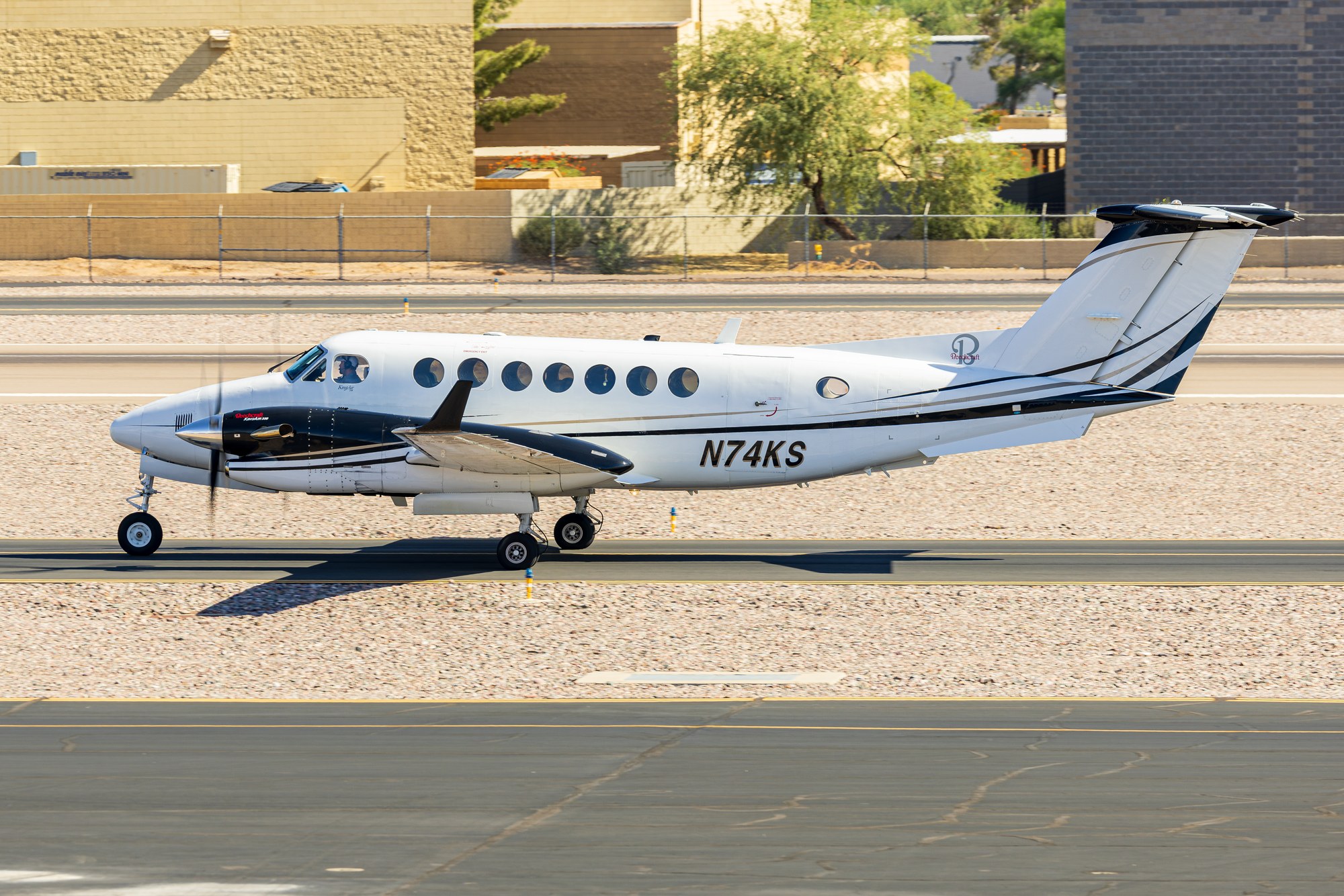
You can see it in one of the frames on this page. The King Air taxiing past has a wall and a chain-link fence behind it that are visibly wobbling, and that was the eighth of October, when the average high is 87F. In July it would have been unusable.
The season, and what fills it
From November to March the highs sit between 65F and 76F, which is shirt weather with a jumper for the evening. That is also when the town is full, which is the same reason the aeroplanes are here. Two events in particular put an extraordinary number of business jets on this one runway.
Barrett-Jackson, the collector car auction, is held at WestWorld of Scottsdale a few minutes from the airport. In 2022 the city recorded 2,042 IFR movements during its week. The 2027 sale runs from 23 to 31 January, which is the nine day format the auction has used for several years now.
The WM Phoenix Open at TPC Scottsdale is the other. The same figures give it 1,831 IFR movements. In 2027 it runs from 11 to 14 February.
To put those numbers in proportion, the city gives a typical peak season week as around 1,094 IFR movements. So both of those events roughly double the airport’s busiest normal week, and they fall six days apart in the calendar.
Those figures are from 2022 and I have not found newer ones, so I am quoting them as history rather than as a forecast. But the shape of the thing is not going to have changed: if you want to see the maximum number of business jets Scottsdale can hold, go in late January or the second week of February, and book somewhere to stay a long way in advance.
Light, and a thing about Arizona clocks
The deck faces southeast, so it is an afternoon position, and that is unusual enough to build a day around. At most airports in this archive the advice is be there at dawn. Here it is have a lie in.
Arizona does not observe daylight saving. The state stays on Mountain Standard Time all year, so from March to November it is an hour behind California rather than level with it, and every time you look up a flight arrival you need to be sure which clock you are reading. It also means the sun sits in a different place at a given clock time from what you would expect anywhere else in the west.
| Date | Sunrise | Sunset | Solar noon |
|---|---|---|---|
| 15 January | 07:32 | 17:42 | 12:36 |
| 15 March | 06:38 | 18:35 | 12:36 |
| 15 June | 05:17 | 19:39 | 12:28 |
| 15 October | 06:32 | 17:53 | 12:13 |
| 15 December | 07:25 | 17:20 | 12:22 |
In the good season the sun goes down between half five and six, so you get a proper golden hour at a civilised time and you can be at dinner by seven. In January sunrise is not until half past seven, which is the latest of any airport on this site and another reason the morning is not the point here.
What I got wrong, so you do not have to
I shot this set between about midday and twenty past one local. Solar noon that day was 12:15. In other words I photographed an entire session with the sun almost directly overhead, which is the worst light of the day anywhere on earth.
The pictures came out because business jets are small, close and mostly white, and because the deck puts you above them rather than squinting up from below. But the mountain backdrops would have been better two hours later, when the ranges get their modelling and stop looking flat. If I go again I will arrive at three.
What lens you actually need
More than at either of the Californian airports on this site, and the reason is simple arithmetic: the aeroplanes are smaller.
| Range | Frames | Share |
|---|---|---|
| 100 to 199mm | 9 | 21% |
| 200 to 299mm | 17 | 40% |
| 300 to 399mm | 6 | 14% |
| 400 to 499mm | 7 | 16% |
| 500mm | 4 | 9% |
The median was 270mm. A quarter of the set is at 400mm or beyond. The widest frame is 118mm and the longest is 500mm, so the whole range of a 100-500 earned its place in eighty minutes.
Nine frames out of forty three came in at or under 200mm, which is 21 per cent. Thirty eight of the forty three, or 88 per cent, are at or under 400mm. So a 100-400mm lens would have taken the great majority and you would have missed four departures and a turboprop.
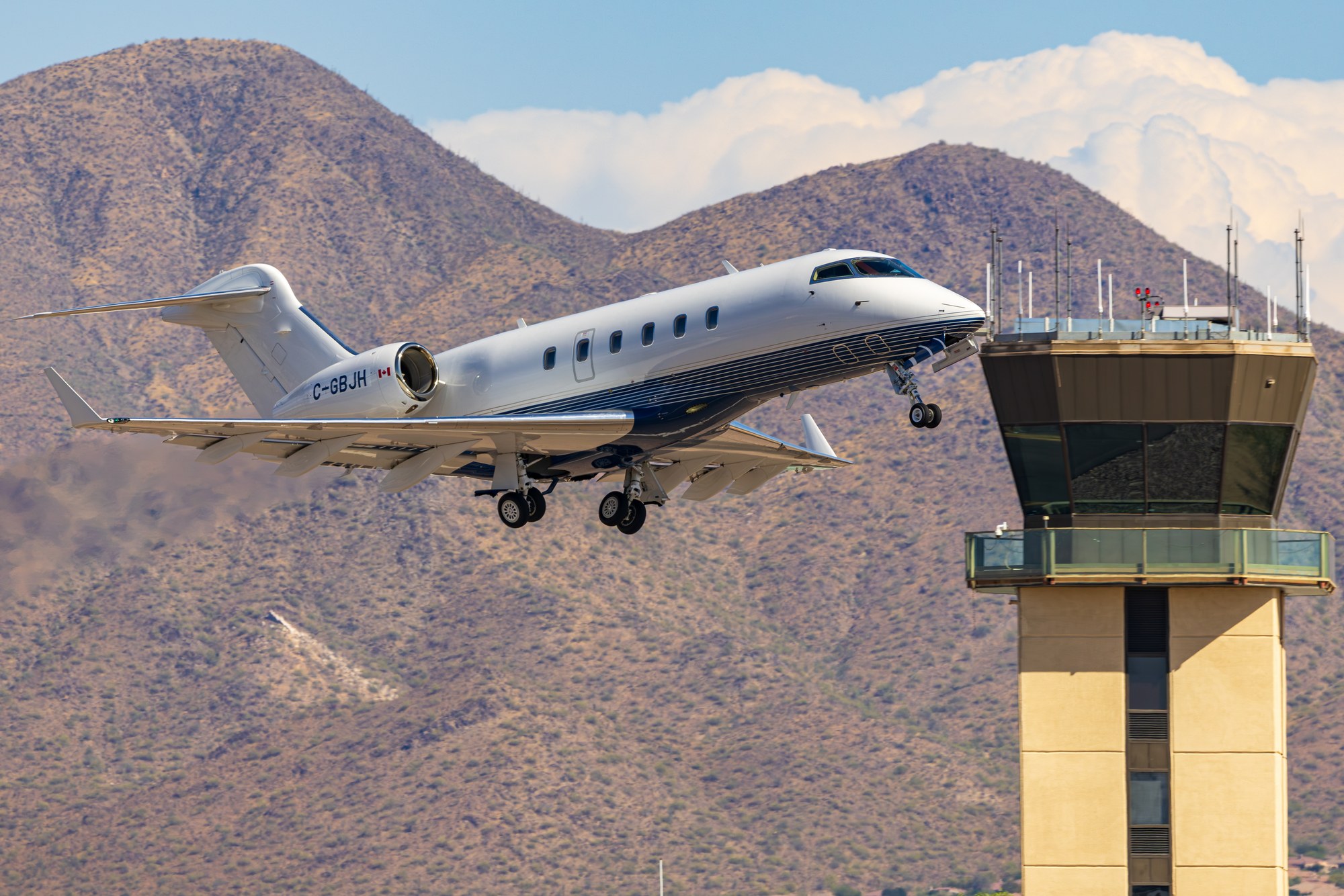
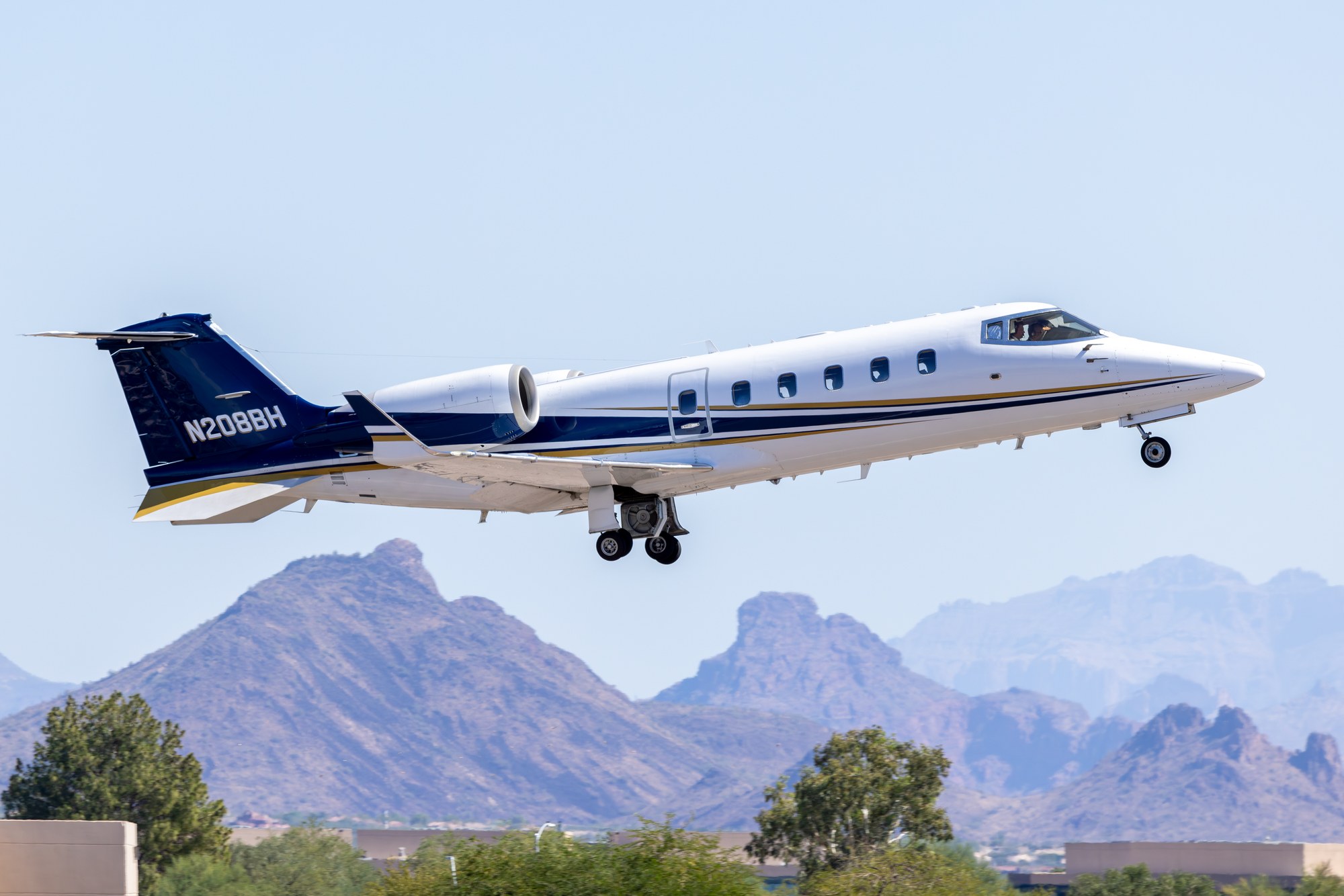
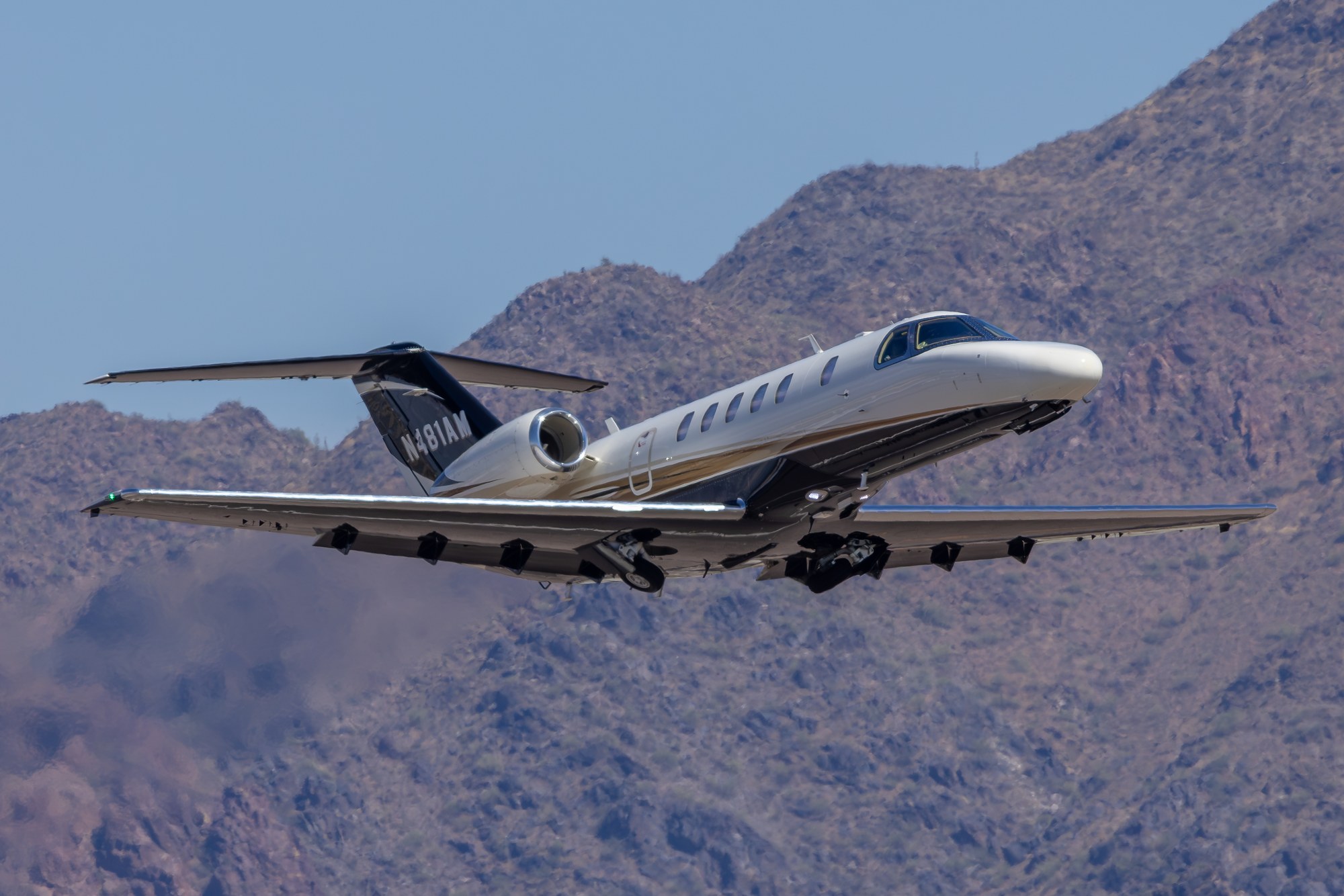
The four 500mm frames are all aircraft climbing away against the mountains, which is the shot this airport gives you that nowhere else on this site does. If you want that picture, you want 500mm. If you are happy with taxiing shots and ramp work, 400mm is plenty and 300mm covers most of it.
Three airports, one camera, one lens
These three sets were shot on the same Canon body with the same zoom, two of them in the same week in March and this one in October. Putting them next to each other says something a single visit cannot.
| Scottsdale | San Diego | Palm Springs | |
|---|---|---|---|
| Frames | 43 | 30 | 49 |
| Median focal length | 270mm | 254mm | 186mm |
| Longest frame | 500mm | 363mm | 500mm |
| At or under 200mm | 21% | 17% | 59% |
| What flies there | Business jets | Airliners | Airliners |
The pattern is the subject, not the airport. Palm Springs has the shortest median because a 737 is enormous and the positions are close. Scottsdale has the longest because a Citation is a third the length of a 737 and sits no nearer. Aircraft size drives focal length far harder than anything else, which is worth remembering the next time somebody tells you that you need 600mm for aviation. Our guide to the best lenses for aviation photography goes through the options, and the Canon RF 100-500mm took every frame in all three sets.
What you will see
Eighty minutes on the deck on an ordinary Sunday in October, and this is what came past.
Cessna Citations, constantly. They turned up in several sizes across the afternoon, from the small straight-wing ones to the larger swept-wing types, and they were the type I photographed most often.
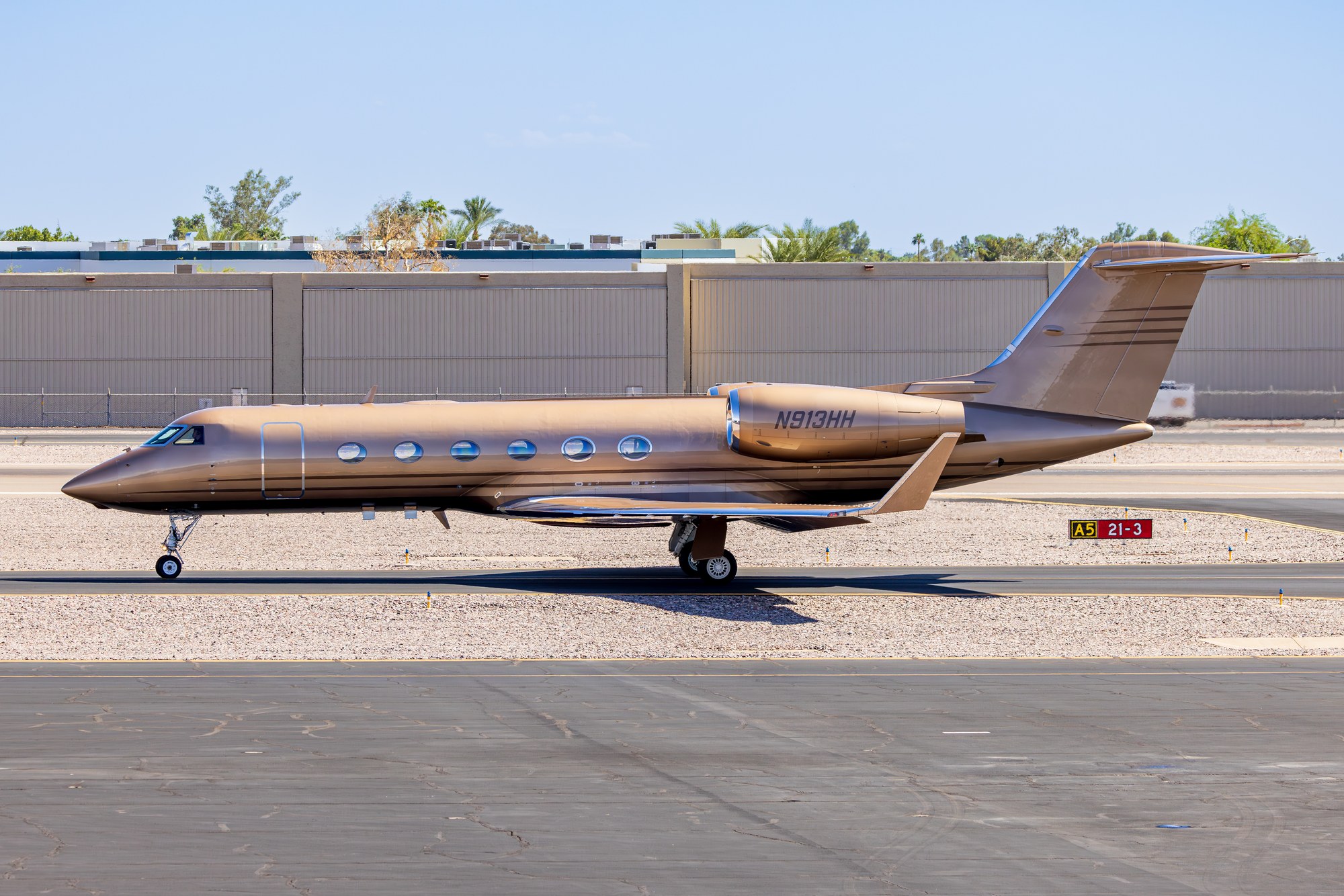
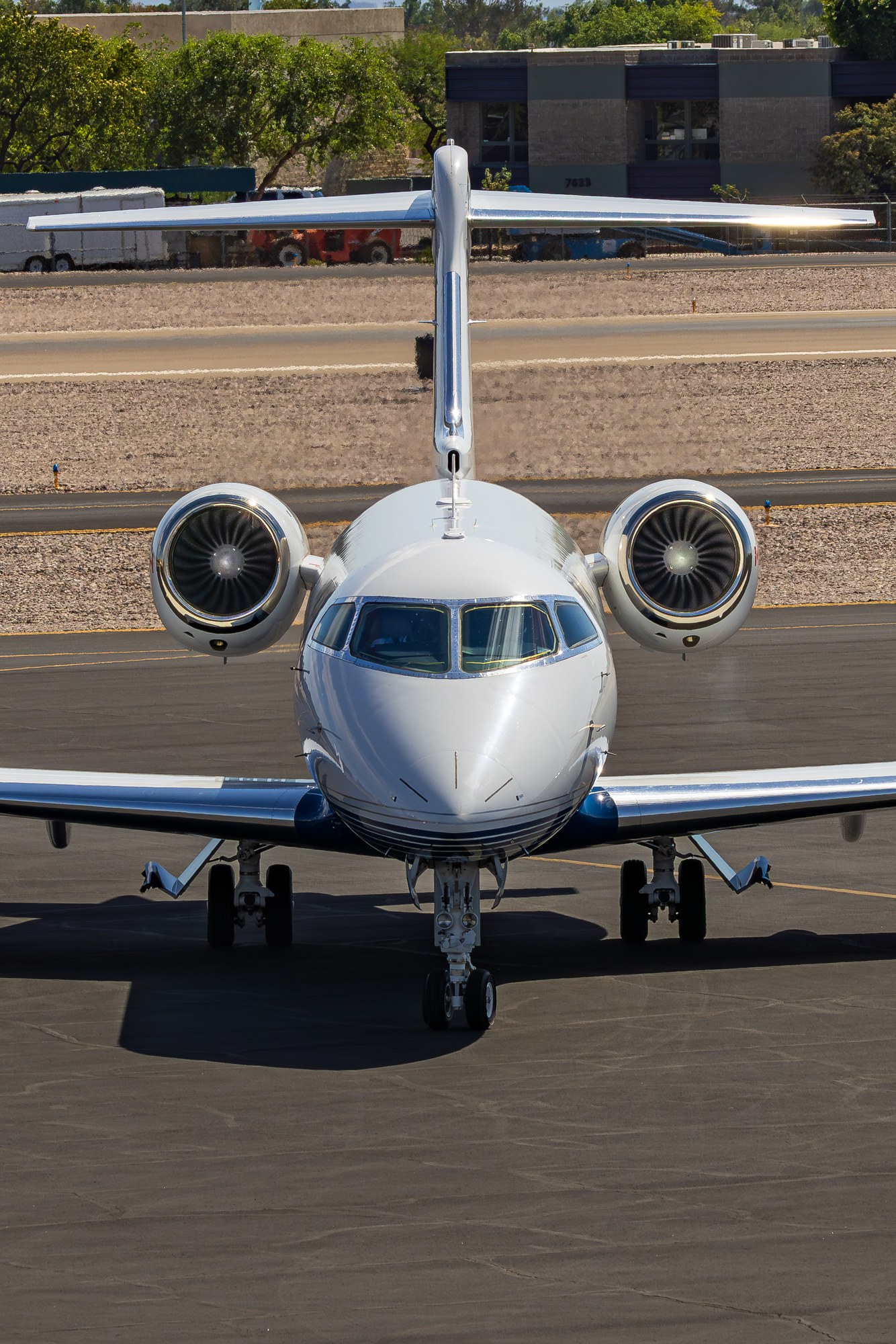
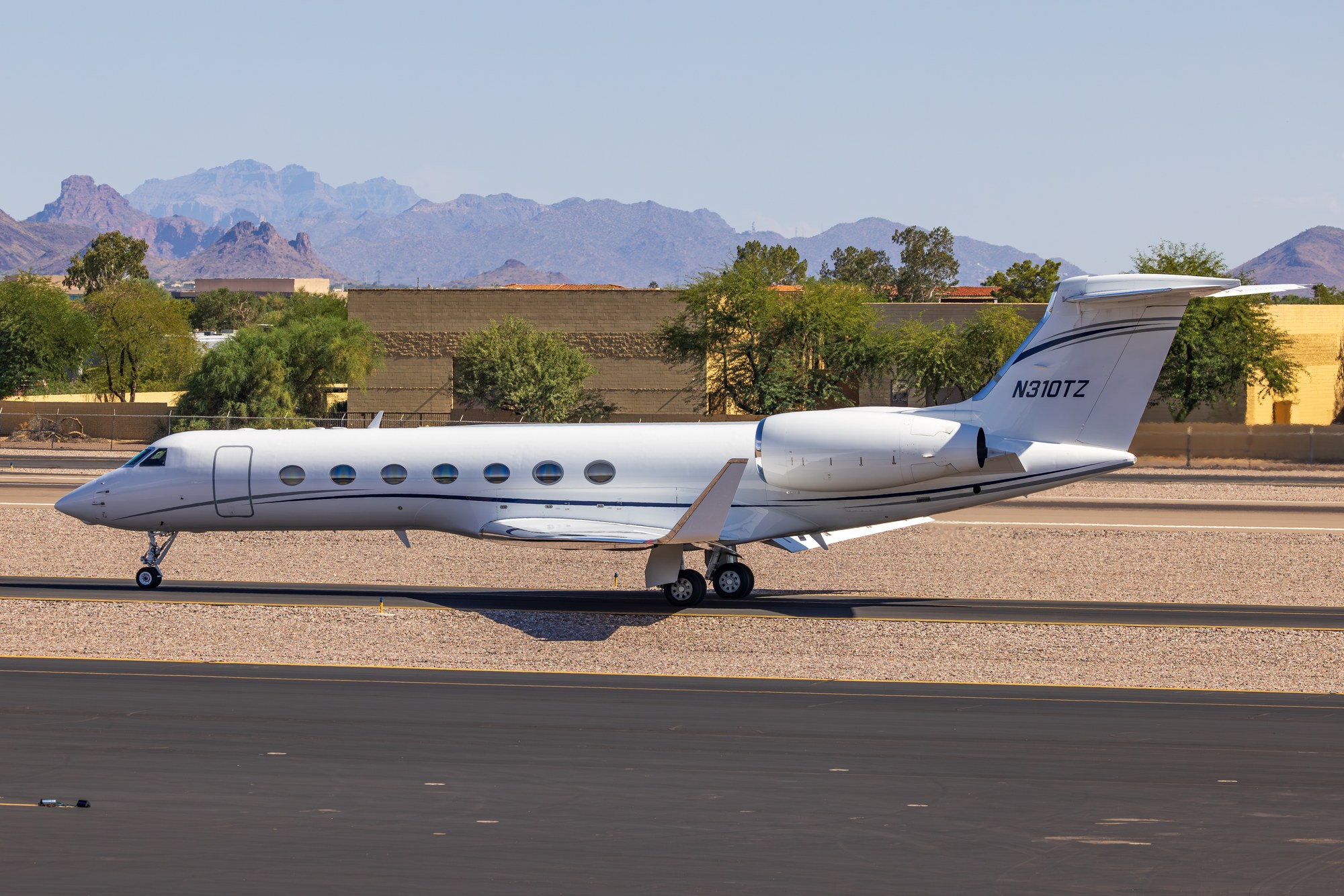
Gulfstreams. Several, including one in a bronze metallic scheme that I have not seen anywhere else, and a big one taxiing out with three ranges of Arizona stacked up behind it.
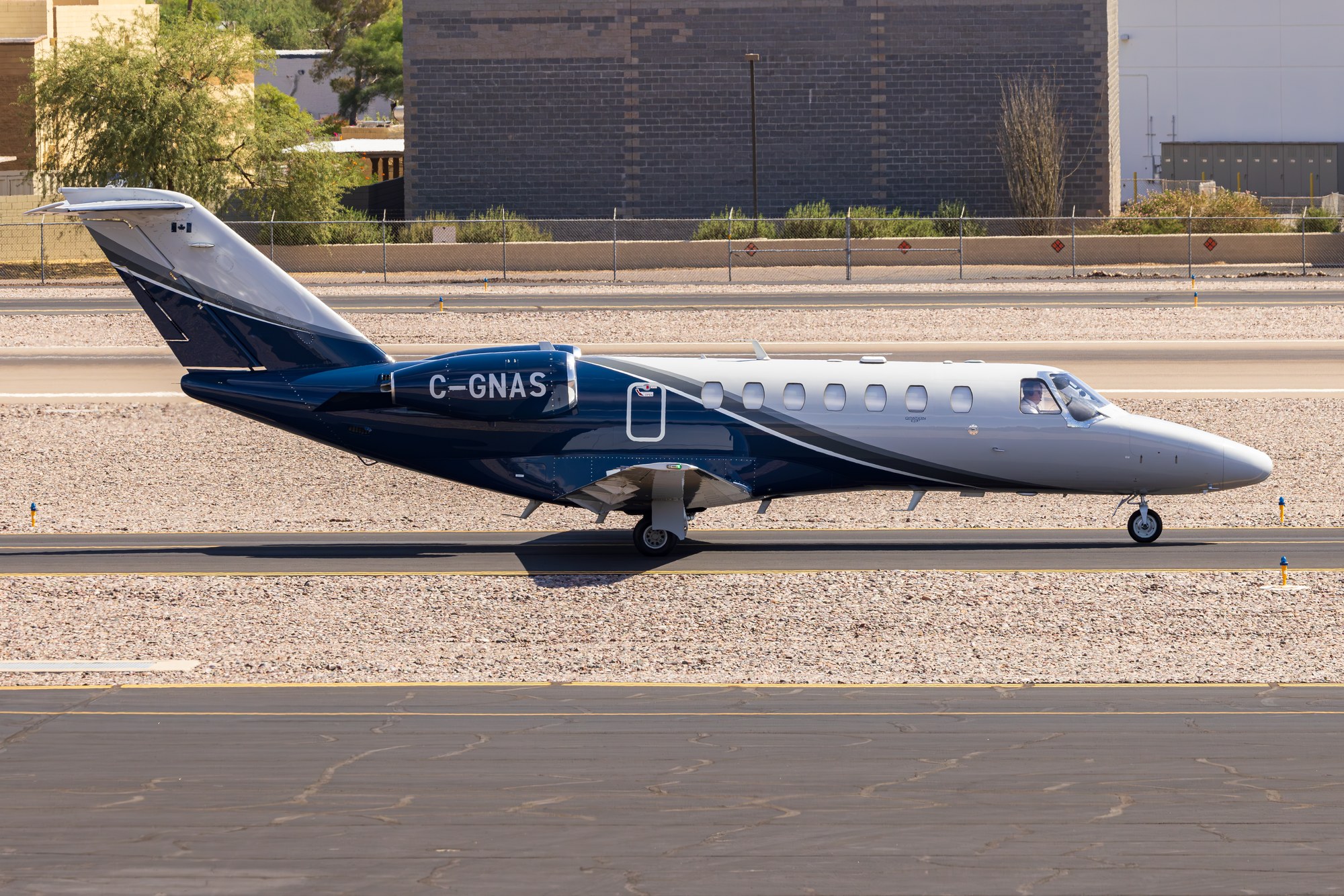
Bombardier Challengers and Learjets. The Challenger that got airborne past the control tower is the best frame of the day and it happens to be Canadian registered.
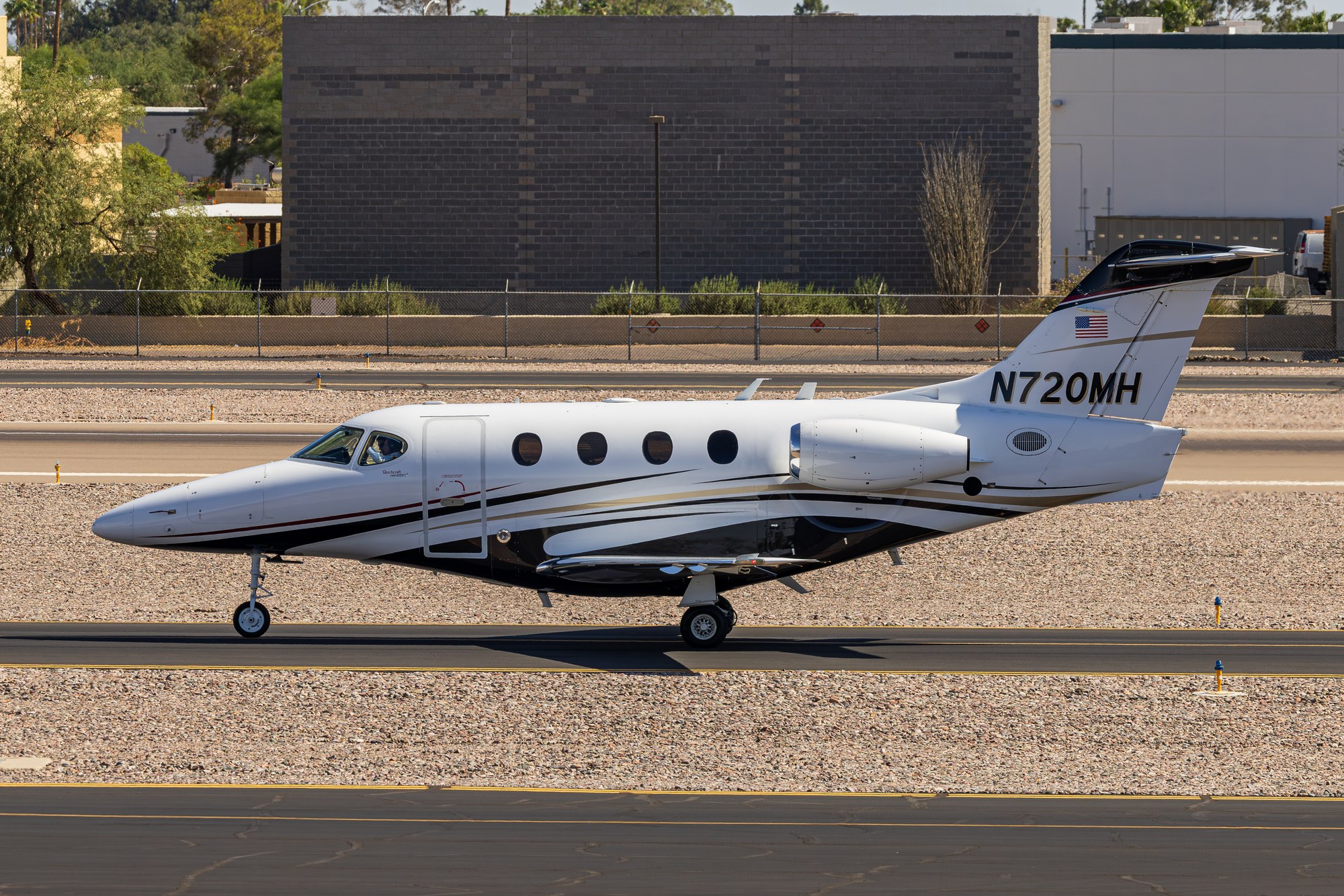
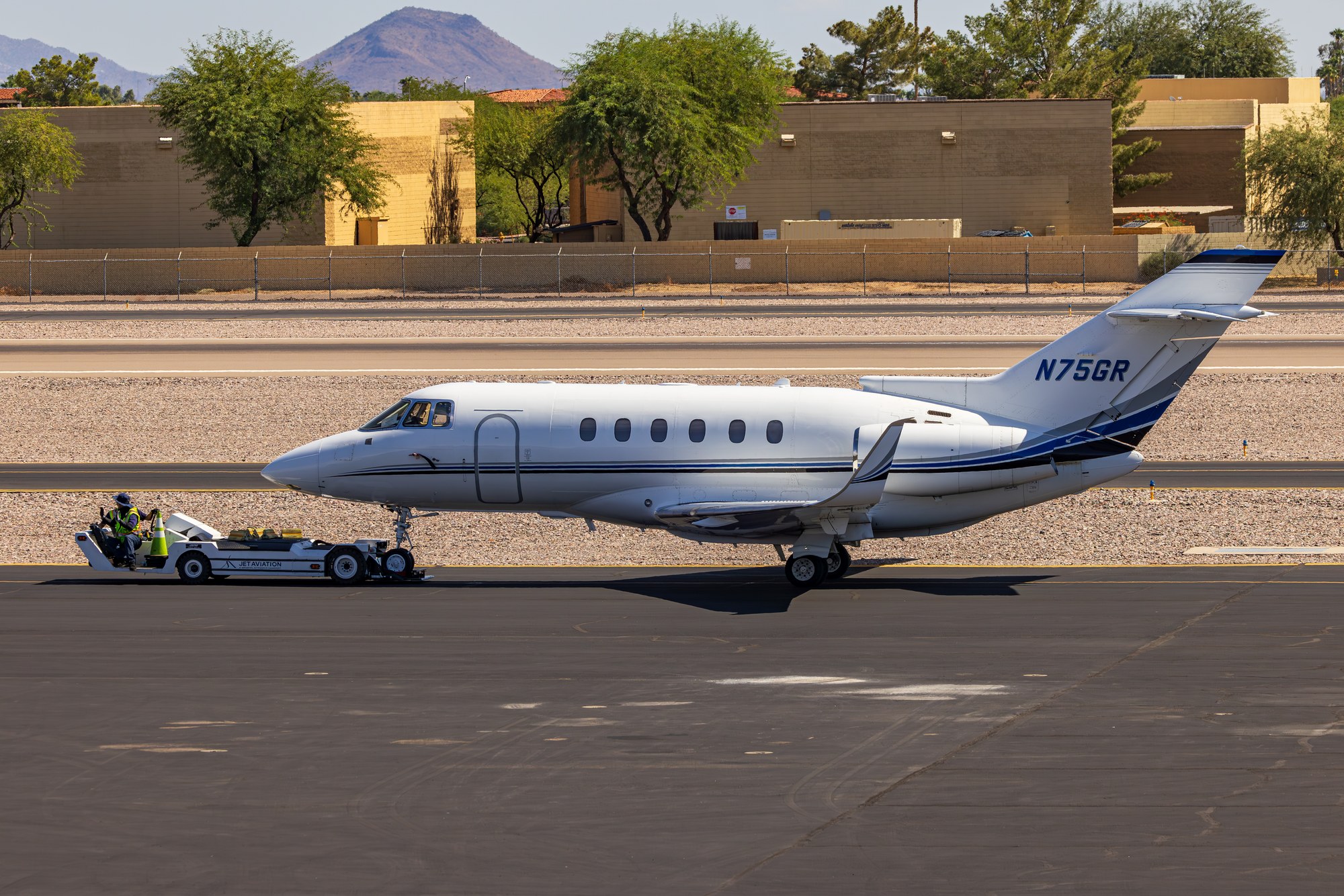
Hawkers, Embraers, Beechcraft. Including a Premier, which is a small composite twinjet you do not see often, and a Hawker being towed across the apron by a Jet Aviation tug.
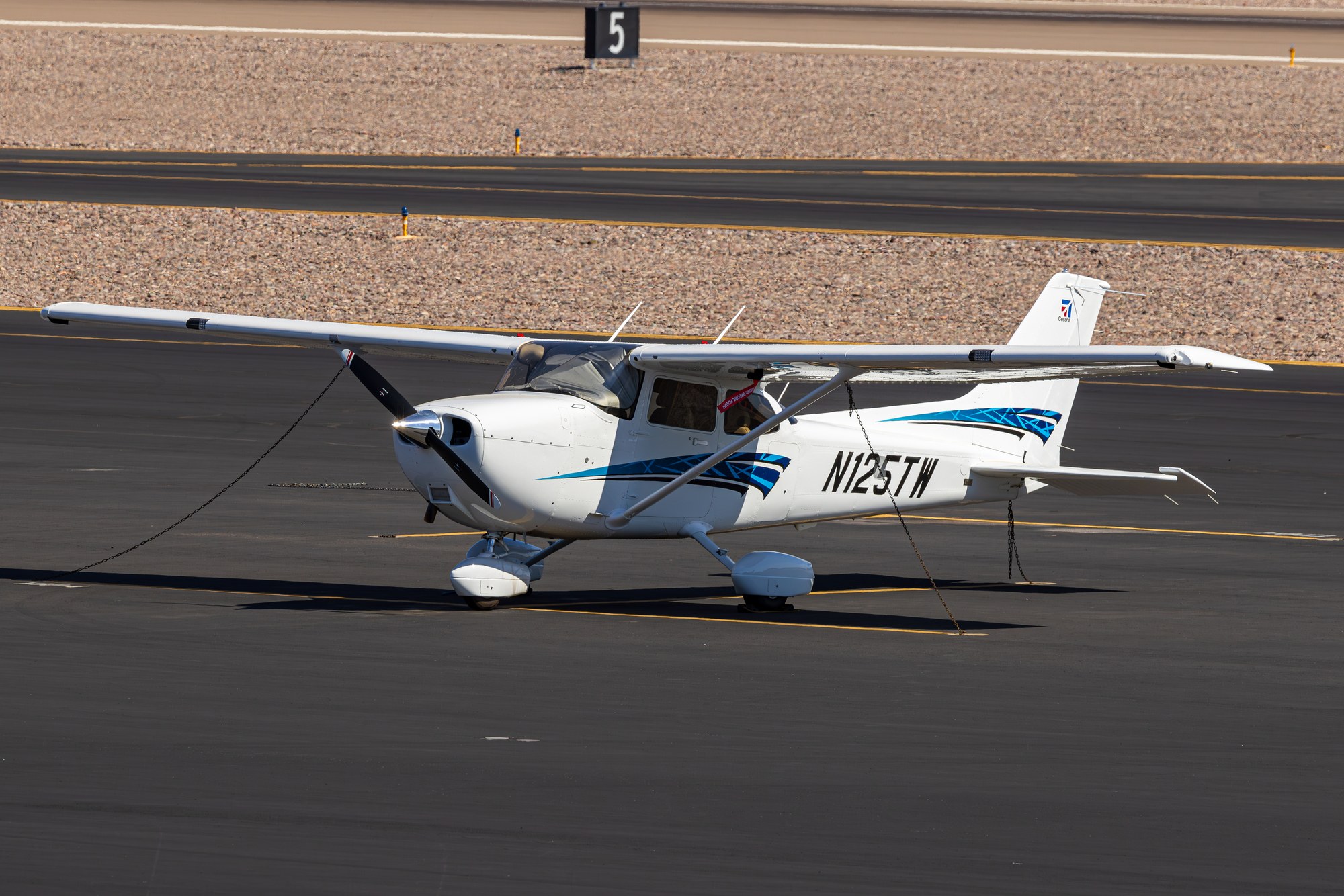
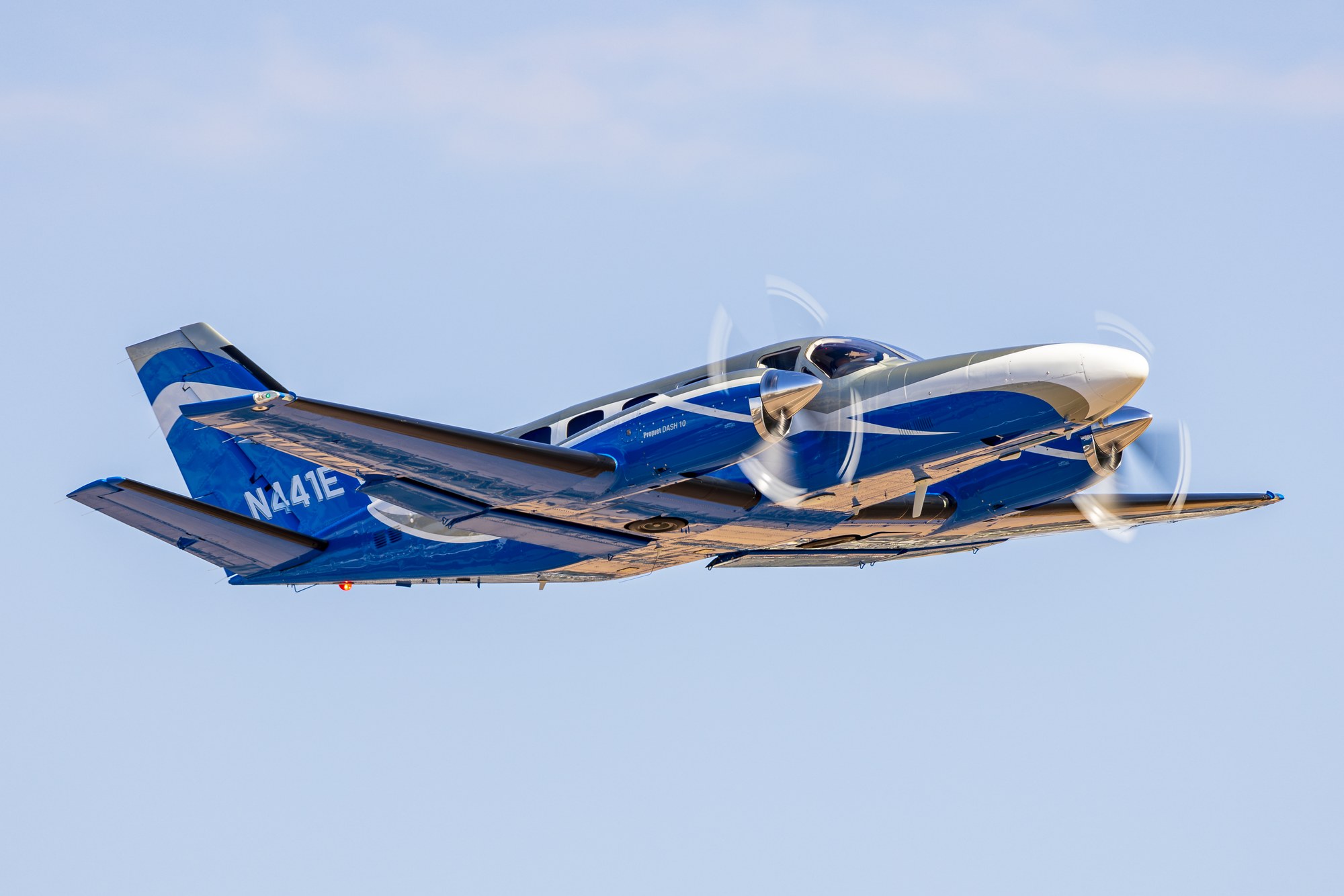
Turboprops and light aircraft. King Airs working, a twin turboprop conversion with Propjet Dash 10 painted on the nacelle, and a Cessna 172 chained down on the ramp between two jets, which is a photograph about this airport in one frame.
Canada and Mexico. Two Canadian registrations in eighty minutes, which is a much higher rate than you would get at a British airfield and matches what the published guides say about the traffic here in the cool months.
What you will not see is an airliner, unless JSX counts, and it did not exist here when I visited. No cargo either. This is an airport for a very particular kind of aeroplane and it does that one thing at volume.
Camera settings
Scottsdale asks a bit more of you than an airliner airport does, because half the traffic has propellers on it and the other half is small and quick.
Shutter speed
1/2000 for jets, which is where 38 of my 43 frames sit. A Citation rotating is moving across you faster in angular terms than a 737 on approach, because it is closer and lighter and it goes up like a lift.
Then drop hard for anything with a propeller. Three of my frames are slower, and all three are propeller aircraft: 1/250 for the twin turboprop climbing out, 1/200 for the King Air taxiing. At 1/2000 a King Air has four stopped blades and looks like a model on a shelf. At 1/200 the discs are full and it looks like an aeroplane. That is not a preference, it is the difference between a photograph and a mistake. Our guide to propeller blur shutter speeds has the numbers for each type.
The practical problem is that at this airport the two arrive in any order. A Gulfstream, a Citation, then a King Air, then another jet. You will be changing shutter speed all afternoon and you will miss one because you forgot. Everybody does.
Aperture
Mine came out at f/8 on 17 frames, f/6.3 on 11 and f/7.1 on 11. That is a middling aperture rather than wide open, and it was the right call here: the backgrounds are close, detailed and worth keeping, whether that is the control tower, the perimeter wall or a hillside a mile off.
Compare that with Palm Springs, where I shot the same lens wide open almost throughout because the background was open sky and a mountain two miles away. Same kit, opposite decision, and the deciding factor was what sat behind the aeroplane.
Four frames at the very start of the session are at f/14, with the ISO climbing to 1250 to pay for it. I do not have a good explanation for those and I am not going to invent one. They are the first four frames on the card and by the fifth I was at f/8.
ISO
100 to 1250 across the set, mostly between 250 and 500. Arizona light in October is strong but the deck puts you shooting into the southeast, so it is not as generous as the raw sunshine suggests. Auto ISO with a floor and a fast shutter is the sensible arrangement.
Autofocus
Servo with aircraft subject detection. Two things to watch here that you do not get at an airliner airport. Small aircraft against a busy mountainside give autofocus much more to argue with than a 737 against blue sky, so expect the occasional frame where the camera has chosen a rock. And a taxiing aircraft crossing behind a fence or a wall will pull focus onto the foreground if you let it.
Exposure
White jets on pale concrete in strong desert light will fool a meter into underexposing, and the backgrounds here are pale too, so there is not much to anchor it. Watch the highlight warning on the fuselage top, not the sky. When something dark taxis past, and there are plenty of dark liveries at this airport, be ready to go the other way by a stop.
Practical notes
Go in the cool half of the year. November to March. This is the least negotiable advice on this page.
Take water anyway. Even in the good months an afternoon on an exposed deck in the desert will get through more than you expect.
Bring 500mm if you want the mountain departures. 400mm covers most of the day and misses the best of it.
Remember Arizona ignores daylight saving. For half the year it is an hour behind California and level with the Pacific coast for the other half. Check what your phone is telling you.
A car helps but is not essential. Everything is walkable from the terminal if you stay in the Airpark, and the deck alone will fill an afternoon.
You do not need a step or a ladder anywhere. That is worth saying because at most American airports you do.
Getting there and staying
Scottsdale sits in the northeast corner of the Phoenix metropolitan area. Phoenix Sky Harbor is about half an hour away and is where you will fly in, and there are hotels within walking distance of the airport in the Scottsdale Airpark, the business district built around the field. The airport’s own page calls it a 2,600 acre area, home to more than 2,500 businesses and 48,000 employees, and the third largest employment centre in the Greater Phoenix region. The city’s economic development arm gives a larger footprint of 8.6 square miles and higher business and employee counts, so take the exact size loosely. For a visiting photographer that translates as plenty of hotels, plenty of places to eat and a short walk to the deck.
If you are building a wider trip, Palm Springs is about four hours west by road and San Diego five and a half. All three appear on this site because they were shot in the same year with the same camera, and between them they cover desert airliners, city airliners and business jets without much repetition.
Is it worth the trip?
If business aviation bores you, no. There is one runway, no airliners, no variety of the kind an enthusiast counts, and you can see the whole operation in an afternoon.
If it does not bore you, this is one of the most comfortable and productive airports I have photographed anywhere. A free public deck with an unobstructed view, no fence, no ladder, no argument, a restaurant behind you, mountains behind the aeroplanes, and a movement every few minutes for as long as you want to stand there. In eighty minutes I came away with forty three frames I was happy to keep, which is a better rate than I have managed at airports with ten times the traffic.
The honest way to put it is that Scottsdale is not a destination, it is a very good afternoon. Fly into Phoenix for something else, or come through on a wider western trip, and give it from three o’clock until the sun goes. Go in February and you will see more business jets in a day than most British photographers see in a year.
Every photograph on this page comes from the Piemags aviation archive. You can browse the aviation archive to licence images for personal, editorial or commercial use, on the terms set out in our licence terms. For the airliner end of American spotting, our guides to San Diego and Palm Springs cover very different airports the same way, and our guide to photographing static aircraft is the one for the ramp work.
Questions people ask
Is Scottsdale a good airport for plane spotting?
Yes, and it is the easiest one in this archive to actually use. There is a free public viewing deck on the first floor of the terminal at 15000 North Airport Drive, with unobstructed views of the ramp and runway, free parking and a restaurant behind you. No fence to shoot through and nothing to stand on. The airport recorded 164,624 takeoffs and landings during 2025, almost all of them business aircraft.
Does Scottsdale Airport have a viewing area?
Yes. There is an outdoor public viewing deck on the first floor of the terminal building at the end of Butherus Drive, shared with the Volanti restaurant. Parking is free and the view over the ramp and runway is unobstructed. It faces roughly southeast, which makes it an afternoon position rather than a morning one, and that is unusual among American airports.
What lens do you need at Scottsdale airport?
More than at an airliner airport. Across 43 frames shot there on full frame the median focal length was 270mm, a quarter of the set was at 400mm or beyond, and four frames needed the full 500mm. Only 21 per cent came in at or under 200mm. Business jets are roughly a third the length of a 737 and sit no closer, so they need considerably more reach. A 100-400mm covers 88 per cent of it.
When is the best time of year to photograph Scottsdale airport?
November to March, and it is not a close call. Scottsdale averages 92 days a year at or above 100F and eleven at or above 110F. July averages 104F and 26 days at or above 100F. Beyond the personal discomfort, hot ground makes the air above it shimmer and a long lens magnifies that as efficiently as it magnifies an aeroplane. From November to March the average high sits between 65F and 76F.
What time of day is best at Scottsdale?
Afternoon. The viewing deck faces roughly southeast, so it works better as the sun comes round, which is the opposite of most airports. I shot my own set between midday and about twenty past one local, with solar noon at 12:15, and the overhead light is the one thing I would change. Arriving at three would have given the mountain backdrops far better modelling.
Which runway does Scottsdale use?
There is only one, 3/21, running northeast to southwest and 8,249 feet long. Runway 3 is the designated calm wind runway and the preferred one for noise abatement, so in still air aircraft depart towards the northeast. Westerly winds put the airport onto runway 21. The city publishes the policy but not the statistics, so no percentage split is quoted here. Circuits are left hand on runway 3 and right hand on runway 21.
Does Scottsdale Airport have a curfew?
Not an enforceable one. There is a voluntary curfew between 10pm and 6am, but under its federal grant obligations the airport must be available for public use 24 hours a day, so it is a request rather than a rule. A voluntary curfew letter is only sent to an operator after a noise complaint. Touch and go landings are prohibited from 9:30pm to 6am and engine run-ups from 10pm to 7am. The control tower works 6am to 9pm.
What aircraft can you see at Scottsdale?
Business aircraft, almost exclusively. Cessna Citations in every size dominate, then Gulfstreams, Bombardier Challengers, Learjets, Hawkers, Embraer and Beechcraft light jets, and King Air turboprops. There are flying schools too, so light singles share the runway. Canadian and Mexican registrations are common in the cool months. There are no airliners and no cargo.
Do airlines fly to Scottsdale Airport?
Not in the ordinary sense. JSX moved its Arizona operation from Phoenix Sky Harbor to Scottsdale in January 2024 and flies 30-seat Embraer regional jets to Los Angeles, Burbank, Las Vegas, Denver, Oakland and others. It is worth being precise: JSX is a public charter operation running under Part 135 rules through a Department of Transportation provision, not a certificated scheduled airline. For scheduled airline service you want Phoenix Sky Harbor.
When is Scottsdale airport busiest with private jets?
Late January and the second week of February. Barrett-Jackson, the collector car auction at WestWorld of Scottsdale, generated 2,042 IFR movements in its week in 2022, and the WM Phoenix Open at TPC Scottsdale generated 1,831. A typical peak season week is around 1,094, so each of those roughly doubles it. In 2027 Barrett-Jackson runs 23 to 31 January and the WM Phoenix Open 11 to 14 February.
What settings should you use at Scottsdale?
1/2000 for jets, which is where 38 of my 43 frames sit, and drop to around 1/250 or 1/200 for anything with a propeller or the blades stop dead. Aperture in the middle rather than wide open, f/6.3 to f/8, because the backgrounds here are close and detailed and worth keeping. ISO between 250 and 500. Servo autofocus with subject detection, and expect the occasional frame where the camera has focused on a mountain instead of a Citation.
How does Scottsdale compare with Palm Springs and San Diego?
All three were shot with the same camera and lens, which makes the comparison fair. Scottsdale needs the most lens, median 270mm, because business jets are small. San Diego came out at 254mm and Palm Springs at 186mm, because airliners are large. Scottsdale is the most comfortable of the three to work at, with a proper viewing deck and no fences. Palm Springs has the best light and the mountain, and San Diego has by far the most traffic and variety.
Sources and further reading
- City of Scottsdale, archived annual operational statistics, for 164,624 movements in 2025, 166,585 in 2024 and 171,675 in 2023. The airport operator’s own published figures. scottsdaleaz.gov
- City of Scottsdale, airport history, for the airport’s own description of itself as “one of the premier general aviation airports with a single runway in the country, and one of the busiest corporate jet facilities in the state”, and for the Scottsdale Airpark as the third largest employment centre in the Greater Phoenix region. scottsdaleaz.gov
- City of Scottsdale, noise abatement procedures, for the voluntary 10pm to 6am curfew, the touch and go and engine run-up restrictions, and runway 3 as the designated calm wind and preferred noise abatement runway. scottsdaleaz.gov
- City of Scottsdale, airport operations, for the control tower working 6am to 9pm daily while the airport itself remains open around the clock. scottsdaleaz.gov
- Signals AZ, carrying a City of Scottsdale release dated 2 March 2022 and citing WingX flight tracking data, for the airport being fourth in the world for business aviation departures, for 2,042 IFR movements during Barrett-Jackson and 1,831 during the WM Phoenix Open, and for a typical peak season week of about 1,094. Four years old and quoted here as a period claim rather than a current figure. signalsaz.com
- Barrett-Jackson, for the 2027 Scottsdale auction running 23 to 31 January 2027. The auction house markets nine days as new for 2027, but the 2023 to 2026 sales all ran nine days as well, so the article does not repeat that claim. barrett-jackson.com
- Experience Scottsdale, carrying the December 2023 announcement that JSX would move its Arizona operation from Phoenix Sky Harbor to Scottsdale from 10 January 2024, flying 30-seat Embraer jets. experiencescottsdale.com
- JSX, current departures from Scottsdale, used for the destination list. JSX operates as a public charter under Part 135 rather than as a certificated scheduled airline, which the text above states. jsx.com
- Arizona State Climate Office, Scottsdale normals, means and extremes, for the mean maximum temperature by month and the counts of days at or above 100F and 110F. The sheet states its data comes from NOAA Regional Climate Centers, 1991 to 2020 normals. NOAA-derived rather than NOAA-published, and labelled secondary here. globalfutures.asu.edu
- Spotter Guide, Scottsdale SCF/KSDL, page last changed May 2024, for the numbered vantage points, the terminal balcony and the terminal address at 15000 North Airport Drive. A secondary source and the one to check for current access before travelling. spotterguide.net
- Flightline Aviation Media, Phoenix area airports, dated 31 August 2024, for the first floor outdoor viewing deck at the end of Butherus Drive shared with the Volanti restaurant, the free parking, the southeast aspect and the description of the traffic as business jets from Canada and Mexico plus flying school aircraft. flightlineaviationmedia.com
- AZFamily, 17 November 2024, independently confirming the Volanti restaurant and its public deck at 15000 North Airport Drive. Local news rather than a spotting guide. azfamily.com
- Sunrise, sunset and solar noon calculated for the airport position, 33.6229N 111.9106W, in the America/Phoenix time zone, which keeps Mountain Standard Time all year.
- Focal length, aperture, shutter speed and ISO for all 43 frames read from the EXIF of the original files, Canon EOS R5 with RF 100-500mm F4.5-7.1L IS USM, 8 October 2023. Registrations read directly off the airframes and not claimed where the airframe does not show them, and aircraft types given at family level where the airframe carries no type marking.

Leave a Reply