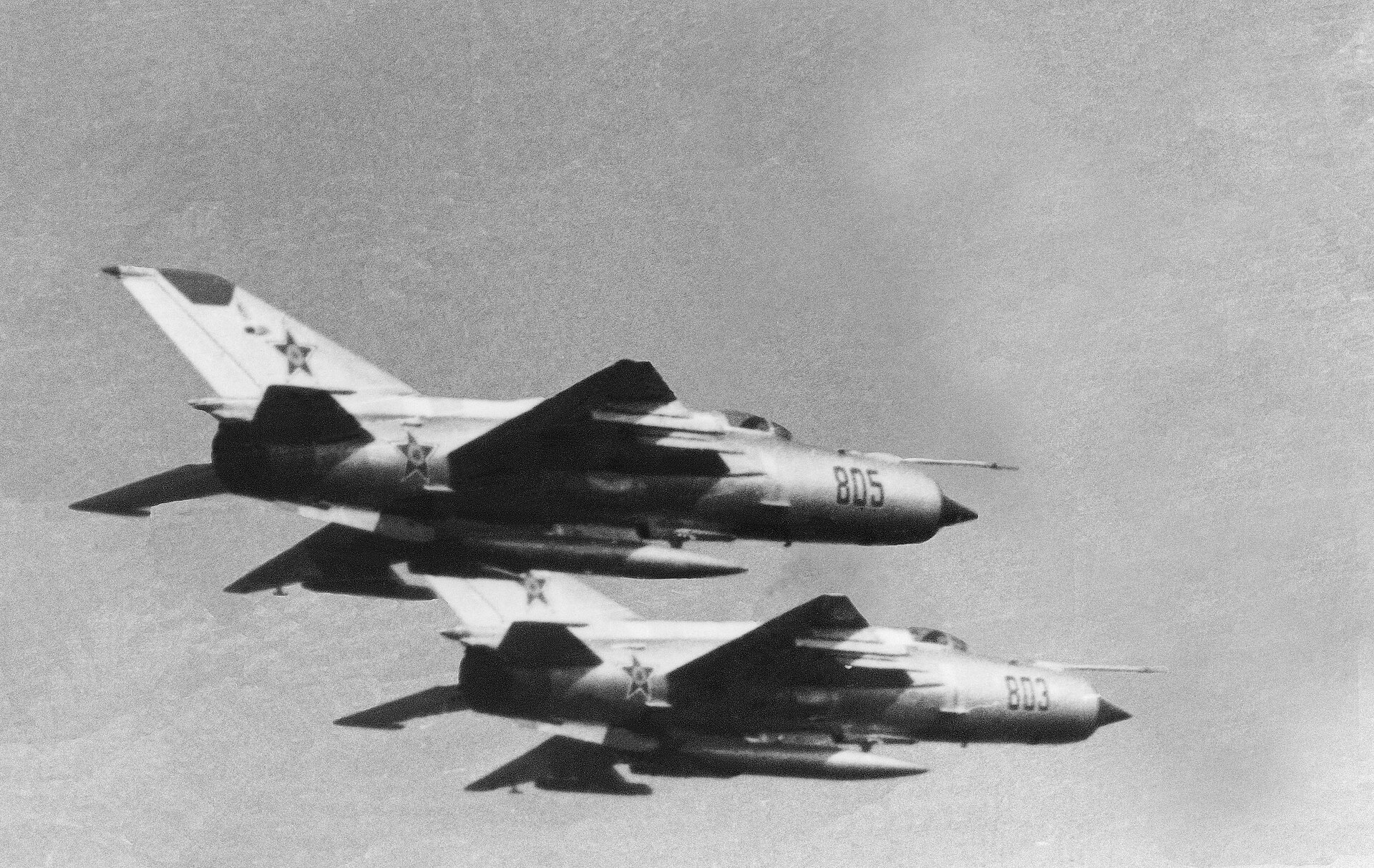
If one aircraft symbolises Soviet air power in the Cold War, it is the Mikoyan-Gurevich MiG-21. Small, fast and cheap to build, it was produced in greater numbers than any other supersonic aircraft in history and flew with around sixty air forces across four continents. It fought the American F-4 Phantom over Vietnam, the Israelis over Sinai and the Pakistanis over the plains of the Punjab, and it was still flying front line missions with some air arms seventy years after its first flight.
This guide tells the whole story of the aircraft NATO called the Fishbed: where it came from, how its designers arrived at that distinctive tailed delta shape, how it was armed, what it did in war after war, the long line of variants and foreign copies, and where the survivors are today.
Mikoyan-Gurevich MiG-21: key facts
- First flight: Ye-4 delta prototype, 16 June 1955.
- Designer: the Mikoyan-Gurevich design bureau, founded by Artem Mikoyan and Mikhail Gurevich.
- Number built: 11,496 in all, including Czechoslovak and Indian licence production, the most produced supersonic aircraft in history.
- NATO reporting name: Fishbed (trainers were called Mongol).
- Layout: single seat, single engine, tailed delta with a nose intake.
- Operators: around sixty air forces across four continents.
- Still flying: in small numbers into the 2020s; India retired its last in 2025.
What this guide covers
- Origins and development
- Design and engineering
- Flying the MiG-21
- Armament and firepower
- The MiG-21 over Vietnam
- The Middle East wars
- India and Pakistan
- The cost of ubiquity: the safety record
- A fighter for the whole world
- Variants and generations
- Keeping it competitive: the upgraded MiG-21
- Specifications and key facts
- Foreign production and the Chengdu J-7
- Where the survivors are today
- Legacy
- Frequently asked questions
Origins and development
The MiG-21 grew out of the lessons the Soviet Union drew from the Korean War, where its MiG-15 had shown the value of a small, light fighter but also the limits of one that could not catch faster enemies. The Mikoyan design bureau, founded by Artem Mikoyan and Mikhail Gurevich, set out to build a lightweight interceptor that could reach twice the speed of sound and climb quickly to meet incoming bombers, the great fear of the early Cold War.
The path to the finished aircraft ran through a series of experimental prototypes. An initial study, the Ye-1, was reworked when its engine proved underpowered, becoming the Ye-2, which first flew in February 1955 with swept wings. The bureau then tried a tailed delta wing, and it was this configuration, in the prototype known as the Ye-4, that made its maiden flight on 16 June 1955 and pointed the way ahead. Further prototypes, the Ye-5 and Ye-6, refined the engine and the airframe, and by the late 1950s the design had settled into the shape that would enter production as the MiG-21F. The aircraft made its first public appearance at the Soviet Aviation Day display at Tushino in 1956, where Western observers got their first look at the new fighter.
Production then ran for more than a quarter of a century in the Soviet Union, ending with the MiG-21bis in 1985, by which time 10,645 had been built in the Soviet Union, with Czechoslovak and Indian licence production taking the total to 11,496. That total makes the MiG-21 the most produced supersonic aircraft in history and one of the most produced jet combat aircraft ever built. It includes the aircraft assembled under licence in Czechoslovakia and India, though not the closely related Chinese copy, which pushed the number of this basic design higher still.
At the height of the Cold War the MiG-21 was everywhere in Soviet service. It equipped the fighter regiments of Frontal Aviation, tasked with air combat over the battlefield, and the interceptor squadrons of the air defence force that guarded Soviet skies against Western bombers. Thousands were on strength at once, and the type became the yardstick by which Soviet fighter strength was measured through the 1960s and into the 1970s. Its very ordinariness within the Soviet system, a fighter turned out almost like a car, was part of what made it so influential abroad.
Design and engineering
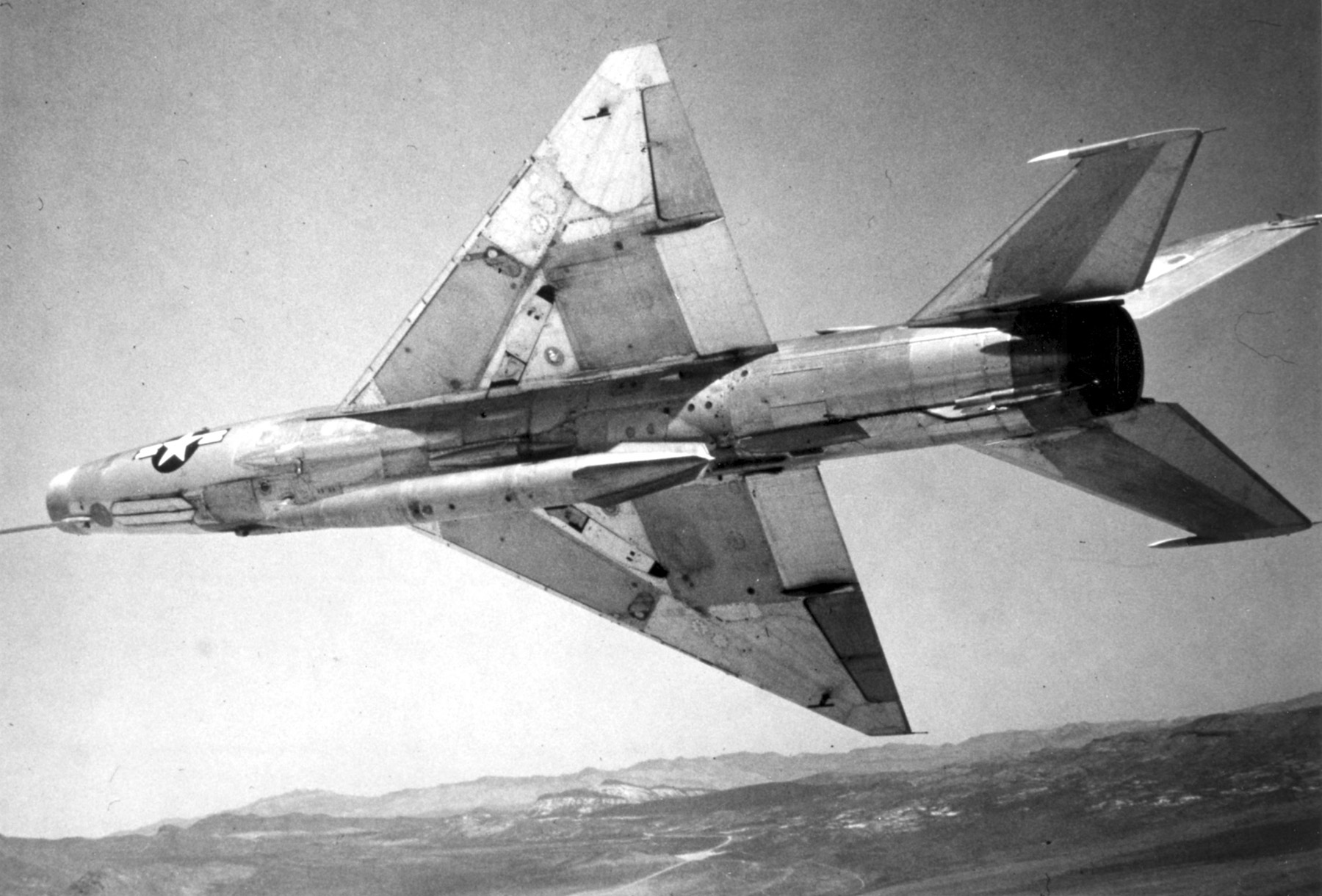
The MiG-21 was built around a simple idea: wrap the smallest possible airframe around one powerful engine and keep the weight down. The result was a tailed delta, with a sharply swept triangular wing for high speed and a conventional tailplane for control, powered by a single Tumansky turbojet with an afterburner and fed through a circular nose intake. A movable shock cone in the centre of that intake managed the airflow as speed rose towards Mach 2, and on later models it housed the ranging radar.
That relentless focus on lightness brought one famous drawback. The MiG-21 carried very little internal fuel, so its range and endurance were short. A clean aircraft had a combat radius measured in only a few hundred kilometres, and pilots learned to watch the fuel gauge as closely as the enemy. It was, in the truest sense, a point defence interceptor, designed to scramble, climb fast, make one or two firing passes and land again before the fuel ran low. Drop tanks helped, but they could not disguise the basic nature of the aircraft.
What the design gave in return was performance and simplicity. The MiG-21 was fast, it climbed hard, and it was light and responsive in a dogfight, though the delta wing bled off energy quickly in a tight turn, so a careless pilot could find himself slow and vulnerable. Just as important, it was cheap to build and easy to maintain in rough conditions, needing far less in the way of facilities and skilled technicians than a Western fighter of the same era. For the many air forces that could not afford anything more elaborate, that combination of Mach 2 speed and low cost was exactly right. Soviet pilots gave it the affectionate nickname balalaika, after the three cornered folk instrument its planform resembled.
The nose intake that fed the single engine shaped the whole front of the aircraft. Its movable centre cone slid in and out to control the airflow at different speeds, and on radar equipped versions it grew larger to house the scanner, giving the later marks their characteristic bulged nose. It was an elegant solution for its day, though it left little room for a large or powerful radar, one more consequence of building everything around the smallest possible airframe.
For all its limitations the MiG-21 was tough and practical. It was built to operate from rough, semi prepared airfields, to be turned around quickly by conscript ground crews, and to survive the hard use of front line service far from well equipped bases. That ruggedness, as much as its speed, is why it appealed to air forces operating in difficult conditions with limited resources, and why so many examples kept flying long after more delicate and demanding designs would have been grounded. In an aircraft meant to be built and used in enormous numbers, that plain durability mattered as much as any headline figure.
Flying the MiG-21
To the pilots who flew it, the MiG-21 was fast, agile and unforgiving. It was light on the controls and could out turn many heavier Western fighters for a moment, but the delta wing paid for that agility by bleeding off speed quickly, so a pilot who hauled it into a hard turn could find himself slow and short of energy, the worst place to be in a dogfight. Knowing when to turn and when to keep the speed up was the key to fighting well in it.
The cockpit was cramped and the view, especially to the rear, was poor, a common failing of the era but a real handicap against opponents who saw first. The instruments were basic, the radar on early models was short ranged and easily cluttered, and much depended on the ground controllers who vectored the fighter towards its target. Soviet doctrine treated the MiG-21 less as an independent hunter than as a fast missile carrier to be aimed from the ground, and air forces that flew it that way could be very effective with it. Where pilots were given more freedom and better training, as in the West, the same aircraft was often outfought, not because it was a poor design but because it was being asked to fight in a way that did not suit it.
It was also a demanding aircraft to operate safely. The landing speed was high, the fuel margins were thin, and a pilot who mishandled an engine problem or let the tanks run too low had few options. For all that, generations of pilots around the world learned to fly and fight in the MiG-21, and many remember it with real affection as a genuine hot rod of a fighter.
Armament and firepower
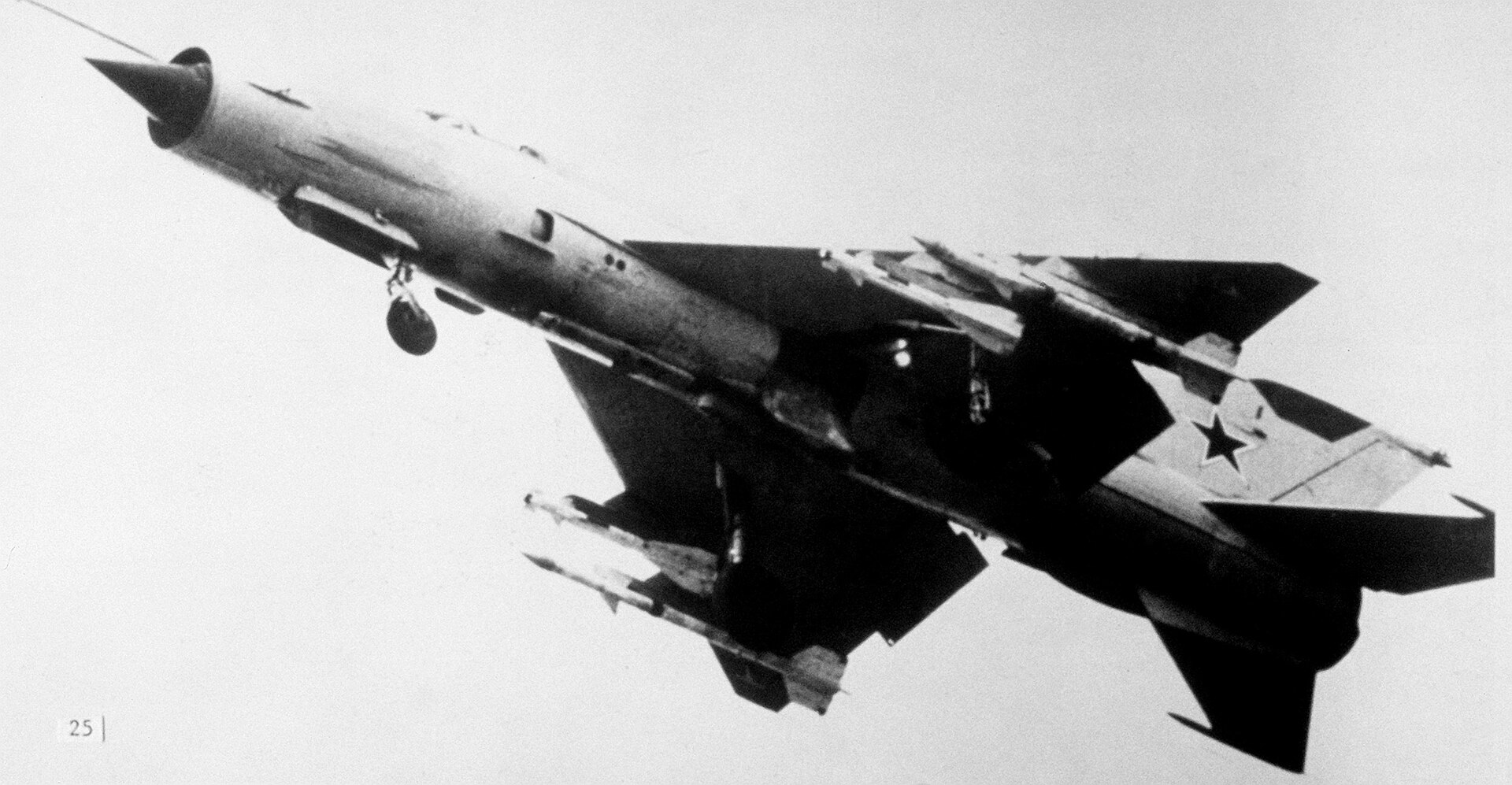
The MiG-21’s armament followed the same lean philosophy as the rest of the aircraft. The early models relied mainly on a pair of short range infrared guided missiles, the K-13, which Western intelligence knew as the Atoll. The K-13 was itself a close copy of the American AIM-9 Sidewinder, reverse engineered after one lodged in a Chinese MiG without exploding during the crises over the Taiwan Strait, and it gave the MiG-21 a modern heat seeking weapon at a stroke.
Guns were a more troubled story. Confident that missiles were the future, the Soviets deleted the built in cannon from some early variants, only for combat to prove that a fighter still needed a gun for close in fighting and for the moments when missiles missed or would not lock. Later versions restored an internal cannon, most carrying a twin barrelled 23mm GSh-23, and could also carry rockets and bombs on underwing pylons for ground attack. The lesson, learned the hard way and shared with Western air forces at the same time, was that the dogfight had not gone away, and that a supersonic interceptor still had to be able to fight up close.
The MiG-21 over Vietnam
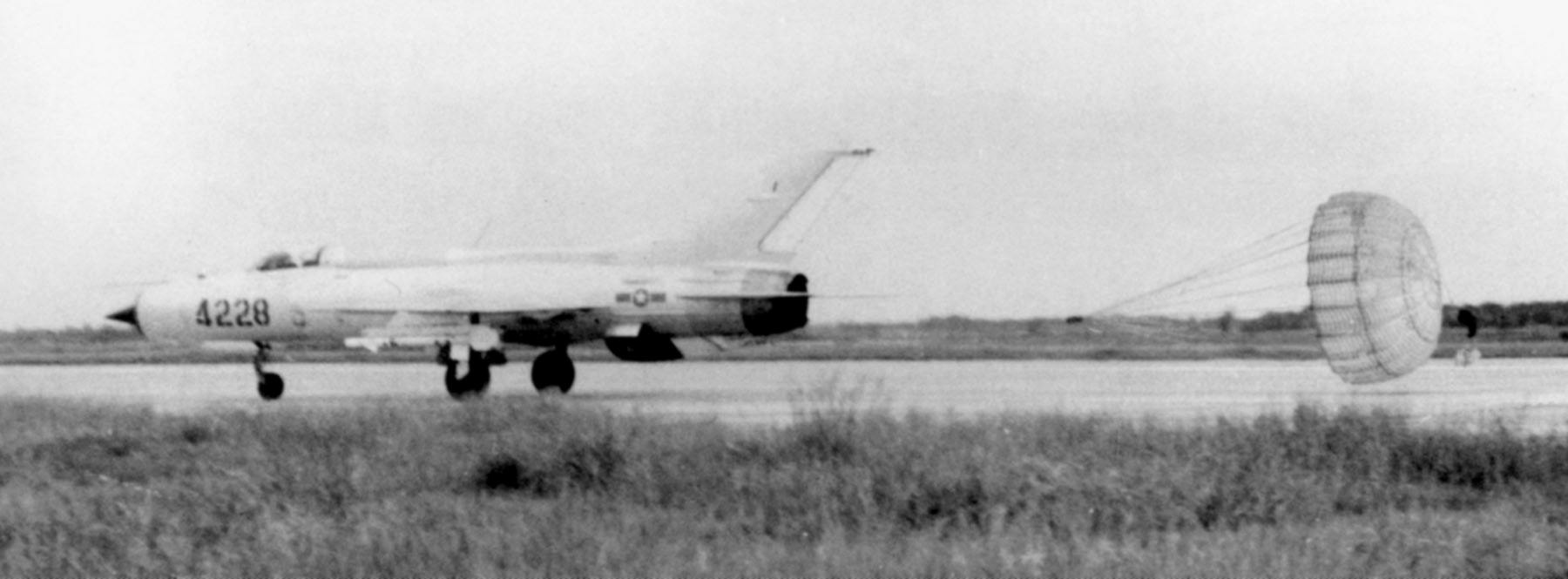
The MiG-21 first drew wide attention over Vietnam, where it flew with the North Vietnamese air force from the mid 1960s. It was never used as a Western fighter would have been. Instead, small numbers of MiG-21s were controlled tightly from the ground, vectored into ambush positions and sent in for fast slashing attacks on American strike formations before diving away. The tactic was summed up by the crews in a blunt phrase: one pass, then haul away. Often the MiG-17s made head on attacks to break up a formation while the MiG-21s came in from behind to fire their heat seeking missiles.
Against heavily laden F-105 Thunderchiefs and the F-4 Phantoms escorting them, this was a serious problem for the United States. Across December 1966 the MiG-21 pilots of the 921st Fighter Regiment claimed as many as fourteen F-105s without loss, though US records credit far fewer. Claims from the war are disputed by both sides, and the overall exchange is argued over to this day, but there is no doubt that the small, cheap Soviet fighter fought the far larger and more expensive Phantom on roughly even terms. The trouble American crews had against it, and against the smaller MiG-17, helped drive the United States Navy to set up its Fighter Weapons School, better known as Top Gun, to rebuild the dogfighting skills its aircrew had let slip.
The overall balance of the air war over Vietnam is still argued over. American and North Vietnamese figures do not agree, and both sides had reasons to shade their claims. What is clear is that a handful of North Vietnamese pilots became aces flying the MiG-21, that the aircraft forced the United States to change how it trained and fought, and that a cheap Soviet interceptor gave the most powerful air force in the world a serious and lasting problem.
Among the North Vietnamese pilots who made their names on the MiG-21 was Nguyen Van Coc, credited as the top scoring VPAF ace of the war, most of his victories won in the little delta fighter. That a pilot flying a cheap Soviet interceptor, guided from the ground and often outnumbered, could run up such a score against the aircraft of the United States said a great deal about how dangerous the MiG-21 could be when it was handled well.
The Middle East wars
In the Middle East the MiG-21 equipped the Egyptian and Syrian air forces through their long confrontation with Israel, and there its record was mixed. In the opening hours of the Six Day War in June 1967 the Israelis destroyed much of the Egyptian air force on the ground before it could get airborne, and many MiG-21s were lost without ever taking off, a brutal lesson in the value of surprise and of protecting aircraft on the ground. Those that did fight found the Israeli Mirages difficult opponents.
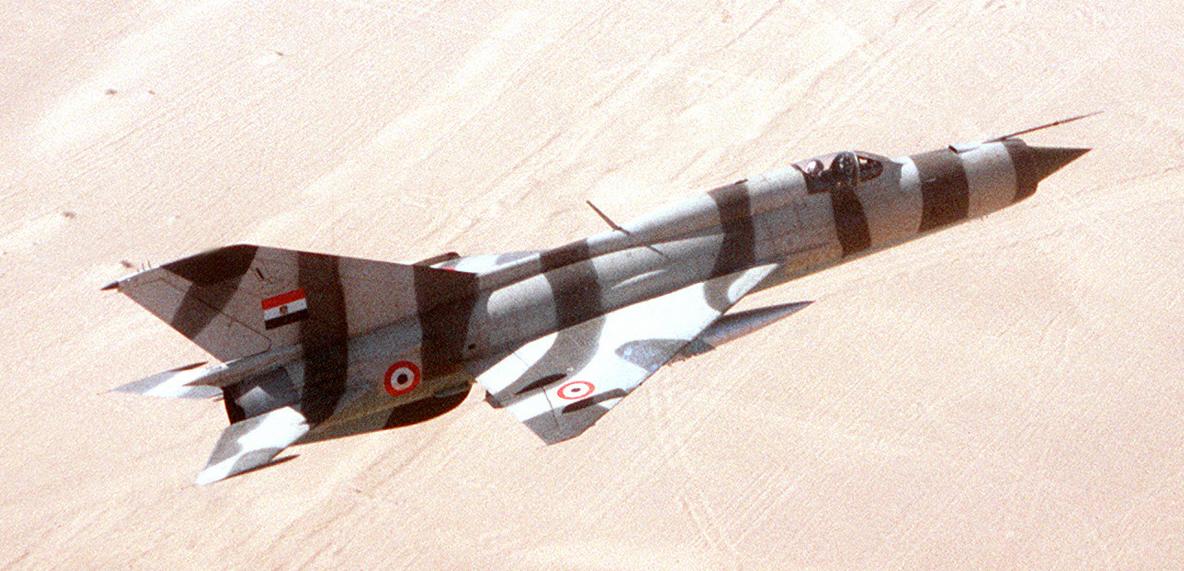
The aircraft fought on through the War of Attrition and again in the Yom Kippur War of October 1973, by which time both sides had newer equipment and the fighting in the air was harder and more even. Syrian and Egyptian MiG-21s tangled with Israeli Phantoms and Mirages in some of the largest jet battles since Korea. The MiG-21 was quick and hard to see, but its short endurance and its reliance on ground control told against it in the swirling, prolonged engagements that developed, and Israeli pilots, better trained and flying with more freedom, generally held the upper hand.
One episode summed up the difficulty. In 1970, during the War of Attrition, Soviet pilots flew MiG-21s in Egyptian service and challenged the Israelis directly. In a carefully prepared ambush the Israelis shot down several of these Soviet flown MiGs in a matter of minutes without loss, a sharp demonstration that the aircraft, however good, was only as effective as the training and tactics behind it.
India and Pakistan
India became one of the aircraft’s greatest users, buying it in quantity and later building it under licence. Indian MiG-21s saw combat against Pakistan, most dramatically in the war of 1971. That conflict brought the first supersonic air combat over the subcontinent, when an Indian MiG-21 shot down a Pakistani F-104 Starfighter with its 23mm cannon, and by the end of the war Indian MiG-21s had claimed a string of Pakistani aircraft, including several F-104s, a number of Chinese built F-6s, an F-86 Sabre and even a C-130 transport.
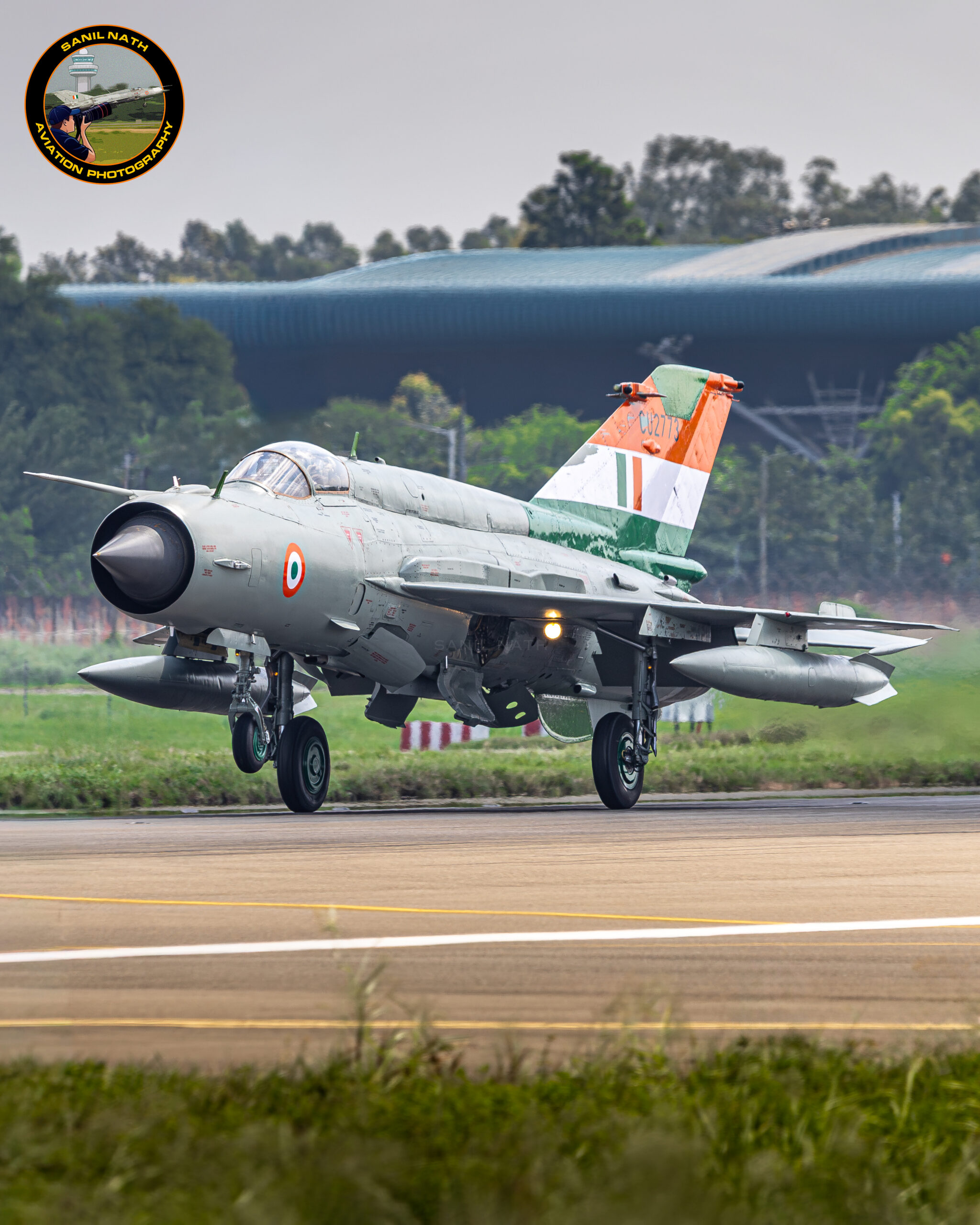
India flew the MiG-21 for more than sixty years, far longer than almost any other operator, and it remained in the news to the end. One was involved in the clash with Pakistan over Kashmir in 2019, and the type finally left Indian service only in 2025. That six decade career with a single major air force says a great deal about how sound the basic design was, though it came at a price. The ageing Indian fleet suffered a long series of accidents in its later years that earned it grim nicknames in the Indian press, a reminder that keeping a 1950s design flying for so long carries real risks.
The cost of ubiquity: the safety record
The very things that made the MiG-21 so widespread, its low cost and its long service life, also gave it a darker reputation in its later years. As fleets aged and spare parts grew scarce, accident rates climbed, and nowhere was this felt more sharply than in India, which flew the type in huge numbers for six decades. So many Indian MiG-21s were lost in crashes that the aircraft picked up grim nicknames in the press, and its safety record became a recurring political controversy.
Much of this was the fault of age rather than the design. A fighter kept in service for fifty or sixty years, flown hard by air forces without the deep support of the original manufacturer, is bound to suffer, and the thin fuel margins and high landing speed that had always demanded care of the pilot became less forgiving as airframes and engines wore. The MiG-21 was not unusually dangerous when it was new, but keeping a first generation Mach 2 fighter flying decades past its intended life had a human cost, and that too is part of its history. It is one reason India and others finally let the type go, however useful and however affordable it had been.
A fighter for the whole world
Beyond these headline conflicts the MiG-21 became the standard fighter of much of the developing world. Around sixty countries flew it at one time or another, from Warsaw Pact allies in Europe to air forces across Africa, the Middle East and Asia. It fought in the long Iran-Iraq War, in the Angolan Civil War and other African conflicts, and in the wars that broke up Yugoslavia in the 1990s. Wherever a country wanted a supersonic fighter it could afford and keep flying without a large technical base, the MiG-21 was very often the answer.
That ubiquity is a central part of its story. The aircraft also gave its name a place in the wider culture. MiG, from Mikoyan and Gurevich, became shorthand in the West for a Soviet fighter of almost any kind, and for a generation of readers a hostile jet was simply a MiG. More than any other single type, the MiG-21 fixed that image in the public mind, the small silver dart with the pointed nose that stood for the other side of the Cold War.
The list of conflicts the MiG-21 touched is a long one. It flew for Iraq in the war with Iran and again in 1991, for Syria in its wars with Israel and in the civil war that followed, for a string of African states in their border wars and insurgencies, and for the various sides in the break up of Yugoslavia. In many of these it was the most modern combat aircraft available to at least one side, and its presence, real or rumoured, shaped how air power was used in dozens of smaller wars far from the main Cold War fronts.
Variants and generations
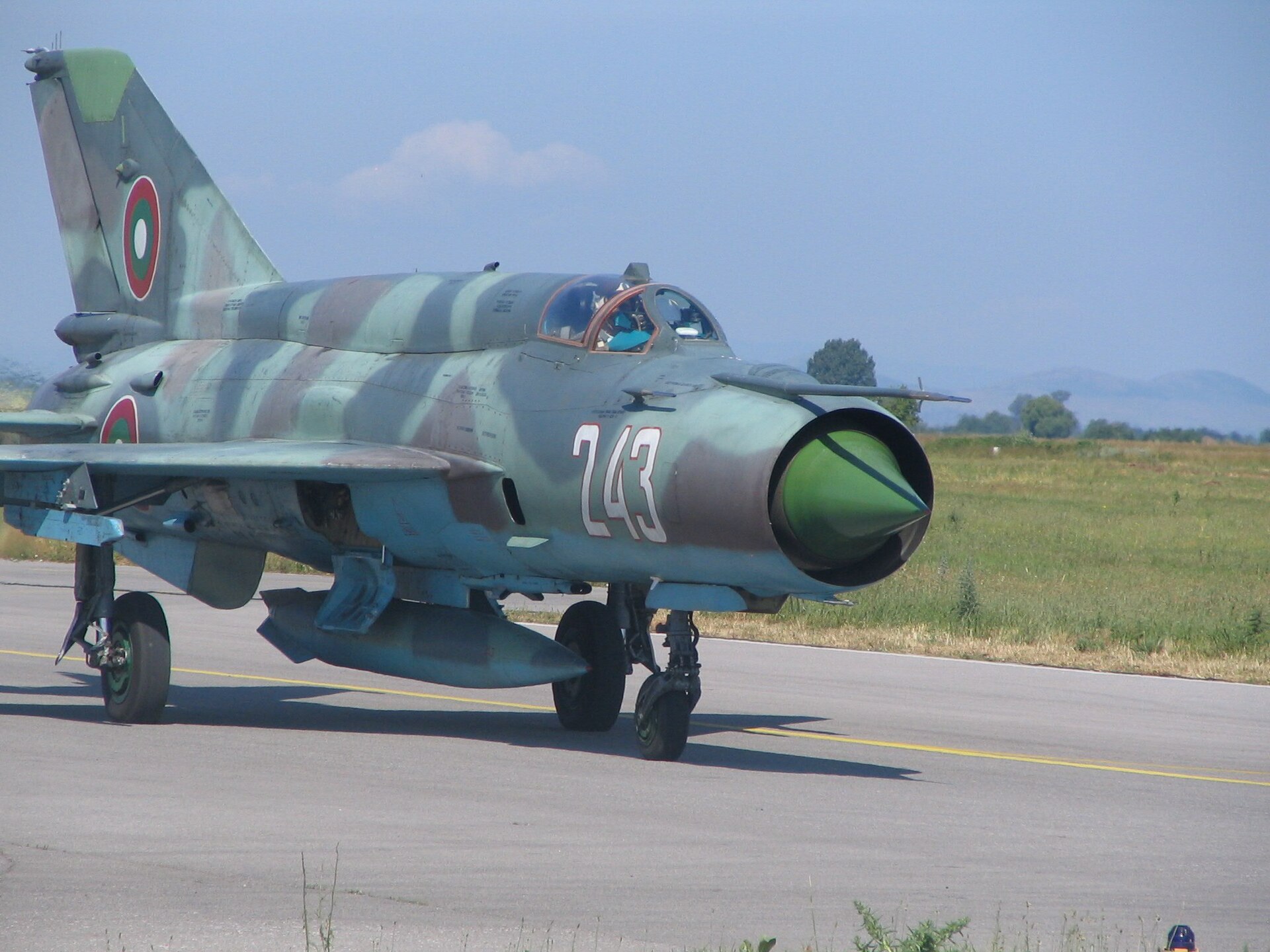
The MiG-21 developed through what are usually described as four broad generations. The first were clear weather day fighters like the MiG-21F, armed mainly with missiles and, on some, a cannon, with only a simple ranging radar. The second generation brought all weather versions such as the MiG-21PF and PFM, with a proper search radar housed in an enlarged intake cone and more powerful engines, turning the aircraft from a fair weather interceptor into something that could fight at night and in cloud.
The third generation added dedicated reconnaissance aircraft, the MiG-21R with camera and sensor pods, and improved fighters such as the MiG-21SM and MF with better radar, an internal cannon restored and more capable weapons. The fourth and final Soviet generation was the MiG-21bis, with a more powerful Tumansky R-25 engine, better avionics and improved missiles, produced into the mid 1980s and still a useful aircraft. Two seat trainer versions, which NATO called Mongol, were built alongside the fighters so that pilots could convert onto the demanding little jet. Across all these marks the basic shape stayed remarkably consistent, a sign of how right the original delta had been.
Keeping it competitive: the upgraded MiG-21
By the 1990s the basic MiG-21 was clearly obsolete, but there were thousands of them in service and many air forces could not afford to replace them. The answer, for several operators, was to rebuild the aircraft around modern electronics. Israeli industry offered a comprehensive upgrade, and Romania fielded a version known as the LanceR with a new radar, Western avionics and the ability to carry modern air to air and precision ground attack weapons.
India took the same route with its MiG-21 Bison, fitting a new radar, better cockpit displays and beyond visual range missiles to keep the type useful into the twenty first century. These upgraded aircraft were a very different proposition from the simple day fighters of the 1960s, and in exercises they occasionally embarrassed far more expensive opponents at close range. The Chinese J-7 was developed along similar lines for export, with Western avionics and a reshaped wing. None of this could change the aircraft’s basic limitations of range and airframe age, but it showed how much life could be wrung out of a sound design, and it kept the MiG-21 shape in front line service decades after it should, by any normal reckoning, have retired.
Specifications and key facts
| Crew | 1 |
|---|---|
| First flight | Ye-4 delta prototype, 16 June 1955 |
| Entered service | 1959 to 1960 (MiG-21F) |
| Engine | 1 x Tumansky R-25-300 afterburning turbojet |
| Length | About 14.5 m (without nose probe) |
| Wingspan | About 7.15 m |
| Maximum speed | Around 2,125 km/h, roughly twice the speed of sound |
| Combat radius | Short, a few hundred kilometres on internal fuel |
| Armament | 1 x 23mm GSh-23 cannon plus short range air to air missiles, rockets or bombs on underwing pylons |
| Number built | 11,496 in all (about 10,645 in the Soviet Union, plus Czechoslovak and Indian licence production) |
Preserved MiG-21s turn up at airshows and as gate guardians across Europe, and you will find Cold War jets among the images in the Piemags archive galleries. Print and usage terms are on the licensing page.
Foreign production and the Chengdu J-7
The MiG-21 spread far beyond the Soviet Union not only through exports but through licensed and copied production. India built large numbers under licence at Hindustan Aeronautics, and Czechoslovakia assembled the type for the Warsaw Pact. The most significant offshoot, though, came from China. After the Sino-Soviet split cut off Soviet help, China reverse engineered the MiG-21 and put it into production as the Chengdu J-7, exported as the F-7.
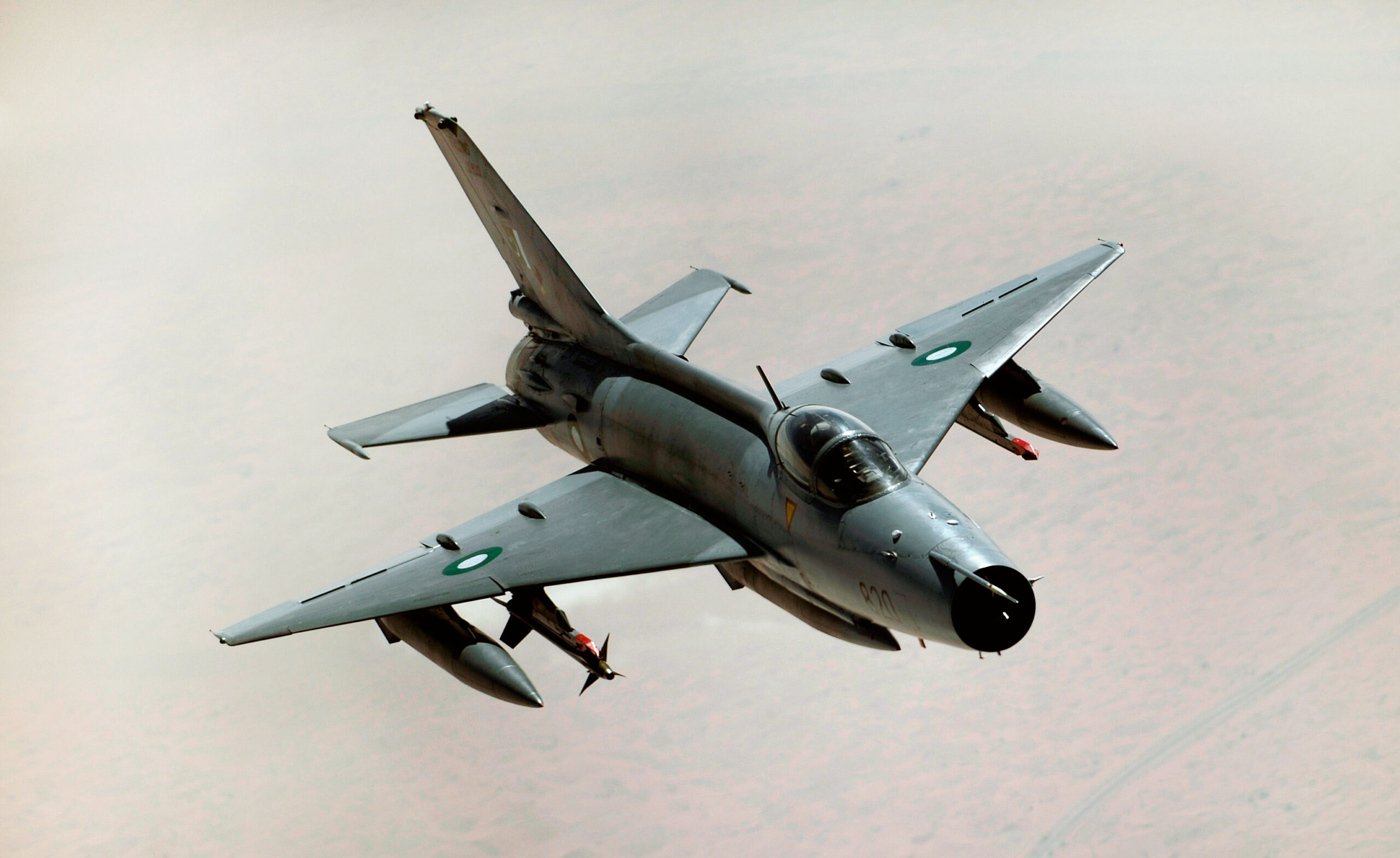
The J-7 took on a life of its own, built in large numbers over several decades and steadily developed with Western avionics and new wings for export customers. Between the Soviet aircraft, the Indian and Czech licence machines and the Chinese derivative, the basic MiG-21 layout became one of the most widely produced military aircraft designs of the twentieth century, and Chinese built examples kept the shape in front line service long after Russia itself had moved on.
India’s licensed production is worth dwelling on, because it was on a huge scale. Hindustan Aeronautics built hundreds of MiG-21s over many years, and the programme did as much as anything to establish an Indian combat aircraft industry. For decades the MiG-21 was the most numerous fighter in Indian service, and the skills and facilities built up making it fed directly into later Indian aircraft projects.
Where the survivors are today
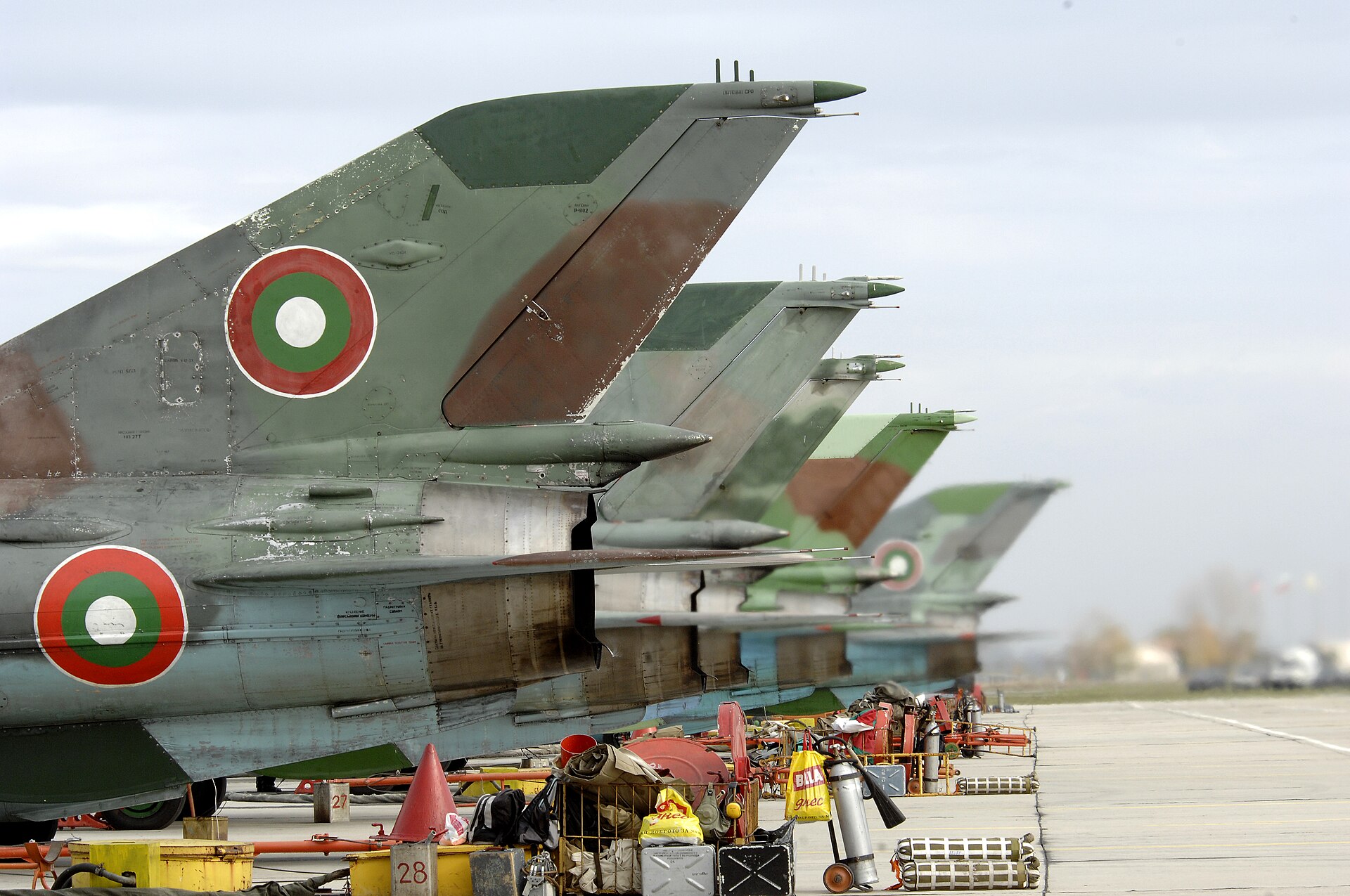
Because so many were built and so many air forces flew them, MiG-21s are among the most common Cold War jets in preservation. They stand as gate guardians at former Warsaw Pact bases, fill museum halls across the old Eastern Bloc, and a good number have passed into private hands in the West, where a small number are kept airworthy and flown at displays and even offered for high speed passenger flights. Retired examples are cheap and plentiful compared with Western fighters of the same age, which is part of why they turn up so widely.
Major collections hold the type as a milestone of jet development. The Smithsonian National Air and Space Museum in the United States, for example, preserves an early MiG-21F-13, the clear weather day fighter that first took the design into wide service. The aircraft is also not entirely a museum piece even now. Long after the major powers moved on, a handful of smaller air forces kept the MiG-21 or its Chinese cousin in service into the 2020s, valuing its low cost and simplicity even as spare parts grew scarce, and India, once its largest operator outside the Soviet Union, flew its last examples until 2025.
The aircraft has also found a place in the civilian world. In the years after the Cold War, companies in Russia offered paying passengers flights towards the edge of space in two seat MiG jets, and privately owned MiG-21s appear at airshows in Europe and North America, their afterburners and sharp lines still drawing a crowd. For an aircraft built in the tens of thousands as an almost disposable Cold War interceptor, that afterlife as a prized warbird is a fitting turn.
Legacy
The MiG-21 is one of the great survivors of aviation. It was designed as a simple answer to a narrow problem, the fast climbing interceptor, and that very simplicity let it be built cheaply, sold widely and kept flying for decades. Its weaknesses, above all its short range and its reliance on ground control, were real, but for many air forces the combination of Mach 2 speed and a low price was exactly what they could afford and use, and no other fighter offered it to so many for so long.
Its influence ran both ways across the Cold War divide. The trouble American crews had against it over Vietnam helped push the United States towards better missiles, better training and, in time, the lightweight fighter thinking that produced aircraft like the F-16. The Fishbed forced its opponents to raise their game, and it did so for far longer than anyone could have expected of a design first flown in 1955. Few aircraft have been so widely used, so often underestimated, or so hard to finally retire.
It is worth setting the MiG-21 beside its Western contemporaries. The American F-104 Starfighter chased raw speed at the expense of manoeuvrability and gained a fearsome accident record of its own, while the French Mirage III, another tailed delta, sold widely and fought well but never in the same numbers. The MiG-21 outlasted and outsold them both. It was not the best fighter of its generation by any single measure, but as an all round balance of speed, cost, simplicity and availability it had no real equal, and that balance is why it, rather than its rivals, became the definitive Cold War fighter of the wider world.
For the aircraft it fought and the ideas it prompted, see our histories of the McDonnell Douglas F-4 Phantom II, the English Electric Lightning and the General Dynamics F-16. If you want to photograph fast jets like these, our guide to air-to-air photography is a useful starting point.
The MiG-21 was built in greater numbers than any other supersonic aircraft and flown by more than fifty air forces, which makes accurate attribution really difficult. Our guide to aviation picture research explains how to verify operator and variant.
Frequently asked questions
Why is the MiG-21 called the Fishbed?
Fishbed is the NATO reporting name for the MiG-21. NATO gave Soviet aircraft code names to identify them, using names beginning with F for fighters. The two seat trainer versions were given the name Mongol.
How many MiG-21s were built?
About 11,496 MiG-21s were built in total, which makes it the most produced supersonic aircraft in history and one of the most produced jet combat aircraft ever built. That figure includes licence production in Czechoslovakia and India, but not the related Chinese Chengdu J-7.
Is the MiG-21 still in service?
A small number of air forces kept the MiG-21 or its Chinese J-7 cousin flying into the 2020s, valuing its low cost and simplicity. India, once a major operator, retired its last MiG-21s in 2025.
Why did the MiG-21 have such short range?
The MiG-21 was designed as a lightweight point defence interceptor, and its small airframe carried very little internal fuel. That kept it fast and cheap but gave it a combat radius of only a few hundred kilometres, so pilots had to manage fuel very carefully.
How did the MiG-21 compare with the F-4 Phantom?
The two were very different aircraft. The Phantom was large, heavy and packed with sensors and missiles, while the MiG-21 was small, light and agile with a short reach. Over Vietnam the little Soviet fighter fought the far more expensive Phantom on roughly even terms in close combat.
When did the MiG-21 first fly?
The delta winged Ye-4 prototype that led to the MiG-21 first flew on 16 June 1955. The production MiG-21F entered service around 1959 to 1960.
What engine does the MiG-21 use?
The MiG-21 is powered by a single Tumansky afterburning turbojet fed through a nose intake, the exact type changing with the variant. The final MiG-21bis used the more powerful R-25 engine.
How was the MiG-21 armed?
Early MiG-21s relied mainly on short range infrared missiles, the K-13 or Atoll, a copy of the American Sidewinder. Later versions restored an internal 23mm cannon and could carry rockets and bombs, after combat showed that a fighter still needed a gun.
Which countries used the MiG-21?
Around sixty countries flew the MiG-21, from Warsaw Pact members in Europe to air forces across Africa, the Middle East and Asia. India was the largest operator outside the Soviet Union.
What is the Chengdu J-7?
The Chengdu J-7 is a Chinese built version of the MiG-21, reverse engineered after the Sino-Soviet split and produced in large numbers over several decades. Exported as the F-7, it kept the basic design in front line service long after Russia moved on.
How fast is the MiG-21?
The MiG-21 can reach around 2,125 km/h, roughly twice the speed of sound. It was designed above all as a fast climbing interceptor able to reach high flying targets quickly.
Did India use the MiG-21 in combat?
Yes. Indian MiG-21s fought Pakistan, most notably in the 1971 war, which brought the first supersonic air combat over the subcontinent when a MiG-21 shot down a Pakistani F-104. One was also involved in the 2019 clash over Kashmir.
What was the MiG-21 nickname in Russian?
Soviet pilots called the MiG-21 the balalaika, after the three cornered Russian folk instrument that its triangular delta planform resembled.
Which was the last version of the MiG-21?
The last Soviet built version was the MiG-21bis, produced into the mid 1980s with a more powerful engine and improved avionics. Chinese J-7 development continued even later.
Why was the MiG-21 so successful?
The MiG-21 combined Mach 2 speed with low cost and simple maintenance, so it was affordable and usable for air forces that could not manage a more complex fighter. That, more than any single quality, explains why it was built in such numbers and flew for so long.
Who was the top scoring MiG-21 ace?
The most successful MiG-21 pilot was the North Vietnamese airman Nguyen Van Coc, generally credited as the top scoring ace of the war over Vietnam, with most of his victories won in the little delta fighter. That a pilot flying a cheap Soviet interceptor, guided from the ground and often outnumbered, could run up such a score against American aircraft said a great deal about how dangerous the MiG-21 could be when it was handled well.
Why was the MiG-21 so much cheaper than Western fighters?
The MiG-21 was deliberately built as the smallest possible airframe around a single engine, with simple systems and a small, low-powered radar, so it needed far less material, labour and skilled support than a large, sensor-packed Western fighter. As a result it cost a fraction of what a contemporary like the F-4 Phantom did, and could be turned out almost like a car. That low price, combined with rugged simplicity, is why so many air forces with limited budgets could afford it.
Could a MiG-21 pilot eject safely at low level?
Later MiG-21s used the KM-1 ejection seat, which gave the pilot a realistic chance of survival at ground level within a band of speeds. Earlier arrangements were more limited and more dangerous. Ejection capability improved through the aircraft’s life, but the MiG-21 remained a demanding machine to abandon in the worst corners of its flight envelope.
The MiG-21 also holds a footnote in another aircraft’s story: it was the first victim of the F-15, as told in our F-15 Eagle history.
The MiG-21 was the supersonic successor to the aircraft that first shocked the West over Korea: our full history of the Mikoyan-Gurevich MiG-15 tells that earlier story.
