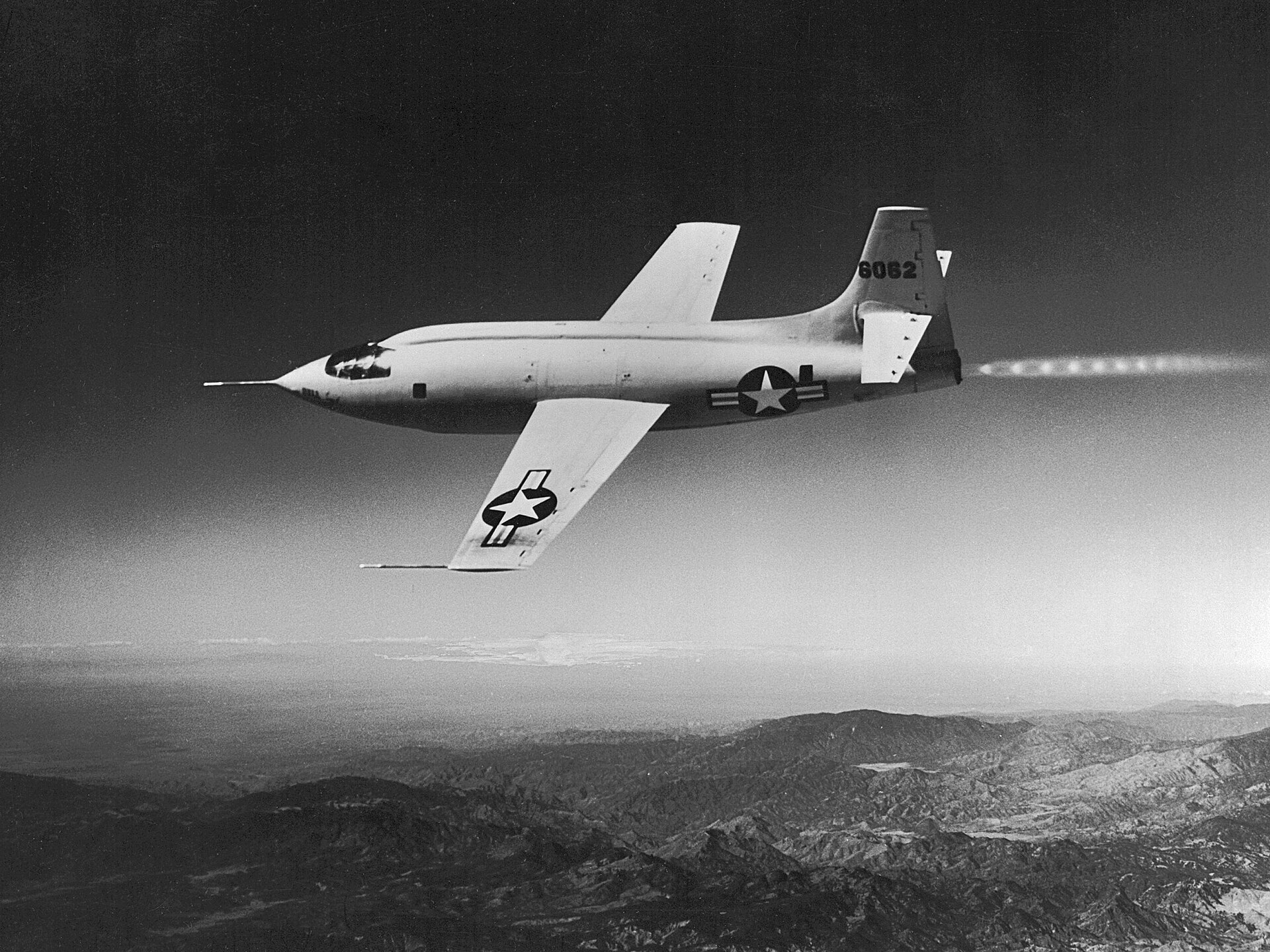
On 14 October 1947, US Air Force Captain Charles “Chuck” Yeager became the first pilot to fly faster than the speed of sound, reaching Mach 1.06 in the rocket-powered Bell X-1 over the Mojave Desert in California. The flight lasted minutes, the supersonic portion seconds, and the announcement, when it finally came, changed aviation permanently. The story behind those seconds involves a cancelled British rival, a bullet-shaped aeroplane with no undercarriage worth the name, a contract dispute that put a 24-year-old war veteran in the cockpit, two broken ribs, a sawn-off broomstick, and a piece of flight test flying so calm that the radio call announcing the most famous moment in aeronautical history was a joke about instrumentation. This is the full account of how the sound barrier was broken, why it nearly was not, and what followed.
What this guide covers
- The myth of the sound barrier
- The race to Mach 1
- Building the X-1
- The programme before the record
- 14 October 1947: the flight
- Why it mattered
- What it was like to fly the X-1
- The people behind the flight
- Secrecy and announcement
- The aftermath and the race to Mach 2
- Key facts and figures
- Where to see the X-1 today
- Legacy
- Frequently asked questions
The myth of the sound barrier
The sound barrier was never a wall, but by 1945 it had killed enough people to feel like one. As piston-engined fighters of the Second World War grew powerful enough to approach the speed of sound in dives, pilots began meeting something aerodynamics could not yet fully explain. Airflow over parts of a wing goes supersonic before the aircraft itself does, forming shock waves that move and strengthen unpredictably. Controls froze or reversed. Noses tucked under. Buffeting shook airframes hard enough to break them. P-38 pilots diving on targets met control forces they could not overcome; test pilots probing the region sometimes did not come back.
The phrase itself came from a misreading. In 1935 the British aerodynamicist W. F. Hilton described to a journalist how drag rose sharply near the speed of sound, and the resulting newspaper coverage turned a steep drag rise into a physical “barrier”. The name stuck because the experience of pilots seemed to confirm it. Some respected engineers argued an aircraft might need infinite power to pass Mach 1, or that no controllable passage through the transonic region was possible at all.
The deaths gave the idea weight. In September 1946, Geoffrey de Havilland Jr, chief test pilot and son of the founder of the de Havilland company, was killed when the tailless DH 108 Swallow he was flying broke up over the Thames Estuary during high-speed trials, a loss widely attributed to the violent pitch behaviour of the transonic region. To the public, and to a fair number of professionals, the message seemed plain: something in the air near Mach 1 destroyed aeroplanes and the men in them.
The truth, as the X-1 would demonstrate, was that the transonic region was survivable if an aircraft was built specifically to pass through it: strong enough to take the buffet, clean enough to limit the drag rise, and, above all, controllable by means that did not depend on conventional elevators, which shock waves rendered nearly useless at the critical moment. The barrier was an engineering problem wearing the costume of a law of nature.
The race to Mach 1
Three programmes converged on Mach 1 in the mid-1940s, and the one remembered least came closest to getting there first. In 1943 Britain’s Miles Aircraft was contracted to build the M.52, a slim, straight-winged, turbojet-powered aircraft designed to reach 1,000 mph. It was in several respects startlingly advanced: it featured an all-moving horizontal tailplane, exactly the control solution supersonic flight would prove to demand. In February 1946, with the design well advanced, the programme was abruptly cancelled by the British government, a decision still argued about. The design work was not entirely wasted: a 3/10-scale rocket-powered model of the M.52 flew to Mach 1.38 under autopilot in October 1948, a year after Yeager’s flight, making its cancellation one of the sharper what-ifs in British aviation. How much M.52 data reached the American programmes, and how much it influenced them, remains contested, and claims that the X-1 simply borrowed its tail solution from Miles should be treated with caution.
In the United States, the effort split in two. The Navy and NACA (the National Advisory Committee for Aeronautics, forerunner of NASA) backed the Douglas D-558 programme, a cautious, methodical research effort. The Army Air Forces wanted the answer faster and contracted Bell Aircraft of Buffalo, New York, in 1945 to build a small rocket-powered aircraft designed to do one thing: fly through Mach 1 and live. It was designated XS-1, for Experimental Sonic 1, later shortened to X-1, the first of the X-planes.
There was also a fourth contender, unofficial and unadmitted. North American’s XP-86 Sabre prototype, the swept-wing jet fighter that would dominate the Korean War, began flying at Muroc in the same weeks the X-1 was closing on Mach 1. Test pilot George Welch, it was later claimed, may have pushed the XP-86 through the sound barrier in a dive on 1 October 1947, days before Yeager. The claim rests on recollection and circumstance rather than instrumented data, Welch himself never publicly made it, and the US Air Force has never recognised it. The official record stands with the X-1, which did it in level flight with full instrumentation, but the story is worth knowing because it shows how close supersonic flight had come to being an everyday property of ordinary fighter aircraft.
Building the X-1
Bell’s engineers began from a piece of ballistic common sense. Nobody knew what a supersonic aeroplane should look like, but everyone knew one object that travelled supersonically in perfect stability: a bullet. The X-1’s fuselage took the profile of a .50 calibre machine-gun round, stretched to just under 31 feet and fitted with a cockpit whose glazing followed the fuselage line so smoothly that the pilot had almost no forward visibility and entered through a hatch in the side.
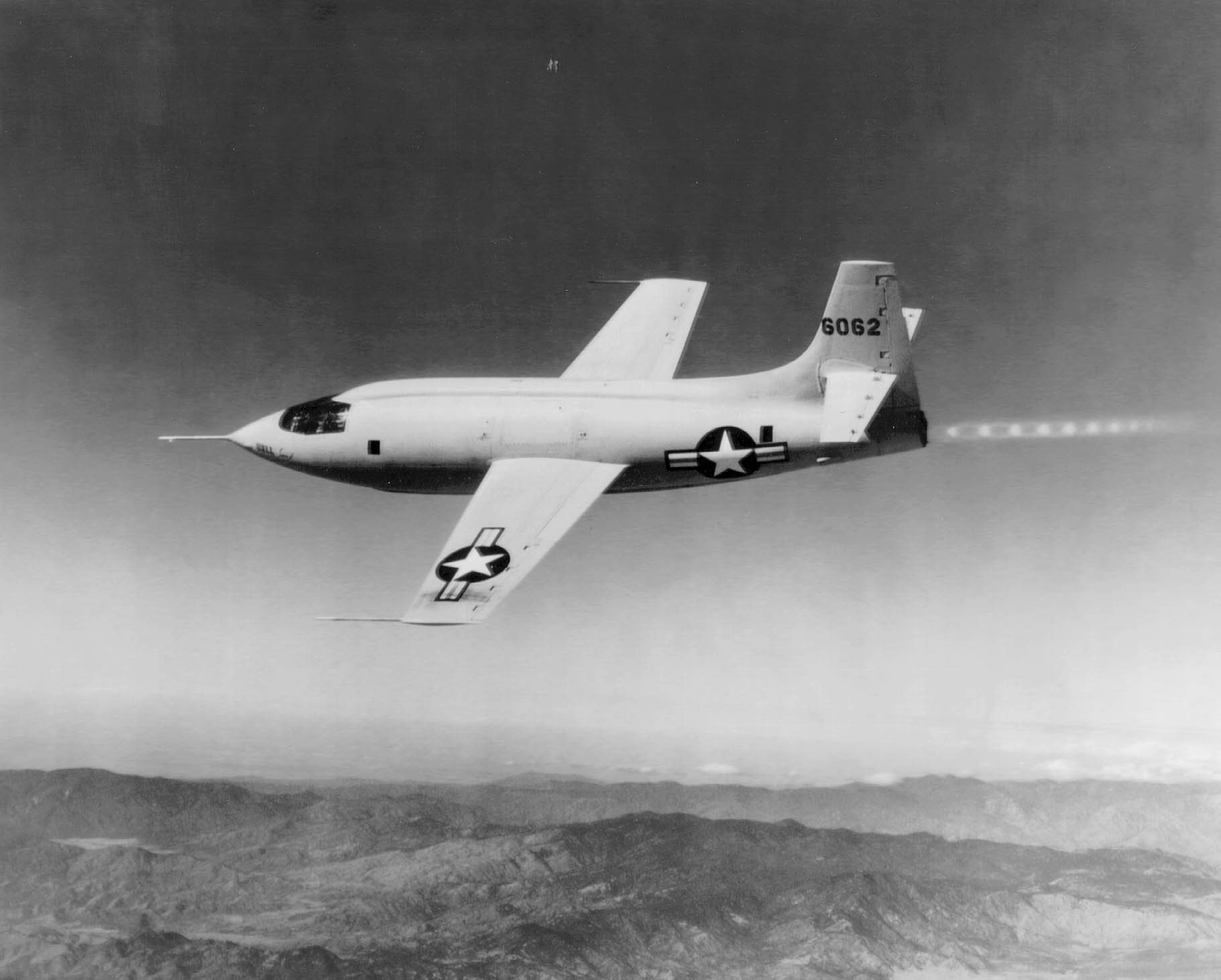
The wings were the second decision. Shock waves form earliest on thick wings, so the X-1’s were made brutally thin for the era and dead straight: two sets were built, one of 10 per cent thickness-to-chord ratio and one of 8 per cent, so the programme could compare them. They were also immensely strong, stressed to withstand loads far beyond fighter norms, because nobody could promise what the transonic buffet would do.
The third decision was the one that made the record possible. The X-1’s horizontal stabiliser was mounted high, clear of the wing’s wake, and crucially it was adjustable in flight: an electric motor could tilt the whole tailplane. When shock waves formed along the tail at high Mach and blanketed the elevator, robbing it of authority, the pilot could still command pitch by moving the entire stabiliser. This adjustable tail, and the flying technique built around it, was the practical key that unlocked Mach 1, and the all-moving tailplane became standard on essentially every supersonic aircraft since.
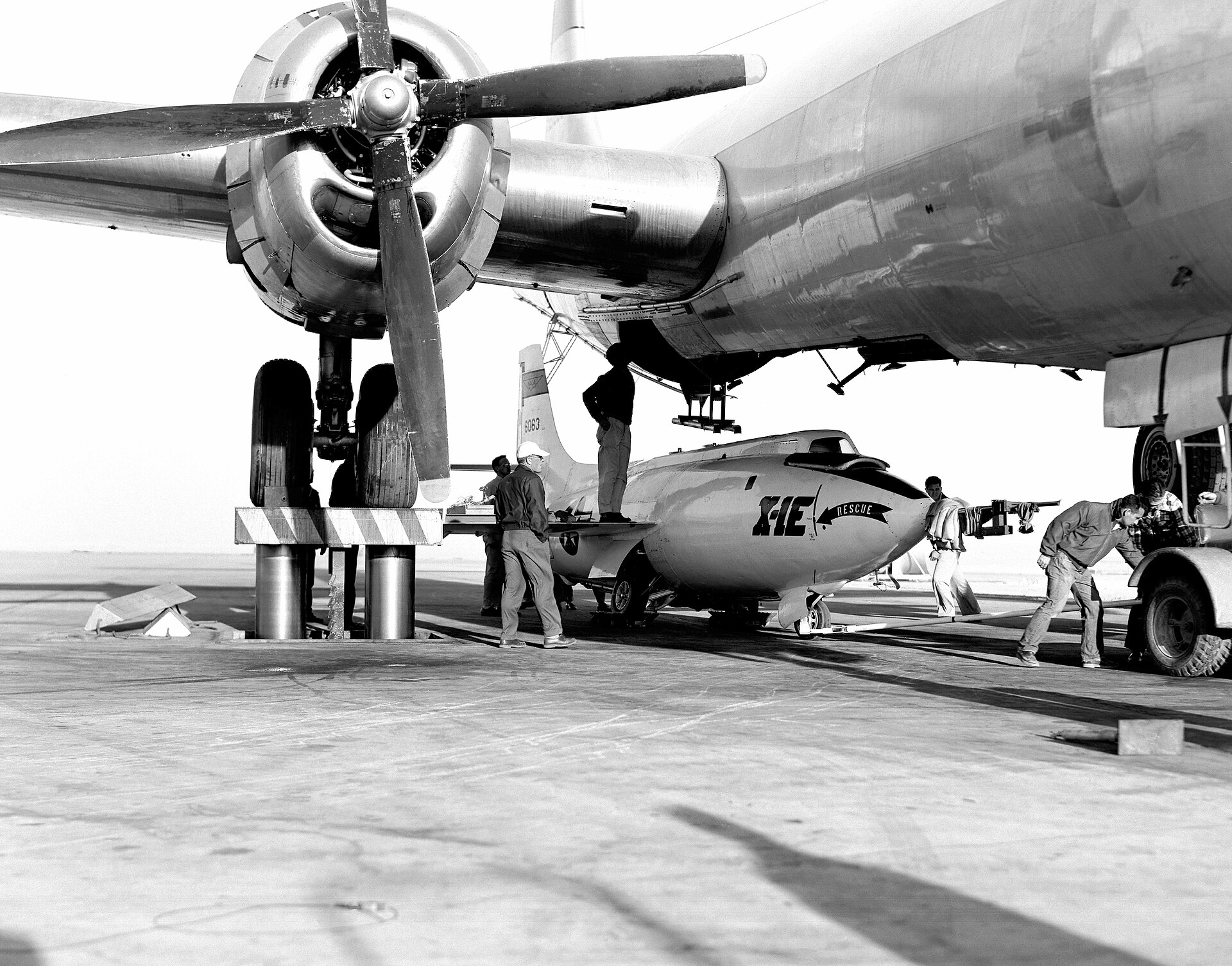
Power came from a Reaction Motors XLR11-RM-3 rocket engine burning liquid oxygen and diluted ethyl alcohol: four chambers of 1,500 pounds of thrust each, 6,000 pounds in all, with no throttle as such. The pilot switched chambers on and off individually, in whatever combination the flight plan called for. Fuel was sufficient for only around two and a half minutes of full-power flight, which settled the launch question: rather than waste propellant on take-off and climb, the X-1 would be carried to altitude in the modified bomb bay of a Boeing B-29 Superfortress and dropped like a weapon, lighting its chambers in mid-air. It was a research instrument as much as an aircraft, wired with 500 pounds of instrumentation to radio pressures, loads and speeds back to engineers on the lakebed.
The programme before the record
The X-1 flew before it flew fast. On 19 January 1946, Bell test pilot Jack Woolams made the first unpowered glide flight at Pinecastle Field in Florida, and completed ten glides testing the aircraft’s low-speed handling before the first aircraft went back to Bell for its rocket engine. The programme then moved to the place whose name would become synonymous with the X-planes: Muroc Army Air Field, a vast dry lakebed in California’s Mojave Desert, later renamed Edwards Air Force Base, where a mile-long runway overrun mattered less because the lakebed itself was the runway. Woolams never made a powered flight; he was killed in August 1946 practising for the National Air Races in a Bell P-39.
Bell’s Chalmers “Slick” Goodlin took over, and on 9 December 1946 made the first powered flight of the programme in the second aircraft, 46-063. Over the following months Goodlin took the X-1 progressively deeper into the transonic region, reaching around Mach 0.8 in accordance with a deliberately conservative Bell test plan. Then came the handover that history turned on. The often-told version is that Goodlin demanded a bonus of $150,000 to take the aircraft through Mach 1, and that the Army Air Forces, unwilling to pay, took the programme in-house; Goodlin disputed that account for the rest of his life, and the fuller truth seems to involve contract wrangling, insurance and the Air Force’s desire to control its own flight test. Either way, in the summer of 1947 the programme passed to the Air Force’s test division, and the price of the pilot dropped to a captain’s monthly salary.
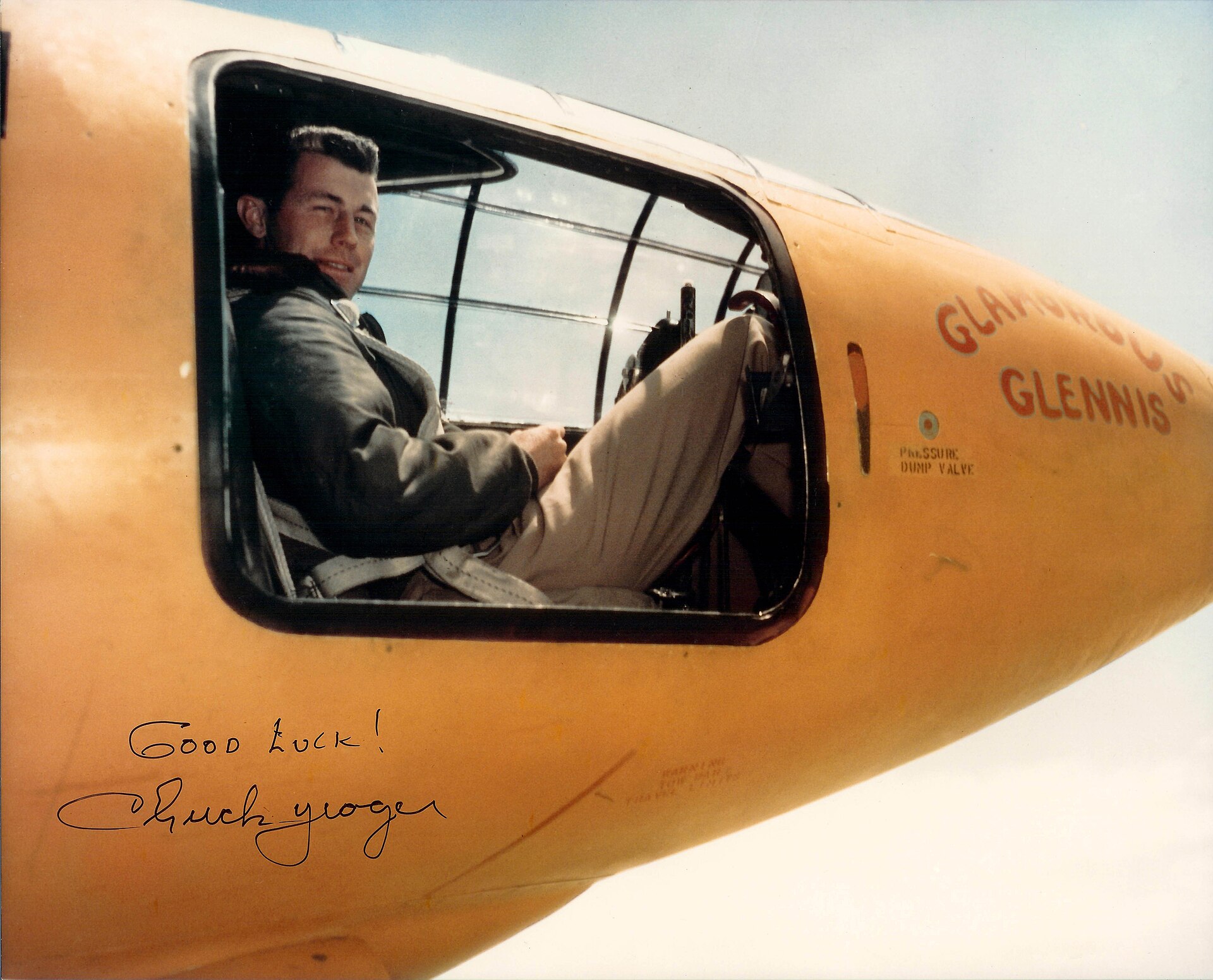
The captain was Charles E. Yeager, 24 years old, a West Virginian who had flown P-51 Mustangs in combat over Europe, been shot down over France, evaded capture with the Resistance, and returned to operations. He was chosen for reasons his commander Colonel Albert Boyd considered obvious: he was, by wide agreement, the finest instinctive stick-and-rudder pilot in the test division and unusually good at describing what an aircraft was doing to engineers afterwards. Flying chase and backup was Lieutenant Bob Hoover, with Captain Jack Ridley, an engineer-pilot Yeager trusted completely, as the project’s flight test engineer. Yeager named the aircraft Glamorous Glennis after his wife, as he had named his wartime Mustangs.
Through August, September and early October 1947, Yeager worked the X-1 up through a series of powered flights, each nudging the Mach number higher. At Mach 0.94 he met the problem that had killed the sound barrier’s earlier victims: shock waves blanketed the elevator and pitch control faded towards nothing. The programme’s answer was the adjustable stabiliser. Ridley and Yeager worked out a technique for flying pitch on the stabiliser trim motor alone, in small increments, and it worked. The elevator problem, the one really dangerous unknown, had a procedure. What remained was to fly it.
14 October 1947: the flight
The famous flight nearly did not happen for the least aeronautical of reasons. A couple of days beforehand, Yeager and Glennis went riding after dinner at Pancho Barnes’s ranch near the base, and racing back in the dark Yeager hit a closed gate, was thrown, and broke two ribs on his right side. A flight surgeon would have grounded him instantly and the flight would have passed to another pilot, so Yeager went instead to a civilian doctor in the nearby town, had the ribs taped, and told almost nobody. The one person on the programme he did tell was Jack Ridley.
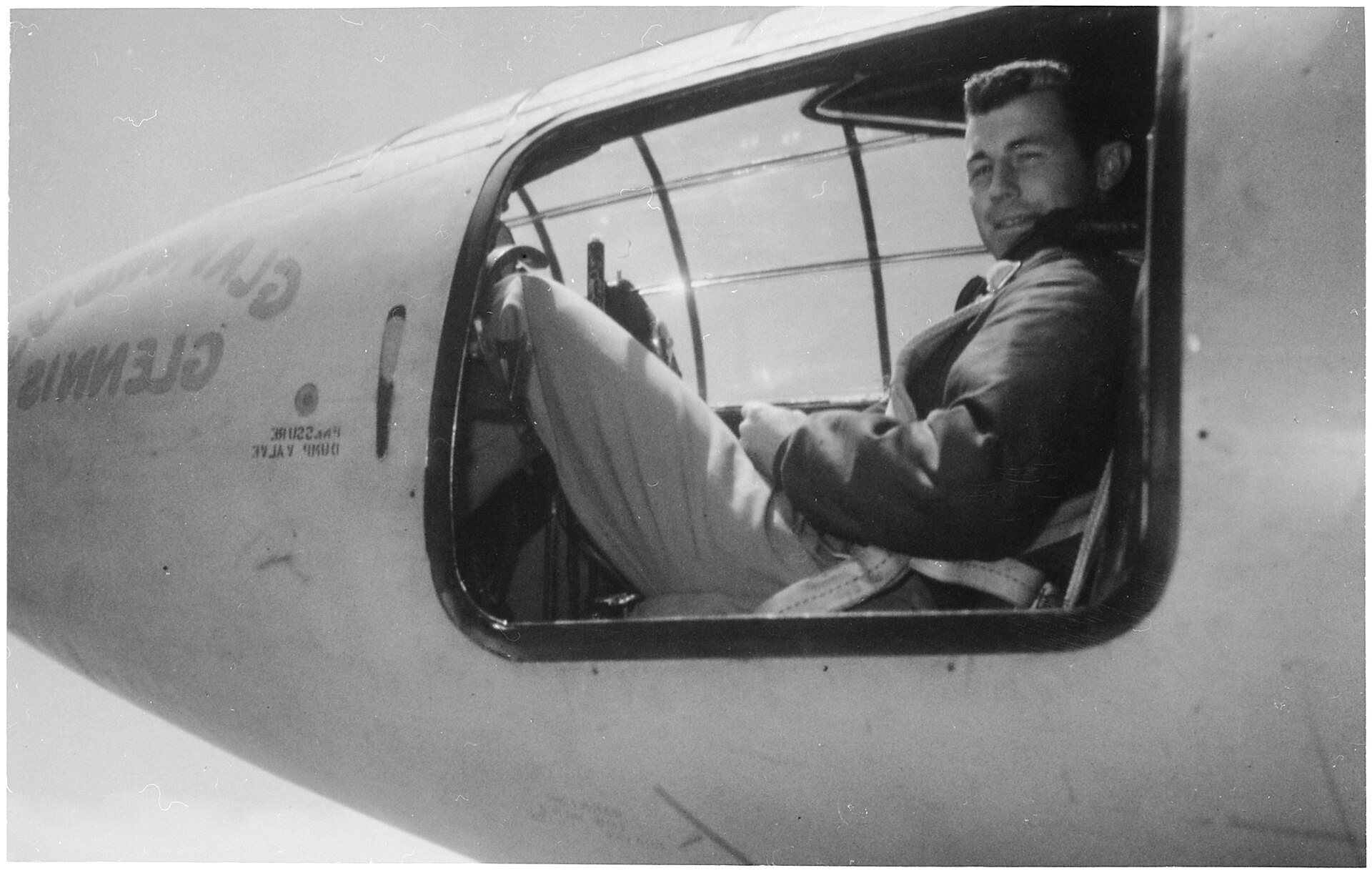
That mattered because of the hatch. Sealing the X-1’s side hatch from inside required holding it in place with one hand while slamming a heavy locking lever with the other, exactly the two-handed, rib-straining movement Yeager could no longer make. Ridley’s solution has entered aviation folklore: a length of broomstick, sawn off to give Yeager a lever he could operate left-handed with enough mechanical advantage to lock the hatch. It worked, and the most sophisticated flying machine on Earth went supersonic with a piece of broom handle as mission-critical equipment.
The morning of 14 October followed the programme’s established rhythm. The X-1, fuelled with liquid oxygen and alcohol, hung in the bomb bay of the B-29 as it climbed over the desert. Yeager descended the ladder into the cockpit in the freezing slipstream, sealed the hatch with Ridley’s broomstick, and ran his checks. At around 20,000 feet the B-29 dropped the X-1 into free flight. This was the programme’s 50th flight of an XS-1, and Yeager’s ninth powered flight in the aircraft.
He lit the four rocket chambers in sequence and climbed, shutting chambers down and relighting them to manage the propellant as he pushed through the well-explored region: Mach 0.88, 0.92, the buffet arriving on schedule, the elevator fading at 0.94, pitch control shifted to the stabiliser trim as rehearsed. At around 42,000 feet he levelled and relit a third chamber. The Machmeter climbed to 0.965, flickered, and then, in his own later description, jumped off the scale. The needle’s jump was the shock wave passing over the aircraft’s pitot system: the X-1 was supersonic. Instruments on the ground put the aircraft at Mach 1.06, roughly 700 miles per hour, at an altitude generally recorded as around 43,000 feet (some accounts say 45,000). It stayed there for about 20 seconds. The flight was so smooth that Yeager radioed to Ridley that the Machmeter must be broken; below on the lakebed, the tracking crews heard a sound nobody had ever heard before, the distant double thump of a sonic boom rolling across the desert, and knew it was not.
There was no announcement, no fanfare, and officially no flight. Yeager shut down the engine, glided to the lakebed as every X-1 flight ended, and was helped out of the cockpit by men sworn to secrecy. The programme carried on flying two days later as if nothing had happened, which, as far as the world knew, was true. That evening’s celebration was private, and the man who had just made the most famous flight since Kitty Hawk had two broken ribs, a taped chest, and orders to say nothing to anyone.
Why it mattered
The obvious answer is the record, but records fall every year. The X-1’s achievement was categorical rather than incremental: it converted the transonic region from a mystery that killed test pilots into a charted piece of sky with published procedures. The flight proved three things at once. The buffet could be survived by adequate structure. The drag rise could be overcome with adequate thrust. And, most importantly, the control problem had a solution, the flying tail, which migrated from the X-1 to the F-86’s later variants and to effectively every supersonic aircraft designed since. When Korean War pilots fought MiG-15s in Sabres whose all-flying tails kept them controllable in transonic dives, they were using the X-1’s answer to the sound barrier.
It also mattered institutionally. The flight came less than a month after the US Air Force was created as an independent service in September 1947, and it handed the new service a founding achievement. It validated the whole research-aircraft concept: a purpose-built experimental machine, flown from a desert lakebed, feeding data to engineers who fed designs to industry. The X-planes that followed, through the X-15 to the lifting bodies that shaped the Space Shuttle, all descend from the X-1’s method as much as its airframe. NACA’s role in the programme carried directly into NASA’s flight research culture; the drop-launch technique itself was reused for generations of research aircraft.
And it mattered in the imagination. Supersonic flight had been the era’s shorthand for the impossible. Within six years of Yeager’s flight, production fighters were supersonic; within fifteen, airliners were being designed to cruise at twice the speed of sound. The distance from the X-1 to Concorde’s first flight in 1969 is barely 21 years, a compression of progress that the 14 October flight, more than any other single event, set in motion.
What it was like to fly the X-1
The mission profile made the X-1 unlike anything else in the sky. The pilot did not strap in on the ground and take off; he rode in the B-29’s fuselage while the bomber climbed, then, in the coldest part of the flight, descended a ladder into the X-1’s cramped cockpit hanging in the bomb bay, with the desert two and a half miles below the open bay and the slipstream battering him the whole way. Once sealed in, he sat surrounded by tanks of liquid oxygen so cold that frost formed on the aircraft’s skin, waiting through the countdown for the drop.
The drop itself was a controlled fall. The X-1 left the bomb bay heavy, nose-high tendencies and all, and the pilot had seconds to stabilise the glide before lighting the first chamber. Ignition was binary: each of the four XLR11 chambers was either off or at full thrust, so acceleration arrived in violent steps rather than a smooth push, and managing speed meant flying an engine with four switches instead of a throttle. From drop to burnout was measured in a couple of minutes; every flight ended the same way, engine silent, in a long glide to the lakebed with no power to correct a misjudged approach. The X-1 landed at high speed on a skid-and-wheel arrangement, and the lakebed’s miles of flat clay were not a luxury but a requirement.
Add the details the era took for granted: no ejection seat worth the name in the earliest configuration, a hatch the pilot could not open against the slipstream at speed, no forward visibility to speak of through the faired windscreen, and instrumentation taking priority over comfort in every design decision. Test pilots of the period regarded the propulsion system, not the sound barrier, as the aircraft’s real hazard, and the programme’s later losses to explosions proved them right. It took a particular temperament to treat all of this as routine, which is precisely what the small Muroc community did.
The people behind the flight
The record carries Yeager’s name, but the flight was a small team’s work, and the team is worth naming. Colonel Albert Boyd, chief of the Air Force’s flight test division and a formidable standard-setter, chose Yeager for the programme and defended the choice of a 24-year-old captain over more senior candidates. Captain Jack Ridley was the programme’s flight test engineer and Yeager’s translator between cockpit sensation and engineering data; it was Ridley whose stabiliser-trim technique solved the transonic control problem, Ridley whom Yeager told about the ribs, and Ridley’s broomstick that sealed the hatch. Yeager said for the rest of his life that Ridley was the reason the programme worked.
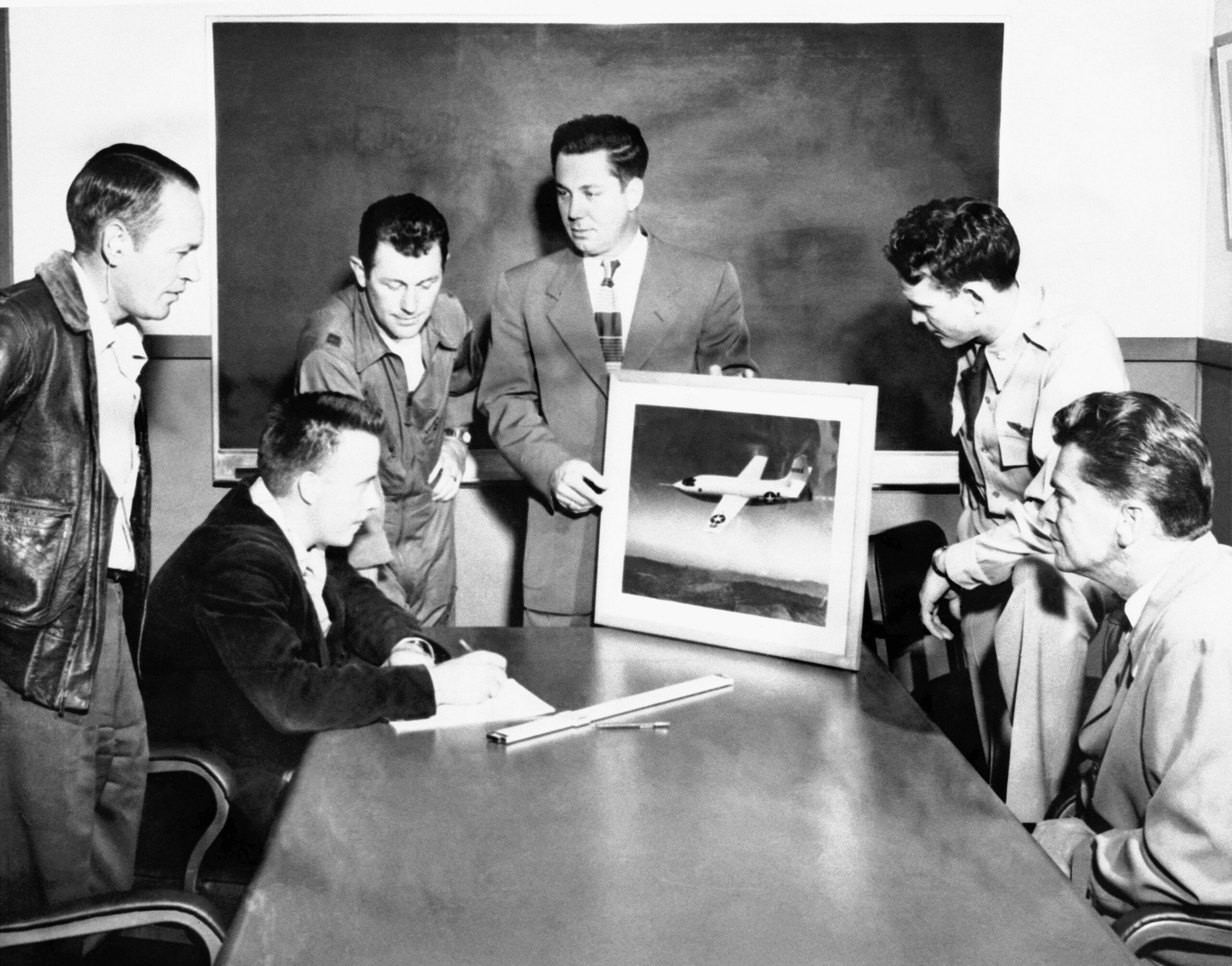
Lieutenant Bob Hoover flew chase in a P-80, watching the X-1 from alongside on the flights that led to the record, and later became perhaps the most admired display pilot in history. Dick Frost of Bell provided the manufacturer’s engineering continuity, and John Stack of NACA led the research effort whose wind tunnel and instrumentation work underpinned every decision; his share of the Collier Trophy recognised that the flight was the visible tip of a research programme years deep. Behind them stood the B-29 crews, the propulsion technicians handling cryogenic oxygen in desert heat, and the trackers on the lakebed who were, on 14 October 1947, the first people on Earth to hear a sonic boom made by an aeroplane in level flight.
It is also worth remembering the pilots the programme lost around its edges: Jack Woolams, killed before he could make a powered flight, and the string of X-plane pilots through the following decade for whom the propulsion systems proved deadlier than the aerodynamics. The X-1 story is often told as one man in one machine on one morning; it was a community’s work, done at real and continuing cost.
Secrecy and announcement
The flight was classified, and stayed officially secret for months. The Air Force wanted the data, and the lead it represented, kept from rivals; the pilots wanted to keep flying. The secrecy held imperfectly: in December 1947, Aviation Week magazine published the story of a successful supersonic flight, to official fury, and the existence of the achievement became an open secret in the industry while remaining unconfirmed in public. Formal confirmation followed in 1948, and with it the honours. The 1947 Collier Trophy, American aviation’s most prestigious award, was presented by President Truman jointly to three men: Larry Bell, whose company built the aircraft, Captain Chuck Yeager, who flew it, and John Stack of NACA, whose research underpinned it. The three-way award was a fair map of how the thing had actually been done: industry, service and research institution in harness.
For Yeager, the public half of fame arrived slowly and then all at once. Within the flying world he became the standard against which test pilots measured themselves; to the wider public he remained little known until Tom Wolfe’s 1979 book The Right Stuff, and the 1983 film of it, made him the era’s emblem. He kept flying operationally for decades, commanded fighter squadrons and wings, retired as a brigadier general, and died on 7 December 2020 at the age of 97, having outlived the aircraft’s era so thoroughly that he had flown in an F-15 past Mach 1 on the flight’s 50th anniversary in 1997, aged 74.
The aftermath and the race to Mach 2
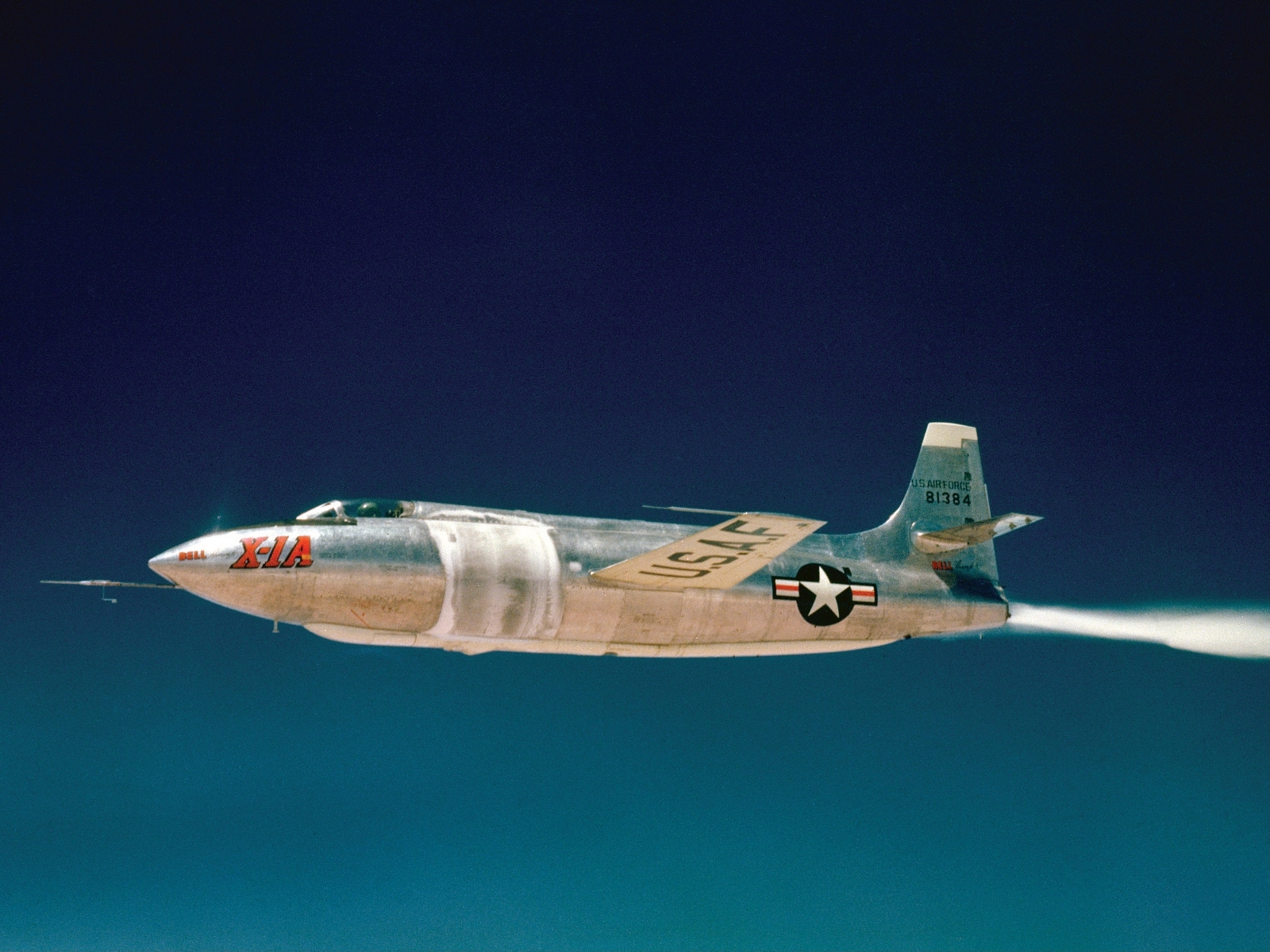
The X-1 programme did not stop at Mach 1.06. The original aircraft went on flying research missions, and 46-062 itself was flown to Mach 1.45 and, in 1949, to an altitude of over 71,000 feet. Three of the original series were built; the third, 46-064, known as Queenie, was destroyed in a ground explosion in 1951, one of the propulsion-system fires that dogged the programme far more lethally than the sound barrier ever had. Second-generation aircraft followed: the X-1A, X-1B and X-1D (the X-1D was lost to another explosion, as was the X-1A eventually, both without loss of life), and the X-1E, rebuilt from the second original aircraft, 46-063, which flew research missions until 1958.
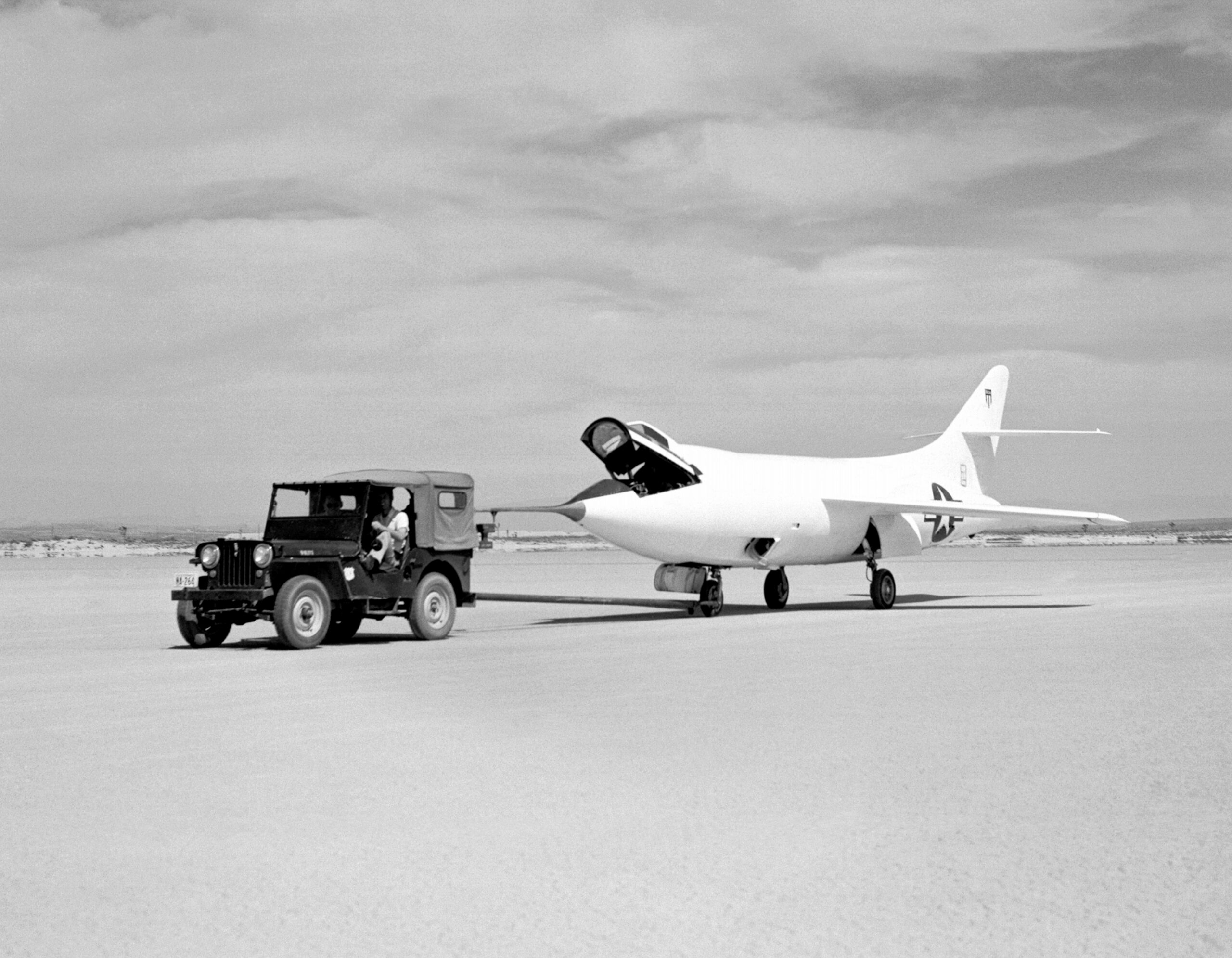
The next symbolic line was Mach 2, and this time the Navy and NACA got there first. On 20 November 1953, Scott Crossfield took the Douglas D-558-II Skyrocket to Mach 2.005 in a shallow dive, becoming the first human to fly at twice the speed of sound. Yeager and Ridley answered three weeks later with a plan they called Operation NACA Weep. On 12 December 1953, Yeager flew the X-1A to Mach 2.44, around 1,620 mph, in level flight at 74,700 feet. Moments after the record, the X-1A departed controlled flight in the then barely understood phenomenon of inertia coupling and tumbled, losing some 50,000 feet in about a minute while Yeager was battered around the cockpit hard enough to crack the canopy with his helmet. He recovered it, in an episode that has entered test flying legend, and landed. The X-1A’s Mach 2.44 stood as the fastest X-1 series flight ever made; the research line then passed to the X-2 and ultimately the X-15.
Key facts and figures
| Item | Detail |
|---|---|
| Aircraft | Bell X-1 (originally XS-1), serial 46-062, “Glamorous Glennis” |
| First supersonic flight | 14 October 1947, from Muroc Army Air Field (now Edwards AFB), California |
| Pilot | Captain Charles E. “Chuck” Yeager, USAF (1923-2020) |
| Speed achieved | Mach 1.06, roughly 700 mph / 1,127 km/h |
| Altitude | Around 43,000 ft (sources vary between 43,000 and 45,000 ft) |
| Engine | Reaction Motors XLR11-RM-3 four-chamber liquid-fuel rocket, 6,000 lbf total |
| Launch method | Air-dropped from a modified Boeing B-29 Superfortress |
| Programme milestone | 50th flight of the XS-1 series; Yeager’s ninth powered X-1 flight |
| First glide flight | 19 January 1946, Jack Woolams, Pinecastle Field, Florida |
| First powered flight | 9 December 1946, Chalmers “Slick” Goodlin, aircraft 46-063 |
| Recognition | 1947 Collier Trophy to Larry Bell, Chuck Yeager and John Stack |
| Aircraft today | Smithsonian National Air and Space Museum, Washington DC |
Where to see the X-1 today
Glamorous Glennis was retired in 1950 and went straight from the Air Force to the Smithsonian. Today the actual aircraft, serial 46-062, hangs in the Boeing Milestones of Flight Hall at the National Air and Space Museum in Washington DC, sharing the museum’s central space with the Wright Flyer and the Spirit of St Louis, which is precisely the company it belongs in. It remains one of the most photographed aircraft in any museum on Earth.
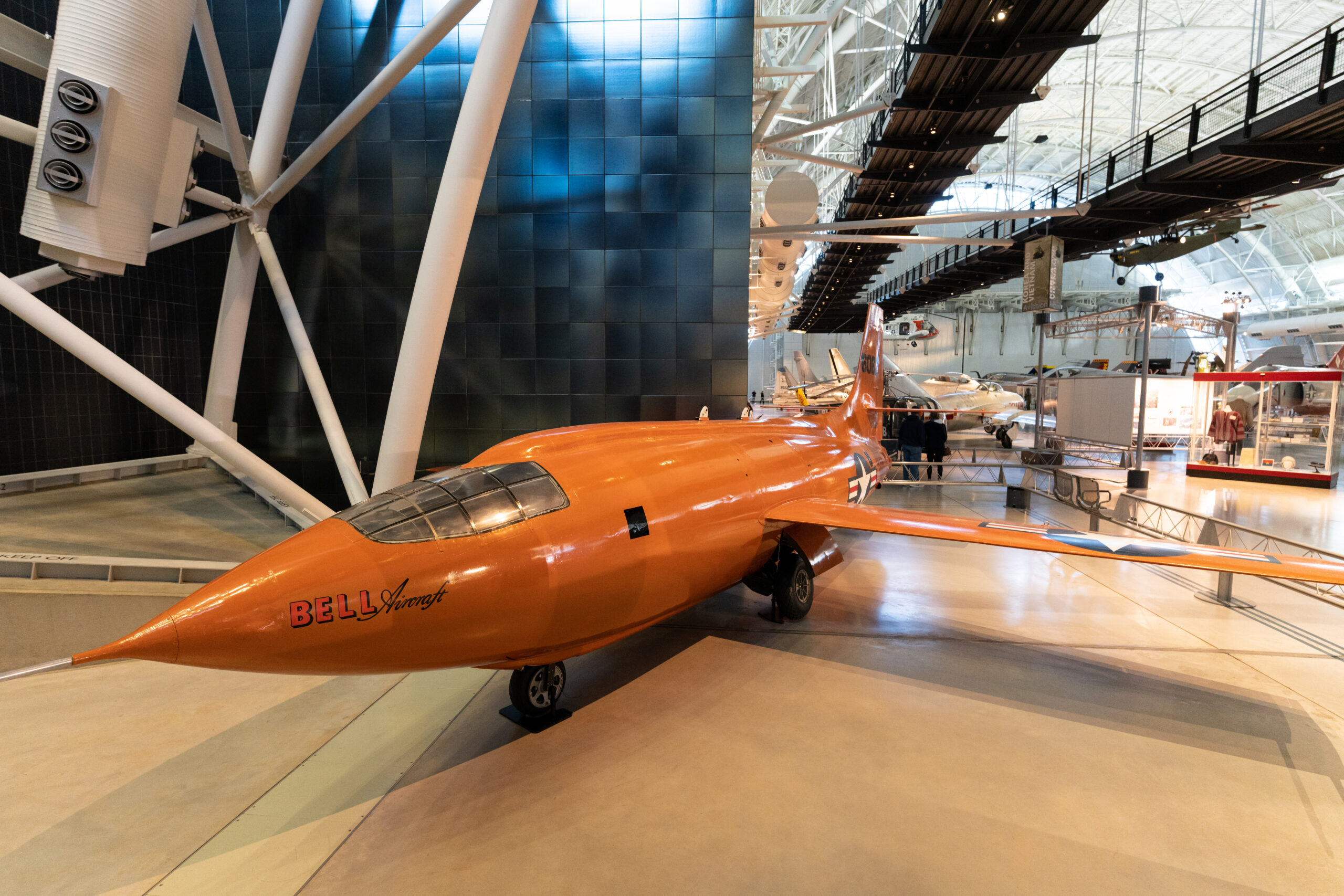
Of the wider family, the X-1B is preserved at the National Museum of the United States Air Force at Wright-Patterson Air Force Base in Dayton, Ohio, and the X-1E stands on a pedestal outside NASA’s Armstrong Flight Research Center at Edwards Air Force Base in California, the lakebed where all of this happened. The X-1A, X-1D and the third original aircraft were all destroyed in propulsion explosions during the programme; no example of those airframes survives.
For photographers, museum aircraft like these reward the same discipline as any static subject: work the angles the lighting gives you, and treat the airframe as sculpture. Suspended as it is above a bright hall, the X-1’s orange paint and bullet fuselage make it one of the more forgiving indoor subjects, and a fine companion piece to the supersonic types in our SR-71 Blackbird history. The skills transfer directly from our guide to photographing fast jets, minus the panning.
Legacy
Every aircraft that has flown supersonically since 1947 owes something specific and traceable to the X-1: the all-flying tail that keeps it controllable through the transonic region. Few pieces of experimental data have transferred so directly from research aircraft to production line. The Sabres that fought over Korea, the Lightnings that climbed at Mach 2 from British runways (told fully in our English Electric Lightning history), Concorde carrying passengers across the Atlantic faster than a rifle bullet, and every fast jet displaying at an airshow this summer, all inherit the same solution to the same problem, demonstrated once, quietly, over a dry lake in California.
The programme’s method proved as durable as its data. The X-1 established the template of the dedicated research aircraft, the X-plane, and the desert flight test culture that produced it, running through the X-15 to the space programme; a striking number of the early astronauts came up through the community the X-1 created. The 24-year-old captain with the taped ribs became the archetype of the test pilot, and the phrase that titled his story, the right stuff, entered the language.
And the sound barrier itself became what it had always really been: an engineering problem, solved. Supersonic flight is now so routine that the loudest reminder most people ever get of Yeager’s flight is the boom of a display jet pulling out of a dive, and even that is usually below Mach 1. The barrier’s true memorial is its own anticlimax. It turned out there was no wall in the sky, only a region that demanded better engineering than 1947 had needed before, and the small orange aeroplane that proved it hangs in Washington to make the point permanently. Aircraft from every era of that story appear throughout our aviation photography galleries, and licensing details for any of them are on our licences page.
The programme that took the same idea to its limit is covered in our history of the North American X-15.
Eight years before the sound barrier was a question anybody could ask, a single-engined monoplane crossed the Atlantic alone. Our account of Lindbergh and the Spirit of St. Louis covers the flight that turned aviation from a stunt into an industry.
The other question the research aeroplanes of that era were built to settle was whether a gas turbine could fly at all. Our account of the first jet flight, and the Heinkel He 178, covers the morning in August 1939 when it was answered.
Frequently asked questions
Who broke the sound barrier first?
Captain Chuck Yeager of the US Air Force made the first confirmed supersonic flight on 14 October 1947, flying the rocket-powered Bell X-1 to Mach 1.06 over the Mojave Desert. A claim that test pilot George Welch went supersonic in a dive in the XP-86 Sabre prototype days earlier is plausible but was never instrumented or officially recognised, and Welch himself never publicly made it.
How fast is Mach 1?
Mach 1 is the local speed of sound, which varies with air temperature and therefore altitude. At the roughly 43,000 feet where Yeager flew, it is around 660 mph; at sea level on a standard day it is around 761 mph. The X-1’s Mach 1.06 equated to roughly 700 mph.
Why was the Bell X-1 shaped like a bullet?
Because a .50 calibre machine-gun bullet was the one man-made object known to travel supersonically in stable flight. Bell’s designers copied its profile for the fuselage, added thin straight wings to delay shock wave formation, and fitted an adjustable horizontal stabiliser that kept the aircraft controllable when shock waves made conventional elevators ineffective.
Did Chuck Yeager really fly with broken ribs?
Yes. He broke two ribs falling from a horse at Pancho Barnes’s ranch shortly before the flight and hid the injury from the programme’s doctors, telling only flight engineer Jack Ridley. Because he could not seal the cockpit hatch normally, Ridley cut down a broomstick to give him a lever he could operate left-handed.
Where is the Bell X-1 now?
The record-breaking aircraft, Glamorous Glennis, hangs in the Boeing Milestones of Flight Hall at the Smithsonian National Air and Space Museum in Washington DC. The X-1B is at the National Museum of the US Air Force in Dayton, Ohio, and the X-1E is displayed outside NASA’s Armstrong Flight Research Center at Edwards Air Force Base in California.
How many Bell X-1s were built?
Three first-generation aircraft were built, followed by the second-generation X-1A, X-1B and X-1D, and the X-1E, which was rebuilt from the second original airframe. Three of the family (the X-1A, X-1D and the third original, nicknamed Queenie) were destroyed by propulsion-system explosions, a greater hazard to the programme than supersonic flight itself proved to be.
What happened to the sound barrier flight being secret?
The 14 October 1947 flight was classified, and the programme carried on in silence. Aviation Week broke the story that December without official confirmation, and the achievement was formally acknowledged in 1948, after which Larry Bell, Chuck Yeager and John Stack shared the 1947 Collier Trophy, presented by President Truman.
Was the X-1 the first aircraft to reach Mach 2?
No. The first flight at twice the speed of sound was made by Scott Crossfield in the Douglas D-558-II Skyrocket on 20 November 1953, in a shallow dive. Three weeks later, on 12 December 1953, Yeager flew the Bell X-1A to Mach 2.44 in level flight, surviving a violent inertia-coupling tumble immediately afterwards.
