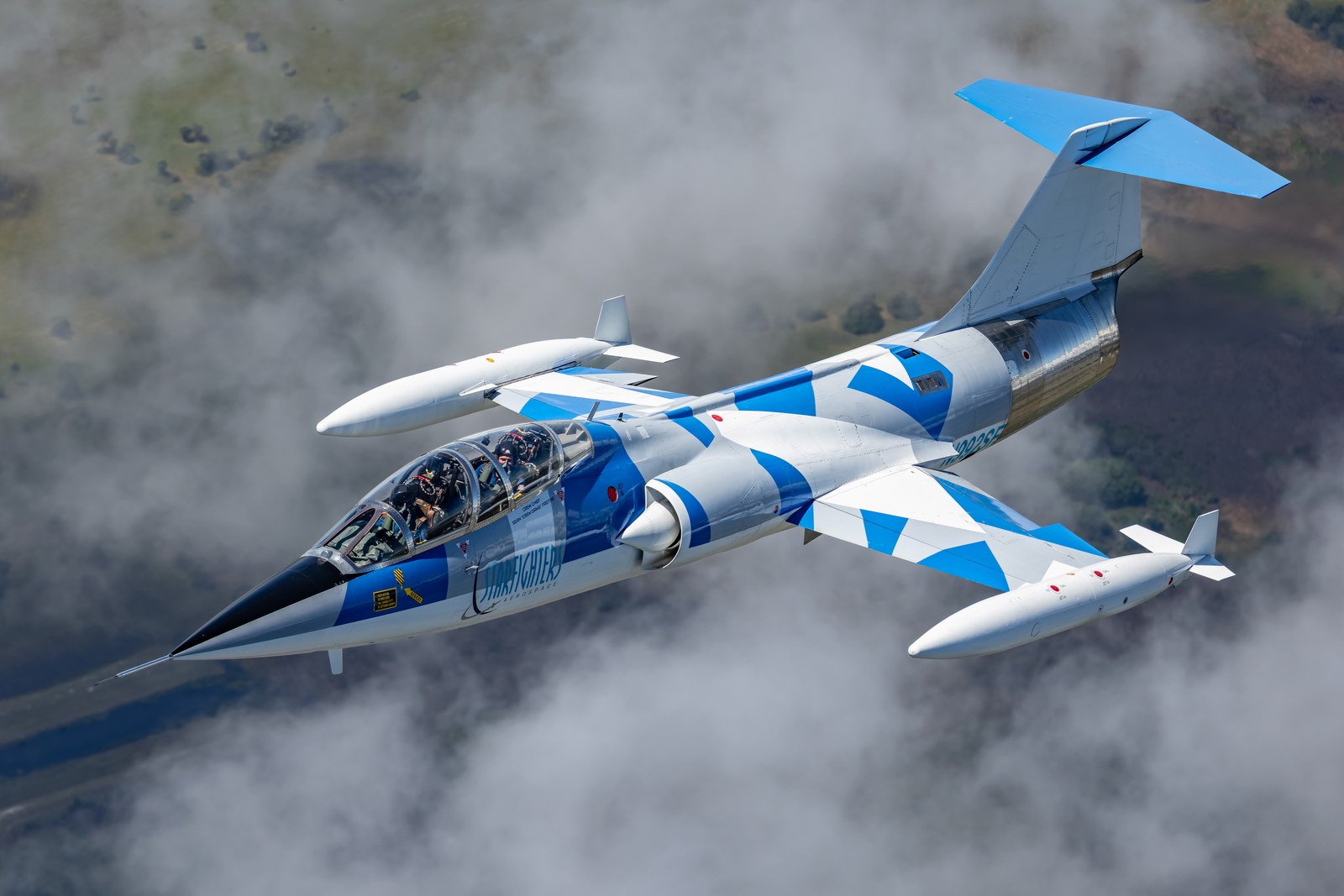
F-104 Starfighter photographs of an aircraft actually in the air are governed by a single number, and the number is seven. Seven Starfighters are held in flying condition anywhere in the world, all of them with one operator in Florida, and and the fleet is flown from two sites. Against a production run of 2,578 airframes across seven lines in seven countries, that is one aircraft in 369. No air force has flown the type in front line service since 31 October 2004, which means every image of a Starfighter in flight made after that date comes from the same small pool of civil aircraft, on the days that pool is flown, with a camera ship alongside. Our own contribution to it is 164 photographs of one aeroplane, 59 of them air-to-air, made during the Sun N Fun Aerospace Expo in Florida in 2025.
On this page
- Why F-104 Starfighter photographs are scarce
- What we hold: 164 frames of N992SF
- The aircraft, and what the frames show
- The angles buyers ask for
- Who buys Starfighter imagery, and why
- The Widowmaker story, with the numbers attached
- Technical quality and delivery
- Licensing terms in plain English
- Commissioning new Starfighter photography
- Getting the caption right
- A short history for people writing about it
- How to request Starfighter images
- Frequently asked questions
Why F-104 Starfighter photographs are scarce
The scarcity rests entirely on the population of aircraft capable of leaving the ground, and the arithmetic is unusually brutal.
Start with military service, because that is where almost all aviation photography of a fast jet comes from. The last front line operational flight of an F-104 took place on 31 October 2004, when an Italian Air Force F-104S/ASA-M, MM6930 carrying the code 9-99, flew with 9 Stormo from Grazzanise. No air force has operated the type since. That is more than two decades in which no photographer has stood on a flight line, or a crowd line, or in the back of a tanker, and seen a serving Starfighter go past. Turkey had already ended its operations in 1995. Every squadron aircraft in every one of the fifteen nations that flew the type is now in a museum, on a gate, or gone.

Then look at what survives in flying hands. Total production was 2,578 airframes, of which Lockheed built 789 and the rest were built under licence abroad. Against that, the population maintained for flight anywhere on earth is a fleet of seven airframes at a single operator. Seven out of 2,578 is one airframe in 369, or 0.27 per cent of every Starfighter ever built. Put the other way round, more than 99.7 per cent of the aircraft ever built will never fly again.
Those seven are also all with one operator. Our guide to aviation picture research covers the questions a buyer should ask of any set like this. Starfighters Aerospace runs the world’s only fleet of flight-ready F-104s, from the former Shuttle Landing Facility at Kennedy Space Center in Florida and from Midland International Air and Space Port in Texas. Every flying Starfighter in the United States belongs to one operator. Outside the United States there is nothing airworthy at all. Norway’s CF-104D, LN-STF, owned by Foreningen Starfighterens Venner at Bodø, flew again on 28 September 2016 and has displayed in Norway and Denmark since. It has been grounded since the autumn of 2019, and the obstacle is the rocket cartridges in its ejection seats, which are beyond their service life. Canada’s CF-104D 12633 at the KF Centre for Excellence in Kelowna has not flown since 2008, though the centre removed and inspected its engine in 2025 and is working towards engine runs and taxi trials.
Europe is the sharpest illustration of what that means for a picture desk. Between the Italian retirement and September 2016 no Starfighter flew in Europe at all. The gap ended with the Norwegian flight and closed again when that aircraft was grounded. A visiting American aircraft, N991SF, flew from Grosseto on 12 June 2023 and displayed at the Italian Air Force centenary show at Pratica di Mare later that month.
That last point is the one that decides whether new photography can be made at all. Ground photography of a static or taxiing Starfighter is possible whenever the operator appears in public. Air-to-air is a different proposition. It needs the operator to launch a jet, a second aircraft to serve as a camera platform, and a formation brief agreed before engines start. The documented instance in 2025 was the Sun N Fun mission of 2 April, flown with an Aviation Photo Crew Skyvan photo ship, in which N992SF held formation for roughly twenty-five minutes before returning to base.
The air-to-air camera time available on this type in a given year is measured in tens of minutes rather than thousands, and it is controlled by one operator in the United States.
What we hold: 164 frames of N992SF
Our Starfighter holding is 164 photographs of a single aircraft, all made at the Sun N Fun Aerospace Expo in Florida in 2025. The subject is a Lockheed TF-104G Starfighter, civil registration N992SF, formerly Italian Air Force MM54261, construction number 583H-5212, operated by Starfighters Aerospace and wearing a splinter camouflage scheme. 59 of the 164 frames are air-to-air.

The air-to-air material covers the shot list a picture editor works from rather than a single lucky angle. There are head-on passes, close pilot-perspective frames looking through the canopy, formation frames, banking passes that show the topside and then the underside, afterburner frames, and frames with the gear down. That range matters more than the raw count, because fifty-nine near-identical beam shots would solve one layout problem and no others, whereas this covers title cards, technical reference, markings features, mood spreads and documentary cutaways from the same sortie and in consistent light.
It is worth being equally clear about what the collection is not, because a picture researcher who discovers the limits after the layout is drawn will not thank anyone. This is one airframe, at one event, in one year. We do not hold images of any other Starfighter, any other operator, any other event or any other country, and we hold no period photography of the type. A project needing German, Canadian, Dutch or Japanese Starfighters, or any service aircraft from the type’s operational career, needs archive sources, and we would rather say so at the enquiry stage than at the proof stage.
Two things follow from the aircraft being civil-registered rather than military. Clearance is simple, because there is a live FAA registration, a named operator and a documented former military identity, which is what a broadcast compliance desk wants to see. And the caption has to be accurate about status: this is not a serving military aeroplane and must never be described as one. It is a civil-registered former Italian Air Force TF-104G on an FAA experimental certificate, flown by a commercial operator, which is both the correct description and, for several buyer categories, the interesting one.
The aircraft, and what the frames show
The TF-104G is the combat-capable two-seat conversion trainer version of the F-104G, built as Lockheed Model 583. It keeps the NASARR fire control system and the underwing weapon racks, but the 20 mm M61 Vulcan cannon is deleted to make room for the second cockpit, the centreline bomb rack goes with it, and internal fuel is reduced against a single-seater. Lockheed built 220 TF-104Gs, of which 48 were assembled from components made by the European consortium. The second canopy is visible in most of these frames, which makes an F-104G caption an error any reader who knows the type will spot.
The suffix in TF-104G-M, the designation the FAA carries for this airframe, is Italian. The M is for Modificato, and it denotes aircraft brought up to the ASA-M standard, the last Italian Starfighter update, ASA standing for Aggiornamento Sistema d’Arma, weapon system update. ASA-M added a canopy GPS antenna, Have Quick secure radio and a new TACAN, deleted the underfuselage pylon and the ECM fit, and introduced a grey scheme in FS 36280. The two-seaters received the ASA-M cockpit configuration and systems.

What the camera sees first, in every frame, is the wing, or rather the lack of one. It has a thickness-to-chord ratio of 3.36 per cent and a leading edge radius of 0.016 in, with 18 degrees of sweepback at the quarter chord and 10 degrees of anhedral, that is, negative dihedral. The span is 21 ft 11 in on an aircraft 54 ft 9 in long, which is why photographs of the type surprise people who have only seen it in a three-view. The leading edge was sharp enough that ground crews fitted protective felt strips over it when the aircraft was parked.
The wing is thin because thin wings make less drag at high Mach numbers, and it is small because Kelly Johnson wanted the lightest possible airframe around the biggest possible engine. Everything else about the aeroplane, including how fast it has to be flown to land, follows from that one decision. The anhedral improves roll control and high-altitude stability, which the aircraft needed because the tailplane mounted on top of the fin produces a strong rolling moment in sideslip. The trade-off is high induced drag when manoeuvring at high g.
The gear-down frames are the ones that reward explanation, because they show the answer Lockheed had to find to the problem the wing created. A small, thin, sharp-edged wing produces very little lift at low speed. The solution was in two parts: full-span leading edge flaps that droop for takeoff and landing, and boundary layer control, in which compressed air bled from the seventeenth stage of the engine compressor is ducted into the wing and blown out through slots along the trailing edge, over the upper surface of the flaps. The blown air re-energises the airflow across the flap, delays separation and lowers the stalling speed. For scale, the stalling speed of the F-104A is 198 mph.
On the TF-104G-M the consequence is rotation above 190 knots, an approach at 170 to 180 knots indicated, and 150 knots across the threshold, with engine rpm held above 80 per cent all the way down because the boundary layer control works only while the engine is producing bleed air. That is the detail worth putting in a caption or a script: the pilot cannot simply pull the power back on final. Less rpm means less bleed air, which means a less effective blown flap, which raises the stalling speed at the worst possible moment. The engine has to keep working for the wing to keep working.
The engine on this airframe is a General Electric J79-11B. The J79-11B is rated at 15,800 lb with afterburner and 10,000 lb at military power. The J79 family spans variants with different ratings, and the later production standard of 17,000 lb belongs to other marks. What all of them share is the feature that made the type possible: variable stator vanes, whose incidence changes with operating condition. Those vanes are the reason the J79 could hold a useful pressure ratio from a subsonic cruise all the way to Mach 2, and the reason the Starfighter could sustain Mach 2 rather than merely touch it in a dive. The engine occupies more than half the length of the fuselage, which is the physical fact behind the aircraft’s shape: essentially an engine with a cockpit in front of it and a small wing bolted to the side.
One point of caution on the scheme. The aircraft wears splinter camouflage in these photographs, and that is as far as any caption should go, because the operator has previously painted aircraft in non-standard schemes.
The angles buyers ask for
Picture research for an aircraft type is more specific than people outside the trade expect. Editors rarely ask for a Starfighter. They ask for a Starfighter doing a particular thing from a particular angle, because the layout or the script has already decided what the picture has to contribute.
The head-on pass is the drama frame, and it is the one that ends up on covers and title sequences. On this type it is also the most informative angle available, because head-on is where the wing disappears almost completely and the aeroplane reads as a fuselage with a cockpit and two stubs, which is the visual fact every reader remembers afterwards. It is also the hardest frame to make, requiring the subject to fly at the camera ship with both aircraft safely separated, which is a matter of briefing rather than luck.

The close pilot-perspective frames through the canopy are the documentary material, and producers building a stills sequence ask for them more often than anything else, because they put a person in the story. One caution attaches: we do not supply crew names for close portrait frames without permission.
The banking passes do two jobs in one sequence. Rolling towards the camera gives the topside, which is what a markings feature, a profile artist or a modelling reference needs, because it shows panel lines, the full planform of that remarkable wing and the demarcation of the camouflage. Rolling away gives the underside, which is the angle a museum walk-round can never supply and which decal producers and simulation developers ask for specifically.
The afterburner frames are the energy pictures, and they carry a page about performance, records or the operator’s hypersonic test work. The gear-down frames are the technical ones, showing the aircraft with the leading edge flaps drooped, which is what any caption about the type’s landing behaviour needs beside it. The formation frames are the context pictures, useful in a way that is easy to overlook: they place the aircraft in relation to something else and give a designer somewhere to put type. Tell us what the picture has to do rather than which angle you think you want, and we will select against the job.
Who buys Starfighter imagery, and why
Six categories account for most requests for this type, and they want different things from the same set of files.
Book and magazine publishers. Cold War aviation is a permanent backlist category and the F-104 is one of its named aircraft. The problem for a picture editor is that almost everything available is period monochrome, museum static or preserved airframes in poor light. A modern, high-resolution colour air-to-air set of a flying example solves a jacket or a double-page spread that archive material cannot.
Documentary and factual television. Programmes on the Cold War, on NATO air power, on the German Starfighter story and on aviation safety all need stills for graphics, lower thirds and sequences. Broadcasters want licensed, cleared, high-resolution material with a named operator and a traceable airframe identity, and this aircraft has a documented Italian Air Force provenance and a live FAA registration.
Museums and heritage organisations. Institutions holding a static F-104 are spread across the United States, Canada, Germany and Italy, and not one of them can photograph the type flying. Interpretation panels, exhibition graphics, catalogues, membership magazines and fundraising material all need an image of the aircraft in the air. This is a repeat-licence category with long terms and good renewal behaviour.
Model, decal and simulation companies. Kit manufacturers, decal producers and simulation developers need the angles a walk-round cannot supply: underside, gear-down, canopy detail, panel lines and camouflage demarcation in flight. The splinter scheme is precisely the sort of subject a decal sheet or a livery pack is built around, and a commercially produced desk model of N992SF already exists, which is a fair indication of the appetite here.

Aerospace and defence corporate use. This is the highest-rate category on the list, and it exists because the operator is a live commercial business rather than a preservation group. Starfighters Space, Inc. is publicly traded on NYSE American under the ticker FJET, trades operationally as Starfighters Aerospace, and works in hypersonic component test and evaluation, microgravity experiments, spaceflight simulation, jet warbird pilot training and the STARLAUNCH air-launch programme for small satellites. The one customer named in its most recent annual filing is Boom Supersonic, for which it flew pilot training missions. Starfighters Space describes itself as one of the only commercial operators able to fly payloads at sustained Mach 2 while retaining a launch capability. Corporate communications, investor material, trade-show graphics and capability brochures in that sector need imagery of the actual platform in flight, and there is exactly one platform.
The German and Italian markets. Germany bought 916 Starfighters, more than a third of all production, and the type is a fixture of German popular history, defence journalism and public broadcasting, recurring whenever procurement or air force safety is in the news. No German Starfighter has flown since 22 May 1991, so the shortage of modern flying imagery in that market is permanent. The caveat is absolute: this aircraft is an ex-Italian TF-104G-M and can illustrate the type, but must never be captioned as a Luftwaffe aircraft. Italy is the more natural fit for this specific airframe, which served with 20 Gruppo, 4 Stormo at Grosseto, and Italy flew the type longer than anyone.
| Date | Anniversary | Market it drives |
|---|---|---|
| October 2027 | 40 years since the F-104 was withdrawn from Luftwaffe operational units | German publishing and broadcast |
| 20 February 2028 | 70 years since USAF service entry with the 83rd Fighter Interceptor Squadron | United States |
| 7 and 16 May 2028 | 70 years since the world altitude and world speed records | General and records features |
| December 2028 | 70 years since the time-to-climb record series at Point Mugu | United States, records features |
| 4 March 2029 | 75 years since first flight | The largest peg in the window, general and international |
| 31 October 2029 | 25 years since the last front line operational flight of an F-104 | Italy, and end-of-an-era features |
The practical consequence is that book and magazine commissioning for a March 2029 anniversary begins in 2027, and picture research typically runs twelve to eighteen months ahead of publication. The 75th anniversary of first flight is the peg to sell against, and the window opens in 2027.
The Widowmaker story, with the numbers attached
Any commissioning editor working on this type will meet the Widowmaker story, and most retellings of it are wrong in the same way. The German figures are firm. West Germany procured 916 F-104s, lost 292 of them in accidents, which is 31.9 per cent of the fleet, and 116 pilots were killed. The worst single year was 1965, with 26 accidents and 16 deaths. The last German fatality on the type was on 11 December 1984, the aircraft was withdrawn from operational units in October 1987, and the last German Starfighter flight was made by F-104G 98+04 with WTD 61 at Manching on 22 May 1991.
What is usually missing is the comparison. Set against its contemporaries the German record is bad but not the worst. On the figures below it is the lowest share in the table.
| Operator or type | Losses | Share of fleet |
|---|---|---|
| German F-104 | 292 of 916 | 31.9 per cent |
| Canadian CF-104 | 110 of 238 | 46 per cent, the highest share of any F-104 operator, on a fleet that flew more hours than the German one |
| RAF English Electric Lightning | Not published | 45.58 per cent, for a type flown only as an interceptor |
| Netherlands and Belgium F-104 | Not published | approximately 35 per cent |
| Danish F-100D | Not published | approximately 35 per cent |
| Bulgarian MiG-19 | Not published | 48 per cent |
| Hungarian MiG-21F-13 | Not published | approximately 37 per cent |
Canada lost a higher proportion of its Starfighters than Germany did. The RAF lost a comparable proportion of its Lightnings. Bulgaria lost a higher proportion of its MiG-19s. The German story is the famous one partly because Germany bought so many aircraft that the absolute numbers were large, partly because the losses were concentrated in the mid-1960s while the air force was being rebuilt from nothing, and partly because it became a political scandal.
The causes do not reduce to a bad aeroplane either. Esser and Ruff-Stahl’s 2020 HFACS study in the Journal of Aviation Technology and Engineering examined 71 German F-104 accidents from 1978 to 1986 and found that more than half were attributable to technology or the physical environment, and that more than half of the sample was engine related. The type was more accident-prone than its contemporaries, and the J79 was a significant reliability concern in German service. Lockheed ran a programme called SURE, the Starfighter Utilization Reliability Effort, to work through production and operational problems, and funded specialist pilot training. The nickname itself is German in origin and specific to the German experience; Italy called the aircraft the Spillone.
One design decision belongs in the same passage because it is so often misremembered. The first Starfighters ejected their pilots downwards, because Lockheed’s engineers did not believe a seat could clear that high tail at the speeds the aircraft was built to fly. The logic held at altitude and failed on the runway, which is where most ejections actually happen, and the type was rebuilt around an upward seat. The Stanley C-1 downward seat gave way to the Lockheed C-2 upward seat across the A, B, C, D, F, G, J and DJ variants, and several air arms fitted Martin-Baker seats as the final standard, Italy adopting the IQ7A for ejection from a standstill on the ground. No caption should state which seat is fitted to the aircraft in these photographs.
Technical quality and delivery
Air-to-air photography is unforgiving, and the technical standard behind the frames determines what the files can be used for. Everything is shot in RAW and processed to preserve real detail rather than to manufacture it. On a splinter-camouflaged subject that means resisting the temptation to crush the shadows in the darker segments of the scheme or to push saturation into the sky behind it. The demarcation between the camouflage colours is what a modelling feature or a profile artist is buying, and heavy processing destroys it faster than anything else.

Resolution is full-frame at 24 megapixels or better, delivered without downsampling. In practical terms that supports a double-page spread at 300dpi with room to crop, a book cover with bleed, an exhibition print at normal viewing distance, and any current broadcast standard including 4K stills with pan and scan. High-quality JPEGs are supplied as standard, TIFFs are available for print production, and files are never downsampled before delivery.
Delivery is by direct download link, normally the same working day for anything already in the archive. Files arrive with embedded IPTC metadata containing the caption, credit line, date and location, plus the aircraft type, variant, registration and former identity, so the information travels with the image instead of being retyped, and mistyped, at every stage. If you need a particular metadata schema or credit format for house style, tell us and the files will be supplied that way.
Licensing terms in plain English
We license Starfighter photography for editorial, commercial and advertising use, and we try to keep the paperwork proportionate. Editorial licensing covers books, magazines, newspapers, documentary and broadcast, museum interpretation and exhibitions, and educational publishing. Commercial and advertising licensing covers corporate and promotional use, packaging, merchandise and campaigns, and is quoted separately because the value depends on the scale and territory of the campaign rather than on the picture.
Rights-managed is our normal basis. You tell us the use, the territory, the print run or audience, and the duration, and we quote for that. It keeps costs proportionate to the actual use, and a regional magazine is not charged as though it were a global campaign. Exclusivity is available, whether for a period, a territory or a market sector, and is quoted on request. Where a project needs something simpler, we can arrange a broader licence covering a set of images across a whole publication or series.
Pricing is negotiable, and we will match or beat what you pay other aviation agencies for comparable imagery for comparable material. That reflects the fact that we shoot and own the work directly, without the layers of commission that sit between a photographer and a picture desk at a large agency, and it means that if you hold a quote for equivalent imagery elsewhere, we would rather have the conversation than lose the commission.
Practical questions get practical answers. Turnaround for material already in the archive is normally the same working day and always within twenty-four hours on a working day. Rush requests against a deadline are welcome and carry no surcharge. If you need to see options before committing, we will send low-resolution watermarked selects for layout at no charge, and there is no fee for a search. Repeat and volume users are quoted accordingly, and publishers running a series can be set up on standing terms.
Commissioning new Starfighter photography
If what you need does not exist, it is worth asking whether it can be made, and it is worth asking early. Commissioning air-to-air photography of this type is a different exercise from commissioning it of a military aircraft, because there is no public affairs office in the chain. There is one commercial operator, in Florida, with a fleet of seven airframes and a working business in hypersonic test, air-launch and pilot training that has first call on those aircraft and on the people who fly them.
That changes the shape of the request rather than making it impossible. A sortie needs the operator to launch, a camera ship to fly the platform, formation-qualified crews on both aircraft, a brief agreed on the ground and weather that cooperates. What a commission buys, when it can be arranged, is control of the result: the angles, the configuration, the light and the background are flown to a shot list rather than assembled from whatever the day produced. For a publisher planning a major title against the 2029 anniversary, that is the difference between illustrating a book and defining it. Treat the access as the calendar constraint rather than the photography, and talk to us while the project is still taking shape rather than when the layout is drawn.
Getting the caption right
This airframe carries four separate identifiers, and they are routinely confused with one another. The table below is the version to hand to a sub-editor.
| Identifier | What it is |
|---|---|
| N992SF | The United States civil registration, held by Starfighters International Inc of Merritt Island, Florida, current to 31 March 2030, with an FAA experimental airworthiness certificate issued on 26 December 2024. This is the aircraft’s legal identity and the one a caption should lead with. |
| MM54261 | The former Italian Air Force military serial. MM is Matricola Militare, the Italian military serial prefix. Written unspaced, never as MM 54261 or M.M.54261, and always marked as former. |
| 583H-5212 | The Lockheed construction number. 583 is Lockheed’s model number for its two seat Starfighters, covering the CF-104D and the F-104DJ as well as the TF-104G, the letter denotes the production version or customer block across six versions running from 583C to 583H, and the figure after the hyphen is the sequential airframe number. |
| 20-26 and 4-42 | The Italian Air Force unit code carried in service with 20 Gruppo, 4 Stormo at Grosseto. The first figure is the Gruppo or the Stormo, the second the individual aircraft. |
The recommended full caption for a lead image is: Lockheed TF-104G Starfighter N992SF, formerly Italian Air Force MM54261, operated by Starfighters Aerospace, photographed air-to-air over Florida during the Sun N Fun Aerospace Expo, 2025. The short form is: Lockheed TF-104G Starfighter N992SF, ex-Italian Air Force, Starfighters Aerospace.

The manufacturer name is the error most likely to be spotted. The airframe is recorded as a 1969 build, and in 1969 the company was Lockheed Aircraft Corporation. It became Lockheed Corporation in 1977 and Lockheed Martin Corporation in 1995, on the merger with Martin Marietta. Lockheed TF-104G Starfighter is the everyday form and the one the trade press uses; Lockheed Aircraft Corporation TF-104G Starfighter is correct if the full corporate name is wanted. Lockheed Martin TF-104G is wrong by 26 years.
Provenance is the second trap, and it is set by the fame of the German story. This aircraft is ex-Italian, and its traced service is 20 Gruppo, 4 Stormo at Grosseto. Six ex-German TF-104Gs did go to Italy in 1984, when the Italian two-seat fleet went from an initial 24 aircraft to 30, so a writer reaching for the better-known narrative can construct something that sounds plausible and is not true of this airframe. Nor should the splinter scheme be described as a Luftwaffe scheme, an Italian Air Force scheme or an authentic period finish. Describe it as a splinter camouflage scheme and make no claim about which air force it represents.
Four smaller points save trouble at the proof stage. Do not write that the aircraft is in service or serving with anyone; operated by is the correct verb for a civil aircraft on an experimental certificate. Do not call it the only F-104 in the world or the only one flying; it is one of a handful of Starfighters still flying anywhere in the world, all of them with a single operator in Florida. Caption the location as Lakeland, not as the aircraft’s base. The aircraft lives at the former Shuttle Landing Facility inside Kennedy Space Center, operated by Space Florida as the Launch and Landing Facility, while the photographs were made at, and in the air near, Lakeland, roughly 100 miles away. And if thrust is quoted, quote this airframe’s engine of record, a J79-11B rated at 15,800 lb with afterburner, rather than the 17,000 lb figure that belongs to later marks.
One last convention. Starfighters Aerospace is the operating name to use in editorial captions. Starfighters Space, Inc. is the corporate entity, for when the company itself is the subject. Starfighters International Inc is the registered owner of record on the FAA registration. All three are correct in context, and mixing two of them inside one caption is not.
A short history for people writing about it
Design work began in November 1952, prompted by what American pilots had met in the MiG-15 over Korea, and the premise was minimum weight and minimum complexity for maximum speed and rate of climb. The wings were seven feet long and sharp as the blade of a dagger, on an aircraft conceived as an inexpensive lightweight fighter. The XF-104 prototype, 53-7786, first flew on 4 March 1954 with Tony LeVier at the controls. The F-104A entered USAF service on 20 February 1958 with the 83rd Fighter Interceptor Squadron at Hamilton AFB, California.

What followed over the next two years is the reason the type has a permanent place in records journalism. On 7 May 1958 Major Howard C. Johnson took YF-104A 55-2957 to 27,811 m, which converts to 91,243 ft, for the world absolute altitude record. On 16 May 1958 Captain Walter Irwin flew YF-104A 55-2969 from Edwards AFB to a world absolute speed record of 2,259.538 km/h, or 1,404.012 mph. In the space of nine days in May 1958 the Starfighter took both the world absolute altitude record and the world absolute speed record, the first aircraft to hold the two at once. It went on to hold the world records for speed, altitude and time-to-climb at the same time, the climb records set at NAS Point Mugu on 13 and 14 December 1958, with 3,000 m reached in 41.85 seconds and 25,000 m in 266.03 seconds. On 14 December 1959 Captain Joe B. Jordan took F-104C 56-885 to 31,513 m, or 103,389 ft, the first world altitude record above 100,000 ft and the first time an aircraft taking off under its own power had exceeded that height. The 1958 Collier Trophy went to the team behind the aircraft and its engine.
It was the first interceptor in American service able to fly at sustained speeds above Mach 2. It is also the aircraft Lockheed marketed as the missile with a man in it, a nickname worth using as a nickname and never as an engineering description.
The type’s real career, though, was European and Asian rather than American. Of 2,578 airframes built, Lockheed built 790 in the United States and 1,790 were built under licence abroad, which is 69.4 per cent of all production. Fifteen nations operated the Starfighter, and NASA flew it as well.
| Manufacturer | Country | Airframes |
|---|---|---|
| Fiat, later Aeritalia | Italy | 445 |
| Fokker | Netherlands | 350 |
| Canadair | Canada | 340 |
| Messerschmitt-Bölkow group | West Germany | 260 |
| Mitsubishi | Japan | 207 |
| SABCA | Belgium | 188 |
Italy’s involvement runs from that production line to the end of the story. The Italian Air Force took an initial fleet of 24 TF-104Gs, all built by Lockheed at Palmdale, the second twelve airlifted to Turin and reassembled by Fiat, the first of them MM54226 delivered on 23 February 1965, and topped the fleet up to 30 with ex-German aircraft in 1984. Italy flew the type longer than anyone, retaining a small number for the Reparto Sperimentale Volo even after the front line retirement of 31 October 2004. The J79 went on to power the Convair B-58 Hustler, the McDonnell F-4 Phantom II and the North American RA-5 Vigilante.
How to request Starfighter images
The quickest route is to tell us what the picture has to do. A message describing the project, the angle or mood you need, the intended use and the deadline will normally come back the same working day with a selection of low-resolution files for layout and a price for the use described. Because this holding is one aircraft from one event, an enquiry can be answered precisely: either the frame you need is among the 164, or it is not, and we will say which.
A closing thought for anyone weighing a Starfighter project against a deadline further out. Of 2,580 aircraft built, seven are held in flying condition, four were airworthy at the last published count, and all of them belong to one operator in the United States. No air force has flown the type in front line service since 31 October 2004, and nothing about that arithmetic is going to improve. The photographs of this aeroplane in the air either exist or they do not, and the ones that exist were made in a window of about twenty-five minutes.
Requesting images. Email sales@piemags.com with the subject you need, the medium, the territory, the print run or audience, and your deadline. That is enough to quote against. Licensing terms are set out on the Piemags licences page.
For the technique behind photographing anything this fast, see our guide to photographing fast jets. For the questions a picture buyer should be asking of any set like this one, see our note on aviation picture research, and for a type with a comparable licensing story our guide to licensing F-4 Phantom photographs.
Frequently asked questions
Which Starfighter appears in these photographs?
A Lockheed TF-104G Starfighter, civil registration N992SF, formerly Italian Air Force MM54261, construction number 583H-5212, operated by Starfighters Aerospace and wearing a splinter camouflage scheme. All 164 photographs are of this one aircraft, made at the Sun N Fun Aerospace Expo in Florida in 2025.
How many of the photographs are air-to-air?
59 of the 164 frames are air-to-air. They cover head-on passes, close pilot-perspective frames looking through the canopy, formation frames, banking passes showing the topside and the underside, afterburner frames, and frames with the gear down.
Why are air-to-air photographs of a flying F-104 so hard to find?
Because of the population of flying aircraft. Seven Starfighters are held in flying condition anywhere in the world, all with one operator in the United States. Against 2,578 airframes built, seven is one aircraft in 369, or 0.27 per cent. No air force has flown the type in front line service since 31 October 2004, and air-to-air access happens only when the operator launches with a camera ship.
What resolution are the files, and will they take a double-page spread?
Yes. Images are shot on full-frame professional bodies and supplied at native resolution, 24 megapixels and above, which gives a double-page spread at 300dpi with room to crop, plus cover use, exhibition printing and any current broadcast standard. High-quality JPEGs are standard, TIFFs are available for print production, and files are never downsampled before delivery.
How much does it cost to license an F-104 Starfighter photograph?
It depends on the use rather than the picture. We license on a rights-managed basis, so tell us the medium, territory, print run or audience, and duration, and we will quote for exactly that. A regional magazine is not priced as a global campaign. Pricing is negotiable, and we will match or beat what you pay other aviation agencies for comparable material.
How quickly can you supply images against a deadline?
Same working day for anything already in the archive, and always within twenty-four hours on a working day. Rush requests are welcome and carry no surcharge. If you need to lay out before committing, we will send low-resolution watermarked selects free of charge, and there is no search fee.
Do you hold historic Starfighter imagery, or pictures of German aircraft?
No. This is one airframe, at one event, in one year, and we hold no period photography of the type and no images of any other Starfighter, operator or country. A project needing German, Canadian, Dutch or Japanese Starfighters needs archive sources, and we would rather say so at the enquiry stage than at the proof stage.
Can you shoot new Starfighter photographs to a brief?
It is worth asking early. There is no public affairs office in the chain for this type, only one commercial operator in Florida with a working business in hypersonic test, air-launch and pilot training that has first call on the aircraft. A sortie needs the operator to launch, a camera ship, formation-qualified crews, a brief agreed on the ground and cooperative weather, and the access rather than the photography is the calendar constraint.
What is the difference between editorial and commercial licensing here?
Editorial licensing covers books, magazines, newspapers, documentary and broadcast, museums, exhibitions and educational publishing, and is priced by circulation and duration. Commercial and advertising licensing covers promotional campaigns, packaging and merchandise, and is quoted separately because value scales with the campaign rather than the image. Tell us which applies and we will quote the right one.
Can I get exclusive use of an image?
Yes. Exclusivity can be arranged by period, by territory or by market sector, and is quoted on request. Publishers planning a signature cover image or a broadcaster building a title sequence often take a limited exclusivity so that the same frame does not appear on a rival product during the campaign, and that is simple to arrange.
What credit line do you require, and is metadata embedded?
The standard credit is Aviation Photo Crew, and we will supply it in your house format if you have one. Every file carries embedded IPTC metadata with the caption, credit, date and location, plus the aircraft type, variant, registration and former identity, so the information travels with the image through production instead of being retyped at each stage.
Which anniversaries should a publisher be planning against?
The 75th anniversary of first flight falls on 4 March 2029 and is the largest peg in the window. Before it come 40 years since the F-104 left Luftwaffe operational units in October 2027, 70 years since USAF service entry in 2028, and 70 years since the altitude and speed records on 7 and 16 May 2028. Commissioning for a March 2029 anniversary begins in 2027, and picture research runs twelve to eighteen months ahead of publication.
The Starfighter was Kelly Johnson’s work, and it sits in a line that runs from the first American jet fighter to the F-117. See our history of Lockheed’s Skunk Works.
