On this page
- Why air-to-air Red Arrows photographs are hard to come by
- What we hold: twelve air-to-air Red Arrows frames
- The aircraft, and how the markings date the pictures
- The angles buyers ask for
- Who buys Red Arrows imagery, and why
- Seven, not nine, and why a picture editor should care
- Technical quality and delivery
- Licensing terms in plain English
- Insignia, trade marks and the trap for commercial users
- Getting the caption right
- A short history for people writing about the team
- How to request Red Arrows images
- Frequently asked questions
- Sources
The Red Arrows photographs in this guide show a nine aircraft formation wearing the Royal Air Force centenary markings, made air to air from a camera aircraft in July 2018. Neither half of that description can be arranged again. The aircraft carry the RAF centenary emblem, marking RAF100, the centenary of the Royal Air Force, which fell on 1 April 2018. The nine aircraft formation has come and gone in the seasons since, and the 2026 aerobatic display is flown by seven aircraft, Reds 1 to 7, with nine used only for selected flypasts including national and state occasions.
The frames were shot at the Royal International Air Tattoo of 2018, held from 13 to 15 July at RAF Fairford in Gloucestershire under the theme RAF100, the centenary of the Royal Air Force marked on 1 April 2018. They are not display pictures. Nothing here was taken from a crowd line or a public enclosure. The camera was in another aeroplane, flying with the formation, and the aircraft are seen from above and from slightly behind with the countryside running away beneath them. All the frames carry the credit line Aviation Photo Crew.
Formation size is the first thing a picture researcher should count, because it dates the image on its own. The team flew seven aircraft in the 2022 season and eight in 2023. The Diamond Nine was restored for the 2024 season. Seven is the number for 2026. A photograph showing nine aircraft in the aerobatic configuration therefore does not come from 2022, from 2023 or from 2026, and one showing the RAF100 emblem comes from 2018.
Behind that sits the aircraft. The team flies the BAE Systems Hawk T1, and on 1 June 2026 the fleet stood at 24 airframes, of which 14 had used more than 80 per cent of their fatigue index. Two aircraft, XX159 and XX301, have been deregistered since 16 January 2025 as part of a managed drawdown ahead of the planned Out of Service Date. The Hawk T1 is expected to serve the team until the end of the 2029 display season, with a formal Out of Service Date of March 2030. Every air to air frame of the type in its display markings is now a picture of an aeroplane with a published end date.
Why air-to-air Red Arrows photographs are hard to come by
Start with how the picture is made. An air show photographer works from the ground, at a fixed point on one side of a display line, and photographs whatever passes. An air to air photograph is a different undertaking. It requires a second aeroplane carrying the photographer, and a sortie flown for the purpose, with the formation and the camera aircraft airborne together. It cannot be obtained from the ground at any show, in any weather. The viewpoint it delivers looks down on the formation and along the smoke rather than up at it.

The content of the picture then dates itself, and this is where a buyer needs to be careful with stock captions. The number of aircraft the team puts into its display has moved across recent seasons. Seven were flown in 2022. Eight were flown in 2023. Nine returned for the 2024 season. For 2026 the RAF gives seven for the aerobatic display, with the eighth and ninth aircraft joining only for selected flypasts. An image of nine aircraft in formation is not a general purpose illustration of the Red Arrows as they fly now. It is a photograph of a particular arrangement that the team has used in some seasons and not in others, and a caption that reads simply “the Red Arrows” will mislead a reader who counts the aircraft.
The markings narrow it further. The aircraft carry the RAF centenary emblem on the forward fuselage, marking RAF100, the centenary of the Royal Air Force, which fell on 1 April 2018. The frames themselves were made at the centenary show that July. A picture editor working to a brief that calls for centenary imagery has a closed pool to work from, bounded by one season, and a picture editor who wants the team as it looks in a current season should not use these frames.

The fleet position closes the gap from the other end. The Hawk T1 no longer serves anywhere else in the Royal Air Force. It was withdrawn from 100 Squadron on 31 March 2022, and the surviving airframes are allocated solely to sustaining the Red Arrows. Of the 24 aircraft in the fleet on 1 June 2026, 14 had passed 80 per cent of their fatigue index, and the drawdown towards the Out of Service Date of March 2030 has already taken two airframes off the register. The 2029 display season is expected to be the type’s last with the team, its fiftieth, counting from the first Hawk season in 1980. Sustainment funding of 860 million pounds is committed to keeping the Hawk T1 and T2 flying safely until the Jet Training System arrives, and the Defence Investment Plan published on 30 June 2026 commits to new jets that will allow the Red Arrows to replace the ageing Hawk. No replacement type has been chosen: a competition is committed to but no aircraft is named, and no in-service date has been published.
This guide makes no claim about what other photographers hold. What the position does mean is that the combination in front of you, nine aircraft, RAF100 markings, air to air, is bounded by facts that are now closed, and that the supply of such frames cannot be increased.
What we hold: twelve air-to-air Red Arrows frames
The holding is small and it is worth stating its size exactly, because a buyer planning a picture spread needs to know what the ceiling is before they enquire. There are 12 Red Arrows frames in the Piemags archive in total. Eight of them are published in the body of this article. One further frame runs as the opening image. The remaining frames sit in the same archive set and are not reproduced in the body of this article.
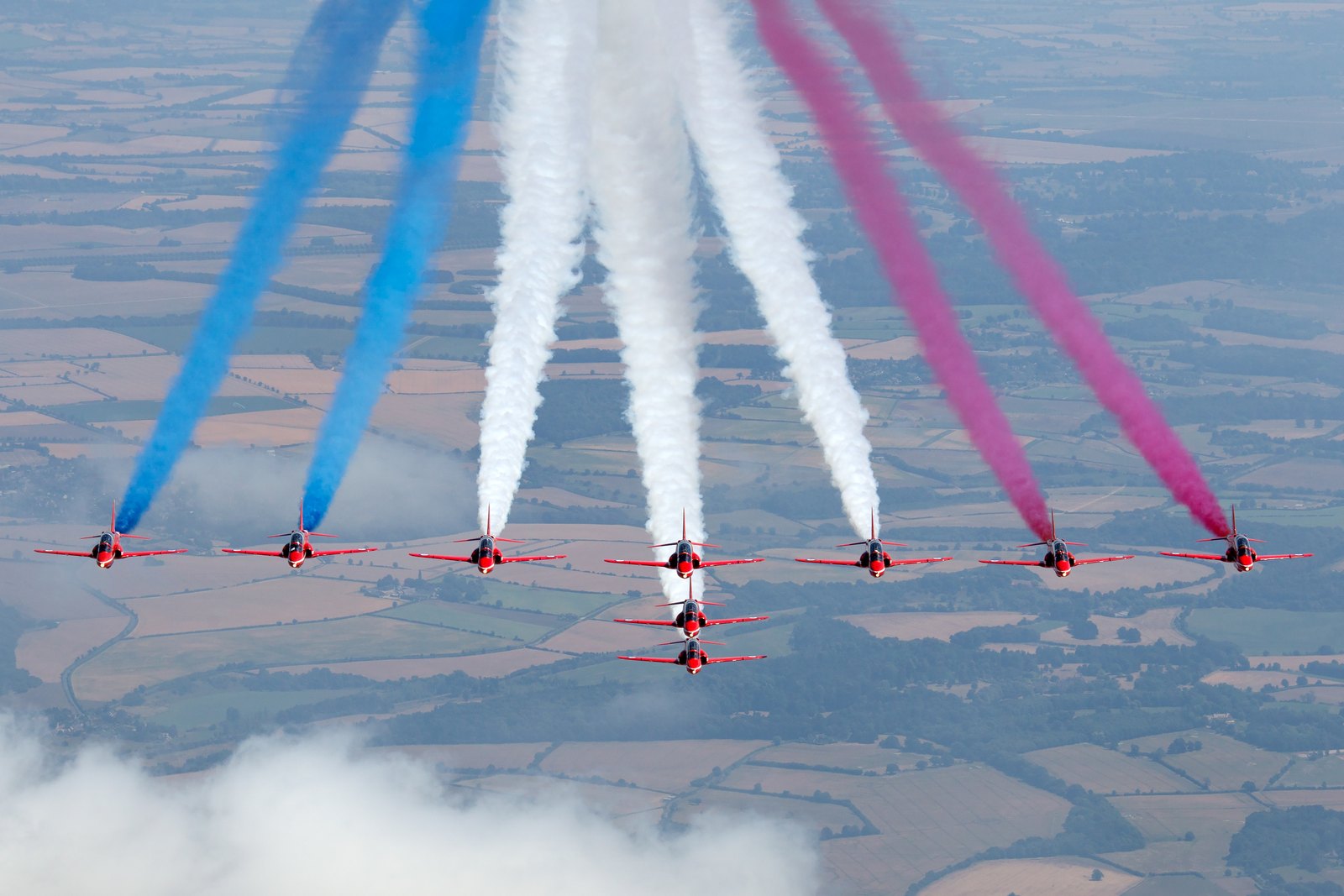
All of the frames come from the same air to air work. The team is seen in formation from above and from slightly behind, over farmland and small settlements, in summer light. That single viewpoint is consistent across the set, which is a strength for a designer laying out a sequence and a limitation for anyone who needs variety of angle within one commission. The opening image is a head on frame, with all nine aircraft visible and the full red, white and blue trail extending behind them. A second head on frame exists in the archive in portrait format.

The smoke varies from frame to frame and is worth checking against the layout before selection. In three of the eight frames published here the trail carries all three colours. In three more the whole formation is trailing white. In the remaining two it is red and blue, with no white at all. For a cover, an endpaper or any design that depends on the tricolour reading cleanly across the width of the page, that distinction decides the selection, and it is not something a thumbnail will always show.
The files are supplied at native resolution. They are whole frames rather than crops, and native pixel dimensions run from 2,541 by 1,694 to 4,188 by 2,792. All are 3:2 in aspect ratio apart from the single portrait frame, which is 2:3. The credit line for every frame is Aviation Photo Crew.
What is not in the set matters as much as what is, and the list is short. There is no ground or crowd line coverage here. There are no cockpit interiors. There is no engineering or personnel coverage, nothing of the technicians who service the aircraft, nothing of the pilots on the ground. There is nothing of the team at any other event, and nothing from any other year. A publisher building a book chapter that needs a spread of subjects, aircraft in the air, people at work, aircraft on the ground at base, will not find it in this holding, and should say so at the enquiry stage rather than discover it after a shortlist has been circulated. What the set does supply, in depth, is the formation in flight in its centenary year, photographed from the air.
The aircraft, and how the markings date the pictures
The aircraft in these frames is the BAE Systems Hawk T1, described by the Royal Air Force as a fully aerobatic, low-wing, transonic, two-seat training aircraft. The prototype, XX154, first flew from Dunsfold on 21 August 1974 in the hands of the chief test pilot Duncan Simpson, and the type entered RAF service in 1976. The Red Arrows flew their first Hawk season in 1980, the Gnat having flown its final Red Arrows season in 1979. BAE Systems puts the global Hawk fleet at 650 aircraft across 16 countries.
The aircraft is a small one. The span is 9.39 m and the length 11.96 m. The engine is a Rolls-Royce Turbomeca Adour Mk 151 of 5,200 lb thrust, giving a maximum speed of Mach 1.2, a maximum altitude of 48,000 ft and a maximum range of 1,000 nm. Both T1 and T1A airframes are in team use.

One point of nomenclature repays care in a caption. The Hawk T1 is not a current RAF trainer. It was withdrawn from 100 Squadron on 31 March 2022, and the airframes that remain exist to sustain the Red Arrows. Advanced fast jet training is flown on the Hawk T2, which the team does not fly and which appears nowhere in this holding. Captioning a Red Arrows aircraft as an RAF advanced trainer, or as a T2, is an error that a specialist reader will spot immediately.
The markings are where the dating is done. Every aircraft in the set wears the red display scheme with a Union flag on the fin, RAF roundels, and ROYAL AIR FORCE titles along the fuselage. The forward fuselage carries the RAF centenary emblem, marking RAF100, the centenary of the Royal Air Force, which fell on 1 April 2018. It is a small device, legible at full resolution and not on a web-sized reproduction, which is a reason to work from the supplied file rather than from a preview. For a picture researcher checking an unfamiliar Red Arrows image from any source, the sequence is quick. Count the aircraft, which narrows the year. Look at the fin, the fuselage titles and the forward fuselage, which tell you the scheme. Then take the shoot date from the file’s own metadata rather than from a guess. Applied to this set, the answer is the same every time, and it is carried in the metadata of every file.
The angles buyers ask for
Requests for display team imagery arrive in a small number of recognisable shapes. The first is the topside formation shot, the aircraft seen from above with the pattern of the formation readable as a shape rather than as a row of silhouettes. The second is the head on frame with the full trail running back behind it. The third is a frame with enough quiet area for a cover line, a masthead or a strapline. The fourth is a frame with countryside beneath the aircraft, wanted for a national feel on a jacket or a tourism spread. This holding answers the first two outright, answers the fourth with one caveat, leaves the third to be judged frame by frame, and does not answer several other things a researcher may assume are available.
The topside shot is the one that cannot be bought from the crowd line at any price, because there is no vantage point on the ground that produces it. It exists only when a second aeroplane is flying with the formation and the camera is looking down. Every frame in this set is made that way, from above and from slightly behind, so the formation reads as a shape and the smoke runs away from the viewer rather than across the frame.

The head on frame with the full trail behind it is answered by the opening image, which shows all nine aircraft with the red, white and blue trail extending back from them. A second head on frame is held in portrait format, 2:3, which is the shape a book jacket, a poster or a full page advertisement usually wants. Those two frames are the ones to ask about if the brief is a cover rather than an interior spread.
Space for type is a judgement to make on the file rather than a claim to accept in advance. The topside frames put farmland and small settlements behind the aircraft rather than open sky, which is what a brief asking for a landscape setting wants and is not the same thing as an empty corner to drop a masthead into. Ask for the low resolution selects and lay the type over them.
What the set does not answer is short and worth stating plainly. Every frame shows the team in formation in the air, so there is no crowd line coverage, no aircraft on the ground, no cockpit interior and no coverage of the engineering and support staff. There is nothing from any other year and nothing from any other event. The ground beneath the aircraft is not identified, so a caption cannot place it.
Who buys Red Arrows imagery, and why
News and editorial desks want an image that can run at speed against a story about the team, the fleet or the display season, and what they need most is a caption they can trust, because a wrong aircraft count or a wrong base is the error a specialist reader writes in about. Editorial use of Ministry of Defence material sits under the MOD News and Editorial Licence, which expressly excludes departmental or public sector organisation logos, crests, military insignia and the Royal Arms, except where they form an integral part of a document or dataset or are incidentally displayed in images or film footage, and which requires that nothing be used in a way suggesting official status, association, partnership or endorsement by the MOD or the UK Government. That exclusion is the reason a commercial or merchandise user cannot treat an editorial permission as cover.
Book and calendar publishers work further ahead. A calendar needs twelve frames that hold together, in one aspect ratio, at a size that will stand a full page. A book needs frames that can be cut into a chapter without repeating the same shape three pages running.
Merchandise and collectables, scale model packaging and box art, jewellery, coins, clothing, games and playthings all sit in a different legal position from editorial. Insignia licensing for MOD names, logos and marks runs through Defence Intellectual Property Rights, the only authority able to issue such licences, which operates a dedicated Red Arrows Licence, while the Directorate of Defence Communications is the only authority that can approve how the insignia is applied to the product. The published terms run at 8.5 per cent of the net sales price of each licensed product, with a minimum of 100 pounds plus VAT per royalty period, a 500 pounds plus VAT application fee, and 5 million pounds of product liability insurance carrying an indemnity to principal clause. The composite mark ROYAL AIR FORCE RED ARROWS is registered to the Secretary of State for Defence. Its United States extension was cancelled on 20 June 2025, so the mark is not in force there. A picture licence covers the photograph. It does not and cannot cover the insignia, and a licensee needs both. Take your own advice on your own use.

The Royal Mint Red Arrows 50p, issued on 6 February 2025 to mark 60 years since the first public display in 1965, is the worked example of a high end licensed commercial use. It is a product carrying the team’s identity, released against a dated anniversary and planned long before that date arrived.
Airshow organisers and their programme and poster suppliers, charities running events, tourism and place marketing bodies and corporate advertisers all buy on that same pattern, against a fixed date with a long lead time. The dates worth planning against are 1964 for the team’s formation, 1 March 1965 for the squadron being officially constituted, 6 May 1965 for the first display flown to the press at RAF Little Rissington, 9 May 1965 for the first public display at Clermont-Ferrand in France, and 15 May 1965 for the first UK air show appearance at Biggin Hill. Formation and first display are separate anniversaries and a caption should say which is meant. The date that will move the market, though, is not a round numbered team anniversary. It is the retirement of the Hawk. The 2029 season is expected to be the type’s last with the team, and the formal Out of Service Date is March 2030. No in-service date for the team’s replacement aircraft has been published. Demand for pictures of Hawks in Red Arrows markings will be at its highest in the run up to that.
Seven, not nine, and why a picture editor should care
The number of aircraft the Red Arrows put into a display is not a constant, and treating it as one is a common source of error in Red Arrows captions. Seven aircraft were flown in the 2022 season. Eight were flown in 2023. The Diamond Nine was restored for the 2024 season. For 2026 the RAF gives seven aircraft, Reds 1 to 7, for the aerobatic display, with nine used only for selected flypasts including national and state occasions.
The RAF’s own website does not speak with one voice on this. The Red Arrows landing page still describes the trademark Diamond Nine. The displays page gives seven for 2026. The displays page is the current one, and a researcher who reads only the landing page arrives at the wrong answer while believing they are on a primary source.

For dating an image, this is a gift. Count the aircraft first. A nine aircraft aerobatic image is not from 2022, from 2023 or from 2026. If the brief is the team as it flies now, a nine aircraft frame is the wrong picture, however good it is, and the caption to use is that in 2026 the Red Arrows fly seven aircraft in aerobatic displays, with nine used only for selected flypasts and state occasions. If the brief is the team at full strength, at the size the formation has held for most of its history, then a nine aircraft frame is exactly the picture and the caption needs to carry its year.
It is worth knowing what the higher number buys you. These frames show a nine aircraft formation. Among national display teams that is a large one. Italy’s Frecce Tricolori fly nine in formation with a tenth as soloist, and Canada’s Snowbirds fly nine aircraft formations, while the US Navy Blue Angels and the USAF Thunderbirds each fly six. In 2026 the Red Arrows are flying below their own historic norm.
There is a precedent for a reduction. In a written answer of 7 May 1971 the Minister of State for Defence told Parliament that in view of the need to absorb new members into the team, and the shorter season than usual available for training, “the formation will operate only seven aircraft in place of the usual nine”, with the synchronised display manoeuvres replaced by individual aerobatics. The parallel is worth noting and worth not overstating. The circumstances of 1971 and of 2026 are not the same, and the seven aircraft display of 2026 is what the RAF states for 2026 rather than a permanent settlement.
As of 12 August 2026 the season is running and disrupted. Public Display Authority was granted on 22 May 2026 and the first UK display was flown on 29 May 2026, with the season due to run until October. In a statement published on 8 August 2026 the RAF said the team’s return from its tour of the United States had been postponed because of prolonged poor weather in north-eastern Canada, that the Atlantic crossing was expected to resume late in the week following that statement, and that Airbourne at Eastbourne, the Royal Edinburgh Military Tattoo and Lyme Regis Lifeboat Week had been lost. The Hawks are single-engined, cannot refuel in the air, and cross the Atlantic in stages.
Technical quality and delivery
Native pixel dimensions across the holding run from 2,541 by 1,694 to 4,188 by 2,792. Files are supplied at their native resolution and are never downsampled before delivery, so the print size available to you is set by the file itself rather than by anything done at this end. If the use is a large format one, a jacket, a poster or a spread, ask which frames carry the larger dimensions before the layout is committed, because the range across the set is wide.
The frames are whole frames rather than crops. All are 3:2 in aspect ratio apart from the single portrait file, which is 2:3, and no crop is required for any of them at 3:2. That matters more than it sounds. A whole frame gives a designer the photographer’s full field to work in, and a file that has already been cropped to fit somebody else’s page has taken that decision away. If a use needs a shape the set does not hold, a square for social, a shallow banner for a web header, cropping to it is a decision better taken with the whole frame in front of you.
High quality JPEGs are the standard delivery. TIFFs are available for print production on request. Every file carries embedded IPTC metadata holding the caption, the credit line and the date, so the information travels with the file through a picture desk, a design department and a printer without being retyped and without being lost at the first handover. The credit line for every frame in this set is Aviation Photo Crew.
Low resolution watermarked selects are supplied free of charge so that a designer can lay out with the actual images before any money changes hands. There is no search fee. Anything already in the archive is supplied on the same working day, and always within twenty-four hours on a working day. Rush requests are welcome and carry no surcharge, because a picture desk working to a deadline should not be paying extra for the deadline.
Licensing terms in plain English
These photographs are licensed rights managed, which means the price is set by the use rather than by the picture. Two buyers looking at the same file will not pay the same figure, because they are not buying the same thing. You tell us the medium, the territory, the print run or the audience, and the duration. You get back a quote for exactly that. A regional magazine running one image inside a feature is not priced as a global campaign.
That is the whole of the method. If the use is one image, in one book, in one territory, for one edition, that is what is quoted. Pricing is negotiable, and if you are already licensing comparable aviation imagery from another agency, tell us what you pay for it. We will match it or beat it.
The first thing to settle in any enquiry is which side of the editorial line the use sits on, because the two are priced on different logic. Editorial licensing covers books, magazines, newspapers, documentary and broadcast, museums and exhibitions, and educational publishing. It is priced by circulation and by duration, so a specialist title with a modest print run and a mass market newspaper are quoted differently for the same frame, and one edition costs less than a title that will stay in print for years.
Commercial and advertising licensing is quoted separately. It covers campaigns, packaging and merchandise, and it is treated on its own because the value of the use scales with the campaign rather than with the image. The same photograph on a poster site, on a product, or on a range of merchandise is doing a different job from the same photograph in a magazine feature. A commercial user also has a second matter to deal with, set out in the section below. The same division applies across the archive and in our licensing guide to F-104 Starfighter photographs.
Exclusivity is available and is quoted on request. It can be taken by period, so that no one else licenses the frame while your campaign or your edition runs, by territory, so that the frame is held out of one market while remaining available in others, or by market sector, so that a competitor in your own field cannot use it while a buyer in an unrelated field still can. Which of the three you need is worth raising at the enquiry stage.
The standard credit for every frame is Aviation Photo Crew.
Insignia, trade marks and the trap for commercial users
Licensing a photograph from a picture library and clearing the rights in what the photograph shows are two separate matters. A picture licence is a licence to reproduce that image. The badges, marks and insignia inside the frame are somebody else’s property, and they are not the photographer’s to grant. For editorial use this rarely bites. For commercial use, on merchandise, packaging or an advertising campaign, it is the point at which projects come unstuck, and it is worth understanding before artwork is commissioned rather than after.
The team’s identity is registered. ROYAL AIR FORCE RED ARROWS is held by the Secretary of State for Defence as international registration 1376135, filed on 26 May 2017 and covering Nice classes 09, 14, 25 and 28, which take in recordings, software and downloadable publications, jewellery, watches and coins, clothing, footwear and headgear, and games and playthings. The same identity is registered in the United Kingdom, where the register carries UK00002534492, applied for on 14 December 2009 and registered on 30 April 2010, and UK00003233797, filed on 26 May 2017. The United Kingdom specifications are not identical to the international one and the Ministry of Defence protects the name and the badge across a wider range of goods than any single registration shows, so look the marks up on the register for yourself before you rely on a class list, including this one. The United States extension of the international registration was cancelled on 20 June 2025, so the mark is not in force there.
A word about how to read a specification, because it is easy to read one wrongly. The classes tell you the goods for which a mark is registered. They are a map of where the Ministry of Defence asserts rights, not a definition of what does and does not need a licence. What needs a licence is set out separately in the MOD’s own guidance, and it is the use of MOD insignia on merchandise.
Two bodies stand between a commercial user and a product, not one. Defence Intellectual Property Rights, acting for the Secretary of State for Defence, is the only authority that can issue licences for the use of MOD insignia, and it operates a dedicated Red Arrows Licence under which the licensed material can only include Red Arrows insignia. The Directorate of Defence Communications is the only authority that can advise and approve how MOD insignia is applied and used on merchandise. A licence from one without approval from the other does not get a product to market.
The published terms are specific enough to price against. Royalties run at 8.5 per cent of the net sales price of each licensed product, with a minimum royalty of 100 pounds plus VAT per royalty period, and it is the royalty or the minimum, whichever is greater, that falls due at the end of each period. The minimum does not apply during the sell-off period. A new application costs 500 pounds plus VAT, a renewal 200 pounds, an amendment 100 pounds and a late submission 40 pounds, each plus VAT. The licensee must take out and maintain product liability insurance to a minimum of 5 million pounds with an indemnity to principal clause, and provide evidence of it for the duration of the licence. Artwork must be submitted before production, physical samples may be required, and both go to the Directorate of Defence Communications for approval at application and throughout the term. Licensed products carry OFFICIAL LICENSED PRODUCT holographic stickers, one per product, each with a unique reference number. Licences are generally approved for five years. The MOD does not grant exclusive licences, which is worth knowing before a marketing plan assumes otherwise.
Editorial users have their own instrument, and it is narrower than it looks. The MOD Crown Copyright News and Editorial Licence covers material originated solely by the Ministry of Defence and expressly made available under it. It does not cover this archive, which is licensed by Piemags, and a permission under it is not a permission for anything in this guide. Where it does apply, five things sit outside it: unpublished or undisclosed information, third party rights the MOD is not authorised to license, identity documents, information subject to other intellectual property rights including patents, trade marks and design rights, and departmental or public sector organisation logos, crests, military insignia and the Royal Arms, except where they form an integral part of a document or dataset or are incidentally displayed in images or film footage. That fourth exclusion is the one to notice. The MOD says of its own free editorial licence exactly what this guide says of a picture licence, which is that a copyright permission is not a trade mark permission.
The same licence carries two conditions a picture desk has to work to. Imagery must be credited in the form of the photographer’s rank and name followed by Crown copyright and the year, together with the Ministry of Defence’s own Crown copyright line. And the material must not be copied, adapted, modified or altered in any way, which puts a crop outside what the licence allows. Neither condition applies to the frames in this guide, whose credit line is Aviation Photo Crew and which are supplied as whole frames for the buyer to work with, but a picture desk handling both sources in one layout needs to keep the two regimes apart.
There is a second owner to consider where the picture was made. Royal International Air Tattoo and Technozone are registered trade marks of the Royal Air Force Charitable Trust Enterprises, registered for entertainment and event services rather than for goods, so a product naming the show is in a different position from an event trading under the name. The show is run by that charity’s trading company and not by the RAF, and a copywriter who writes otherwise has made a factual error before anyone reaches the legal question. The distinction runs through our guide to photographing the Royal International Air Tattoo as well.
What is set out above is a description of what the trade mark registers and the published MOD guidance say, with the registration numbers and the dates given so that you can look them up. Piemags is a picture library and not a law firm, none of this is legal advice, and whether a particular use infringes anything depends on facts and on defences that no guide can settle for you. A commercial user should take their own advice on their own use, and should verify the registrations themselves before committing to a product.
Getting the caption right
A handful of errors reach print again and again in Red Arrows captions, and every one of them is avoidable.
The base is the first. The team left RAF Scampton in 2022 and is based at RAF Waddington in Lincolnshire. Any earlier photograph taken at base was taken at Scampton, and a caption that puts a current picture at Scampton is wrong.
The formation size is the second, and it dates the picture rather than merely describing it. Seven aircraft were flown in the 2022 season, eight in 2023, nine from the 2024 season, and seven again for the 2026 aerobatic display, with nine used only for selected flypasts. Count before you caption.
The aircraft is the third. These are Hawk T1s. The Hawk T2 is the type used for advanced fast jet training, and the team does not fly it. Captioning a Red Arrows aircraft as a T2 is an error a specialist reader will spot at a glance.
The fourth concerns accidents. The AAIB does not investigate Red Arrows accidents. UK military air accidents are investigated by the Defence Accident Investigation Branch, which sits within the Defence Safety Authority alongside the Military Aviation Authority, and Service Inquiries are convened by the Director General of the Defence Safety Authority. A caption citing the AAIB has named the wrong body.
The fifth and sixth both concern the trails. The white trail is not dyed. It is fuel vaporised above the jet exhaust, and only the red and the blue involve dye. The fuel used for the trails was traditionally diesel, and for the King’s Birthday Flypast over London on 14 June 2025 the team used Hydrotreated Vegetable Oil instead, a renewable fuel with a chemical structure almost identical to that of diesel. The sixth is the aircraft fuel, which is a different thing again. The jets were flown on a high ratio blend of Sustainable Aviation Fuel for that same flypast, and the team flew its first aerobatic display on sustainable fuels at the Royal International Air Tattoo in July 2025. Sustainable Aviation Fuel is what the engines burn. It is not what comes out of the smoke system.
The last is the show. The Royal International Air Tattoo is not run by the RAF. It is run by the Royal Air Force Charitable Trust Enterprises, the trading company of a registered charity.
Every Piemags file carries its caption in embedded metadata, so the information travels with the picture through a picture desk, a design department and a printer, and nobody has to retype it or remember it.
A short history for people writing about the team
Writers who need a paragraph of background can take it from here. The team was formed in 1964 by amalgamating the Royal Air Force squadron display teams then flying, among them the Yellowjacks, the Red Pelicans and the Blue Diamonds. An earlier team, the Black Arrows of 111 Squadron, had been selected as the official RAF display team in 1956 and flew all black Hawker Hunters. On the name, an archived RAF page of 2013 explained it this way: “By 1965, Royal Air Force training aircraft were predominantly red in colour. The ‘arrows’ part of the title was in recognition of the Black Arrows”.
The first display was flown to the press at RAF Little Rissington on 6 May 1965. The first public display followed on 9 May 1965 at Clermont-Ferrand in France, and the first UK air show appearance was at Biggin Hill on 15 May 1965. The team flew 65 displays in that first season and won the Britannia Trophy.

The first aircraft was the Folland Gnat T1, which had entered RAF service with the Central Flying School in February 1962. The Gnat flew its last Red Arrows season in 1979 and the team’s first Hawk season was 1980. The history of the BAE Hawk covers the type in full. The team was at RAF Scampton from 1983 to 2022, with an interlude at RAF College Cranwell from 1995 to 2000. The move to RAF Waddington was announced on 19 May 2020 and carried out in 2022.
The formation is flown in two sections. Enid is the front section, Reds 1 to 5. Hanna is the rear section, Reds 6 to 9, named for Ray Hanna, who led the team for four consecutive seasons from 1966 to 1969. Reds 6 and 7 are the Synchro Pair, who fly the opposition manoeuvres. Two more terms are often misused in captions. The Circus is ten aircraft-engineering technicians and one photographer, known as a visual communicator, each paired with a pilot for the season, who fly in the rear seat of the Hawk to and from display venues and service the jets away from base. The Blues are the whole engineering and support cadre, named for their royal blue flying suits.
Pilots serve a three-year tour, with up to three selected each year. An applicant needs 1,500 flying hours, a completed frontline operational tour and an assessment of above average in the flying role, and faces what the RAF calls a “gruelling flying test, formal interview, media test and peer assessments”. Red 1 must already have completed an earlier three-year tour with the team.
On the flying itself, the RAF has published minimum heights for the display: manoeuvres in front of and parallel to the crowd may be flown down to 300 ft, the Synchro Pair may go to 100 ft straight and level, and inverted flight by the Synchro pilots is not permitted below 150 ft. The same guidance gives up to 5g for the main section, rising to 7g in the Vixen Break, and 7g frequently for the Synchro Pair, up to the aircraft limit of 8g. Display limits are set by the Military Aviation Authority and a writer quoting them should check the current position rather than an archived page.
How to request Red Arrows images
An enquiry does not need to be formal. It needs four things: the subject you are after, the medium the image will appear in, the territory it will be seen in, and the print run or the audience. Add your deadline, and add the shape of the space if the layout is already fixed, because the portrait frame answers a different page from the topside frames. Low resolution watermarked selects come back free of charge, and a quote follows for the use as described. If you want to make your own pictures of the team instead, our guide to photographing the Red Arrows from the ground is the companion piece to this one.
One closing thought about what is actually on offer. The nine aircraft formation, in RAF100 centenary markings, photographed air to air from a camera aircraft, is a configuration no photographer working now can go out and repeat. The markings belonged to 2018. The aircraft themselves are on a published timetable, expected to serve the team until the end of the 2029 display season, with a formal Out of Service Date of March 2030. Pictures of Hawks in Red Arrows markings will be wanted most in the run up to that date, and the frames that exist are the frames there will be.
Requesting images. Email sales@piemags.com with the subject you need, the medium, the territory, the print run or audience, and your deadline. That is enough to quote against. Licensing terms are set out on the Piemags licences page.
Frequently asked questions
What do these Red Arrows photographs show?
A nine aircraft formation wearing the Royal Air Force centenary markings, photographed air to air from a camera aircraft at the Royal International Air Tattoo of 2018, held from 13 to 15 July at RAF Fairford in Gloucestershire under the theme RAF100. The team is seen in formation from above and from slightly behind, over farmland and small settlements, in summer light. Nothing here was taken from a crowd line or a public enclosure.
How many Red Arrows photographs do you hold?
There are 12 Red Arrows frames in the Piemags archive in total. Eight of them are published in the body of this article and one further frame runs as the opening image. The remaining frames sit in the same archive set and are not reproduced in the body of this article.
Why can these pictures not be taken again?
Because two things in them are closed. The aircraft carry the RAF centenary emblem on the forward fuselage, marking RAF100, the centenary of the Royal Air Force, which fell on 1 April 2018. The nine aircraft formation has come and gone in the seasons since, and the 2026 aerobatic display is flown by seven aircraft, Reds 1 to 7, with nine used only for selected flypasts including national and state occasions. An air to air photograph also requires a second aeroplane carrying the photographer, and a sortie flown for the purpose.
How many aircraft do the Red Arrows fly in 2026?
In 2026 the Red Arrows fly seven aircraft in aerobatic displays, Reds 1 to 7, with nine used only for selected flypasts and state occasions. Seven aircraft were flown in the 2022 season and eight in 2023. The Diamond Nine was restored for the 2024 season. The RAF’s Red Arrows landing page still describes the trademark Diamond Nine, while the displays page gives seven for 2026, and the displays page is the current one.
What aircraft is it, and when does it retire?
The BAE Systems Hawk T1, described by the Royal Air Force as a fully aerobatic, low-wing, transonic, two-seat training aircraft. On 1 June 2026 the fleet stood at 24 airframes, of which 14 had used more than 80 per cent of their fatigue index. The Hawk T1 is expected to serve the team until the end of the 2029 display season, with a formal Out of Service Date of March 2030. No replacement type has been chosen.
What resolution are the files, and are they cropped?
Native pixel dimensions across the holding run from 2,541 by 1,694 to 4,188 by 2,792. Files are supplied at their native resolution and are never downsampled before delivery. They are whole frames rather than crops. All are 3:2 in aspect ratio apart from the single portrait file, which is 2:3.
How much does it cost to license a Red Arrows photograph?
The price is set by the use rather than by the picture. You tell us the medium, the territory, the print run or the audience, and the duration, and you get back a quote for exactly that. A regional magazine running one image inside a feature is not priced as a global campaign. Pricing is negotiable, and if you are already licensing comparable aviation imagery from another agency we will match or beat what you pay for it.
How quickly can you supply images against a deadline?
Low resolution watermarked selects are supplied free of charge so that a designer can lay out with the actual images before any money changes hands. There is no search fee. Anything already in the archive is supplied on the same working day, and always within twenty-four hours on a working day. Rush requests are welcome and carry no surcharge.
Do I need a separate licence to use the Red Arrows insignia?
For commercial use, yes, and two bodies are involved. Defence Intellectual Property Rights is the only authority that can issue licences for the use of MOD insignia, and it operates a dedicated Red Arrows Licence. The Directorate of Defence Communications is the only authority that can advise and approve how MOD insignia is applied and used on merchandise. The published terms run at 8.5 per cent of the net sales price of each licensed product, with a minimum royalty of 100 pounds plus VAT per royalty period, a new application fee of 500 pounds plus VAT, and product liability insurance to a minimum of 5 million pounds with an indemnity to principal clause. Licences are generally approved for five years and the MOD does not grant exclusive licences. A picture licence covers the photograph. It does not and cannot cover the insignia, and a licensee needs both.
Is the Red Arrows name a registered trade mark?
ROYAL AIR FORCE RED ARROWS is held by the Secretary of State for Defence as international registration 1376135, filed on 26 May 2017 and covering Nice classes 09, 14, 25 and 28. The same identity is registered in the United Kingdom, where the register carries UK00002534492, applied for on 14 December 2009 and registered on 30 April 2010, and UK00003233797, filed on 26 May 2017. The United Kingdom specifications are not identical to the international one, so look the marks up on the register for yourself before you rely on a class list. The United States extension of the international registration was cancelled on 20 June 2025, so the mark is not in force there. Piemags is a picture library and not a law firm, none of this is legal advice, and a commercial user should take their own advice and verify the registrations themselves.
What are the commonest errors in Red Arrows captions?
The base, because the team left RAF Scampton in 2022 and is based at RAF Waddington in Lincolnshire. The formation size, which dates the picture. The aircraft, because these are Hawk T1s and the Hawk T2 is the type used for advanced fast jet training, which the team does not fly. The investigating body, because UK military air accidents are investigated by the Defence Accident Investigation Branch, which sits within the Defence Safety Authority alongside the Military Aviation Authority, and not by the AAIB. The white trail, which is fuel vaporised above the jet exhaust and is not dyed. And the show, because the Royal International Air Tattoo is run by the Royal Air Force Charitable Trust Enterprises and not by the RAF.
What credit line do you require?
The standard credit for every frame is Aviation Photo Crew. Every Piemags file carries its caption in embedded metadata, so the information travels with the picture through a picture desk, a design department and a printer, and nobody has to retype it or remember it.
Sources
Every figure in this guide traces to one of the following. They are the Royal Air Force, the Ministry of Defence, Parliament, national museums and the official trade mark registers, rather than secondary aviation writing.
- Putting on a display
- Royal Air Force Red Arrows frequently asked questions, archived 2013
- Red Arrows take off
- Royal Air Force, the Hawk T1
- Royal Air Force, the Red Arrows
- RAF Red Arrows move to new Lincolnshire home
- Red Arrows relocation to RAF Waddington
- Royal Air Force, Red Arrows displays
- New Red 1 prepares Diamond Nine for 60th season
- Transatlantic season gets underway for Red Arrows
- New voice of the Red Arrows among pilots joining for 2026
- Royal Air Force, the Red Arrows team
- Classic jet helps launch Red Arrows 60th display season calendar
- New season of international shows begins for Red Arrows
- Red Arrows launch 60th Diamond season plans
- New Red Arrows officer commanding
- Royal International Air Tattoo 2018, Saturday round up
- RAF Museum
- Service Inquiry into the Hawk T1 XX204 accident
- Red Arrows celebrate opening of new Dye Bay with fly-past
- Find a Tender, provision of smoke dye for the RAF Aerobatic Team
- Ministry of Defence, Red Arrows operating costs
- The Defence Investment Plan
- Royal International Air Tattoo triumphs as show draws to a close
- Royal International Air Tattoo 2018
- Royal International Air Tattoo
