On this page
- How the Falklands air war began
- The tyranny of distance
- Black Buck: bombing Stanley from Ascension
- 1 May, and the first air fighting
- Sheffield, and the Exocet
- San Carlos, and the days in Bomb Alley
- Atlantic Conveyor, and the helicopters that went with her
- The Sea Harrier, and the arithmetic of air combat
- Goose Green, Bluff Cove and the last attacks
- What the air war cost
- What it changed
- Where to see it today
- Frequently asked questions
- Sources
The Falklands air war of 1982 was governed by distance before it was governed by anything else. The British task force fought some 8,000 miles from home, at the end of a supply line that ran through a single Atlantic island. Argentina fought from its own mainland, from airfields in Patagonia and Tierra del Fuego with runways, workshops and fuel of its own. Britain had two carriers, twenty Sea Harriers embarked when the ships sailed, and no airfield anywhere in the South Atlantic it could use.
Twenty-eight Sea Harrier FRS1s reached the theatre in all, and fourteen RAF Harrier GR3s of No 1(F) Squadron went south to join them. Against them the Fuerza Aerea Sur counted 84 combat aircraft in its mainland deployment, and that was one of four Argentine air arms in the war. The IWM puts the Argentine strength as a whole at over 100 aircraft of varying types.
The fighter arithmetic was unforgiving. Holding three combat air patrols meant eighteen Sea Harriers airborne at once, six on station, six outbound and six on the way home, from a pool of twenty-eight that was never reinforced. The carriers stood 90 to 120 miles off by the Argentine Air Force’s own assessment, which gave a Harrier ten to twenty minutes over the target.
The campaign ran from 2 April to 14 June 1982, seventy-four days. It killed 907 people: 255 British servicemen, 649 Argentines and three Falkland Islanders. No Sea Harrier was lost in air-to-air combat in the whole of it.
How the Falklands air war began
Argentine forces landed on the Falkland Islands at about 0600 Falklands time on 2 April 1982, which was 1000 in London. South Georgia was occupied on 3 April. That same day the Government announced that a task force would sail.
The ships left the United Kingdom on 5 and 6 April. HMS Hermes sailed with 826 Naval Air Squadron, part of 846 and 800; HMS Invincible with 820 and 801. On 8 April No 1(F) Squadron RAF was warned to prepare “as attrition replacements for Sea Harrier combat losses”. On 9 April 3 Commando Brigade sailed aboard the liner Canberra. On 13 April, eleven days after the invasion, the order went out to fit Nimrods for air-to-air refuelling, which they had never had; the first test flight followed on 30 April. The first four Victor tankers reached Wideawake airfield on Ascension Island on 18 April and there were nine by 19 April. South Georgia was recaptured on 25 April.
A Maritime Exclusion Zone came into force on 12 April. The Total Exclusion Zone was announced on 28 April with forty-eight hours’ notice and came into force at 1100 GMT, noon in London, on 30 April. It was a circle of 200 nautical miles centred on 51 degrees 40 minutes south, 59 degrees 30 minutes west, and any ship or aircraft inside it without the authority of the Ministry of Defence would be regarded as hostile and liable to be attacked.
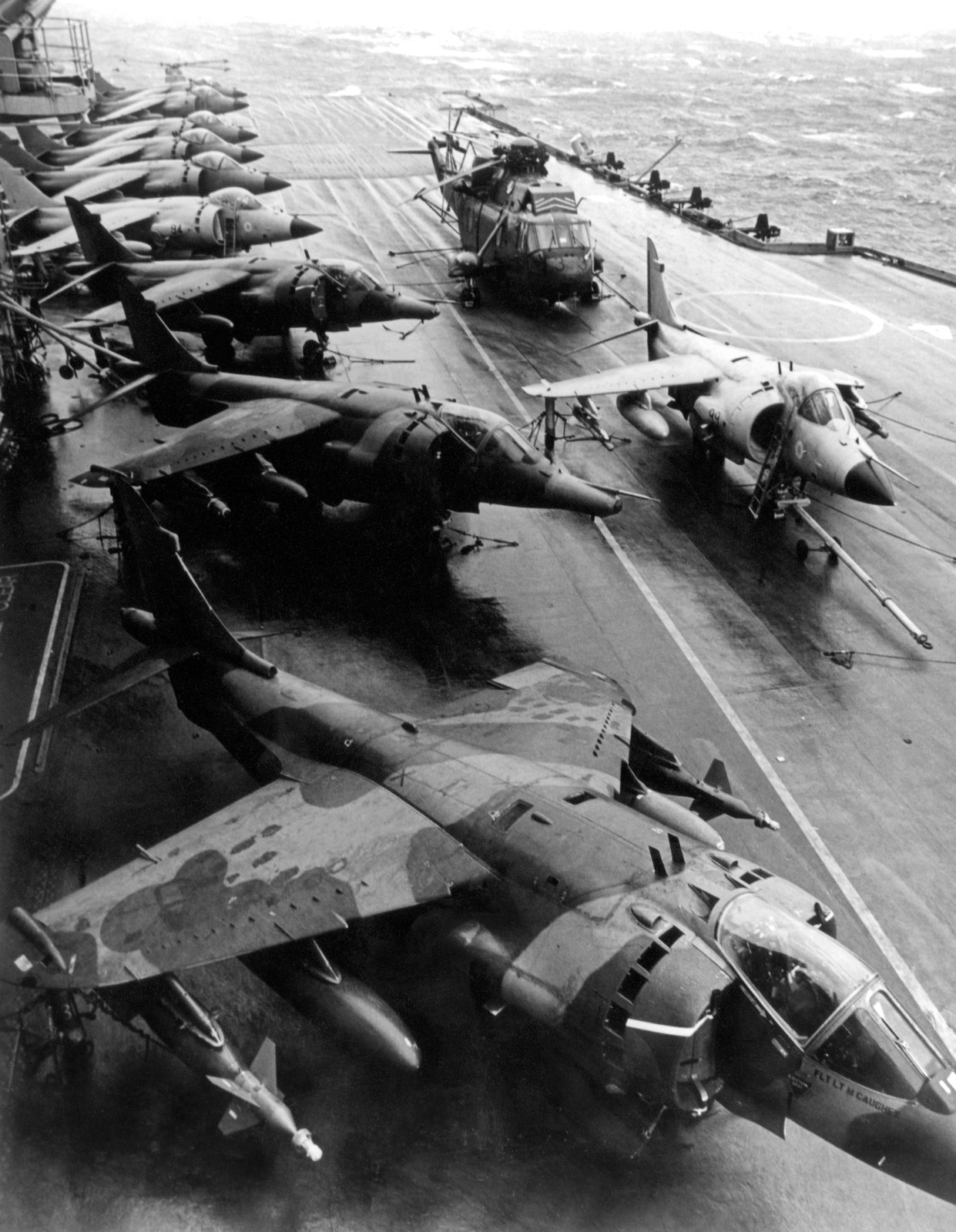
What Britain could put over the islands was Harriers from two decks: twenty Sea Harriers embarked at the start, flown by 800 and 801 Naval Air Squadrons. A third unit, 809, was formed for the campaign and followed later in Atlantic Conveyor. Six Harrier GR3s went south first, embarked in the container ship Atlantic Conveyor, which they joined on 6 May, and more followed.
What Argentina could put over the islands came from four services, and the distinctions matter. The Fuerza Aerea Argentina held six Canberra B Mk 62 at Trelew; four Mirage IIIEA at Comodoro Rivadavia and six at Rio Gallegos; four Daggers, which were the M-5 and not Mirages, at Comodoro Rivadavia and eight more at Rio Grande; fifteen A-4C Skyhawks at San Julian and ten A-4B at Rio Gallegos; eight IA-58 Pucaras on the mainland at Santa Cruz, with twelve more assigned to the islands and the first six flown in on 4 April; seven C-130H Hercules; five Learjet LR-35s of the Escuadron Fenix; and two KC-130H tankers to refuel the lot. The Armada Argentina flew Super Etendards from Rio Grande in Tierra del Fuego with the Segunda Escuadrilla Aeronaval de Caza y Ataque, A-4Q Skyhawks with the Tercera Escuadrilla, MB-339As of the Primera Escuadrilla Aeronaval de Ataque from Estacion Aeronaval Malvinas at Stanley, and T-34C Turbo Mentors of the naval flying school at Estacion Aeronaval Calderon on Isla Borbon, which the British called Pebble Island. Argentina had ordered fourteen Super Etendards; five had been delivered with their missiles before the French embargo stopped the rest. British intelligence assessed the threat at the outset as five Super Etendards equipped with Exocet sea-skimming missiles, which was exactly right.
The tyranny of distance
Everything the RAF did in the South Atlantic went through Ascension Island, where Wideawake airfield lies 4,000 miles from the United Kingdom and nearly 4,000 miles, 6,400 kilometres, from Port Stanley. The route from Ascension came down on the islands from the north-east. Before the war, the Commander-in-Chief’s despatch records, Wideawake was manned for and accustomed to dealing with only three movements each week. Within three weeks its establishment went from nothing to over 800 officers and men of all three services.
The island could hold only what it could park. Air Marshal Sir John Curtiss, the Air Commander, put the capacity at twenty-two to twenty-four aircraft at any one time; twenty-three were based there on 20 May and twenty-four on 31 May. The Commander Task Force’s despatch gives the permanent detachment Ascension could sustain as up to seventeen Victors, three Vulcans, four Hercules, four Nimrods, two air defence aircraft and two support helicopters. The island consumed 5.5 million US gallons of aviation fuel.
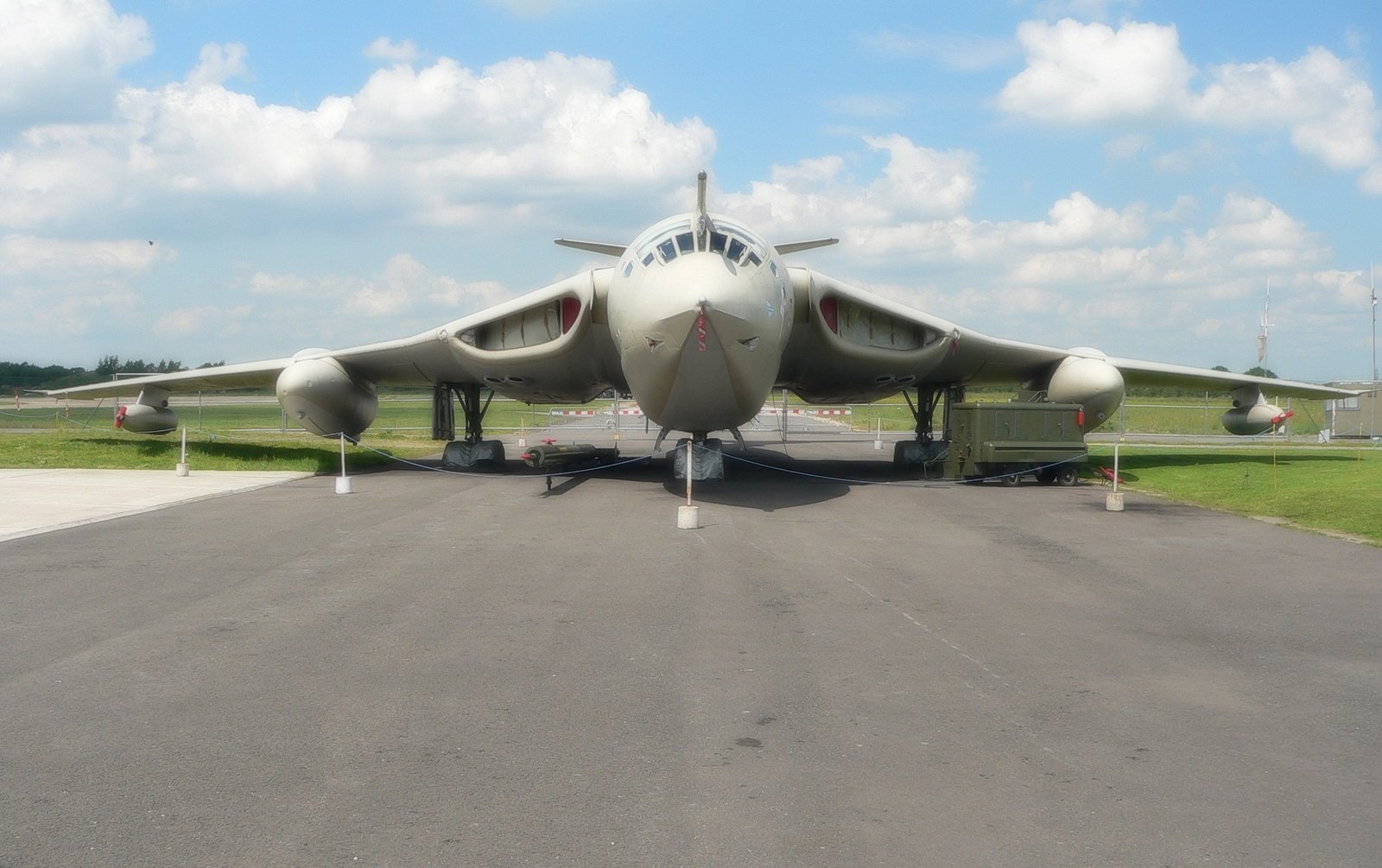
By the fall of Stanley there had been 535 air movements into Ascension, bringing in 23 helicopters, 5,907 tons of freight and 5,242 passengers. Fourteen VC10 C1s were committed to the operation. Twenty Victor K2s were deployed on Operation CORPORATE and flew 375 sorties in support of 67 missions. Thirteen Nimrods were modified for air-to-air refuelling and flew 111 sorties from the island, the longest patrol lasting about nineteen hours. Six Hercules C1 and C1K made 44 airdrops to the fleet; the longest single sortie, flown by Flight Lieutenant T Locke, lasted 28 hours and 3 minutes.
For the Argentine pilots the distance worked differently and no less severely. Their runways were their own and they were long, but the islands lay a long way out to sea and the whole Skyhawk force was supported by two KC-130H tankers. Two tankers can get a strike package there and bring it home. They cannot buy it time to loiter. The Argentine Air Force’s own history describes the Mirages’ fuel state over the islands as the reason they could not come down and fight, because an aircraft that arrives with minutes in hand cannot trade height for combat and still get home. Argentine formations flew very much further than the Harriers to reach the same piece of sky, and one arriving at its bingo fuel as it arrived at the target had a single pass, which had to be made low.
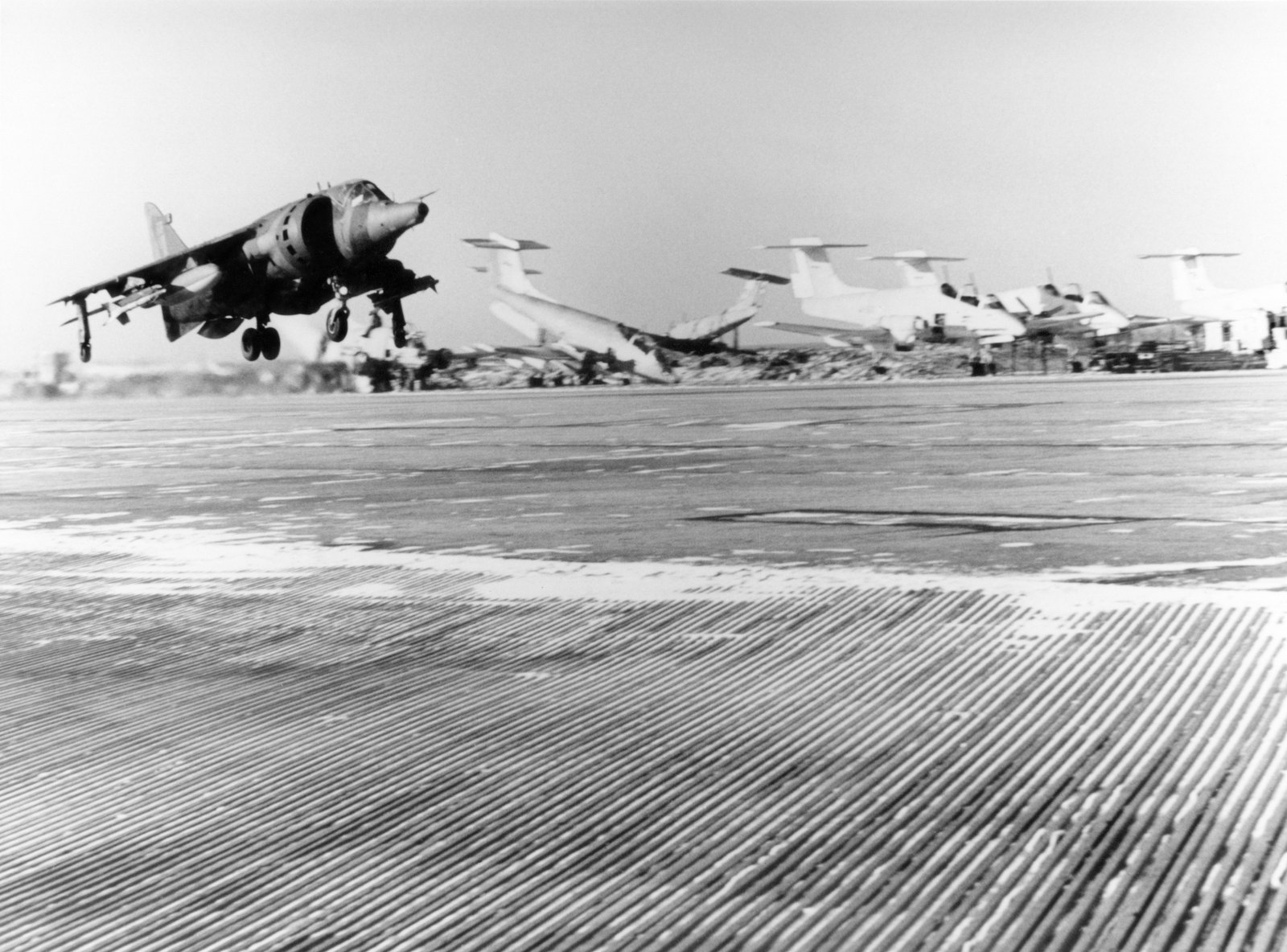
The British problem was the opposite one and just as intractable: there was no runway they could use. Everything that flew over the islands flew from a deck or from Wideawake. Peter Squire, commanding No 1(F) Squadron, put his own aircraft’s position simply: they were some 8,000 miles from home, and the GR3s crossed the 4,000-mile leg to Ascension in one hop, over nine hours in a single seat. A strip was eventually laid at Port San Carlos, defended by all eight Blindfire Rapier systems of No 63 Squadron RAF Regiment by 3 June; the matting for it had been aboard Atlantic Conveyor when she was hit on 25 May. RAF Harriers did not operate from an airfield in the Falklands until 4 July 1982, when a GR3 detachment took up the air defence of Stanley.
Black Buck: bombing Stanley from Ascension
Seven Black Buck missions were mounted and five were completed. The bombing sorties were Black Buck 1, 2 and 7; the anti-radar sorties were Black Buck 5 and 6. The first went out on the night of 30 April and 1 May 1982, and it is the one that shows what the operation cost.
The Vulcan had not been brought out of retirement; it was in service. What had lapsed was its flight-refuelling and conventional bombing capability, moribund for several years, which had to be restored along with crews who had never refuelled in flight or dropped a conventional bomb. Three Vulcan B2s were forward-based at Ascension.
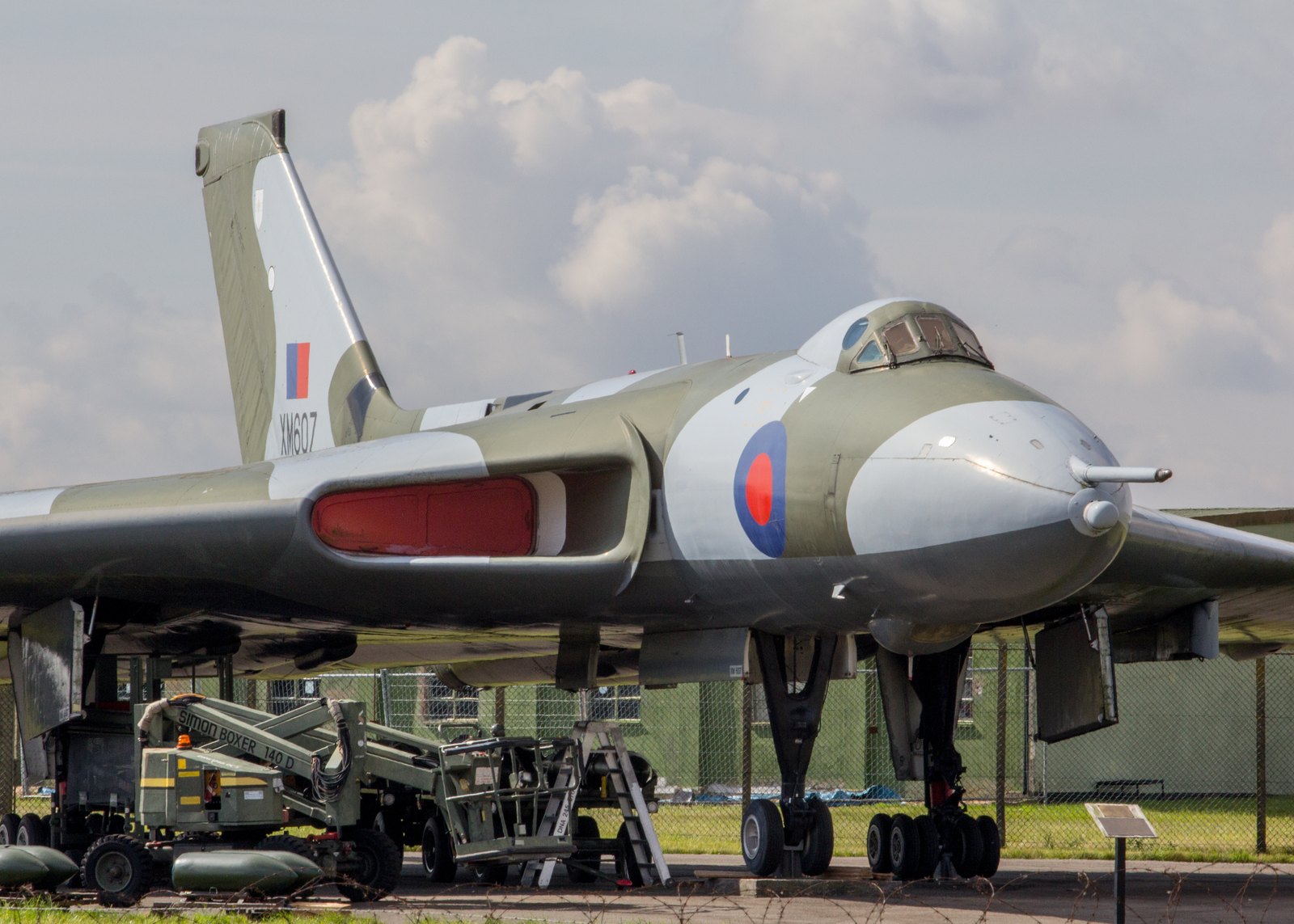
Eleven Victors launched ahead of the bomber, two of them airborne reserves, with the primary Vulcan and its own airborne reserve, the whole formation departing at one-minute intervals. The primary aircraft, XM598, turned back with a pressurisation failure, and the reserve went on: XM607, flown by Flight Lieutenant Martin Withers. Eleven Victors went out with the two Vulcans, six more met the bomber on the way home in two waves of three, and the Air Commander reckoned each raid tied up seventeen tankers and two bombers. Total Victor flying time came to 105 hours 25 minutes. The Victor in the long slot was airborne for 14 hours 5 minutes; the Vulcan for 16 hours 2 minutes, roughly eight thousand miles there and back. The tankers uplifted 1,955,000 lb of fuel, 244,000 imperial gallons, outbound and inbound. Seven per cent of it reached the bomber. Twenty per cent was passed between one Victor and another simply to keep the chain moving, and the fuel in the Vulcan’s tanks at the target had passed through five aircraft.
The Vulcan carried twenty-one 1,000 lb bombs and dropped them across the runway at Stanley. One hit it. The Air Commander’s own reckoning settles what that crater was worth: rendering a runway like Stanley’s unusable would have taken some twenty-five to thirty sorties, so one hit from one aircraft was, in his words, a pretty fair result. It was not the same thing as closing the airfield. On 4 May 1982 Nott told the Commons that the runway had been rendered unusable by transport aircraft; Argentine C-130s flew into Stanley until the last days of the war. No attempt was ever made to operate A-4s from the damaged runway or to lengthen it. Curtiss states that the Mirages were withdrawn to the defence of Buenos Aires as a result of the raids; the Argentine Air Force’s official history gives technical failures in the Mirage fleet and the fuel problem over the islands as its own constraints.
Black Buck 3 was cancelled before take-off on 16 May because of strong headwinds. Black Buck 4 was aborted in the air on the night of 28 and 29 May when a Victor’s refuelling hose failed; the bomber that night was XM598 again, carrying two fuel tanks in the bomb bay in place of bombs. The last two completed sorties were flown against radars, with Shrike missiles. On 31 May, XM597 under Squadron Leader Neil McDougall launched two Shrikes from six to seven miles; the radar stopped transmitting and the damage was quickly repaired. On 3 June the same aircraft went back and loitered for forty minutes to draw a radar into transmitting. The Argentine anti-aircraft war diary records the Vulcan detected at 0608 at 10,000 feet, and an Army Skyguard fire-control set radiating at 0630 and being hit. Four soldiers were killed: Dachary, Blanco, Diarte and Llamas. The Vulcan left to the north-east on 033 degrees at 250 knots, timed at 0640, then broke its refuelling probe on the way home and diverted to Rio de Janeiro.
The last raid, Black Buck 7, was flown on 12 June 1982. The Argentine anti-aircraft war diary counted fourteen bombs in a single run with the craters forty metres apart. The despatch describes it in careful words: it was flown in an attempt to prevent any further use of the airfield. It never claims the airfield was closed.
What the raids were for is best understood through what they displaced. A raid tying up seventeen tankers and two bombers, out of a parking space that held twenty-two to twenty-four aircraft, meant, as Curtiss put it, that no other operations were possible at the same time. Every Black Buck was bought with the Nimrod patrol and the Hercules airdrop that could not fly alongside it. That is the real measure of the operation: not whether the runway was closed, but that a single crater at Stanley cost the whole of Ascension’s flying for a day. Curtiss’s own summary of the message was that if the RAF could reach the Falklands it could reach Buenos Aires: a point about signalling rather than a plan.
1 May, and the first air fighting
The crater on the Stanley runway was the opening of 1 May 1982 and not the whole of it. The Total Exclusion Zone had been in force since noon London time on 30 April, and the carriers were now inside the war they had sailed towards. The Argentine Air Force’s own return for the day records two combat aircraft destroyed at Darwin and Goose Green.
The Argentine Air Force’s return for 1 May counts four of its aircraft shot down, and it counts its dead: four pilots, one of whom was killed on the ground, one navigator and eight non-commissioned officers. The men who flew against the fleet were regular officers and NCOs of the Fuerza Aerea and the Armada, career aircrew for the most part, and an air force that loses four pilots in a day is losing the part of itself that takes longest to replace.
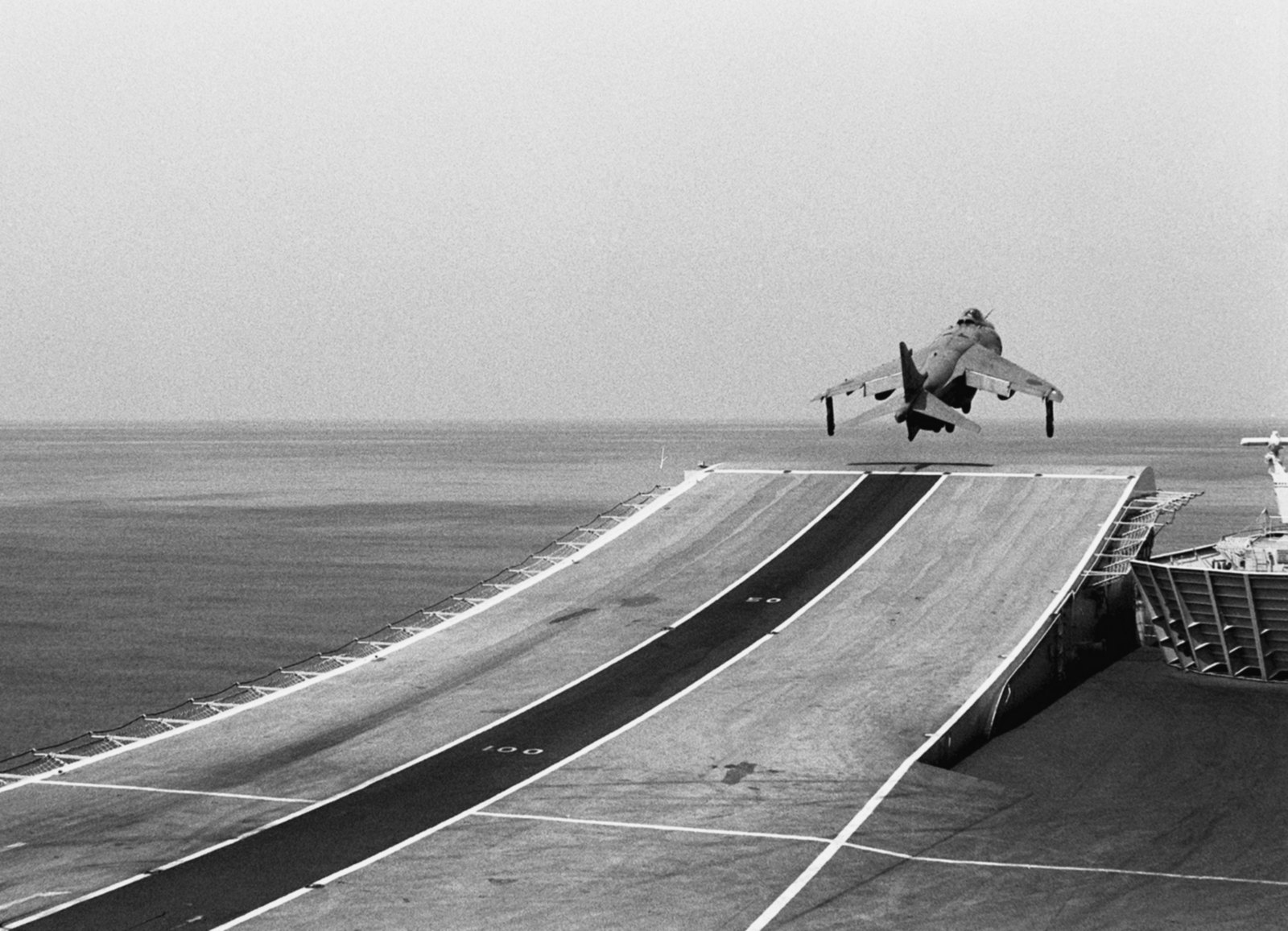
What the British took from the day was the value of the missile rather than the aeroplane. The IWM puts the difference in one sentence: earlier Sidewinders could only be fired from directly behind the enemy, and the AIM-9L worked from anywhere. An all-aspect seeker removes the need to manoeuvre into the target’s rear hemisphere before shooting, so a fighter can fire on the merge instead of having to win a turning fight first. Curtiss credited the Sea Harrier’s superior weapon aiming system and the late-model Sidewinder missiles which, in his words, the British had obtained from their American friends. What the Argentines took from it was the arithmetic of their own fuel: their official history is candid that an aircraft reaching the islands with minutes in hand cannot trade height for combat and still get home, and that the Mirages could not come down and fight.
The following day, 2 May, ARA General Belgrano was sunk. Three torpedoes were fired and two struck her. She was outside the Total Exclusion Zone, about 35 miles outside it in Nott’s own words to the Commons on 4 May, and the Government’s case rested on the threat she and her Exocet-armed escorts posed rather than on where she was. The Commander-in-Chief’s despatch puts it that the enemy force was in a position where it posed a serious threat to a number of British ships engaged in operations off the Falklands while other Argentine surface units were poised to the north; the despatch does not mention the exclusion zone at all in connection with the sinking. The Argentine Navy gives 1,093 men aboard, 323 killed and 770 rescued. The sinking was contested in Parliament for years afterwards; on 24 March 1983 Tam Dalyell charged the Prime Minister in the Commons with a war crime over it.
For the air war the consequence was immediate. After the attack, in the despatch’s words, Argentine naval surface forces remained within 12 nautical miles of their coast for the remainder of the campaign. The Argentine Navy’s war college makes the same point from the other side: until 2 May the British had treated the carrier and her embarked air group as the enemy centre of gravity, and after the Belgrano was sunk and the fleet withdrew into shallow water that centre of gravity moved to the air and naval air units flying from Patagonia. Argentine naval aviation fought the rest of the war from mainland bases and from Stanley, and not from a deck.
Sheffield, and the Exocet
Argentina had ordered fourteen Super Etendards. Five had been delivered, with their missiles, before the French embargo stopped the rest, and they flew with the Segunda Escuadrilla Aeronaval de Caza y Ataque from Rio Grande in Tierra del Fuego. Five air-launched AM39 Exocets were held at the outbreak of the war. British intelligence assessed the threat at the outset as five Super Etendards equipped with Exocet sea-skimming missiles. Curtiss, planning against it, worked on the Argentines having five or six missiles at their disposal, and that uncertainty of one missile either way, rather than the tidy count available afterwards, is what the fleet had to live with.
On 4 May an Argentine SP-2H Neptune reported two British groups south-east of the islands, well out from the centre of the exclusion zone and sixteen nautical miles apart. A KC-130 tanker held west-north-west of the islands at 10,000 feet, 237 nautical miles out from the same reference point. Two Super Etendards launched two missiles, one from each aircraft, at 1104 local time.
HMS Sheffield, a Type 42 destroyer, was hit. Twenty of her company were killed and 236 were recovered safely. She sank on 10 May. She was the first Royal Navy ship lost to enemy action since the Second World War, and she was lost in the first week of the shooting to a single missile.
The rest of the AM39 story is short. A fourth Super Etendard sortie went out on 23 May, the first flown without a scout aircraft because the Navy’s SP-2H Neptunes had gone out of service in mid-May; it found no target and launched nothing. On 25 May two missiles were fired at 1620 local time at SS Atlantic Conveyor. On 30 May the last missile was fired at the carrier group with four A-4C Skyhawks in company; the despatch records that the missiles were evaded and exploded harmlessly, and that three Skyhawks were shot down, two by Sea Dart and one by 4.5in gunfire. The Argentine Navy states that the impact on the carrier was confirmed by Air Force pilots and that HMS Invincible was damaged, and prints the British denial in the same paragraph, and it publishes both to this day. Invincible was not hit. The five air-launched missiles were expended on three occasions, two of which found a target.
That was not the end of the Exocet. MM38 rounds were taken off destroyers and improvised for firing from the ground: four were flown into Stanley by C-130 with their trailers and at least one more arrived later. Two were fired. The first failed on the launcher. The second hit HMS Glamorgan on 12 June, a fortnight after the last air-launched missile had gone, striking the flight deck aft and destroying a fully fuelled and armed Wessex. Thirteen of her company were killed in the attack and a fourteenth died of his injuries some months later. A hit above the waterline, into a deck rather than into machinery or a compartment below the sea, left the ship’s buoyancy intact, which is why she is the only ship hit by an Exocet in the campaign to survive it. The Argentine Navy’s own account calls it the first attack on a ship by a missile fired from a coastal battery. What it actually was, and the improvisation is documented in the Argentine Air Force’s official history, was a ship’s launcher taken off a destroyer and bolted to a lorry.
San Carlos, and the days in Bomb Alley
The landings went in on the night of Thursday 20 May 1982. About 5,000 men were put ashore without a casualty, which was the last quiet thing that happened for a week. On 19 May a Sea King cross-decking between ships had ditched, killing twenty-one of the thirty men aboard: eighteen of the Special Air Service, the naval aircrewman, a Royal Signals soldier and the only Royal Air Force man to die in the war. A bird strike was believed responsible at the time and that has since been doubted. No 1(F) Squadron flew its first operational sortie on 20 May.
From 21 May the Argentine air arms came at the beachhead and at the ships covering it. Three warships were hit that day, one of them fatally. HMS Ardent, a Type 21, was repeatedly hit aft by bombs which exploded, and she was lost close inshore in the Falkland Sound; 22 of her company were killed and 177 were saved. The Argentine Navy’s account is that Air Force aircraft damaged her first and that naval A-4Qs of the Tercera Escuadrilla then put the bombs into her stern that sank her. The British despatch assigns the attack to no service. The Argentine Navy also records what the day cost it: three A-4Q Skyhawks shot down by Sea Harriers on 21 May, Marquez killed and Phillippi and Arca both surviving, and a fourth aircraft lost in a landing accident on 23 May in which CC Zubizarreta was killed. Two Gazelle helicopters were shot down by ground fire on 21 May, with three Royal Marines killed, and the first of the three Harrier GR3s lost to enemy fire went down on 21 May. TN Crippa attacked HMS Argonaut south-east of Fanning Head.
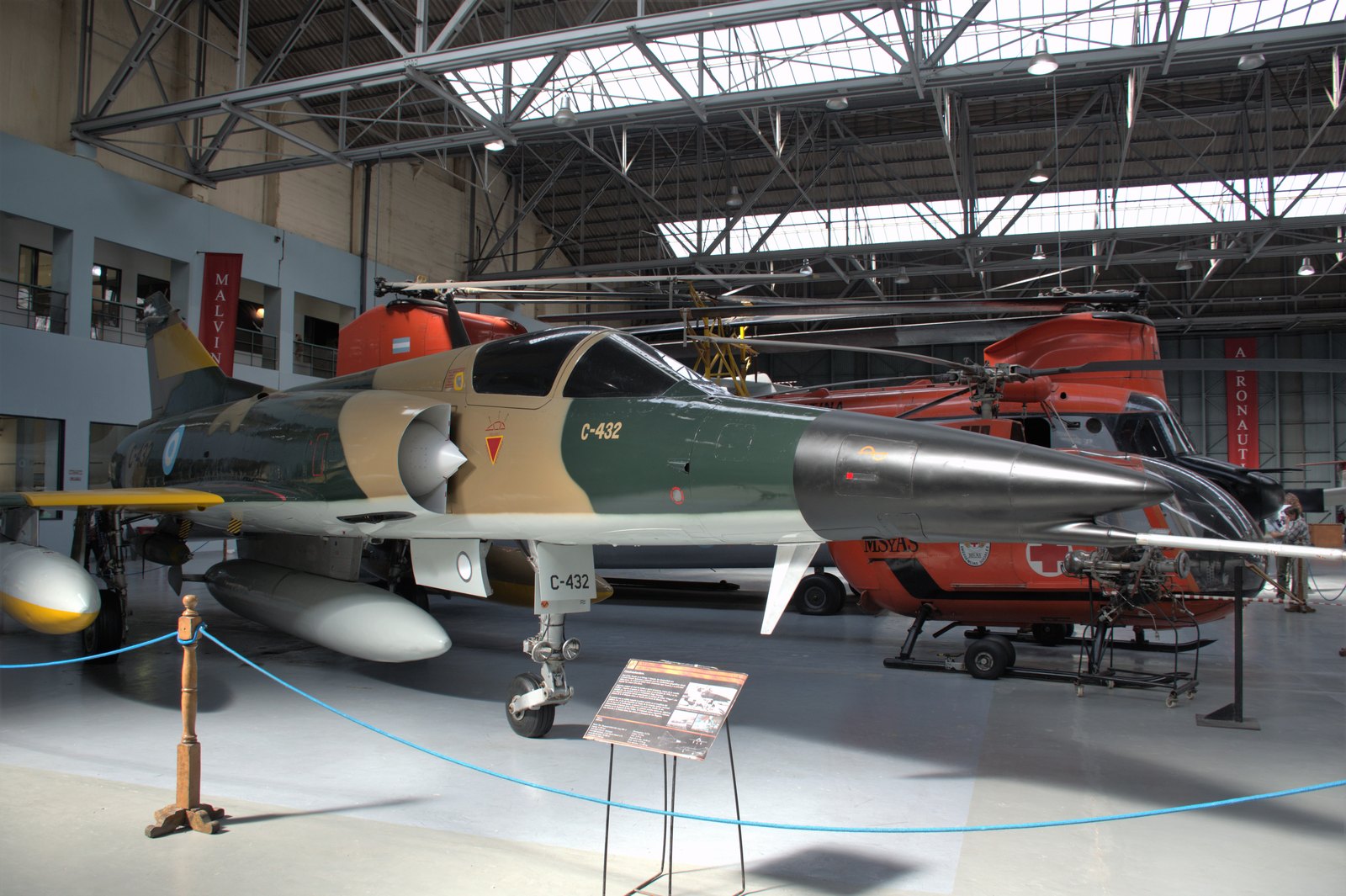
On 23 May HMS Antelope, another Type 21, was hit. The bomb killed one of her company as it entered the ship and did not explode. Efforts to defuse it failed, and the explosion killed one of the disposal team and seriously injured the other. On 25 May HMS Coventry, a Type 42, was bombed by A-4 Skyhawks and capsized. Nineteen of her company died that day, out of about 280 aboard, and a twentieth died in March 1983 of injuries received in the sinking. HMS Broadsword was damaged in the same attack. Coventry was the last Royal Navy warship lost to enemy action, which is the Royal Navy’s own description of her. Between 21 and 25 May three British ships were sunk and eight more were damaged.
The extraordinary thing about those days is how much worse they should have been. The Argentine Air Force’s own history is specific about one bomb type, the MK-17, of which only two exploded on their targets in the whole campaign, into Ardent on 21 May and into Antelope on 23 May, both of which were lost. More than ten failed to explode, or passed cleanly through the ship they hit. The same history is emphatic that the MK-17 was powerful enough that a single detonation would have been expected to destroy the ship that received it.
The reason lies in the delivery, not the ordnance. The attack profile the Argentine history describes is release at very low altitude, at only tens of metres from the target. A retarded-fall bomb’s fuse arms on a time or airstream cycle after it leaves the aircraft. Released that low and that close, the bombs reached the ship before the fuse had finished arming, and arrived inert. The pilots flew that profile because it was the only way through the defences: with mainland basing, two KC-130H tankers for the whole Skyhawk force and no margin to loiter, a formation arrived at its bingo fuel almost as it arrived at the target, which allowed one pass, which had to be made low. The failure was a consequence of the tactic and of the distance behind it, and the men who flew it were doing the only thing the fuel state allowed.
Atlantic Conveyor, and the helicopters that went with her
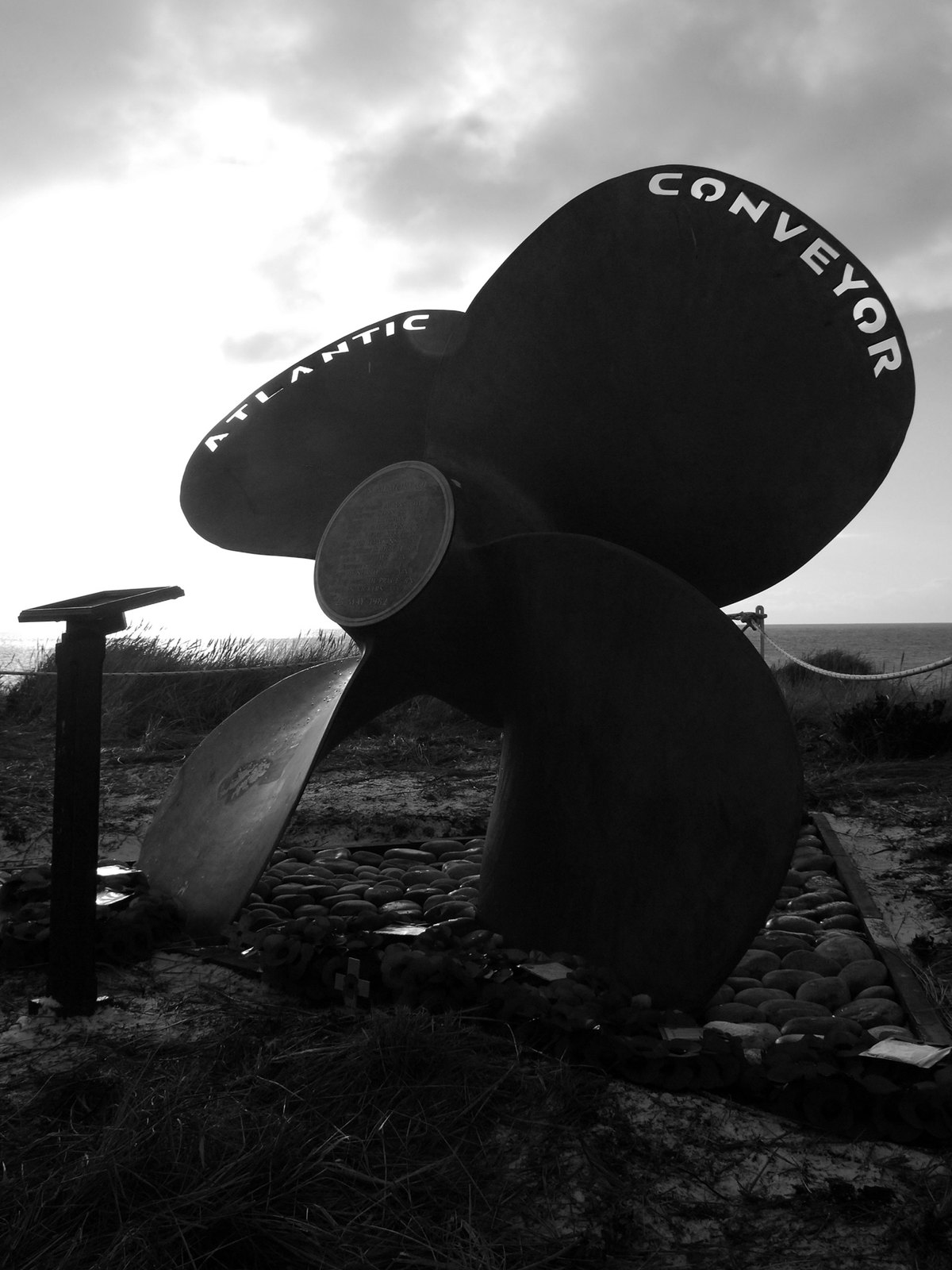
On 25 May, the day HMS Coventry was lost, two Super Etendards fired their two Exocets at 1620 local time and hit the requisitioned container ship SS Atlantic Conveyor. She was east-north-east of the islands, in the sea area where the carrier group was operating in late May. She burned and sank on 28 May. Twelve of her people were killed. On 26 May 1982 Nott told the Commons that four had died of about 170 aboard, a statement made while the ship was still burning and before her survivors had been fully accounted for.
What she was carrying is the point. She had brought fourteen Harriers south, eight Sea Harriers of 809 Naval Air Squadron and six RAF GR3s of No 1(F) Squadron, and every one of them had cross-decked to Hermes and Invincible between 18 and 20 May. Not a single aeroplane was lost with her. What went down with the ship was the heavy lift: six Wessex 5, three Chinook HC1 and one Lynx, by the Ministry of Defence’s own loss list. That official list records sixteen British helicopters lost at sea in the whole campaign, four Sea King, three Lynx, six Wessex 5 and three Chinook. Ten of the sixteen were aboard Atlantic Conveyor on 25 May. With them went the matting for the airstrip at Port San Carlos and No 18 Squadron’s field equipment and ammunition, loaded, as its commanding officer put it, somewhere aboard the Conveyor.
Four Chinooks had been embarked, in the despatch’s words, to provide vital mobility for troops and equipment in the land battle. Three of them went to the bottom in one afternoon. The fourth was ZA718, Bravo November, the only one of the four sent south to survive; over the campaign it carried something like 1,500 troops, 95 casualties, 650 prisoners of war and 550 tonnes of stores.
The land campaign was reshaped that afternoon. Three of the four medium-lift helicopters that were to move men, guns and ammunition across East Falkland were gone, leaving one Chinook and the Wessex force to do the work of a fleet. That is why 2 Para and 45 Commando walked. Everything the land force did between the beachhead and Stanley, it did with the transport that a single pair of missiles had left it.
The Sea Harrier, and the arithmetic of air combat
The Sea Harrier force flew over 2,000 combat air patrol sorties from the twenty-eight aircraft that reached the theatre, and Curtiss recorded that there were no more beyond the twenty-eight afloat. Kenneth Warren told the Commons on 22 July 1982 that the readiness rate achieved was three times better than the United States Navy could then manage in peacetime.
Twenty Argentine aircraft were shot down by Sea Harriers, by the modern museum count. The Commander-in-Chief’s despatch records twenty-three aircraft destroyed in air-to-air combat, a count of every such kill rather than of the Sea Harriers’ alone. Blaker told the Commons on 19 July 1982 that the figure was at least twenty-eight, a wartime claim since revised down. Set against the whole, Sea Harriers accounted for the air-to-air fighting almost single-handed, and for roughly a quarter of the Argentine aircraft Britain claimed to have destroyed. Missiles fired from ships and from the ground accounted for more.
No Sea Harrier was lost in air-to-air combat. Six were lost in all: four to accidents and two to ground fire. Ten Harriers of all marks were lost to all causes, and none of the ten to an enemy aircraft.
Sixteen of the twenty Sea Harrier kills were made with the AIM-9L Sidewinder. In 1982 the Ministry of Defence put the missile’s score higher still, at “at least 23”. The two numbers come from different years and different counting regimes, and neither will carry a percentage: no probability of kill was published, and nor was the number of rounds fired. What the missile contributed was the freedom to shoot without first winning the turning fight, which is what allowed a subsonic aeroplane with no numerical advantage to engage faster ones successfully. Fieldhouse noted the Sidewinder missile success rate as being particularly noteworthy, and the Argentine Navy’s war college journal reached the same verdict from the other side, ascribing a great superiority to the American air-to-air missiles, “debido a los misiles aire-aire estadounidenses”, while judging that the aeroplane itself “carecieron del alcance y la velocidad adecuadas”, lacked adequate range and speed.
The disadvantage the Argentine fighter pilots flew under was structural, and it is set out in their own air force’s history. Two KC-130H tankers supported the whole Skyhawk force; the Mirages could not descend to fight because of their fuel state over the islands; technical failures in the Mirage fleet and the weather at the mainland bases stand in the same list of constraints, and it is the Argentine Air Force’s own list. None of it is a judgment on the men in the cockpits.
The Harrier GR3s had a different job, and it was not the job they were sent for. Fourteen went south, modified to GR.3C “Corporate” standard, ordered out as attrition replacements for Sea Harrier combat losses. There were none in the air to replace, and No 1(F) Squadron was re-roled to ground attack on arrival. Curtiss recorded that the GR3s were also to act as reserves for air-to-air combat, although in the end they were not actually used for that purpose. They flew about 150 sorties against targets on the islands, the work the type had been built for and which our history of the Harrier jump jet follows from the beginning.
Goose Green, Bluff Cove and the last attacks
Twelve IA-58 Pucaras were assigned to the islands, the first six flown in on 4 April, with eight more held on the mainland at Santa Cruz. The Argentine Air Force’s own critique explains what became of them: the Pucara had no air-to-air capability and lacked the appropriate equipment, “carecia del equipamiento adecuado”. A slow, unarmoured counter-insurgency aeroplane operating from unhardened strips within reach of naval gunfire, special forces and Harriers cannot be protected. The raid on Base Aeronaval Calderon at Pebble Island on the night of 14 and 15 May, which ran from 0410 to about 0840, made the point in a morning: the British party counted eleven aircraft destroyed including six Pucaras, while the Argentine Air Force’s return names five Pucaras by serial, A-520, A-526, A-502, A-529 and A-552, the balance being Navy Turbo Mentors and a Coastguard Skyvan it does not count. Eleven Pucaras were lost in all by that return, and thirteen more were written off in accidents or abandoned.
The land fighting took its own aircraft. A Harrier GR3 was shot down at Goose Green on 27 May, flown by Squadron Leader Bob Iveson. On 28 May a Blowpipe missile brought down the naval MB-339A 4-A-114 of the Primera Escuadrilla Aeronaval de Ataque at Goose Green and Teniente de Corbeta Daniel Miguel was killed, and a Scout helicopter was shot down by an enemy aircraft the same day. Late in the campaign the GR3s were being hit without being lost: of every four aircraft launched one would return with holes in it, Squire recorded, and no aircraft spent longer than forty-eight hours in the hangar.
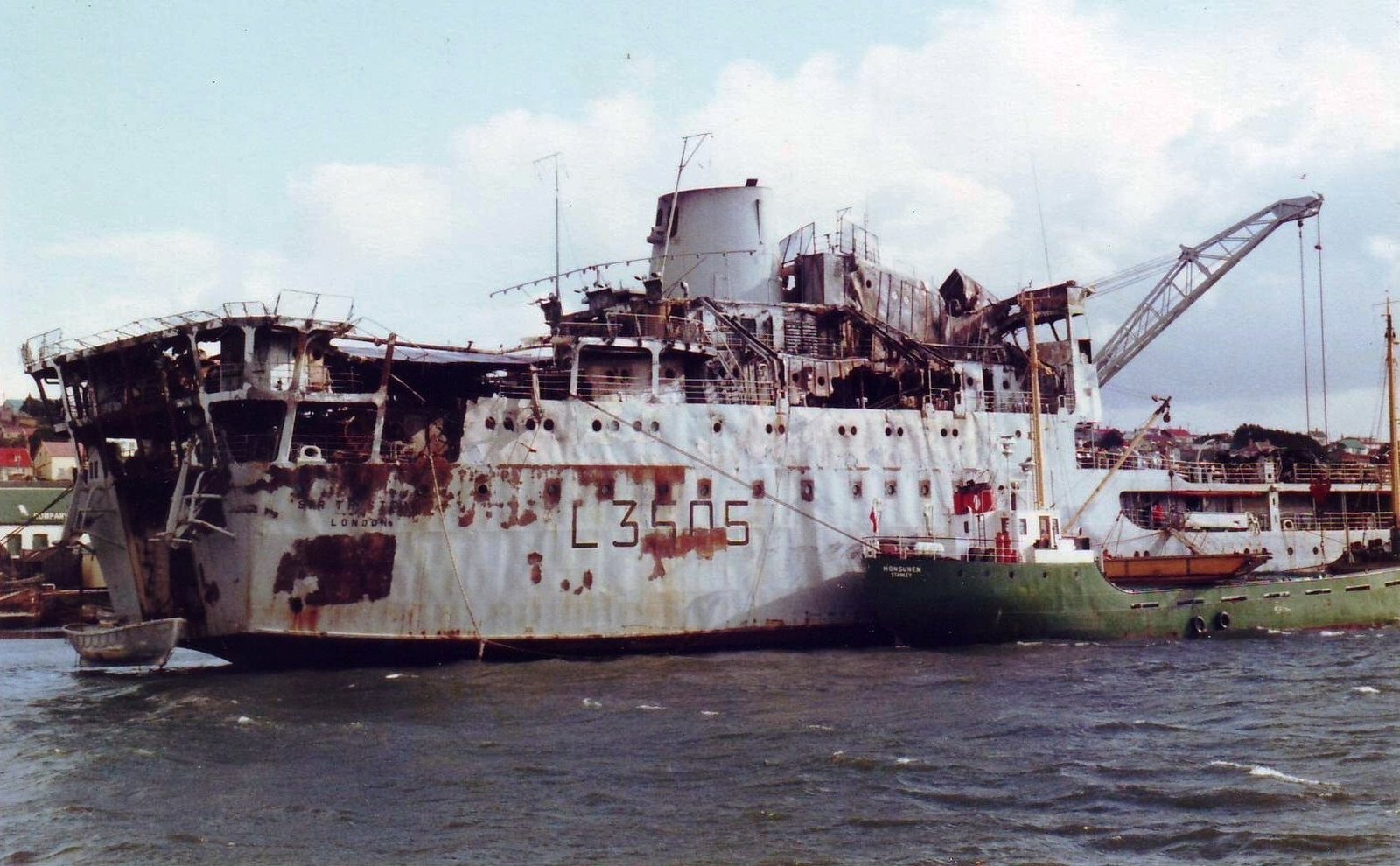
On 8 June the Argentine air arms attacked the landing ships at Fitzroy and Bluff Cove. Three bombs hit RFA Sir Galahad and two hit RFA Sir Tristram. Forty-eight men died in Sir Galahad: thirty-two Welsh Guardsmen, eleven other Army personnel, among them men of 16 Field Ambulance, Royal Army Medical Corps, and five Royal Fleet Auxiliary crewmen, with about 150 wounded. Two more Royal Fleet Auxiliary crewmen died in Sir Tristram. In a further raid the same day a landing craft, LCU Foxtrot Four, was bombed and sank in Choiseul Sound, and six men were killed including her coxswain, Colour Sergeant Brian Johnston, posthumously awarded the Queen’s Gallantry Medal. Fifty-six men died that day. Sir Galahad was lost. Sir Tristram was gutted and abandoned, then recovered, rebuilt and returned to service. The fourth and last Harrier GR3 loss of the campaign came the same day, an accident at the forward operating base.
The final days ran down quickly. On 12 June a land-launched MM38 Exocet struck HMS Glamorgan and the seventh and final Black Buck sortie was flown against Stanley. On 13 June Wing Commander Peter Squire, in Harrier GR3 XZ997, put a Paveway II laser-guided bomb into an Argentine company headquarters on Mount Tumbledown. Argentine forces surrendered on 14 June 1982, Falklands time, the surrender being accepted at 0100 London time on 15 June, seventy-four days after the Argentine landing of 2 April. Something over eleven thousand Argentine servicemen were taken prisoner, the great majority of them at Port Stanley.
What the air war cost
Britain lost ten Harriers of all marks to all causes. Six were Sea Harriers, four of them to accidents and two to ground fire. Four were GR3s out of the fourteen in theatre, three shot down by enemy fire on 21, 27 and 30 May and the fourth destroyed in an accident at the forward operating base on 8 June.
The Ministry of Defence’s own list records sixteen British helicopters lost at sea: four Sea King, three Lynx, six Wessex 5 and three Chinook. Ten of the sixteen went down with SS Atlantic Conveyor on 25 May, six Wessex 5, three Chinook HC1 and a Lynx, none of them in flight. Over land and on deck the despatch records two Wessex lost in whiteout on the Fortuna Glacier on 22 April, the first British aircraft lost on the operation and not combat losses; two Gazelles to ground fire on 21 May; a Scout shot down by an enemy aircraft on 28 May; a Gazelle on 6 June; and a Wessex destroyed on HMS Glamorgan’s flight deck on 12 June. That comes to at least twenty-three, counted up from the official returns rather than published as a total by the Ministry of Defence. The Argentine Air Force’s official history claims twenty-four, one of the very few places where the two national tallies come near each other.
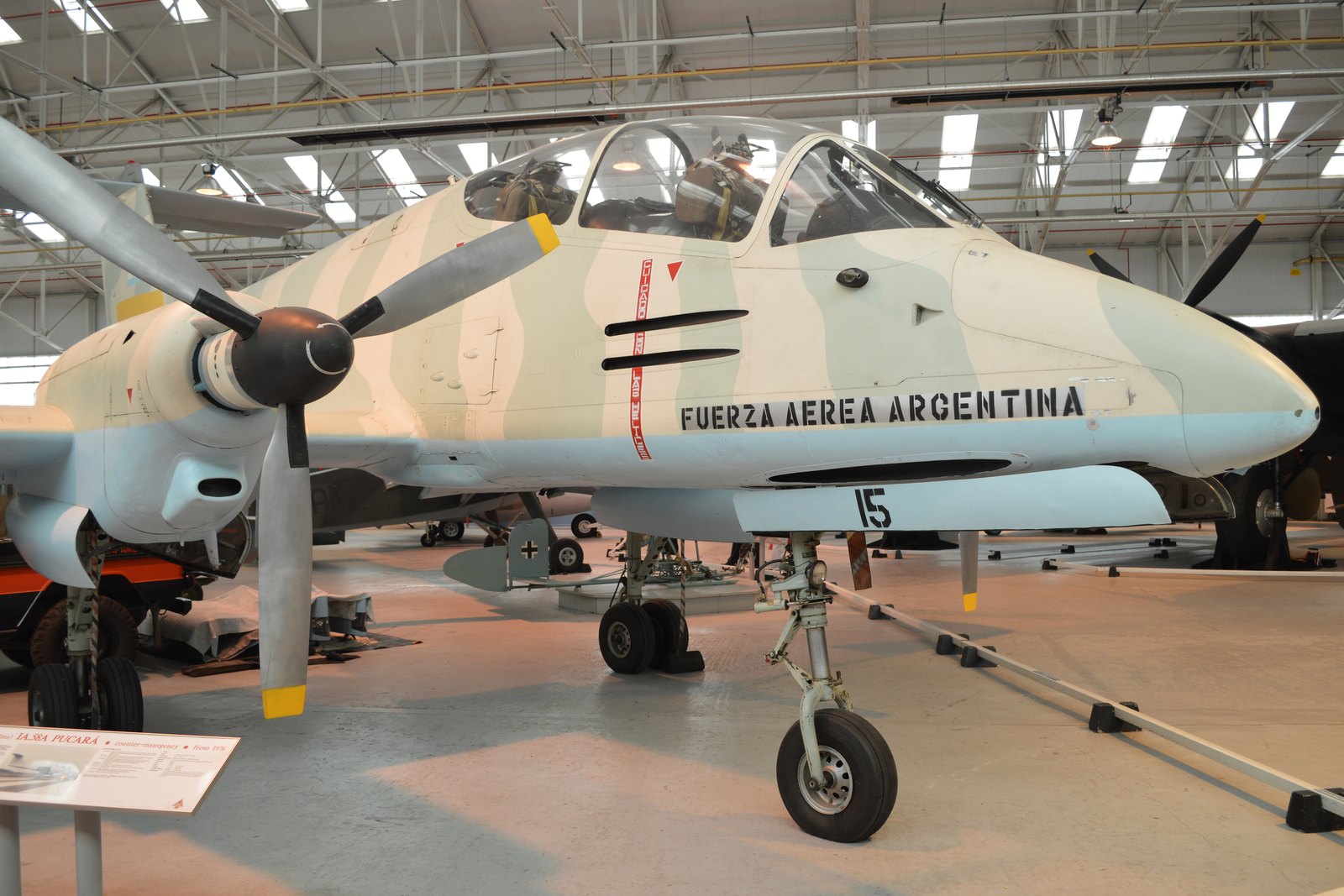
Britain’s own count of Argentine aircraft destroyed, published on 28 June 1982, was ninety-one, with the minister’s caveat that these figures are estimates based on reports from British forces. Of them, twenty-seven were credited to land-based British weapons, eleven by sabotage, nine to Rapier and seven to hand-held weapons including Blowpipe; twenty-one to sea-launched systems, seven to Sea Dart, five to Sea Wolf, six to Sea Cat and three to naval gunfire; and the rest to aircraft, on the ground as well as in the air. Twenty-three of the aircraft claims were air-to-air kills. The Argentine Air Force’s own return, published sixteen years later, was forty-seven of its own aircraft: ten A-4B and nine A-4C Skyhawks, eleven Daggers, two Mirage IIIEA, two Canberra B Mk 62, eleven Pucaras, one C-130H Hercules and one Learjet, with a further thirteen Pucaras and two Bell 212 lost to accidents or abandonment. Neither figure covers the same ground. The Argentine Navy’s losses stand outside that return: four A-4Q Skyhawks and two MB-339As, one of them lost in an accident on 3 May in which Teniente de Fragata Benitez was killed. No Super Etendard was lost. Britain’s list counted one Aermacchi and Argentina records two, which are compatible rather than rival accounts: the British claim counted only the aircraft British forces shot down.
The war killed 907 people: 255 British servicemen, 649 Argentines and three Falkland Islanders. The Argentine Air Force’s own history gives the Argentine dead as 635, an accounting difference between the services. John Silkin gave the British wounded as 777 in the Commons on 21 December 1982; the RAF’s figure for all sides is over 2,000. Of the Argentine Air Force’s fifty-five dead, thirty-six were officers, fourteen were non-commissioned officers and five were conscripts, most of them aircrew, and forty-seven of its men were wounded. Seven British ships were lost: HMS Sheffield, HMS Ardent, HMS Antelope, HMS Coventry, RFA Sir Galahad, SS Atlantic Conveyor and LCU Foxtrot Four.
What it changed
The campaign showed what a small carrier air group could and could not do. Twenty-eight fighters, never reinforced, held the air over a landing and a land campaign against an air force flying from its own territory, and not one of them was lost in air-to-air combat. It also showed where the killing was done: more Argentine aircraft fell to weapons fired from ships and from the ground than to fighters. The fighters were necessary and they were not sufficient, and both official assessments put the credit on the missile rather than the airframe.
What it exposed was how much had been allowed to lapse. The Vulcan’s flight refuelling and conventional bombing capability had been moribund for several years and had to be rebuilt along with crews who had never refuelled in flight or dropped a conventional bomb. The Nimrod had no air-to-air refuelling capability until the order to fit it went out on 13 April, with the first test flight on 30 April. A campaign that depended on tankers began by inventing part of its own tanker fleet.
The assumption on which the RAF Harriers were despatched turned out to be wrong. No 1(F) Squadron went south as attrition replacements for Sea Harrier combat losses and found none to replace, which is the clearest single measure of how the air fighting went. What was not anticipated was how narrow the margin at sea would prove. The Argentine Air Force’s history records more than ten of its MK-17 bombs failing to explode or passing cleanly through the ships they hit, against two that detonated, and the effect of that was acknowledged in the Lords on 17 January 1983, in the debate on the Government’s paper on the lessons of the campaign, without ever being counted.
The Exocet threat did not end when the last air-launched missile was fired on 30 May: MM38 rounds taken off destroyers and bolted to a lorry were still in the islands, and one of them hit HMS Glamorgan on 12 June. British planners had worked throughout on the Argentines holding five or six missiles, and the planning was done against that uncertainty rather than against the number.
Whether the cratering of the Stanley runway kept Argentine fast jets off it cannot be established: no attempt was made to operate A-4s from it or to lengthen it, and Argentine C-130s flew into Stanley until the last days of the war. What did follow was a garrison. A Harrier GR3 detachment took up the air defence of Stanley from 4 July 1982 and stayed until May 1985.
Where to see it today
The Vulcan has not flown since 2015 and the Harrier was withdrawn from RAF service in 2010. The United States Marine Corps stood down its last Harrier squadron on 3 June 2026.
Vulcan B2 XM598, the Black Buck 1 primary that turned back with a pressurisation failure and the aircraft of the aborted Black Buck 4, is on display at the RAF Museum Midlands at Cosford; our history of the Avro Vulcan covers the type from its design onwards, as our history of the Blackburn Buccaneer does for its contemporary. XM597, which flew both Shrike missions and diverted to Rio de Janeiro on the second, is preserved in Scotland. Harrier GR3 XZ997, the Mount Tumbledown aircraft, is held in its original Falklands configuration in Hangar 1 at Cosford, alongside Chinook HC1 ZA718, Bravo November. That hangar is closed to visitors until the summer of 2027 while the museum rebuilds the exhibition. GR3 XZ133, one of the fourteen brought up to “Corporate” standard, is in the IWM collection, and Sea Harrier ZA175, which fought in 1982 as an FRS1 and is displayed in its later FA2 form, is at IWM Duxford, an aircraft that shot down an enemy aeroplane in air to air combat and is on public display in Britain. Piemags holds no photography of the 1982 campaign, and every picture in this article is licensed from another source with its terms checked. The Piemags aviation archive covers the types that survived it, the Vulcan, the Harrier and the Hawk among them, in later service. Bob Iveson’s immersion suit, worn when he was shot down at Goose Green, is in the Age of Uncertainty exhibition in Hangar 6 at the RAF Museum in London. They are the airframes a photographer can still work with, on the approach set out in our guide to photographing preserved warbirds.
The memorials are quieter. A plaque and a tree dedicated on 14 July 2023 in the Royal Naval Association’s Memorial Garden at Portsmouth Naval Base commemorate fourteen of HMS Glamorgan’s company. Argentina marks 4 May as the Dia de la Aviacion Naval, the carrier ARA 25 de Mayo, paid off in 1997 and since broken up, was awarded the Argentine Navy’s Operaciones de Combate decoration, and the Escuela de Guerra Naval holds an annual Seminario Malvinas at which veterans give evidence. The fixed dates in the calendar are 2 April and 14 June, which is Liberation Day in the Falkland Islands, and the fiftieth anniversary in 2032 is the one the institutions are likely to build around.
Frequently asked questions
What was the Falklands air war and when did it happen?
The Falklands air war was the air fighting that ran alongside the British campaign to retake the Falkland Islands after Argentine forces landed there at about 0600 Falklands time on 2 April 1982. The campaign ran from 2 April to 14 June 1982, seventy-four days. The British task force fought some 8,000 miles from home, at the end of a supply line that ran through a single Atlantic island, while Argentina fought from its own mainland, from airfields in Patagonia and Tierra del Fuego with runways, workshops and fuel of its own. Argentine forces surrendered on 14 June 1982, Falklands time.
How many aircraft did each side lose in the Falklands?
Britain lost ten Harriers of all marks to all causes, six of them Sea Harriers and four of them GR3s out of the fourteen in theatre. The Ministry of Defence’s own list records sixteen British helicopters lost at sea, and adding the losses over land and on deck comes to at least twenty-three, counted up from the official returns rather than published as a total. Britain’s own count of Argentine aircraft destroyed, published on 28 June 1982, was ninety-one. The Argentine Air Force’s own return, published sixteen years later, was forty-seven of its own aircraft. Neither figure covers the same ground.
What was Operation Black Buck, and did it work?
Black Buck was the series of Vulcan raids flown from Ascension Island against Stanley. Seven missions were mounted and five were completed. On the first, on the night of 30 April and 1 May 1982, the Vulcan carried twenty-one 1,000 lb bombs and dropped them across the runway at Stanley. One hit it. The Air Commander reckoned that rendering a runway like Stanley’s unusable would have taken some twenty-five to thirty sorties, so one hit from one aircraft was a pretty fair result. It was not the same thing as closing the airfield, and Argentine C-130s flew into Stanley until the last days of the war.
How many aircraft did the Sea Harrier shoot down, and how many Sea Harriers were lost?
Twenty Argentine aircraft were shot down by Sea Harriers, by the modern museum count. The Commander-in-Chief’s despatch records twenty-three aircraft destroyed in air-to-air combat, a count of every such kill rather than of the Sea Harriers’ alone, and Blaker told the Commons on 19 July 1982 that the figure was at least twenty-eight, a wartime claim since revised down. Sixteen of the twenty Sea Harrier kills were made with the AIM-9L Sidewinder. No Sea Harrier was lost in air-to-air combat. Six were lost in all: four to accidents and two to ground fire.
What did the Exocet do in the Falklands, and how many were fired?
Five air-launched AM39 Exocets were held at the outbreak of the war, and the five were expended on three occasions, two of which found a target. On 4 May two Super Etendards launched two missiles, one from each aircraft, and HMS Sheffield, a Type 42 destroyer, was hit; twenty of her company were killed and 26 injured out of 281 aboard, and she sank on 10 May. On 25 May two missiles were fired at SS Atlantic Conveyor. On 30 May the last missile was fired at the carrier group and was evaded. Two land-launched MM38 rounds were also fired, and the second hit HMS Glamorgan on 12 June.
Why did so many Argentine bombs fail to explode?
The Argentine Air Force’s own history is specific about one bomb type, the MK-17, of which only two exploded on their targets in the whole campaign, into HMS Ardent and into HMS Antelope. More than ten failed to explode, or passed cleanly through the ship they hit. The failure lay in the delivery, not the ordnance. The attack profile was release at very low altitude, at only tens of metres from the target. A retarded-fall bomb’s fuse arms on a time or airstream cycle after it leaves the aircraft, so released that low and that close the bombs reached the ship before the fuse had finished arming, and arrived inert.
What happened to SS Atlantic Conveyor, and why did it matter?
On 25 May two Super Etendards fired their two Exocets at 1620 local time and hit the requisitioned container ship SS Atlantic Conveyor. She burned and sank on 28 May, and twelve of her people were killed. She had brought fourteen Harriers south, and every one of them had cross-decked to Hermes and Invincible between 18 and 20 May, so not a single aeroplane was lost with her. What went down with the ship was the heavy lift: six Wessex 5, three Chinook HC1 and one Lynx, along with the matting for the airstrip at Port San Carlos. That is why 2 Para and 45 Commando walked.
How many people died in the Falklands conflict?
The war killed 907 people: 255 British servicemen, 649 Argentines and three Falkland Islanders. The Argentine Air Force’s own history gives the Argentine dead as 635, an accounting difference between the services. John Silkin gave the British wounded as 777 in the Commons on 21 December 1982, and the RAF’s figure for all sides is over 2,000. The single heaviest loss was the sinking of ARA General Belgrano on 2 May, in which the Argentine Navy gives 1,093 men aboard, 323 killed and 770 rescued. Seven British ships were lost.
What happened at Bluff Cove and Fitzroy on 8 June 1982?
On 8 June the Argentine air arms attacked the landing ships at Fitzroy and Bluff Cove. Three bombs hit RFA Sir Galahad and two hit RFA Sir Tristram. Forty-eight men died in Sir Galahad: thirty-two Welsh Guardsmen, eleven other Army personnel and five Royal Fleet Auxiliary crewmen, with about 150 wounded. Two Royal Fleet Auxiliary crewmen died in Sir Tristram. The same day a landing craft, LCU Foxtrot Four, was bombed and sank in Choiseul Sound, and six men were killed including her coxswain. Fifty-six men died that day. Sir Galahad was lost. Sir Tristram was gutted and abandoned, then recovered, rebuilt and returned to service.
Why did Argentine pilots have so little time over the islands?
The islands lay a long way out to sea and the whole Skyhawk force was supported by two KC-130H tankers. Two tankers can get a strike package there and bring it home. They cannot buy it time to loiter. The Argentine Air Force’s own history describes the Mirages’ fuel state over the islands as the reason they could not come down and fight, because an aircraft that arrives with minutes in hand cannot trade height for combat and still get home. A formation arriving at its bingo fuel as it arrived at the target had a single pass, which had to be made low.
What aircraft did each side use in the Falklands air war?
Britain flew Harriers from two decks. Twenty-eight Sea Harrier FRS1s reached the theatre in all, and fourteen RAF Harrier GR3s of No 1(F) Squadron went south to join them. From Ascension the RAF flew Vulcans, Victor tankers, Nimrods, Hercules and VC10s. Argentina flew from four services. The Fuerza Aerea Argentina held Canberra B Mk 62s, Mirage IIIEAs, Daggers, A-4C and A-4B Skyhawks, IA-58 Pucaras, C-130H Hercules, Learjet LR-35s and two KC-130H tankers. The Armada Argentina flew Super Etendards, A-4Q Skyhawks, MB-339As and T-34C Turbo Mentors.
Where can you see surviving Falklands aircraft today?
Vulcan B2 XM598, the Black Buck 1 primary that turned back with a pressurisation failure, is on display at the RAF Museum Midlands at Cosford, and XM597, which flew both Shrike missions, is preserved in Scotland. Harrier GR3 XZ997, the Mount Tumbledown aircraft, is held in its original Falklands configuration in Hangar 1 at Cosford, alongside Chinook HC1 ZA718, Bravo November, but that hangar is closed to visitors until the summer of 2027. Sea Harrier ZA175, which fought in 1982 as an FRS1 and is displayed in its later FA2 form, is at IWM Duxford.
Sources
Every figure in this article traces to one of the following. They are official histories, the Commander-in-Chief’s own despatch, Parliament, national museums and the Argentine armed forces’ own publications, rather than secondary accounts of the campaign.
- The London Gazette, supplement 1
- The London Gazette, supplement 2
- The London Gazette, supplement 3
- The London Gazette, supplement 4
- The London Gazette, supplement 5
- Royal Air Force Historical Society Journal 30, the Falklands campaign
- RAF Museum, air-to-air refuelling in the Falklands War
- RAF Museum, the Avro Vulcan, part 3
- RAF Museum, Harrier GR3 XZ997, the journey of a Falklands veteran
- RAF Museum, Harriers over the Falklands
- Radar Malvinas, Argentine Air Force combat report
- Radar Malvinas, Argentine Air Force combat report, part 2
- Air Historical Branch, RAF operations during the Falklands conflict 1982
- Royal Air Force remembers start of Falklands conflict
- RAF Waddington
- Falkland Islands (Hansard, 3 April 1982)
- Falkland Islands (Hansard, 29 April 1982)
- Falkland Islands (Hansard, 28 April 1982)
- Falkland Islands (Hansard, 4 May 1982)
- Falkland Islands (Hansard, 24 May 1982)
- The Royal Navy (Hansard, 19 July 1982)
- Falkland Islands (Hansard, 15 June 1982)
- Royal Air Force (Hansard, 22 July 1982)
- Imperial War Museums, the Falklands conflict
- Imperial War Museums, the Falklands conflict at sea
- How Sea Harriers defied the odds in the Falklands conflict
- Imperial War Museums, collection item 70000080
- National Museum of the Royal Navy
- HMS Coventry and Atlantic Conveyor remembered
- Glamorgan crew dedicate new memorial to Falklands destroyer in Portsmouth
