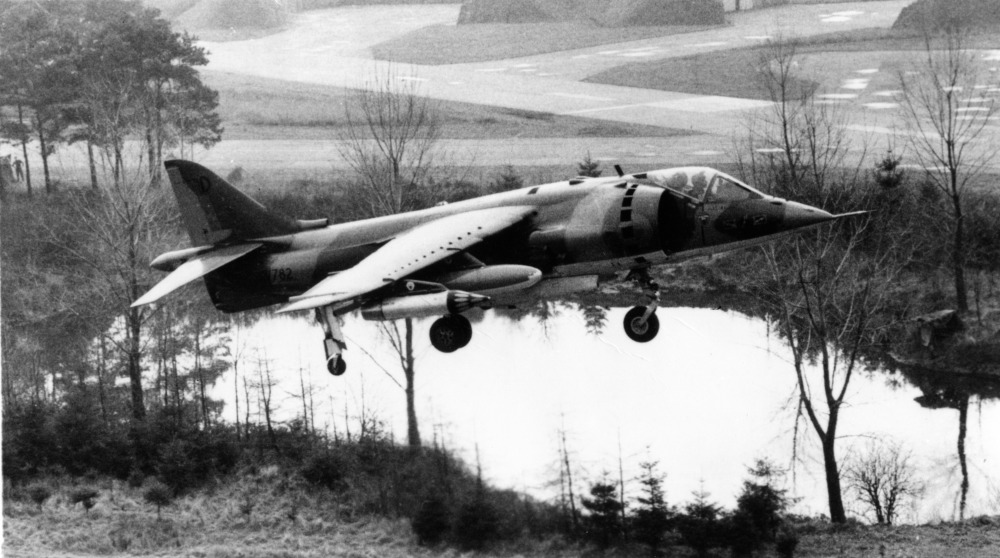
Most combat aircraft need a runway. The Hawker Siddeley Harrier did not, and that single fact made it one of the most distinctive military aircraft ever built. It could rise straight up off a patch of forest road, hang motionless in the air, swivel its jet nozzles downwards and settle back onto the ground like a helicopter, then a moment later accelerate away as a fast jet. No other Western fighter in front-line service has matched that trick at the speed and scale the Harrier managed for more than forty years.
This is the story of the first-generation aircraft: the experimental P.1127, the Kestrel evaluation machines, and the RAF Harrier GR.1 and GR.3 that grew out of them, along with their American, Spanish and Thai cousins. The later and larger Harrier II is a separate development with its own story, and the navalised Sea Harrier deserves its own profile, so both appear here only where they touch the land-based Harrier directly.
What this guide covers
- A different idea about how aircraft should fly
- Origins: the P.1127 and the engine that changed everything
- From Kestrel to Harrier: the GR.1 enters service
- Design: how the Harrier actually works
- Variants and the family tree
- The Harrier goes to war: the Falklands, 1982
- Guarding the inner German border: RAF Germany
- Jump jets in the jungle: Belize
- Crossing the Atlantic: the AV-8A and the US Marines
- Spain, Thailand and the Sea Harrier
- Where the survivors are today
- A demanding aircraft to fly
- Weapons and the reconnaissance role
- The one that worked when others did not
- Legacy: the jet that proved a point
- Frequently asked questions
A different idea about how aircraft should fly
The thinking behind the Harrier came out of a problem that worried air forces throughout the 1950s. Jet fighters were getting heavier and faster, and they needed longer and longer concrete runways. Those runways were obvious, fixed and easy to find on a map. Planners on both sides of the Cold War understood that in the opening hours of a major war the first thing to be cratered would be the enemy’s airfields. An air force tied to a handful of big bases could be silenced before its aircraft ever left the ground.
Vertical and short take-off and landing, usually shortened to V/STOL, offered a way out. If an aircraft could operate from a clearing in a wood, a stretch of motorway or the deck of a small ship, it could not be wiped out by one well-aimed strike on a runway. Many designers chased that idea in the 1950s, often with batteries of separate lift engines that did nothing useful once the aircraft was airborne. The Harrier’s solution was cleaner, and it came from an engine.
Origins: the P.1127 and the engine that changed everything
Camm, Hooper and the Bristol connection
Formal design work on what became the Harrier began in 1957 at Hawker Aircraft, the company famous for the Hurricane and the Hunter. The key figures were Sir Sydney Camm, Hawker’s veteran chief designer, and Ralph Hooper, a senior project engineer. The third name belongs at Bristol: Stanley Hooker, the engine specialist whose team was developing a vectored-thrust turbofan that drew on elements of the Olympus and Orpheus engines. That engine became the Bristol (later Rolls-Royce) Pegasus, and it is the heart of the whole concept.
The clever part of the Pegasus was that it could point its thrust. Instead of all the exhaust blasting straight out of the back, the engine fed four rotating nozzles, two on each side of the fuselage. Swing the nozzles down and the thrust pushed the aircraft up. Swing them back and the same thrust pushed it forward. One engine did the lifting and the flying, with no dead weight to carry once airborne. Hooper laid out an aircraft around that engine, and the P.1127 was the result.
First hovers at Dunsfold
The first prototype, XP831, began tethered hovering trials at Dunsfold in Surrey. The chief test pilot Bill Bedford made the first tethered hover on 21 October 1960, with the aircraft held down by cables as a safety measure while the controls were sorted out. The first free, untethered hover followed on 19 November 1960. Conventional wing-borne flights were carried out separately, and during 1961 the test team worked through the hardest part of the whole programme: the transition from jet-borne hovering flight to wing-borne forward flight and back again. Getting an aircraft to hover is one thing. Teaching it to move smoothly between hovering and flying, without losing control in the middle, was the real breakthrough.
The early aircraft were experimental and they looked it, but they proved the principle worked. In 1963 a P.1127 landed aboard the carrier HMS Ark Royal, an early hint that the vectored-thrust idea would one day take fast jets to sea on ships far too small for conventional aircraft.
Proving the transition, and a public setback
The single hardest technical question was whether an aircraft could move cleanly between hovering on jet thrust and flying on its wings. XP831 made its first conventional flight on 13 March 1961, staying airborne for a little over twenty minutes like an ordinary jet. The two flight regimes were then brought together step by step through 1961, and on 8 September 1961 the team completed a full transition, closing the gap between vertical and wing-borne flight. From that point the P.1127 was no longer two separate aircraft sharing one airframe but a single machine that could do both.
Development was not without drama. In 1963 XP831 crashed in front of the crowds at the Paris Air Show, the result of a speck of dirt in the air lines controlling the engine nozzles, which caused the nozzles to stick. The pilot survived, the aircraft was repaired, and flying resumed. Setbacks like this were part of the price of pioneering a truly new way of flying, and the programme pressed on.
The Tripartite Kestrel
The P.1127 attracted international interest. In 1962 the United Kingdom, the United States and West Germany agreed to fund a small batch of nine aircraft, developed from the P.1127, to evaluate what V/STOL could actually do in service. These were named Kestrel FGA.1 in British use, and the first flew on 7 March 1964. They were operated by a joint unit, the Tripartite Evaluation Squadron, with British, American and German pilots flying the same aircraft. Several of the Kestrels later went to the United States for further testing under the designation XV-6A, and one survives in the Smithsonian’s National Air and Space Museum collection.
The Kestrels were more representative of a usable warplane than the rough early P.1127s, but they were still evaluation machines rather than a finished combat aircraft. What they proved was that ordinary squadron pilots, not just elite test pilots, could be trained to fly a vectored-thrust jet safely. That gave governments the confidence to order the real thing.
The death of the P.1154
For a while the British plan was not the subsonic Harrier at all but a much more ambitious supersonic V/STOL fighter, the Hawker Siddeley P.1154. It promised the same vertical capability with twice the speed, and it was meant to serve both the RAF and the Royal Navy. The reality was that the two services wanted very different aircraft, the technical risks were high, and the costs kept climbing. The P.1154 was cancelled in 1965.
That cancellation, often remembered as one of the bleak moments of 1960s British defence policy, actually saved the Harrier. With the supersonic dream dead, the government ordered a developed version of the proven subsonic Kestrel instead. Six pre-production aircraft, designated P.1127 (RAF), were ordered in 1965, and the first of them flew on 31 August 1966. The name Harrier, which had originally been intended for the P.1154, was given to this aircraft in 1967.
From Kestrel to Harrier: the GR.1 enters service
The first production Harrier GR.1 made its maiden flight on 28 December 1967. The aircraft entered RAF service on 1 April 1969, with No. 1 Squadron at RAF Wittering taking the type first. For the first time, an air force had a single-seat jet combat aircraft in regular squadron use that could take off vertically, hover, and land vertically, while also flying conventional missions as a ground-attack and reconnaissance machine.
The GR designation stood for ground attack and reconnaissance, and that was the Harrier’s job. It was not a dogfighter built to win air superiority. It was a fast, low-flying strike aircraft designed to carry bombs, rockets, gun pods and a reconnaissance camera fit, and to do so from places the enemy would never think to bomb. To underline the point, in 1969 a pair of RAF Harriers took part in the Daily Mail Transatlantic Air Race, operating from a coal yard near St Pancras station in central London and a site in Manhattan, dramatising the aircraft’s freedom from runways in front of the world’s press.
Design: how the Harrier actually works
The Pegasus and vectored thrust
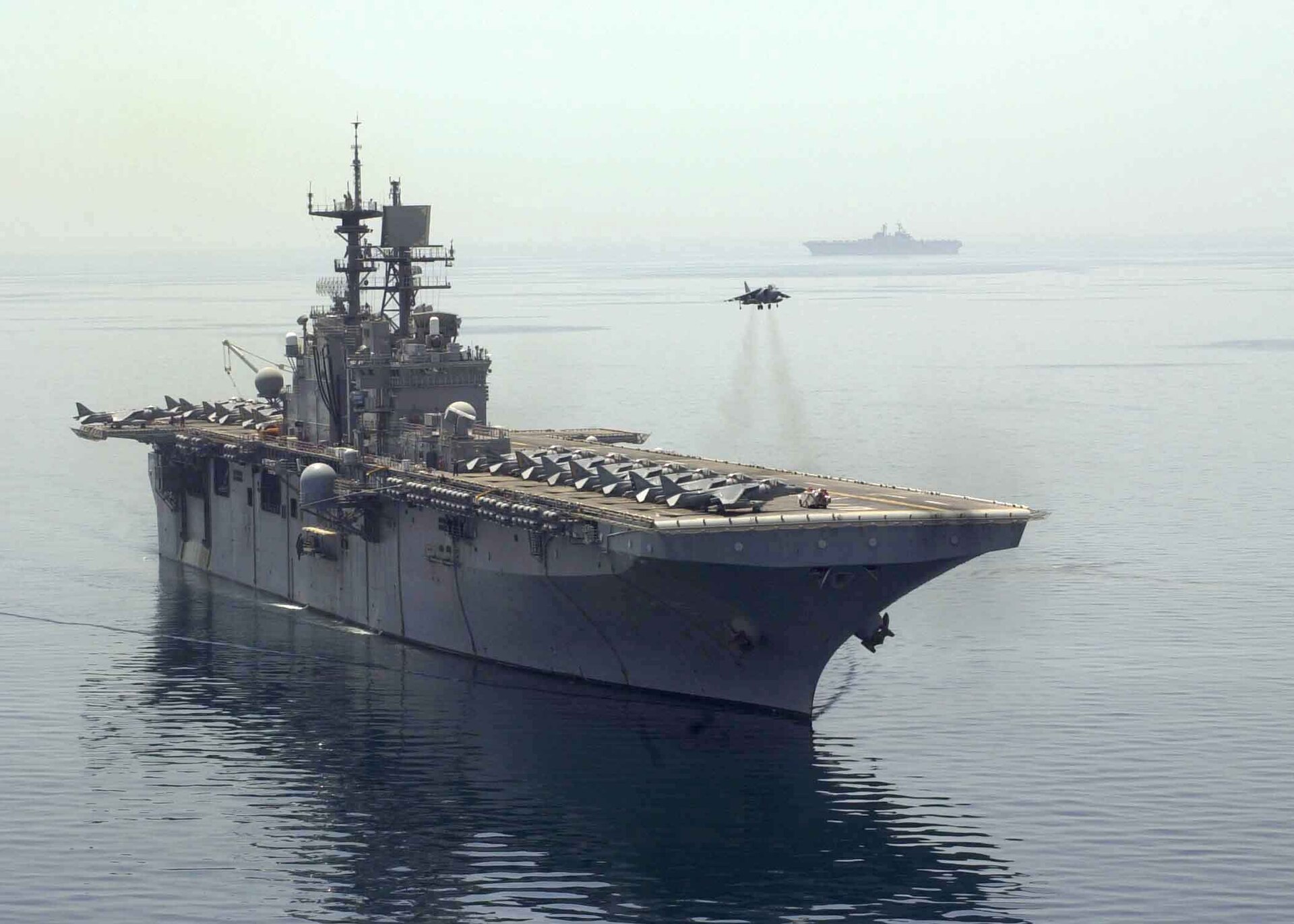
Everything about the Harrier flows from the Pegasus engine and its four swivelling nozzles. The two front nozzles handle cool air from the fan, the two rear nozzles handle hot exhaust, and all four rotate together, controlled by a single lever in the cockpit alongside the throttle. With the nozzles pointing straight back the Harrier flies like any other jet. Rotate them down to about ninety degrees and the thrust holds the aircraft in a hover. Angles in between give short take-offs and decelerating approaches.
Because the lift comes from raw engine thrust rather than from wings moving through the air, the Harrier in the hover must produce more thrust than it weighs. That is why payload and fuel have to be traded carefully against the type of take-off used. A vertical take-off uses the most thrust and allows the least weight. A short take-off, with a run of only a few hundred feet and the nozzles partly lowered, lets the wing do some of the work and allows a far heavier load of fuel and weapons. In practice front-line Harriers almost always used short take-offs for real missions and saved the pure vertical departure for displays and demonstrations.
Reaction controls and flying the hover
An ordinary aircraft steers using ailerons, elevators and a rudder, all of which need air flowing over them to work. In the hover there is no airflow, so those surfaces do nothing. The Harrier solved this with reaction control valves, small puffer jets at the nose, tail and wingtips fed with high-pressure air bled from the engine. When the pilot moves the stick and rudder pedals in the hover, these jets fire to pitch, roll and yaw the aircraft. The system blends in automatically as speed builds, so the pilot uses the same controls throughout, but the workload in the hover was high and the Harrier earned a reputation as a demanding aircraft to master.
VIFFing
One trick the Harrier could play in combat became famous: vectoring in forward flight, universally shortened to VIFFing. By swivelling the nozzles downwards or even partly forwards while flying fast, a Harrier pilot could decelerate violently, tighten a turn or change the aircraft’s flight path in a way a conventional fighter could not follow. It was never the main reason the Harrier existed, and its value in a real dogfight has been debated ever since, but it gave the aircraft an option no pursuing pilot expected.
Living without a runway
The Harrier was built to be hidden. RAF Harrier units trained to disperse into woods and fields, operating from short strips of matting, with aircraft tucked under camouflage netting and supported by tented workshops, fuel bowsers and portable equipment. The whole force could pick up and move to a new site before the enemy worked out where it was. This field-deployment skill, as much as the vertical take-off itself, was what made the Harrier valuable, and it shaped the way the squadrons trained for decades.
Variants and the family tree
The first-generation Harrier appeared in several marks, mostly distinguished by the engine fitted and the equipment in the nose. The RAF ordered 118 aircraft of the GR.1 and GR.3 series, alongside two-seat trainers.
RAF single-seaters
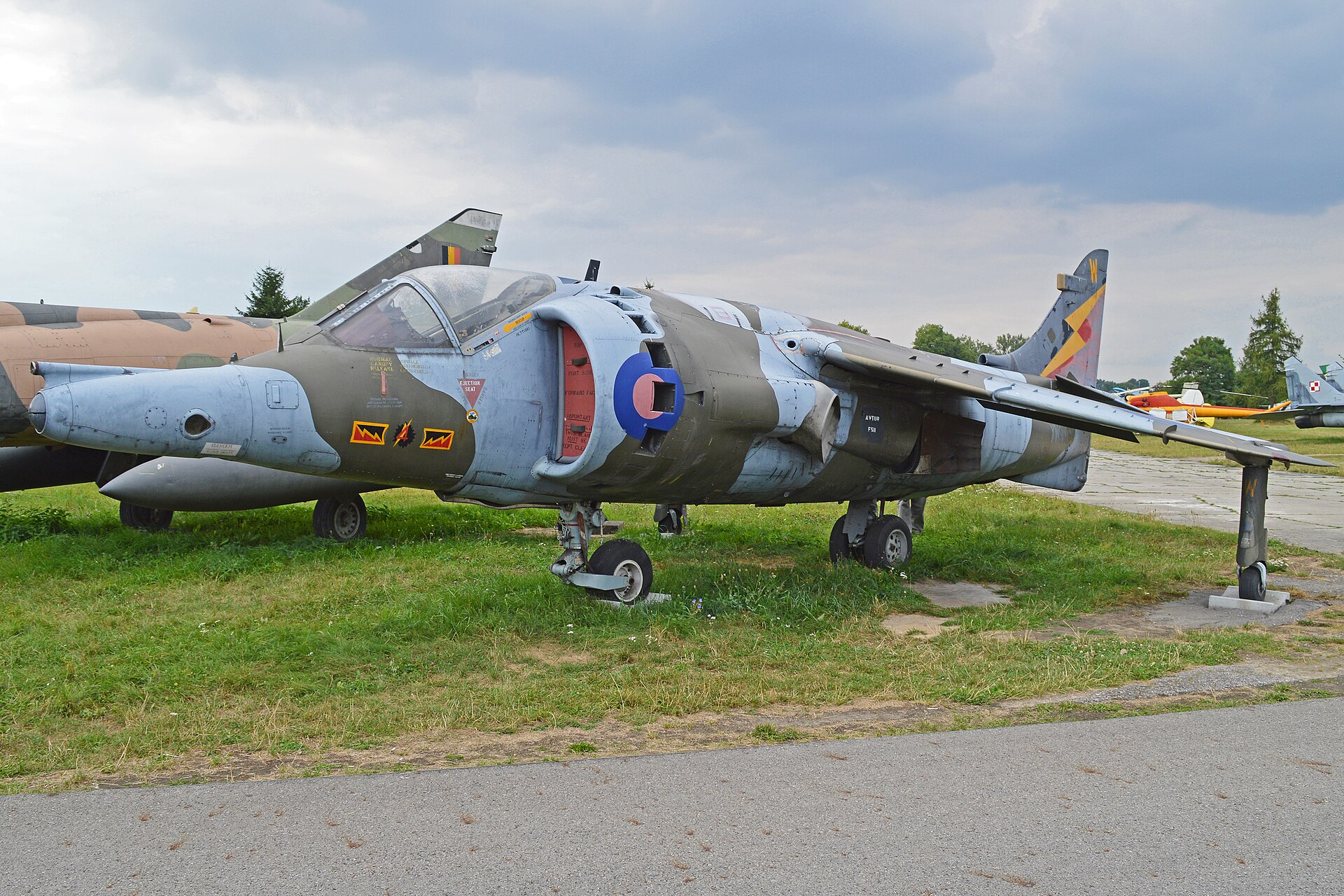
The Harrier GR.1 was the first production version, powered by the Rolls-Royce Pegasus 6, also known as the Pegasus Mk 101, of around 19,000 lb thrust. The GR.1A introduced the more powerful Pegasus 10 (Mk 102) of around 20,500 lb thrust, applied both to new-build aircraft and to upgraded GR.1s. The definitive RAF version was the GR.3, with the further uprated Pegasus 11 (Mk 103) of around 21,500 lb thrust. The GR.3 is the one most people picture, recognisable by its longer, bottle-shaped nose, which housed a Ferranti laser rangefinder and marked-target seeker for more accurate weapons delivery. The GR.3 also added a radar warning receiver, normally seen as a small fairing on the tail fin, and improved electronic countermeasures.
Two-seat trainers
Conversion to the Harrier was difficult, so a two-seat trainer was essential. The RAF used the T.2, later upgraded to T.4 standard to match the GR.3, with the more powerful engine and similar equipment. The trainers kept full combat capability and a raised rear cockpit, giving them a distinctive humped profile and a longer tail to balance the lengthened nose.
Export and naval relatives
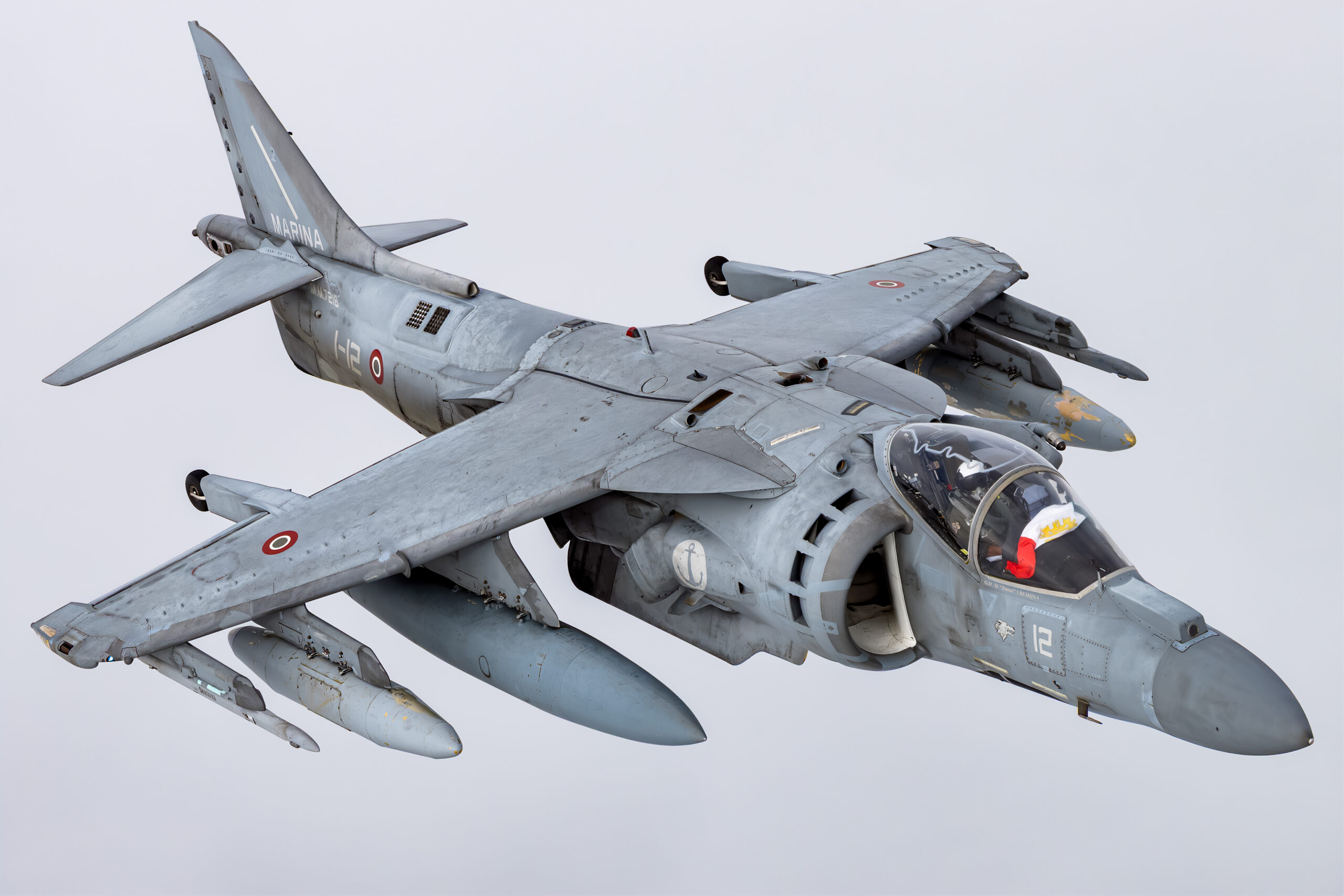
The American AV-8A, the Spanish and Thai AV-8S Matador, and the Royal Navy’s Sea Harrier were all developed from this first-generation aircraft and are covered in their own sections below. The much larger and substantially redesigned Harrier II family, including the RAF’s GR.5, GR.7 and GR.9 and the US Marines’ AV-8B, came later and is really a different aircraft sharing a name and a concept.
Key specifications: Harrier GR.3
| Role | Single-seat V/STOL ground-attack and reconnaissance aircraft |
|---|---|
| Manufacturer | Hawker Siddeley (later British Aerospace) |
| First flight (GR.1) | 28 December 1967 |
| RAF service entry | 1 April 1969 |
| Powerplant | One Rolls-Royce Pegasus 11 (Mk 103) vectored-thrust turbofan |
| Thrust | Approximately 21,500 lb (around 95 kN) |
| Maximum speed | Around 730 mph (about 1,176 km/h) at low level |
| Combat radius | Around 230 miles (about 370 km), mission dependent |
| Crew | One (two in T.4 trainer) |
| Armament | Two underfuselage 30 mm ADEN cannon pods; bombs, rockets and, after 1982, AIM-9 Sidewinder air-to-air missiles on underwing pylons |
Figures for V/STOL aircraft should always be read with care, because speed, radius and payload depend heavily on the type of take-off and the load carried. The numbers above are representative rather than absolute.
The Harrier goes to war: the Falklands, 1982
The Harrier’s most famous campaign came in 1982, when Argentina occupied the Falkland Islands and Britain sent a task force 8,000 miles south to take them back. The story is often told as a Sea Harrier story, and rightly so, but the land-based RAF Harrier GR.3 played an important part too, and the two should not be confused.
Two different Harriers, two different jobs
The Sea Harrier FRS.1 was a navalised derivative built for the Royal Navy, fitted with radar and configured primarily for air defence with Sidewinder missiles. Flying from the carriers HMS Hermes and HMS Invincible, the Sea Harriers were the fleet’s fighters. The RAF Harrier GR.3, by contrast, was the land-attack version with no radar, optimised for hitting targets on the ground.
No. 1(F) Squadron’s GR.3s were the only Harriers cleared and trained for air-to-air refuelling, so they could be flown out to join the task force. They were originally intended as attrition replacements, ready to make up Sea Harrier losses in air combat. As it turned out the Sea Harriers were not being lost in air combat, so the GR.3s were used instead as dedicated ground-attack reinforcements, flying from the carriers and later from a forward strip ashore.
What the Harriers actually did
The numbers tell the story plainly. The ten RAF Harrier GR.3s that saw combat flew 126 sorties, attacking Argentine positions, supply dumps and airfields on the islands, and lost four aircraft. The 28 Sea Harrier FRS.1s flew 1,435 sorties and were credited with around twenty confirmed air-to-air kills against Argentine aircraft for the loss of six of their own. Crucially, every Harrier and Sea Harrier lost in the conflict went down to ground fire or to accidents. Not one was shot down by an enemy aircraft.
Before the GR.3s could fight they had to be hastily modified, because they had never been intended for air combat. Engineers added the wiring and pylons to carry AIM-9 Sidewinder missiles and fitted chaff and flare dispensers for self-protection. The Falklands proved the core Harrier promise in the harshest possible test: fast jets operating far from any proper airfield, flying from small carriers and a rough forward base, in dreadful South Atlantic weather, and making a real difference to the campaign.
In the United States, the Pima Air and Space Museum in Tucson, Arizona and the National Naval Aviation Museum hold early Harriers, and one of the original Tripartite Kestrels survives in the Smithsonian’s National Air and Space Museum as an XV-6A. Because museum collections change as aircraft move, repaint or go into storage, it is always worth checking with a museum before travelling specifically to see a particular airframe.
Guarding the inner German border: RAF Germany
For most of its career the Harrier’s day job was not in the South Atlantic but in West Germany, facing the Warsaw Pact across the inner German border. This was the role the aircraft had been designed for, and it is where the field-deployment idea was taken most seriously.
RAF Germany operated Harriers from the early 1970s. No. 4 Squadron and No. 20 Squadron were among the first, joined by No. 3 Squadron, which re-formed on the Harrier at RAF Wildenrath in 1972. In 1977 the Harrier force concentrated at RAF Gütersloh, the most easterly RAF base in Germany and so the closest to the potential front line. No. 20 Squadron was disbanded around this reorganisation and its aircraft and crews absorbed by the remaining units, building them up to a larger establishment.
From Gütersloh the plan was stark. In a crisis the squadrons would abandon the main base, which would be an obvious target, and melt away into pre-surveyed field sites scattered through the German countryside. Operating from strips of aluminium matting hidden in woodland, the Harriers would support NATO ground forces by attacking Warsaw Pact armour and supply lines as part of the alliance’s flexible response strategy. The aircraft would be moved between sites to stay ahead of any threat. It was demanding, muddy, unglamorous work, and it was exactly what the Harrier had been invented to do.
The Cold War never turned hot, so this contribution can never be measured in combat results. What it gave NATO was a force that could not be neutralised by a first strike on its airfields, and that uncertainty was part of the deterrent. For more on the Cold War flying environment, see our profiles of the English Electric Lightning and the McDonnell Douglas F-4 Phantom II, both of which served alongside the Harrier in different roles.
Jump jets in the jungle: Belize
Germany and the Falklands are the famous postings, but the Harrier also spent years on the other side of the world keeping the peace in Central America. In 1975, with neighbouring Guatemala laying claim to British Honduras, soon to become independent Belize, six Harrier GR.1As of No. 1 Squadron were flown out to the international airport at Ladyville in November 1975 as a visible deterrent against invasion. They operated from simple hides dispersed around the airport and garrison, named off using the NATO phonetic alphabet.
The first detachment returned home in April 1976 once the threat seemed to have eased, but the Harriers were back the following year, and from 1980 the commitment was formalised as No. 1417 Flight. The Belize Harrier flight kept watch over the young country until it was finally stood down in 1993. It was an unusual posting for a Cold War strike aircraft, swapping the woods of north Germany for tropical heat and jungle, and it showed off the same quality that defined the whole type: the ability to operate as a credible fast-jet force from a modest site far from any major air base.
Crossing the Atlantic: the AV-8A and the US Marines
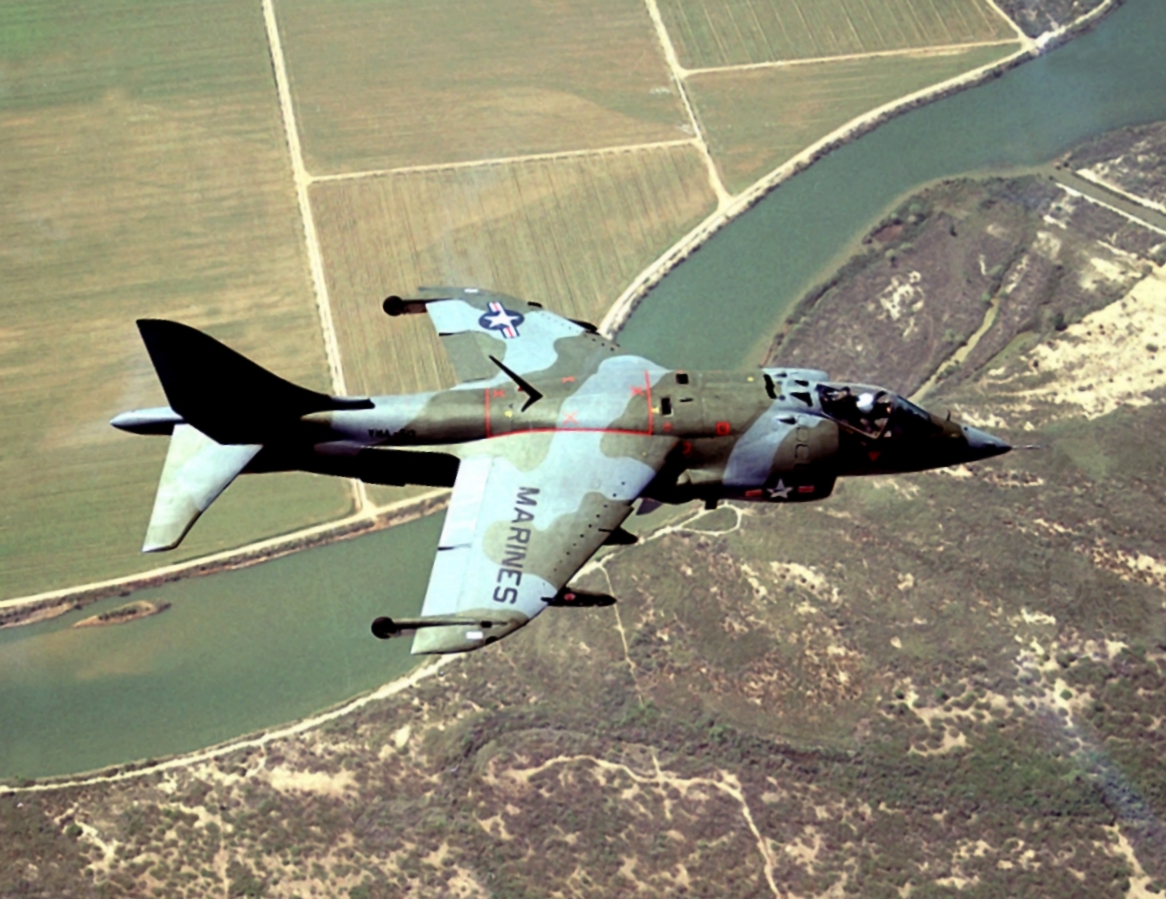
The Harrier’s most enthusiastic foreign customer was the United States Marine Corps. The Marines, whose whole purpose is amphibious assault from the sea, immediately saw the value of an aircraft that could operate close to the beach from austere sites and small ships, giving ground troops air support without waiting for a captured airfield.
The Marines bought the British-built Harrier off the shelf, designating the single-seater AV-8A and the two-seat trainer TAV-8A. Between 1971 and 1976 the Corps received 102 AV-8A and 8 TAV-8A aircraft. Operating the Harrier taught the Marines hard lessons about V/STOL flying, and a number were lost in accidents as crews learned the aircraft’s demands, but the type embedded the vertical-lift idea deeply into Marine Corps thinking. Later, some AV-8As were upgraded to AV-8C standard. That commitment is why the United States went on to co-develop the second-generation Harrier II and why the Marines flew jump jets for half a century.
Spain, Thailand and the Sea Harrier
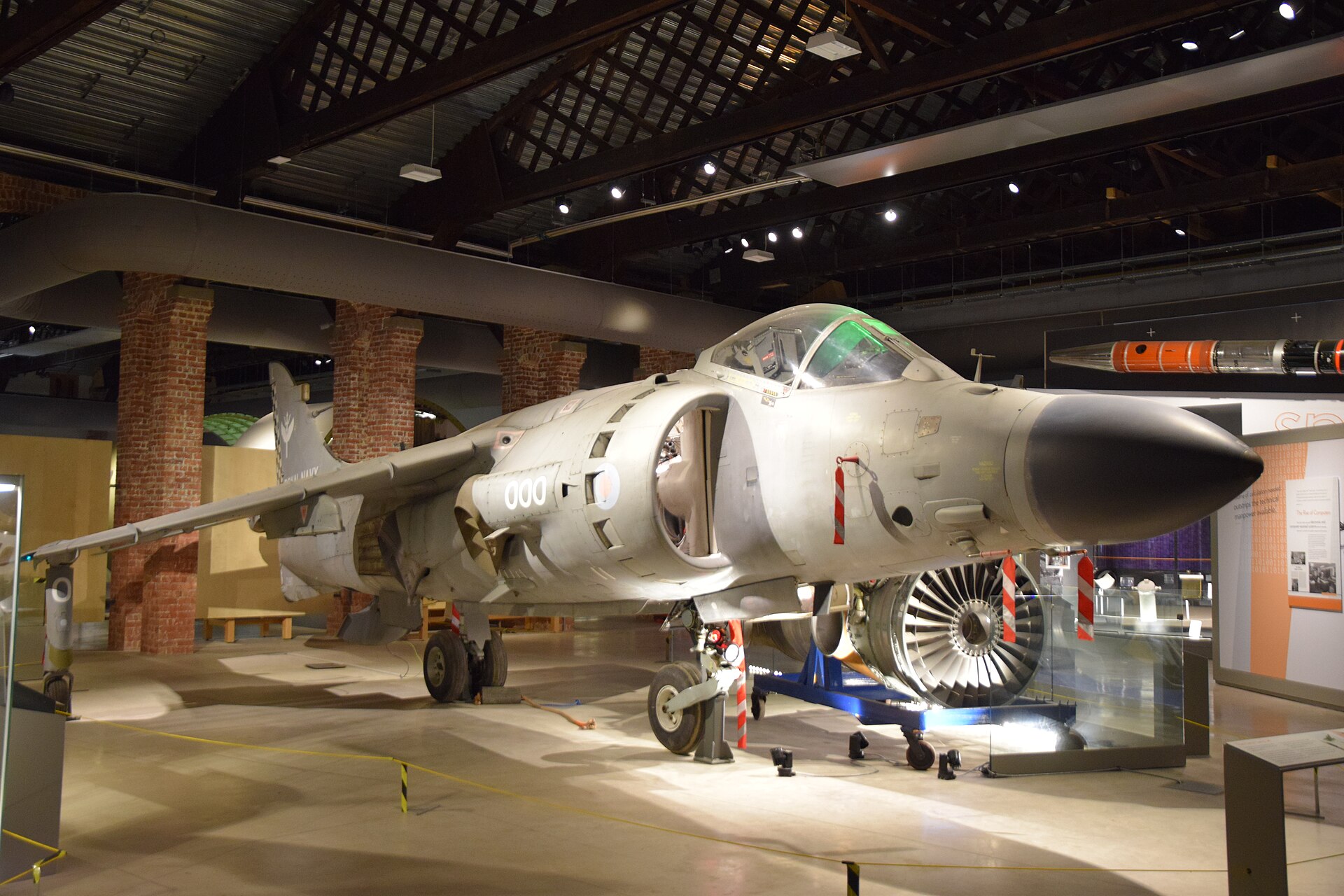
Two navies bought the first-generation Harrier to fly from small aircraft carriers. The Spanish Navy acquired the AV-8S, known in Spanish service as the Matador, as the fixed-wing element of its carrier force. When Spain moved on to newer aircraft, it sold its surviving Matadors to the Royal Thai Navy in 1997, where they flew from the carrier Chakri Naruebet. The Thai Harriers were withdrawn around 2006, largely because spare parts had become impossible to obtain, which left Thailand operating a carrier without fixed-wing aircraft.
The Royal Navy took the concept to sea in its own way with the Sea Harrier FRS.1, a dedicated naval fighter and reconnaissance derivative with radar and air-to-air weapons. Flying from the Navy’s small Invincible-class carriers using a ski-jump ramp to boost the short take-off, the Sea Harrier gave the fleet its own air defence after the large conventional carriers were retired. The ski jump is one of the neatest ideas in naval aviation: an upward-curved ramp at the bow that throws the aircraft into the air at a climbing angle, letting it take off heavier than a flat deck would allow. The Sea Harrier’s combat record in the Falklands, noted above, secured the reputation of the whole Harrier family.
Where the survivors are today
Plenty of first-generation Harriers survive in museums and collections, which is good news for anyone who wants to photograph one up close. In Britain, the Royal Air Force Museum and the Imperial War Museum both hold Harriers, with an ex-US Marine Corps AV-8A displayed at IWM North in Manchester. Many of the RAF’s retired GR.3s went to museums, gate guardians and training schools around the country, and several smaller aviation heritage centres have examples.
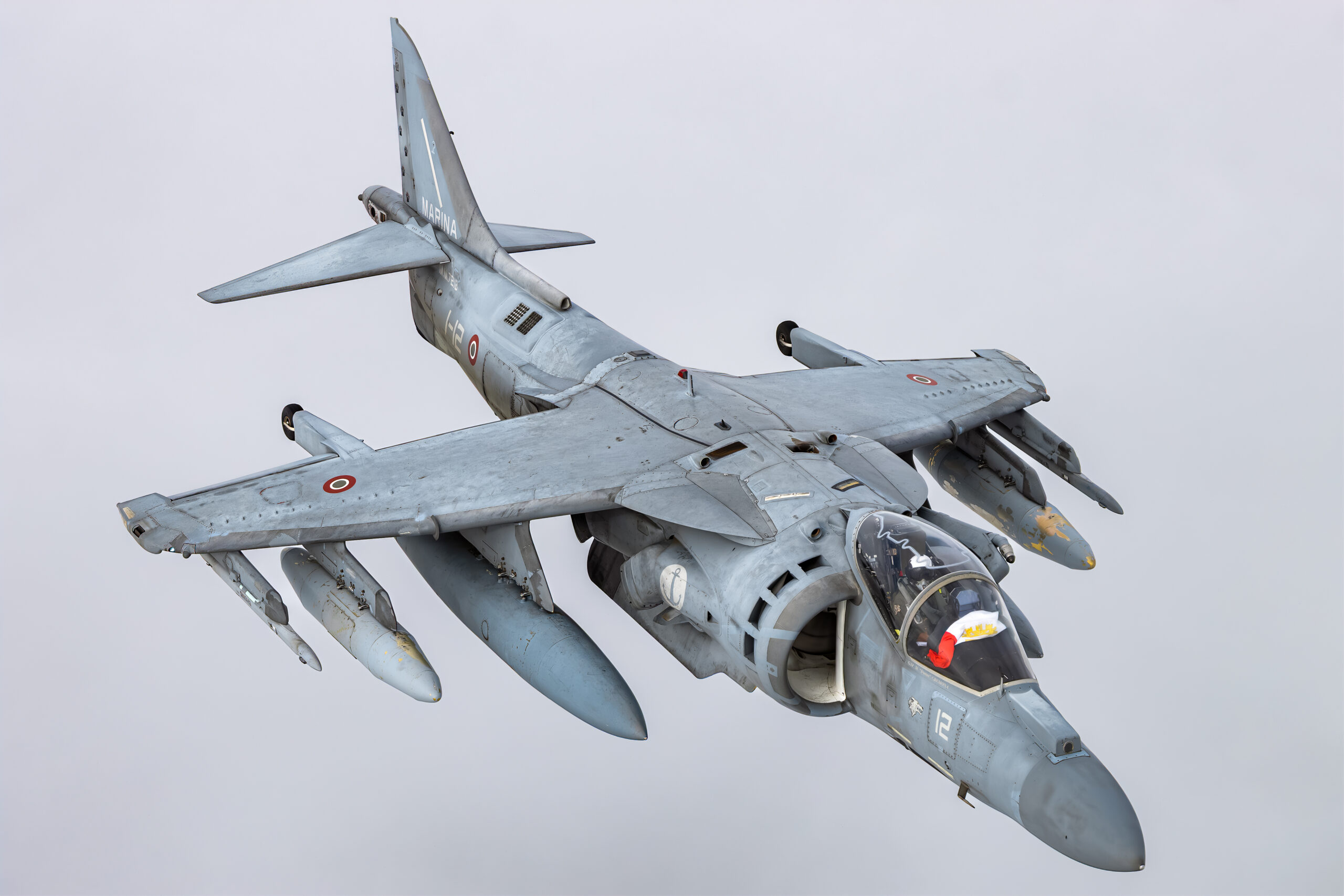
That success led directly to the bigger and more capable Harrier II, which served the RAF and the US Marines into the 21st century, and the whole experience fed into the design of the short take-off and vertical landing version of the F-35 Lightning II that now flies from British and American carriers. The modern jump jet does in software and with a lift fan what the Harrier did with brute thrust and a pilot’s skill, but the line of descent is direct. Every time an F-35B settles vertically onto a flight deck, it is finishing an idea that Bill Bedford first proved over a Surrey airfield in 1960.
A demanding aircraft to fly
It would be dishonest to tell the Harrier’s story without admitting that it was difficult and at times dangerous to operate. Flying the hover by hand, balancing thrust against weight while working the reaction controls, left little margin for error close to the ground. The penalty for getting it wrong at low height was severe, and the first-generation Harrier and its export versions suffered a significant number of accidents over their careers, a fact the US Marines learned the hard way with their AV-8A fleet.
The response was not to abandon the concept but to train hard and respect the aircraft. Conversion to the Harrier was a careful process built around the two-seat trainers, and squadron flying placed a premium on airmanship. Pilots who mastered it tended to speak of the Harrier with real affection, precisely because it asked so much of them. The aircraft also drove improvements that fed into later jump jets, where automation and a more forgiving lift system reduced the workload that had made the original Harrier such a handful.
None of this took away from what the aircraft delivered. A force that can disappear into the countryside and keep flying when every runway has been cratered is worth a great deal, and the Harrier was the only Western aircraft that could actually do it in numbers for decades. The demands it placed on its pilots and engineers were the cost of that unique capability.
Weapons and the reconnaissance role
As a ground-attack aircraft the Harrier carried its punch externally. Two 30 mm ADEN cannon could be fitted in pods under the fuselage, with the strakes between them also helping to trap a cushion of air that improved lift close to the ground. Underwing and underfuselage pylons carried free-fall and retarded bombs, cluster weapons, and pods of unguided rockets for attacking vehicles and troops. After the Falklands lessons, the AIM-9 Sidewinder gave the GR.3 a measure of self-defence against enemy aircraft.
Reconnaissance was always part of the brief, hinted at by the R in the GR designation. Harriers could carry a camera reconnaissance pod, letting a dispersed Harrier site double as a tactical reconnaissance asset, bringing back imagery of enemy movements without needing a separate specialist aircraft. Combined with the laser rangefinder and marked-target seeker in the GR.3’s nose, which let the aircraft work with ground troops marking targets, this made the Harrier a flexible tool for supporting an army in the field rather than a single-purpose bomber.
The one that worked when others did not
It is easy to forget how crowded the V/STOL field was in the 1950s and 1960s, and how few of those projects led anywhere. Designers across Europe and America tried tail-sitters that took off pointing at the sky, aircraft with separate banks of lift engines, tilting wings and tilting propellers, and various other schemes. Most never reached service. They were too complex, too thirsty, too heavy with machinery that was useless once airborne, or simply too dangerous. The graveyard of cancelled vertical-flight prototypes is a large one.
The Soviet Union did field a vectored-thrust naval fighter of its own, the Yakovlev Yak-38, which flew from the deck of the Kiev-class ships. It used a combination of a vectoring main engine and separate lift engines, and it never came close to matching the Harrier’s flexibility or success. That contrast is part of why the Harrier matters. Among all the attempts to build a practical vertical-flight combat aircraft, the Hawker Siddeley design was the one that worked, served in numbers, went to war, and stayed in front-line use long enough to spawn a second generation and influence a third.
The reason comes back to that one decision taken at Hawker and Bristol in 1957: to get the lift and the forward thrust from a single engine by pointing its exhaust, rather than carrying dead-weight lift engines for the few minutes they were needed. It was an elegant answer to a hard problem, and elegance, in engineering, tends to last.
Legacy: the jet that proved a point
The first-generation Harrier was not a large programme by fast-jet standards, and it was never the fastest or the longest-ranged aircraft of its day. Its importance lies elsewhere. It was the first, and for a long time the only, V/STOL combat aircraft to enter wide front-line service and stay there, and it did so by being really useful rather than a flying laboratory. It showed that a single vectored-thrust engine could lift a real warplane, hover it, and fly it as a conventional jet, all without the dead weight of separate lift engines.
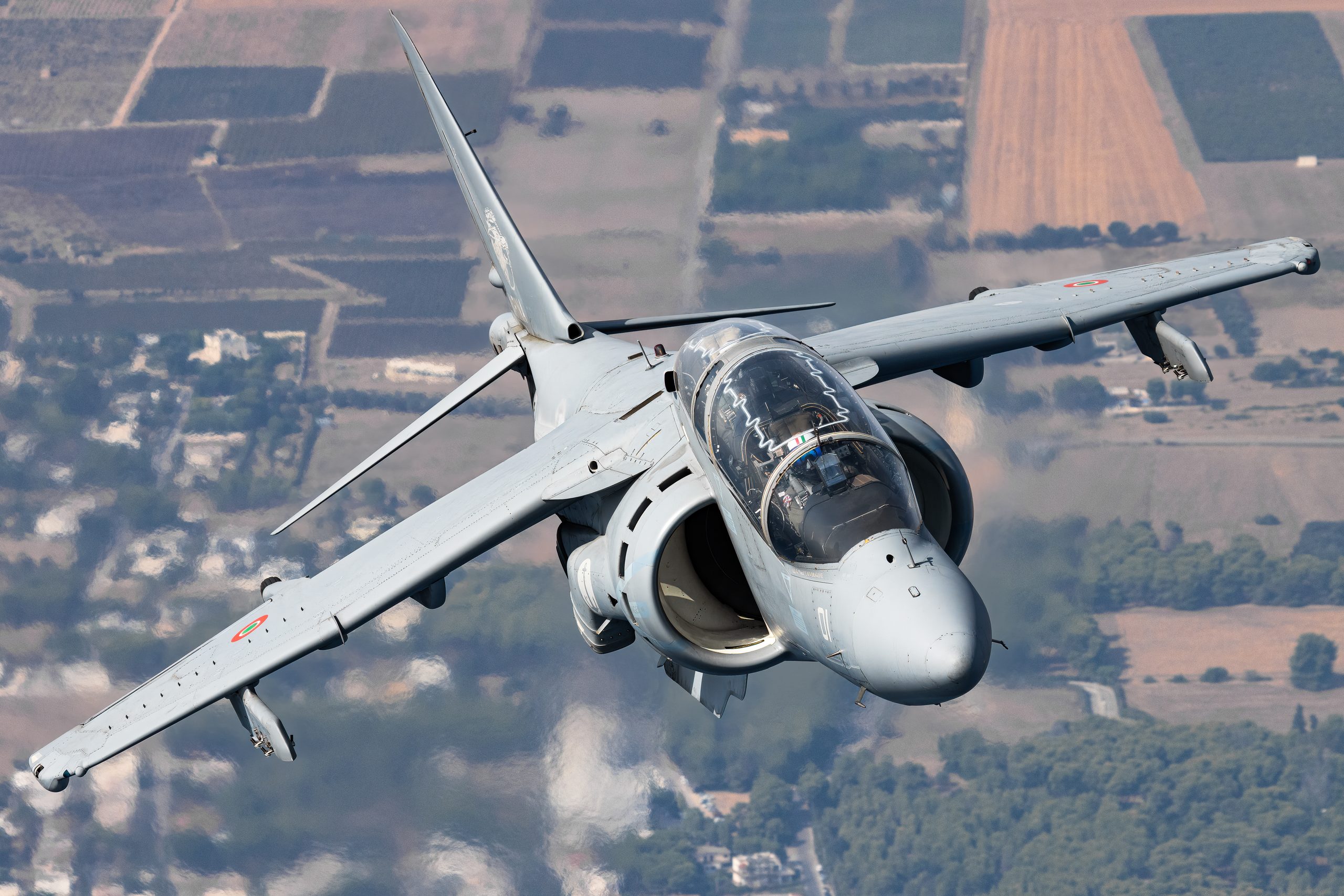
For photographers and enthusiasts, the first-generation Harrier remains one of the most characterful subjects in aviation: small, purposeful, slightly hunched, and tied forever to the unforgettable sight and sound of a fast jet hanging motionless in the air.
Harrier imagery is in steady demand and thinning out now the type has left front-line service, with Sea Harrier and GR-series airframes often confused in captions. Our guide to aviation picture research covers what to check before you commit to a frame.
The type’s hardest test came in the South Atlantic. Our account of the Falklands air war of 1982 covers what the Sea Harrier and the Harrier GR3 achieved there, and what each of them lost.
Frequently asked questions
What is the difference between the Hawker Siddeley Harrier and the Harrier II?
The Hawker Siddeley Harrier is the original first-generation aircraft of the late 1960s, including the RAF GR.1 and GR.3 and the US AV-8A. The Harrier II, including the RAF GR.5, GR.7 and GR.9 and the US AV-8B, is a substantially larger and redesigned later aircraft with a new wing and much greater payload. They share a name and the vectored-thrust concept but are different aircraft.
When did the Harrier first fly and enter service?
The experimental P.1127 first hovered in 1960. The first production Harrier GR.1 flew on 28 December 1967, and the type entered RAF service on 1 April 1969 with No. 1 Squadron.
How does the Harrier take off and land vertically?
It uses a single Rolls-Royce Pegasus engine with four rotating nozzles that direct the thrust. Pointing the nozzles downwards lifts the aircraft for a vertical or short take-off and a vertical landing; pointing them rearwards drives it forward in normal flight. Small puffer jets at the nose, tail and wingtips control the aircraft when it is too slow for its normal flying surfaces to work.
Did the Harrier fight in the Falklands War?
Yes. RAF Harrier GR.3s of No. 1(F) Squadron flew ground-attack missions, while the Royal Navy’s related Sea Harrier FRS.1 handled air defence and scored around twenty air-to-air kills. No Harrier or Sea Harrier was shot down by an enemy aircraft during the conflict; all losses were to ground fire or accidents.
How many first-generation Harriers were built for the RAF?
The RAF ordered 118 aircraft of the GR.1 and GR.3 single-seat series, along with a batch of two-seat T.2 and T.4 trainers. Exact sub-totals for new-build versus converted aircraft vary between sources.
Who flew the Harrier apart from Britain?
The United States Marine Corps flew it as the AV-8A, Spain operated the AV-8S Matador from its carrier, and Spain later sold those aircraft to the Royal Thai Navy. The Royal Navy flew the navalised Sea Harrier derivative.
What was VIFFing in the Harrier?
VIFFing stood for vectoring in forward flight, a trick unique to the Harrier. By swivelling the engine nozzles downwards or partly forwards while flying fast, the pilot could decelerate sharply or tighten a turn in a way a conventional fighter could not follow. Its true value in a real dogfight has been debated, but it gave the aircraft an option no pursuing pilot expected.
How many Harriers did the US Marine Corps buy?
Between 1971 and 1976 the United States Marine Corps received 102 single-seat AV-8A aircraft and 8 two-seat TAV-8A trainers, bought largely off the shelf from Britain. Some AV-8As were later upgraded to AV-8C standard. The experience embedded vertical-lift flying into Marine Corps thinking and led on to the second-generation AV-8B Harrier II.
Why did the Harrier not need a runway?
It was built to operate from clearings, roads, matting strips or small ships so that it could not be wiped out by a strike on a fixed airfield. RAF units trained to disperse into woods and fields, hidden under camouflage netting and supported by portable equipment, then move on before the enemy could find them. That field-deployment ability, as much as the vertical take-off itself, was the whole point of the design.
For the story of the jet that now stands quick reaction alert where Harriers once did, see our history of the Eurofighter Typhoon.
The Harrier’s vertical-flight lessons did not die with it: they shaped the lift-fan system at the heart of the F-35B. Our full profile of the Lockheed Martin F-35 Lightning II picks up the STOVL story where the Harrier left off.
