The first powered, sustained and controlled flight in history was made by Orville Wright on 17 December 1903 at Kill Devil Hills, North Carolina, when the Wright Flyer flew 120 feet in 12 seconds, the first time a machine carrying a man had lifted itself into the air by its own power, travelled under control, and landed no lower than it started. Four flights were made that morning, and the last of them, Wilbur Wright’s 852 feet in 59 seconds, removed any doubt that the thing had really been done.
No single event in the history of technology has a sharper before and after. Before that Thursday morning, human flight was a dream pursued by visionaries and cranks, and it was really hard to tell the two apart. After it, flight was an engineering problem with a known solution. This is the story of how two bicycle builders from Dayton, Ohio got there first, what actually happened on the sand that morning, and how the little machine that flew for a total of 98 seconds ended up as perhaps the most argued-over artefact in American history.
What this guide covers
- The problem of flight in 1899
- The road to December: gliders and the wind tunnel
- Camp life on the Outer Banks
- Building the Flyer
- 14 December: the coin toss and the false start
- 17 December 1903: the four flights
- How we know: the evidence trail
- The most famous photograph in aviation
- Why it mattered
- Aftermath: proving it to the world
- Contested claims and the Smithsonian feud
- Where the Flyer is today
- Frequently asked questions
The problem of flight in 1899
By the end of the nineteenth century, powered flight was close enough to touch and stubbornly out of reach. The physics was not the obstacle; balloons had been carrying people for over a century, and gliding pioneers had shown that curved wings generate usable lift. The obstacle was that nobody could agree on what the actual problem was.
Most serious contenders thought the problem was power. Build a machine strong and light enough, the reasoning went, aim it into the air, and flight follows. Hiram Maxim built an enormous steam-driven test rig in England in the 1890s that generated plenty of lift and no control whatsoever. In France, Clement Ader claimed a brief hop in a bat-winged steam machine as early as 1890, a claim still argued about and, at best, an uncontrolled skim. In Washington, Samuel Pierpont Langley, secretary of the Smithsonian Institution and one of the most respected scientists in America, flew impressive steam-powered models and won substantial War Department funding, reported at around fifty thousand dollars, to scale them up into a man-carrying machine he called the Aerodrome.
A minority understood that the real problem was control. The German engineer Otto Lilienthal made some two thousand glides in the 1890s, steering by throwing his body weight around, and published the lift data everyone else built upon. His death in a gliding accident in 1896 was the event that pulled the Wright brothers into aeronautics; Wilbur later wrote of his interest being revived by news of it. In Chicago, the engineer Octave Chanute refined glider structures and, just as importantly, acted as the connective tissue of world aeronautics, corresponding with everyone and hiding nothing.
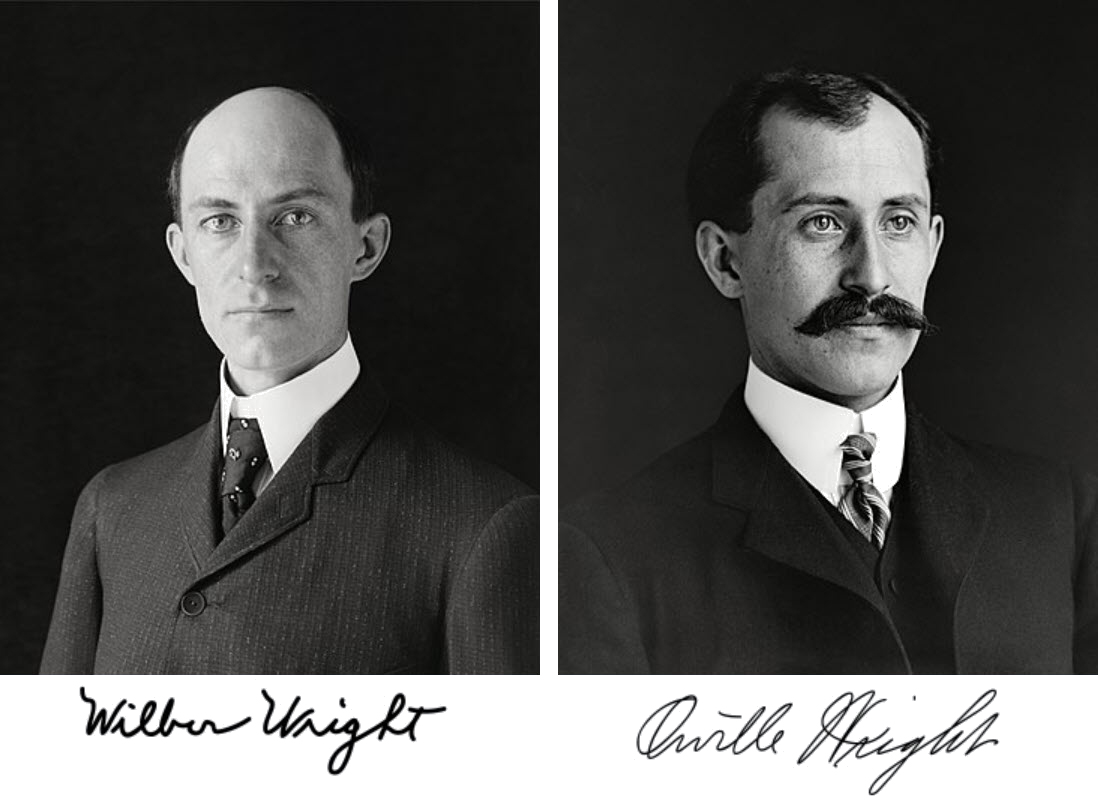
Wilbur and Orville Wright ran a bicycle sales and manufacturing business in Dayton, Ohio. Neither had a university education. What they had was a craft trade that lived on precision, balance and light structures, and a habit of thinking for themselves. When Wilbur wrote to the Smithsonian in 1899 asking for everything published on flight, the brothers began, as good engineers do, by reading the literature. Then they did something almost nobody else had done: they identified the crux. A flying machine, Wilbur reasoned, was like a bicycle. It would be inherently unstable, and that was fine, provided the rider had the means to balance it continuously. Power without control was a catapulted death. Control was the invention.
The road to December: gliders and the wind tunnel
The Wrights’ campaign was a model of incremental engineering, and it is worth following, because the Flyer of 1903 makes no sense without it. Their first insight was wing warping, allegedly prompted by Wilbur idly twisting a long inner-tube box in the shop: twist the whole wing structure so one tip meets the air at a greater angle than the other, and the aircraft rolls. It was the ancestor of every aileron flying today, and no one else had anything like it.
They tested the idea on a five-foot kite in 1899, then took a man-carrying glider to the Outer Banks of North Carolina in 1900, chosen for its steady winds, soft sand and blessed remoteness. A bigger glider followed in 1901, and it flew poorly, producing far less lift than Lilienthal’s published tables promised. Most people would have blamed their own workmanship. The Wrights concluded the world’s data was wrong, went home to Dayton, and built a six-foot wind tunnel in the back of the bicycle shop. Through the autumn of 1901 they measured the lift and drag of around two hundred miniature wing shapes with balances made from hacksaw blades and bicycle spokes, producing the first aerodynamic data anyone could actually design against.
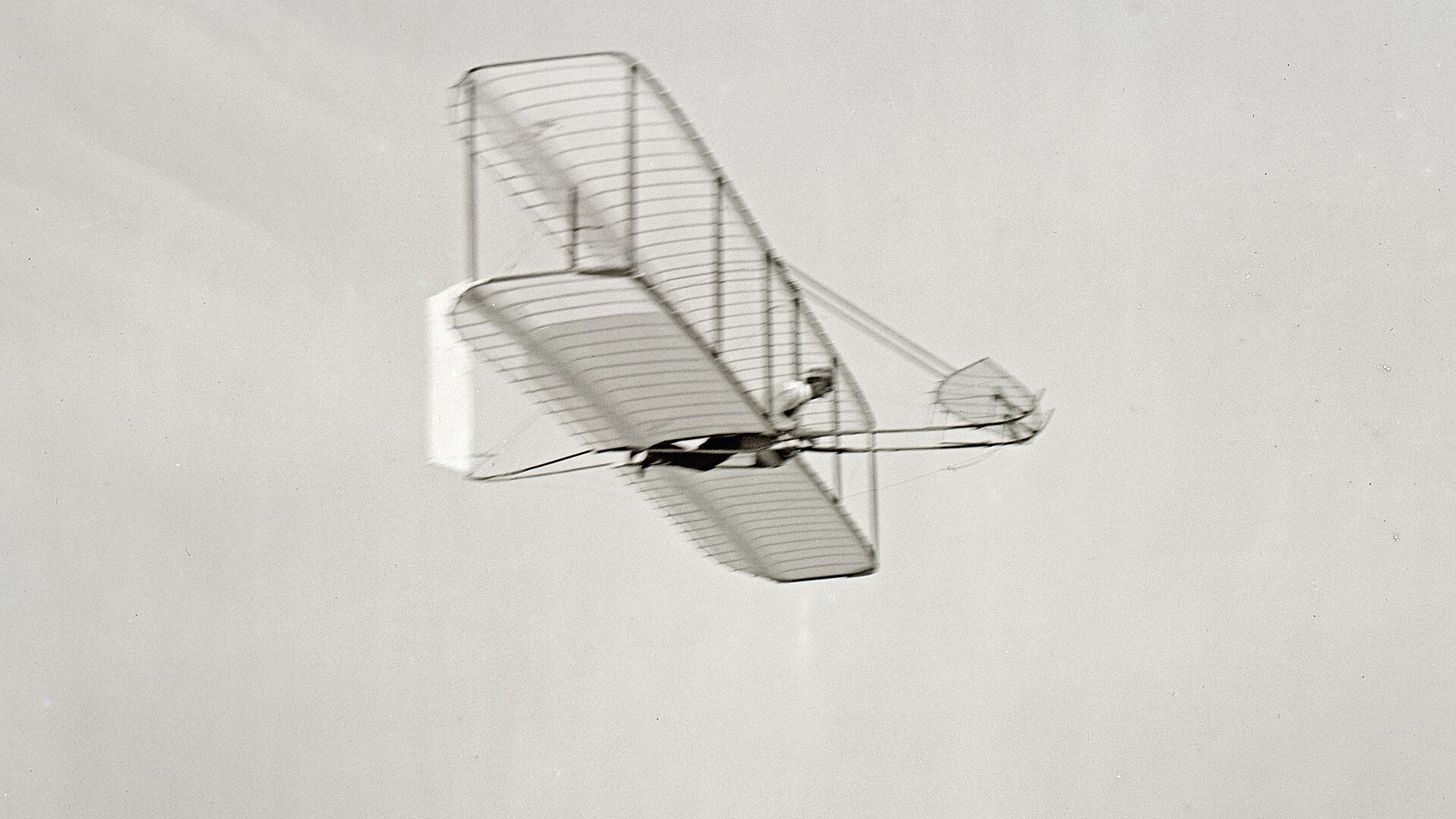
The 1902 glider, designed from their own numbers, was the true breakthrough. It flew beautifully, and it taught them the last hard lesson: wing warping alone produced a vicious skidding tendency, solved when Orville proposed making the rear rudder movable and linking it to the warping control. With that, the 1902 glider became the first aircraft in history controllable in all three axes: pitch from the front elevator, roll from wing warping, yaw from the linked rudder. They made nearly a thousand glides in it. When they went home in the autumn of 1902, the brothers knew how to fly. All they lacked was power, and power, as they had correctly judged from the start, was the easy part.
Camp life on the Outer Banks
It is easy to read the Wright story as a sequence of clean technical steps and miss what the campaigns actually cost. The Outer Banks of 1900 were about as remote as the eastern United States offered: a ribbon of dune and scrub between the Atlantic and Albemarle Sound, reachable by an unreliable boat crossing, with a scattering of fishing families and the crews of the government lifesaving stations for company. Getting there from Dayton took the best part of a week. Wilbur’s first journey down in 1900 included a storm-lashed passage in a leaking schooner that nearly ended the whole enterprise before it began.
Each season the brothers built or repaired a wooden camp at Kill Devil Hills, part workshop, part hangar, part home. They cooked on a petrol stove, slept in bunks slung in the rafters, drank rainwater and killed the endless mosquitoes that made the late summer of 1901 a special misery, the worst, they wrote home, in years. Storms regularly stripped the camp; the autumn of 1903 brought gales that pinned the brothers indoors and once had Orville up on the roof in the blast, hammering battens with his coat flogging around him. The machine shared the shed with the men, and sand got into everything: food, blankets, bearings.
The isolation was chosen deliberately, for wind, for soft landings, and for privacy, and it shaped the brothers’ relationship with the locals in ways that served history well. The lifesavers of the Kill Devil Hills station hauled timber, retrieved gliders, carried the Flyer to its rail, and stood witness on the day itself. The photograph of the first flight exists because Orville trusted one of them with the camera. In an age of laboratory aviation funded by governments, the first aeroplane was built by hand in a shed and launched with the help of neighbours, and there is no better measure of the Wrights’ approach than the fact that this was enough.
Building the Flyer
The 1903 machine was a scaled-up 1902 glider with an engine, which is precisely why it worked. No automobile manufacturer would supply a petrol engine light enough, so the brothers’ shop mechanic, Charlie Taylor, built one from scratch in six weeks: four cylinders, an aluminium alloy crankcase, no carburettor, no spark plugs in the modern sense, roughly 180 pounds with its accessories, and about 12 horsepower. It was crude even by 1903 standards, and it was enough.
The propellers were the hidden masterpiece. Everyone else treated aircraft propellers like ship screws pushing against the air. The Wrights realised a propeller is a rotating wing generating thrust as lift, and designed theirs with their wind tunnel data. Modern analysis has found their 8.5 foot spruce propellers remarkably efficient for hand-carved wood, and the twin pusher arrangement, chain-driven with one chain crossed so the propellers rotated in opposite directions, cancelled torque neatly. Both innovations came from the same habit of mind: distrust analogy, measure everything.
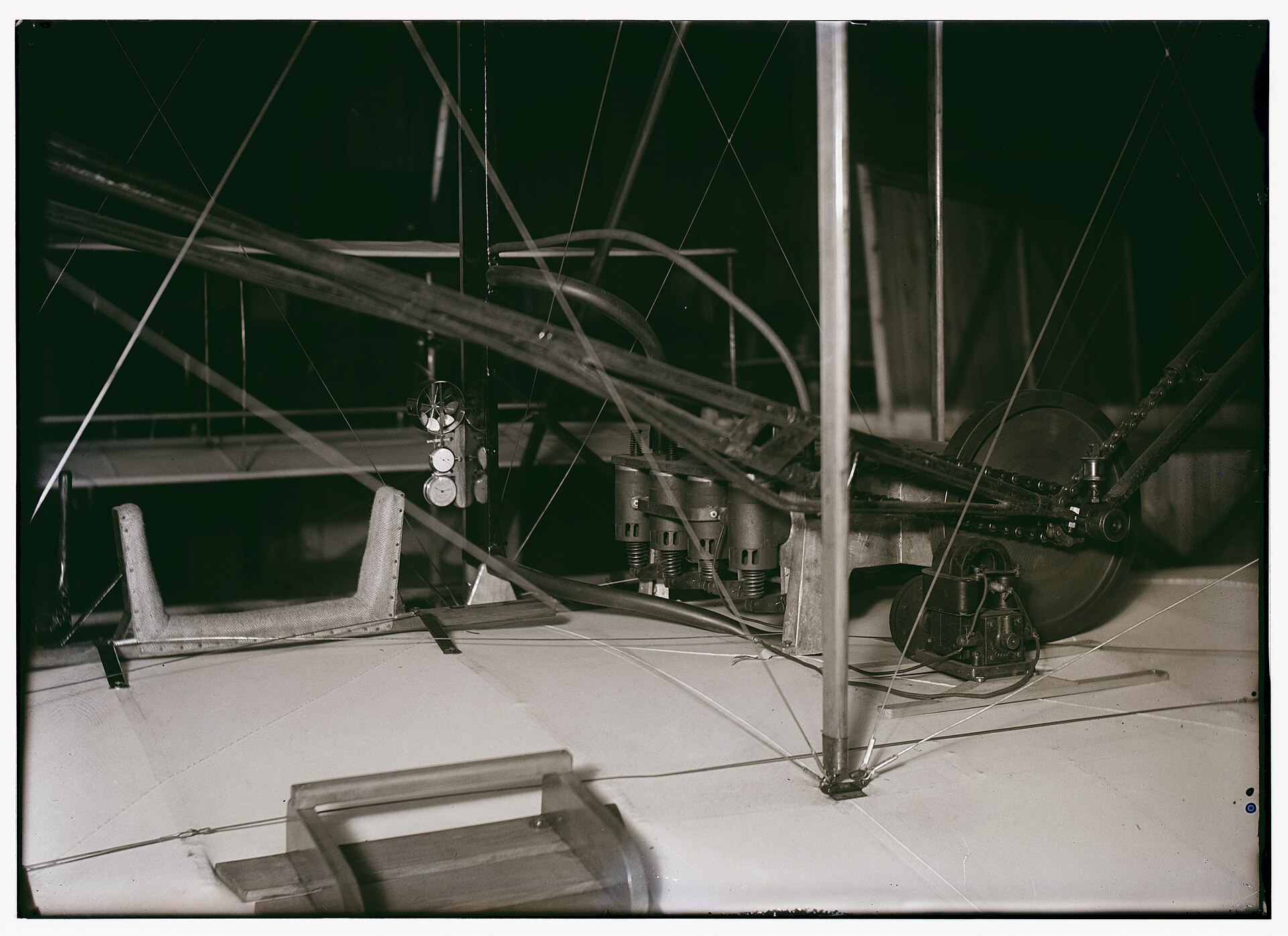
The pilot lay prone in a hip cradle on the lower wing; shifting the hips sideways warped the wings and moved the rudder, while a hand lever worked the front elevator. There were no wheels. The Flyer took off from a sixty-foot wooden launching rail the brothers called, with characteristic dryness, the Grand Junction Railroad.
| Item | Detail |
|---|---|
| Wingspan | 40 ft 4 in (12.3 m); the right wing about four inches longer to offset the engine’s off-centre weight |
| Length | 21 ft 1 in (6.4 m) |
| Weight | About 605 lb (274 kg) empty; roughly 750 lb (340 kg) with pilot |
| Engine | Four-cylinder petrol engine built by Charlie Taylor, about 12 hp, roughly 180 lb with accessories |
| Propellers | Two 8.5 ft spruce pushers, chain-driven, counter-rotating |
| Control | Front elevator (pitch), wing warping (roll), linked movable rudder (yaw) |
| Airspeed on 17 December 1903 | Around 34 mph into a headwind of over 20 mph, giving a ground speed of under 10 mph |
| Total flying career | Four flights, roughly 98 seconds in the air, one day |
14 December: the coin toss and the false start
The brothers reached their camp at Kill Devil Hills, four miles south of the fishing village of Kitty Hawk, in late September 1903. The autumn was a catalogue of frustrations: storms battered the camp, the propeller shafts cracked repeatedly and had to be remade in Dayton, and the brothers followed newspaper reports of Langley’s progress with understandable anxiety. They need not have worried. Langley’s Aerodrome, launched by catapult from a houseboat on the Potomac, failed twice that autumn, on the second occasion, nine days before Kitty Hawk, folding up and dropping its pilot into the icy river. Fifty thousand dollars of public money had produced two splashes. The Wrights’ entire campaign, from 1900 to 1903, had cost them about a thousand dollars of bicycle-shop profits.
By 14 December the Flyer was ready. The brothers tossed a coin for the first attempt, and Wilbur won. They laid the launching rail down the slope of the big Kill Devil dune to help the underpowered machine accelerate, and at the end of the rail Wilbur pulled the nose up too sharply, stalled, and came down in the sand after three and a half seconds and about 105 feet, damaging the elevator. Neither brother counted it as a flight, and their honesty about that failed attempt is one of the reasons their records were believed. The repairs took two days.
It is worth pausing on that decision, because it defines the pair. A machine that leaves a downhill rail and settles into the sand has not flown, and they knew it. The test they set themselves was the one history now uses: the machine must rise from level ground, sustain itself in the air under its own power, remain under control, and land at a point no lower than where it started. Nothing less would count.
17 December 1903: the four flights
Thursday 17 December dawned cold, with puddles iced over and a wind of over twenty miles per hour out of the north. It was, if anything, too much wind; they had wanted calmer air, but the season was closing and patience had run out. At about ten in the morning they hung a signal flag out for the crew of the Kill Devil Hills Life-Saving Station, a mile away, and five witnesses came: lifesavers John T. Daniels, Willie Dough and Adam Etheridge, the lumber buyer W. C. Brinkley, and Johnny Moore, a teenager from Nags Head. This time the rail was laid on the flat, level sand. Whatever happened would owe nothing to gravity.
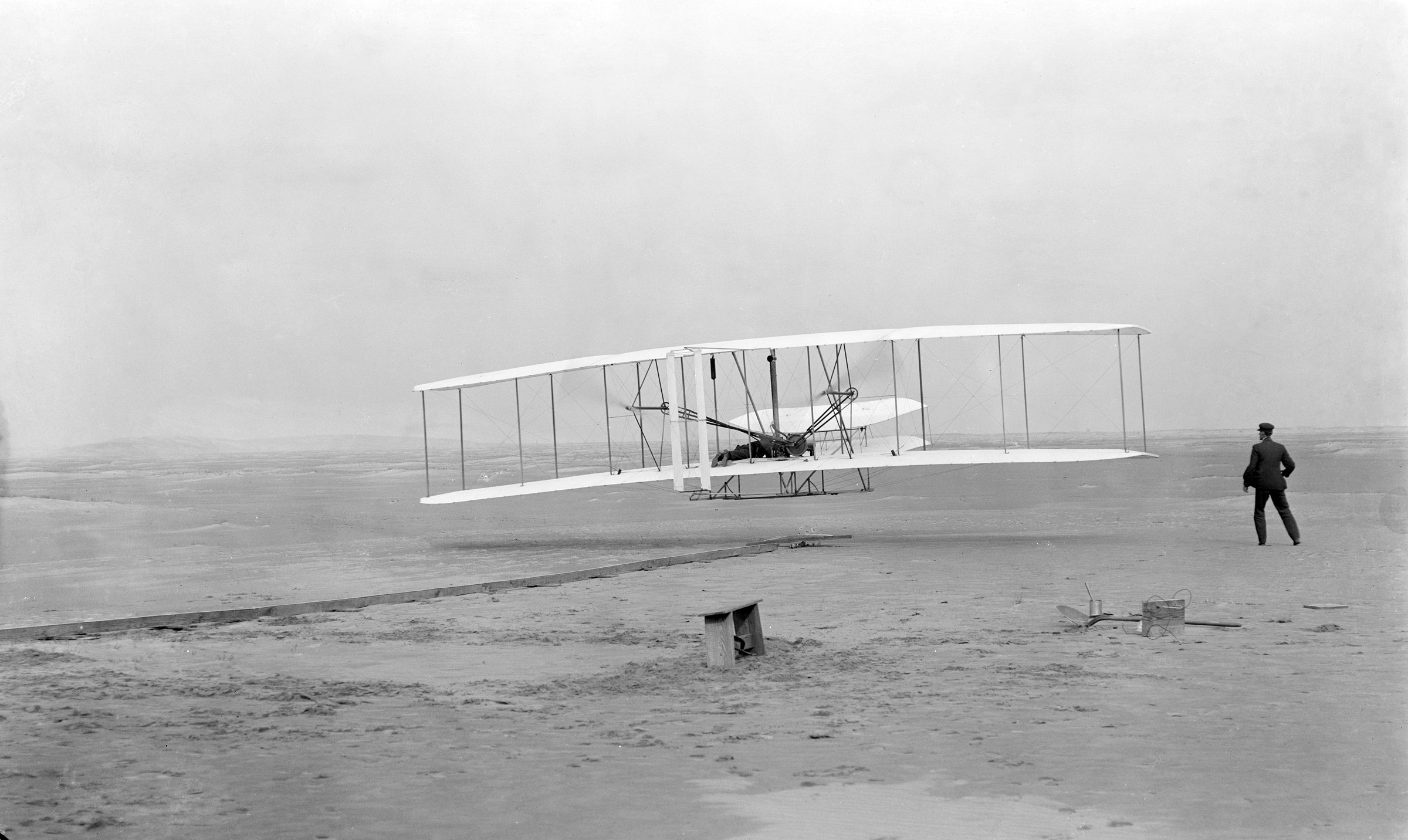
It was Orville’s turn. At 10:35 am he released the restraining wire, the Flyer trundled down the rail into the stiff headwind with Wilbur steadying the right wingtip, and it lifted off. The flight was ragged, the machine porpoising as Orville over-corrected with the sensitive elevator, and it ended after 12 seconds and 120 feet with a slight bump into the sand. Measured against everything humans had ever done before, it was everything: a machine had raised a man into the air by its own power, moved forward under control, and landed no lower than it began.
They flew three more times that morning, taking turns, carrying the 600-pound machine back to the rail between flights. Wilbur managed about 175 feet, Orville around 200. Then, at about noon, Wilbur made the fourth flight, and after the same initial pitching settled the machine down and simply flew, on and on across the flat, until the elevator dipped and the Flyer came down 852 feet from the rail after 59 seconds. The distance rebuts every attempt to explain the day away as a lucky hop. Fifty-nine seconds is not luck. It is an aeroplane.
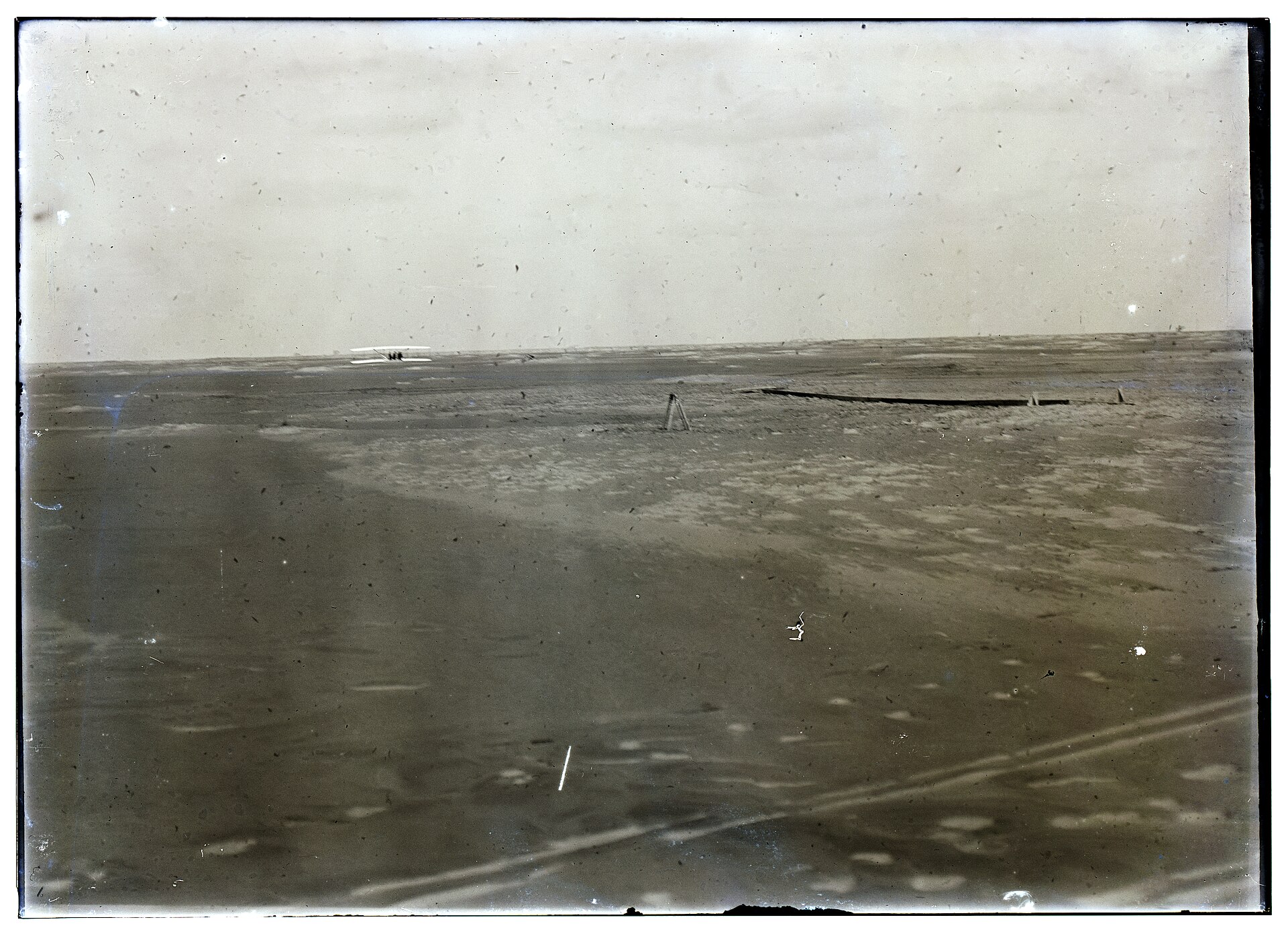
While the men stood discussing the flight, a gust caught the parked Flyer and rolled it over and over across the sand. Daniels, who grabbed a strut and was tumbled inside the wreckage, escaped with bruises and a story he told for the rest of his life; the machine was wrecked. It had flown four times, for a combined 98 seconds or so, and it never flew again. That afternoon the brothers walked to Kitty Hawk and telegraphed their father, Bishop Milton Wright, in Dayton: success, four flights Thursday morning, all against a twenty one mile wind, longest 57 seconds, inform press, home Christmas. The 57 was a transmission error for 59. Even the most important telegram in aviation history had a typo.
| Flight | Pilot | Distance | Time | Notes |
|---|---|---|---|---|
| 1 (10:35 am) | Orville Wright | 120 ft (37 m) | 12 seconds | The first: porpoising flight path as Orville adjusted to the sensitive elevator |
| 2 | Wilbur Wright | About 175 ft (53 m) | About 12 seconds | Similar undulating path in the gusty headwind |
| 3 | Orville Wright | About 200 ft (61 m) | About 15 seconds | Steadier; a side gust lifted a wing, corrected with warping |
| 4 (about noon) | Wilbur Wright | 852 ft (260 m) | 59 seconds | Settled into stable flight; ended when the elevator dipped the nose into the sand |
How we know: the evidence trail
Part of what makes Kitty Hawk unassailable as history is the quality of its documentation, which was no accident. The brothers were the sons of a bishop whose court battles within his church had taught the family the value of a paper trail, and they recorded their work with a thoroughness rare among inventors of any era.
The evidence for 17 December is layered. There is Orville’s diary, written up that evening, matter-of-fact to the point of comedy about the most important morning in transport history. There are the five independent witnesses, who were interviewed repeatedly over the following decades and never wavered on the essentials. There is the telegram, timestamped that afternoon, its contents fixed before any question of retrospective embellishment could arise. There is the photograph of the first flight, and further plates from the day, including the image of the machine at rest far down the sand after the fourth flight. And there are the letters, hundreds of them, between the brothers and Octave Chanute, tracking every technical step from 1900 onwards in real time.
Historians lean on that record because it forms a chain in which each link corroborates the others, and it is exactly the kind of chain the rival claims lack. No photograph shows Whitehead’s machine in the air. Pearse left no measurements. Ader’s supporting evidence shrank every time it was examined. The Wrights, by contrast, behaved from the beginning as though they expected to be doubted, and documented accordingly. For anyone who works in photography the lesson lands close to home: the picture, made at the moment, with its provenance intact, is what turns a claim into a record.
The most famous photograph in aviation
The image of the first flight deserves a section of its own on a photography site, because it is one of the most remarkable photographs ever made, and it was taken by a man who had never operated a camera before. Orville, a keen and careful photographer, had positioned his glass-plate camera on a tripod aimed at the point where he expected the Flyer to leave the rail, and asked John T. Daniels to squeeze the bulb if anything interesting happened. Daniels, by his own account, was so excited he could never quite remember doing it.
The plate was not developed until the brothers returned to Dayton. What it caught is perfect beyond any art director’s brief: the Flyer a few feet up, props still blurred with power, Wilbur frozen mid-stride at the wingtip, the launching rail receding beneath, the bleak sweep of sand fixing the place. It is documentary proof, composition and human drama on a single glass plate. Consider what it required: a pre-visualised frame, trust handed to a novice, and one exposure with no second chance. Every aviation photographer who has waited for a display aircraft to hit a pre-focused patch of sky is working in a tradition that photograph started, one we explore across our aviation history writing and in the Piemags galleries.
Why it mattered
The four flights of 17 December 1903 were short, low and slow. A fit spectator could have jogged alongside the first one. Why, then, does this morning divide the history of transport in two?
Because the Wrights had not performed a stunt; they had solved the problem. The distinction between their 120 feet and the hops, skims and catapulted plunges that came before is the distinction between demonstrating a principle and getting lucky. The Flyer rose from level ground, in a strong wind, under continuous control, four separate times, with two different pilots, before witnesses, with photographic evidence and meticulous records. Nothing about it was unrepeatable, and that was the point. Repeatability is what separates engineering from anecdote.
The deeper achievement was the method. The brothers had inherited a literature full of errors, tested it, thrown out what failed, generated their own data, and designed against it. The wind tunnel balances, the propeller theory, the three-axis control system: each was a piece of infrastructure for everyone who came after. Wing warping itself was obsolete within a decade, replaced by the aileron, but the principle that an aircraft must be controlled continuously in pitch, roll and yaw is embedded in every aircraft that has ever flown since, from a microlight to an A380. When you watch a display pilot roll into a turn, you are watching the 1902 glider’s linked controls, refined for a century.
And the consequences arrived with astonishing speed. Within six years of Kitty Hawk, Bleriot had crossed the English Channel, an event we cover in our Louis Bleriot profile. Within eleven, aircraft were at war. Within sixty-six, humans were on the Moon, a compression of progress with no parallel anywhere else in technology. The line from the sands at Kill Devil Hills runs directly through the milestones we have written about elsewhere, from Yeager and the Bell X-1 to Concorde’s first flight.
Aftermath: proving it to the world
The strangest part of the story is what happened next: almost nothing. The Dayton newspapers mangled the story or ignored it, and the wider press, burned by years of failed flying machine claims and by Langley’s very public humiliation, treated the Wrights with a scepticism that hardened as the brothers, protective of their invention ahead of patents and contracts, declined to fly in public.
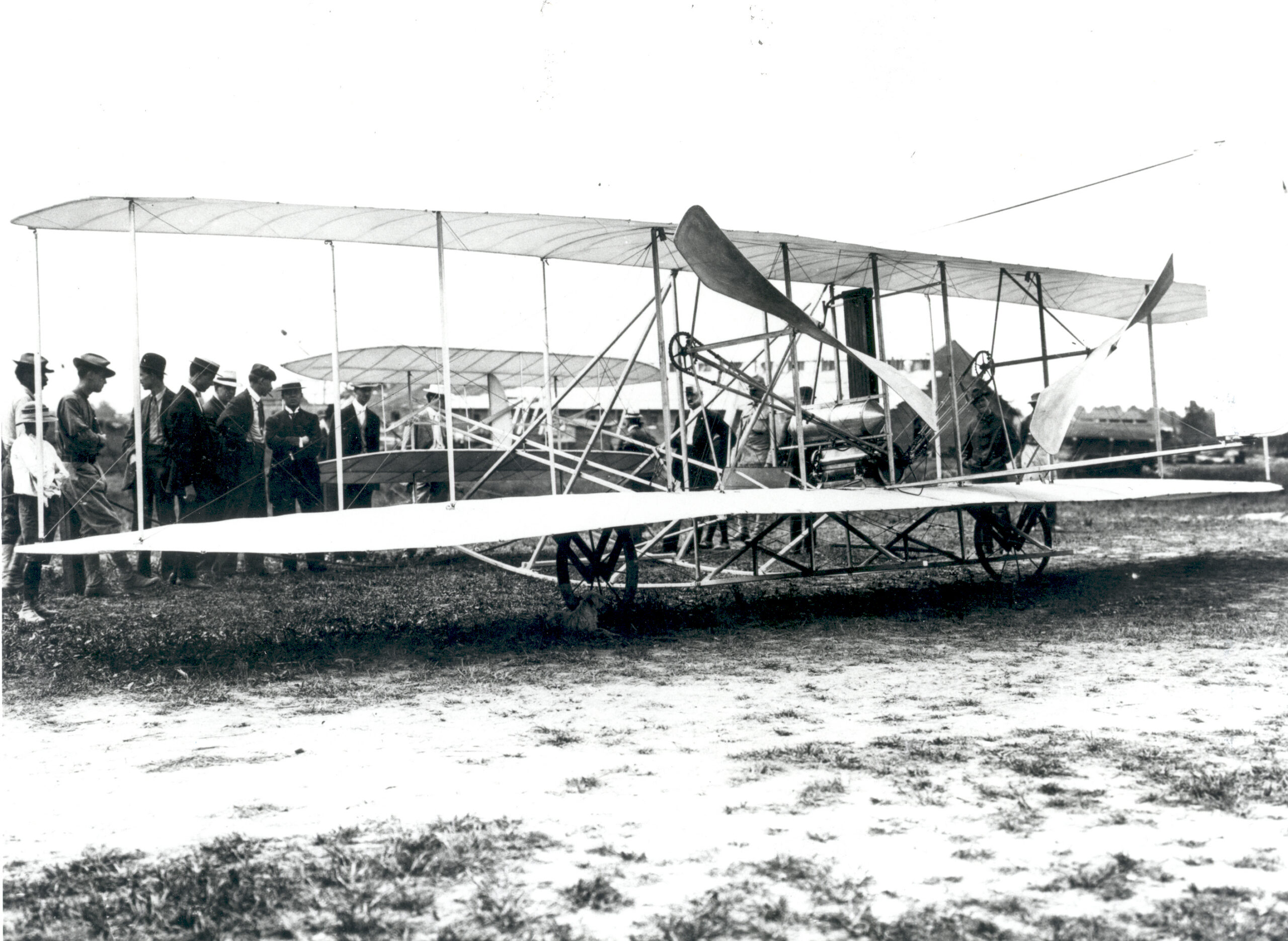
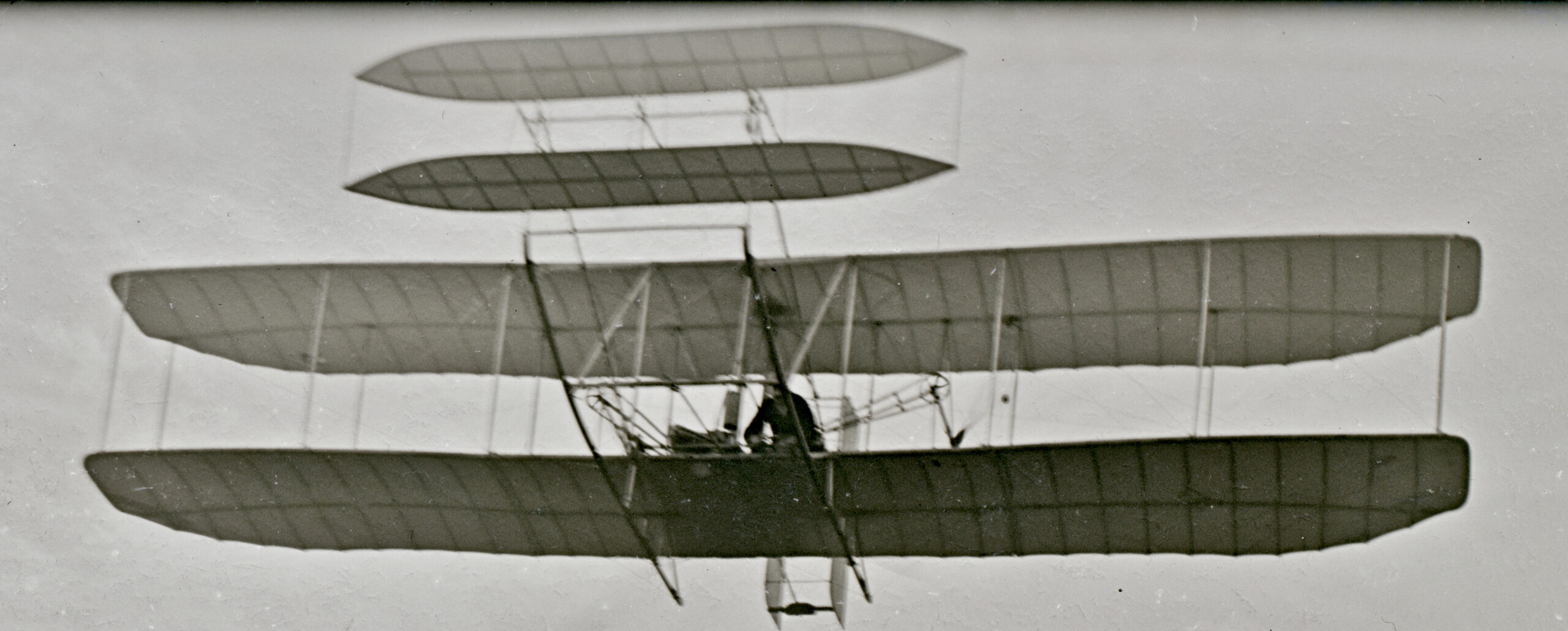
They kept working. Through 1904 and 1905, at Huffman Prairie, a cow pasture outside Dayton, they turned the marginal 1903 machine into a practical aeroplane. The Flyer II of 1904 made the first circle in the air; the Flyer III of 1905 could bank, turn figures of eight and stay up for over half an hour, landing when its fuel ran out rather than when the machine failed. By any engineering measure the 1905 Flyer III was the first practical aeroplane in history, and almost nobody outside Dayton knew it existed.
Their American patent, applied for in 1903 and granted in 1906, covered the control system rather than the aeroplane as such, and it made them formidable and, eventually, controversial litigants. But the vindication came in the summer of 1908, when the brothers finally flew in public on two continents at once. At a racecourse near Le Mans in France, Wilbur silenced a deeply sceptical European aviation establishment in minutes; the leading French aviators of the day, who had been managing straight-line hops, watched him carve controlled, banked circles and admitted, in the words that have come down from that evening, that compared with the Wrights they were beginners. At Fort Myer, Virginia, Orville demonstrated for the US Army, a trial marred that September by the crash that injured him and killed his passenger, Lieutenant Thomas Selfridge, the first person to die in a powered aeroplane accident. The Army bought its first aeroplane from the brothers the following year.
Wilbur did not live to see where it led. He died of typhoid fever in 1912, aged 45. Orville sold the Wright Company in 1915 and lived until January 1948, long enough to see aircraft cross oceans, fight two world wars and approach the speed of sound, all steered by the descendants of his hip cradle and linked rudder.
Contested claims and the Smithsonian feud
Was the Wright Flyer really first? The question has a small industry attached, so a plain summary is worth giving. Several claims predate or shadow Kitty Hawk. Clement Ader’s 1890 steam hop in France was real but uncontrolled and inches high, and his later claims collapsed under scrutiny. Gustave Whitehead, a Connecticut-based inventor, was reported to have flown in 1901; the claim rests on inconsistent newspaper accounts and recollections gathered decades later, with no photograph of the machine in the air, and the overwhelming majority of aviation historians reject it. Richard Pearse, a New Zealand farmer of real ingenuity, may have made brief uncontrolled hops around 1903; surviving evidence is thin, and Pearse himself never claimed priority. Alberto Santos-Dumont’s celebrated 1906 flights in Paris were the first in Europe and the first officially observed by what became the FAI, which is why parts of the world, Brazil especially, honour him as first; but they came three years after Kitty Hawk and two years after the Wrights were flying circles.
The most damaging challenge came not from a rival inventor but from the Smithsonian Institution itself. After Langley’s death, the Smithsonian allowed his rebuilt Aerodrome, extensively modified by Glenn Curtiss in 1914 and briefly flown, to be exhibited as the first machine capable of flight. Orville’s response was patient and devastating: in 1928 he lent the restored 1903 Flyer to the Science Museum in London, and let the fact that America’s most sacred aviation relic sat in a foreign capital speak for itself. The Smithsonian held out until 1942, when it finally published a retraction of the Aerodrome claims. The Flyer waited out the war in Britain, and Orville died in early 1948, months before it came home.
Where the Flyer is today
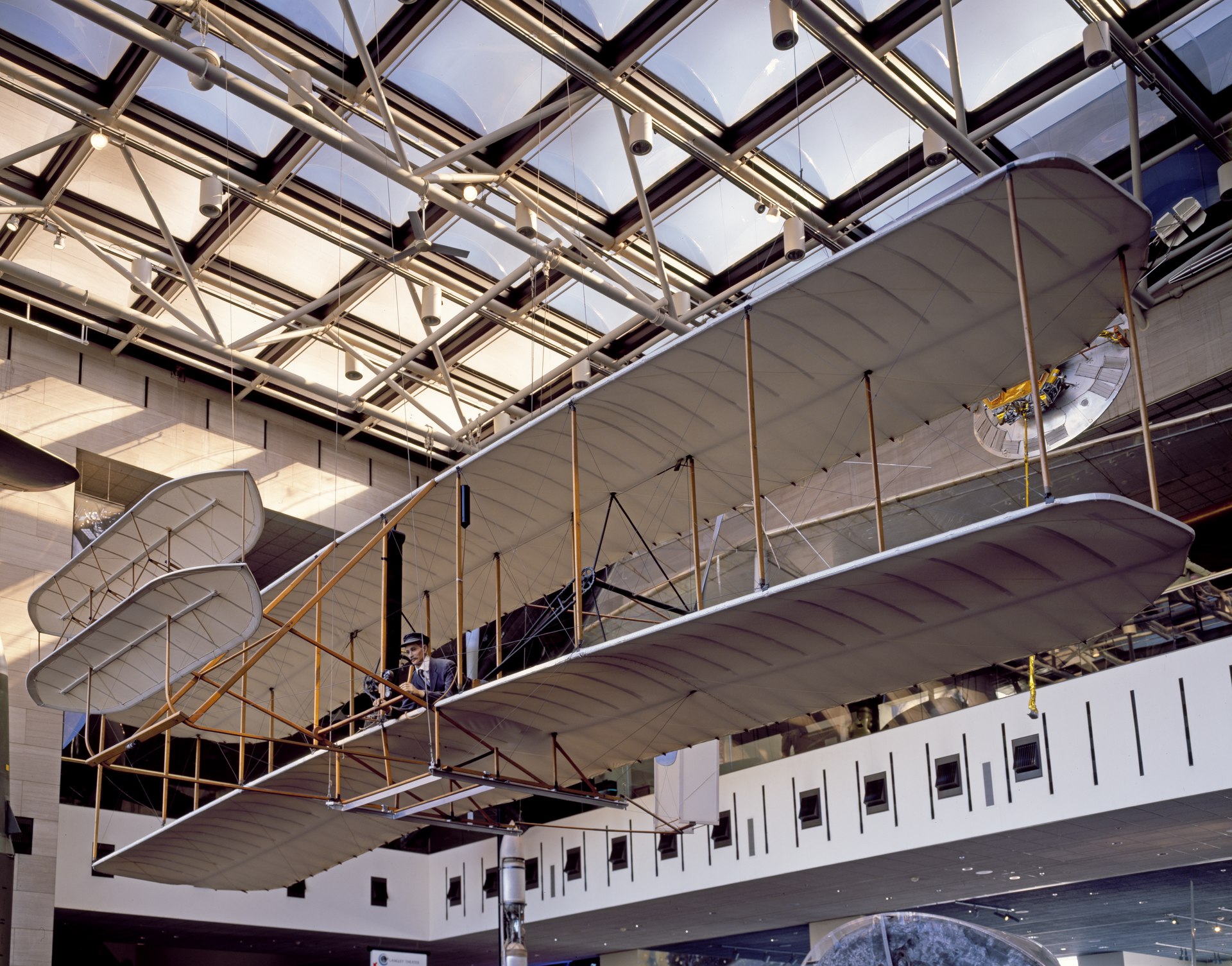
On 17 December 1948, forty-five years to the day after the four flights, the 1903 Wright Flyer went on display at the Smithsonian, and it remains the centrepiece of the National Air and Space Museum in Washington, DC, exhibited with a label that says what its builders proved on the sand: the first powered, sustained and controlled flight of an aeroplane.
The wider Wright story is spread across some rewarding sites. The Wright Brothers National Memorial at Kill Devil Hills marks the launch rail line and the landing points of all four flights with stone markers, and walking the 852 feet of the fourth flight is the best way anywhere to feel the scale of the achievement. Dayton preserves the bicycle shop district and Huffman Prairie. For photographers, these are contemplative rather than action subjects, though replica Flyers appear at heritage events, and our guides to photographing historic aircraft and the pioneer-era glass plate archive cover the era’s imagery in more depth; licensing enquiries for our own historical collections are handled through the Piemags licensing page.
A practical note for anyone photographing the Flyer itself: museum aviation is its own discipline. The Smithsonian display sits under mixed artificial light with tight visitor sightlines, so favour a fast prime or a stabilised zoom over a tripod, which is not permitted in the galleries without arrangement; shoot RAW for the white balance flexibility, meter for the muslin wing surfaces, which burn out easily against the darker hall, and work the details, the wing warping wires, the crossed drive chain, the hip cradle, where the engineering story lives. The replicas at Kill Devil Hills reward wider context shots that include the memorial dune and the flight markers, best in the low raking light of early morning before the crowds arrive, an approach our golden hour guide covers in depth.
Twenty-four years after Kitty Hawk an aeroplane crossed the Atlantic with one man in it. Our account of Lindbergh and the Spirit of St. Louis sets out how far the machine had come, and how far it still had to go.
Frequently asked questions
Who flew first, Orville or Wilbur Wright?
Orville made the first flight at 10:35 am on 17 December 1903, covering 120 feet in 12 seconds. The brothers had tossed a coin for the first attempt three days earlier and Wilbur won, but his try on 14 December ended in a stall and minor damage after three and a half seconds, which neither brother counted as a flight. They then alternated, and Wilbur flew the great 852 foot fourth flight.
How long and how far was the first flight?
The first flight lasted 12 seconds and covered 120 feet, about 37 metres, less than the wingspan of a modern wide-body airliner. The fourth and final flight of the day was far more convincing: 852 feet, about 260 metres, in 59 seconds, with the machine flying steadily until its elevator dipped it into the sand.
How fast did the Wright Flyer fly?
Its airspeed on 17 December was around 34 mph, but because it flew into a headwind of more than 20 mph its speed over the ground was under 10 mph. That is why Wilbur could run alongside the wingtip in the famous photograph. The strong wind was deliberate: the brothers needed it to get airborne from their short launching rail.
Did the Wright Flyer ever fly again after 17 December 1903?
No. Shortly after the fourth flight a gust of wind rolled the parked machine over, wrecking it, and it never flew again. Its entire flying career was four flights totalling roughly 98 seconds in one morning. The brothers shipped the remains home to Dayton and did their later development flying with the Flyer II and Flyer III at Huffman Prairie.
Where is the original Wright Flyer today?
The restored 1903 Wright Flyer is displayed at the Smithsonian National Air and Space Museum in Washington, DC. It went on show there on 17 December 1948, exactly 45 years after the flights, following two decades on loan to the Science Museum in London during Orville’s feud with the Smithsonian over the Langley Aerodrome’s false claim to priority.
Were the Wright brothers really the first to fly?
For powered, sustained and controlled flight, yes, by the standard of evidence historians apply. Earlier claims, such as Clement Ader’s 1890 hop and the reports around Gustave Whitehead in 1901, lack the documentation, witnesses and photographs the Wrights provided, and most aviation historians reject them. Alberto Santos-Dumont’s 1906 flights in Paris were the first in Europe and the first officially observed by the FAI’s predecessor, which is why Brazil honours him, but they came three years after Kitty Hawk.
Who took the photograph of the first flight?
John T. Daniels, a member of the Kill Devil Hills Life-Saving Station crew, squeezed the shutter bulb on Orville Wright’s pre-positioned glass plate camera as the Flyer lifted off. It was the first photograph Daniels had ever taken. The plate was developed back in Dayton and has become one of the most reproduced photographs ever made.
How many people witnessed the first flight?
Five: lifesavers John T. Daniels, Willie Dough and Adam Etheridge, lumber buyer W. C. Brinkley, and Johnny Moore, a local teenager. Their independent accounts, given repeatedly over the following decades, form part of the unusually strong evidence trail that puts the Wright claim beyond serious dispute.
Ninety-eight seconds of flying, on one December morning, by a machine that never flew again: it does not sound like the hinge of an age, and it was. The Wright Flyer’s first flight rewards attention not because it was dramatic but because it was earned, glide by glide, measurement by measurement, in a wind tunnel made of pine and a camp made of driftwood. The photographs survive, the evidence holds, and the aeroplane overhead as you read this is the direct descendant of the machine on the sand.
