
The man who climbed into a small monoplane at Les Baraques, just outside Calais, on the morning of 25 July 1909 was not a natural-born flyer. He was a businessman in his late thirties with a badly burned foot, a long record of expensive crashes, and a fortune he had very nearly spent. A few minutes later Louis Blériot would be the most famous aviator in the world.
We have been working through a set of photographs from this period, including a contemporary album assembled by the Rol news agency in Paris under the title Cent instantanés de la vie en aéroplane de Louis Blériot, a hundred snapshots of his flying life from 1905 up to the Channel crossing. Spend time with images like these and the familiar story changes shape. The crossing was not a bolt from the blue. It was the end of four hard years.
What this guide covers
- The lamp maker who wanted to fly
- First experiments and the Voisin partnership
- Backing the monoplane
- The road to the Type XI
- The Channel prize and the rivals
- The crossing of 25 July 1909
- What the crossing changed
- Blériot the manufacturer
- The later years
- The aircraft today
- Photographing early aviation subjects
- Why the photographs still matter
- Frequently asked questions
The lamp maker who wanted to fly
Louis Blériot was born in Cambrai in 1872 and trained as an engineer at the École Centrale in Paris. His money came from a thoroughly down-to-earth source: acetylene headlamps for motor cars. He opened a showroom on the rue de Richelieu in 1897, built one of the first really practical car headlamps, and was soon supplying firms such as Renault and Panhard-Levassor. It made him comfortably wealthy, and he spent the proceeds chasing a far riskier idea.
The headlamp itself is worth pausing on, because it explains the man. After leaving the École Centrale, Blériot took a job with Baguès, an electrical engineering firm in Paris, and in his own time worked out how to build a compact acetylene lamp with an integral gas generator. It was a really clever piece of design at a moment when motoring was young and night driving was close to impossible. He was still in his mid twenties when he left his employer to sell the lamp under his own name, and the business grew quickly enough to make him independent for life, or so it must have seemed.
Flight had interested him since his student days, but the itch seems to have become serious around the turn of the century, when Clément Ader’s bat-winged Avion III was shown at the Exposition Universelle of 1900 in Paris. Ader’s machine had never truly flown, yet it made the idea look tantalisingly close. Blériot began spending his headlamp profits on experiments of his own, starting, as many pioneers did, in exactly the wrong place.
His first machines were ornithopters, contraptions designed to fly by flapping their wings like a bird. They were complete failures, as every ornithopter of the period was, but they mark the true beginning of the story. From roughly 1901 onwards Blériot was an aviation experimenter who happened to run a lamp company, rather than the other way round. The pattern that would define the next decade was already set: earn money in the showroom, spend it on the flying field, and treat every failure as tuition.

First experiments and the Voisin partnership
The turning point came in April 1905, when Blériot watched Gabriel Voisin test a floatplane glider towed behind a motorboat on the Seine. Voisin was then working for Ernest Archdeacon, one of the wealthy patrons who kept early French aviation alive, and the towed glider trials were among the most promising experiments in the country. Blériot was impressed enough to commission a similar machine of his own, known as the Blériot II.
The Blériot II nearly killed its pilot. On 18 July 1905 Voisin attempted to fly the glider off the Seine, lost control, and crashed into the river, escaping from the tangle of wires and fabric only with difficulty. A man nearly drowning in your aeroplane might reasonably end a friendship. Instead, Blériot suggested that Voisin leave Archdeacon and go into business with him, and the two men set up a joint aircraft workshop, one of the earliest anywhere in the world.
Their output was a pair of powered floatplanes built around box-kite principles. The Blériot III of 1906 was a strange and rather beautiful machine with tandem elliptical wing cells and a 24 horsepower Antoinette engine. In May 1906 Blériot and Voisin tried to coax it off the Lac d’Enghien, north of Paris, and it refused to leave the water. They rebuilt it that autumn as the Blériot IV, with a more conventional forward biplane cell, a second engine and pusher propellers. It was no more successful.
By the end of 1906 the partnership had run its course. Voisin went off with his brother Charles to build biplanes under the Voisin name, machines that would soon carry Henry Farman to fame. Blériot, poorer and wiser, decided to carry on alone. The two years of failure had taught him a great deal about what did not work, and he now had firm ideas about what might. Almost alone among the leading French experimenters, he was starting to think in terms of a single wing.
Backing the monoplane
While most designers of the day trusted the biplane, Blériot became convinced that a single wing was the future. Across 1907 and 1908 he built a run of his own machines, numbered as he went. The Blériot VII of 1907 is often described as the first practical monoplane, although it, like most of the others, ended in a crash. The Rol photographs catch this unglamorous side of pioneering: aircraft with curved wings at Bagatelle, tandem-winged oddities, engines being wheeled out by shirt-sleeved mechanics, and the wreckage afterwards.
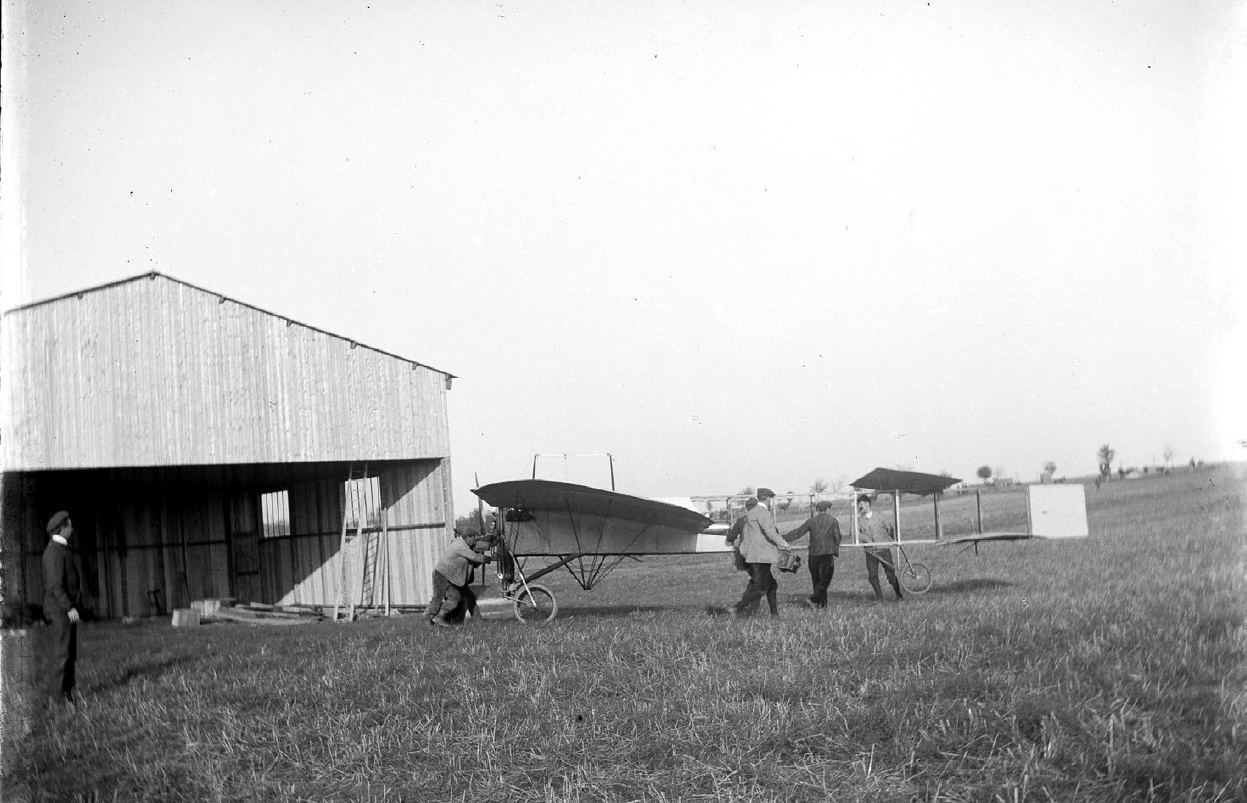
The machines came one after another. The Type V was a canard monoplane with the tail surfaces at the front; it managed short hops early in 1907 before being wrecked. The Type VI, named Libellule, or dragonfly, carried its wings in tandem. Each was flown, broken, studied and abandoned, and each moved the design a little closer to the shape we now take for granted.
It was the Blériot VIII of 1908 that pulled the threads together. It had a tractor engine at the nose, the pilot behind it, a single main wing, and a tail at the back doing the work of stabilising the aircraft rather than lifting it. Just as importantly, Blériot fitted it with a single control stick governing both pitch and roll, with the rudder worked by a pivoted bar under the pilot’s feet. That combination of layout and controls, arrived at through trial and painful error, is essentially the one aircraft designers have used ever since.
He simply kept rebuilding. In October 1908 he flew one of his monoplanes cross-country from Toury to Artenay, a genuine journey at a time when most flights were short hops around an airfield. By then the crashes had swallowed most of his lamp fortune, and he was flying on stubbornness as much as money.
That flight of 31 October 1908 deserves more attention than it usually gets. Flying the Type VIII, Blériot made a round trip between Toury and Artenay, about 28 kilometres in all, landing at prearranged points along the way. Only the day before, Henry Farman had made the world’s first true cross-country flight from Bouy to Reims, so Blériot missed one record by twenty-four hours. But a return journey between two towns, with landings, was its own kind of first, and it proved that his monoplanes could navigate, land and take off again away from home. The aeroplane was becoming a vehicle.
The road to the Type XI
The machine that changed everything was the Type XI, built late in 1908 with design help from a young engineer named Raymond Saulnier, who would later co-found Morane-Saulnier. It flew for the first time at Issy-les-Moulineaux, on the southern edge of Paris, on 23 January 1909. In its earliest form it was let down by its powerplant, and the aircraft only came good at the end of May 1909, when Blériot fitted a three-cylinder Anzani engine of about 25 horsepower, built by the motorcycle engine maker Alessandro Anzani, driving a two-blade Chauvière Intégrale propeller carved from laminated walnut.
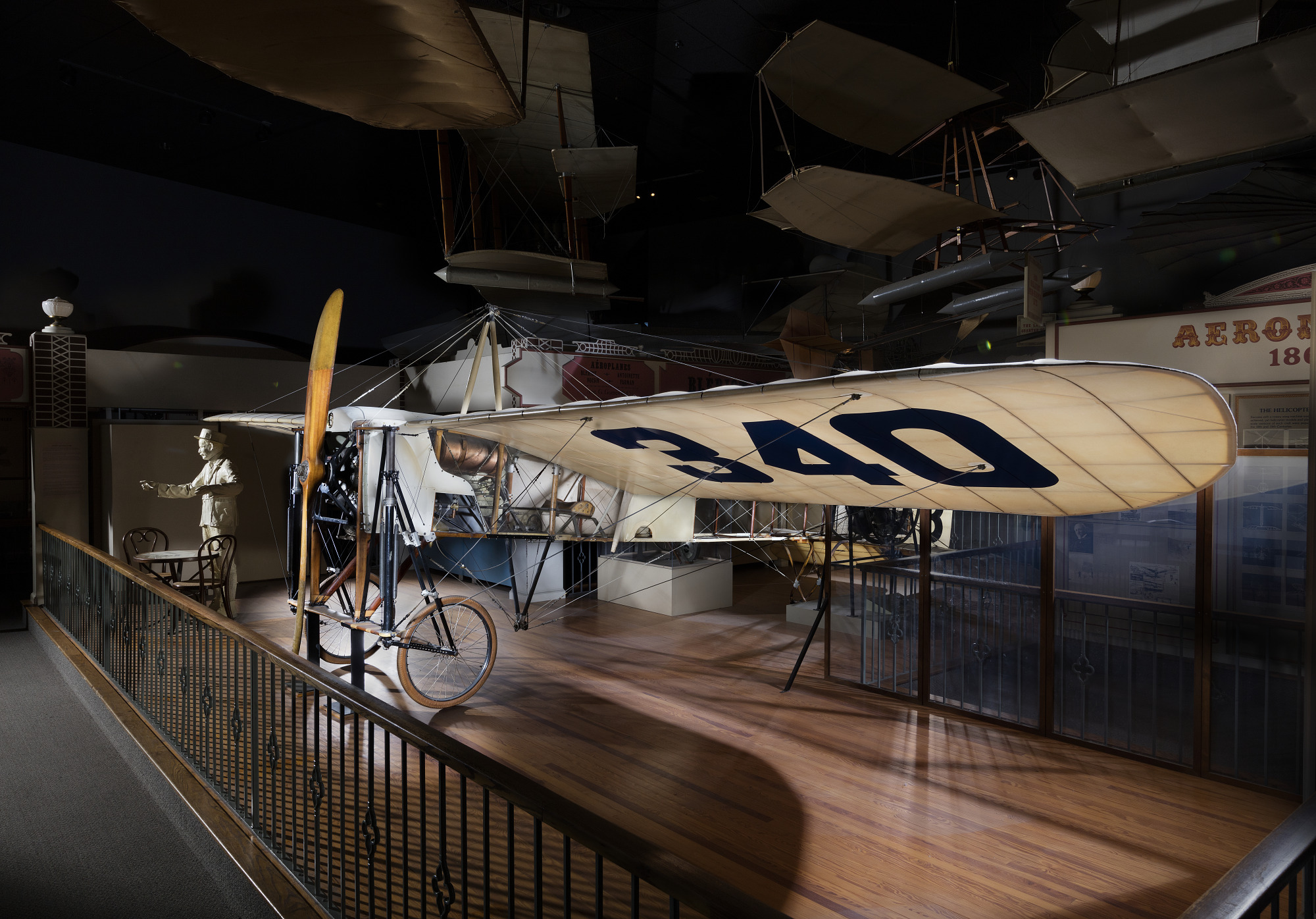
Nothing about the XI was exotic. The fuselage was a wire-braced box girder of ash, left uncovered behind the cockpit. Lateral control was by wing warping, twisting the wings themselves rather than using ailerons. The engine was cheap, crude and prone to overheating. What the aeroplane had was balance: it was small, light, simple to repair and honest to fly, and the Anzani, for all its faults, kept running long enough to matter. The combination of Blériot’s layout, Saulnier’s detail design and Lucien Chauvière’s efficient propeller made it the most useful flying machine in Europe in the summer of 1909.
Flying it demanded a particular sort of nerve. The pilot sat in the open at the wing roots, feet on the rudder bar, with the whirring Anzani a few centimetres beyond his toes throwing back a fine mist of castor oil. Cruising flight meant perhaps 60 to 75 kilometres per hour, low enough and slow enough that every gust registered, and the warping wings asked for constant small corrections. There was no cockpit instrumentation worth the name, and on the Channel flight not even a compass. Blériot navigated the busiest seaway in the world by eye, which is either magnificent or mad depending on how you feel about engine failure over water.
| Blériot Type XI, cross-Channel configuration, 1909 | |
|---|---|
| Crew | One pilot |
| Length | 8 m (26 ft 3 in) |
| Wingspan | 7.8 m (25 ft 7 in) |
| Wing area | 14 sq m (about 150 sq ft) |
| Empty weight | About 230 kg (507 lb) |
| Engine | Anzani three-cylinder semi-radial, about 25 hp |
| Propeller | Chauvière Intégrale two-blade, laminated walnut |
| Speed | About 75 km/h (47 mph) |
| Lateral control | Wing warping |
| First flight | 23 January 1909, Issy-les-Moulineaux |
On 13 July 1909 Blériot used the XI to win the Aéro-Club de France’s first Prix du Voyage, a competition requiring a cross-country flight of at least 40 kilometres. Setting out from near Étampes before five in the morning, he flew some 41.5 kilometres to Chevilly, near Orléans, in 56 minutes. The prize of 14,000 francs was shared, tellingly, between the pilot and the makers of the airframe, the engine and the propeller, which in Blériot’s case meant himself, Anzani and Chauvière. The little monoplane could clearly cover real ground. The Channel was the obvious next prize.
The Channel prize and the rivals
The prize itself was a newspaper stunt of the best kind. In October 1908 the Daily Mail offered 500 pounds to anyone who could fly the Channel before the end of the year. Nobody came close to trying, so the paper doubled the money to 1,000 pounds and extended the offer through 1909. Lord Northcliffe’s paper understood exactly what it was buying: if the flight succeeded it would be the story of the decade, and if it failed the offer cost nothing.
By July 1909 three serious contenders had gathered on the French coast. The favourite was Hubert Latham, an elegant, laconic sportsman flying the beautiful Antoinette monoplane, who had set up camp at Sangatte, west of Calais. The second was Count Charles de Lambert, the first man in France to be taught to fly by Wilbur Wright, with a pair of Wright biplanes. The third, at Les Baraques, was Blériot, hobbling on a foot he had badly burned days earlier when an exhaust fitting failed in flight and roasted his shoe.
Latham moved first. On 19 July he took off from near Sangatte and headed out to sea, and about thirteen kilometres out his engine failed. He glided down to the water in what is generally recorded as the first controlled ditching of an aeroplane at sea, and was picked up unhurt, sitting on the floating wreck. The salvage ruined the aircraft, so his team shipped out their newest machine, an Antoinette VII that arrived on 21 July having never been flown. De Lambert, meanwhile, crashed one of his Wrights in a practice flight and was out of the running. The stage was left to a limping lamp maker and a rival waiting for the wind to drop.
It is worth remembering why the Channel loomed so large. The straits at their narrowest are more than thirty kilometres of open water, and in 1909 no aero engine could be trusted to run for half an hour without protest. A failure over a French field meant a broken undercarriage; a failure in mid-Channel meant a swim, at best, in a machine made of wood, wire and doped fabric. There were no parachutes, no radios and no rescue services beyond whatever boat happened to be near. Latham’s two ditchings were not bad luck so much as the expected outcome, which is precisely why the Daily Mail’s money had sat unclaimed for the better part of a year.

The crossing of 25 July 1909
The night of 24 July was windy, and both camps expected another day of waiting. Towards dawn the wind eased. Blériot was up in the small hours, made a short trial flight around Les Baraques as the sky lightened, and decided to go. The French destroyer Escopette stood out in the Channel on a line towards Dover, part escort and part signpost for a pilot who carried no compass.
By half past three his wife Alice had been put aboard the Escopette, which was under orders to follow the aeroplane and fish her husband out of the sea if the engine gave up. The ship could make a brisk pace, and the theory was that the aircraft would never be far from rescue. The theory did not survive contact with the Anzani at full throttle: within minutes of setting course the monoplane had simply outrun its escort, and the Escopette steamed on to Dover to deliver a worried wife to a husband who, by then, was already famous. It is a reminder of how quickly the sums changed in 1909. Even a warship built for speed could not keep up with a 25 horsepower aeroplane.
He took off at 4:41 in the morning. He carried no compass, and for several minutes over open water he could see neither France nor England, holding his line by guesswork. The Anzani had a habit of overheating, and by his own account a passing rain shower cooled it just enough to keep it turning. After about thirty-six and a half minutes he crossed the English coast, side-slipped into a meadow near Dover Castle, and smashed his undercarriage in the rough landing. None of that mattered. He was the first person to fly an aircraft across the Channel, and the news ran around the world within hours.
The detail behind that bare account is worth having. The XI quickly outpaced the Escopette, and once the ship fell behind, Blériot spent roughly ten minutes alone over open water with nothing to steer by. When the English coast finally appeared, the wind had pushed him east of Dover, so he turned and followed the cliffs until he spotted Charles Fontaine, a journalist from the Paris newspaper Le Matin, waving a large tricolour from Northfall Meadow, a gap in the cliffs beside Dover Castle that Fontaine had chosen as a landing ground. Blériot circled to lose height, cut the engine, and dropped heavily onto the sloping field in gusty air, breaking the undercarriage and splintering the propeller. Contemporary accounts differ by a few minutes on the exact landing time, but not on the essentials: thirty-six and a half minutes, France to England.
| The race for the Channel, 1908 to 1909 | |
|---|---|
| 5 October 1908 | The Daily Mail offers 500 pounds for a Channel flight before the year’s end |
| Early 1909 | With no attempt made, the prize is doubled to 1,000 pounds and extended through 1909 |
| 13 July 1909 | Blériot wins the Prix du Voyage, flying 41.5 km from near Étampes to Chevilly |
| 19 July 1909 | Latham’s first attempt ends with engine failure and a ditching about 13 km out |
| 21 July 1909 | Latham’s replacement Antoinette VII arrives, still untested in flight |
| 25 July 1909, 4:41 am | Blériot takes off from Les Baraques, near Calais |
| 25 July 1909, 36 minutes 30 seconds later | Heavy landing at Northfall Meadow, beside Dover Castle |
| 27 July 1909 | Latham tries again and comes down in the sea within sight of Dover |
Two days later Latham made his second attempt in the untested Antoinette VII and was within a couple of kilometres of the English shore when his engine failed again. He was fished out of the sea a second time, and history remembers him, a little unfairly, as the man who did not cross the Channel. The Rol album gives him his due: a superb pilot, flying arguably a more refined aeroplane, beaten by luck and by an opponent who refused to wait for perfect conditions.

What the crossing changed
The reaction was instant and enormous. Crowds mobbed Blériot at Dover and again in London, and when the battered XI was hurriedly patched up it went on public display at Selfridges department store in Oxford Street, where tens of thousands queued to look at a machine that had been invented, in effect, seven months earlier. In October 1909 the aircraft, which never flew again, was presented to the Conservatoire des Arts et Métiers in Paris by the newspaper Le Matin, and it has been in the national collection ever since.
British commentators understood at once what the flight meant. The country was, as the saying went, no longer an island. A body of water that had defeated Napoleon had been crossed before breakfast by a private citizen in a machine costing less than a decent motor car, and every serious newspaper drew the military conclusion. The 1,000 pound cheque from the Daily Mail was almost the least of it: within days orders for the Type XI began arriving faster than the works could handle, and the spot where he landed at Northfall Meadow is marked to this day by a granite outline of his monoplane set into the turf.
The clearest measure of what the crossing set off came only four weeks later, at the Grande Semaine d’Aviation de la Champagne held near Reims from 22 to 29 August 1909. It was the world’s first great international flying meeting, drawing crowds in the hundreds of thousands, and the aeroplane went from music-hall curiosity to national spectacle in a single week. Blériot was there, of course, and was narrowly beaten by the American Glenn Curtiss in the first Gordon Bennett Trophy speed contest. He also crashed once again and walked away once again, which by that stage of his career was practically a signature. Reims would have happened eventually. That it happened in 1909, at that scale, owed a great deal to one flight in July.
Blériot the manufacturer
Overnight, Blériot became a celebrity and a manufacturer in demand. By the end of September 1909 he had taken orders for more than a hundred Type XIs, and between the crossing and the outbreak of war in August 1914 his factory turned out more than 800 aircraft, most of them XIs or close relations, used for training, racing and early military work. The lamp business had funded the experiments; now the aeroplane business repaid the debt many times over.
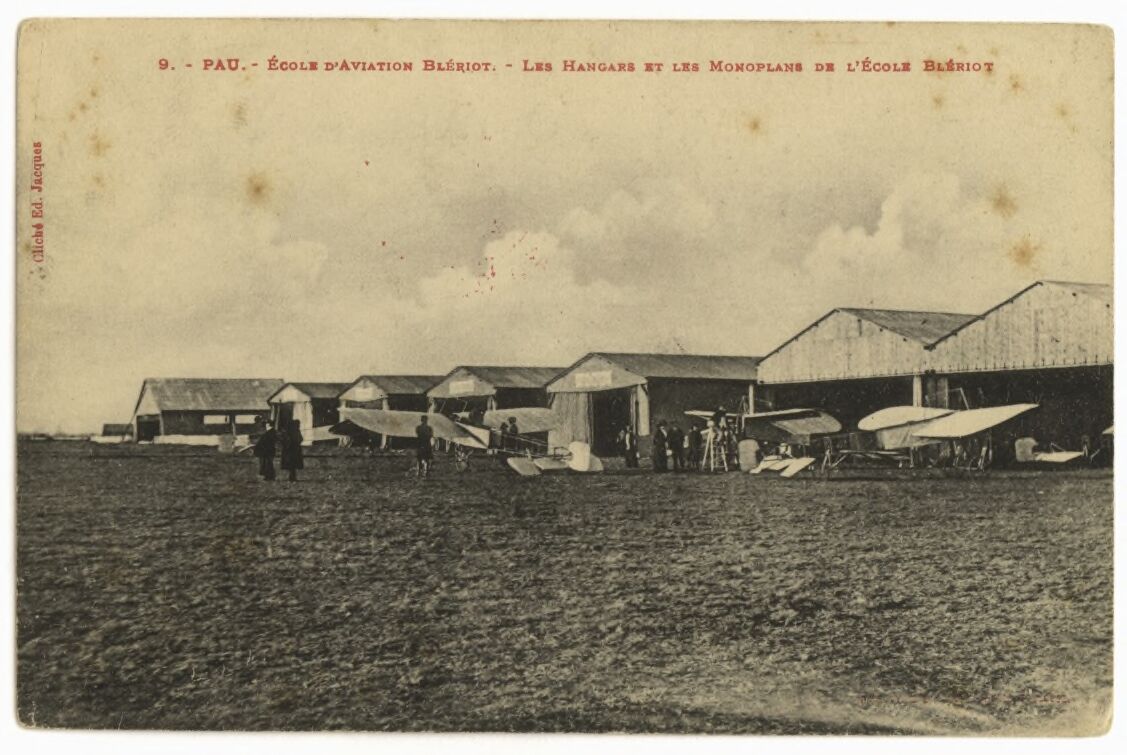
Blériot also grasped, earlier than most, that selling aeroplanes meant creating pilots. He opened flying schools at Étampes and then at Pau in early 1910, and in September 1910 added a third at Hendon, outside London. By 1914 nearly a thousand pilots had qualified at Blériot schools, roughly half of all the licences issued in France to that point. Tuition was free if you bought one of his aeroplanes; for everyone else it cost 2,000 francs, cut to 800 francs in 1912 as competition grew. It tells you a good deal about his instincts as a businessman: the schools sold aeroplanes, the aeroplanes filled the schools, and both fed the reputation of the name painted on the rudder.
The Type XI kept making history without him at the controls. On 23 October 1911, during the Italo-Turkish War, Captain Carlo Piazza of the Italian army flew a Blériot XI over Turkish positions in Libya in the first use of an aeroplane in war, a reconnaissance sortie of about an hour. In September 1913 Adolphe Pégoud, Blériot’s own test pilot, flew a XI upside down and then, on 21 September at Buc, performed the first loop flown in France, a few days after the Russian pilot Pyotr Nesterov had looped in Kiev. The embryonic air arms of France, Britain, Italy, Austria and Russia all operated Blériot machines, and the XI flew reconnaissance for both French and British squadrons in the opening months of the First World War.
The reach of the design in those five years is easy to underestimate now. Blériot monoplanes were bought by flying clubs as far away as Australia, copied with and without permission across Europe and America, and flown by most of the famous names of the pioneer era at meetings from Lanark to Los Angeles. For a young man or woman in 1910 who wanted to fly, the likeliest route ran through a Blériot school, in a Blériot aeroplane, towards a licence that about half the time carried the influence of the same busy factory. No single aircraft type did more to turn flying from a stunt into an occupation.
His biggest wartime contribution came through an acquisition. In August 1913 Armand Deperdussin, whose firm built the fastest aircraft in the world, was arrested for large-scale financial fraud and his company collapsed. In August 1914 a group led by Blériot took over its assets, keeping the famous SPAD initials but changing what they stood for: Société Pour l’Aviation et ses Dérivés. Under Blériot’s ownership the SPAD design office, led by Louis Béchereau, produced the S.VII and S.XIII fighters flown by the likes of Georges Guynemer, René Fonck and Eddie Rickenbacker. Around 8,500 S.XIIIs alone had been built by the end of 1918, making the little firm Blériot rescued one of the great fighter producers of the war.
The later years
Peace was less kind to him than war had been. In 1921 the SPAD operation was folded into the parent firm as Blériot-SPAD, and through the 1920s and 1930s Blériot Aéronautique built a mixed catalogue of fighters, airliners and record-breakers, along with sidelines in motorcycles and light cars when aircraft orders ran thin. The most celebrated of the later machines was the Blériot 110, a long-range monoplane of 1930 built for endurance and distance flying. The company never dominated its industry the way it had in 1910, but it survived, which in interwar French aviation was an achievement in itself.
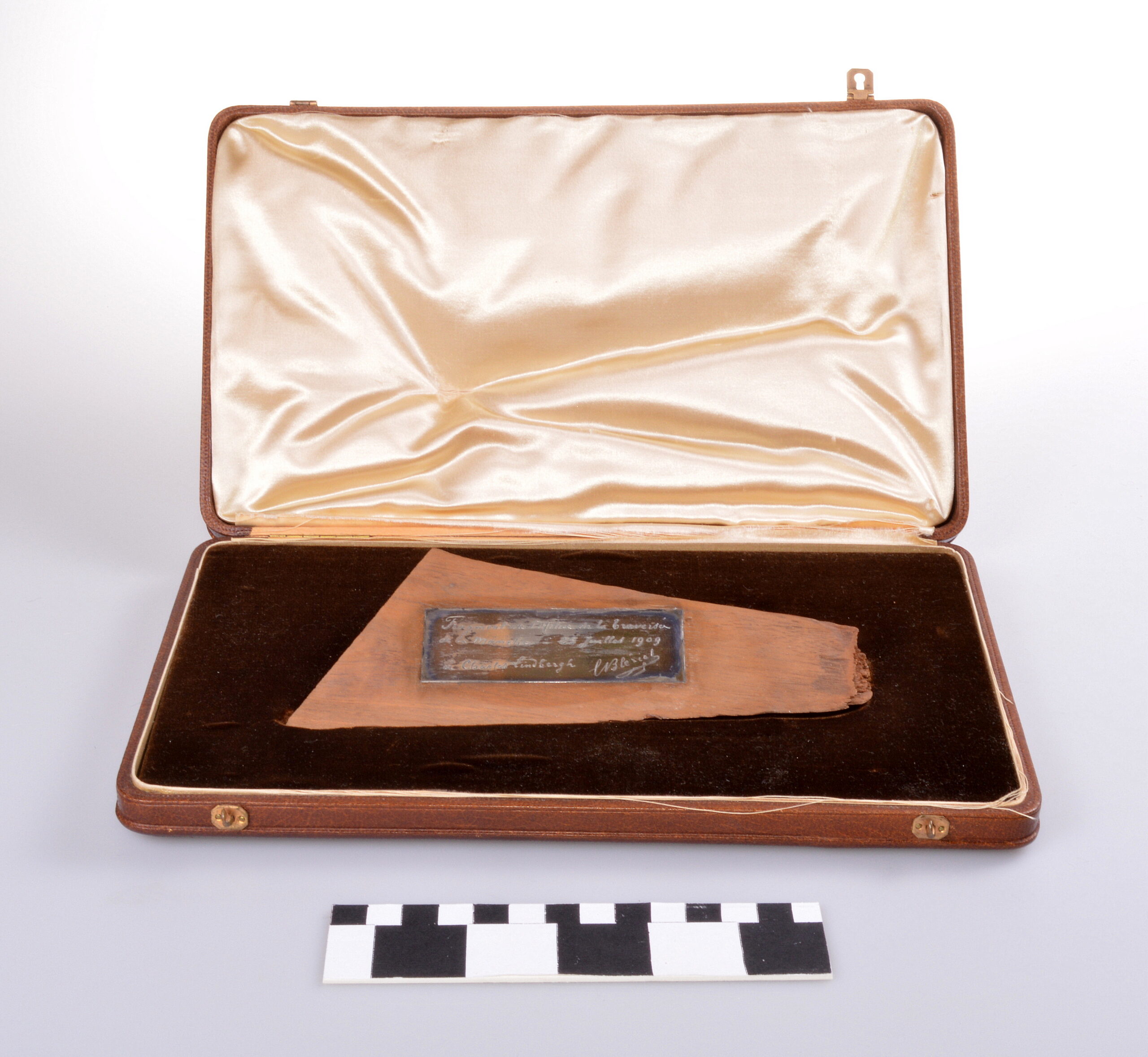
Blériot himself became the elder statesman of French flying. When Charles Lindbergh landed at Le Bourget in May 1927 after crossing the Atlantic, it was Blériot who greeted him, the man who had flown the first sea crossing embracing the man who had flown the widest. He remained convinced that aviation had barely started: visiting Newark in 1934, he predicted scheduled transatlantic passenger flights within a few years.
He died in Paris on 1 August 1936, of a heart attack, still at the head of his company at sixty-four. France gave him a funeral with full military honours at Les Invalides, and he was buried in the Cimetière des Gonards at Versailles. Within months Blériot Aéronautique was swept up in the nationalisation of the French aircraft industry and absorbed into the state combine SNCASO, a lineage that runs through Sud Aviation and Aérospatiale to today’s Airbus. The fragile single-seaters of his youth had given way to metal airliners. He had lived to see the whole arc.
The aircraft today
Remarkably, the aeroplane that crossed the Channel still exists. After its outing at Selfridges and its presentation by Le Matin in October 1909, the original machine went to the Musée des Arts et Métiers in Paris, where it hangs today in the former church of Saint-Martin-des-Champs, suspended above a hall of scientific instruments. It never flew again after Northfall Meadow, which means the fabric, the ash longerons and the little Anzani are substantially the ones that made the crossing.
Because so many Type XIs were built, a surprising number survive, and a few still fly. The Shuttleworth Collection at Old Warden in Bedfordshire operates a 1909-built XI, registered G-AANG, powered by its original type of three-cylinder Anzani and generally described as the world’s oldest airworthy aeroplane; it is limited to straight hops down the grass on calm evenings. Old Rhinebeck Aerodrome in New York State flies its own 1909 machine, the oldest flying aircraft in the Americas, and some sources argue it left the factory a few weeks before the Shuttleworth aeroplane, so the title of oldest flyer is genially contested across the Atlantic. Other original XIs are preserved in national collections, including the Smithsonian’s National Air and Space Museum in Washington.
If you get the chance to stand under one, take it. Photographs flatten the XI into a diagram; in person it is startlingly small and delicate, closer to a piece of furniture than to anything we would now call an aircraft. The uncovered rear fuselage lets you read the whole structure at a glance, every wire doing a visible job, and the seat is a plain hollow in which one determined man sat over the Channel with his burned foot on a rudder bar. Few museum objects anywhere close the distance to their moment of history so completely.

Photographing early aviation subjects
Pioneer-era aircraft set photographic problems that a modern fast jet never will. In museums the machines usually hang from the roof or sit behind barriers in low light, so you are working at high ISO with no flash, looking for angles that separate a cat’s cradle of wires and translucent fabric from a busy background. Wing warping, exposed engines and open framework reward close, detailed studies as much as full-aircraft views. At events where replicas fly, the challenge reverses: these aircraft are so slow that panning technique built for jets needs rethinking, and shutter speeds can drop far lower than feels natural.
If you want to build these skills, our guide to aviation photography composition covers how to organise a frame full of struts and rigging, and our warbird photography guide deals with propeller blur and slow-moving historic aircraft in flight. For the period machines themselves, the surviving record is overwhelmingly photographic, which is where archives come in. You can browse our early flying material in the Piemags archive galleries, and details of how the images can be used are on our licensing page.
Working with the period photographs themselves is its own discipline. The Blériot material we handle was shot on glass plates and printed by hand, and each frame carries the fingerprints of its making: uneven skies where the emulsion struggled, motion blur on propellers that stopped for nobody, retouching applied by agency staff who needed a clean image for the next morning’s paper. When we digitise this material we keep those traces rather than polishing them away, because they are part of the evidence. A 1909 press print is not just a picture of an aeroplane. It is a record of how the first people to see these machines chose to show them.
Why the photographs still matter
It is easy to remember Blériot for one famous morning. The pictures tell the longer and more honest story. They show the trials on the river, the broken machines, the patient ground crews, the curious crowds, and the quiet persistence of a man who failed in public, repeatedly, before he succeeded. Press photographs like these were never made to last, and most have not, which is much of what makes the survivors worth looking after.
We are still checking captions and identifications across this material, and we would really welcome corrections from anyone who knows the period well. You can browse the wider archive of early flying and historic aviation photographs in our galleries, where individual images are available for licensing and as fine-art prints.
If you photograph aircraft yourself, our guide to airshow photography covers the camera settings and technique for capturing modern aircraft in flight.
Frequently asked questions
When did Louis Blériot cross the English Channel?
On 25 July 1909. Blériot took off from Les Baraques, near Calais, at 4:41 in the morning and landed at Northfall Meadow beside Dover Castle, becoming the first person to cross the Channel in a heavier-than-air aircraft and winning the Daily Mail’s 1,000 pound prize.
How long did the Channel crossing take?
About 36 and a half minutes. Blériot flew without a compass, using the destroyer Escopette as an early reference, and for around ten minutes in mid-Channel he could see no land at all. The landing was heavy and broke the aircraft’s undercarriage and propeller.
How did Louis Blériot make his money before flying?
He built a successful business manufacturing acetylene headlamps for the early motor-car industry, supplying firms such as Renault and Panhard-Levassor, and he spent the profits on years of costly and often unsuccessful aircraft experiments.
What aircraft did Blériot use for the crossing?
The Blériot XI, a light single-seat monoplane designed with Raymond Saulnier and first flown in January 1909. For the crossing it was powered by a three-cylinder Anzani engine of about 25 horsepower driving a Chauvière laminated walnut propeller.
Who else tried to fly the Channel in 1909?
Hubert Latham, flying Antoinette monoplanes, ditched in the sea on 19 July and again on 27 July, both times after engine failure. Count Charles de Lambert, flying Wright biplanes, crashed in practice and withdrew before making an attempt.
Where can you see a Blériot XI today?
The original Channel-crossing aircraft hangs in the Musée des Arts et Métiers in Paris. The Shuttleworth Collection in Bedfordshire still flies a 1909-built XI, Old Rhinebeck Aerodrome in New York flies another, and further originals survive in collections including the Smithsonian.
Who was Louis Bleriot?
Louis Bleriot was a French engineer and businessman, born in Cambrai in 1872, who made his fortune manufacturing acetylene headlamps for early motor cars. He spent that fortune on years of aircraft experiments, and in July 1909 became the first person to fly an aeroplane across the English Channel. He later became a major aircraft manufacturer whose Type XI monoplane was built in large numbers.
What prize did Bleriot win for the Channel crossing?
He won a prize of 1,000 pounds offered by the Daily Mail newspaper for the first flight across the Channel. The paper had first offered 500 pounds in 1908, then doubled it when no one attempted the crossing. The publicity was worth far more than the money, and orders for his aircraft began arriving faster than the works could handle.
Did Bleriot have any rivals for the Channel flight?
Yes. His main rival was Hubert Latham, flying the elegant Antoinette monoplane, who ditched in the sea on 19 July 1909 after engine failure and again on 27 July, both times narrowly failing. Count Charles de Lambert, flying Wright biplanes, crashed in practice and withdrew before making an attempt. Bleriot succeeded partly because he refused to wait for perfect conditions.
Original glass-plate imagery of Blériot’s era can be licensed from the archive; see our early aviation photographs licensing guide.
