On this page
- The mistake almost everyone makes
- What flies from Lakenheath
- What flies from Mildenhall
- Two runways, one wind
- The light
- What you need on the front of the camera
- Where people go at Lakenheath
- Where people go at Mildenhall
- What the old guides get wrong
- A law that no longer exists
- The spotters who had the police on speed dial
- How it actually goes
- Before you go
- Frequently asked questions
- Sources
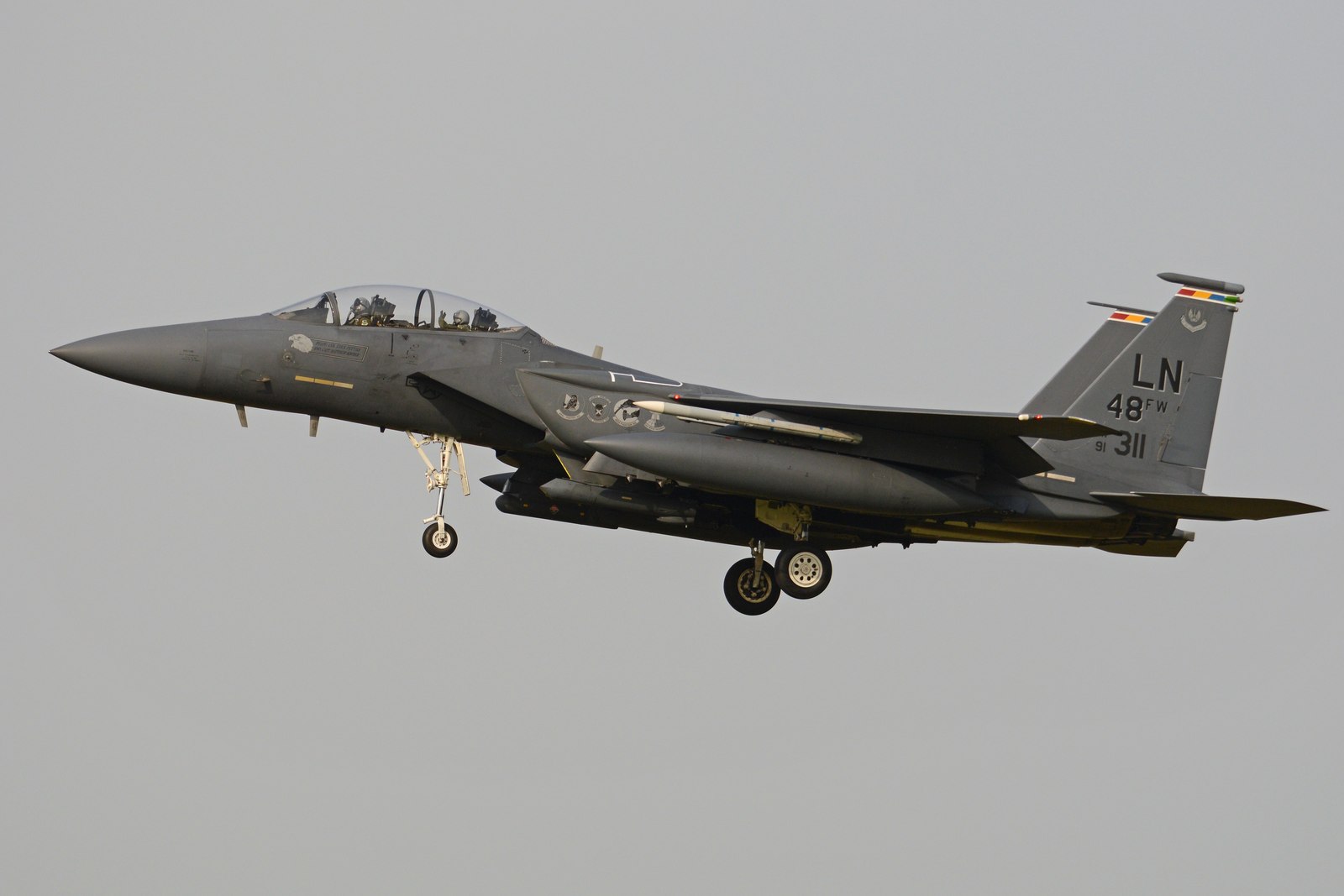
At twenty past four on a February afternoon the light over Suffolk goes the colour of weak tea and the sun sits so low it comes in almost horizontally across the heath. You hear it first. Not a jet noise exactly, more a pressure on the chest, and then a Strike Eagle comes down the approach with its gear out and its landing light burning a hole in the murk, close enough that you can read the two letters on the fin, and it fills the frame and is gone over the fence, and the noise arrives properly about a second later and rolls away across the forest.
That is what people drive to Suffolk for. Two airfields four miles apart, the busiest American flying in Europe, and no ticket, no enclosure and no fence line to shoot through if you know where to stand. It is also, more often than anyone admits, a wasted day: the wrong two days of the week, the wrong end of the runway, the wrong lens on the camera and a sun in exactly the wrong place. This guide is about not wasting the day.
The mistake almost everyone makes
Book a weekend. That is the mistake, and it is nearly universal, because a weekend is when people are free and because every other kind of aviation photography in Britain happens at weekends.
Lakenheath does not. The published hours for the aerodrome run from six in the morning to ten at night Monday to Thursday, six to six on Friday, and then it closes: Saturday, Sunday, and both UK and US holidays. A Saturday planned around Lakenheath fast jets is a Saturday planned around an airfield that is published as shut.
Mildenhall is the opposite, and it is the reason a weekend need not be a write-off. It runs six in the morning to eleven at night Monday to Thursday and six to six Friday, Saturday and Sunday. There is a weekend there. The same entry notes that movements outside nine to six on Saturdays, Sundays and public holidays are discouraged for local reasons, so the realistic weekend window is a working day’s worth in the middle.
Which gives you the shape of a trip. Tuesday, Wednesday and Thursday are for the fast jets at Lakenheath. Saturday and Sunday are for tankers and special operations aeroplanes at Mildenhall, and if you have driven a long way and can only come at a weekend, go to Mildenhall and do not sit outside a closed airfield hoping.
Two more things about the clock. Mildenhall publishes quiet hours, eleven at night to six in the morning Monday to Thursday and then straight through from six on Friday evening to six on Monday morning. Lakenheath publishes only that mandatory quiet hours apply, and requires approval for any movement during them. The times themselves are not published. Nobody outside the wire knows them, including this page.
And night flying at Lakenheath happens in announced blocks. In November 2022 the wing gave two of them, the first four days of the month and then the seventh to the tenth, five in the evening to ten. In November 2024 it gave three days, the fourth to the sixth, seven to ten in the evening. Those notices go up in advance on the station’s news page, and reading that page a fortnight before you travel is worth more than any window quoted in an article, this one included.
What flies from Lakenheath
The 48th Fighter Wing, the Liberty Wing, describes itself as the largest American fighter operation in Europe. Four combat squadrons, two types, one runway.
The Strike Eagle
The 492d and the 494th Fighter Squadrons fly the F-15E Strike Eagle, and it is still the aeroplane most people come for, and the type’s own story is in our history of the F-15 Eagle. Two seats, two engines, nineteen and a half metres of it, and a shape that reads instantly in a photograph even at a bad angle. It is also the aeroplane that behaves best for a photographer: it comes down the approach slowly enough to work with, it makes an enormous amount of noise on departure, and it will pull away off the runway in a way the Lightning does not.
Nineteen and a half metres long and just over thirteen across the wing. Remember those two numbers, because everything in the lens section below comes out of them.
The Lightning
The 495th Fighter Squadron, the Valkyries, stood up on 1 October 2021 as the first F-35A squadron based in Europe, and the first aircraft arrived that December. The 493d converted later, and by June 2026 the wing was putting twelve F-35As from the 493d into a NATO exercise.
The Lightning is a harder photographic subject than the Eagle, and not for the reasons people expect. It is smaller, so it needs about a fifth again as much lens for the same framing. It is painted in a grey that eats detail in flat light. And it is quieter on the approach, which sounds trivial until you are standing on a lane in the dark trying to work out whether anything is coming. If you want the aircraft’s own story rather than how to photograph it, that is in our history of the F-35 Lightning II.
The ghost of the Eagle
If you read an older guide, or an older forum thread, you will find people talking about photographing F-15s at Lakenheath and meaning the F-15C Eagle: single seat, no conformal tanks, an air-to-air fighter rather than a bomber. Those went in 2022, after flying from the station since 1994. What remains is the Strike Eagle, which is a different aeroplane.
The station’s own website has not entirely caught up. It still carries an F-15 Eagle fact sheet marked as current as of April 2019, describing a type that has not been there for four years. It is a small thing and it tells you something useful about how much of what you read online about this station is out of date.
One jet in 1986 paint
There is one specific aeroplane worth knowing about. On 28 April 2026 the wing rolled out an F-15E painted in the camouflage and markings of the F-111F Aardvarks that flew from Lakenheath forty years earlier, for the anniversary of Operation El Dorado Canyon, the 1986 raid on Libya. Twenty-two days of masking, sanding and painting went into it. It is not a museum piece and it is not on a pole; it is a serving aeroplane in an old scheme, and if it comes down the approach in front of you on a good afternoon it is the best photograph available at either station.
How many aircraft are actually there is the one thing the official sources will not settle. When the 495th activated, the wing said the squadron would consist of twenty-seven aircraft and roughly sixty personnel. When the first jets arrived, a different official article said twenty-four, delivered in phases. Both are official. They do not agree, so no number appears here as a fact.
What flies from Mildenhall
Four miles to the south-west, and a completely different airfield. Bigger aeroplanes, slower, lower, and a weekend.
The tankers
The 100th Air Refueling Wing has been at Mildenhall since 1 February 1992 and calls itself the only permanent American air refuelling wing in the European theatre. Its flying squadron is the 351st, on the KC-135 Stratotanker.

The KC-135 is a 1950s design still doing the job, and it is a gift to a photographer. It is enormous. It comes over the fence slowly. It has a boom hanging off the back that gives the silhouette something to be. And there are enough of them that you will not wait long, although the wing’s own fact sheet gives seventeen aircraft in one place and fifteen in another, which is why no count appears here either.
Two variants are in use and they look different in the cockpit rather than outside. The first Block 45 arrived on 24 November 2021 with a better autopilot and a single glass display where the old engine instruments used to be.
The special operations aeroplanes
The 352d Special Operations Wing is the reason to keep a long lens on the camera when the tankers go quiet, and it calls itself the only Air Force special operations unit in the European theatre.
The 7th Special Operations Squadron flies the CV-22B Osprey, which is the aeroplane everybody wants and the hardest to time: rotors forward it is an aeroplane, rotors up it is a helicopter, and in between it is a shape no other airframe makes. The 67th flies the MC-130J Commando II. The 321st Special Tactics Squadron does not fly at all, which is worth knowing before you spend an afternoon waiting for it.
The one that arrived quietly
In December 2024 a third type turned up. American public affairs recorded on the fifth of that month that the C-146A Wolfhound had arrived that week at the 352d. It is a small twin, nothing like the rest of the ramp, and it is the sort of thing that makes a set of photographs from a day at Mildenhall interesting rather than repetitive.
The station’s own aircraft page still did not list it in August 2026, twenty months on. If you go looking for what is based at Mildenhall using official pages, you will not find it. That is not a criticism of anyone; base websites are maintained by people with other jobs. It is a reason not to treat any single page as the last word.
The one that was supposed to leave
In November 2018 it was announced that the RC-135 Rivet Joint mission would move from Mildenhall to RAF Fairford, along with the 95th Reconnaissance Squadron and the 488th Intelligence Squadron, beginning in 2023 and finishing in 2024.
Whether it happened is not clear. No official source could be found saying the move was completed, and none saying it was cancelled. Mildenhall’s aircraft page still lists the type and its about page still lists both squadrons. So the honest position is that the Rivet Joint may or may not still be there, and if one comes over the fence while you are standing on Folly Road you should photograph it, because nobody can tell you how many more chances there will be.
Two runways, one wind
Each station has exactly one runway, which simplifies everything and decides everything. There are two ends. Which one is in use is set by the wind, and the wind does not care about your plans.
Lakenheath, 05 and 23
2,742 metres of it, running south-west to north-east, on true bearings of just under 56 degrees and just under 236. Land on 23 and the aircraft come in from the north east, over the Wangford Road end. Land on 05 and they come from the south west, over the B1112 and Eriswell.
Those two ends are entirely different photographic propositions with entirely different light, and this is the single thing that most often ruins a day. Arrive, see aircraft using the far end, and you have a twenty-minute drive round to get to the right side, by which time the wind may have changed its mind.
Mildenhall, 10 and 28
2,808 metres, running east to west, on bearings of just over 103 and just over 283 degrees. Land on 28 and they come in from the east, over the town and the Mound. Land on 10 and they come from the west, over Pollards Lane and John’s Field.
One useful oddity: repeated jet approaches to the 10 end are prohibited, so if you are sitting at the western end hoping for a tanker to do circuits, it will not.
The two airfields do not share an axis. Lakenheath’s runway and Mildenhall’s differ by nearly 48 degrees, which means no position of the sun stands in the same relationship to both. A morning that is perfect at one is not automatically perfect at the other, four miles away.
The light
This is flat country. There are no hills to hide behind and no buildings to bounce anything off, so the sun does exactly what the almanac says it will do, and you can plan around it with more confidence here than almost anywhere.
Through the year the sun rises due east and sets due west at the equinoxes, swings out to a bearing of about 48 degrees at midsummer sunrise and 312 at sunset, and pulls right round to 129 and 231 in the depths of December. What changes more than the bearing is the height. At noon in June it is 61 degrees up, which is nearly overhead and is the worst light of the year for aeroplanes. At noon in December it is 14 degrees up, and it stays low and directional all day.

A rule you can do in your head
You do not need an app. Take the bearing your camera is pointing, subtract the bearing of the sun, and fold the answer into the range zero to 180.
Over 135 degrees and the sun is behind you and the aircraft is lit from the front. Between 45 and 135 it is coming across, which is where the shape and the shadow are. Under 45 and you are shooting into it, which is either a disaster or the best frame of the day and there is not much in between.
Worked once, at Lakenheath at sunset on the shortest day: the sun sets on a bearing of about 231. A camera looking down the runway on 236 is five degrees off the sun, straight into it. Turn round and look the other way, on 56, and the sun is 175 degrees behind you and everything is lit like a studio.
Eight mornings and evenings a year
With one runway at each station there are exactly eight dates in a year on which the rising or setting sun lines up along a runway axis, and they are worth marking.
At Lakenheath the sun rises on the 05 axis on 17 May and again on 26 July, and sets on the 23 axis on 16 January and 25 November. At Mildenhall it rises on the 10 axis on 26 February and 15 October, and sets on the 28 axis on 8 April and 3 September.
Each pair sits symmetrically either side of a solstice, which is why they come in twos. Whether anything flies on those dates is another matter entirely, and no calculation can help you there.
Why winter is the season
Everyone comes in summer. Summer is the worst of it.
The June day at Lakenheath runs sixteen hours and forty-nine minutes, which sounds generous until you realise the middle nine of them have the sun too high to do anything with. In December the day is seven hours forty, and every minute of it is usable, because the sun never gets more than about 14 degrees off the deck. Cold, grey, often hopeless, and then it breaks for twenty minutes at three in the afternoon and the light is better than anything you will see in July.
Both stations share a sunrise to within about half a minute, so the same plan works for either.
What you need on the front of the camera
More than you have. That is the short answer, and our guide to the best lenses for aviation photography works through the reasoning behind the glass, and it is worth being honest about it before you spend a day finding out.
How high they are
An aircraft on the published approach path at Lakenheath is 227 feet up, about 69 metres, when it is a kilometre from the threshold, and 1,647 feet, about 502 metres, at five nautical miles out. Mildenhall’s approach is very slightly shallower and comes out a little lower at both distances.

That matters because the distance that governs your lens is the slant range, not the distance across the ground. Stand a kilometre to one side of something 300 metres up and it is 1,044 metres away, not a thousand.
The numbers
On a full-frame camera, if you want a Strike Eagle to fill half the long edge of the frame across its wingspan, you need 690 mm at 500 metres, 1,379 mm at a kilometre and 2,759 mm at two. Frame it on its length instead and those drop to 463, 925 and 1,851 mm.
The F-35A is smaller, so it is worse: 843 mm at 500 metres and 1,687 mm at a kilometre. Want either of them filling eighty per cent of the frame rather than half, at 500 metres? That is 1,103 mm for the Eagle and 1,350 mm for the Lightning.
Nobody owns those lenses. The point of the arithmetic is not to send you shopping, it is to tell you where to stand. 400 mm is plenty at 150 metres and useless at a kilometre, and the difference between a good day here and a bad one is usually position rather than glass.
Crop sensors
An APS-C body helps and it helps by less than the marketing suggests. Working off a 23.5 mm sensor, everything above scales by about two thirds: the Strike Eagle wingspan figures become 450 mm at 500 metres and 900 mm at a kilometre, and the Lightning 551 and 1,101 mm.
Canon’s APS-C is slightly smaller again, at 22.3 mm nominal, which takes another five per cent off every figure. A 1.4x teleconverter multiplies the effective focal length by 1.4 and costs you light and a little sharpness, and cropping to half the linear frame doubles magnification for nothing except pixels.
What none of this tells you is whether heat shimmer will destroy the frame anyway, which on a hot afternoon at a kilometre it very often will.
Where people go at Lakenheath
Our introduction to plane spotting covers the general habits; what follows is specific to these two stations. Eleven places appear in the spotting literature for Lakenheath, and the honest measure of how established any of them is comes down to how many independent guides mention it. Some are named by six sources. Some by one. The difference matters.
One thing before the list: the roads round both stations are working country roads with fast traffic and no pavements, several of the spots are field entrances that farm vehicles need, and the guides are unanimous about not blocking gateways and lanes. That is not a legal point, it is a not-being-a-nuisance point, and this community’s access to these places depends entirely on it.

The Aircraft Viewing Area off Wangford Road
Six separate guides name it, which makes it the best documented place at Lakenheath by a distance. It sits at the north-east end, about 330 metres out from the 23 threshold and 220 metres off to the north west of the centreline. You get there from the crossroads north east of the station, into Wangford Road and immediately left down a short surfaced lane. Two guides give a postcode, and it is a real one covering the lane, though a postcode unit is far too coarse to put you on a spot.
Five of the six call it the official or approved or signposted viewing area. Not one of them says who provides it, owns it or maintains it, and that could not be established from any official source either. So: an established place that everybody uses, and nobody can tell you whose it is.
The guides split on how good it actually is. One rates it well for departures off 05 and for line-up and landing shots on 23, best from four in the afternoon to sunset in summer and backlit in winter. Another rates it poor for photography and specifically bad for 05 departures. Both are probably right on different days with the runway in different directions.
It fills up the moment anything is rumoured. The verges either side are a nature reserve according to one guide, and everyone asks you to keep off them.
Forest Gate and the 23 approach
Coming up the Brandon Road from the A11, the main gate has traffic lights and nowhere at all to park, so drive past it. Further north on the east side is a layby under trees that the guides call the forest entrance and everyone else calls Forest Gate. Two sources cover it properly and a third in passing, and they like it: excellent for departures off 05, decent for the 23 approach. The trees are the problem. They mask an aircraft on the approach until it is nearly on top of you, which gives you a second or two and no more.
Beyond that, two guides cover the field beside the 23 approach and the wide verge opposite it. Side-on to arrivals on 23 from one side; from the far side you get 23 departures and head-on arrivals, and for those you want 500 mm or more. Both guides describe the road as heavy and fast, which it is. Two more cover the paved layby just past the approach lights, arrivals on 23 only, and put a Strike Eagle somewhere between 100 and 400 mm from there.
South west of the viewing area a lane runs towards Wangford, covered by two guides, for aircraft holding and taxiing and for 23 arrivals. One of them calls it a private road and asks readers to keep well clear of the yard at the far end.
The south-west end
Two guides cover a rough layby on the B1112 Eriswell Road between Lakenheath village and Eriswell, a small rest area with a path leaving opposite the parking and about ten minutes on foot to the spot. Arrivals on 05, and one guide puts the approach at 150 mm and the runway itself at 400. Best from two in the afternoon to sunset in summer, backlit in winter.
One guide alone covers the far, south-east side of that approach, reached on foot, and reports that you cannot get as close as you once could. One alone covers the stretch of the B1112 nearer Eriswell where the road crosses the extended centreline about 1.23 kilometres out from the threshold: the aircraft are high by then and there is almost nowhere to leave a car.
Maidscross Hill
Reached by Wings Road and Maidscross Hill, and covered by two sources, one of them the station’s own article from 2015, which tells visitors to park on Broom Road because the road up to the reserve is unpaved. The guides describe it as a nature reserve and neither treats it as a place for flying shots. Go for the view and the walk, not for the photographs.
Where people go at Mildenhall
Twelve places appear in the Mildenhall literature, and one guide puts the position bluntly: it is a military station, there are no formal viewing facilities and no parking, and a car is essential. The busiest place at either airfield is not a facility at all. It is a campsite, and it charges.
John’s Field
Seven independent guides document John’s Field at The Nook Campsite, off Pollards Lane in West Row, which makes it the most written-about spot at either station. It sits at the south-west corner of the 10 end, about 220 metres out from the threshold and 270 metres south of the centreline. The route in is Jarman’s Lane into Pollards Lane, a rough track with poor forward visibility, so take it slowly.

It is close. Very close for arrivals on 10, and it sits under departures off 28, by which point they are high. One guide reckons 24 to 105 mm is enough, which after the lens arithmetic above should tell you exactly how close it is.
The fee is the thing nobody can pin down. A pound a head in April 2022, a pound fifty across 2022 and 2023, about two pounds a guest in June 2025, paid into an honesty box. The opening hours are given differently by different guides too. The campsite’s own website does not resolve and nothing could be confirmed with the operator, so treat every figure you read, here included, as historical. Take cash. The guides also record it closing in bad weather and over Christmas, and they are unanimous on the important point: it is private land, and the operator’s rules are the rules.
Pollards Lane and the 10 end
Three guides cover the end of Pollards Lane itself, for the 10 end and for aircraft rolling out on 28 or climbing away from it. All three say the same thing about it: room is very tight, there are houses either side, and do not block the lane.
Two cover Hurdle Drove out past the western approach, where the lane crosses the extended centreline about 670 metres out from the 10 threshold. Arrivals on 10 only, and room for one car or two. Three mention The Willows campsite, about 520 metres out, again for arrivals passing overhead. One covers Cow and Sheep Drove, under the approach, where trees hide most of it until the aircraft is close. And one covers the verge on Jarman’s Lane opposite the bungalows: departures off 28 only, and over 300 mm for something the size of a tanker.
The Mound
Five guides document the place everyone calls the Mound, west of the A1101 Field Road at the northern edge of the town, on the 28 approach. It is elevated, which at a flat airfield is worth a great deal, and it is principally for arrivals on 28 with departures possible if you have the focal length.
Where exactly it is, nobody will say. The five sets of directions start from two different places, not one gives a coordinate, mapping records no such feature, and one of the five deliberately withholds the detail. Two of them disagree about the ground: one says it is unowned and free, another calls it waste ground where parking may bring you trouble with the residents. Neither account settles anything. What they agree on is that it is rough ground with no facilities of any kind.
Folly Road
A short lane off Hampstead Avenue, about 250 metres west of the 28 threshold and roughly abeam the runway, covered by five guides. Arrivals on 28 and low departures off 10, one guide quoting anything from 24 to 400 or 500 mm, and the light against you first thing in the morning. Nearby, one guide covers Hampstead Avenue itself and the open ground by the 28 approach lights: arrivals on 28 that can run a bit high, departures off 10 that are very high by the time they reach you.
Folly Road is also the one place in the whole literature where photographers regularly report being spoken to. One guide says security occasionally have a wobble about people hanging around there. Another, the fullest account anywhere in the sources, says the Ministry of Defence Police will come and look at cars in the lane when somebody asks them to, that they are normally perfectly reasonable about it, and that problems are extremely rare. It says the same of Pollards Lane.
That is other photographers reporting their experience. It is not policy, it is not a guarantee, and the sensible reading of it is the obvious one: you are standing on a lane next to a working military airfield, somebody may well come and ask what you are doing, and the answer is that you are photographing aeroplanes.
Three entries finish the list, all thin. Two guides cover West Row Road where it becomes Mildenhall Road at the Chapel Road end, and neither treats it as a flying shot location. One covers two disused gates further west, and describes obstructions and fast traffic. Two cover the north side of the A1101 between the Bird in Hand roundabout and Beck Row, where the light is against you for most of the day.
The ladder question
Everybody who goes to Mildenhall regularly owns a step ladder, and nobody tells you the rules, so here they are as the guides record them.
Ladders are tolerated at both stations. They must be freestanding, and they must not be leaned against the fence. One guide advises keeping yours flat on the ground until you actually need it, so as not to invite attention you did not need. Another asks for two metres of clearance from the fence as a matter of course. Occasionally an individual officer will decide he would rather you did not, and the guides are unanimous that this is rare and that arguing about it is a losing move.
The reason for the fence rule is more sensible than it sounds. Personnel run on a track inside the wire at both stations, and a ladder propped against the fence with somebody on it is exactly the shape of thing that makes a runner reach for a phone.
It is the car they mind, not the camera
Read the reported experience across all the guides and a pattern falls out that nobody states outright: almost every account of trouble is about a vehicle, and almost none is about a photograph.
One Lakenheath guide records police turning up in 2021 to move cars off a verge along from the forest entrance, with no restriction markings anywhere in sight, and notes drily that most days you will find the verge in use regardless. Another simply says do not park on the grass verge or you will be pulled. A third, written by a couple travelling in a motorhome, explains that they will not use the smaller nature reserve car park at all because their vehicle would fill two spaces and be conspicuous.
None of that is about cameras. It is about a country lane with no pavement, a verge that somebody has to mow, and a gateway a farmer needs at seven in the morning. Park somewhere a tractor can get past, and most of the problem other people write about never happens to you.
What the old guides get wrong
A surprising amount, and in ways that will cost you a morning.
The runway numbers, first. Lakenheath is 05/23 and Mildenhall is 10/28. Plenty of the spotting literature still says 06/24 for Lakenheath and 11/29 for Mildenhall, because runway numbers follow the magnetic compass and the magnetic compass has been moving. Those are the same two runways under different names. But if you carry the old numbers into anything official, or into a conversation, you will be talking about runways that do not exist.
Then the postcodes. One recent Mildenhall guide gives a postcode for Folly Road that simply does not exist; look it up and you get nothing back. Postcodes in this sort of country are hopeless anyway. They cover a lane, not a spot, and no postcode will put you on the right side of a runway.
And the fees, the opening times and the phone numbers, all of which the guides copy from each other and none of which is dated. The campsite fee has been quoted at three different amounts across four years. That is not anybody lying, it is what happens when a page written in 2019 gets quoted in a page written in 2023 which gets quoted again in 2025.
A law that no longer exists
Nearly every spotting guide you will read about these two stations warns you, at some point, about the Official Secrets Act 1911.
It was repealed in December 2023. All of it. The Act those guides are quoting has not been the law of this country since before some of those pages were last edited, and the most-quoted warning of the lot comes from an interview given in 2014, nine years before the current arrangements came in. New rules replaced it, and they are not the same rules.

What has not changed is any of the sensible part. These are working military airfields. The people who work there are entitled to wonder who you are. Stand on the public side of things, do not go through gates, do not block lanes that farmers and residents need, do not photograph guards and gates and defences because that is not what you came for anyway, and if somebody asks what you are doing, tell them, because photographing aeroplanes is a perfectly good answer and it is the truth.
Every photographer who has been going to these places for years will tell you the same thing: courtesy is what keeps the spots open. The moment somebody is a nuisance, a gateway gets blocked off and nobody gets it back.
The spotters who had the police on speed dial
In December 2014 RAF Mildenhall’s public affairs office published something you would not expect: an article about a joint scheme between the American security squadron and the Ministry of Defence Police in which the regular spotters were checked, registered on a database, and issued with cards to identify themselves.
The reasoning, from a Ministry of Defence Police officer quoted in it, was that because the spotters were around the perimeter most days and often for hours, they were in a position to notice anything out of the ordinary. One of the spotters quoted described being given phone numbers to call if he saw something wrong, so that somebody could be there quickly.

Whether any of that still runs could not be established. The article is nearly twelve years old and nothing later was found on either station’s website. But it is a useful thing to know about the culture of this particular fence line, because it says something the newer guides do not: the people inside have at times regarded the people outside as an asset rather than a nuisance. That is not a right and it is not a permission. It is a reason to behave in a way that keeps it true.
How it actually goes
Here is the honest version of a day at Lakenheath, drawn from what the people who go there report.
You arrive at eight. Nothing happens. You sit in the car with the engine off because it is eleven degrees and you did not bring enough clothing, and you refresh a flight tracking app that tells you nothing because military traffic does not appear on it. At half past ten something starts up, and for forty minutes there is more aviation than you can photograph properly: pairs going off 23, one coming back on 05 because the wind has swung, and you are on the wrong side for two of the three.
Then nothing again until three. Then everything, in the last hour of usable light, and you drive home having taken eleven hundred frames of which nine are any good. When it is pictures you need rather than a day in a Suffolk lane, our aviation photography archive is online, and the licence terms are on the same site.
That is not pessimism, that is the pattern, and it is why the people who get the good photographs from these stations are the ones who go often rather than the ones who go far. It is also why a two-station trip beats a one-station trip: when Lakenheath is dead you are four miles from an airfield with a completely different set of aeroplanes on a completely different axis.
And a day at Mildenhall
Different rhythm entirely. Tankers do not scramble; they go when the receivers need them, which tends to be mid-morning and again late afternoon, and they come back hours later. So a Mildenhall day is long, quiet and occasionally spectacular, and the trick is having something to do between movements.
The Osprey is the wildcard. It does not follow the tanker pattern, it can appear from any direction, and it is slow enough and low enough that a modest lens is plenty. If you are at John’s Field with 105 mm on the camera and a CV-22 comes over with the rotors halfway between positions, that is the frame of the trip and it did not need any of the arithmetic above.
Before you go
The next station in this series is RAF Coningsby, which is a very different proposition: a Royal Air Force station with an official public viewing area, Typhoons all week and the Battle of Britain Memorial Flight in a hangar you can walk through.
Five things, and then go.
Go midweek if you want fast jets, and go to Mildenhall if you can only come at a weekend. Check the station news page a fortnight out for night flying blocks and any announced closure. Bring more lens than you think and be prepared to move rather than zoom. Watch the wind, because it decides which end is in use and therefore which side of the airfield you should have parked on. And go in winter, when the sun stays low all day, rather than in July when it sits overhead from ten until four.
The best frame either of these stations will give you is a Strike Eagle on short finals in low February sun with the gear down and the light coming from behind your shoulder. It takes about four seconds. Everything above is about being in the right place with the right lens when those four seconds happen.
Frequently asked questions
Can you photograph aircraft at RAF Lakenheath and RAF Mildenhall?
Yes, and a lot of people do. There is a long established spotting community at both stations and a set of well known places people go, most of them roadside. Both are working military airfields, so behave accordingly: stay on the public side, do not block gateways or lanes, keep off the grass verges, and if somebody comes and asks what you are doing, tell them. The photographers who have been going for years all say the same thing, which is that courtesy is what keeps these places open.
What aircraft are based at RAF Lakenheath and RAF Mildenhall?
Lakenheath has the 48th Fighter Wing with four squadrons: the 492d and 494th on the F-15E Strike Eagle, and the 493d and 495th on the F-35A Lightning II. The F-15C Eagle left in 2022, so older references to F-15s there may mean a type that has gone. Mildenhall has the 100th Air Refueling Wing on the KC-135 Stratotanker, and the 352d Special Operations Wing with the CV-22B Osprey, the MC-130J Commando II and, since December 2024, the C-146A Wolfhound. The RC-135 Rivet Joint was announced in 2018 as moving to RAF Fairford, and whether that has happened is not clear from any official source.
What days and hours do they fly at Lakenheath and Mildenhall?
This is the thing that catches people out. Lakenheath is published as operating six in the morning to ten at night Monday to Thursday and six to six on Friday, then closed on Saturdays, Sundays, and both UK and US holidays. Mildenhall runs six to eleven Monday to Thursday and six to six Friday, Saturday and Sunday, with movements outside nine to six at weekends discouraged for local reasons. So midweek for fast jets, weekends for tankers and special operations aircraft. Published hours say when the airfield is open, not whether anything will actually fly.
Is there a viewing area at RAF Lakenheath?
There is a place everybody calls the Aircraft Viewing Area, off Wangford Road, about 330 metres beyond the north-east end of the runway and 220 metres off the extended centreline. Six separate spotting guides name it, which makes it the best documented spot at either station. Five of them call it official or approved or signposted, and not one says who provides or maintains it, which could not be established from any official source either. It fills quickly whenever anything is expected, and the verges either side are described as a nature reserve, so keep off them.
Which runway do they use, and where does the sun sit?
Each station has one runway. Lakenheath is 05/23, running south-west to north-east; Mildenhall is 10/28, running roughly east to west. Which end is in use depends on the wind, so check before you commit to a side, because it is a twenty minute drive round. The two runways differ by nearly 48 degrees, so no position of the sun suits both. In this flat country the sun does exactly what the almanac says: due east and west at the equinoxes, out to 48 and 312 degrees at midsummer, and round to 129 and 231 in December, when it never climbs above about 14 degrees and the light stays directional all day.
What lens do you need at Lakenheath and Mildenhall?
More than you have. On a full-frame camera, filling half the long edge of the frame with an F-15E Strike Eagle across its wingspan needs about 690 mm at 500 metres, 1,379 mm at a kilometre and 2,759 mm at two kilometres. The smaller F-35A needs about 843 mm at 500 metres. An APS-C body scales all of that by roughly two thirds. Nobody owns those lenses, which is the point: at these stations position matters far more than focal length, and 400 mm from the right lane beats 800 mm from the wrong one.
When is the best time of year to photograph there?
Winter, which surprises people. The December day at Lakenheath is only seven hours and forty minutes long, but the sun never gets more than about 14 degrees above the horizon, so every minute of it is usable light. In June the day runs sixteen hours and forty-nine minutes and the middle nine of them have the sun almost overhead, which is the worst light of the year for aircraft. There are also eight dates a year when the rising or setting sun lines up along a runway axis, four at each station.
Is John’s Field at Mildenhall worth paying for?
Seven independent guides document it, which makes it the most written-about spot at either station, and it is very close to arrivals on runway 10. Close enough that one guide reckons 24 to 105 mm is adequate, which after the focal length arithmetic tells you a great deal. It is a privately owned campsite off Pollards Lane in West Row and there is a fee, paid at an honesty box. Published amounts have ranged from a pound a head in 2022 to about two pounds a guest in 2025, so take cash and do not rely on any figure you read online, this page included. It is private land and the operator’s rules govern.
Can you use a ladder at Lakenheath or Mildenhall?
The spotting guides record ladders as tolerated at both stations, with conditions. They must be freestanding and must not be leaned against the fence, and one guide advises keeping yours flat on the ground until you actually need it. Another asks for a couple of metres of clearance from the fence as a matter of routine. The reason is practical: personnel run on a track inside the wire, and somebody up a ladder propped against the fence is exactly what prompts a phone call.
Do the police move photographers on?
Read across the guides and the pattern is that almost every reported problem is about a parked vehicle rather than a camera. One Lakenheath guide records police moving cars off a verge in 2021 where there were no restriction markings at all; another simply advises not parking on the grass. At Mildenhall, Folly Road is the one place where photographers regularly report being spoken to, and the fullest account says the Ministry of Defence Police will come and look at cars there when asked, are normally perfectly reasonable, and that problems are extremely rare. That is other photographers reporting their experience, not policy and not a guarantee.
What do the older spotting guides get wrong?
Three things reliably. The runway numbers: plenty of guides still say 06/24 for Lakenheath and 11/29 for Mildenhall, which are the same runways under old designations, now 05/23 and 10/28. The postcodes: one recent Mildenhall guide gives a postcode for Folly Road that does not exist, and postcodes in this sort of country cover a whole lane anyway. And the law: nearly every guide still warns about the Official Secrets Act 1911, which was repealed in December 2023, with the most-quoted warning of the lot dating from 2014.
Is there an airshow at RAF Lakenheath or RAF Mildenhall?
Not one that is currently advertised. Neither station promotes a public airshow or open day in any official material, and the Red Arrows display over Mildenhall for the station’s 90th anniversary in October 2024 was watched from the control tower rather than by the public. Mildenhall’s own history records the Air Fete series without recording when it ended. Aircraft from both wings do appear publicly at the Royal International Air Tattoo, which is at RAF Fairford in Gloucestershire, not in Suffolk. What both stations do have is ordinary flying most weeks of the year, which for a photographer is worth more than one show a summer.
the RAF has other stations worth the drive, including our guide to RAF Marham and the F-35B.
Sources
The facts in this guide come from the following. Where a spotting guide is the source for a place, it is named in the text.
- UK Military AIP, RAF Lakenheath, for the hours, runway and approach figures
- UK Military AIP, RAF Mildenhall
- 48th Fighter Wing, the squadrons and what they fly
- 48 FW unveils the Operation El Dorado Canyon 40th anniversary scheme, April 2026
- RAF Lakenheath F-15 Eagle fact sheet, current as of April 2019
- 100th Air Refueling Wing fact sheet
- 352d Special Operations Wing fact sheet
- Arrival of the C-146A Wolfhound at RAF Mildenhall, December 2024
- 100th Security Forces Squadron and the MOD Police on spotters, December 2014
- US Air Force F-15E Strike Eagle fact sheet, for the dimensions behind the lens figures
- Thunder and Lightnings spotting guides, Lakenheath and Mildenhall
