On 17 January 1991, the first night of the Gulf air war, F/A-18C Hornets of VFA-81 flew off USS Saratoga loaded for a bombing run. On the way in, Lieutenant Commander Mark Fox and Lieutenant Nick Mongillo each shot down a MiG-21. Then they carried on to their bombing target on the same sortie.
The Navy’s own chronology calls those the first aerial victories for the Hornet. That night the same squadron lost Lieutenant Commander Michael Scott Speicher, the first American casualty of the war. It took eighteen years, and information given to US Marines by Iraqi civilians in Anbar province in July 2009, before anyone knew what had become of him.
The aeroplane that did both those things had been designed for the United States Air Force, entered in a competition against what became the F-16, and beaten.
What is on this page
- The aeroplane the Air Force turned down
- Congress hands the Navy somebody else’s design
- Who owned it, and the lawsuit that followed
- One airframe, two jobs, and a new letter
- The test reports
- The fence on the leading edge
- Lemoore, the Black Knights and the first cruise
- Surt in March, El Dorado Canyon in April
- The first night over Iraq
- Finding Michael Speicher
- Night attack, 1985 to 1992
- A bigger aeroplane with the same name
- The GAO report of June 1996
- The Growler
- Nathan White, 2 April 2003
- The Red Sea and Yemen, 2023 to 2025
- Canada first, then Australia and Spain
- Finland buys an interceptor and turns it into a bomber
- Switzerland rebuilds an aeroplane it is supposed to be retiring
- The Blue Angels give up the old one
- The line at St Louis
- The Hornets still flying
- Frequently asked questions
- Sources and further reading
The F/A-18 Hornet: key facts
- Origin: the Northrop YF-17, which lost the US Air Force competition to the YF-16 on 13 January 1975.
- Chosen by the Navy: 2 May 1975, as a carrier-suitable derivative of the YF-17.
- Wing: a leading edge extension each side, with a fence added to each to cure the buffet that was cracking the fins.
- Prime contractor: McDonnell Douglas, with Northrop as subcontractor.
- Engines: two General Electric F404 in the legacy Hornet, two F414 in the Super Hornet.
- Maiden flight: 18 November 1978, McDonnell Douglas, St Louis, Missouri.
- First landing at sea: aboard USS America in October 1979, 32 catapults and traps in five days.
- Combat radius: 366 nautical miles as a fighter and 415 as an attack aircraft in the C and D, on Congressional Research Service figures.
- First operational squadron: VMFA-314, the Black Knights, in January 1983.
- Crew: one in the A, C and E; two in the B, D, F and Growler.
- Combat debut: Operation El Dorado Canyon, 14 and 15 April 1986, from USS Coral Sea.
- Air-to-air kills: two MiG-21s on 17 January 1991, and one Su-22 by a Super Hornet on 18 June 2017.
- What the Super Hornet added: 4.3 ft of length, a quarter more wing area and two extra weapon stations.
- Export operators of the legacy Hornet: Canada, Australia, Spain, Kuwait, Finland, Switzerland and Malaysia.
- Production: C and D ended in 2000; Super Hornet deliveries end by spring 2027.
The aeroplane the Air Force turned down
Northrop had been building small, cheap fighters for a long time. The Air Force Test Center history office traces the line back to the N-102 Fang of 1956 and through the F-5 family. Vintage Aviation News takes the last stretch of it further: project N-300, which grew into the P-530 Cobra with General Electric engines of 13,000 lb thrust and a raised wing.
In January 1972 the Air Force started the Lightweight Fighter programme. It was a technology demonstration rather than a purchase: two contractors, two prototypes each, and no promise of an order at the end. General Dynamics and Northrop were picked in April 1972. Northrop reworked the P-530 into the P-600 as a pure air-to-air demonstrator and moved the cannon from the bottom of the fuselage to the top. The P-600 is the aeroplane the Air Force took as the YF-17.
The YF-16 was rolled out on 13 December 1973 and made an unplanned first flight on 20 January 1974, lifting off during a high-speed taxi run. Its first official flight was on 2 February. The YF-17 was rolled out on 4 April 1974 and flew from Edwards Air Force Base on 9 June, with Northrop test pilot Hank Chouteau at the controls. It flew on two afterburning General Electric YJ101-GE-100s, the engine that grew into the F404.
The Air Force’s real selection came later in 1974, as the Air Combat Fighter competition, and on 13 January 1975 Air Force Secretary John L. McLucas announced that the General Dynamics aeroplane had won it. The YF-16 was judged better in agility, in acceleration, in turn rate and in endurance. From the losing side, the Air Force Test Center puts it in one line: the project was discontinued on 13 January 1975.
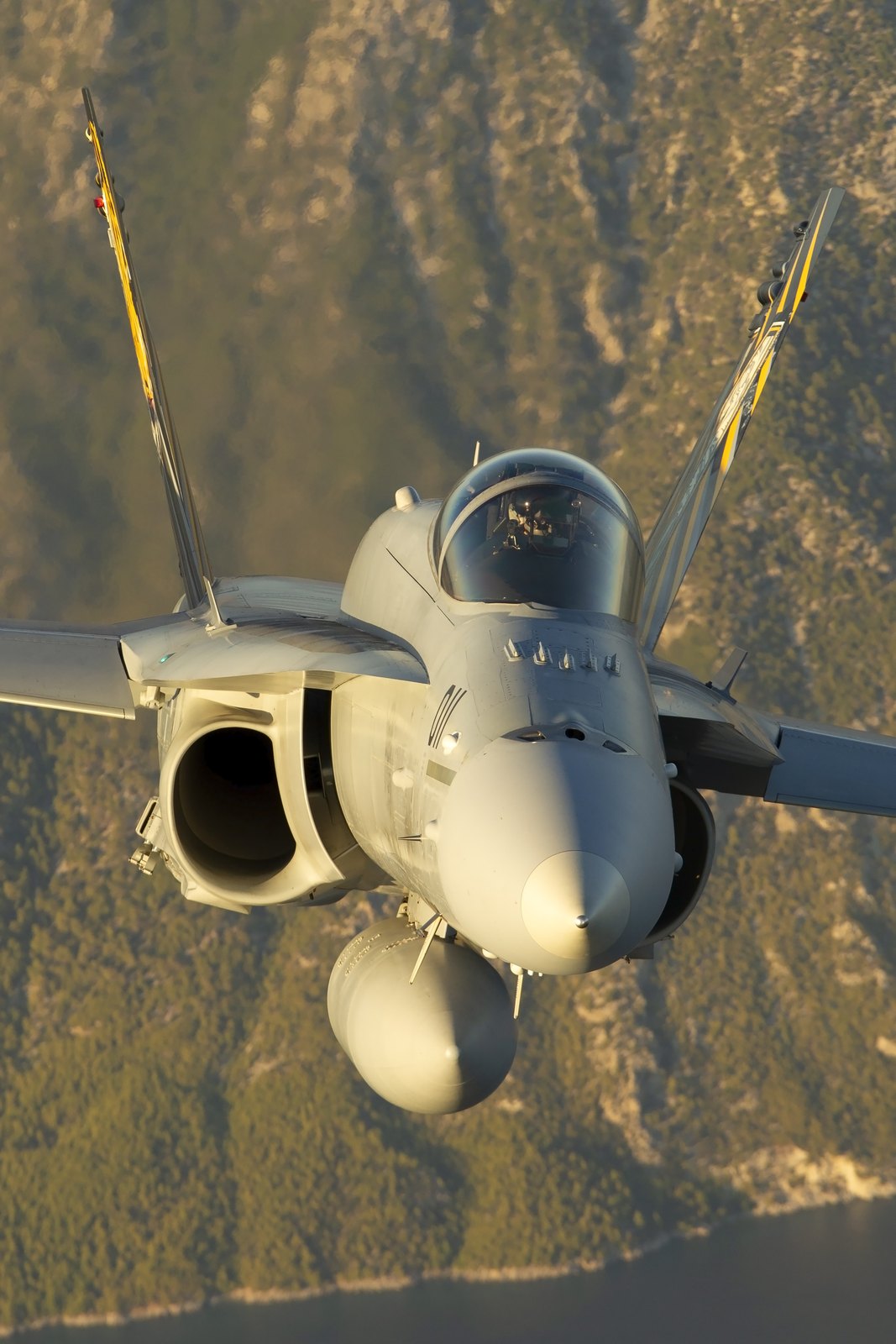
Congress hands the Navy somebody else’s design
At the same time the Navy was running a programme of its own. On 28 August 1974 the Chief of Naval Operations released a formal operational requirement for VFAX and directed Naval Air Systems Command to go out to industry. VFAX was to replace two aeroplanes at once, the F-4 Phantom II and the A-7 Corsair II, which meant putting the fighter job and the light attack job in one airframe. The Navy account traces that idea back to policy from before the Second World War and again in the 1950s.
Congress stopped it. Both the National Naval Aviation Museum and the Air & Space Forces Association’s magazine record that the separate VFAX programme was cancelled and the Navy directed to choose from the Air Force’s competitors instead. Neither names the Act that did it.
So the Navy looked at the two Lightweight Fighter prototypes and reached the opposite conclusion from the Air Force. On 2 May 1975 it selected a derivative of the YF-17, for its carrier compatibility. The requirement announced that day was for more than Mach 1.5, a combat ceiling above 45,000 feet and a radius of action over 400 nautical miles, with emphasis on manoeuvring, reliability and maintainability. On 28 January 1976 the Navy put $16 million into McDonnell Douglas to start full-scale development.
The Air Force chose the YF-16 on 13 January 1975. The Navy chose a derivative of the YF-17 on 2 May, fifteen weeks later, for its carrier compatibility.
Who owned it, and the lawsuit that followed
Northrop had designed the aeroplane, but McDonnell Douglas built it. The reason is set out in the court’s recitation of the paperwork, in Northrop Corp. v. McDonnell Douglas Corp., decided on 5 September 1980.
On 2 October 1974 the two companies signed a teaming agreement, to develop and produce an Air Force derivative of the YF-17 and a carrier-suitable version. On 27 June 1975, eight weeks after the Navy’s decision, a basic agreement divided the market: McDonnell Douglas would be prime contractor for F-18 aircraft bought by the US Navy and for carrier-suitable variants, and Northrop could be prime for anything else derived from the YF-17. An amendment of 26 August 1976 spelled it out further. Northrop had elected to design, develop and produce for sale to the United States and to foreign governments all aircraft designed only for land-based operations which were derived from the YF-17.
That land-based aeroplane was the F-18L, and it was Northrop’s to sell. No F-18L is recorded as having been sold or flown. Northrop sued in 1979, alleging breach of the market-sharing agreement, misappropriation of proprietary technology, fraud, attempted monopolisation and unfair competition, and asking for an injunction, damages and an accounting of McDonnell Douglas’s profits.
The 1980 ruling went almost entirely against Northrop, and on grounds that have nothing to do with aeroplanes. The court dismissed part of the case for failure to join the United States Government, which controlled F-18 procurement and had superior rights in the technology. It dismissed another part for want of jurisdiction. It gave summary judgment against Northrop on the first Sherman Act count because the market-division agreement the company was suing to enforce was itself per se illegal market allocation, and on the second because the government rather than private parties controls the weapons market. In the court’s phrase, the United States Government is the market concerned with production and distribution of weapons systems.
The International Directory of Company Histories has it that in April 1985 the matter was resolved in Northrop’s favour with an award of $50 million, and that McDonnell Douglas kept the prime contractor’s role for all future F-18s with Northrop as subcontractor.
One airframe, two jobs, and a new letter
The aeroplane was first designated F-18A. A new model designation, F/A for strike fighter, was created and given to it in the late 1970s, and under the Department of Defense listing it appears under both the A and the F symbols, as A-18 and F-18. On 1 March 1977 it was named Hornet, a name the Navy had used for ships of the line, and the chronology writes it F/A-18 in that 1977 entry, before the designation it describes had been created.
That compound letter turned into a weapons loading demonstration at Patuxent River on 15 June 1980, showing the 20 mm Vulcan cannon, the AIM-7F Sparrow, the AIM-9L Sidewinder, flare dispensers, rocket launchers, fuel-air explosives and Rockeye. Walleye, Maverick, Harpoon, HARM and laser-guided bombs went on the list as well.
First flight was on 18 November 1978 at McDonnell Douglas in St Louis. The chronology notes what it was designed for: a combat radius of more than 550 miles and a ferry range of more than 2,000 miles. Patuxent River had the first aircraft on 16 January 1979.
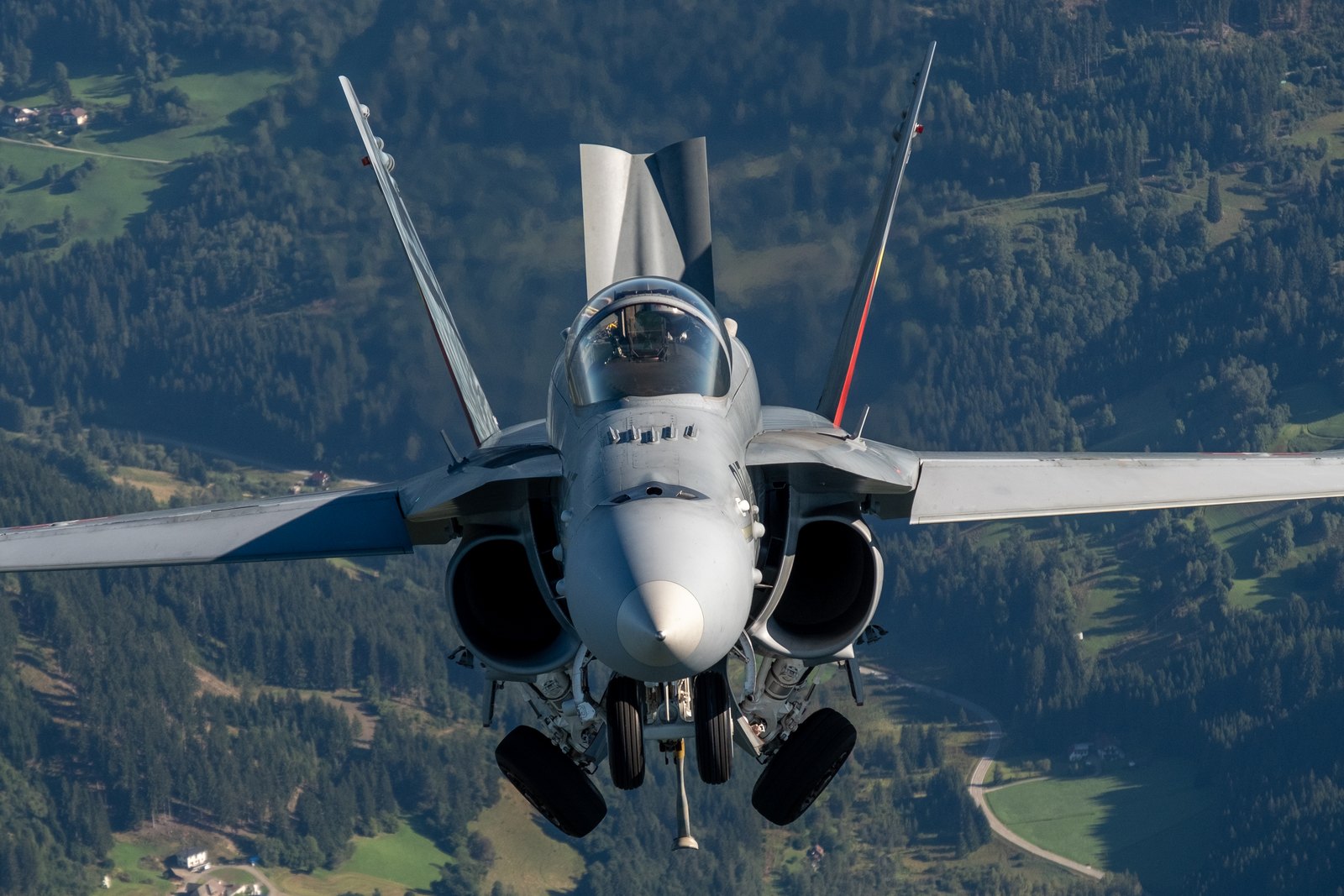
A Hornet landed at sea for the first time on 30 October 1979, aboard USS America, and the Navy logged 32 catapult and arrested landings over five days of trials. A two-seater followed on 17 December that year. Over 1979 the test centre flew the F/A-18 on 416 flights for 555 hours, and on 12 December it fired a Sidewinder from one for the first time.
The test reports
The General Accounting Office reported on the programme to Congress all the way through it. In February 1980 it found that the acceleration threshold had not been attained and that initial specifications in several areas, including range, had not been achieved; as at 21 November 1979 the aircraft could meet neither the Defense nor the Navy range threshold. Acceleration time exceeded the Defense threshold by 9 to 27 per cent. The aircraft was about 1,962 lb over its initial specification weight of 20,146 lb, roughly 9 per cent heavy. Nose-wheel lift-off speed was 25 knots higher than predicted.
Range was the one that stuck. A Navy Preliminary Evaluation flown in September and October 1980 found fighter escort range 22 per cent below the development contract goal. By February 1982 the Navy’s own estimate had the fighter configuration about 5 per cent below its threshold, and Navy officials put the gap between those two numbers down to incompatible test flight profiles.
Roll rate was fixed rather than argued about. Initial testing showed inadequate roll performance, caused by the flexibility of the outer wing panel combined with an excessive damping effect. In 1980 the Navy added composite layers to stiffen the wing, fitted larger ailerons and introduced differential trailing-edge flaps. In 1981 differential leading-edge flaps were added. Roll rate then met specification, the GAO reported.
The tail was the part nobody had costed. On 28 November 1984 the Navy recorded that deliveries had resumed after four months, McDonnell Douglas having announced it would bear the cost of modifications to correct a fatigue-related problem in the tail area.
The aircraft the Navy approved for full production in June 1981 was about 9 per cent heavier than its own specification, slower to accelerate than the Defense Department asked for, and 22 per cent short on fighter escort range. It went into service anyway.
The fence on the leading edge
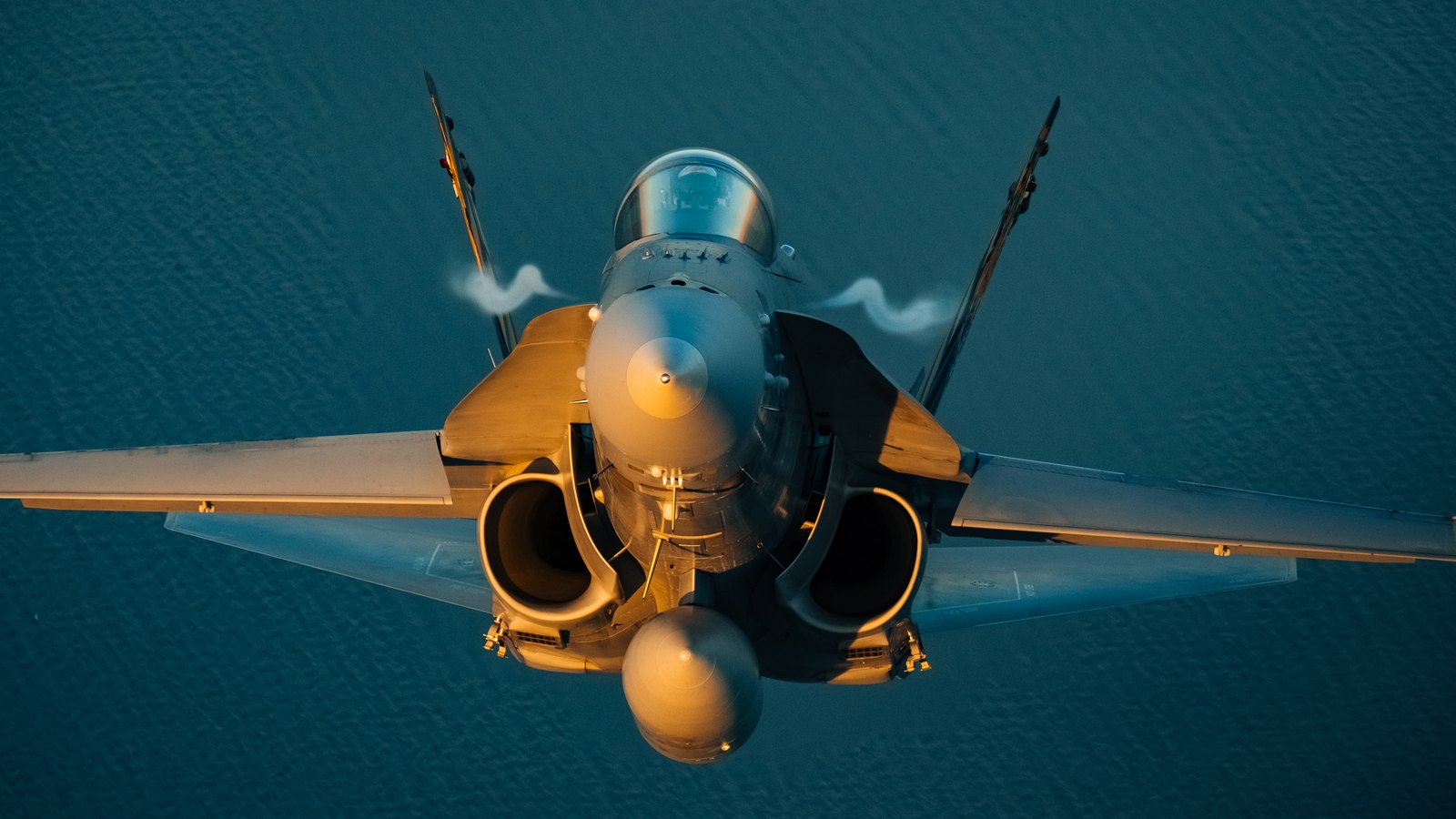
Look at a Hornet head on and the two strakes running forward from the wing roots to either side of the cockpit are the first thing you notice. They are the leading edge extensions, and at high angles of attack they throw off a pair of powerful vortices that let the aeroplane go on flying when a conventional wing would have stopped.
The same vortices shook the twin fins to pieces. NASA Langley set out the cost in a technical memorandum on the ACROBAT programme: special and costly 200-flight-hour inspections were required to check the fins for structural damage due to buffet loads, and structural modifications proved inadequate. The mechanism usually given, though the page that explains it cites nothing of its own, is that at certain attitudes the vortices burst and the broken flow struck the fins at close to their own first bending frequency.
A small vertical fence on top of each leading edge extension fixed it. McDonnell Douglas developed it, and the Navy adopted it as a fleet retrofit after testing showed it could reduce the steady and unsteady pressures on the vertical tail. On the same account it works by shedding a second vortex that interacts with the main one so that it does not burst near the tails. NASA also noted the cost of the cure: the fence increases the unsteady pressure fluctuations on the upper surface of the extension itself.
| Date | What happened |
|---|---|
| January 1972 | The US Air Force starts the Lightweight Fighter programme as a technology demonstration |
| 9 June 1974 | Northrop YF-17 first flight, Edwards Air Force Base, pilot Hank Chouteau |
| 2 October 1974 | Northrop and McDonnell Douglas sign a teaming agreement |
| 13 January 1975 | The Air Force picks the YF-16; the YF-17 project is discontinued |
| 2 May 1975 | The Navy selects a YF-17 derivative, for carrier compatibility |
| 27 June 1975 | The basic agreement makes McDonnell Douglas prime for Navy aircraft |
| 28 January 1976 | $16 million contract to begin full-scale development |
| 1 March 1977 | The aircraft is named Hornet |
| 18 November 1978 | First flight, St Louis |
| 30 October 1979 | First landing at sea, USS America, 32 catapults and traps in five days |
| 13 November 1980 | VFA-125 established at NAS Lemoore, the first Hornet squadron |
| 29 June 1981 | The Secretary of Defense approves full production |
| 7 January 1983 | VMFA-314 becomes the first operational squadron |
| 28 November 1984 | Deliveries resume after a four-month halt for a tail fatigue problem |
| 21 February 1985 | First overseas deployment, USS Constellation, CVW-14 |
| 14 and 15 April 1986 | Combat debut over Libya, Operation El Dorado Canyon |
Lemoore, the Black Knights and the first cruise
VFA-125 was established at NAS Lemoore in California on 13 November 1980 as the Navy’s first Hornet squadron, to train aircrew and maintainers for both the Navy and the Marine Corps. It received its first aircraft for fleet operations on 19 February 1981. The National Naval Aviation Museum dates the first deliveries to May 1980 instead, six months before the squadron existed.
On 29 June 1981 the Secretary of Defense approved full production, the aircraft having met all requirements for use as a Navy and Marine Corps fighter. On 7 January 1983 the first Hornets entered operational service outside the training squadrons, with the Black Knights of VMFA-314, replacing the F-4 Phantom II. Naval Air Systems Command gives October 1983 for A and B model operational service.
On 21 February 1985 the Hornet deployed overseas for the first time, with Battle Group Delta headed by USS Constellation, on a routine Seventh Fleet deployment to the Western Pacific and Indian Ocean. Two squadrons of CVW-14, VFA-25 and VFA-113, had replaced their A-7E Corsair IIs, which made Constellation the first carrier with Hornets in her air wing. A Mediterranean deployment followed on 13 October 1985 aboard USS Coral Sea, with VFA-131 and VFA-132 of CVW-13, Coral Sea’s first Sixth Fleet cruise since 1957.
The pilot got a cockpit built round the head-up display instead of conventional instruments, with the critical combat switches moved onto the throttle and the stick. The maintainers got quick engine changes. The museum’s figure for an engine change by squadron personnel is twenty minutes.
Surt in March, El Dorado Canyon in April
Two American operations against Libya ran three weeks apart in the spring of 1986. On 24 and 25 March, after Libyan missile firings at US Navy forces in the Gulf of Sidra, the Navy struck the SA-5 radar site at Surt. A-7E Corsair IIs of VA-83 fired the HARM shots, with VA-81’s A-7Es as the decoy group. That same day A-6A Intruders of VA-34 damaged a Libyan Combattante II fast attack craft with a Harpoon, the first operational combat use of that weapon, and VA-85 sank it with Rockeye. The Navy’s chronology entry records no Hornet involvement at all.
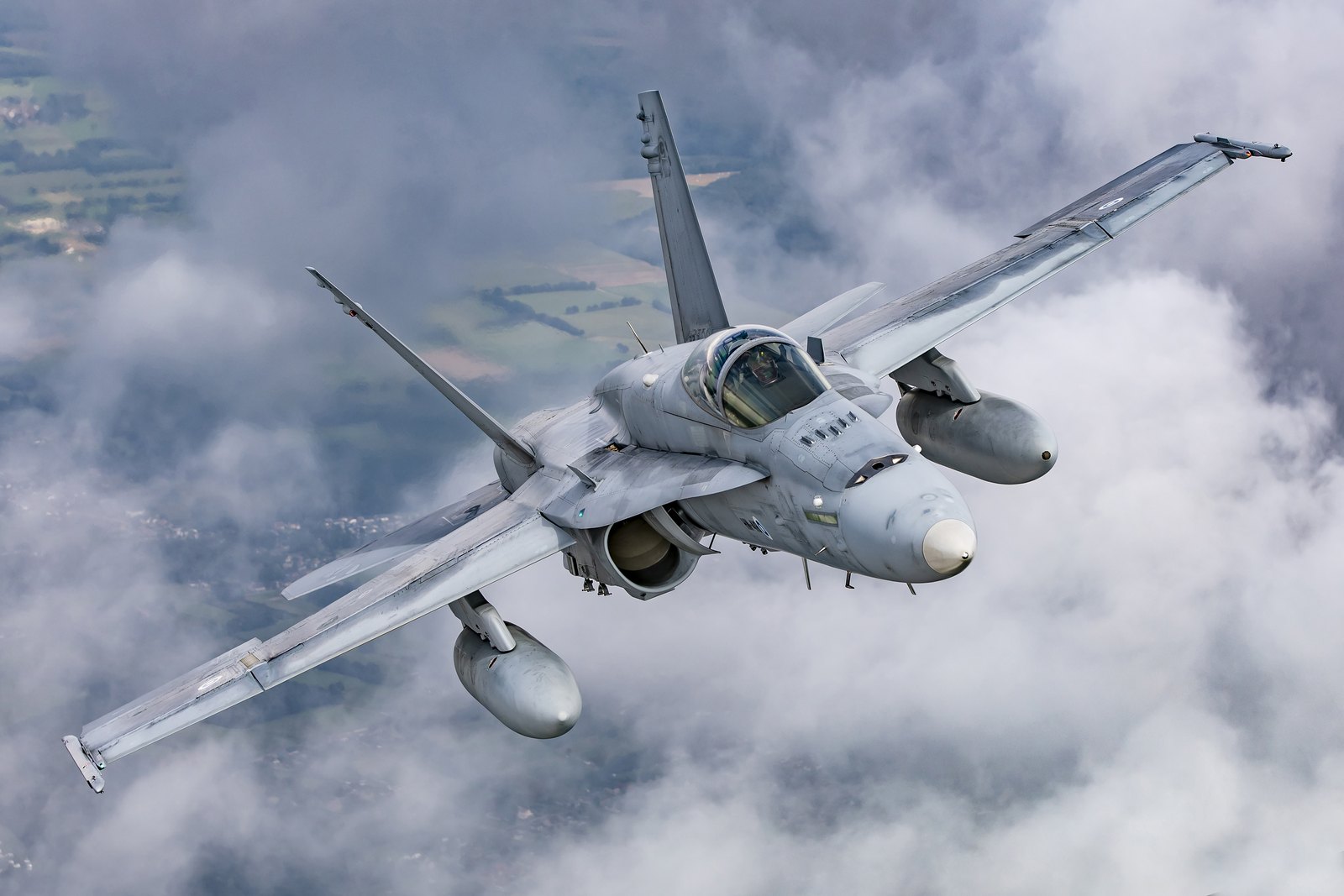
Operation El Dorado Canyon on 14 and 15 April is the Hornet’s combat debut. F/A-18s of CVW-13 from Coral Sea, together with A-7Es from America, fired Shrike and HARM missiles at Libyan surface-to-air missile sites at Benghazi and Tripoli, minutes ahead of the A-6Es from both carriers and the Air Force F-111s coming in behind them. The Air Force account of the operation counts 14 A-6E strike aircraft and 12 F/A-18 and A-7 support jets off the two carriers, against 24 F-111s flying from RAF Lakenheath and five EF-111s from RAF Upper Heyford on a 3,500-mile route with four aerial refuellings each. One F-111 was lost with both crew. The strike killed 37 people and injured 93.
The Air Force dates the operation to 14 April and the Navy to 14 and 15 April. The aircraft went in during the small hours of the 15th, Libyan time, and both are right.
The first night over Iraq
The legacy Hornet’s only two air-to-air kills, against MiG-21s, came on the opening night of Desert Storm, from the same squadron, on aircraft configured to drop bombs.
The Navy’s entry reads: “F/A-18Cs piloted by Lieutenant Commander Mark Fox and Lieutenant Nick Mongillo of VFA-81, assigned to Saratoga, each shot down a MiG-21. They were the first-ever aerial victories for the Hornet.” The museum’s account adds that the two pilots continued to their bombing target on the same sortie.
The rest of that war was ordinary work. On 24 January Hornets and A-6s attacked the naval base at Umm Qasr. On 30 January all eighteen Hornets aboard Saratoga put 100,000 lb of thousand-pound Mk 83s onto Iraqi positions in Kuwait, which the Navy recorded as the largest bomb tonnage carried on a single mission.
Finding Michael Speicher
Michael Scott Speicher was flying an F/A-18C of VFA-81 off Saratoga on the first night. What brought him down has never been settled. The Navy’s own chronology says an Iraqi surface-to-air missile. The account that circulated later, and that most people now repeat, is that an Iraqi MiG-25 shot him down with an air-to-air missile. It appears in journalism and in secondary aviation writing, and in no official document.
His status was changed five times in eighteen years, by a review board, an excavation, two intelligence findings and a working group, between categories that mean very different things to a family.
| Date | Status | What prompted it |
|---|---|---|
| 17 January 1991 | Missing | Shot down on the first night of Desert Storm |
| 22 May 1991 | Killed in action, body not recovered | A Status Review Board found no credible evidence of survival |
| September 1996 | Presumptive death reaffirmed | Excavation of the crash site |
| January 2001 | Missing in action | New evidence and an intelligence community reassessment |
| October 2002 | Missing, captured | A working group set up in July 2002 |
| 10 March 2009 | Missing in action | The intelligence community concluded he was dead, his remains unlocated |
In early July 2009 Iraqi civilians gave information to US Marines in Anbar province. One of them said he had been present when Bedouins found Speicher’s remains and buried them. The Marines were led to the place in the desert and dug there over several days, recovering bones and skeletal fragments. Identification was made from dental records, by Central Command’s account a match both visually and radiographically. DNA testing was under way. The announcement came on 2 August 2009, approximately eighteen years after he was lost, and President Obama issued a statement the same day.
The remains reached NAS Jacksonville on 13 August 2009. After an overnight viewing at All Saints Chapel a motorcade took the casket through Jacksonville, stopping at his church, his high school, the Veterans Memorial Wall and Cecil Field, and he was buried in a private ceremony. VFA-81 flew a missing-man formation over the grave. Rear Admiral Patrick Driscoll, who had flown with him the night he was shot down, was the official escort, and called it a bittersweet day. He had been promoted while missing, and was buried a captain.
Night attack, 1985 to 1992
On 29 March 1985 the Navy contracted McDonnell Douglas to develop night attack capability. About 750 aircraft were to get a navigational forward-looking infrared pod, a television-like head-up display, night vision goggles for the pilot and other improvements.
Deliveries of the F/A-18C began on 21 September 1987, carrying AMRAAM and the infrared imaging Maverick, with reliability and survivability work on the fuel system and room to grow in computer memory, speed and mission computer interface channels. AMRAAM itself had already been proved from a modified Hornet on 18 August 1986, when one shot down a QF-86 drone at Point Mugu in a low-altitude, high-clutter intercept, the Hornet at 890 feet and Mach 0.49 and the drone at 625 feet and Mach 0.68.
A prototype night attack F/A-18D flew at St Louis on 6 May 1988 with a FLIR sensor called TINS, and the type entered service at Marine Corps Air Station El Toro on 18 May 1990. It was the first two-seat Hornet meant to fly tactical missions rather than training ones, with a pilot and a naval flight officer, and the Navy’s entry says it would replace the A-6 Intruder as the Marine Corps day and night attack aircraft. On 14 February 1992 VMFA(AW)-225 took the first fleet two-seater capable of carrying the Advanced Tactical Airborne Reconnaissance System.
The radar changed as well. The AN/APG-73 replaced the AN/APG-65 and went into production in 1993, offering higher processor throughput, more memory, better reliability and easier maintenance with no increase in size or weight. Raytheon put the eventual total at 932 radars delivered to the Navy and to international customers, and named Australia, Canada, Finland, Malaysia and Switzerland among them.
The Marines flew the result in Kosovo in 1999. Two squadrons of two-seaters went from a cold start to on the deck and ready in fourteen days, operating 24 F/A-18Ds out of Taszar in Hungary, doing strike, airborne forward air control, tactical air control and HARM shooting, and carrying the reconnaissance system for battle damage assessment. Marine aviation flew about 6,000 hours in that operation.
A bigger aeroplane with the same name
The Super Hornet is not a modified Hornet, whatever the paperwork called it. It was approved on 12 May 1992 as a major modification, which is a procurement category and not a description, and on 7 December that year the Navy and McDonnell Douglas Aerospace finalised a $3.715 billion development contract covering seven and a half years of engineering, seven flight test aircraft and three ground test airframes. Every E and F was built new; no C or D was ever converted.
| Measure | Change in the E/F |
|---|---|
| Length | 4.3 ft longer |
| Wing area | 25 per cent greater |
| Empty weight | about 6,100 lb heavier |
| Internal fuel | 6,600 lb more |
| Engine | F414-GE-400 in place of the F404-GE-402 EPE |
| Uninstalled thrust | 20,727 lb against 17,754 lb, 17 per cent more |
| Weapon stations | 11 against 9, the two new ones outboard |
The Congressional Research Service measures it differently. It gives internal fuel as two totals, 14,500 lb against 10,381 lb, where the GAO gives a difference of 6,600 lb, and the two do not reconcile. On thrust the CRS says 36 per cent where the GAO says 17. The GAO’s figure is uninstalled thrust. The CRS does not say what its own figure measures. The CRS does give the number the whole aeroplane was bought for. Combat radius went from 366 nautical miles as a fighter and 415 as an attack aircraft in the C and D, to 420 and 490 in the E and F.
First flight was on 29 November 1995, from St Louis Lambert International Airport, with McDonnell Douglas pilot Fred Madenwald flying F/A-18E1. The Navy chronology, Boeing’s caption to the landing photograph and a 2025 congressional resolution all give that date. The CRS says December 1995, which is wrong.
Carrier operations began aboard USS John C. Stennis in January 1997, development finished in May 1999, the first production aircraft was delivered in December 1998 and the first squadron stood up at Lemoore in January 1999. Full-rate production was approved on 16 June 2000 and VFA-115 reached initial operational capability in September 2001. On 24 July 2002, twelve Super Hornets of VFA-115 sailed in USS Abraham Lincoln on the type’s first deployment. Combat came that November over Iraq.
All that extra size buys 54 nautical miles of combat radius as a fighter and 75 as an attack aircraft, on the Congressional Research Service’s figures. A Navy Preliminary Evaluation flown that autumn had already found the fighter escort range 22 per cent below the contract goal,.
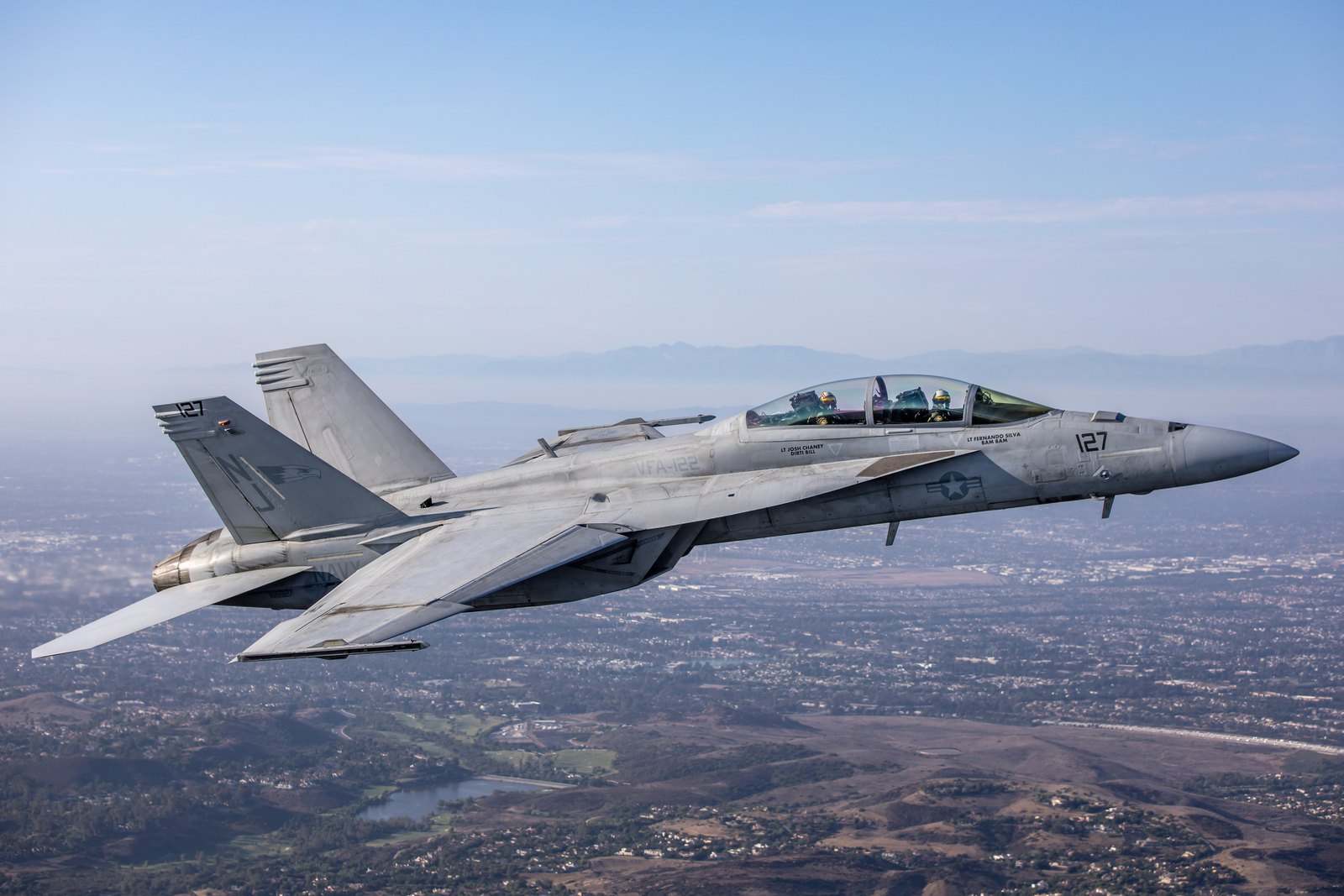
The GAO report of June 1996
The GAO called it Navy Aviation: F/A-18E/F Will Provide Marginal Operational Improvement at High Cost. It found that the E/F bought its range advantage at the expense of aerial combat performance, with an inferior sustained turn rate and inferior acceleration compared with enhanced C and D models. It found the aeroplane was not justified to counter a particular military threat that could not be met with the aircraft already in service. The two new outboard weapon stations were limited to 1,150 lb each, not enough for Harpoon, SLAM or a laser-guided Mk 84, and wind tunnel tests showed weapons released from them would hit the side of the fuselage. On price it put unit recurring flyaway at $53.2 million in 1996 dollars against the Department of Defense’s own $43.6 million, and against $28 million for a C or D. It estimated that buying 660 more C and D models instead would save about $17 billion, and it recommended the Secretary of Defense reconsider producing the E and F at all.
At that point the plan was 1,000 aircraft, 660 for the Navy and 340 for the Marine Corps, at $57.31 billion in 1996 dollars or $83.35 billion in then-year dollars, over 1997 to 2015, at 72 aircraft a year. Development was put at $5.783 billion, of which about $3.75 billion had gone by the end of 1995. By 2006 the plan was 462.
None of that stopped it. On 21 April 2011 the 500th Super Hornet or Growler went to the Navy, and Boeing’s line in that release answers the GAO directly: Boeing has delivered every F/A-18E/F and EA-18G to the US Navy on budget and ahead of schedule.
The Super Hornet also got the US Navy’s first aerial kill since the 1991 Gulf War. On 18 June 2017 a Syrian Air Force Su-22 dropped bombs near Syrian Democratic Forces fighters south of Tabqah and was shot down by a US Navy F/A-18E from USS George H.W. Bush. The pilot, Lieutenant Commander Michael Tremel, fired an AIM-9X first, which the Su-22 decoyed with flares, then an AMRAAM, which did not miss. He was given the Distinguished Flying Cross for it in September 2018. Sources disagree on his squadron: USNI News said VFA-31 on the day, while Military.com and Task & Purpose later said VFA-87. Both were in CVW-8 aboard the same carrier.
The Growler
The EA-18G took the F model’s airframe and avionics and turned it into an electronic attack aircraft. Ninety were planned at about $9 billion, a unit cost of $67 to $68 million each, on two engines of 22,000 lb thrust, with a span of 44.9 ft and a combat range given as over 850 nautical miles. Production of the first test aircraft began in October 2004, it flew in August 2006, and the first production machine went to VAQ-129 at NAS Whidbey Island on 3 June 2008. Initial operational capability came in September 2009 and full-rate production that autumn. The first combat deployment was VAQ-132 in November 2010, and the first combat use was over Libya in 2011.
Every Growler squadron is at Whidbey Island except VAQ-141, which is attached to CVW-5 and forward deployed to MCAS Iwakuni in Japan. Australia is the only operator besides the US Navy.
Nathan White, 2 April 2003
Operation Iraqi Freedom began on 20 March 2003. Thirteen days in, Lieutenant Nathan D. White of VFA-195, in Carrier Air Wing 5 aboard USS Kitty Hawk, was killed when his single-seat F/A-18C was shot down over southern Iraq. He came from Mesa, Arizona, and he was the first American pilot killed in that war.
At the time, the military’s assessment was that his aircraft had probably been brought down by an American Patriot missile.
The Red Sea and Yemen, 2023 to 2025
Twenty-two years after White was shot down, the Super Hornet is doing the work the Hornet did in 1991, in roughly the same part of the world. A congressional resolution to honour the type sets out the recent record: deployments aboard USS Gerald R. Ford, USS Dwight D. Eisenhower, USS Abraham Lincoln, USS Theodore Roosevelt and USS Harry S. Truman between December 2023 and May 2025, strikes on targets in Yemen on 3 February 2024, and on 1 February 2025 what it calls the largest airstrike launched from a single aircraft carrier, delivering approximately 124,000 lb of munitions.
Canada first, then Australia and Spain
Canada bought it before anybody else. A contract for 138 CF-188s was signed in April 1980 and the aircraft were delivered between 1982 and 1988, 98 single-seat CF-188As and 40 two-seat CF-188Bs, replacing the CF-101 Voodoo, the CF-104 Starfighter and the CF-116. They flew in the 1991 Gulf War and over the former Yugoslavia in 1999 and 2000. Canada’s first aircraft, 188901, was built in 1982 and served with No. 410 Cougar Squadron at Cold Lake.
Australia took 75, fifty-seven F/A-18As and eighteen F/A-18Bs. On 17 May 1985 the first two arrived at RAAF Base Williamtown in New South Wales after a trans-Pacific ferry of about fifteen hours with KC-10 tankers, and were escorted in by Mirages. Four were lost in flying accidents between 1987 and 1992. The fleet flew Operation Slipper over Afghanistan from November 2001, Operation Falconer over Iraq in February 2003, which the Department of Defence calls the first operational combat deployment of Australian fighters since Korea, and Operation Okra against Daesh from 2014 to 2018, in which the classic Hornets flew 1,937 missions and 14,780 hours and delivered about 1,600 munitions. On 29 November 2021 the type was retired at Williamtown with nearly 408,000 flying hours on the fleet, and replaced by the F-35A.
Spain chose the Hornet in December 1982 for 72 single-seaters and 12 two-seaters, and cut that by May 1983 to 60 and 12. Spanish designations are C.15 for the single-seat EF-18A and CE.15 for the two-seat EF-18B. Spain’s first aircraft, CE.15-01, was presented on 22 November 1985 and flew on 4 December; the last single-seater arrived in July 1990. A 1993 programme brought 46 of them up towards C and D standard as EF-18A+ and EF-18B+. Spain then bought 24 second-hand US Navy F/A-18A and B from late 1995, serialled C.15-73 to C.15-96, for Escuadron 211 at Moron. Those Spanish figures are Joe Baugher’s reference pages rather than a Spanish government source.
Kuwait and Malaysia came later. Kuwait bought the legacy Hornet at the end of the 1980s, in a quantity no source consulted here can settle. Malaysia contracted for eight F/A-18Ds in June 1993 and took them in two batches in May and August 1997, with APG-73 radar and F404-GE-402 engines, which Boeing called the first nation in Southeast Asia to purchase and receive the type. Kuwait moved to the Super Hornet: the Defense Security Cooperation Agency notified Congress on 22 November 2016, published in the Federal Register six days later, of a possible sale of 32 F/A-18Es and eight F/A-18Fs at an estimated $10.1 billion, and the contract actually signed on 27 June 2018 was for 28 aircraft, 22 Es and six Fs, at $1,504,995,240.
| Country | Quantity | Order, selection or first arrival | Where it stands |
|---|---|---|---|
| Canada | 138 CF-188 | April 1980 | Delivered 1982 to 1988 |
| Australia | 75 | First two arrived 17 May 1985 | Retired 29 November 2021, replaced by the F-35A |
| Spain | 72, plus 24 second-hand | Selected December 1982 | Upgraded to EF-18A+ standard from 1993 |
| Kuwait | Legacy fleet, quantity not established | Commonly given as 1988 | 28 Super Hornets contracted 27 June 2018 |
| Finland | 64 | Announced May 1992 | 62 on strength in January 2018; being replaced by 64 F-35A |
| Switzerland | 34 | Federal decree 17 June 1992 | 30 rebuilt to 6,000 hours by April 2026, flying into the early 2030s |
| Malaysia | 8 F/A-18D | June 1993 | Delivered 1997 |
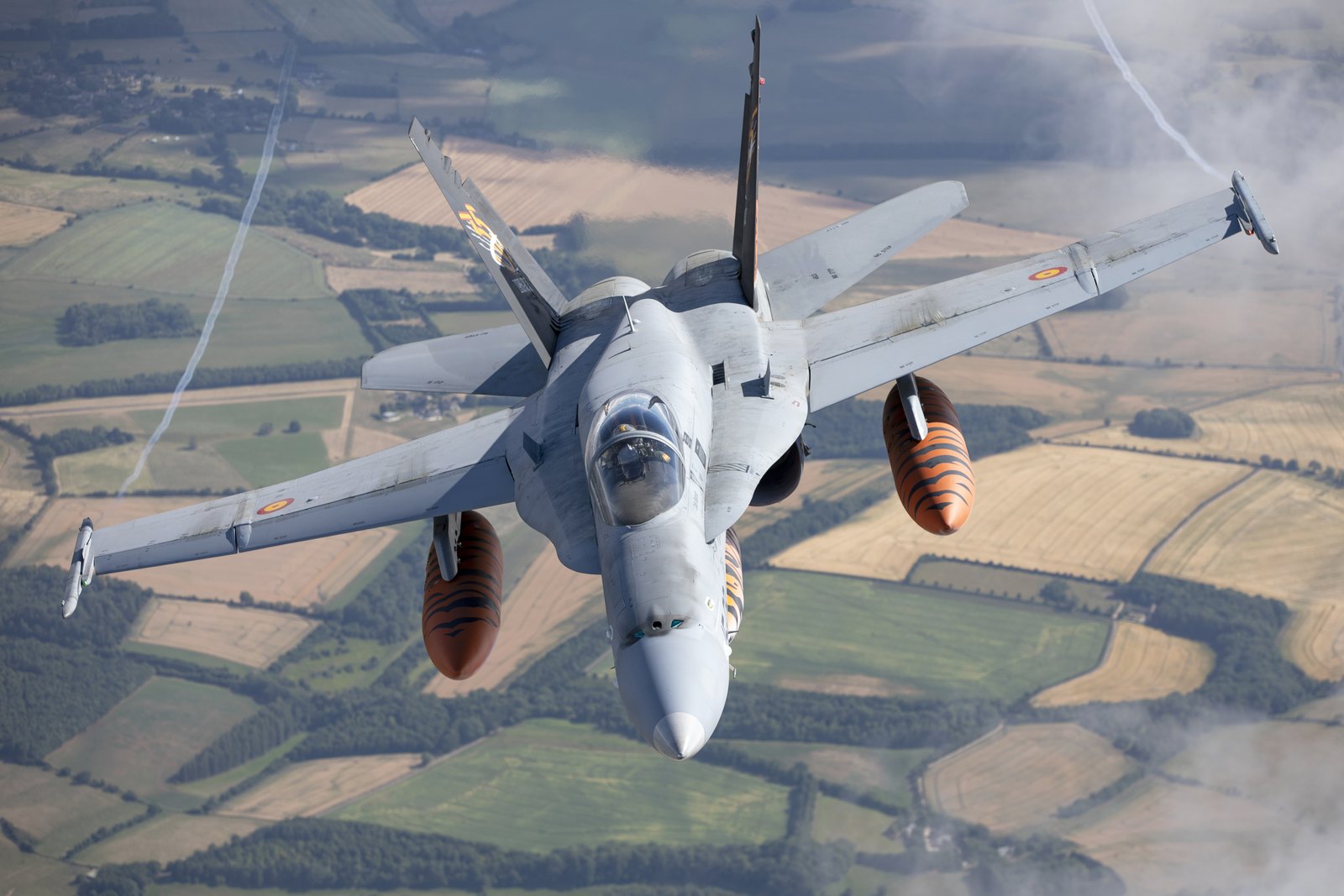
Finland buys an interceptor and turns it into a bomber
Finland announced its choice in May 1992 and bought 64. Fifty-seven single-seaters were assembled in Finland at the Patria Finavitec plant and seven two-seaters were built in the United States. The first six, all two-seat F-18Ds, arrived in November 1995, and the production run finished in 2000. By January 2018 the fleet stood at 62, 55 F/A-18Cs and seven F/A-18Ds, split between Fighter Squadron 11 at Lapland Air Command and Fighter Squadron 31 at Karelia Air Command.
Finland bought it as an interceptor and nothing else. Two mid-life upgrades changed that. The first, from 2006 to 2010, was still an air-to-air programme: the AIM-9X, the Joint Helmet-Mounted Cueing System, tactical mapping displays, new identification systems and new radios. The second, from 2012 to 2016, gave a pure fighter force a strike capability it had never had, with JDAM for short range, JSOW as a medium-range glide bomb, JASSM for long-range stand-off, Link 16, targeting pods, upgraded air-to-air missiles and new cockpit displays. On 9 December 2016 the last aircraft through the programme, HN-465, came off the line. Nothing further was planned. The upgrades were meant to hold the fleet together through the 2020s and no longer.
A Naval Air Systems Command article of 2005 says Finland selected the Hornet in January 1991 and that the purchase required approval by national referendum. The Finnish Air Force history says May 1992 and mentions no referendum. The American article has almost certainly confused Finland with Switzerland, which did put its own Hornet purchase to a national vote, in 1993.
On 10 December 2021 Finland chose 64 F-35A Block 4, beating a Super Hornet bid among others, at a total acquisition cost of about 8.378 billion euros. That figure covers 4.703 billion for the aircraft, 754.6 million for AMRAAM and Sidewinder and 2.92 billion for services, training and sustainment through 2030. Alongside it sit 777 million for infrastructure and 823.8 million held as a weapons package reserve. The first two Finnish F-35As, JF-510 and JF-512, landed at Rovaniemi at a quarter to six in the evening on 18 September 2026. Finland will fly both types together until the F-35 reaches full operational capability at the end of 2030.
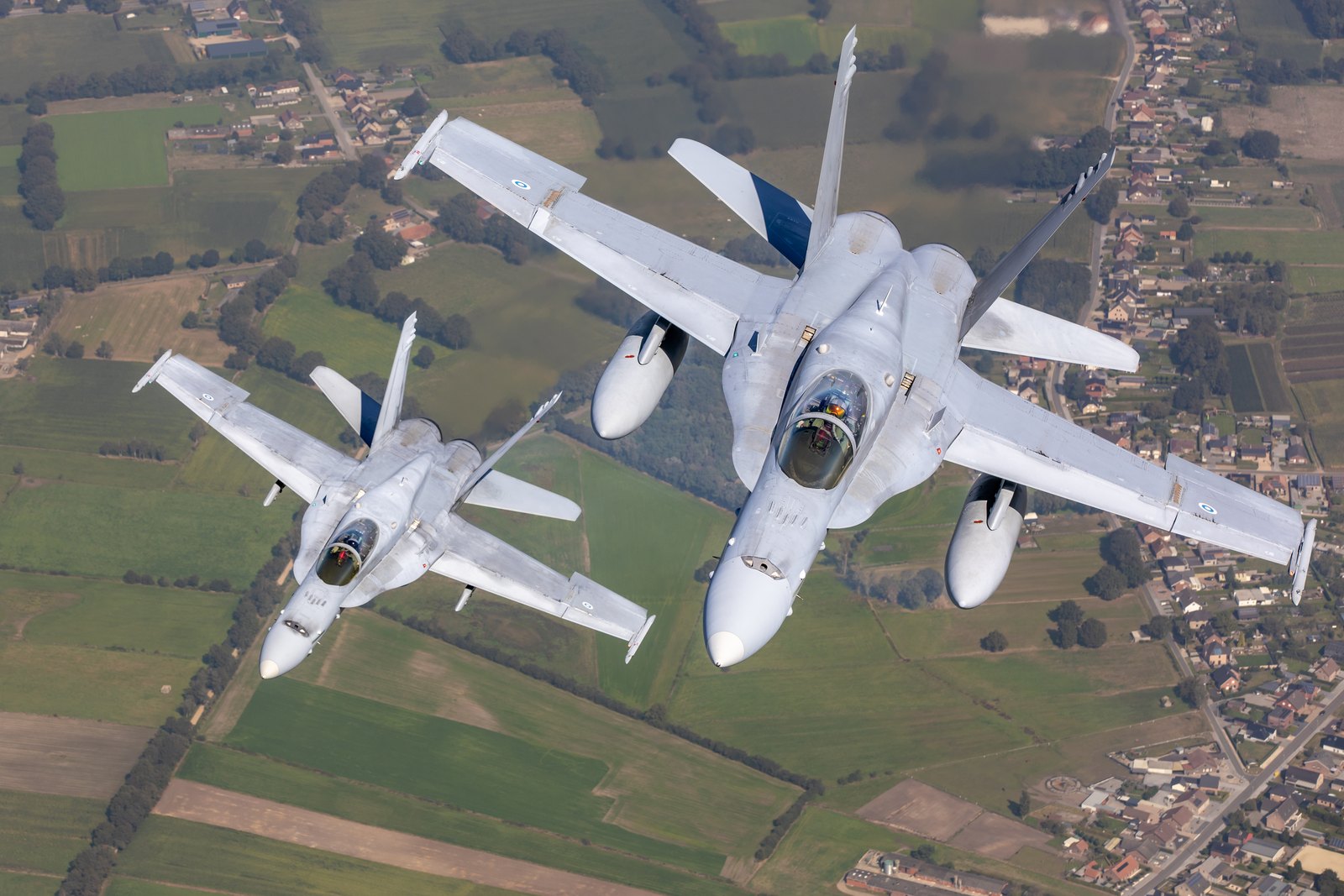
Switzerland rebuilds an aeroplane it is supposed to be retiring
Parliament approved 34 aircraft by federal decree on 17 June 1992, with a commitment credit of 3.495 billion Swiss francs. One single-seater and one two-seater were completed in the United States and the other 32 were assembled at Emmen. The Swiss industrial share of the manufacture came to about 320 million francs, and McDonnell Douglas was contractually obliged to offset about 2.3 billion francs in industrial participation by 2003.
The decree did not settle it. On 6 June 1993 Swiss voters were asked to approve a popular initiative for a Switzerland without new combat aircraft, launched to stop this exact purchase. It was rejected, with 42.81 per cent voting yes on a turnout of 55.58 per cent, and it lost on cantons 4 to 19.
Emmen’s first assembled aircraft, the two-seat J-5232, flew on 3 October 1996 and was handed over at Emmen on 23 January 1997 in front of about 400 guests. Defence Minister Adolf Ogi said the air force was now on the cutting edge of modern technology. Monthly deliveries would bring three squadrons to operational readiness in 1997, 1998 and 1999.
Upgrade 25 followed in 2008, approved by the Federal Council on 22 September as a 404 million franc slice of a 917 million franc armaments programme and confirmed by the Standerat on 17 December. It covered 33 aircraft, 26 Cs and seven Ds, and bought 20 ATFLIR targeting pods, 44 ALR-67(V)3 electronic warfare sets, new cockpit display suites, upgraded GPS and digital recorders. Those figures come from Defense Industry Daily rather than from a Swiss government paper. A further American support case worth an estimated $200 million was notified to Congress in December 2013.
Switzerland had already tried once to replace them. Saab’s Swedish production order of December 2013 included 22 new Gripen E for Switzerland if Switzerland decided to buy them, and on 18 May 2014 Swiss voters rejected the purchase, with 46.59 per cent voting yes.
Then the arithmetic went wrong. The Swiss Hornets were certified to 5,000 flight hours each and were expected to reach the end of their technical life by 2025 at the latest, which was fine as long as a replacement arrived on time. On 27 September 2020 Swiss voters approved the purchase of new combat aircraft by 50.13 per cent on a turnout of 59.43 per cent. The decree authorised a maximum of 6 billion francs and deliberately left the type and the number to the government.
The government picked the F-35A, and the plan the Federal Council later described itself as abandoning was 36 of them. On 12 December 2025 the Federal Council decided instead to buy the maximum possible number within the 6 billion francs voters had approved, having been told by the United States that the price had risen for inflation, raw materials and development, and having concluded that asking for more money was not possible from a fiscal policy point of view. On 6 March 2026 it approved a supplementary credit of 394 million francs, which exhausted the ceiling. The 6 billion francs voters approved is indexed to inflation, and by 2026 it stood at 6.429 billion. On current projections that buys about 30 aircraft. Buying all 36 would have needed another 1.1 billion. Switzerland has to give Washington a definitive number by the second quarter of 2027 to keep its production slots.
So the old aeroplanes had to last. Armasuisse finished the structural life extension in April 2026: 30 aircraft, inspections and repairs on numerous selected structural components, cleared to 6,000 flight hours each. On the project page the cost is given as 440 million francs, and 450 million in the completion release. The aircraft will now fly into the early 2030s. Logistics deliveries and project closure run to the end of 2027, pushed back from 2025 by supply delays.
Switzerland approved 34 Hornets in 1992 and had to survive a referendum to keep them. In April 2026 it finished rebuilding 30 of them to 6,000 flight hours each, to hold the air-policing job until the F-35A arrives. That F-35A buy has since fallen from a planned 36 aircraft to about 30, because the 6 billion francs voters approved in 2020 will not stretch further.
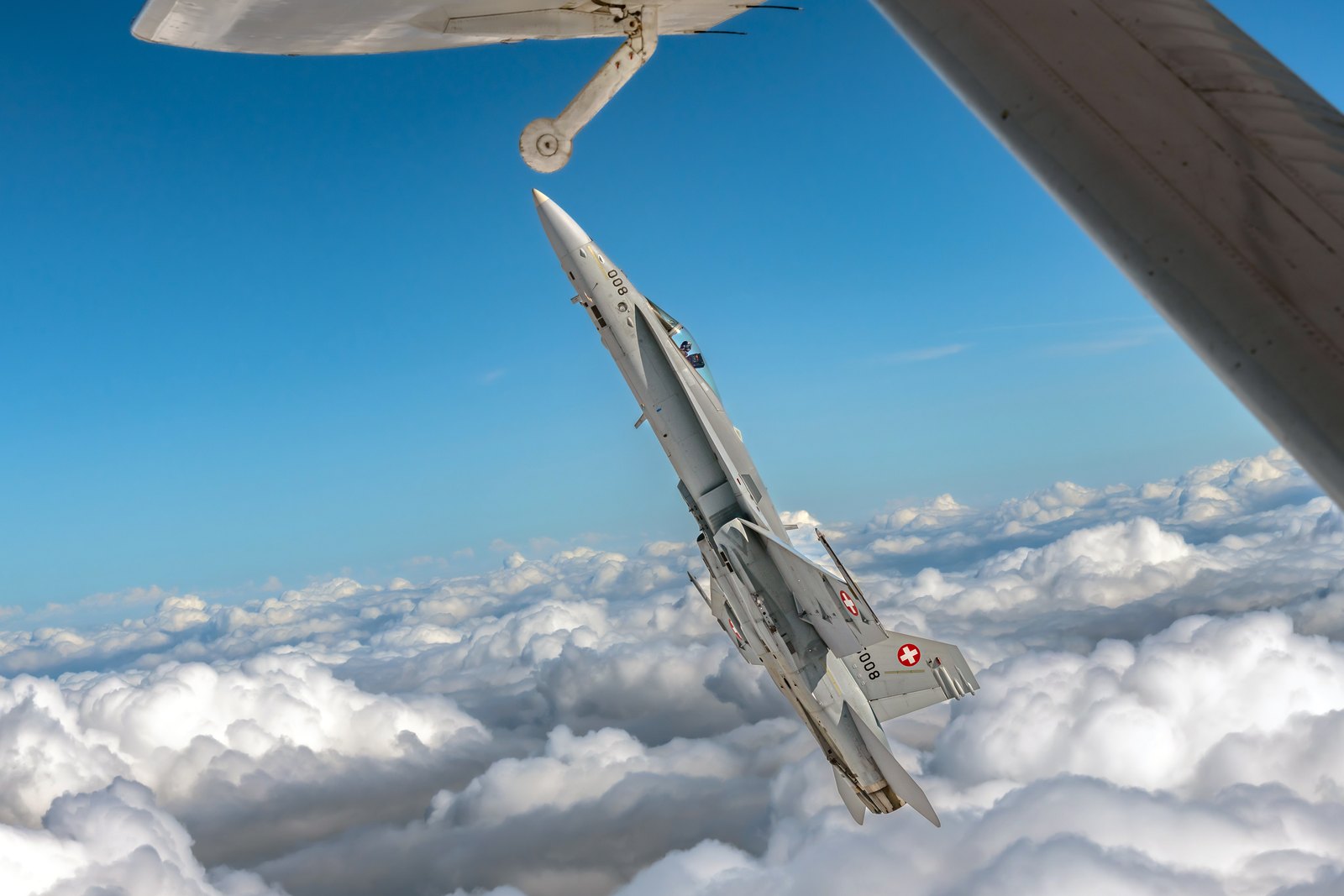
The Blue Angels give up the old one
The Navy Flight Demonstration Squadron flew the legacy Hornet longer than it has flown anything else. The Navy release puts it at 1986 to 2020, thirty-four years, and the National Naval Aviation Museum dates it from 1987.
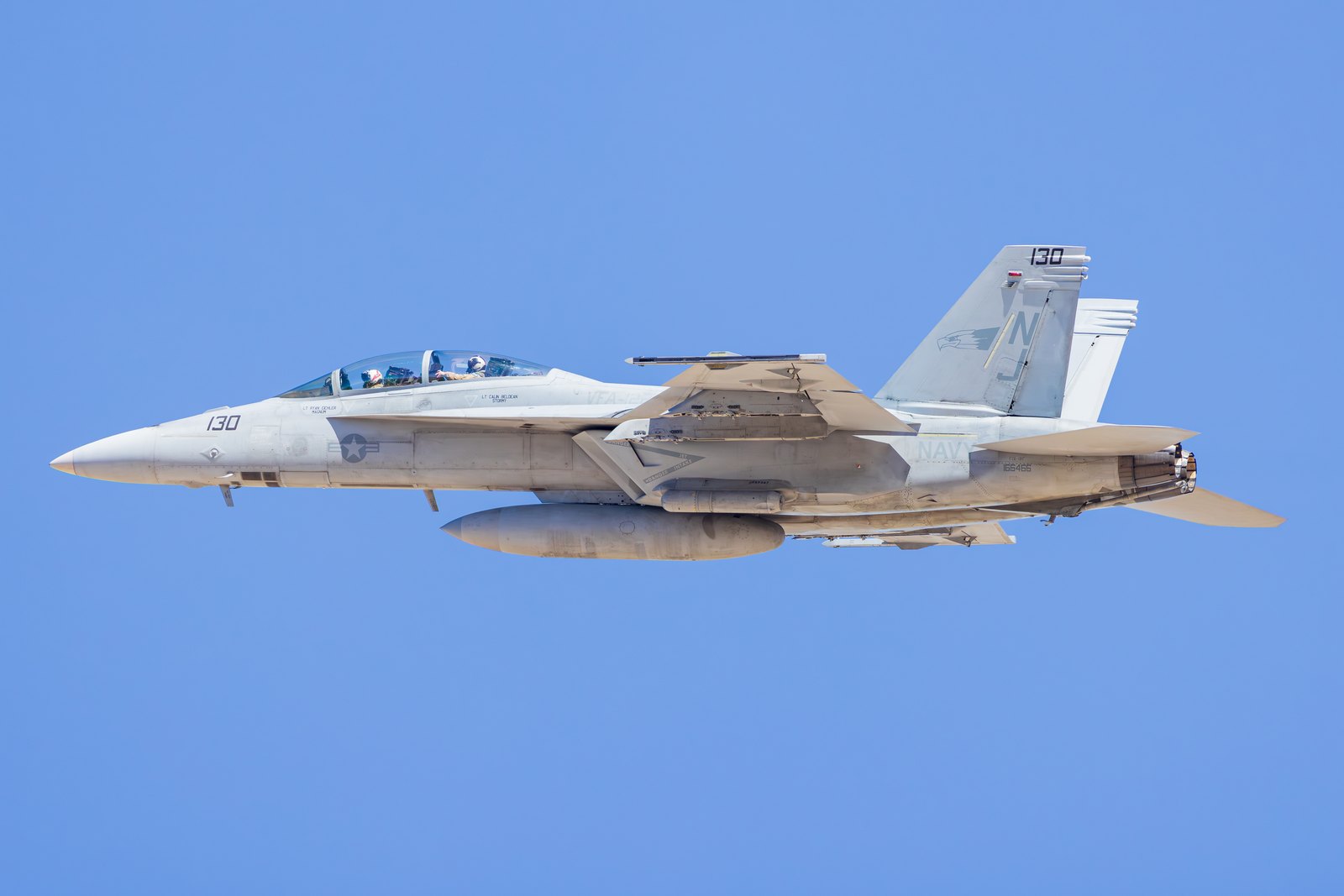
The last demonstration on the type was flown at NAS Pensacola on the afternoon of 4 November 2020, a thirty-minute display with flyovers of coastal Alabama and Florida, led by Commander Brian Kesselring. Winter training began twelve days later and moved to El Centro in California in January, which is where Paul photographed the Super Hornet below, on one of the air-to-air trips. The team’s 2021 season, its seventy-fifth anniversary, was the first on the Super Hornet.
The line at St Louis
Production of the C and D ended in 2000, the same year the Finnish production series was completed. The total built is usually given as 1,480, a figure that appears in a great many places and in no Boeing or Navy statement.
The Super Hornet outlasted it by twenty-seven years and is now finishing too. On 19 March 2024 the Navy gave Boeing $1.3 billion for seventeen more aircraft, cut from a planned twenty because of inflation, with final delivery by spring 2027 at the latest. Boeing dropped the rate from two aircraft a month to one and a half and began moving St Louis staff onto the F-15EX, the T-7A and the MQ-25. Boeing’s Mark Sears said the company had run a number of international campaigns it was unsuccessful in, and that there were no active discussions with the Navy about additional F-18s beyond those seventeen.
The Hornets still flying
The United States Navy flies the F/A-18E and F and the EA-18G off its carriers and will go on doing so well past the end of the production line. In April 2020 the final Block II was delivered, and the first two Block III test aircraft in June 2020. Australia flies 24 F/A-18Fs with No. 1 Squadron at Amberley and is the only export operator of the Growler. Kuwait contracted for 28 Super Hornets in 2018, with completion expected in January 2021, and no source consulted here settles whether the last one has arrived.
The old aeroplane is thinner on the ground than it was. Australia’s classic fleet went in 2021; Finland will fly Hornets and F-35As alongside each other until the end of 2030. Spanish Hornets were still turning up in tiger schemes at Fairford in 2022. Switzerland’s thirty were structurally rebuilt in April 2026 and are cleared into the early 2030s.
The photographs in this article were taken from another aeroplane, which is its own discipline, and the frames are available to licence. Four air arms are in them, over Greece, Austria, Belgium, England and California, and the oldest frame is from 2018 and the newest from 2024. Seven of the nine aircraft in them belong to an air force rather than to a navy.
Switzerland has just finished rebuilding thirty Hornets to fly into the 2030s, because the F-35A meant to replace them is arriving late and in smaller numbers than planned. The first flight at St Louis was forty-seven years ago.
Frequently asked questions
Who makes the F/A-18 Hornet?
Boeing makes it now, at St Louis, Missouri. It was designed by Northrop as the YF-17 and built by McDonnell Douglas, which Boeing later absorbed. Under an agreement of 27 June 1975 McDonnell Douglas took the Navy aircraft as prime contractor and Northrop kept the right to any land-based version. Thirty-two of Switzerland’s 34 were assembled at Emmen, and 57 of Finland’s 64 at the Patria Finavitec plant.
When did the F/A-18 Hornet first fly?
On 18 November 1978, at McDonnell Douglas in St Louis, Missouri. Its ancestor the Northrop YF-17 had flown on 9 June 1974 at Edwards Air Force Base with Hank Chouteau at the controls. The Hornet made its first landing at sea aboard USS America on 30 October 1979, and the Secretary of Defense approved full production on 29 June 1981.
Why did the Navy buy an aeroplane the Air Force had rejected?
Because Congress made it. The Navy was running its own programme, VFAX, to replace the F-4 Phantom II and the A-7 Corsair II. Congress cancelled it and directed the Navy to pick from the Air Force’s Lightweight Fighter competitors instead. The Air Force chose the single-engined YF-16; the Navy chose the twin-engined YF-17 on 2 May 1975, for its carrier compatibility.
What is the difference between the Hornet and the Super Hornet?
The Super Hornet is a different aeroplane that shares a name. The GAO’s 1996 figures put it 4.3 ft longer, with 25 per cent more wing area, about 6,100 lb heavier empty, carrying 6,600 lb more internal fuel, with eleven weapon stations against nine and F414 engines in place of F404s. Every one was built new.
What are the fences on the leading edge extensions for?
They keep the fins from being shaken apart. NASA Langley records that buffet loads on the twin fins meant special 200-flight-hour inspections for structural damage, and that structural modifications proved inadequate, after which McDonnell Douglas developed the fence and the Navy adopted it as a fleet retrofit. The usual explanation, from a source that cites nothing of its own, is that the fence sheds a second vortex which keeps the main one from bursting near the tails.
Has the F/A-18 ever shot down an enemy aircraft?
Three aircraft, on two occasions. On 17 January 1991 Lieutenant Commander Mark Fox and Lieutenant Nick Mongillo of VFA-81, flying off USS Saratoga, each shot down a MiG-21 while on their way to a bombing target. On 18 June 2017 a US Navy F/A-18E from USS George H.W. Bush shot down a Syrian Air Force Su-22 near Tabqah, which a congressional resolution calls the Navy’s first aerial kill since the 1991 Gulf War.
What happened to Scott Speicher?
He was shot down on the first night of Desert Storm, 17 January 1991, flying an F/A-18C of VFA-81, and the Navy records him as the first American casualty of the war. His status was changed five times over eighteen years. In July 2009 Iraqi civilians told US Marines in Anbar province where Bedouins had buried his remains; they were recovered, identified from dental records, and announced on 2 August 2009.
Which countries have flown the Hornet?
The United States Navy and Marine Corps, Canada, Australia, Spain, Kuwait, Finland, Switzerland and Malaysia flew the legacy Hornet. Australia retired its classic fleet on 29 November 2021, and Finland, which bought 64 and had 62 on strength in January 2018, is replacing them with the F-35A now. For the Super Hornet, Boeing names only Australia and Kuwait as international customers, and Australia is the only export operator of the EA-18G Growler.
Is Switzerland still flying the Hornet?
Yes, and it has just rebuilt them. Armasuisse completed a structural life extension in April 2026 covering 30 aircraft, clearing each to 6,000 flight hours instead of 5,000, at a cost of 450 million Swiss francs. They will fly into the early 2030s. The F-35A buy meant to replace them has fallen from a planned 36 aircraft to about 30 because the 6 billion francs approved by voters in 2020 will not cover more.
When is Finland retiring its Hornets?
Gradually, between now and the end of 2030. Finland selected 64 F-35A Block 4 on 10 December 2021 at a total acquisition cost of about 8.378 billion euros, and the first two aircraft landed at Rovaniemi on 18 September 2026. The Finnish Air Force will operate Hornets and F-35As at the same time until the newer type reaches full operational capability at the end of 2030.
When does Super Hornet production end?
Spring 2027 at the latest. On 19 March 2024 the Navy placed a $1.3 billion order for seventeen more aircraft, cut from a planned twenty because of inflation. Boeing reduced the build rate from two aircraft a month to one and a half and began moving St Louis staff onto the F-15EX, T-7A and MQ-25. Legacy Hornet production had already ended in 2000.
Was the land-based F-18L ever sold?
None was ever sold. Under agreements of 1975 and 1976 Northrop held the right to develop and sell land-based derivatives of the YF-17 while McDonnell Douglas took the carrier aircraft. Northrop sued McDonnell Douglas in 1979 over that division of the market and lost almost the whole case in September 1980, partly because the market-sharing agreement it was trying to enforce was itself illegal.
What does the F/A in F/A-18 mean?
Fighter and attack. The aircraft was first designated F-18A, and the Navy’s designation appendix records that a new model designation, F/A for strike fighter, was established and assigned to it in the late 1970s. The aeroplane was meant to replace both the F-4 Phantom II and the A-7 Corsair II. Under the Department of Defense listing it appears under both symbols, as A-18 and F-18.
Sources and further reading
- Roy A. Grossnick, United States Naval Aviation 1910 to 1995, Naval Historical Center, the official dated chronology of US naval aviation, entry by entry, from the VFAX requirement to the Super Hornet’s first flight.
- GAO, F/A-18 Naval Strike Fighter: Its Effectiveness Is Uncertain, PSAD-80-24, 14 February 1980, the weight, the acceleration shortfall and the range thresholds.
- GAO, MASAD-82-20, 26 February 1982, the 22 per cent fighter escort range shortfall and the roll rate fix.
- GAO, Navy Aviation: F/A-18E/F Will Provide Marginal Operational Improvement at High Cost, NSIAD-96-98, June 1996, the Super Hornet dimensions, the outboard pylon limits and the unit cost comparison.
- Congressional Research Service, report RL30624, updated 8 June 2006, the internal fuel figures, the thrust comparison and the combat radius numbers for both aircraft.
- Robert W. Moses, Vertical Tail Buffeting Alleviation Using Piezoelectric Actuators, ACROBAT Program, NASA TM-110336, April 1997, the buffet loads, the 200-hour inspections and the leading edge extension fence.
- Aerospaceweb, F-18 leading edge extension fences, the burst-vortex explanation of the fence, which the page gives without sources of its own.
- Northrop Corp. v. McDonnell Douglas Corp., 498 F. Supp. 1112 (C.D. Cal. 1980), the teaming agreement, the market division and why the case failed.
- International Directory of Company Histories, Northrop Corp., the April 1985 settlement figure, which is a reference work and not a court record.
- National Naval Aviation Museum, F/A-18 Hornet, VFA-25 and VFA-113 aboard Constellation, the head-up display and switch layout, and the twenty-minute engine change.
- US Central Command, “Officials identify Gulf War pilot’s remains”, 2 August 2009, the recovery in Anbar province and the dental identification.
- Navy News Service items of 10 March and 14 August 2009, mirrored at GlobalSecurity, the six dated status determinations and the return and burial at Jacksonville.
- Air Force Historical Support Division, Operation El Dorado Canyon, the aircraft numbers on both sides and the casualty figures.
- Air Force Test Center, 9 June 1974, YF-17 Cobra first flight, the first flight, the pilot and the N-102 Fang lineage.
- Air & Space Forces Magazine, the legacy of the Lightweight Fighter competition, the programme dates, the rollouts and the 13 January 1975 decision.
- Naval History and Heritage Command, Kosovo: Naval Lessons Learned During Operation Allied Force, the fourteen days from cold start, the 24 aircraft at Taszar and the Marine flying hours.
- Finnish Air Force, history and the F/A-18C/D fact sheet, the May 1992 decision, the 64 aircraft, the Patria assembly and the two mid-life upgrades.
- Finnish Ministry of Defence, the F-35A decision of 10 December 2021, the cost breakdown and the phase-out plan for the Hornet fleet.
- armasuisse, “Nutzungsdauer der F/A-18C/D der Schweizer Luftwaffe verlängert”, the April 2026 completion, the 30 aircraft and the 6,000-hour clearance.
- Swiss Federal Council, 6 March 2026, on the F-35A numbers, the 394 million franc supplementary credit and the fall from 36 aircraft to about 30.
- Swiss Federal Administration, 30 January 1997, the handover of J-5232 at Emmen, the Emmen assembly and the offset obligation.
- Swissvotes, Année Politique Suisse, University of Bern, vote 393.00, the 6 June 1993 initiative against new combat aircraft, with the cantonal result. Vote 635.00 on the same site covers 27 September 2020.
- Defense Industry Daily, Switzerland’s Hornet Upgrade 25 programme, the 2008 approval, the 404 million franc allocation and the equipment counts. A trade source, not a Swiss government paper.
- Australian Department of Defence, 29 November 2021, the Australian retirement, the operations flown and the fleet flying hours.
- Canada Aviation and Space Museum, the April 1980 contract for 138 CF-188s and the delivery split.
- Joe Baugher, Hornet for Spain, the Spanish quantities, designations, delivery dates and the 1993 upgrade. A reference encyclopaedia, not a Spanish government source.
- Boeing, 9 September 1997, the Malaysian order, the 1997 deliveries and the radar and engine fit.
- USNI News, 28 June 2018, and the Federal Register notice of 28 November 2016, the Kuwaiti contract for 28 aircraft and the earlier 40-aircraft notification.
- USNI News, 18 June 2017, the Su-22 shootdown as Operation Inherent Resolve stated it on the day.
- Military.com, 10 September 2018, the pilot, the missile sequence and the Distinguished Flying Cross, and a different squadron from the one USNI gave on the day.
- Military Times, Lieutenant Nathan D. White, the 2 April 2003 loss and the Patriot assessment. A press database rather than an investigation report.
- US Navy via DVIDS, the Blue Angels’ final legacy Hornet flight, the 4 November 2020 display, the flight leader and the move to El Centro.
- Naval Air Systems Command, the F/A-18 and EA-18G product pages, the service dates, the Block II and Block III deliveries and the Growler programme.
- Boeing, 21 April 2011, the 500th delivery and the company’s claim about budget and schedule.
- Breaking Defense, April 2024, the final order of seventeen aircraft and the 2027 end of the line.
