The Pearl Harbor aircraft did not win the morning on their own. What made the attack possible was a torpedo modified to run in forty feet of water, using two pieces of wood that did their work in two seconds of falling and then broke off. What made it fail was that the three American aircraft carriers were somewhere else, because they were carrying aircraft.
What is on this page
- Forty feet of water
- Three aircraft, three jobs
- A shell with fins
- Kagoshima, and Taranto
- The shape of the operation
- Opana, and what a warning was worth
- Two signals, and what each of them said
- What the torpedoes found
- The aircraft on the ground
- Alert No. 1
- Fourteen pilots
- The flight from Hamilton Field
- The aircraft from Enterprise
- The wave that was never ranged
- The oil, the boats and the yard
- Three ships, and one reason
- What came back
- 1942
- Twenty-nine aircraft
- What survives
- The engineering and the answer
- Questions people ask
Forty feet of water
Pearl Harbor is a shallow anchorage. The museum on the site gives the water over the fleet moorings as only about forty feet, and forty feet was not enough for an air-dropped torpedo of 1941. Such a weapon does not begin its run at the surface. It enters the water on a ballistic path and carries on down that path while it sheds speed, and only then does its depth engine, a hydrostat working against a pendulum, bring it up to the depth set on the dial. That downward travel is the initial dive. An unmodified Type 91 plunged a hundred and fifty feet, and the standard design was still diving twenty metres in early trials, well beyond what Pearl Harbor allowed.
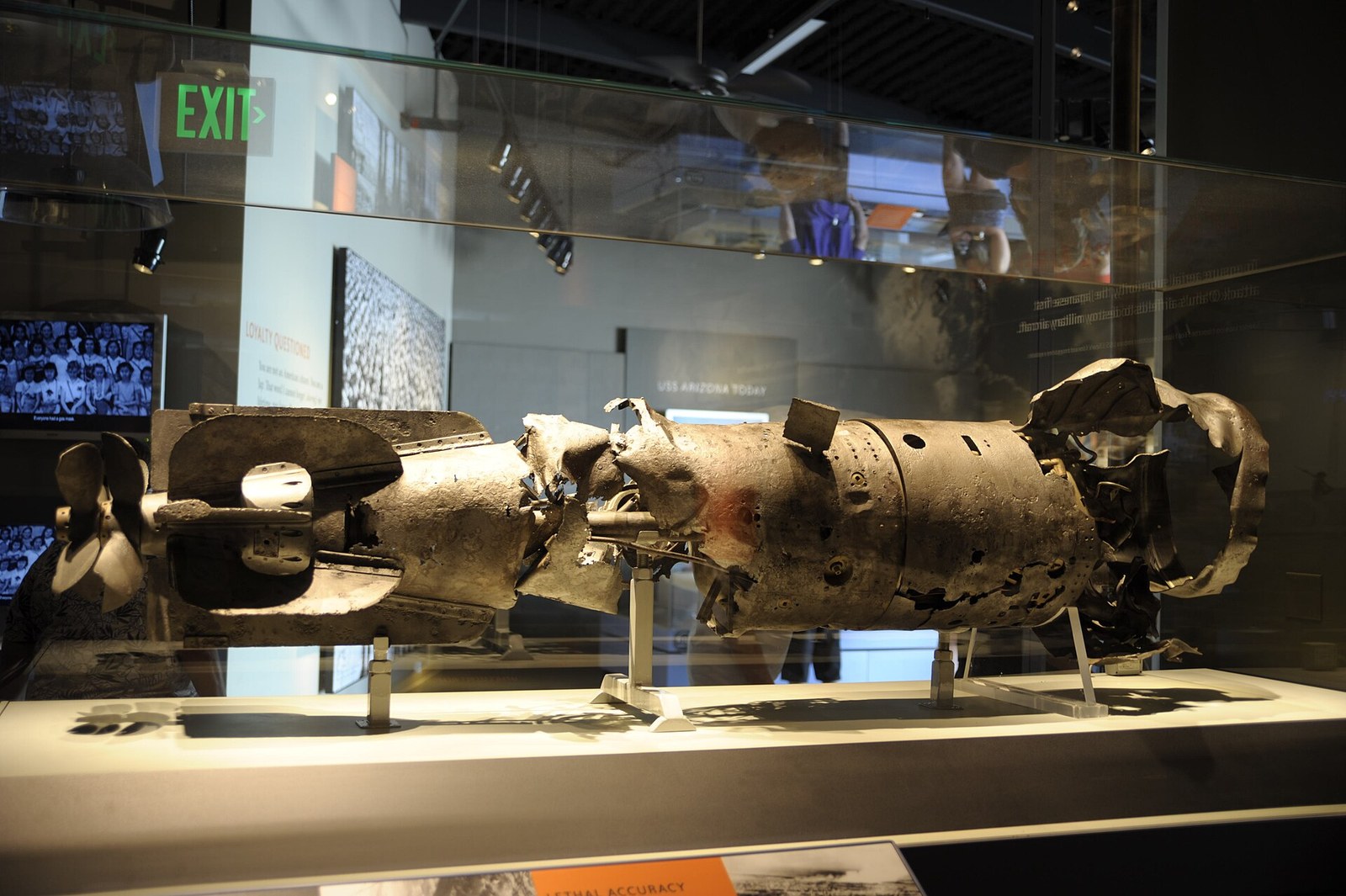
What sets the dive is the angle and the speed at which the weapon meets the water, and the attitude it is holding as it touches. A torpedo leaving the rack at a hundred and sixty knots has a long body, a small tail and two seconds in which to settle. If it is still rolling when it arrives, it enters at an angle nobody can predict.
The answer was wood, in two places. Wooden extension fins went on the metal horizontal and vertical tail fins, enlarging the tail area behind the centre of gravity so that the weapon weathercocked onto its path within that two-second fall. The Type 91 Mod 2 also carried anti-roll stabilisers on the aft body, small metal tabs that worked like ailerons, and these were given a larger wooden sheath, which the Pearl Harbor Aviation Museum describes as a thirty-fold increase in control authority. Roll had to be beaten, because a rolling torpedo cannot hold an entry attitude. Both fittings broke away on impact with the water, and with them the permitted release height doubled. The aircraft still had to release within a couple of hundred metres of the ship’s side, which is why the run into Battleship Row was low, flat and straight.
There was a second gain, and it is the part the popular account leaves out. The earliest Type 91s were steadied in roll by leaving the warhead only partly filled, so stability was bought with empty space in the nose. Once the anti-roll flippers worked, that space could be filled: the Mod 1 carried 150 kg of explosive and the Mod 2 carried 205 kg. The aerodynamic fix bought a warhead more than a third larger.
None of it was ready early. Mod 2 deliveries began in April 1941, the weapon was ready for service by the middle of October, and an adequate quantity reached the striking force on 18 November. The force sailed from Hitokappu Bay at 0600 on 26 November, Japan time; every other time in this article is Hawaii local time on 7 December 1941.
The weapon that did most of the damage was finished, and delivered, in the last weeks before the fleet sailed. Fifty existed. Forty were carried.
Three aircraft, three jobs
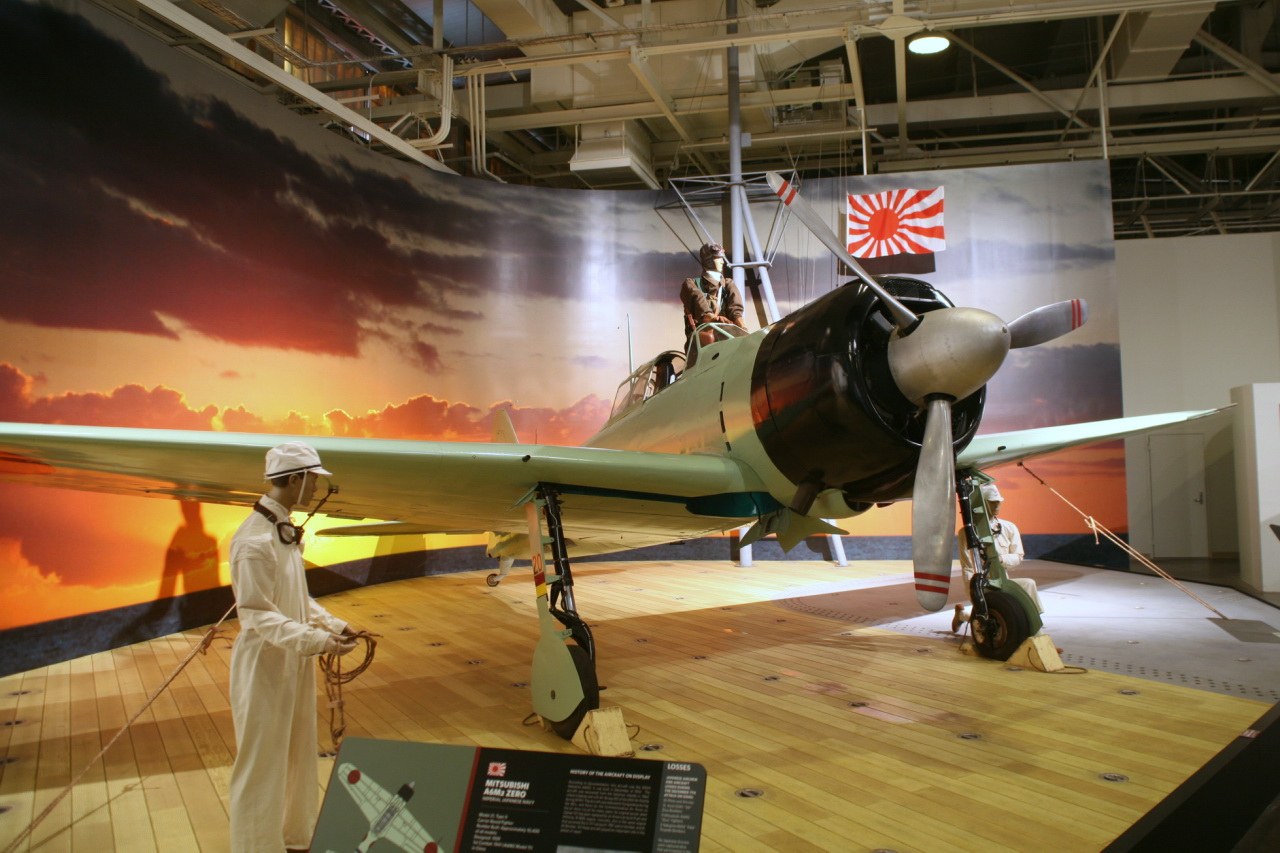
The Mitsubishi A6M2, the Navy Type 0 Carrier Fighter, came from a team led by Jiro Horikoshi and made its maiden flight in April 1939. It had the Nakajima Sakae 12 of 940 hp, and the Pearl Harbor Aviation Museum puts the Model 21’s top speed at about 317 to 332 mph at around 16,000 feet. Its contribution that morning was not air combat but reach: it could fly two hundred miles to Oahu, work over the island and get home, on an airframe with no armour and no self-sealing tanks. The fighters were to destroy American fighters as they got airborne, and failing that, to attack aircraft on the ground.
The Aichi D3A1, the Navy Type 99 Carrier Bomber, was an Aichi design with a fixed spatted undercarriage and an elliptical wing, presented as a prototype in December 1937. Its bomb load was the whole of its character on the day, because it could not pierce a battleship’s armour, and the first-wave dive bombers went instead to the hangars and the parked aircraft at Ford Island and Wheeler Field.
The Nakajima B5N2 was the aircraft in the strike that could sink a battleship, and it did the job in two ways. Nakajima had won a 1935 competition against Mitsubishi with a clean three-seat monoplane, folding-winged and Fowler-flapped. Forty went in with torpedoes under Lieutenant Commander Shigeharu Murata, and forty-nine or fifty with converted naval shells under Commander Mitsuo Fuchida. Five of the torpedo aircraft were lost in the first wave, the crews who had to fly straight, level, slow and low.
| Type | Crew | Guns | Load on 7 December |
|---|---|---|---|
| Mitsubishi A6M2 | 1 | Two 20 mm, two 7.7 mm | None; sweep and strafing |
| Aichi D3A1 | 2 | Two forward 7.7 mm, one rear 7.7 mm | One 250 kg bomb, two 60 kg bombs |
| Nakajima B5N2 | 3 | One rear 7.7 mm | One torpedo, or one 800 kg armour-piercing bomb |
What was known about them beforehand was less than it should have been. Claire Chennault’s reports on the Zero from China were ignored, and American recognition manuals did not carry a picture of one. One thing is worth settling here, because most readers will have met the other version. The names Val and Kate did not exist on 7 December 1941; they were issued in September 1942, in a memorandum written by Frank T. McCoy on General Kenney’s intelligence staff.
A shell with fins
The weapon the B5Ns carried against the battleships from high level was not designed as a bomb. The Type 99 Number 80 Mark 5 (Special) was remanufactured from obsolete 16-inch battleship shells. It weighed 1,756.6 lb, of which 49.2 lb was explosive, a Type 91 filling of trinitroanisole. That charge was 2.8 per cent of the weight of the weapon, where a general-purpose bomb of the era ran at forty to fifty per cent.
The proportion was the point. Against horizontal armour, penetration is bought with mass, hardness and striking velocity rather than with explosive, so the Japanese built what was in effect a shell with fins. It was rated to go through six inches of armour plate, and it was released from 3,000 metres or higher so that gravity supplied the speed.
In practice the converted shells did poorly. Of fifty dropped, a maximum of eight struck home, and the case was weak enough to give a high dud rate. Then one of them struck Arizona forward, and the ship’s own propellant did the rest. Of the 1,512 men aboard, 1,177 were killed. The reconstruction published in the Naval Institute’s Proceedings in 1997 traces the weapon through four decks and 5.62 inches of armour into the forward magazines. No bomb went down the funnel, which is the version that has come down to us. What the shell carried was twenty-two kilograms of explosive, and it did what it did because it opened a path to hundreds of tonnes of powder.
Kagoshima, and Taranto
Intensive training of the designated air groups began in August 1941, with the emphasis on shallow-water torpedo drops, on bombing and on strafing. The torpedo crews went to Kagoshima Bay on Kyushu in October, and Fuchida and Okumiya described the bay as matching Pearl Harbor in depth and surrounding terrain. The crews flew at heights reported as low as ten metres, in full public view, and residents recalled aeroplanes so low that they could smell the burning petrol.
Taranto is usually made to carry more than it can. Lieutenant Commander Takeshi Naito, assistant naval attaché in Berlin, visited Taranto in December 1940, and if he wrote a report it has not been published. On Fuchida’s 1964 account, what Naito offered him in October 1941 was encouragement: if the British could launch torpedoes in a harbour, so could the Japanese. A naval mission under Rear Admiral Koki Abe saw Taranto in the summer of 1941 without being cleared for the Pearl Harbor plan, and the fin work had begun before it set out. The technique was Japanese.
The shape of the operation
The operation was Yamamoto’s idea. Rear Admiral Tokijiro Onishi was ordered to make a preliminary study in January 1941 and passed it in February to Commander Minoru Genda, who concluded that the plan was not impossible of accomplishment. At war games in September the team playing the Japanese side expected to lose about a third of the attacking force. Had the negotiations with the United States succeeded during the approach, the attack would have been cancelled.
What sailed was six carriers, Akagi, Kaga, Soryu, Hiryu, Shokaku and Zuikaku, under Vice Admiral Chuichi Nagumo, screened by a light cruiser and nine destroyers, with two battleships, two heavy cruisers and eight tankers in support. The Naval History and Heritage Command makes the point that carries the others: the first time the Japanese ever launched a six-carrier strike was 7 December 1941. What the plan rested on was not tactics. The element of surprise and the ability to refuel at sea were the most important factors, and if either failed the operation would have been impossible.
The two aircraft totals in circulation are not rival counts of the same thing. The order of battle called for 360 aircraft, 189 in the first wave and 171 in the second. The number that got into the attack is usually given as 353. The first wave took off at 0600 from a position 220 miles north of Oahu, and the second at 0715. Fuchida’s aircraft were over the island at 0740, and at 0749 he had his radio operator send the order to attack, in plain code, as the repeated opening syllable of totsugeki. The tiger signal everyone knows was sent after that, and it carried a different message: it reported that surprise had been achieved. The bombing began at Hickam and Ford Island at 0755.
Opana, and what a warning was worth
The Army had six radar sets on Oahu and five of them working, the sixth still sitting at Schofield Barracks. They were SCR-270-B mobile sets, and the Air Force’s own official history is candid about their limits: a set of that type could not give a target’s altitude, its size or its number, and could not tell friend from foe. The sites had been on the air from 0400, and at 0645 three of them tracked a Japanese scout floatplane about 135 miles north of the island, a plot nobody found unusual.
The sites and the Information Center shut down at 0700. Private Joseph L. Lockard, the trained operator, and Private George E. Elliott, learning the plotting board, kept the Opana set running because their breakfast truck had not come. At about 0702 they picked up what Lockard took for a large flight of aircraft, slightly east of north, at about 130 miles. They reported it to Fort Shafter at 0720, they held it until 0740, and the first bombs fell at 0755.
What was said to them at Fort Shafter has been quoted in a dozen forms it never took. The officer in the building was Second Lieutenant Kermit A. Tyler, a pursuit pilot on his second shift there, and his words, in his own sworn testimony, were “Well, don’t worry about it.”
The Air Force’s history then makes a point that matters more, and it is not about Tyler. An air warning system has three parts, radars on the air, a staffed Information Center and armed fighters ready to launch, and Oahu that morning had the first of the three. The plotters had come off duty at 0700, and there was no director and no aircraft controller. The history states plainly that Tyler had no part to play in a system he was there to watch, and that a call from him would not have helped, because no fighters had been made ready to launch. A perfect warning would have reached aircraft whose guns were unloaded. Lockard said later that he had known from the size of the return that there were more than fifty aircraft, and said equally clearly that he had told nobody so at the time.
On 12 November 1941 the same system had been tested against a simulated Navy strike launched from 80 miles out. The sets found it, the Information Center called it hostile, and interceptors were airborne within six minutes and met the attackers 30 miles from the island. What was missing on 7 December was not the radar.
Two signals, and what each of them said
The wave crossed the coast at 3,000 metres, above a cloud layer at about 2,000. At 0740 Fuchida fired a black dragon flare to open the surprise-attack sequence, having read surprise from an empty sky and silent guns. The order to attack went out at 0749. The tiger signal came after it, and it was not an order to anybody: it was sent over Fuchida’s head to Nagumo and to Tokyo, and what it reported was that surprise had been achieved. The signal remembered as the beginning of the attack was sent before a bomb had fallen.
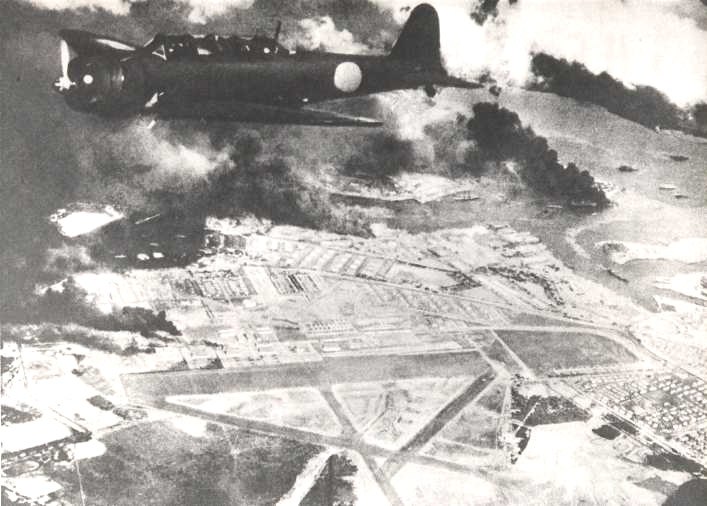
The wave then went in by unit and by clock. The dive bombers were over Wheeler at 0755, Murata’s torpedo aircraft were at the battleships at 0757, the fighters began strafing at 0800, and the level bombers ran in on the battleships at 0805. From Ford Island, Patrol Wing Two put out the signal that fixed the morning in the language of the service: AIR RAID PEARL HARBOR X THIS IS NOT DRILL.
What the torpedoes found
Forty torpedo aircraft went in, and the CinCPac action report plots the tracks of twenty-one of them. Twelve crossed from the south-east, over the tank farm and Merry Point, at the battleships moored along the south side of Ford Island. Three came from the south-west across Dry Dock No. 1 at California, Oklahoma and West Virginia, one came from the west at Helena and Oglala, and five came from the north-west and split to take in Tangier, Utah, Raleigh and Detroit, in berths that included two designated for carriers. The careful reconstruction published in Proceedings in 1977 puts the result at no more than seventeen hits out of the forty, thirteen of them against battleships.
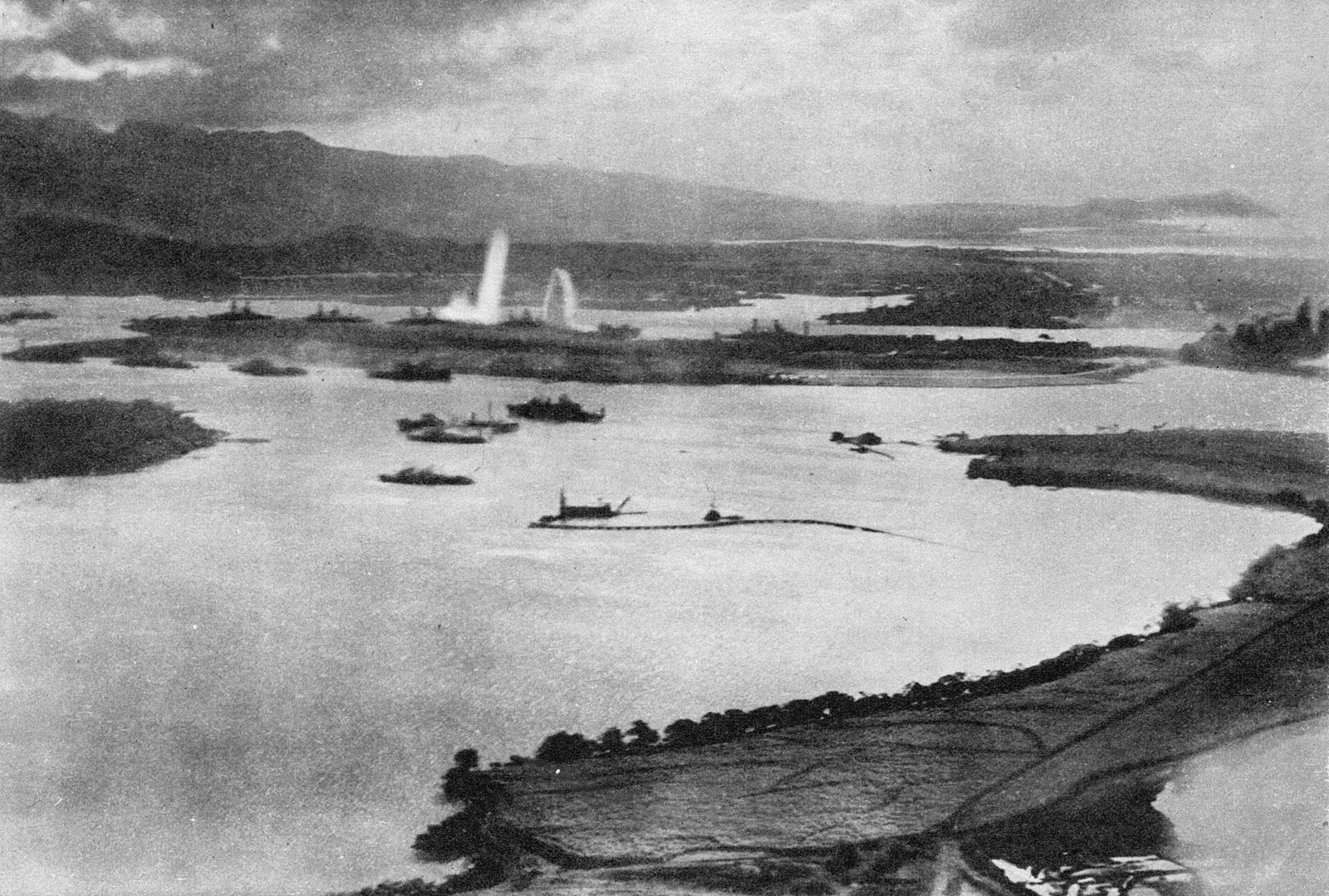
What those hits did is the answer to the engineering set out in the first part of this article, and it is not the answer usually given. One Type 91 Mod 2 did not defeat an American battleship’s side protection. Nevada took a single torpedo, which split seams and let water in without penetrating the holding bulkhead. California took two, which deflected the holding bulkhead inwards and left it intact, and she went down over three days because void-space hatches had been left open for a coming inspection. Oklahoma capsized and West Virginia settled on an even keel, and both went to repeated hits in the same flank. Against West Virginia and California the side protection did what it had been designed to do. It had not been designed against seven torpedoes in one flank.
The level bombers ran in at 0805 with the converted shells, and against the rest of the line those did much less. The CinCPac report describes them from underneath, as about 20-inch holes with low order detonation and very little flame. One went clean through Vestal, leaving an irregular hole about five feet across just inboard of the bilge keel. Nevada, with steam up, got under way and stood down the channel, and at 0910 she was aground at Hospital Point.
The aircraft on the ground
Hickam was the bomber base, next door to the Navy Yard, and it held twelve B-17D, thirty-two B-18, twelve A-20A, two P-26A, two A-12A, two C-33 transports and a single B-24A on its way to the Philippines. The CinCPac report estimates eighteen aircraft in the attack on Hickam and about nine dive bombers coming out of the north-east against the naval air station on Ford Island. Ford Island held the patrol squadrons VP-22, VP-23 and VP-24, the utility squadrons and the fleet’s spare and overhauling aircraft, and twenty-seven dive bombers of the No. 15 Attack Unit had been assigned to its hangars and parked aircraft.
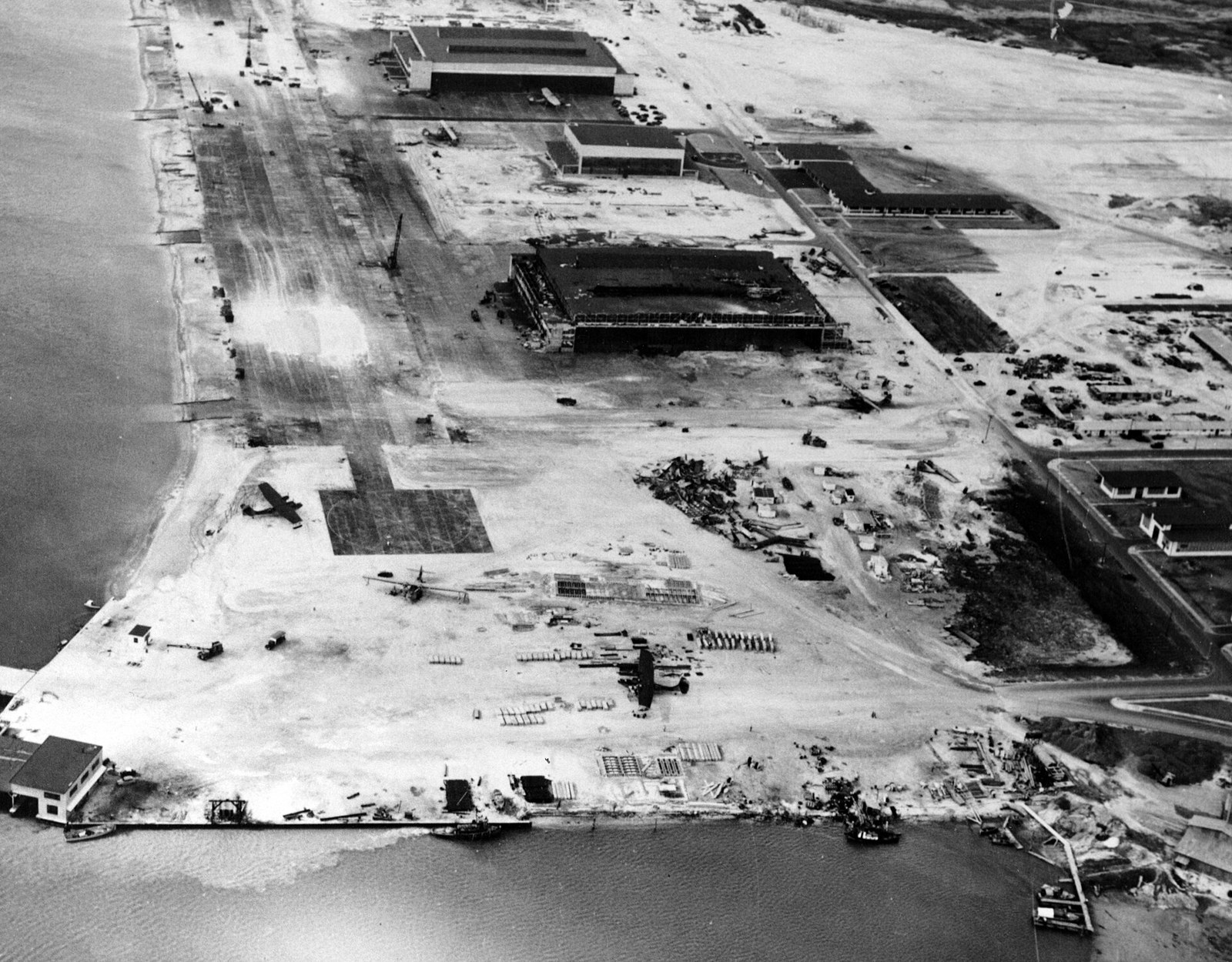
Wheeler, in the middle of the island, was where the fighters were: eighty-seven P-40B, twelve P-40C, thirty-nine P-36A, twelve P-26s, three B-12A, four AT-6 and four amphibians. Twenty-seven dive bombers of the No. 16 Attack Unit went to it. A hangar took a direct hit, and the ammunition stored inside it burned and cooked off for hours.
Kaneohe Bay, on the windward side, was Patrol Wing One’s base, with VP-11, VP-12 and VP-14 and thirty-six PBY-5s, and it was attacked three times. Captain McGinnis reported the result without softening it: all planes actually at the base were put out of commission, thirty-three patrol planes, one OS2U-1 and the J2F-1. The three aircraft that survived were airborne on the dawn patrol.
Ewa was the Marine field, with the aircraft of MAG-21 parked on the north-west apron, and most of them were destroyed. The Japanese crews claimed sixty destroyed at Ewa, which is more aircraft than were there.
On the two services’ own counts, of 234 Army aircraft on Oahu 76 were destroyed and 83 were still flyable at the end of the day, and of 301 naval aircraft, 202 had been ready to fly that morning and 52 could fly that night.
Alert No. 1
The aircraft were where they were because of an order, and that order is usually told as one commander’s eccentricity. It was a formally defined alert state, one of three standing alerts in the Hawaiian Department, chosen in answer to a War Department warning. The Roberts Commission printed its definition. “This alert is a defense against acts of sabotage and uprisings within the islands, with no threat from without.”
On 27 November 1941 Marshall signalled Short that negotiations with Japan appeared to be terminated and that hostile action was possible at any moment. Short chose Alert No. 1 and reported back in a single line: “Department alerted to prevent sabotage. Liaison with the Navy.” The Army Pearl Harbor Board found that he ordered the alert and reported the measures taken within an hour of receiving the message.
What the alert did to the aircraft is in the Roberts Commission’s own words: it required all Army aircraft to be concentrated in order more effectively to guard against possible sabotage, instead of being dispersed in order to afford greater security against air attack. It did the same to the ammunition, which was boxed and stored centrally wherever it was not needed for immediate training, and that is why so much anti-aircraft ammunition was away from its guns. At Wheeler the maintenance crews took the machine gun ammunition out of the aircraft and then out of the belts, so that it could be boxed and held in one location. The location was a hangar, and the hangar was hit.
The dispersal is the part the caricature takes too lightly. Earthen revetments had already been built around Wheeler for about 125 aircraft, for dispersal and protection from air attack. Colonel Flood asked to keep the fighters in them, and Short disapproved his request. Martin, who commanded the Hawaiian Air Force, held that the sabotage danger was real and argued Short’s case against his own staff. No act of sabotage occurred. The alert was a defence against a threat that did not exist, and the belief that it did was a belief about the Japanese population of Oahu.
Alert No. 2 is what makes the choice legible. It kept everything in Alert No. 1 and added four things: activate the Air Warning Center, arm the fighters and put them on alert, fly long-range reconnaissance, and arm and deploy the anti-aircraft units. Those four are precisely what Oahu did not have at 0755.
Fourteen pilots
The Air Force’s own history is blunt. There was no coordinated, systematic, island-wide air defence that morning, and fourteen individual pilots attempted to engage the enemy with varying degrees of success.
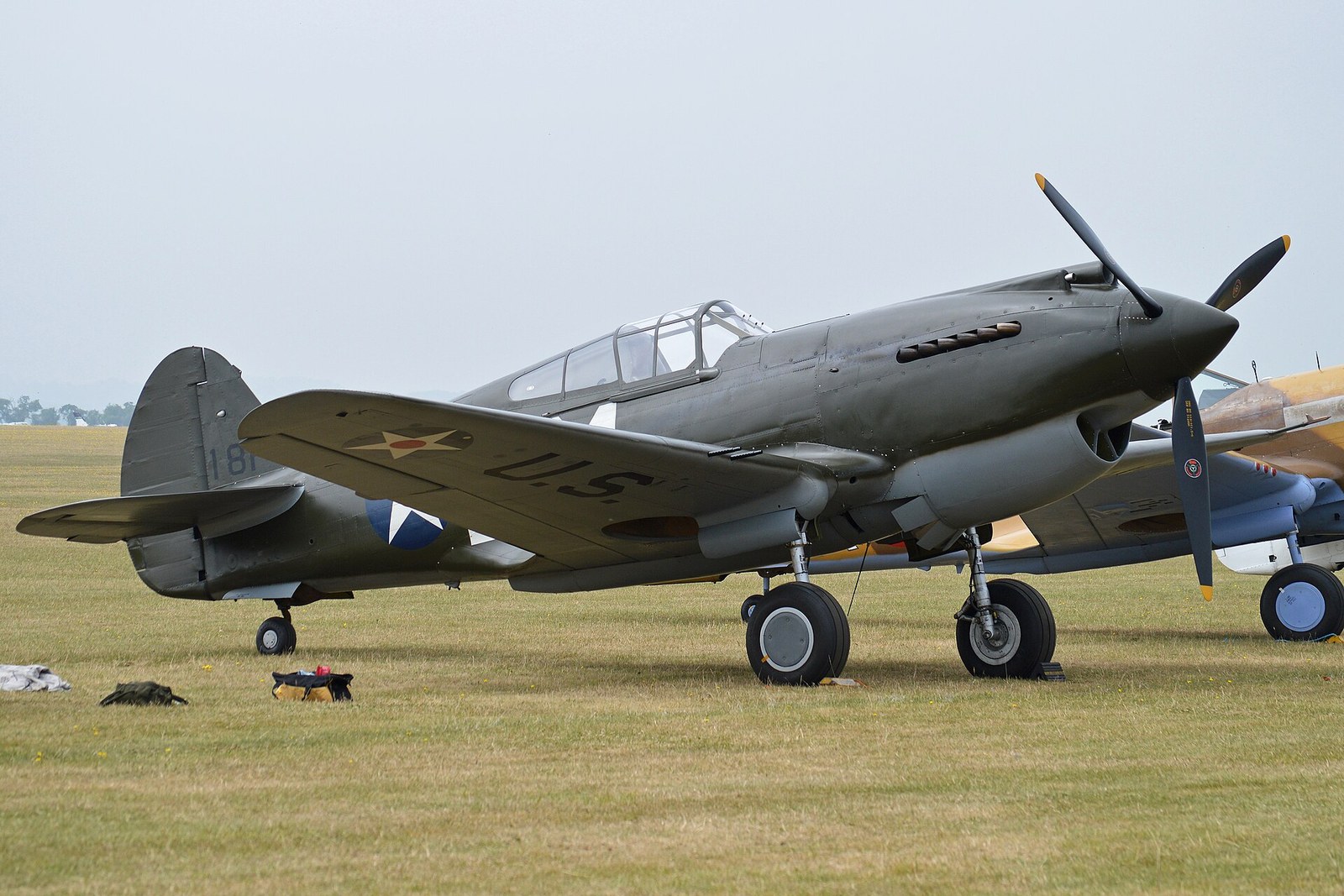
Second Lieutenants George Welch and Kenneth Taylor of the 47th Pursuit Squadron had been at a dance at the Wheeler officers’ club and were still up when the attack began. They drove to Haleiwa. Haleiwa was a dirt auxiliary strip on the north shore, and it was not on anybody’s target list. That is why there were P-40s there to fly. The 47th Pursuit Squadron had gone up for gunnery practice, and the ground crews armed and fuelled the aircraft as Welch and Taylor arrived. Take-off was around 0830, and ground control sent them to the southern tip of the island, where first-wave aircraft were working over Ewa. They joined a line of Japanese aircraft and each shot down two.
They landed to rearm at Wheeler, which was burning. Welch got off again ahead of Taylor, and as Taylor began his run the second wave arrived over the field. Taylor took off into it with his guns firing. One aircraft got on his tail, and Welch, who had stayed over Wheeler, turned in behind that one and shot it down. Taylor, wounded, kept flying. Welch went back to Ewa and got a fourth.
First Lieutenant Lewis Sanders of the 46th Pursuit Squadron told three pilots at Wheeler to take the first aircraft ready. Second Lieutenant Gordon Sterling took the one Lieutenant Othneil Norris had left to fetch a parachute. The four P-36As, the older and slower type, were off around 0850 and met the second wave over Kaneohe. Sanders shot one down. Sterling was diving on a second with a third behind him; Sanders came in behind the third and set it alight; the aircraft Sterling was firing at crashed, and Sterling, close behind it, went into the sea.
At Bellows, Second Lieutenant George Whiteman took a P-40 that was still being loaded and went without its gun cowlings; two Zeros hit him at about fifty feet, and he died trying to belly-land. First Lieutenant Samuel Bishop got airborne behind him and was shot into the sea half a mile offshore. Wounded in the leg, he got out of the aircraft and swam ashore. Second Lieutenant John Dains flew three sorties, and coming back from the third the guns at Schofield Barracks killed him.
Ten victories were officially credited to American fighter pilots for 7 December 1941: four to Welch, two to Taylor, and one each to Brown, Sanders, Rasmussen and Sterling. Taylor is usually given three or four, and the Air Force’s narrative history says he damaged at least one more, but the register that adjudicated the claims gives him two. Sterling’s was posthumous, for an aircraft he shot down in the same seconds in which he was shot down himself.
The flight from Hamilton Field
Sixteen B-17s were to stage through Hawaii to the Philippines. Long-range tanks in the bomb bays and the headwinds pushed the departure to the evening of 6 December, and twelve made the flight, spaced about ten minutes apart. Their guns were still packed in protective grease and they carried no ammunition, the weight having gone into fuel. It was a calculated risk that war would not start until after the aircraft arrived in Hawaii.
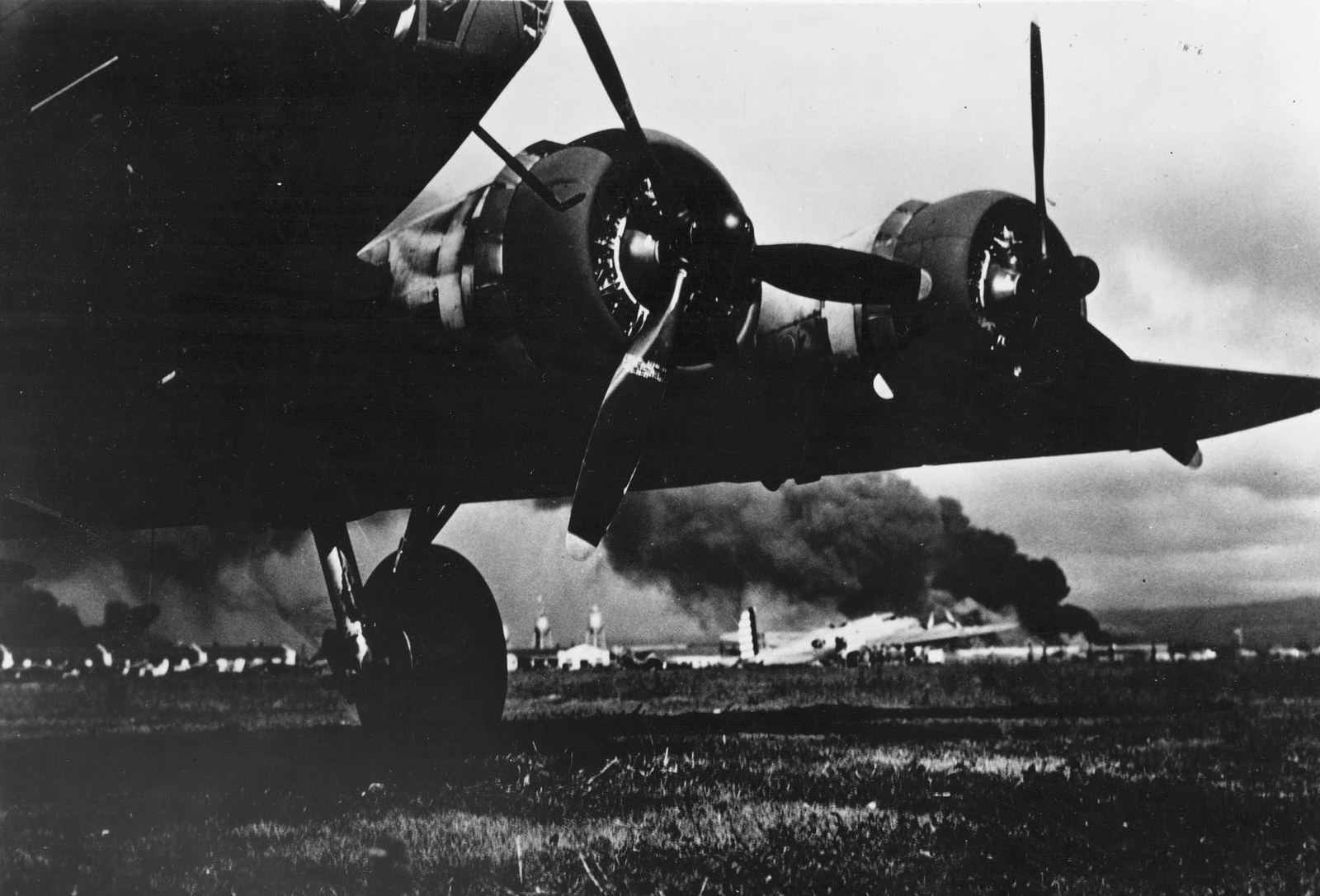
Crews of the 38th Reconnaissance Squadron sighted the islands and saw fighters coming out to meet them, and were glad of the escort until it opened fire. They were as unrecognised as they were unarmed, and a B-17 pilot on the ground took them for Japanese.
Captain Raymond Swenson landed his B-17C at Hickam and a strafing fighter hit the flare storage box amidships. The flares ignited and the aircraft burned in two. The crew got clear except First Lieutenant William Schick, the squadron’s flight surgeon, riding in the observer’s seat, who was mortally wounded by a passing fighter.
First Lieutenant Robert Richards was harried off his approach at Hickam and put down downwind on the short fighter strip at Bellows, riddled from nose to tail and with severely wounded men aboard. He touched down halfway along, retracted the gear and slid over a ditch into a cane field. They counted 73 bullet holes in his aircraft.
Captain Richard Carmichael and First Lieutenant Harold Chaffin passed up Hickam and landed at Haleiwa, the field Welch and Taylor had just left. All twelve arrived, and none was shot down in the air.
The aircraft from Enterprise
Enterprise was at sea west of Oahu, and at 0615 she began launching eighteen Dauntlesses of Scouting Six and Bombing Six, the group commander flying with them, in nine two-plane sections, to search 150 miles ahead and then land at Ford Island. They carried no bombs, and the crews did not know there was a war.
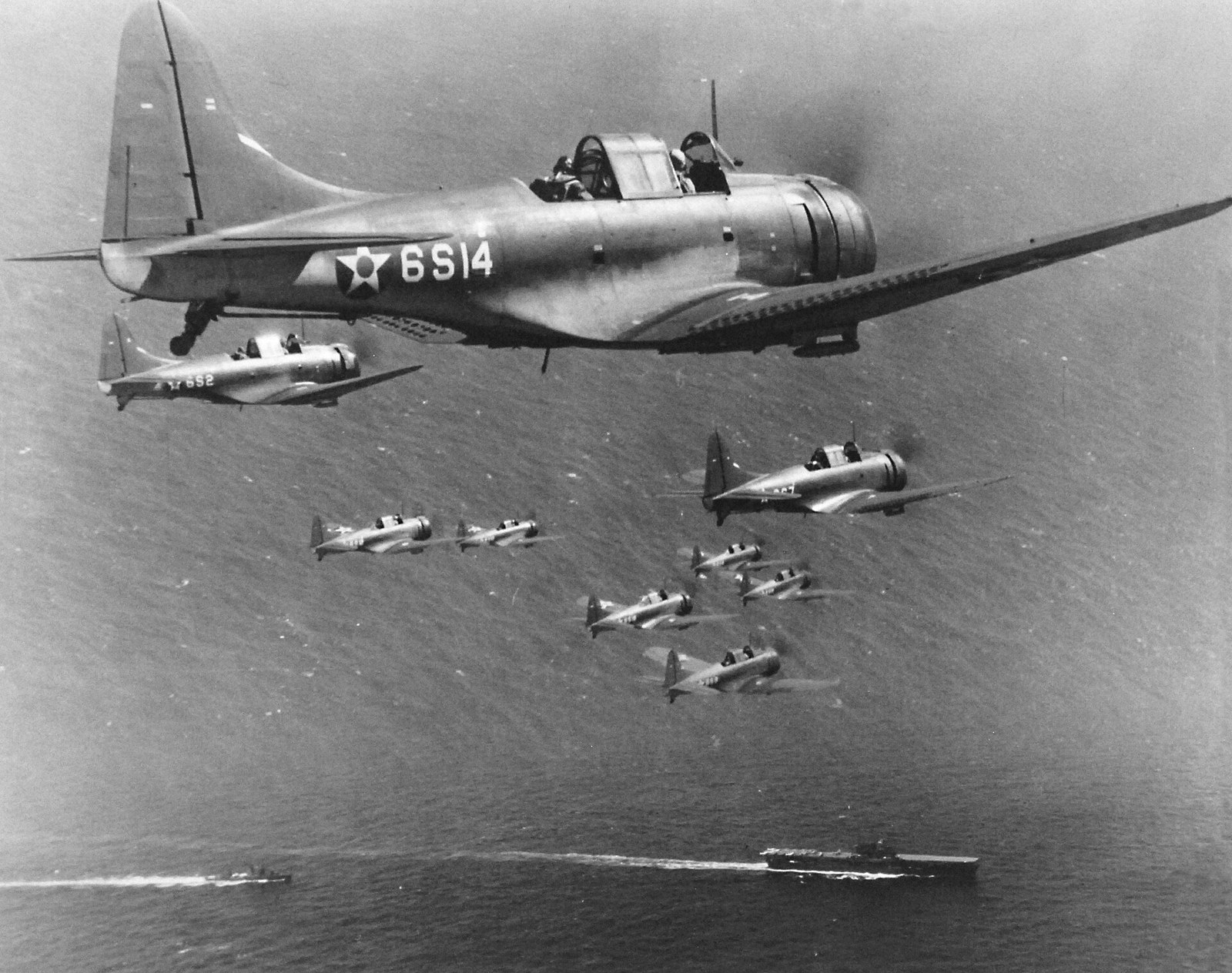
Commander Howard Young passed Barbers Point to seaward at 0820 and took the aircraft circling Ewa in column for American pursuit. Between Ewa and Ford Island he saw heavy anti-aircraft fire ahead, and at almost the same instant he was attacked from the rear without warning. He had not the fuel to go back to the ship, so he went in to Ford Island with his wheels and flaps down, under fire the whole way.
Lieutenant Clarence Dickinson was shot down and bailed out, and his gunner, Radioman First Class William Miller, was killed. Dickinson walked to Ford Island, said nothing about it, and took another aircraft on the afternoon search. Ensign John Vogt and Radioman Third Class Sidney Pierce collided with a Japanese dive bomber over Ewa and bailed out too low for their parachutes to open. Ensign Walter Willis and Coxswain Fred Ducolon were shot down and did not come back, and Ensign Manuel Gonzalez and Radioman Third Class Leonard Kozelek were lost at sea.
That night Enterprise sent six Wildcats of Fighting Six in to Ford Island, and Young could not raise them. Machine guns on Pennsylvania opened up as the flight came in and the harbour followed. Four of the six were shot down by American fire, and Lieutenant Junior Grade Francis Hebel, Ensign Herbert Menges and Lieutenant Junior Grade Eric Allen were killed. Men from Wheeler ran to two of the crash sites, pulled the pilots out, and only then saw the insignia.
Young wrote his report eight days afterwards. “Lack of information that hostilities had started with Japan, proper communications, the inability of our ground and shipboard forces to recognize friendly planes, or know the proper recognition signals were the contributory causes for the loss of personnel and airplanes of the Enterprise Air Group.”
The wave that was never ranged
The image of a third strike armed on the flight decks and stood down has nothing behind it, because there was no third wave in the plan. What faced the Japanese command was whether to continue, not whether to execute a prepared attack.
The reasoning survives in the officers’ own order. The sole objective was to destroy the capital ship strength of the United States Pacific Fleet in order to delay an American advance across the Pacific, and air attack had achieved it. The whereabouts of the American carriers was unknown and the chances of finding them by air search were small, so a quick withdrawal was thought most advantageous. Consideration was also given to a counterattack by the estimated fifty or more large land-based aircraft that remained in Hawaii.
Put the other way round, Nagumo did not know where the American carriers were, and he assumed, wrongly, that the Americans knew where he was. Underneath the three reasons lies an assumption held about the whole war rather than about the morning: that it would be too short for the tanks, the shops and the submarine base to matter. What a third strike would in fact have achieved has been reconstructed by operations analysis, which finds only minor damage and a base fully operational in a relatively short period of time.
The oil, the boats and the yard
The Pacific Fleet had just finished restocking its fuel to a total capacity of about 4.5 million barrels, all of it above ground in three farms on the eastern side of the base. The torpedo aircraft of the main attack crossed the tank farm on their way to the battleships. The tanks were perfectly visible to the naked eye and nobody attacked them. The submarine base went the same way: three aircraft swung in over it from the south-east during the second phase of the raid, and it was never a target.
The yard was hit. Dive bombers went for Dry Dock No. 1, with Pennsylvania, Cassin and Downes in it, at least twice, and for the floating dock holding Shaw, whose forward magazine detonated. What came through was the plant rather than the ships in it, the dock structure and the machine shops, and it came through because nobody had aimed at it and the strike carried no weapon suited to it.
Nimitz set down his own view on 3 April 1965, in a letter to the Chief of Naval Operations. He had been quoted correctly, he wrote, as saying that as bad as the losses at Pearl Harbor were, they could have been devastatingly worse had the Japanese returned for more strikes against the naval installations, the surface oil storage and the submarine base. Such attacks could have been made with impunity, as there was little left to oppose them. Nagumo, he wrote, missed a great chance by not following up his attack.
Set against that is the thing the argument leaves out. The surface tanks were already condemned. Excavation of the Red Hill underground fuel facility had begun on 26 December 1940, nearly a year before the attack: twenty tanks, each a hundred feet across and two hundred and fifty feet high, under about a hundred feet of rock. The first was ready in September 1942 and the whole facility in September 1943.
What the Japanese left alone was not a permanent weakness. It was a weakness with eleven months left to run, and its replacement was already being cut out of the rock above the harbour.
Three ships, and one reason
The United States had seven aircraft carriers in commission on 7 December 1941 and three of them in the Pacific. None was in the harbour.
Enterprise, with Task Force 8 under Vice Admiral William Halsey, was about 215 miles west of Oahu at dawn. She was coming back from Wake Island, where she had delivered the Grumman F4F-3 Wildcats of the Marine squadron VMF-211, and weather had made her late for a return due on 6 December. She was there because Kimmel was reinforcing the outlying islands, in answer to the same war warning that produced Short’s sabotage alert. Lexington, under Rear Admiral John Newton, was about 500 miles south-east of Midway with eighteen Vought SB2U-3 Vindicators of VMSB-231 aboard for the island. Saratoga reached San Diego late in the forenoon watch on 7 December, after an interim docking at Bremerton, to embark her air group and further Marine aircraft for Pearl Harbor.
All three were absent for the same reason. Enterprise had taken Wildcats to Wake, Lexington was taking Vindicators to Midway, and Saratoga was at San Diego waiting to load. The aircraft carriers were missing because they were being used as aircraft transports.
The absence was not luck alone. Berths F-10 and F-11 on the north-west side of Ford Island were designated carrier berths, and the second wave’s eighty-one dive bombers were assigned to carriers and cruisers. The Japanese did not fail to look. They failed to find.
What came back
Of the eight battleships in the harbour, six fought again. Arizona was left where she lay, Oklahoma was raised and never repaired, and Utah, a target ship, was never raised at all. Three of the six were damaged lightly enough to sail for the mainland in December 1941, and three had to be refloated where they lay.
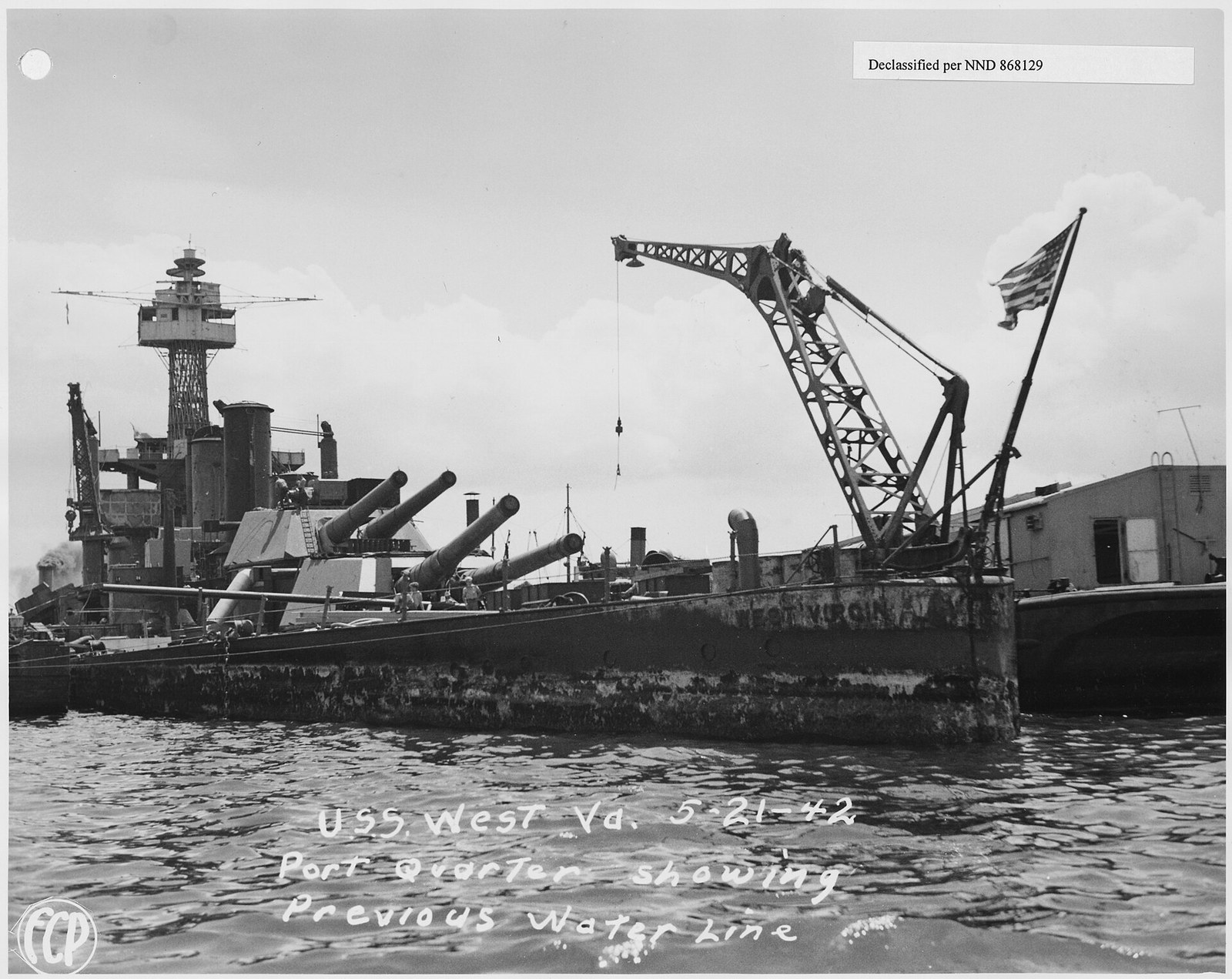
| Ship | Raised or released | In action again |
|---|---|---|
| Pennsylvania | Out of Dry Dock No. 1, 12 December 1941 | Repairs complete, 30 March 1942 |
| Maryland | Sailed 20 December 1941 | Out of yard hands, 26 February 1942 |
| Tennessee | Sailed 20 December 1941 | Out of yard hands, 26 February 1942 |
| Nevada | Refloated 12 February 1942 | Attu, May 1943; Normandy, June 1944 |
| California | Refloated 24 March 1942 | Saipan and Surigao Strait, 1944 |
| West Virginia | Refloated 17 May 1942 | Leyte and Surigao Strait, October 1944 |
West Virginia had been opened along one side. Divers sealed patches against her hull with 325 cubic yards of concrete poured under water, in sections about thirteen and a half feet long, and in dry dock the crews needed dynamite to break it loose.
Oklahoma was the harder problem, because she was upside down and weighed 35,000 tons. Twenty-one electric winches were anchored in concrete on Ford Island, each pulling about twenty tons through a block system, on cables that ran over wooden struts standing on her bottom. Compressed air blown into the hull took nearly 20,000 tons off her weight. She came upright on 16 June 1943 with a list of two degrees and ten minutes, in accordance with the models tested beforehand. More than four hundred bodies were recovered from her, and the work inside her began with gas testing and ventilation.
Rear Admiral Oldendorf’s battle line at Surigao Strait on 25 October 1944 was six battleships, and the Navy’s caption to the photograph reads: “Except for Mississippi, all these battleships were damaged during the attack on Pearl Harbor in December 1941.”
1942
Sixteen Army B-25s flew off Hornet on 18 April 1942, from about 650 miles out, with Enterprise flying the combat air patrol, and bombed Tokyo. We tell that story in full in our account of the Doolittle Raid. The material damage was slight and the consequence was not: the raid pushed the Japanese command into the Midway operation.
Coral Sea came next, from 4 to 8 May 1942, Yorktown and Lexington against Shokaku, Zuikaku and Shoho. Shoho sank on 7 May, and the Lexington that had been carrying Vindicators towards Midway was lost on 8 May. Port Moresby was not taken, and on the Navy’s own assessment the two Japanese fleet carriers then missed Midway. From 4 to 7 June 1942, Enterprise, Hornet and Yorktown put up 234 carrier aircraft against Nagumo’s 229. Akagi, Kaga, Soryu and Hiryu, four of the six carriers that had launched the Pearl Harbor strike, were fatally damaged on 4 June, and the Americans lost Yorktown, the destroyer Hammann and three torpedo squadrons.
Twenty-nine aircraft
Twenty-nine Japanese aircraft did not come back: nine A6M, fifteen D3A and five B5N. Nine were lost in the first wave, three fighters, one dive bomber and five torpedo aircraft. Twenty were lost in the second wave, which arrived over a base that was awake and shooting, and which had been sent after ships that were not there.
Some of the men are named in the Japanese unit records. Petty Officer 1st Class Takashi Hirano of Akagi came down at Fort Kamehameha and was killed there, and his aircraft was examined at Hickam on 8 December, the report noting no armour plate to protect the pilot. Petty Officer 1st Class Shigenori Nishikaichi of Hiryu crash-landed on Niihau and was killed there. Five midget submarines were committed and five were lost, nine of their crewmen killed and one, Ensign Kazuo Sakamaki, taken prisoner.
What survives
The National Park Service, which holds the names, gives the American dead as 2,390, of whom 49 were civilians, some killed by Japanese aircraft and some by American anti-aircraft rounds falling back into Honolulu. Other institutions publish higher totals, and most of the difference between them sits in the civilian count.
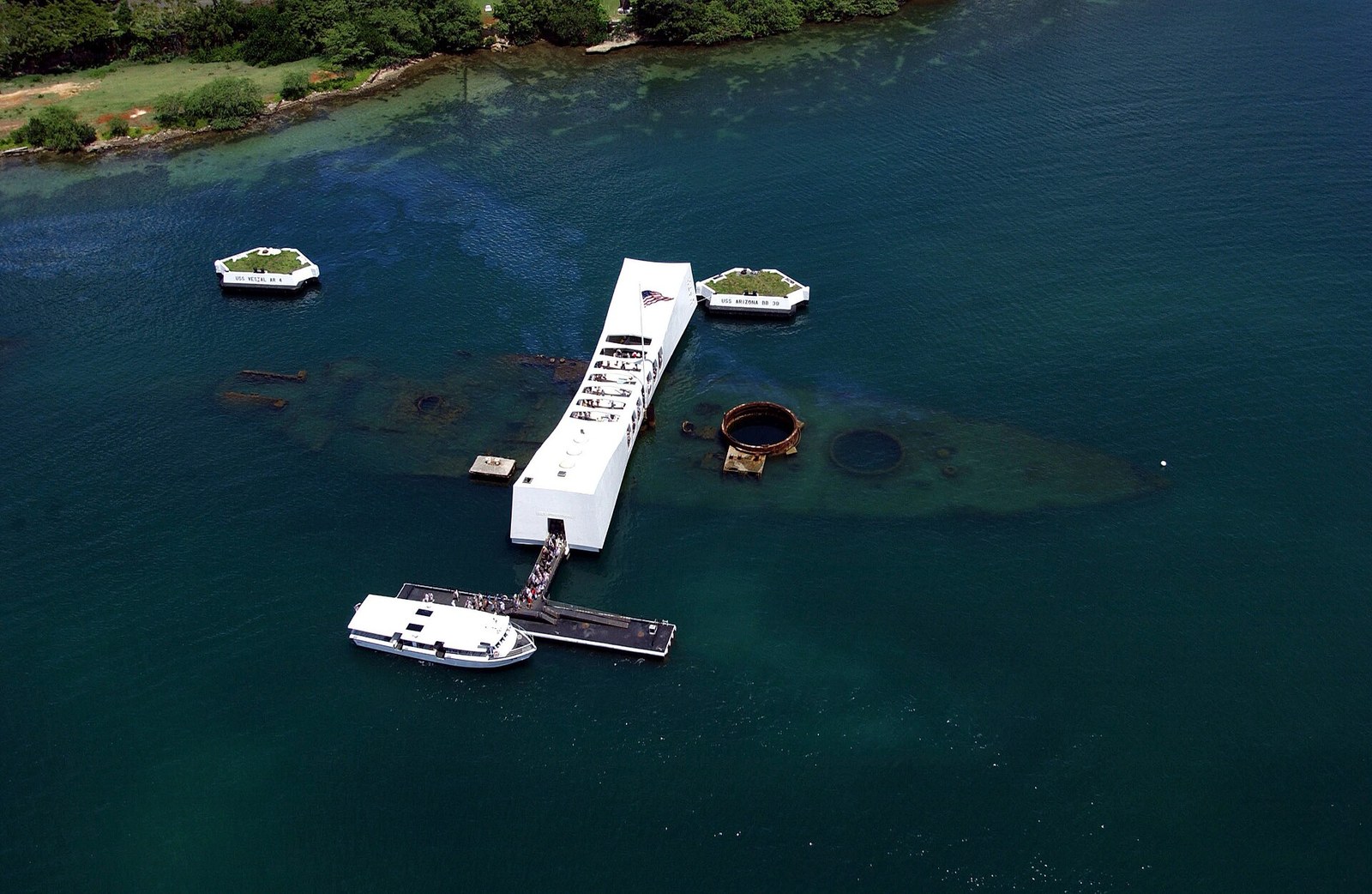
The Arizona is a war grave, and on the National Park Service’s programme page, dated 7 May 2026, visitors are taken out by boat and spend time on the memorial. That arrangement is recent and it has not been stable. The memorial was closed from May 2018 to 1 September 2019, and boat transport was suspended again on 3 September 2021. Access was paused from 9 July 2025 while the Navy took off two salvage platforms bolted to the wreck since the 1940s, and the shuttles resumed on 5 October 2025.
The Utah was never salvaged and lies where she rolled over. Fifty-eight of her crew died. Four were recovered in the weeks after the attack, and the other fifty-four are in her still. She is reached on the Park Service’s Ford Island bus tour, which was running three afternoons a week when its page was updated on 16 October 2025.
The Pearl Harbor Aviation Museum occupies Hangars 37 and 79 on Ford Island, both of them on the field on 7 December 1941. Hangar 79 was completed that year as a maintenance and engine repair shop, and its blue glass windows still carry the bullet holes. The Navy did not replace them, on the museum’s account, so that sailors would know they were working in a combat zone.
As of the most recent published account, the Planes of Fame A6M5 at Chino, construction number 5357, is the only flyable Zero still turning an original Nakajima Sakae; every other airworthy Zero flies behind an American Pratt & Whitney R-1830. No D3A flies and none is complete, and no B5N flies either. The museum’s own B5N has an empty engine bay and a reproduction port wing. None of these aircraft was at Pearl Harbor. Photographing any of them is museum work, with the light and the angles that go with it, which our guide to shooting aircraft indoors covers.
Roy Vitousek and his son Martin were flying an Aeronca 65TC over Oahu when they were caught in the raid, landed at John Rodgers Airport at around 0810, and on the museum’s account took gunfire damage on the way. The Aeronca that was in the air over Oahu that morning survives at the Pearl Harbor Aviation Museum, which calls it the only surviving civilian aircraft from the Pearl Harbor attack. The types that had fought the year before are the subject of our history of the aircraft of the Battle of Britain. Our own aviation photographs are catalogued in the Piemags aviation archive, and the terms for reproducing one are on the licences page.
The engineering and the answer
Judged as an air operation, the morning was an engineering success and a strategic failure, and both halves turn on aeroplanes. The success was a torpedo made to run in forty feet of water, with wooden parts that did their work in two seconds of falling and then broke off. The failure was that the three aircraft carriers were elsewhere, because they were carrying aircraft. The stated objective was to destroy the capital ship strength of the United States Pacific Fleet in order to delay an American advance across the Pacific. Six of the eight battleships came back, and four of the six carriers that launched the strike were fatally damaged on one day in June 1942.
The fins came back out of the water as well. Nimitz’s action report of 15 February 1942 records that “specially contrived wooden fins, remnants of which were discovered on salvaged enemy torpedoes, were no doubt responsible for insuring shallow dives of the torpedoes upon launching.” The same report put the torpedo’s charge at a thousand pounds of explosive. It was 452.
Four of the six carriers that struck Pearl Harbor were mortally damaged in a single morning six months later, and all four were finished off by torpedoes from their own destroyers. Our account of the battle decided from the air at Midway follows the aircraft that did it.
Questions people ask
Why did the depth of Pearl Harbor matter?
Because the water over the fleet moorings is only about forty feet, and forty feet was not enough for an air-dropped torpedo of 1941. Such a weapon enters the water on a ballistic path and carries on down it while it sheds speed, and only then does its depth engine bring it up to the depth set on the dial. An unmodified Type 91 plunged a hundred and fifty feet. Solving that was the engineering that made the attack possible.
What were the wooden fins on the Japanese torpedoes?
Wood in two places. Wooden extension fins went on the metal tail fins, enlarging the tail area behind the centre of gravity so that the weapon weathercocked onto its path within its two-second fall. The Type 91 Mod 2 also carried anti-roll stabilisers on the aft body, small metal tabs given a larger wooden sheath. Both fittings broke away on impact, and with them the permitted release height doubled.
Did the wooden fins do anything besides steady the torpedo?
They bought a bigger warhead, and that is the part the popular account leaves out. The earliest Type 91s were steadied in roll by leaving the warhead only partly filled, so stability was bought with empty space in the nose. Once the anti-roll flippers worked, that space could be filled. The Mod 1 carried 150 kg of explosive and the Mod 2 carried 205 kg.
What aircraft attacked Pearl Harbor?
Three types: the Mitsubishi A6M2 fighter, the Aichi D3A1 dive bomber and the Nakajima B5N2, which was the aircraft in the strike that could sink a battleship. Forty B5Ns went in with torpedoes and forty-nine or fifty with converted naval shells. The plan had 360 aircraft in it, 189 in the first wave and 171 in the second. The number that got into the attack is usually given as 353, which is why both numbers appear in the accounts.
Were the Japanese aircraft called Zero, Val and Kate at the time?
Not Val and Kate. Those names did not exist on 7 December 1941. They were issued in September 1942, in a memorandum written by Frank T. McCoy on General Kenney’s intelligence staff.
Did the signal Tora Tora Tora order the attack?
No. The order to attack went out at 0749, Hawaii local time. The tiger signal came after it, and it was not an order to anybody: it was sent over Fuchida’s head to Nagumo and to Tokyo, and what it reported was that surprise had been achieved. The signal remembered as the beginning of the attack was sent before a bomb had fallen.
Did radar detect the attack, and could it have made a difference?
It detected it. At about 0702 the Opana set picked up what its operator took for a large flight of aircraft at about 130 miles, they reported it to Fort Shafter at 0720 and held it until 0740, and the first bombs fell at 0755. It could not have made a difference. An air warning system has three parts, radars on the air, a staffed Information Center and armed fighters ready to launch, and Oahu that morning had the first of the three. A perfect warning would have reached aircraft whose guns were unloaded.
Why were the American aircraft parked out in the open?
Because of Alert No. 1, a formally defined alert state chosen in answer to a War Department warning, which the Roberts Commission defined as a defence against sabotage with no threat from without. It required Army aircraft to be concentrated rather than dispersed, and the ammunition to be boxed and held centrally. At Wheeler the crews took the machine gun ammunition out of the aircraft and out of the belts, and the hangar it was boxed in was hit. Earthen revetments for about 125 aircraft had already been built at Wheeler, and Short disapproved the request to use them.
How many American pilots got airborne, and what were they credited with?
Fourteen individual pilots attempted to engage. Ten victories were officially credited to American fighter pilots for 7 December 1941: four to Welch, two to Taylor, and one each to Brown, Sanders, Rasmussen and Sterling. Taylor is usually given three or four, but the register that adjudicated the claims gives him two. Sterling’s was posthumous.
Where were the American aircraft carriers?
Enterprise was about 215 miles west of Oahu, coming back from delivering Wildcats to Wake Island. Lexington was about 500 miles south-east of Midway with Vindicators aboard for the island. Saratoga reached San Diego on 7 December to embark her air group. All three were absent for the same reason: the aircraft carriers were missing because they were being used as aircraft transports.
How many aircraft did the Japanese lose?
Twenty-nine did not come back: nine A6M, fifteen D3A and five B5N. Nine were lost in the first wave and twenty in the second, which arrived over a base that was awake and shooting, and which had been sent after ships that were not there. Five midget submarines were committed and five were lost.
Can you see any of the aircraft that attacked Pearl Harbor?
No. None of the surviving Japanese aircraft of these types was at Pearl Harbor. The Planes of Fame A6M5 at Chino, construction number 5357, is the only flyable Zero still turning an original Nakajima Sakae, and every other airworthy Zero flies behind an American Pratt and Whitney R-1830. No D3A flies and none is complete, and no B5N flies either. One aeroplane that was over Oahu that morning does survive: the Aeronca 65TC flown by Roy Vitousek and his son Martin, which landed at around 0810 and, on the museum’s account, took gunfire damage on the way. It is at the Pearl Harbor Aviation Museum.
Sources and further reading
- Commander in Chief, United States Pacific Fleet, action report on the Japanese air raid, 15 February 1942, including the plotted torpedo tracks and the recovered wooden fins. history.navy.mil
- Naval History and Heritage Command, overview of the attack on Pearl Harbor, 7 December 1941. history.navy.mil
- National Park Service, Pearl Harbor National Memorial, the American dead and the memorial programme. nps.gov
- Arakaki and Kuborn, 7 December 1941: The Air Force Story, Pacific Air Forces Office of History, 1991. The source for the Army aircraft numbers, the fourteen pilots and the air warning system. media.defense.gov
- USAF Historical Study 85, the official register of victory credits, for 7 December 1941. afhra.af.mil
- Report of the Commission Appointed by the President to Investigate the Japanese Attack of December 7, 1941, the Roberts Commission, on Alert No. 1 and the concentration of aircraft. ibiblio.org
- United States Strategic Bombing Survey, interrogations of Japanese officials, giving the planned order of battle for the strike. ibiblio.org
- Homer N. Wallin, Pearl Harbor: Why, How, Fleet Salvage and Final Appraisal, Naval History Division, the official salvage account. history.navy.mil
- Pearl Harbor Aviation Museum, on the depth of the harbour, the Type 91 modifications and the hangars on Ford Island. pearlharboraviationmuseum.org
- National Museum of the United States Air Force, fact sheets on the Curtiss P-40 and the Boeing B-17. nationalmuseum.af.mil
- Naval History and Heritage Command, Battle of Midway, 4 to 7 June 1942. history.navy.mil
- The National WWII Museum, research starters on the attack and on the Pacific war that followed. nationalww2museum.org
