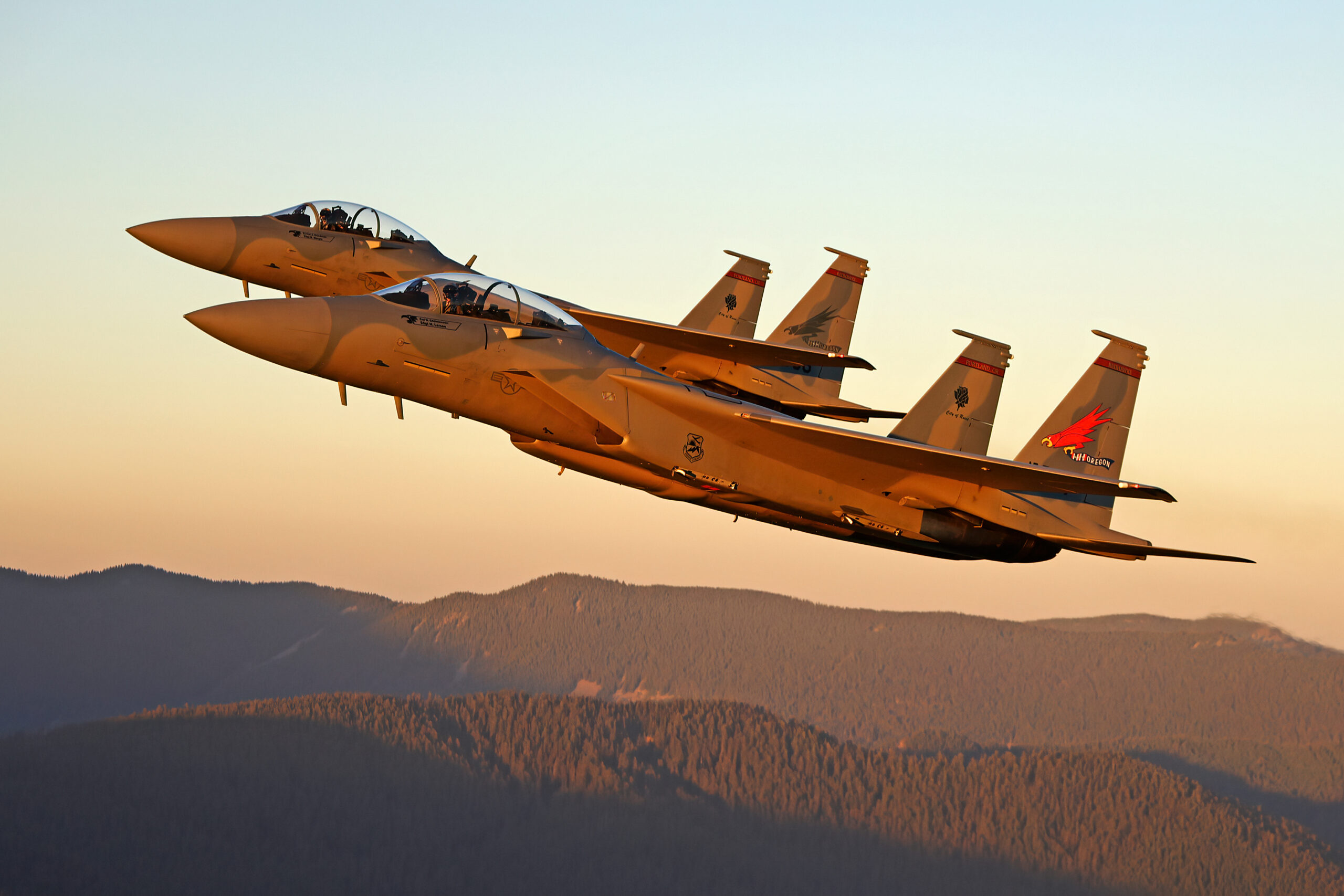
The McDonnell Douglas F-15 Eagle is the most successful air superiority fighter of the jet age: it first flew on 27 July 1972, it is credited with more than 100 air-to-air victories against no confirmed losses in air-to-air combat, and more than half a century later it is still in production as the Boeing F-15EX Eagle II. No other fighter combines that longevity with that record.
The Eagle was born from a hard lesson over Vietnam, shaped by an exaggerated fear of a Soviet interceptor, and built around a simple demand that nothing would out-climb, out-turn or out-shoot it. This is the full story: where the F-15 came from, how it is built, what it has done in five decades of service, every major variant from the A model to the EX, where to find the survivors, and how to photograph the Eagles still flying today.
What this guide covers
- Why the F-15 exists
- Origins and development
- Design: built to dominate
- Flying the Eagle
- The Streak Eagle records
- Service and combat history
- The Eagle in dates
- The Eagle among its rivals
- Variants: from F-15A to F-15EX
- Operators around the world
- Where to see an F-15 today
- Specifications: F-15C Eagle
- Photographing the F-15 today
- Legacy
- Frequently asked questions
Why the F-15 exists
Two shocks created the F-15. The first was the air war over North Vietnam, where the US Air Force discovered that its principal fighter, the McDonnell Douglas F-4 Phantom II, was paying a heavy price against lightweight, agile MiGs flown close-in, where the Phantom’s missiles and sheer power counted for less than turning ability. Hundreds of Phantoms were lost during the conflict, many in air-to-air combat, and the exchange ratios of Korea were a distant memory. We tell that aircraft’s own remarkable story in our F-4 Phantom history, but its Vietnam experience is the essential backdrop here: America needed a fighter that could win a dogfight, not just a missile engagement.
The second shock arrived in 1967, when the Soviet Union revealed the MiG-25 Foxbat. Huge, twin-finned and apparently capable of astonishing speed, the Foxbat was read in the West as a super-fighter that threatened American air superiority for a generation. The truth, learned years later when a defecting pilot delivered one to Japan, was that the MiG-25 was a specialised interceptor built of steel, with brutal speed but limited agility. The fear it generated was real all the same, and it pushed the specification for America’s new fighter towards uncompromised performance.
The US Air Force had begun studies under the F-X programme in the mid-1960s, and the requirement that emerged called for an all-weather air superiority fighter with unmatched thrust, low wing loading and the most capable radar ever fitted to a fighter. In 1969 the Air Force selected McDonnell Douglas, the same St Louis company that built the Phantom, to build it. The motto attached to the programme became famous: not a pound for air-to-ground. The F-15 would be a pure air superiority machine, and everything about the design flowed from that single idea.
Doctrine shaped the aeroplane as much as fear did. Through the late 1960s a group of Pentagon analysts and fighter pilots argued, with increasingly influential mathematics, that a fighter’s worth lay in energy: how quickly it could gain it, keep it through a turn, and spend it in the vertical. Those energy manoeuvrability ideas ran straight into the F-X requirement, and they explain the Eagle’s defining choices, the giant wing, the two enormous engines, the refusal to load the design with strike equipment. The F-15 is what a fighter looks like when the turning and climbing sums are allowed to win every argument.
Origins and development
The first F-15A prototype was rolled out at St Louis in June 1972, an event McDonnell Douglas staged with the confidence of a company that knew what it had built. On 27 July 1972 the chief experimental test pilot, Irving Burrows, took the aircraft up for the first time from Edwards Air Force Base in California. The flight test programme that followed was notably smooth by the standards of the era. The two-seat F-15B trainer flew in July 1973, and the Air Force accepted its first Eagle in November 1974.
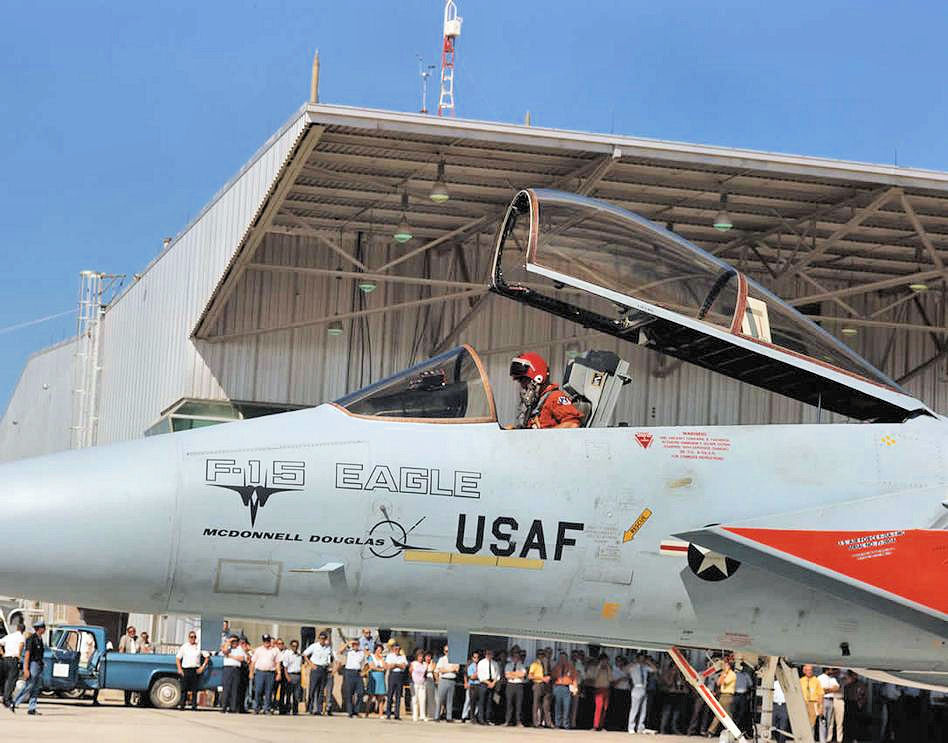
Initial operational capability came in September 1975, and in January 1976 the first Eagle destined for a front-line combat squadron was delivered, with the 1st Tactical Fighter Wing at Langley among the earliest recipients. By 1977 F-15As were standing alert at Bitburg in West Germany as NATO’s first line of defence, positioned squarely against the Soviet threat that had shaped them. Pilots converting from the Phantom found an aircraft with more thrust than weight, a bubble canopy with a clear view all round, and handling that veteran test pilot Paul Millett, who flew one at Bitburg, described as the highest performance aeroplane he had ever flown.
Development did not stop at the A model. The improved F-15C and two-seat F-15D entered the inventory from 1979, carrying an extra 2,000 pounds of internal fuel, provision for conformal fuel tanks hugging the intake sides, and a maximum take-off weight raised to 68,000 pounds. The Multistage Improvement Programme launched in February 1983 brought upgraded computers, provision for advanced AIM-7, AIM-9 and AIM-120 missiles, and improved electronic warfare equipment, with the last aircraft receiving the Hughes APG-70 radar. Each step kept the Eagle ahead of anything it might meet, a pattern of continuous reinvention that has defined the type for fifty years.
Design: built to dominate
The F-15’s shape is a lesson in single-mindedness. The wing is enormous, 608 square feet of it, set high on the shoulders of a broad flat fuselage that itself generates lift. The result is very low wing loading, the ratio of weight to wing area that governs how tightly a fighter can turn without bleeding speed. Combined with two Pratt & Whitney F100 turbofans delivering roughly 23,500 pounds of thrust each in afterburner, the Eagle arrived with a thrust-to-weight ratio better than one at combat weights: it could accelerate going straight up. The climb rate of the early F-15A approached 50,000 feet per minute, and the type is capable of around Mach 2.5 at altitude, performance that remains near the top of the fighter world today.
Just as radical was what the pilot could see and do. The single-piece bubble canopy gave a genuine all-round view at a time when most fighters buried their pilots between heavy canopy frames. The head-up display projected everything needed to fight, speed, altitude, weapons cues, onto the windscreen, so the pilot never needed to look down in combat. The concept that became HOTAS, hands on throttle and stick, put weapons selection and radar control on the controls themselves. And the APG-63 pulse-Doppler radar could look down against ground clutter and pick out low-flying targets, then hand them to the weapons system automatically as the fight closed in.
The armament matched the philosophy: four radar-guided AIM-7 Sparrows recessed under the fuselage corners, four heat-seeking AIM-9 Sidewinders on wing pylons, and an M61A1 20mm rotary cannon with 940 rounds in the right wing root for the close fight the missiles were supposed to prevent. Later Eagles traded Sparrows for AIM-120 AMRAAMs, and the newest carry up to a dozen air-to-air missiles. Twin fins kept the aircraft controllable at extreme angles of attack, and the widely spaced engines gave battle damage tolerance that would later produce one of the most extraordinary survival stories in aviation, covered below. Nothing about the design was subtle. All of it worked.
The Eagle’s early years were not friction-free, and the honest history says so. The F100 engine that made the performance possible was the most highly stressed turbofan yet flown, and in early service it demanded careful handling and heavy maintenance, with throttle-related stalls a recurring frustration until progressive engine improvements through the late 1970s and 1980s matured it into the reliable powerplant later crews took for granted. The lesson, that a fighter is only as good as the engine programme behind it, shaped American propulsion procurement for a generation. What never wavered was the airframe itself: strong, roomy for growth, and so aerodynamically sound that fifty years of added weight and equipment have not exhausted it.
Flying the Eagle
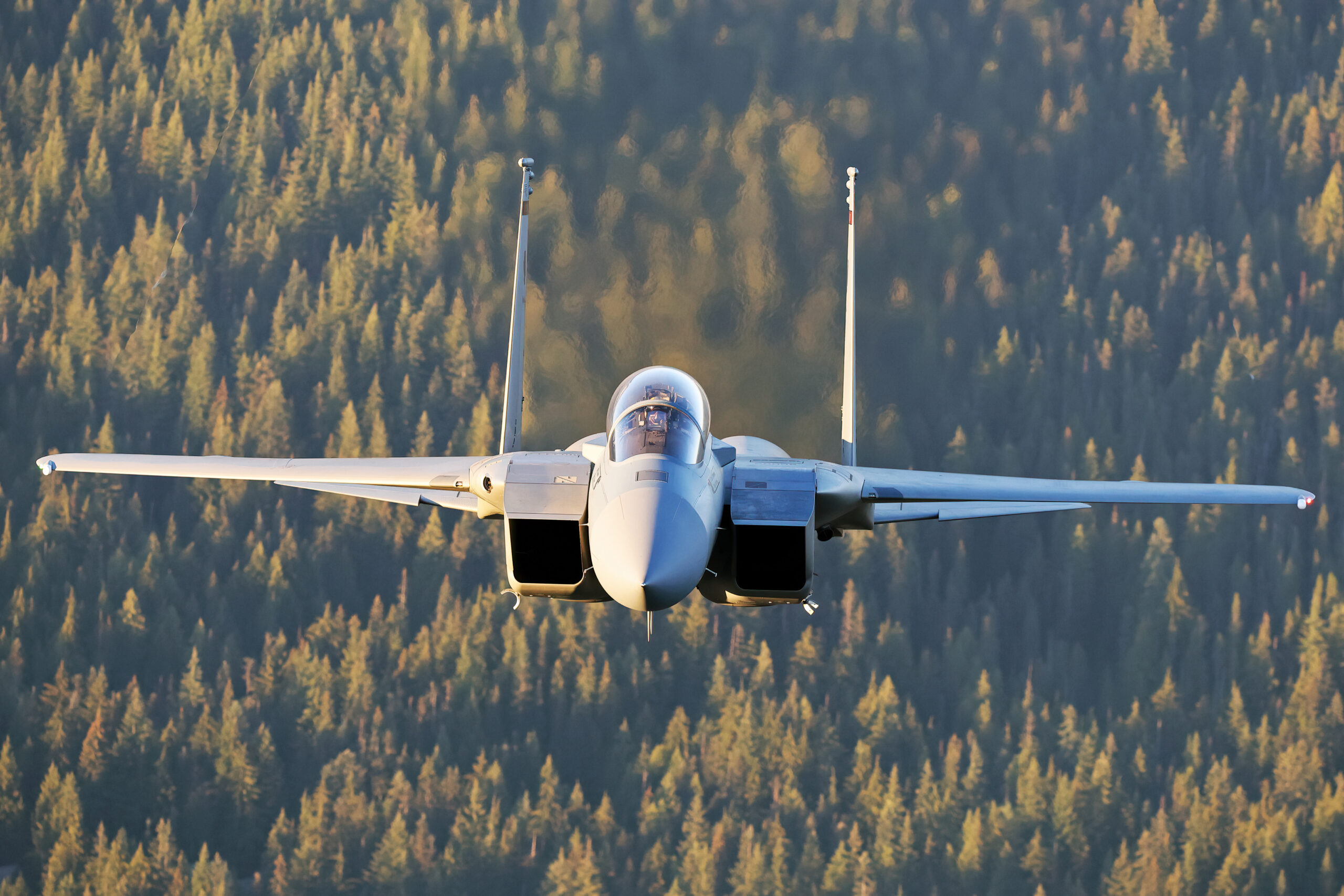
Ask anyone who converted onto the F-15 in its first decade and the same themes recur: the view, the power, and the sense that the aeroplane had been designed around the fight rather than the flight. The canopy sits the pilot high and forward with sightlines over the nose and past the tails that Phantom crews could only imagine, and in a visual engagement that view is worth more than any single instrument. Beneath it, the cockpit put every combat-critical control on the stick and throttles, so the pilot could switch weapons, manage the radar and track a target without ever moving hands or eyes at the moment that mattered most.
The power changed habits as much as the view. A clean Eagle at light fuel could stand on its tail and accelerate, which rewrote the energy rules every fighter pilot had been raised on: altitude lost in a turn could simply be bought back with throttle. Pilots learned to fight in the vertical as instinctively as earlier generations fought in the horizontal. Veteran British test pilot Paul Millett, who flew the type at Bitburg soon after it reached Europe, called it the highest performance aeroplane he had ever flown, a wonderful handling machine with no vices he could find in a flight.
Day to day, the Eagle’s working life through the Cold War was the alert cycle: crews at readiness beside armed aircraft in Germany, Iceland, Japan and the continental United States, scrambling to meet Soviet bombers and reconnaissance types probing the air defence zones. It was unglamorous, repetitive and utterly central to the deterrence the aircraft existed to provide, and the quick reaction alert tradition continues today with Japanese F-15Js launching against probing aircraft over the East China Sea.
The Streak Eagle records
McDonnell Douglas and the US Air Force knew precisely what they had, and in the winter of 1975 they set out to prove it in public. A very early F-15A was stripped of its paint, radar and every non-essential system, emerging roughly 1,800 pounds lighter, bare metal and purposeful. The project was called Streak Eagle, and between 16 January and 1 February 1975, flying from Grand Forks Air Force Base in North Dakota in the cold, dense winter air, three Air Force pilots, Majors Roger Smith, Willard Macfarlane and David Peterson, broke eight world time-to-climb records with it.
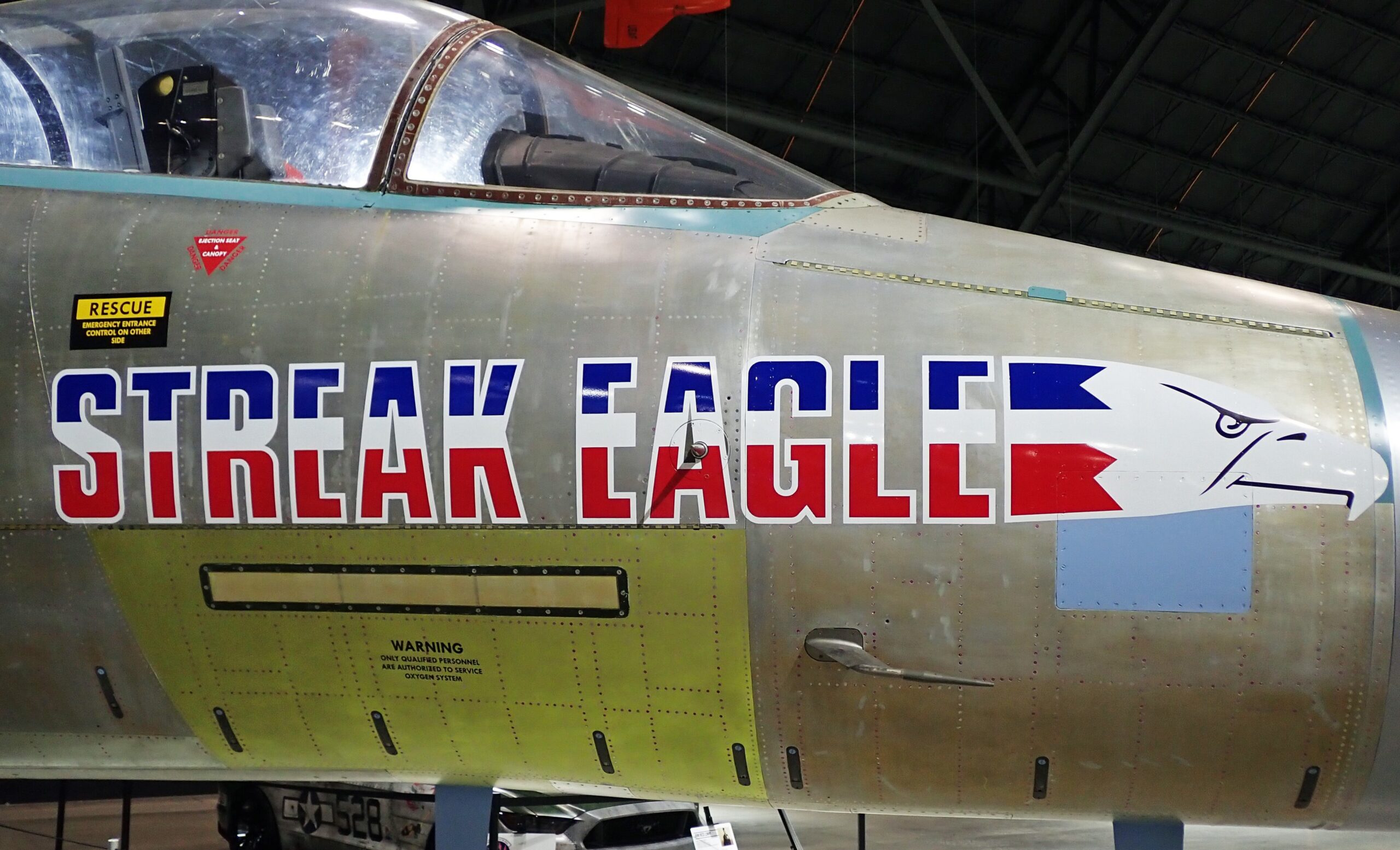
The numbers still read like typographical errors. The Streak Eagle reached 3,000 metres in under 28 seconds from brake release. It passed 20,000 metres, around 65,000 feet, in just over two minutes. For the final record on 1 February 1975 it reached 30,000 metres, or 98,425 feet, in 3 minutes 27.799 seconds, coasting ballistically over the top of a climb profile flown like a rocket launch. Several of the marks took back records set by the rocket-assisted NASA and Soviet types of the 1960s, and the message to Moscow was not subtle: the new American fighter out-climbed everything, including the Foxbat that had frightened the West into building it.
The Streak Eagle itself survives. It was turned over to the National Museum of the United States Air Force in December 1980, and it remains with the museum at Dayton, Ohio, still in bare metal, still wearing its record titles, one of the most significant single airframes of the Cold War.
Service and combat history
The F-15’s first air-to-air victory belongs not to the United States but to Israel, which had ordered the Eagle almost as soon as it existed and had Eagles on strength by 1977. In 1979, Israeli pilot Moshe Melnik shot down a Syrian MiG-21, opening the F-15’s account against the family of fighters we profile in our MiG-21 history. Over the Bekaa Valley in June 1982, during the Lebanon War, Israeli F-15s fought one of the largest jet-versus-jet battles ever seen and were credited with dozens of Syrian MiGs destroyed for no air-to-air losses, a result that stunned analysts on both sides of the Iron Curtain.
Israeli service also produced the Eagle’s most famous survival story. On 1 May 1983, during a training engagement over the Negev desert, an F-15D flown by Zivi Nedivi with navigator Yehoar Gal collided with an A-4 Skyhawk. The collision sheared the F-15’s right wing off close to the root. Streaming fuel vapour hid the damage from the crew, and Nedivi, unaware he was flying a one-winged aeroplane, kept it airborne with afterburner and landed at nearly double the normal approach speed. McDonnell Douglas engineers initially struggled to believe the account. The Eagle’s broad lifting fuselage had, in effect, flown as a wing itself. The aircraft was repaired and returned to service.
The US Air Force’s own combat debut for the Eagle came later, but its strangest mission came first: on 13 September 1985, Major Wilbert Pearson, flying a modified F-15A in a near-vertical zoom climb over the Pacific, launched an ASM-135 missile that destroyed the Solwind P78-1 satellite in orbit, the only satellite kill ever scored by an aircraft. When Iraq invaded Kuwait in 1990, F-15Cs deployed within days and formed the air superiority umbrella for the coalition build-up. During Operation Desert Storm in 1991, F-15Cs accounted for 34 of the US Air Force’s 37 air-to-air victories, including kills against the MiG-25 Foxbat the Eagle had been designed to beat, while the new F-15E Strike Eagle hunted Scud missile launchers by night with its LANTIRN targeting system.
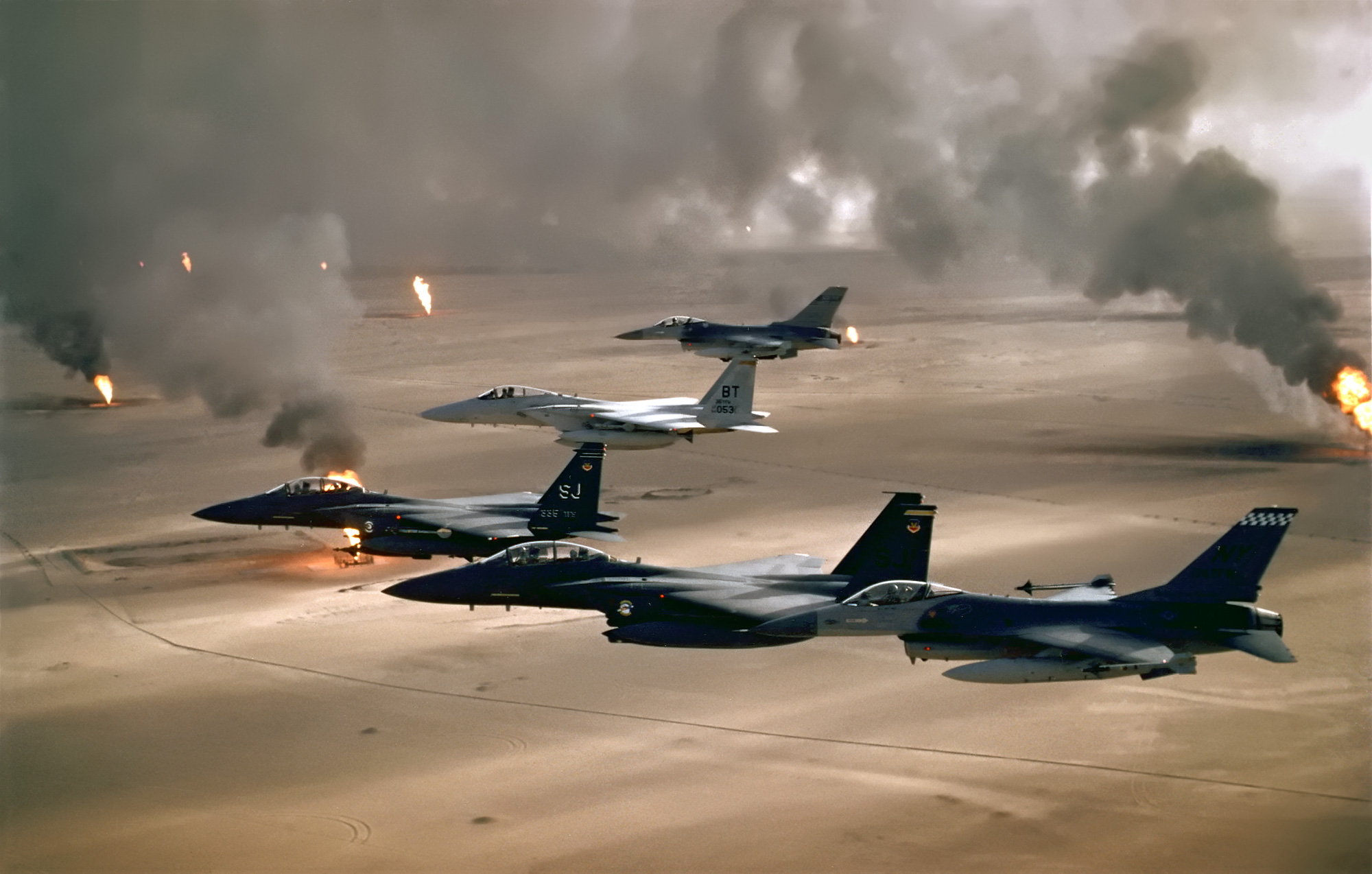
The pattern continued through the 1990s and beyond: patrols over Bosnia, MiG-29 kills over the Balkans in 1999, and continuous combat employment of the Strike Eagle over Afghanistan and Iraq through the 2000s and 2010s. In April 2024, USAF F-15Es were credited with destroying scores of Iranian one-way attack drones launched at Israel, air defence work no one imagined for the type in 1972. The Eagle’s air-to-air ledger stands at more than 100 victories, with totals of 102 to 104 quoted by different sources and Israel claiming over half of them, against no confirmed losses in air-to-air combat. That last clause matters: F-15s have been lost to accidents and to ground-based defences over the years, and in April 2026 a US F-15E was shot down over Iran during Operation Epic Fury, reportedly by a shoulder-fired missile, and the rescued pilot’s account, reported that June, described an unusual swarm of Iranian drones in the same airspace. The undefeated record is an air-to-air record, it is debated at the margins by historians, and it remains without parallel all the same.
The Eagle in dates
Every date below is drawn from the primary sources listed at the end of this guide.
| Date | Event |
|---|---|
| 1969 | McDonnell Douglas selected to build the F-X air superiority fighter |
| June 1972 | First F-15A prototype rolled out at St Louis |
| 27 July 1972 | First flight, Edwards AFB, Irving Burrows at the controls |
| July 1973 | Two-seat F-15B flies |
| November 1974 | First Eagle delivered to the US Air Force |
| 16 January to 1 February 1975 | Streak Eagle sets eight world time-to-climb records |
| September 1975 | Initial operational capability |
| 1977 | F-15As on NATO alert at Bitburg; Israeli Eagles in service |
| 1979 | First air-to-air kill, an Israeli F-15 against a Syrian MiG-21; F-15C flies |
| June 1982 | Bekaa Valley air battles over Lebanon |
| 1 May 1983 | Israeli F-15D lands after losing a wing in a mid-air collision |
| 13 September 1985 | F-15A destroys the Solwind satellite in the only aircraft-launched satellite kill |
| 1991 | Desert Storm: F-15Cs take 34 of 37 USAF air-to-air victories |
| 1999 | F-15Cs down Serbian MiG-29s over the Balkans |
| 2 February 2021 | Boeing F-15EX Eagle II first flight; first delivery to Eglin AFB on 11 March |
| July 2024 | 142nd Wing at Portland declares the F-15EX operational |
The Eagle among its rivals
The F-15 arrived as the senior member of the so-called teen series, the family of American fighters that rebuilt Western air power in the 1970s, and it is best understood alongside its siblings. The US Navy’s F-14 Tomcat, which flew two years earlier, solved a different problem: fleet air defence at long range, with swing wings and enormous missiles. The Eagle’s problem was purer, achieving air superiority over land against whatever the Warsaw Pact could send, and its fixed wing, simpler systems and land-based logistics made it the more enduring machine; the Tomcat retired from American service in 2006 while Eagles were still being ordered new.
The partnership that mattered most was with the General Dynamics F-16 Fighting Falcon. The Eagle was magnificent and expensive, and the Air Force could never afford enough of them to fill every squadron, so the lightweight F-16 was procured in thousands to fly alongside it, the famous high-low mix. The two types shared engines, tactics and airspace for four decades, the F-15 taking the air superiority and deep strike missions while the F-16 filled the multirole mass, and the story of that remarkable partnership is told from the other side in our F-16 history.
Against its intended opponents, the comparison the Eagle was built for never truly materialised: the Soviet types it was sized against, the MiG-25 above all, proved narrower machines than feared, and the later MiG-29 and Su-27 generation, designed explicitly with the F-15 in mind, met it in combat only in isolated encounters that the Eagle’s record survived intact. The truest measure of the design is that the aircraft built to beat it defined the next Soviet generation, while the Eagle simply carried on.
Variants: from F-15A to F-15EX
The Eagle family divides into three broad generations: the pure air superiority fighters (A through D), the strike derivatives (E and its export children), and the new-build EX. The single-seat F-15A and two-seat F-15B established the type from 1974. The F-15C and F-15D from 1979 added fuel, structural strength and progressively better radar and weapons through the Multistage Improvement Programme, and they carried the burden of American air superiority for three decades, and the C model alone ran to a production total of 483 aircraft.
The F-15E Strike Eagle, developed in the 1980s to give the Air Force a long-range all-weather interdictor, is almost a new aircraft in Eagle clothing: strengthened structure, conformal fuel tanks as standard, a rear cockpit with a weapons systems officer managing the APG-70 radar and LANTIRN night targeting pods, and the ability to haul a fighter’s missiles and a bomber’s payload simultaneously. It proved itself hunting Scuds by night in 1991 and has been in combat somewhere in the world almost continuously since. Its layout, dark grey and purposeful, makes it the easiest Eagle to identify at European airshows, where Lakenheath-based examples appear regularly.
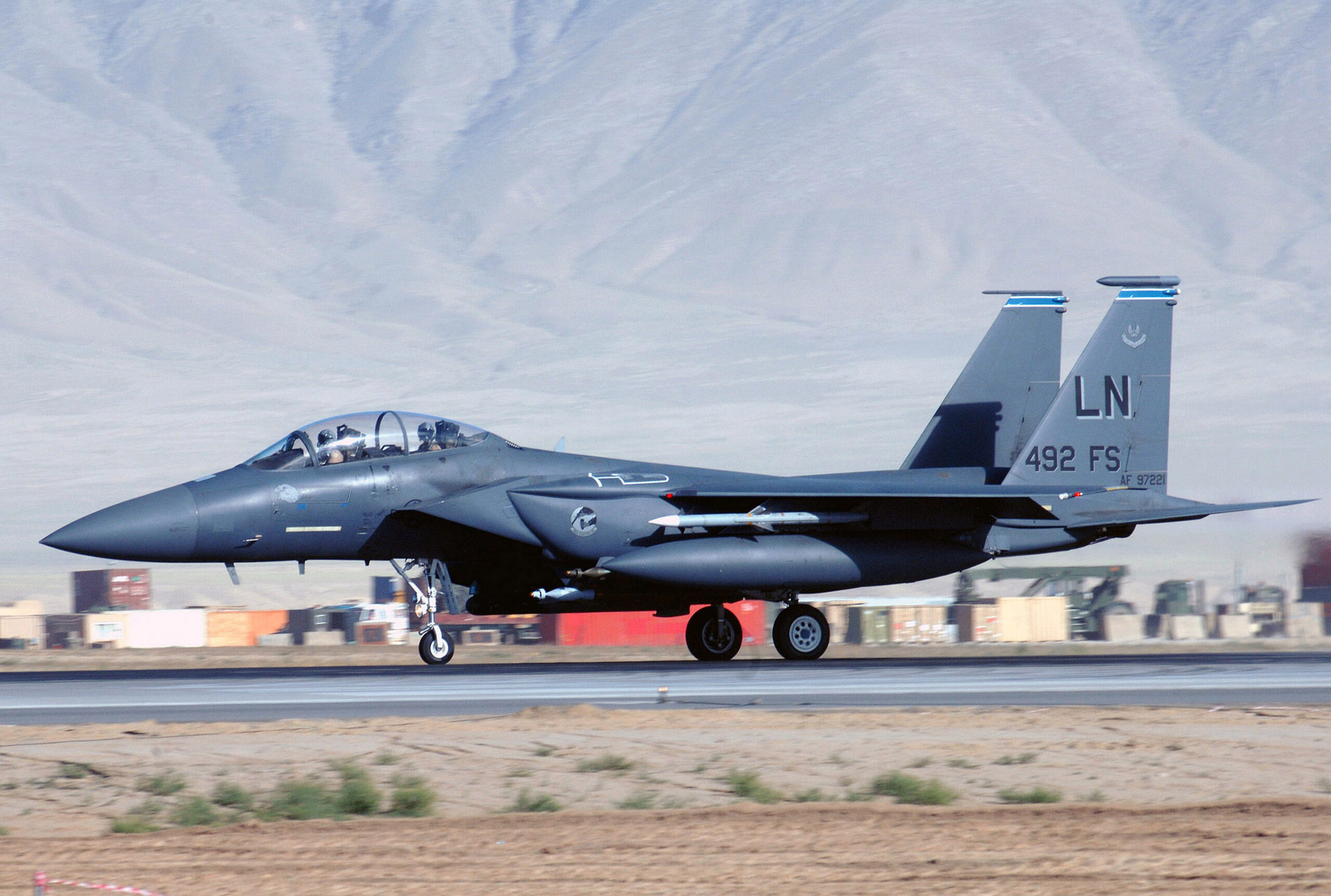
Exports built the Eagle’s second family tree. Israel’s F-15A/B/C/D fleet, known locally as the Baz, was joined by the F-15I Ra’am strike variant. Japan became the largest operator outside the United States: its F-15J and two-seat F-15DJ fleet, of which about 200 were delivered and a smaller number remain in service, the great majority assembled under licence in Japan by Mitsubishi Heavy Industries between the early 1980s and the late 1990s, and Japanese Eagles still stand quick reaction alert against daily intrusions today. Saudi Arabia flies the F-15C/D, the F-15S and the advanced F-15SA; South Korea developed the F-15K Slam Eagle; Singapore operates the F-15SG; and Qatar’s F-15QA introduced the fly-by-wire, big-screen cockpit generation that leads directly to the newest variant of all.
That newest variant is the Boeing F-15EX Eagle II, ordered to replace worn-out F-15C/Ds whose airframes had flown decades beyond their design lives. Based on the Qatari QA, the EX brings digital fly-by-wire controls, the APG-82 AESA radar, the EPAWSS electronic warfare suite, an open-architecture computing core and the ability to carry up to twelve air-to-air missiles. It first flew on 2 February 2021 and the first aircraft was delivered to Eglin Air Force Base for testing on 11 March 2021. The first operational unit is the Oregon Air National Guard’s 142nd Wing at Portland, which declared initial capability in July 2024, and EX deliveries are now reshaping Eagle squadrons from Oregon to Okinawa. More than fifty years after Irving Burrows lifted the prototype off at Edwards, new-build Eagles are still rolling out of St Louis.
Operators around the world
Six nations beyond the United States have flown the Eagle, and the export story is inseparable from the type’s combat record. Israel was first and remains the most storied operator: its F-15 squadrons, flying the aircraft they named Baz, opened the type’s score in 1979, dominated the Bekaa Valley fighting in 1982, and later added the long-range F-15I Ra’am for the strike role. Every air-to-air kill total the Eagle claims leans heavily on Israeli gunsights, with over half the type’s victories credited to Israeli crews.
Japan committed earlier and deeper than anyone else. The Japan Air Self-Defense Force selected the Eagle at the end of the 1970s and built its fleet at home, with Mitsubishi Heavy Industries assembling the great majority of some 200 F-15Js and two-seat F-15DJs between the early 1980s and late 1990s. Upgraded J models remain the backbone of Japanese air defence, and they fly some of the world’s busiest quick reaction alert schedules. Saudi Arabia has operated air defence Eagles since the 1980s and flies the advanced F-15SA today; South Korea chose the F-15K Slam Eagle in the 2000s; Singapore operates the F-15SG; and Qatar’s F-15QA, the most advanced Eagle exported to date, provided the technical basis for the US Air Force’s own F-15EX. Half a century after the type’s debut, more Eagles fly outside the United States than most air forces possess fighters of any kind.
No posting defined the late Eagle era like Okinawa. F-15C/Ds held the air superiority watch at Kadena Air Base for decades, sitting at the crossroads of the Pacific where the type’s range and radar mattered most, and the wearing out of those long-serving C models became the immediate reason the US Air Force ordered the F-15EX rather than letting the line close. Fittingly, new Eagle IIs are set to arrive at Kadena from 2027 as the old jets retire, the same watch handed from one generation of the same aircraft to the next.
Where to see an F-15 today
The essential pilgrimage is to the National Museum of the United States Air Force at Dayton, Ohio, where the record-breaking Streak Eagle is preserved in bare metal. In the United Kingdom, the American Air Museum at IWM Duxford displays an early F-15A that stood NATO alert at Bitburg in the 1970s, exhibited alongside the F-4 Phantom whose Vietnam experience created the Eagle requirement, and Duxford’s collection makes the design lineage physically visible in a way no book can.
Better still, the F-15 is not yet a museum piece. The 48th Fighter Wing at RAF Lakenheath in Suffolk continues to fly the F-15E alongside its F-35As, making England one of the best places on earth to see Strike Eagles working. Japanese F-15Js fly daily, Israeli, Saudi, Korean, Singaporean and Qatari Eagles remain front-line equipment, and the F-15EX is appearing at North American shows as new wings convert. UK enthusiasts get their chances at the Royal International Air Tattoo, which has hosted USAF Eagles for decades, and through Lakenheath’s local flying. For the walk-round experience, preserved Eagles also sit with museums across the United States, from Air Force base gate guards to the Smithsonian’s collection in Washington.
Museum Eagles also happen to be superb photographic subjects, all intakes, angles and shoulder-mounted wing, and hall lighting rewards the wide-angle, low-viewpoint approach we describe in our museum and static display guides. If you shoot the Duxford or Dayton airframes, work the nose-on symmetry and the twin fins, and give the polished Streak Eagle the reflection study it deserves.
Specifications: F-15C Eagle
| Specification | F-15C Eagle |
|---|---|
| Crew | One |
| Powerplant | Two Pratt & Whitney F100-PW-100/220/229 afterburning turbofans |
| Thrust | Approximately 23,450 lb per engine with afterburner |
| Wingspan | 42 ft 10 in (13.05 m) |
| Length | 63 ft 9 in (19.44 m) |
| Height | 18 ft 6 in (5.6 m) |
| Maximum take-off weight | 68,000 lb (30,844 kg) |
| Maximum speed | 1,875 mph, around Mach 2.5 at altitude |
| Service ceiling | 65,000 ft (19,812 m) |
| Ferry range | 3,450 miles with conformal and external tanks |
| Armament | One M61A1 20mm cannon (940 rounds); AIM-7/AIM-9/AIM-120 air-to-air missiles |
| First flight (F-15A) | 27 July 1972 |
Figures from the US Air Force’s published fact sheet for the C/D model. Individual blocks and upgrade states differ in detail; the F-15EX raises maximum take-off weight to around 81,000 pounds and payload to 29,500 pounds.
Photographing the F-15 today
The Eagle is a gift to photographers: it is enormous for a fighter, it flies displays with afterburner and vapour to spare, and its twin fins and broad planform read unmistakably in silhouette. Everything in our guide to photographing fast jets applies directly. Shoot at 1/1000s or faster for passes, push to 1/1600s for the vertical departures the type loves, and watch for the wing-root vapour that blooms whenever an Eagle pulls hard in humid air. The dark Strike Eagle rewards a stop or so of positive exposure compensation against bright sky, exactly the situation covered in our metering guide, and the full settings bracket for every situation is on our aviation photography cheat sheet.
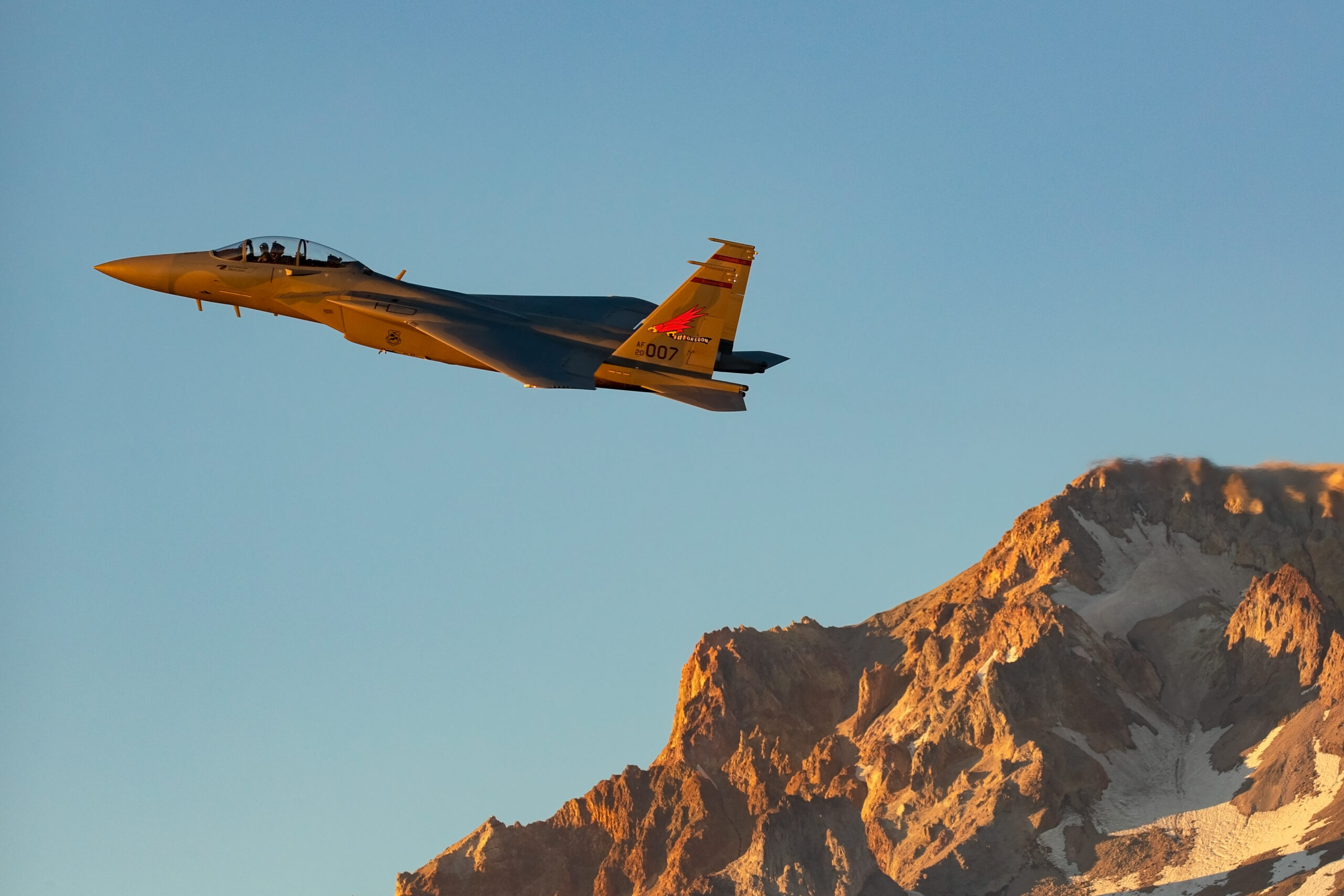
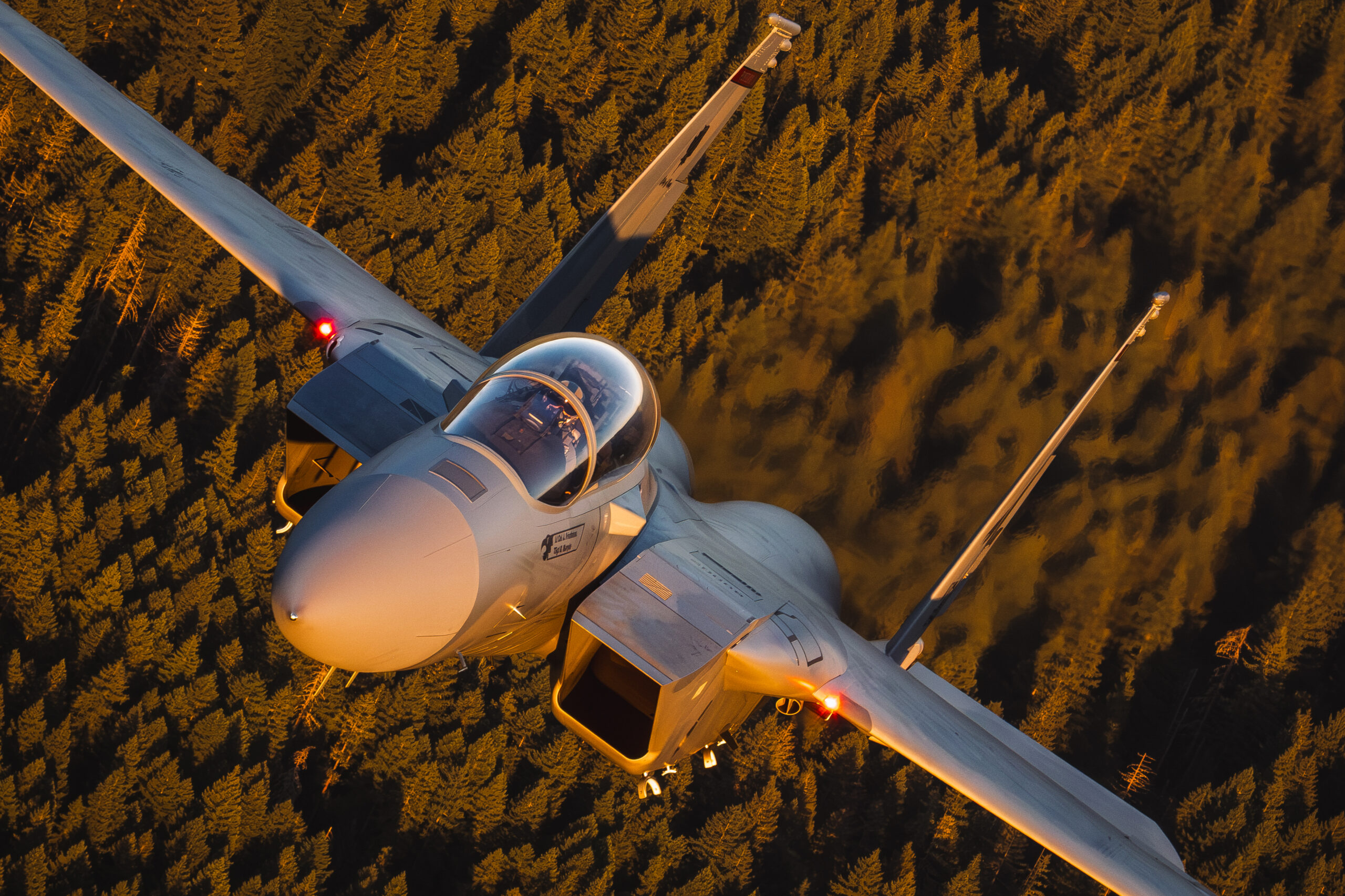
In Britain, Lakenheath movements and the Royal International Air Tattoo are the reliable opportunities, and our RIAT photography guide covers positioning at Fairford in detail. We photograph Eagles whenever the chance arises, including a 2024 air-to-air session with the 142nd Wing’s F-15EX Eagle IIs over the American Pacific Northwest; those frames are in the ANG F-15 Eagles gallery, and licensing details for all of them are on our licences page. Few subjects repay long glass and patience so generously.
Legacy
Judge a fighter by what it was built to do. The F-15 was built to guarantee air superiority after Vietnam had shown it could not be assumed, and for half a century it has done exactly that: more than 100 victories, no confirmed air-to-air losses, and a deterrent presence from Germany to Okinawa that shaped Soviet and post-Soviet air power planning for generations. The MiG-25 scare that accelerated it produced, by accident, the most complete fighter of its era, and the aircraft the Foxbat was supposed to render obsolete ended up outliving the Soviet Union that built it.
The Eagle’s deeper legacy is the idea that a fighter can be continuously reinvented. The airframe that stood alert at Bitburg in 1977 shares its shape with the fly-by-wire, AESA-equipped F-15EX rolling out of St Louis today, and plans currently run the type’s service life towards the 2050s. Its design DNA is visible in every twin-finned fighter since, its combat record remains the benchmark against which the F-16 generation and the stealth era are measured, and its longevity now approaches that of the B-52 in bomber service. Not a pound for air-to-ground began as a slogan and ended as the most successful single-purpose design brief in fighter history, even if the Strike Eagle cheerfully betrayed it to become indispensable in a second role the founders never wanted.
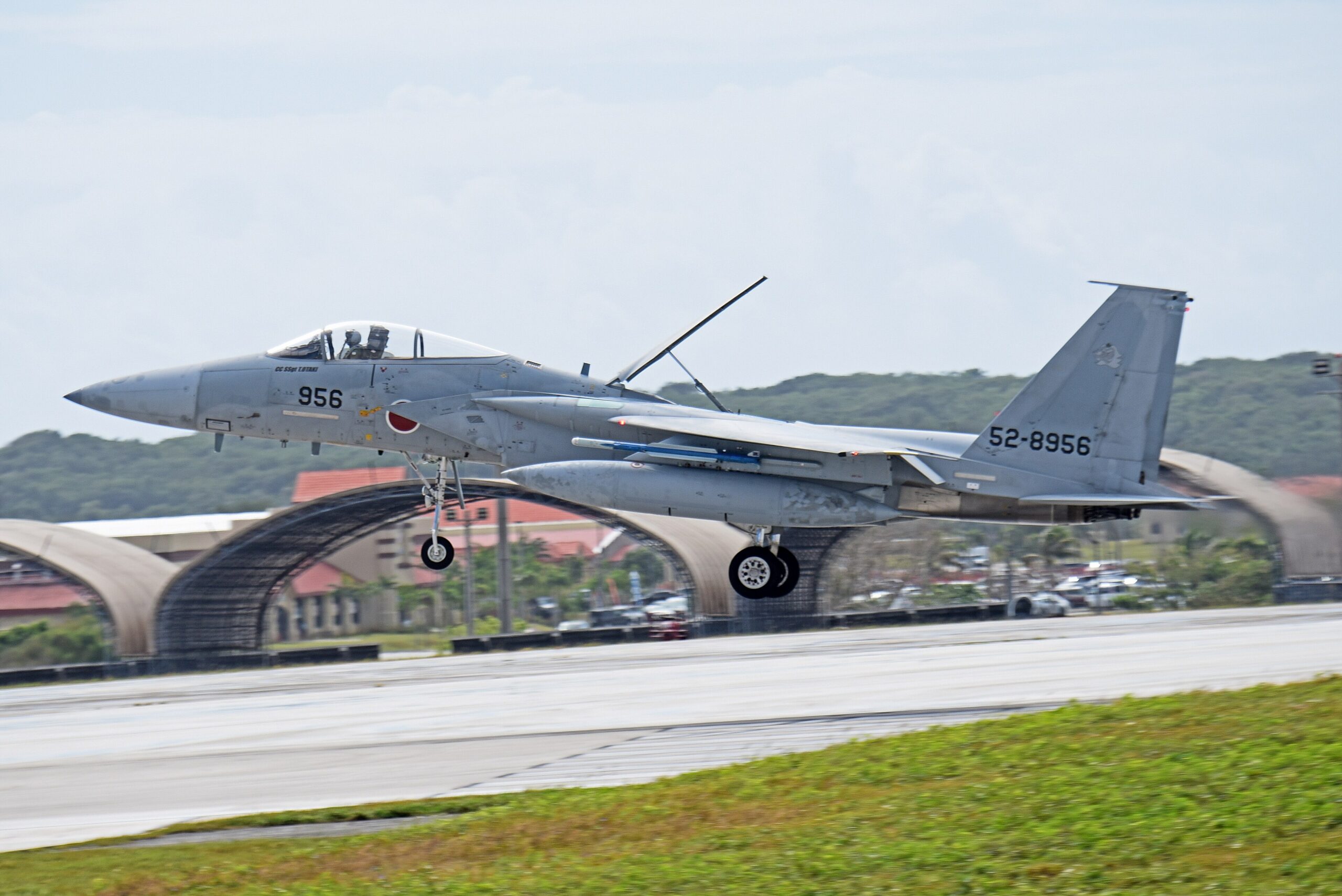
The Strike Eagle still flies from Suffolk, and our location guide to RAF Lakenheath and RAF Mildenhall works out the focal lengths the approach distances demand and when the light falls along the runway.
Frequently asked questions
When did the F-15 Eagle first fly?
The prototype F-15A made its first flight on 27 July 1972 from Edwards Air Force Base in California, flown by McDonnell Douglas chief experimental test pilot Irving Burrows. The two-seat F-15B followed in July 1973, the first aircraft was delivered to the US Air Force in November 1974, and initial operational capability came in September 1975.
How many air-to-air kills does the F-15 have?
The F-15 is credited with more than 100 air-to-air victories, with totals of 102 to 104 quoted by different sources. Israel accounts for over half of them, including the type’s first kill in 1979 and the large-scale air battles over the Bekaa Valley in 1982. US Air Force F-15Cs added 34 of the 37 USAF air-to-air victories of the 1991 Gulf War.
Has an F-15 ever been shot down?
No F-15 has been confirmed lost in air-to-air combat, which is the basis of the famous undefeated record, although historians debate a small number of contested claims. Eagles have been lost to accidents and to ground-based defences, and in April 2026 a US F-15E was shot down over Iran, reportedly by a shoulder-fired surface-to-air missile.
How many F-15s have been built?
Well over 1,500 F-15s of all variants have been built since 1972, including 483 F-15Cs, licence-assembled F-15Js in Japan, and export models for Israel, Saudi Arabia, South Korea, Singapore and Qatar. The line in St Louis remains open, with the F-15EX Eagle II in production for the US Air Force today.
What is the difference between the F-15C and the F-15E?
The F-15C is a single-seat air superiority fighter, built purely to win air-to-air combat. The F-15E Strike Eagle is a two-seat derivative with a weapons systems officer in the rear cockpit, strengthened structure, conformal fuel tanks and night targeting equipment, able to carry a heavy air-to-ground payload while retaining its air-to-air weapons.
Is the F-15 still in production?
Yes. The Boeing F-15EX Eagle II first flew on 2 February 2021 and is in production for the US Air Force, with the Oregon Air National Guard’s 142nd Wing at Portland the first operational unit. The EX adds fly-by-wire controls, the APG-82 AESA radar and a defensive electronics suite, and can carry up to twelve air-to-air missiles.
How fast is the F-15 Eagle?
The F-15 is capable of around Mach 2.5 at altitude, approximately 1,875 mph, with a service ceiling of 65,000 feet. The stripped-down Streak Eagle demonstrated the type’s raw performance in 1975 by climbing to 98,425 feet in under three and a half minutes from brake release, one of eight world time-to-climb records it set that winter.
Where can I see an F-15 in the UK?
The American Air Museum at IWM Duxford displays an early F-15A that served at Bitburg in Germany during the Cold War. For flying examples, the 48th Fighter Wing at RAF Lakenheath in Suffolk operates the F-15E Strike Eagle, and USAF Eagles have appeared regularly at the Royal International Air Tattoo at RAF Fairford.
The Eagle’s great naval contemporary took a different path to the same air superiority mission: read the full story of the Grumman F-14 Tomcat, the fleet defender.
For the other half of the 1970s USAF revolution, from air superiority to attrition-proof close air support, see our history of the A-10 Warthog.
