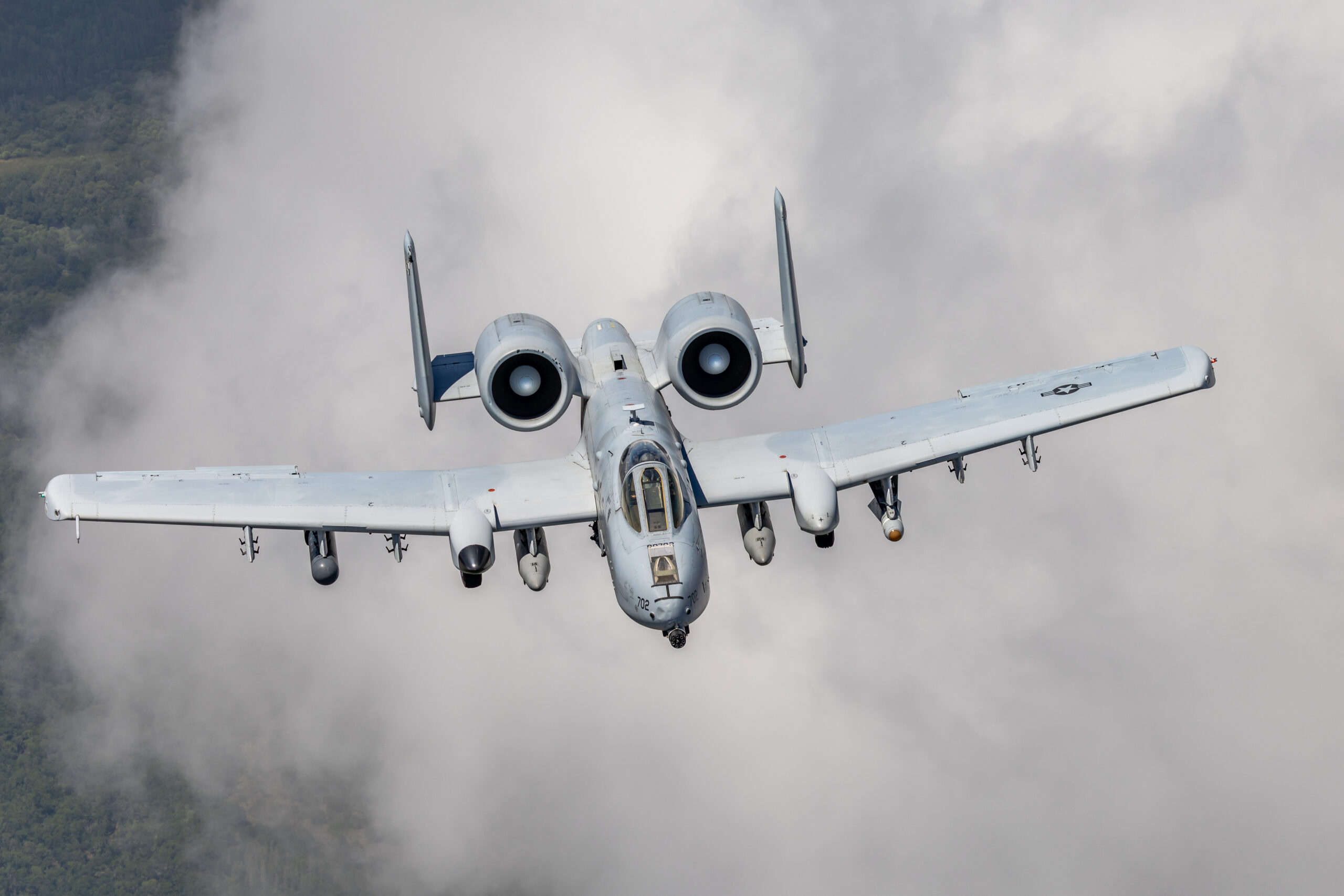
The Fairchild Republic A-10 Thunderbolt II, universally known as the Warthog, is a twin-engine American close air support jet that first flew on 10 May 1972, entered service in 1976 and built its fearsome reputation around a 30 mm GAU-8/A cannon firing 3,900 rounds a minute. It was the first US Air Force aircraft designed from a blank sheet for the close air support mission, and half a century later it remains the benchmark against which every battlefield attack aircraft is judged. This profile traces the full A-10 Warthog history: the Vietnam lessons that produced it, the gun and the titanium armour that define it, its combat record from the Gulf War to the 2020s, and its long, contested slide towards retirement, which the Air Force partly reversed in April 2026, extending three squadrons, about 54 aircraft, into 2029 and a residual 36 jets to 2030, while the rest of the fleet retires.
What this guide covers
- Origins and the A-X programme
- A design built around a gun
- Survivability: the titanium bathtub and built-in redundancy
- Service and combat history
- Variants and upgrades
- The retirement debate and current status
- A-10C specifications
- Where to see A-10s today
- Photographing the A-10 today
- Legacy
- Frequently asked questions
Origins and the A-X programme
The A-10 exists because of Vietnam. By the mid-1960s the United States was discovering, at painful cost, that its supersonic fighter force was poorly suited to the war it was actually fighting. Close air support, the business of putting ordnance within metres of friendly troops, demanded aircraft that could fly low and slow, loiter for long periods over the battlefield, absorb ground fire and operate from rough forward strips. The jets of the day could do none of this well. Fast movers such as the F-100 and the F-4 Phantom II arrived over a firefight with limited fuel, saw little at 500 knots, and were gone again in minutes; we cover that aircraft’s own remarkable career in our F-4 Phantom history. Meanwhile the aeroplane doing the bulk of the dirty work in South East Asia was the Douglas A-1 Skyraider, a piston-engined design conceived during the Second World War. The Skyraider could loiter and haul a huge load, but it was slow, increasingly vulnerable, and long out of production.
In 1966 the US Air Force issued a requirement for a purpose-built close air support aircraft under the A-X (Attack, Experimental) programme. The thinking behind A-X drew on combat data from Vietnam and on studies of what had actually killed aircraft over the battlefield since 1945. The reform-minded analyst Pierre Sprey is often credited as a driving intellectual force behind the concept; how decisive his personal influence really was remains debated among historians, but the requirements themselves were unambiguous. The new aircraft had to be simple, cheap, long-legged and lethal against armour, with survivability designed in from the first line on the drawing board rather than bolted on afterwards.
A refined request for proposals followed in May 1970, now shaped by a second consideration: the Soviet Army’s enormous tank fleet facing NATO in Central Europe. The RFP specified an aircraft built around a large-calibre 30 mm rotary cannon, with a substantial external weapons load, long loiter time, short-field performance and a low unit cost. Six companies submitted designs. In December 1970 the Air Force selected two to build competing prototypes: Northrop, with its YA-9A, and Fairchild Republic, the Long Island firm descended from the company that had built the P-47 Thunderbolt, with its YA-10A.
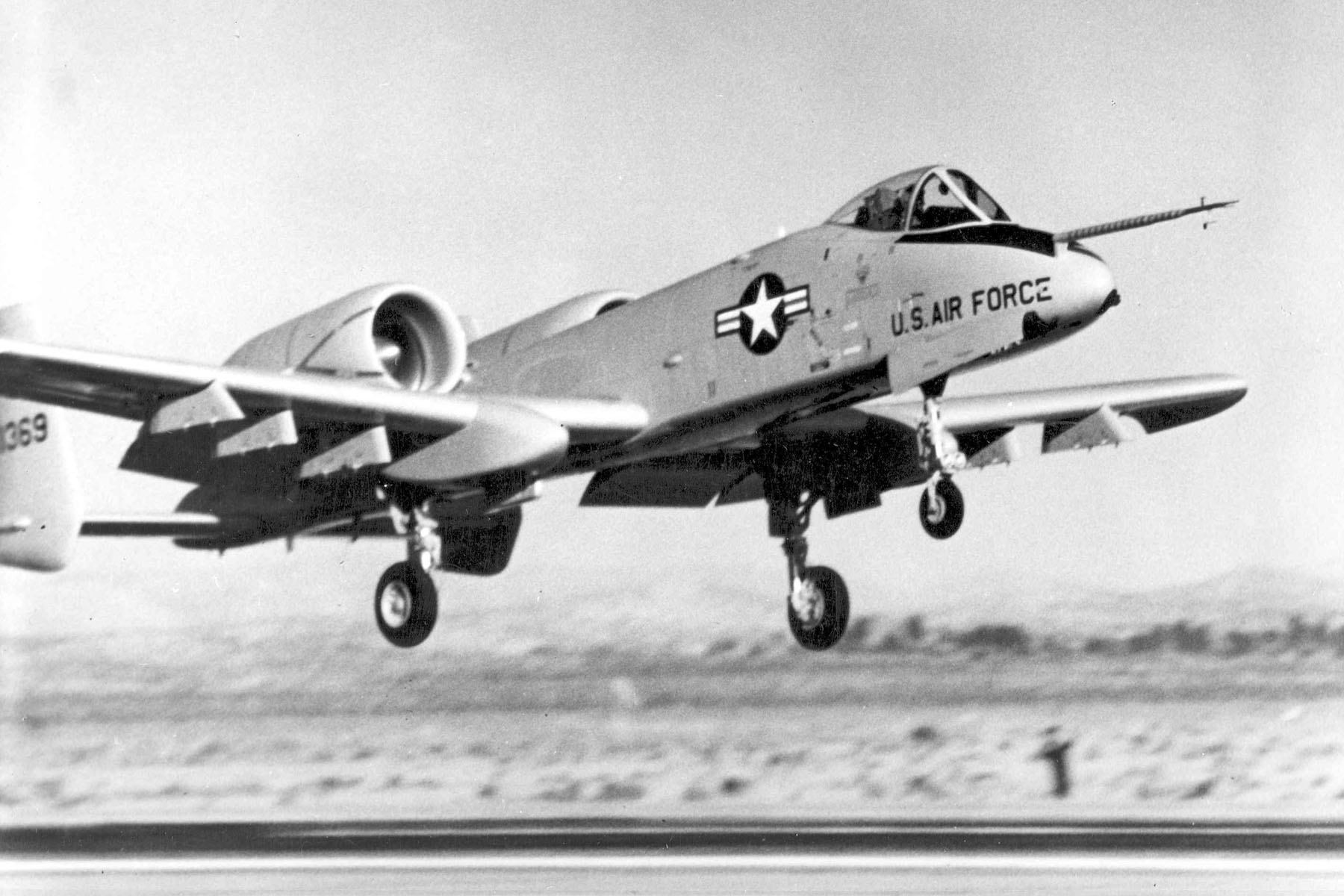
The Fairchild Republic YA-10A flew first. On 10 May 1972 company chief test pilot Howard “Sam” Nelson lifted the first prototype, serial 71-1369, off the runway at Edwards Air Force Base in California. Northrop’s YA-9A followed on 30 May 1972. Through the autumn of 1972 the two prototypes were flown head to head in a competitive fly-off, and in January 1973 the Air Force announced Fairchild Republic as the winner. A separate competition settled the all-important gun, with General Electric’s design selected over a rival Philco-Ford offering to become the GAU-8/A Avenger. The YA-9A was a capable aircraft, and observers noted its more conventional lines, but the YA-10A’s engine placement, redundancy and battle-damage tolerance matched the A-X philosophy more completely.
The first production A-10A was delivered to Davis-Monthan Air Force Base, Arizona, in October 1975, with the type formally deployed from March 1976, a neat piece of symmetry given that Davis-Monthan would anchor A-10 training and storage for the next half century. The Air Force named the aircraft Thunderbolt II in honour of Republic’s P-47, itself a celebrated ground-attack machine in the last years of the Second World War. Nobody in a flying suit ever called it that. To its pilots and crews the snub-nosed, slab-winged jet was the Warthog, or simply the Hog, a name earned by looks and worn with pride.
A design built around a gun
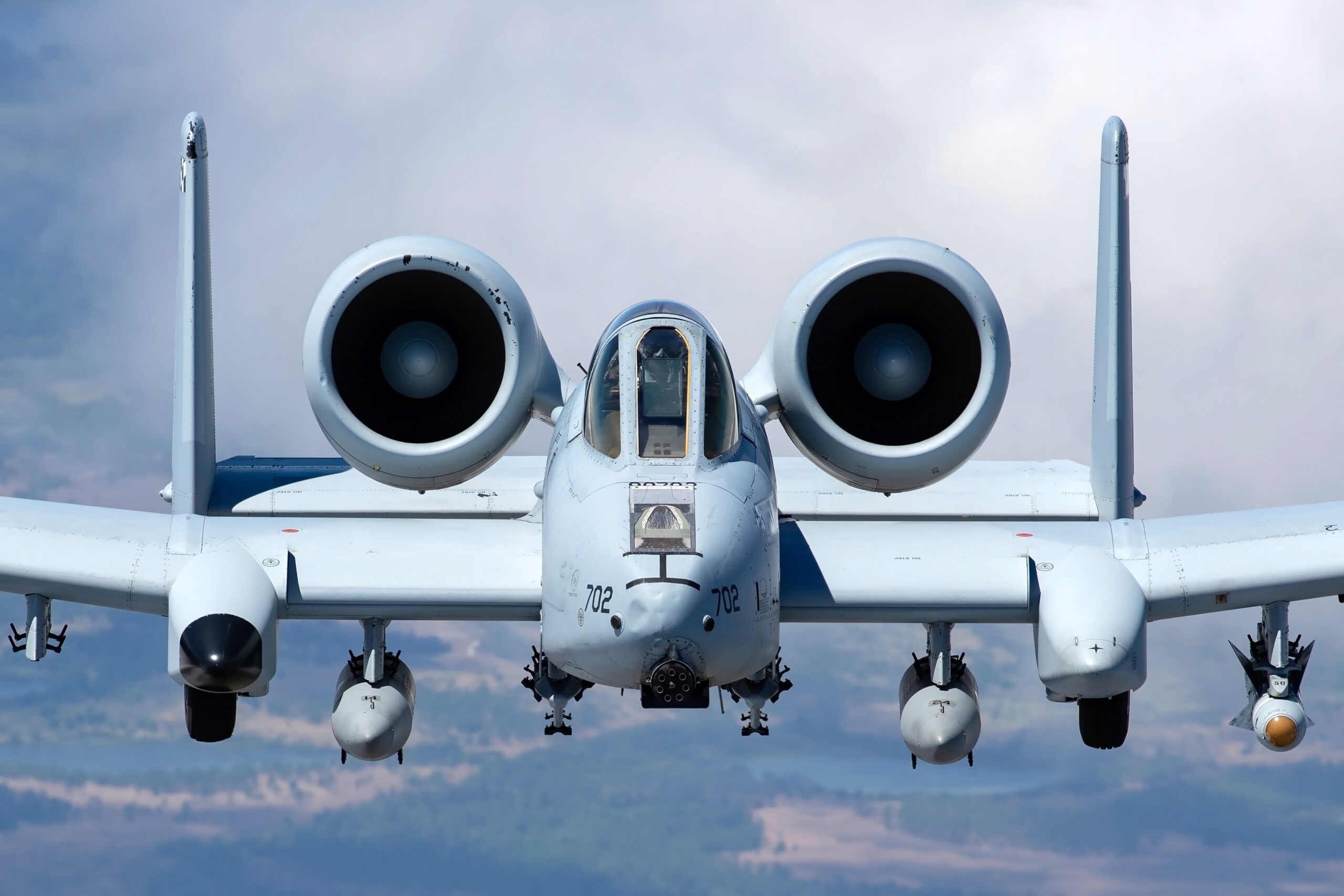
Most combat aircraft carry a gun. The A-10 is built around one. The GAU-8/A Avenger is a seven-barrel 30 mm rotary cannon of extraordinary size: the complete weapon, including its feed system and ammunition drum, measures 19 ft 5.5 in (5.93 m) from muzzle to the back of the drum, roughly the length of a family car, and weighs 4,029 lb (1,828 kg) with a full load of ammunition. The drum holds up to 1,174 rounds, with 1,150 the typical combat load. It is often said, accurately, that the airframe was designed around the gun rather than the other way round: the weapon occupies most of the forward fuselage, and the nose landing gear is offset to the right of the centreline so that the firing barrel, in the nine o’clock position of the rotating cluster, sits exactly on the aircraft’s centreline. That keeps recoil from yawing the jet off its aim.
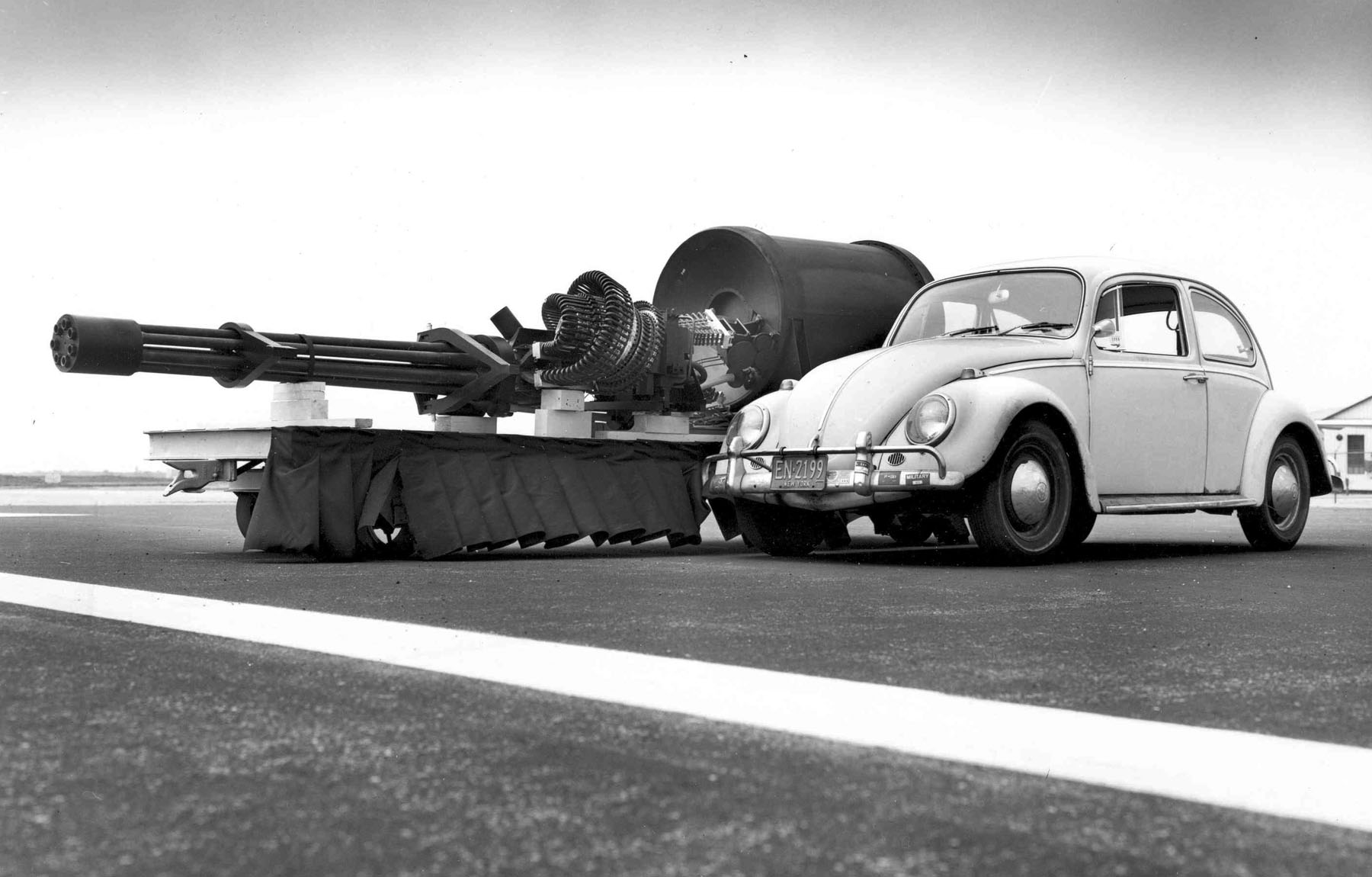
On rate of fire, published sources differ, and it is worth being precise. As originally fitted, the GAU-8/A had a selectable rate: 2,100 rounds per minute on the low setting and 4,200 on the high setting. The gun was later fixed at a single rate of 3,900 rounds per minute, which is the figure the US Air Force quotes in its current A-10C fact sheet. That works out at about 65 rounds every second. In practice pilots fire short bursts of one or two seconds to manage barrel wear and heat, and because a two-second burst of 30 mm is usually more than enough for anything on the receiving end. The signature sound, a deep ripping growl heard after the shells have already arrived, has made “brrrt” the most famous onomatopoeia in modern military aviation.
The ammunition matters as much as the gun. The primary anti-armour round is the PGU-14/B armour-piercing incendiary, which uses a penetrator of depleted uranium, a material half again denser than lead, allowing the relatively small 30 mm projectile to defeat tank armour from above and behind. It is mixed with the PGU-13/B high-explosive incendiary round for soft targets. A frequently quoted comparison holds that the gun’s average recoil force is close to the thrust output of one of the aircraft’s two engines; the numbers broadly support it, and it conveys the essential truth that firing the Avenger is a structural event, not an afterthought.
Around the gun, Fairchild Republic wrapped an airframe optimised for the low-and-slow fight. The wing is long, straight and thick, generating abundant lift for short take-offs, tight turns at low speed and stable weapons passes. The A-10 is not fast, with a top speed of about 420 mph, and was never meant to be. What the design buys instead is endurance and control authority exactly where a close air support pilot needs it, below 1,000 feet with the target in sight. Eleven pylons, eight under the wings and three under the fuselage, carry up to 16,000 lb (7,200 kg) of mixed ordnance: Mk 82 and Mk 84 bombs, AGM-65 Maverick missiles, rocket pods, and in later years laser- and GPS-guided weapons, plus AIM-9 Sidewinders for self-defence. Simplicity was a requirement in its own right. Many parts are interchangeable left and right, including the engines, main landing gear and vertical stabilisers, and the jet was designed to be serviced from austere bases with minimal ground equipment.
Survivability: the titanium bathtub and built-in redundancy
If the gun defines what the A-10 does, the armour defines what it can survive. The pilot sits inside a tub of titanium armour, universally known as the titanium bathtub, weighing about 1,200 lb (540 kg), almost six per cent of the aircraft’s empty weight. The plates vary from 0.5 to 1.5 inches (13 to 38 mm) thick, their thickness in each location determined by studies of likely projectile trajectories, and the tub also shields parts of the flight control system. It is designed to withstand direct hits from armour-piercing and high-explosive projectiles up to 23 mm, the calibre of the Soviet ZSU-23-4 anti-aircraft gun that A-X planners expected the jet to meet over a European battlefield. Interior surfaces carry a multi-layer nylon spall shield to catch fragments.
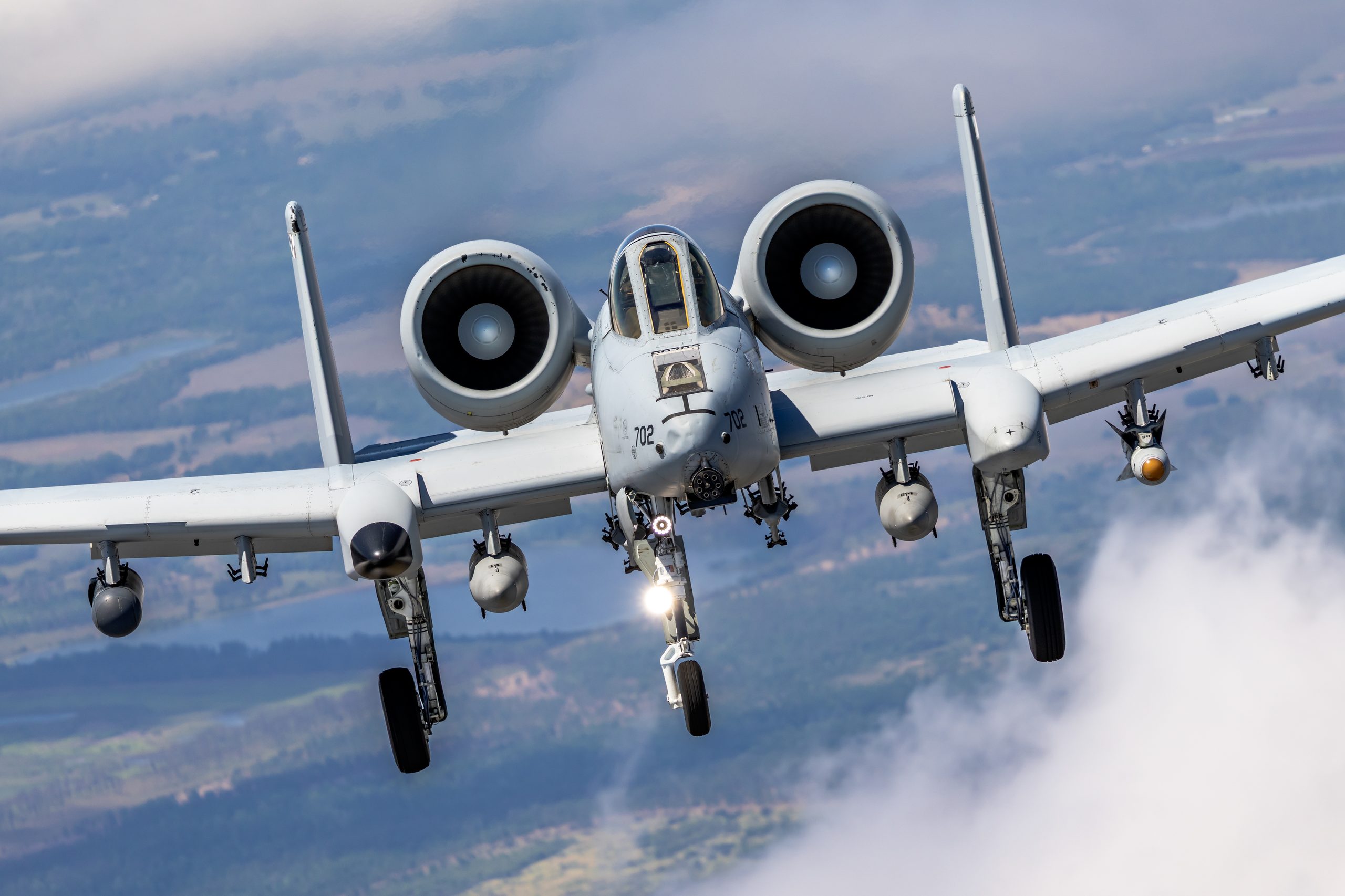
The armour is only the most visible layer of a survivability philosophy that runs through the whole aircraft. The flight controls are doubly redundant: two independent hydraulic systems, backed by an entirely mechanical mode called manual reversion, in which the pilot flies the aircraft through cables, cranks and trim tabs with no hydraulic assistance at all. It is heavy, crude and demanding, and it has brought pilots home when everything else had failed. The fuel cells are self-sealing and protected by internal and external foam to suppress fire and explosion. Primary structure is duplicated so that the loss of one load path does not doom the airframe. An often repeated line, found in countless official and semi-official descriptions, holds that the A-10 can stay airborne with one engine, half a tail, one elevator and half a wing missing; it is a designers’ boast rather than a test result, but the battle-damage photographs from three decades of combat make it hard to dismiss.
The engines are part of the same logic. Two General Electric TF34-GE-100 high-bypass turbofans, each producing 9,065 lb of thrust, sit in separate pods mounted high on the rear fuselage, a derivative of the engine developed for the US Navy’s S-3 Viking. The unusual position does several jobs at once. It places the exhaust above the tailplane and between the twin fins, masking the infrared signature from gunners below. It keeps the intakes clear of debris on rough strips. It separates the engines from the wing and fuel system, so that a hit on one is less likely to damage the other, and it allows the aircraft to fly on a single engine. The high-set pods also simplify servicing at forward bases: ground crews can work on them without stands and jigs, and because the pods are identical, a spare engine fits either side.
The whole package added up to an aircraft unlike anything else in the inventory. Critics called it slow, ugly and vulnerable to modern air defences, criticisms that would echo through every retirement debate for the next fifty years. Its defenders answered that no other aircraft could stay over troops in contact, take the punishment, and keep fighting. Both were right, which is why the argument never ended.
Service and combat history
The A-10’s first two decades were spent training for a war that never came. Through the late 1970s and 1980s the Warthog force was positioned against the Warsaw Pact, with the largest overseas concentration in England. The 81st Tactical Fighter Wing began converting to the A-10 in 1979, with the first jets arriving at RAF Bentwaters in Suffolk in January that year, and eventually operated six squadrons split between Bentwaters and neighbouring RAF Woodbridge. In wartime the wing’s aircraft would have surged to forward operating locations in West Germany to blunt Soviet armoured thrusts across the North German Plain. For fourteen years the grey-green jets were a familiar sight over East Anglia, until the Cold War drawdown: the last A-10 departed Bentwaters on 23 March 1993 and the wing was inactivated that July.
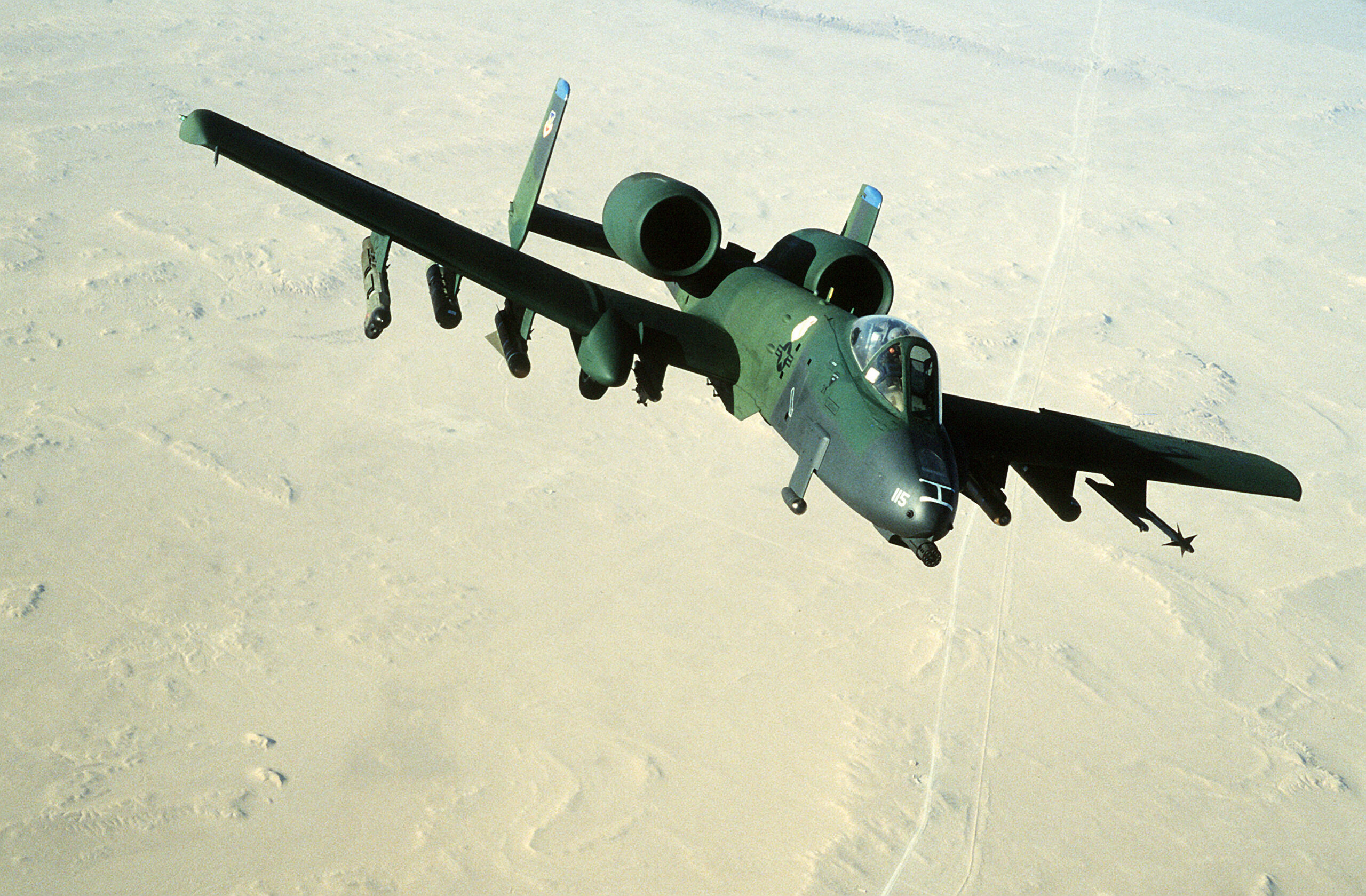
Desert Storm, 1991
The war the A-10 finally fought was in the desert, not in Europe, and it made the aircraft’s reputation. During Operation Desert Storm in early 1991, A-10s and OA-10s flew 8,100 sorties with a mission capable rate of 95.7 per cent, a figure the US Air Force still quotes in its official fact sheet, and launched 90 per cent of all the AGM-65 Maverick missiles fired in the war. USAF accounts credit the A-10 force with destroying 987 Iraqi tanks, 926 artillery pieces and 1,355 combat vehicles, along with aircraft caught on the ground and two Iraqi helicopters shot down in air-to-air engagements with the GAU-8 cannon, the only air-to-air gun kills of the campaign and the only ones ever recorded by the type.
Two episodes stand out. On 25 February 1991, Captain Eric Salomonson and First Lieutenant John Marks of the 76th Tactical Fighter Squadron flew three combat sorties between them and were credited with destroying 23 Iraqi tanks in a single day, widely cited as the highest one-day tank tally ever recorded by a pair of fixed-wing aircraft. A month earlier, on 21 January, Captain Paul Johnson had flown an eight-hour rescue support mission deep into Iraq, refuelling repeatedly while protecting the effort to recover a downed Navy pilot; he was awarded the Air Force Cross, and the very aircraft he flew that day now hangs in the National Museum of the United States Air Force. The campaign was not cost-free. Five A-10s were destroyed during Desert Storm, with roughly twenty more returning with significant battle damage, several of them flying home in conditions that would have destroyed most other aircraft. That ratio, enormous destruction dealt against modest losses absorbed, settled the argument about whether a slow, armoured jet could survive modern war, at least against the defences Iraq possessed.
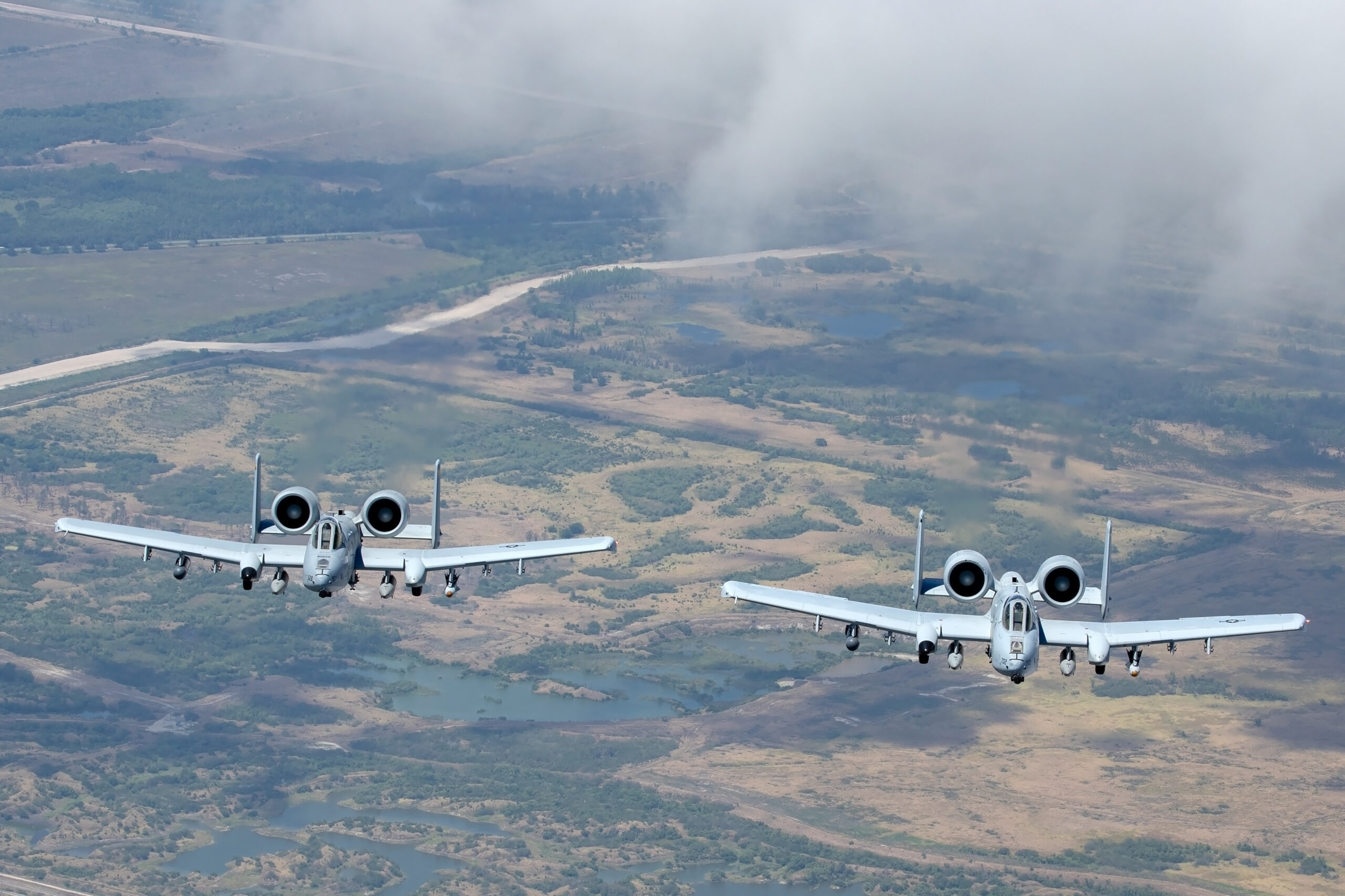
Kosovo, Afghanistan and Iraq
Through the 1990s the A-10 patrolled the no-fly zones over northern and southern Iraq, and in 1999 it went to war again over the Balkans. In Operation Allied Force, A-10s and OA-10s flew airborne forward air control and combat search and rescue support missions over Kosovo, hunting Serbian forces beneath cloud that frustrated higher-flying jets. After 2001 the Warthog became a fixture of the wars in Afghanistan and Iraq. Its long loiter time, huge weapon load and, above all, the psychological weight of its gun made it the aircraft ground troops asked for by name. From the mountains of the Hindu Kush to the streets of Fallujah, the low growl of a Hog overhead became shorthand for help arriving.
The most celebrated single sortie of this era came over Baghdad on 7 April 2003, during the invasion of Iraq. Captain Kim Campbell of the 75th Fighter Squadron was pulling off a strafing pass when her A-10, serial 81-0987, was hit by Iraqi ground fire; accounts vary between a shoulder-fired missile detonating near the tail and heavy anti-aircraft artillery, and both versions circulate in official retellings. The damage was not in dispute: hundreds of shrapnel holes down the right side, a football-sized hole in the right horizontal stabiliser, and both hydraulic systems gone in an instant. The jet rolled left and pointed at the ground. Campbell engaged manual reversion, took hold of an aircraft now flown through cables and cranks alone, and flew it for the better part of an hour back to her base in Kuwait, landing without hydraulics rather than ejecting over friendly lines. She received the Distinguished Flying Cross, and her aircraft, patched up, flew again. No single story better illustrates why the A-10 was built the way it was.
Combat deployments continued into the 2010s and 2020s: strikes against ISIS over Iraq and Syria from 2014, repeated rotations to the Middle East, and dispersed-operations exercises, including landings on highways, designed to prove the old jet still had a place in a new era. Even in 2026, with retirement finally in motion, deployed A-10s were reported flying operational missions in the Middle East, including against small boats and one-way attack drones, roles nobody imagined for it in 1972.
Variants and upgrades
For an aircraft in service for fifty years, the A-10 family tree is remarkably short. Two YA-10A prototypes were built for the fly-off, followed by six pre-production development aircraft and then the production run of A-10As. Production ended in 1984, with the last aircraft delivered in March that year; counting prototypes and development airframes, 715 aircraft were built in total, of which 713 were production A-10As. Totals of 713, 715 and 716 all appear in print depending on what is counted, but 715 delivered airframes is the figure most consistently supported. There were no exports, no naval version and no two-seat trainer in service: every A-10 pilot has always soloed the jet on their first flight.
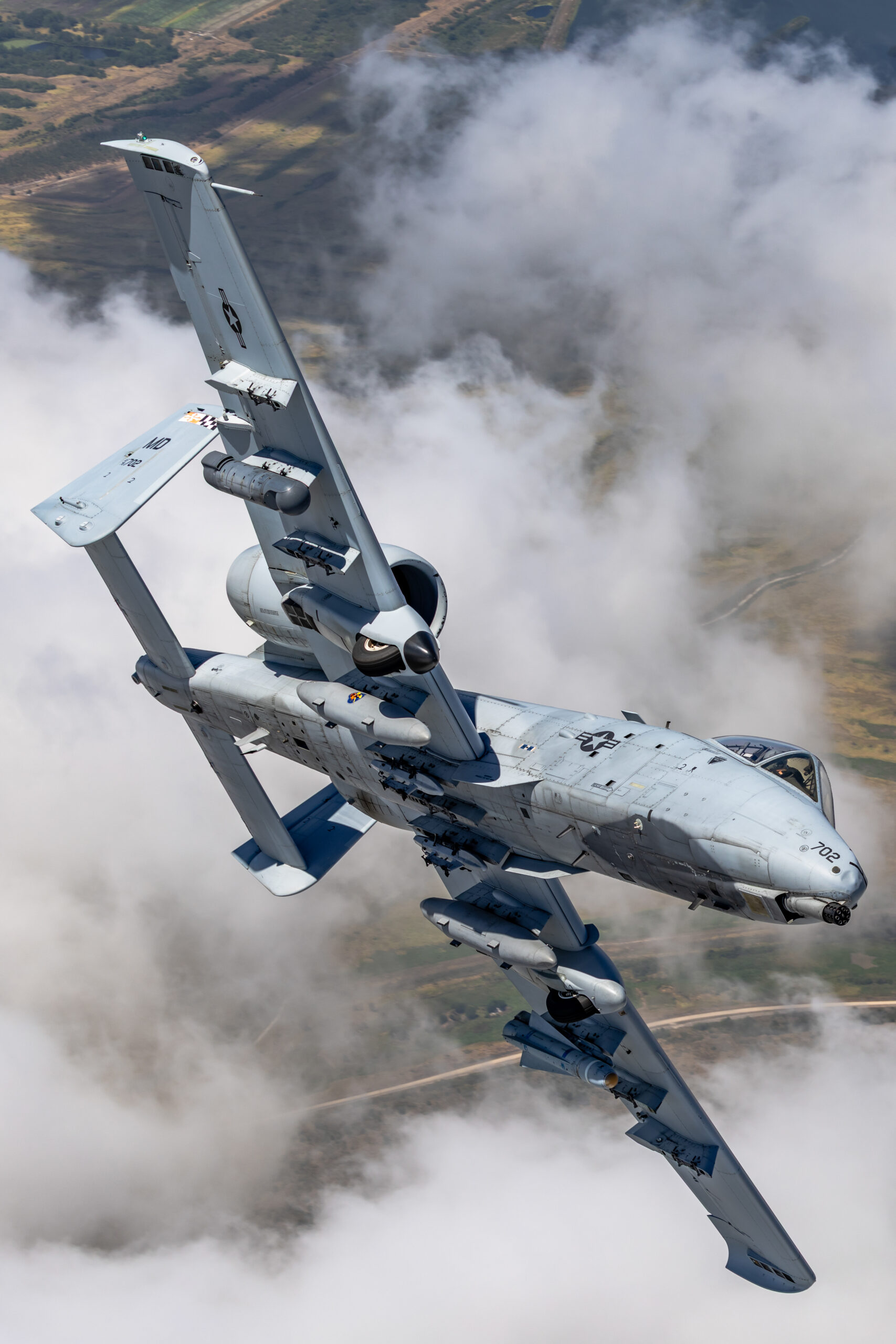
The exceptions and offshoots are few. A single pre-production airframe was converted into the two-seat YA-10B Night/Adverse Weather prototype in 1979 to test a radar- and sensor-equipped variant; the Air Force declined to fund it and the sole example never entered production. In the forward air control role, standard airframes were redesignated OA-10A from the late 1980s, identical machines distinguished only by mission and typical war load of rockets and smoke markers. The designation mattered on paper, and not at all to the aircraft.
The one transformative upgrade came in the 2000s. Under the Precision Engagement programme, the fleet was rebuilt around digital weapons employment: two cockpit multifunction displays, hands-on throttle and stick controls blending F-16 and F-15 hardware philosophies, a digital stores management system, Link 16 style datalink connectivity, satellite communications and full integration of targeting pods and GPS- and laser-guided bombs. The first upgraded aircraft, redesignated A-10C, flew in January 2005 at Eglin Air Force Base, the variant reached initial operational capability in September 2007, and by June 2011 the entire surviving fleet of 356 A-10s and OA-10s had been converted. The A-10C could now drop a JDAM through cloud with coordinates passed digitally from a ground controller, while still carrying the same gun and the same armour.
Keeping half-century-old airframes structurally sound required an equally large investment in metal. Under a contract awarded to Boeing in 2007, valued at roughly 1.1 billion dollars, 173 aircraft received completely new Enhanced Wing Assembly wings, a programme completed in August 2019. That same month the Air Force awarded Boeing a follow-on contract worth up to 999 million dollars, known as ATTACK (A-10 Thunderbolt Advanced Continuation Kitting), covering up to 112 further wing assemblies, built with Korean Aerospace Industries as a partner. The irony was noted at the time: the Air Force was fitting new wings to an aircraft it was simultaneously asking Congress for permission to retire.
The retirement debate and current status
No modern aircraft has been retired as often, as loudly and as unsuccessfully as the A-10. From the mid-2010s onwards the US Air Force repeatedly proposed divesting the fleet, arguing that the money and manpower were needed for newer types, and that the A-10, for all its virtues, could not survive against a modern integrated air defence system. The counterargument, pressed hard in Congress and by ground troops with first-hand experience of the jet, was that nothing else provided close air support with the same persistence, resilience and gun. For years the F-35 was presented as the replacement, just as the F-16 had once been groomed for the role in earlier rounds of the argument; the story of how that agile multirole jet became the Air Force’s default answer to every requirement is told in our F-16 history. Legislators responded to each retirement proposal by writing minimum fleet sizes into law, and the Warthog flew on.
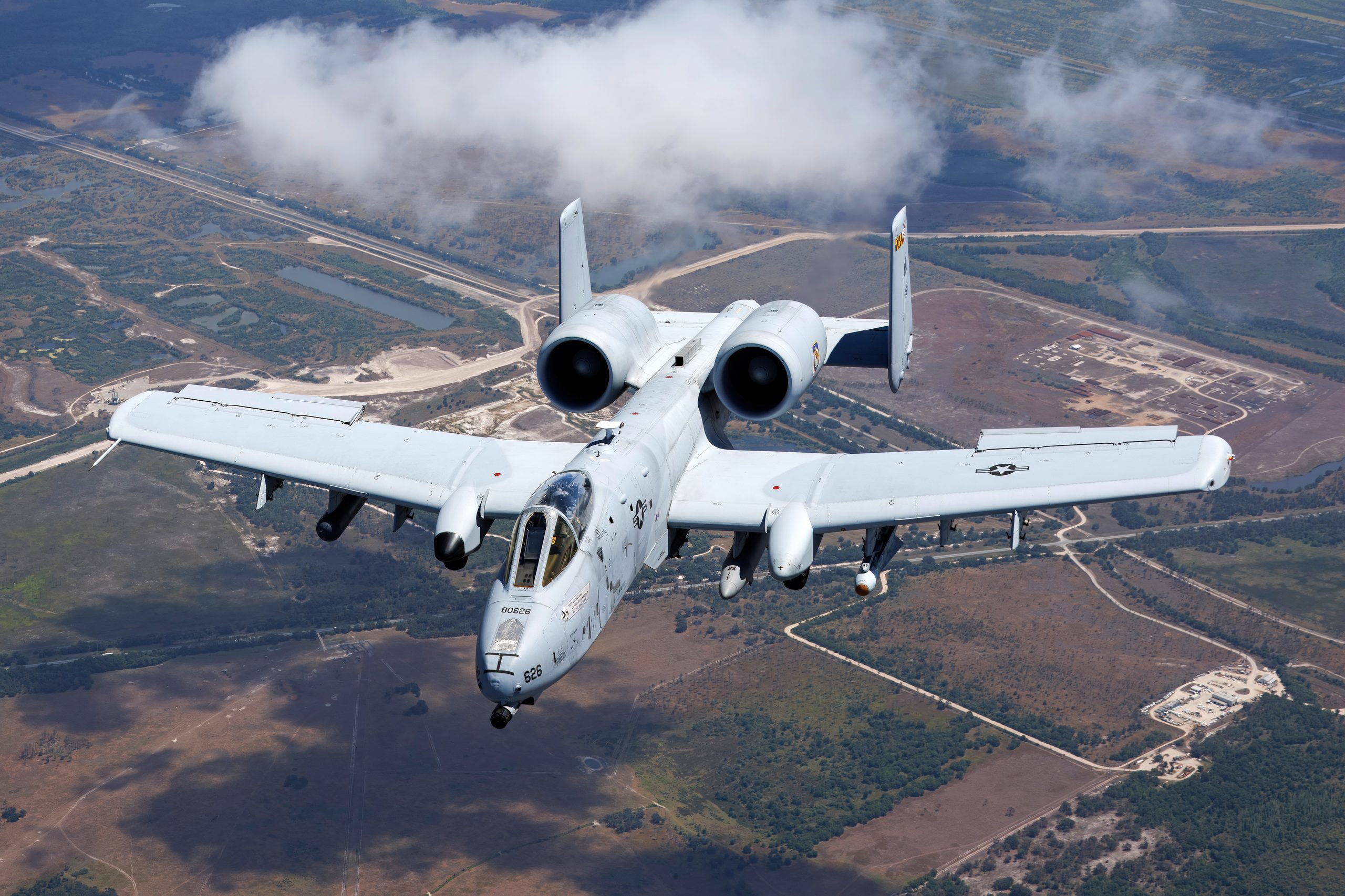
The dam broke in the mid-2020s. Congress began permitting tranches of retirements, and the fleet, which the USAF fact sheet listed at approximately 281 aircraft in December 2020, shrank quickly as squadrons converted to other types or inactivated. The supporting infrastructure was wound down in step. The A-10C Demonstration Team at Davis-Monthan flew its final air show season in 2024, ending more than forty years of A-10 display flying. The Maryland Air National Guard flew its last A-10 sorties in September 2025. Davis-Monthan’s 355th Wing, the aircraft’s home since that first delivery in October 1975, began divesting its own jets, and the schoolhouse closed its doors: on 3 April 2026 the 357th Fighter Squadron graduated the final class of A-10 student pilots, with retired Colonel Kim Campbell, of Baghdad manual-reversion fame, addressing the last graduates.
Updated July 2026: As of July 2026 the A-10 is still in US Air Force service, but the end is now scheduled rather than speculative. The Air Force’s fiscal year 2026 budget request seeks to retire all remaining A-10s, about 162 aircraft, during FY2026, having estimated a saving of 423 million dollars in operating costs; Congress has partially resisted, with defence legislation requiring a minimum of 103 A-10s to be retained until 30 September 2026, and the FY2025 defence bill having authorised 59 retirements before that. No new pilots are being trained following the April 2026 closure of the formal training unit, the demonstration team is gone, and on 20 April 2026 Air Force Secretary Troy Meink announced that the service would retain three A-10 squadrons, about 54 aircraft, through 2029, with 36 remaining into 2030, while the rest of the fleet retires. Remarkably, deployed A-10s were still flying combat missions in the Middle East in 2026, including reported operations against fast attack craft in the Strait of Hormuz. The Warthog is leaving service the way it arrived: arguing its own case from the cockpit.
A-10C specifications
The figures below are taken from the US Air Force’s official A-10C Thunderbolt II fact sheet. Note that the museum placard for the A-10A in Dayton quotes a slightly higher maximum speed of 450 knots for the lighter early variant; the fact sheet figure of 420 mph reflects the current A-10C configuration.
| Specification | Detail |
|---|---|
| Primary function | Close air support, airborne forward air control, combat search and rescue |
| Contractor | Fairchild Republic Co. |
| Powerplant | Two General Electric TF34-GE-100 turbofans, 9,065 lb thrust each |
| Length | 53 ft 4 in (16.16 m) |
| Height | 14 ft 8 in (4.42 m) |
| Wingspan | 57 ft 6 in (17.42 m) |
| Speed | 420 mph (Mach 0.56) |
| Ceiling | 45,000 ft (13,636 m) |
| Maximum take-off weight | 51,000 lb (22,950 kg) |
| Range | 800 miles (695 nautical miles) |
| Armament | One 30 mm GAU-8/A seven-barrel Gatling gun; up to 16,000 lb (7,200 kg) of mixed ordnance on eight under-wing and three under-fuselage pylons |
| Crew | One |
| First flight (YA-10A) | 10 May 1972 |
| Date deployed | March 1976 |
| Unit cost | 9.8 million dollars (FY1998 constant dollars) |
| Total built | 715 including prototypes and development aircraft (713 production A-10As), 1972 to 1984 |
Where to see A-10s today
As the operational fleet winds down, museum airframes are becoming the reliable way to get close to a Warthog, and several collections on both sides of the Atlantic hold significant examples. The most historically important is at the National Museum of the United States Air Force at Wright-Patterson Air Force Base near Dayton, Ohio. Its A-10A, displayed in the Cold War Gallery alongside a separate GAU-8/A cannon exhibit, is the aircraft Captain Paul Johnson flew on his Air Force Cross-earning eight-hour rescue support mission on 21 January 1991; it was delivered to the museum in January 1992 still wearing its Desert Storm record. Standing under its nose, level with that enormous gun muzzle, is the best free lesson in A-10 design philosophy available anywhere.
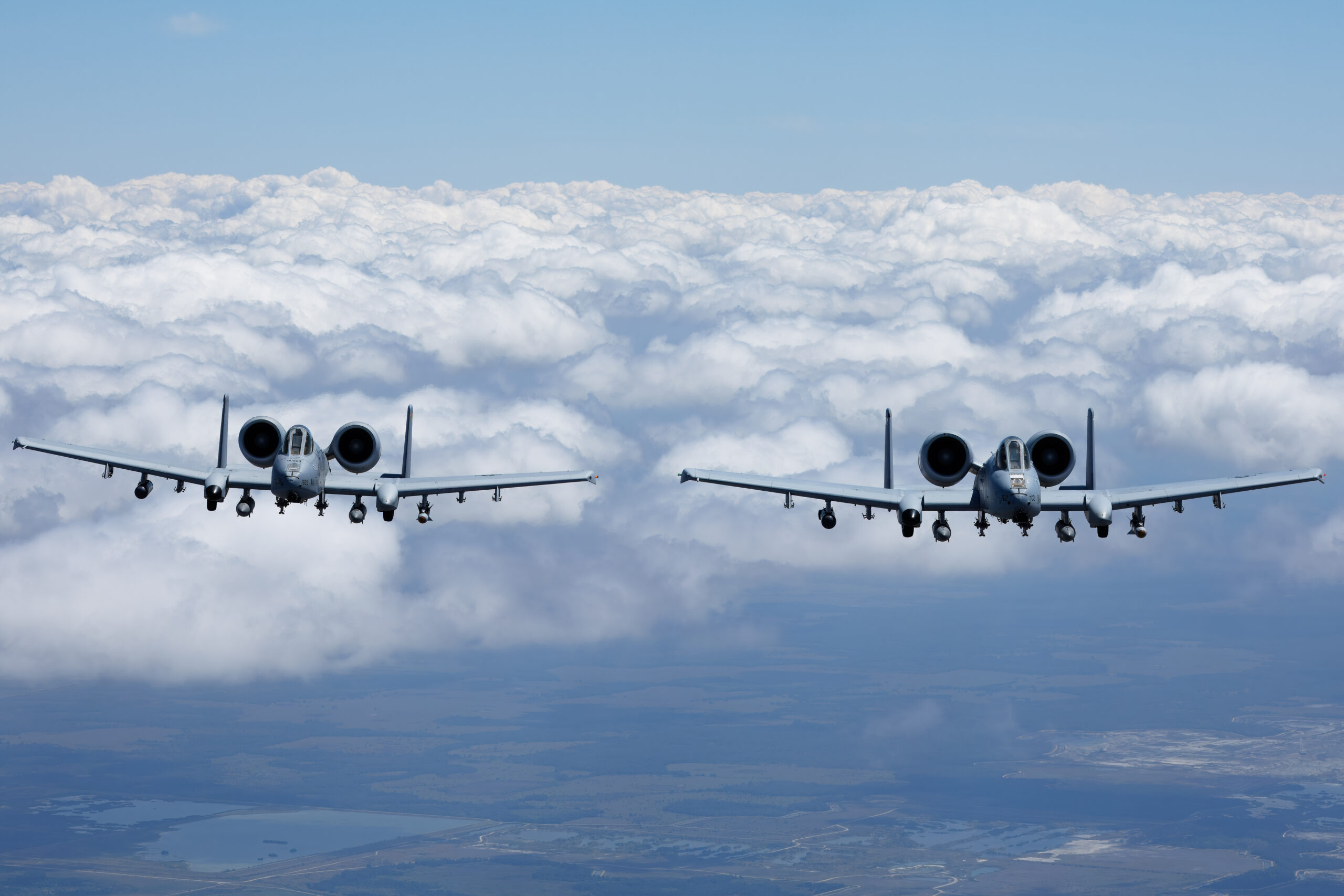
For UK readers, the essential visit is the Imperial War Museum at Duxford in Cambridgeshire. The American Air Museum there displays A-10A 77-0259, which was flown into Duxford on its retirement in 1992 from RAF Alconbury, where it had served with the 10th Tactical Fighter Wing, making it a genuine artefact of the A-10’s fourteen-year residence in England. The former twin bases of the 81st Tactical Fighter Wing are also worth a pilgrimage: the Bentwaters Cold War Museum, on the old airfield in Suffolk, preserves the story of the six-squadron A-10 wing that stood alert there until 1993.
In the United States, the Cradle of Aviation Museum on Long Island, New York, displays an A-10 on the aircraft’s home ground, a few miles from the Farmingdale plant where Fairchild Republic built every Warthog; the museum tells the story of the company that also gave the world the P-47. Hill Aerospace Museum in Utah, attached to the base that performed A-10 depot maintenance for decades, likewise displays an A-10A. And at Davis-Monthan itself, retired A-10s are accumulating in the storage rows of the 309th Aerospace Maintenance and Regeneration Group, the famous boneyard, where the type’s story began in 1975 and where much of the fleet will end it. Expect the number of A-10s on museum display to grow substantially over the next few years as divestment frees up airframes.
Photographing the A-10 today
Photographers should be under no illusions: the window for shooting a flying A-10 is narrowing. The USAF A-10C Demonstration Team flew its final display season in 2024, so the reliable annual airshow appearances are over, and with the training pipeline closed since April 2026 and with two operational squadrons now funded into 2029 and a residual force into 2030, the A-10 should remain a realistic airshow and flypast subject for several seasons yet. If an A-10 turns up on an airshow programme anywhere in the next year, treat it as a last chance and plan accordingly. Museum airframes, by contrast, are a permanent and rewarding subject, and the type’s bulk, cannon and war paint make it one of the most photogenic statics in any collection.
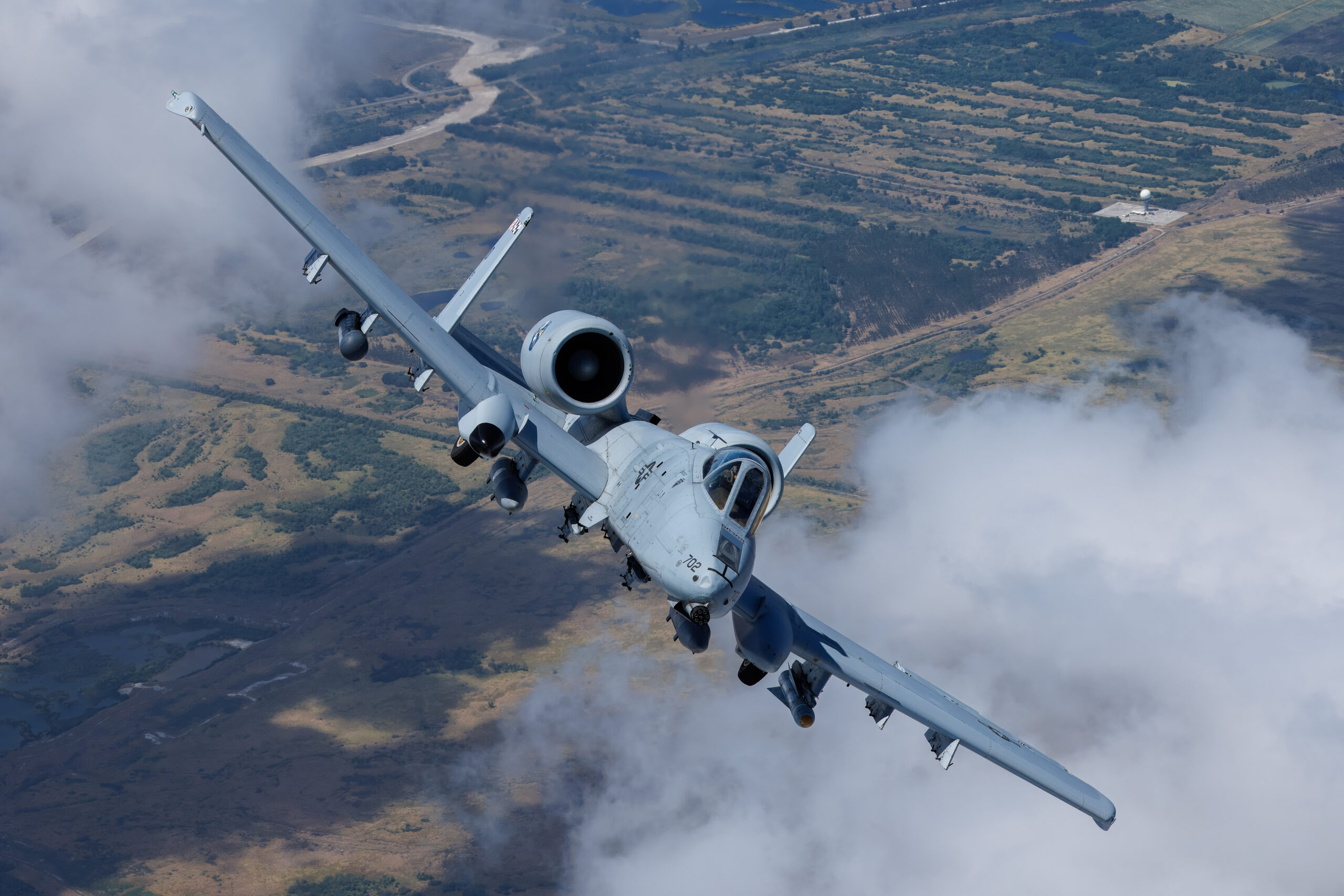
When a flying example does appear, the A-10 rewards technique that differs from standard fast jet work. It is slow by jet standards, flies tight, low display lines and turns hard, so you get longer to track it but against cluttered backgrounds rather than clean sky. Shutter speeds can sit higher than for propeller subjects since there are no blades to blur, but the flat grey paint is easy to underexpose against bright cloud, so watch your histogram and be ready to dial in positive compensation. Our guide to how to photograph fast jets covers panning, prefocus points and display-line reading, and our companion piece on airshow camera settings and autofocus works through the AF-mode and tracking decisions that make the difference when a jet is crossing at 300 feet. For statics, take a wide lens for the gun-and-nosewheel head-on shot, and a short telephoto to isolate details: the offset nose gear, the eleven pylons, the bathtub cockpit surround.
If you need A-10 images without a flight line in reach, or licensed photography for publication, our archive holds Warthog material from airshow seasons past alongside the rest of the military collection in our aviation photography galleries, with usage terms explained on our licensing page.
Legacy
The A-10’s legacy is easiest to see in the argument it started, which has outlived every attempt to end it. For fifty years the Warthog has been the physical embodiment of one side of a genuine doctrinal divide: whether close air support is a mission any fast jet can perform with the right weapons and sensors, or a specialisation demanding a dedicated aircraft built to loiter, absorb damage and fight low. The US Air Force never resolved that question so much as outlasted it, and no direct successor was ever built. When the last A-10 lands, the concept of the purpose-built armoured attack jet retires with it, at least in the West.
Its engineering influence runs deeper than its production numbers. The A-10 demonstrated, in combat rather than in studies, the value of designed-in survivability: separated redundant systems, manual backup flight controls, fuel protection and armour placed by analysis of real threat data. Those lessons shaped survivability thinking across later programmes, even in aircraft that look nothing like it. Culturally, no post-war combat aircraft except perhaps the Spitfire enjoys anything like its public affection. The gun sound has its own name, the silhouette is recognised by people with no other interest in aviation, and the aircraft’s reputation among the soldiers it protected is unmatched, which is precisely why every retirement attempt for a decade ran into a wall of congressional resistance. Ugly, slow, magnificent and mourned in advance: the Hog leaves service with its argument, like its airframe, still largely intact.
Frequently asked questions
Why is the A-10 called the Warthog?
The official name is Thunderbolt II, honouring Republic’s P-47 Thunderbolt of the Second World War. Crews thought the snub-nosed, slab-sided jet was too ugly for so grand a name and christened it the Warthog, or simply the Hog. The nickname stuck so completely that the official name is rarely used outside documents.
How many rounds does the GAU-8 fire per second?
About 65 rounds per second, based on the fixed rate of 3,900 rounds per minute quoted in the official USAF fact sheet. The gun was originally built with selectable rates of 2,100 or 4,200 rounds per minute before being fixed at 3,900. Pilots typically fire one- to two-second bursts.
Is the A-10 still in service in 2026?
Yes. The FY2026 inventory was 162 aircraft and Congress required at least 103 to be held until 30 September 2026, but in April 2026 the Air Force reversed its full-divestment plan and will keep three squadrons flying into 2029, with about 36 aircraft remaining in 2030. The final training class graduated in April 2026.
Can the A-10 really fly with one engine?
Yes. The two TF34 engines are mounted in separate pods precisely so that losing one does not mean losing the aircraft, and A-10s have returned from combat on a single engine. The often-quoted claim that it can fly with one engine, half a wing and half a tail is a designers’ boast, but battle-damage cases lend it credibility.
How many A-10s were built?
A total of 715 airframes were delivered between 1972 and 1984, comprising two YA-10A prototypes, six development aircraft and 713 production A-10As. Slightly different totals appear in print depending on whether prototypes are counted. There were no exports, so every A-10 has served with the US Air Force.
When did the A-10 first fly?
The prototype YA-10A first flew on 10 May 1972 at Edwards Air Force Base, California, with Fairchild Republic chief test pilot Howard “Sam” Nelson at the controls. After a fly-off against the Northrop YA-9A, the design was declared the winner in January 1973 and entered service from 1976.
Has the A-10 ever shot down another aircraft?
Yes. During the 1991 Gulf War, A-10 pilots shot down two Iraqi helicopters using the GAU-8 cannon, the type’s only air-to-air kills. They remain among the very few gun kills recorded by any aircraft since the Vietnam era.
What is the titanium bathtub?
It is the tub of titanium armour, weighing about 1,200 lb (540 kg), that surrounds the A-10 cockpit and parts of the flight control system. Its plates are 0.5 to 1.5 inches thick and are designed to withstand hits from projectiles up to 23 mm. It is a key reason so many damaged A-10s have brought their pilots home.
Why are the A-10’s engines mounted high on the rear fuselage?
The position shields the hot exhausts from ground-based infrared missiles by masking them behind the wing and tailplane, keeps the intakes clear of debris on rough airstrips, and separates the engines from the fuel system so one hit is less likely to disable both. It also simplifies engine changes at austere bases.
Did the A-10 serve in the UK?
Yes, for fourteen years. The 81st Tactical Fighter Wing operated up to six A-10 squadrons from the twin bases of RAF Bentwaters and RAF Woodbridge in Suffolk from 1979, tasked with reinforcing NATO forces in Germany. The last A-10 left Bentwaters on 23 March 1993.
Where can I see an A-10 in a museum?
The National Museum of the US Air Force in Dayton, Ohio displays a Desert Storm veteran A-10A, and in the UK the American Air Museum at IWM Duxford displays A-10A 77-0259, retired from RAF Alconbury in 1992. Other examples include the Cradle of Aviation Museum on Long Island and Hill Aerospace Museum in Utah.
What will replace the A-10?
No direct replacement was ever built. The US Air Force assigns the close air support mission to multirole types, principally the F-35A and F-16, supported by other platforms, arguing that modern sensors and weapons offset the loss of a dedicated aircraft. Critics counter that nothing matches the A-10’s loiter time, armour and gun.
