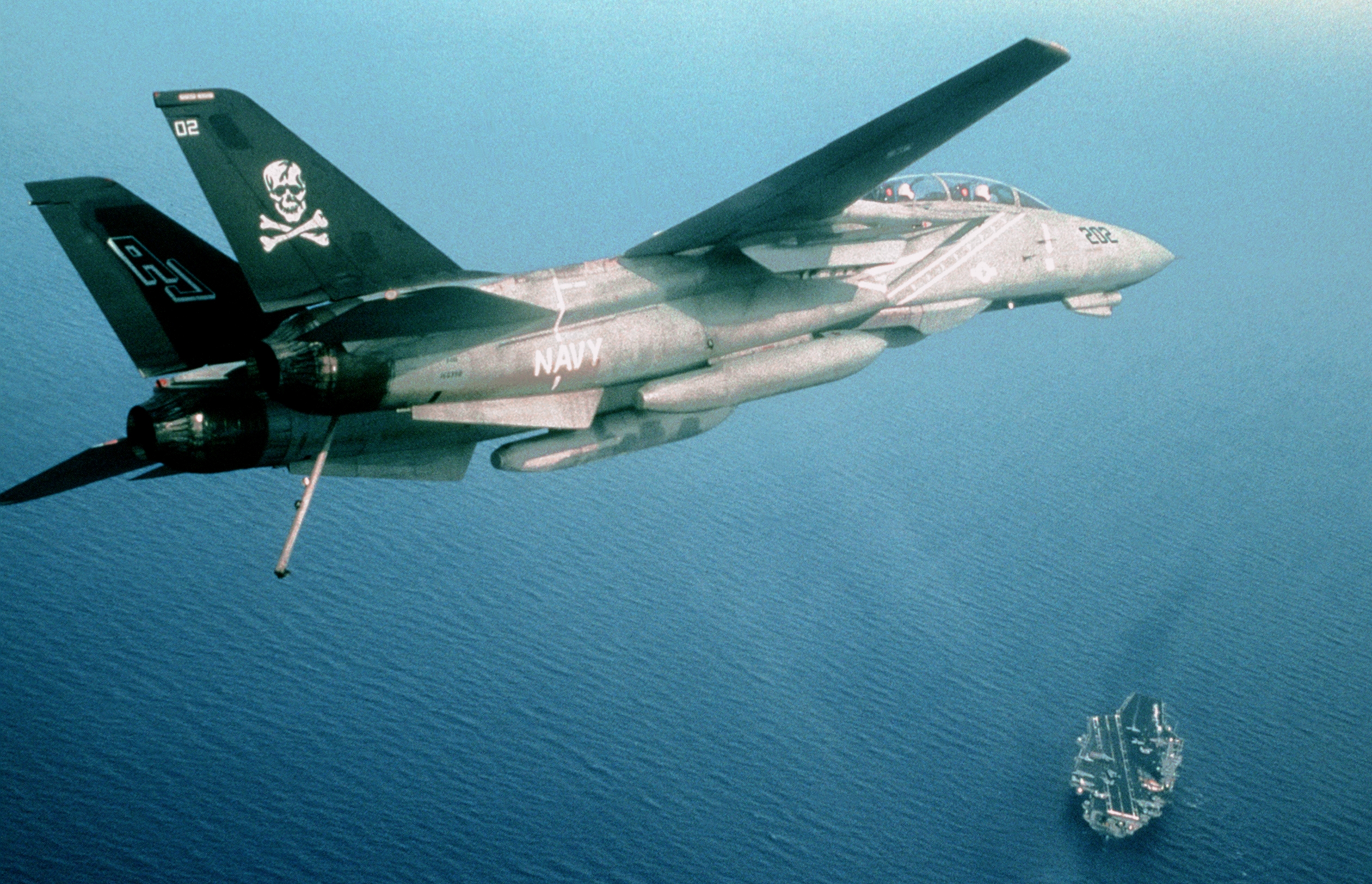
This F-14 Tomcat history covers the aircraft from the VFX programme to its final carrier cruise. The Grumman F-14 Tomcat was a twin-engine, variable-sweep-wing, two-seat US Navy fleet defence fighter that first flew on 21 December 1970, entered combat squadron service in 1974, and was retired by the US Navy on 22 September 2006 after 712 had been built. Designed to stop Soviet bombers and missiles far from the carrier with its AWG-9 radar and AIM-54 Phoenix missiles, it became one of the most recognisable military aircraft ever made, downed Libyan fighters over the Gulf of Sidra, dropped precision weapons over Iraq and Afghanistan as the Bombcat, and flew on in Iran for decades after the last American example reached a museum. This is the full story of the Fleet Defender, from a cancelled programme in 1968 to the survivors you can photograph today.
What this guide covers
Origins and development
The Tomcat exists because another aeroplane failed. In the early 1960s the US Department of Defense pushed the Navy and Air Force towards a common swing-wing fighter, the General Dynamics F-111. The naval version, the F-111B, was developed to give the fleet a long-range interceptor armed with the new Hughes AWG-9 radar and AIM-54 Phoenix missile, but the aircraft that emerged was far too heavy for safe carrier operation. The Navy fought the programme almost from the start, and in 1968 Congress cut the F-111B funding.
The requirement it was meant to answer had not gone away. Soviet long-range bombers and the anti-ship cruise missiles they carried could be launched from hundreds of miles out, which meant the fleet needed a fighter that could sprint out, detect targets at great distance and kill several of them at once, well beyond visual range. The Navy immediately opened a new competition, the VFX programme, to produce a purpose-built carrier fighter around the same AWG-9 and Phoenix combination.
Grumman’s Model 303
Grumman was closely placed to win. The company had been building the Navy’s cats since the 1930s, from Wildcat and Hellcat to Cougar and Tiger, and it had worked on the F-111B closely enough to understand exactly why it failed. Its VFX proposal, design Model 303, kept the radar, the missiles and the two-man crew, and wrapped them in a new twin-engined airframe with variable-geometry wings. Grumman had flown a swing-wing prototype as early as the 1950s with the experimental XF10F Jaguar, and that experience, unhappy as it was at the time, fed directly into the new design. In January 1969 Grumman was selected to build the aircraft, designated F-14. The name continued the company cat tradition, and by well-worn Navy telling it also honoured Vice Admiral Thomas F. Connolly, the naval aviator who had testified bluntly to Congress that the F-111B was unfit for carrier decks. Tom’s cat became the Tomcat.
Schedule pressure was intense, and Grumman skipped the prototype stage in the conventional sense, moving straight to a small batch of development aircraft. The first F-14 flew from the company’s Calverton, Long Island plant on 21 December 1970, a short hop flown ahead of schedule. Development was not painless. The first prototype was lost on only its second flight, on 30 December 1970, when fatigue failure in the hydraulic lines cost the crew their flying controls on approach to Calverton; both men ejected at very low level and survived, and the investigation changed how hydraulic systems were routed in the aircraft, with the mirror-image plumbing that had allowed one failure mode to take out both systems redesigned. Further aircraft were lost in test, and the decision to keep the Pratt & Whitney TF30 engine from the F-111 programme, taken to save time and money, would follow the F-14A through its entire career. Even so, progress from cancellation to carrier was remarkably fast. Deliveries to the Navy began in June 1972, training squadron VF-124 stood up as the schoolhouse, and the first operational squadrons, VF-1 Wolfpack and VF-2 Bounty Hunters, took the Tomcat on its maiden deployment aboard USS Enterprise in 1974.
Design: wings, radar and reach
The F-14 was built around three ideas: wings that could reshape themselves for any speed, a radar that could fight several battles at once, and missiles with unprecedented reach. Everything else followed from those.
The variable-geometry wing
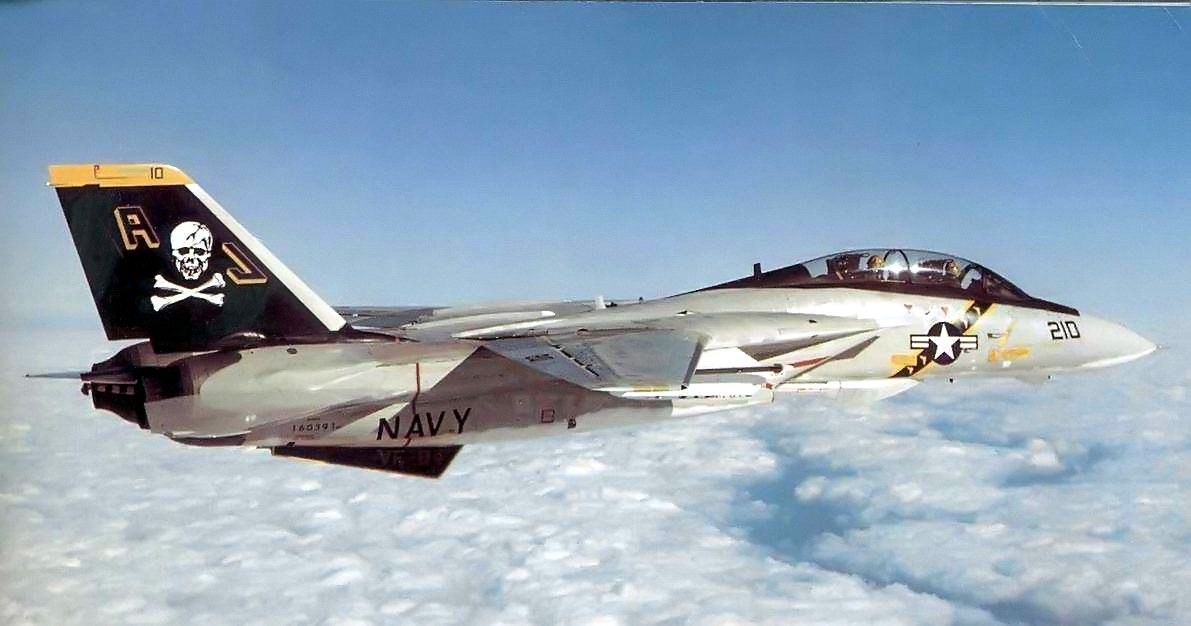
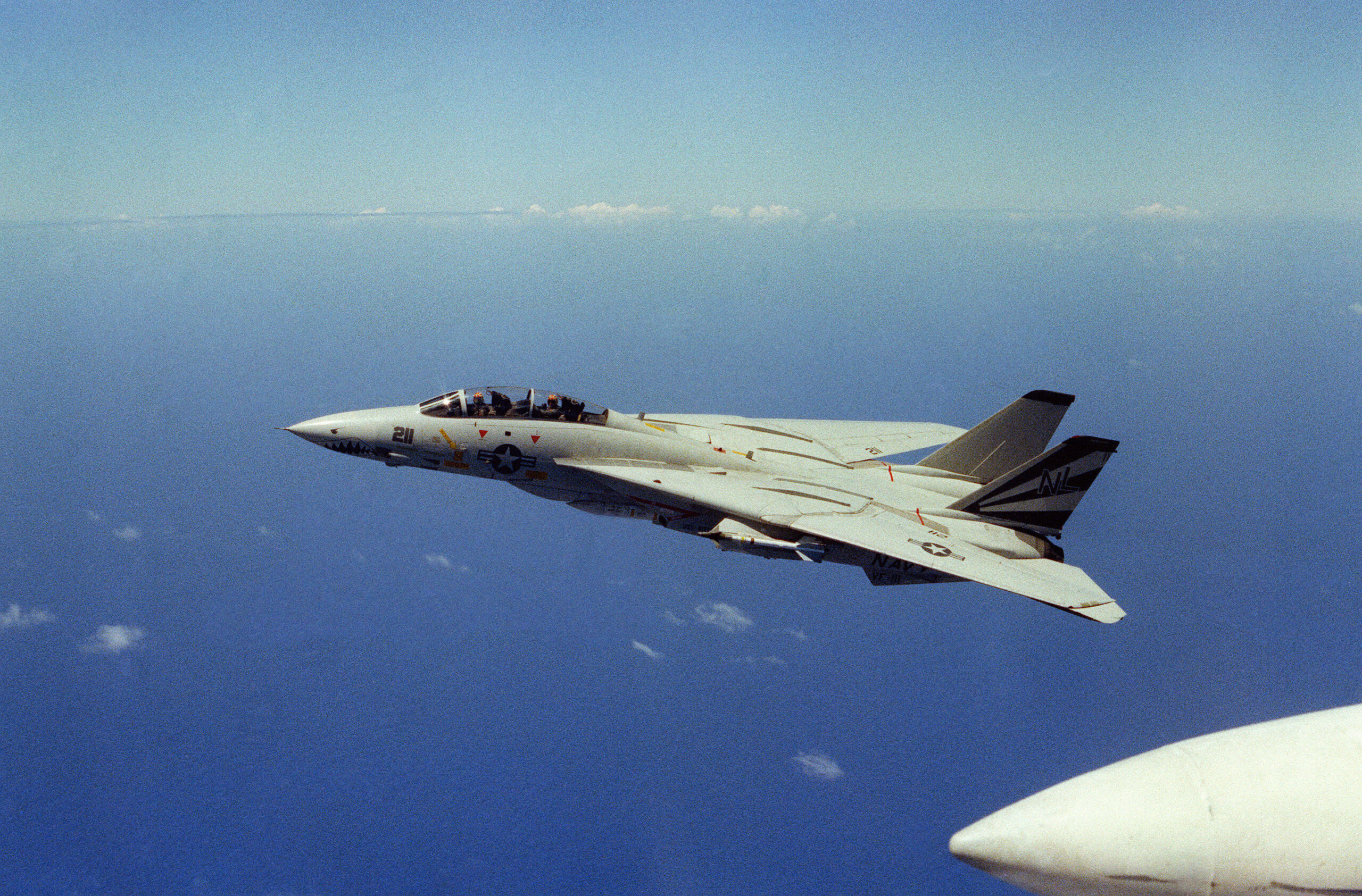
The Tomcat’s wings sweep between 20 degrees for take-off, landing and slow-speed manoeuvring and 68 degrees for high-speed flight, driven automatically in flight by the Mach sweep programmer so the wing is always at an efficient angle for the speed, with 21,000 lb class engines pushing the aircraft beyond twice the speed of sound. For deck parking the wings could be overswept to 75 degrees to save space. Unlike earlier swing-wing designs the sweep is handled without the pilot needing to think about it, and the broad flat area between the widely spaced engine nacelles acts as a lifting body in its own right. The result was an aircraft that could fly a stately 130-knot carrier approach and a Mach 2 intercept in the same sortie. Watching the wings move in flight became one of aviation’s great sights, and photographers learned that a fully swept Tomcat mid-display was the shot that said everything about the aircraft.
AWG-9 and the Phoenix
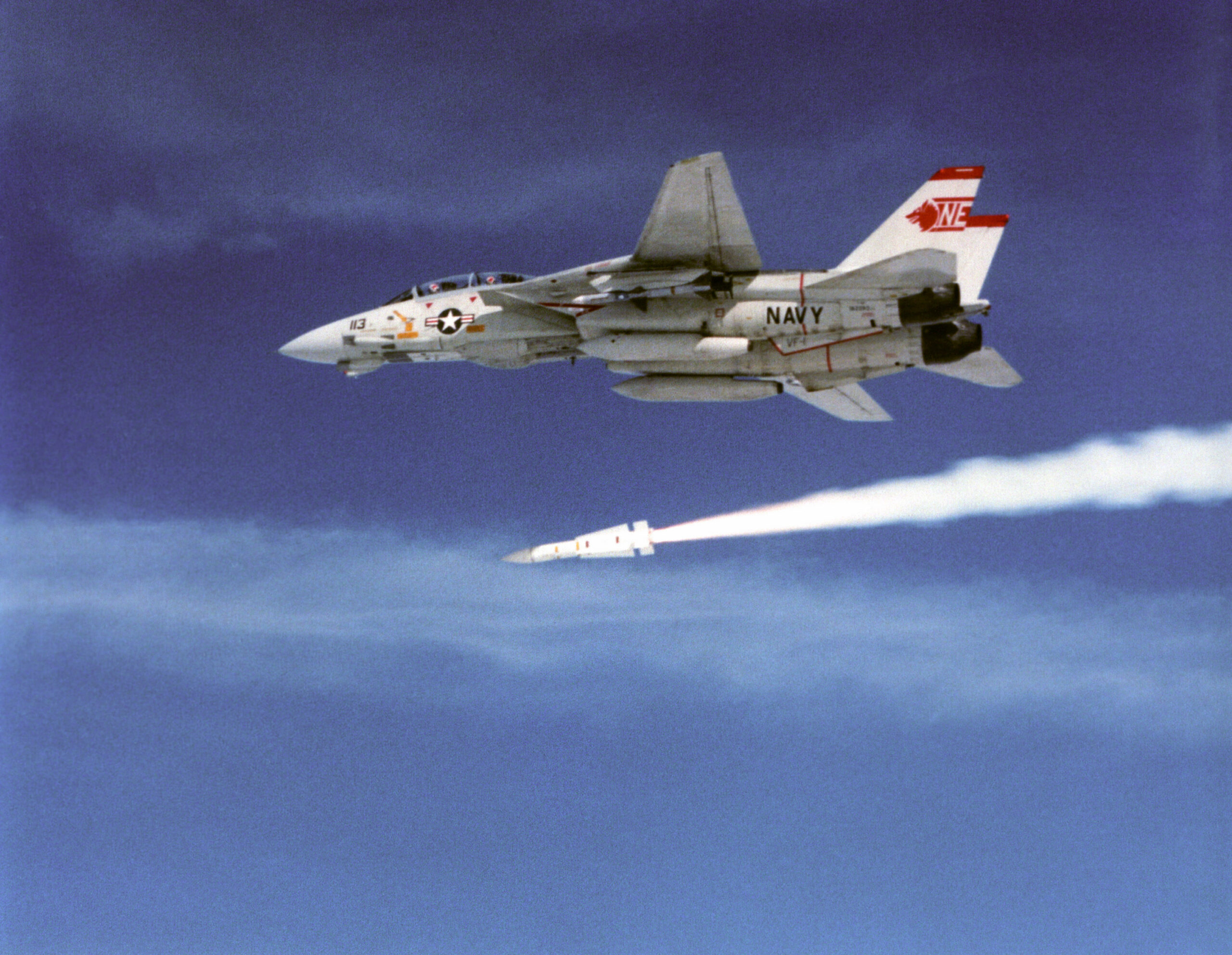
The Hughes AN/AWG-9 was the most capable fighter radar of its era, able to track two dozen targets and guide missiles against six of them simultaneously, at a time when most fighters could prosecute one target at a time. Its partner was the AIM-54 Phoenix, a large, expensive, Mach 5 class missile that could kill targets as far as 100 miles from the launch aircraft. A Tomcat could carry six, although a full six-Phoenix load was so heavy it was rarely flown at sea. The combination existed for one scenario above all: massed Soviet bomber and cruise-missile raids against a carrier battle group, engaged so far out that the ship never came under attack. It is a measure of how specialised this capability was that the US Navy fired the Phoenix in anger only a handful of times, with no confirmed kills; the weapon’s job was to make the raid unattractive before it launched, and that job it did for thirty years.
Two seats, one weapon system
Behind the pilot sat the radar intercept officer, the RIO, who ran the AWG-9, managed the intercept and handled communications and countermeasures. The Tomcat could not be fought properly by one person; crews trained and deployed as pairs, and the culture of the two-seat fighter community shaped everything from tactics to the banter that the film Top Gun later made famous. For close-in work the aircraft carried an internal 20mm M61 Vulcan cannon alongside AIM-7 Sparrow and AIM-9 Sidewinder missiles, and its handling in a dogfight, particularly with the wings programmed automatically, surprised opponents who assumed anything so large must be clumsy.
Airframe and engines
Structurally the Tomcat mixed conventional aluminium with a titanium wing box carrying the enormous loads of the pivoting wings, and the two engines sat in widely separated nacelles either side of the flat under-fuselage. That separation gave the aircraft its distinctive planform and useful survivability, but it also meant that losing one engine at high power produced a violent yaw, a characteristic implicated in a number of accidents with the original TF30 engines, whose compressor stalls were most likely at exactly those moments. Early F-14As also carried small glove vanes, retractable surfaces in the wing gloves that extended automatically at high Mach to control the shifting centre of lift; clever in principle, they added weight and complexity for modest benefit and were disabled and eventually deleted from the fleet. The airframe told the wider story of the aircraft: brilliant, ambitious, and demanding of the people who flew and fixed it.
Service and combat history
The Tomcat’s American career ran just over three decades, from the 1974 Enterprise cruise to the 2006 retirement ceremony, and its combat record maps almost exactly onto the confrontations of that period.
Guarding the fleet
For its first two decades the F-14’s daily work was the mission it was designed for: flying combat air patrol stations hundreds of miles from the carrier, intercepting and escorting Soviet reconnaissance and bomber aircraft that came out to find the battle group. Photographs of Tomcats tucked alongside Tu-95 Bears became a visual signature of the Cold War at sea. The aircraft also took on the fleet reconnaissance role with the TARPS camera pod from the early 1980s, making the Tomcat the Navy’s carrier-based photographic platform, a niche that later kept the aircraft busy long after the interceptor mission faded.
The intercept mission had a rhythm all its own. Alert crews sat strapped in on deck, ready to launch within minutes when the ship’s radar picture showed company coming, and the arrival alongside a Soviet Bear, often after a long transit and a tanker join, ended with the two Cold War adversaries flying formation close enough to wave. Crews photographed the Bears, the Bears photographed the carrier, and both sides went home. The ritual mattered: every intercept demonstrated that the raid the Soviet crews were rehearsing would be met hundreds of miles out. From the early 1980s a proportion of each air wing’s Tomcats also flew with the TARPS reconnaissance pod, and TARPS crews became the fleet’s eyes over Lebanon, the Balkans and Iraq, work that generated some of the lowest and fastest flying of the aircraft’s career.
The Gulf of Sidra
The Tomcat’s first air combat came on 19 August 1981, when two F-14As of VF-41 Black Aces from USS Nimitz were engaged over the Gulf of Sidra by two Libyan Su-22 Fitters, one of which fired a missile at the lead Tomcat. The engagement lasted under a minute: both Libyan jets were shot down with Sidewinders. Eight years later, on 4 January 1989, two VF-32 Swordsmen F-14As from USS John F. Kennedy fought a lengthy engagement with a pair of Libyan MiG-23 Floggers that had repeatedly manoeuvred against them. After several attempts to offset, the Tomcats were cleared to engage; a Sparrow from the wing aircraft and a Sidewinder from the lead destroyed both MiGs, whose pilots ejected. One of the two victorious airframes from 1989 is now displayed at the Smithsonian’s Udvar-Hazy Center.
Desert Storm and the Bombcat years
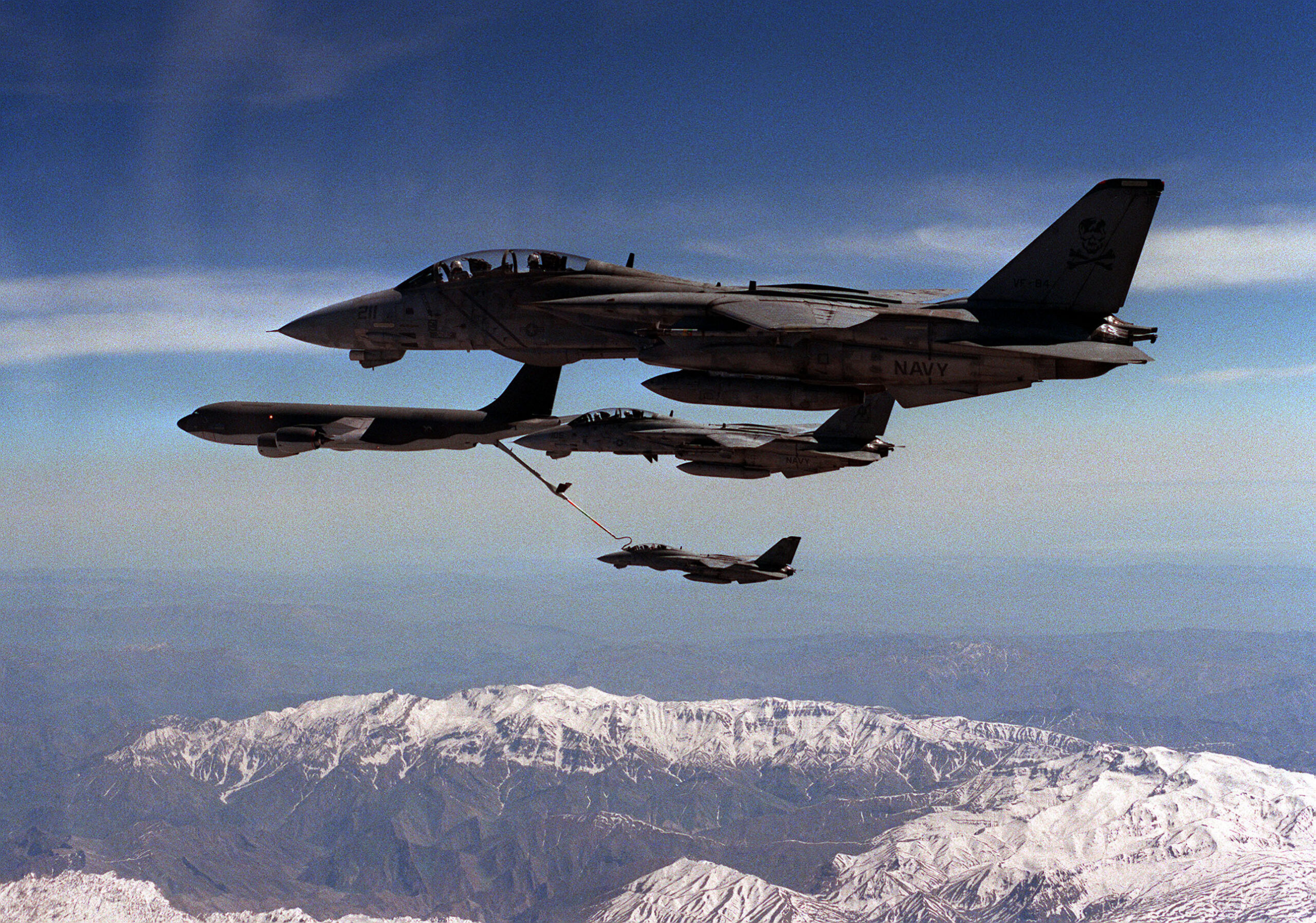
In the 1991 Gulf War, Tomcats flew fleet defence, escort and TARPS reconnaissance missions. Air-to-air trade largely passed the F-14 by, a consequence of tasking and geography: the type recorded one confirmed kill, a helicopter, while an F-14 was lost to a surface-to-air missile with the crew surviving as prisoner and evader respectively. The lesson the Navy took from the 1990s was different: with the Soviet raid threat gone, an aircraft the Tomcat’s size needed a strike role to justify its deck spots. Fitted first with dumb-bomb capability and then, from the mid 1990s, the LANTIRN targeting pod, the Bombcat became a really capable precision striker, and F-14s dropped laser-guided bombs over Bosnia, in the Iraq no-fly zones, and over Afghanistan from 2001, where their long range and two-man crew proved ideal for the flying distances involved. The final combat missions were flown over Iraq, and the type’s last bombs fell in 2006, a mission set unimaginable to the interceptor crews of 1974.
Retirement
The end came quickly once the F/A-18E/F Super Hornet matured. The newer aircraft could not match the Tomcat’s range or speed, but it was dramatically cheaper to maintain: the F-14’s swing wings, elderly systems and hand-built Grumman structure demanded maintenance hours per flight hour that had become indefensible. Squadrons transitioned through the early 2000s, VF-31 Tomcatters and VF-213 Black Lions flew the final cruise aboard USS Theodore Roosevelt in 2005-06, and the US Navy formally retired the Tomcat at NAS Oceana on 22 September 2006. Surviving airframes were mostly stripped and scrapped or sent to museums under unusually strict controls, precisely because the only other Tomcat operator on earth was Iran.
Operating the Tomcat at sea
Statistics and combat narratives miss what the F-14 actually asked of the people around it every day. It was among the largest fighters ever operated routinely from carriers, and everything about taking it to sea was a small industrial exercise.
The deck cycle
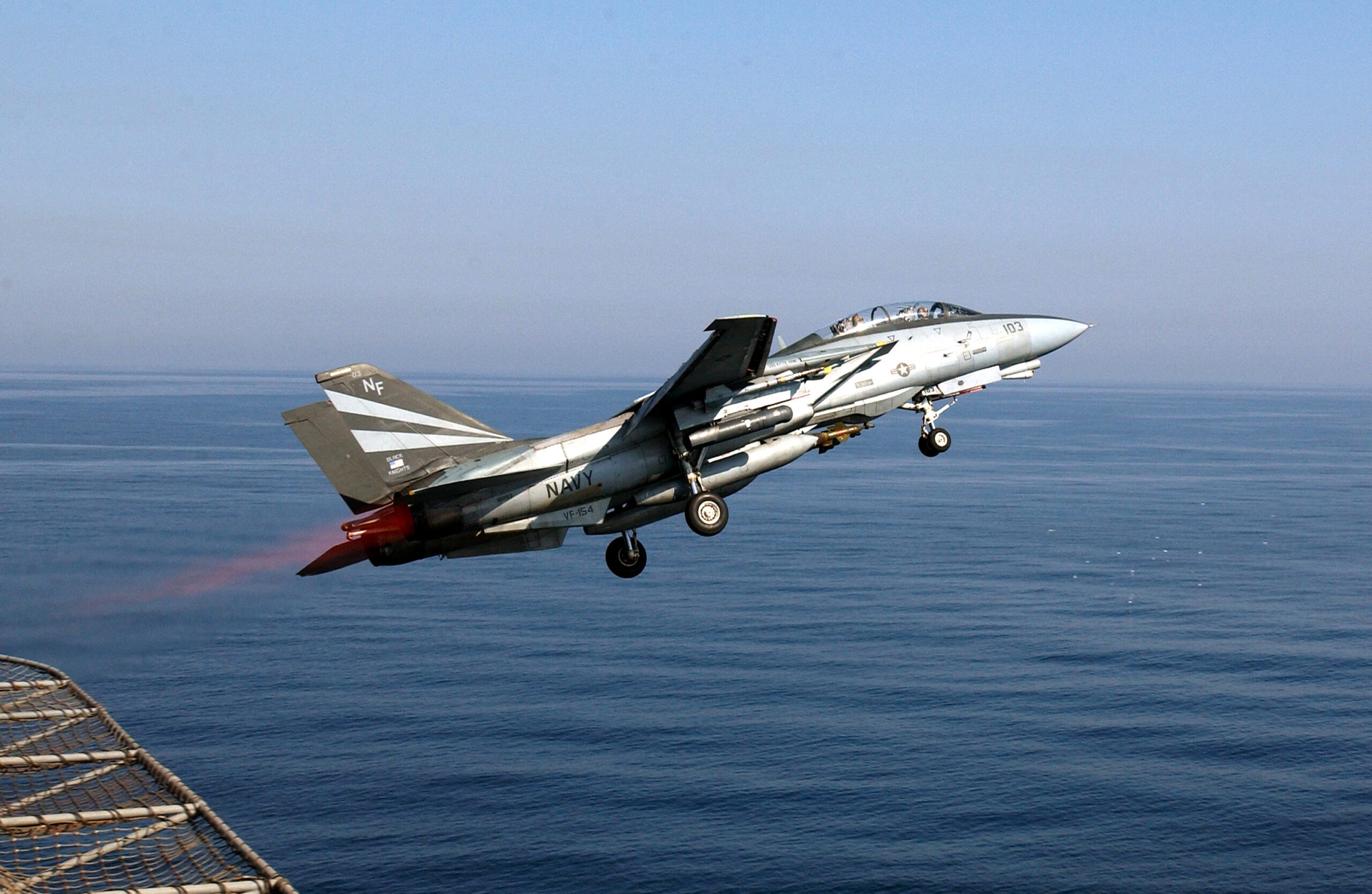
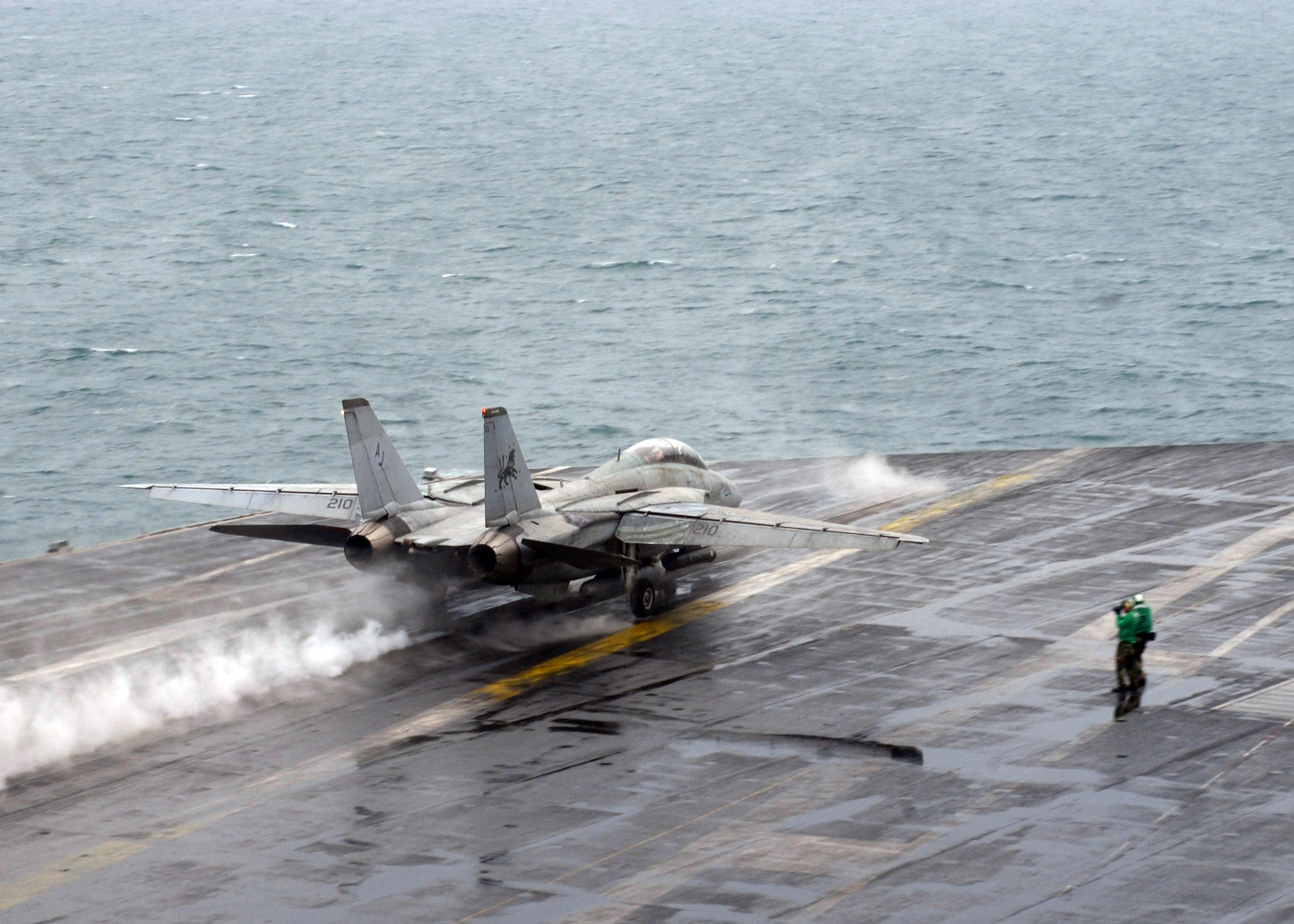
A Tomcat launch was a spectacle in itself. At maximum weights the F-14A went off the bow in afterburner, wings at 20 degrees, leaving the deck at well over 150 knots after a stroke lasting around two seconds. Recovery asked even more: bringing a big, long-nosed aircraft aboard at night, on a moving deck, demanded precise speed control from an engine that disliked rapid throttle movement, and Tomcat crews regarded the night trap as the true measure of the community. Between launch and recovery the aircraft was struck below or respotted with wings overswept to 75 degrees, nose-to-tail with its squadron mates, and the sight of a packed Tomcat flight deck remains one of the defining images of the late Cold War navy.
The maintenance bill
The Tomcat was hand-built in the old Grumman manner and it aged accordingly. The swing-wing mechanism, the hydraulics, the early avionics and above all the TF30 engines consumed maintenance hours at a rate that became the decisive argument against the aircraft; commonly cited figures put the late-career Tomcat at several times the maintenance burden per flight hour of the Super Hornet that replaced it. None of this was a secret to the sailors doing the work, and the affection Tomcat maintainers still express for the aircraft is of the exasperated, hard-earned kind. When people say the F-14 was retired by accountants rather than adversaries, this is what they mean.
Crews and community
Two seats bred a particular culture. Pilot and RIO shared success, blame and cockpit workload, and the best crews flew as a single organism, the RIO calling the intercept geometry while the pilot flew the aircraft to it. The community’s self-image, confident to the point of theatrical, was earned at the boat and amplified by Hollywood, and it left a legacy in naval aviation culture that outlasted the airframe. Ask any airshow photographer who worked the years when Tomcat demonstrations still ran: no display team needed less introduction.
The Tomcat in Iran
The F-14’s export story has no parallel. In the early 1970s the Shah of Iran, flush with oil revenue and facing Soviet MiG-25 overflights, shopped for the best interceptor America made and chose the Tomcat over the F-15. Iran ordered 80 aircraft; 79 were delivered between 1976 and 1978, with the final aircraft withheld after the 1979 revolution ended the relationship between Washington and Tehran. Iranian crews and technicians had been trained in the United States, and Iran’s Tomcats came with Phoenix missiles, making the Islamic Republic Air Force the only foreign operator of the system in history.
When Iraq invaded Iran in 1980 the Tomcat went to war in circumstances its designers never imagined, flown without American support, spares or software updates. Iranian sources credit the aircraft with a substantial number of aerial victories in the Iran-Iraq War, and some Western researchers support many of those claims, but the true tally is contested and cannot be stated as settled fact; what is not in dispute is that Iraqi pilots learned to respect the aircraft, and that the AWG-9’s ability to see and sort targets at range made the Tomcat valuable even when it did not shoot. Equally remarkable is that Iran kept the fleet flying at all. Through cannibalisation, smuggled parts, and a domestic overhaul and reverse-engineering effort centred on Isfahan, a shrinking core of Iranian Tomcats remained operational for nearly five decades after delivery, appearing regularly over military parades long after the type left US service. Reports from 2026 indicate that strikes on Iranian air bases during the recent conflict destroyed much of the surviving fleet on the ground, and how many airworthy Iranian Tomcats now remain, if any, is unclear. If the reports are accurate, the last flying Tomcats anywhere may already have flown their final sorties.
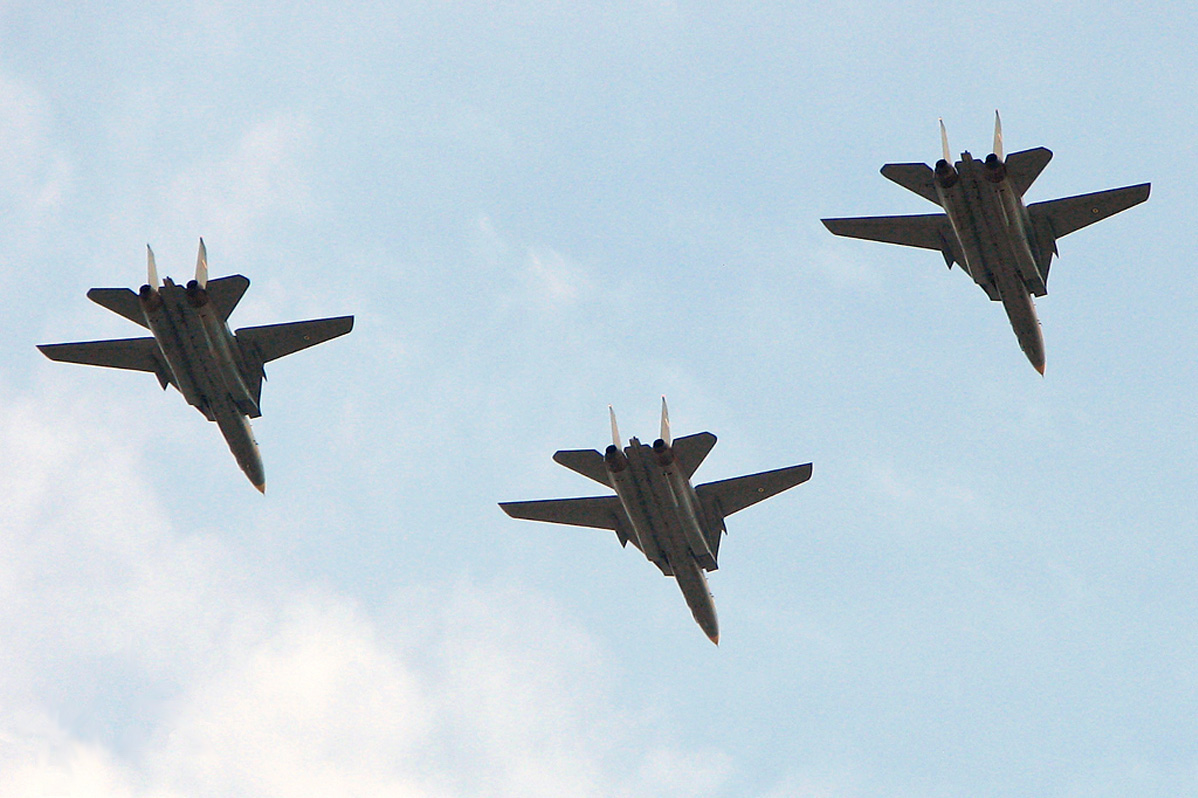
The Iranian Tomcat also reshaped what happened to the American fleet after retirement. Because Tehran’s fleet depended on scavenged and smuggled components, Washington treated every retired F-14 part as a proliferation risk: sales of surplus Tomcat spares were halted, and from 2007 the United States ran most of its stored airframes through industrial shredders rather than risk components reaching Isfahan through the surplus market. Museum aircraft were gutted of usable systems before delivery for the same reason. It is a strange distinction for a fighter to hold, being deemed too dangerous to exist even in retirement, and it explains why the Tomcat, unlike the Phantom or the Skyhawk, never had a warbird afterlife.
Variants: F-14A, F-14B and F-14D
Three principal versions of the Tomcat served, all built at Grumman’s Calverton plant, with total production of 712 aircraft between 1969 and 1992.
F-14A
The original and by far the most numerous version, powered by two Pratt & Whitney TF30 turbofans. The TF30 was the Tomcat’s weak point for its whole career: prone to compressor stalls at high angle of attack and with a punishing accident record in the early years, it demanded careful engine handling in exactly the flight regimes where a fighter pilot least wants to think about the throttles. Iran’s 79 aircraft were F-14As, and A models served the US Navy to the end of the type’s career.
F-14B
The cure for the TF30 was the General Electric F110-GE-400, which transformed the aircraft: more thrust, no stall temperament, and catapult launches without afterburner. Aircraft re-engined or new-built with the F110 but retaining broadly the original avionics were designated F-14B (initially called F-14A+). Crews regarded the B as the sweet spot of raw performance.
F-14D Super Tomcat
The definitive version combined the F110 engines with a digital cockpit, new AN/APG-71 radar developed from the AWG-9, and modernised defensive systems. Some were new-build aircraft and others, designated F-14D(R), were remanufactured from A models. The D arrived just as the Cold War ended and procurement was cut short, so it served in modest numbers; it was the D that closed out US Tomcat service in 2006. Proposals for further developed versions, including the Super Tomcat 21 concept offered as an alternative to the Super Hornet, never left the drawing board.
Where the survivors are today
No F-14 flies in private hands, and none ever will: because Iran still operated the type after 2006, retired US airframes were demilitarised with unusual thoroughness, and museum aircraft had key systems removed to keep spare parts out of the supply chain. That makes the museum survivors the only Tomcats a photographer can get close to, and there are good ones across the United States.
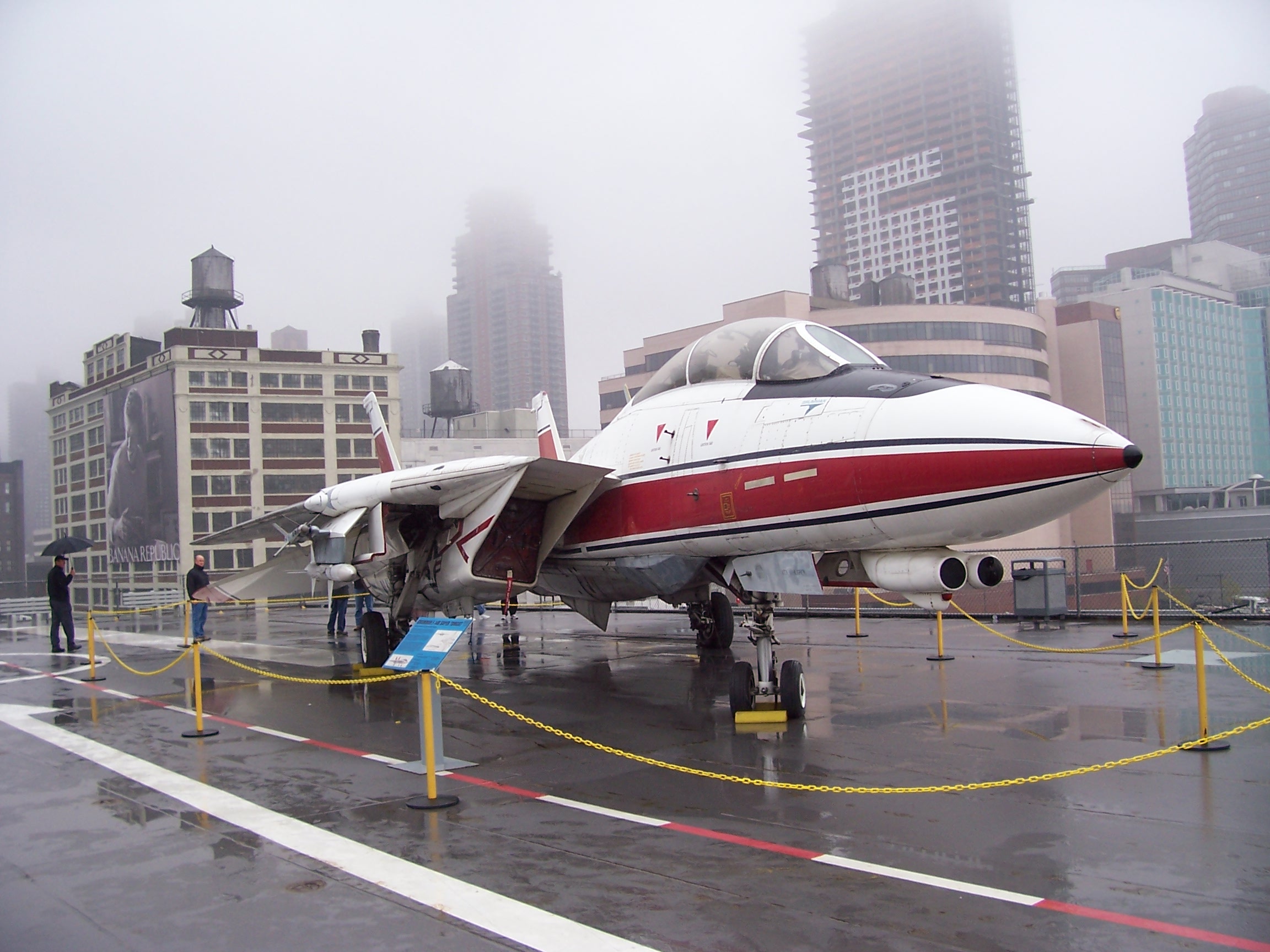
The Smithsonian’s Steven F. Udvar-Hazy Center at Chantilly, Virginia, displays F-14D(R) BuNo 159610, one of the two Tomcats that downed Libyan MiG-23s on 4 January 1989. The National Naval Aviation Museum at Pensacola, Florida, holds BuNo 157984, the fifth Tomcat built and a flight-test prototype, which became the first F-14 ever placed on public display. The Museum of Flight in Seattle shows an F-14A, BuNo 160382, a veteran of VF-84 and VF-41 among other squadrons, on loan from Pensacola. In New York the Intrepid Museum keeps a Tomcat on the carrier deck where the type looks most at home, and on the west coast the USS Midway Museum in San Diego does the same. Further examples stand with USS Yorktown at Patriots Point, South Carolina, and at numerous naval air stations and municipal museums across America. There are no Tomcats on public display in the United Kingdom, so European photographers need to build the type into an American trip.
Specifications: Grumman F-14A Tomcat
Figures below are for the F-14A, from the National Naval Aviation Museum and Museum of Flight reference data.
| Specification | F-14A Tomcat |
|---|---|
| Crew | Two: pilot and radar intercept officer |
| Powerplant | 2 x Pratt & Whitney TF30-P-412A/414A turbofans, 20,900 lb thrust each |
| Length | 62 ft 8 in (19.1 m) |
| Height | 16 ft (4.9 m) |
| Wingspan (unswept) | 64 ft 1 in (19.5 m) |
| Wingspan (fully swept) | 38 ft 2 in (11.6 m); overswept on deck to 33 ft 3 in |
| Wing sweep range | 20 to 68 degrees in flight, 75 degrees overswept for parking |
| Empty weight | 40,100 lb (18,190 kg) |
| Maximum weight | 74,349 lb (33,724 kg) |
| Maximum speed | 1,544 mph (Mach 2.34) |
| Ceiling | 55,000 ft |
| Range | About 2,400 miles |
| Armament | 20mm M61A-1 cannon; up to six AIM-54 Phoenix, plus AIM-7 Sparrow and AIM-9 Sidewinder; later laser-guided bombs and JDAM |
| Built | 712 (1969-1992) |
Photographing the F-14 today
With the flying population reduced to, at most, whatever remains in Iran, photographing the Tomcat now means museum work, and the aircraft rewards it more than most subjects. The F-14 is enormous, sculptural and full of detail, and the difference between a snapshot and a portfolio image comes down to the same craft that applies on a flight line.
Work the angles first. Head-on and three-quarter-front views emphasise the intakes, the flat pancake between the engines and the tumblehome of the twin tails, and they hide the museum clutter behind the airframe. The classic problem aircraft-in-a-hall shot, roped off with fifty other exhibits, responds to a long lens: isolate the cockpit, the wing glove, the tail art, the intake lips. Detail studies of the swing-wing pivot and the exhaust petals say Tomcat as clearly as a full airframe portrait, and our composition guide covers the thinking. Deck-top examples like Intrepid’s and Midway’s give you sky backgrounds and honest carrier context that no hall can match; time them for early entry or late afternoon and check the deck orientation against the light before you go. Indoor halls mean high ISO, wide apertures and careful white balance under mixed lighting, the same discipline described in our low light guide. And squadron markings matter with this aircraft: the Jolly Rogers skull and crossbones on a Tomcat tail is one of aviation’s great graphics, so shoot the markings properly, as our guide to military markings and serials explains.
The Tomcat and its rivals
Judging the F-14 fairly means setting it beside its contemporaries. Its great American rival was the land-based F-15 Eagle, designed in the same years for the same broad air-superiority mission; the Eagle was simpler, easier to maintain and unburdened by carrier structure, while the Tomcat carried a radar and missile system the F-15 could not match until decades of upgrades later, along with everything needed to live on a ship. The Shah of Iran evaluated both and chose the Tomcat, largely for the AWG-9 and Phoenix combination against high-flying MiG-25 reconnaissance flights.
On the Soviet side, the interceptor the Tomcat most resembled in mission was arguably the MiG-31, another big, fast, two-seat radar platform built for long-range missile engagements, while the fighters it might have met in a war, the MiG-23 and later the Su-27 family, offered a different balance of agility and reach. The two Gulf of Sidra engagements are the only occasions US Tomcats fought other fighters, and both were one-sided, though against Libyan rather than front-line Soviet opposition. The honest comparison is institutional as much as technical: no other navy in the world ever operated anything in the Tomcat’s class from a carrier deck, and none has since. The type’s closest successor in spirit today is not a naval aircraft at all but the long-range interceptor mission itself, now handled by missiles of ever greater reach on much smaller fighters.
Tomcat timeline
| Year | Event |
|---|---|
| 1968 | F-111B cancelled; VFX competition launched |
| 1969 | Grumman Model 303 selected; F-14 contract awarded |
| 1970 | First flight, 21 December; first prototype lost nine days later |
| 1972 | Deliveries to the US Navy begin |
| 1974 | First operational cruise, VF-1 and VF-2 aboard USS Enterprise |
| 1976-78 | 79 F-14As delivered to Iran |
| 1981 | Two Libyan Su-22s downed over the Gulf of Sidra |
| 1989 | Two Libyan MiG-23s downed off Libya |
| 1991 | Desert Storm service |
| 1992 | Production ends at 712 with the last F-14D |
| Mid 1990s | LANTIRN pod turns the Tomcat into a precision striker |
| 2001-06 | Bombcat combat over Afghanistan and Iraq |
| 2006 | US Navy retirement, 22 September, NAS Oceana |
A museum shot list for the Tomcat
Six frames worth planning before you visit. One: the head-on portrait at cockpit height, intakes symmetrical, shot long from across the hall to compress the airframe. Two: the wing pivot detail, the mechanical heart of the aircraft, lit best by side light on deck-top examples. Three: the twin tails from the rear quarter with the exhaust petals filling the lower frame. Four: squadron art, nose numbers and kill markings, shot square-on to keep the lettering honest. Five: the cockpit from the visitor stand where one exists, framed tight on the two seats that defined the aircraft. Six: the environmental portrait, the whole aircraft in its setting, which on a carrier deck at golden hour is as close as anyone now gets to seeing a Tomcat where it belonged. Every frame in the list works within normal museum access, and all of it is licensable subject matter if the venue permits commercial photography; our licensing page explains how archive images like our gallery collections are cleared for editorial use.
Legacy
Few aircraft have a cultural footprint to match the Tomcat’s. The 1986 film Top Gun fixed the F-14 in the public imagination as the American fighter, recruiting a generation into naval aviation, and the aircraft’s farewell appearance in 2022’s Top Gun: Maverick was greeted like the return of a retired champion. Within aviation the Tomcat’s legacy is more specific: it proved that a very large, very fast interceptor could also be a dogfighter and, late in life, a precision bomber; it demonstrated automatic variable geometry so well that no one has needed to repeat it; and its AWG-9/Phoenix system pioneered the multi-target, beyond-visual-range air battle that every modern fighter now takes for granted.
The aircraft it dethroned and the aircraft that replaced it frame its story neatly. The Tomcat took the fleet defence crown from the F-4 Phantom II, the type it flew alongside in its early years, and it handed the deck to the Super Hornet, an aircraft that is cheaper, easier and, most Tomcat crews would say quietly, less magnificent. Its great land-based contemporary, the F-15 Eagle, is still in production in updated form nearly two decades after the last Tomcat cruise, a reminder that the F-14’s early exit was economic, not aerodynamic. Grumman itself did not long outlive its most famous cat as an independent company, merging into Northrop Grumman in 1994, and Calverton’s runways fell silent. What remains is the aircraft’s hold on everyone who saw one: wings sweeping, burners lit, the Fleet Defender doing the thing it was built for.
Frequently asked questions
Why was the F-14 Tomcat retired?
Cost, not capability. The F-14’s variable-sweep wings, ageing systems and labour-intensive Grumman construction made it far more expensive to maintain per flight hour than the F/A-18E/F Super Hornet that replaced it. With the Soviet bomber threat gone after the Cold War, the Navy could no longer justify the bill, and the type was retired from US service on 22 September 2006.
How many F-14 Tomcats were built?
Grumman built 712 Tomcats between 1969 and 1992 at its Calverton, New York plant. The total includes the F-14A, the re-engined F-14B and the modernised F-14D, plus 79 F-14As delivered to Iran in the late 1970s, the type’s only export customer.
How fast was the F-14 Tomcat?
The F-14 could reach 1,544 mph, about Mach 2.34, with its wings fully swept to 68 degrees. Its service ceiling was around 55,000 feet. Few carrier aircraft before or since have matched that combination of speed and reach.
Did the F-14 ever shoot down enemy aircraft?
Yes. US Navy Tomcats destroyed two Libyan Su-22s over the Gulf of Sidra on 19 August 1981 and two Libyan MiG-23s on 4 January 1989, plus an Iraqi helicopter during Desert Storm. Iranian F-14s are credited by Iranian and some Western sources with a much larger number of kills during the Iran-Iraq War, though those totals remain contested.
Does anyone still fly the F-14?
After the US retirement in 2006, Iran was the only operator, keeping a small number of F-14As airworthy through domestic overhaul and reverse engineering. Reports from 2026 indicate that much of the surviving Iranian fleet was destroyed on the ground during recent strikes, and it is unclear whether any airworthy Tomcats remain. No F-14 flies in civilian hands anywhere.
What was the AIM-54 Phoenix missile?
The Phoenix was the F-14’s signature long-range air-to-air missile, able to engage targets around 100 miles away at speeds approaching Mach 5. Guided by the AWG-9 radar, up to six could be carried and engaged against separate targets simultaneously. It was designed to break up massed Soviet bomber raids before they could threaten a carrier group.
What is the difference between the F-14A, F-14B and F-14D?
The F-14A was the original version with Pratt & Whitney TF30 engines. The F-14B swapped them for General Electric F110s, curing the type’s engine problems. The F-14D Super Tomcat combined the F110 engines with a digital cockpit and the AN/APG-71 radar; some were new-build and some, designated F-14D(R), were remanufactured F-14As.
Where can I see an F-14 Tomcat today?
All public survivors are museum aircraft, almost all in the United States. Highlights include the Smithsonian Udvar-Hazy Center in Virginia (a MiG-killing F-14D(R)), the National Naval Aviation Museum at Pensacola (the fifth Tomcat built), the Museum of Flight in Seattle, and carrier-deck examples aboard the Intrepid in New York, USS Midway in San Diego and USS Yorktown in South Carolina.
