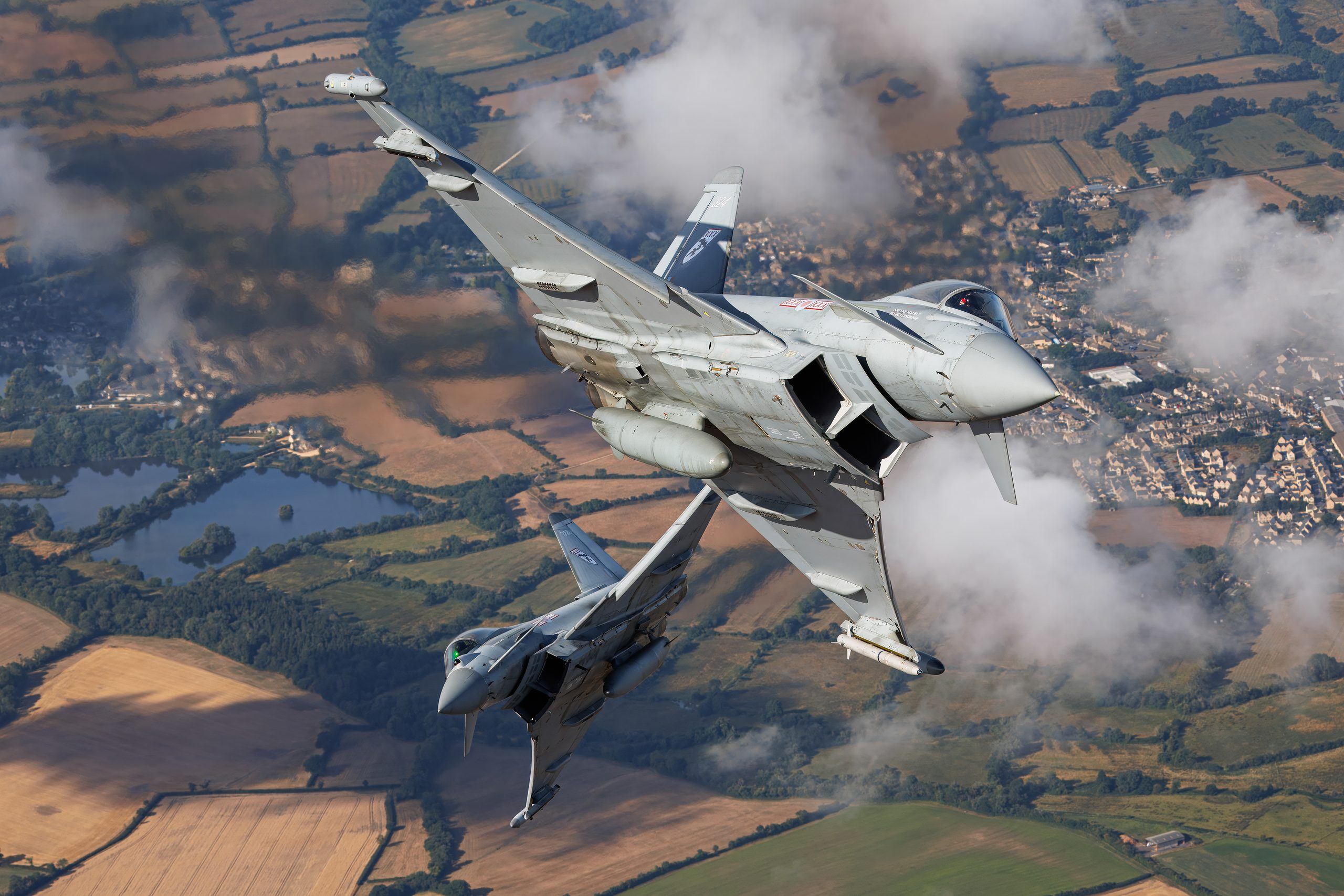
The Eurofighter Typhoon is a twin-engine, delta-canard multirole fighter built by a four-nation consortium of the United Kingdom, Germany, Italy and Spain, first flown on 27 March 1994 and in frontline service since 2003 with air forces from Scotland to the Gulf. It is the aircraft that survived the end of the Cold War it was designed for, absorbed three decades of political argument, and emerged as the backbone of European air defence, with more than 600 delivered and an order book that now stretches to ten nations. This is the full story of how it got here, where it fought, and where you can point a camera at one in 2026.
What this guide covers
- The search for a European fighter
- The end of the Cold War and near-cancellation
- Design: canards, instability and thrust
- First flight and the development aircraft
- Into service with four air forces
- Export success: from Vienna to the Gulf
- Combat history
- Tranches and variants
- Production and orders in 2026
- Where to see and photograph Typhoons today
- Eurofighter Typhoon specifications
- Legacy
- Frequently asked questions
The search for a European fighter
The Typhoon’s paper trail starts in 1979, when France, West Germany and the United Kingdom launched the European Combat Fighter study. Each nation had different aircraft to replace and different ideas about what should replace them. The RAF wanted a successor to the Harrier and the Jaguar, and increasingly saw the new jet as a Phantom replacement too, which pushed the requirement towards air-to-air performance. The French wanted something lighter that could fly from aircraft carriers. The Germans sat somewhere in between. Three companies, BAe, Dassault and MBB, produced three proposals, and no consensus emerged.
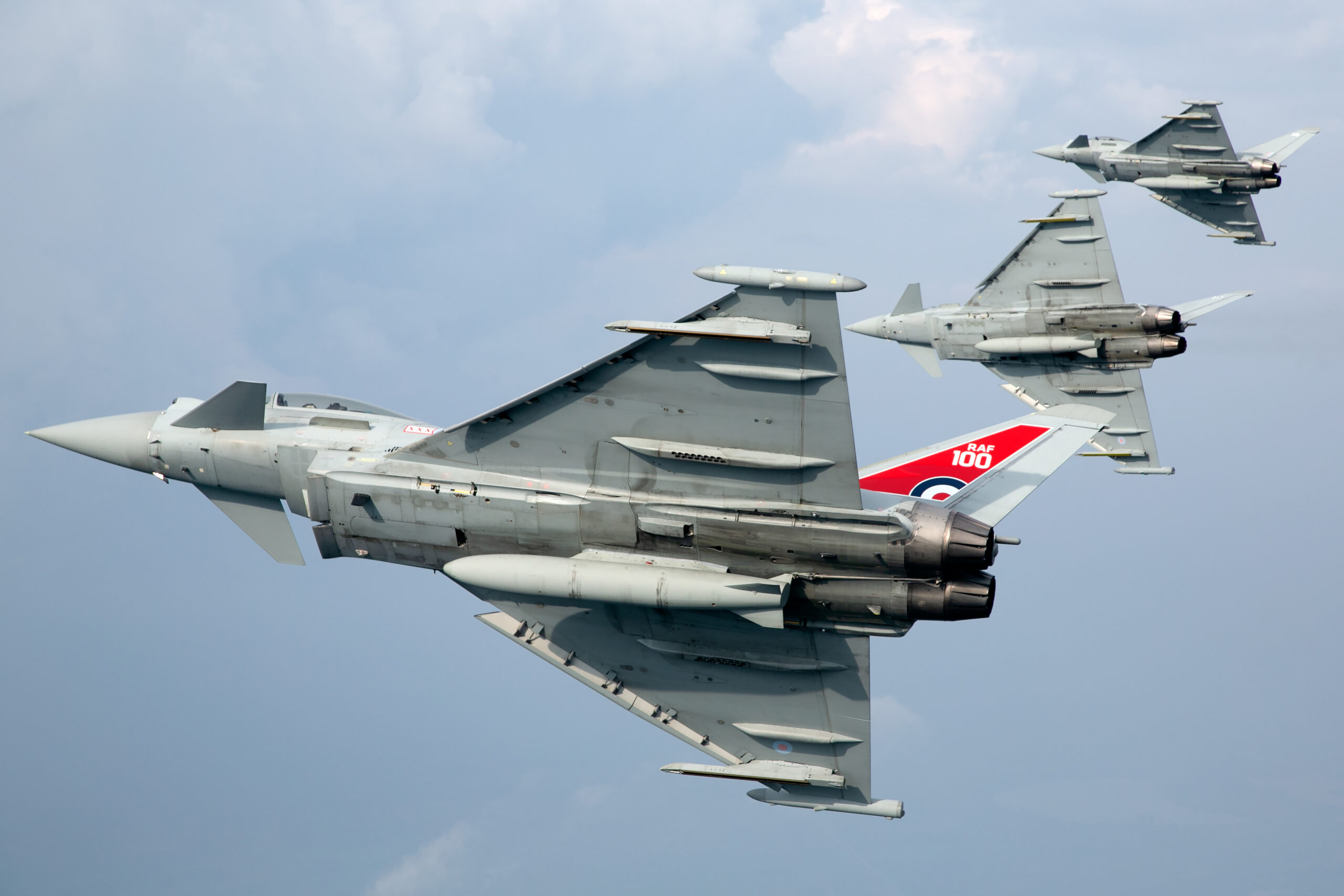
In parallel, the three Panavia nations behind the Tornado, Britain, West Germany and Italy, sketched out the Agile Combat Aircraft, a fast, highly manoeuvrable delta-canard design. The ACA programme faltered as government funding wavered, but British Aerospace refused to let the configuration die. In 1983 the British government ordered demonstrator work under the Experimental Aircraft Programme, and although hoped-for financial commitment from Italy and West Germany never fully materialised, BAe pressed on and built a single EAP prototype at Warton, powered by the Tornado’s RB199 engines.
The EAP, registered ZF534, flew for the first time on 8 August 1986 from Warton in Lancashire. Anyone looking at photographs of it today will recognise the Typhoon immediately: cranked delta wing, foreplanes, chin intake, fly-by-wire controls managing an unstable airframe. It was a hugely productive risk-reduction exercise, and it proved the aerodynamic and control concepts that the production fighter would use.
By the mid-1980s the five-nation framework had collapsed into the shape we know. France insisted on a smaller, carrier-capable aircraft and favoured Dassault’s ACX design, and in 1985 it went its own way; the ACX became the Rafale, whose demonstrator flew on 4 July 1986, a month before the EAP. The remaining four nations, the UK, West Germany, Italy and Spain, agreed a common set of requirements in 1987 for what was formally called the European Fighter Aircraft. Eurofighter Jagdflugzeug GmbH was established in Munich to manage the programme, with the work shared between BAe, MBB, Aeritalia and CASA, and the main development contracts were awarded in 1988. A parallel consortium, Eurojet, was formed to develop the new EJ200 engine. On paper, everything was set. Then history intervened.
The end of the Cold War and near-cancellation
The EFA was conceived as a Cold War interceptor and air-superiority fighter, designed to meet Warsaw Pact aircraft over the North German Plain. In November 1989 the Berlin Wall came down, and within a year the programme’s central justification had evaporated along with the state it was designed to fight. Defence budgets across Europe fell fast, and no partner felt the squeeze more than the newly reunified Germany, which was absorbing the enormous cost of integrating the former East.
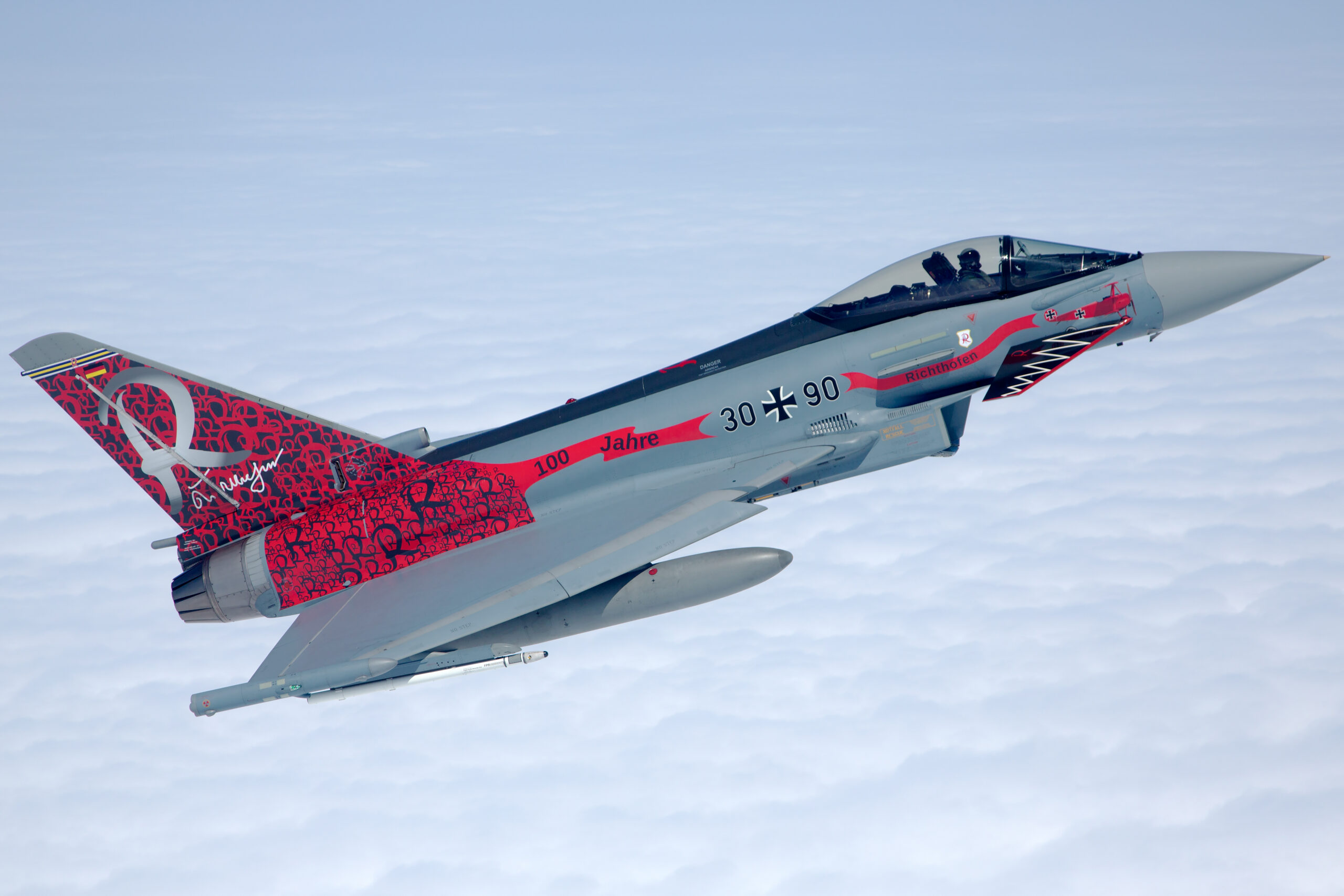
In 1992 Germany’s defence minister Volker Rühe publicly pushed to abandon the EFA as too expensive, and for a period the programme’s survival was in real doubt. The compromise that saved it was a cost-reduction exercise and a rebranding: the aircraft re-emerged as Eurofighter 2000, with a stretched timetable and options for cheaper equipment fits. The airframe and the core design survived intact. What the wrangling really bought was delay, and the delay is why an aircraft with a 1980s requirement did not reach squadrons until 2003.
It is worth pausing on how close this came to never happening. Four parliaments had to keep voting money for a fighter whose original enemy no longer existed, through the recessions of the early 1990s, with the press in every partner nation asking why the money was not being spent elsewhere. The programme survived partly because of industrial logic, tens of thousands of skilled jobs spread across four countries, and partly because air forces argued, correctly as it turned out, that air policing and expeditionary warfare would still need a modern fighter. The production umbrella contracts were finally signed in 1998, the same year the aircraft received its service name: Typhoon in the UK and for export, Tifone in Italy, Tifón in Spain. Germany generally sticks to plain Eurofighter to this day.
Design: canards, instability and thrust
The Typhoon is a deliberately unstable aeroplane. Its cranked delta wing and long-arm foreplanes place the centre of lift ahead of the centre of gravity at subsonic speeds, which means that without intervention the aircraft would pitch away from controlled flight in a fraction of a second. A quadruplex digital fly-by-wire system, with no mechanical backup, makes hundreds of corrections per second and turns that instability into agility. The idea was not new in itself, the F-16 had flown with relaxed stability and analogue fly-by-wire in 1974, but the Typhoon pushed the concept further, pairing severe pitch instability with a big delta and canards for enormous lift and rapid pitch response, especially at high altitude and supersonic speed, where the aircraft was designed to fight.
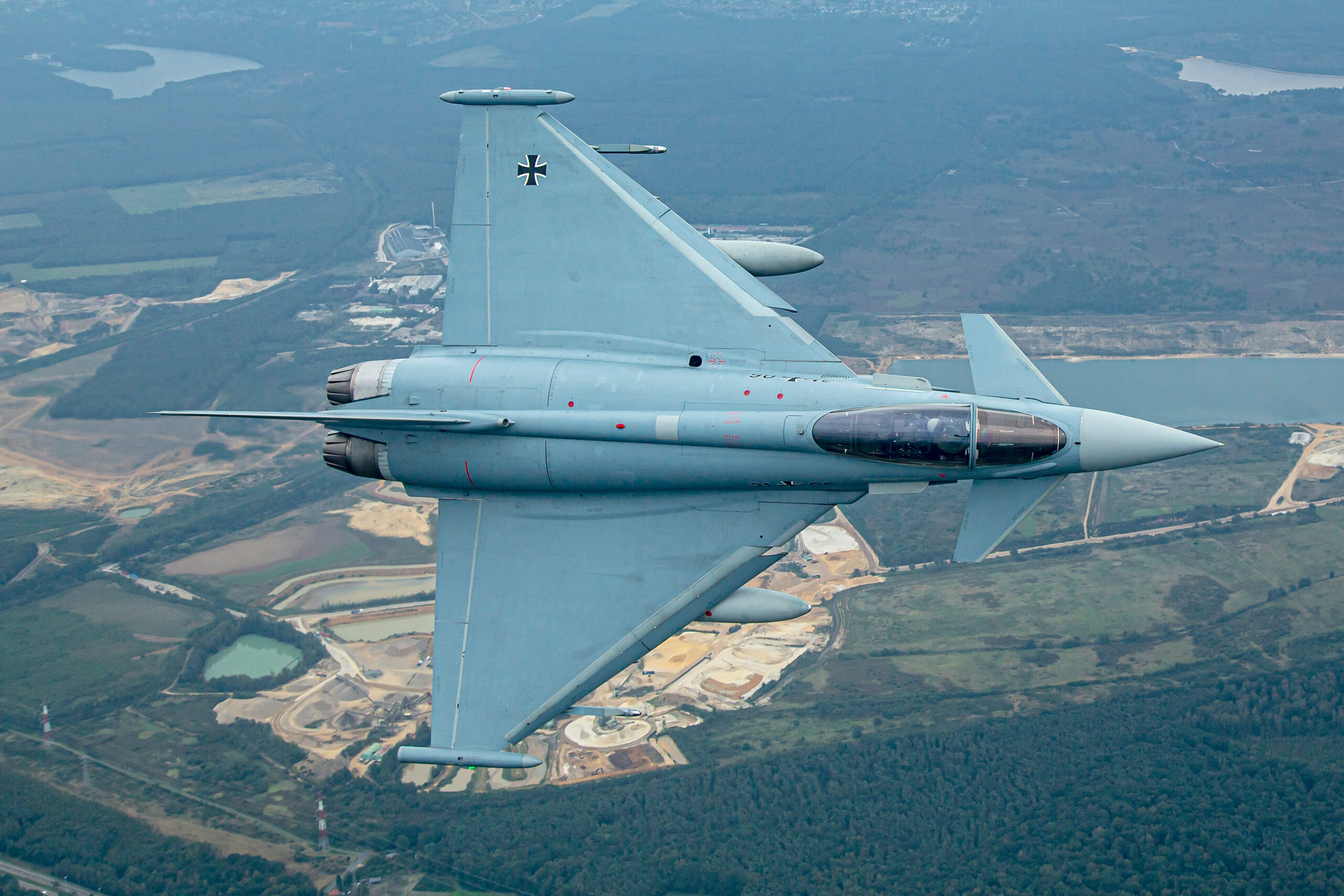
That last point is the key to understanding the whole design. The Typhoon was shaped around beyond-visual-range combat: get to height and speed quickly, launch long-range missiles from an energy advantage, and dictate the terms of the fight. Everything serves that goal. The two Eurojet EJ200 turbofans each produce around 13,500 lb of thrust dry and 20,000 lb in reheat, giving a thrust-to-weight ratio better than one at typical combat weights, and Eurofighter states the aircraft can supercruise, sustaining supersonic flight without reheat in appropriate configurations. The airframe is roughly 82 per cent composites and other low-observable-friendly materials by surface area according to Eurofighter, and while the Typhoon is not a stealth aircraft, its frontal radar cross-section is far smaller than the Tornado and Phantom generation it replaced.
Sensors and defensive aids
The original radar is the Captor, a mechanically scanned multi-mode set developed from the ECR 90 programme, backed by the PIRATE infrared search and track sensor on the port side of the windscreen, which lets the pilot find and track targets passively without radiating. Self-protection comes from the Defensive Aids Sub-System, DASS, an integrated suite of radar warning receivers, electronic countermeasures, missile approach warners, chaff and flare dispensers and a towed radar decoy streamed from the starboard wingtip pod.
The big sensor story of the last decade is the move to electronically scanned radar. The Captor-E AESA family, known as the European Common Radar System, comes in three strands: ECRS Mk0, developed for Kuwait and Qatar and now in frontline service; ECRS Mk1 for German and Spanish aircraft; and the most ambitious, ECRS Mk2, developed by Leonardo UK for the RAF, which adds electronic warfare and electronic attack functions to the radar itself. A prototype Mk2 flew on a Typhoon test aircraft from Warton in September 2024, and in January 2026 the UK confirmed full production funding of £453.5 million, building on an initial £204.6 million integration contract from June 2025, with around 40 RAF aircraft due to receive the radar from about 2030. A distinctive feature across the Captor-E family is the repositioner, a swashplate mount that lets the antenna physically swivel as well as steer its beam electronically, giving a wider field of regard than a fixed AESA plate.
The cockpit
The pilot flies with a hands-on-throttle-and-stick arrangement, three large multifunction displays, a wide-angle head-up display and direct voice input for selected commands. The helmet-mounted symbology system lets the pilot cue sensors and high-off-boresight missiles by looking at a target. Compared with the aircraft it replaced, the workload reduction is enormous, which matters in the Typhoon’s daily reality of long quick-reaction-alert scrambles flown by a single pilot.
First flight and the development aircraft
The first Eurofighter development aircraft, DA1, made its maiden flight on 27 March 1994 from Manching in Germany, flown by DASA chief test pilot Peter Weger. Because the definitive EJ200 engines were not yet ready, DA1 flew on RB199s borrowed from the Tornado programme, and its early work focused on handling qualities. Britain’s DA2 followed from Warton in early April 1994, also RB199-powered, and went on to a long career in envelope expansion, much of it in a striking all-black paint scheme covered in pressure-sensing transducers; it is now displayed at the RAF Museum.
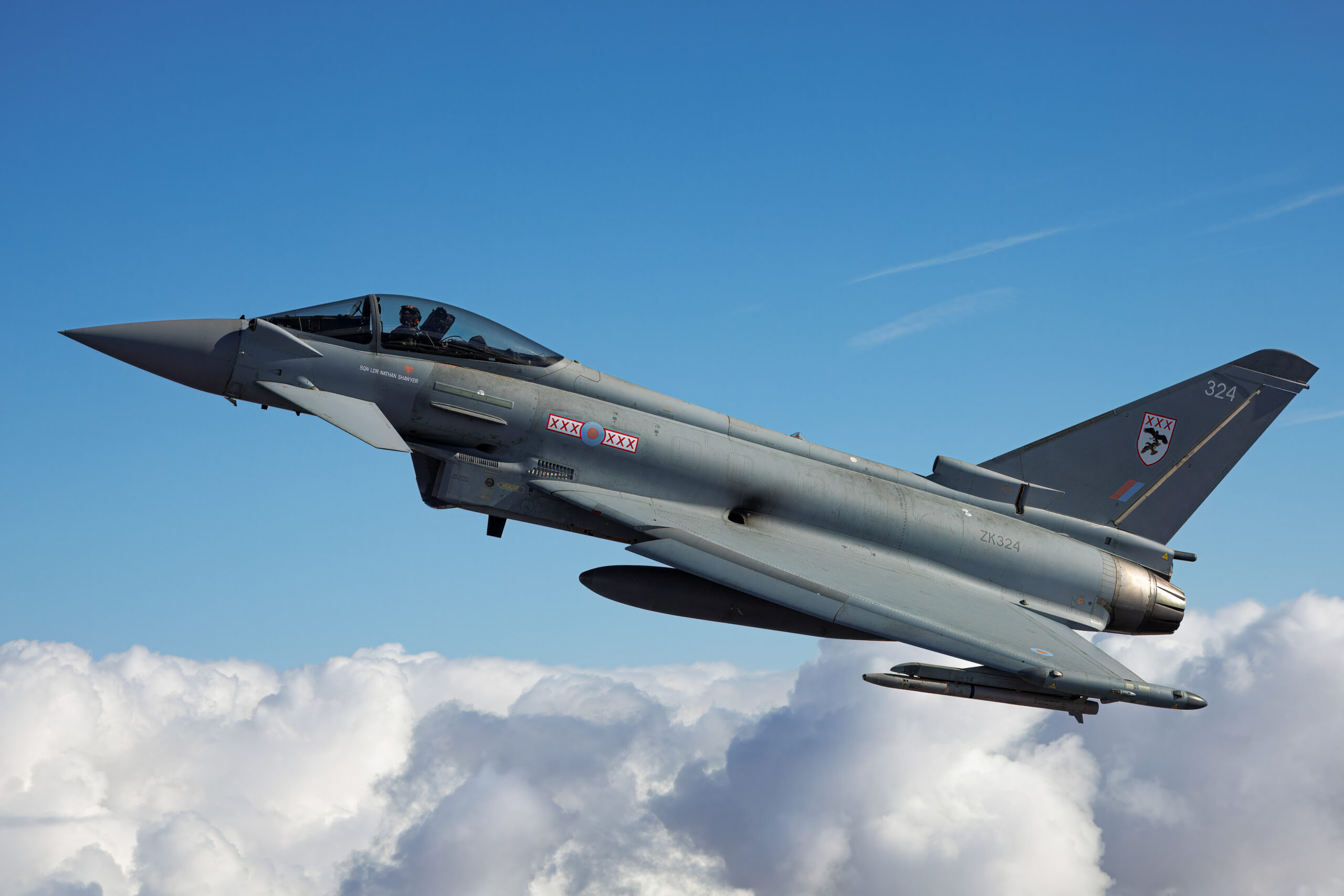
Seven development aircraft eventually flew, shared among the four partners, each with a specialism. Italy’s DA3 became the first to fly with EJ200 engines in 1995 and led weapons integration work. Spain’s DA6 was the first two-seater. DA4, a British two-seater, carried radar development, while the German DA5 led on the Captor radar and Italy’s DA7 handled navigation and missile firing trials. DA1 itself was re-engined with EJ200s after 123 flights and rejoined the test programme in 1999 with updated avionics. The development fleet was later reinforced by instrumented production aircraft, and between them they cleared the flight envelope, the carefree-handling flight control laws, and the initial air-to-air weapons fit that the first squadrons would take on alert.
The test programme was not without cost or tragedy elsewhere in the wider effort, and progress was slower than anyone had hoped in the lean 1990s, but by the turn of the millennium the aircraft worked, the production contracts were signed, and four final assembly lines, at Warton in England, Manching in Germany, Turin in Italy and Getafe in Spain, were tooling up. Uniquely among modern fighters, every partner nation assembles its own aircraft, with each country building the same components for every jet: front fuselages in the UK, centre fuselages in Germany, wings shared between Italy and Spain, and so on. It is industrially inefficient and politically brilliant, which is a fair summary of the entire programme.
Into service with four air forces
Series production aircraft began reaching the four air forces in 2003. Germany took its first production aircraft in August 2003, and in May 2004 Jagdgeschwader 73 “Steinhoff” at Rostock-Laage formally welcomed the type as the first operational wing, initially focused on converting former MiG-29 pilots. In the UK, No. 17 (Reserve) Squadron worked up as the operational evaluation unit and began Typhoon operations at the start of 2004 after teething troubles, including a braking-system grounding, pushed the handover back from late 2003. Italy delivered its first aircraft to Cameri in February 2004 for pilot training, and Spain’s 113 Squadron at Morón Air Base received its first three aircraft on 27 May 2004.
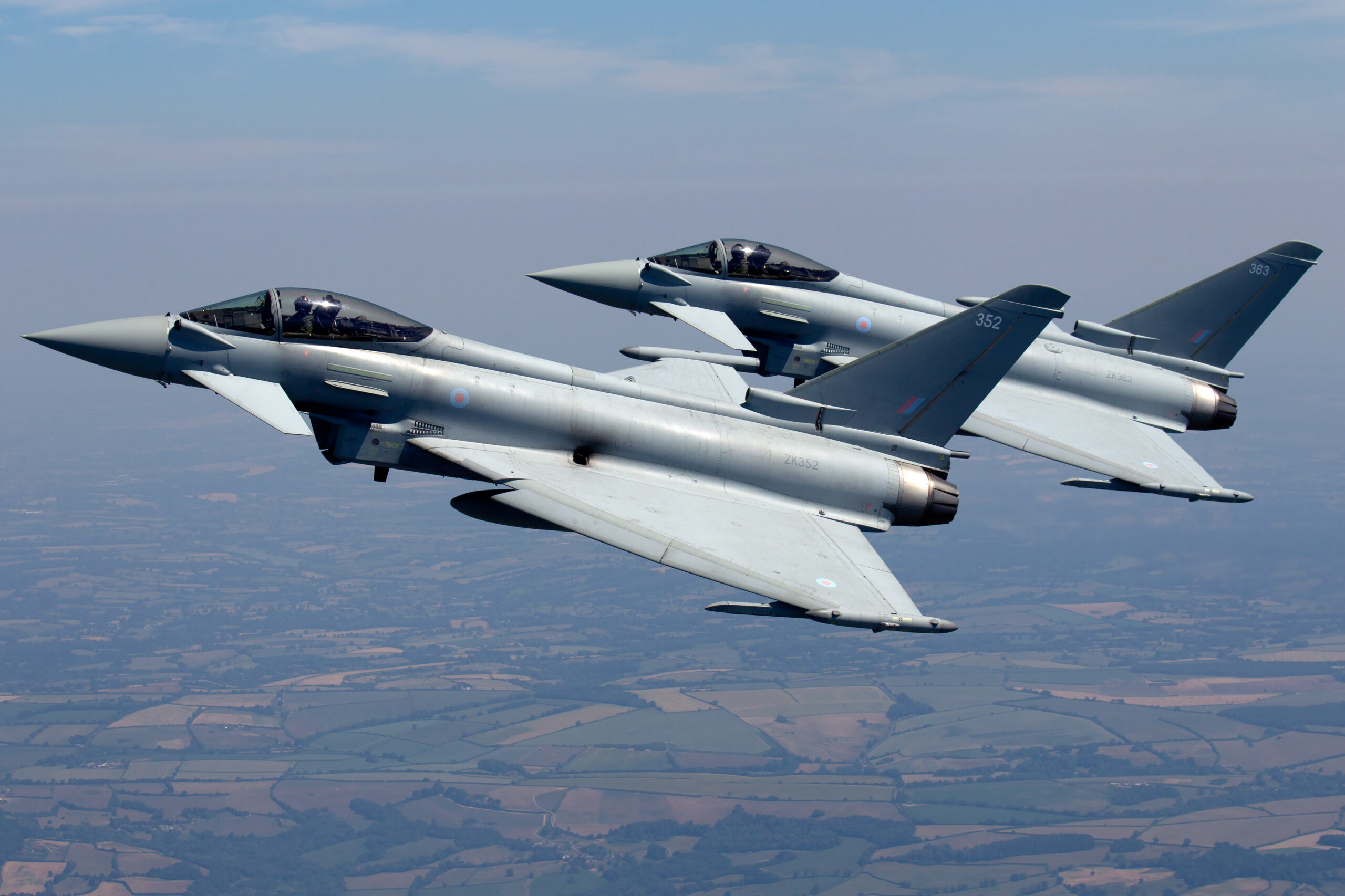
The early jets were pure air-defence machines, and the type settled quickly into the quick reaction alert role that remains its bread and butter. RAF Typhoons took over southern UK QRA at Coningsby in 2007 and later northern QRA at Lossiemouth, ending decades of Tornado F3 alert duty. German Eurofighters stood up alert at Neuburg and later Wittmund and Nörvenich; Italy’s Grosseto and Gioia del Colle wings and Spain’s Morón and Albacete wings did the same over their own airspace and, increasingly, over allies. Baltic air policing detachments to Lithuania and Estonia became a fixture for all four nations, and by the 2020s Typhoons were also policing NATO’s southern flank from Romania under the RAF’s Operation Biloxi and equivalent allied deployments.
Growing pains
The early years were not smooth. Tranche 1 aircraft arrived as air-defence jets in an era when the wars being fought, Afghanistan and Iraq, demanded ground attack, and critics in every partner nation asked pointed questions about cost and availability. An austere air-to-surface capability was rushed onto RAF jets from 2008, but the fleet spent much of its first decade doing what it was actually designed for: holding alert. Availability improved steadily as the support arrangements matured, and the four nations gradually shifted from bespoke national fixes to common upgrade packages agreed through NETMA, the NATO agency that manages the programme. The lesson the partners drew, that capability must be planned in coherent steps rather than bolted on, shaped the tranche structure that followed.
For the RAF the transformational step was Project Centurion, completed before the Tornado GR4 retired in March 2019. Centurion transferred the Tornado’s precision-strike arsenal to the Typhoon FGR4: Storm Shadow cruise missiles, Brimstone anti-armour missiles and the Meteor ramjet-powered air-to-air missile joined the already-integrated Paveway IV precision bomb. The single airframe now covered almost the entire fast-jet task, which is exactly what the original 1979 requirement had struggled to define.
Export success: from Vienna to the Gulf
Austria became the first export customer, selecting the Typhoon in 2002 and taking 15 Tranche 1 aircraft, flown by the surveillance wing at Zeltweg, where they still mount Austria’s airspace policing today. The order was politically contentious in Austria for years, but the jets have quietly done their job for two decades, and Zeltweg’s Airpower show remains one of the best places in Europe to see them.
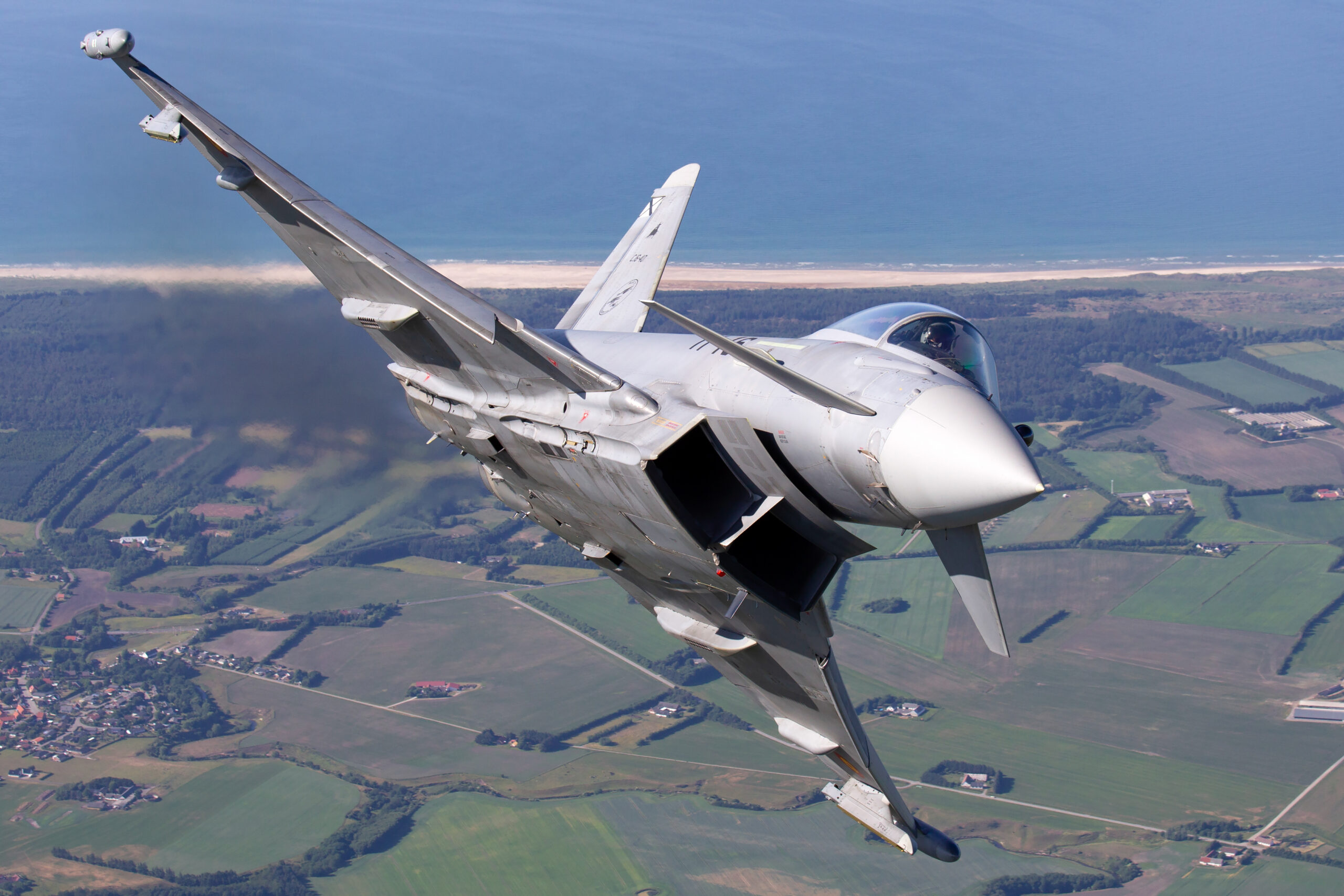
The Gulf transformed the programme’s finances. Saudi Arabia signed the Project Salam deal in 2007 for 72 aircraft, with deliveries from BAE Systems beginning in 2009 and completing in 2017; the Royal Saudi Air Force remains the largest export operator, and its 72 delivered jets have flown combat missions over Yemen, operations that human-rights organisations have persistently criticised. Oman ordered 12, all delivered by the end of 2018 and flown from Adam Air Base. Kuwait ordered 28 in 2016 and became the first customer for the Captor-E AESA radar, with handovers beginning in December 2021; 21 had been delivered by late 2025. Qatar signed for 24 in 2017, and its jets, delivered from 2022, train alongside the RAF in the unique joint No. 12 Squadron arrangement at Coningsby, the first joint RAF squadron with another nation since the Second World War.
Then, in October 2025, came the order the programme had chased for years: the Republic of Türkiye signed for 20 Tranche 4 standard aircraft in a government-to-government deal with the UK reported at up to £8 billion including weapons and support, making Türkiye the tenth Eurofighter nation. First deliveries are planned for 2030 from the Warton final assembly line. Reports of additional second-hand aircraft for Türkiye from Qatari and Omani stocks have circulated in credible trade media but had not been confirmed as signed contracts at the time of writing, so treat those as unconfirmed. Campaigns elsewhere, including long-running interest from Poland’s neighbours’ market watchers and repeated speculation about further Saudi batches, likewise remain just that, speculation, until contracts are signed.
Combat history
The Typhoon fired its first shots in anger over Libya. When the UN-mandated intervention began in March 2011, RAF Typhoons deployed to Gioia del Colle in southern Italy under Operation Ellamy and flew their first combat missions on 21 March 2011, initially policing the no-fly zone. In April 2011 an RAF Typhoon dropped its first bombs in combat, striking Libyan ground vehicles with Enhanced Paveway II, and XI Squadron jets went on to fly more than 300 combat missions during the campaign, working in mixed pairs with Tornado GR4s that carried the targeting expertise the Typhoon force was still building. Italian Air Force Typhoons flew air-defence sorties over Libya in the same campaign.
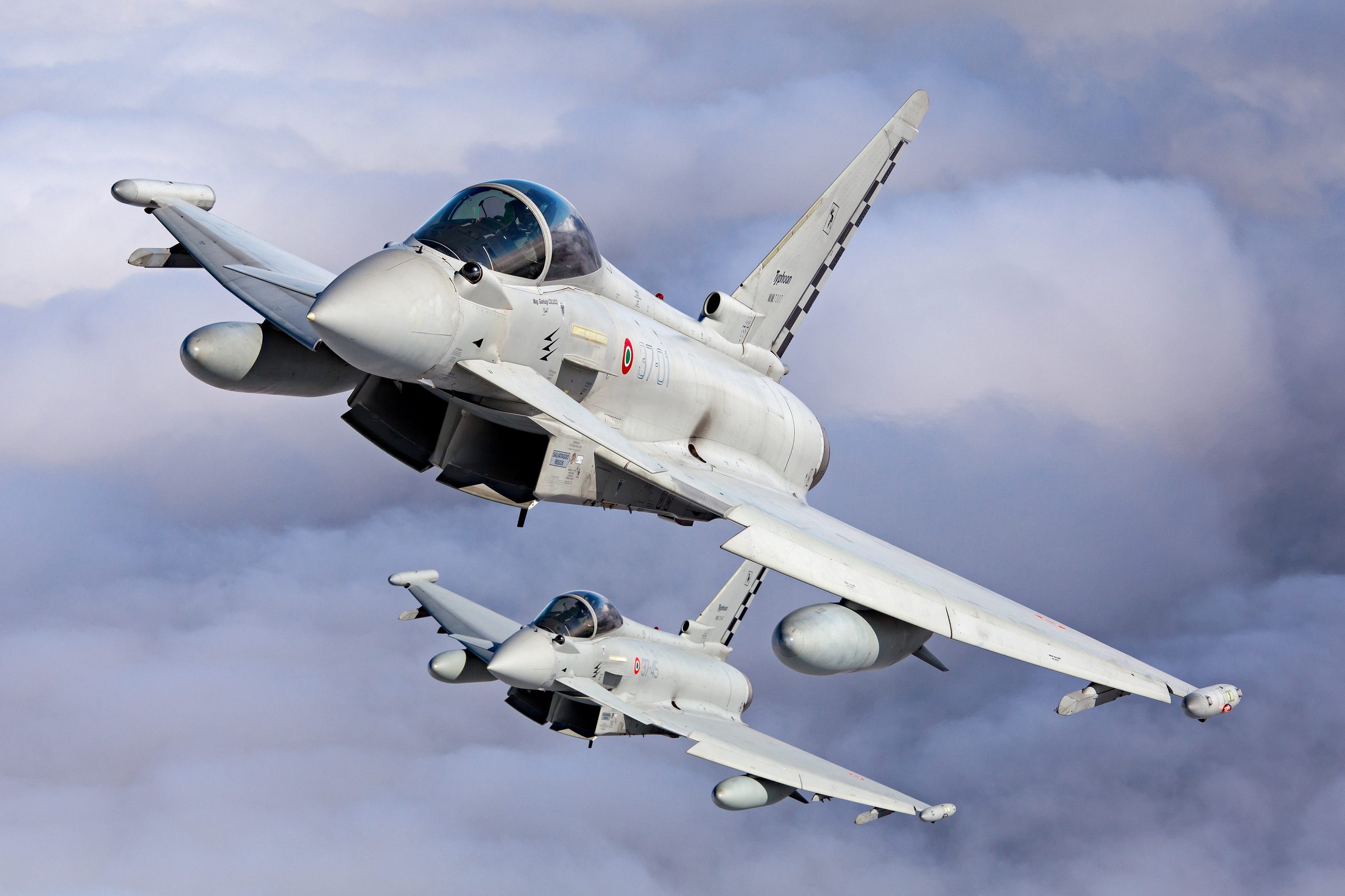
From December 2015 RAF Typhoons joined Operation Shader, the UK contribution to the campaign against the Islamic State group, flying strike missions over Iraq and Syria from RAF Akrotiri in Cyprus with Paveway IV and, from 2019, Brimstone. On 14 December 2021 a Typhoon on a Shader patrol destroyed a small hostile drone threatening the coalition base at Al Tanf in Syria with an ASRAAM, the type’s first operational air-to-air kill and the first RAF air-to-air missile firing of the operation. In April 2024 RAF Typhoons shot down Iranian one-way attack drones during the mass attack on Israel, and from January 2024 Typhoons from Akrotiri struck Houthi military targets in Yemen in US-led operations to protect Red Sea shipping.
Saudi Typhoons have flown strike and air-defence missions in the Yemen conflict since 2015. Beyond the headlines, the type’s daily operational output is air policing: UK QRA from Coningsby, Lossiemouth and the Falklands, German alert over central Europe, Italian and Spanish detachments from Iceland to the Black Sea, and near-continuous Baltic policing rotations that regularly intercept Russian aircraft. Eurofighter’s chief executive said in late 2025 that around 80 per cent of the four core nations’ operational air missions are flown by the Typhoon. Claims you will see about exercise performance, such as Typhoons “beating” F-22s at Red Flag Alaska in 2012 or racking up lopsided kill ratios against various types, trace back to pilot anecdotes and partial accounts of specific training setups; treat all of them as anecdotal rather than as verified combat records.
Tranches and variants
Typhoon production is organised in tranches, contractual batches that double as capability steps. Tranche 1 aircraft, delivered from 2003, were air-defence jets with limited ground-attack capability added later; the RAF’s were designated Typhoon F2 (single-seat) and T1 (two-seat), later upgraded to FGR4 and T3 standards. Tranche 2, delivered from 2008, brought a new mission computer suite and full multirole growth, and Tranche 3A added provisions for the AESA radar, conformal-tank plumbing and other updates. The RAF ordered 160 aircraft across those three tranches: 53 Tranche 1, 67 Tranche 2 and 40 Tranche 3A. The UK retired its remaining Tranche 1 fleet in 2025, apart from four aircraft that continue to fly air defence from Mount Pleasant in the Falkland Islands with 1435 Flight until around 2027.
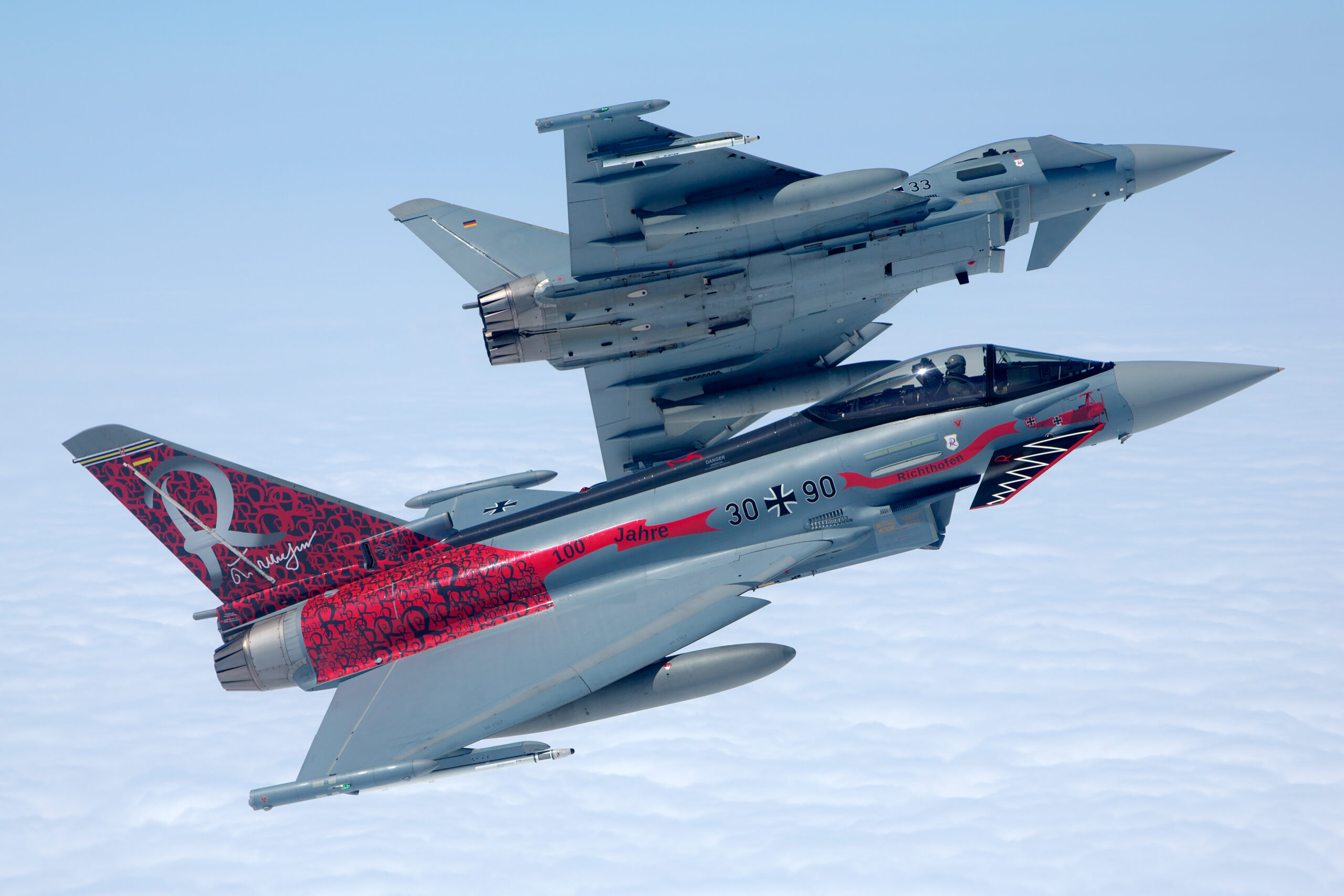
Tranche 4 is the current production standard, launched by Germany’s 38-aircraft Quadriga order signed in November 2020 and continued by Spain’s 20-aircraft Halcon I contract in 2022, Italy’s order for up to 24 aircraft agreed in 2024, Spain’s 25-aircraft Halcon II follow-up concluded in December 2024, and Türkiye’s 20. These jets carry the ECRS Mk1 radar in German and Spanish service and much-updated computing. Tranche 5, signed first by Germany in October 2025 for 20 aircraft with deliveries planned from 2031 to 2034 from the Manching line, will fold in further elements of the planned Long Term Evolution upgrade path.
Two specialised directions deserve mention. Germany’s Eurofighter EK, confirmed by parliamentary approval in November 2023, will convert 15 existing German aircraft for electronic combat, fitted with Saab’s Arexis emitter-location and jamming technology and Northrop Grumman’s AGM-88E AARGM anti-radiation missile, to be NATO-certified by 2030 as the replacement for the Tornado ECR in the air-defence-suppression role. And the RAF’s ECRS Mk2 programme will give around 40 British Tranche 3 aircraft a radar that doubles as an electronic-warfare weapon from about 2030. The long-discussed naval Typhoon and thrust-vectoring variants, by contrast, never left the brochure stage.
Production and orders in 2026
For most of the 2010s the Typhoon story was one of a production line winding down. That has reversed emphatically. The war in Ukraine, European rearmament and the long timelines of sixth-generation programmes have combined to refill the order book, and the manufacturing consortium is now increasing output rather than managing decline.
Updated July 2026: By September 2025, 613 Typhoons had been delivered, and Eurofighter GmbH passed the milestone of one million fleet flying hours around the turn of 2025-26. Confirmed orders now come from ten nations and stand at more than 750 aircraft, following Germany’s Quadriga (38) and Tranche 5 (20) contracts, Spain’s Halcon I and II (45 in total), Italy’s order for up to 24 Tranche 4 jets, and Türkiye’s 20 aircraft signed in October 2025. Production is running at roughly 14 aircraft a year, with the partner companies working to lift that to 20 a year by 2028 and studying rates of up to 30. BAE Systems completed the final jet of Qatar’s order at Warton in July 2025, temporarily pausing UK final assembly, but the Turkish contract restarts the Warton line, with first deliveries due in 2030; under the programme’s workshare, about 37 per cent of every Typhoon is built in the UK regardless of assembly location. The UK itself had not ordered any new-build Tranche 4 or 5 aircraft as of mid-2026, a gap that unions, industry and a November 2025 House of Commons debate on Typhoon sovereign capability have all pressed the government to close. Eurofighter’s chief executive has said the newest aircraft will be flying into the 2060s.
The programme sustains more than 100,000 jobs across over 400 European companies, which is a large part of why four governments kept it alive through every crisis since 1989. The consortium is also positioning the Typhoon as the bridge to the next generation: the UK and Italy plan to replace it from around 2035 with the GCAP fighter developed with Japan, while Germany and Spain look to the Franco-German-Spanish FCAS, and in both cases current Typhoons and their crews are the foundation those programmes will build on.
Where to see and photograph Typhoons today
The Typhoon is one of the most accessible modern fighters for photographers, because it stands quick reaction alert from bases with well-established viewing spots and because the RAF still fields a dedicated display jet. In the UK, RAF Coningsby in Lincolnshire is the obvious first stop: two frontline squadrons, the operational conversion unit, the joint UK-Qatari 12 Squadron and the Battle of Britain Memorial Flight share the circuit, and the lay-bys off the A153 give honest side-on light for most of the day. RAF Lossiemouth on the Moray coast is the northern QRA station and pairs Typhoon movements with P-8 Poseidons; the viewing area near the 05 threshold is popular for a reason.
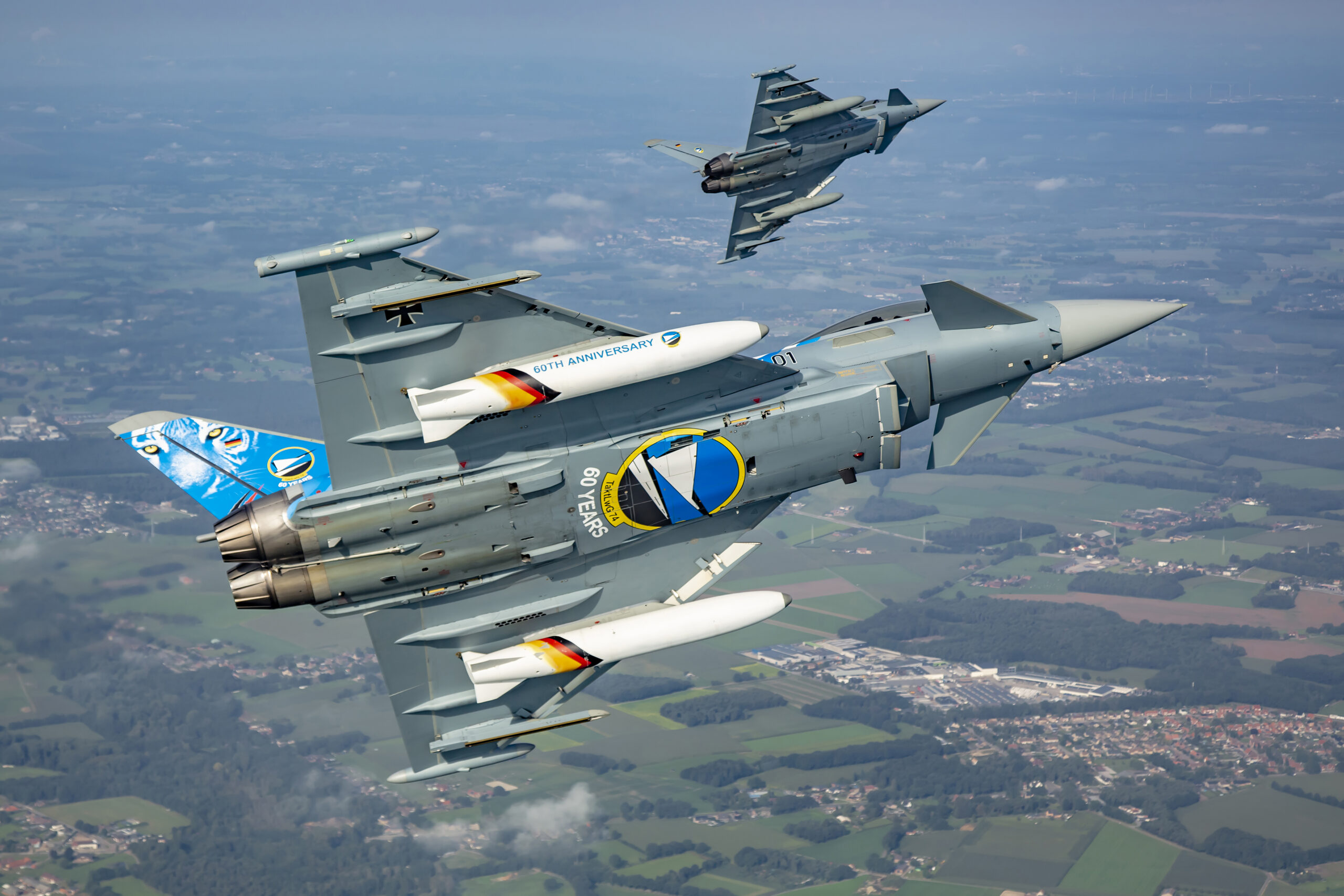
On the continent, German Eurofighters fly from Neuburg, Nörvenich, Wittmund and the training wing at Rostock-Laage; Italy’s fly from Grosseto and Gioia del Colle; Spain’s from Morón near Seville and Albacete, which also hosts NATO’s Tactical Leadership Programme and its excellent spotting culture; and Austria’s from Zeltweg, home of the spectacular Airpower show in the Styrian mountains. For 2026 the RAF Typhoon Display Team flies under the callsign DRAGON01, with Flight Lieutenant Tom Nation of 29 Squadron at Coningsby displaying the FGR4 at venues including Duxford, RIAT at Fairford, Cosford, Eastbourne and Blackpool plus dates in Sweden and Denmark, so check the published schedule before you travel. The Royal International Air Tattoo remains the single best event for Typhoon variety, regularly drawing RAF, German, Italian, Spanish and Gulf-operated jets to one flightline.
A few practicalities for base photography. Typhoon squadrons typically fly two or three waves a day in the working week, with a morning launch around mid-morning and recoveries an hour or two later, though nothing is guaranteed and QRA scrambles come when they come. Winter often brings the best combination at Coningsby: low sun angles, active flying and reheat departures that show visible flame in the cold air. Stay on public land, never obstruct the crash gates, and be aware that both UK bases are used to photographers and generally relaxed provided people behave sensibly. At the big European shows, arrival and departure days frequently produce better images than the display itself, because the jets taxi close to the crowd line and the light is not overhead.
Photographically, the Typhoon rewards preparation. It is fast, it displays tight, and its grey-on-grey scheme kills contrast in flat light, so meter for the airframe rather than the sky and shoot in the golden hours when bases fly late waves. Reheat take-offs with the twin EJ200s are a low-light gift. If you are new to fast jets, our guide on how to photograph fast jets covers shutter-speed strategy and panning technique, and our walkthrough of airshow camera settings and autofocus will help you keep a display Typhoon sharp through a minimum-radius turn. You can see a selection of my own Typhoon work in the galleries, and details of usage terms for editorial and commercial licensing are on the licences page.
Eurofighter Typhoon specifications
The figures below are for the RAF’s Typhoon FGR4 as published by the Royal Air Force, with Eurofighter GmbH figures noted where they differ. The often-quoted Mach 2.0 maximum comes from the manufacturer for a clean aircraft at altitude; the RAF currently lists the more conservative Mach 1.6 for its service-configured jets.
| Crew | 1 pilot (two-seat trainer variants in all fleets) |
|---|---|
| Powerplant | 2 x Eurojet EJ200 turbofans |
| Thrust | 20,000 lb each in reheat (approx. 13,500 lb dry) |
| Length | 15.96 m |
| Height | 5.28 m |
| Wingspan | 10.95 m |
| Wing area | 50 m² |
| Maximum speed | Mach 1.6 (RAF); Mach 2.0 quoted by Eurofighter GmbH |
| Maximum altitude | 55,000 ft |
| Radar | Captor (ECR 90); Captor-E/ECRS AESA on new-build and upgraded aircraft |
| Air-to-air weapons | Meteor, AMRAAM, ASRAAM |
| Air-to-surface weapons | Paveway IV, Brimstone 2, Storm Shadow |
| Gun | Mauser 27 mm cannon |
| Refuelling | Probe and drogue |
Numbers only tell part of the story. What sets the Typhoon apart in service is sustained performance at height: the combination of thrust, wing and instability lets it hold energy in a supersonic fight better than almost anything it trains against, and the Meteor missile turns that altitude and speed into launch range.
Legacy
Judged against its original schedule, the Typhoon was late, over budget and aimed at an enemy that dissolved before it flew. Judged against what actually happened, it is one of the most consequential European defence programmes ever undertaken. It kept four nations’ combat-aircraft industries alive through the lean decades, trained the engineers now building GCAP and FCAS, and gave European NATO an air-defence fighter it actually owns, with a supply chain answerable to European governments, a point whose value has become obvious since 2022.
As an aircraft, it settled the argument it was built for. The delta-canard, unstable, fly-by-wire formula that the EAP demonstrated in 1986 proved so sound that Europe’s two rival fighters, the Typhoon and the Rafale, both use it, and the type matured from a single-role interceptor into a true multirole platform that has fought in Libya, Iraq, Syria and Yemen while intercepting Russian aircraft from the Baltic to the Black Sea. Its air-to-air record is modest in the way peacetime deterrence is supposed to be: the wars it was designed to win are the ones that never started. Where the F-15 Eagle built its legend on air-to-air kills, the Typhoon’s measure is a million flying hours of holding the line, scrambled at ten minutes’ notice, year after year.
With new-build aircraft now contracted into the 2030s, radars that double as jammers on the way, and airframes expected to fly into the 2060s, the Typhoon will outlast most of the arguments that surrounded it. For photographers, that means at least another three decades of reheat climbs out of Coningsby. Few compromises between four governments have ever looked this good in afternoon light.
Frequently asked questions
How fast is the Eurofighter Typhoon?
Eurofighter GmbH quotes a maximum speed of Mach 2.0 at altitude for a clean aircraft. The RAF currently lists Mach 1.6 and a 55,000 ft ceiling for its service-configured Typhoon FGR4, which reflects typical operational fits with external stores. The manufacturer also states the aircraft can supercruise, holding supersonic speed without using reheat.
Why does the Typhoon have canards?
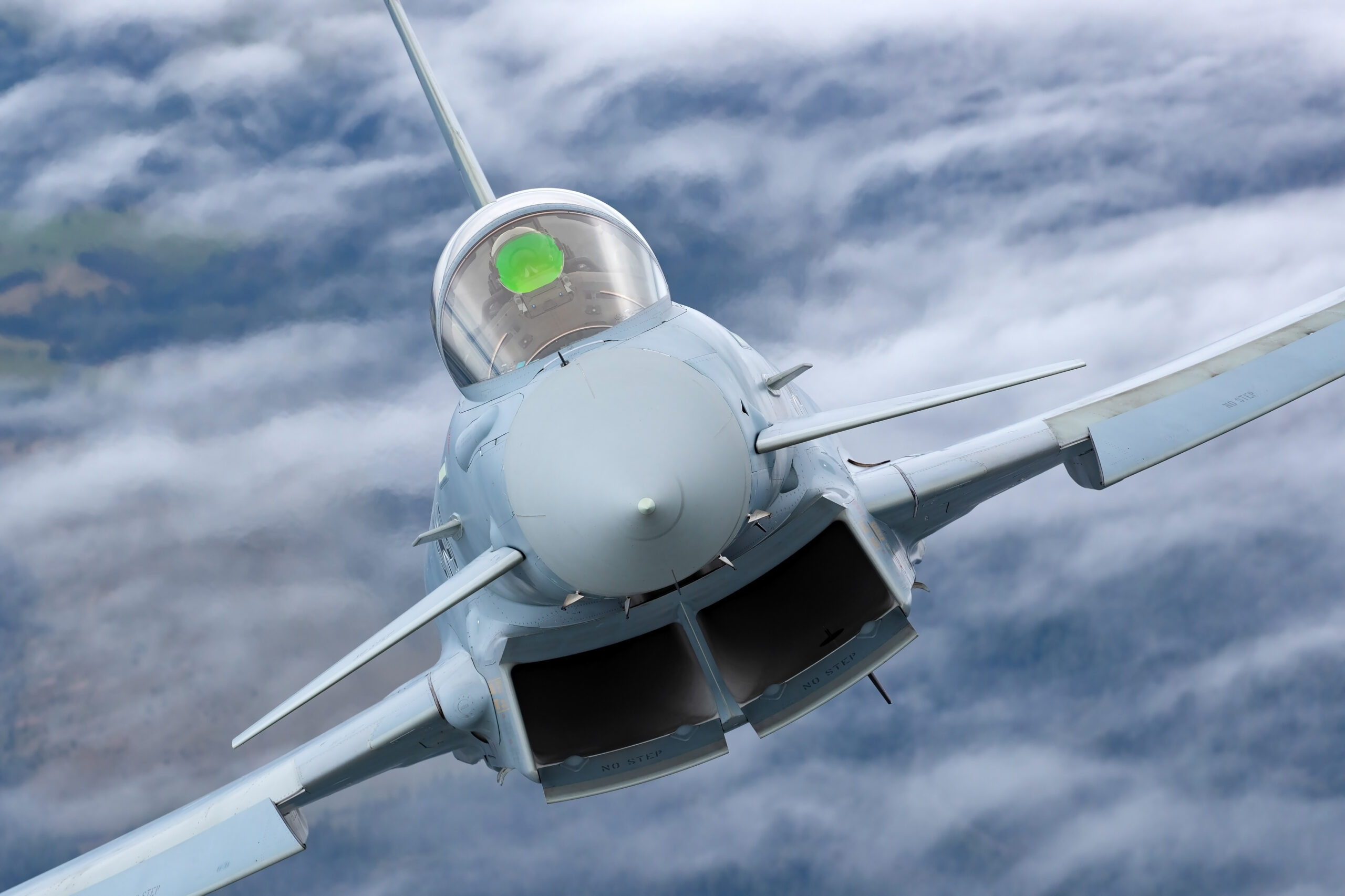
The foreplanes work with the delta wing to control an airframe that is deliberately unstable in pitch at subsonic speeds, which makes the aircraft extremely agile. The quadruplex fly-by-wire system uses the canards and wing surfaces together to keep the jet controllable while exploiting that instability. Placing the canards well forward also improves supersonic trim and reduces drag at high speed.
Is the Typhoon better than the Rafale?
They are close contemporaries built to the same delta-canard formula, and honest comparisons depend on the mission. The Typhoon was optimised for high-altitude air superiority and has the edge in raw climb and high-end air-to-air performance, while the Rafale was designed from the start as an omnirole aircraft, flies from carriers, and gained a more complete strike and AESA fit earlier. Both have won export competitions against each other, and neither has met the other in combat.
How many Typhoons have been built?
By September 2025, 613 Typhoons had been delivered across the programme. Total confirmed orders from ten nations stand at more than 750 aircraft, so production will continue for years to come. The fleet passed one million combined flying hours around the turn of 2025-26.
Is the Typhoon still in production in 2026?
Yes. Aircraft are in production for Germany, Spain and Italy at roughly 14 aircraft a year, with the consortium working to raise output to 20 a year by 2028. BAE Systems’ Warton line is restarting final assembly for Türkiye’s 20 aircraft, due for delivery from 2030, and Germany’s Tranche 5 jets are scheduled for delivery from Manching between 2031 and 2034.
Which countries fly the Eurofighter Typhoon?
The four partner nations are the United Kingdom, Germany, Italy and Spain. Export operators are Austria, Saudi Arabia, Oman, Kuwait and Qatar, and Türkiye became the tenth customer in October 2025, with its first aircraft due in 2030. Saudi Arabia is the largest export operator with 72 aircraft.
When did the Eurofighter Typhoon first fly?
The first development aircraft, DA1, flew on 27 March 1994 from Manching in Germany, piloted by Peter Weger. Britain’s DA2 followed from Warton in early April 1994. Both early aircraft used Tornado RB199 engines because the definitive EJ200 was not yet ready; Italy’s DA3 became the first to fly with EJ200s in 1995.
Has the Typhoon ever shot down another aircraft?
An RAF Typhoon scored the type’s first operational air-to-air kill on 14 December 2021, destroying a small hostile drone over Al Tanf in Syria with an ASRAAM. RAF Typhoons also shot down Iranian one-way attack drones during the April 2024 attack on Israel. No Typhoon has engaged a manned aircraft in combat.
What does Typhoon FGR4 mean?
FGR4 is the RAF designation standing for Fighter, Ground attack, Reconnaissance, Mark 4. It marks the multirole standard that replaced the original air-defence-only Typhoon F2, with two-seat trainers designated T3. The Tornado GR4’s weapons, including Storm Shadow and Brimstone, were transferred to the FGR4 under Project Centurion by 2019.
What will replace the Eurofighter Typhoon?
The UK and Italy plan to replace their Typhoons from around 2035 with the GCAP sixth-generation fighter being developed with Japan, while Germany and Spain are partners in the separate FCAS programme with France. In the meantime the Typhoon keeps evolving through new tranches, the ECRS radar family and the Long Term Evolution upgrade path. Eurofighter expects the newest aircraft to fly into the 2060s.
Where can I see a Typhoon fly in the UK?
RAF Coningsby in Lincolnshire and RAF Lossiemouth in Moray are the two Typhoon main operating bases, and both have well-known public viewing spots. For displays, the 2026 RAF Typhoon Display Team, callsign DRAGON01 flown by Flight Lieutenant Tom Nation, appears at shows including Duxford, RIAT at Fairford, Cosford, Eastbourne and Blackpool. RIAT usually hosts Typhoons from several nations on one flightline.
What engines does the Eurofighter Typhoon use?
Two Eurojet EJ200 afterburning turbofans, developed by a consortium of Rolls-Royce, MTU Aero Engines, Avio and ITP. Each produces around 13,500 lb of thrust dry and 20,000 lb in reheat, giving the Typhoon a thrust-to-weight ratio better than one at combat weights. The engine’s growth margin underpins the aircraft’s planned service life into the 2060s.
The Typhoon’s partner in RAF service gets its own full profile: the Lockheed Martin F-35 Lightning II, the stealth half of the UK’s fast-jet force.

Leave a Reply