The SEPECAT Jaguar was an Anglo-French strike jet, built jointly by Britain and France from the late 1960s, that started life as a trainer and ended up as one of the most rugged low-level attack aircraft of the Cold War. It served the RAF from 1973 until 2007, fought in the Gulf, the Balkans and Africa, and still flies today with the Indian Air Force, the last operator of the type.
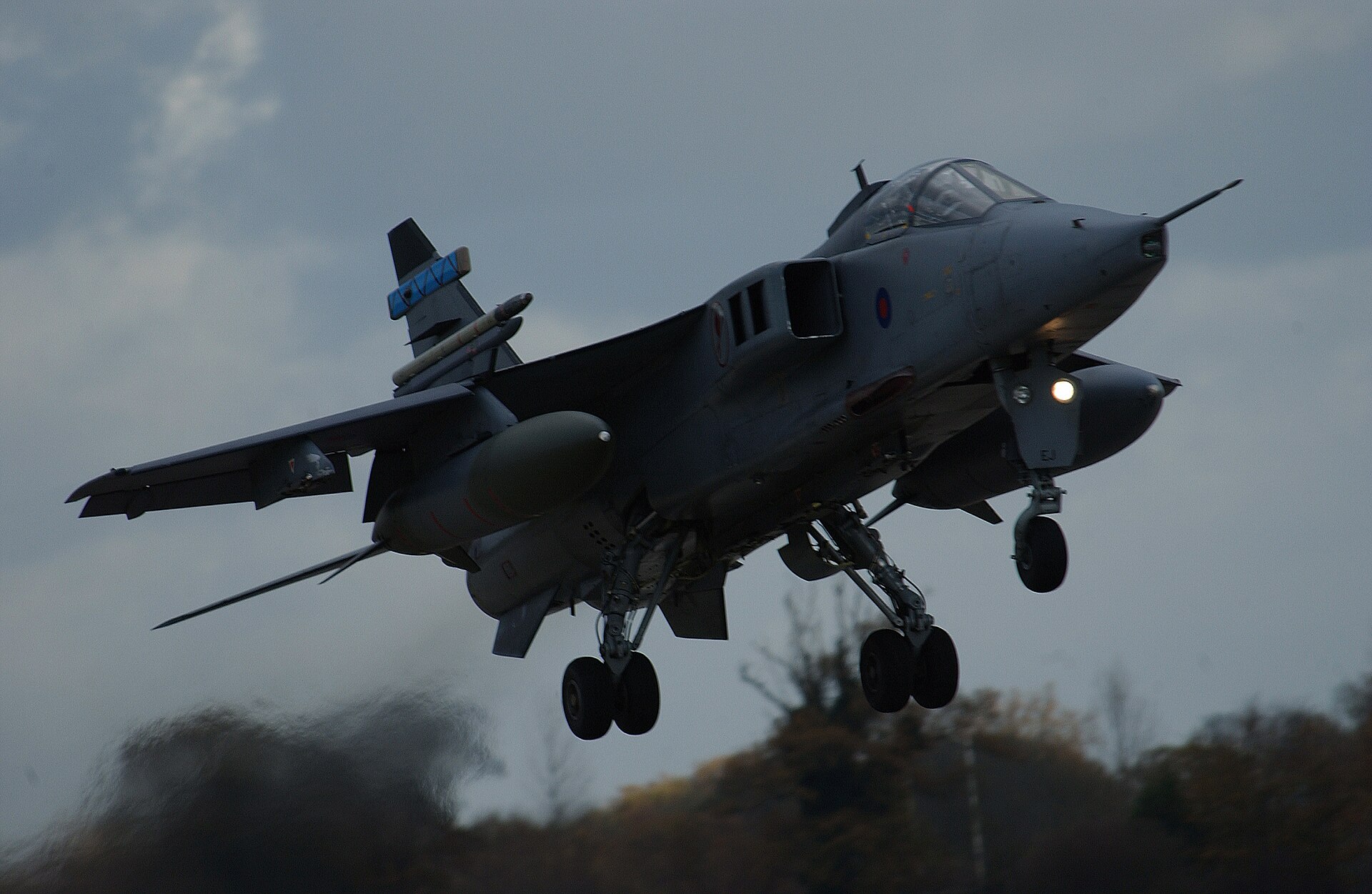
Few aircraft have a stranger origin story. The Jaguar was conceived as a cheap supersonic trainer with a bit of light attack capability, a modest aeroplane to fill a gap in two air forces at once. By the time it entered service the requirement had turned on its head, and the RAF was flying it as a nuclear-armed strike aircraft holding Quick Reaction Alert on the edge of the Cold War. It was underpowered, unglamorous and, for a while, unloved. It also turned out to be tough, reliable and hard to kill, and it outlasted many of the fast jets that were supposed to be more capable.
This guide tells the full story: how two governments came to build a single aircraft together, how the design changed from trainer to strike jet, what each mark could do, where it fought, why the RAF gave it up, and where you can stand in front of one today. Every date and figure here has been checked against the manufacturer, the RAF Museum and established references, and where sources really disagree, that is said plainly.
What this guide covers
- An Anglo-French bargain: how the Jaguar began
- From trainer to strike jet
- Design and the Adour engines
- Variants: Jaguar A to GR.3 and Shamsher
- In RAF service: Germany, Coltishall and the nuclear role
- Combat: the Gulf, the Balkans and Africa
- French and Indian Jaguars
- The fly-by-wire Jaguar that shaped Eurofighter
- SEPECAT Jaguar specifications
- Retirement: why the RAF let it go
- Where to see a SEPECAT Jaguar today
- Photographing the Jaguar today
- Legacy
- Frequently asked questions
An Anglo-French bargain: how the Jaguar began
The Jaguar came out of two separate national needs that happened to point at the same aircraft. In Britain, Air Staff Target 362 called for an advanced supersonic trainer to replace the Folland Gnat and the two-seat Hawker Hunter. In France, the requirement was known as ECAT, short for Ecole de Combat et d’Appui Tactique, a tactical combat support trainer to replace the Fouga Magister, the Lockheed T-33 and the Dassault Mystere IV. Both were looking for something cheap, and by October 1964 the two air staffs had realised their needs converged.
France ran a design competition between Dassault’s Cavalier and Breguet’s Br.121. On 15 January 1965 Breguet won, because its aircraft was smaller, lighter and within budget. A Memorandum of Understanding was signed in May 1965, with Dassault dating the ministers’ signature to 17 May, to develop two aircraft together: a trainer based on the ECAT design, which became the Jaguar, and a larger swing-wing type, the Anglo-French Variable Geometry aircraft, or AFVG.
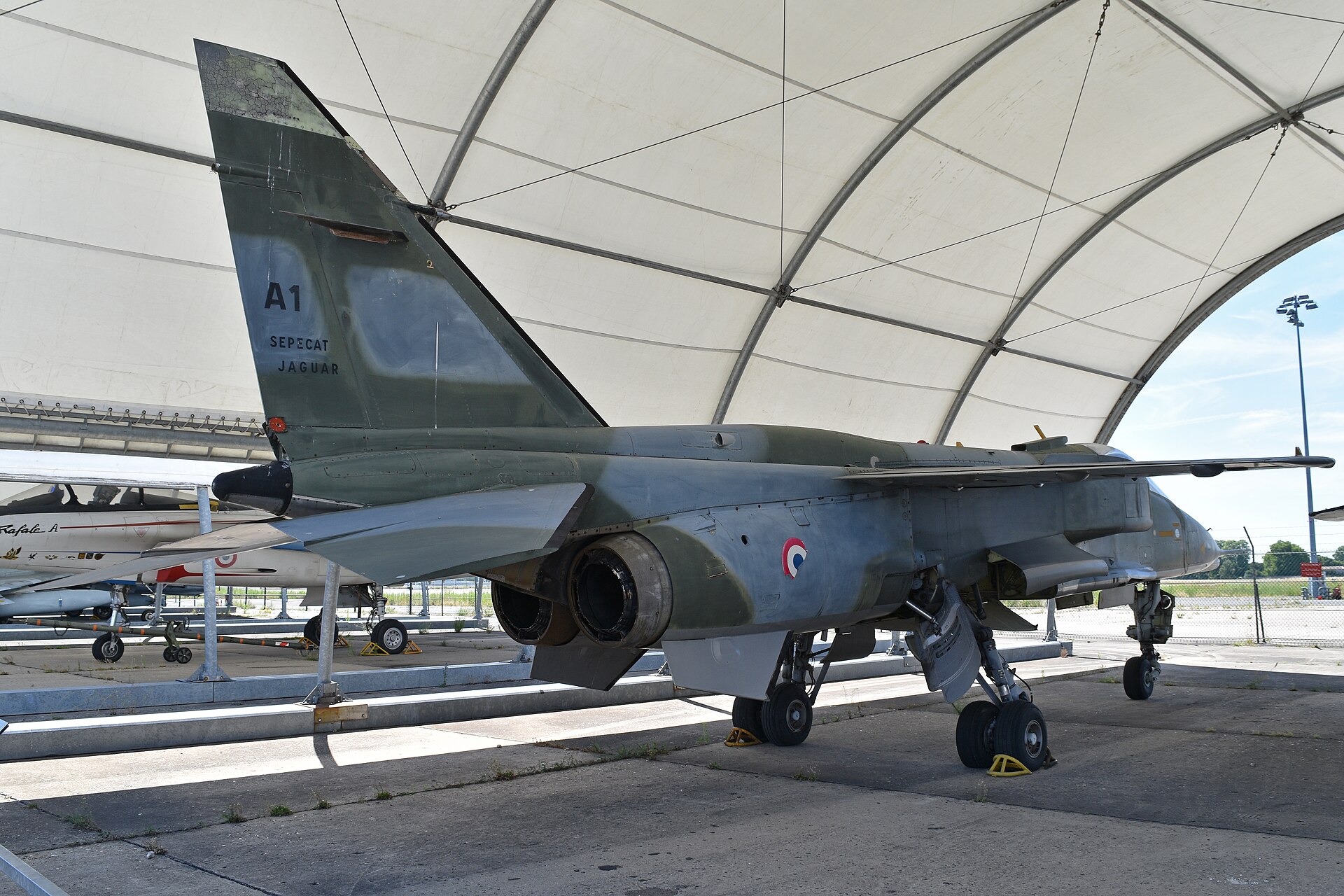
To build the airframe, a joint company was formed in 1966: SEPECAT, the Societe Europeenne de Production de l’avion d’Ecole de Combat et d’Appui Tactique, owned jointly by Breguet and the British Aircraft Corporation. Work was carefully divided so that no component was built twice. Breguet made the nose, the fuselage centre-section and the undercarriage; BAC made the wings, the tail, the rear fuselage and the air intakes. Final assembly lines ran in both countries. The engines came from a separate partnership between Rolls-Royce and Turbomeca, which developed the Adour afterburning turbofan, named after a river in south-west France and built in Derby and in Tarnos.
There was a complication that shaped everything. Breguet was bought by Dassault in 1967. Dassault had its own fast jets to sell, the Mirage F1 and later the Super Etendard, and never had much enthusiasm for a rival it half-owned. That tension ran through the whole programme, and it is part of why the Jaguar was pushed hard as an export product by the British side while France quietly favoured its own designs.
From trainer to strike jet
The aircraft that flew was not the aircraft that had been ordered. A run of cancellations gutted Britain’s strike plans in the mid-1960s. The TSR-2 was cancelled in 1965, the P.1154 supersonic Harrier went with it, and the replacement order for American F-111Ks was abandoned in 1968. France then pulled out of the AFVG in June 1967, killing the swing-wing half of the joint programme. The RAF suddenly had a strike gap and an aircraft on the drawing board that could be grown to fill part of it.
So the Jaguar was redrawn. The British version got a thinner wing, a redesigned fuselage, a raised rear cockpit and afterburning engines, changes so extensive that it was effectively a new aeroplane rather than the subsonic trainer Breguet had first drawn. The RAF order shifted away from trainers: by October 1970 it stood at 165 single-seat strike aircraft and 35 two-seaters. The pure training role the Jaguar had been invented for was handed to other types, the Alpha Jet in France and the Hawker Hawk in Britain. As Dassault later put it, an aircraft first conceived as a combat trainer ended up as a heavy tactical support aircraft.
The first prototype, the French two-seat E.01, flew on 8 September 1968 at Istres in the hands of Bernard Witt. That flight was also the first for the Adour engine. The aircraft went supersonic on its third flight. A French single-seat prototype followed in 1969, the first British aircraft flew in October 1969, and a navalised prototype for the French Navy flew that November. The Jaguar was in the air, and its identity as a low-level strike aircraft was set.
Design and the Adour engines
The Jaguar was a swept-wing, twin-engined aircraft on a tall tricycle undercarriage, shaped around one job: getting to a target at very low level, very fast, in a sky full of enemy air defences. The tall landing gear and rugged structure suited rough forward airstrips, and twin engines gave a better chance of getting home if one was hit. An engine could be changed in around thirty minutes, which mattered to the engineers who kept it flying.
The two Adour turbofans were the aircraft’s making and, in early service, its frustration. Pilots grumbled that it was underpowered, and the RAF Museum records the joke that it had the turning ability of a brick. The answer was a steady series of more powerful engines. France entered service with the Adour Mk.101 and the RAF with the Mk.102; the RAF re-engined its fleet with the Mk.104 from around 1981 and the Mk.106 from 1999. Indian aircraft used the more powerful Adour Mk.811. A non-afterburning version of the same engine went on to power the Hawk, which had beaten the Jaguar for the RAF trainer role, as well as the T-45 Goshawk.
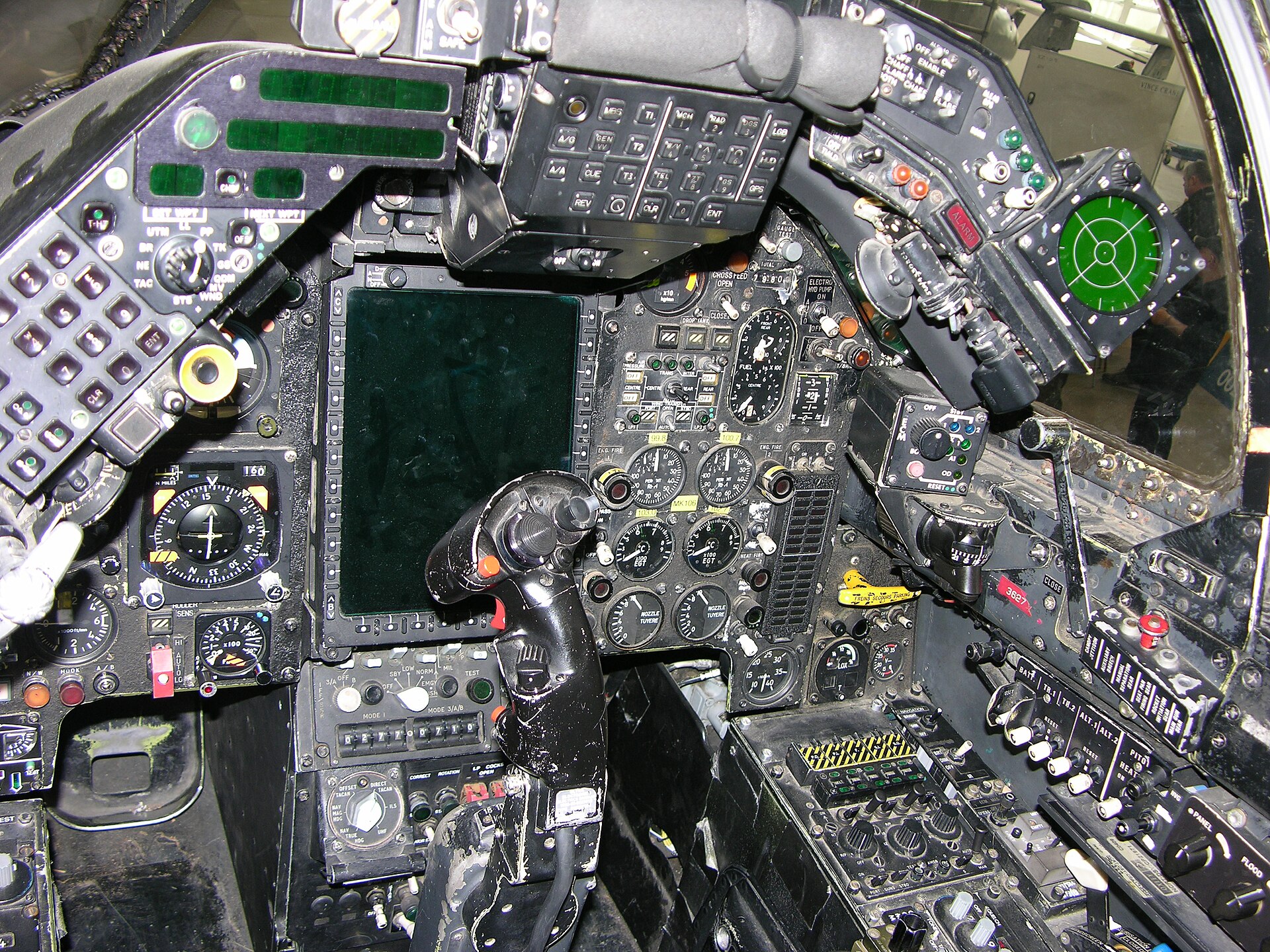
Where the British aircraft pulled decisively ahead of the French was in its avionics. The French Jaguar A used a relatively simple navigation system derived from the Mirage III. The British aircraft carried a Ferranti and Marconi navigation and weapon-aiming sub-system, known as NAVWASS, with a projected moving-map display, a head-up display and a laser ranger and marked-target seeker in the nose. That let it attack accurately at low level without a radar. From late 1983 the RAF replaced NAVWASS with the digital FIN1064 system. The gap in kit was so wide that in the 1991 Gulf War French Jaguars, with their weaker navigation, had to be escorted to their targets by Mirage F1 reconnaissance aircraft.
For self-defence and strafing the Jaguar carried two internal 30 mm cannon, the British ADEN or the French DEFA, with the RAF two-seat trainer carrying a single gun. Later RAF upgrades added terrain-referenced navigation and GPS, keeping a 1960s design useful into the 2000s. For its class it had a notably long reach, with a combat radius often quoted at around 850 km.
Variants: Jaguar A to GR.3 and Shamsher
The Jaguar family split early along national lines and then branched further through decades of upgrades. The core distinction is simple: France flew the A and E, Britain flew the S-derived GR and T marks, and India flew licence-built aircraft it named Shamsher, meaning sword of justice.
| Variant | Operator | Role and notes |
|---|---|---|
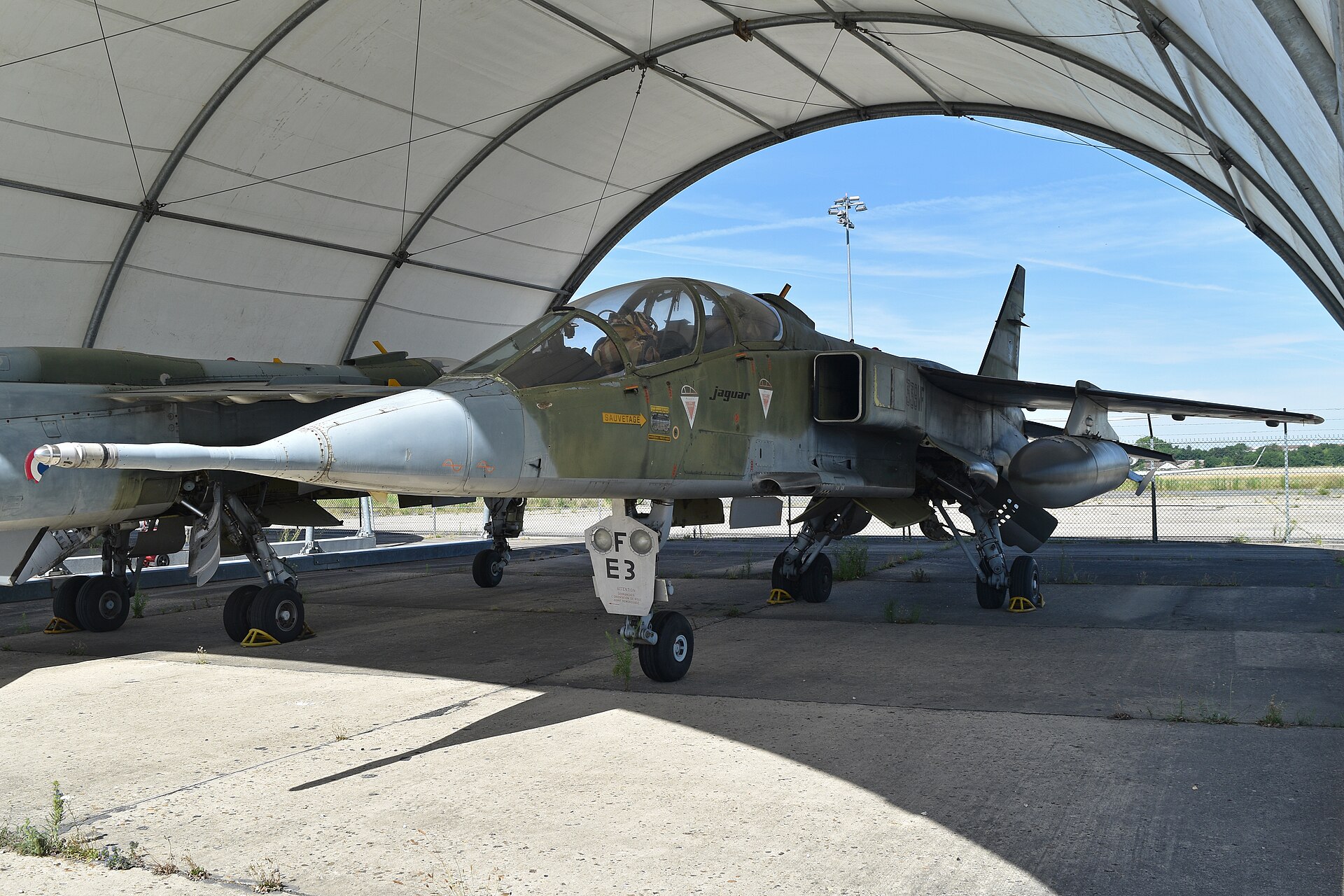
| Jaguar A | France | Single-seat strike and ground attack; 160 built |
| Jaguar E | France | Two-seat trainer; 40 built |
| Jaguar M | France (Navy) | Navalised prototype with arrestor hook; one built; cancelled in 1973 for the Super Etendard |
| Jaguar GR.1 / GR.1A | RAF | Single-seat strike; 165 built; GR.1A added the FIN1064 system from 1983 |
| Jaguar GR.3 / GR.3A | RAF | 1990s upgrade: TIALD, GPS, TERPROM, new HUD and helmet sight; GR.3A re-engined with Adour Mk.106 |
| Jaguar T.2 / T.4 | RAF | Two-seat trainers; 38 built, later upgraded in step with the single-seaters |
| Jaguar International | Ecuador, Oman, Nigeria | Export versions of the single- and two-seat aircraft |
| Jaguar IS / IB / IM (Shamsher) | India | Licence-built by HAL; DARIN avionics, later DARIN III; IM was a maritime strike version |
| Jaguar ACT | UK (trials) | Single fly-by-wire demonstrator, XX765; fed data into Eurofighter |
The export aircraft, sold as the Jaguar International, went to Ecuador, Oman and Nigeria. The largest export by far was India, which chose the Jaguar in 1978 over the Mirage F1 and the Saab Viggen and built the bulk of its fleet at home. The single most unusual member of the family was the Jaguar M, a navalised prototype with a strengthened structure and an arrestor hook that carried out carrier trials on the Clemenceau in 1970 before France cancelled it in 1973 in favour of the cheaper, all-French Super Etendard.
In RAF service: Germany, Coltishall and the nuclear role
The RAF received its first Jaguar GR.1 in 1974, with No. 54 Squadron among the first units, while France had taken its first aircraft the year before. The type quickly settled into two homes: the UK-based squadrons at RAF Coltishall in Norfolk, including the reconnaissance-tasked No. 41 Squadron, and the much larger force in Germany.
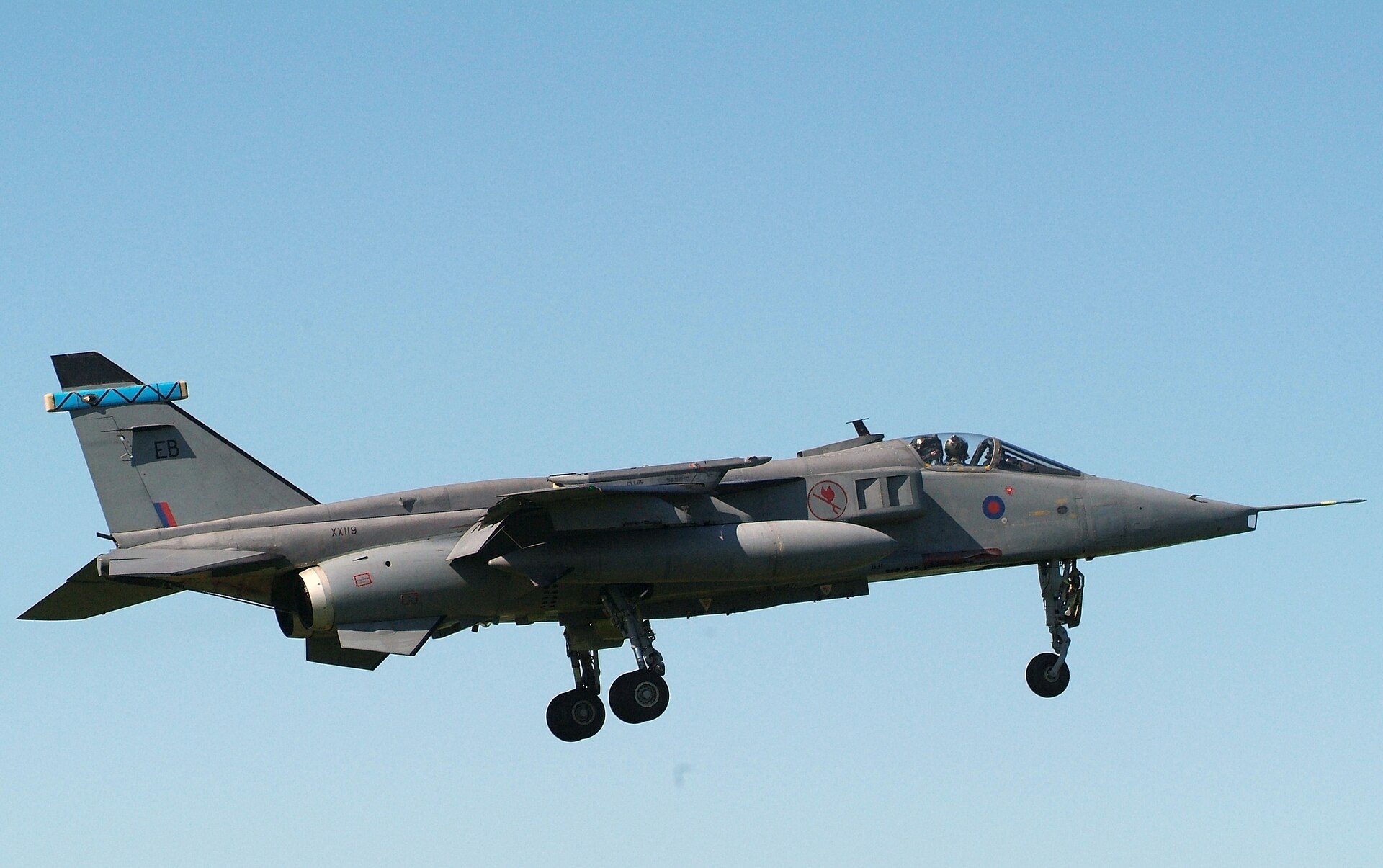
RAF Germany was where the Jaguar earned its keep in the Cold War. Five squadrons flew it there, four strike and attack units at RAF Bruggen and a tactical reconnaissance unit, No. 2 Squadron, at RAF Laarbruch. Their most serious task was nuclear. Jaguars stood Quick Reaction Alert armed with the WE.177 tactical nuclear bomb, held at fifteen minutes’ readiness around the clock in support of NATO’s plans. Alongside that sat the conventional job of hitting airfields, bridges and armoured columns if the Warsaw Pact ever rolled west. RAF planners held a stock of nuclear bombs earmarked for the Jaguar force.
The Jaguar was never meant to hold that frontline for long, and it did not. From 1984 the Tornado GR.1 began replacing it in Germany, and by the end of the decade the surviving Jaguars had concentrated back at Coltishall in Nos. 6, 41 and 54 Squadrons. That should have been the beginning of a quiet wind-down. Instead the aircraft found a second career, because the end of the Cold War brought exactly the kind of expeditionary wars the Jaguar turned out to be good at.
Reconnaissance was a serious part of the Jaguar’s work that is easy to forget behind the strike role. No. 41 Squadron in the UK and No. 2 Squadron in Germany flew the tactical reconnaissance version, carrying a camera pod rather than bombs and bringing home the imagery that commanders needed. The Coltishall squadrons were also assigned to NATO’s Allied Command Europe Mobile Force, a rapid-reaction commitment to reinforce the alliance’s flanks. The plan was for two ground-attack squadrons to deploy to Denmark and for the reconnaissance-tasked No. 41 Squadron to fly to Bardufoss, inside the Arctic Circle in northern Norway. It was a demanding role that put a small, short-legged jet a long way from home in some of the worst flying weather in Europe.
Combat: the Gulf, the Balkans and Africa
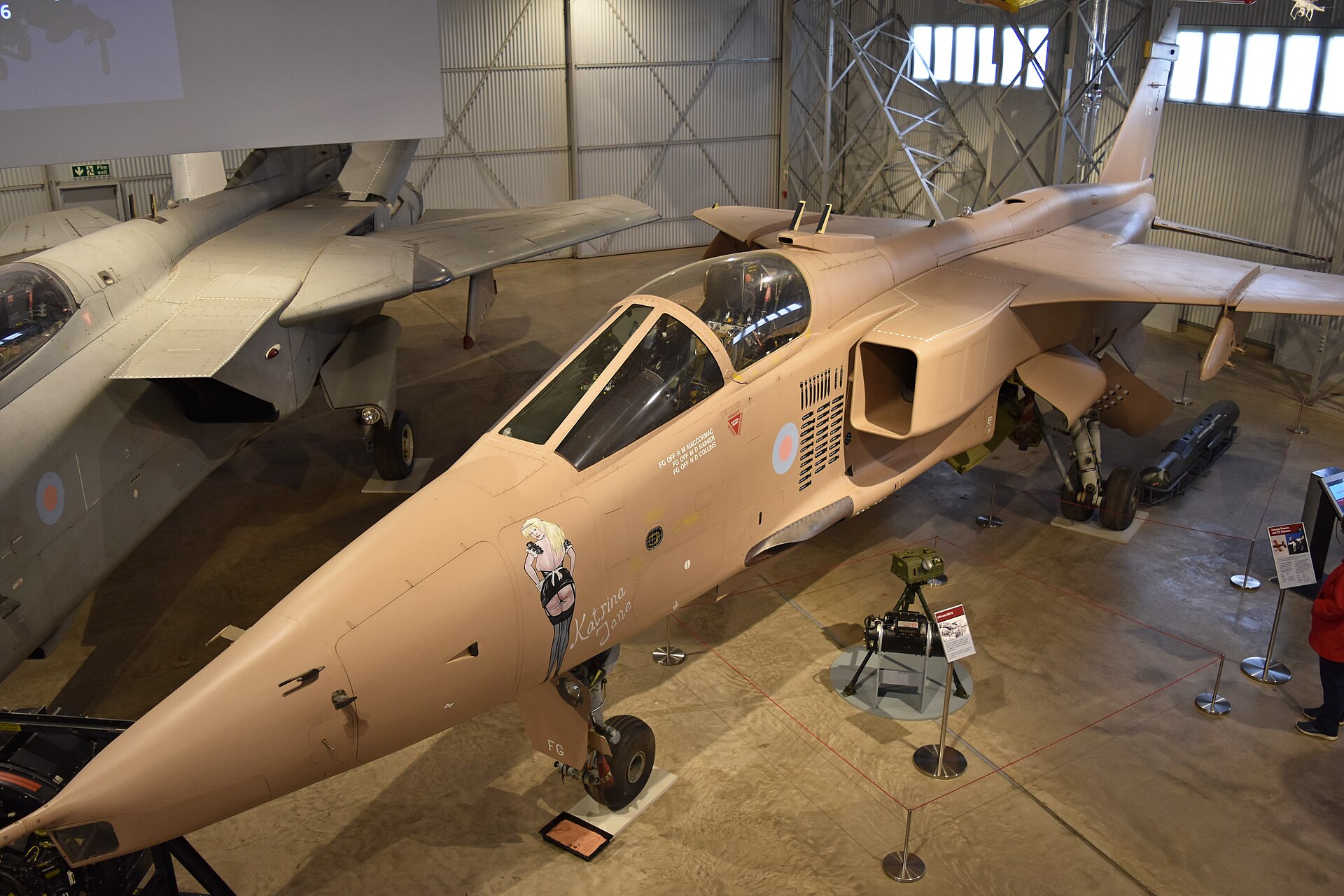
The Jaguar’s combat reputation was made in the 1991 Gulf War. The RAF sent an initial dozen Jaguar GR.1As to the region, flying from Bahrain and Oman. Over the campaign they flew 612 combat sorties without a single loss, a record that says as much about the aircraft’s reliability as about luck. They were fitted with overwing Sidewinder rails, CRV7 rockets and cluster bombs, and one airframe, XZ364, nicknamed Sadman, flew 47 missions, more than any other RAF aircraft in the war. On 30 January two Jaguars helped sink an Iraqi landing ship.
France ran a parallel campaign, Operation Daguet, deploying to Saudi Arabia with a force that peaked at 28 aircraft and flew 615 sorties. On the first morning, 17 January 1991, twelve French Jaguars struck Ahmad al-Jaber air base; three aircraft were damaged and all returned. The two national Jaguar forces, born of the same programme, ended up fighting the same war from opposite sides of the same coalition.
The aircraft kept working through the 1990s. RAF Jaguars fitted with TIALD laser designators deployed to Italy for operations over Bosnia in 1995, marking targets for other aircraft, and a No. 41 Squadron Jaguar carried out what was described as the first RAF bombing raid in Europe since the Second World War. Jaguars policed the no-fly zones over Iraq from Turkish bases. They were lined up to take part in the 2003 invasion of Iraq, but Turkey refused access to its bases and the Jaguars did not fly those missions.
The French Jaguar also had a long African combat record that is easy to overlook. It made its debut in Mauritania in December 1977 and then flew repeatedly over Chad through the late 1970s and 1980s, including the raid on the Ouadi Doum airfield in February 1986. Two French Jaguars were shot down over Chad, and one pilot was killed. This was hard, sustained combat flying a long way from the tidy Cold War script the aircraft had been designed for.
India gave the Jaguar its most recent combat too. In the 1999 Kargil War against Pakistan the IAF used the aircraft as a deep-strike platform, dropping both unguided and laser-guided bombs, and Indian Jaguars have stayed on operations far longer than the RAF ever imagined for the type. As recently as 2025, Indian Jaguars were reported striking targets with stand-off Rampage missiles during a flare-up with Pakistan, which means an aircraft first flown in 1968 was still going to war more than half a century later.
French and Indian Jaguars
France flew 160 Jaguar As and 40 Jaguar Es from 1973. For part of that time the aircraft held a pre-strategic nuclear role with the AN-52 bomb, a rung on the ladder of French deterrence rather than part of the strategic force, a task it gave up in 1991. The last French Jaguar squadron, EC 1/7 Provence, retired the type on 1 July 2005, handing its work to the Rafale. French Jaguars had by then flown combat in Africa and the Gulf and served for more than three decades.
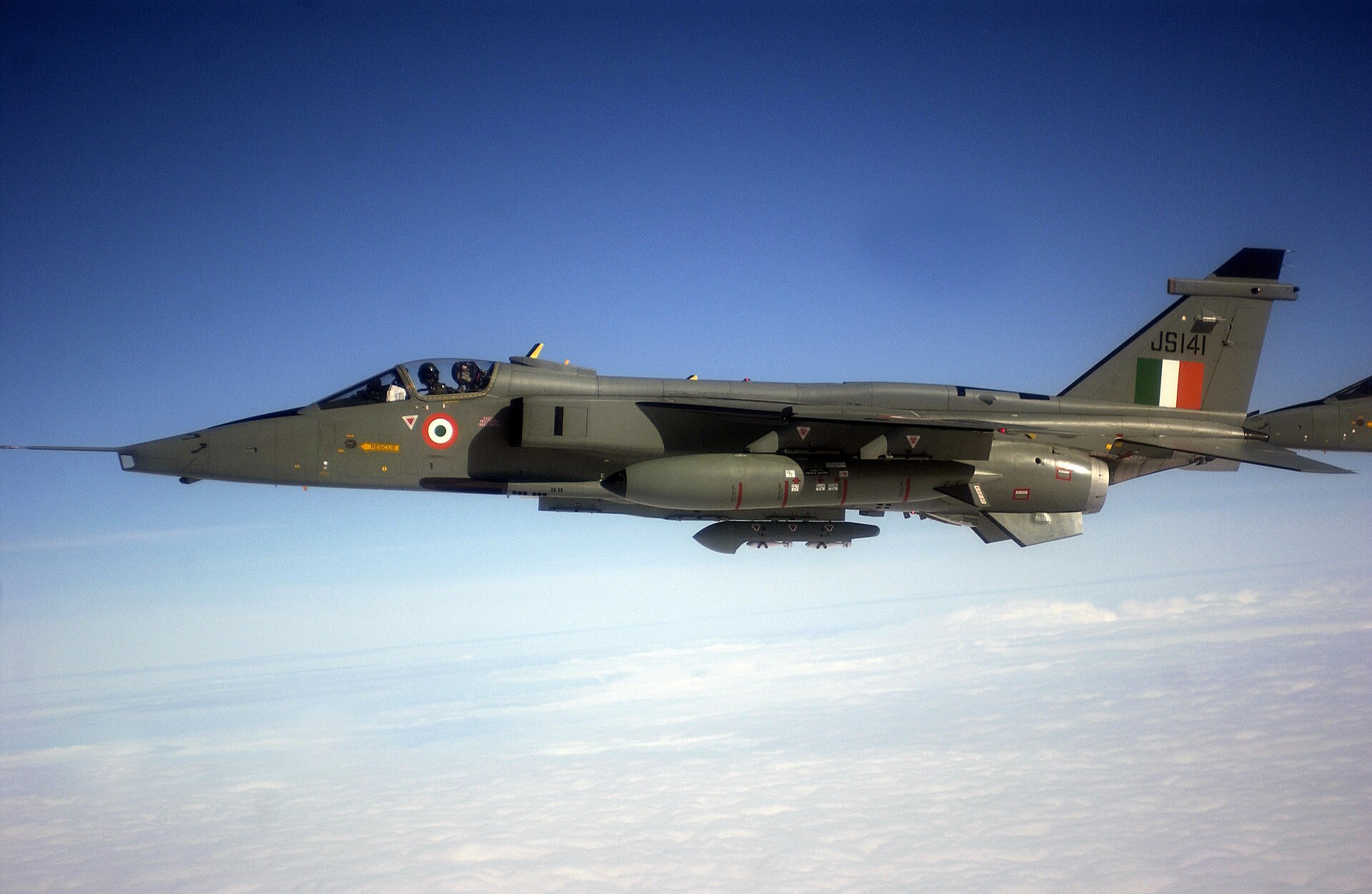
India is where the Jaguar’s story is still being written. The Indian Air Force chose it in 1978, took eighteen ex-RAF aircraft on loan from 1979 to get started, and then built the bulk of its fleet under licence at Hindustan Aeronautics Limited. Indian aircraft use indigenous DARIN avionics and the more powerful Adour Mk.811 engine, and later upgrades have taken part of the fleet to DARIN III standard with a modern AESA radar and new weapons. The IAF flew the Jaguar in combat in the 1999 Kargil War, using it as a deep-strike aircraft dropping guided and unguided bombs, and Indian Jaguars have remained frontline aircraft far longer than anyone expected.
India is now the sole remaining Jaguar operator anywhere in the world. That status is not permanent. In 2024 the IAF announced it would begin retiring its oldest aircraft, roughly sixty of them, from around 2028 to 2031, replacing them with modern types such as the HAL Tejas while upgrading the rest. Some projections suggest a residual fleet could soldier on into the late 2030s, which would put the Jaguar in service some seven decades after its first flight. India lost several aircraft to accidents in early 2025 and, in a neat closing of the circle, acquired retired Omani Jaguars in late 2025 to keep its own fleet supplied with spares.
The other export operators had shorter stories. Ecuador used its small fleet for ground attack, including limited action in the 1995 Cenepa War with Peru, and retired them in the 2000s. Oman flew its Jaguars until 6 August 2014, when the last four were retired, making Oman the last operator other than India. Nigeria’s aircraft had the unhappiest fate, largely stored and unused after a planned second batch was cancelled.
Updated July 2026. India remains the world’s only Jaguar operator. In 2024 the Indian Air Force set out a plan to begin retiring its oldest aircraft, around sixty of them, from roughly 2028 to 2031, while upgrading the rest to the DARIN III standard with a modern AESA radar and new missiles. The fleet had a difficult early 2025 with several accidents, and in late 2025 India bought a batch of retired Omani Jaguars purely as a source of spare parts to keep its own aircraft flying. Firm out-of-service dates beyond the first retirements have not been published, so claims that the type will serve into the late 2030s are projections rather than settled policy.
The fly-by-wire Jaguar that shaped Eurofighter
One Jaguar did something none of the others did, and its influence outlived the whole fleet. In the 1980s a single aircraft, XX765, was converted into the Jaguar ACT, standing for Active Control Technology. Engineers deliberately made it aerodynamically unstable, the opposite of the safe, self-correcting shape a normal aeroplane has, and then flew it entirely through a computerised fly-by-wire control system that made thousands of tiny corrections a second to keep it in the air.
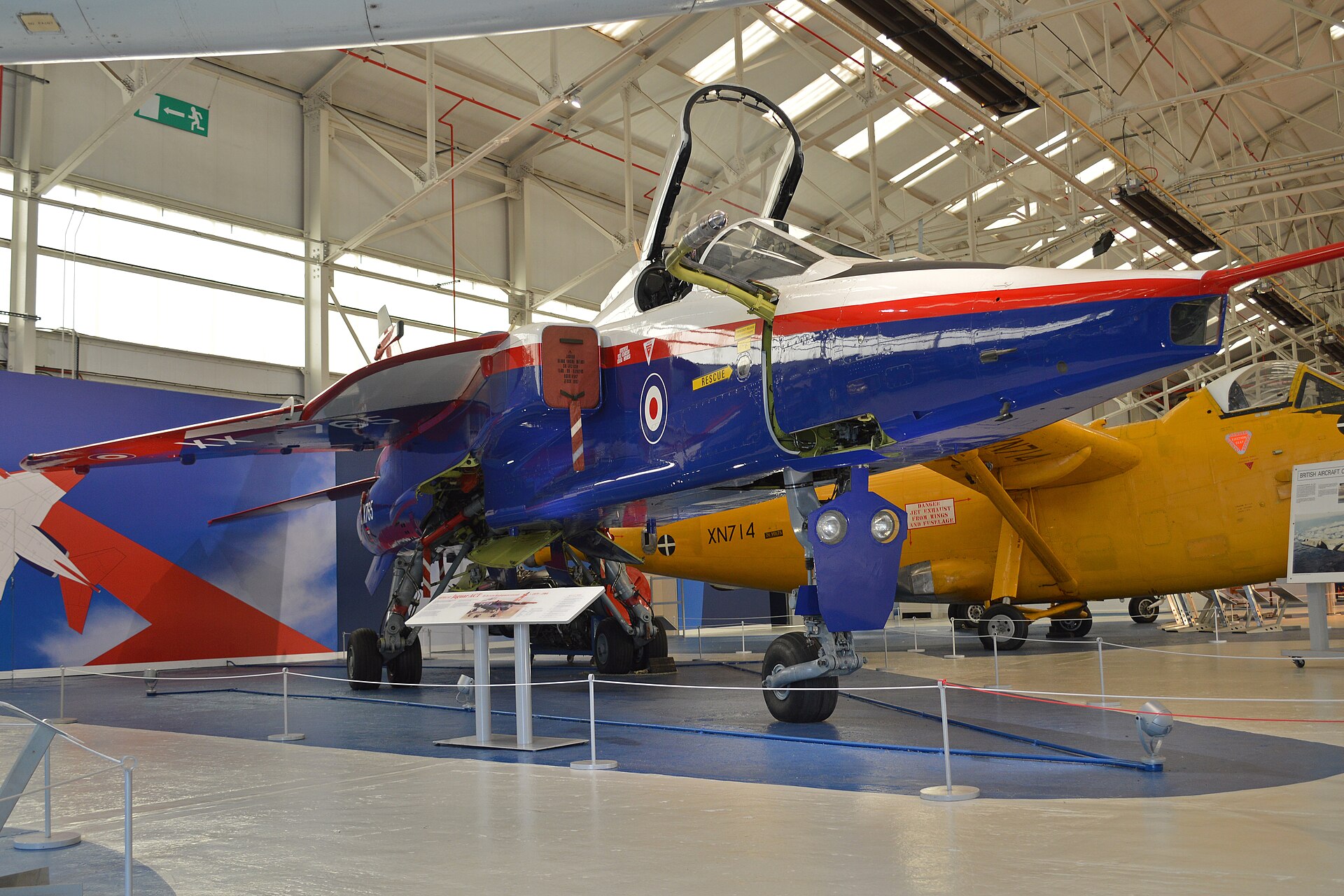
An unstable airframe is more agile, because it wants to change direction rather than resist it, but no human pilot can fly one unaided. The Jaguar ACT proved the concept worked and gathered the flight data that British engineers needed. That work fed directly into the Eurofighter Typhoon, the unstable, fly-by-wire fighter that now anchors RAF air defence. XX765 survives today at the RAF Museum Midlands at Cosford, a quiet exhibit that happens to be one of the most important research aircraft Britain ever flew.
SEPECAT Jaguar specifications
The figures below are for the RAF Jaguar GR.1 with the Adour Mk.102 engine, drawn from Jane’s All the World’s Aircraft. Later marks were heavier and more powerful, so treat these as representative of the early aircraft rather than the last GR.3As. Where a figure is commonly quoted with slight variation between sources, that is noted.
| Crew | 1 (single-seat); 2 (trainer) |
|---|---|
| Length | 16.83 m (55 ft 3 in) |
| Wingspan | 8.69 m (28 ft 6 in) |
| Height | 4.89 m (16 ft 1 in) |
| Wing area | 24.18 m² (260.3 sq ft) |
| Max take-off weight | 15,700 kg (34,600 lb) with external stores |
| Powerplant | 2 × Rolls-Royce Turbomeca Adour Mk.102 afterburning turbofans, about 32.5 kN (7,300 lbf) each with reheat; RAF later re-engined to Mk.104 and Mk.106 |
| Maximum speed | Mach 1.6 (about 1,700 km/h; 917 kn) at altitude; about Mach 1.1 at sea level |
| Combat radius | about 815 km (440 nmi) on a hi-lo-hi profile; commonly quoted around 850 km |
| Ferry range | about 1,900 km (1,025 nmi) with external tanks |
| Service ceiling | about 14,000 m (46,000 ft) |
| Cannon | 2 × 30 mm ADEN or DEFA (single gun in RAF trainer) |
| Hardpoints | 7, carrying up to about 4,500 kg (10,000 lb) of stores |
Two numbers are worth a caveat. The engine thrust rose noticeably across the marks, so the Mk.104 and Mk.106 aircraft were meaningfully stronger than the figure above suggests, and different sources quote the later thrust by a few hundred pounds either way. Range and radius depend heavily on the mission profile, which is why the same aircraft is quoted at very different distances by different references.
Retirement: why the RAF let it go
The RAF Jaguar was retired not because it stopped being useful but because there was no money to keep it. The 2004 Defence White Paper brought its withdrawal forward, and the timetable then collapsed faster than anyone expected. An out-of-service date that had been pencilled in for October 2007 was suddenly pulled forward, at only five days’ notice, to 30 April 2007. The last flight by a British military Jaguar, a trials aircraft, came on 20 December 2007.
The roles the Jaguar had carried, tactical strike and armed reconnaissance, were folded into the Tornado GR.4 and, in time, the Typhoon. Many of the retired airframes did not go to scrap. Instead they went to RAF Cosford to serve as ground-instructional aircraft, teaching the next generation of RAF technicians and engineers on real, complete airframes. That is why Cosford holds the largest surviving concentration of Jaguars anywhere.
The scale of that survival is striking. Because so many Jaguars went into ground-instructional and storage use rather than to the scrapyard, and because a Suffolk parts dealer bought a large batch that escaped disposal, the type is one of the best-preserved of all RAF fast jets. The Defence School of Aeronautical Engineering at RAF Cosford alone holds dozens of complete airframes, and examples are scattered across museums, private collections and gate guardians from Scotland to Cornwall. A handful have even been shipped to India in recent years to support the last flying fleet, a quietly fitting end for airframes that once stood alert on the Cold War frontline.
Where to see a SEPECAT Jaguar today
Because so many airframes survived retirement, the Jaguar is one of the easier Cold War jets to find in a British museum. Survivor locations do change as aircraft move between collections, so it is always worth checking with a museum before travelling, but the following are well established.
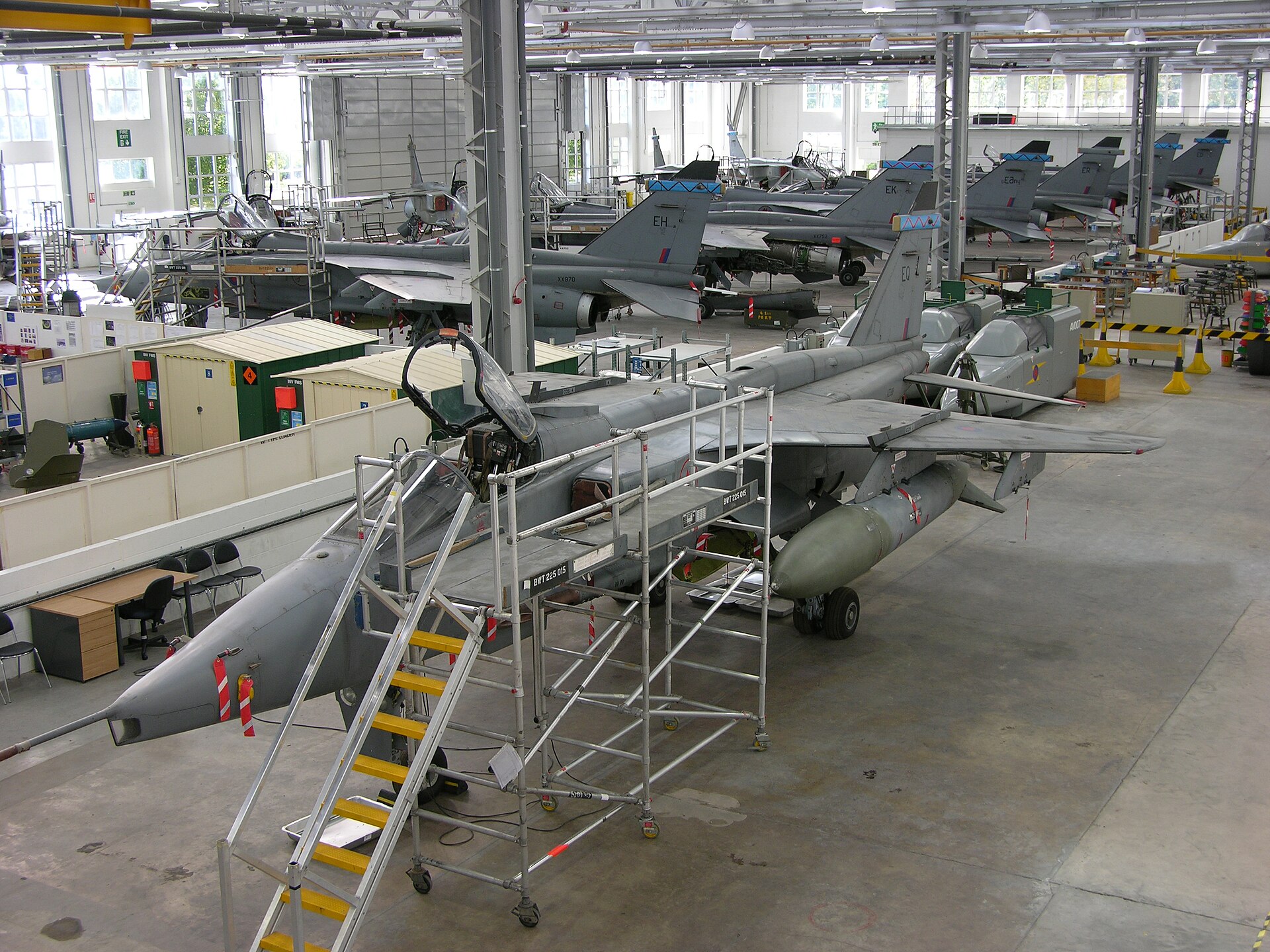
The RAF Museum London at Hendon holds XX824, a GR.1, as its flagship example. The RAF Museum Midlands at Cosford has the unique Jaguar ACT fly-by-wire demonstrator, XX765, and the wider Cosford site holds many more airframes. Elsewhere in the UK you can find examples at the Yorkshire Air Museum at Elvington, Newark Air Museum, the South Wales Aviation Museum at St Athan, the Solway Aviation Museum at Carlisle, the City of Norwich Aviation Museum and the National Museum of Flight at East Fortune, where the Gulf War veteran XZ119 “Katrina Jane” is preserved. A taxiable Jaguar, XX741, is kept at the Bentwaters Cold War Museum in Suffolk. Overseas, notable aircraft include a Gulf War veteran with visible missile damage at the Musee de l’Air et de l’Espace at Le Bourget in France, and examples at the Pima Air and Space Museum in Arizona.
Photographing the Jaguar today
For most photographers, the Jaguar is now a museum subject rather than a flying one, unless you travel to India. That changes how you approach it, but it does not make it any less rewarding. The long, purposeful shape, the twin exhausts and the low stance all reward a photographer who takes time over angles and light.
Indoors at a museum, the usual problems are mixed artificial light, tight spaces and a lack of clean backgrounds. Shooting wide to take in the whole airframe usually means fighting clutter, so it is often better to work the details: the intake, the cannon port, the squadron markings and the business end of the Adour exhausts. A steady approach to close-ups pays off, and our guide to aircraft detail and close-up photography covers the technique. For the shape as a whole, the principles in our piece on composition for aviation photography apply just as much to a static jet as to a flying one.
If you do get to India, or to an event where an Indian Jaguar or a fast-taxi example is running, the aircraft becomes a proper action subject. Low, fast passes suit the panning and shutter-speed techniques in our guide to photographing fast jets. Whether you are shooting a preserved airframe or a working one, our aviation galleries show the kind of results these methods produce, and if you want to use aviation images commercially, the licences page explains how that works.
Legacy
The Jaguar matters for two reasons that have nothing to do with how it looked on the ramp. It was the first major Anglo-French military aircraft programme and the first operational RAF aircraft built by an international partnership, and it proved that two countries with different needs and different industries could build a single successful combat aircraft together. That template became normal. The Panavia Tornado that replaced it on the Cold War frontline was a three-nation project, and the Eurofighter Typhoon that followed was a four-nation one that drew directly on the Jaguar ACT’s fly-by-wire research.
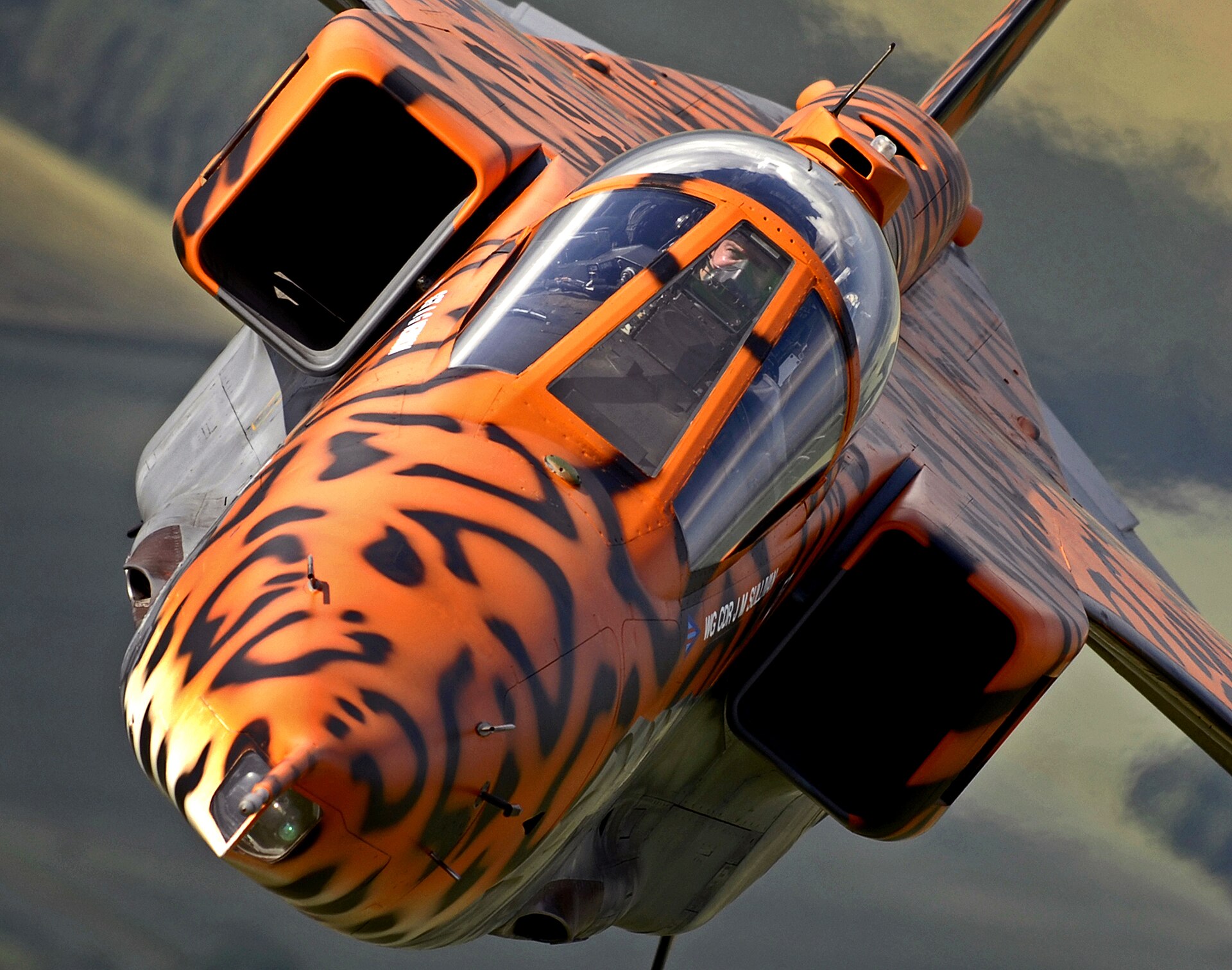
The second reason is simply endurance. An aircraft that began as a reluctant compromise, mocked for being underpowered, matured into a rugged and reliable strike aircraft that fought hard in three continents and outlasted much of its own generation. Nearly six decades after the first Jaguar left the ground at Istres, the type is still flying. Not many accidental Cold War warriors can say that.
The Jaguar was not sent south in 1982, and the reasons are part of the story told in our account of the Falklands air war.
Frequently asked questions
Is the SEPECAT Jaguar still in service?
Yes, but with only one air force. As of 2026 the Indian Air Force is the sole remaining Jaguar operator. The Royal Air Force retired the type in 2007, France in 2005, and Oman, the last other user, in 2014.
How fast was the Jaguar?
About Mach 1.6, roughly 1,700 km/h or 917 knots, at altitude, and around Mach 1.1 at sea level. It was built for high-speed low-level penetration rather than high-altitude dogfighting, so its real strength was speed down among the hills rather than outright top-end figures.
Who built the SEPECAT Jaguar?
SEPECAT, a joint venture set up in 1966 between France’s Breguet, which Dassault bought in 1967, and Britain’s British Aircraft Corporation. The Adour engines came from a separate Rolls-Royce and Turbomeca partnership. In India the aircraft was later licence-built by Hindustan Aeronautics Limited.
What engine did the Jaguar use?
Two Rolls-Royce Turbomeca Adour afterburning turbofans, itself an Anglo-French design built in Derby and in Tarnos. RAF marks progressed from the Adour Mk.102 to the Mk.104 and finally the Mk.106, while Indian HAL-built aircraft used the more powerful Adour Mk.811.
How many Jaguars were built?
Sources differ. Dassault, the manufacturer, cites a global order of 573 aircraft, while many references state that roughly 543 were actually completed, the difference being cancelled orders. Either way the total is somewhere around 540 to 570 across France, Britain, four export customers and Indian licence production.
Was the Jaguar used in the Gulf War?
Yes, heavily. RAF Jaguars flew 612 sorties in the 1991 Gulf War, Operation Granby, without a single loss, while French Jaguars flew 615 sorties in Operation Daguet. Both forces attacked airfields, armour, artillery and naval targets, and the type earned a strong reputation for reliability.
Why did the RAF retire the Jaguar?
Budget cuts. The 2004 Defence White Paper brought the withdrawal forward, and an out-of-service date expected in October 2007 was pulled forward at only five days’ notice to 30 April 2007. Its roles were absorbed by the Tornado and later the Typhoon.
What is the difference between the Jaguar GR.1 and GR.3?
The GR.1 was the original 1970s RAF strike aircraft built around the NAVWASS navigation and attack system. The GR.3 and GR.3A were a late-1990s upgrade that added a TIALD laser designator, GPS, TERPROM terrain-referenced navigation, a new head-up display, a helmet-mounted sight, digital cockpit displays and a datalink, with the GR.3A also gaining uprated Adour Mk.106 engines.
Did the Jaguar ever fly with fly-by-wire?
Yes. A single aircraft, XX765, was converted into the Jaguar ACT, or Active Control Technology, demonstrator. It was made deliberately unstable and flown entirely by a fly-by-wire system, and the data it produced fed into Eurofighter development. XX765 survives at the RAF Museum Midlands at Cosford.
What weapons could the Jaguar carry?
Two internal 30 mm cannon, either ADEN or DEFA, plus up to about 4,500 kg of external stores on seven hardpoints. That included free-fall and laser-guided bombs, cluster bombs, rocket pods, anti-radar and anti-ship missiles, Sidewinder or Magic air-to-air missiles for self-defence, and tactical nuclear bombs, the WE.177 for the RAF and the AN-52 for France.
Where can I see a SEPECAT Jaguar?
In the UK you can see examples at the RAF Museum London at Hendon, the RAF Museum Midlands at Cosford, the Yorkshire Air Museum, Newark Air Museum, the South Wales Aviation Museum, the National Museum of Flight and many other collections. A taxiable example is kept at the Bentwaters Cold War Museum in Suffolk.
Is the Indian Air Force still flying the Jaguar?
Yes, as the world’s last Jaguar operator. In 2024, however, the IAF announced it would begin retiring its oldest aircraft from around 2028 to 2031, while upgrading the rest to the DARIN III standard, with some projections suggesting the type could serve into the late 2030s.
