The early jet airliners of the 1950s were the aircraft that turned flying from a slow, noisy, propeller-driven business into fast, smooth, high-altitude travel, led by the British de Havilland Comet, which entered service in 1952 as the world’s first jet airliner, and followed by the Soviet Tupolev Tu-104, the French Caravelle and the American Boeing 707 and Douglas DC-8. In under a decade they rewrote what an aeroplane journey felt like.
It is hard now to picture how strange the idea seemed in 1949. Airliners had piston engines and propellers, cruised below the weather at a few hundred miles an hour, and shook and droned the whole way. Then a sleek, whistling machine climbed above the clouds at close to 500 miles an hour in near silence, and the ground shifted under the entire industry. Within ten years the propeller had been pushed to the margins of long-haul travel and the jet had taken the world.
This is the story of that decade: the aircraft that opened the jet age, the people and companies who built them, the triumph and the disaster that shaped how every jet since has been designed, and the reason the lead passed from Britain to the United States by the end of the 1950s. It covers the Comet, the Avro Jetliner that history almost forgot, the Tu-104, the Caravelle, the Dash 80 and the 707 and DC-8, and it ends with where you can still see these machines and how to photograph the survivors.
What this guide covers
- Overview: the decade the jet age began
- The de Havilland Comet: first into the sky
- Triumph and tragedy: the Comet’s fatigue crisis
- The Soviet answer: the Tupolev Tu-104
- French innovation: the Sud Aviation Caravelle
- The American giants: Dash 80, 707 and DC-8
- The turning points that decided the jet age
- What it was like to fly the early jets
- Early jet airliners compared
- Legacy: the template for modern air travel
- Photographing the early jets and their survivors today
- Frequently asked questions
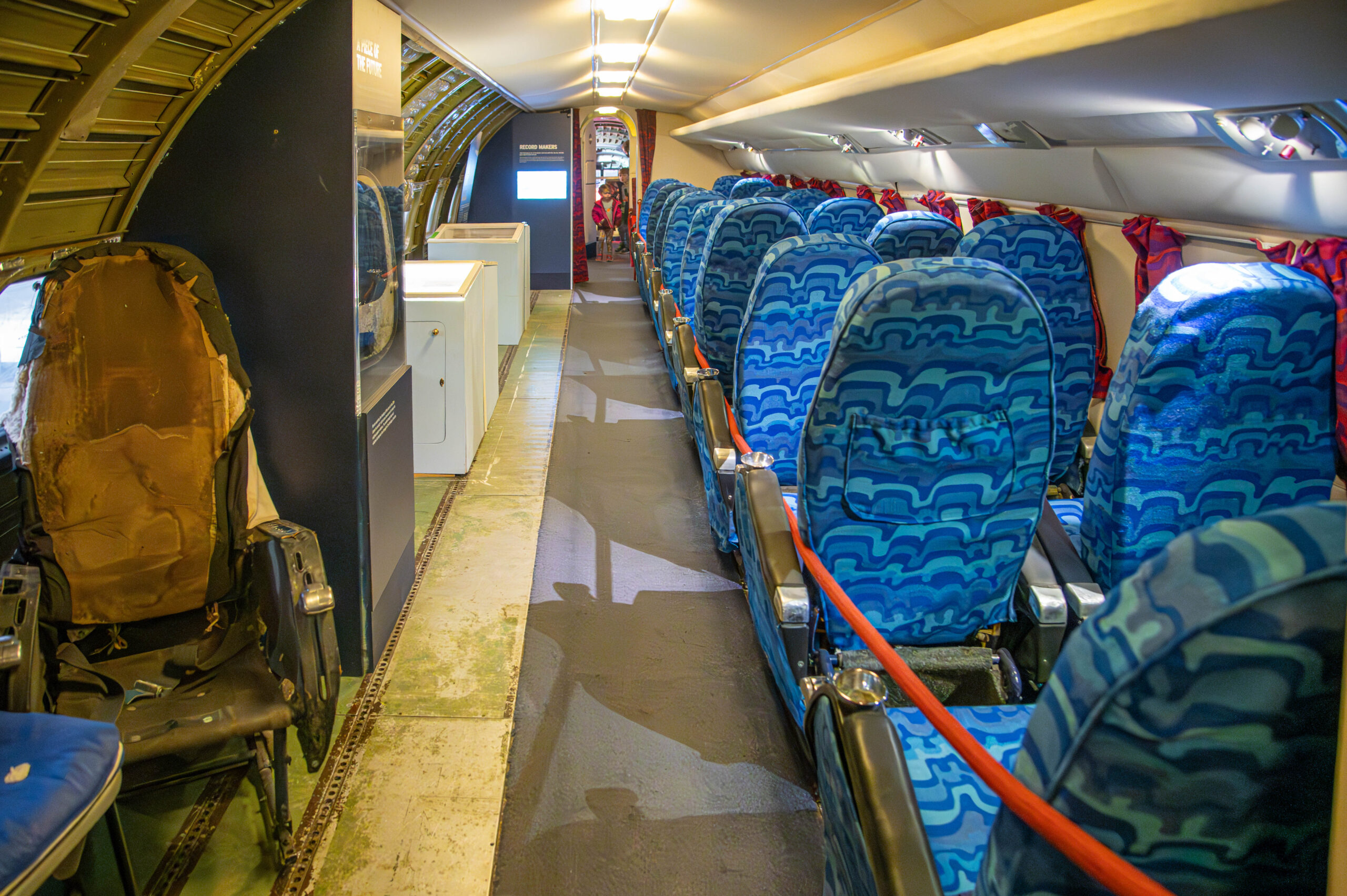
Overview: the decade the jet age began
The jet engine was a wartime invention, developed in Britain by Frank Whittle and in Germany by Hans von Ohain during the 1930s and 1940s. By 1945 jet fighters were flying in combat, but nobody had yet built a jet designed to carry paying passengers. Turning a thirsty, high-revving military engine into the heart of a safe, economic airliner was a formidable problem, and the country that solved it first would own a huge head start.
Britain moved fastest. With its aircraft industry intact and a government keen to lead the post-war market, it backed the de Havilland company to build a jet airliner while the United States hesitated, wedded to its excellent and profitable piston-engined types such as the Douglas DC-6 and the Lockheed Constellation. The result was the Comet, which flew in 1949 and carried its first passengers in 1952, years ahead of anything American.
What followed was not a straight British victory but a decade of leapfrogging. The Comet suffered a catastrophic setback. The Soviet Union produced its own jetliner with startling speed. France found a clever niche. And the American manufacturers, once they committed, brought resources and a home market so large that they overtook everyone. By 1959 the shape of modern air travel, a swept-wing jet with engines slung under the wing or at the tail, cruising near the speed of sound above the weather, was fixed. The table later in this guide sets the main types side by side.
The engines themselves were the key. A turbojet burns fuel in a continuous stream of compressed air and uses the exhaust to spin a turbine and produce thrust, and unlike a piston engine it thrives at high altitude and high speed. That is why the early jets flew so high and so fast: the thin air that starved a piston engine suited a jet, and above 30,000 feet there was less drag and smoother air to cruise through. The price was thirst, because early turbojets drank fuel at a rate that made range and operating economics a constant worry, and quietening and cleaning them up would take the industry decades.
The de Havilland Comet: first into the sky
The de Havilland DH.106 Comet was the aircraft that started it all. Designed under Ronald Bishop, who had led the Mosquito, it was a thing of real beauty: a clean, low-set swept wing, four de Havilland Ghost turbojets buried in the wing roots, and a slim pressurised fuselage that let it cruise at 40,000 feet, far higher than any piston airliner. The prototype first flew on 27 July 1949 from Hatfield, with de Havilland test pilot John Cunningham at the controls.
Just thirteen days later, on 10 August 1949, the Avro Canada C102 Jetliner flew in Toronto, becoming the second purpose-built jet airliner in the world. It was a promising design, and it gave the word “jetliner” to the language, but Canadian priorities shifted to fighter production during the Korean War and the sole prototype was eventually scrapped. It never carried a fare-paying passenger, and history remembers the Comet instead.
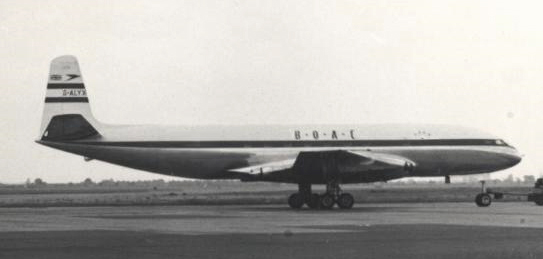
On 2 May 1952 a BOAC Comet 1, registered G-ALYP, took off from London for Johannesburg on the world’s first scheduled jet passenger service. The difference was extraordinary. The Comet cut journey times almost in half, flew above the turbulence that made piston travel so wearing, and did it in a smooth hush that passengers found close to magical. BOAC’s Comet fleet filled its seats, orders came in from around the world, and for a brief period Britain looked set to dominate the coming jet market. The full story of the type is told in our profile of the de Havilland Comet.
The company behind the Comet reflected its founder. Geoffrey de Havilland had been building aircraft since before the First World War, and his firm had a reputation for bold, elegant designs, the wooden Mosquito among them. That willingness to try something new is what put Britain first into the jet age, though it also meant venturing into territory, high-altitude pressurised jet flight, that nobody fully understood. The Ghost engines buried in the wing roots, the thin high-speed wing and the unprecedented cruising altitude were all steps into the unknown, taken with more confidence than the science of the day could really support.
The Comet was a family of aircraft, not a single type. The original Comet 1 gave way to the Comet 2 with more powerful Rolls-Royce Avon engines, and development was already advancing when the 1954 disasters halted everything. After the fatigue investigation the design was rebuilt as the Comet 4, longer, stronger and with far greater range, and it flew a useful career from 1958 into the 1970s. A maritime patrol derivative, the Hawker Siddeley Nimrod, kept the Comet’s basic airframe in Royal Air Force service for decades, long after the airliner itself had retired, a quiet afterlife for a design that began the jet age.
Triumph and tragedy: the Comet’s fatigue crisis
The triumph did not last. In 1954 two Comets broke apart in flight within a few months of each other. On 10 January 1954 the same G-ALYP that had opened jet service disintegrated after taking off from Rome, its wreckage falling into the sea near the island of Elba, killing all 35 on board. On 8 April 1954 a second Comet, G-ALYY, was lost in similar circumstances near Naples. The type’s certificate of airworthiness was withdrawn and the fleet was grounded.
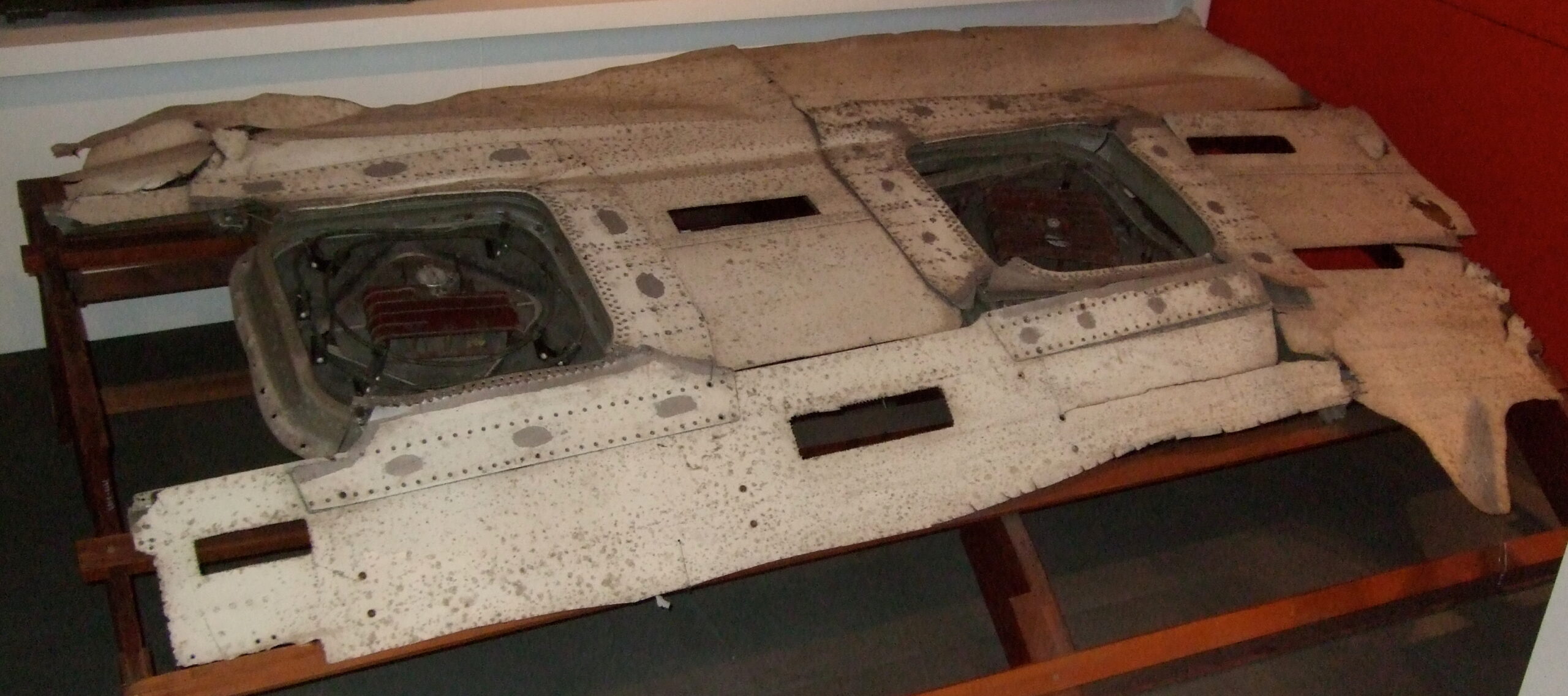
The investigation that followed, one of the most thorough in aviation history, recovered wreckage from the sea and subjected a Comet fuselage to repeated pressurisation cycles in a water tank until it failed. The cause was metal fatigue. Each time the cabin was pressurised for high-altitude flight and depressurised on landing, the aluminium skin flexed, and cracks grew from points of stress concentration around openings in the fuselage. Once a crack reached a critical length the cabin burst apart at altitude. The lesson was not simply about window shape, as the story is often told, but about how fatigue accumulates in a pressurised structure over thousands of flights.
The consequences reached every aircraft built since. Designers learned to round off openings, to reinforce them, and to design structures that fail slowly and visibly rather than suddenly, an approach now called fail-safe or damage-tolerant design. Testing became far more rigorous. The Comet itself was redesigned into the much-improved Comet 4, which returned to service in 1958, but the years lost to the grounding were fatal to Britain’s lead. While the Comet sat idle, its rivals caught up and passed it.
The Soviet answer: the Tupolev Tu-104
While Britain grappled with the Comet’s flaws, the Soviet Union produced a jet airliner with a speed that surprised the West. The Tupolev Tu-104 was developed quickly from the Tu-16 jet bomber, sharing its wings, engines and tail with a new, wider pressurised fuselage for passengers. It first flew on 17 June 1955 and entered Aeroflot service on 15 September 1956 on the Moscow to Omsk to Irkutsk route.
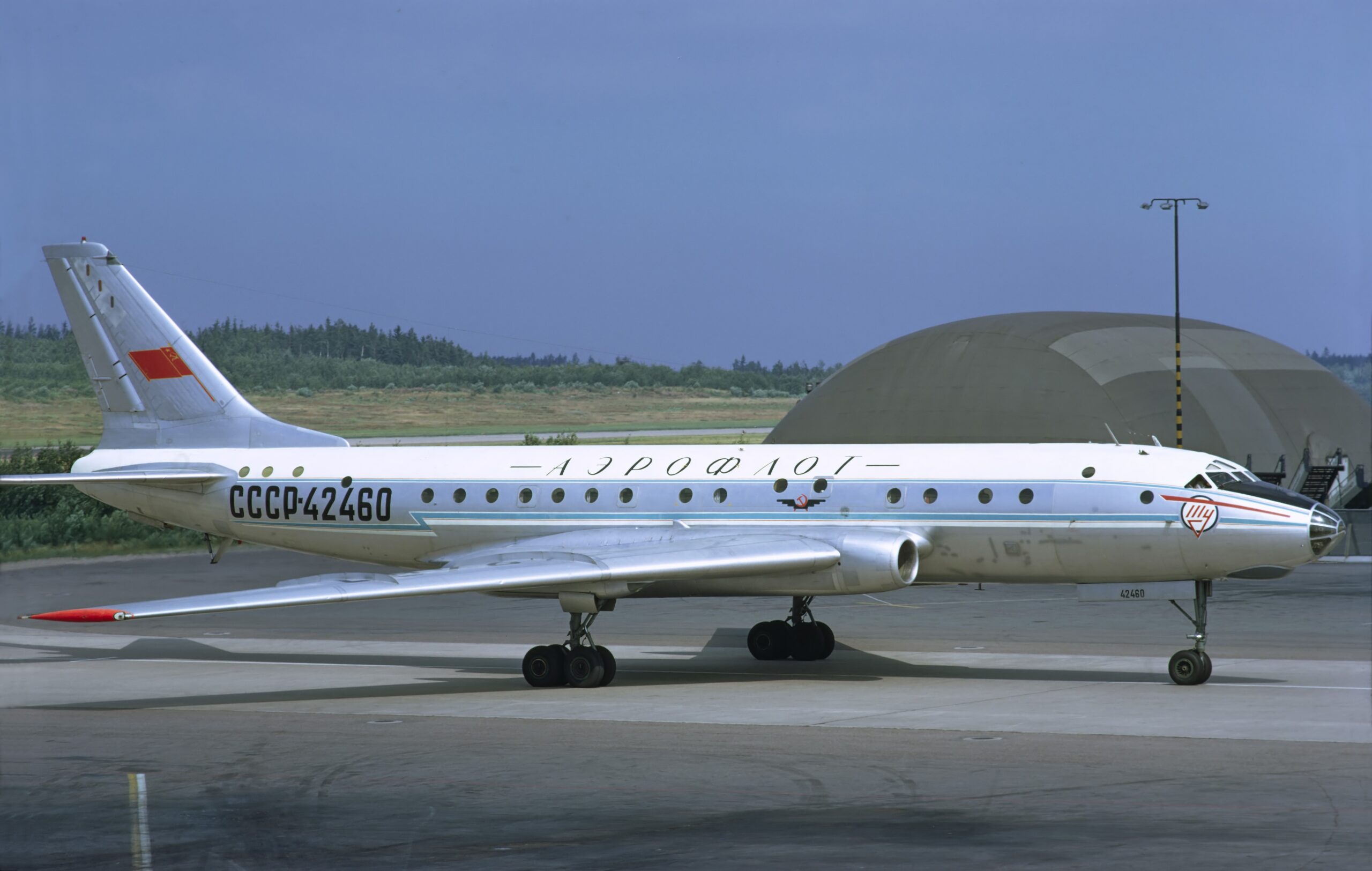
The timing gave the Tu-104 a remarkable distinction. Because the Comet was grounded from 1954 and did not return until 1958, the Tu-104 was, from 1956 to 1958, the only jet airliner in scheduled service anywhere in the world. When one landed at London in 1956 carrying Soviet officials, Western observers were startled that the USSR had a working passenger jet at all. It was not a subtle aircraft. It was noisy, thirsty and demanding to fly, and its bomber-derived wing made it a handful, but it worked, it flew fast, and it carried Aeroflot passengers in large numbers for years, more than ninety million of them over its career.
The Tu-104 mattered less for its engineering than for what it proved: that the jet airliner was not a uniquely Western achievement, and that the Soviet industry could field front-line civil aircraft on its own terms. It shortened Soviet domestic journeys dramatically and set the pattern for a long line of Tupolev jetliners that followed.
Behind the Tu-104 stood Andrei Tupolev, one of the towering figures of Soviet aviation, whose design bureau produced a long line of bombers and airliners across the twentieth century. Building the jetliner from the Tu-16 bomber was a pragmatic shortcut that got the Soviet Union into the jet age years before it could have designed a civil airliner from scratch, and it was typical of Tupolev’s practical approach. The trade-off was an aircraft that flew like the bomber it came from, fast but unforgiving, with a high landing speed that demanded skilled crews and long runways.
In service the Tu-104 transformed Soviet domestic travel. Distances inside the USSR were vast, and a jet that crossed them in a fraction of the time a piston airliner needed was a genuine leap. Aeroflot pressed it into service across the Soviet network and on prestige international routes, and a version also flew with the Czechoslovak carrier. Safety was patchy by later standards and the type suffered a number of accidents that were rarely publicised at the time, but it carried enormous numbers of passengers and gave the Soviet industry the confidence and experience to build the jetliners that followed.
French innovation: the Sud Aviation Caravelle
France took a different and clever path. Rather than chase the long-haul market where the Comet and the coming American giants would fight, Sud Aviation built a jet for shorter European routes, the sort of city-to-city hops that piston airliners still dominated. The SE 210 Caravelle first flew on 27 May 1955 and entered service in 1959, with Scandinavian Airlines beginning revenue operations on 26 April 1959 and Air France following.
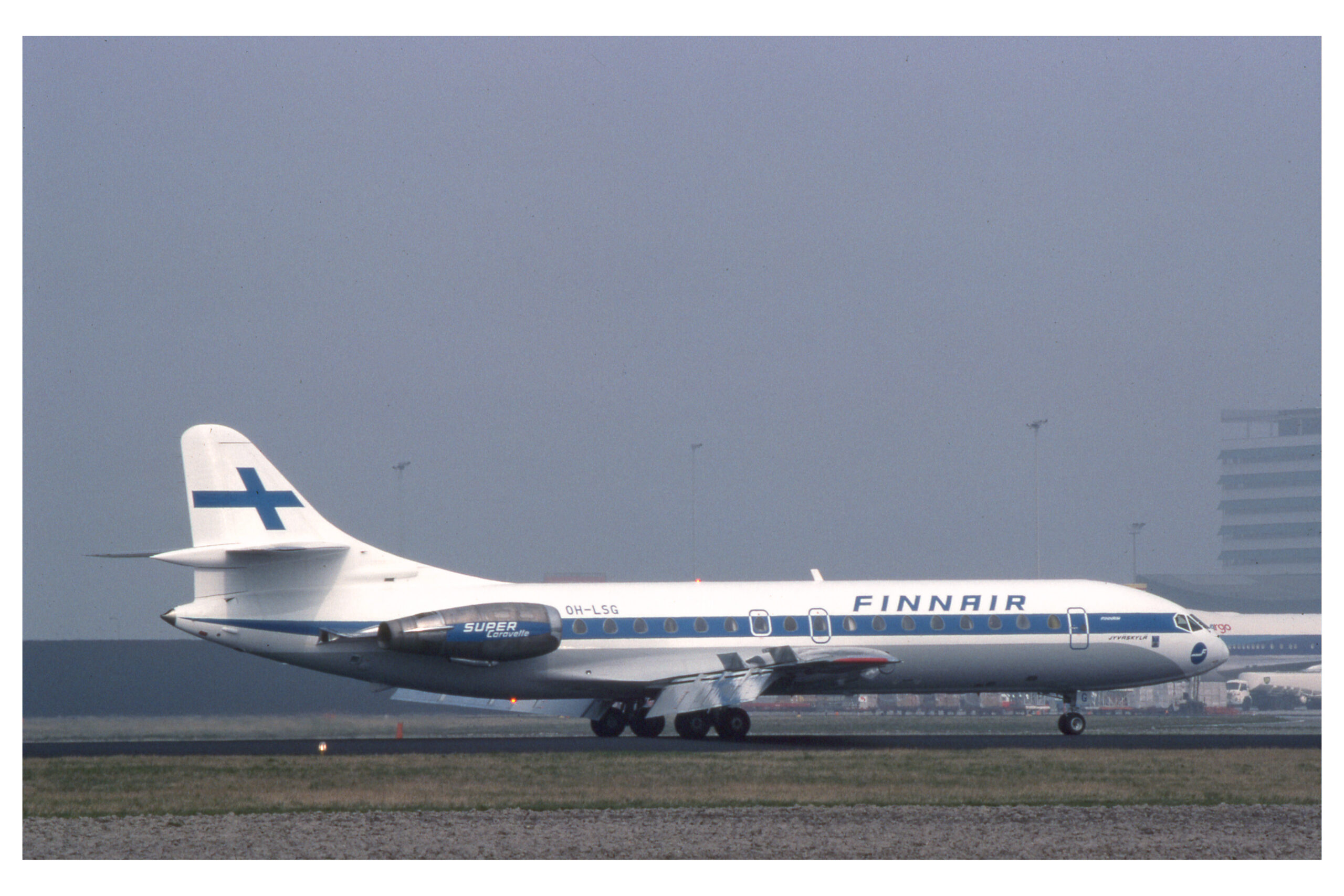
The Caravelle introduced an idea that shaped airliners for decades: mounting the engines at the rear of the fuselage rather than under the wing. This left the wing clean and efficient, cut cabin noise by moving the engines behind the passengers, and kept the intakes clear of debris from rougher regional runways. The layout was widely copied, from the Douglas DC-9 to the Boeing 727 to countless business jets. In a nice detail of the period, the Caravelle borrowed its nose and cockpit design from the Comet under licence, a reminder of how ideas crossed between these pioneers.
Commercially the Caravelle was a solid success by European standards, with 282 built up to 1972, and it gave France a firm foothold in the jet market that would later grow into Airbus. It proved that the jet belonged not only on prestige intercontinental routes but on the everyday short-haul network, which is where most of the world’s flying actually happens.
The American giants: Dash 80, 707 and DC-8
The United States entered the jet age late but decisively. The turning point was a private gamble by Boeing, whose president Bill Allen authorised the company to spend its own money on a prototype jet transport when no airline had ordered one. That aircraft, the Boeing 367-80, universally known as the Dash 80, first flew on 15 July 1954. It was a demonstrator, built to prove that a large swept-wing jet could be safe, fast and sellable, and it did its job so well that it became the basis for both the KC-135 military tanker and the 707 airliner.
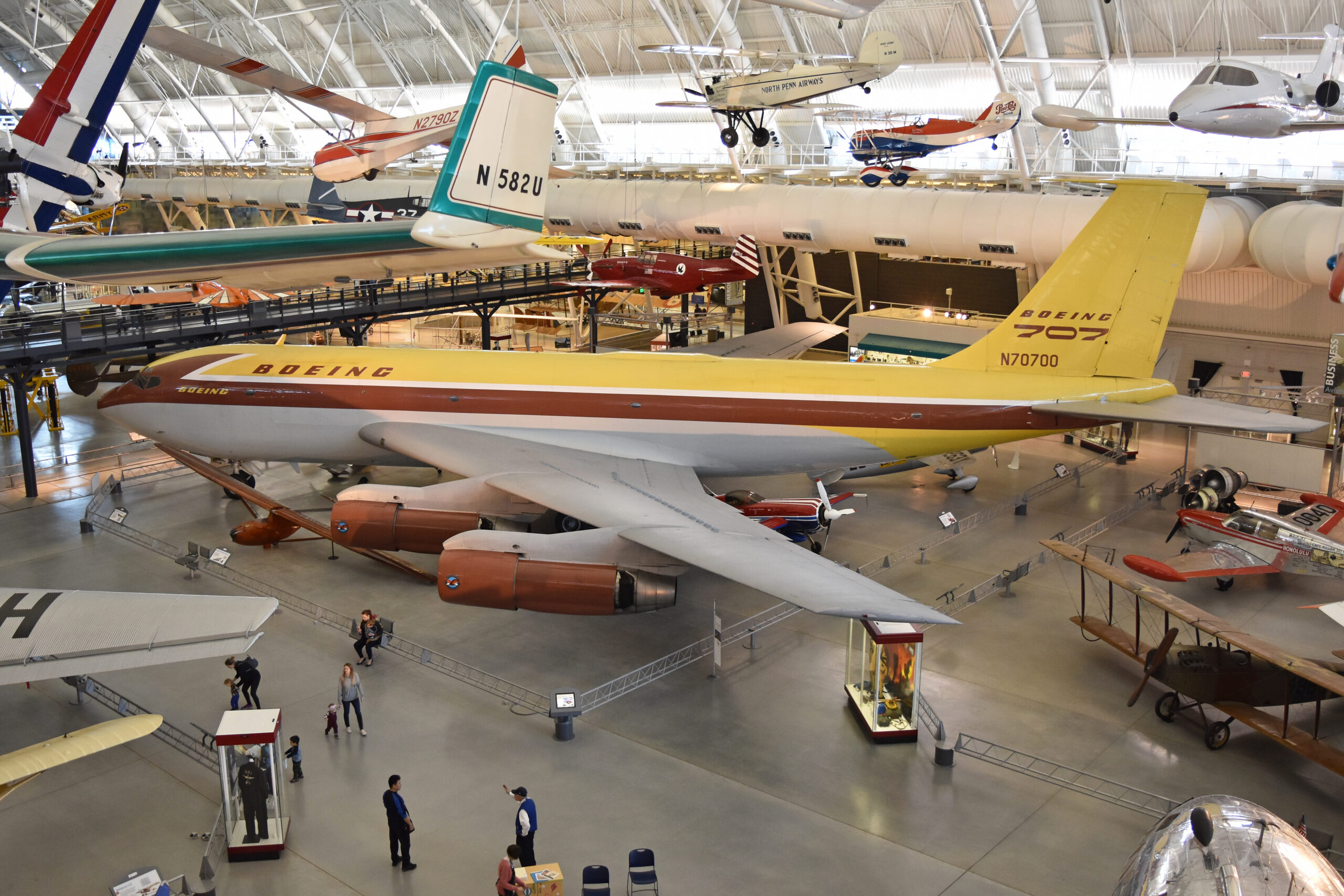
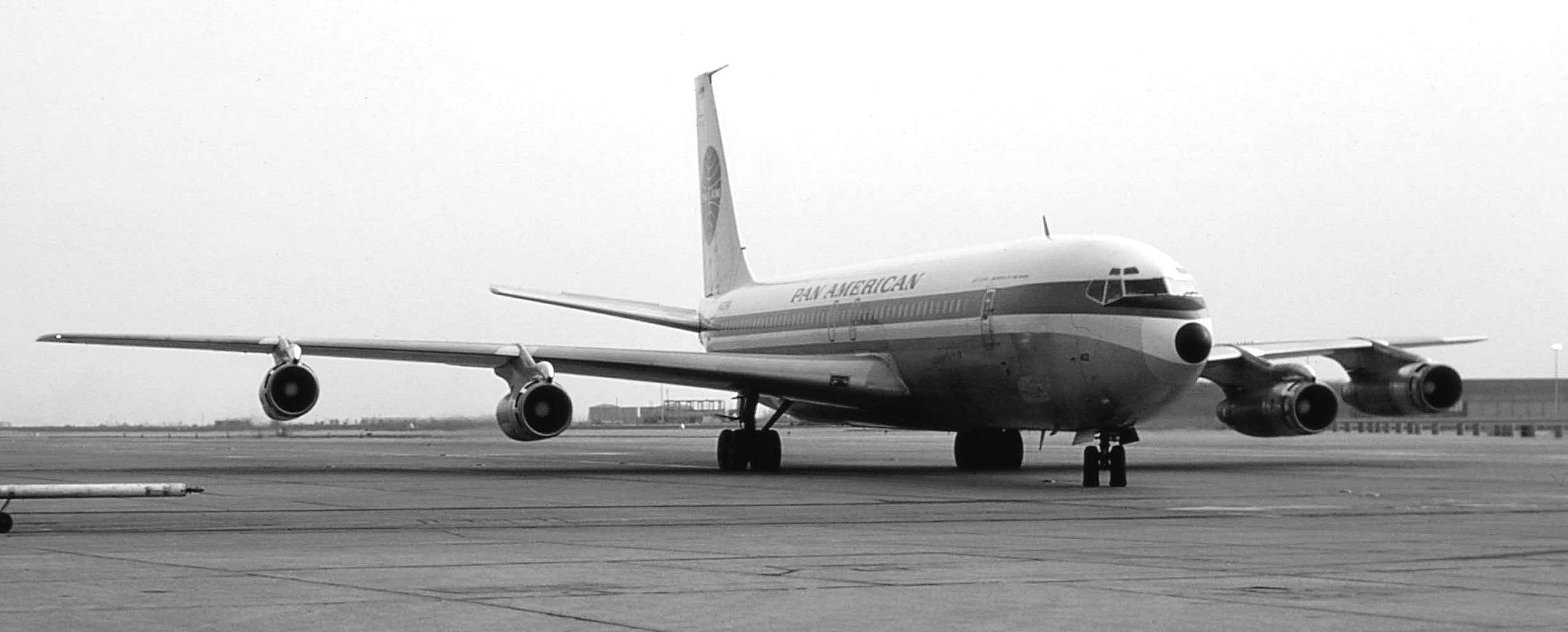
The production Boeing 707 first flew on 20 December 1957 and entered service with Pan American on 26 October 1958. It was larger, faster and longer-legged than the Comet, with four podded engines slung under a strongly swept wing, and it could cross the Atlantic with a full load in a way the Comet never comfortably could. Pan Am’s founder Juan Trippe had ordered it in quantity, and the 707 quickly became the aircraft that made intercontinental jet travel ordinary rather than exceptional.
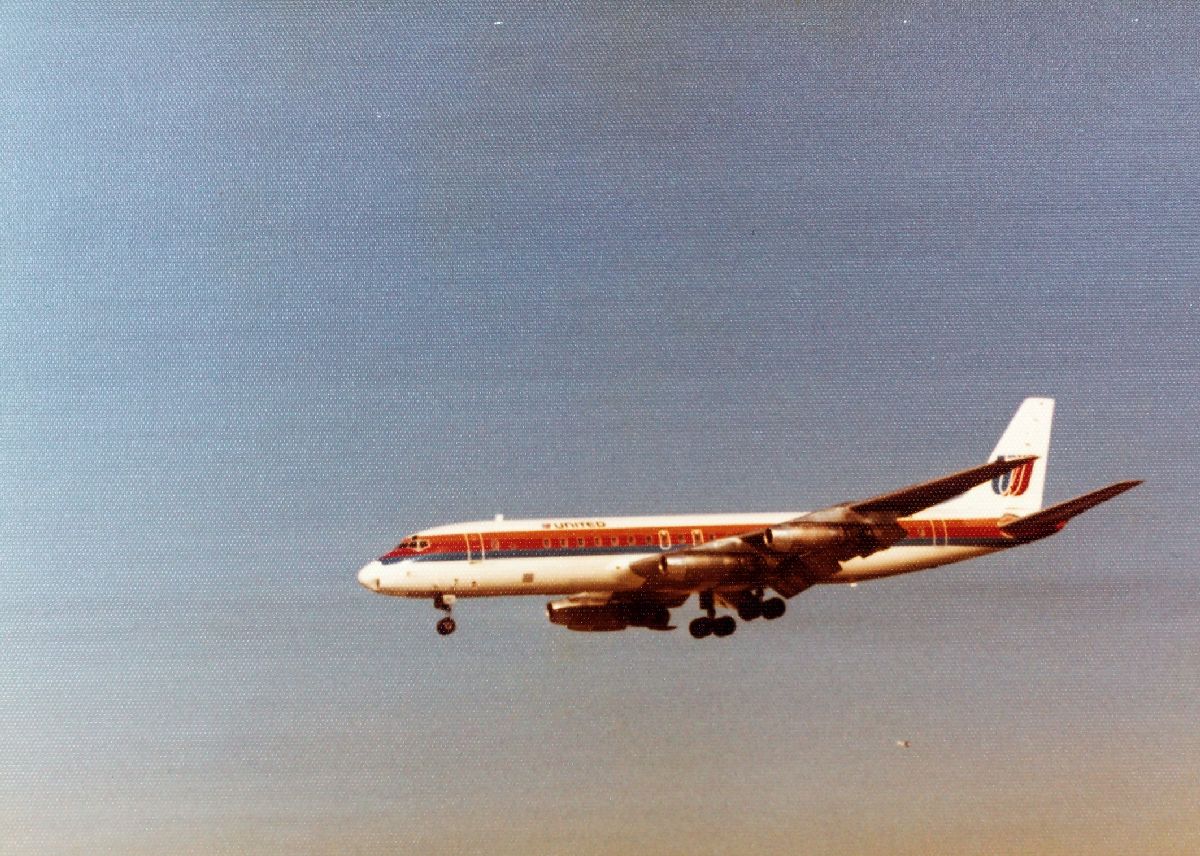
Douglas, the dominant name in piston airliners, answered with the DC-8. It first flew on 30 May 1958 and entered service with United Airlines and Delta Air Lines on the same day, 18 September 1959. Similar in size and layout to the 707, the DC-8 split the American market with Boeing and went on to a long career, later stretched into versions that served well into the jumbo-jet era. Between them the 707 and DC-8 set the template that the Boeing 727, 737, DC-9 and everything after would refine.
Two people loom over the American story. Juan Trippe, the founder of Pan American, used his airline’s buying power to force the pace, ordering jets in numbers that committed the manufacturers and made the economics work. And Tex Johnston, Boeing’s chief test pilot, famously barrel-rolled the Dash 80 over a crowd of airline executives and dignitaries at Seattle in 1955, an unauthorised stunt that alarmed his bosses but demonstrated the aircraft’s strength in the most memorable way possible. Boeing’s gamble, and the confidence around it, helped turn a private prototype into the world’s dominant airliner.
Boeing and Douglas were not quite alone. Convair, another established American manufacturer, tried to enter the market with the 880 and the faster 990 Coronado at the end of the 1950s. Both were quick, the 990 among the fastest subsonic airliners ever built, but they carried fewer passengers than the 707 and DC-8 and arrived too late to win many orders. They lost Convair a great deal of money and stand as a reminder that even in a booming market there was room for only so many large jets. The market had chosen the 707 and the DC-8, and it did not need a third.
The turning points that decided the jet age
Why did the lead pass from Britain to the United States in barely a decade? Several turning points decided it, and none of them was simply that one country built better engineers than another.
The Comet grounding
The single most important event was the loss of two Comets and the long grounding that followed. It cost de Havilland years at the exact moment the market was forming. When the redesigned Comet 4 returned in 1958, the far larger and longer-ranged 707 was weeks away. The Comet 4 did win a symbolic prize, flying the first transatlantic jet passenger service on 4 October 1958, a little over three weeks ahead of Pan Am’s 707. But it lacked the range to fly the westbound Atlantic reliably against the wind, and within two years the 707 had taken those routes.
Size, range and the American market
The American jets were bigger. More seats meant lower costs per passenger, and greater range meant fewer stops on the long routes that made jets pay. Behind that lay a home market no other country could match: a vast domestic network and airlines with the money to order jets by the dozen. Boeing and Douglas could amortise development across enormous production runs, and once the 707 and DC-8 were selling, the economics ran away from everyone else.
The under-wing engine
The layout mattered too. Podded engines slung under the wing, as on the 707 and DC-8, were easier to maintain, kept the wing structure clean, and made it simple to fit more powerful engines later. The Comet’s engines, buried in the wing roots, were elegant and low-drag but hard to enlarge and awkward to service. The under-wing pod became the standard for large jets and remains so today, which tells you which bet paid off.
It is worth remembering how narrow some of these margins were. Had the Comet not been grounded, or had de Havilland understood metal fatigue a few years sooner, the story might read very differently, with a British aircraft established on the world’s routes before Boeing’s prototype had even flown. The jet age was not bound to be American. It became American because of a handful of decisions, accidents and advantages that fell a certain way in the middle years of the 1950s.
What it was like to fly the early jets
For passengers, the early jets were a revelation. The most immediate change was smoothness. Piston airliners flew in the weather, bumping through cloud and turbulence, their big engines shaking the whole airframe. The jets climbed above most of it, to 30,000 or 40,000 feet, where the air was smooth and the ride quiet by comparison. Journey times fell sharply. A crossing that took a piston airliner the best part of a day could be done in hours.
Speed was the headline figure. Where a Constellation cruised at perhaps 300 miles an hour, the new jets cruised near 500 to 600, close to the speed of sound. That halved long-haul times and made routes practical that had needed multiple fuel stops. It also made flying feel modern in a way that captured the public imagination, and airlines sold the glamour hard, with the phrase “the jet age” doing the work of a thousand adverts.
It was not perfect. The first jets were thirsty and needed long runways, so airports had to be rebuilt to take them. Early engines were smoky and very loud on the ground, a nuisance for anyone living near an airport that would take decades to address. Fares were high, and jet travel began as a privilege of the well-off before economies of scale slowly brought prices down. But the direction was set, and there was no going back to the propeller for serious long-haul travel.
For crews, the jets demanded a new kind of flying. They were faster and flew higher, which left less time to react and made weather and fuel planning more exacting. Early jet engines responded slowly to the throttle, so approaches had to be flown with more anticipation than a piston pilot was used to, and the high speeds meant mistakes developed quickly. Airlines invested heavily in training and in the new discipline of jet operations, and the profession of the airline pilot changed along with the aircraft.
On the ground, the jets reshaped the airport itself. Longer runways, stronger pavements, larger terminals and jet bridges all followed, and the noise of early turbojets forced the first serious thinking about aircraft nuisance around airports. The whole infrastructure of modern air travel, from the length of a runway to the layout of a terminal, was pulled into being by the aircraft of this decade. The jet did not just change the journey, it changed everything on the ground that the journey touched.
Early jet airliners compared
The table below sets the main pioneers side by side. Seating varied widely by variant and airline layout, and cruise figures are rounded, so treat these as a guide to scale rather than exact specifications for a single sub-type.
| Aircraft | Origin | First flight | Into service | Typical seats | Approx. cruise | Significance |
|---|---|---|---|---|---|---|
| de Havilland Comet 1 | United Kingdom | 27 July 1949 | 2 May 1952 | 36 to 44 | 740 km/h (460 mph) | World’s first jet airliner in service |
| Avro Canada C102 Jetliner | Canada | 10 August 1949 | Never (prototype) | Around 50 | Around 660 km/h (410 mph) | Second jet airliner to fly; never produced |
| Tupolev Tu-104 | Soviet Union | 17 June 1955 | 15 September 1956 | 50 to 100 | 800 km/h (500 mph) | Second into service; only jetliner flying 1956 to 1958 |
| Sud Aviation Caravelle | France | 27 May 1955 | 26 April 1959 | Around 80 | 800 km/h (500 mph) | First rear-engined and short-haul jet airliner |
| Boeing 367-80 (Dash 80) | United States | 15 July 1954 | Never (prototype) | Demonstrator | Around 880 km/h (550 mph) | Prototype for the 707 and KC-135 |
| Boeing 707 | United States | 20 December 1957 | 26 October 1958 | 140 to 180 | 900 km/h (560 mph) | Made intercontinental jet travel routine |
| Douglas DC-8 | United States | 30 May 1958 | 18 September 1959 | 120 to 180 | 900 km/h (560 mph) | Boeing’s main American rival; long career |
Legacy: the template for modern air travel
By the end of the 1950s the pattern of the modern airliner was set, and it has barely changed in outline since. A pressurised tube, a strongly swept wing, turbine engines in pods, cruising high above the weather near the speed of sound: describe a jet from 1959 and you have described the basic shape of the aircraft you fly in today. The refinements since, high-bypass turbofans, more efficient wings, digital systems, twin-engine long-haul, are improvements on a template these aircraft fixed.
The human legacy is just as large. The jet made the world smaller. Journeys that had taken days took hours, and over the following decades falling costs turned a privilege of the wealthy into something ordinary. Mass tourism, global business, the movement of people across continents at will: much of it rests on the jet airliner that the 1950s invented. The dark side of the story, the noise and the fuel burn, is also part of that inheritance, and it drives the industry’s search for quieter, cleaner aircraft to this day.
There is a lesson in the leadership passing from Britain to the United States, too. Being first is not the same as winning. Britain’s early lead was real and its engineering was often brilliant, but a catastrophic setback, a smaller home market and a design that was harder to grow all told against it. The United States arrived later with more range, more capacity and the resources to build in quantity, and that is what carried the day. For the wider Cold War contest playing out in these same years, our overview of the V-bombers covers the military jets built from much the same technology.
The aircraft of the 1950s also fixed the commercial shape of the industry. The idea that an airline would order dozens of a single type, that manufacturers would recover their costs over long production runs, and that a small number of makers would dominate the world market all hardened in this decade. The duopoly of large jet makers that defines airliner manufacturing today has its roots in the moment when Boeing and Douglas pulled decisively ahead of everyone else.
Photographing the early jets and their survivors today
None of these pioneers still fly in airline service, but several survive in museums, and photographing them is a rewarding challenge quite different from shooting aircraft in the air. The de Havilland Aircraft Museum near London holds Comet airframes, the National Air and Space Museum in the United States preserves the original Dash 80, and Comets, 707s, DC-8s, a Tu-104 and Caravelles are displayed at collections across Britain, Europe, Russia and North America. Survivor aircraft do move between collections, so it is worth checking a museum’s current holdings before you travel.
Shooting large aircraft in tight spaces
Museum jets are big and often parked close to walls or other exhibits, so a wide-angle lens is essential to take in the whole airframe. Look for a three-quarter angle from low down to give the aircraft presence, and watch the background, since clutter and other aircraft compete for attention. Many of the same habits that make a strong airliner photograph outdoors apply here, and our guide to shooting civil airliners covers angle, light and livery in more detail.
Details tell the story
With historic types, the details are the story: the buried engine intakes of the Comet, the rear-mounted engines of the Caravelle, the period cockpit dials, the riveted skin, the faded airline livery. Close-up frames of these features often say more about the aircraft’s place in history than a full-length record shot. Strong composition matters as much indoors as out, and it is worth reading our guide to aviation photography composition before a museum visit.
Light and access
Indoor light is often dim and mixed, so a fast lens, a high ISO and careful white balance help, and a small tripod is worth having where the museum allows it. Outdoors, a preserved airliner on a gate or apron rewards the same golden-hour light that flatters any aircraft. If you build a set of these images, keyword them carefully by type, operator and location so they are easy to find later, and consider offering the best as prints or stock through a clear set of licensing options. You can see how a working archive is organised in the Piemags aviation galleries.
Every one of these aeroplanes traces back to a single circuit of a works airfield in Mecklenburg. Our account of the first jet flight, and the Heinkel He 178, covers where the turbojet actually came from.
One of this generation went on to be built in numbers none of the others came near. Our history of the Boeing 707 is the long version of the American half of this story, from the Dash 80 gamble to the arithmetic that finished the piston fleets.
Frequently asked questions
What was the first jet airliner?
The de Havilland Comet was the world’s first jet airliner to carry fare-paying passengers, entering service with BOAC on 2 May 1952 on the London to Johannesburg route. It had first flown on 27 July 1949. It cruised higher, faster and far more smoothly than any piston airliner of the day.
Why did the de Havilland Comet crash?
Two Comets broke apart in flight in 1954 because of metal fatigue. Each pressurisation and depressurisation cycle flexed the fuselage skin, and cracks grew from stress concentrations around openings in the structure until the cabin failed explosively at altitude. The investigation transformed how pressurised aircraft are designed and tested, introducing fail-safe structures and rounded openings.
What was the second jet airliner?
It depends on the measure. The Avro Canada C102 Jetliner was the second jet airliner to fly, just thirteen days after the Comet in August 1949, but it never entered service. The second jet airliner to carry passengers commercially was the Soviet Tupolev Tu-104, which entered Aeroflot service in September 1956.
Which came first, the Boeing 707 or the Douglas DC-8?
The Boeing 707 came first. It first flew on 20 December 1957 and entered service with Pan American on 26 October 1958. The Douglas DC-8 first flew on 30 May 1958 and entered service with United and Delta on 18 September 1959. Both were similar in size and layout and split the American market between them.
What made the Sud Aviation Caravelle special?
The Caravelle was the first jet airliner designed for short and medium routes, and the first to mount its engines at the rear of the fuselage rather than under the wing. That layout cut cabin noise and kept the wing clean, and it was widely copied on later types such as the DC-9 and the Boeing 727. It entered service in 1959.
Why did American jets overtake the British Comet?
Several factors combined. The Comet’s 1954 fatigue disasters grounded it for years at the crucial moment, and when the improved Comet 4 returned in 1958 the larger, longer-ranged Boeing 707 was almost ready. The American jets carried more passengers over greater distances, and a huge home market let Boeing and Douglas build them in quantity. The Comet was first, but the 707 and DC-8 won the market.
How fast did the early jet airliners fly?
The 1950s jets cruised roughly between 740 and 900 km/h, that is about 460 to 560 mph, close to the speed of sound and far faster than the piston airliners they replaced, which managed around 480 km/h or 300 mph. The larger American jets such as the 707 and DC-8 were the fastest, cruising near 900 km/h. Journey times on long routes were roughly halved.
Can you still see early jet airliners today?
Yes, in museums, though none remain in airline service. Comet airframes survive at the de Havilland Aircraft Museum, the original Boeing Dash 80 is preserved at the National Air and Space Museum, and Tu-104s, Caravelles, 707s and DC-8s are displayed at collections across Europe, Russia and North America. Because preserved aircraft are sometimes moved between collections, check a museum’s current holdings before travelling.
The last word in big airliners came half a century later: our history of the Airbus A380.
The jet age these pioneers opened reached its full scale a decade later, a story told in our Boeing 747 history.
