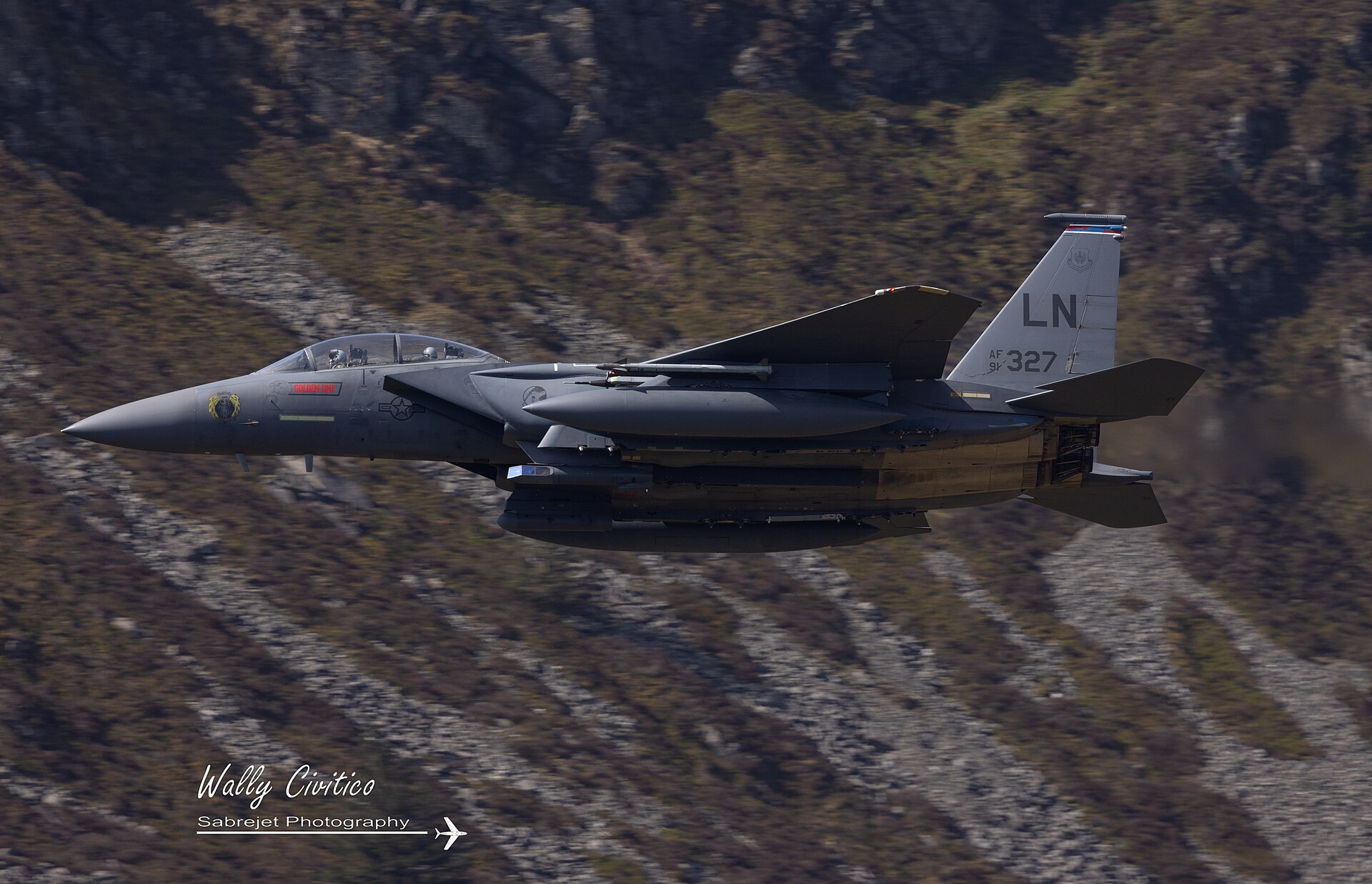
Mach Loop photography means climbing one of the hillsides above the low flying valleys between Dolgellau and Machynlleth in Wales and photographing military jets as they pass below you at around 250 feet, which calls for a 100-400mm class lens, shutter speeds near 1/1000s for sharp frames, continuous autofocus, and a weekday visit planned around the MOD’s published low flying timetable.
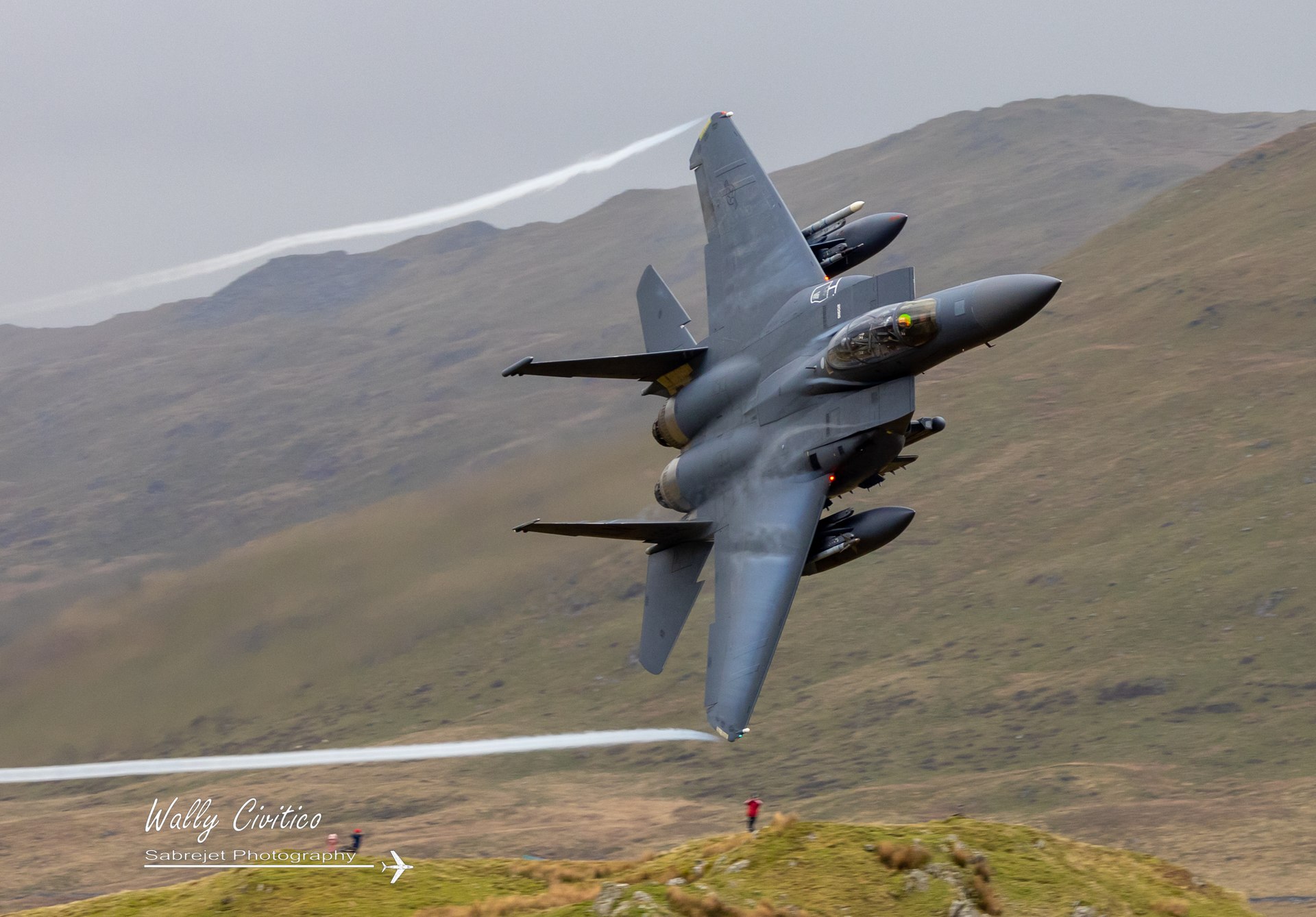
Nowhere else in Britain puts a photographer above a fast jet in quite the same way. At an airshow you crane upwards at a display line hundreds of metres away. On the Cad East hillside you look down on the topside of an F-15E as it banks through the bowl beneath your boots, close enough to read the tail code and count the weapons pylons. That reversal of the normal shooting angle is what makes the Loop special, and it is also what makes it technically demanding. This guide covers everything that actually matters: how the low flying system works, when to go, where to stand, what gear earns its place in the bag, the settings that work, and the mistakes that cost people their best frames.
What this guide covers
- What the Mach Loop is and why it suits photographers
- The rules: LFA7, the TTA and the low flying timetable
- When to go and how to plan a visit
- The viewing locations compared
- Cameras, lenses and what to carry up the hill
- Camera settings for the Mach Loop
- Technique: tracking jets from above
- The aircraft and how each one shoots
- A worked day at the Loop
- Light, weather and the valley problem
- Hillside fieldcraft, etiquette and safety
- Common mistakes at the Mach Loop
- After the shoot: editing and captioning
- Frequently asked questions
What the Mach Loop is and why it suits photographers
The Mach Loop, sometimes written Machynlleth Loop, is a chain of connected valleys in west-central Wales, roughly eight miles east of Barmouth, running between the market towns of Dolgellau to the north and Machynlleth to the south. The name comes from Machynlleth rather than from Mach numbers, though the pun does no harm to its reputation. Military crews use the terrain to practise low level flying, following the valley floors and ridgelines in a rough circuit that passes several photogenic pinch points on the way round.
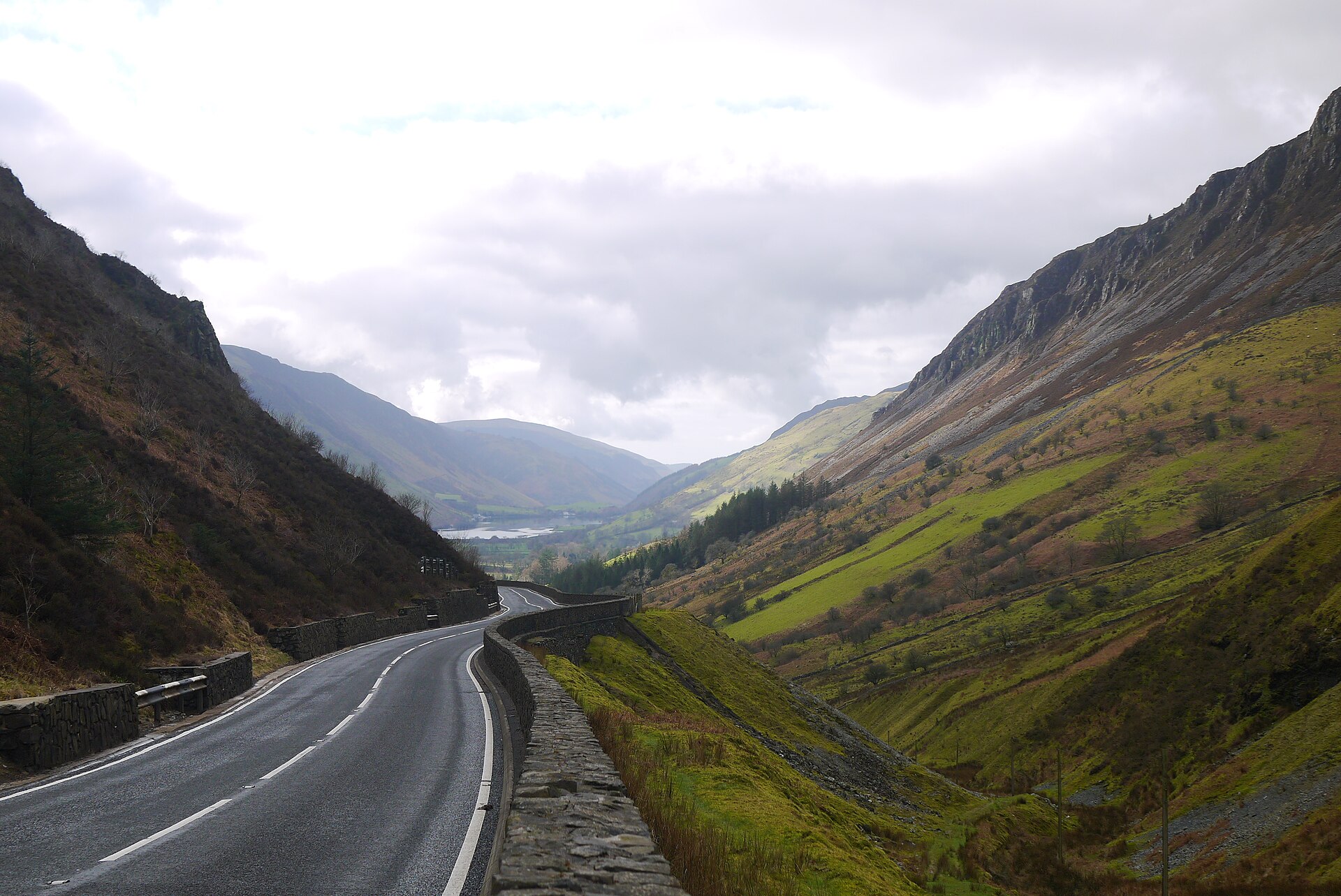
The Loop sits inside Low Flying Area 7, the designated low flying area that covers the whole of Wales, and it forms part of the wider UK Military Low Flying System, which extends across open UK airspace from the surface to 2,000 feet. In practical terms this means fast jets are legally and routinely operating down to 250 feet above ground level as they thread the valleys. When aircraft drop into the Loop they are below the crests of the surrounding hills, so a photographer standing halfway up the slope is at or above cockpit height as the jet goes past. You photograph topsides, not bellies.
Aircraft seen regularly include RAF Hawks from Valley, Typhoons, F-35s, Texan T1 trainers and the A400M, along with United States Air Force F-15E Strike Eagles from RAF Lakenheath and MC-130 and Osprey traffic associated with RAF Mildenhall. Foreign air arms appear from time to time when they are in the UK for exercises. Traffic levels have never been guaranteed, and reporting around a 2018 Ministry of Defence review suggests usage of the Loop was deliberately reduced from that point, with overseas-based aircraft generally excluded unless flying as part of a UK exercise. Quiet days happen, and every regular has stories of eight-hour sits for nothing. The photographers who come home with portfolios treat the Loop as a repeat venue rather than a single pilgrimage.
The rules: LFA7, the TTA and the low flying timetable
Understanding the system pays off directly in planning. The UK is divided into 20 low flying areas. Within three of them sit Tactical Training Areas, one in a small area of mid Wales, one in northern Scotland and one across the borders of southern Scotland and northern England. The Welsh TTA lies to the south of the Mach Loop itself. When a TTA is activated, fixed wing aircraft may operate down to 100 feet above ground level. Outside those activation windows, and everywhere else in the low flying system, fixed wing aircraft fly no lower than 250 feet, while helicopters are authorised down to ground level.
The Ministry of Defence publishes an operational low flying training timetable on GOV.UK covering the three TTAs. It is worth reading correctly: it tells you when the TTA south of the Loop may be active for 100 foot training, not when jets will fly the Loop itself. The MOD is explicit that it cannot provide a timetable for routine low flying, because tasking and weather change too quickly. The final decision to use a TTA is taken on the day. So treat the timetable as one signal among several. An active TTA week in Wales raises the odds that fast jets will be working in the area, and crews transiting to and from the TTA often route through the Loop, but nothing is promised.
Two consequences for photographers follow. First, weekdays are what matter. Military low flying training is overwhelmingly a weekday activity, and the timetable itself is published for Monday to Friday. Second, there are no set flight paths and no published pass times, so the people on the hill with the most patience win. Regulars monitor the timetable, aviation forums and social media groups where morning sightings are shared, then commit to a full day on the hill rather than a speculative two hours.
When to go and how to plan a visit
The planning sequence that works is simple. Check the GOV.UK operational low flying timetable for the Welsh TTA during the week you can travel. Cross-reference school holidays and major exercises: large NATO exercises hosted in the UK historically increase low level traffic, while the weeks around Christmas, Easter and the height of summer leave can be dead. Then watch the weather, because low flying only happens when crews can see, and the Loop sits in some of the wettest terrain in Britain.
Time of year changes both traffic and light. Winter offers low sun angles that sidelight the valleys beautifully, but short days, ice on the paths and long quiet spells. Spring and autumn are the sweet spots, with active training cycles, workable light for most of the day and bearable conditions on the hill. Summer brings the longest days and the most visitors, but also heat haze in the valley bottoms, flat overhead light in the middle of the day and, in some years, reduced flying during the main leave period.
Time of day matters more than most first-timers expect. Historically the busiest windows have been mid-morning and early afternoon, which fits normal squadron working days: crews brief, fly a morning wave, turn the jets round over lunch and fly an afternoon wave. Arriving on the hill by 08:30 and staying until 16:00 covers the realistic window on most days. Passes come with little warning. You hear a jet before you see it, usually ten to twenty seconds out, and at 420 knots it crosses the photographable arc in five to eight seconds. Everything about your day is arranged around being ready during those seconds.
First visit logistics are worth taking seriously. The nearest towns with accommodation are Dolgellau and Machynlleth, with Barmouth on the coast a short drive away. Fuel and food options near the viewing areas are thin, so bring everything you need for a full day. Mobile signal on the hillsides ranges from patchy to absent, which is another reason the regulars organise themselves the night before. If you are new to aviation photography generally, our beginner’s guide to plane spotting covers the habits of mind that transfer directly to the Loop: learn the traffic, keep notes, and let patience do the heavy lifting.
The viewing locations compared
Every location on the Loop is a hillside above a bend in a valley, and each has its own geometry, climb and light. The four below account for the overwhelming majority of published Mach Loop photographs.
Cad East
The most photographed spot on the circuit, above the A487 mountain pass south of the Cadair Idris massif, from which the Cad names come. Jets approaching from the north-west drop into a natural bowl and bank hard in front of the slope, showing their topsides to photographers sitting above. Morning light favours Cad East, lighting the aircraft from behind the photographer for the first half of the day. The climb is steep and takes twenty to thirty minutes at a steady pace with camera gear. Parking is in the car park and lay-bys on the pass below, including the car park on the site of Llyn y Tri Greyenyn, and fills early on days when word has gone round.
Cad West
Directly across the pass from Cad East, Cad West offers the classic level pass: aircraft come through wings-level or in a gentle bank, slightly below or level with the photographer, making it the friendliest location for panning and for holding focus on the cockpit. Afternoon light suits it better than morning. The climb is shorter and less brutal than Cad East, which makes it the usual recommendation for a first visit. The two Cads are close enough that some photographers move between them during the day as the light swings round.
The Bwlch
About five miles east of Dolgellau on the A470 towards Dinas Mawddwy, the Bwlch overlooks a long straight valley run, and aircraft frequently pass below the crest, giving true look-down angles at topsides against the valley floor. Parking is in lay-bys on the A470 with space for roughly twenty cars, and on busy days those spaces are gone before 08:30. The slope is more open than the Cads, with more room to spread out and a wider choice of shooting angles along the ridge.
Corris Corner
Above the village of Corris on the Machynlleth side of the circuit, this spot puts you above a tight bend where aircraft bank hard through the turn. The climb is a twenty to thirty minute walk of medium difficulty, parking is a small lay-by holding perhaps five to ten cars, and the light only really works before noon. It is quieter than the Cads on most days, which some photographers count as a feature.
| Location | Best light | Climb | Parking | Signature shot |
|---|---|---|---|---|
| Cad East | Morning | Steep, 20 to 30 min | Pass car park and lay-bys, fills early | Topside banking shot in the bowl |
| Cad West | Afternoon | Moderate, shorter than Cad East | Same pass parking as Cad East | Level pass at eye level, panning friendly |
| The Bwlch | Middle of day | Moderate, open slope | A470 lay-bys, around 20 cars | Look-down topside against the valley floor |
| Corris Corner | Before noon | Medium, 20 to 30 min | Small lay-by, 5 to 10 cars | Hard turn through the bend |
Cameras, lenses and what to carry up the hill
The Loop rewards reach and punishes weight, and every gear decision sits somewhere on that line. On focal length, the honest answer is that 400mm on a full frame body, or its equivalent, is the working minimum for frame-filling shots of fast jets at the Cads, and 500mm to 600mm gives cropping room for the more distant lines. The 100-400mm and 150-600mm zooms have become the standard Loop lenses for good reason: aircraft appear at unpredictable distances and a zoom lets you take the wide topside shot at the near point of the pass and the tight cockpit shot on approach without changing anything. A second body with a 70-200mm covers formation pairs and the wider valley context. If you are choosing glass for this kind of work, our guide to aviation photography lenses goes deeper on the trade-offs.
Body choice matters less than autofocus behaviour. Anything with a competent continuous AF mode and a burst rate of eight frames per second or better will do the job. Mirrorless bodies with subject detection have made the vertical tracking problem at the Loop noticeably easier, because they hold the aircraft when it crosses from sky background to hillside background, which is exactly where older contrast-based systems used to let go. Buffer depth is worth checking before you travel: a pair of jets through the bowl can pull sixty to eighty frames out of you in under ten seconds.
Support is a personal call. Most regulars shoot handheld, because passes are short and arrive from ambush, and a monopod slows the swing from one end of the arc to the other. If you do carry support for a long lens, a monopod with a loose head beats a tripod on the slope in every respect. Everything else in the bag is about surviving the day: waterproofs regardless of forecast, warm layers even in summer because the wind on the tops is relentless, more water than feels reasonable for the climb, food for a full day, and a sit mat, because you will be on wet ground for hours. Keep total carried weight under control. The climb to Cad East with fifteen kilos of glass is a different sport.
Camera settings for the Mach Loop
Settings at the Loop start from one fact: you are usually shooting downwards at a fast subject against a textured background, not upwards against sky. That changes exposure, autofocus and shutter speed decisions compared with airshow work. The full logic of jet settings is covered in our guide to photographing fast jets, but the Loop-specific version follows.
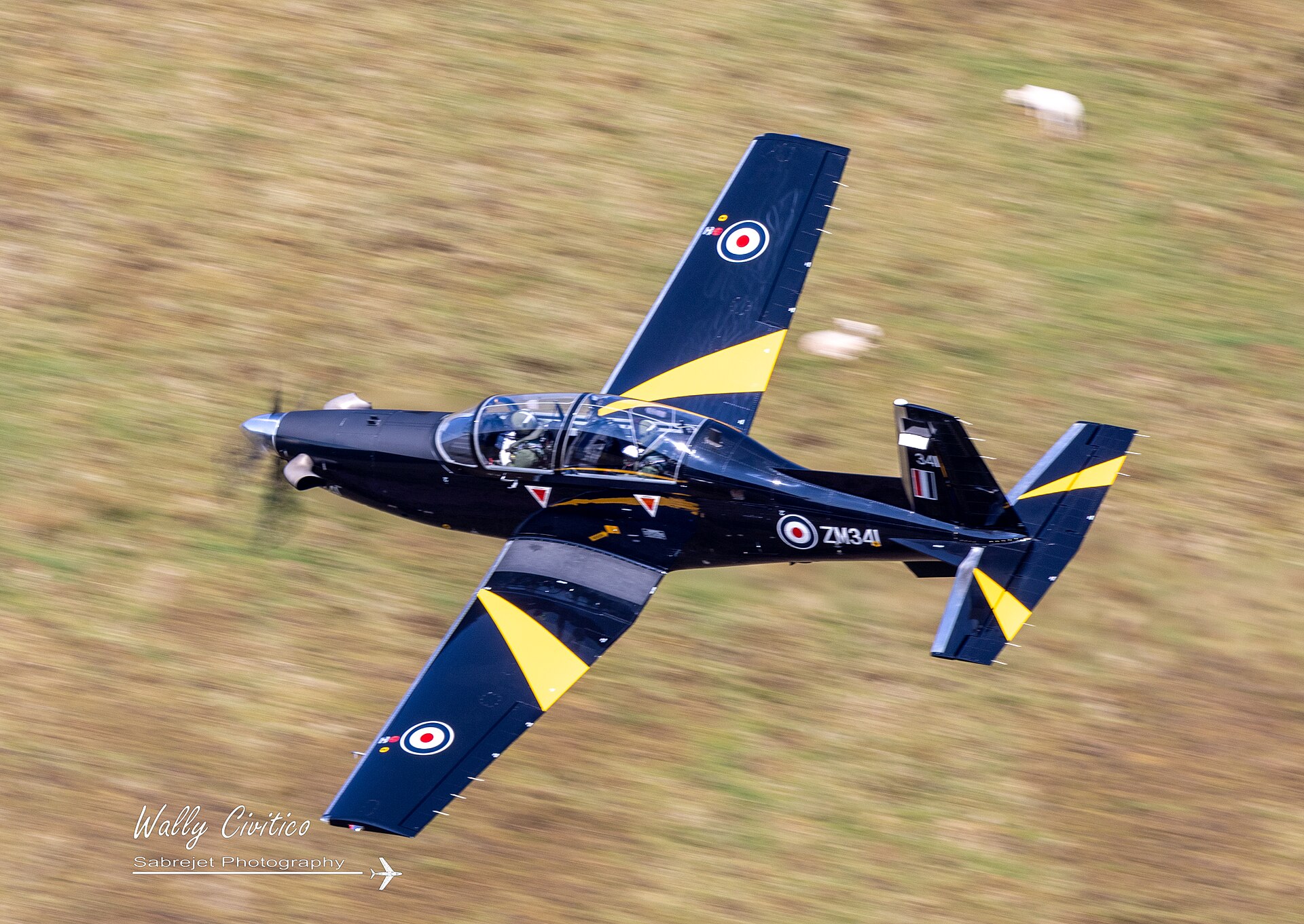
Shutter speed first. For sharp jets, 1/1000s is the working floor and 1/1600s to 1/2000s is safer for the close, fast crossers at the Cads, where angular speed is at its highest. Jets have no propellers, so there is no blur penalty for going fast. The exception is the deliberate pan at slower speeds against the hillside, covered in the technique section, and propeller-driven traffic: for the Texan T1 you need 1/250s to 1/320s to keep the prop disc alive, which is its own discipline and is explained fully in our propeller blur guide.
Aperture and ISO follow from the shutter speed. Wide open or one third down from wide open is normal, and on a 100-400mm at the long end that means f/5.6 or f/6.3. Let auto ISO carry the exposure and cap it where your body gets ugly, typically ISO 3200 to 6400 on current sensors. Welsh valley light swings constantly, so auto ISO with manual shutter and aperture is the mode that keeps up. Add between two thirds and one stop of positive exposure compensation when a dark jet is against a dark hillside and your meter tries to lift the whole scene; check the histogram after the first pass rather than trusting the rear screen in daylight.
Autofocus: continuous servo, a grouped or zone area rather than a single point, and back-button focus if you have adopted it. Subject detection set to aircraft or vehicles where available. The killer problem is the background transition: a jet drops below the ridgeline mid-pass and the AF system suddenly has hillside texture competing for attention. Grouped points plus a high tracking sensitivity setting that resists switching targets handles it. Our autofocus and camera settings guide covers the equivalent menu names across Canon, Nikon and Sony.
| Situation | Shutter | Aperture | ISO | Notes |
|---|---|---|---|---|
| Fast jet, sharp frame | 1/1600s | Wide open to f/6.3 | Auto, cap 6400 | Default for the Cads |
| Fast jet, more margin | 1/2000s | Wide open | Auto | Close, high crossing speed passes |
| Deliberate pan against hillside | 1/320s to 1/500s | Stopped down as needed | 100 to 400 | Practise before spending a real pass on it |
| Texan T1 and other props | 1/250s to 1/320s | As light allows | Base where possible | Prop disc needs blur |
| Dull day, grey overcast | 1/1000s | Wide open | Auto, accept 6400 plus | Noise reduction beats motion blur |
Technique: tracking jets from above
The core skill is a smooth horizontal swing with a vertical correction laid over it, because aircraft in the Loop descend, climb and bank through the pass rather than crossing on a rail. Set your stance before anything appears: feet apart, pointing at the middle of the arc, so the swing unwinds your torso rather than fighting it. Pick up the aircraft early, at the far end of the valley, settle the AF group on it while it is still small, and let the lens track ahead of the action rather than chasing from behind. The follow-through matters as much as it does in any panning discipline: keep swinging after the last frame, because stopping the swing early is what drags the tail out of focus in the final burst.
Sound is your radar. Jets announce themselves seconds before they show, and the direction of the sound tells you which entry to cover. Experienced hands at Cad East sit facing the north-west entry with the camera already half raised. When a pair comes through, discipline beats greed: take the lead aircraft through the prime arc, then commit cleanly to the wingman rather than sawing between them and getting neither.
Shooting downwards changes composition. Backgrounds are hillside, scree, forestry and road, and they move fast in the frame. The classic Loop portfolio has three shots: the tight topside banking shot with the full airframe against the valley floor, the head-on cockpit shot as the jet points at the hill before turning, and the environmental wide shot that shows the aircraft small in a huge landscape. The third is the most underrated. When the jet is too far for a frame-filler, stop trying to crop your way to one and shoot the valley with a jet in it. Those frames license well and win competitions precisely because everyone else binned them.
The deliberate pan is the advanced play. Against a static hillside background, a jet at 1/400s with a properly matched swing gives a streaked, speed-soaked image that a frozen 1/2000s frame cannot touch. The hit rate is low and the technique is identical to any other pan: pre-swing, match angular speed, squeeze during the smoothest part of the arc, follow through. Build the skill on road traffic at home before spending real passes on it.
The aircraft and how each one shoots
Each type that works the Loop sets its own problems, and knowing them before the noise starts is worth more than any menu setting.
BAE Hawk T2
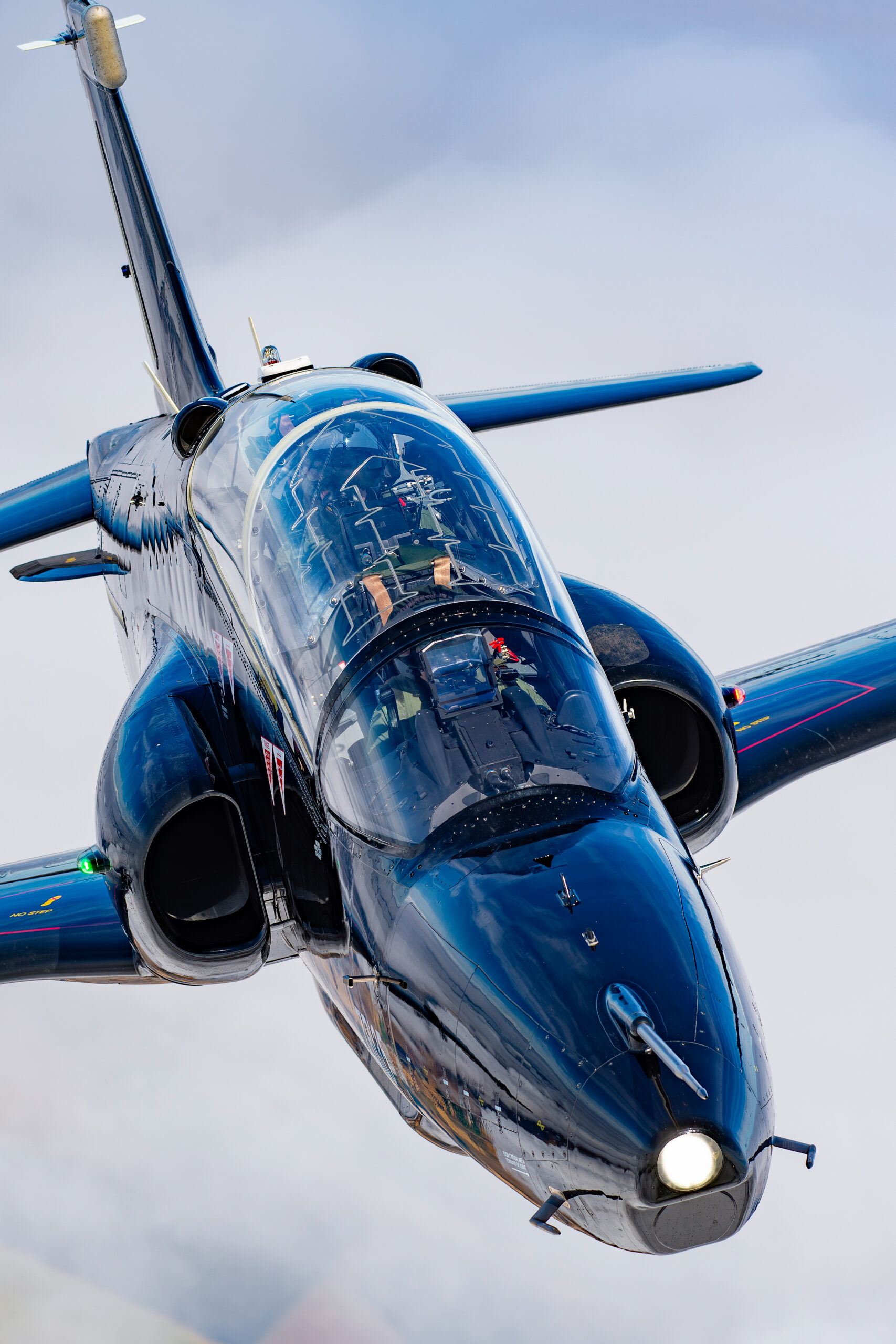
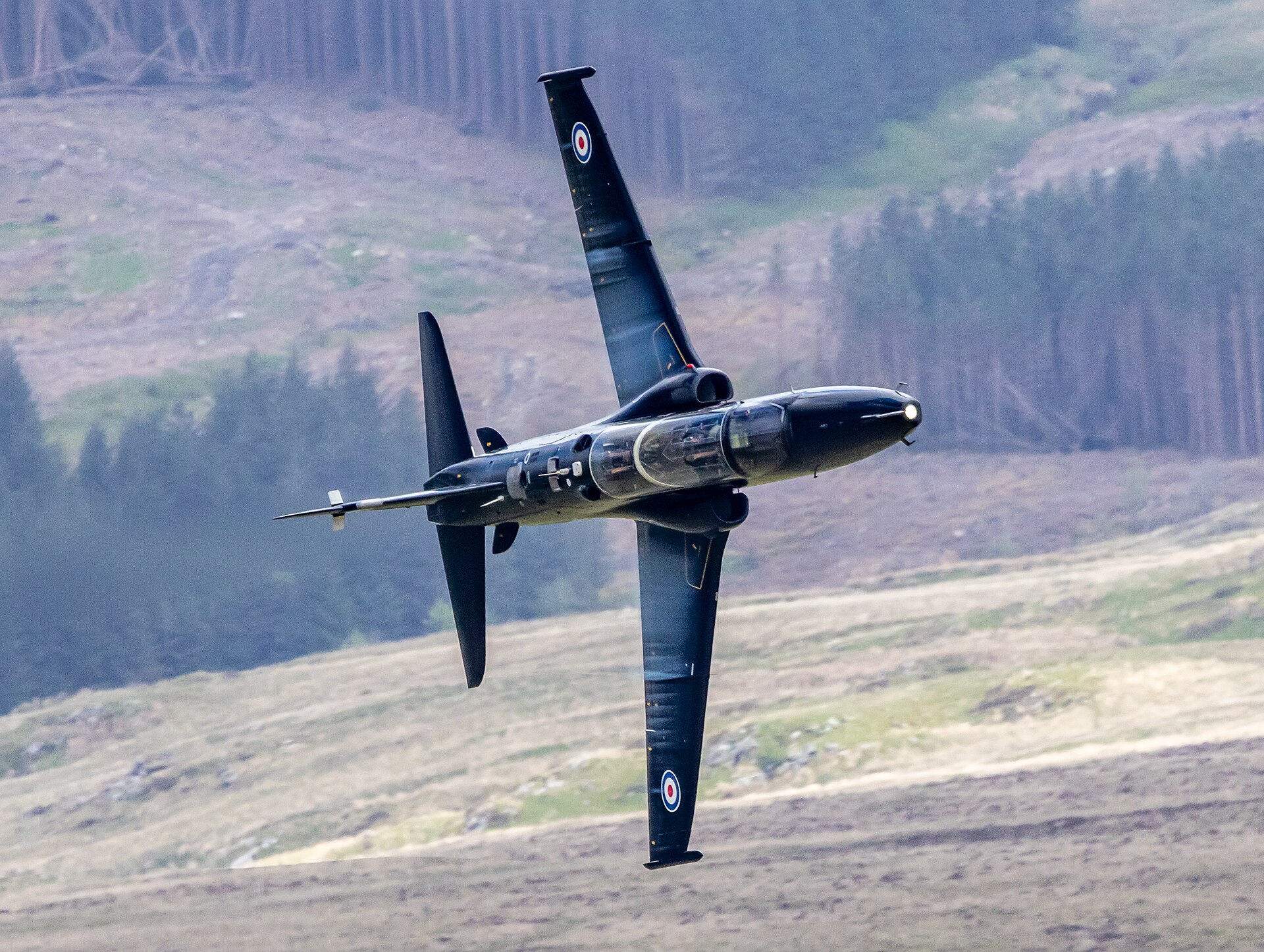
The resident type, flown from RAF Valley on Anglesey, and the aircraft you are most likely to see on an average day. The Hawk is small, dark and quick through the turns, which makes it the hardest common subject to keep large in the frame and the best teacher on the circuit. Its glossy black scheme swallows light, so add positive exposure compensation against bright ground and watch the histogram. When a Hawk rolls hard through the bend the topside plan view lasts perhaps a second: that is the frame.
Eurofighter Typhoon
Loud early warning, big delta wing, and vapour off the leading edges on humid days. Typhoons tend to come through fast and stabilised, and the head-on cockpit shot as the jet points at the hill is often stronger than the crossing shot because of the airframe’s dramatic frontal geometry.
F-15E Strike Eagle
The Lakenheath Strike Eagles are the prize for many visitors: big, dark, twin-tailed and frequently flown in pairs through the Cads. The size helps your autofocus and your framing, and the LN tail codes and coloured fin flashes read clearly in files, which matters for editorial captions. Pairs demand the discipline described above: lead first, then commit to the wingman.
F-35 Lightning II
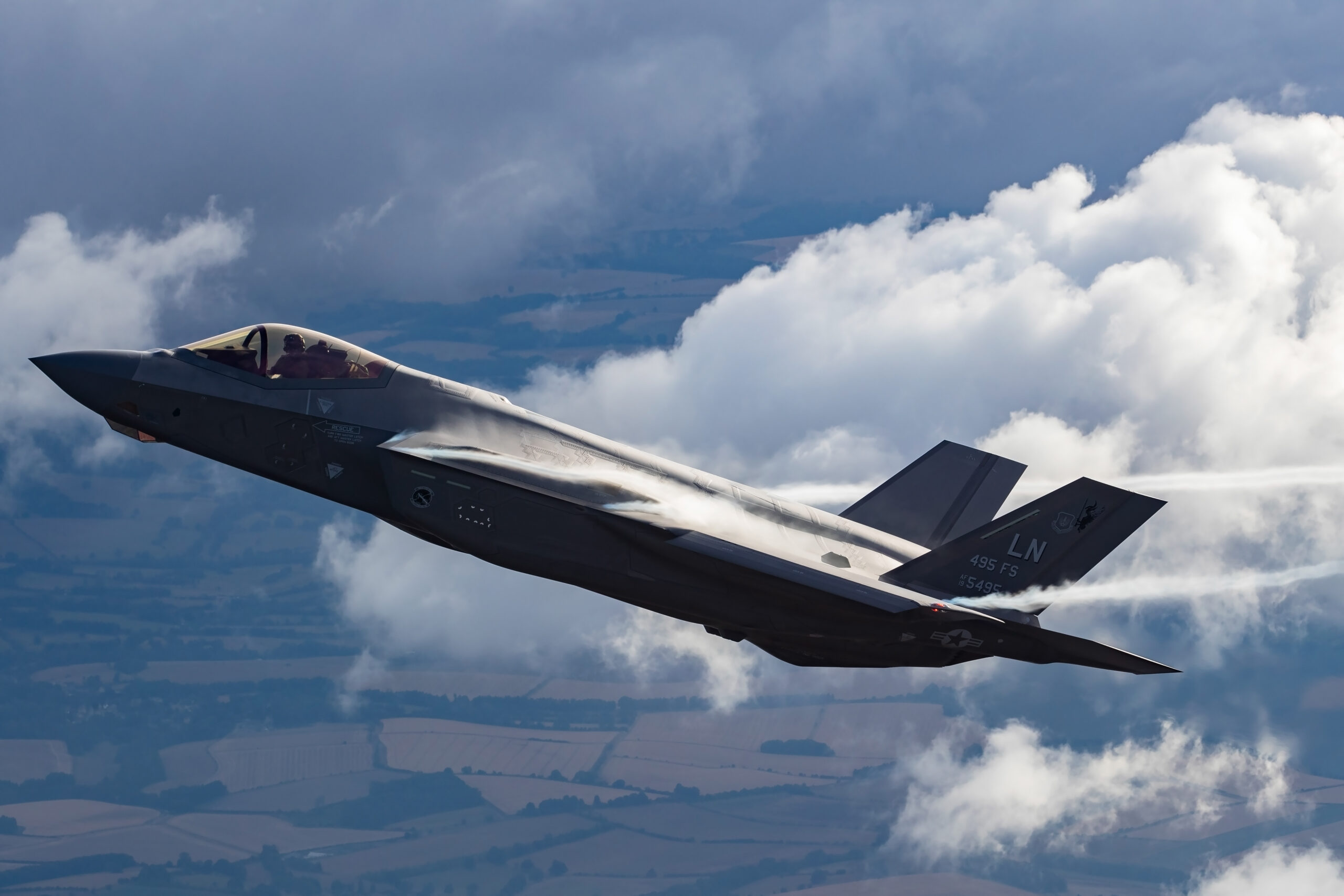
Both RAF F-35Bs and, when exercises bring them, US F-35As appear at low level. The type’s uniform grey and faceted surfaces meter differently from legacy jets, tending to underexpose against bright hillsides, and its relatively quiet approach compared with a Typhoon shortens your warning time. Treat every distant rumble as live.
Texan T1
The RAF’s turboprop trainer is the reason a second shutter speed lives in your head. At jet speeds it is a routine subject; at 1/1600s its propeller freezes into a stationary cross and the picture dies. Drop to 1/250s to 1/320s, accept the lower keeper rate, and the prop disc comes back.
A400M and the heavy traffic
Transport types thread the valleys more slowly and more predictably, which makes them the best practice subjects of the day and a really photogenic sight against the terrain. Prop discipline applies: the A400M’s eight-blade scimitar props want 1/320s or slower to blur convincingly, and the type’s size lets you hold that speed with a confident pan.
A worked day at the Loop
Here is how a productive day actually runs, assembled from many real ones. The alarm goes at 06:00 in Dolgellau. The TTA timetable said active this week, last night’s forecast promised a clearing front, and the group chat reported jets in the system yesterday. Park below the Cads by 08:00, boots on, camera bag checked: two bodies, the 100-400mm and a 70-200mm, six batteries, cards formatted, waterproofs, two litres of water, lunch. Climb Cad West in twenty five minutes and pick a spot level with the expected line, a respectful gap from the two regulars already settled in.
Rig both bodies before sitting down: long lens at 1/1600s, f/5.6, auto ISO capped at 6400, AF-C group, aircraft detection on; short lens at the same exposure logic. Fire a test frame down the valley and read the histogram. Then the waiting starts, and the discipline is to stay rigged. At 10:20 a low rumble builds from the north-west and resolves into a pair of Hawks, thirty seconds apart. First Hawk: picked up early, tracked through the bowl, long burst through the bank, follow through. Second Hawk: same again, and this one rolls harder and gives the plan view. At 11:05 a singleton Texan comes through; shutter down to 1/320s in one dial spin because the speed was pre-decided, pan, twelve frames, two keepers likely.
Lunch happens in shifts with your neighbours so someone is always watching the entry. At 13:40 the sound is different, deeper, and two F-15Es run the valley in trail. Everything the morning practised now happens at half the reaction time: lead jet through the arc, commit to the trailer, buffer held for the bank, done in nine seconds. Review nothing. At 15:30 the light goes flat, the group chat goes quiet, and you walk down with four passes, several hundred frames and, realistically, five portfolio candidates. That is a good day at the Mach Loop, and the blank day you had last month is the price already paid for it.
Light, weather and the valley problem
Valley light is the Loop’s quiet difficulty. The hills put hard shadow lines across the valley floor for hours either side of midday in winter, and a jet crossing from lit ground to shadowed ground inside a single pass will swing exposure by two stops or more. This is why auto ISO earns its place, and why the histogram check after the first pass of the day is non-negotiable. Overcast days are not a disaster: an even grey sky acts as a giant softbox, kills the shadow line problem and saturates the greens and browns of the hillsides, at the cost of higher ISO and flatter modelling on the airframe.
Heat haze is the other saboteur, and it is worse than most visitors expect because you are shooting long lenses across a valley of moving air. On warm days the shimmer above the valley floor will soften every frame taken through it, and no amount of sharpening recovers detail that never reached the sensor. The mitigations are the same ones covered in our heat haze guide: shoot earlier in the day, favour higher shooting positions so the light path spends less time in the boiling layer near the ground, and accept that the near pass will always out-resolve the far one. Rain squalls, in contrast, can be a gift. The half hour after a front clears, with washed air and low sun under the cloud deck, produces the cleanest long-lens conditions the Loop ever offers.
Wind deserves respect on its own terms. The passes funnel it, and a 40mph gust while you are braced behind a 600mm lens on a scree slope is a safety issue as well as a sharpness issue. On strong wind days, drop lower on the slope, shorten the lens, and raise the shutter speed a stop to fight the buffeting.
Hillside fieldcraft, etiquette and safety
The Loop’s hillsides are open access land grazed by sheep, crossed by streams and strewn with rock, and they deserve the same respect as any mountain day. Boots, not trainers. Waterproofs always. Tell someone where you are. The weather on Cadair Idris’s shoulders turns fast, and a clear morning is no promise of a clear afternoon. Carry your rubbish down, close what you open, and give the livestock room; the goodwill of the farmers whose land borders these slopes is part of what keeps the locations viable.
Etiquette on the hill is simple and mostly unwritten. Arrive early rather than walking through everyone’s sightline at 11:00. Pick a spot that does not put your head in the frame of the row behind, and ask if unsure; the regulars are friendly to anyone who is not oblivious. Keep chatter down when engines are audible. Drones are a hard no anywhere near the Loop: flying one in an active military low flying area endangers aircrew and will make you the least popular person in Wales. The rules on drones near military activity are unambiguous, and the CAA and MOD treat infringements seriously.
Photographing the road pass from the lay-bys is legitimate and produces real images, especially of traffic dropping into the far end of the valley, but do not shoot from the carriageway itself and do not park anywhere that blocks passing places or field gates. The A470 and A487 are working roads, and the goodwill point applies double.
Common mistakes at the Mach Loop
Every regular made all of these once. Going on a weekend is the classic: military training flying is a weekday activity and Saturday sits are almost always silent. Leaving at 14:00 and missing the afternoon wave runs it close. Standing on the valley floor wastes the Loop’s one unique offer, the look-down angle, so climb even when the legs complain. Checking the rear screen after every pass costs the follow-up pass; frames are reviewed at home, not on the hill.
Technical mistakes cluster around three things. Shutter speeds carried over from airshow prop work, 1/320s and similar, produce soft jets when the adrenaline hits and the swing gets ragged; jets get 1/1000s minimum unless a pan is deliberate. Single-point AF loses the aircraft at the ridgeline transition, so use a group. And burst discipline collapses at exactly the wrong moment: the buffer filled during the approach has nothing left for the topside moment in the bowl, which is the frame the whole day was for. Shoot the approach in short bursts, then hold the long burst for the bank.
The strategic mistake is treating the Loop as a one-off. The photographers with the portfolios went ten times, had four blank days, and kept notes on light, wind and traffic patterns each visit. The venue pays out on compound interest.
After the shoot: editing and captioning low-level images
Loop files respond to restrained processing. The topside shots are about texture, camouflage against hillside, so a gentle clarity lift and careful colour separation of airframe from background outperform heavy contrast. Watch the greens: oversaturated Welsh hillsides tip into cartoon fast. Noise reduction on high ISO overcast frames should protect panel line detail; modern AI denoise handles ISO 6400 valley files remarkably well. Crops are legitimate at the Loop, everyone crops, but respect the pixels you actually captured through the haze.
Caption accurately and your files become licensable. Record type, unit if identifiable from tail codes, location name and date while memory is fresh. An F-15E with the LN code photographed at Cad East is a documented military aviation image with editorial value, not just a pretty picture. If licensing is where you want your work to go, the workflow from keywording to sales is covered in our licensing guide, and our own low level and military work is licensed through the Professional Aviation Photography galleries under the terms on the licences page.
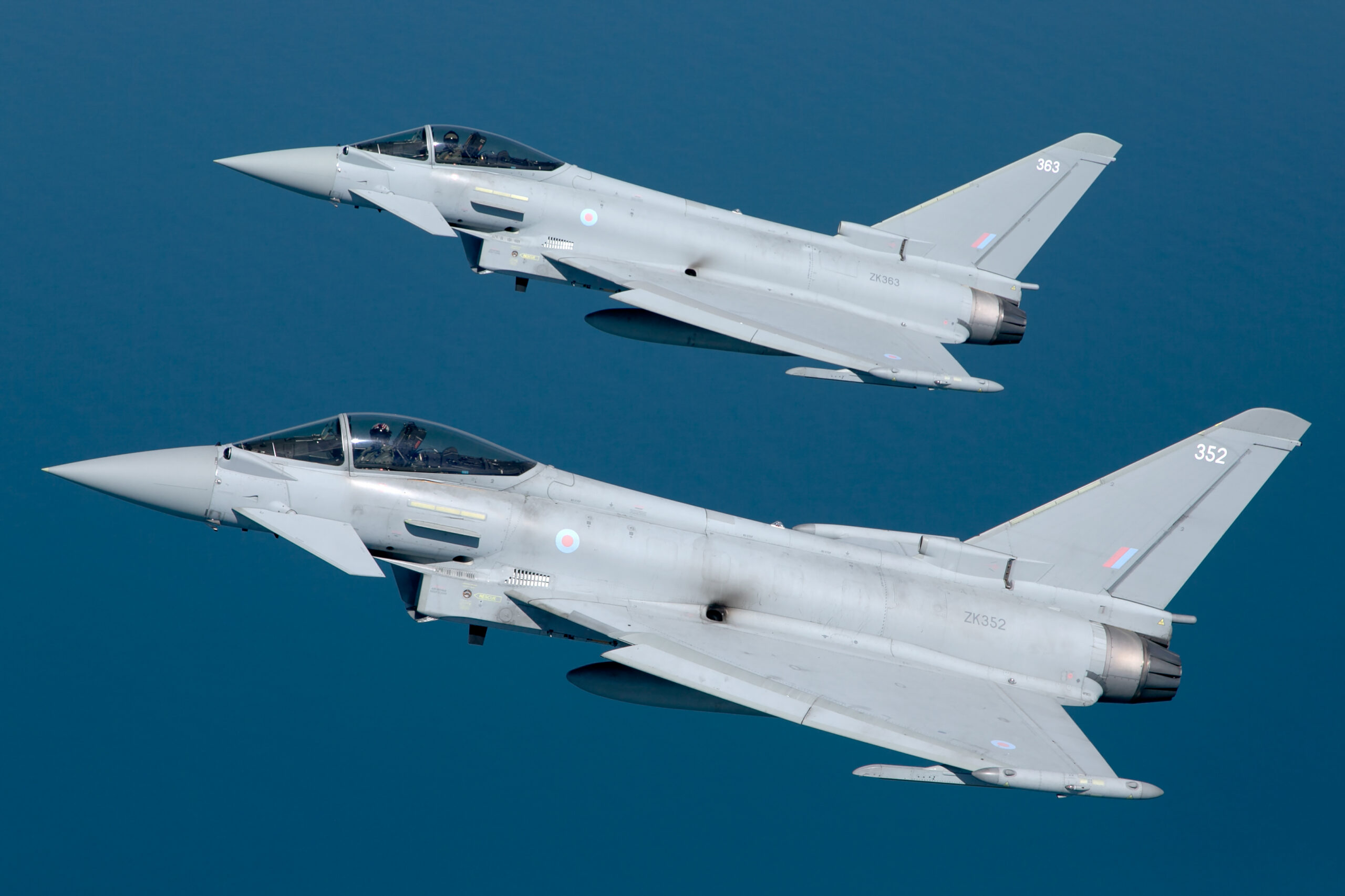
Our air-to-air and low-level work is collected in the galleries on the main site, and is available to license.
The Loop is where the training happens. The stations the aircraft come from are covered in our location guide to RAF Lakenheath and RAF Mildenhall, the first in a series of location guides.
Frequently asked questions
What is the Mach Loop?
The Mach Loop is a series of connected valleys in west-central Wales, between Dolgellau and Machynlleth, used by military aircraft for low level flying training. It sits within Low Flying Area 7, which covers all of Wales, and is one of the few places in the world where photographers on the hillsides can look down on fast jets in flight.
How low do jets fly in the Mach Loop?
Fixed wing military aircraft routinely fly down to 250 feet above ground level in the UK low flying system, which includes the Mach Loop. Flight down to 100 feet is only permitted inside the three Tactical Training Areas at published activation times, and the Welsh TTA lies to the south of the Loop itself.
Is there a schedule for Mach Loop flights?
No. The MOD publishes a timetable on GOV.UK for the three Tactical Training Areas only, and states that it cannot provide a timetable for routine low flying. The TTA timetable is a useful signal of likely activity in Wales, but there are no published pass times for the Loop and quiet days happen.
What is the best viewing location at the Mach Loop?
Cad West is the usual first-visit recommendation because the climb is manageable and aircraft pass roughly level with the photographer, which makes tracking easier. Cad East offers the classic topside banking shot in morning light, the Bwlch gives look-down angles over a long valley run, and Corris Corner suits mornings.
What lens do I need for the Mach Loop?
A 100-400mm zoom on a full frame body is the practical working minimum, and 150-600mm class lenses are common because aircraft pass at unpredictable distances. A second body with a 70-200mm is useful for formation pairs and wider landscape compositions.
What camera settings work best at the Mach Loop?
For sharp jets use 1/1600s, aperture wide open or one third down, auto ISO capped around 6400, and continuous autofocus with a grouped area. Slow the shutter to around 1/250s to 1/320s for the propeller-driven Texan T1, and only attempt slow panned shots once the sharp frames are banked.
What days and times are best for the Mach Loop?
Weekdays only, since military training flying rarely happens at weekends. Mid-morning and early afternoon have historically been the most productive windows, matching squadron morning and afternoon waves, so being on the hill from around 08:30 until 16:00 covers the realistic day.
Is visiting the Mach Loop free?
Yes. The viewing hillsides are open access land and there is no charge to park in the lay-bys or climb the slopes. The costs are effort and patience: a steep 20 to 30 minute climb with your gear and no guarantee of aircraft on any given day.
Is there any guarantee of jets at the Mach Loop?
None whatsoever. The Loop is a training area, not a display, so flying depends on squadron programmes, weather and operational demands. People regularly spend a full day on the hillside and see nothing. Treat any pass as a bonus and check notices and enthusiast reports before travelling.
What lens do you need at the Mach Loop?
Longer than most people expect. The body of this guide sets 400mm on full frame as the working minimum, with 100-400mm and 150-600mm zooms the standard choices, because aircraft pass at unpredictable distances. A second body with a 70-200mm covers formation pairs and the wider valley shots, but it is a companion to the long lens rather than a substitute for it.
Do you need permission to photograph at the Mach Loop?
The hills are open access land in Wales and photography is not restricted, but you are responsible for parking legally, respecting farmland, closing gates and staying safe on steep terrain. There is no permit scheme for the common vantage points, though you should follow any signage and the Countryside Code.
What is the best time of year for the Mach Loop?
Spring and autumn are generally favoured, because the light angle is lower and the weather is often clearer than high summer haze, while squadron training is in full swing. Winter brings short days and difficult conditions underfoot, and summer holiday periods can be quieter for military flying. There is no guaranteed season.
For something at the other end of the spectrum, our Heathrow spotting guide covers the busiest two-runway airport in the world.
If a Typhoon thunders through the Loop, it helps to know the aircraft: our Eurofighter Typhoon history covers the jet from EAP demonstrator to Tranche 5.
